
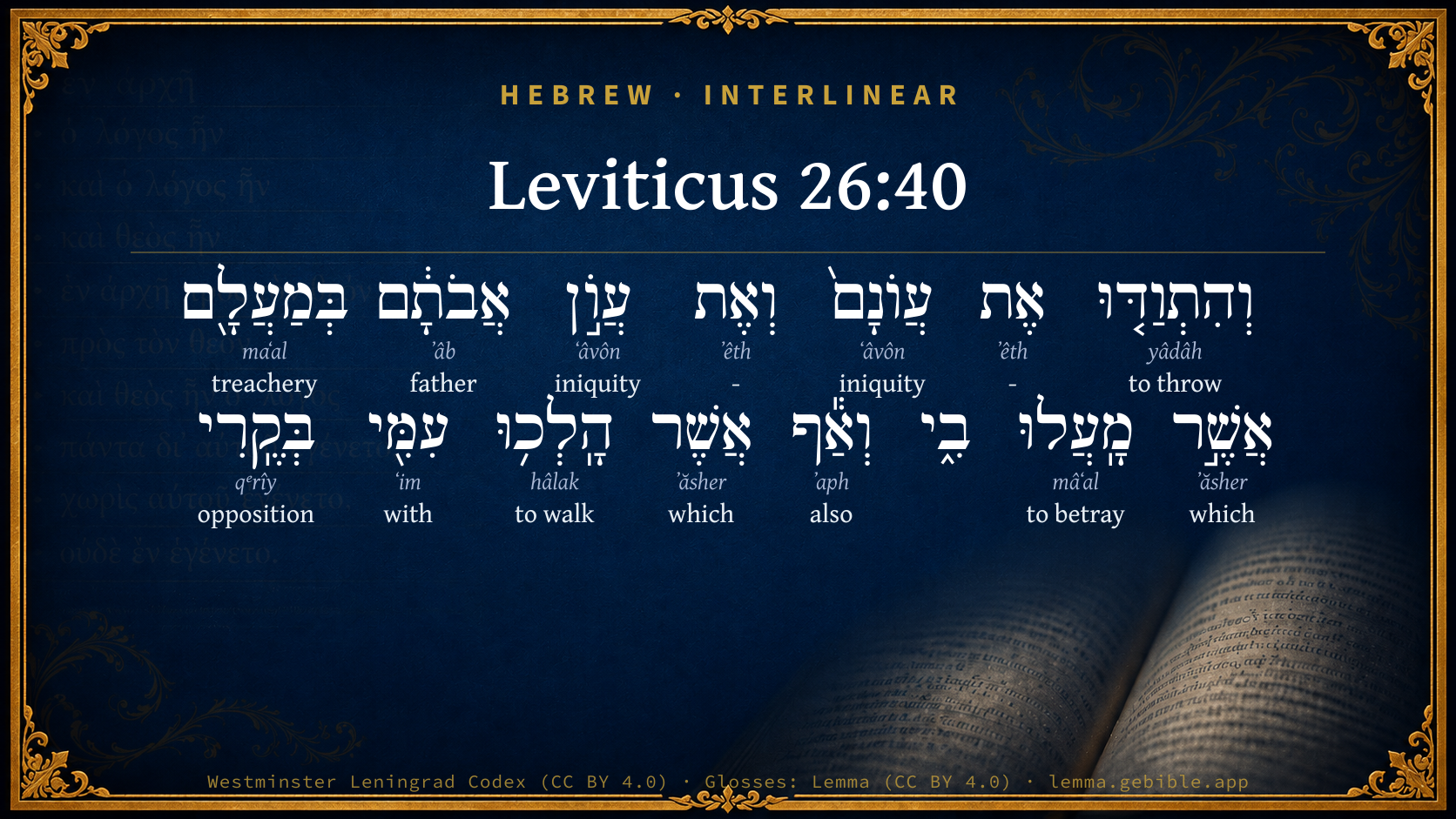
Leviticus 26:40

Hebrew (Westminster Leningrad Codex) Leviticus 26:40 appears in the Hebrew Old Testament. The text above is from the Westminster Leningrad Codex. Each word links to its Strong’s number, a concise gloss, and parsing drawn from the Open Scriptures Hebrew Bible morphology. Click any word for its full Brown-Driver-Briggs (BDB) entry.
Download image
Cite this verse

Leviticus 26:40 (World English Bible). Public Domain. Lemma interlinear Bible study tool, https://lemma.gebible.app/v/leviticus/26/40.

Show BibTeX & RIS
BibTeX
RIS
English Translation
"'If they confess their iniquity, and the iniquity of their fathers, in their trespass which they trespassed against me, and also that, because they walked contrary to me,
World English Bible · Public Domain
Download a study sheet

One document with this verse’s original text, its word-by-word gloss line, the meaning frame, cross-references with their text, attributed commentary, and full source and license credits — printable, and it pastes into notes with its structure intact.

This verse Autodidact and up

Study sheet (.html) Plain text (.txt)

A passage Seminary Student

Up to 50 verses in one chapter. A passage sheet keeps up to 6 commentary sources and 12 cross-references per verse, in the order this page ranks them, and says so on the sheet whenever that leaves anything out. Ask for a single verse and you get the Autodidact verse sheet above.

Everything on this page stays free to read, with no account — the sheet is a download of what is already on screen, not access to it.

Want to remove ads? Support Godless Engineer
Compare translations 3

The same verse in 3 English versions, stacked beneath the original-language interlinear above. Click any original word for its lexicon entry.

Each is an independent rendering of the whole verse — the interlinear is not word-aligned to these translations.

Highlighted words mark where these versions differ — a whole-verse word diff, not a word-by-word alignment.

  • World English Bible Public Domain
    "'If they confess their iniquity, and the iniquity of their fathers, in their trespass which they trespassed against me, and also that, because they walked contrary to me,
  • King James Version Public Domain
    If they shall confess their iniquity, and the iniquity of their fathers, with their trespass which they trespassed against me, and that also they have walked contrary unto me;
  • unfoldingWord Literal Text CC BY-SA 4.0
    And they confess their iniquity and the iniquity of their fathers in their unfaithfulness which they were unfaithful to me, and also that they walked with me in hostility,

unfoldingWord Literal Text — © unfoldingWord, licensed CC BY-SA 4.0. Word-aligned USFM3 via Door43 (git.door43.org/unfoldingWord/en_ult).

Versions to compare (up to 4)

3 of 4 selected

Show all 18 translations

Every available English version of this verse, each an independent rendering of the whole verse.

  • World English Bible Public Domain
    "'If they confess their iniquity, and the iniquity of their fathers, in their trespass which they trespassed against me, and also that, because they walked contrary to me,
  • Berean Standard Bible Public Domain
    But if they will confess their iniquity and that of their fathers in the unfaithfulness that they practiced against Me, by which they have also walked in hostility toward Me—
  • Majority Standard Bible Public Domain
    But if they will confess their iniquity and that of their fathers in the unfaithfulness that they practiced against Me, by which they have also walked in hostility toward Me—
  • King James Version Public Domain
    If they shall confess their iniquity, and the iniquity of their fathers, with their trespass which they trespassed against me, and that also they have walked contrary unto me;
  • American Standard Version (1901) Public Domain
    And they shall confess their iniquity, and the iniquity of their fathers, in their trespass which they trespassed against me, and also that, because they walked contrary unto me,
  • Revised Version (1885) Public Domain
    And they shall confess their iniquity, and the iniquity of their fathers, in their trespass which they trespassed against me, and also that because they have walked contrary unto me,
  • Geneva Bible (1599) Public Domain
    Then they shall confesse their iniquitie, and the wickednes of their fathers for their trespasse, which they haue trespassed against mee, and also because they haue walked stubburnly against me.
  • Douay-Rheims (1899) Public Domain
    Until they confess their iniquities and the iniquities of their ancestors, whereby they have transgressed me, and walked contrary unto me.
  • Young's Literal Translation Public Domain
    `And -- they have confessed their iniquity, and the iniquity of their fathers, in their trespass which they have trespassed against Me, and also, that they have walked with Me, in opposition,
  • Literal Standard Version CC BY-SA 4.0
    And [if] they have confessed their iniquity and the iniquity of their fathers, in their trespass which they have trespassed against Me, and also that they have walked with Me in opposition,
  • Unlocked Literal Bible CC BY-SA 4.0
    Yet if they confess their sins and their fathers' sin, and their treason by which they were unfaithful to me, and also their walking against me—
  • unfoldingWord Literal Text CC BY-SA 4.0
    And they confess their iniquity and the iniquity of their fathers in their unfaithfulness which they were unfaithful to me, and also that they walked with me in hostility,
  • Darby Bible Public Domain
    And they shall confess their iniquity, and the iniquity of their fathers, through their unfaithfulness wherein they were unfaithful to me, and also that they have walked contrary unto me,
  • World Messianic Bible Public Domain
    “‘If they confess their iniquity and the iniquity of their fathers, in their trespass which they trespassed against me; and also that because they walked contrary to me,
  • Webster's Bible Public Domain
    If they shall confess their iniquity, and the iniquity of their fathers, with their trespass which they trespassed against me, and that also they have walked contrary to me;
  • Free Bible Version CC BY-SA 4.0
    They need to confess their sins and those of their fathers, acting in such an unfaithful way towards me, opposing me.
  • Bible in Basic English Public Domain
    And they will have grief for their sins and for the sins of their fathers, when their hearts were untrue to me, and they went against me;
  • JPS Tanakh (1917) Public Domain
    And they shall confess their iniquity, and the iniquity of their fathers, in their treachery which they committed against Me, and also that they have walked contrary unto Me.

Literal Standard Version (2020), Covenant Press — licensed CC BY-SA 4.0. Text via the HelloAO Bible API (eBible.org). Unlocked Literal Bible (unfoldingWord) — licensed CC BY-SA 4.0. Text via the HelloAO Bible API (eBible.org). unfoldingWord Literal Text — © unfoldingWord, licensed CC BY-SA 4.0. Word-aligned USFM3 via Door43 (git.door43.org/unfoldingWord/en_ult). Free Bible Version, Dr. Jonathan Gallagher — licensed CC BY-SA 4.0. Text via the HelloAO Bible API (eBible.org).

Word by word

More ways to search: Search by grammar → Find every occurrence → Compare this word →

Practice this passage: Drill this verse → Learn its vocabulary →

בְּקֶֽרִי
qᵉrîy
H7147
“in/at · opposition”
Preposition + Noun, Common, Masculine, Singular, Absolute
Part of Speech
Preposition + Noun
Type
Common
Gender
Masculine
Number
Singular
State
Absolute
Full BDB Definition

Origin: from H7136

TWOT: 2068b

opposition, contrariness, encounter, contrary or hostile encounter
  1. וְהִתְוַדּ֤וּ yâdâh H3034 “and · to throw” Conjunction + Verb, Hithpael, Sequential Perfect, 3rd Person, Common, Plural
  2. אֶת ʼêth H853 “-” Particle, Direct Object
  3. עֲוֺנָם֙ ʻâvôn H5771 “iniquity · their” Noun, Common, Both, Singular, Construct + Suffix, Personal, 3rd Person, Masculine, Plural
  4. וְאֶת ʼêth H853 “and · -” Conjunction + Particle, Direct Object
  5. עֲוֺ֣ן ʻâvôn H5771 “iniquity of” Noun, Common, Both, Singular, Construct
  6. אֲבֹתָ֔ם ʼâb H1 “fathers · their” Noun, Common, Masculine, Plural, Construct + Suffix, Personal, 3rd Person, Masculine, Plural
  7. בְּמַעֲלָ֖ם maʻal H4604 “in/at · treachery · their” Preposition + Noun, Common, Masculine, Singular, Construct + Suffix, Personal, 3rd Person, Masculine, Plural
  8. אֲשֶׁ֣ר ʼăsher H834 “which” Particle, Relative
  9. מָֽעֲלוּ mâʻal H4603 “to betray” Verb, Qal, Perfect, 3rd Person, Common, Plural
  10. וְאַ֕ף ʼaph H637 “and · also” Conjunction + Adverb
  11. אֲשֶׁר ʼăsher H834 “which” Particle, Relative
  12. הָֽלְכ֥וּ hâlak H1980 “to walk” Verb, Qal, Perfect, 3rd Person, Common, Plural
  13. עִמִּ֖י ʻim H5973 “with · me” Preposition + Suffix, Personal, 1st Person, Common, Singular

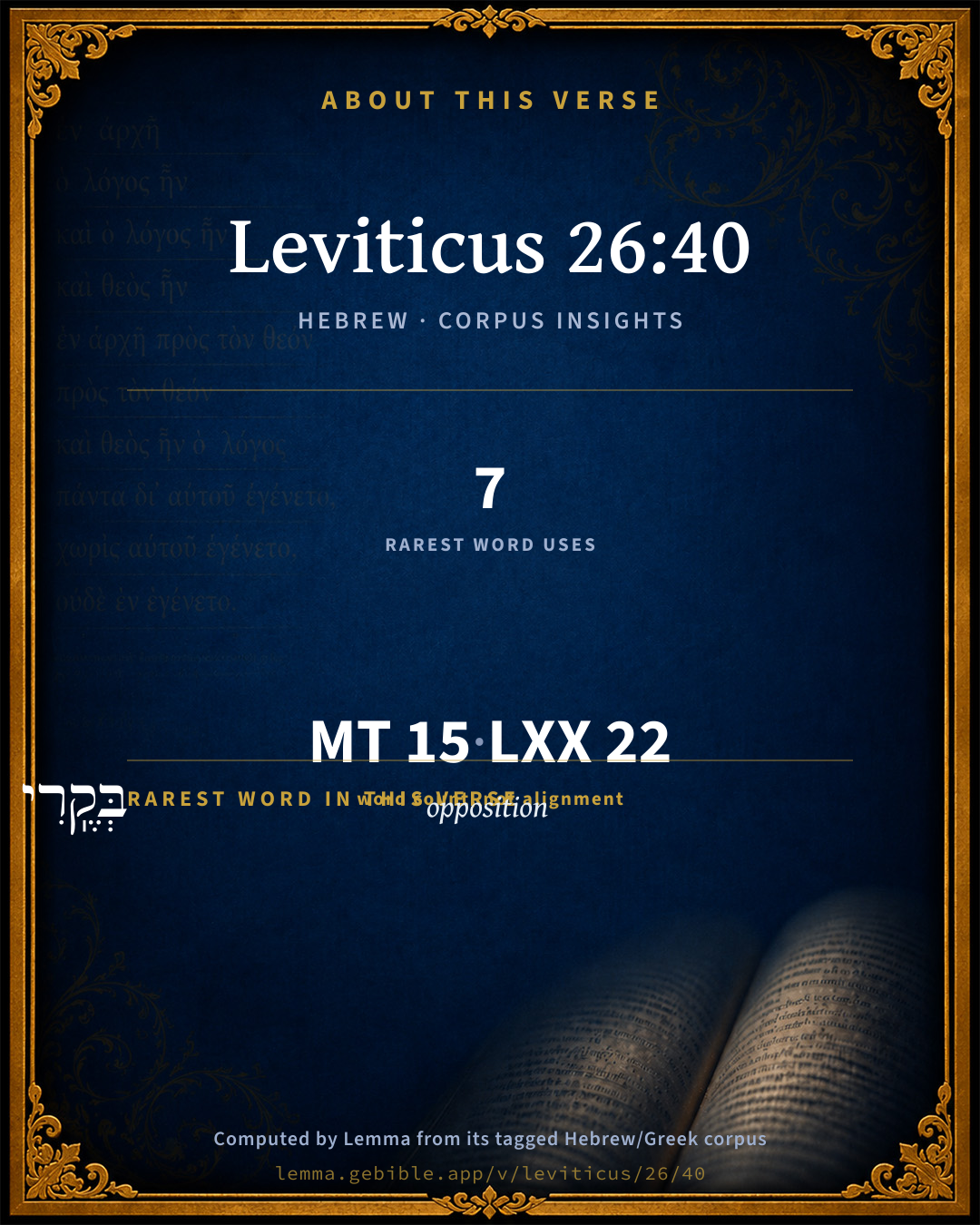
About this verse

These counts appear in no published source. They are computed here, from the morphology-tagged text and Lemma’s own curated glosses. What Lemma adds →

15
words
11
distinct lemmas
Pentateuch
section

Notable vocabulary

The rarest word here is בְּקֶֽרִי opposition H7147 — appearing just 7 times in the whole Hebrew Bible.

Shared distinctive vocabulary

בְּקֶֽרִי opposition H7147 occurs in 7 verses of the Hebrew Bible. Also found in:

Grammatical profile

  • 3 verbs
  • 5 nouns
  • 2 prepositions
  • 1 adverb
  • 4 particles

Verb forms

  • וְהִתְוַדּ֤וּ Hithpael · Sequential Perfect
  • מָֽעֲלוּ Qal · Perfect
  • הָֽלְכ֥וּ Qal · Perfect

Repetition

Words recur within this verse — often emphatic in Hebrew:

  • עֲוֺנָם֙ iniquity H5771 ×2
  • אֲשֶׁ֣ר which H834 ×2

Hebrew & Septuagint length

In English translation the verse runs 28 words from the Hebrew and 27 from the Septuagint (LXX English) — closely comparable.

A rough comparison of the two English renderings, which tokenize alike — not a word-level alignment.

Word counts can differ between the Hebrew and the Greek without any difference in meaning — e.g. the Hebrew direct-object marker אֵת has no separate Greek word, and Greek often adds the article ὁ.

In the original languages it is 15 Hebrew tokens and 22 Greek tokens — but the two are counted differently (Hebrew bundles its prefixes and suffixes into one token; the Greek is in lemma form), so that isn’t a like-for-like length.

Cross-references

20

Topical passages linked to Leviticus 26:40 in the Treasury of Scripture Knowledge — connected by theme and wording, ordered by reader-vote popularity; previews shown in the World English Bible.

  • Proverbs 28:13 He who conceals his sins doesn't prosper, But whoever confesses and renounces them finds mercy.
  • Nehemiah 9:2–5 The seed of Israel separated themselves from all foreigners, and stood and confessed their sins, and the iniquities of their fathers.
  • 1 John 1:8–10 If we say that we have no sin, we deceive ourselves, and the truth is not in us.
  • Hosea 5:15–6:2 I will go and return to my place, until they acknowledge their offense, And seek my face. In their affliction they will seek me earnestly."
  • Numbers 5:7 then he shall confess his sin which he has done, and he shall make restitution for his guilt in full, and add to it the fifth part of it, and give it to him in respect of whom he has been guilty.
  • Deuteronomy 30:1–3 It shall happen, when all these things are come on you, the blessing and the curse, which I have set before you, and you shall call them to mind among all the nations, where Yahweh your God has driven you,
  • 1 Kings 8:33–36 When your people Israel are struck down before the enemy, because they have sinned against you; if they turn again to you, and confess your name, and pray and make supplication to you in this house:
  • Leviticus 26:21 "'If you walk contrary to me, and won't listen to me, then I will bring seven times more plagues on you according to your sins.
  • Leviticus 26:24 then I will also walk contrary to you; and I will strike you, even I, seven times for your sins.
  • Leviticus 26:27–28 "'If you in spite of this won't listen to me, but walk contrary to me;
  • Deuteronomy 4:29–31 But from there you shall seek Yahweh your God, and you shall find him, when you search after him with all your heart and with all your soul.
  • Joshua 7:19 Joshua said to Achan, My son, please give glory to Yahweh, the God of Israel, and make confession to him; and tell me now what you have done; don't hide it from me.
  • 1 Kings 8:47 yet if they shall repent themselves in the land where they are carried captive, and turn again, and make supplication to you in the land of those who carried them captive, saying, We have sinned, and have done perversely, we have dealt wickedly;
  • Job 33:27–28 He sings before men, and says, 'I have sinned, and perverted that which was right, And it didn't profit me.
  • Psalms 32:5 I acknowledged my sin to you. I didn't hide my iniquity. I said, I will confess my transgressions to Yahweh, And you forgave the iniquity of my sin. Selah.
  • Jeremiah 31:18–20 I have surely heard Ephraim bemoaning himself [thus], You have chastised me, and I was chastised, as a calf unaccustomed [to the yoke]: turn you me, and I shall be turned; for you are Yahweh my God.
  • Ezekiel 36:31 Then shall you remember your evil ways, and your doings that were not good; and you shall loathe yourselves in your own sight for your iniquities and for your abominations.
  • Jeremiah 3:12–15 Go, and proclaim these words toward the north, and say, Return, you backsliding Israel, says Yahweh; I will not look in anger on you; for I am merciful, says Yahweh, I will not keep [anger] forever.
  • Daniel 9:3–20 I set my face to the Lord God, to seek by prayer and petitions, with fasting and sackcloth and ashes.
  • Luke 15:18–19 I will get up and go to my father, and will tell him, "Father, I have sinned against heaven, and in your sight.

Cross-references courtesy of OpenBible.info (CC BY 4.0).

Hebrew and Greek witnesses Masoretic Hebrew ↔ Greek Septuagint

The same verse in the two great witnesses to the Old Testament, shown verse-for-verse.

These are two independent witnesses, not word-aligned to each other, and the Septuagint is shown in lemma (dictionary) form.

Hebrew Leviticus 26:40 Masoretic · Westminster Leningrad Codex

וְהִתְוַדּ֤וּ אֶת עֲוֺנָם֙ וְאֶת עֲוֺ֣ן אֲבֹתָ֔ם בְּמַעֲלָ֖ם אֲשֶׁ֣ר מָֽעֲלוּ בִ֑י וְאַ֕ף אֲשֶׁר הָֽלְכ֥וּ עִמִּ֖י בְּקֶֽרִי

"'If they confess their iniquity, and the iniquity of their fathers, in their trespass which they trespassed against me, and also that, because they walked contrary to me,

World English Bible · Public Domain

Greek LXX Leviticus 26:40 Septuagint · lemma form

καί ἐκἀγορεύω ὁ ἁμαρτία αὐτός καί ὁ ἁμαρτία ὁ πατήρ αὐτός ὅτι παραβαίνω καί ὑπερὁράω ἐγώ καί ὅτι πορεύομαι ἐναντίον ἐγώ πλάγιος

And they shall confess their sins, and the sins of their fathers, that they have transgressed and neglected me, and that they have walked perversely before me,

LXX2012 (modern English Septuagint) · Public Domain

On this verse, Keil & Delitzsch discusses the Septuagint’s reading. Read the note in Commentary ↓

Hebrew: Westminster Leningrad Codex (CC BY 4.0). Greek: Septuagint (public domain); English from LXX2012 (modern English Septuagint) (Public Domain). How the Septuagint differs from the Hebrew →

Targum (Aramaic paraphrase)

2

The Targum is the ancient Jewish Aramaic paraphrase of the Hebrew Scriptures — an interpretive translation, not the Hebrew text itself. Onkelos (literal) and Pseudo-Jonathan (expansive) render the Torah, and Jonathan the Prophets. Coverage is partial: where no permissively-licensed English translation exists for a verse, only the Aramaic is shown. This is verse-level text, not a word-by-word alignment to the Hebrew.

  1. Targum Onkelos Torah (Genesis–Deuteronomy)
    וִיוַדוּן יָת חוֹבֵיהוֹן וְיָת חוֹבֵי אֲבָהַתְהוֹן בְּשִׁקְרְהוֹן דְשַׁקָרוּ קֳדָמַי וְאַף דִי הַלִיכוּ קֳדָמַי בְּקַשְׁיוּ

    (no public-domain English translation for this verse)

    Targum Onkelos — Aramaic: “Onkelos Genesis” (public domain); “Onkelos Exodus” (public domain); “Onkelos Leviticus” (public domain); “Onkelos Numbers” (public domain); “Onkelos Deuteronomy” (public domain). English: “Sefaria Community Translation” (CC0 1.0 (public-domain dedication)); “J.W. Etheridge. The Targums of Onkelos and Jonathan Ben Uzziel on the Pentateuch. London: Longmans, Green, 1862” (public domain). Text via Sefaria.

  2. Targum Pseudo-Jonathan Torah (Genesis–Deuteronomy)
    וִיוַדוּן בְּשַׁעַת אַנִיקְהוֹן יַת חוֹבֵיהוֹן וְיַת חוֹבֵי אַבְהַתְהוֹן בְּשִׁקְרֵיהוֹן דְשַׁקְרוּ בְּמֵימְרִי וְאוּף דְהַלִיכוּ עִמִי בְּעַרְאַי

    But (when) in the hour of their need they shall confess their sins, and the sins of their fathers, with their falseness with which they have acted falsely against My Word; and that they have acted frowardly also with Me,

    Targum Pseudo-Jonathan — Aramaic: “Targum Jonathan on Genesis” (public domain); “Targum Jonathan on Exodus” (public domain); “Targum Jonathan on Leviticus” (public domain); “Targum Jonathan on Numbers” (public domain); “Targum Jonathan on Deuteronomy” (public domain). English: “The Targum of Jonathan ben Uzziel, trans. J. W. Etheridge, London, 1862” (public domain). Text via Sefaria.

Commentary

Notes on Leviticus 26:40 from classic Christian and Jewish commentators (each source and its license shown beneath its notes). The classic Christian expositions comment on the surrounding passage and are grouped to its opening verse, so a note may address several verses; the Jewish commentaries on the Tanakh (Rashi and others) are per-verse, so they appear only where the commentator wrote on this verse.

Lemma curates 59 commentaries, every one of them public domain or Creative Commons licensed, each selected and text-cleaned for this edition rather than reprinted as found. About our sources →

Matthew Henry's Commentary

Here the chapter concludes with gracious promises of the return of God's favour to them upon their repentance, that they might not (unless it were their own fault) pine away in their iniquity. Behold, with wonder, the riches of God's mercy to a people that had obstinately stood it out against the judgments of God, and would never think of surrendering till they were reduced to the last extremity. Yet turn to strong-hold, you prisoners of hope, Zac 9:12. As bad as things are, they may be mended. Yet there is hope in Israel. Observe,

I. How the repentance which would qualify them for this mercy is described, Lev 26:40, Lev 26:41. The instances of it are three: - 1. Confession, by which they must give glory to God, and take shame to themselves. There must be a confession of sin, their own and their fathers', which they must lament the guilt of because they feel the smart of it; that thus they may cut off the entail of wrath. They must in their confession put sin under its worst character, as walking contrary to God; this is the sinfulness of sin, the worst thing in it, and which in our repentance we should especially bewail. There must also be a confession of wrath; they must overlook the instruments of their trouble and the second causes, and confess that God has walked contrary to them, and so dealt with them according to their sins. Such a confession as this we find made by Daniel just before the dawning of the day of their deliverance (ch. 9), and the like, Ezr 9:1-15 and Neh 9:2. Remorse and godly sorrow for sin: If their uncircumcised heart be humbled. An impenitent, unbelieving, unhumbled heart, is called an uncircumcised heart, the heart of a Gentile that is a stranger to God, rather than the heart of an Israelite in covenant with him. True circumcision is of the heart (Rom 2:29), without which the circumcision of the flesh avails nothing, Jer 9:26. Now in repentance this uncircumcised heart was humbled, that is, it was truly broken and contrite for sin. Note, A humble heart under humbling providences prepares for deliverance and true comfort. 3. Submission to the justice of God in all his dealings; if they then accept of the punishment of their iniquity (Lev 26:41 and again Lev 26:43), that is, if they justify God and condemn themselves, patiently bear the punishment as that which they have well deserved, and carefully answer the ends o it as that which God has well designed, accept it as a kindness, take it as physic, and improve it, then they are penitents indeed.

II. How the mercy which they should obtain upon their repentance is described. 1. They should not be abandoned: Though they have despised my judgments, yet, for all that, I will not cast them away, Lev 26:43, Lev 26:44. He speaks as a tender Father that cannot find in his heart to disinherit a son that has been very provoking. How shall I do it? Hos 11:8, Hos 11:9. Till he had laid the foundations of a church for himself in the Gentile world, the Jewish church was not quite forsaken, nor cast away. 2. They should be remembered: I will remember the land with favour, which is grounded upon the promise before, I will remember my covenant (Lev 26:42), which is repeated, Lev 26:45. God is said to remember the covenant when he performs the promises of it, purely for his faithfulness' sake; not because there is any thing in us to recommend us to his favour, but because he will be as good as his word. This is the church's plea. Psa 74:20, Have respect unto the covenant. He will remember the constitution of the covenant, which is such as leaves room for repentance, and promises pardon upon repentance; and the Mediator of the covenant, who was promised to Abraham, Isaac, and Jacob, and was sent, when the fulness of time came, in remembrance of that holy covenant. The word covenant is thrice repeated, to intimate that God is ever mindful of it and would have us to be so. The persons also with whom the covenant was made are mentioned in an unusual manner, per modum ascensus - in the ascending line, beginning with Jacob, to lead them gradually to the most ancient promise, which was made to the father of the faithful: thus (Mic 7:20) he is said to perform the truth to Jacob, and the mercy to Abraham. He will for their sakes (Lev 26:45), not their merit's sake, but their benefit's sake, remember the covenant of their ancestors, and upon that score show kindness to them, though most unworthy; they are therefore said to be, as touching the election, beloved for the fathers' sake, Rom 11:28. Note, When those that have walked contrary to God in a way of sin return to him by sincere repentance, though he has walked contrary to them in a way of judgment he will return to them in a way of special mercy, pursuant to the covenant of redemption and grace. None are so ready to repent as God is to forgive upon repentance, through Christ, who is given for a covenant.

Lastly, These are said to be the laws which the Lord made between him and the children of Israel, Lev 26:46. His communion with his church is kept up by his law. He manifests not only his dominion over them, but his favour to them, by giving them his law; and they manifest not only their holy fear, but their holy love, by the observance of it; and thus it is made between them, rather as a covenant than a law; for he draws with the cords of a man.

Matthew Henry's Commentary on the Whole Bible (1708–1710) — public domain (CC PDM 1.0). Text via the HelloAO Bible API.

Trapp's Complete Commentary

John Trapp

Lev 26:40 If they shall confess their iniquity, and the iniquity of their fathers, with their trespass which they trespassed against me, and that also they have walked contrary unto me;

Ver. 40. A special text touching the rejection and conversion of the Jews.

John Trapp, A Commentary or Exposition upon All the Books of the Old and New Testament (1647–1656) — public domain. Text from a community e-Sword module.

Matthew Poole's English Annotations

If they shall confess, Heb. And they shall confess, where our translation and many others understand the particle if, which is also wanting and understood, Exo 4:23; Mal 1:2; 3:8. So here, And if they shall confess, &c.

But there seems no necessity of any such supplement, but these and the following words may be taken as they lie in their plain and proper signification, to this purpose, Lev 26:40, And through the heaviness and extraordinariness of their affliction, their consciences will force them to confess their iniquity, and the iniquity of their fathers, with their trespass which they have trespassed against me, i.e. with their prevarication with me and defection from me to idolatry, which by way of eminency he calls their trespass;

and that also they have walked contrary to me, Lev 26:41, and that I also have walked contrary unto them, and have brought them into the land of their enemies; i.e. that they are not come into these calamities by chance, nor by the misfortune of war, but by my just judgment upon them. All which confession is no more than Pharaoh made in his distresses, and than hypocrites in their affliction use to make. And therefore he adds, if then their uncircumcised, i.e. impure, carnal, profane, and impenitent hearts be humbled, i.e. subdued, purged, reformed; if to this confession they add sincere humiliation and reformation, I will do what follows.

Matthew Poole's English Annotations on the Holy Bible (1683–1685) — public domain. Text from a community e-Sword/MySword module.

Whedon's Commentary on the Bible

Daniel D. Whedon

MERCY AFTER JUDGMENTS — ISRAEL NOT UTTERLY DESTROYED, Lev_26:40-46.

40. If they shall confess — Confession implies conviction of sin and sincere repentance. David said, “I will confess my transgressions unto the Lord; and thou forgavest the iniquity of my sin.”

And the iniquity of their fathers — So far as they had endorsed the iniquity of their fathers, by approving and imitating it, they were in a modified sense guilty. Thus must we reprint not only of our actual sins but abhor their source, the poison stung into our nature by the transgression of our first parents. By so doing we obtain, through faith in Jesus Christ, not only justification from our personal sins, but the still greater blessing of entire sanctification from that corrupt state of heart which is technically called sin.

Daniel D. Whedon (gen. ed.), Commentary on the Old and New Testaments (1874–1909) — public domain. Text from a community e-Sword module.

Keil & Delitzsch

C. F. Keil & F. Delitzsch

In this state of pining away under their enemies, they would confess to themselves their own and their fathers' sins, i.e., would make the discovery that their sufferings were a punishment from God for their sins, and acknowledge that they were suffering what they had deserved, through their unfaithfulness to their God and rebellion against Him, for which He had been obliged to set Himself in hostility to them, and bring them into the land of their enemies; or rather their uncircumcised hearts would then humble themselves, and they would look with satisfaction upon this fruit of their sin. The construction is the following: וזכרתּי (Lev 26:42) corresponds to התודּוּ (Lev 26:40) as the apodosis; so that, according to the more strictly logical connection, which is customary in our language, we may unite Lev 26:40, Lev 26:41 in one period with Lev 26:42. "If they shall confess their iniquity...or rather their uncircumcised heart shall humble itself...I will remember My covenant." With בּמעלם a parenthetical clause is introduced into the main sentence explanatory of the iniquity, and reaches as far as "into the land of their enemies." With יכּנע או־אז, "or if, etc.," the main sentence is resumed. או, "or rather" (as in Sa1 29:3), bringing out the humiliation of the heart as the most important result to which the confession of sin ought to deepen itself. The heart is called "uncircumcised" as being unsanctified, and not susceptible to the manifestations of divine grace. את־עונם ירצוּ וץ̓הןךח́ףןץףי פב̀ע ב̓לבספי́בע בץ̓פש͂ם (lxx), they will take pleasure, rejoice in their misdeeds, i.e., in the consequences and results of them-that their misdeed have so deeply humbled them, and brought them to the knowledge of the corruption into which they have fallen: a bold and, so to speak, paradoxical expression for their complete change of heart, which we may render thus: "they will enjoy their misdeeds," as רצה may be rendered in the same way in Lev 26:43 also.

(Note: Luther has translated עון in this sense, "punishment of iniquity," and observes in the marginal notes, - "(Pleasure), i.e., just as they had pleasure in their sins and felt disgust at My laws, so they would now take pleasure in their punishment and say, 'We have just what we deserve. This is what we have to thank our cursed sin for. It is just, O God, quite just.' And these are thoughts and words of earnest repentance, hating itself from the bottom of the heart, and crying out, Shame upon me, what have I done? This pleases God, so that He becomes gracious once more.")

But where punishment bears such fruit, God looks upon the sinner with favour again. When Israel had gone so far, He would remember His covenant with the fathers ("My covenant with Jacob," יעקב בּריתי: the suffix is attached to the governing noun, as in Lev 6:3, because the noun governed, being a proper name, could not take the suffix), and remember the land (including its inhabitants), which, as is repeated again in Lev 26:43, would be left by them (become desolate) and enjoy its Sabbaths whilst it was waste (depopulated) from (i.e., away from, without) them; and they would enjoy their iniquity, because they had despised the judgments of the Lord, and their soul had rejected His statues.

Keil & Delitzsch — Biblical Commentary on the Old Testament (1861–1891) — public domain (CC PDM 1.0). Text via the HelloAO Bible API. (Old Testament only.)

The Expositor's Bible

THE PROMISED RESTORATION

Lev_26:40-45

"And they shall confess their iniquity, and the iniquity of their fathers, in their trespass which they trespassed against Me, and also that because they have walked contrary unto Me, I also walked contrary unto them, and brought them into the land of their enemies: if then their uncircumcised heart be humbled, and they then accept of the punishment of their iniquity; then will I remember My covenant with Jacob; and also My covenant with Isaac, and also My covenant with Abraham will I remember; and I will remember the land. The land also shall be left of them, and shall enjoy her sabbaths, while she lieth desolate without them; and they shall accept of the punishment of their iniquity: because, even because they rejected My judgments, and their soul abhorred My statutes. And yet for all that, when they be in the land of their enemies, I will not reject them, neither will I abhor them, to destroy them utterly. and to break My covenant with them: for I am the Lord their God: but I will for their sakes remember the covenant of their ancestors, whom I brought forth out of the land of Egypt in the sight of the nations, that I might be their God: I am the Lord."

This closing section of this extraordinary chapter yet remains to be considered. It is the most remarkable of all, whether from a historical or a religious point of view. It declares that even under so extreme visitations of Divine wrath, and howsoever long Israels stubborn rebellion and impenitence should continue, yet the nation should never become extinct and pass away. Very impressive are the words (Lev_26:43-45) which emphasise this prediction: "The land also shall be left of them, and shall enjoy her sabbaths, while she lieth desolate without them; and they shall accept of the punishment of their iniquity: because, even because they rejected My judgments, and their soul abhorred My statutes. And yet for all that, when they be in the land of their enemies, I will not reject them, neither will I abhor them, to destroy them utterly, and to break My covenant with them: for I am the Lord their God: but I will for their sakes remember the covenant of their ancestors, whom I brought forth out of the land of Egypt in the sight of the nations, that I might be their God: I am the Lord."

As to what is included in this promise of everlasting covenant mercy, we are told explicitly (Lev_26:40) that as the final result of these repeated and long-continued judgments, the children of Israel "shall confess their iniquity, and the iniquity of their fathers, in their trespass which they trespassed" against the Lord. Also they will acknowledge (Lev_26:41) that all these calamities have been sent upon them by the Lord; that it is because they have walked contrary unto Him that He has also walked contrary unto them, and brought them into the land of their enemies. And then follows the great promise (Lev_26:41-42): "If then their uncircumcised heart be humbled, and they then accept of the punishment of their iniquity; then will I remember My covenant with Jacob; and also My covenant with Isaac, and also My covenant with Abraham will I remember; and I will remember the land."

These words are very full and explicit. That they have had already a partial and inadequate fulfilment in the restoration from Babylon, and the spiritual quickening by which it was accompanied, is not to be denied. But one only needs to refer to the covenants to which reference is made, and especially the covenant with Abraham, as recorded in the book of Genesis, to see that by no possibility can that Babylonian reatoration be said to have exhausted this prophecy. Since those earlier days Israel has again forsaken the Lord, and committed the greatest of all their national sins in the rejection and crucifixion of the promised Messiah; and therefore, again, according to the threat of the earlier part of this chapter, they have been cast out of their land and scattered among the nations, and the land, again, for centuries has been left a desolation. But for all this, Gods covenant with Israel has not lapsed, nor, as we are here formally assured, can it ever lapse. To imagine, with some, that because of the new dispensation of grace to the Gentiles which has come in, therefore the promises of this covenant have become void, is a mistake which is fatal to all right understanding of the prophetic word. As for the spiritual blessing of true repentance and a national turning unto God, Zechariah, after the Babylonian captivity, represents the prediction as yet to have a larger and far more blessed fulfilment, in a day which, beyond all controversy, has never yet risen on the world. For it is written: {Zec_12:8-14, Zec_13:1} "In that day I will pour upon the house of David, and upon the inhabitants of Jerusalem, the spirit of grace and of supplication; and they shall look unto Me whom they have pierced: and they shall mourn for Him, as one mourneth for his only son, and shall be in bitterness for Him, as one that is in bitterness for his firstborn; all the families that remain, every family apart, and their wives apart. In that day there shall be a fountain opened to the house of David and to the inhabitants of Jerusalem, for sin and for uncleanness." And that this great promise, which implies by its very terms the previous "piercing" of the Messiah, is still valid for the nation in the new dispensation, is expressly testified by the Apostle Paul, who formally teaches, with regard to Israel, that "God did not cast off His people which He foreknew"; that "the gifts and calling of God are without repentance"; and that therefore the days are surely coming when "all Israel shall be saved". {Rom_11:2; Rom_11:29; Rom_11:26}

And while nothing is said in this chapter of Leviticus as to the relation of this future repentance of Israel to the establishment of the kingdom of God, we only speak according to the express teaching both of the later prophets and of the apostles, when we add that we are not to think of this covenant of God concerning Israel as of little consequence to our faith and hope as Christians. For we are plainly taught, with regard to the present exclusion and impenitence of Israel, {Rom_11:15} that "the receiving of them" again shall be as "life from the dead"; which, again, is only what long before had been declared in the Old Testament; {Psa_102:13-16} that when God shall arise and have mercy upon Zion, and the set time to have pity upon her shall come, the nations shall fear the name of the Lord, and all the kings of the earth His glory.

And while we may grant that the matter is in itself of less moment, it is yet of importance to observe that the very covenant which promises spiritual mercy to the people, as explicitly assures us (ver. 42) that, when Israel confesses its sin, God "will remember the land" as well as the people. All that has been said for the present and unchangeable validity of the former part of this promise, is of necessity true for this latter part also. To affirm the former, and on that ground maintain the faith and expectation of the future repentance of Israel, and yet deny the latter part of this promise, which is no less verbally explicit, regarding the land of Israel, is an inconsistency of interpretation which is as astonishing as it is common. For the restoration of the scattered nation to their land is repeatedly promised, as here, in connection with, and yet in clear distinction from, their conversion, by both the pre- and post-exilian prophets. And if, for reasons not hard to discover, the promise concerning the land is not in so many words repeated in the New Testament. its future fulfilment is yet, to say the least, distinctly assumed in the prediction of Christ, {Luk_21:24} that Israel, because of their rejection of Him, should be "led captive into all the nations, and Jerusalem be trodden down of the Gentiles,"-not forever, but only-"until the times of the Gentiles be fulfilled." Surely these words of our Lord imply that, whenever these "times of the Gentiles" shall have run their course, their present domination over the Holy City and the Holy Land shall end.

Nor is such a restoration of Israel to their land, with all that it implies, inconsistent, as some have urged, with the spirit and principles of the Gospel. Many a Gentile nation is greatly favoured of the Lord, and, as one mark of that favour, is permitted to abide in peace and prosperity in their own land. Why should it be any more alien to the spirit of the Gospel that penitent Israel should be blessed in like manner, and, upon their turning unto the Lord, also, like many other nations, be permitted to dwell in peace and safety in that land which lies almost empty and desolate for them until this day? And if it be urged that, admitting this interpretation, we shall also be obliged to admit that Israel is in the future to be exalted to a position of preeminence among the nations, which, again, is inconsistent, it is said, with the principles of the Gospel dispensation, we must again deny this last assertion, and for a similar reason. If not inconsistent with the Gospel that the British nation, for example, should today hold a position of exceptional eminence and world wide influence among the nations, how can it be inconsistent with the Gospel that Israel, when repentant before God, should be in like manner exalted of Him to national eminence and glory?

While in itself this question may be of little consequence, yet in another aspect it is of no small moment that we steadfastly affirm the permanent validity of this part of the promise of the covenant with Israel as given in this chapter. For it is not too much to say that the logic and the exegesis which make the promise to have become void with regard to Israels land, if accepted, would equally justify one in affirming the abrogation of the promise of Israels final repentance, if the exigencies of any eschatological theory should seem to require it. Either both parts of this promise in Lev_26:42 are still valid, or neither is now valid; and if either is still in force, the other is in force also. These two, the promise concerning the people, and the promise concerning the land, stand or fall together.

William Robertson Nicoll, ed., The Expositor's Bible (London: Hodder & Stoughton, 1887–1910) — public domain. 65 of 66 books (1 Corinthians is not separately keyed, as that volume carries no machine-parseable verse references); section-level commentary keyed to the opening verse. Introductory and overview sections not keyed to a specific passage are excluded.

Tyndale Open Study Notes

Tyndale Open Resources

26:40-45 The chapter ends with a message of hope: Even after Israel violated the covenant and experienced judgment, reconciliation and restoration remained possible if the people confessed and repented (see study note on 4:20). God’s grace had not been taken away. God did not want to destroy his people; he would restore them if they would only humble themselves and repent (see also 2 Chr 7:14).

Tyndale Open Study Notes — © Tyndale Open Resources, licensed CC BY-SA 4.0. Text via the HelloAO Bible API.

Jamieson, Fausset & Brown

Robert Jamieson, A. R. Fausset & David Brown

If they shall confess their iniquity, &c.--This passage holds out the gracious promise of divine forgiveness and favor on their repentance, and their happy restoration to their land, in memory of the covenant made with their fathers (Rom. 2:1-29).

Jamieson, Fausset & Brown — Commentary Critical and Explanatory on the Whole Bible (1871) — public domain (CC PDM 1.0). Text via the HelloAO Bible API.

Ellicott's Commentary for English Readers

(40) If they shall confess their iniquity.—Better, And they shall confess, that is, when their sufferings have reached this terrible point, the Israelites will realise and confess their iniquities and those of their fathers who have perished in these terrible punishments, on account of their sins, and who are no longer alive to confess their sins themselves. The whole description is present to the Lawgiver’s mind; hence the different degrees of the sins, the various stages of the sufferings, and the ultimate penitence of the people are described as passing before our eyes, as if exhibited in a kaleidoscope.

With their trespass which they trespassed against me.—Better, because of their trespass that they have, &c., as this phrase is rendered in the Authorised Version in Dan_9:7.

A Bible Commentary for English Readers, edited by Charles John Ellicott (1878–1897) — public domain. Text from a community e-Sword module.

The Cambridge Bible for Schools and Colleges

gen. ed. J. J. S. Perowne

40–45. Repentance shall bring restoration

The Cambridge Bible for Schools and Colleges (gen. ed. J. J. S. Perowne; Cambridge University Press, 1878–1918) — public domain. Text from a community e-Sword module.

John Gill's Exposition

And that I also have walked contrary unto them,.... Showed no regard unto them, as if he took no care of them, or in a providential way concerned himself for them, but let what would befall them; yea, came out in the way of his judgments against them, as if he was an enemy to them; see Gill on Lev 26:24,

and have brought them into the land of their enemies; should acknowledge the hand of God in it, that he himself brought them out of their own country into an enemy's land, as Assyria, Babylon, and other nations: and that this was not the chance of war, or owing to the superior power or skill of their enemies, but to the just judgment of God upon them for their sins, who on that account delivered them up into the hands of their enemies:

if then their uncircumcised heart be humbled; their foolish proud heart, as the Targums of Onkelos and Jonathan; it signifies a sinful, wicked, hard, and impenitent heart, brought to a sense of sin, to repentance and humiliation for it. Jarchi interprets it, "or if their uncircumcised heart", &c. as in Exo 2:23; and observes another sense of the word, "perhaps their uncircumcised heart", &c. not only would in words confess their sins, but be truly humbled at heart for them:

and they then accept of the punishment of their iniquity; take it well at the hand of God, bear it patiently without murmuring, or thinking themselves hardly dealt by, but freely owning it is less than their iniquities deserve; or complete and finish the punishment of their sins, as Aben Ezra, which upon their humiliation should be put an end to, and cease. Jarchi takes the word in the sense of atonement and pacification, as if by their chastisement their sins were expiated (d), and God was pacified toward them: but rather it denotes the free and full pardon of their sins, manifested to them upon their repentance and humiliation for sin.

(d) Siphri apud Yalkut, ut supra. (par. 1. fol. 197. 2.)

John Gill's Exposition of the Whole Bible (1746–1763) — public domain (CC PDM 1.0). Text via the HelloAO Bible API.

The Pulpit Commentary

Vers. 40-45. God"s pardon will, even yet, as always, follow upon confession of sin and genuine repentance. They must recognize not only that they have sinned, but that their sufferings have been a punishment for those sins at God"s hand. This will work in them humble acquiescence in God"s doings, and then he will remember his covenant with Jacob, and also his covenant with Isaac, and also his covenant with Abraham, and for the sake of the covenant of their ancestors, he will not east them away, neither will he abhor them, to destroy them utterly, and to break his covenant with them. Whether Jewish repentance has been or ever will be so full as to obtain this blessing, cannot be decided now. Perhaps it may be the case that all the blessings promised by Moses and by future prophets to repentant and restored Israel are to find their accomplishment in the spiritual Israel, the children of Abraham who is "the father of all them that believe", (Rom_4:11) seeing that "God is able of stones to raise up children unto Abraham". (Mat_3:9)

Vers. 40-46. Hope for Israel.

The curses of this chapter have proved prophetic. So, may we infer, will the blessings prove. We may therefore hope to see the conversion of the Hebrews to Christ, their restoration to their ancient inheritance, and the sun of prosperity shining brightly upon them.

I THEY WILL CONFESS THEIR SIN.

1. Their personal iniquity.

(1) They will have many things to confess, as all sinners have. They will "humble their uncircumcised heart". (see Jer_9:26 Rom_2:29)

(2) In particular they will confess their capital sin in rejecting Christ. This crime filled up the measure of their fathers.

2. The iniquity of their fathers.

(1) This was the same as their own. They will acknowledge themselves, not in pride, but in penitence, to be the children of their fathers.

(2) Instead of attempting to extenuate their sin because of the example of their fathers, they will repent for the sin of their fathers as well as for their own. This is in accordance with the principle of the visitation of the iniquities of the fathers upon the children.

3. The justice of God in their punishment.

(1) They acknowledge that they walked contrary to God. (see Ezr 9 Neh_1:4 Neh_9:1, Neh_9:2, 29 Dan_9:3, Dan_9:4)

(2) That he has therefore walked contrary to them. Afflictions do not spring out of the dust.

II THEN GOD WILL REMEMBER HIS COVENANT. Therefore:

1. He will not destroy them utterly.

(1) His providence will be over them. What else could have preserved them now for nineteen centuries amidst untoward circumstances? They are, notwithstanding their sufferings, as numerous today as they were in the zenith of their prosperity in the days of Solomon.

(2) The remnant of them shall be saved.

(3) How tender is the compassion of God! (Hos_11:8, Hos_11:9)

2. He will reinstate them in their land.

(1) He will remember his land. For in the covenant they are promised the land "forever.

(2) Remembering the land also implies that it will recover its ancient fruitfulness (see promises, verses 4, 5, 10).

(3) In that condition it will be the appropriate type and pledge of the heavenly country. (see Isa_62:4)

3. He will make them a blessing in the earth.

(1) They will grow into a multitude.

(2) They will rejoice in spiritual blessings.

(3) The miracles of the Exodus from Egypt will be repeated.

(4) The heathen will be startled into thoughtfulness (verse 45).

(5) The heathen will once more learn the way of salvation from the lips of Hebrews.

4. In all this they are beloved for the fathers" sakes.

(1) This is distinctly stated. (verse 42; comp. Rom_11:28)

(2) The patriarchs of the covenant are referred to in the order of ascent, viz. Jacob, Isaac, Abraham. Note: when the Jews in humility confess themselves the children of their more recent sinful fathers, God will acknowledge them as the children of their earlier faithful ancestors.

(3) It is an encouragement to faith that the memory of Divine mercy is far-reaching everlasting. J.A.M.

Vers. 40-45. Sorrow unto salvation.

The chastisements of God, like the gospel of Jesus Christ, are either a savour of life unto life or of death unto death; they either make or mar; they may sanctify and save or they may leave the soul more bound in the bonds of sin than ever. It is only godly sorrow sorrow regarded in a true light and treated in the way that God intended that works repentance unto salvation; otherwise it works death. (2Co_7:10) The right use of affliction is indicated in the text; there must be

I A SENSE OF ILL DESERT. The uncircumcised heart must be humbled (verse 41). God seeks by his chastisements to break our pride, our haughtiness of heart, our sinful self-complacency. Until this is done nothing is done. When the soul is at ease in its iniquity, it is in a very "far country," a long way from God, truth, salvation. When trouble touches and pierces our complacency, filling the soul with a sense of its rebelliousness, as soon as the heart says, "I have sinned," a large part of the work of the correcting hand is wrought. Then necessarily and readily follows

II THE LANGUAGE. OF CONFESSION. Directly the heart feels the lip speaks. Too often men use the language of penitence when the feeling is entirely absent. But he that searcheth the hearts makes due distinction between the words which are true and those which are false. There is nothing gained with God by adopting the language which we ought to be disposed to use, but which does not express our actual condition; everything unreal is offensive in his sight. But there is much gained by the simple, natural, heartfelt utterance of penitential feeling. "If they shall confess their iniquity," etc. (verses 40-42). "With the mouth confession is made unto salvation". (Rom_10:10) The spirit thus taught of God through his servant, sorrow, has now

III THE SUBJECT WILL. It "accepts of the punishment of its iniquity" (verse 41). It says, "Surely it is meet to be said unto God, I have borne chastisement, I will not offend any more: that which I see not teach thou me," etc. (Job_34:31, Job_34:32) It is "in subjection unto the Father of spirits". (Heb_12:9) It submits to his guidance and surrenders itself to his will. And then comes

IV DIVINE RESTORATION. God "remembers his covenant" (verses 42, 45). As he remembered the covenant he made with the ancestors of the children of Israel, and "did not abhor them" (verse 44), but withdrew his anger from them, so he remembers his promise with us, sealed with a Saviour"s blood, to pardon our sins and to restore our souls to his Divine favour. Yet there are

V LINGERING CONSEQUENCES OF SIN. With penitent Israel, toward whom God was extending his mercy, "the land also was to be left of them, and was to enjoy her sabbaths, while she lay desolate without them" (verse 43). With us, when penitent and restored, when taken back into the family and kingdom of God, there are lingering consequences of sin which even Divine mercy does not, cannot remove consequences in:

(1) miserable memories which will visit the mind;

(2) enfeebled faculty that must work in a lesser sphere with smaller influence;

(3) diminished reputation among men;

(4) abiding results in those who have been injured, and who are beyond the reach of our restoration, etc. While facing this solemn fact a fact which makes sin seem to us the stern, sad, hurtful thing it is we may nevertheless find a glad relief in recalling

VI THE BLESSED HOPE OF THE HOLY. There is a country where the penal consequences of sin will be so removed from sight and sense that to our consciousness they will exist no more. Sin and sorrow shall never cross the stream that "divides that heavenly land from ours;" they must always remain on this side of it. What will remain to us there is a remembrance that will enhance our joy a recollection of sin that has been forgiven, and of sorrow that has been endured, both the one and the other magnifying the mercy of our crowned and exalted King. C.

Vers. 40-46. The gracious invitation to repentance.

The covenant may be restored. Even in the midst of the declarations of Divine sovereignty and government, long-suffering mercy meets "the earliest and faintest breathings of a broken and penitent spirit.

I Confirm by history (see Judges and Kings). The restoration from Babylon. All consummated in Messiah.

II The free grace of God is the foundation of hope; "I am the Lord their God;" "I will remember;" "for all that I will not cast them away" "of faith, that it might be by grace.

III The forgiveness of God dependent on the fulfillment of declared conditions. "If they shall confess;" "if their uncircumcised heart be humbled.

1. Spirituality of religion maintained from the beginning.

2. The purpose and. end of all Divine chastisements to produce an acceptable state of heart.

3. The true penitence was the true circumcision, in other words, it was a renewal of the covenant, therefore included faith and acceptance of the Divine revelation and ordinances, Repentance and faith are one in the higher light of the gospel, for they are both "toward" the covenant in Christ Jesus. R.

The Pulpit Commentary (1880–1919), ed. H.D.M. Spence-Jones & Joseph S. Exell — public domain. Text from a community e-Sword module.

John Wesley's Explanatory Notes

If they shall confess their iniquity, and the iniquity of their fathers, with their trespass which they have trespassed against me - That is, with their prevarication with me and defection from me to idolatry, which by way of eminency he calls their trespass: and that also they have walked contrary to me, ver. 41, and that I also have walked contrary unto them, and have brought them into the land of their enemies - That is, that they are not come into these calamities by chance, nor by the misfortune of war, but by my just judgment upon them. And, if then their uncircumcised, that is, impure, carnal, profane, and impenitent hearts be humbled, that is, subdued, purged, reformed: if to this confession they add sincere humiliation and reformation, I will do what follows.

John Wesley, Explanatory Notes Upon the Whole Bible (1754–1765) — public domain. Text via the GEBible commentary corpus.

unfoldingWord translationNotes

Door43 World Missions Community

their fathers' sin

The word "fathers" represents their ancestors. (See: Metonymy)

their treason by which they were unfaithful to me

"the way that they were unfaithful to me and tuned against me after I had been so good to them"

walking against me

Walking represents behavior. Walking against God represents opposing him or rebelling against him. AT: "opposing me" or "rebelling against me" (See: Metaphor)

to turn against them

This represents opposing them. AT: "to oppose them" (See: Metaphor)

if their uncircumcised hearts become humbled

Here the term "uncircumcised hearts" refers to the whole person. AT: "if they will be humble instead of stubbornly disobedient" (See: Synecdoche)

then will I call to mind my covenant with Jacob, my covenant with Isaac, and my covenant with Abraham

"Call to mind" here is an idiom meaning "intentionally remember." Here it represents fulfilling his covenant. AT: "then I will fulfill the covenant I made with Jacob, Isaac, and Abraham" (See: Idiom and Metonymy)

I will call the land to mind

"Call to mind" here is an idiom meaning "intentionally remember." Here it represents fulfilling his promise concerning the land. AT: "I will fulfill my promise about the land" (See: Idiom and Metonymy)

translationWords

confess

faithful

walk

turn

circumcise

heart

humble

punish

call

mind

covenant

Jacob

Isaac

Abraham

unfoldingWord translationNotes — © Distant Shores Media and the Door43 World Missions Community, licensed CC BY-SA 4.0. Source: git.door43.org/Door43/en_tn.

Sforno

Rabbi Ovadia Sforno

They will confess. A few of them, such as Daniel, Ezra, and the like.

Sforno on the Tanakh — English translation: “Yalkut, Sifsei Chachomim Chumash, Metsudah Publications, 2009” (CC BY 4.0). Text via Sefaria.

Lesson kit

Teaching starters — assembled from the data on this page, not authored interpretation. Every prompt links to the verse data it draws on. Edit before teaching.

Leviticus, in the Pentateuch, opens this verse with 15 words (11 distinct Hebrew lemmas). Its most distinctive word is qᵉrîy (“opposition”). A historical commentator’s framing appears above. Read the whole chapter for the surrounding context.

Discussion questions

  1. How does “opposition” (qᵉrîy) shape what this verse is saying?
  2. Leviticus 26:21 shares the word «opposition» with this verse. How do the two illuminate each other?
  3. “iniquity” occurs 2× in this one verse. What is the effect of the repetition?
  4. These translations render this verse differently. What is at stake in choosing one wording over another?
  5. The verb «וְהִתְוַדּ֤וּ» is Hithpael Sequential Perfect. How does its form color the action?
  6. Reading how Matthew Henry's Commentary and Trapp's Complete Commentary read this verse, where do the two commentators agree and where do they part?

Things to notice

Reading settings

Reading text

Shown beneath each verse's original-language words.

Old Testament
Old Testament edition

Read the OT as the Masoretic Hebrew (MT) or the Greek Septuagint (LXX).

English shown for the Greek Septuagint (in the Hebrew ↔ Greek comparison).

Comparing translations? Open the Compare panel on any verse page to stack up to four side by side.