Isaiah 57:17

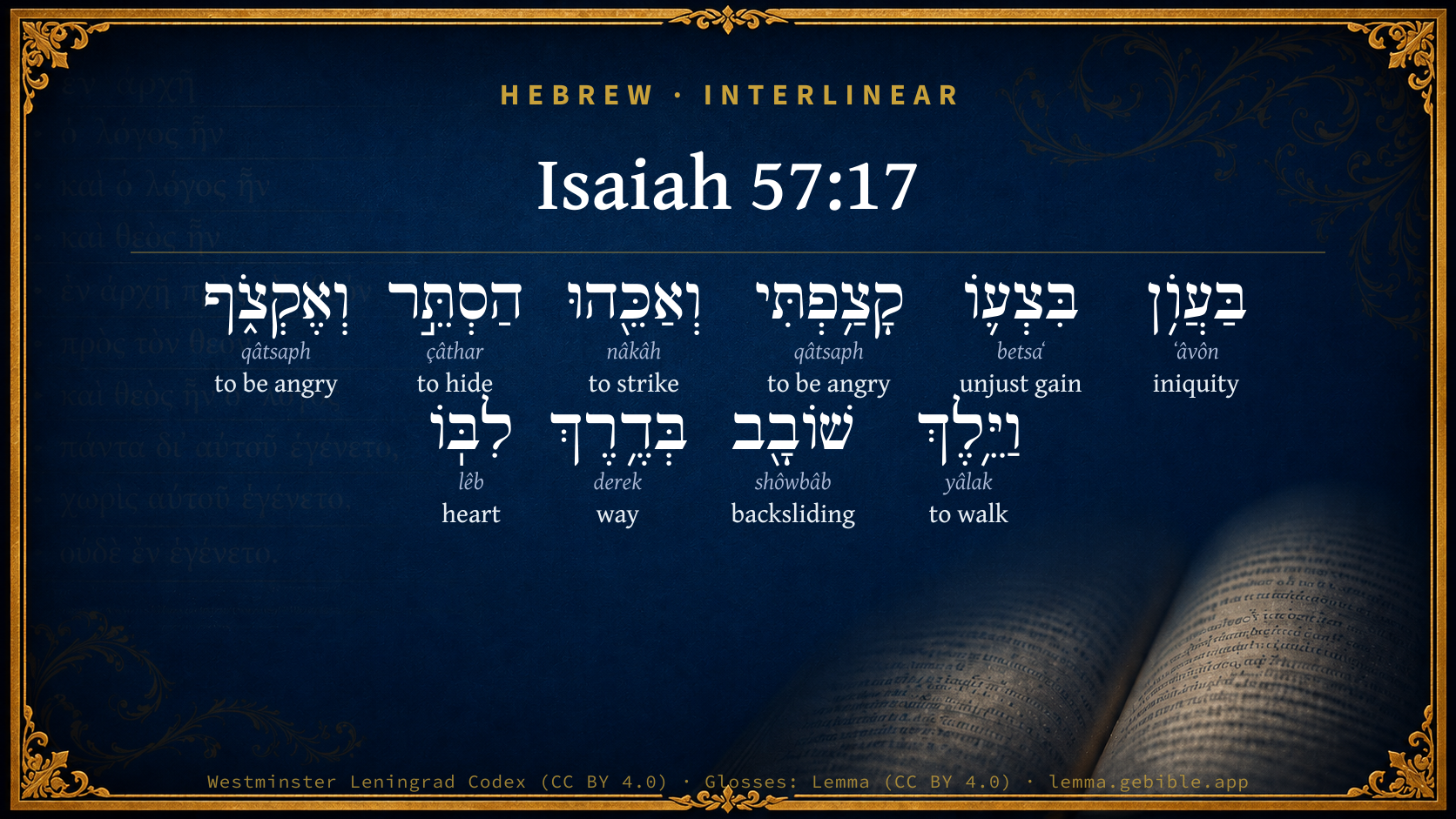
Hebrew (Westminster Leningrad Codex) Isaiah 57:17 appears in the Hebrew Old Testament. The text above is from the Westminster Leningrad Codex. Each word links to its Strong’s number, a concise gloss, and parsing drawn from the Open Scriptures Hebrew Bible morphology. Click any word for its full Brown-Driver-Briggs (BDB) entry.
Download image
Cite this verse

Isaiah 57:17 (World English Bible). Public Domain. Lemma interlinear Bible study tool, https://lemma.gebible.app/v/isaiah/57/17.

Show BibTeX & RIS
BibTeX
RIS
English Translation
For the iniquity of his covetousness was I angry, and struck him; I hid [my face] and was angry; and he went on backsliding in the way of his heart.
World English Bible · Public Domain
Highlights
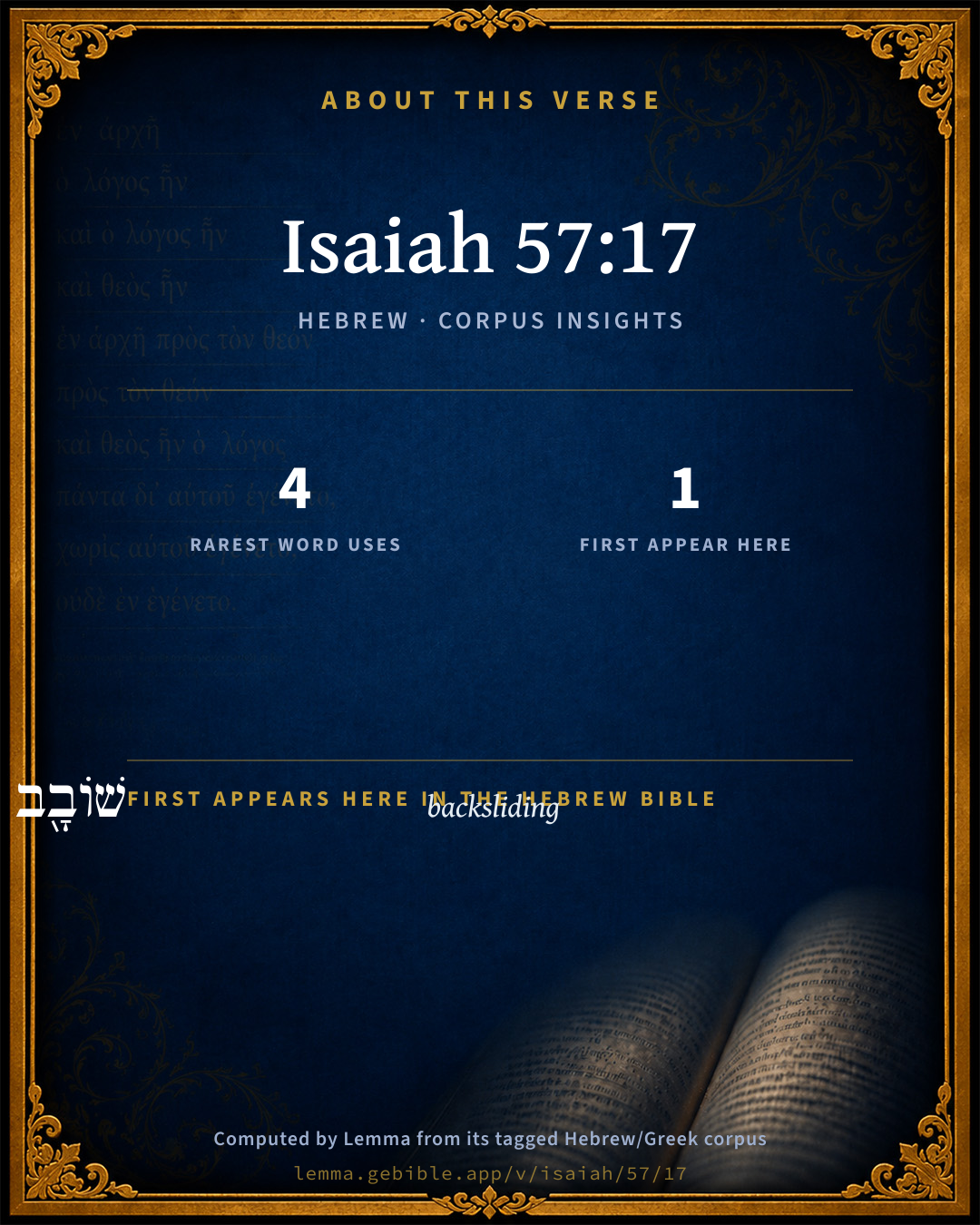
  • 1 first appearance in the Hebrew Bible
Full analysis ↓
Download a study sheet

One document with this verse’s original text, its word-by-word gloss line, the meaning frame, cross-references with their text, attributed commentary, and full source and license credits — printable, and it pastes into notes with its structure intact.

This verse Autodidact and up

Study sheet (.html) Plain text (.txt)

A passage Seminary Student

Up to 50 verses in one chapter. A passage sheet keeps up to 6 commentary sources and 12 cross-references per verse, in the order this page ranks them, and says so on the sheet whenever that leaves anything out. Ask for a single verse and you get the Autodidact verse sheet above.

Everything on this page stays free to read, with no account — the sheet is a download of what is already on screen, not access to it.

Want to remove ads? Support Godless Engineer
Compare translations 3

The same verse in 3 English versions, stacked beneath the original-language interlinear above. Click any original word for its lexicon entry.

Each is an independent rendering of the whole verse — the interlinear is not word-aligned to these translations.

Highlighted words mark where these versions differ — a whole-verse word diff, not a word-by-word alignment.

  • World English Bible Public Domain
    For the iniquity of his covetousness was I angry, and struck him; I hid [my face] and was angry; and he went on backsliding in the way of his heart.
  • King James Version Public Domain
    For the iniquity of his covetousness was I wroth, and smote him: I hid me, and was wroth, and he went on frowardly in the way of his heart.
  • unfoldingWord Literal Text CC BY-SA 4.0
    For the iniquity of his gain, I was angry, and I struck him; I hid, and I was angry, but he went backward in the way of his heart.

unfoldingWord Literal Text — © unfoldingWord, licensed CC BY-SA 4.0. Word-aligned USFM3 via Door43 (git.door43.org/unfoldingWord/en_ult).

Versions to compare (up to 4)

3 of 4 selected

Show all 18 translations

Every available English version of this verse, each an independent rendering of the whole verse.

  • World English Bible Public Domain
    For the iniquity of his covetousness was I angry, and struck him; I hid [my face] and was angry; and he went on backsliding in the way of his heart.
  • Berean Standard Bible Public Domain
    I was enraged by his sinful greed, so I struck him and hid My face in anger; yet he kept turning back to the desires of his heart.
  • Majority Standard Bible Public Domain
    I was enraged by his sinful greed, so I struck him and hid My face in anger; yet he kept turning back to the desires of his heart.
  • King James Version Public Domain
    For the iniquity of his covetousness was I wroth, and smote him: I hid me, and was wroth, and he went on frowardly in the way of his heart.
  • American Standard Version (1901) Public Domain
    For the iniquity of his covetousness was I wroth, and smote him; I hid `my face' and was wroth; and he went on backsliding in the way of his heart.
  • Revised Version (1885) Public Domain
    For the iniquity of his covetousness was I wroth and smote him, I hid my face and was wroth: and he went on frowardly in the way of his heart.
  • Geneva Bible (1599) Public Domain
    For his wicked couetousnesse I am angry with him, and haue smitten him: I hid mee and was angry, yet he went away, and turned after the way of his owne heart.
  • Douay-Rheims (1899) Public Domain
    For the iniquity of his covetousness I was angry, and I struck him: I hid my face from thee, and was angry: and he went away wandering in his own heart.
  • Young's Literal Translation Public Domain
    For the iniquity of his dishonest gain, I have been wroth, and I smite him, Hiding -- and am wroth, And he goeth on turning back in the way of his heart.
  • Literal Standard Version CC BY-SA 4.0
    For the iniquity of his dishonest gain, || I have been angry, and I strike him, || Hiding—and am angry, || And he goes on turning back in the way of his heart.
  • Unlocked Literal Bible CC BY-SA 4.0
    Because of the sin of his violent gain, I was angry, and I punished him; I hid my face and was angry, but he went backward in the way of his heart.
  • unfoldingWord Literal Text CC BY-SA 4.0
    For the iniquity of his gain, I was angry, and I struck him; I hid, and I was angry, but he went backward in the way of his heart.
  • Darby Bible Public Domain
    For the iniquity of his covetousness was I wroth, and smote him; I hid me, and was wroth, and he went on backslidingly in the way of his heart.
  • World Messianic Bible Public Domain
    I was angry because of the iniquity of his covetousness and struck him. I hid myself and was angry; and he went on backsliding in the way of his heart.
  • Webster's Bible Public Domain
    For the iniquity of his covetousness I was wroth, and smote him: I hid me, and was wroth, and he went on frowardly in the way of his heart.
  • Free Bible Version CC BY-SA 4.0
    Yes, I was angry with these sinful, greedy people so I punished them. I was angry, so I hid myself from them, but they went on their own rebellious way, doing whatever they wanted.
  • Bible in Basic English Public Domain
    I was quickly angry with his evil ways, and sent punishment on him, veiling my face in wrath: and he went on, turning his heart from me.
  • JPS Tanakh (1917) Public Domain
    For the iniquity of his covetousness was I wroth and smote him, I hid Me and was wroth; and he went on frowardly in the way of his heart.

Literal Standard Version (2020), Covenant Press — licensed CC BY-SA 4.0. Text via the HelloAO Bible API (eBible.org). Unlocked Literal Bible (unfoldingWord) — licensed CC BY-SA 4.0. Text via the HelloAO Bible API (eBible.org). unfoldingWord Literal Text — © unfoldingWord, licensed CC BY-SA 4.0. Word-aligned USFM3 via Door43 (git.door43.org/unfoldingWord/en_ult). Free Bible Version, Dr. Jonathan Gallagher — licensed CC BY-SA 4.0. Text via the HelloAO Bible API (eBible.org).

Word by word

More ways to search: Search by grammar → Find every occurrence → Compare this word →

Practice this passage: Drill this verse → Learn its vocabulary →

שׁוֹבָ֖ב
shôwbâb
H7726
“backsliding”
Adjective, Adjective, Masculine, Singular, Absolute
Part of Speech
Adjective
Type
Adjective
Gender
Masculine
Number
Singular
State
Absolute
Full BDB Definition

Origin: from H7725

TWOT: 2340c

backsliding, backturning, apostate, recusant
  1. בַּעֲוֺ֥ן ʻâvôn H5771 “in/at · iniquity of” Preposition + Noun, Common, Both, Singular, Construct
  2. בִּצְע֛וֹ betsaʻ H1215 “unjust gain · his” Noun, Common, Masculine, Singular, Construct + Suffix, Personal, 3rd Person, Masculine, Singular
  3. קָצַ֥פְתִּי qâtsaph H7107 “to be angry” Verb, Qal, Perfect, 1st Person, Common, Singular
  4. וְאַכֵּ֖הוּ nâkâh H5221 “and · to strike · him” Conjunction + Verb, Hiphil, Imperfect, 1st Person, Common, Singular + Suffix, Personal, 3rd Person, Masculine, Singular
  5. הַסְתֵּ֣ר çâthar H5641 “to hide” Verb, Hiphil, Infinitive Absolute
  6. וְאֶקְצֹ֑ף qâtsaph H7107 “and · to be angry” Conjunction + Verb, Qal, Imperfect, 1st Person, Common, Singular
  7. וַיֵּ֥לֶךְ yâlak H3212 “and · to walk” Conjunction + Verb, Qal, Sequential Imperfect, 3rd Person, Masculine, Singular
  8. בְּדֶ֥רֶךְ derek H1870 “in/at · way of” Preposition + Noun, Common, Both, Singular, Construct
  9. לִבּֽוֹ lêb H3820 “heart · his” Noun, Common, Masculine, Singular, Construct + Suffix, Personal, 3rd Person, Masculine, Singular

About this verse

These counts appear in no published source. They are computed here, from the morphology-tagged text and Lemma’s own curated glosses. What Lemma adds →

10
words
9
distinct lemmas
Prophets
section

Notable vocabulary

The rarest word here is שׁוֹבָ֖ב backsliding H7726 — appearing just 4 times in the whole Hebrew Bible.

First appearance in Scripture

This word makes its first canonical appearance in the Hebrew Bible here:

  • שׁוֹבָ֖ב backsliding H7726

Shared distinctive vocabulary

שׁוֹבָ֖ב backsliding H7726 occurs in 4 verses of the Hebrew Bible. Also found in:

Grammatical profile

  • 5 verbs
  • 4 nouns
  • 1 adjective

Verb forms

  • קָצַ֥פְתִּי Qal · Perfect
  • וְאַכֵּ֖הוּ Hiphil · Imperfect
  • הַסְתֵּ֣ר Hiphil · Infinitive Absolute
  • וְאֶקְצֹ֑ף Qal · Imperfect
  • וַיֵּ֥לֶךְ Qal · Sequential Imperfect

Repetition

A word recurs within this verse — often emphatic in Hebrew:

  • קָצַ֥פְתִּי to be angry H7107 ×2

Hebrew & Septuagint length

In English translation the verse runs 30 words from the Hebrew and 33 from the Septuagint (LXX English) — closely comparable.

A rough comparison of the two English renderings, which tokenize alike — not a word-level alignment.

Word counts can differ between the Hebrew and the Greek without any difference in meaning — e.g. the Hebrew direct-object marker אֵת has no separate Greek word, and Greek often adds the article ὁ.

Cross-references

21

Topical passages linked to Isaiah 57:17 in the Treasury of Scripture Knowledge — connected by theme and wording, ordered by reader-vote popularity; previews shown in the World English Bible.

  • Isaiah 56:11 Yes, the dogs are greedy, they can never have enough; and these are shepherds who can't understand: they have all turned to their own way, each one to his gain, from every quarter.
  • Jeremiah 6:13 For from the least of them even to the greatest of them everyone is given to covetousness; and from the prophet even to the priest everyone deals falsely.
  • Colossians 3:5 Put to death therefore your members which are on the earth: sexual immorality, uncleanness, depraved passion, evil desire, and covetousness, which is idolatry;
  • Ephesians 5:3–5 But sexual immorality, and all uncleanness, or covetousness, let it not even be mentioned among you, as becomes saints;
  • 2 Peter 2:14 having eyes full of adultery, and who can't cease from sin; enticing unsettled souls; having a heart trained in greed; children of cursing;
  • Ecclesiastes 6:9 Better is the sight of the eyes than the wandering of the desire. This also is vanity and a chasing after wind.
  • Isaiah 1:4 Ah sinful nation, A people loaded with iniquity, A seed of evil-doers, Children who deal corruptly! They have forsaken Yahweh. They have despised the Holy One of Israel. They are estranged and backward.
  • Isaiah 5:8–9 Woe to those who join house to house, Who lay field to field, until there is no room, And you are made to dwell alone in the midst of the land!
  • Isaiah 8:17 I will wait for Yahweh, who hides his face from the house of Jacob, and I will look for him.
  • Isaiah 9:13 Yet the people have not turned to him who struck them, neither have they sought Yahweh of Hosts.
  • Isaiah 45:15 Most assuredly you are a God who hid yourself, God of Israel, the Savior.'
  • Jeremiah 2:30 In vain have I struck your children; they received no correction: your own sword has devoured your prophets, like a destroying lion.
  • Jeremiah 5:3 O Yahweh, don't your eyes look on truth? you have stricken them, but they were not grieved; you have consumed them, but they have refused to receive correction: they have made their faces harder than a rock; they have refused to return.
  • Jeremiah 8:10 Therefore will I give their wives to others, and their fields to those who shall possess them: for everyone from the least even to the greatest is given to covetousness; from the prophet even to the priest every one deals falsely.
  • Jeremiah 22:17 But your eyes and your heart are not but for your covetousness, and for shedding innocent blood, and for oppression, and for violence, to do it.
  • Ezekiel 33:31 They come to you as the people comes, and they sit before you as my people, and they hear your words, but don't do them; for with their mouth they show much love, but their heart goes after their gain.
  • Micah 2:2–3 They covet fields, and seize them; And houses, and take them away: And they oppress a man and his house, Even a man and his heritage.
  • Luke 12:15 He said to them, "Beware! Keep yourselves from covetousness, for a man's life doesn't consist of the abundance of the things which he possesses."
  • 1 Timothy 6:9 But those who are determined to be rich fall into a temptation and a snare and many foolish and harmful lusts, such as drown men in ruin and destruction.
  • Luke 15:14–16 When he had spent all of it, there arose a severe famine in that country, and he began to be in need.
  • 2 Peter 2:3 In covetousness they will exploit you with deceptive words: whose sentence now from of old doesn't linger, and their destruction will not slumber.

Cross-references courtesy of OpenBible.info (CC BY 4.0).

Hebrew and Greek witnesses Masoretic Hebrew ↔ Greek Septuagint

The same verse in the two great witnesses to the Old Testament, shown verse-for-verse.

These are two independent witnesses, not word-aligned to each other, and the Septuagint is shown in lemma (dictionary) form.

Hebrew Isaiah 57:17 Masoretic · Westminster Leningrad Codex

בַּעֲוֺ֥ן בִּצְע֛וֹ קָצַ֥פְתִּי וְאַכֵּ֖הוּ הַסְתֵּ֣ר וְאֶקְצֹ֑ף וַיֵּ֥לֶךְ שׁוֹבָ֖ב בְּדֶ֥רֶךְ לִבּֽוֹ

For the iniquity of his covetousness was I angry, and struck him; I hid [my face] and was angry; and he went on backsliding in the way of his heart.

World English Bible · Public Domain

Greek LXX Isaiah 57:17 Septuagint · lemma form

διά ἁμαρτία βραχύς τις λυπέω αὐτός καί πατάσσω αὐτός καί ἀποστρέφω ὁ πρόσωπον ἐγώ ἀπό αὐτός καί λυπέω καί πορεύομαι στυγνός ἐν ὁ ὁδός αὐτός

On account of sin for a little while I grieved him, and struck him, and turned away my face from him; and he was grieved, and he went on sorrowful in his ways.

LXX2012 (modern English Septuagint) · Public Domain

On this verse, Adam Clarke's Commentary discusses the Septuagint’s reading. Read the note in Commentary ↓

Hebrew: Westminster Leningrad Codex (CC BY 4.0). Greek: Septuagint (public domain); English from LXX2012 (modern English Septuagint) (Public Domain). How the Septuagint differs from the Hebrew →

Targum (Aramaic paraphrase)

1

The Targum is the ancient Jewish Aramaic paraphrase of the Hebrew Scriptures — an interpretive translation, not the Hebrew text itself. Onkelos (literal) and Pseudo-Jonathan (expansive) render the Torah, and Jonathan the Prophets. Coverage is partial: where no permissively-licensed English translation exists for a verse, only the Aramaic is shown. This is verse-level text, not a word-by-word alignment to the Hebrew.

  1. Targum Jonathan Prophets (Joshua–Malachi)
    בְּחוֹבֵי מָמוֹנְהוֹן דַאֲנָסוּ הֲוָה רוּגְזִי עֲלֵיהוֹן וְאַלְקֵיתִינוּן סַלֵיקִית שְׁכִנְתִּי מִנְהוֹן וְטַלְטֵלְתִּינוּן בַּדְרֵית גַלְוַתְהוֹן עַל דְטָעוּ בָתַר הִרְהוּר לִבְּהוֹן:

    My wrath is upon them on account of their robbed riches, and I smote them; I removed my Shekinah from them, and cast them out; I scattered their captives, because they went astray after the imagination of their hearts.

    Targum Jonathan — Aramaic: “Mikraot Gedolot” (public domain). English: “Sefaria Community Translation” (CC0 1.0 (public-domain dedication)); “London "Chaldee Paraphrase," 1871” (public domain). Text via Sefaria.

Commentary

Notes on Isaiah 57:17 from classic Christian and Jewish commentators (each source and its license shown beneath its notes). The classic Christian expositions comment on the surrounding passage and are grouped to its opening verse, so a note may address several verses; the Jewish commentaries on the Tanakh (Rashi and others) are per-verse, so they appear only where the commentator wrote on this verse.

Lemma curates 59 commentaries, every one of them public domain or Creative Commons licensed, each selected and text-cleaned for this edition rather than reprinted as found. About our sources →

Matthew Henry's Commentary

The body of the people of Israel, in this account of God's dealings with them, is spoken of as a particular person (Isa 57:17, Isa 57:18), but divided into two sorts, differently dealt with - some who were sons of peace, to whom peace is spoken (Isa 57:19), and others who were not, who have nothing to do with peace, Isa 57:20, Isa 57:21. Observe here,

I. The just rebukes which that people were brought under for their sin: For the iniquity of his covetousness I was wroth, and smote him. Covetousness was a sin that abounded very much among that people. Jer 6:13, From the least to the greatest of them, every one is given to covetousness. Those that did not worship images were yet carried away by this spiritual idolatry: for such is covetousness; it is making money the god, Col 3:5. No marvel that the people were covetous when their watchmen themselves were notoriously so, Isa 56:11, Yet, covetous as they were, in the service of their idols they were prodigal, Isa 57:6. And it is hard to say whether their profuseness in that or their covetousness in every thing else was more provoking. But for this iniquity, among others, God was angry with them, and brought one judgment after another upon them, and their destruction at last by the Chaldeans. 1. God was wroth. He resented it, took it very ill that a people who were devoted to himself, and portioned in himself, should be so entirely given up to the world and choose that for their portion. Note, Covetousness is an iniquity that is very displeasing to the God of heaven. It is a heart-sin, but he sees it, and therefore hates it, and looks upon it with jealousy, because it sets up a rival with him in the soul. It is a sin which men bless themselves in (Psa 49:18) and in which their neighbours bless them (Psa 10:3); but God abhors it. 2. He motes him, reproved him for it by his prophets, corrected him by his providence, punished him in those very things he so doted upon and was covetous of. Note, Sinners shall be made to feel from the anger of God. Those whom he is wroth with he smites; and covetousness particularly lays men under the tokens of God's displeasure. Those that set their hearts upon the wealth of this world are disappointed of it or it is embittered to them; it is either clogged with a cross or turned into a curse. 3. God hid himself from him when he was under these rebukes, and continued wroth with him. When we are under the rod, if God manifest himself to us, we may bear it the better; but if he both smite us and hide himself from us, send us no prophets, speak to us no comfortable word, show us no token for good, if he tear and go away (Hos 5:14), we are very miserable.

II. Their obstinacy and incorrigibleness under these rebukes: He went on frowardly in the way of his heart, in his evil way. He was not sensible of the displeasure of God that he was under. He felt the smart of the rod, but had no regard at all to the hand; the more he was crossed in his worldly pursuits the more eager he was in them. He either would not see his error or if he saw it would not amend it. Covetousness was the way of his heart; it was what he was inclined to and intent upon, and he would not be reclaimed, but in his distress he trespassed yet more, Ch2 28:22. See the strength of the corruption of men's hearts, and the sinfulness of sin, which will take its course in despite of God himself and all the flames of his wrath. See also how insufficient afflictions of themselves are to reform men, unless God's grace work with them.

III. God's wonderful return in mercy to them, notwithstanding the obstinacy of the generality of them.

1. The greater part of them went on frowardly, but there were some among them that were mourners for the obstinacy of the rest; and with an eye to them, or rather for his own name's sake, God determines not to contend for ever with them. With the froward God may justly show himself froward (Psa 18:26), and walk contrary to those that walk contrary to him, Lev 26:24. When this sinner here went on frowardly in the way of his heart, one would think it should have followed, "I have seen his ways and will destroy him, will abandon him, will never have any thing more to do with him." But such are the riches of divine mercy and grace, and so do they rejoice against judgment, that it follows, I have seen his ways and will heal him. See how God's goodness takes occasion from man's badness to appear so much the more illustrious; and where sin has abounded grace much more abounds. God's reasons of mercy are fetched from within himself, for in us there appears nothing but what is provoking: "I have seen his ways, and yet I will heal him for my own name's sake." God knew how bad the people were, and yet would not cast them off. But observe the method. God will first give him grace, and then, and not till then, give him peace: "I have seen his way, that he will never turn to me of himself, and therefore I will turn him." Those whom God has mercy in store for he has grace in readiness for, to prepare and qualify them for that mercy which they were running from as fast as they could. (1.) God will heal him of his corrupt and vicious disposition, will cure him of his covetousness, though it be ever so deeply rooted in him and his heart have been long exercised to covetous practices. There is no spiritual disease so inveterate, but almighty grace can conquer it. (2.) God will lead him also; not only amend what was amiss in him, that he may cease to do evil, but direct him into the way of duty, that he may learn to do well. He goes on frowardly, as Saul, yet breathing out threatenings and slaughter, but God will lead him into a better mind, a better path. And them, (3.) He will restore those comforts to him which he had forfeited and lost, and for the return of which he had thus prepared him. There was a wonderful reformation wrought upon captives in Babylon, and then a wonderful redemption wrought for them, which brought comfort to them, to their mourners, to those among them that mourned for their own sins, the sins of their people, and the desolations of the sanctuary. To those mourners the mercy would be most comfortable, and to them God had an eye in working it out. Blessed are those that mourn, for to them comfort belongs, and they shall have it.

2. Now, as when that people went into captivity some of them were good figs, very good, others of them bad figs, very bad, and accordingly their captivity was to them for their good or for their hurt (Jer 24:8, Jer 24:9), so, when they came out of captivity, still some of them were good, others bad, and the deliverance was to them accordingly.

(1.) To those among them that were good their return out of captivity was peace, such peace as was a type and earnest of the peace which should be preached by Jesus Christ (Isa 57:19): I create the fruit of the lips, peace. [1.] God designed to give them matter for praise and thanksgiving, for that is the fruit of the lips (Heb 13:15), the calves of the lips, Hos 14:2. I create this. Creation is out of nothing, and this is surely out of worse than nothing, when God creates matter of praise for those that went on frowardly in the way of their heart. [2.] In order to this, peace shall be published: Peace, peace (perfect peace, all kinds of peace) to him that is afar off from the general rendezvous, or from the head-quarters, as well as to him that is near. Peace with God; though he has contended with them, he will be reconciled and will let fall his controversy. Peace of conscience, a holy security and serenity of mind, after the many reproaches of conscience and agitations of spirit they had been under their captivity. Thus God creates the fruit of the lips, fresh matter for thanksgiving; for, when he speaks peace to us, we must speak praises to him. This peace is itself of God's creating. He, and he only, can work it; it is the fruit of the lips, of his lips - he commands it, of the minister's lips - he speaks it by them, Isa 40:1. It is the fruit of preaching lips and praying lips; it is the fruit of Christ's lips, whose lips drop as a honeycomb; for to him this is applied, Eph 2:17 : He came and preached peace to you who were afar off, you Gentiles as well as to the Jews, who were nigh-to after-ages, who were afar off in time, as well as to those of the present age.

(2.) To those among them that were wicked, though they might return with the rest, their return was no peace, Isa 57:20. The wicked, wherever he is, in Babylon or in Jerusalem, carries about with him the principle of his own uneasiness, and is like the troubled sea. God healed those to whom he spoke peace (Isa 57:19): I will heal them; all shall be well again and set to rights; but the wicked would not be healed by the grace of God and therefore shall not be healed by his comforts. They are always like the sea in a storm, for they carry about with them, [1.] Unmortified corruptions. They are not cured and conquered, and their ungoverned lusts and passions make them like the troubled sea when it cannot rest, vexatious to all about them and therefore uneasy to themselves, noisy and dangerous. When the intemperate heats of the spirit break out in scurrilous and abusive language, then the troubled sea casts forth mire and dirt. [2.] Unpacified consciences. They are under a frightful apprehension of guilt and wrath, that they cannot enjoy themselves; when they seem settled they are in disquietude, when they seem merry they are in heaviness; like Cain, who always dwelt in the land of shaking. The terrors of conscience disturb all their enjoyments, and cast forth such mire and dirt as make them a burden to themselves. Though this does not appear (it may be) at present, yet it is a certain truth, what this prophet had said before (Isa 48:22), and here repeats (Isa 57:21), There is no peace to the wicked, no reconciliation to God (nor can they be upon good terms with him, while they go on still in their trespasses), no quietness or satisfaction in their own mind, no real good, no peace in death, because no hope. My God hath said it, and all the world cannot unsay it, That there is no peace to those that allow themselves in any sin. What have they to do with peace?

Matthew Henry's Commentary on the Whole Bible (1708–1710) — public domain (CC PDM 1.0). Text via the HelloAO Bible API.

Trapp's Complete Commentary

John Trapp

Isa 57:17 For the iniquity of his covetousness was I wroth, and smote him: I hid me, and was wroth, and he went on frowardly in the way of his heart.

Ver. 17. For the iniquity of his covetousness.] Or, Of his concupiscence, the sin of his nature. But covetousness is a wickedness with a witness, the "root of all evil." {1Ti 6:10} Timon could say that there were two sources of all sin, viz., απληστιαν και φιλοδοξιαν, covetousness and vainglory.

And he went on frowardly in the way of his own heart,] i.e., Excaecotus sequitur animalem suum spiritum, he, blindling, blundered on, without fear or wit, cross grained and irreclaimable.

John Trapp, A Commentary or Exposition upon All the Books of the Old and New Testament (1647–1656) — public domain. Text from a community e-Sword module.

The Biblical Illustrator

Joseph S. Exell

Isa_57:17-19

For the iniquity of his covetousness was I wroth

The punishment of backsliders; but their encouragement when penitent

These words remind us of the language of the apostle to the Romans: Where sin abounded grace did much more abound.

I. THE ACCUSATORY PART.

1. The evil complained of--The iniquity of his covetousness. Then covetousness is iniquity. So the apostle considered it, or he would not have called it idolatry. All idolatry is not gross or corporeal. Much of it is refined and mental. It is lamentable to think that this evil so commonly prevails. You will find, by the sacred writers, that the Jews were always given to it. Is it not awful to see how this vice prevails in our country?

2. The reward of transgression. For the iniquity of his covetousness was I wroth and smote him. Sin is the same in whomsoever it is found. The evil is not lessened when it is found in the people of God; it is even increased. They stand in nearer relation to God than others. They sin under greater obligations to God than others. They sin against a renewed nature and an enlightened con science. Hence God is peculiarly angry, because of the provoking of His sons and of His daughters. Hence He says, You only have I known of all the families of the earth, therefore will I punish you. For unto whomsoever much is given, of him shall be much required; and to whom men have committed much, of him they will ask the more. Sin never hurts the believer, is an antinomian sentiment: but what saith the Scriptures? Turn back to the history of Moses and Aaron. Turn to the history of David, even when God assured him that his sin was pardoned. How wise, how merciful, are those hidings and those smitings He employs to bring His people to Himself.

3. The perverseness under this. He went on frowardly in the way of his heart. It is said of Ahaz that, in his affliction, he sinned yet more and more against the Lord. So Jeremiah says, Thou hast stricken them, but they have not grieved; Thou hast consumed them, but they have refused to receive correction; they have made their faces harder than a rock; they have refused to return. Do afflictions produce no benefit? Let us distinguish. There are many who have been afflicted, and yet have not been humbled by the dispensations of Providence, by which they have been exercised. But, you say, Can this be, in any measure, the ease with real Christians? Will they require the rebukes of Divine Providence? Will they go on in the frowardness of their hearts? Yes, for a while; and, sometimes, for a long while. There is Jonah--he was disobedient to the word of the Lord.

4. Here is Gods knowledge of all the ways and works of men. I have seen his ways. Therefore the speaker is authorized to say, Be sure your sin will find you out. And now, after all that He has seen, what shall we certainly expect to hear next from Him? I have tried long enough, I have employed means long enough, I will now avenge Me of My adversaries. But no, I have seen his ways--and what ways!--and will heal him, etc.

II. THE PROMISSORY PART. Observe the extensiveness of the engagement. It takes in four things.

1. I will heal him, All sin is a disease, and it affects the soul much in the same way as affliction affects the body; depriving it of liberty, of enjoyment, of usefulness. It is the same with backsliding.

2. I will lead him also. Bishop Hall says, Though God has a large family, not one of them can go alone. Ann there is none so dull, but He can teach them.

3. I will restore comforts unto him.

4. And I will restore comforts unto his mourners,--for he had made others to mourn as well as himself. This is always the case. The wicked are not only corrupt, but they are children who are corrupters. But who are they of whom the Prophet here speaks? Not men of the world. They are not his mourners. They rather rejoice. They say, Ah! so would we have it, instead of grieving over the falls of professors of religion and of the people of God. But his mourners? They are his ministers--they who only live when you stand fast in the Lord. They are the humble believers in Jesus, who are sorrowful for the solemn assembly, and to whom the reproach of it is a burden. (W. Jay.)

A cluster of promises

I. HERE ARE PROMISES, REACHING TO THE VERY ROOT OF ALL OUR SINFUL NEED, made to sinners as sinners, nay, to the very worst sinners.

1. The promise of healing I will heal him.

2. A promise of leading. The Hebrew is, I will conduct him safely to his own country.

3. I will restore comforts to him. It is not the singular word, it is not comfort, but comforts; all sorts of comforts, and this though I have seen his ways. This is just the language we have in Isa_54:8-12.

4. There is a fourth promise, Peace, peace to him that is far off, and to him that is near, saith the Lord; a liberal promise! to those afar off--aye, far as the ends of the earth--from God, from light, and rest, and truth.

II. THE PERSONS TO WHOM THESE PROMISES ARE MADE. I said God makes promises to sinners, as sinners; will you observe the persons to whom these promises are made, as God describes them here? (Isa_54:17.) Covetousness is the root of all sin; covetousness sets up self instead of God in the heart, and everything that ariseth in practice contrary to God and His Word has its root in covetousness--selfism; but here is not merely covetousness, but the iniquity of covetousness, a state of mind that rests at nothing likely to gratify or minister to self, but will go through hell-fire to get at what it wants. Then, again (Isa_54:17), God smote, but the soul was no better; it is a terrible aggravation of a sinful state, when the correcting hand of God does not mend it; see what God says (Isa_1:5). Now, says God, I have seen his ways, obstinate, incorrigible, in sin, and I will heal him. Such is the divinely gracious way in which peace is proclaimed to him that is afar off. (M. Rainsford.)

He went on frowardly

The deceitfulness of the heart, with respect to adversity

1. This sometimes appears by despising afflictions. Many attempt to outbrave calamity, as if they were stronger than God.

(1) Those may be said to despise His chastening, who account it a small matter, who from a principle of pride and presumption think it unworthy of them to seem affected with it, or refuse to turn to the hand that smiteth.

(2) Again, we despise affliction, if we consider not its origin, which is the corruption of our whole nature by sin.

(3) Adversity is also despised, when the subjects of it do not consider the more immediate cause of it, which is the anger of God because of sin, and confess with Moses, the man of God: We are consumed by Thine anger, and by Thy wrath are we troubled.

(4) Further, affliction is despised, if we do not consider the design of it.

2. By repining under adversity.

3. By keeping death at a distance, if the affliction be of a bodily kind.

4. By forming empty resolutions of repentance and reformation, while under affliction.

5. By exciting men to make lies their refuge. The deceitful heart prompts them to trust in earthly means for deliverance from affliction.

6. By making them despise means. We have seen again and again how the deceitfulness of the heart works by contraries, in its opposition to God. If it prevail not with those under affliction to depend absolutely on means, it will strenuously urge the total neglect of them.

7. By seeking deliverance from the affliction itself, rather than the sanctified use of it.

8. By abusing adversity, as an occasion of hardening itself against God. (J. Jameson, M. A.)

The Biblical Illustrator, edited by Joseph S. Exell (c. 1880s–1900s) — public domain. Text from a community e-Sword module.

Joseph Benson's Commentary

Isa 57:17. For the iniquity of his covetousness — The covetousness of the Jewish people, (here addressed as one man,) who were eminently guilty of this sin before the Babylonish captivity, as is expressly affirmed, Jer 6:13; and Jer 8:10; and they were still more addicted to it in the time of Christ, and previous to the destruction of their city by the Romans; Christ himself testifying, that the greatest professors of sanctity among them devoured widows’ houses, and, for a pretence, made long prayers. But this sin is not mentioned exclusively of others, but so as to comprehend all those sins for which God was wroth, and smote them: covetousness, however, joined with a froward going on in the way of their own hearts, has been the characteristic sin of that people, in all ages, since the overturning of their commonwealth by the Romans. If Vitringa’s exposition of this chapter be adopted, this verse must be understood of the avarice of the Church of Rome, manifested by her enormous exactions, and her infamous traffic in indulgences, dispensations, and a variety of equally abominable practices, which, for many ages, have disgraced that church in the view of all intelligent and pious Christians. I hid me, and was wroth —

I withdrew my favour and help from him, and left him in great calamities. And he went on frowardly — Yet he was not reformed by corrections, but in his distresses trespassed more and more, and obstinately persisted in those sinful courses which were most pleasing to the lusts of his own corrupt heart.

Joseph Benson's Commentary on the Old and New Testaments (1811–1818) — public domain. Text from a community e-Sword module.

The Preacher's Complete Homiletical Commentary

Joseph S. Exell (gen. ed.)

ABOUNDING SIN AND ABOUNDING GRACE

Isa_57:17-19. For the iniquity of his covetousness I was wroth, &c.

The design of the Bible is twofold: first, to reveal man to himself, and, next, to reveal God to him. The Bible contains a revelation of the gracious heart of God, and of the sinful heart of man. Both were necessary, for man is essentially ignorant of himself, and the degree of his distance and separation from God (Pro_30:13; Rev_3:17-19). The text is a case in point. It was necessary that the Jews should be rebuked for their rebellion, and that God’s mercy should be revealed to them. God condescends to argue the case with them, and to justify His procedure in permitting their captivity and desolation, whilst He gives the promise of their future restoration and recovery to His image and favour.

I. THE ABOUNDINGS OF SIN ON THE PART OF ISRAEL.

By the “iniquity of covetousness” we may perhaps understand their reluctance to uphold the service of God, contrasted by their prodigality and profusion in the service of idols (Isa_57:5-6; Isa_57:9; Isa_43:22-24; Hos_2:8-9). But as human nature is always the same, we may trace here the marks of a declining professor.

1. Their obduracy under Divine chastisement (Jer_5:3; Zep_3:2; Zep_3:5; Zep_3:7). It argues a strange boldness not to put away sin, when men are suffering under Divine rebukes. It is to refuse the antidote, and let the poison of sin work on. The bond of iniquity must be exceedingly strong, if when the hand of God is upon us, the heart do not relent (Pro_23:15; 2Ch_28:22). We may well pray: “From all hardness of heart,” &c. Guard not only against sinful acts, but against a sinful and unsubdued temper of mind (Rev_3:19; Psa_32:9).

2. Their apathy under the Divine with-drawments. A good man is anxious to possess the tokens of the Divine favour, &c. The withholding of these is a source of humiliation and sorrow (Psa_51:12; Psa_77:1-9). But Israel was full of apathy. Samson was unconscious of the loss he sustained: “He wist not that the Lord had departed.”

3. Their neglect of the kindest appeals and promises of God’s mercy. God had said (Isa_57:15-16); yet this awakened no response. There are some whom neither judgments awe, nor mercy subdues.

II. THE ABOUNDINGS OF GRACE ON THE PART OF GOD.

1. For obduracy here is mercy. The criminal is arraigned, convicted, condemned, and punishment actually begun; and yet an arrest is placed upon the execution of judgment. When you would expect nothing but actual destruction, you have immediately after the triumph of grace. “Who is a God like Thee?” &c. God hates the sinner’s ways, but He loves the sinner’s soul. His grace is able to subdue the evils that nothing else can. He not only pardons but sanctifies.

2. For desertion here is the promise of guidance. Christ is the Shepherd of the souls He came to redeem.

3. For sorrow here is comfort. When the soul wants peace, it can have none till God speak it.

4. For despondency here is triumph. So great was the despondency that the restoration of peace is a miracle! It must be created! (Isa_65:17-18).

CONCLUSION.—The text is a most instructive and encouraging comment on Rom_5:20. It has been the characteristic of humanity, in all conditions and dispensations, that sin abounded. But the mercy of God has super-abounded. The pardoning mercy of the Gospel greatly triumphs over sin, though so greatly aggravated by the light of Divine revelation. It can erase the deepest stains of guilt, and ennoble the nature which sin has degraded and defiled. This abounding grace is offered for your acceptance.—Samuel Thodey.

Isa_57:18. GOD’S TENDER MERCY TOWARD PENITENT SINNERS.

Through the cloud of His people’s sins God’s mercy shines most brightly. Here is unspeakable tenderness, to melt, to strengthen, and to console. Verily, “the mercy of the Lord is from everlasting to everlasting upon them that fear Him,” &c. (Isa_43:25; Isa_48:9, and others).

God’s tender mercy toward penitent sinners is here presented in several ways—

I. He sees them. This ancient doctrine is at variance with modern popular philosophy, which maintains that God holds Himself too high apart to take cognisance of men on this low earth; that if there is a God at all, He is very distant, and does not condescend to “look upon men” (Job_33:27-28). If this is the God of popular philosophy, it is not the God of the Bible (Psa_113:6; Pro_15:3; Pro_5:21; Heb_4:13). Present everywhere, He sees all that transpires throughout His vast domains, &c. In this chapter, we read of some of the things that God saw in those of whom He here speaks; scoffing at religion; infatuated by sin; given over to the grossest iniquity; hardened in sin (Isa_57:4-9; Isa_57:17). God’s compassionate eye is fixed upon you; He sees your wanderings, sins, repentance, &c., from His Omniscient out look, as though you alone of all His children were penitent. As a compassionate parent looks upon his erring penitent child, so God looks upon broken-hearted penitents. His pitying eye sees the contrite spirit and the aching heart, &c. (Psa_103:13; Luk_15:20; Luk_22:61). Ever look upon God as ever looking upon you. Look well to your “ways,” cherish the spirit of prayerful watchfulness and self-denial. “Thou God seest me.”

II. He heals them. Pardons and restores them. Sin is often represented as a painful, loathsome disease, and pardon and salvation as a healing of the disease (Isa_6:10; Isa_30:26; 2Ch_7:14; Jer_3:22; Jer_8:22; Jer_17:4; Jer_33:6; Psa_41:3-4; Psa_103:3; Psa_147:3).

1. The inimitable character of the Physician.

(1.) His skill is infinite. A physician must understand anatomy, disease, symptoms, causes, &c., and he must be skilful to prescribe suitable directions and remedies, &c. The Divine Physician possesses unbounded knowledge of the cause, the progress, and the precise state of the soul’s disorders and infirmities, of which bodily diseases are analogous. (See pp. 496.)

(2.) His power is almighty. No spiritual disease so inveterate and stubborn but He can conquer and cure it with infinite ease. He never turns any away, saying, “I can do no more for you,” &c.

(3.) His tenderness and compassion is unspeakable (Isa_42:3; Psa_103:13-14).

(4.) His patience and diligence is unwearied. He bears with their ingratitude, &c., pursues His work till He has effected a cure.

2. The remedy by which He heals.

(1.) His pardoning and restoring mercy through the redemption of Christ (Isa_53:5; Zec_13:1; Rom_3:23-26; Rev_5:9, Rev_5:12; Rev. 8:14). Announced in the ministry of the Word. Applied by His Spirit (Eze_36:25-27; Heb_10:16). Received by faith.

(2.) The means of grace (Eph_4:11-13). Designed to promote spiritual health. The Church—the hospital of grace, where the Divine art of healing is carried on, &c.

III. He leads them. Not only amends what is amiss in them, that they may cease to do evil; but directs them into the way of duty, that they may learn to do well (Psa_23:2-3; Psa_73:24; and others. See pp. 296). He leads them to the mercy-seat; to His Word; into paths of righteousness, &c.

IV. He comforts them. He restores the comforts which they had forfeited and lost, for the return of which the grace of God had prepared them, and for which the pious among them had fervently prayed. They had experienced true and satisfying joy, but they sinned it away—they had lost their peace of mind, their souls were sad and cheerless. Sin always produces this effect. In the path of sin neither hope nor comfort can be found. And when lost, it can be recovered only by penitent faith (Psa_51:1-12, and others). God graciously restores the comfort of forfeited mercy, lost joy, vanished hope, &c. (Psa_23:3). He removes all false comforts, and then restores true comforts—the comfort of perfect pardon, daily communion, &c.

CONCLUSION.—Some of you are still impenitent—indifferent about spiritual healing, &c. Remember! God sees you always, in all your sinful “ways,” and therefore sees that which in righteousness He must abhor, and in pity mourn. As a faithful father mourns because of the continued rebellion of a prodigal, so your heavenly Father mourns over you. Take that into your consideration, and surely you will be reluctant to weary out His patience, &c. “Repent and believe the Gospel,” then God shall not see you as sinners He must condemn, but as penitents He must save, and heal, and lead, and comfort (1Jn_1:8-9).—A. Tucker.

ASPECTS OF THE DIVINE CHARACTER.

The proper study of man is God. Nothing so tends to expand the mind, and humble the soul, &c. This description of God is worthy our careful consideration. From it we learn—

I. God is the all-seeing One. The doctrine of the Divine Omniscience one of the most important. Yet practically ignored. It should—

1. Exert a restraining influence. If we realised that God’s eye was upon us we should refrain from sin in all its forms and manifestations; like Joseph we should exclaim, “How can I,” &c.

2. Encourage the penitent.

3. Stimulate the Christian worker.

II. God is the great Physician. Men need healing. Not a hopeless case. Bodily health valuable, spiritual far more precious.

III. God is the Leader of His people. They need leading. God graciously offers to be our Guide—all-wise, powerful, faithful, &c. He is leading us to the heavenly habitation, &c. (see p. 296).

IV. God is the Comforter of His people. In the world they have tribulation, &c. Therefore need super-human comfort.

CONCLUSION.—“Acquaint now thyself with Him and be at peace, thereby good shall come to thee.”—A. Tucker.

The Preacher's Complete Homiletical Commentary (gen. ed. Joseph S. Exell; Funk & Wagnalls, c. 1892) — public domain (pre-1929). A full-Bible homiletical/sermon-outline anthology covering 65 of 66 books (2 John is absent from the source module). Text from a community e-Sword module.

Geneva Bible (1599)

Geneva Bible translators

That is, for the vices and faults of the people, which is meant here by covetousness.

Geneva Bible (1599) marginal notes — public domain. Text via Bolls.life.

Jamieson, Fausset & Brown

Robert Jamieson, A. R. Fausset & David Brown

covetousness--akin to idolatry; and, like it, having drawn off Israel's heart from God (Isa 2:7; Isa 56:11; Isa 58:3; Jer 6:13; Col 3:5).

hid me-- (Isa 8:17; Isa 45:15).

went on frowardly--the result of God's hiding His face (Psa 81:12; Rom 1:24, Rom 1:26).

Jamieson, Fausset & Brown — Commentary Critical and Explanatory on the Whole Bible (1871) — public domain (CC PDM 1.0). Text via the HelloAO Bible API.

Adam Clarke's Commentary

Verse 17. For the iniquity of his covetousness was I wroth - "Because of his iniquity for a short time was I wroth"] For בצעו bitso, I read בצע betsa, a little while, from בצע batsa, he cut off, as the Septuagint read and render it, βραχυ τι "a certain short space." Propter iniquitatem avaritiae ejus, "because of the iniquity of his avarice," the rendering of the Vulgate, which our translators and I believe all others follow, is surely quite beside the purpose.

Adam Clarke's Commentary on the Bible (1810–1826) — public domain. Text from a community e-Sword/MySword module.

Ellicott's Commentary for English Readers

(17) For the iniquity of his covetousness . . .—Literally, of his gain. This was the root-evil, out of which all others sprang (Jer_6:13; Eze_33:31; 1Ti_6:10), and for this, therefore, a sharp chastisement was needed that men might learn what their true wealth consisted in. The last clause may either state the guilt Which caused the wrath, or paint the obduracy which went on doing evil in spite of it.

A Bible Commentary for English Readers, edited by Charles John Ellicott (1878–1897) — public domain. Text from a community e-Sword module.

The Cambridge Bible for Schools and Colleges

gen. ed. J. J. S. Perowne

17. For the iniquity of his covetousness] The mention of “covetousness” as the typical sin of the community here addressed affords some support to the theory that the post-exilic Jews are referred to. See Hag_1:2; Hag_1:9; Mal_1:8; Mal_1:13-14; Mal_3:8; Nehemiah 5. These passages shew that a sordid, avaricious spirit was characteristic of the returned exiles, although on the other hand Jer_6:13 shews that it was prevalent before the Captivity (cf. Eze_33:31). The same feature is touched on in ch. Isa_56:11 and in ch. 58. The significant thing is that it is specified as the besetting sin of the time, and this again appears to indicate that the people spoken of are distinct from those who were guilty of the more heinous offences enumerated in Isa_57:5-9.

covetousness is strictly “gain”; (Gen_37:26) then unjust gain.

I hid me, and was wroth] hiding myself in my wrath (lit. “hiding and being wroth”; see Davidson’s Syntax, § 87 R. 1).

and he went on frowardly] (cf. Jer_3:14; Jer_3:22; Jer_31:22; Jer_49:4) lit. “turning away” (R.V. marg.). The meaning can hardly be that the effect of punishment was to harden the people in sin, and that therefore Jehovah desists from it. The clause does not give the consequence of the chastisement, but continues the description of the sinful life of the people which had drawn forth the Divine anger.

The Cambridge Bible for Schools and Colleges (gen. ed. J. J. S. Perowne; Cambridge University Press, 1878–1918) — public domain. Text from a community e-Sword module.

John Gill's Exposition

For the iniquity of his covetousness was I wroth, and smote him, .... Not the greedy watchmen of the church of Rome, Isa 56:10, but teachers and preachers in the reformed churches, who mind their own things, and not the things of Christ; seek after good benefices and livings, temporalities and pluralities, and to be lord bishops; taking the oversight of the flock for filthy lucre sake; which may easily be observed to be the predominant sin of the preachers and professors of the reformed churches; for which God has a controversy with them, and, resenting it, has smote and rebuked them in a providential way; and has threatened them, as he did the church at Sardis, the emblem of the reformed churches, that he will come upon them as a thief, Rev 3:4.

I hid me, and was wroth: showed his displeasure by departing from them; and how much God has withdrawn his presence, and caused his spirit to depart from the churches of the Reformation, is too notorious:

and he went on frowardly in the way of his heart; took no notice of the reproofs and corrections of God; was unconcerned at his absence; not at all affected with his departure, and the withdrawings of his Spirit; these had no effect to cause a reformation, as is now too visibly the case; the same evil is pursued with equal eagerness; this is a way the heart of man is set upon, and they do not care to be turned out of it; and are like froward peevish children under the rod, receive no correction by it.

John Gill's Exposition of the Whole Bible (1746–1763) — public domain (CC PDM 1.0). Text via the HelloAO Bible API.

Albert Barnes' Notes on the Bible

For the iniquity of his covetousness - The guilt of his avarice; that is, of the Jewish people. The word rendered here ‘covetousness’ (בצע betsa‛) means “plunder, rapine, prey”; then unjust gains, or lucre from bribes 1Sa 7:3; Isa 33:15; or by any other means. Here the sense is, that one of the prevailing sins of the Jewish people which drew upon them the divine vengeance, was avarice, or the love of gain. Probably this was especially manifest in the readiness with which those who dispensed justice received bribes (compare Isa 2:7). See also Jer 6:13 : ‘For from the least of them even unto the greatest of them every one is given to covetousness.’

And smote him - That is, I brought heavy judgments on the Jewish people.

I hid me - I withdrew the evidences of my presence and the tokens of my favor, and left them to themselves.

And he went on frowardly - Margin, ‘Turning away.’ That is, abandoned by me, the Jewish people declined from my service and sunk deeper into sin. The idea here is, that if God withdraws from his people, such is their tendency to depravity, that they will wander away from him, and sink deeper in guilt a truth which is manifest in the experience of individuals, as well as of communities and churches.

Albert Barnes' Notes on the Bible (1834–1885) — public domain. Text from a community e-Sword/MySword module.

Haydock's Catholic Bible Commentary

Heart. Dreadful state of the abandoned sinner! (Deuteronomy xxxii.21., and Psalm xii. 2., and xliii. 24.)

George Leo Haydock (1774–1849), Haydock's Catholic Family Bible and Commentary, 1859 edition — public domain. Excludes Psalms (Douay-Rheims chapter numbering differs from Protestant) and Deuterocanonical books (Catholic canon only).

Matthew Poole's English Annotations

Covetousness; of which sin the Jews were eminently guilty, as is expressly affirmed, Jer 6:13; 8:10. But this is not mentioned exclusively as to other sins, but synecdochically, so as to comprehend all those sins for which God contended with them.

I hid me; I withdrew my favour and help from him, and left him in great calamities.

And he went on frowardly in the way of his heart; yet he was not reformed by corrections, but in his distresses trespassed more and more, as was said of Ahaz, and obstinately persisted in those sinful courses which were chosen by and were most pleasing to the lusts of his own corrupt heart.

Matthew Poole's English Annotations on the Holy Bible (1683–1685) — public domain. Text from a community e-Sword/MySword module.

Whedon's Commentary on the Bible

Daniel D. Whedon

17. Iniquity of his covetousness — The strong words that describe this evil are rapine, plunder, prey. Of these the Jews, in grade just above the very wicked, were guilty.

Smote him — For these Jehovah disciplined Israel. Avarice and love of unjust gains were habits with the people.

I hid me — Kept from them all tokens of approval.

And he — Spoken as a unit — the people.

Went on frowardly — They continued as before — sunk deeper into sin. The doctrine taught is, If removal of divine restraint is forced upon God — if he be expelled from the conscience, deeper into the mire of sin will men sink.

Daniel D. Whedon (gen. ed.), Commentary on the Old and New Testaments (1874–1909) — public domain. Text from a community e-Sword module.

The Pulpit Commentary

For the iniquity of his covetousness was I wroth. Among the sins that angered God most against the Jews of the later kingdom of Judah was their covetousness that desire of unjust gain which led them continually to oppress their weaker brethren, to remove their neighbours" landmarks, to harass them with lawsuits, to obtain from the courts corrupt judgments against them, and so to strip them of their inheritances. (see Isa_1:15-23 Isa_3:5, Isa_3:14, 15 5:8, 23 Jer_6:13 Eze_33:31, etc.) This was far from being their only sin; but it was their besetting sin, and it led on to a number of others. It would seem even to have been the principal cause of those judicial murders with which they are so constantly taxed by the prophets. (Isa_1:15, Isa 21:33:15 Isa_59:3 Jer_2:34 Jer_19:4 Eze_7:23 Eze_11:6 Hos_4:2 Mic_3:10 Mic_7:2, etc. ) Isaiah selects the sin of covetousness here, as typical or representative of the entire class of Judah"s besetting sins the most striking indication of that alienation of their hearts from God, which constituted their real guilt, and was the true cause of their punishment. And smote him. The form of the verb marks repeated action. God gave Judah many warning"s before the final catastrophe. He punished Judah by the hand of Sargon, by that of Sennacherib, (2Ki_18:14-16) by that of Manasseh, (2Ch_33:11) by that of Pharaoh-Necho, (2Ch_35:20-24) by that of the Syrians, the Moabites and the Ammonites, (2Ki_24:2) and others, during the hundred and forty years which intervened between the accession of Hezekiah and the completion of the Captivity. I hid me. (comp. Isa_8:17 Isa_54:8)

Vers. 17-21. The course of the soul.

These words of Isaiah indicate the course which the human spirit often takes in its downward and upward path. We have

I THE ESSENCE OF INIQUITY THIS IS SELFISHNESS. "The iniquity of his selfishness," as it may be rendered. Whether it takes the specific form of rapacity, of unholy ambition, of self-indulgence or of any other special sin, you may trace iniquity home to the evil spirit of selfishness the withholding from God, for self, of that which is due to him. Those who are transgressing none of the ten commandments in the letter, but are yet living to themselves, are living in iniquity.

II DIVINE DISPLEASURE AND REBUKE. "I was wroth and smote him: I hid me." Our wilful departure from God and refusal of our hearts and lives excite his profound displeasure, his sacred grief call forth his parental wrath and displeasure. In a very solemn sense "God is angry with the wicked;" they abide under his "wrath." He is compelled to withhold from them the light of his countenance; he rebukes them; he sends the penalty which is due to sin, and Which is appropriate to the particular sin which is being committed. He hides his face; he withdraws his blessing; he causes pain, disappointment, sorrow, to visit the doer, to afflict the heart.

III HUMAN RESENTMENT AND INCREASED REBELLIOUSNESS OF SPIRIT. "He went on frowardly in the way of his heart." That which is intended to draw near, sometimes drives away. Godly sorrow works repentance; but sorrow, taken ill and treated wrongly, works death. If the heat does not melt, it hardens.

IV THE VICTORY OF DIVINE LOVE. Still, in spite of a growing waywardness, the pity of God pursues the wandering soul. And though deceived and led astray, man travels far and wanders long, God "sees his ways;" he stretches forth the hand of power and grace, and he heals him;" he leads him home and comforts him with the priceless blessings which are under the Father"s roof. These blessings are:

1. Reconciliation: the being spiritually healed, being restored to God after the saddest of all separations spiritual distance from God.

2. Peace: peace offered and granted to those who were more distant and also to those less far removed from truth and righteousness and purity the peace of conscious acceptance.

3. Praise: "the fruit of the lips," joyful ascription unto him that redeemed and restored; the daily song of gratitude that wells up from a heart filled with gratitude and love.

V A POWERFUL INCENTIVE TO RETURN. Perhaps it may be taken as one "fruit of the lips" that the healed and restored soul now speaks for God to men; now becomes his spokesman; now teaches transgressors his. (Psa_51:12, Psa_51:13) And one convincing and impressive truth which a home-brought wanderer can enforce better than an unfallen angel is the hardness of the transgressor"s road, the weariness of the way to him who is leaving God for the far country, the restlessness of a heart that is separated from its Divine Source and Friend; the truth that the mirth of unhallowed enjoyment is very shallow and short-lived, that fast on the heels of guilty pleasure come pursuing pain of body and misery of soul; the fact that there is no peace to the wicked, no lasting joy to any one who has abandoned the fountain of living waters for the broken cisterns of earth and time. The plaintive cry which comes from the aching hearts and troubled lives of guilt is answered by one voice alone by that of him who stands before all generations of men, and says, in the accents of sweet and sovereign pity "Come unto me, all ye that labour and are heavy laden, and I will give you rest. C.

The Pulpit Commentary (1880–1919), ed. H.D.M. Spence-Jones & Joseph S. Exell — public domain. Text from a community e-Sword module.

John Wesley's Explanatory Notes

Covetousness - Of which sin the Jews were eminently guilty. But this comprehends all those sins for which God contended with them. He went - Yet he was not reformed, but trespassed more and more.

John Wesley, Explanatory Notes Upon the Whole Bible (1754–1765) — public domain. Text via the GEBible commentary corpus.

Keil & Delitzsch

C. F. Keil & F. Delitzsch

This general law of His action is most especially the law of His conduct towards Israel, in which such grievous effects of its well-deserved punishment are apparent, and effects so different from those intended, that the compassion of God feels impelled to put an end to the punishment for the good of all that are susceptible of salvation. "And because of the iniquity of its selfishness, I was wroth, and smote it; hiding myself, and being angry: then it went on, turning away in the way of its own heart. I have seen its ways, and will heal it; and will lead it, and afford consolations to it, and to its mourning ones." The fundamental and chief sin of Israel is here called בּצע, lit., a cut of slice (= gain, Isa 56:11); then, like πλεονεξία, which is "idolatry" according to Col 3:5, or like φιλαργυρία, which is "the root of all evil" according to Ti1 6:10, greedy desire for worldly possession, self-seeking, or worldliness generally. The future ואכּהוּ, standing as it does by the side of the perfect here, indicates that which is also past; and ואקצף stands in the place of a second gerund: abscondendo (viz., pânai, my face, Isa 54:8) et stomachando. When Jehovah had thus wrathfully hidden His gracious countenance from Israel, and withdrawn His gracious presence out of the midst of Israel (Hos 5:6, מהם חל), it went away from Him (שׁובב with שׁובב, like עולל with עולל), going its own ways like the world of nations that had been left to themselves. But Jehovah had not seen these wanderings without pity. The futures which follow are promising, not by virtue of any syntactic necessity, but by virtue of an inward necessity. He will heal His wounded (Isa 1:4-6) and languishing people, and lead in the right way those that are going astray, and afford them consolation as a recompense for their long sufferings (נחוּמים is derived from the piel נחם, and not, as in Hos 11:8, from the hiphal hinnâchēm, in the sense of "feelings of sympathy"), especially (Vav epexeget.; Ges. 155, 1) its mourning ones (Isa 61:2-3; Isa 66:10), i.e., those who punishment has brought to repentance, and rendered desirous of salvation.

Keil & Delitzsch — Biblical Commentary on the Old Testament (1861–1891) — public domain (CC PDM 1.0). Text via the HelloAO Bible API. (Old Testament only.)

J. A. Alexander on Isaiah

Joseph Addison Alexander

“For his covetous iniquity I am wroth and will smite him, (I will) hide me and will be wroth; for he has gone on turning away (i.e., persevering in apostasy) in the way of his heart (or of his own inclination).” The futures in the first clause show that both the punishment and mercy are still future. The first phrase in the verse has been variously understood. Some suppose ‘covetousness’ to be here used in a wide sense for all selfish desires or undue attachment to the things of time and sense, a usage which they think may be distinctly traced both in the Old and New Testament. (See Psa 119:36; Eze 33:31; 1Ti 6:10; Eph 5:5). Perhaps the safest and most satisfactory explanation is that which adheres to the strict sense of the word, but supposes covetousness to be here considered as a temptation and incentive to other forms of sin. The singular pronouns ‘his’ and ‘him’ refer to the collective noun ‘people’, or rather to Israel as an ideal person. In the last clause the writer suddenly reverts from the future to the past, in order to assign the cause of the infliction threatened in the first. This connection can be rendered clear in English only by the use of the word ‘for’, although the literal translation would be ‘and he went’.

Joseph Addison Alexander, The Prophecies of Isaiah (1846–1847; New York: Scribner, 1870–1878) — public domain. Text from a community e-Sword module.

Rashi

Rabbi Shlomo Yitzchaki (Rashi)

For the iniquity of his thievery Heb. בִּצְעוֹ, his thievery.

I became wroth at the beginning and I smote him, always hiding My face from his distress and I was wroth for he went rebelliously in the way of his heart. Transpose the verse and explain it thus: For the iniquity of his thievery and the fact that he went rebelliously in the way of his heart, I became wroth and smote him.

Rashi on the Tanakh — English translations: “The Judaica Press complete Tanach with Rashi, translated by A. J. Rosenberg” (CC BY 4.0); “Pentateuch with Rashi's commentary by M. Rosenbaum and A.M. Silbermann, 1929-1934” (public domain); “The Metsudah Tanach series, Lakewood, N.J” (CC BY 4.0); and “The Book of Joshua, Metsudah Publications, 1997” (CC BY 4.0). Text via Sefaria.

Ibn Ezra

Rabbi Abraham ibn Ezra

ואכהו And smote him, namely, my people (ver. 14), or him that is of a contrite and humble spirit (ver. 15). It is the imperfect, for which the Hebrew language has no special form.

I hid me. I hid my face when I smote him with my hand. It is a figurative expression for I smote him without pity. הסתר lit., to hide is infinitive.

וילך שובב He went on returning, with frowardness and obstinacy, in the way of his heart, that is, in his evil ways. שובב is used in a bad sense.

Ibn Ezra on the Tanakh — English translations: “Sefaria Community Translation” (CC0 1.0 (public-domain dedication)); “Yalkut, Sifsei Chachomim Chumash, Metsudah Publications, 2009” (CC BY 4.0); and “Commentary of Ibn Ezra on Isaiah - trans. by M. Friedlander, 1873” (public domain). Text via Sefaria.

Lesson kit

Teaching starters — assembled from the data on this page, not authored interpretation. Every prompt links to the verse data it draws on. Edit before teaching.

Isaiah, in the Prophets, opens this verse with 10 words (9 distinct Hebrew lemmas). Its most distinctive word is shôwbâb (“backsliding”). A historical commentator’s framing appears above. Read the whole chapter for the surrounding context.

Discussion questions

  1. How does “backsliding” (shôwbâb) shape what this verse is saying?
  2. This is the first place “backsliding” appears in Scripture (first appears here). What does its debut here establish?
  3. How does Jeremiah 3:14, which shares the word «backsliding», read alongside this verse?
  4. What does the repetition of “to be angry” (2× in this one verse) do in this verse?
  5. The translations on this page render this verse differently — a whole-verse word diff, not a word-by-word alignment. What might account for the different wordings?
  6. «קָצַ֥פְתִּי» is a Qal Perfect verb. How does that grammatical form shape the action described?
  7. Compare how Matthew Henry's Commentary and Trapp's Complete Commentary read this verse. Where do they agree or differ?

Things to notice

  • 1 word makes its first canonical appearance in Scripture here.
  • These translations choose different wording for 11 words in this verse.
  • “to be angry” occurs 2× in this single verse.
  • 9 distinct Hebrew lemmas span 10 words in this verse.

Reading settings

Reading text

Shown beneath each verse's original-language words.

Old Testament
Old Testament edition

Read the OT as the Masoretic Hebrew (MT) or the Greek Septuagint (LXX).

English shown for the Greek Septuagint (in the Hebrew ↔ Greek comparison).

Comparing translations? Open the Compare panel on any verse page to stack up to four side by side.