
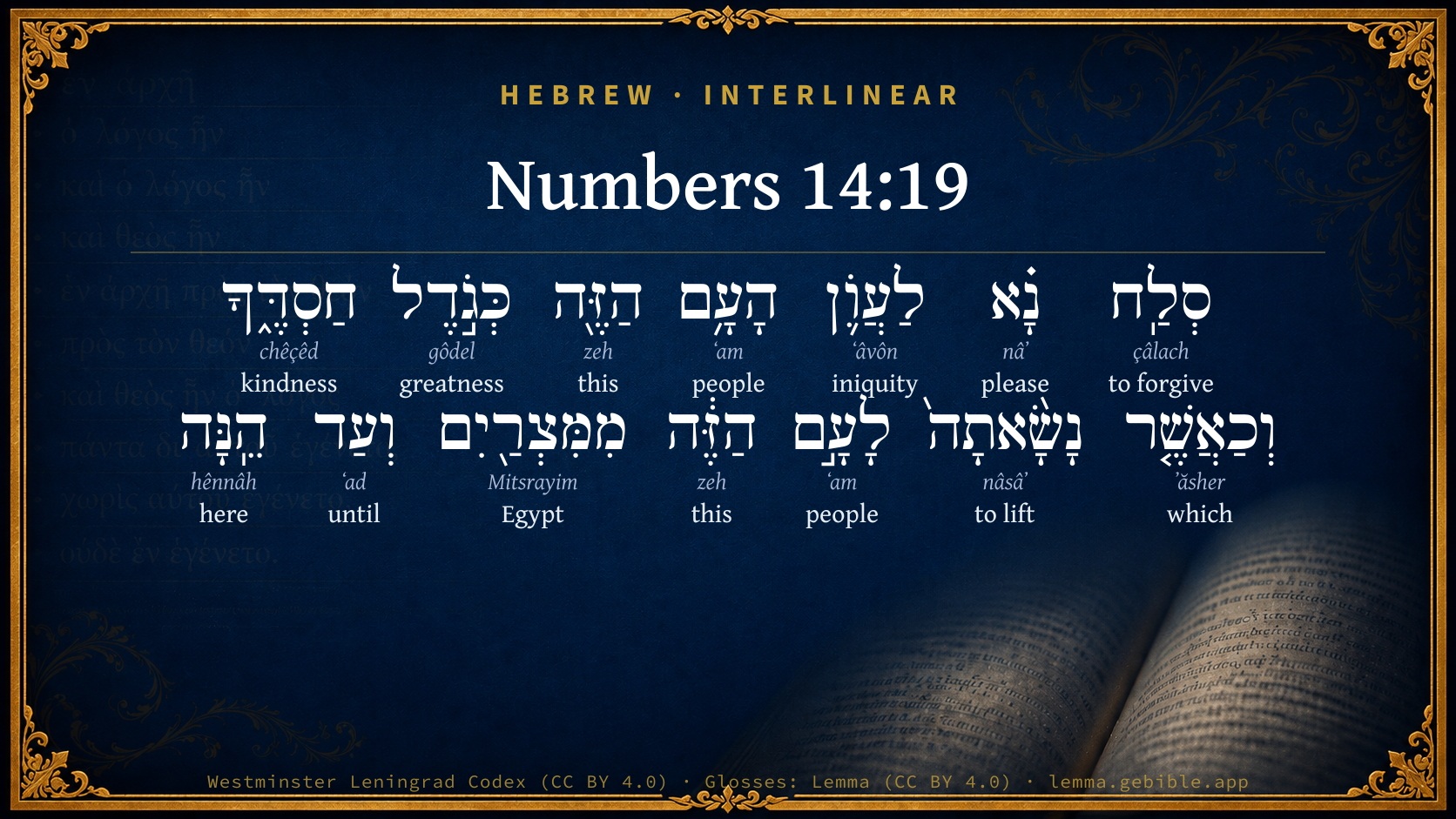
Numbers 14:19

Hebrew (Westminster Leningrad Codex) Numbers 14:19 appears in the Hebrew Old Testament. The text above is from the Westminster Leningrad Codex. Each word links to its Strong’s number, a concise gloss, and parsing drawn from the Open Scriptures Hebrew Bible morphology. Click any word for its full Brown-Driver-Briggs (BDB) entry.
Download image
Cite this verse

Numbers 14:19 (World English Bible). Public Domain. Lemma interlinear Bible study tool, https://lemma.gebible.app/v/numbers/14/19.

Show BibTeX & RIS
BibTeX
RIS
English Translation
Pardon, Please, the iniquity of this people according to the greatness of your loving kindness, and according as you have forgiven this people, from Egypt even until now.
World English Bible · Public Domain
Highlights Full analysis ↓
Download a study sheet

One document with this verse’s original text, its word-by-word gloss line, the meaning frame, cross-references with their text, attributed commentary, and full source and license credits — printable, and it pastes into notes with its structure intact.

This verse Autodidact and up

Study sheet (.html) Plain text (.txt)

A passage Seminary Student

Up to 50 verses in one chapter. A passage sheet keeps up to 6 commentary sources and 12 cross-references per verse, in the order this page ranks them, and says so on the sheet whenever that leaves anything out. Ask for a single verse and you get the Autodidact verse sheet above.

Everything on this page stays free to read, with no account — the sheet is a download of what is already on screen, not access to it.

Want to remove ads? Support Godless Engineer
Compare translations 3

The same verse in 3 English versions, stacked beneath the original-language interlinear above. Click any original word for its lexicon entry.

Each is an independent rendering of the whole verse — the interlinear is not word-aligned to these translations.

Highlighted words mark where these versions differ — a whole-verse word diff, not a word-by-word alignment.

  • World English Bible Public Domain
    Pardon, Please, the iniquity of this people according to the greatness of your loving kindness, and according as you have forgiven this people, from Egypt even until now.
  • King James Version Public Domain
    Pardon, I beseech thee, the iniquity of this people according unto the greatness of thy mercy, and as thou hast forgiven this people, from Egypt even until now.
  • unfoldingWord Literal Text CC BY-SA 4.0
    Please forgive this people for the iniquity according to the greatness of your covenant faithfulness and just as you lifted up for this people from Egypt and as far as here.”

unfoldingWord Literal Text — © unfoldingWord, licensed CC BY-SA 4.0. Word-aligned USFM3 via Door43 (git.door43.org/unfoldingWord/en_ult).

Versions to compare (up to 4)

3 of 4 selected

Show all 18 translations

Every available English version of this verse, each an independent rendering of the whole verse.

  • World English Bible Public Domain
    Pardon, Please, the iniquity of this people according to the greatness of your loving kindness, and according as you have forgiven this people, from Egypt even until now.
  • Berean Standard Bible Public Domain
    Pardon, I pray, the iniquity of this people, in keeping with the greatness of Your loving devotion, just as You have forgiven them ever since they left Egypt.”
  • Majority Standard Bible Public Domain
    Pardon, I pray, the iniquity of this people, in keeping with the greatness of Your loving devotion, just as You have forgiven them ever since they left Egypt.”
  • King James Version Public Domain
    Pardon, I beseech thee, the iniquity of this people according unto the greatness of thy mercy, and as thou hast forgiven this people, from Egypt even until now.
  • American Standard Version (1901) Public Domain
    Pardon, I pray thee, the iniquity of this people according unto the greatness of thy lovingkindness, and according as thou hast forgiven this people, from Egypt even until now.
  • Revised Version (1885) Public Domain
    Pardon, I pray thee, the iniquity of this people according unto the greatness of thy mercy, and according as thou hast forgiven this people, from Egypt even until now.
  • Geneva Bible (1599) Public Domain
    Be mercifull, I beseech thee, vnto the iniquitie of this people, according to thy great mercie, and as thou hast forgiuen this people from Egypt, euen vntill nowe.
  • Douay-Rheims (1899) Public Domain
    Forgive, I beseech thee, the sins of this people, according to the greatness of thy mercy, as thou hast been merciful to them from their going out of Egypt unto this place.
  • Young's Literal Translation Public Domain
    forgive, I pray Thee, the iniquity of this people, according to the greatness of Thy kindness, and as Thou hast borne with this people from Egypt, even until now.'
  • Literal Standard Version CC BY-SA 4.0
    please forgive the iniquity of this people, according to the greatness of Your kindness, and as You have borne with this people from Egypt, even until now.”
  • Unlocked Literal Bible CC BY-SA 4.0
    Pardon, I plead with you, this people's sin because of the greatness of your covenant faithfulness, just as you have always forgiven this people from the time they were in Egypt until now.”
  • unfoldingWord Literal Text CC BY-SA 4.0
    Please forgive this people for the iniquity according to the greatness of your covenant faithfulness and just as you lifted up for this people from Egypt and as far as here.”
  • Darby Bible Public Domain
    Pardon, I beseech thee, the iniquity of this people according to the greatness of thy loving-kindness, and as thou hast forgiven this people, from Egypt even until now.
  • World Messianic Bible Public Domain
    Please pardon the iniquity of this people according to the greatness of your loving kindness, and just as you have forgiven this people, from Egypt even until now.”
  • Webster's Bible Public Domain
    Pardon, I beseech thee, the iniquity of this people according to the greatness of thy mercy, and as thou hast forgiven this people, from Egypt, even until now.
  • Free Bible Version CC BY-SA 4.0
    Please forgive the sin of these people since your trustworthy love is so great, in the same way that you have forgiven them from the time they left Egypt until now.”
  • Bible in Basic English Public Domain
    May the sin of this people have forgiveness, in the measure of your great mercy, as you have had mercy on them from Egypt up till now.
  • JPS Tanakh (1917) Public Domain
    Pardon, I pray Thee, the iniquity of this people according unto the greatness of Thy lovingkindness, and according as Thou hast forgiven this people, from Egypt even until now.'

Literal Standard Version (2020), Covenant Press — licensed CC BY-SA 4.0. Text via the HelloAO Bible API (eBible.org). Unlocked Literal Bible (unfoldingWord) — licensed CC BY-SA 4.0. Text via the HelloAO Bible API (eBible.org). unfoldingWord Literal Text — © unfoldingWord, licensed CC BY-SA 4.0. Word-aligned USFM3 via Door43 (git.door43.org/unfoldingWord/en_ult). Free Bible Version, Dr. Jonathan Gallagher — licensed CC BY-SA 4.0. Text via the HelloAO Bible API (eBible.org).

Word by word

More ways to search: Search by grammar → Find every occurrence → Compare this word →

Practice this passage: Drill this verse → Learn its vocabulary →

כְּגֹ֣דֶל
gôdel
H1433
“like/as · greatness of”
Preposition + Noun, Common, Masculine, Singular, Construct
Part of Speech
Preposition + Noun
Type
Common
Gender
Masculine
Number
Singular
State
Construct
Full BDB Definition

Origin: from H1431

TWOT: 315b

greatness - greatness, magnitude - magnificence - pride, insolence (bad sense)
  1. סְלַֽח çâlach H5545 “forgive” Verb, Qal, Imperative, 2nd Person, Masculine, Singular
  2. נָ֗א nâʼ H4994 “please” Particle, Exhortation
  3. לַעֲוֺ֛ן ʻâvôn H5771 “to/for · iniquity of” Preposition + Noun, Common, Both, Singular, Construct
  4. הָעָ֥ם ʻam H5971 “the · people” Particle, Definite Article + Noun, Common, Masculine, Singular, Absolute
  5. הַזֶּ֖ה zeh H2088 “the · this” Particle, Definite Article + Pronoun, Demonstrative, Masculine, Singular
  6. חַסְדֶּ֑ךָ chêçêd H2617 “kindness · your” Noun, Common, Masculine, Singular, Construct + Suffix, Personal, 2nd Person, Masculine, Singular
  7. וְכַאֲשֶׁ֤ר ʼăsher H834 “and · like/as · which” Conjunction + Preposition + Particle, Relative
  8. נָשָׂ֨אתָה֙ nâsâʼ H5375 “to lift” Verb, Qal, Perfect, 2nd Person, Masculine, Singular
  9. לָעָ֣ם ʻam H5971 “to/for the · people” Preposition, Determined + Noun, Common, Masculine, Singular, Absolute
  10. הַזֶּ֔ה zeh H2088 “the · this” Particle, Definite Article + Pronoun, Demonstrative, Masculine, Singular
  11. מִמִּצְרַ֖יִם Mitsrayim H4714 “from · Egypt” Preposition + Noun, Proper
  12. וְעַד ʻad H5704 “and · until” Conjunction + Preposition
  13. הֵֽנָּה hênnâh H2008 “here” Adverb

About this verse

These counts appear in no published source. They are computed here, from the morphology-tagged text and Lemma’s own curated glosses. What Lemma adds →

14
words
12
distinct lemmas
Pentateuch
section

Notable vocabulary

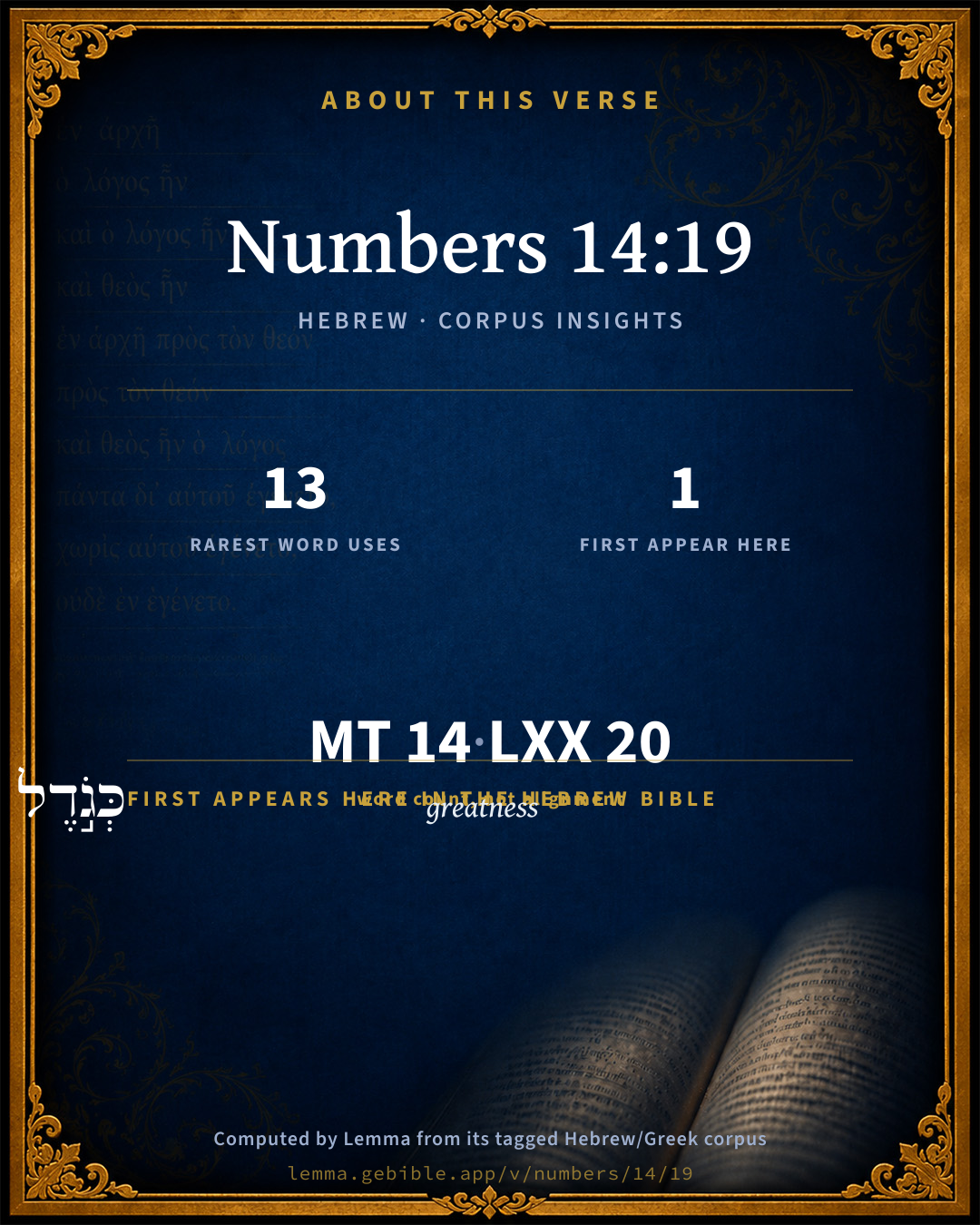
The rarest word here is כְּגֹ֣דֶל greatness H1433 — appearing just 13 times in the whole Hebrew Bible.

First appearance in Scripture

This word makes its first canonical appearance in the Hebrew Bible here:

  • כְּגֹ֣דֶל greatness H1433

Shared distinctive vocabulary

כְּגֹ֣דֶל greatness H1433 occurs in 13 verses of the Hebrew Bible. Also found in:

Grammatical profile

  • 2 verbs
  • 6 nouns
  • 2 pronouns
  • 1 preposition
  • 1 adverb
  • 2 particles

Verb forms

  • סְלַֽח Qal · Imperative
  • נָשָׂ֨אתָה֙ Qal · Perfect

Repetition

Words recur within this verse — often emphatic in Hebrew:

  • הָעָ֥ם people H5971 ×2
  • הַזֶּ֖ה this H2088 ×2

Hebrew & Septuagint length

In English translation the verse runs 28 words from the Hebrew and 20 from the Septuagint (LXX English) — the Septuagint runs noticeably shorter here. See the side-by-side →

A rough comparison of the two English renderings, which tokenize alike — not a word-level alignment.

Word counts can differ between the Hebrew and the Greek without any difference in meaning — e.g. the Hebrew direct-object marker אֵת has no separate Greek word, and Greek often adds the article ὁ.

In the original languages it is 14 Hebrew tokens and 20 Greek tokens — but the two are counted differently (Hebrew bundles its prefixes and suffixes into one token; the Greek is in lemma form), so that isn’t a like-for-like length.

Cross-references

18

Topical passages linked to Numbers 14:19 in the Treasury of Scripture Knowledge — connected by theme and wording, ordered by reader-vote popularity; previews shown in the World English Bible.

  • Exodus 34:9 He said, "If now I have found favor in your sight, Lord, please let the Lord go in the midst of us; although this is a stiff-necked people; pardon our iniquity and our sin, and take us for your inheritance."
  • Psalms 78:38 But he, being merciful, forgave iniquity, and didn't destroy them. Yes, many times he turned his anger away, And didn't stir up all his wrath.
  • Psalms 106:45 He remembered for them his covenant, And repented according to the multitude of his loving kindnesses.
  • Exodus 32:32 Yet now, if you will, forgive their sin-- and if not, please blot me out of your book which you have written."
  • Psalms 51:1–2 Have mercy on me, God, according to your loving kindness. According to the multitude of your tender mercies, blot out my transgressions.
  • Jonah 4:2 He prayed to Yahweh, and said, "Please, Yahweh, wasn't this what I said when I was still in my own country? Therefore I hurried to flee to Tarshish, for I knew that you are a gracious God, and merciful, slow to anger, and abundant in loving kindness, and you repent of the evil.
  • Exodus 32:10–14 Now therefore leave me alone, that my wrath may burn hot against them, and that I may consume them; and I will make of you a great nation."
  • Exodus 33:17 Yahweh said to Moses, "I will do this thing also that you have spoken; for you have found favor in my sight, and I know you by name."
  • 1 Kings 8:34 then hear you in heaven, and forgive the sin of your people Israel, and bring them again to the land which you gave to their fathers.
  • Psalms 106:7–8 Our fathers didn't understand your wonders in Egypt. They didn't remember the multitude of your loving kindnesses, But were rebellious at the sea, even at the Red Sea.
  • Isaiah 55:7 let the wicked forsake his way, and the unrighteous man his thoughts; and let him return to Yahweh, and he will have mercy on him; and to our God, for he will abundantly pardon.
  • Ezekiel 20:8–9 But they rebelled against me, and would not listen to me; they did not every man cast away the abominations of their eyes, neither did they forsake the idols of Egypt. Then I said I would pour out my wrath on them, to accomplish my anger against them in the midst of the land of Egypt.
  • Daniel 9:19 Lord, hear; Lord, forgive; Lord, listen and do; don't defer, for your own sake, my God, because your city and your people are called by your name.
  • Jonah 3:10 God saw their works, that they turned from their evil way. God repented of the evil which he said he would do to them, and he didn't do it.
  • Micah 7:18 Who is a God like you, who pardons iniquity, And passes over the disobedience of the remnant of his heritage? He doesn't retain his anger forever, Because he delights in loving kindness.
  • James 5:15 and the prayer of faith will heal him who is sick, and the Lord will raise him up. If he has committed sins, he will be forgiven.
  • 1 John 5:14–16 This is the boldness which we have toward him, that, if we ask anything according to his will, he listens to us.
  • Titus 3:4–7 But when the kindness of God our Savior and his love toward mankind appeared,

Cross-references courtesy of OpenBible.info (CC BY 4.0).

Hebrew and Greek witnesses Masoretic Hebrew ↔ Greek Septuagint

The same verse in the two great witnesses to the Old Testament, shown verse-for-verse.

Here the Septuagint runs noticeably shorter than the Hebrew — LXX2012 (modern English Septuagint) 20 words vs World English Bible 28. A rough length comparison of the two English translations, not a word-level alignment — read both below.

These are two independent witnesses, not word-aligned to each other, and the Septuagint is shown in lemma (dictionary) form.

Hebrew Numbers 14:19 Masoretic · Westminster Leningrad Codex

סְלַֽח נָ֗א לַעֲוֺ֛ן הָעָ֥ם הַזֶּ֖ה כְּגֹ֣דֶל חַסְדֶּ֑ךָ וְכַאֲשֶׁ֤ר נָשָׂ֨אתָה֙ לָעָ֣ם הַזֶּ֔ה מִמִּצְרַ֖יִם וְעַד הֵֽנָּה

Pardon, Please, the iniquity of this people according to the greatness of your loving kindness, and according as you have forgiven this people, from Egypt even until now.

World English Bible · Public Domain

Greek LXX Numbers 14:19 Septuagint · lemma form

ἀποἵημι ὁ ἁμαρτία ὁ λαός οὗτος κατά ὁ μέγας ἔλεος σύ καθάπερ ἵλεως αὐτός γίγνομαι ἀπό αἴγυπτος ἕως ὁ νῦν

Forgive this people their sin according to your great mercy, as you were favourable to them from Egypt until now.

LXX2012 (modern English Septuagint) · Public Domain

Hebrew: Westminster Leningrad Codex (CC BY 4.0). Greek: Septuagint (public domain); English from LXX2012 (modern English Septuagint) (Public Domain). How the Septuagint differs from the Hebrew →

Targum (Aramaic paraphrase)

2

The Targum is the ancient Jewish Aramaic paraphrase of the Hebrew Scriptures — an interpretive translation, not the Hebrew text itself. Onkelos (literal) and Pseudo-Jonathan (expansive) render the Torah, and Jonathan the Prophets. Coverage is partial: where no permissively-licensed English translation exists for a verse, only the Aramaic is shown. This is verse-level text, not a word-by-word alignment to the Hebrew.

  1. Targum Onkelos Torah (Genesis–Deuteronomy)
    שְׁבוֹק כְּעַן לְחוֹבֵי עַמָא הָדֵין כִּסְגִיאוּת טַבְוָתָךְ וּכְמָא דִי שְׁבַקְתָּא לְעַמָא הָדֵין מִמִצְרַיִם וְעַד כְּעָן

    (no public-domain English translation for this verse)

    Targum Onkelos — Aramaic: “Onkelos Genesis” (public domain); “Onkelos Exodus” (public domain); “Onkelos Leviticus” (public domain); “Onkelos Numbers” (public domain); “Onkelos Deuteronomy” (public domain). English: “Sefaria Community Translation” (CC0 1.0 (public-domain dedication)); “J.W. Etheridge. The Targums of Onkelos and Jonathan Ben Uzziel on the Pentateuch. London: Longmans, Green, 1862” (public domain). Text via Sefaria.

  2. Targum Pseudo-Jonathan Torah (Genesis–Deuteronomy)
    שְׁבוֹק כְּדוֹן לְסוּרְחָנוּת עַמָא הָדֵין כִּסְגִיאוּת טֵבְוָותָךְ וְהֵיכְמָא דְשָׁרִיתָא לְעַמָא הָדֵין מִן זְמַן דִנְפָקוּ מִמִצְרַיִם וְעַד כְּדוֹן

    Pardon now the sin of this people according to Thy great goodness, even as Thou hast forgiven them from the time that they came out from Mizraim until now.

    Targum Pseudo-Jonathan — Aramaic: “Targum Jonathan on Genesis” (public domain); “Targum Jonathan on Exodus” (public domain); “Targum Jonathan on Leviticus” (public domain); “Targum Jonathan on Numbers” (public domain); “Targum Jonathan on Deuteronomy” (public domain). English: “The Targum of Jonathan ben Uzziel, trans. J. W. Etheridge, London, 1862” (public domain). Text via Sefaria.

Commentary

Notes on Numbers 14:19 from classic Christian and Jewish commentators (each source and its license shown beneath its notes). The classic Christian expositions comment on the surrounding passage and are grouped to its opening verse, so a note may address several verses; the Jewish commentaries on the Tanakh (Rashi and others) are per-verse, so they appear only where the commentator wrote on this verse.

Lemma curates 59 commentaries, every one of them public domain or Creative Commons licensed, each selected and text-cleaned for this edition rather than reprinted as found. About our sources →

Trapp's Complete Commentary

John Trapp

Num 14:19 Pardon, I beseech thee, the iniquity of this people according unto the greatness of thy mercy, and as thou hast forgiven this people, from Egypt even until now.

Ver. 19. According to the greatness of thy mercy.] God’s power pleaded, {Num 14:17} and his mercy here are the Jachin and the Boaz whereon faith resteth.

John Trapp, A Commentary or Exposition upon All the Books of the Old and New Testament (1647–1656) — public domain. Text from a community e-Sword module.

MacLaren's Expositions of Holy Scripture

Alexander MacLaren

Numbers

MOSES THE INTERCESSOR

Num 14:19.

See how in this story a divine threat is averted and a divine promise is broken, thus revealing a standing law that these in Scripture are conditional.

This striking incident of Moses’ intercession suggests to us some thoughts as to

I. The ground of the divine forgiveness.

The appeal is not based on anything in the people. God is not asked to forgive because of their repentance or their faith. True, these are the conditions on which His pardon is received by us, but they are not the reasons why it is given by Him. Nor does Moses appeal to any sacrifices that had been offered and were conceived to placate God. But he goes deeper than all such pleas, and lays hold, with sublime confidence, on God’s own nature as his all-powerful plea. ‘The greatness of Thy mercy’ is the ground of the divine forgiveness, and the mightiest plea that human lips can urge. It suggests that His very nature is pardoning love; that ‘mercy’ is proper to Him, that it is the motive and impulse of His acts. He forgives because He is mercy. That is the foundation truth. It is the deep spring from which by inherent impulse all the streams of forgiveness well up.

What was true when Moses prayed for the rebels is true to-day. Christ’s work is the consequence, not the cause, of God’s pardoning love. It is the channel through which the waters reach us, but the waters made the channel for themselves.

II. The persistency of the divine pardon.

‘As thou hast forgiven . . .even until now.’

His past is the guarantee of His future. This is true of every one of His attributes. There is no limitation to the divine forgiveness; you cannot exhaust it.

Sometimes there may be long tracts of almost utter godlessness, or times of apathy. Sometimes there may be bursts of great and unsanctified evil after many professions of fidelity, as in David’s case. Sometimes there may be but a daily experience in which there is little apparent progress, little consciousness of growing mastery over sin, little of deepening holiness and spiritual power. Be it so! To all such, and to every other form of Christian unfaithfulness, this blessed thought applies.

We are apt to think as if our many pardons in the past made future pardons less likely, whereas the truth is that we have received forgiveness so often in the past that we may be quite sure that it will never fail us in the future. God has established a precedent in His dealings with us. He binds Himself by His past.

As in His creative energy, the forces that flung the whole universe forth were not exhausted by the act, but subsist continually to sustain it, as ‘He fainteth not, neither is weary,’ so in the works of His providence, and more especially of His grace, there is nothing in the exercise of any of His attributes to exhaust that attribute, nothing in the constant appeal which we make to His forgiving grace to weary out that grace. And thus we may learn, even from the unfading glories of the heavens and the undimmed splendours of His creative works, the lesson that, in the holier region of His love, and His pardoning mercy, there is no exhaustion, and that all the past instances of His pardoning grace only make the broader, firmer ground of certainty as to His continuous present and future forgiveness for all our iniquity. He who has proposed to us the ‘seventy times seven’ as the number of our forgivenesses will not let His own fall short of that tale. Our iniquities may be ‘more than the hairs of our heads,’ but as the psalmist who found his to be so comforted himself with thinking, God’s ‘thoughts which are to usward’ were ‘more than can be numbered.’ There would be a pardoning thought for every sin, and after all sins had been forgiven, there would be ‘multitudes of redemptions’ still available for penitent souls.

There is but one thing that limits the divine pardon, and that is continuous rejection of it.

Whoever seeks to be pardoned is pardoned.

III. The manner of the divine forgiveness.

He pardoned, but He also inflicted punishment, and in both He loves equally. The worst, that is the spiritual, consequences {which are the punishments} of sin, namely separation and alienation from God, He removes in the very act of forgiveness, but His pardon does not affect the natural consequences. ‘Thou wast a God that forgavest them and tookest vengeance of their inventions,’ says a psalmist in reference to this very incident. Thank God that He loves us too wisely and well not to let us by experience ‘know that it is a bitter thing to forsake the Lord.’

It is a blessing that He does so, and a sign that we are pardoned, if we rightly use it.

IV. The vehicle of the divine forgiveness.

The Mediator. Moses here may be taken as a dim shadow of Christ.

‘Moses was faithful in all his house’ but Jesus is the true Mediator, whose intercession consists in presenting the constant efficacy of His sacrifice, and to whom God ever says, ‘I have pardoned according to Thy word.’

Trust utterly to Him. You cannot weary out the forgiving love of God. ‘Christ ever liveth to make intercession’; with God is ‘plenteous redemption.’ ‘He shall redeem Israel out of all his iniquities.’

Alexander MacLaren, Expositions of Holy Scripture (1904–1910) — public domain. Text from a community e-Sword module.

Tyndale Open Study Notes

Tyndale Open Resources

14:19 Israel’s history since leaving Egypt had been a series of transgressions forgiven by the Lord (chs 11–12; Exod 15:22-27; 17:1-7; 32:1-14; Lev 10).

Tyndale Open Study Notes — © Tyndale Open Resources, licensed CC BY-SA 4.0. Text via the HelloAO Bible API.

Adam Clarke's Commentary

Verse 19. Pardon, I beseech thee, the iniquity of this people] From Nu 14:13-19 inclusive we have the words of Moses's intercession; they need no explanation, they are full of simplicity and energy; his arguments with God (for be did reason and argue with his Maker) are pointed, cogent, and respectful; and while they show a heart full of humanity, they evidence the deepest concern for the glory of God. The argumentum ad hominem is here used in the most unexceptionable manner, and with the fullest effect.

Adam Clarke's Commentary on the Bible (1810–1826) — public domain. Text from a community e-Sword/MySword module.

John Gill's Exposition

Pardon, I beseech thee, the iniquity of this people,

according unto the greatness of thy mercy,.... Intimating, that though the sin of this people was great, the mercy of God to pardon was greater; and therefore he entreats that God would deal with them, not according to the greatness of their sins, and the strictness of justice, but according to the greatness of his mercy, who would, and does, abundantly pardon:

and as thou hast forgiven this people from Egypt even until now; which shows both that these people had been continually sinning against the Lord, ever since they came out of Egypt, notwithstanding the great goodness of God unto them, and that he had as constantly pardoned; and therefore it was hoped and entreated that he would still continue to pardon them, he being the same he ever was, and whose mercy and goodness endure for ever: he had pardoned already sins of the like kind since their coming out of Egypt, as their murmurings for bread in the wilderness of Sin, Exo 16:1, and for water at Rephidim, Exo 17:1, and even a greater sin than these, idolatry, or the worship of the calf, Exo 32:1.

John Gill's Exposition of the Whole Bible (1746–1763) — public domain (CC PDM 1.0). Text via the HelloAO Bible API.

Matthew Poole's English Annotations

After many and great provocations; show thyself still to be the same sin-pardoning God.

Matthew Poole's English Annotations on the Holy Bible (1683–1685) — public domain. Text from a community e-Sword/MySword module.

Whedon's Commentary on the Bible

Daniel D. Whedon

19. Pardon… the iniquity — Moses makes no attempt to appease God by bloody sacrifices. He knows that Jehovah cannot be bought off by gifts and slain victims. Here Mosaism is in striking contrast with Gentilism, which, in the hour of peril, always runs to its altar with its sacrifice to placate some offended deity. Moses casts himself upon the divine clemency, pleading the glory of Jehovah’s great name.

The greatness of thy mercy — Mercy, and mercy only, is the plea of Moses. Not one moral excellence, not one meritorious act of Israel, is adduced as the ground of pardon. Under both the old covenant and the new, salvation is grounded solely on reasons existing in the divine mind, while the condition of that salvation is man’s asking for it by faith. The faith of Moses prevails for Israel.

From Egypt… until now — Every instance of God’s mercy in the past may be urged as a reason for its repetition; but the past clemency of human governors toward offenders justifies a more severe penalty.

Daniel D. Whedon (gen. ed.), Commentary on the Old and New Testaments (1874–1909) — public domain. Text from a community e-Sword module.

The Pulpit Commentary

From Egypt until now. From the first passion of despair in Egypt itself, (Exo_14:11, Exo_14:12) through the murmurings in the wilderness of Sin, and the apostasy of Mount Sinai, to the last rebellion at Kibroth-Hattaavah.

The Pulpit Commentary (1880–1919), ed. H.D.M. Spence-Jones & Joseph S. Exell — public domain. Text from a community e-Sword module.

Lesson kit

Teaching starters — assembled from the data on this page, not authored interpretation. Every prompt links to the verse data it draws on. Edit before teaching.

Numbers, in the Pentateuch, opens this verse with 14 words (12 distinct Hebrew lemmas). Its most distinctive word is gôdel (“greatness”). The Greek Septuagint runs shorter here. A historical commentator’s framing appears above. Read the whole chapter for the surrounding context.

Discussion questions

  1. How does “greatness” (gôdel) shape what this verse is saying?
  2. This is the first place “greatness” appears in Scripture (first appears here). What does its debut here establish?
  3. How does Deuteronomy 3:24, which shares the word «greatness», read alongside this verse?
  4. What does the repetition of “people” (2× in this one verse) do in this verse?
  5. The Septuagint runs shorter here than the Hebrew. What might account for the difference?
  6. These translations render this verse differently; the difference is in the English rendering, not the original. What questions does that raise?
  7. «סְלַֽח» is a Qal Imperative verb. How does that grammatical form shape the action described?
  8. Compare how Trapp's Complete Commentary and MacLaren's Expositions of Holy Scripture read this verse. Where do they agree or differ?

Things to notice

Reading settings

Reading text

Shown beneath each verse's original-language words.

Old Testament
Old Testament edition

Read the OT as the Masoretic Hebrew (MT) or the Greek Septuagint (LXX).

English shown for the Greek Septuagint (in the Hebrew ↔ Greek comparison).

Comparing translations? Open the Compare panel on any verse page to stack up to four side by side.