
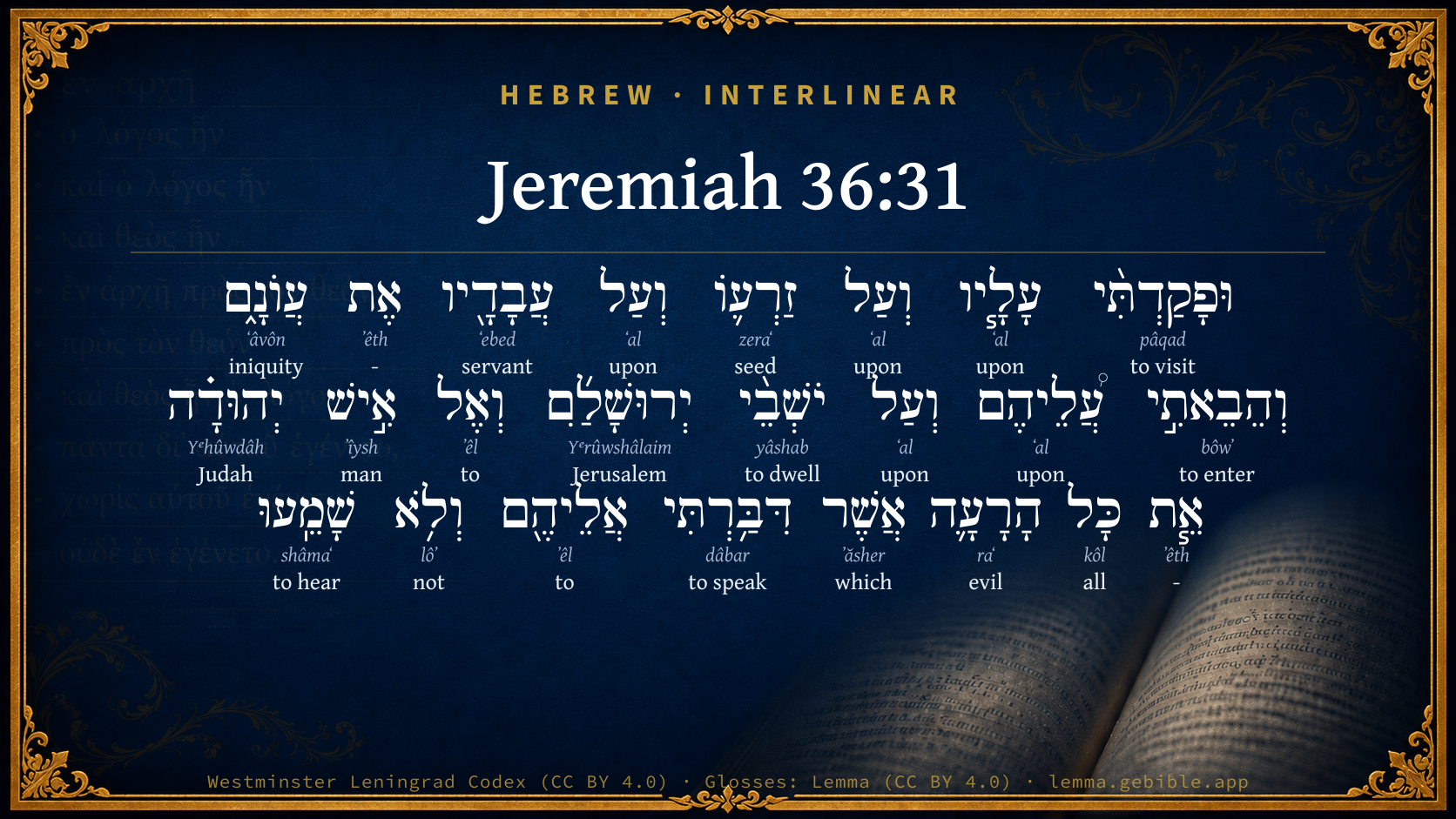
Jeremiah 36:31

Hebrew (Westminster Leningrad Codex) Jeremiah 36:31 appears in the Hebrew Old Testament. The text above is from the Westminster Leningrad Codex. Each word links to its Strong’s number, a concise gloss, and parsing drawn from the Open Scriptures Hebrew Bible morphology. Click any word for its full Brown-Driver-Briggs (BDB) entry.
Download image
Cite this verse

Jeremiah 36:31 (World English Bible). Public Domain. Lemma interlinear Bible study tool, https://lemma.gebible.app/v/jeremiah/36/31.

Show BibTeX & RIS
BibTeX
RIS
English Translation
I will punish him and his seed and his servants for their iniquity; and I will bring on them, and on the inhabitants of Jerusalem, and on the men of Judah, all the evil that I have pronounced against them, but they didn't listen.
World English Bible · Public Domain
Download a study sheet

One document with this verse’s original text, its word-by-word gloss line, the meaning frame, cross-references with their text, attributed commentary, and full source and license credits — printable, and it pastes into notes with its structure intact.

This verse Autodidact and up

Study sheet (.html) Plain text (.txt)

A passage Seminary Student

Up to 50 verses in one chapter. A passage sheet keeps up to 6 commentary sources and 12 cross-references per verse, in the order this page ranks them, and says so on the sheet whenever that leaves anything out. Ask for a single verse and you get the Autodidact verse sheet above.

Everything on this page stays free to read, with no account — the sheet is a download of what is already on screen, not access to it.

Want to remove ads? Support Godless Engineer
Compare translations 3

The same verse in 3 English versions, stacked beneath the original-language interlinear above. Click any original word for its lexicon entry.

Each is an independent rendering of the whole verse — the interlinear is not word-aligned to these translations.

Highlighted words mark where these versions differ — a whole-verse word diff, not a word-by-word alignment.

  • World English Bible Public Domain
    I will punish him and his seed and his servants for their iniquity; and I will bring on them, and on the inhabitants of Jerusalem, and on the men of Judah, all the evil that I have pronounced against them, but they didn't listen.
  • King James Version Public Domain
    And I will punish him and his seed and his servants for their iniquity; and I will bring upon them, and upon the inhabitants of Jerusalem, and upon the men of Judah, all the evil that I have pronounced against them; but they hearkened not.
  • unfoldingWord Literal Text CC BY-SA 4.0
    For I will punish you, your descendants, and your servants for the iniquity of you all. I will bring on you, on all the inhabitants of Jerusalem, and on every person in Judah all the disasters with which I have threatened you with, but to which you paid no attention.”

unfoldingWord Literal Text — © unfoldingWord, licensed CC BY-SA 4.0. Word-aligned USFM3 via Door43 (git.door43.org/unfoldingWord/en_ult).

Versions to compare (up to 4)

3 of 4 selected

Show all 18 translations

Every available English version of this verse, each an independent rendering of the whole verse.

  • World English Bible Public Domain
    I will punish him and his seed and his servants for their iniquity; and I will bring on them, and on the inhabitants of Jerusalem, and on the men of Judah, all the evil that I have pronounced against them, but they didn't listen.
  • Berean Standard Bible Public Domain
    I will punish him and his descendants and servants for their iniquity. I will bring on them, on the residents of Jerusalem, and on the men of Judah, all the calamity about which I warned them but they did not listen.”
  • Majority Standard Bible Public Domain
    I will punish him and his descendants and servants for their iniquity. I will bring on them, on the residents of Jerusalem, and on the men of Judah, all the calamity about which I warned them but they did not listen.”
  • King James Version Public Domain
    And I will punish him and his seed and his servants for their iniquity; and I will bring upon them, and upon the inhabitants of Jerusalem, and upon the men of Judah, all the evil that I have pronounced against them; but they hearkened not.
  • American Standard Version (1901) Public Domain
    And I will punish him and his seed and his servants for their iniquity; and I will bring upon them, and upon the inhabitants of Jerusalem, and upon the men of Judah, all the evil that I have pronounced against them, but they hearkened not.
  • Revised Version (1885) Public Domain
    And I will punish him and his seed and his servants for their iniquity; and I will bring upon them, and upon the inhabitants of Jerusalem, and upon the men of Judah, all the evil that I have pronounced against them, but they hearkened not.
  • Geneva Bible (1599) Public Domain
    And I will visite him and his seede, and his seruants for their iniquitie, and I will bring vpon them, and vpon the inhabitants of Ierusalem, and vpon the men of Iudah all the euil that I haue pronounced against them: but they would not heare.
  • Douay-Rheims (1899) Public Domain
    And I will punish him, and his seed and his servants, for their iniquities, and I will bring upon them, and upon the inhabitants of Jerusalem, and upon the men of Juda all the evil that I have pronounced against them, but they have not heard.
  • Young's Literal Translation Public Domain
    and I have charged on him, and on his seed, and on his servants, their iniquity; and I have brought in on them, and on the inhabitants of Jerusalem, and unto the men of Judah, all the evil that I have spoken unto them, and they hearkened not.'
  • Literal Standard Version CC BY-SA 4.0
    and I have charged on him, and on his seed, and on his servants, their iniquity; and I have brought in on them, and on the inhabitants of Jerusalem, and to the men of Judah, all the evil that I have spoken to them, and they did not listen.”
  • Unlocked Literal Bible CC BY-SA 4.0
    For I will punish you, your descendants, and your servants for the iniquity of you all. I will bring on you, on all the inhabitants of Jerusalem, and on every person in Judah all the disasters with which I have threatened you with, but to which you paid no attention.”
  • unfoldingWord Literal Text CC BY-SA 4.0
    For I will punish you, your descendants, and your servants for the iniquity of you all. I will bring on you, on all the inhabitants of Jerusalem, and on every person in Judah all the disasters with which I have threatened you with, but to which you paid no attention.”
  • Darby Bible Public Domain
    And I will visit their iniquity upon him, and upon his seed, and upon his servants; and I will bring upon them, and upon the inhabitants of Jerusalem, and upon the men of Judah, all the evil that I have pronounced against them; and they have not hearkened.
  • World Messianic Bible Public Domain
    I will punish him, his offspring, and his servants for their iniquity. I will bring on them, on the inhabitants of Jerusalem, and on the men of Judah, all the evil that I have pronounced against them, but they didn’t listen.”’”
  • Webster's Bible Public Domain
    And I will punish him and his seed and his servants for their iniquity; and I will bring upon them, and upon the inhabitants of Jerusalem, and upon the men of Judah, all the evil that I have pronounced against them; but they hearkened not.
  • Free Bible Version CC BY-SA 4.0
    I'm going to punish him and his descendants and officials for their sins. I will bring down on them and on the people living in Jerusalem and Judah, all the disasters I warned them about but they refused to listen.
  • Bible in Basic English Public Domain
    And I will send punishment on him and on his seed and on his servants for their evil-doing; I will send on them and on the people of Jerusalem and the men of Judah, all the evil which I said against them, but they did not give ear.
  • JPS Tanakh (1917) Public Domain
    And I will visit upon him and his seed and his servants their iniquity; and I will bring upon them, and upon the inhabitants of Jerusalem, and upon the men of Judah, all the evil that I have pronounced against them, but they hearkened not.'

Literal Standard Version (2020), Covenant Press — licensed CC BY-SA 4.0. Text via the HelloAO Bible API (eBible.org). Unlocked Literal Bible (unfoldingWord) — licensed CC BY-SA 4.0. Text via the HelloAO Bible API (eBible.org). unfoldingWord Literal Text — © unfoldingWord, licensed CC BY-SA 4.0. Word-aligned USFM3 via Door43 (git.door43.org/unfoldingWord/en_ult). Free Bible Version, Dr. Jonathan Gallagher — licensed CC BY-SA 4.0. Text via the HelloAO Bible API (eBible.org).

Word by word

More ways to search: Search by grammar → Find every occurrence → Compare this word →

Practice this passage: Drill this verse → Learn its vocabulary →

זַרְע֛וֹ
zeraʻ
H2233
“seed · his”
Noun, Common, Masculine, Singular, Construct + Suffix, Personal, 3rd Person, Masculine, Singular
Part of Speech
Noun
Type
Common
Gender
Masculine
Number
Singular
State
Construct
Full BDB Definition

Origin: from H2232

TWOT: 582a

seed, sowing, offspring - a sowing - seed - semen virile - offspring, descendants, posterity, children - of moral quality - a practitioner of righteousness (figuratively) - sowing time (by metonymy)
  1. וּפָקַדְתִּ֨י pâqad H6485 “and · to visit” Conjunction + Verb, Qal, Sequential Perfect, 1st Person, Common, Singular
  2. עָלָ֧יו ʻal H5921 “upon · him” Preposition + Suffix, Personal, 3rd Person, Masculine, Singular
  3. וְעַל ʻal H5921 “and · upon” Conjunction + Preposition
  4. וְעַל ʻal H5921 “and · upon” Conjunction + Preposition
  5. עֲבָדָ֖יו ʻebed H5650 “servants · his” Noun, Common, Masculine, Plural, Construct + Suffix, Personal, 3rd Person, Masculine, Singular
  6. אֶת ʼêth H853 “-” Particle, Direct Object
  7. עֲוֺנָ֑ם ʻâvôn H5771 “iniquity · their” Noun, Common, Both, Singular, Construct + Suffix, Personal, 3rd Person, Masculine, Plural
  8. וְהֵבֵאתִ֣י bôwʼ H935 “and · to enter” Conjunction + Verb, Hiphil, Sequential Perfect, 1st Person, Common, Singular
  9. עֲ֠לֵיהֶם ʻal H5921 “upon · them” Preposition + Suffix, Personal, 3rd Person, Masculine, Plural
  10. וְעַל ʻal H5921 “and · upon” Conjunction + Preposition
  11. יֹשְׁבֵ֨י yâshab H3427 “dwelling” Verb, Qal, Participle Active, Masculine, Plural, Construct
  12. יְרוּשָׁלִַ֜ם Yᵉrûwshâlaim H3389 “Jerusalem” Noun, Proper
  13. וְאֶל ʼêl H413 “and · to” Conjunction + Preposition
  14. אִ֣ישׁ ʼîysh H376 “man of” Noun, Common, Masculine, Singular, Construct
  15. יְהוּדָ֗ה Yᵉhûwdâh H3063 “Judah” Noun, Proper
  16. אֵ֧ת ʼêth H853 “-” Particle, Direct Object
  17. כָּל kôl H3605 “all of” Noun, Common, Masculine, Singular, Construct
  18. הָרָעָ֛ה raʻ H7451 “the · evil” Particle, Definite Article + Noun, Common, Feminine, Singular, Absolute
  19. אֲשֶׁר ʼăsher H834 “which” Particle, Relative
  20. דִּבַּ֥רְתִּי dâbar H1696 “to speak” Verb, Piel, Perfect, 1st Person, Common, Singular
  21. אֲלֵיהֶ֖ם ʼêl H413 “to · them” Preposition + Suffix, Personal, 3rd Person, Masculine, Plural
  22. וְלֹ֥א lôʼ H3808 “and · not” Conjunction + Particle, Negative
  23. שָׁמֵֽעוּ shâmaʻ H8085 “to hear” Verb, Qal, Perfect, 3rd Person, Common, Plural

About this verse

These counts appear in no published source. They are computed here, from the morphology-tagged text and Lemma’s own curated glosses. What Lemma adds →

24
words
18
distinct lemmas
Prophets
section

Grammatical profile

  • 5 verbs
  • 8 nouns
  • 7 prepositions
  • 4 particles

Verb forms

  • וּפָקַדְתִּ֨י Qal · Sequential Perfect
  • וְהֵבֵאתִ֣י Hiphil · Sequential Perfect
  • יֹשְׁבֵ֨י Qal · Participle Active
  • דִּבַּ֥רְתִּי Piel · Perfect
  • שָׁמֵֽעוּ Qal · Perfect

Repetition

Words recur within this verse — often emphatic in Hebrew:

  • עָלָ֧יו upon H5921 ×5
  • וְאֶל to H413 ×2

Cross-references

11

Topical passages linked to Jeremiah 36:31 in the Treasury of Scripture Knowledge — connected by theme and wording, ordered by reader-vote popularity; previews shown in the World English Bible.

  • Proverbs 29:1 He who is often rebuked and stiffens his neck Will be destroyed suddenly, with no remedy.
  • Jeremiah 19:15 Thus says Yahweh of Hosts, the God of Israel, Behold, I will bring on this city and on all its towns all the evil that I have pronounced against it; because they have made their neck stiff, that they may not hear my words.
  • Jeremiah 23:34 As for the prophet, and the priest, and the people, who shall say, The burden of Yahweh, I will even punish that man and his house.
  • Jeremiah 35:17 therefore thus says Yahweh, the God of hosts, the God of Israel: Behold, I will bring on Judah and on all the inhabitants of Jerusalem all the evil that I have pronounced against them; because I have spoken to them, but they have not heard; and I have called to them, but they have not answered.
  • Leviticus 26:14 "'But if you will not listen to me, and will not do all these commandments;
  • Deuteronomy 28:15–68 But it shall come to pass, if you will not listen to the voice of Yahweh your God, to observe to do all his commandments and his statutes which I command you this day, that all these curses shall come on you, and overtake you.
  • Jeremiah 11:8 Yet they didn't obey, nor turn their ear, but walked everyone in the stubbornness of their evil heart: therefore I brought on them all the words of this covenant, which I commanded them to do, but they didn't do them.
  • Jeremiah 17:18 Let them be disappointed who persecute me, but let not me be disappointed; let them be dismayed, but don't let me be dismayed; bring on them the day of evil, and destroy them with double destruction.
  • Jeremiah 29:17–19 thus says Yahweh of Hosts; Behold, I will send on them the sword, the famine, and the pestilence, and will make them like vile figs, that can't be eaten, they are so bad.
  • Jeremiah 44:4–14 However I sent to you all my servants the prophets, rising up early and sending them, saying, Oh, don't do this abominable thing that I hate.
  • Matthew 23:37 "Jerusalem, Jerusalem, who kills the prophets, and stones those who are sent to her! How often would I have gathered your children together, even as a hen gathers her chickens under her wings, and you would not!

Cross-references courtesy of OpenBible.info (CC BY 4.0).

Hebrew and Greek witnesses Masoretic Hebrew ↔ Greek Septuagint

The same verse in the two great witnesses to the Old Testament, shown verse-for-verse.

These are two independent witnesses, not word-aligned to each other, and the Septuagint is shown in lemma (dictionary) form.

Hebrew Jeremiah 36:31 Masoretic · Westminster Leningrad Codex

וּפָקַדְתִּ֨י עָלָ֧יו וְעַל זַרְע֛וֹ וְעַל עֲבָדָ֖יו אֶת עֲוֺנָ֑ם וְהֵבֵאתִ֣י עֲ֠לֵיהֶם וְעַל יֹשְׁבֵ֨י יְרוּשָׁלִַ֜ם וְאֶל אִ֣ישׁ יְהוּדָ֗ה אֵ֧ת כָּל הָרָעָ֛ה אֲשֶׁר דִּבַּ֥רְתִּי אֲלֵיהֶ֖ם וְלֹ֥א שָׁמֵֽעוּ

I will punish him and his seed and his servants for their iniquity; and I will bring on them, and on the inhabitants of Jerusalem, and on the men of Judah, all the evil that I have pronounced against them, but they didn't listen.

World English Bible · Public Domain

Greek LXX Structure differs

In the Septuagint, Jeremiah is about an eighth shorter than the Hebrew and arranges its material differently — the Oracles Against the Nations (Hebrew chapters 46–51) appear in the middle of the Greek book, after 25:13. Because the chapter and verse boundaries do not line up, a verse-for-verse comparison with the Hebrew is not shown.

A verse-for-verse comparison isn’t shown here because the chapters and verses don’t line up. Switch to the LXX edition with the MT / LXX toggle above to read the Greek directly.

Hebrew: Westminster Leningrad Codex (CC BY 4.0). Greek: Septuagint (public domain); English from a public-domain English Septuagint. How the Septuagint differs from the Hebrew →

Targum (Aramaic paraphrase)

1

The Targum is the ancient Jewish Aramaic paraphrase of the Hebrew Scriptures — an interpretive translation, not the Hebrew text itself. Onkelos (literal) and Pseudo-Jonathan (expansive) render the Torah, and Jonathan the Prophets. Coverage is partial: where no permissively-licensed English translation exists for a verse, only the Aramaic is shown. This is verse-level text, not a word-by-word alignment to the Hebrew.

  1. Targum Jonathan Prophets (Joshua–Malachi)
    וְאַסְעַר עֲלוֹהִי וְעַל בְּנוֹהִי וְעַל עַבְדוֹהִי יַת חוֹבֵיהוֹן וְאַיְתִי עֲלֵיהוֹן וְעַל יַתְבֵי יְרוּשְׁלֶם וְעַל אֱנַשׁ יְהוּדָה יַת כָּל בִּישָׁתָא דִגְזָרֵית עֲלֵיהוֹן וְלָא קַבִּילוּ:

    (no public-domain English translation for this verse)

    Targum Jonathan — Aramaic: “Mikraot Gedolot” (public domain). English: “Sefaria Community Translation” (CC0 1.0 (public-domain dedication)); “London "Chaldee Paraphrase," 1871” (public domain). Text via Sefaria.

Commentary

Notes on Jeremiah 36:31 from classic Christian and Jewish commentators (each source and its license shown beneath its notes). The classic Christian expositions comment on the surrounding passage and are grouped to its opening verse, so a note may address several verses; the Jewish commentaries on the Tanakh (Rashi and others) are per-verse, so they appear only where the commentator wrote on this verse.

Lemma curates 59 commentaries, every one of them public domain or Creative Commons licensed, each selected and text-cleaned for this edition rather than reprinted as found. About our sources →

Trapp's Complete Commentary

John Trapp

Jer 36:31 And I will punish him and his seed and his servants for their iniquity; and I will bring upon them, and upon the inhabitants of Jerusalem, and upon the men of Judah, all the evil that I have pronounced against them; but they hearkened not.

Ver. 31. And I will punish him and his seed.] See on Jer 36:26. The like is threatened to Zedekiah, {Jer 21:7} who was therefore the worse, because he should have been warned by his brother’s miseries.

And I will bring upon them.] See Jer 35:17. Malis horrendis adobruentur omnes.

John Trapp, A Commentary or Exposition upon All the Books of the Old and New Testament (1647–1656) — public domain. Text from a community e-Sword module.

John Calvin's Commentaries

Here a reason is given for what the former verse contains; for if the Prophet had only said, that the dead body of the king would remain unburied and cast out in dishonor to be exposed in the night to the cold and in the day to the heat, the narrative would not have produced the effect intended; but God shews here the cause, which was this, that he had forewarned King Jehoiakim and all his counsellors, (called here servants) and the inhabitants of Jerusalem, and all the Jews universally: as then they had been in due time clearly told what calamity was near at hand, and yet no one had repented, for this so great an obstinacy God says now that he would take vengeance, I will visit him and his seed and the whole people for their iniquity — what was the iniquity? even that they had so grievously and in so many ways provoked God, and had not returned to a sound mind, though reproved by the Prophet, but had become more and more hardened.

The extremity of their iniquity the Prophet thus points out, because they hearkened not to the threatenings, by which God had endeavored to rescue them from the coming ruin: for there would have been some hope of deliverance, had they deprecated God’s wrath; but as his threatenings had been despised, it was, as I have said, an extreme iniquity. And we see elsewhere how much God abominates this diabolical presumption of men,

“I have called to sackcloth and ashes; but ye have called to the harp and to joy, and have said, ‘Let us feast and drink, for to-morrow we shall die:’ as I live, this iniquity shall not be blotted out.” (Isaiah 22:12, 13)

God swore by himself, that this sin should not be expiated, for the Jews repented not when he kindly invited them to himself, and declared to them that they could not escape extreme punishment. It is therefore no wonder that God in this place also represents their obstinate wickedness as being the greatest, the Jews having not hearkened to the reproofs conveyed to them by the mouth of Jeremiah. It follows —

John Calvin's Commentaries (1540-1563) — public domain. Text from the Calvin Translation Society English edition (1840s-50s) via the Christian Classics Ethereal Library (ccel.org). Calvin's coverage is partial (roughly two-thirds of the Bible); uncommented books and verses are honest gaps, never fabricated. The 19th-century editor's footnotes and remarks are omitted so the notes are faithfully Calvin's own voice.

John Gill's Exposition

And I will punish him and his seed and his servants for their iniquity,.... In cutting the roll pieces, and burning it, as Abarbinel interprets it; which either was done by himself, or by his order, and with his connivance; and at which perhaps his sons were present, and expressed a pleasure in it; an& his servants that stood by assented to it, excepting three; nor were they afraid of the judgments of God for it, nor in the least shocked at it, Jer 36:24; though this may be understood of all their iniquities they had been guilty of, the singular being put for the plural:

and I will bring upon them, and upon the inhabitants of Jerusalem, and upon the men of Judah, all the evil that I have pronounced against them; the sword, famine, and pestilence; the destruction of their land, city, and temple; and their captivity in Babylon:

but they hearkened not; to what was said to them, neither in the first nor in the second roll.

John Gill's Exposition of the Whole Bible (1746–1763) — public domain (CC PDM 1.0). Text via the HelloAO Bible API.

Matthew Poole's English Annotations

As to the people, God threateneth they should feel, what they were not willing to hear, even all the evil which God by his prophet had pronounced against them.

Matthew Poole's English Annotations on the Holy Bible (1683–1685) — public domain. Text from a community e-Sword/MySword module.

The Pulpit Commentary

I will bring upon them, etc. (comp. Jer_35:17 Jer_19:15)

The Pulpit Commentary (1880–1919), ed. H.D.M. Spence-Jones & Joseph S. Exell — public domain. Text from a community e-Sword module.

Lesson kit

Teaching starters — assembled from the data on this page, not authored interpretation. Every prompt links to the verse data it draws on. Edit before teaching.

Jeremiah, in the Prophets, opens this verse with 24 words (18 distinct Hebrew lemmas). Its most distinctive word is zeraʻ (“seed”). A historical commentator’s framing appears above. Read the whole chapter for the surrounding context.

Discussion questions

  1. The word zeraʻ carries the sense “seed.” How does it shape the verse?
  2. Proverbs 29:1 shares this passage’s theme. How do the two illuminate each other?
  3. “upon” occurs 5× in this one verse. What is the effect of the repetition?
  4. These translations render this verse differently. What is at stake in choosing one wording over another?
  5. The verb «וּפָקַדְתִּ֨י» is Qal Sequential Perfect. How does its form color the action?
  6. Reading how Trapp's Complete Commentary and John Calvin's Commentaries read this verse, where do the two commentators agree and where do they part?

Things to notice

Reading settings

Reading text

Shown beneath each verse's original-language words.

Old Testament
Old Testament edition

Read the OT as the Masoretic Hebrew (MT) or the Greek Septuagint (LXX).

English shown for the Greek Septuagint (in the Hebrew ↔ Greek comparison).

Comparing translations? Open the Compare panel on any verse page to stack up to four side by side.