
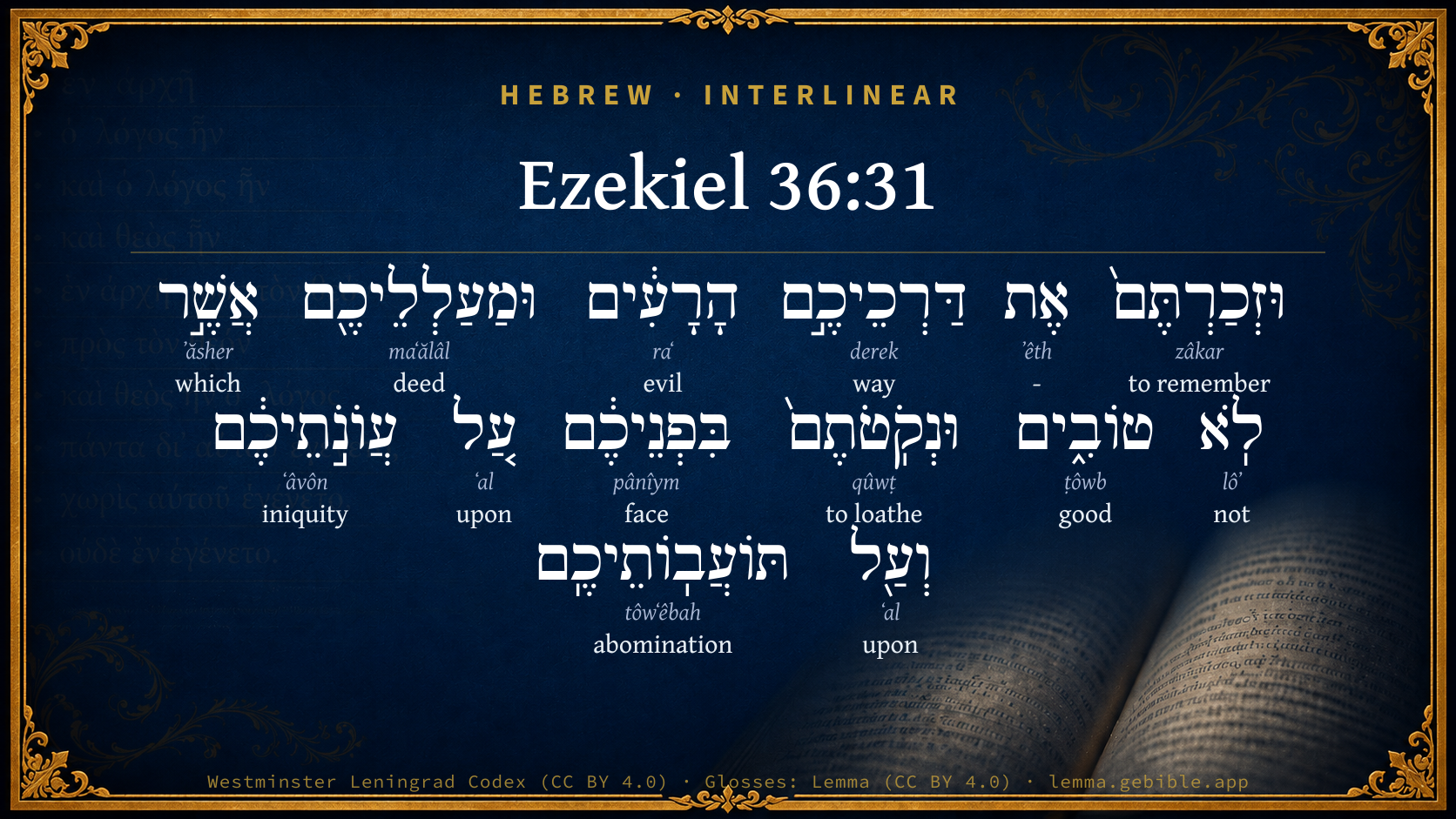
Ezekiel 36:31

Hebrew (Westminster Leningrad Codex) Ezekiel 36:31 appears in the Hebrew Old Testament. The text above is from the Westminster Leningrad Codex. Each word links to its Strong’s number, a concise gloss, and parsing drawn from the Open Scriptures Hebrew Bible morphology. Click any word for its full Brown-Driver-Briggs (BDB) entry.
Download image
Cite this verse

Ezekiel 36:31 (World English Bible). Public Domain. Lemma interlinear Bible study tool, https://lemma.gebible.app/v/ezekiel/36/31.

Show BibTeX & RIS
BibTeX
RIS
English Translation
Then shall you remember your evil ways, and your doings that were not good; and you shall loathe yourselves in your own sight for your iniquities and for your abominations.
World English Bible · Public Domain
Download a study sheet

One document with this verse’s original text, its word-by-word gloss line, the meaning frame, cross-references with their text, attributed commentary, and full source and license credits — printable, and it pastes into notes with its structure intact.

This verse Autodidact and up

Study sheet (.html) Plain text (.txt)

A passage Seminary Student

Up to 50 verses in one chapter. A passage sheet keeps up to 6 commentary sources and 12 cross-references per verse, in the order this page ranks them, and says so on the sheet whenever that leaves anything out. Ask for a single verse and you get the Autodidact verse sheet above.

Everything on this page stays free to read, with no account — the sheet is a download of what is already on screen, not access to it.

Want to remove ads? Support Godless Engineer
Compare translations 3

The same verse in 3 English versions, stacked beneath the original-language interlinear above. Click any original word for its lexicon entry.

Each is an independent rendering of the whole verse — the interlinear is not word-aligned to these translations.

Highlighted words mark where these versions differ — a whole-verse word diff, not a word-by-word alignment.

  • World English Bible Public Domain
    Then shall you remember your evil ways, and your doings that were not good; and you shall loathe yourselves in your own sight for your iniquities and for your abominations.
  • King James Version Public Domain
    Then shall ye remember your own evil ways, and your doings that were not good, and shall lothe yourselves in your own sight for your iniquities and for your abominations.
  • unfoldingWord Literal Text CC BY-SA 4.0
    Then you will think of your wicked ways and your deeds that were not good, and you will show loathing on your faces because of your own sins and your disgusting deeds.

unfoldingWord Literal Text — © unfoldingWord, licensed CC BY-SA 4.0. Word-aligned USFM3 via Door43 (git.door43.org/unfoldingWord/en_ult).

Versions to compare (up to 4)

3 of 4 selected

Show all 18 translations

Every available English version of this verse, each an independent rendering of the whole verse.

  • World English Bible Public Domain
    Then shall you remember your evil ways, and your doings that were not good; and you shall loathe yourselves in your own sight for your iniquities and for your abominations.
  • Berean Standard Bible Public Domain
    Then you will remember your evil ways and wicked deeds, and you will loathe yourselves for your iniquities and abominations.
  • Majority Standard Bible Public Domain
    Then you will remember your evil ways and wicked deeds, and you will loathe yourselves for your iniquities and abominations.
  • King James Version Public Domain
    Then shall ye remember your own evil ways, and your doings that were not good, and shall lothe yourselves in your own sight for your iniquities and for your abominations.
  • American Standard Version (1901) Public Domain
    Then shall ye remember your evil ways, and your doings that were not good; and ye shall loathe yourselves in your own sight for your iniquities and for your abominations.
  • Revised Version (1885) Public Domain
    Then shall ye remember your evil ways, and your doings that were not good; and ye shall loathe yourselves in your own sight for your iniquities and for your abominations.
  • Geneva Bible (1599) Public Domain
    Then shall ye remember your owne wicked wayes, and your deedes that were not good, and shall iudge your selues worthie to haue bene destroyed for your iniquities, and for your abominations.
  • Douay-Rheims (1899) Public Domain
    And you shall remember your wicked ways, and your doings that were not good: and your iniquities, and your wicked deeds shall displease you.
  • Young's Literal Translation Public Domain
    And ye have remembered your ways that `are' evil, And your doings that `are' not good, And have been loathsome in your own faces, For your iniquities, and for your abominations.
  • Literal Standard Version CC BY-SA 4.0
    And you have remembered your ways that [are] evil, || And your doings that [are] not good, || And have been loathsome in your own faces, || For your iniquities, and for your abominations.
  • Unlocked Literal Bible CC BY-SA 4.0
    Then you will think of your wicked ways and your deeds that were not good, and you will show loathing on your faces because of your own sins and your disgusting deeds.
  • unfoldingWord Literal Text CC BY-SA 4.0
    Then you will think of your wicked ways and your deeds that were not good, and you will show loathing on your faces because of your own sins and your disgusting deeds.
  • Darby Bible Public Domain
    And ye shall remember your evil ways, and your doings which were not good, and shall loathe yourselves for your iniquities and for your abominations.
  • World Messianic Bible Public Domain
    “‘“Then you will remember your evil ways, and your deeds that were not good; and you will loathe yourselves in your own sight for your iniquities and for your abominations.
  • Webster's Bible Public Domain
    Then shall ye remember your own evil ways, and your doings that were not good, and shall lothe yourselves in your own sight for your iniquities, and for your abominations.
  • Free Bible Version CC BY-SA 4.0
    Then you will remember your evil ways and terrible things you've done, and you'll hate yourselves for your sins and disgusting actions.
  • Bible in Basic English Public Domain
    And at the memory of your evil ways and your wrongdoings, you will have bitter hate for yourselves because of your evil-doings and your disgusting ways, O children of Israel.
  • JPS Tanakh (1917) Public Domain
    Then shall ye remember your evil ways, and your doings that were not good; and ye shall loathe yourselves in your own sight for your iniquities and for your abominations.

Literal Standard Version (2020), Covenant Press — licensed CC BY-SA 4.0. Text via the HelloAO Bible API (eBible.org). Unlocked Literal Bible (unfoldingWord) — licensed CC BY-SA 4.0. Text via the HelloAO Bible API (eBible.org). unfoldingWord Literal Text — © unfoldingWord, licensed CC BY-SA 4.0. Word-aligned USFM3 via Door43 (git.door43.org/unfoldingWord/en_ult). Free Bible Version, Dr. Jonathan Gallagher — licensed CC BY-SA 4.0. Text via the HelloAO Bible API (eBible.org).

Word by word

More ways to search: Search by grammar → Find every occurrence → Compare this word →

Practice this passage: Drill this verse → Learn its vocabulary →

וּנְקֹֽטֹתֶם֙
qûwṭ
H6962
“and · to loathe”
Conjunction + Verb, Niphal, Sequential Perfect, 2nd Person, Masculine, Plural
Part of Speech
Conjunction + Verb
Stem
Niphal
Form
Sequential Perfect
Person
2nd Person
Gender
Masculine
Number
Plural
Full BDB Definition

Origin: a primitive root

TWOT: 1996

to loathe, be grieved, feel a loathing - (Qal) to feel a loathing - (Niphal) - to feel loathing against self - to detest - (Hithpolel) to loathe oneself
  1. וּזְכַרְתֶּם֙ zâkar H2142 “and · to remember” Conjunction + Verb, Qal, Sequential Perfect, 2nd Person, Masculine, Plural
  2. אֶת ʼêth H853 “-” Particle, Direct Object
  3. דַּרְכֵיכֶ֣ם derek H1870 “ways · your” Noun, Common, Both, Plural, Construct + Suffix, Personal, 2nd Person, Masculine, Plural
  4. הָרָעִ֔ים raʻ H7451 “the · evil” Particle, Definite Article + Adjective, Adjective, Masculine, Plural, Absolute
  5. וּמַעַלְלֵיכֶ֖ם maʻălâl H4611 “and · deeds · your” Conjunction + Noun, Common, Masculine, Plural, Construct + Suffix, Personal, 2nd Person, Masculine, Plural
  6. אֲשֶׁ֣ר ʼăsher H834 “which” Particle, Relative
  7. לֹֽא lôʼ H3808 “not” Particle, Negative
  8. טוֹבִ֑ים ṭôwb H2896 “good” Adjective, Adjective, Masculine, Plural, Absolute
  9. בִּפְנֵיכֶ֔ם pânîym H6440 “in/at · face(s) · your” Preposition + Noun, Common, Both, Plural, Construct + Suffix, Personal, 2nd Person, Masculine, Plural
  10. עַ֚ל ʻal H5921 “upon” Preposition
  11. עֲוֺנֹ֣תֵיכֶ֔ם ʻâvôn H5771 “iniquities · your” Noun, Common, Both, Plural, Construct + Suffix, Personal, 2nd Person, Masculine, Plural
  12. וְעַ֖ל ʻal H5921 “and · upon” Conjunction + Preposition
  13. תּוֹעֲבֽוֹתֵיכֶֽם tôwʻêbah H8441 “abominations · your” Noun, Common, Feminine, Plural, Construct + Suffix, Personal, 2nd Person, Masculine, Plural

About this verse

These counts appear in no published source. They are computed here, from the morphology-tagged text and Lemma’s own curated glosses. What Lemma adds →

14
words
13
distinct lemmas
Prophets
section

Notable vocabulary

The rarest word here is וּנְקֹֽטֹתֶם֙ to loathe H6962 — appearing just 6 times in the whole Hebrew Bible.

Shared distinctive vocabulary

וּנְקֹֽטֹתֶם֙ to loathe H6962 occurs in 6 verses of the Hebrew Bible. Also found in:

Grammatical profile

  • 2 verbs
  • 5 nouns
  • 2 adjectives
  • 2 prepositions
  • 3 particles

Verb forms

  • וּזְכַרְתֶּם֙ Qal · Sequential Perfect
  • וּנְקֹֽטֹתֶם֙ Niphal · Sequential Perfect

Repetition

A word recurs within this verse — often emphatic in Hebrew:

  • עַ֚ל upon H5921 ×2

Hebrew & Septuagint length

In English translation the verse runs 30 words from the Hebrew and 30 from the Septuagint (LXX English) — the same length.

A rough comparison of the two English renderings, which tokenize alike — not a word-level alignment.

Word counts can differ between the Hebrew and the Greek without any difference in meaning — e.g. the Hebrew direct-object marker אֵת has no separate Greek word, and Greek often adds the article ὁ.

Cross-references

15

Topical passages linked to Ezekiel 36:31 in the Treasury of Scripture Knowledge — connected by theme and wording, ordered by reader-vote popularity; previews shown in the World English Bible.

  • Ezekiel 6:9 Those of you that escape shall remember me among the nations where they shall be carried captive, how that I have been broken with their lewd heart, which has departed from me, and with they eyes, which play the prostitute after their idols: and they shall loathe themselves in their own sight for the evils which they have committed in all their abominations.
  • Ezekiel 20:43 There shall you remember your ways, and all your doings, in which you have polluted yourselves; and you shall loathe yourselves in your own sight for all your evils that you have committed.
  • Nehemiah 9:26–35 Nevertheless they were disobedient, and rebelled against you, and cast your law behind their back, and killed your prophets that testified against them to turn them again to you, and they committed awful blasphemies.
  • Job 42:6 Therefore I abhor myself, And repent in dust and ashes."
  • Isaiah 6:5 Then I said, "Woe is me! For I am undone, because I am a man of unclean lips, and I dwell in the midst of a people of unclean lips: for my eyes have seen the King, Yahweh of Hosts!"
  • Ezekiel 16:61–63 Then shall you remember your ways, and be ashamed, when you shall receive your sisters, your elder [sisters] and your younger; and I will give them to you for daughters, but not by your covenant.
  • Leviticus 26:39 Those of you who are left will pine away in their iniquity in your enemies' lands; and also in the iniquities of their fathers shall they pine away with them.
  • Ezra 9:6–15 and I said, my God, I am ashamed and blush to lift up my face to you, my God; for our iniquities are increased over our head, and our guiltiness is grown up to the heavens.
  • Jeremiah 31:18–20 I have surely heard Ephraim bemoaning himself [thus], You have chastised me, and I was chastised, as a calf unaccustomed [to the yoke]: turn you me, and I shall be turned; for you are Yahweh my God.
  • Daniel 9:4–20 I prayed to Yahweh my God, and made confession, and said, Oh, Lord, the great and dreadful God, who keeps covenant and loving kindness with those who love him and keep his commandments,
  • Zechariah 12:10–11 I will pour on the house of David, and on the inhabitants of Jerusalem, the spirit of grace and of supplication; and they will look to me whom they have pierced; and they shall mourn for him, as one mourns for his only son, and will grieve bitterly for him, as one grieves for his firstborn.
  • Luke 18:13 But the tax collector, standing far away, wouldn't even lift up his eyes to heaven, but beat his breast, saying, 'God, be merciful to me, a sinner!'
  • Romans 6:21 What fruit then did you have at that time in the things of which you are now ashamed? For the end of those things is death.
  • Isaiah 64:6 For we are all become as one who is unclean, and all our righteousness are as a polluted garment: and we all do fade as a leaf; and our iniquities, like the wind, take us away.
  • 2 Corinthians 7:10–11 For godly sorrow works repentance to salvation, which brings no regret. But the sorrow of the world works death.

Cross-references courtesy of OpenBible.info (CC BY 4.0).

Hebrew and Greek witnesses Masoretic Hebrew ↔ Greek Septuagint

The same verse in the two great witnesses to the Old Testament, shown verse-for-verse.

These are two independent witnesses, not word-aligned to each other, and the Septuagint is shown in lemma (dictionary) form.

Hebrew Ezekiel 36:31 Masoretic · Westminster Leningrad Codex

וּזְכַרְתֶּם֙ אֶת דַּרְכֵיכֶ֣ם הָרָעִ֔ים וּמַעַלְלֵיכֶ֖ם אֲשֶׁ֣ר לֹֽא טוֹבִ֑ים וּנְקֹֽטֹתֶם֙ בִּפְנֵיכֶ֔ם עַ֚ל עֲוֺנֹ֣תֵיכֶ֔ם וְעַ֖ל תּוֹעֲבֽוֹתֵיכֶֽם

Then shall you remember your evil ways, and your doings that were not good; and you shall loathe yourselves in your own sight for your iniquities and for your abominations.

World English Bible · Public Domain

Greek LXX Ezekiel 36:31 Septuagint · lemma form

καί μιμνήσκω ὁ ὁδός σύ ὁ πονηρός καί ὁ ἐπιτήδευμα σύ ὁ μή ἀγαθός καί προςὀχθίζω κατά πρόσωπον αὐτός ἐν ὁ ἀνομία σύ καί ἐπί ὁ βδέλυγμα σύ

And you⌃ shall remember your evil ways and your practices that were not good, and you⌃ shall be hateful in your own sight for your transgressions and for your abominations.

LXX2012 (modern English Septuagint) · Public Domain

Hebrew: Westminster Leningrad Codex (CC BY 4.0). Greek: Septuagint (public domain); English from LXX2012 (modern English Septuagint) (Public Domain). How the Septuagint differs from the Hebrew →

Targum (Aramaic paraphrase)

1

The Targum is the ancient Jewish Aramaic paraphrase of the Hebrew Scriptures — an interpretive translation, not the Hebrew text itself. Onkelos (literal) and Pseudo-Jonathan (expansive) render the Torah, and Jonathan the Prophets. Coverage is partial: where no permissively-licensed English translation exists for a verse, only the Aramaic is shown. This is verse-level text, not a word-by-word alignment to the Hebrew.

  1. Targum Jonathan Prophets (Joshua–Malachi)
    וְתִדְכְּרוּן יַת אוֹרְחֵיכוֹן בִּישָׁתָא וְעוֹבָדֵיכוֹן דְלָא תַקְנִין וּתְדַנְקוּן וּתְהוֹן חָזָן עַל חוֹבֵיכוֹן וְעַל תּוֹעֲבָתֵיכוֹן:

    (no public-domain English translation for this verse)

    Targum Jonathan — Aramaic: “Mikraot Gedolot” (public domain). English: “Sefaria Community Translation” (CC0 1.0 (public-domain dedication)); “London "Chaldee Paraphrase," 1871” (public domain). Text via Sefaria.

Commentary

Notes on Ezekiel 36:31 from classic Christian and Jewish commentators (each source and its license shown beneath its notes). The classic Christian expositions comment on the surrounding passage and are grouped to its opening verse, so a note may address several verses; the Jewish commentaries on the Tanakh (Rashi and others) are per-verse, so they appear only where the commentator wrote on this verse.

Lemma curates 59 commentaries, every one of them public domain or Creative Commons licensed, each selected and text-cleaned for this edition rather than reprinted as found. About our sources →

Trapp's Complete Commentary

John Trapp

Eze 36:31 Then shall ye remember your own evil ways, and your doings that [were] not good, and shall lothe yourselves in your own sight for your iniquities and for your abominations.

Ver. 31. Then shall ye remember.] The goodness of God shall lead you to repentance; so many mercies heaped upon so undeserving, nay, so illdeserving creatures, shall bring you to a deep detestation of your iniquities.

Your own evil ways, and your doings that were not good.] There are some things, saith one, that we can hardly forget, viz., our sorrows and our pleasures, as Esau; some things we can hardly remember, as our faults and our friends, as Joseph’s butler. Augustine was famous, saith another for two of his works: his Retractions, which are the confessions of his errors; and his Confessions, which are the retractions of his life. See Eze 20:43.

And shall loathe yourselves.] Or, Ye shall look upon yourselves as worthy to be destroyed. Or, Ye shall scold within yourselves against your iniquities. Litigabitis intra vos contra flagitia vestra.

John Trapp, A Commentary or Exposition upon All the Books of the Old and New Testament (1647–1656) — public domain. Text from a community e-Sword module.

The Biblical Illustrator

Joseph S. Exell

Eze_36:31

Then shall ye remember your own evil ways . . . and shall loathe yourselves.

True conversion

Israel had fallen from God, had gone after idols, and had sunk into the grossest moral corruptions. Then came the Chaldeans and crushed the nation, and removed it into captivity. However, God promised restoration to His people.

I. What is the result, the very first result of restoration? What happens directly that Israel is cleansed from past defilements, saved from present misery, assured against future fall? There would be exultation, no doubt, triumphant shouting when restored to the promised land and full privileges of being Gods children; but this is observable, that the first and truest emotion called forth is remembrance of past transgression and therefore self-loathing. It is the sight of Gods mercy enduring forever, the sight of the overflowing of the cup of love from His hand that calls forth this intense sorrow, this bitter loathing. There is a German story of a man, who, for the love of gold, sold his heart to a wood demon, and obtained in its place a heart of stone, and a purse which was never empty. He was now rich, but cold-hearted. He ill-treated his wife and caused her death, he drove his old mother from his door, be oppressed the poor, neglected his children, and went over the world seeking selfish pleasure. After many years he returned discontented, but still rich. He could get no real pleasure anywhere. Then in a fit of spleen, he sought the demon of the forest, and by the aid of the Cross recovered his heart of flesh. And the moment it was again in his breast, all that he had done returned to him. He flung himself, in floods of tears, on the ground weeping for his wife, his mother, his children, his friends, for all the wrong he had done, and all the good he had left undone. So it was with Israel. The heart of stone was taken from them, a heart of flesh was given them back, and instantly they remember their evil ways, and loathe themselves in their own sight for their iniquities.

II. This is the picture of true conversion. (S. Baring Gould, M. A.)

The sense of sin

A true sense of sin implies the consciousness of the fact of our sinfulness. Intellectually speaking, at different periods we estimate ourselves very differently. Whilst still young, we were confident and self-sufficient. But years bring experience to all, and sense to some, and looking back on our earlier selves we are distressed: we see how egregiously vain, stupid, and intolerable we were. The older man knows that his younger self was a fool.

1. A true sense of sin implies the consciousness that our sinfulness is personal. Your own evil ways. Ezekiel is the prophet of individuality, and here he singles out the individual sinner, seeking to bring home to the consciousness of his personal fault.

(1) Before we become truly awake to sin we delude ourselves by identifying it with nature. Just as certain laws of nature work out eclipses, volcanoes, earthquakes, and blizzards, so we imagine that other laws of nature work out in murderous tempers, greedy appetites, wrathful and defiant lusts and disobediences. We are fond of boasting of our ability to control the laws and forces of nature--taming the lightning, harnessing Niagara, and coercing sun, storm, and stream into our service: intellectual pride gloats over these triumphs; but as soon as it becomes a question of responsibility for our moral faults, we are in haste to abase ourselves, and to plead that natural laws and forces ride rough shod over us.

(2) Again we delude ourselves by charging sin back upon our ancestry. Our failings are inherited, and are not therefore properly ours. Men and women never cordially give the credit of their strength and beauty, their wit and virtue to their ancestry, these they coolly and emphatically claim as distinctively their own; but their anger, pride, gluttony, and selfishness are unblushingly debited to their grandfather. It will not do. Much about us is inherited from man, but a little something about us is inherited from God.

(3) We blind ourselves by blaming society. All men are dominated by the spirit of the age, and the community is blamed for the lapses of the individual. Yet how often do men who argue like this in regard to their sordid and soiled character boast of their social independence and proceed proudly to set the community at defiance! If their commercial advantage or political ideals are at stake, they are good against the world; but when society constrains them to vanity and vice, no choice is left them but meekly to succumb! No, no; our sins are our own.

2. A true sense of sin implies the consciousness of its hatefulness. The text speaks of evil with the sense of horror and loathing--detestable things, iniquities, abominations, filthiness, uncleanness. How tenderly and apologetically certain writers speak of ghastly vices! The true thinker must know no anger or contempt in the presence of a crime; he must regard it with the indifference with which the chemist regards a poisonous drug, or the naturalist a poisonous flower. Again Bourget writes: The artist admits that there are virtues which are not lovely, and corruptions which are splendid, or, rather, he cares nothing for virtue or for corruption. He knows that there are beautiful things and things that are ugly, and he knows nothing else. It is altogether another thing when the soul is convinced of sin and judgment. Ye shall loathe your own face, declares the text. As a patient afflicted with a malignant disease shrinks with horror from the sight of his own face when for the first time he looks in the mirror, so does the convicted sinner shrink at the sight of his heart and life as revealed in the light of Gods holiness. Ye that fear the Lord hate evil. I repent and abhor myself in sackcloth and ashes.

3. A true sense of sin implies the consciousness of its guilt. And shall judge yourselves unworthy to live. We judge ourselves, condemn ourselves, pass the sentence of death upon ourselves. We instinctively feel that the difference is simply immeasurable between a mistake and a sin. A man may be liable to punishment for a mistake, as it involves culpable carelessness; but a simple error of judgment, a lapse of memory, an oversight, belongs to a mild category compared with the deliberate breach of the moral law. We feel that the difference is infinite between a misfortune and a sin. When one is overtaken by blindness, crippled by rheumatism, smitten by fever, or shattered by an accident, we do not blame and punish, we pity and help; but a transgression of Gods law awakens quite another order of ideas and sentiments. The penitent stands face to face with the righteous and loving God, and is filled with surprise, grief, and shame. He has done what deserves utterest reprobation, and is worthy of death. The sense of sin is first created by the Divine Spirit causing us to see and feel the purity and love of God, especially as these attributes are revealed in Jesus Christ. This is the golden ground against which sin stands out in terrible relief. And the sense of the folly, shame, and peril of sin becomes more acute all through the regenerate life. (W. L. Watkinson.)

Mistaken notions about repentance

The day of manifested mercy is to be the day of hearty repentance. Then. When God loads you with benefits you shall loathe yourselves. Repentance is wrought in the heart by a sense of love Divine. Many are kept from Christ and hope by misapprehensions of this matter. They have--

I. Mistaken ideas of what repentance is.

1. They confound it with--

(1) Morbid self-accusation, which is the fruit of dyspepsia, or melancholy, or insanity. This is an infirmity of mind, and not a grace of the Spirit. A physician may here do more than a divine.

(2) Unbelief, despondency, despair: which are not even a help to repentance, but tend rather to harden the heart.

(3) Dread of hell, and sense of wrath: which might occur even to devils, and yet would not cause them to repent. A measure of this may go with repentance, but it is no part of it.

(4) Satanic temptations. These are by no means like to repentance, which is the fruit of the Spirit.

(5) A complete knowledge of the guilt of sin; which even advanced saints have not yet obtained.

(6) Entire abstinence from all sin,--a consummation devoutly to be wished, but by no means included in repentance.

2. It is--

(1) A hatred of evil.

(2) A sense of shame.

(3) A longing to avoid sin.

3. It is all wrought by a sense of Divine love.

II. Mistaken ideas of the place which repentance occupies.

1. It is looked upon by some as a procuring cause of grace, as if repentance merited remission: a grave error.

2. It is wrongly viewed by others as a preparation for grace; a human goodness laying the foundation for mercy, a meeting of God half way; this is a deadly error.

3. It is treated as a sort of qualification for believing, and even as the ground for believing: all which is legality, and contrary to pure Gospel truth.

4. Others treat it as the argument for peace of mind. They have repented so much, and it must be all right. This is to build our confidence upon a false foundation.

III. Mistaken ideas of the way in which it is produced in the heart.

1. It is not produced by a distinct and immediate attempt to repent.

2. Nor by strong excitement at revival meetings.

3. Nor by meditating upon sin, and death, and hell, etc.

4. But the God of all grace produces it--

(1) By His free grace, which by its action renews the heart (verse 26).

(2) By bringing His great mercy to our mind.

(3) By making us receive new mercy (verses 28-30).

(4) By revealing Himself and His methods of grace (verse 32).

5. Every Gospel truth urges repentance upon the regenerate. Election, redemption, justification, adoption, eternal love, etc., are all arguments for loathing every evil way.

6. Every Gospel privilege makes us loathe sin: prayer, praise, the reading of Scripture, the fellowship of saints, the table of the Lord, etc.

7. Every Gospel hope purifies us from sin, whether it be a hope for more grace in this world, or for glory in the next. (C. H. Spurgeon.)

True repentance

I. The nature of true repentance.

1. True repentance is the gift of God, and the peculiar effect of His Holy Spirit.

2. The grief and self-loathing of true penitents do not flow so much from their feeling that sin is hurtful to themselves, as from the consideration of its own base nature; and especially of the ingratitude which it carries in it towards a kind and merciful God.

3. The souls conversion to God is the great introductory blessing which renders all other blessings valuable.

4. As this great and valuable blessing cometh down from the Father of lights, who is the Author of every good and perfect gift, it is therefore to be sought by our humble supplications and prayers (verse 37).

II. To recommend the example of these penitents described in the text to your imitation.

1. Let me call upon you to remember your ways. The neglect of serious consideration is the ruin of almost every soul that perisheth eternally. Consider the various relations in which you have been placed, the special duties which arose from those relations, and the manner in which you have performed them. When by such means you have discovered your own evil ways, then proceed to consider attentively the nature and degree of that evil which is in them. Let it not suffice to know that you have been sinners, without pondering the dreadful malignity and demerit of sin.

2. Loathe yourselves in your own sight, for your iniquities, and for your abominations. Thou art displeased with thine enemies who seek to injure thee; but where is there such an enemy as thou art to thyself? Thou abhorrest him who hath killed thy dearest friend; but where hadst thou ever such a friend as the Lord Jesus Christ, whom, by thy sins, thou hast crucified and slain?

3. Let me conclude with exhorting you to repair to that fountain which is opened for sin and for uncleanness, to that blood which can cleanse you from all sin. (H. Blair, D. D.)

Self-abasement, the sign of a Christian

Bradford, a martyr, yet subscribes himself A sinner. If I be righteous, yet will I not lift up my head; like the violet, a sweet flower, but hangs down the head. (Thomas Watson.)

The Biblical Illustrator, edited by Joseph S. Exell (c. 1880s–1900s) — public domain. Text from a community e-Sword module.

Joseph Benson's Commentary

Eze 36:31-32. Then shall ye remember your own evil ways — Reflect seriously upon your former sins. And shall loathe yourselves in your own sight — With holy shame and confusion of face, seeing how loathsome you have made yourselves in the sight of God; for your iniquities and for your abominations — Being convinced that they were without all excuse. Here we see what is the most powerful inducement to an evangelical repentance, namely, a just sense of the mercy and grace of God toward us. The more we see of his readiness to receive us into favour upon our repentance, the more reason we shall see we have to be ashamed of ourselves that we should ever sin against so much love. That heart is hard indeed that will not be thus melted: see notes on Eze 6:9; Eze 16:61. Not for your sakes do I this, be it known to you — Here is repeated what is said Eze 36:22, on purpose to check all vain presumption in the Jews, and confidence of their own merit; a fault they have been very prone to in every age.

Joseph Benson's Commentary on the Old and New Testaments (1811–1818) — public domain. Text from a community e-Sword module.

Geneva Bible (1599)

Geneva Bible translators

Ye shall come to true repentance, and think yourselves unworthy to be of the number of God’s creatures, for your ingratitude against him.

Geneva Bible (1599) marginal notes — public domain. Text via Bolls.life.

Jamieson, Fausset & Brown

Robert Jamieson, A. R. Fausset & David Brown

remember your . . . evil ways--with shame and loathing. The unexpected grace and love of God, manifested in Christ to Israel, shall melt the people into true repentance, which mere legal fear could not (Eze 16:61, Eze 16:63; Psa 130:4; Zac 12:10; compare Jer 33:8-9).

Jamieson, Fausset & Brown — Commentary Critical and Explanatory on the Whole Bible (1871) — public domain (CC PDM 1.0). Text via the HelloAO Bible API.

Adam Clarke's Commentary

Verse 31. Then shall ye remember your own evil ways] Ye shall never forget that ye were once slaves of sin, and sold under sin; children of the wicked one; heirs to all God's curses, with no hope beyond hell. Such cleansed people never forget the horrible pit and the miry clay out of which they have been brought. And can they then be proud? No; they loathe themselves in their own sight. They never forgive themselves for having sinned against so good a God, and so loving a Saviour. And can they undervalue HIM by whose blood they were bought, and by whose blood they were cleansed? No! That is impossible: they now see Jesus as they ought to see him; they see him in his splendour, because they feel him in his victory and triumph over sin. To them that thus believe he is precious, and he was never so precious as now. As to their not needing him when thus saved from their sins, we may as well say, as soon may the creation not need the sustaining hand of God, because the works are finished! Learn this, that as it requires the same power to sustain creation as to produce it, so it requires the same Jesus who cleansed to keep clean. They feel that it is only through his continued indwelling, that they are kept holy, and happy, and useful. Were he to leave them the original darkness and kingdom of death would soon be restored.

Adam Clarke's Commentary on the Bible (1810–1826) — public domain. Text from a community e-Sword/MySword module.

Ellicott's Commentary for English Readers

(31) Shall lothe yourselves.—Comp. Note on Eze_20:43.

A Bible Commentary for English Readers, edited by Charles John Ellicott (1878–1897) — public domain. Text from a community e-Sword module.

The Cambridge Bible for Schools and Colleges

gen. ed. J. J. S. Perowne

31. Cf. Eze_6:9, Eze_16:61; Eze_16:63. Omit the words “in your own sight,” ch. Eze_20:43.

The Cambridge Bible for Schools and Colleges (gen. ed. J. J. S. Perowne; Cambridge University Press, 1878–1918) — public domain. Text from a community e-Sword module.

John Gill's Exposition

Then shall ye remember your own evil ways,.... That were of their own choosing; in which they walked, and delighted to walk: and very evil ones they were; opposite to the ways of God; such as open violation of the law of God; neglect of his worship; idolatry, and many other sins, before the captivity; adhering to the traditions of their elders; and setting up their own righteousness as a justifying one afterwards; also their disbelief and rejection of the Messiah; their blasphemy against him, and persecution of his interest and people: now these will all be remembered with shame and confusion when the Lord shall bestow upon them the above blessings, spiritual and temporal; especially when a new heart and spirit shall be given them; the goodness of God will have such an influence upon them as to refresh their memories with former sins, and bring them to repentance for them; as well as to affect their minds, and make them thankful for present mercies: sins, which were before forgotten, or were not thought to be sins, shall now come fresh in their minds, with all their aggravated guilt:

and your doings that were not good: far from being so, they were very evil, contrary to the law of God and Gospel of Christ; as they will at this time appear to themselves to be:

and shall loath yourselves in your own sight for your iniquities and for your abominations; their sins will be abominable to them, as they are in themselves, and to the Lord; and they will not only loath them, but themselves for them, when they shall come to have a true sight of them in their own colours, and a true sense of the evil nature of them; and this shall not be expressed only in the sight of men, and so as to be observed by them; but in their own sight, secretly and within themselves, under a clear and full conviction of their sins. The Syriac version is, "your faces shall be wrinkled"; as men's are when they are displeased with themselves for what they have done. The Targum is,

"and ye shall groan when ye shall see, because of your sins, and because of your abominations;''

which is the case of sensible sinners, Co2 5:4.

John Gill's Exposition of the Whole Bible (1746–1763) — public domain (CC PDM 1.0). Text via the HelloAO Bible API.

Matthew Poole's English Annotations

Then, when I have given you my Spirit, renewed your hearts, brought you by miraculous mercy out of captivity in a strange land unto liberty in your own, ye shall call to mind, review, and examine all your past life, your ways opposite to God’s; therefore both their own by choice, and also evil in their very nature, the ways the prophets condemned and threatened, as Eze 22; Jer 3:5, &c.

Not good; it is a meiosis; not good, i.e. exceeding evil, like, yea worse than, other nations, Eze 5:6, than Sodom, Eze 16:46.

Loathe yourselves: see Eze 6:9. Your mind shall abhor what you loved, and deeply grieve at what you rejoiced in; when swine, ye wallowed in mire; when made sheep, you shall as much fear and flee from it.

In your own right; not in sight of others, but repentance in the chief parts lieth more retired and inward, and loathes sins that are in the heart, though none ever knew them beside God and his own soul. This fruit is the first and most sure sign of true repentance.

Matthew Poole's English Annotations on the Holy Bible (1683–1685) — public domain. Text from a community e-Sword/MySword module.

The Pulpit Commentary

Ye shall loathe yourselves in your own sight. (comp. Eze_16:61 Eze_42:10) The last result of this enlarged experience of the Divine goodness would be to quicken in the heart of forgiven and renewed Israel a sense of shame and a feeling of repentance. (comp. Rom_2:4)

Sad memories.

The restored people are to be cleansed, renewed, and inspired. Yet they will still carry with them sad memories of their former sins.

I THE PARDONED PENITENT CANNOT FORGET HIS PAST. The hardened sinner may do so; or at least he may carry the memory of his ill deeds with so light a heart that it will be no burden to him. While he thus bears the whole weight of his sin, its guilt, and its hurtful influence, he is scarcely conscious of it; but directly he begins to repeat, the sin grows into an unbearable burden, and the sinner becomes keenly con-solons of its continuous presence. He carries about with him the vision of his life"s story written in letters of fire. Now, after forgiveness and renewal, the burden and stain of guilt are gone. Still the sin is not undone. The restored penitent must feel that his was an evil past. God forgets his sin, but he cannot forget it himself.

II THE MEMORY OF PAST SIN SHOULD NOT BECOME A HAMPERING BURDEN. It is possible that it may be so in a morbid conscience. But if God has forgiven our sin, we need not feel continuous distress at the thought of it. It is hard for the penitent ever to forgive himself. Yet he may do dishonor to the grace of God by dwelling too painfully on the memory of sin, so that he even forgets the wealth of pardoning love with which it has been covered. We need courage to take the grace of God, and to dare to go on our way rejoicing in the gladness which it is meant to afford us.

III SAD MEMORIES MAY BE TURNED TO WHOLESOME USES.

1. They may keep us humble. Though restored now, we cannot forget the pit from which we have been digged. Let us, then, beware of falling back into it. "The burnt child dreads the fire." The soul that has fallen once should fear temptation for the future.

2. They should make us grateful. Every time we remember past sins we should also recollect the grace of God that has delivered us from them. The memory of the disease should call up the picture of the good Physician. Christ"s love never shines so brightly as when it is seen against the background of man"s sin.

3. They should drive us to Christ. Still do we need him. Away from him our souls are saddened with dark shadows of the horrible past. A gloom hangs over the earth when the light of Christ is withdrawn from it. Thus we are kept back from too much earthly elation that tends to frivolity. It may not be bad for us at times to be subdued to a sober sadness. Through the experience of it there may steal over the soul a sense of deep peace in God. Then we can see that Christ is our Light and the Light of the world. Life may be sunny still, but its light is from Christ.

IV WE SHOULD BEWARE OF SOWING THE SEED OF SAD MEMORIES. This is a lesson for the young. During youth the memories that will cheer or sadden age are created and stored up for use in years to come. It is impossible to unwrite a soul"s history. Then let those who are engaged on its early pages take heed what they set down upon them. It is possible to sow very carelessly seeds that will spring up in a most bitter harvest. If we would not have a gloomy old age of sad memories, let us spend our early years wisely and purely. Though God may forgive the follies of youth, old age will not forget them. In this sense, "Whatsoever a man soweth, that shall he also reap.

Self-knowledge and self-loathing.

It is instructive to observe that this assertion that Israel shall remember and loathe past sin is placed immediately after the promise of renewal, purification, fruitfulness, and blessing. However this may" seem out of place, a little reflection will convince us that the juxtaposition is both intentional and just. Men do not truly know the heinousness of their sin until they have been turned from it. It is the holy character to which moral evil is most repugnant.

I SIN BLINDS MEN TO THEIR REAL CONDITION, AND FOSTERS UNDUE SELF-SATISFACTION. It is when men are offending most grievously that they are least sensible of their folly and guilt. They will not think, they will not suffer conscience to speak, they will not listen to any voice save the voice of passion and the voice of prejudice. They persuade themselves, and they allow themselves to be persuaded by others, that they are not to blame in following the dictates of "nature," in conforming to the usages of "society.

II GOD"S CHASTISEMENTS AND GOD"S MERCIES AWAKEN MEN TO REFLECTION AND TO SELF-KNOWLEDGE. Israel came to herself when she had passed through the discipline of defeat, of captivity, of national humiliation. This was needed in order to open the eyes which were blind to her own state. Yet even this was not sufficient. Restoration and favor melted the heart to penitence and to gratitude. Sensible of God"s mercies, she became sensible to her own faults. And it has often been observed that, after forgiveness has been obtained and reconciliation has been experienced, after Divine kindness has made its appeal to the better nature, then men"s minds become alive to the magnitude and inexcusableness of the transgressions which have been committed. In the light of God"s forbearance and loving-kindness, sin is seen to be what it really is.

III SELF-KNOWLEDGE, BY REVEALING INIQUITY IN ITS TRUE LIGHT, LEADS TO SELF-LOATHING. Israel, remembering her evil ways, loathed herself in her own sight for her iniquities and for her abominations. Now that she was restored to her own territory, now that she entered again upon the enjoyments and privileges of her national life, she reflected upon her past. The guilt and folly of her idolatry, her unfaithfulness to Jehovah, her sensuality and pride, were apparent to her conscience. She saw herself in some measure as her God saw her. And at the sight she was filled with remorse and with self-loathing. What Christian is there who has not passed through an experience somewhat similar to this? There are times when we are comparatively insensible to the blemishes and imperfections of our own character. And there are times when God"s mercy in Christ comes home to our hearts; and then we feel that to such a Being, who has so dealt with us, our sin must indeed be distressing and offensive, and we hate ourselves because we are not more what he would have us to be.

IV THUS SELF-KNOWLEDGE LEADS TO REPENTANCE AND TO A BETTER LIFE. To repent of sin is to aspire after holiness. It is well that we should have a conscience of sin; but it is not well to rest in this. This should lead us to desire both to escape and to conquer sin in the future, and to resolve, by God"s grace, that there shall not in that future be the same reason for self-reproach as in the past. Thus the pardon of sin and the victory over sin are made, by the appointment of Divine wisdom, the means of progress in the spiritual life towards moral perfection. Explain the mystery of sin, we cannot. But we are at liberty to remark how, in Christian experience, even the prevalence of sin is made the occasion of the manifestation of God"s grace to his people, and how in this manner evil, ever remaining evil, is overruled for good, To love God and to loathe the sinful self are very closely associated in the Christian experience. It is to be desired by all of us that we may not be the victims of self-delusion; that we may see and feel our sin, our need of a Savior; that all the motives of the gospel may be brought to bear upon our nature, with a view to our swifter progress in the Divine and holy life. T.

The Pulpit Commentary (1880–1919), ed. H.D.M. Spence-Jones & Joseph S. Exell — public domain. Text from a community e-Sword module.

Rashi

Rabbi Shlomo Yitzchaki (Rashi)

and you will loathe yourselves in your own eyes [Heb. וּנְקטֹתֶם,] demonir in Old French, to melt. You will melt in yourselves, from your shame over the evil recompense that you repaid Me whereas I recompense you with good.

Rashi on the Tanakh — English translations: “The Judaica Press complete Tanach with Rashi, translated by A. J. Rosenberg” (CC BY 4.0); “Pentateuch with Rashi's commentary by M. Rosenbaum and A.M. Silbermann, 1929-1934” (public domain); “The Metsudah Tanach series, Lakewood, N.J” (CC BY 4.0); and “The Book of Joshua, Metsudah Publications, 1997” (CC BY 4.0). Text via Sefaria.

Lesson kit

Teaching starters — assembled from the data on this page, not authored interpretation. Every prompt links to the verse data it draws on. Edit before teaching.

Ezekiel, in the Prophets, opens this verse with 14 words (13 distinct Hebrew lemmas). Its most distinctive word is qûwṭ (“to loathe”). A historical commentator’s framing appears above. Read the whole chapter for the surrounding context.

Discussion questions

  1. How does “to loathe” (qûwṭ) shape what this verse is saying?
  2. Psalms 95:10 shares the word «to loathe» with this verse. How do the two illuminate each other?
  3. “upon” occurs 2× in this one verse. What is the effect of the repetition?
  4. These translations render this verse differently; the difference is in the English rendering, not the original. What questions does that raise?
  5. The verb «וּזְכַרְתֶּם֙» is Qal Sequential Perfect. How does its form color the action?
  6. Reading how Trapp's Complete Commentary and The Biblical Illustrator read this verse, where do the two commentators agree and where do they part?

Things to notice

Reading settings

Reading text

Shown beneath each verse's original-language words.

Old Testament
Old Testament edition

Read the OT as the Masoretic Hebrew (MT) or the Greek Septuagint (LXX).

English shown for the Greek Septuagint (in the Hebrew ↔ Greek comparison).

Comparing translations? Open the Compare panel on any verse page to stack up to four side by side.