
Job 31:28

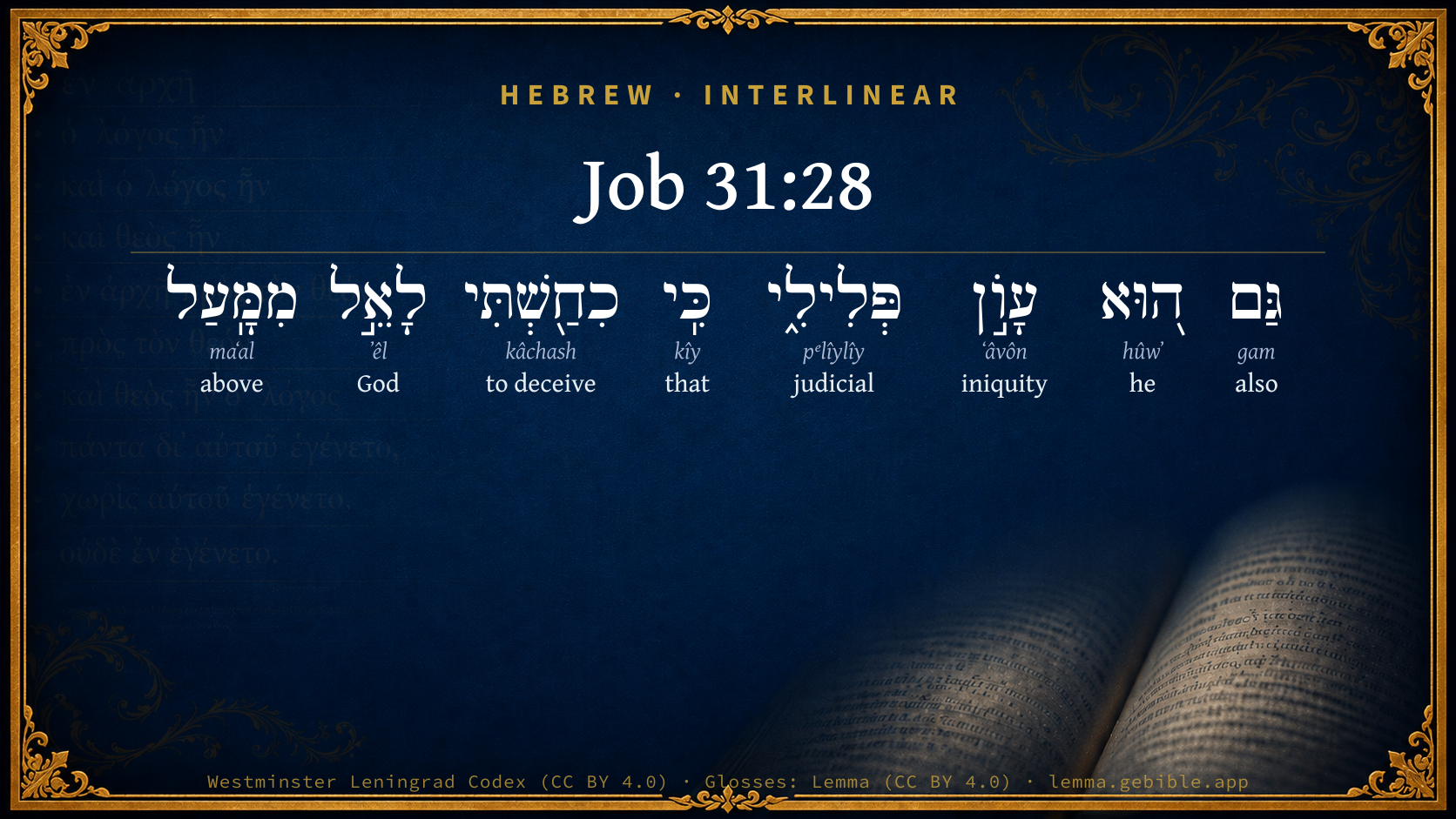
Hebrew (Westminster Leningrad Codex) Job 31:28 appears in the Hebrew Old Testament. The text above is from the Westminster Leningrad Codex. Each word links to its Strong’s number, a concise gloss, and parsing drawn from the Open Scriptures Hebrew Bible morphology. Click any word for its full Brown-Driver-Briggs (BDB) entry.
Download image
Cite this verse

Job 31:28 (World English Bible). Public Domain. Lemma interlinear Bible study tool, https://lemma.gebible.app/v/job/31/28.

Show BibTeX & RIS
BibTeX
RIS
English Translation
This also would be an iniquity to be punished by the judges; For I should have denied the God who is above.
World English Bible · Public Domain
Highlights
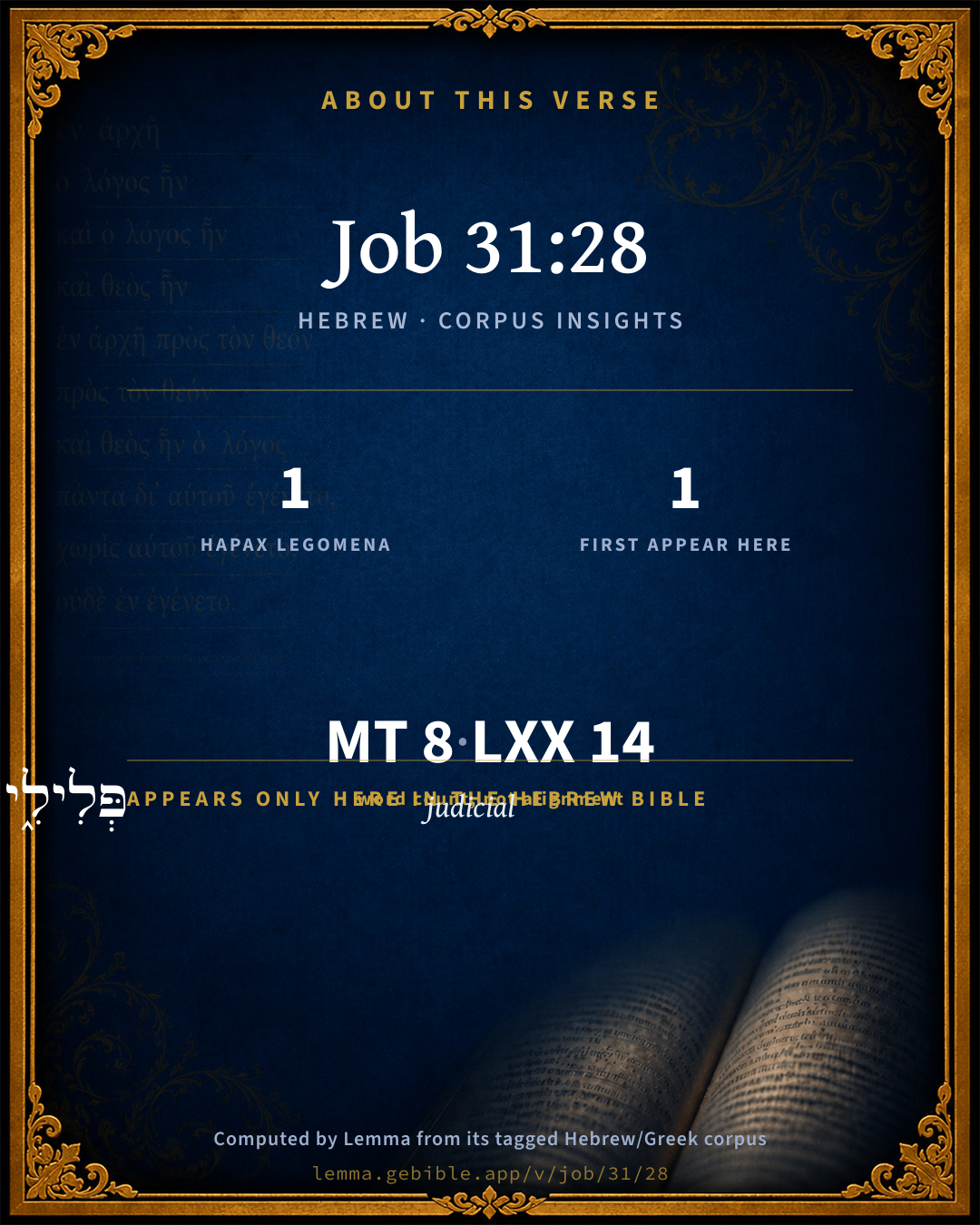
  • 1 hapax legomenon — only here in the Hebrew Bible
  • 1 first appearance in the Hebrew Bible
Full analysis ↓
Download a study sheet

One document with this verse’s original text, its word-by-word gloss line, the meaning frame, cross-references with their text, attributed commentary, and full source and license credits — printable, and it pastes into notes with its structure intact.

This verse Autodidact and up

Study sheet (.html) Plain text (.txt)

A passage Seminary Student

Up to 50 verses in one chapter. A passage sheet keeps up to 6 commentary sources and 12 cross-references per verse, in the order this page ranks them, and says so on the sheet whenever that leaves anything out. Ask for a single verse and you get the Autodidact verse sheet above.

Everything on this page stays free to read, with no account — the sheet is a download of what is already on screen, not access to it.

Want to remove ads? Support Godless Engineer
Compare translations 3

The same verse in 3 English versions, stacked beneath the original-language interlinear above. Click any original word for its lexicon entry.

Each is an independent rendering of the whole verse — the interlinear is not word-aligned to these translations.

Highlighted words mark where these versions differ — a whole-verse word diff, not a word-by-word alignment.

  • World English Bible Public Domain
    This also would be an iniquity to be punished by the judges; For I should have denied the God who is above.
  • King James Version Public Domain
    This also were an iniquity to be punished by the judge: for I should have denied the God that is above.
  • unfoldingWord Literal Text CC BY-SA 4.0
    this also iniquity of judges, for I would have denied God above.

unfoldingWord Literal Text — © unfoldingWord, licensed CC BY-SA 4.0. Word-aligned USFM3 via Door43 (git.door43.org/unfoldingWord/en_ult).

Versions to compare (up to 4)

3 of 4 selected

Show all 18 translations

Every available English version of this verse, each an independent rendering of the whole verse.

  • World English Bible Public Domain
    This also would be an iniquity to be punished by the judges; For I should have denied the God who is above.
  • Berean Standard Bible Public Domain
    this would also be an iniquity to be judged, for I would have denied God on high.
  • Majority Standard Bible Public Domain
    this would also be an iniquity to be judged, for I would have denied God on high.
  • King James Version Public Domain
    This also were an iniquity to be punished by the judge: for I should have denied the God that is above.
  • American Standard Version (1901) Public Domain
    This also were an iniquity to be punished by the judges; For I should have denied the God that is above.
  • Revised Version (1885) Public Domain
    This also were an iniquity to be punished by the judges: for I should have lied to God that is above.
  • Geneva Bible (1599) Public Domain
    (This also had bene an iniquitie to be condemned: for I had denied the God aboue)
  • Douay-Rheims (1899) Public Domain
    Which is a very great iniquity, and a denial against the most high God.
  • Young's Literal Translation Public Domain
    It also `is' a judicial iniquity, For I had lied to God above.
  • Literal Standard Version CC BY-SA 4.0
    It also [is] a judicial iniquity, || For I had lied to God above.
  • Unlocked Literal Bible CC BY-SA 4.0
    this also would be a crime to be punished by judges, for I would have denied the God who is above.
  • unfoldingWord Literal Text CC BY-SA 4.0
    this also iniquity of judges, for I would have denied God above.
  • Darby Bible Public Domain
    This also would be an iniquity for the judge, for I should have denied the ùGod who is above.
  • World Messianic Bible Public Domain
    this also would be an iniquity to be punished by the judges, for I would have denied the God who is above.
  • Webster's Bible Public Domain
    This also were an iniquity to be punished by the judge: for I should have denied the God that is above.
  • Free Bible Version CC BY-SA 4.0
    This too would be a sin deserving punishment for it would mean I had denied God above.
  • Bible in Basic English Public Domain
    That would have been another sin to be rewarded with punishment by the judges; for I would have been false to God on high.
  • JPS Tanakh (1917) Public Domain
    This also were an iniquity to be punished by the judges; for I should have lied to God that is above.

Literal Standard Version (2020), Covenant Press — licensed CC BY-SA 4.0. Text via the HelloAO Bible API (eBible.org). Unlocked Literal Bible (unfoldingWord) — licensed CC BY-SA 4.0. Text via the HelloAO Bible API (eBible.org). unfoldingWord Literal Text — © unfoldingWord, licensed CC BY-SA 4.0. Word-aligned USFM3 via Door43 (git.door43.org/unfoldingWord/en_ult). Free Bible Version, Dr. Jonathan Gallagher — licensed CC BY-SA 4.0. Text via the HelloAO Bible API (eBible.org).

Word by word

More ways to search: Search by grammar → Find every occurrence → Compare this word →

Practice this passage: Drill this verse → Learn its vocabulary →

About this verse

These counts appear in no published source. They are computed here, from the morphology-tagged text and Lemma’s own curated glosses. What Lemma adds →

8
words
8
distinct lemmas
Wisdom
section

Notable vocabulary

1 hapax legomenon — a word that appears only here in the entire Hebrew Bible:

  • פְּלִילִ֑י judicial H6416

First appearance in Scripture

This word makes its first canonical appearance in the Hebrew Bible here:

  • פְּלִילִ֑י judicial H6416

Shared distinctive vocabulary

כִחַ֖שְׁתִּי to deceive H3584 occurs in 22 verses of the Hebrew Bible. Also found in:

Grammatical profile

  • 1 verb
  • 2 nouns
  • 1 adjective
  • 1 pronoun
  • 1 conjunction
  • 1 adverb
  • 1 particle

Verb forms

  • כִחַ֖שְׁתִּי Piel · Perfect

Hebrew & Septuagint length

In English translation the verse runs 22 words from the Hebrew and 22 from the Septuagint (LXX English) — the same length.

A rough comparison of the two English renderings, which tokenize alike — not a word-level alignment.

Word counts can differ between the Hebrew and the Greek without any difference in meaning — e.g. the Hebrew direct-object marker אֵת has no separate Greek word, and Greek often adds the article ὁ.

In the original languages it is 8 Hebrew tokens and 14 Greek tokens — but the two are counted differently (Hebrew bundles its prefixes and suffixes into one token; the Greek is in lemma form), so that isn’t a like-for-like length.

Cross-references

16

Topical passages linked to Job 31:28 in the Treasury of Scripture Knowledge — connected by theme and wording, ordered by reader-vote popularity; previews shown in the World English Bible.

  • Deuteronomy 17:2–7 If there be found in the midst of you, within any of your gates which Yahweh your God gives you, man or woman, who does that which is evil in the sight of Yahweh your God, in transgressing his covenant,
  • Job 31:11 For that would be a heinous crime; Yes, it would be an iniquity to be punished by the judges:
  • Psalms 50:6 The heavens shall declare his righteousness, For God himself is judge. Selah.
  • Genesis 18:25 Be it far from you to do things like that, to kill the righteous with the wicked, that so the righteous should be as the wicked. May that be far from you. Shouldn't the Judge of all the earth do right?"
  • Deuteronomy 17:9 and you shall come to the priests the Levites, and to the judge who shall be in those days: and you shall inquire; and they shall show you the sentence of judgment.
  • Joshua 24:23 Now therefore put away, [said he], the foreign gods which are among you, and incline your heart to Yahweh, the God of Israel.
  • Joshua 24:27 Joshua said to all the people, Behold, this stone shall be a witness against us; for it has heard all the words of Yahweh which he spoke to us: it shall be therefore a witness against you, lest you deny your God.
  • Judges 11:27 I therefore have not sinned against you, but you do me wrong to war against me: Yahweh, the Judge, be judge this day between the children of Israel and the children of Ammon.
  • Job 9:15 Whom, though I were righteous, yet would I not answer. I would make supplication to my judge.
  • Job 23:7 There the upright might reason with him, So I should be delivered forever from my judge.
  • Proverbs 30:9 Lest I be full, deny you, and say, 'Who is Yahweh?' Or lest I be poor, and steal, And so dishonor the name of my God.
  • Titus 1:16 They profess that they know God, but by their works they deny him, being abominable, disobedient, and unfit for any good work.
  • Hebrews 12:23 to the general assembly and assembly of the firstborn who are enrolled in heaven, to God the Judge of all, to the spirits of just men made perfect,
  • 2 Peter 2:1 But there also arose false prophets among the people, as among you also there will be false teachers, who will secretly bring in destructive heresies, denying even the Master who bought them, bringing on themselves swift destruction.
  • 1 John 2:23 Whoever denies the Son, the same doesn't have the Father. He who confesses the Son has the Father also.
  • Jude 1:4 For there are certain men who crept in secretly, even those who were long ago written about for this condemnation: ungodly men, turning the grace of our God into lasciviousness, and denying our only Master, God, and Lord, Jesus Christ.

Cross-references courtesy of OpenBible.info (CC BY 4.0).

Hebrew and Greek witnesses Masoretic Hebrew ↔ Greek Septuagint

The same verse in the two great witnesses to the Old Testament, shown verse-for-verse.

These are two independent witnesses, not word-aligned to each other, and the Septuagint is shown in lemma (dictionary) form.

Hebrew Job 31:28 Masoretic · Westminster Leningrad Codex

גַּם ה֭וּא עָוֺ֣ן פְּלִילִ֑י כִּֽי כִחַ֖שְׁתִּי לָאֵ֣ל מִמָּֽעַל

This also would be an iniquity to be punished by the judges; For I should have denied the God who is above.

World English Bible · Public Domain

Greek LXX Job 31:28 Septuagint · lemma form

καί οὗτος ἐγώ ἄρα ἀνομία ὁ μέγας λογίζομαι ὅτι ψεύδω ἐναντίον κύριος ὁ ὕψιστος

let this also then be reckoned to me as the greatest iniquity: for I should have lied against the Lord Most High.

LXX2012 (modern English Septuagint) · Public Domain

Hebrew: Westminster Leningrad Codex (CC BY 4.0). Greek: Septuagint (public domain); English from LXX2012 (modern English Septuagint) (Public Domain). How the Septuagint differs from the Hebrew →

Commentary

Notes on Job 31:28 from classic Christian and Jewish commentators (each source and its license shown beneath its notes). The classic Christian expositions comment on the surrounding passage and are grouped to its opening verse, so a note may address several verses; the Jewish commentaries on the Tanakh (Rashi and others) are per-verse, so they appear only where the commentator wrote on this verse.

Lemma curates 59 commentaries, every one of them public domain or Creative Commons licensed, each selected and text-cleaned for this edition rather than reprinted as found. About our sources →

Trapp's Complete Commentary

John Trapp

Job 31:28 This also [were] an iniquity [to be punished by] the judge: for I should have denied the God [that is] above.

Ver. 28. This also were an iniquity to be punished by the judge] No less than adultery, but rather more. This also is iniquitas iudiciaria, a God provoking, land desolating sin, a wickedness with a witness, a capital crime. See Job 31:11, and take notice how these foul sins swell in Job’s eyes as so many toads; and how full in the mouth he is in speaking of them.

For I should have denied the God that is above] Far above any of these deastri gentium, even the most high God, Gen 14:18; Gen 14:22. I should rob the master to give to the servant; ascribe that to the creature which is due only to the Creator; this he will by no means endure. For, be the gods of the heathens good fellows, saith one; the true God is a jealous God, and will not share his glory with another.

John Trapp, A Commentary or Exposition upon All the Books of the Old and New Testament (1647–1656) — public domain. Text from a community e-Sword module.

Joseph Benson's Commentary

Job 31:28. This also were an iniquity — No less than the other fore- mentioned sins of adultery, oppression, &c.; to be punished by the judge — The civil magistrate; who, being advanced and protected by God, is obliged to maintain and vindicate his honour, and consequently to punish idolatry. For I should have denied God — Not directly, but by consequence, because this was to rob God of his prerogative, by giving to the creature that worship which is peculiar to God.

Joseph Benson's Commentary on the Old and New Testaments (1811–1818) — public domain. Text from a community e-Sword module.

Tyndale Open Study Notes

Tyndale Open Resources

31:28 In Israel, the judges (see 31:11) were to punish idol worship by execution (Deut 17:2-7). • Denying the God of heaven violated the first commandment (Deut 5:7).

Tyndale Open Study Notes — © Tyndale Open Resources, licensed CC BY-SA 4.0. Text via the HelloAO Bible API.

Geneva Bible (1599)

Geneva Bible translators

By putting confidence in anything but in him alone.

Geneva Bible (1599) marginal notes — public domain. Text via Bolls.life.

Jamieson, Fausset & Brown

Robert Jamieson, A. R. Fausset & David Brown

The Mosaic law embodied subsequently the feeling of the godly from the earliest times against idolatry, as deserving judicial penalties: being treason against the Supreme King (Deu 13:9; Deu 17:2-7; Eze 8:14-18). This passage therefore does not prove Job to have been subsequent to Moses.

Jamieson, Fausset & Brown — Commentary Critical and Explanatory on the Whole Bible (1871) — public domain (CC PDM 1.0). Text via the HelloAO Bible API.

Adam Clarke's Commentary

Verse 28. For I should have denied the God that is above.] Had I paid Divine adoration to them, I should have thereby denied the God that made them.

Adam Clarke's Commentary on the Bible (1810–1826) — public domain. Text from a community e-Sword/MySword module.

Ellicott's Commentary for English Readers

(28) By the judge.—Rather, perhaps, by my judge, i.e., God; unless, indeed, there be any reference to the Mosaic law (Deu_17:2-7), which does not seem likely.

A Bible Commentary for English Readers, edited by Charles John Ellicott (1878–1897) — public domain. Text from a community e-Sword module.

The Cambridge Bible for Schools and Colleges

gen. ed. J. J. S. Perowne

28. Comp. Deu_4:19; Deu_17:3-7. Such adoration would have been a “denial” of, or a being false to, God, the one spiritual God, above. Much more than a thousand years later Mohammed has still to say to his Arabs, “Worship not the sun, neither the moon: but worship God who created them,” Kor. ch. 41. A pretty fable is told also of Abraham—“When night closed over him he saw a star, and said, This is my Lord; but when it set he said, I love not those that set. And when he saw the moon appearing he said, This is my Lord; but when it set he said, Surely if my Lord direct me not aright I shall be of the people that go astray. And when he saw the sun rising he said, This is my Lord, this is the greatest; but when it set he said, O my people, verily I am clear of what ye associate with God; verily I have turned my face towards Him who hath created heaven and earth,” &c. Kor. ch. 6:76.

The Cambridge Bible for Schools and Colleges (gen. ed. J. J. S. Perowne; Cambridge University Press, 1878–1918) — public domain. Text from a community e-Sword module.

John Gill's Exposition

Neither have I suffered my mouth to sin,.... Which, as it is the instrument of speech, is often the means of much sin; particularly of cursing men, and expressing much bitterness against enemies; but Job laid an embargo upon it, kept it as with a bridle, restrained it from uttering any evil, or wishing any to his worst adversaries; which is difficult to do, when provocations are given, as follows:

by wishing a curse to his soul; not to his soul as distinct from his body, being the superior excellency and immortal part; that it be everlastingly damned, as wicked men wish to their own souls, and the souls of others, but to his person, wishing some calamity might befall him, some disease seize upon him, or that God would take him away by death: Job would never suffer himself to wish anything of this kind unto his enemy.

John Gill's Exposition of the Whole Bible (1746–1763) — public domain (CC PDM 1.0). Text via the HelloAO Bible API.

Albert Barnes' Notes on the Bible

This also were an iniquity to be punished by the judqe - Note Job 31:11. Among the Hebrews idolatry was an offence punishable by death by stoning; Deu 17:2-7. It is possible, also, that this might have been elsewhere in the patriarchal times a crime punishable in this manner. At all events, Job regarded it as a heinous offence, and one of which the magistrate ought to take cognizance.

For I should have denied the God that is above - The worship of the heavenly bodies would have been in fact the denial of the existence of any Superior Being. This, in fact, always occurs, for idolaters have no knowledge of the true God.

Albert Barnes' Notes on the Bible (1834–1885) — public domain. Text from a community e-Sword/MySword module.

Matthew Poole's English Annotations

This also, no less than the other forementioned sins, adultery, oppression, &c.

By the judge, i.e. by the civil magistrate; who being advanced and protected by God, is obliged to maintain and vindicate his honour, and consequently to punish idolatry. And this did not cease to be his duty, although the magistrates of the world in Job’s time were so far from this, that they themselves also were idolaters. Yet considering that both Job and his friends, who lived in his time and neighbourhood, were most probably the posterity or kindred of Abraham and his family, and by him or his instructed in the knowledge of the true God, and were also men of great power and authority in their places; it seems most likely that they did restrain and punish idolatry in their several jurisdictions, or at least in their own large and numerous families, where the masters anciently had power of life and death without control.

I should have denied God; not directly, (for nothing is more evident than this, that divers of the wiser heathens, who did worship the sun and moon, did yet acknowledge and adore the sovereign and supreme God over and above all,) but by consequence and construction, because this was to rob God of his prerogative, by giving to the creature that religious honour or worship which is peculiar to God.

That is above; who is above the sun and moon, not only in place, his glorious mansion and palace being far above all visible heavens, but also in power and dignity, or adorable excellency.

Matthew Poole's English Annotations on the Holy Bible (1683–1685) — public domain. Text from a community e-Sword/MySword module.

Whedon's Commentary on the Bible

Daniel D. Whedon

28. Denied the God above — The transfer of the predominant affection of the heart from the Creator to the creature is a practical denial of God.

Daniel D. Whedon (gen. ed.), Commentary on the Old and New Testaments (1874–1909) — public domain. Text from a community e-Sword module.

The Pulpit Commentary

This also were an iniquity to be punished by the judge (see the comment on ver. 11, adfin.). It is rightly concluded from this expression that, in the country and age of Job, the sort of idolatry which is here mentioned was practised by some, and also that it was legally punishable. For I should have denied the God that is above. The worship of any other god besides the supreme God is, practically, atheism, since "no man can serve two masters." Moreover, to set up two independent gods is to destroy the idea of God, which implies supremacy over every other being.

The Pulpit Commentary (1880–1919), ed. H.D.M. Spence-Jones & Joseph S. Exell — public domain. Text from a community e-Sword module.

John Wesley's Explanatory Notes

The judge - The civil magistrate; who being advanced and protected by God, is obliged to maintain and vindicate his honour, and consequently to punish idolatry. Denied God - Not directly but by consequence, because this was to rob God of his prerogative, by giving to the creature, that worship which is peculiar to God.

John Wesley, Explanatory Notes Upon the Whole Bible (1754–1765) — public domain. Text via the GEBible commentary corpus.

Lesson kit

Teaching starters — assembled from the data on this page, not authored interpretation. Every prompt links to the verse data it draws on. Edit before teaching.

Job, in the Wisdom, opens this verse with 8 words (8 distinct Hebrew lemmas). Its most distinctive word is pᵉlîylîy (“judicial”). A historical commentator’s framing appears above. Read the whole chapter for the surrounding context.

Discussion questions

  1. What does “judicial” (pᵉlîylîy) contribute to the verse as a whole?
  2. 1 word here appears nowhere else in the Hebrew Bible. Why might the author reach for such rare wording?
  3. This is the first place “judicial” appears in Scripture (first appears here). What does its debut here establish?
  4. How does Genesis 18:15, which shares the word «to deceive», read alongside this verse?
  5. These translations render this verse differently; the difference is in the English rendering, not the original. What questions does that raise?
  6. «כִחַ֖שְׁתִּי» is a Piel Perfect verb. How does that grammatical form shape the action described?
  7. Compare how Trapp's Complete Commentary and Joseph Benson's Commentary read this verse. Where do they agree or differ?

Things to notice

Reading settings

Reading text

Shown beneath each verse's original-language words.

Old Testament
Old Testament edition

Read the OT as the Masoretic Hebrew (MT) or the Greek Septuagint (LXX).

English shown for the Greek Septuagint (in the Hebrew ↔ Greek comparison).

Comparing translations? Open the Compare panel on any verse page to stack up to four side by side.