
Jeremiah 51:6

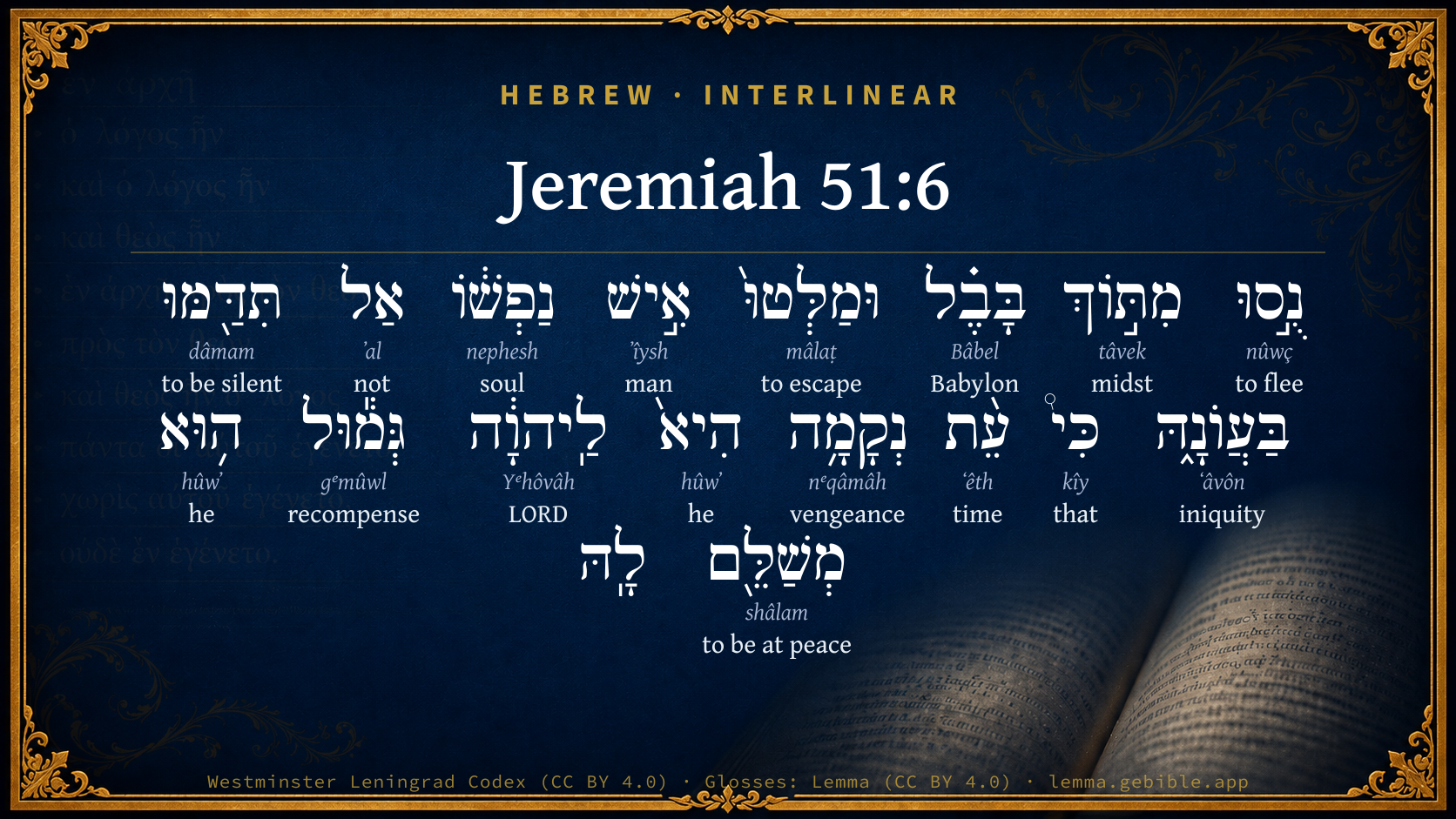
Hebrew (Westminster Leningrad Codex) Jeremiah 51:6 appears in the Hebrew Old Testament. The text above is from the Westminster Leningrad Codex. Each word links to its Strong’s number, a concise gloss, and parsing drawn from the Open Scriptures Hebrew Bible morphology. Click any word for its full Brown-Driver-Briggs (BDB) entry.
Download image
Cite this verse

Jeremiah 51:6 (World English Bible). Public Domain. Lemma interlinear Bible study tool, https://lemma.gebible.app/v/jeremiah/51/6.

Show BibTeX & RIS
BibTeX
RIS
English Translation
Flee out of the midst of Babylon, and save every man his life; don't be cut off in her iniquity: for it is the time of Yahweh's vengeance; he will render to her a recompense.
World English Bible · Public Domain
Download a study sheet

One document with this verse’s original text, its word-by-word gloss line, the meaning frame, cross-references with their text, attributed commentary, and full source and license credits — printable, and it pastes into notes with its structure intact.

This verse Autodidact and up

Study sheet (.html) Plain text (.txt)

A passage Seminary Student

Up to 50 verses in one chapter. A passage sheet keeps up to 6 commentary sources and 12 cross-references per verse, in the order this page ranks them, and says so on the sheet whenever that leaves anything out. Ask for a single verse and you get the Autodidact verse sheet above.

Everything on this page stays free to read, with no account — the sheet is a download of what is already on screen, not access to it.

Want to remove ads? Support Godless Engineer
Compare translations 3

The same verse in 3 English versions, stacked beneath the original-language interlinear above. Click any original word for its lexicon entry.

Each is an independent rendering of the whole verse — the interlinear is not word-aligned to these translations.

Highlighted words mark where these versions differ — a whole-verse word diff, not a word-by-word alignment.

  • World English Bible Public Domain
    Flee out of the midst of Babylon, and save every man his life; don't be cut off in her iniquity: for it is the time of Yahweh's vengeance; he will render to her a recompense.
  • King James Version Public Domain
    Flee out of the midst of Babylon, and deliver every man his soul: be not cut off in her iniquity; for this is the time of the LORD's vengeance; he will render unto her a recompence.
  • unfoldingWord Literal Text CC BY-SA 4.0
    Flee from the midst of Babylon; let each man save himself. Do not perish in her iniquity. For it is the time of Yahweh’s vengeance. He will repay all of it to her.

unfoldingWord Literal Text — © unfoldingWord, licensed CC BY-SA 4.0. Word-aligned USFM3 via Door43 (git.door43.org/unfoldingWord/en_ult).

Versions to compare (up to 4)

3 of 4 selected

Show all 18 translations

Every available English version of this verse, each an independent rendering of the whole verse.

  • World English Bible Public Domain
    Flee out of the midst of Babylon, and save every man his life; don't be cut off in her iniquity: for it is the time of Yahweh's vengeance; he will render to her a recompense.
  • Berean Standard Bible Public Domain
    Flee from Babylon! Escape with your lives! Do not be destroyed in her punishment. For this is the time of the LORD’s vengeance; He will pay her what she deserves.
  • Majority Standard Bible Public Domain
    Flee from Babylon! Escape with your lives! Do not be destroyed in her punishment. For this is the time of the LORD’s vengeance; He will pay her what she deserves.
  • King James Version Public Domain
    Flee out of the midst of Babylon, and deliver every man his soul: be not cut off in her iniquity; for this is the time of the LORD's vengeance; he will render unto her a recompence.
  • American Standard Version (1901) Public Domain
    Flee out of the midst of Babylon, and save every man his life; be not cut off in her iniquity: for it is the time of Jehovah's vengeance; he will render unto her a recompense.
  • Revised Version (1885) Public Domain
    Flee out of the midst of Babylon, and save every man his life; be not cut off in her iniquity: for it is the time of the LORD’S vengeance; he will render unto her a recompence.
  • Geneva Bible (1599) Public Domain
    Flee out of the middes of Babel, and deliuer euery man his soule: be not destroyed in her iniquitie: for this is the time of the Lordes vengeance he will render vnto her a recompence.
  • Douay-Rheims (1899) Public Domain
    Flee ye from the midst of Babylon, and let every one save his own life: be not silent upon her iniquity: for it is the time of revenge from the Lord, he will I render unto her what she hath deserved.
  • Young's Literal Translation Public Domain
    Flee ye from the midst of Babylon, And deliver ye each his soul, Be not cut off in its iniquity, For a time of vengeance it `is' to Jehovah, Recompence He is rendering to her.
  • Literal Standard Version CC BY-SA 4.0
    Flee from the midst of Babylon, || And let each deliver his soul, || Do not be cut off in her iniquity, || For it [is] a time of vengeance for YHWH—His, || He is rendering repayment to her.
  • Unlocked Literal Bible CC BY-SA 4.0
    Flee from the midst of Babylon; let each man save himself. Do not perish in her iniquity. For it is the time of Yahweh's vengeance. He will repay all of it to her.
  • unfoldingWord Literal Text CC BY-SA 4.0
    Flee from the midst of Babylon; let each man save himself. Do not perish in her iniquity. For it is the time of Yahweh’s vengeance. He will repay all of it to her.
  • Darby Bible Public Domain
    Flee out of the midst of Babylon, and save every man his life; be ye not cut off in her iniquity: for this is the time of Jehovah's vengeance: he shall render unto her a recompence.
  • World Messianic Bible Public Domain
    “Flee out of the middle of Babylon! Everyone save his own life! Don’t be cut off in her iniquity, for it is the time of the LORD’s vengeance. He will give to her a recompense.
  • Webster's Bible Public Domain
    Flee from the midst of Babylon, and deliver every man his soul: be not cut off in her iniquity; for this is the time of the LORD'S vengeance; he will render to her a recompense.
  • Free Bible Version CC BY-SA 4.0
    Escape from Babylon! Run for your lives! Don't get caught up in her punishment and die, for this is the time when the Lord pays her back for her sins.
  • Bible in Basic English Public Domain
    Go in flight out of Babylon, so that every man may keep his life; do not be cut off in her evil-doing: for it is the time of the Lord's punishment; he will give her her reward.
  • JPS Tanakh (1917) Public Domain
    Flee out of the midst of Babylon, and save every man his life, be not cut off in her iniquity; for it is the time of the LORD'S vengeance; He will render unto her a recompense.

Literal Standard Version (2020), Covenant Press — licensed CC BY-SA 4.0. Text via the HelloAO Bible API (eBible.org). Unlocked Literal Bible (unfoldingWord) — licensed CC BY-SA 4.0. Text via the HelloAO Bible API (eBible.org). unfoldingWord Literal Text — © unfoldingWord, licensed CC BY-SA 4.0. Word-aligned USFM3 via Door43 (git.door43.org/unfoldingWord/en_ult). Free Bible Version, Dr. Jonathan Gallagher — licensed CC BY-SA 4.0. Text via the HelloAO Bible API (eBible.org).

Word by word

More ways to search: Search by grammar → Find every occurrence → Compare this word →

Practice this passage: Drill this verse → Learn its vocabulary →

גְּמ֕וּל
gᵉmûwl
H1576
“recompense”
Noun, Common, Masculine, Singular, Absolute
Part of Speech
Noun
Type
Common
Gender
Masculine
Number
Singular
State
Absolute
Full BDB Definition

Origin: from H1580

TWOT: 360a

dealing, recompense, benefit - dealing (of one's hand) - recompense - benefit
  1. נֻ֣סוּ nûwç H5127 “flee” Verb, Qal, Imperative, 2nd Person, Masculine, Plural
  2. מִתּ֣וֹךְ tâvek H8432 “from · midst of” Preposition + Noun, Common, Masculine, Singular, Construct
  3. בָּבֶ֗ל Bâbel H894 “Babylon” Noun, Proper
  4. וּמַלְּטוּ֙ mâlaṭ H4422 “and · escape” Conjunction + Verb, Piel, Imperative, 2nd Person, Masculine, Plural
  5. אִ֣ישׁ ʼîysh H376 “man” Noun, Common, Masculine, Singular, Absolute
  6. נַפְשׁ֔וֹ nephesh H5315 “soul · his” Noun, Common, Both, Singular, Construct + Suffix, Personal, 3rd Person, Masculine, Singular
  7. אַל ʼal H408 “not” Particle, Negative
  8. תִּדַּ֖מּוּ dâmam H1826 “to be silent” Verb, Niphal, Jussive, 2nd Person, Masculine, Plural
  9. בַּעֲוֺנָ֑הּ ʻâvôn H5771 “in/at · iniquity · her” Preposition + Noun, Common, Both, Singular, Construct + Suffix, Personal, 3rd Person, Feminine, Singular
  10. כִּי֩ kîy H3588 “that” Conjunction
  11. עֵ֨ת ʻêth H6256 “time of” Noun, Common, Both, Singular, Construct
  12. נְקָמָ֥ה nᵉqâmâh H5360 “vengeance” Noun, Common, Feminine, Singular, Absolute
  13. הִיא֙ hûwʼ H1931 “he” Pronoun, Personal, 3rd Person, Feminine, Singular
  14. לַֽיהוָ֔ה Yᵉhôvâh H3068 “to/for · LORD” Preposition + Noun, Proper
  15. ה֥וּא hûwʼ H1931 “he” Pronoun, Personal, 3rd Person, Masculine, Singular
  16. מְשַׁלֵּ֖ם shâlam H7999 “being at peace” Verb, Piel, Participle Active, Masculine, Singular, Absolute

About this verse

These counts appear in no published source. They are computed here, from the morphology-tagged text and Lemma’s own curated glosses. What Lemma adds →

18
words
16
distinct lemmas
Prophets
section

Notable vocabulary

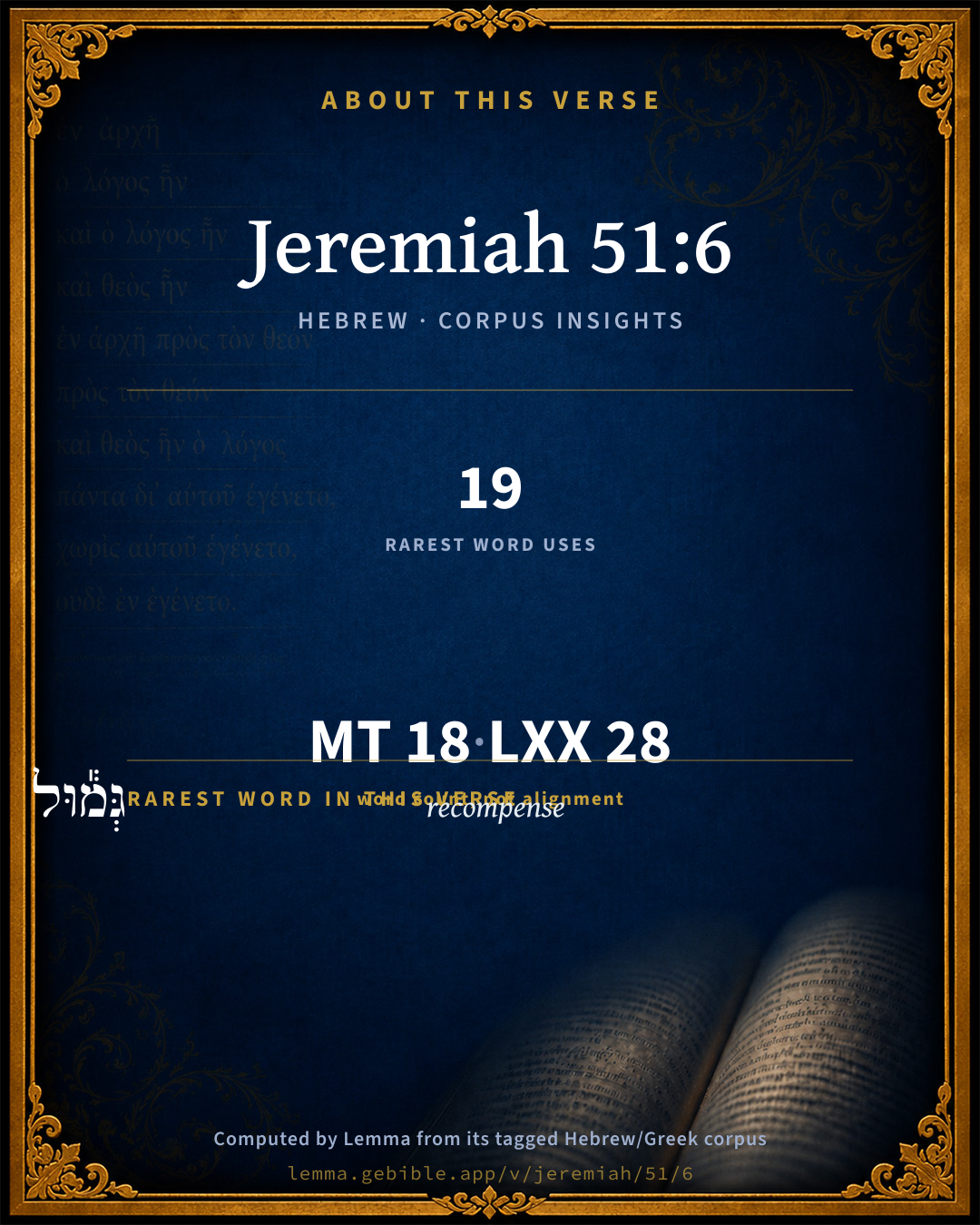
The rarest word here is גְּמ֕וּל recompense H1576 — appearing just 19 times in the whole Hebrew Bible.

Shared distinctive vocabulary

גְּמ֕וּל recompense H1576 occurs in 17 verses of the Hebrew Bible. Also found in:

Grammatical profile

  • 4 verbs
  • 9 nouns
  • 2 pronouns
  • 1 preposition
  • 1 conjunction
  • 1 particle

Verb forms

  • נֻ֣סוּ Qal · Imperative
  • וּמַלְּטוּ֙ Piel · Imperative
  • תִּדַּ֖מּוּ Niphal · Jussive
  • מְשַׁלֵּ֖ם Piel · Participle Active

Repetition

A word recurs within this verse — often emphatic in Hebrew:

  • הִיא֙ he H1931 ×2

Hebrew & Septuagint length

In the original languages it is 18 Hebrew tokens and 28 Greek tokens — but the two are counted differently (Hebrew bundles its prefixes and suffixes into one token; the Greek is in lemma form), so that isn’t a like-for-like length.

Cross-references

23

Topical passages linked to Jeremiah 51:6 in the Treasury of Scripture Knowledge — connected by theme and wording, ordered by reader-vote popularity; previews shown in the World English Bible.

  • Jeremiah 50:8 Flee out of the midst of Babylon, and go forth out of the land of the Chaldeans, and be as the male goats before the flocks.
  • Jeremiah 25:14 For many nations and great kings shall make bondservants of them, even of them; and I will recompense them according to their deeds, and according to the work of their hands.
  • Jeremiah 50:15 Shout against her round about: she has submitted herself; her bulwarks are fallen, her walls are thrown down; for it is the vengeance of Yahweh: take vengeance on her; as she has done, do to her.
  • Jeremiah 50:28 The voice of those who flee and escape out of the land of Babylon, to declare in Zion the vengeance of Yahweh our God, the vengeance of his temple.
  • Numbers 16:26 He spoke to the congregation, saying, Depart, I pray you, from the tents of these wicked men, and touch nothing of theirs, lest you be consumed in all their sins.
  • Jeremiah 51:45 My people, go you out of the midst of her, and save yourselves every man from the fierce anger of Yahweh.
  • Isaiah 48:20 Go you forth from Babylon, flee you from the Chaldeans; with a voice of singing declare you, tell this, utter it even to the end of the earth: say you, Yahweh has redeemed his servant Jacob.
  • Jeremiah 50:31 Behold, I am against you, you proud one, says the Lord, Yahweh of Hosts; for your day is come, the time that I will visit you.
  • Jeremiah 51:9 We would have healed Babylon, but she is not healed: forsake her, and let us go everyone into his own country; for her judgment reaches to heaven, and is lifted up even to the skies.
  • Jeremiah 51:11 Make sharp the arrows; hold firm the shields: Yahweh has stirred up the spirit of the kings of the Medes; because his purpose is against Babylon, to destroy it: for it is the vengeance of Yahweh, the vengeance of his temple.
  • Jeremiah 51:50 You who have escaped the sword, go you, don't stand still; remember Yahweh from afar, and let Jerusalem come into your mind.
  • Zechariah 2:6–7 Come! Come! Flee from the land of the north,' says Yahweh; 'for I have spread you abroad as the four winds of the sky,' says Yahweh.
  • 1 Timothy 5:22 Lay hands hastily on no one, neither be a participant in other men's sins. Keep yourself pure.
  • Revelation 16:19 The great city was divided into three parts, and the cities of the nations fell. Babylon the great was remembered in the sight of God, to give to her the cup of the wine of the fierceness of his wrath.
  • Genesis 19:15–17 When the morning arose, then the angels hurried Lot, saying, "Arise, take your wife, and your two daughters who are here, lest you be consumed in the iniquity of the city."
  • Deuteronomy 32:25 Outside shall the sword bereave, In the chambers terror; [It shall destroy] both young man and virgin, The suckling with the man of gray hairs.
  • Deuteronomy 32:41 If I whet my glittering sword, My hand take hold on judgment; I will render vengeance to my adversaries, Will recompense those who hate me.
  • Deuteronomy 32:43 Rejoice, you nations, [with] his people: For he will avenge the blood of his servants, Will render vengeance to his adversaries, Will make expiation for his land, for his people.
  • Proverbs 13:20 One who walks with wise men grows wise, But a companion of fools suffers harm.
  • Jeremiah 25:16 They shall drink, and reel back and forth, and be mad, because of the sword that I will send among them.
  • Jeremiah 27:7 All the nations shall serve him, and his son, and his son's son, until the time of his own land come: and then many nations and great kings shall make him their bondservant.
  • Jeremiah 46:10 For that day is [a day] of the Lord, Yahweh of Hosts, a day of vengeance, that he may avenge him of his adversaries: and the sword shall devour and be satiate, and shall drink its fill of their blood; for the Lord, Yahweh of hosts, has a sacrifice in the north country by the river Euphrates.
  • Revelation 18:4–6 I heard another voice from heaven, saying, "Come out of her, my people, that you have no participation in her sins, and that you don't receive of her plagues,

Cross-references courtesy of OpenBible.info (CC BY 4.0).

Hebrew and Greek witnesses Masoretic Hebrew ↔ Greek Septuagint

The same verse in the two great witnesses to the Old Testament, shown verse-for-verse.

These are two independent witnesses, not word-aligned to each other, and the Septuagint is shown in lemma (dictionary) form.

Hebrew Jeremiah 51:6 Masoretic · Westminster Leningrad Codex

נֻ֣סוּ מִתּ֣וֹךְ בָּבֶ֗ל וּמַלְּטוּ֙ אִ֣ישׁ נַפְשׁ֔וֹ אַל תִּדַּ֖מּוּ בַּעֲוֺנָ֑הּ כִּי֩ עֵ֨ת נְקָמָ֥ה הִיא֙ לַֽיהוָ֔ה גְּמ֕וּל ה֥וּא מְשַׁלֵּ֖ם לָֽהּ

Flee out of the midst of Babylon, and save every man his life; don't be cut off in her iniquity: for it is the time of Yahweh's vengeance; he will render to her a recompense.

World English Bible · Public Domain

Greek LXX Structure differs

In the Septuagint, Jeremiah is about an eighth shorter than the Hebrew and arranges its material differently — the Oracles Against the Nations (Hebrew chapters 46–51) appear in the middle of the Greek book, after 25:13. Because the chapter and verse boundaries do not line up, a verse-for-verse comparison with the Hebrew is not shown.

A verse-for-verse comparison isn’t shown here because the chapters and verses don’t line up. Switch to the LXX edition with the MT / LXX toggle above to read the Greek directly.

Hebrew: Westminster Leningrad Codex (CC BY 4.0). Greek: Septuagint (public domain); English from a public-domain English Septuagint. How the Septuagint differs from the Hebrew →

Targum (Aramaic paraphrase)

1

The Targum is the ancient Jewish Aramaic paraphrase of the Hebrew Scriptures — an interpretive translation, not the Hebrew text itself. Onkelos (literal) and Pseudo-Jonathan (expansive) render the Torah, and Jonathan the Prophets. Coverage is partial: where no permissively-licensed English translation exists for a verse, only the Aramaic is shown. This is verse-level text, not a word-by-word alignment to the Hebrew.

  1. Targum Jonathan Prophets (Joshua–Malachi)
    עֲרוּקוּ מִגוֹ בָבֶל וְשֵׁיזָבוּ גְבַר נַפְשֵׁיהּ לָא תִלְקוֹן בְּחוֹבָהּ אֲרֵי עִדַן פּוּרְעֲנוּתָא הִיא קֳדָם יְיָ גִמְלָא הוּא מְשַׁלֵם לָהּ:

    (no public-domain English translation for this verse)

    Targum Jonathan — Aramaic: “Mikraot Gedolot” (public domain). English: “Sefaria Community Translation” (CC0 1.0 (public-domain dedication)); “London "Chaldee Paraphrase," 1871” (public domain). Text via Sefaria.

Commentary

Notes on Jeremiah 51:6 from classic Christian and Jewish commentators (each source and its license shown beneath its notes). The classic Christian expositions comment on the surrounding passage and are grouped to its opening verse, so a note may address several verses; the Jewish commentaries on the Tanakh (Rashi and others) are per-verse, so they appear only where the commentator wrote on this verse.

Lemma curates 59 commentaries, every one of them public domain or Creative Commons licensed, each selected and text-cleaned for this edition rather than reprinted as found. About our sources →

Trapp's Complete Commentary

John Trapp

Jer 51:6 Flee out of the midst of Babylon, and deliver every man his soul: be not cut off in her iniquity; for this [is] the time of the LORD’S vengeance; he will render unto her a recompence.

Ver. 6. Flee out of the midst of Babylon.] See Jer 18:1-23. So, in the Hew Testament, we are called upon to flee and avoid the corruptions of the world and of Antichrist. {1Jn 2:7-8 Eph 5:6 Rev 14:3-5; Rev 18:4}

For this is a time, &c.] As Jer 50:15; Jer 50:25; Jer 50:27-28; Jer 46:10.

John Trapp, A Commentary or Exposition upon All the Books of the Old and New Testament (1647–1656) — public domain. Text from a community e-Sword module.

The Biblical Illustrator

Joseph S. Exell

Jer_51:6

Flee out of the midst of Babylon.

Fleeing from the city of destruction

And now the trembling pilgrim, with fixed resolution, having a glimpse of the light and a definite direction, begins to run; it is unutterable relief to his perplexities to run towards Christ, though as yet he sees Him not. But now the world clamours after him, yea, the dearest ones in it try to stop him, but the fire in his conscience is stronger than they; he stops his ears and runs without looking behind, and stays not in all the plain, but runs as swiftly as his burden will let him, crying, Life, life, eternal life! (Lectures on Pilgrims Progress, G. H. Cheever.)

The Biblical Illustrator, edited by Joseph S. Exell (c. 1880s–1900s) — public domain. Text from a community e-Sword module.

Joseph Benson's Commentary

Jer 51:6-7. Flee out of the midst of Babylon, &c. — God’s people are here exhorted to flee out of Babylon with all haste, as Lot did out of Sodom, lest they should be consumed in the iniquity of that place: see Jer 50:8. Babylon hath been a golden cup in the Lord’s hand — In what sense Babylon is called a cup may be seen by comparing Jer 25:15. Her greatness and glory enticed and drew in many nations to be confederate with her, in hopes of enriching or aggrandizing themselves; but thereby they drew down destruction upon themselves. They thought to drink, or be in alliance with the Babylonians, was drinking out of a golden cup, but it proved to them a deadly draught. For she was a splendid instrument of vengeance, ordained by God against them; and as they all had suffered by her, so they are all here represented as glorying over her, and rejoicing when her turn of suffering came. By making all the earth drunken, is meant either making all the neighbouring nations act foolishly, and contrary to true wisdom and prudence, or the causing them, as it were, to stagger and fall through the terror and astonishment, the confusion and dismay, which God’s judgments should produce among them: see note on Jer 25:15. We may observe further here, that this golden cup is said to be in the Lord’s hand, to signify that these things had been brought about by the divine providence, and that God had used Babylon as an instrument to bring the nations to that condign punishment which they had deserved.

Joseph Benson's Commentary on the Old and New Testaments (1811–1818) — public domain. Text from a community e-Sword module.

Tyndale Open Study Notes

Tyndale Open Resources

51:6 The Israelites were urged to flee from Babylon at the appropriate time to avoid being caught up in the Lord’s vengeance against Babylon (cp. 50:8).

Tyndale Open Study Notes — © Tyndale Open Resources, licensed CC BY-SA 4.0. Text via the HelloAO Bible API.

Geneva Bible (1599)

Geneva Bible translators

He showeth that there remaineth nothing for them that abide in Babylon, but destruction, Jer. 17:6 and 48:6.

Geneva Bible (1599) marginal notes — public domain. Text via Bolls.life.

Jamieson, Fausset & Brown

Robert Jamieson, A. R. Fausset & David Brown

Warning to the Israelite captives to flee from Babylon, lest they should be involved in the punishment of her "iniquity." So as to spiritual Babylon and her captives (Rev 18:4).

Jamieson, Fausset & Brown — Commentary Critical and Explanatory on the Whole Bible (1871) — public domain (CC PDM 1.0). Text via the HelloAO Bible API.

John Calvin's Commentaries

He goes on with the same subject, but illustrates it by various figures; for otherwise he would not have penetrated into the hearts of the godly. Were any at this day to predict the destruction of Rome, it could hardly be believed; and yet we know that it has in our life been stormed, and now it hangs as it were by a thread, though hitherto it has been supported and fortified by the greatest forces. But the dignity of the city so confounded the minds of men, that it was hardly credible that it could have been so soon subverted. How, then, was it possible for such a thing to have happened at that time? for Babylon was the mistress of the East. The Assyrians had previously possessed the empire; but they had been subdued, and had, as it were, been brought under the yoke. As, then, Babylon now flourished in power so great and invincible, Jeremiah seemed to be labeling when he spoke of its approaching destruction. It was hence necessary that what he said should be confirmed, as it is now done. And so he now turns to foreigners and guests, and exhorts them to flee lest they should perish in the accursed city.

Flee, he says, from the midst of Babylon But there was then no safer place in the land; for had all the regions of the world been shaken, yet Babylon would have been deemed beyond any danger. But he says that all guests were to flee from the midst of it, if they wished to save their lives. Then he adds, lest ye perish in her iniquity He assigns a reason why those who then dwelt in Babylon could not be safe except they fled, even because God was about to punish the city for its iniquities. He then sets the iniquity of Babylon in opposition to the multitude of its men, as well as to its wealth and defenses, and other means of strength. Babylon was populous; it might also be aided by many auxiliaries; and there were ready at hand those who might hire their services. As, then, there was nothing wanting to that city, the Prophet here shows that wealth and abundance of people, and all other helps would be of no moment, because it was God’s will to punish her iniquity. This is the reason why Jeremiah now says, lest ye perish in her iniquity; that is, “do not mingle with those ungodly men whom God has given up to destruction.”

And for the same purpose he adds, For it is the time of the vengeance of Jehovah Here, again, he obviates an objection; for as God had suspended his judgment, no one thought it possible that a fire could so soon, and, as it were, in a moment be kindled to destroy Babylon. Then the Prophet says, that it was the time; by which he intimates, that though God does not immediately execute his judgments, yet he does not he down as it were idly, so as to forget what he has to do, but that he has his own times. And this doctrine deserves to be noticed, because through our intemperate zeal we make much ado, except God brings us help as soon as we are injured; but if he delays even a short time, we complain and think that he has forgotten our welfare. And even saints, in depositing familiarly their cares and anxieties in his bosom, speak thus,

“Arise, O Lord, why sleepest thou” (Psalm 44:23)

As, then, we are by nature inclined to impatience, we ought to observe what Scripture so often inculcates, even this — that God has his certain and fixed times for punishing the wicked. Hence Jeremiah now teaches us, that the time of God’s vengeance was come.

He then adds, A reward will he render to her; as though he had said, that though Babylon would not have to suffer punishment immediately, yet she would not escape from God’s hand, for the reward which God would render her was already prepared. And this doctrine arises from a general principle, that God will ever render to every one his just reward. We now, then, perceive the design of the Prophet.

We have said that the words were addressed to the strangers and the guests who were in Chaldea, or in the city Babylon. They then pervert this passage, who think that the faithful are here exhorted immediately to depart from Babylon, That is, to withdraw themselves from superstitions and the defilements of the world; for the Prophet means no such thing. A passage might, however, be made from one truth to another. It now follows, —

John Calvin's Commentaries (1540-1563) — public domain. Text from the Calvin Translation Society English edition (1840s-50s) via the Christian Classics Ethereal Library (ccel.org). Calvin's coverage is partial (roughly two-thirds of the Bible); uncommented books and verses are honest gaps, never fabricated. The 19th-century editor's footnotes and remarks are omitted so the notes are faithfully Calvin's own voice.

Ellicott's Commentary for English Readers

(6) Flee out of the midst of Babylon.—The words reproduce the call of Jer_50:8 with a fresh motive. The city was doomed. It was ill done for those who had not been guilty of her sins to involve themselves in her destruction. The call is reproduced, as referring to the mystical Babylon, in Rev_18:4.

A Bible Commentary for English Readers, edited by Charles John Ellicott (1878–1897) — public domain. Text from a community e-Sword module.

The Cambridge Bible for Schools and Colleges

gen. ed. J. J. S. Perowne

6. Flee] addressed to the Jewish residents in Babylon. Cp. Jer_51:45 (“My people”), Jer_50:6; Isa_48:20; Isa_52:6.

The Cambridge Bible for Schools and Colleges (gen. ed. J. J. S. Perowne; Cambridge University Press, 1878–1918) — public domain. Text from a community e-Sword module.

John Gill's Exposition

Flee out of the midst of Babylon,.... This is said either to such as were there of other nations upon trade and business, as Kimchi, to get out of it as fast as they could, that they might not be consumed; or to the Israelites, as Jarchi, the Jews that were captives there. This is applied to the people of God in mystical Babylon, Rev 18:4;

and deliver every man his soul; or "life"; from the destruction coming on the city, and the inhabitants of it;

be not cut off in her iniquity; or, "that he be not cut off" (f); with her, in the punishment inflicted upon her for her iniquities; which is the same as partaking of her plagues, Rev 18:4;

for this is the time, of the Lord's vengeance; the time fixed by him to take vengeance on Babylon for her sins against him, and the wrongs done to his people:

he will render unto her a recompence; the just demerit of their sins; a recompence or reward by way of punishment for them; see Rev 18:6.

(f) "ne exscindamini", Junius & Tremellius, Schmidt; "ne committitote ut exscindamini", Piscator.

John Gill's Exposition of the Whole Bible (1746–1763) — public domain (CC PDM 1.0). Text via the HelloAO Bible API.

Haydock's Catholic Bible Commentary

Silent. Jews proclaim that Babylon is justly punished, (Calmet) lest you partake in her crimes, Apocalypse xviii. 4. Protestants, "be not cut off in her," &c. (Haydock)

George Leo Haydock (1774–1849), Haydock's Catholic Family Bible and Commentary, 1859 edition — public domain. Excludes Psalms (Douay-Rheims chapter numbering differs from Protestant) and Deuterocanonical books (Catholic canon only).

Matthew Poole's English Annotations

It is a matter of no great moment whether we understand these words as spoken to the Jews in the captivity of Babylon, as Jer 1:8, or to those whom the Chaldeans had hired to help them, or to such strangers as for their secular advantages lived in Babylon. By soul here seemeth to be meant life, and by iniquity the punishment of the Babylonians’ iniquity (as the Hebrew word oft signifies); though in the New Testament these words be used as a monition to people to separate from the idolatries of mystical Babylon, yet they seem here to be only a warning to others to remove out of the reach of Babylon’s fall.

For this is the time of the Lord’s vengeance; he will render unto her a recompence; for the time is come when God hath determined to take vengeance on Babylon, and to recompense to her all her sin, and that cruelty which she showed to the Jews in particular.

Matthew Poole's English Annotations on the Holy Bible (1683–1685) — public domain. Text from a community e-Sword/MySword module.

The Pulpit Commentary

Vers. 6, 50. The duty of separating from the world.

I IN WHAT SENSE OBLIGATORY UPON THE CHILDREN OF GOD.

1. Spiritual detachment is always the duty of saints. In heart and life they are to be separate unto the Lord. Their motives, ulterior aims, and dispositions are to be such as the Holy Spirit creates and fosters. They obey the law of the resurrection life, and "seek those things which are above, where Christ sitteth on the right hand of God, setting their affection on things above, not on things on the earth". (Col_3:1, Col_3:2)

2. Physical removal may be requisite when

(1) all hope of saving or benefiting sinful men is at end; or

(2) there is danger that we snail yield to the temptations of their society, or encourage them in their evil courses, and thus share their curse. The Jews were to seek the peace of Babylon so long as that was possible; to share in civic life, business pursuits, and social intercourse, until this prophecy came to their knowledge.

II THE MOTIVES AND AIMS THAT ARE TO INFLUENCE US IN DOING THIS, They are not selfish. It is only when spiritual interests are at stake. There must be no idleness or lingering when the call of duty comes. The Jew was to arise and seek his long forsaken land at once. His motives were:

1. Allegiance to God. He was to "remember the Lord afar off." God was indeed near to him, even there in Babylon. lie is to seek more closely to serve and honour him. And this ought ever to be the aim of Christians: "a closer walk with God." And if he be spiritually minded, he will feel the attraction of the Divine presence and the blessedness of the Divine communion, which far more than make up for temporal loss or sorrow incurred for conscience" sake. It is the special duty of Christians to call upon God and obey him when amongst those who do not know his Name.

2. The interests of the kingdom of God on earth. God sought to separate and sanctify to himself a peculiar people in olden time, that it might witness to his truth. He still seeks to gather a spiritual Church, whose communion consists of those who are redeemed by the blood of his Son. Through its manifold ministries he is carrying out the salvation of the world. Every Christian is bound to connect himself with it in some form or other, and to take his part in its worship and work. The language of the ancient exile might well be adopted by every member of the new Israel Ps 122 Psa_137:5, Psa_137:6. M.

HOMILIES BY S. CONWAY Ver. 6. "Escape for thy life!

"Flee out of the midst of Babylon," etc. This word was addressed to those who should be found in Babylon when the day of vengeance came upon her. (cf. Gen_19:15) And it seems to anticipate what was afterwards the fact that many of the Jews would not care to go away from Babylon. Note

I WHO ARE TO ESCAPE. This word was not addressed to all. Many of God"s people did "let Jerusalem come into their mind," and, as soon as ever opportunity was given them, they returned to their own land. But there were many who chose to stay. They had long dwelt in Babylon. They had got to like her rule, for they had prospered in this world"s wealth. The surrounding idolatries did not "vex" their souls. They felt secure in her; they had become morally and spiritually enslaved. Hence they would not return with their brethren when the opportunity came. And how like is the position of men now! They are in bondage and spiritual captivity under the power of "the prince of this world." Some have heard the word and have escaped, but others care not to flee. They are content to be where and as they are.

II WHENCE THEY ARE TO ESCAPE. Babylon stands for the kingdom of evil, which is ruled over by the spirit of evil. Now, that kingdom is fitly represented by Babylon. The power, the attractiveness, the fascination, the deceptiveness, the widespread and long continued rule of the one find their type and likeness in the other. And the unwillingness which was felt by the great majority of Jews to quit Babylon is paralleled by the more sad unwillingness to abandon that kingdom of evil which God is ever bidding us escape and flee from.

III WHY WE ARE TO ESCAPE. It is "for our life." This cannot be taken literally of the Jews in Babylon. For, so far as this life was concerned, they prospered greatly under the Persian rule (cf. Book of Esther in proof). And their descendants lived on right down to the times of the apostles, and were those "of the dispersion" of whom we read in the New Testament. But for the most their national and spiritual life was lost by their disobedience to this command. They ceased to be Jews, and were absorbed in the heathen nations around. And, of course, their religious life perished at the same time (see histories of the Captivity). And so in regard to the spiritual analogies of these events. Men will not, do not, literally lose this life by refusing to come away from the kingdom of evil into the kingdom of God. On the contrary, they seem to flourish greatly. The prosperity of the ungodly has been a notorious and perplexing fact in all ages of the world, And it is a sore temptation and trial to those who feel the drawing of the kingdom of God. And the temptation can only be overcome by remembering that the life of the soul depends upon our obedience to this word. It is when the unseen and the eternal are seen by faith that the gloss and glamour of the world are seen at their real and poor value, and the solid worth of the kingdom of God is confessed and yielded to. The angels had to "hasten" even "just Lot," though the fire of the Lord was on the point of descending on "the cities of the plain." And how we need hastening now! How slow to believe that judgment is nigh! For with the advent of death that judgment begins to every soul that enters into eternity unforgiven and unsaved.

IV HOW WE SHALL ESCAPE. The one all-essential question is Do you really wish to? For if there be the genuine desire, the path of escape will be soon revealed. No directions are of any use until this desire be awakened in the soul. But where it exists, it will express itself in what the Bible calls "seeking the Lord." And, as this is continued, there will he deepened in the soul that hatred of sin and aspiration after holiness which lie at the root of all true religious life. Repentance will thus be formed within the soul, and will be fostered by careful obedience to the will of God as declared in his Word. But

V WHITHER SHALL WE ESCAPE? There is but one answer to this. To the Lord Jesus Christ. It is as we look up to him in lowly, earnest trust, renouncing all self-reliance, that the new life is begotten in us, and we are grafted in him, and so become "new creatures," as St. Paul tells, and so are we in the kingdom of God, and clean escaped from the kingdom of the evil one. We are pardoned, accepted, made possessors of the Holy Ghost and of eternal life. C.

Individual escape.

Two whole chapters are taken up in enforcing the inevitable doom on Babylon. The city as a whole cannot possibly escape; therefore so much the more necessary is it to point out escape for the individual and put hope into his heart. Observe

I HOW THIS EXHORTATION TO THE INDIVIDUAL SETS BEFORE US CLEARLY THE GENERAL DOOM. All who stay in heedlessness and unbelief must perish. Particular inhabitants of Babylon have not to sin some special sin in order to bring destruction on themselves. All they have to do is just to go on in their buying, selling, and getting gain. So the natural man everywhere has just to go on within the common worldly limits and according to the common worldly traditions. Going on quietly accepting the position of the unregenerate, he will assuredly come to the end of such. "Out of Christ we may perish" is not the word to be said, but "Out of Christ we must perish.

II GOD"S CONSTANT CONSIDERATION FOR THE INDIVIDUAL. Masses of men have to suffer because the great bulk of them will ever be heedless of the signs of danger. But every wise, foreseeing individual, in whose heart there are steady inclinings to the right, may escape. Certainly we cannot escape always involvement in temporal calamities. It might even be cowardly and selfish to run away from them. To run away from a temporal calamity might be the very way to bring on ourselves the severest spiritual calamity. But with respect to spiritual perils, in comparison with which temporal perils are mere trifles, every individual has his chance. He must have individuality of character in this matter, ability to see danger when others see none, and courage to flee when others stand still and laugh at him. Recollect that there may be flight in one sense, while in another sense things remain unchanged. We may remain in a community, and yet flee from all danger by avoiding its follies and its disobedience to God.

III THE NEED FOR PROMPTITUDE AND DECISION. Not specified, promptitude is yet evidently implied. Flee at once; for if you wait until you can see danger, it may be too late. Y.

The Pulpit Commentary (1880–1919), ed. H.D.M. Spence-Jones & Joseph S. Exell — public domain. Text from a community e-Sword module.

John Wesley's Explanatory Notes

Soul - By soul is meant life, and by iniquity the punishment of the Babylonian's iniquity.

John Wesley, Explanatory Notes Upon the Whole Bible (1754–1765) — public domain. Text via the GEBible commentary corpus.

Rashi

Rabbi Shlomo Yitzchaki (Rashi)

Flee Israel, from within Babylon.

Rashi on the Tanakh — English translations: “The Judaica Press complete Tanach with Rashi, translated by A. J. Rosenberg” (CC BY 4.0); “Pentateuch with Rashi's commentary by M. Rosenbaum and A.M. Silbermann, 1929-1934” (public domain); “The Metsudah Tanach series, Lakewood, N.J” (CC BY 4.0); and “The Book of Joshua, Metsudah Publications, 1997” (CC BY 4.0). Text via Sefaria.

Lesson kit

Teaching starters — assembled from the data on this page, not authored interpretation. Every prompt links to the verse data it draws on. Edit before teaching.

Jeremiah, in the Prophets, opens this verse with 18 words (16 distinct Hebrew lemmas). Its most distinctive word is gᵉmûwl (“recompense”). A historical commentator’s framing appears above. Read the whole chapter for the surrounding context.

Discussion questions

  1. What does “recompense” (gᵉmûwl) contribute to the verse as a whole?
  2. How does Judges 9:16, which shares the word «recompense», read alongside this verse?
  3. What does the repetition of “he” (2× in this one verse) do in this verse?
  4. The translations on this page render this verse differently — a whole-verse word diff, not a word-by-word alignment. What might account for the different wordings?
  5. «נֻ֣סוּ» is a Qal Imperative verb. How does that grammatical form shape the action described?
  6. Compare how Trapp's Complete Commentary and The Biblical Illustrator read this verse. Where do they agree or differ?

Things to notice

Reading settings

Reading text

Shown beneath each verse's original-language words.

Old Testament
Old Testament edition

Read the OT as the Masoretic Hebrew (MT) or the Greek Septuagint (LXX).

English shown for the Greek Septuagint (in the Hebrew ↔ Greek comparison).

Comparing translations? Open the Compare panel on any verse page to stack up to four side by side.