
Ezekiel 18:19

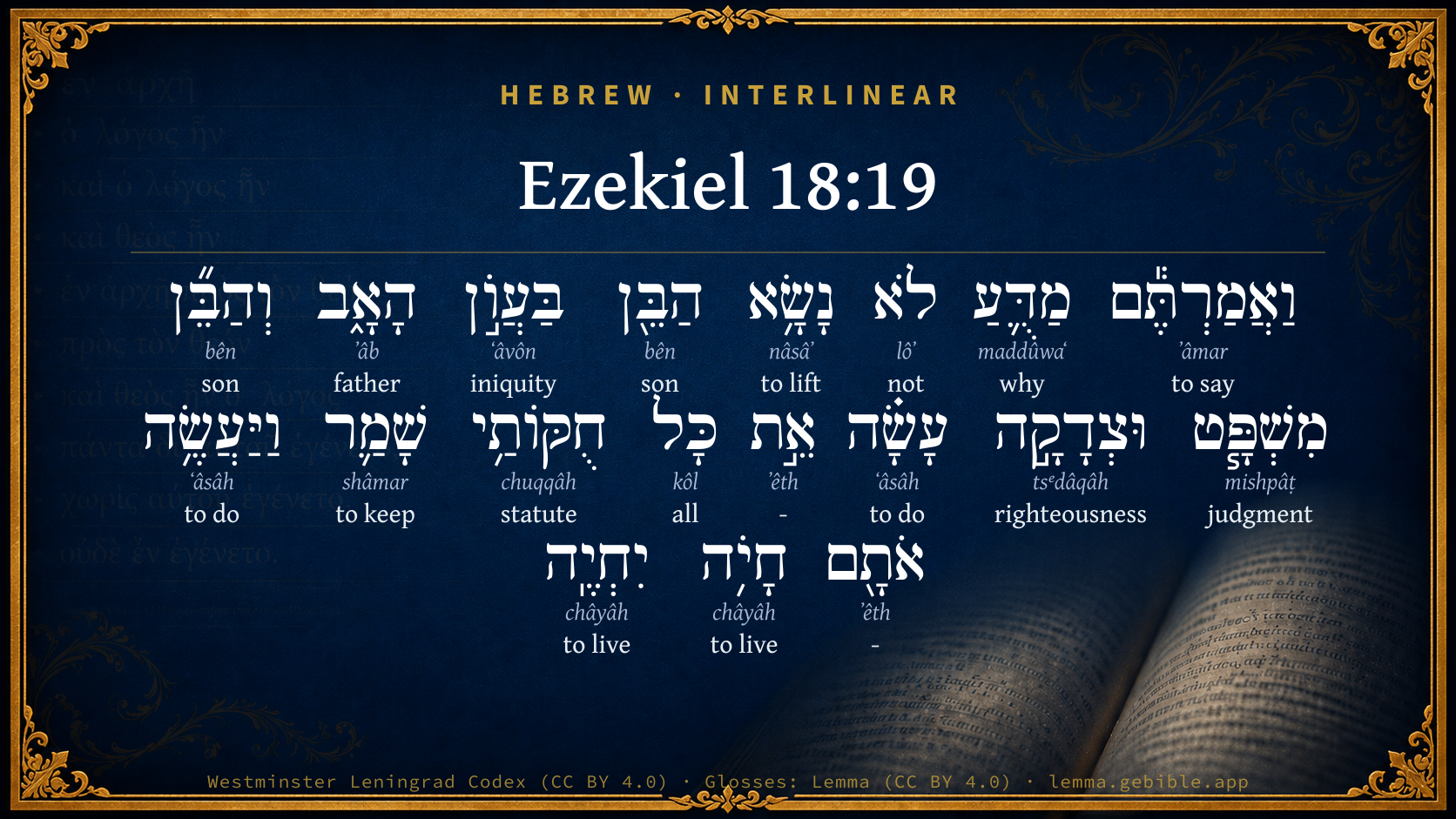
Hebrew (Westminster Leningrad Codex) Ezekiel 18:19 appears in the Hebrew Old Testament. The text above is from the Westminster Leningrad Codex. Each word links to its Strong’s number, a concise gloss, and parsing drawn from the Open Scriptures Hebrew Bible morphology. Click any word for its full Brown-Driver-Briggs (BDB) entry.
Download image
Cite this verse

Ezekiel 18:19 (World English Bible). Public Domain. Lemma interlinear Bible study tool, https://lemma.gebible.app/v/ezekiel/18/19.

Show BibTeX & RIS
BibTeX
RIS
English Translation
Yet say you, Why does not the son bear the iniquity of the father? when the son has done that which is lawful and right, and has kept all my statutes, and has done them, he shall surely live.
World English Bible · Public Domain
Download a study sheet

One document with this verse’s original text, its word-by-word gloss line, the meaning frame, cross-references with their text, attributed commentary, and full source and license credits — printable, and it pastes into notes with its structure intact.

This verse Autodidact and up

Study sheet (.html) Plain text (.txt)

A passage Seminary Student

Up to 50 verses in one chapter. A passage sheet keeps up to 6 commentary sources and 12 cross-references per verse, in the order this page ranks them, and says so on the sheet whenever that leaves anything out. Ask for a single verse and you get the Autodidact verse sheet above.

Everything on this page stays free to read, with no account — the sheet is a download of what is already on screen, not access to it.

Want to remove ads? Support Godless Engineer
Compare translations 3

The same verse in 3 English versions, stacked beneath the original-language interlinear above. Click any original word for its lexicon entry.

Each is an independent rendering of the whole verse — the interlinear is not word-aligned to these translations.

Highlighted words mark where these versions differ — a whole-verse word diff, not a word-by-word alignment.

  • World English Bible Public Domain
    Yet say you, Why does not the son bear the iniquity of the father? when the son has done that which is lawful and right, and has kept all my statutes, and has done them, he shall surely live.
  • King James Version Public Domain
    Yet say ye, Why? doth not the son bear the iniquity of the father? When the son hath done that which is lawful and right, and hath kept all my statutes, and hath done them, he shall surely live.
  • unfoldingWord Literal Text CC BY-SA 4.0
    But you say, ‘Why does the son not bear the iniquity of his father?’ Because the son carries out justice and righteousness and keeps all my statutes; he does them. He will surely live!

unfoldingWord Literal Text — © unfoldingWord, licensed CC BY-SA 4.0. Word-aligned USFM3 via Door43 (git.door43.org/unfoldingWord/en_ult).

Versions to compare (up to 4)

3 of 4 selected

Show all 18 translations

Every available English version of this verse, each an independent rendering of the whole verse.

  • World English Bible Public Domain
    Yet say you, Why does not the son bear the iniquity of the father? when the son has done that which is lawful and right, and has kept all my statutes, and has done them, he shall surely live.
  • Berean Standard Bible Public Domain
    Yet you may ask, ‘Why shouldn’t the son bear the iniquity of his father?’ Since the son has done what is just and right, carefully observing all My statutes, he will surely live.
  • Majority Standard Bible Public Domain
    Yet you may ask, ‘Why shouldn’t the son bear the iniquity of his father?’ Since the son has done what is just and right, carefully observing all My statutes, he will surely live.
  • King James Version Public Domain
    Yet say ye, Why? doth not the son bear the iniquity of the father? When the son hath done that which is lawful and right, and hath kept all my statutes, and hath done them, he shall surely live.
  • American Standard Version (1901) Public Domain
    Yet say ye, Wherefore doth not the son bear the iniquity of the father? when the son hath done that which is lawful and right, and hath kept all my statutes, and hath done them, he shall surely live.
  • Revised Version (1885) Public Domain
    Yet say ye, Wherefore doth not the son bear the iniquity of the father? When the son hath done that which is lawful and right, and hath kept all my statutes, and hath done them, he shall surely live.
  • Geneva Bible (1599) Public Domain
    Yet say ye, Wherefore shall not the sonne beare the iniquitie of the father? because ye sonne hath executed iudgement and iustice, and hath kept all my statutes, and done them, he shall surely liue,
  • Douay-Rheims (1899) Public Domain
    And you say: Why hath not the son borne the iniquity of his father? Verily, because the son hath wrought judgment and justice, hath kept all my commandments, and done them, living, he shall live.
  • Young's Literal Translation Public Domain
    And ye have said, Wherefore hath not the son, Borne of the iniquity of the father? And -- the son judgment and righteousness hath done, All My statutes he hath kept, And he doeth them, he surely liveth.
  • Literal Standard Version CC BY-SA 4.0
    And you have said, Why has the son not borne of the iniquity of the father? And the son has done judgment and righteousness, || He has kept all My statutes, || And he does them, he surely lives.
  • Unlocked Literal Bible CC BY-SA 4.0
    But you say, 'Why does the son not bear the iniquity of his father?' Because the son carries out justice and righteousness and keeps all my statutes; he does them. He will surely live!
  • unfoldingWord Literal Text CC BY-SA 4.0
    But you say, ‘Why does the son not bear the iniquity of his father?’ Because the son carries out justice and righteousness and keeps all my statutes; he does them. He will surely live!
  • Darby Bible Public Domain
    And ye say, Why doth not the son bear the iniquity of the father? But the son hath done judgment and justice, hath kept all my statutes, and hath done them; he shall certainly live.
  • World Messianic Bible Public Domain
    “Yet you say, ‘Why doesn’t the son bear the iniquity of the father?’ When the son has done that which is lawful and right, and has kept all my statutes, and has done them, he will surely live.
  • Webster's Bible Public Domain
    Yet say ye, Why? doth not the son bear the iniquity of the father? When the son hath done that which is lawful and right, and hath kept all my statutes, and hath done them, he shall surely live.
  • Free Bible Version CC BY-SA 4.0
    You ask, ‘Why shouldn't the son pay for his father's sins?’ If the son has done what is fair and right, keeping all my laws, then he'll live, he won't be punished.
  • Bible in Basic English Public Domain
    But you say, Why does not the son undergo punishment for the evil-doing of the father? When the son has done what is ordered and right, and has kept my rules and done them, life will certainly be his.
  • JPS Tanakh (1917) Public Domain
    Yet say ye: Why doth not the son bear the iniquity of the father with him? When the son hath done that which is lawful and right, and hath kept all My statutes, and hath done them, he shall surely live.

Literal Standard Version (2020), Covenant Press — licensed CC BY-SA 4.0. Text via the HelloAO Bible API (eBible.org). Unlocked Literal Bible (unfoldingWord) — licensed CC BY-SA 4.0. Text via the HelloAO Bible API (eBible.org). unfoldingWord Literal Text — © unfoldingWord, licensed CC BY-SA 4.0. Word-aligned USFM3 via Door43 (git.door43.org/unfoldingWord/en_ult). Free Bible Version, Dr. Jonathan Gallagher — licensed CC BY-SA 4.0. Text via the HelloAO Bible API (eBible.org).

Word by word

More ways to search: Search by grammar → Find every occurrence → Compare this word →

Practice this passage: Drill this verse → Learn its vocabulary →

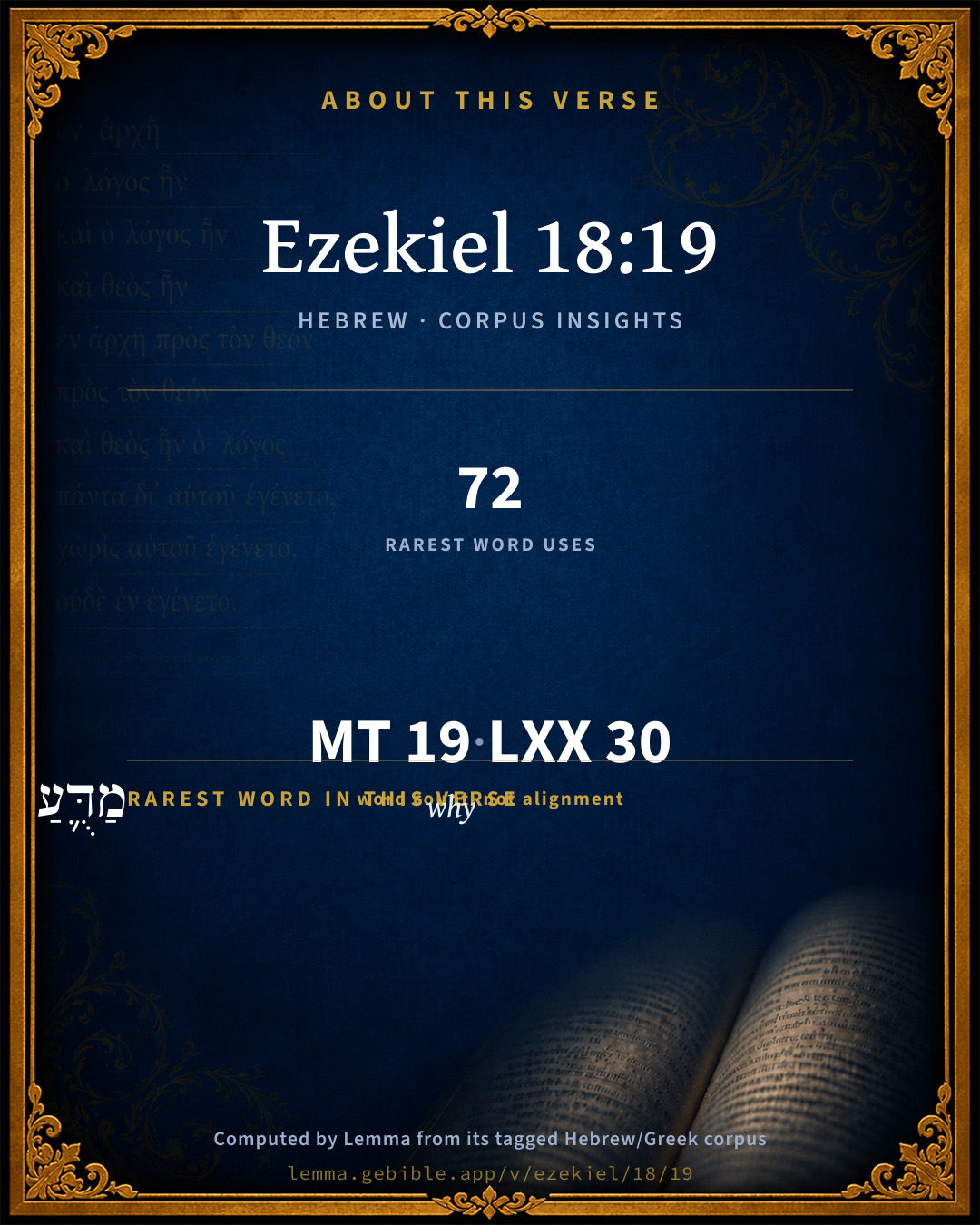
מַדֻּ֛עַ
maddûwaʻ
H4069
“why”
Particle, Interrogative
Part of Speech
Particle
Type
Interrogative
Full BDB Definition

Origin: from H4100 and the pass. participle of H3045

TWOT: 848h

why?, on what account?, wherefore?
  1. וַאֲמַרְתֶּ֕ם ʼâmar H559 “and · to say” Conjunction + Verb, Qal, Sequential Perfect, 2nd Person, Masculine, Plural
  2. לֹא lôʼ H3808 “not” Particle, Negative
  3. נָשָׂ֥א nâsâʼ H5375 “to lift” Verb, Qal, Perfect, 3rd Person, Masculine, Singular
  4. הַבֵּ֖ן bên H1121 “the · son” Particle, Definite Article + Noun, Common, Masculine, Singular, Absolute
  5. בַּעֲוֺ֣ן ʻâvôn H5771 “in/at · iniquity of” Preposition + Noun, Common, Both, Singular, Construct
  6. הָאָ֑ב ʼâb H1 “the · father” Particle, Definite Article + Noun, Common, Masculine, Singular, Absolute
  7. וְהַבֵּ֞ן bên H1121 “and · the · son” Conjunction + Particle, Definite Article + Noun, Common, Masculine, Singular, Absolute
  8. מִשְׁפָּ֧ט mishpâṭ H4941 “judgment” Noun, Common, Masculine, Singular, Absolute
  9. וּצְדָקָ֣ה tsᵉdâqâh H6666 “and · righteousness” Conjunction + Noun, Common, Feminine, Singular, Absolute
  10. עָשָׂ֗ה ʻâsâh H6213 “to do” Verb, Qal, Perfect, 3rd Person, Masculine, Singular
  11. אֵ֣ת ʼêth H853 “-” Particle, Direct Object
  12. כָּל kôl H3605 “all of” Noun, Common, Masculine, Singular, Construct
  13. חֻקּוֹתַ֥י chuqqâh H2708 “statutes · my” Noun, Common, Both, Plural, Construct + Suffix, Personal, 1st Person, Common, Singular
  14. שָׁמַ֛ר shâmar H8104 “to keep” Verb, Qal, Perfect, 3rd Person, Masculine, Singular
  15. וַיַּעֲשֶׂ֥ה ʻâsâh H6213 “and · to do” Conjunction + Verb, Qal, Sequential Imperfect, 3rd Person, Masculine, Singular
  16. אֹתָ֖ם ʼêth H853 “- · them” Particle, Direct Object + Suffix, Personal, 3rd Person, Masculine, Plural
  17. חָיֹ֥ה châyâh H2421 “to live” Verb, Qal, Infinitive Absolute
  18. יִחְיֶֽה châyâh H2421 “to live” Verb, Qal, Imperfect, 3rd Person, Masculine, Singular

About this verse

These counts appear in no published source. They are computed here, from the morphology-tagged text and Lemma’s own curated glosses. What Lemma adds →

19
words
15
distinct lemmas
Prophets
section

Grammatical profile

  • 7 verbs
  • 8 nouns
  • 4 particles

Verb forms

  • וַאֲמַרְתֶּ֕ם Qal · Sequential Perfect
  • נָשָׂ֥א Qal · Perfect
  • עָשָׂ֗ה Qal · Perfect
  • שָׁמַ֛ר Qal · Perfect
  • וַיַּעֲשֶׂ֥ה Qal · Sequential Imperfect
  • חָיֹ֥ה Qal · Infinitive Absolute
  • יִחְיֶֽה Qal · Imperfect

Repetition

Words recur within this verse — often emphatic in Hebrew:

  • הַבֵּ֖ן son H1121 ×2
  • עָשָׂ֗ה to do H6213 ×2
  • חָיֹ֥ה to live H2421 ×2

Hebrew & Septuagint length

In English translation the verse runs 39 words from the Hebrew and 35 from the Septuagint (LXX English) — closely comparable.

A rough comparison of the two English renderings, which tokenize alike — not a word-level alignment.

Word counts can differ between the Hebrew and the Greek without any difference in meaning — e.g. the Hebrew direct-object marker אֵת has no separate Greek word, and Greek often adds the article ὁ.

In the original languages it is 19 Hebrew tokens and 30 Greek tokens — but the two are counted differently (Hebrew bundles its prefixes and suffixes into one token; the Greek is in lemma form), so that isn’t a like-for-like length.

Cross-references

12

Topical passages linked to Ezekiel 18:19 in the Treasury of Scripture Knowledge — connected by theme and wording, ordered by reader-vote popularity; previews shown in the World English Bible.

  • Exodus 20:5 you shall not bow yourself down to them, nor serve them, for I, Yahweh your God, am a jealous God, visiting the iniquity of the fathers on the children, on the third and on the fourth generation of those who hate me,
  • Zechariah 1:3–6 Therefore tell them: Thus says Yahweh of Hosts: 'Return to me,' says Yahweh of Hosts, 'and I will return to you,' says Yahweh of Hosts.
  • Deuteronomy 5:9 you shall not bow down yourself to them, nor serve them; for I, Yahweh, your God, am a jealous God, visiting the iniquity of the fathers on the children, and on the third and on the fourth generation of those who hate me;
  • Jeremiah 15:4 I will cause them to be tossed back and forth among all the kingdoms of the earth, because of Manasseh, the son of Hezekiah, king of Judah, for that which he did in Jerusalem.
  • Ezekiel 18:2 What do you mean, that you use this proverb concerning the land of Israel, saying, The fathers have eaten sour grapes, and the children's teeth are set on edge?
  • Ezekiel 18:9 has walked in my statutes, and has kept my ordinances, to deal truly; he is just, he shall surely live, says the Lord Yahweh.
  • Ezekiel 20:18–20 I said to their children in the wilderness, Don't you walk in the statutes of your fathers, neither observe their ordinances, nor defile yourselves with their idols.
  • 2 Kings 23:26 Notwithstanding, Yahweh didn't turn from the fierceness of his great wrath, with which his anger was kindled against Judah, because of all the provocation with which Manasseh had provoked him.
  • Lamentations 5:7 Our fathers sinned, and are no more; We have borne their iniquities.
  • Ezekiel 20:24 because they had not executed my ordinances, but had rejected my statutes, and had profaned my Sabbaths, and their eyes were after their fathers' idols.
  • Ezekiel 20:30 Therefore tell the house of Israel, Thus says the Lord Yahweh: Do you pollute yourselves after the manner of your fathers? and play you the prostitute after their abominations?
  • 2 Kings 24:3–4 Surely at the commandment of Yahweh came this on Judah, to remove them out of his sight, for the sins of Manasseh, according to all that he did,

Cross-references courtesy of OpenBible.info (CC BY 4.0).

Hebrew and Greek witnesses Masoretic Hebrew ↔ Greek Septuagint

The same verse in the two great witnesses to the Old Testament, shown verse-for-verse.

These are two independent witnesses, not word-aligned to each other, and the Septuagint is shown in lemma (dictionary) form.

Hebrew Ezekiel 18:19 Masoretic · Westminster Leningrad Codex

וַאֲמַרְתֶּ֕ם מַדֻּ֛עַ לֹא נָשָׂ֥א הַבֵּ֖ן בַּעֲוֺ֣ן הָאָ֑ב וְהַבֵּ֞ן מִשְׁפָּ֧ט וּצְדָקָ֣ה עָשָׂ֗ה אֵ֣ת כָּל חֻקּוֹתַ֥י שָׁמַ֛ר וַיַּעֲשֶׂ֥ה אֹתָ֖ם חָיֹ֥ה יִחְיֶֽה

Yet say you, Why does not the son bear the iniquity of the father? when the son has done that which is lawful and right, and has kept all my statutes, and has done them, he shall surely live.

World English Bible · Public Domain

Greek LXX Ezekiel 18:19 Septuagint · lemma form

καί εἶπον τίς ὅτι οὐ λαμβάνω ὁ ἀδικία ὁ υἱός ὁ πατήρ αὐτός ὅτι ὁ υἱός δικαιοσύνη καί ἔλεος ποιέω πᾶς ὁ νόμιμος ἐγώ συντηρέω καί ποιέω αὐτός ζωή ζάω

But you⌃ will say, Why has not the son borne the iniquity of the father? Because the son has wrought judgment and mercy, has kept all my statues, and done them, he shall surely live.

LXX2012 (modern English Septuagint) · Public Domain

On this verse, The Pulpit Commentary discusses the Septuagint’s reading. Read the note in Commentary ↓

Hebrew: Westminster Leningrad Codex (CC BY 4.0). Greek: Septuagint (public domain); English from LXX2012 (modern English Septuagint) (Public Domain). How the Septuagint differs from the Hebrew →

Targum (Aramaic paraphrase)

1

The Targum is the ancient Jewish Aramaic paraphrase of the Hebrew Scriptures — an interpretive translation, not the Hebrew text itself. Onkelos (literal) and Pseudo-Jonathan (expansive) render the Torah, and Jonathan the Prophets. Coverage is partial: where no permissively-licensed English translation exists for a verse, only the Aramaic is shown. This is verse-level text, not a word-by-word alignment to the Hebrew.

  1. Targum Jonathan Prophets (Joshua–Malachi)
    וְתֵימְרוּן מָא דֵין לָא לָקֵי בְרָא בְּחוֹבֵי אַבָּא וּבְרָא דִין וּקְשׁוֹט וּזְכוּ עָבַד יַת כָּל קְיָמֵי נְטַר וַעֲבַד יַתְהוֹן מֵיחָא יְחֵי:

    (no public-domain English translation for this verse)

    Targum Jonathan — Aramaic: “Mikraot Gedolot” (public domain). English: “Sefaria Community Translation” (CC0 1.0 (public-domain dedication)); “London "Chaldee Paraphrase," 1871” (public domain). Text via Sefaria.

Commentary

Notes on Ezekiel 18:19 from classic Christian and Jewish commentators (each source and its license shown beneath its notes). The classic Christian expositions comment on the surrounding passage and are grouped to its opening verse, so a note may address several verses; the Jewish commentaries on the Tanakh (Rashi and others) are per-verse, so they appear only where the commentator wrote on this verse.

Lemma curates 59 commentaries, every one of them public domain or Creative Commons licensed, each selected and text-cleaned for this edition rather than reprinted as found. About our sources →

The Cambridge Bible for Schools and Colleges

gen. ed. J. J. S. Perowne

19. Yet say ye, Why?] Rather: and ye say, wherefore doth not the son bear …? The prophet refers to the current view, and supposes it quoted as an objection to his principle. So long as the idea prevailed that the son was, so to speak, part of the father, it was natural to suppose that he should be included in the father’s punishment; hence the people ask, Why doth the son not bear, lit. bear part of, share in bearing (so Eze_18:20), the iniquity of the father? In opposition to this idea the prophet states his principle on both its sides, Eze_18:19-20.

Secondly, Eze_18:21-32. As men shall not be involved in the sins of their people or their fathers, so the individual soul shall not lie under the ban of its own past.

The sinner who turneth from his evil and doeth righteousness shall live in his righteousness, Eze_18:21-23. And on the other hand, the righteous man who turneth away from his righteousness and doeth evil shall die in his evil, Eze_18:24.

The Cambridge Bible for Schools and Colleges (gen. ed. J. J. S. Perowne; Cambridge University Press, 1878–1918) — public domain. Text from a community e-Sword module.

Trapp's Complete Commentary

John Trapp

Eze 18:19 Yet say ye, Why? doth not the son bear the iniquity of the father? When the son hath done that which is lawful and right, [and] hath kept all my statutes, and hath done them, he shall surely live.

Ver. 19. Yet say ye, Why? doth not the son bear the iniquity of the father?] Thus these unreasonable refractories will not be said, but continue chatting against God, quasi dicant, certe tu non potes negare, &c. {a} Some are ατοποι; {2Th 3:2} they have no topics; there is no talking to them; they will not be set down with right reason.

When the son hath done that is lawful and right.] What a meek, sweet, and satisfactory answer doth God make to these importunate complainers against him! Here we have their replication and his duplication; as Eze 18:25, we have their triplication and his quadruplication. Oh the infinite patience of our good God!

{a} Piscator.

John Trapp, A Commentary or Exposition upon All the Books of the Old and New Testament (1647–1656) — public domain. Text from a community e-Sword module.

Joseph Benson's Commentary

Eze 18:19-20. Yet say ye, Why? doth not the son bear the iniquity of the father? — God here puts into the prophet’s mouth what he knew the Jews would object (at least in their minds) to the foregoing declarations, namely, that they would deny what the prophet had said on this head, and would appeal to facts and experience that the son did bear the iniquity of the father; so that the sense of the first clause of the verse is, Why do you affirm this? does not experience show that the son bears the iniquity of the father? Is it not plain and undeniable, notwithstanding your fine discourse to the contrary? To be sure, we feel the truth of it in our own cases. To this cavil God makes answer in the following words, affirming that this was no otherwise so than when the son followed the example of his father’s iniquity; for that, when the son did that which was lawful and right, and kept God’s statutes, or lived a life of true piety and virtue, he should surely live, that is, should not be punished, or cut off, on account of the iniquity of his father. The righteousness of the righteous shall be upon him — That is, the righteous shall receive the reward of his righteousness. And the wickedness of the wicked shall be upon him — That is, the reward of his wickedness. As certainly as it shall be well with the righteous, because he shall eat the fruit of his doings, so certainly shall woful punishment be executed upon the wicked who persist in their wickedness: see Isa 3:10-11.

Joseph Benson's Commentary on the Old and New Testaments (1811–1818) — public domain. Text from a community e-Sword module.

Whedon's Commentary on the Bible

Daniel D. Whedon

OBJECTIONS TO THE PRECEDING STATEMENT OF GOD’S PRINCIPLES OF GOVERNMENT ARE NOW MET, Eze_18:19-30.

19. Yet say ye, Why? etc. — Rather, And say ye, Why doth not the son bear a part of the iniquity of the father? (also Eze_18:20.) The people were so imbued with the common notion that the father must control the son’s destiny that they again asked in great surprise how it could really be that the son did not share at all in the father’s guilt and penalty. To this the prophet merely reaffirms Jehovah’s way of dealing with the just and the unjust, as previously laid down and illustrated (Eze_18:5-24).

Daniel D. Whedon (gen. ed.), Commentary on the Old and New Testaments (1874–1909) — public domain. Text from a community e-Sword module.

Jamieson, Fausset & Brown

Robert Jamieson, A. R. Fausset & David Brown

Here the Jews object to the prophet's word and in their objection seem to seek a continuance of that very thing which they had originally made a matter of complaint. Therefore translate, "Wherefore doth not the son bear the iniquity of his father?" It now would seem a consolation to them to think the son might suffer for his father's misdeeds; for it would soothe their self-love to regard themselves as innocent sufferers for the guilt of others and would justify them in their present course of life, which they did not choose to abandon for a better. In reply, Ezekiel reiterates the truth of each being dealt with according to his own merits [FAIRBAIRN]. But GROTIUS supports English Version, wherein the Jews contradict the prophet, "Why (sayest thou so) doth not the son (often, as in our case, though innocent) bear (that is, suffer for) the iniquity of their father?" Ezekiel replies, It is not as you say, but as I in the name of God say: "When the son hath done," &c. English Version is simpler than that of FAIRBAIRN.

Jamieson, Fausset & Brown — Commentary Critical and Explanatory on the Whole Bible (1871) — public domain (CC PDM 1.0). Text via the HelloAO Bible API.

Ellicott's Commentary for English Readers

(19) Why? Doth not the son bear?—It would be clearer to read this as a single question, “Why doth not the son, &c?” It is the question proposed by the people in objection to what has been declared. To them it seemed the law of nature, the necessity of the case, the teaching of history, that the son should bear the iniquity of his father. Their ideas had not risen to the conception of man’s individual responsibility to God; to them the individual was still but a part of the nation or the family. They ask, therefore, why this universal law should now be reversed. It was not true that any law was reversed, it was only that the superior prevailed over the inferior law; but, as usual in such cases, the Divine word does not reason with the human objection, but in this and the following verse only reiterates most emphatically the law of individual responsibility.

A Bible Commentary for English Readers, edited by Charles John Ellicott (1878–1897) — public domain. Text from a community e-Sword module.

John Gill's Exposition

The soul that sinneth, it shall die,.... This is repeated from Eze 18:4, for the further confirmation of it:

the son shall not bear the iniquity of the father, neither shall the father bear the iniquity of the son; that is, as the Targum paraphrases it,

"the son shall not be punished for the sins of the father, nor shall the father be punished for the sins of the son.''

This is to be understood of adult persons, and of actual sins; for of such only the prophet speaks throughout the whole chapter, or of temporal, and not of eternal punishment:

the righteousness of the righteous shall be upon him; he shall be rewarded with temporal good things in this life, according to his righteousness; which, as the Targum says, shall "remain" upon him; see Psa 112:9; he shall eat of the fruit of his own doings, Isa 3:10; this is true of a man that is evangelically righteous, or is so through the imputation of Christ's righteousness to him; which is upon him as a robe to clothe him, and will always remain on him, being an everlasting righteousness, and will answer for him in a time to come:

and the wickedness of the wicked shall be upon him; and not another; his sin shall remain on him unatoned for, unexpiated, not taken away or forgiven; the punishment of it shall be on him, and abide upon him.

John Gill's Exposition of the Whole Bible (1746–1763) — public domain (CC PDM 1.0). Text via the HelloAO Bible API.

Albert Barnes' Notes on the Bible

Why?... - Rather, “Why doth not the son bear the iniquity of the father?”

Albert Barnes' Notes on the Bible (1834–1885) — public domain. Text from a community e-Sword/MySword module.

Matthew Poole's English Annotations

Notwithstanding this method of the Divine justice, which renders to every one his own work, and gives to every one the fruit of his own doings, ye, proud, quarrelling, self-justifying debauchees, idolaters, adulterers, murderers, usurers, oppressors, will not see your own sins, for which you are punished, but cry you are innocent, that your fathers sinned and you suffer.

Doth not the son bear the iniquity of the father? The prophet here brings in what he met with among them; still every where they insist on it that they deserved not by any sin of their own what they now suffered, and so would cast the sin and guilt on their fathers, and the rigour and severity on God, and clear themselves to all; which the prophet answers by a recapitulation of what he had more largely spoken, and avows it, that the righteous son of an unrighteous father shall live, and not die.

Kept all my statutes; as Psa 119:44.

Matthew Poole's English Annotations on the Holy Bible (1683–1685) — public domain. Text from a community e-Sword/MySword module.

The Pulpit Commentary

Why? doth not the son, etc.? The words are better taken, with the LXX, Vulgate, Revised Version, and most critics, as a single question, Why doth not the son bear, etc.? What is the explanation of a fact which seemingly contradicts the teaching of the Law? The answer to the question seems at first only an iteration of what had been stated before. The son repents, and therefore does not bear his father"s iniquity. A man is responsible for his own sins, and for those only. To think otherwise is to think of God as less righteous than man.

Vers. 19-22. Personal responsibility.

We can only account for the Prophet Ezekiel laying such special stress upon the principle of individuality in religion by supposing that, in his time and among those with whom he associated, there was a prevalent disposition and habit leading to the denial of what seems to us an unquestionable truth. Indeed, in some form or other, men do incline to shift responsibility from themselves to their parents, their early teachers, their companions, the society in which their lot is cast.

I THE VAIN AND DECEPTIVE CONTENTION THAT THE MORAL QUALITY OF ONE GENERATION IS IMPUTED TO ANOTHER. This contention may take either of two forms.

1. The son of a good father is apt to rely upon his father"s goodness. Thereis no doubt that such a one may inherit much that is advantageous, e.g. a good constitution, a happy temperament, a good introduction to life, the favourable regard of many helpful friends. And it is sometimes forgotten that all this does not interfere with responsibility; in fact, he who is so highly favoured is thereby raised to a higher level of accountability. Much is given, and much will be required.

2. The son of a bad father is apt to excuse his faults by casting the blamefor them upon the transmission of evil influences by heredity, or upon circumstances traceable to family relationships. It is the case that such a person starts heavily weighted upon the race of life; his temptations to error and sin are many and urgent, and restraining influences are weakened. Allowances are made by men, and no doubt by God also, for such disadvantages; but they do not destroy the moral responsibility of the free agent.

II THE WITNESS OF THE CONSCIENCE TO INDIVIDUAL AND INALIENABLE RESPONSIBILITY. Reference has been made to the attempts too often made by shiners to cast their responsibility upon others. But it may unhesitatingly be asserted that those who put forward such excuses are never themselves convinced by them. In their hearts they are well aware that there is no sincerity in such excuses, that they are mere subterfuges. The conscience within, which accuses and excuses, gives no uncertain sound. The religious teacher, the Christian preacher, who seeks to convince men of sin has the assurance that the inner monitor of his hearers supports his endeavour, that he neither upbraids nor pleads alone. When the Lord God exclaims by the voice of his prophet, "Hear now, O house of Israel; Is not my way equal? are not your ways unequal?" every man, convicted by his conscience, is reduced to silence; for there is no reply to be made. When conscience is awakened, its witness is plain and unmistakable.

III THE EXPRESS AND AUTHORITATIVE STATEMENT OF GOD"S OWN WORD AS TO MAN"S INDIVIDUAL ACCOUNTABILITY. The language of this chapter is peculiarly explicit upon this matter. "The soul that sinneth, it shall die; the righteous shall surely live, he shall not die." And these statements are in harmony with the whole tenor of Scripture teaching. The Bible magnifies man"s personality, and never represents man as a machine, an organism. Each living soul stands in its own relation to the Father of spirits, before whom every moral and free nature must appear to render an account for itself, and not for another. The teaching of our Lord and of his apostles is as definite and decided upon this point as the teaching of the Lawgiver and the prophets of the earlier dispensation. We are throughout Scripture consistently taught that there is no evading the great account. T.

The Pulpit Commentary (1880–1919), ed. H.D.M. Spence-Jones & Joseph S. Exell — public domain. Text from a community e-Sword module.

unfoldingWord translationNotes

Door43 World Missions Community

Why does the son not bear the iniquity of his father?

Yahweh speaks of a person being responsible for or guilty of iniquity as if the iniquity were an object that the person carries. AT: "Why is the son not responsible for the iniquity of his father?" or "Why is the son not guilty of the iniquity of his father?" (See: Metaphor)

The righteousness of the one who acts rightly will be on himself

For righteousness to be on a person is an idiom that means the person is responsible for that righteousness. AT: "The one who acts rightly will be responsible for his own righteousness" (See: Idiom)

the wickedness of the wicked will be on himself

For wickedness to be on a person is an idiom that means the person is responsible for that wickedness. AT: "the wicked person will be responsible for his own wickedness" (See: Idiom)

translationWords

son

iniquity

ancestor

just

righteous

statute

life

sin

die

evil

unfoldingWord translationNotes — © Distant Shores Media and the Door43 World Missions Community, licensed CC BY-SA 4.0. Source: git.door43.org/Door43/en_tn.

Lesson kit

Teaching starters — assembled from the data on this page, not authored interpretation. Every prompt links to the verse data it draws on. Edit before teaching.

Ezekiel, in the Prophets, opens this verse with 19 words (15 distinct Hebrew lemmas). Its most distinctive word is maddûwaʻ (“why”). A historical commentator’s framing appears above. Read the whole chapter for the surrounding context.

Discussion questions

  1. How does “why” (maddûwaʻ) shape what this verse is saying?
  2. Exodus 20:5 shares this passage’s theme. How do the two illuminate each other?
  3. “son” occurs 2× in this one verse. What is the effect of the repetition?
  4. These translations render this verse differently; the difference is in the English rendering, not the original. What questions does that raise?
  5. The verb «וַאֲמַרְתֶּ֕ם» is Qal Sequential Perfect. How does its form color the action?
  6. Reading how The Cambridge Bible for Schools and Colleges and Trapp's Complete Commentary read this verse, where do the two commentators agree and where do they part?

Things to notice

Reading settings

Reading text

Shown beneath each verse's original-language words.

Old Testament
Old Testament edition

Read the OT as the Masoretic Hebrew (MT) or the Greek Septuagint (LXX).

English shown for the Greek Septuagint (in the Hebrew ↔ Greek comparison).

Comparing translations? Open the Compare panel on any verse page to stack up to four side by side.