
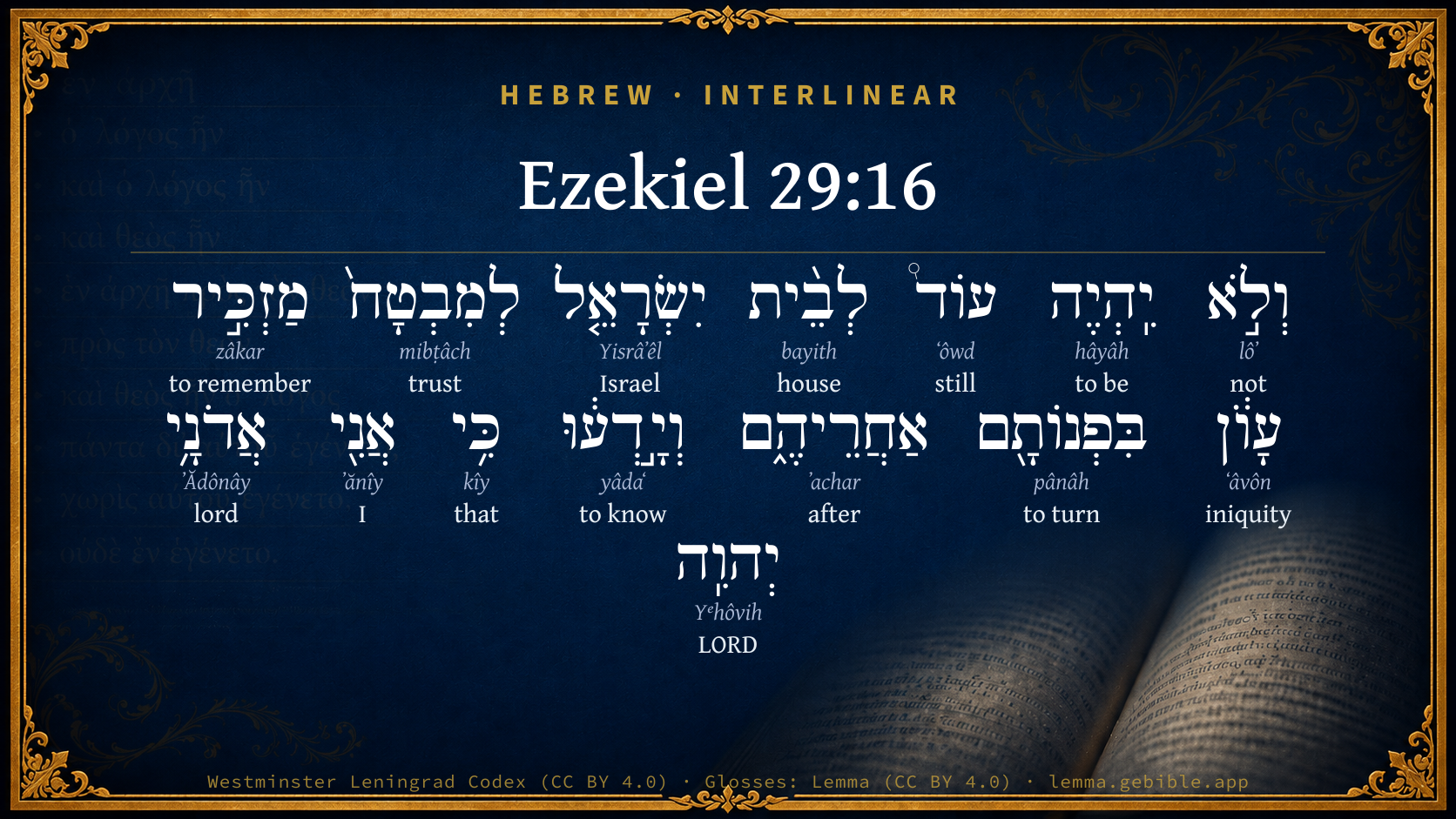
Ezekiel 29:16

Hebrew (Westminster Leningrad Codex) Ezekiel 29:16 appears in the Hebrew Old Testament. The text above is from the Westminster Leningrad Codex. Each word links to its Strong’s number, a concise gloss, and parsing drawn from the Open Scriptures Hebrew Bible morphology. Click any word for its full Brown-Driver-Briggs (BDB) entry.
Download image
Cite this verse

Ezekiel 29:16 (World English Bible). Public Domain. Lemma interlinear Bible study tool, https://lemma.gebible.app/v/ezekiel/29/16.

Show BibTeX & RIS
BibTeX
RIS
English Translation
It shall be no more the confidence of the house of Israel, bringing iniquity to memory, when they turn to look after them: and they shall know that I am the Lord Yahweh.
World English Bible · Public Domain
Download a study sheet

One document with this verse’s original text, its word-by-word gloss line, the meaning frame, cross-references with their text, attributed commentary, and full source and license credits — printable, and it pastes into notes with its structure intact.

This verse Autodidact and up

Study sheet (.html) Plain text (.txt)

A passage Seminary Student

Up to 50 verses in one chapter. A passage sheet keeps up to 6 commentary sources and 12 cross-references per verse, in the order this page ranks them, and says so on the sheet whenever that leaves anything out. Ask for a single verse and you get the Autodidact verse sheet above.

Everything on this page stays free to read, with no account — the sheet is a download of what is already on screen, not access to it.

Want to remove ads? Support Godless Engineer
Compare translations 3

The same verse in 3 English versions, stacked beneath the original-language interlinear above. Click any original word for its lexicon entry.

Each is an independent rendering of the whole verse — the interlinear is not word-aligned to these translations.

Highlighted words mark where these versions differ — a whole-verse word diff, not a word-by-word alignment.

  • World English Bible Public Domain
    It shall be no more the confidence of the house of Israel, bringing iniquity to memory, when they turn to look after them: and they shall know that I am the Lord Yahweh.
  • King James Version Public Domain
    And it shall be no more the confidence of the house of Israel, which bringeth their iniquity to remembrance, when they shall look after them: but they shall know that I am the Lord GOD.
  • unfoldingWord Literal Text CC BY-SA 4.0
    The Egyptians will no longer be a reason for confidence for the house of Israel. Instead, they will be a reminder of the iniquity that Israel committed when they turned to Egypt for help. Then they will know that I am the Lord Yahweh.’”

unfoldingWord Literal Text — © unfoldingWord, licensed CC BY-SA 4.0. Word-aligned USFM3 via Door43 (git.door43.org/unfoldingWord/en_ult).

Versions to compare (up to 4)

3 of 4 selected

Show all 18 translations

Every available English version of this verse, each an independent rendering of the whole verse.

  • World English Bible Public Domain
    It shall be no more the confidence of the house of Israel, bringing iniquity to memory, when they turn to look after them: and they shall know that I am the Lord Yahweh.
  • Berean Standard Bible Public Domain
    Egypt will never again be an object of trust for the house of Israel, but will remind them of their iniquity in turning to the Egyptians. Then they will know that I am the Lord GOD.”
  • Majority Standard Bible Public Domain
    Egypt will never again be an object of trust for the house of Israel, but will remind them of their iniquity in turning to the Egyptians. Then they will know that I am the Lord GOD.”
  • King James Version Public Domain
    And it shall be no more the confidence of the house of Israel, which bringeth their iniquity to remembrance, when they shall look after them: but they shall know that I am the Lord GOD.
  • American Standard Version (1901) Public Domain
    And it shall be no more the confidence of the house of Israel, bringing iniquity to remembrance, when they turn to look after them: and they shall know that I am the Lord Jehovah.
  • Revised Version (1885) Public Domain
    And it shall be no more the confidence of the house of Israel, bringing iniquity to remembrance, when they turn to look after them: and they shall know that I am the Lord GOD.
  • Geneva Bible (1599) Public Domain
    And it shall be no more the confidence of the house of Israel, to bring their iniquitie to remembrance by looking after them, so shall they knowe, that I am the Lord God.
  • Douay-Rheims (1899) Public Domain
    And they shall be no more a confidence to the house of Israel, teaching iniquity, that they may flee, and follow them: and they shall know that I am the Lord God.
  • Young's Literal Translation Public Domain
    And it is no more to the house of Israel for a confidence, Bringing iniquity to remembrance, By their turning after them, And they have known that I `am' the Lord Jehovah.'
  • Literal Standard Version CC BY-SA 4.0
    And it is no longer for confidence to the house of Israel, || Bringing iniquity to remembrance, || By their turning after them, || And they have known that I [am] Lord YHWH.”
  • Unlocked Literal Bible CC BY-SA 4.0
    The Egyptians will no longer be a reason for confidence for the house of Israel. Instead, they will be a reminder of the iniquity that Israel committed when they turned to Egypt for help. Then they will know that I am the Lord Yahweh.'”
  • unfoldingWord Literal Text CC BY-SA 4.0
    The Egyptians will no longer be a reason for confidence for the house of Israel. Instead, they will be a reminder of the iniquity that Israel committed when they turned to Egypt for help. Then they will know that I am the Lord Yahweh.’”
  • Darby Bible Public Domain
    And it shall be no more the confidence of the house of Israel, bringing iniquity to remembrance, when they turn after them: and they shall know that I [am] the Lord Jehovah.
  • World Messianic Bible Public Domain
    It will no longer be the confidence of the house of Israel, bringing iniquity to memory, when they turn to look after them. Then they will know that I am the Lord GOD.”’”
  • Webster's Bible Public Domain
    And it shall be no more the confidence of the house of Israel, which bringeth their iniquity to remembrance, when they shall look after them: but they shall know that I am the Lord GOD.
  • Free Bible Version CC BY-SA 4.0
    The people of Israel won't ever trust in Egypt again; instead they will be reminded of their sin when they turned to the Egyptians for help. Then they will know that I am the Lord God.”
  • Bible in Basic English Public Domain
    And Egypt will no longer be the hope of the children of Israel, causing sin to come to mind when their eyes are turned to them: and they will be certain that I am the Lord.
  • JPS Tanakh (1917) Public Domain
    And it shall be no more the confidence of the house of Israel, bringing iniquity to remembrance, when they turn after them; and they shall know that I am the Lord GOD.'

Literal Standard Version (2020), Covenant Press — licensed CC BY-SA 4.0. Text via the HelloAO Bible API (eBible.org). Unlocked Literal Bible (unfoldingWord) — licensed CC BY-SA 4.0. Text via the HelloAO Bible API (eBible.org). unfoldingWord Literal Text — © unfoldingWord, licensed CC BY-SA 4.0. Word-aligned USFM3 via Door43 (git.door43.org/unfoldingWord/en_ult). Free Bible Version, Dr. Jonathan Gallagher — licensed CC BY-SA 4.0. Text via the HelloAO Bible API (eBible.org).

Word by word

More ways to search: Search by grammar → Find every occurrence → Compare this word →

Practice this passage: Drill this verse → Learn its vocabulary →

לְמִבְטָח֙
mibṭâch
H4009
“to/for · trust”
Preposition + Noun, Common, Masculine, Singular, Absolute
Part of Speech
Preposition + Noun
Type
Common
Gender
Masculine
Number
Singular
State
Absolute
Full BDB Definition

Origin: from H982

TWOT: 233e

trust, confidence, refuge - act of confiding - object of confidence - state of confidence, security
  1. וְלֹ֣א lôʼ H3808 “and · not” Conjunction + Particle, Negative
  2. יִֽהְיֶה hâyâh H1961 “to be” Verb, Qal, Imperfect, 3rd Person, Masculine, Singular
  3. עוֹד֩ ʻôwd H5750 “still” Adverb
  4. לְבֵ֨ית bayith H1004 “to/for · house of” Preposition + Noun, Common, Masculine, Singular, Construct
  5. יִשְׂרָאֵ֤ל Yisrâʼêl H3478 “Israel” Noun, Proper
  6. מַזְכִּ֣יר zâkar H2142 “remembering” Verb, Hiphil, Participle Active, Masculine, Singular, Absolute
  7. עָוֺ֔ן ʻâvôn H5771 “iniquity” Noun, Common, Both, Singular, Absolute
  8. בִּפְנוֹתָ֖ם pânâh H6437 “in/at · to turn · them” Preposition + Verb, Qal, Infinitive Construct + Suffix, Personal, 3rd Person, Masculine, Plural
  9. אַחֲרֵיהֶ֑ם ʼachar H310 “after · them” Preposition + Suffix, Personal, 3rd Person, Masculine, Plural
  10. וְיָ֣דְע֔וּ yâdaʻ H3045 “and · to know” Conjunction + Verb, Qal, Sequential Perfect, 3rd Person, Common, Plural
  11. כִּ֥י kîy H3588 “that” Conjunction
  12. אֲנִ֖י ʼănîy H589 “I” Pronoun, Personal, 1st Person, Common, Singular
  13. אֲדֹנָ֥י ʼĂdônây H136 “Lord · my” Noun, Common, Masculine, Plural, Construct + Suffix, Personal, 1st Person, Common, Singular
  14. יְהוִֽה Yᵉhôvih H3069 “LORD” Noun, Proper

About this verse

These counts appear in no published source. They are computed here, from the morphology-tagged text and Lemma’s own curated glosses. What Lemma adds →

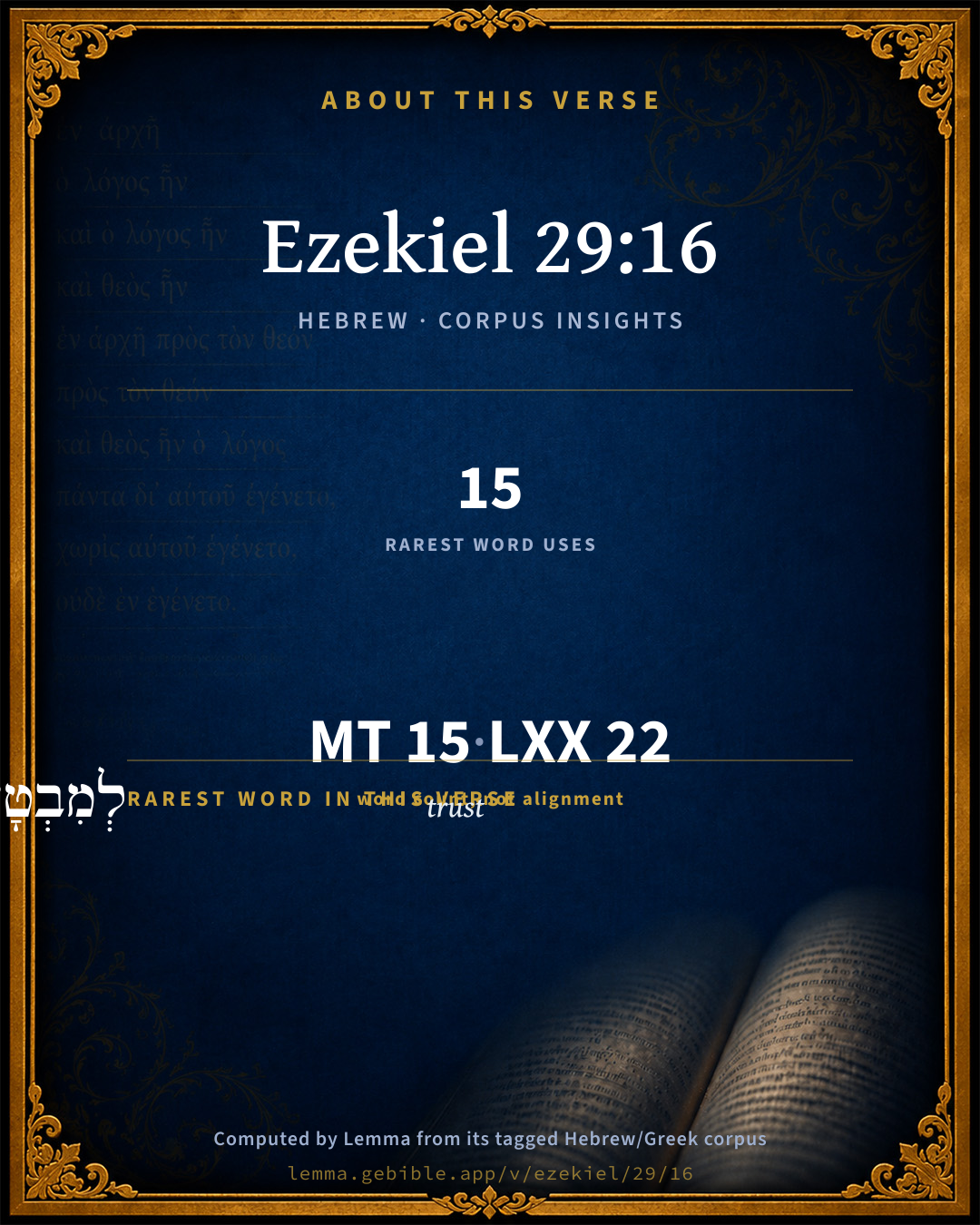
15
words
15
distinct lemmas
Prophets
section

Notable vocabulary

The rarest word here is לְמִבְטָח֙ trust H4009 — appearing just 15 times in the whole Hebrew Bible.

Shared distinctive vocabulary

לְמִבְטָח֙ trust H4009 occurs in 15 verses of the Hebrew Bible. Also found in:

Grammatical profile

  • 4 verbs
  • 6 nouns
  • 1 pronoun
  • 1 preposition
  • 1 conjunction
  • 1 adverb
  • 1 particle

Verb forms

  • יִֽהְיֶה Qal · Imperfect
  • מַזְכִּ֣יר Hiphil · Participle Active
  • בִּפְנוֹתָ֖ם Qal · Infinitive Construct
  • וְיָ֣דְע֔וּ Qal · Sequential Perfect

Hebrew & Septuagint length

In English translation the verse runs 33 words from the Hebrew and 31 from the Septuagint (LXX English) — closely comparable.

A rough comparison of the two English renderings, which tokenize alike — not a word-level alignment.

Word counts can differ between the Hebrew and the Greek without any difference in meaning — e.g. the Hebrew direct-object marker אֵת has no separate Greek word, and Greek often adds the article ὁ.

In the original languages it is 15 Hebrew tokens and 22 Greek tokens — but the two are counted differently (Hebrew bundles its prefixes and suffixes into one token; the Greek is in lemma form), so that isn’t a like-for-like length.

Cross-references

30

Topical passages linked to Ezekiel 29:16 in the Treasury of Scripture Knowledge — connected by theme and wording, ordered by reader-vote popularity; previews shown in the World English Bible.

  • Isaiah 20:5 They shall be dismayed and confounded, because of Ethiopia their expectation, and of Egypt their glory.
  • Ezekiel 29:6–7 All the inhabitants of Egypt shall know that I am Yahweh, because they have been a staff of reed to the house of Israel.
  • Hosea 8:13 As for the sacrifices of my offerings, they sacrifice flesh and eat it; But Yahweh doesn't accept them. Now he will remember their iniquity, And punish their sins. They will return to Egypt.
  • Psalms 25:7 Don't remember the sins of my youth, nor my transgressions. Remember me according to your loving kindness, For your goodness' sake, Yahweh.
  • Isaiah 30:1–6 Woe to the rebellious children, says Yahweh, who take counsel, but not of me; and who make a league, but not of my Spirit, that they may add sin to sin,
  • Isaiah 64:9 Don't be angry very sore, Yahweh, neither remember iniquity forever: see, look, we beg you, we are all your people.
  • Jeremiah 2:36–37 Why go you about so much to change your way? you shall be ashamed of Egypt also, as you were ashamed of Assyria.
  • Jeremiah 14:10 Thus says Yahweh to this people, Even so have they loved to wander; they have not refrained their feet: therefore Yahweh does not accept them; now will he remember their iniquity, and visit their sins.
  • Lamentations 4:17 Our eyes do yet fail [in looking] for our vain help: In our watching we have watched for a nation that could not save.
  • Ezekiel 21:23 It shall be to them as a false divination in their sight, who have sworn oaths to them; but he brings iniquity to memory, that they may be taken.
  • Numbers 5:15 then the man shall bring his wife to the priest, and shall bring her offering for her: the tenth part of an ephah of barley meal. He shall pour no oil on it, nor put frankincense on it, for it is a meal offering of jealousy, a meal offering of memorial, bringing iniquity to memory.
  • 1 Kings 17:18 She said to Elijah, What have I to do with you, you man of God? You have come to me to bring my sin to memory, and to kill my son!
  • Psalms 79:8 Don't hold the iniquities of our forefathers against us. Let your tender mercies speedily meet us, For we are in desperate need.
  • Isaiah 31:1–3 Woe to those who go down to Egypt for help, and rely on horses, and trust in chariots because they are many, and in horsemen because they are very strong, but they don't look to the Holy One of Israel, neither seek Yahweh!
  • Isaiah 36:4–6 Rabshakeh said to them, Say you now to Hezekiah, Thus says the great king, the king of Assyria, What confidence is this in which you trust?
  • Jeremiah 2:18–19 Now what have you to do in the way to Egypt, to drink the waters of the Shihor? or what have you to do in the way to Assyria, to drink the waters of the River?
  • Jeremiah 37:5–7 Pharaoh's army was come forth out of Egypt; and when the Chaldeans who were besieging Jerusalem heard news of them, they broke up from Jerusalem.
  • Ezekiel 17:15–17 But he rebelled against him in sending his ambassadors into Egypt, that they might give him horses and much people. Shall he prosper? shall he escape who does such things? shall he break the covenant, and yet escape?
  • Ezekiel 28:22–24 and say, Thus says the Lord Yahweh: Behold, I am against you, Sidon; and I will be glorified in the midst of you; and they shall know that I am Yahweh, when I shall have executed judgments in her, and shall be sanctified in her.
  • Ezekiel 28:26 They shall dwell securely therein; yes, they shall build houses, and plant vineyards, and shall dwell securely, when I have executed judgments on all those who do them despite round about them; and they shall know that I am Yahweh their God.
  • Ezekiel 29:9 The land of Egypt shall be a desolation and a waste; and they shall know that I am Yahweh. Because he has said, The river is mine, and I have made it;
  • Ezekiel 29:21 In that day will I cause a horn to bud forth to the house of Israel, and I will give you the opening of the mouth in the midst of them; and they shall know that I am Yahweh.
  • Hosea 5:13 When Ephraim saw his sickness, And Judah his wound, Then Ephraim went to Assyria, And sent to king Jareb: But he is not able to heal you, Neither will he cure you of your wound.
  • Hosea 7:11 "Ephraim is like an easily deceived dove, without understanding. They call to Egypt. They go to Assyria.
  • Hosea 9:9 They have deeply corrupted themselves, As in the days of Gibeah. He will remember their iniquity. He will punish them for their sins.
  • Hosea 12:1 Ephraim feeds on wind, And chases the east wind. He continually multiplies lies and desolation. They make a covenant with Assyria, And oil is carried into Egypt.
  • Hosea 14:3 Assyria can't save us. We won't ride on horses; Neither will we say any more to the work of our hands, 'Our gods!' For in you the fatherless finds mercy."
  • Hebrews 10:3 But in those sacrifices there is yearly reminder of sins.
  • Hebrews 10:17 "I will remember their sins and their iniquities no more."
  • Revelation 16:19 The great city was divided into three parts, and the cities of the nations fell. Babylon the great was remembered in the sight of God, to give to her the cup of the wine of the fierceness of his wrath.

Cross-references courtesy of OpenBible.info (CC BY 4.0).

Hebrew and Greek witnesses Masoretic Hebrew ↔ Greek Septuagint

The same verse in the two great witnesses to the Old Testament, shown verse-for-verse.

These are two independent witnesses, not word-aligned to each other, and the Septuagint is shown in lemma (dictionary) form.

Hebrew Ezekiel 29:16 Masoretic · Westminster Leningrad Codex

וְלֹ֣א יִֽהְיֶה עוֹד֩ לְבֵ֨ית יִשְׂרָאֵ֤ל לְמִבְטָח֙ מַזְכִּ֣יר עָוֺ֔ן בִּפְנוֹתָ֖ם אַחֲרֵיהֶ֑ם וְיָ֣דְע֔וּ כִּ֥י אֲנִ֖י אֲדֹנָ֥י יְהוִֽה

It shall be no more the confidence of the house of Israel, bringing iniquity to memory, when they turn to look after them: and they shall know that I am the Lord Yahweh.

World English Bible · Public Domain

Greek LXX Ezekiel 29:16 Septuagint · lemma form

καί οὐκέτι εἰμί ὁ οἶκος ἰσραήλ εἰς ἐλπίς ἀναμιμνήσκω ἀνομία ἐν ὁ αὐτός ἀκολουθέω ὀπίσω αὐτός καί γιγνώσκω ὅτι ἐγώ εἰμί κύριος

And they shall no more be to the house of Israel a confidence bringing iniquity to remembrance, when they follow after them; and they shall know that I am the Lord.

LXX2012 (modern English Septuagint) · Public Domain

Hebrew: Westminster Leningrad Codex (CC BY 4.0). Greek: Septuagint (public domain); English from LXX2012 (modern English Septuagint) (Public Domain). How the Septuagint differs from the Hebrew →

Targum (Aramaic paraphrase)

1

The Targum is the ancient Jewish Aramaic paraphrase of the Hebrew Scriptures — an interpretive translation, not the Hebrew text itself. Onkelos (literal) and Pseudo-Jonathan (expansive) render the Torah, and Jonathan the Prophets. Coverage is partial: where no permissively-licensed English translation exists for a verse, only the Aramaic is shown. This is verse-level text, not a word-by-word alignment to the Hebrew.

  1. Targum Jonathan Prophets (Joshua–Malachi)
    וְלָא יְהוֹן עוֹד לְבֵית יִשְׂרָאֵל לְאִתְרַחָצָא עֲלֵיהוֹן לְאַדְכְּרָא חוֹבִין בְּאַפְנָיוּתְהוֹן בַּתְרֵיהוֹן וְיֵדְעוּן אֲרֵי אֲנָא יְיָ אֱלֹהִים:

    (no public-domain English translation for this verse)

    Targum Jonathan — Aramaic: “Mikraot Gedolot” (public domain). English: “Sefaria Community Translation” (CC0 1.0 (public-domain dedication)); “London "Chaldee Paraphrase," 1871” (public domain). Text via Sefaria.

Commentary

Notes on Ezekiel 29:16 from classic Christian and Jewish commentators (each source and its license shown beneath its notes). The classic Christian expositions comment on the surrounding passage and are grouped to its opening verse, so a note may address several verses; the Jewish commentaries on the Tanakh (Rashi and others) are per-verse, so they appear only where the commentator wrote on this verse.

Lemma curates 59 commentaries, every one of them public domain or Creative Commons licensed, each selected and text-cleaned for this edition rather than reprinted as found. About our sources →

Trapp's Complete Commentary

John Trapp

Eze 29:16 And it shall be no more the confidence of the house of Israel, which bringeth [their] iniquity to remembrance, when they shall look after them: but they shall know that I [am] the Lord GOD.

Ver. 16. And it shall be no more the confidence.] For I will cut them and keep them short enough; I will pull their plumes, so that they shall not stretch their wings beyond the nest; they shall have nothing so many clients and adherents.

Which bringeth their iniquity to remembrance.] Creature confidence is so hated of God, that it inmindeth him of former miscarriages also, and causeth him to plague men for the new and the old together.

John Trapp, A Commentary or Exposition upon All the Books of the Old and New Testament (1647–1656) — public domain. Text from a community e-Sword module.

Joseph Benson's Commentary

Eze 29:16. It shall be no more the confidence of the house of Israel — At the same time that the Jews put confidence in Egypt they distrusted the promises and assistance of God, and forsook him to comply with the idolatries of their allies. Which bringeth — Or, as Newcome translates it, Calling their iniquity to remembrance — That is, as he interprets it, causing God to remember and punish the iniquity of his people. Or the sense of the verse may be, that the Israelites should no more look to Egypt for help; but, by the deplorable state it should be reduced to, be put in mind of the judgments which wickedness brings down from God; and of their own folly and iniquity in distrusting his assistance, and seeking to Egypt for help, contrary to his commands, and even complying with the Egyptian idolatries, in order to engage them in their favour.

Joseph Benson's Commentary on the Old and New Testaments (1811–1818) — public domain. Text from a community e-Sword module.

Geneva Bible (1599)

Geneva Bible translators

Lest I should by this means punish their sins.

Geneva Bible (1599) marginal notes — public domain. Text via Bolls.life.

Jamieson, Fausset & Brown

Robert Jamieson, A. R. Fausset & David Brown

Egypt, when restored, shall be so circumscribed in power that it shall be no longer an object of confidence to Israel, as formerly; for example, as when, relying on it, Israel broke faith with Nebuchadnezzar (Eze 17:13, Eze 17:15-16).

which bringeth their iniquity to remembrance, when they shall look after them--rather, "while they (the Israelites) look to (or, turn after) them" [HENDERSON]. Israel's looking to Egypt, rather than to God, causes their iniquity (unfaithfulness to the covenant) to be remembered by God.

Jamieson, Fausset & Brown — Commentary Critical and Explanatory on the Whole Bible (1871) — public domain (CC PDM 1.0). Text via the HelloAO Bible API.

Ellicott's Commentary for English Readers

(16) The confidence of the house of Israel.—Here the result of this judgment in God’s providence concerning His people is brought out: they had hitherto continually transgressed by looking to Egypt for aid; now this temptation should be entirely removed. This trust of Israel in Egypt had continually brought “their iniquity to remembrance when they looked” to them for help, both by its being against the express command of God, and also by its involving treachery and rebellion against Chaldæa.

A Bible Commentary for English Readers, edited by Charles John Ellicott (1878–1897) — public domain. Text from a community e-Sword module.

The Cambridge Bible for Schools and Colleges

gen. ed. J. J. S. Perowne

16. the confidence] Cf. Isa_30:2-3; Isa_36:4; Isa_36:6.

bringeth iniquity to remembrance] The phrase occurs again Num_5:15; 1Ki_17:18; Eze_21:23-24, and appears to mean to accuse before God. The phrase here is scarcely in apposition to “confidence,” but is rather parallel to that word and a further description of Egypt—no more a confidence and a reminder of iniquity. Egypt was a seduction to Israel, leading them to trust in it and distrust Jehovah; it was an accuser of Israel before Jehovah, calling Israel’s iniquity to his mind. The iniquity lay primarily in trusting in Egypt, but it might be wider and more general (1Ki_17:18).

when they shall look] Rather: in their turning after them—in Israel’s turning to the Egyptians for help. Cf. Eze_23:27, and on Eze_10:11. In the happy time of Israel’s restoration not only shall attack and enmity on the part of the surrounding nations be removed, but all temptation also to look to any for salvation but their God alone.

they shall know] seems said of Israel. See last note.

That Ezekiel names a term of forty years as the period of Chaldean supremacy, and looks for the turn of the world’s affairs in Jehovah’s hand in so short a space of time is in conformity with the manner of representation in all the prophets. To all the day of the Lord is near (Joe_2:1; Zep_1:1; Isaiah 7). In Isaiah 23 seventy years are named as the period of Tyre’s humiliation, at the end of which time she shall be remembered and dedicate her hire to the Lord. In Jeremiah this period is the duration of the captivity of Judah. Such numbers as forty, seventy are general. They imply however that the prophets conceived of the time as comparatively short. It is less easy to suggest an explanation of this mode of conception. What has been named “perspective” in prophecy offers no explanation, for this so-called perspective is but another name for the thing to be explained. The explanation is to be sought rather on these lines: 1. The prophets deal with principles, with what might be called absolute conceptions. Such conceptions are good and evil, Jehovah and the false gods, true religion and idolatry, the kingdom of Jehovah and the power of the heathen world. What the prophets depict is usually a conflict of these principles, and every conflict which they perceive seems to them the absolute and final one, because it is a conflict of principles. True religion comes out of the struggle victorious—the Kingdom is the Lord’s. 2. Moving thus among principles the mind of the prophets either took no note of time, or else as they deal in general with great movements of their own day, these present or imminent movements assume an absolute moral and religious meaning. They appear the embodiment of the principles which fill the prophetic mind. Consequently their issue is the final decision, which therefore appears at hand. When the prophets embody their general conception of the nearness of the final crisis in numbers, these numbers are usually round, and express merely a powerful religious presentiment.

Eze_29:17-21. A later passage of date 570, sixteen years after the fall of Jerusalem, written probably after Nebuchadnezzar’s thirteen years’ siege of Tyre had come to an end, and inserted among the prophecies relating to Egypt already collected. Nebuchadnezzar had served a great service for Jehovah against Tyre, for which neither he nor his army had received wages. Jehovah will recompense him for his service against Tyre by giving him the land of Egypt.

The Cambridge Bible for Schools and Colleges (gen. ed. J. J. S. Perowne; Cambridge University Press, 1878–1918) — public domain. Text from a community e-Sword module.

John Gill's Exposition

And it shall be no more the confidence of the house of Israel,.... It having been treacherous to them, and moreover subdued by the Chaldeans, the Jews, even after their return from captivity, put no more confidence in them; it being now become as it is here prophesied it would, the basest of the kingdoms, more weak, and in a more abject state, than the rest, and so despised by its neighbours, as it was by the Jews:

which bringeth their iniquity to remembrance, when they shall look after them; as they had done in time past, when they looked after them for help, and expected it from them, and trusted in them, and served their idols; which brought to the Lord's remembrance former iniquities and idolatries, for which he punished them; but now they should do so no more:

but they shall know that I am the Lord God; not the Egyptians, but the Israelites; who being returned from captivity, shall acknowledge and serve the only true God, and no more worship the idols of the nations.

John Gill's Exposition of the Whole Bible (1746–1763) — public domain (CC PDM 1.0). Text via the HelloAO Bible API.

Albert Barnes' Notes on the Bible

The false confidence of the Israelites “brought to remembrance,” i. e., discovered in the sight of God and man their “iniquity,” i. e., their treachery and perjury to the Chaldaeans; their falsehood being made evident when they “look after” (turn to) the Egyptians and seek their aid in rebellion. The ruin of Egypt shall put an end to all this.

Albert Barnes' Notes on the Bible (1834–1885) — public domain. Text from a community e-Sword/MySword module.

Matthew Poole's English Annotations

The confidence: on every occasion the Jews were wont, against express prohibition, to renew friendship with Egypt, and make leagues for defence by them, and here they sinfully rested, as Isa 30:2; 31:1; 36:6,9; see Eze 29:7.

Which bringeth their iniquity to remembrance; which sinful reliance on the arm of flesh provoked God to call to mind other their iniquities which accompanied this, viz. their idolatry, and going a whoring with these their confederates. God never forgets, but when he visits, punisheth, and judgeth a nation for their sin, then their sin is come up into remembrance.

When they shall look after them; or, in their, i.e. the house of Israel’s, looking after, i.e. with a desire that the Egyptians would, with hope they will, and with confidence that they can, relieve, rescue, and save them; when they forgot God, and respected Egypt.

They shall know; the house of Israel shall know that I am the Lord, and whoso knows him will put their trust in him, Psa 9:10.

Matthew Poole's English Annotations on the Holy Bible (1683–1685) — public domain. Text from a community e-Sword/MySword module.

Whedon's Commentary on the Bible

Daniel D. Whedon

16. Bringeth their iniquity to remembrance — When Israel looked to Pharaoh instead of to Jehovah for help, it made the national wickedness more conspicuous than the national danger, and instead of helping, as he otherwise would have done, Jehovah chastised. (Compare Eze_21:23-24.)

Daniel D. Whedon (gen. ed.), Commentary on the Old and New Testaments (1874–1909) — public domain. Text from a community e-Sword module.

The Pulpit Commentary

It shall be no more the confidence of the house of Israel. Throughout the history of the two kingdoms of Israel and Judah, as in the ease of Hoshea, (2Ki_17:4) Hezekiah, (Isa_30:2, 3 36:4, 6) and Jehoiakim, (2Ki_23:35) their temptation had been to place its "confidence" in the "chariots and horses" of Egypt as an ally. That temptation should not recur again. Egypt should not in that way bring the iniquity of Israel to the remembrance of the Judge, acting, as it were, as a Satan, first tempting and then accusing. There should be no more looking after Egypt instead of Jehovah, as their succor and defense.

The confidence which is condemned.

To whatever straits and to whatever desolation Egypt was actually reduced that is a question to be decided by our principle of interpretation and byour knowledge of history it is clear that it was to be brought so low that it would be incompetent to play the part of deliverer to Israel or Judah, as it had done before. (see Eze_17:15-17) It would never again be "the confidence of the house of Israel, bringing iniquity to remembrance" (Revised Version). For that misplaced hope in Egypt was iniquity in the sight of God. (see Isa_30:2, 3 31:1 36:4, 6) It was a sinful failure to trust in its one true Refuge, and it was a blind and sensuous confidence in mere numbers and military prowess. The "iniquity" to which Egypt would never again tempt the people of God, or even bring to their remembrance, was, as we thus see, an unwarrantable and God-forgetting trust. We ask Where do our temptations to this same folly lie, and how are they to be shunned or to be defeated?

I WHERE OUR TEMPTATIONS LIE. We are continually invited to look for our resources or for our refuge in other beings than in God, in other things than in his Word and in his service.

1. In man; in the human counsel which proves to be short-sighted and shallow folly, and not the profound wisdom which it purported to be. (see Jer_17:5)

2. In money; in that which commands many valuable things, (Ecc_10:19) but which conspicuously fails in the hour of darkest trouble and deepest need, which cannot enlighten the mind, or cleanse the conscience, or heal the heart, or amend the life: it is ill indeed to "trust in uncertain riches". (1Ti_6:17)

1. In numbers; it is very common delusion that we are right and safe if we have a great majority on our side. But what are all the hosts that man can gather when God is "against" us (Ver. 3)? How often in human history have great numbers proved to be utterly vain, and to have done nothing but stamp and signalize defeat?

2. In our own intelligence. The proud of heart say within themselves, "We shall discern the danger, we shall distinguish between the faithful and the false, we shall be able to defeat the enemy and to secure ourselves; others may have failed, but our sagacity will suffice." But they go on their way of false confidence, and they are rudely awakened from their dream. (see Pro_3:5; Jer_9:23, Jer_9:24) All these false trusts are temptations to us. For they

(1) lead us away from the one true source of strength and safety; and they

(2) conduct us to defeat and to disaster. The hour comes when we recognize our folly, and see that we must suffer seriously for our fault.

II How WHEY ARE TO BE MET AND MASTERED.

1. Not by attempting to avoid them altogether. Those who have sought to shun all temptation to seek safety or satisfaction in lower objects by placing themselves wholly out of their range, have found that they have only put themselves within range of other evils, less apparent but more subtle and quite as serious.

2. By a studious and strenuous endeavor to moderate our trust in the human and the material according to its worth. But chiefly:

3. By careful and constant cultivation of our trust in the living God, by seeking his face, by worshipping in his house, by consulting his Word, by daily addressing ourselves to him in the still hour of private, personal communion. C.

The Pulpit Commentary (1880–1919), ed. H.D.M. Spence-Jones & Joseph S. Exell — public domain. Text from a community e-Sword module.

John Wesley's Explanatory Notes

Which - Which sinful reliance on the arm of flesh provoked God to call to mind their other iniquities. When - When they forgot God, and respected Egypt. They - The house of Israel.

John Wesley, Explanatory Notes Upon the Whole Bible (1754–1765) — public domain. Text via the GEBible commentary corpus.

Rashi

Rabbi Shlomo Yitzchaki (Rashi)

And it will no longer be [i.e.,] Egypt [will no longer be] a source of confidence for the House of Israel, bringing iniquity into remembrance for them, since the Holy One, blessed be he, said to them (Exod. 14:13): “You shall no longer continue to see them.”

Rashi on the Tanakh — English translations: “The Judaica Press complete Tanach with Rashi, translated by A. J. Rosenberg” (CC BY 4.0); “Pentateuch with Rashi's commentary by M. Rosenbaum and A.M. Silbermann, 1929-1934” (public domain); “The Metsudah Tanach series, Lakewood, N.J” (CC BY 4.0); and “The Book of Joshua, Metsudah Publications, 1997” (CC BY 4.0). Text via Sefaria.

Lesson kit

Teaching starters — assembled from the data on this page, not authored interpretation. Every prompt links to the verse data it draws on. Edit before teaching.

Ezekiel, in the Prophets, opens this verse with 15 words (15 distinct Hebrew lemmas). Its most distinctive word is mibṭâch (“trust”). A historical commentator’s framing appears above. Read the whole chapter for the surrounding context.

Discussion questions

  1. How does “trust” (mibṭâch) shape what this verse is saying?
  2. How does Job 8:14, which shares the word «trust», read alongside this verse?
  3. The translations on this page render this verse differently — a whole-verse word diff, not a word-by-word alignment. What might account for the different wordings?
  4. «יִֽהְיֶה» is a Qal Imperfect verb. How does that grammatical form shape the action described?
  5. Compare how Trapp's Complete Commentary and Joseph Benson's Commentary read this verse. Where do they agree or differ?

Things to notice

Reading settings

Reading text

Shown beneath each verse's original-language words.

Old Testament
Old Testament edition

Read the OT as the Masoretic Hebrew (MT) or the Greek Septuagint (LXX).

English shown for the Greek Septuagint (in the Hebrew ↔ Greek comparison).

Comparing translations? Open the Compare panel on any verse page to stack up to four side by side.