
Ezekiel 24:23

Hebrew (Westminster Leningrad Codex) Ezekiel 24:23 appears in the Hebrew Old Testament. The text above is from the Westminster Leningrad Codex. Each word links to its Strong’s number, a concise gloss, and parsing drawn from the Open Scriptures Hebrew Bible morphology. Click any word for its full Brown-Driver-Briggs (BDB) entry.
Download image
Cite this verse

Ezekiel 24:23 (World English Bible). Public Domain. Lemma interlinear Bible study tool, https://lemma.gebible.app/v/ezekiel/24/23.

Show BibTeX & RIS
BibTeX
RIS
English Translation
Your tires shall be on your heads, and your shoes on your feet: you shall not mourn nor weep; but you shall pine away in your iniquities, and moan one toward another.
World English Bible · Public Domain
Download a study sheet

One document with this verse’s original text, its word-by-word gloss line, the meaning frame, cross-references with their text, attributed commentary, and full source and license credits — printable, and it pastes into notes with its structure intact.

This verse Autodidact and up

Study sheet (.html) Plain text (.txt)

A passage Seminary Student

Up to 50 verses in one chapter. A passage sheet keeps up to 6 commentary sources and 12 cross-references per verse, in the order this page ranks them, and says so on the sheet whenever that leaves anything out. Ask for a single verse and you get the Autodidact verse sheet above.

Everything on this page stays free to read, with no account — the sheet is a download of what is already on screen, not access to it.

Want to remove ads? Support Godless Engineer
Compare translations 3

The same verse in 3 English versions, stacked beneath the original-language interlinear above. Click any original word for its lexicon entry.

Each is an independent rendering of the whole verse — the interlinear is not word-aligned to these translations.

Highlighted words mark where these versions differ — a whole-verse word diff, not a word-by-word alignment.

  • World English Bible Public Domain
    Your tires shall be on your heads, and your shoes on your feet: you shall not mourn nor weep; but you shall pine away in your iniquities, and moan one toward another.
  • King James Version Public Domain
    And your tires shall be upon your heads, and your shoes upon your feet: ye shall not mourn nor weep; but ye shall pine away for your iniquities, and mourn one toward another.
  • unfoldingWord Literal Text CC BY-SA 4.0
    Instead, your turbans will be on your heads, and your sandals on your feet; you will not mourn nor weep, for you will melt away in your iniquities, and each man will groan for his brother.

unfoldingWord Literal Text — © unfoldingWord, licensed CC BY-SA 4.0. Word-aligned USFM3 via Door43 (git.door43.org/unfoldingWord/en_ult).

Versions to compare (up to 4)

3 of 4 selected

Show all 18 translations

Every available English version of this verse, each an independent rendering of the whole verse.

  • World English Bible Public Domain
    Your tires shall be on your heads, and your shoes on your feet: you shall not mourn nor weep; but you shall pine away in your iniquities, and moan one toward another.
  • Berean Standard Bible Public Domain
    Your turbans will remain on your heads and your sandals on your feet. You will not mourn or weep, but you will waste away because of your sins, and you will groan among yourselves.
  • Majority Standard Bible Public Domain
    Your turbans will remain on your heads and your sandals on your feet. You will not mourn or weep, but you will waste away because of your sins, and you will groan among yourselves.
  • King James Version Public Domain
    And your tires shall be upon your heads, and your shoes upon your feet: ye shall not mourn nor weep; but ye shall pine away for your iniquities, and mourn one toward another.
  • American Standard Version (1901) Public Domain
    And your tires shall be upon your heads, and your shoes upon your feet: ye shall not mourn nor weep; but ye shall pine away in your iniquities, and moan one toward another.
  • Revised Version (1885) Public Domain
    And your tires shall be upon your heads, and your shoes upon your feet: ye shall not mourn nor weep; but ye shall pine away in your iniquities, and moan one toward another.
  • Geneva Bible (1599) Public Domain
    And your tyre shalbe vpon your heads, and your shooes vpon your feete: ye shall not mourne nor weepe, but ye shall pine away for your iniquities, and mourne one toward another.
  • Douay-Rheims (1899) Public Domain
    You shall have crowns on your heads, and shoes on your feet: you shall not lament nor weep, but you shall pine away for your iniquities, and every one shall sigh with his brother.
  • Young's Literal Translation Public Domain
    And your bonnets `are' on your heads, And your shoes `are' on your feet, Ye do not mourn nor do ye weep, And ye have wasted away for your iniquities, And ye have howled one unto another.
  • Literal Standard Version CC BY-SA 4.0
    And your headdresses [are] on your heads, || And your shoes [are] on your feet, || You do not mourn nor do you weep, || And you have wasted away for your iniquities, || And you have howled to one another.
  • Unlocked Literal Bible CC BY-SA 4.0
    Instead, your turbans will be on your heads, and your sandals on your feet; you will not mourn nor weep, for you will melt away in your iniquities, and each man will groan for his brother.
  • unfoldingWord Literal Text CC BY-SA 4.0
    Instead, your turbans will be on your heads, and your sandals on your feet; you will not mourn nor weep, for you will melt away in your iniquities, and each man will groan for his brother.
  • Darby Bible Public Domain
    and your turbans shall be upon your heads, and your sandals upon your feet: ye shall not mourn nor weep; but ye shall waste away in your iniquities and moan one toward another.
  • World Messianic Bible Public Domain
    Your turbans will be on your heads, and your sandals on your feet. You won’t mourn or weep; but you will pine away in your iniquities, and moan one toward another.
  • Webster's Bible Public Domain
    And your tires shall be upon your heads, and your shoes upon your feet: ye shall not mourn nor weep; but ye shall pine away for your iniquities, and mourn one towards another.
  • Free Bible Version CC BY-SA 4.0
    You will keep your turbans on your heads and your sandals on your feet. You won't mourn or weep, but you will die inside because of your sins, and you will groan to one another.
  • Bible in Basic English Public Domain
    And your head-dresses will be on your heads and your shoes on your feet: there will be no sorrow or weeping; but you will be wasting away in the punishment of your evil-doing, and you will be looking at one another in wonder.
  • JPS Tanakh (1917) Public Domain
    and your tires shall be upon your heads, and your shoes upon your feet; ye shall not make lamentation nor weep; but ye shall pine away in your iniquities, and moan one toward another.

Literal Standard Version (2020), Covenant Press — licensed CC BY-SA 4.0. Text via the HelloAO Bible API (eBible.org). Unlocked Literal Bible (unfoldingWord) — licensed CC BY-SA 4.0. Text via the HelloAO Bible API (eBible.org). unfoldingWord Literal Text — © unfoldingWord, licensed CC BY-SA 4.0. Word-aligned USFM3 via Door43 (git.door43.org/unfoldingWord/en_ult). Free Bible Version, Dr. Jonathan Gallagher — licensed CC BY-SA 4.0. Text via the HelloAO Bible API (eBible.org).

Word by word

More ways to search: Search by grammar → Find every occurrence → Compare this word →

Practice this passage: Drill this verse → Learn its vocabulary →

וּנְהַמְתֶּ֖ם
nâham
H5098
“and · to growl”
Conjunction + Verb, Qal, Sequential Perfect, 2nd Person, Masculine, Plural
Part of Speech
Conjunction + Verb
Stem
Qal
Form
Sequential Perfect
Person
2nd Person
Gender
Masculine
Number
Plural
Full BDB Definition

Origin: a primitive root

TWOT: 1313

to growl, groan - (Qal) - to growl (of lion) - to groan (of sufferer)
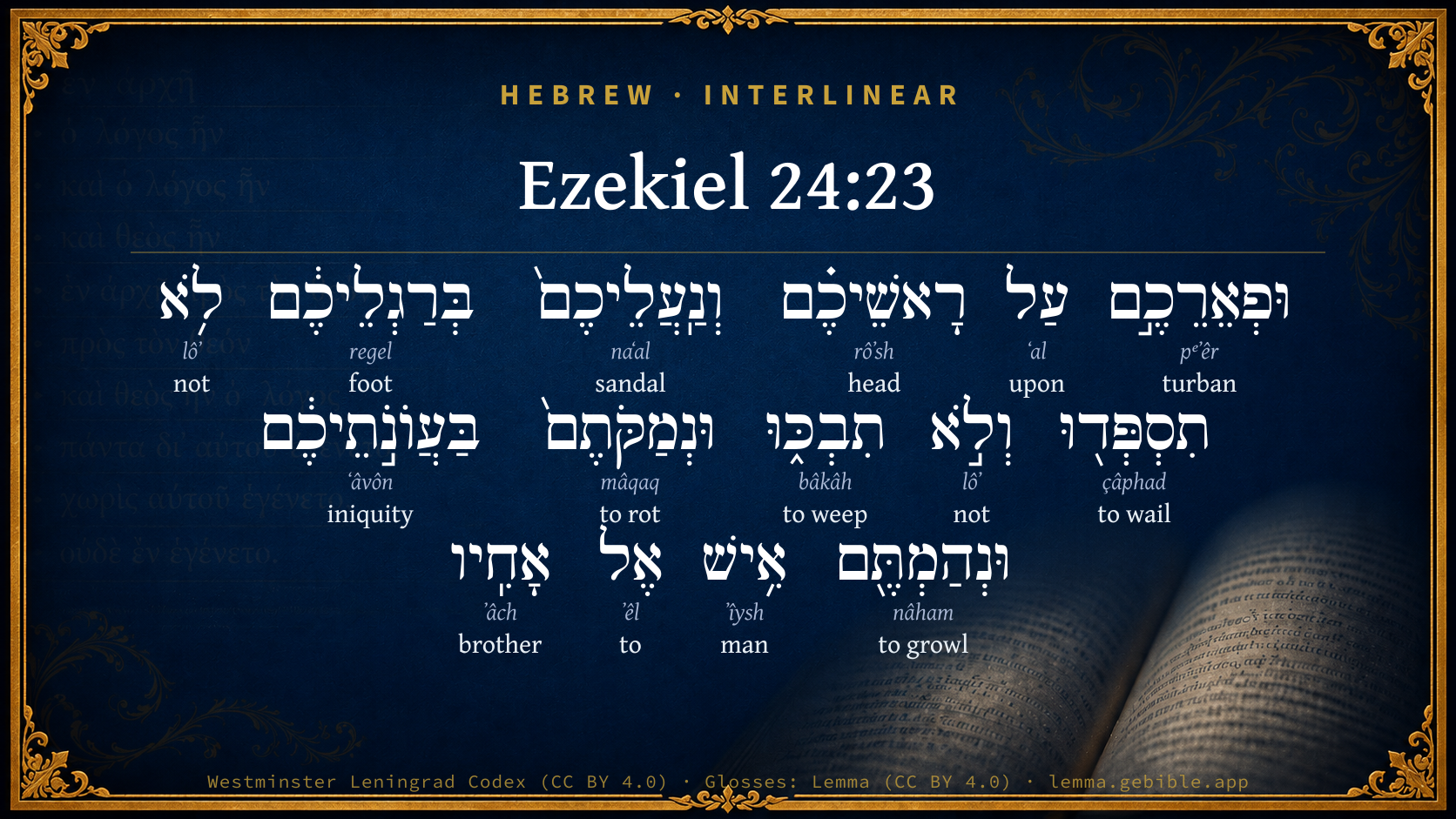
  1. וּפְאֵרֵכֶ֣ם pᵉʼêr H6287 “and · turbans · your” Conjunction + Noun, Common, Masculine, Plural, Construct + Suffix, Personal, 2nd Person, Masculine, Plural
  2. עַל ʻal H5921 “upon” Preposition
  3. רָאשֵׁיכֶ֗ם rôʼsh H7218 “heads · your” Noun, Common, Masculine, Plural, Construct + Suffix, Personal, 2nd Person, Masculine, Plural
  4. וְנַֽעֲלֵיכֶם֙ naʻal H5275 “and · sandals · your” Conjunction + Noun, Common, Feminine, Plural, Construct + Suffix, Personal, 2nd Person, Masculine, Plural
  5. בְּרַגְלֵיכֶ֔ם regel H7272 “in/at · feet · your” Preposition + Noun, Common, Feminine, Dual, Construct + Suffix, Personal, 2nd Person, Masculine, Plural
  6. לֹ֥א lôʼ H3808 “not” Particle, Negative
  7. תִסְפְּד֖וּ çâphad H5594 “to wail” Verb, Qal, Imperfect, 2nd Person, Masculine, Plural
  8. וְלֹ֣א lôʼ H3808 “and · not” Conjunction + Particle, Negative
  9. תִבְכּ֑וּ bâkâh H1058 “to weep” Verb, Qal, Imperfect, 2nd Person, Masculine, Plural
  10. וּנְמַקֹּתֶם֙ mâqaq H4743 “and · to rot” Conjunction + Verb, Niphal, Sequential Perfect, 2nd Person, Masculine, Plural
  11. בַּעֲוֺנֹ֣תֵיכֶ֔ם ʻâvôn H5771 “in/at · iniquities · your” Preposition + Noun, Common, Both, Plural, Construct + Suffix, Personal, 2nd Person, Masculine, Plural
  12. אִ֥ישׁ ʼîysh H376 “man” Noun, Common, Masculine, Singular, Absolute
  13. אֶל ʼêl H413 “to” Preposition
  14. אָחִֽיו ʼâch H251 “brother · his” Noun, Common, Masculine, Singular, Construct + Suffix, Personal, 3rd Person, Masculine, Singular

About this verse

These counts appear in no published source. They are computed here, from the morphology-tagged text and Lemma’s own curated glosses. What Lemma adds →

15
words
14
distinct lemmas
Prophets
section

Notable vocabulary

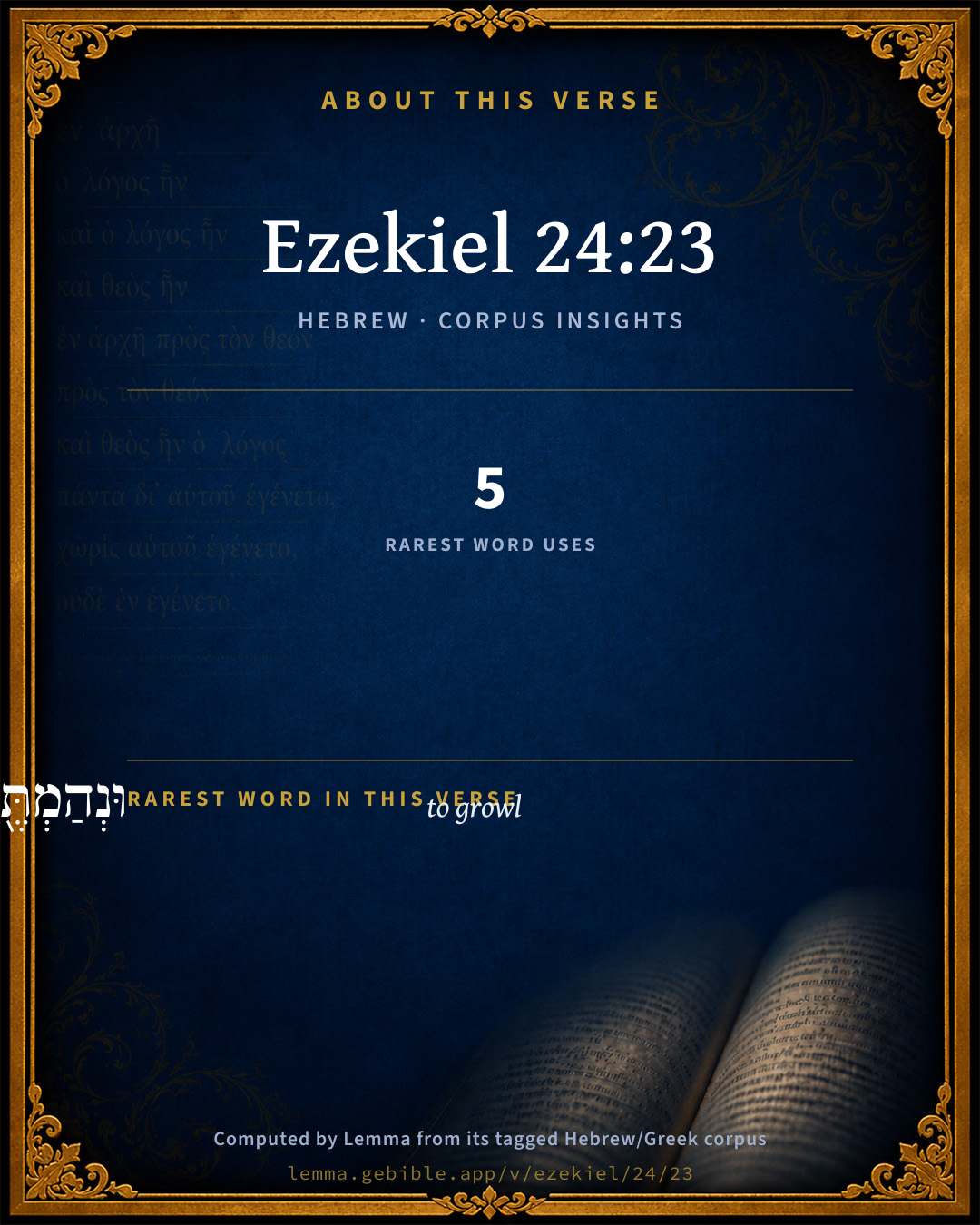
The rarest word here is וּנְהַמְתֶּ֖ם to growl H5098 — appearing just 5 times in the whole Hebrew Bible.

Shared distinctive vocabulary

וּנְהַמְתֶּ֖ם to growl H5098 occurs in 5 verses of the Hebrew Bible. Also found in:

Grammatical profile

  • 4 verbs
  • 7 nouns
  • 2 prepositions
  • 2 particles

Verb forms

  • תִסְפְּד֖וּ Qal · Imperfect
  • תִבְכּ֑וּ Qal · Imperfect
  • וּנְמַקֹּתֶם֙ Niphal · Sequential Perfect
  • וּנְהַמְתֶּ֖ם Qal · Sequential Perfect

Repetition

A word recurs within this verse — often emphatic in Hebrew:

Hebrew & Septuagint length

In English translation the verse runs 32 words from the Hebrew and 37 from the Septuagint (LXX English) — closely comparable.

A rough comparison of the two English renderings, which tokenize alike — not a word-level alignment.

Word counts can differ between the Hebrew and the Greek without any difference in meaning — e.g. the Hebrew direct-object marker אֵת has no separate Greek word, and Greek often adds the article ὁ.

Cross-references

6

Topical passages linked to Ezekiel 24:23 in the Treasury of Scripture Knowledge — connected by theme and wording, ordered by reader-vote popularity; previews shown in the World English Bible.

  • Leviticus 26:39 Those of you who are left will pine away in their iniquity in your enemies' lands; and also in the iniquities of their fathers shall they pine away with them.
  • Ezekiel 4:17 that they may want bread and water, and be dismayed one with another, and pine away in their iniquity.
  • Ezekiel 33:10 You, son of man, tell the house of Israel: Thus you speak, saying, Our transgressions and our sins are on us, and we pine away in them; how then can we live?
  • Job 27:15 Those who remain of him shall be buried in death. His widows shall make no lamentation.
  • Psalms 78:64 Their priests fell by the sword, And their widows couldn't weep.
  • Isaiah 59:11 We roar all like bears, and moan sore like doves: we look for justice, but there is none; for salvation, but it is far off from us.

Cross-references courtesy of OpenBible.info (CC BY 4.0).

Hebrew and Greek witnesses Masoretic Hebrew ↔ Greek Septuagint

The same verse in the two great witnesses to the Old Testament, shown verse-for-verse.

These are two independent witnesses, not word-aligned to each other, and the Septuagint is shown in lemma (dictionary) form.

Hebrew Ezekiel 24:23 Masoretic · Westminster Leningrad Codex

וּפְאֵרֵכֶ֣ם עַל רָאשֵׁיכֶ֗ם וְנַֽעֲלֵיכֶם֙ בְּרַגְלֵיכֶ֔ם לֹ֥א תִסְפְּד֖וּ וְלֹ֣א תִבְכּ֑וּ וּנְמַקֹּתֶם֙ בַּעֲוֺנֹ֣תֵיכֶ֔ם וּנְהַמְתֶּ֖ם אִ֥ישׁ אֶל אָחִֽיו

Your tires shall be on your heads, and your shoes on your feet: you shall not mourn nor weep; but you shall pine away in your iniquities, and moan one toward another.

World English Bible · Public Domain

Greek LXX Ezekiel 24:23 Septuagint · lemma form

καί ὁ κόμη σύ ἐπί ὁ κεφαλή σύ καί ὁ ὑπόδημα σύ ἐν ὁ πούς σύ οὔτε μή κόπτω οὔτε μή κλαίω καί ἐντήκω ἐν ὁ ἀδικία σύ καί παρακαλέω ἕκαστος ὁ ἀδελφός αὐτός

And your hair shall be upon your head, and your shoes on your feet: neither shall you⌃ at all lament or weep; but you⌃ shall pine away in your iniquities, and shall comfort every one his brother.

LXX2012 (modern English Septuagint) · Public Domain

Hebrew: Westminster Leningrad Codex (CC BY 4.0). Greek: Septuagint (public domain); English from LXX2012 (modern English Septuagint) (Public Domain). How the Septuagint differs from the Hebrew →

Targum (Aramaic paraphrase)

1

The Targum is the ancient Jewish Aramaic paraphrase of the Hebrew Scriptures — an interpretive translation, not the Hebrew text itself. Onkelos (literal) and Pseudo-Jonathan (expansive) render the Torah, and Jonathan the Prophets. Coverage is partial: where no permissively-licensed English translation exists for a verse, only the Aramaic is shown. This is verse-level text, not a word-by-word alignment to the Hebrew.

  1. Targum Jonathan Prophets (Joshua–Malachi)
    וְטוֹטְפָתְכוֹן בְּרֵישֵׁיכוֹן וּמַסְגֵיכוֹן בְּרִגְלֵיכוֹן לָא תִסְפְּדוּן וְלָא תִבְכּוּן וְתִתְמְסוּן בְּחוֹבֵיכוֹן וְתִתְנַהֲמוּן גְבַר לַאֲחוֹהִי:

    (no public-domain English translation for this verse)

    Targum Jonathan — Aramaic: “Mikraot Gedolot” (public domain). English: “Sefaria Community Translation” (CC0 1.0 (public-domain dedication)); “London "Chaldee Paraphrase," 1871” (public domain). Text via Sefaria.

Commentary

Notes on Ezekiel 24:23 from classic Christian and Jewish commentators (each source and its license shown beneath its notes). The classic Christian expositions comment on the surrounding passage and are grouped to its opening verse, so a note may address several verses; the Jewish commentaries on the Tanakh (Rashi and others) are per-verse, so they appear only where the commentator wrote on this verse.

Lemma curates 59 commentaries, every one of them public domain or Creative Commons licensed, each selected and text-cleaned for this edition rather than reprinted as found. About our sources →

Trapp's Complete Commentary

John Trapp

Eze 24:23 And your tires [shall be] upon your heads, and your shoes upon your feet: ye shall not mourn nor weep; but ye shall pine away for your iniquities, and mourn one toward another.

Ver. 23. But ye shall pine away for your iniquities.] Non tam stupidi prae maestitia, quam prae malitia stipites. {a} This was long since threatened, {Lev 26:39} and it is reserved to the last, as not the least of those dismal judgments.

{a} Oecolamp.

John Trapp, A Commentary or Exposition upon All the Books of the Old and New Testament (1647–1656) — public domain. Text from a community e-Sword module.

Jamieson, Fausset & Brown

Robert Jamieson, A. R. Fausset & David Brown

ye shall not mourn . . . but . . . pine away for your iniquities--The Jews' not mourning was to be not the result of insensibility, any more than Ezekiel's not mourning for his wife was not from want of feeling. They could not in their exile manifest publicly their lamentation, but they would privately "mourn one to another." Their "iniquities" would then be their chief sorrow ("pining away"), as feeling that these were the cause of their sufferings (compare Lev 26:39; Lam 3:39). The fullest fulfilment is still future (Zac 12:10-14).

Jamieson, Fausset & Brown — Commentary Critical and Explanatory on the Whole Bible (1871) — public domain (CC PDM 1.0). Text via the HelloAO Bible API.

Ellicott's Commentary for English Readers

(23) Ye shall pine away.—In the tumult, distress, and captivity of the approaching judgment there would be no opportunity for the outward display of grief; but all the more should it press upon them inwardly, and, according to the terrible threatening of Lev_26:39, they should “pine away in their iniquity” in their enemies’ land. In the original the preposition is the same here as in Leviticus, “in your iniquity.”

A Bible Commentary for English Readers, edited by Charles John Ellicott (1878–1897) — public domain. Text from a community e-Sword module.

The Cambridge Bible for Schools and Colleges

gen. ed. J. J. S. Perowne

23. pine away for] in your iniquities; Eze_33:10; Lev_26:39.

mourn one towards] moan. The unparalleled severity of the stroke will paralyse grief and prevent it expressing itself.

The Cambridge Bible for Schools and Colleges (gen. ed. J. J. S. Perowne; Cambridge University Press, 1878–1918) — public domain. Text from a community e-Sword module.

John Gill's Exposition

Thus Ezekiel is unto you a sign,.... These are the words of the prophet concerning himself; observing that in all the above things he was a sign to the Jews of what should befall them, and what should be their case:

and according to all that he hath done shall ye do; however it might be then a matter of scorn and derision:

and when this cometh: when this prophecy comes to pass, and all these calamities come upon the city and temple:

ye shall know that I am the Lord God; omniscient, omnipotent, true, and faithful.

John Gill's Exposition of the Whole Bible (1746–1763) — public domain (CC PDM 1.0). Text via the HelloAO Bible API.

Matthew Poole's English Annotations

See Eze 24:16,17.

Ye shall pine away; you shall languish with grief and secret sorrow, when you shall not dare to show it openly, lest you irritate your tyrannical masters, who will expect that nothing grieve you that rejoiceth them.

For your iniquities; the punishment of your iniquities, which have made your land, city, temple, and families desolate and miserable.

And mourn one toward another; in secret, Jew with Jew, you shall bewail what you durst not openly.

Matthew Poole's English Annotations on the Holy Bible (1683–1685) — public domain. Text from a community e-Sword/MySword module.

Whedon's Commentary on the Bible

Daniel D. Whedon

23. Ye shall not mourn nor weep — Does this mean that the people shall be stunned and speechless over the destruction of Jerusalem as was Ezekiel over the loss of his wife, or that they are forbidden to complain at this blow which comes from God?

Mourn — Rather, moan.

Daniel D. Whedon (gen. ed.), Commentary on the Old and New Testaments (1874–1909) — public domain. Text from a community e-Sword module.

John Wesley's Explanatory Notes

Pine away - You shall languish with secret sorrow, when you shall not dare to shew it openly.

John Wesley, Explanatory Notes Upon the Whole Bible (1754–1765) — public domain. Text via the GEBible commentary corpus.

Rashi

Rabbi Shlomo Yitzchaki (Rashi)

and you will melt [Heb. וּנְמַקֹתֶם,] esere(y)z demoniz, and you will collapse.

Rashi on the Tanakh — English translations: “The Judaica Press complete Tanach with Rashi, translated by A. J. Rosenberg” (CC BY 4.0); “Pentateuch with Rashi's commentary by M. Rosenbaum and A.M. Silbermann, 1929-1934” (public domain); “The Metsudah Tanach series, Lakewood, N.J” (CC BY 4.0); and “The Book of Joshua, Metsudah Publications, 1997” (CC BY 4.0). Text via Sefaria.

Lesson kit

Teaching starters — assembled from the data on this page, not authored interpretation. Every prompt links to the verse data it draws on. Edit before teaching.

Ezekiel, in the Prophets, opens this verse with 15 words (14 distinct Hebrew lemmas). Its most distinctive word is nâham (“to growl”). A historical commentator’s framing appears above. Read the whole chapter for the surrounding context.

Discussion questions

  1. The word nâham carries the sense “to growl.” How does it shape the verse?
  2. Proverbs 5:11 shares the word «to growl» with this verse. How do the two illuminate each other?
  3. “not” occurs 2× in this one verse. What is the effect of the repetition?
  4. These translations render this verse differently; the difference is in the English rendering, not the original. What questions does that raise?
  5. The verb «תִסְפְּד֖וּ» is Qal Imperfect. How does its form color the action?
  6. Reading how Trapp's Complete Commentary and Jamieson, Fausset & Brown read this verse, where do the two commentators agree and where do they part?

Things to notice

Reading settings

Reading text

Shown beneath each verse's original-language words.

Old Testament
Old Testament edition

Read the OT as the Masoretic Hebrew (MT) or the Greek Septuagint (LXX).

English shown for the Greek Septuagint (in the Hebrew ↔ Greek comparison).

Comparing translations? Open the Compare panel on any verse page to stack up to four side by side.