
Jeremiah 11:10

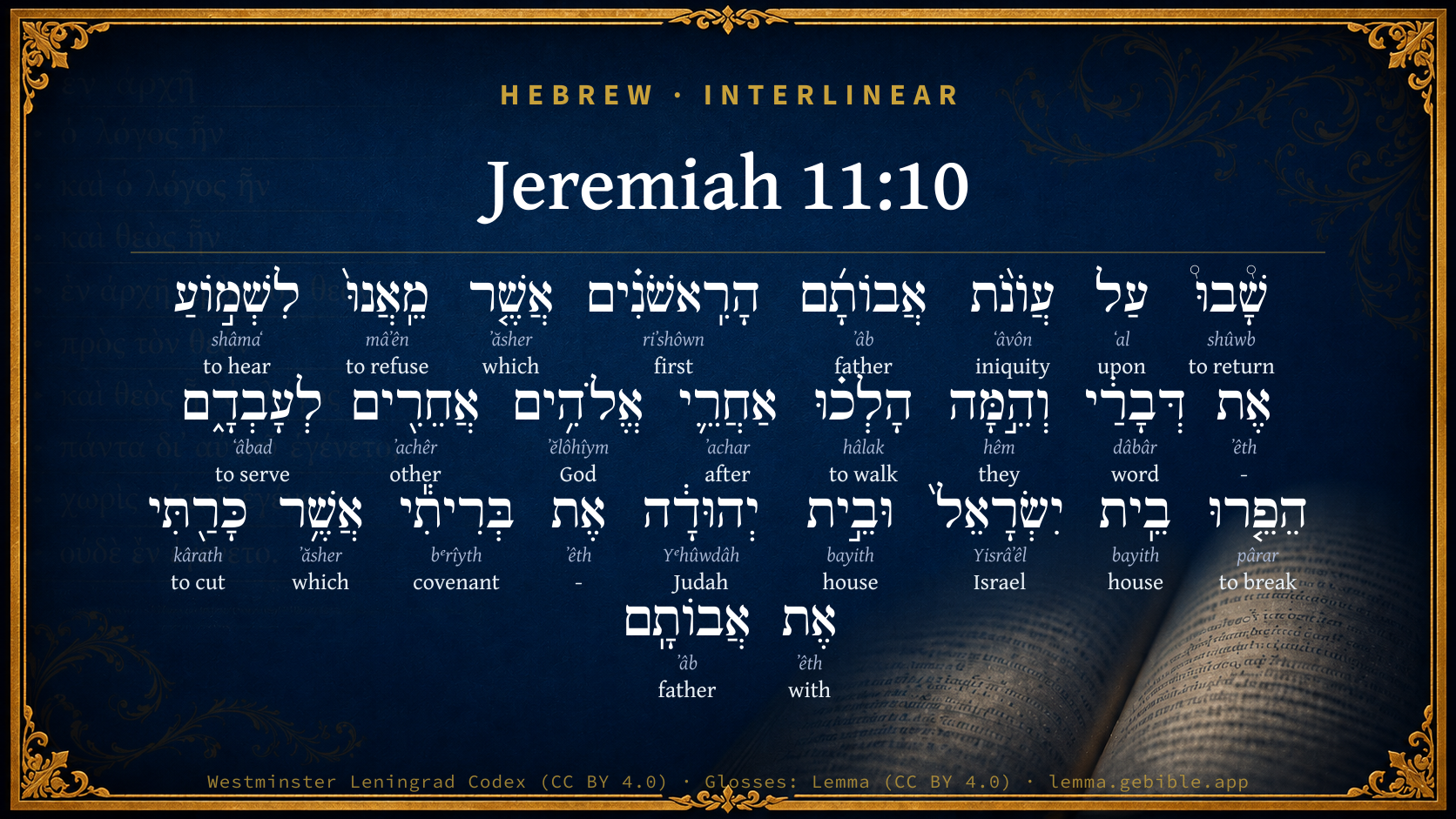
Hebrew (Westminster Leningrad Codex) Jeremiah 11:10 appears in the Hebrew Old Testament. The text above is from the Westminster Leningrad Codex. Each word links to its Strong’s number, a concise gloss, and parsing drawn from the Open Scriptures Hebrew Bible morphology. Click any word for its full Brown-Driver-Briggs (BDB) entry.
Download image
Cite this verse

Jeremiah 11:10 (World English Bible). Public Domain. Lemma interlinear Bible study tool, https://lemma.gebible.app/v/jeremiah/11/10.

Show BibTeX & RIS
BibTeX
RIS
English Translation
They are turned back to the iniquities of their forefathers, who refused to hear my words; and they are gone after other gods to serve them: the house of Israel and the house of Judah have broken my covenant which I made with their fathers.
World English Bible · Public Domain
Download a study sheet

One document with this verse’s original text, its word-by-word gloss line, the meaning frame, cross-references with their text, attributed commentary, and full source and license credits — printable, and it pastes into notes with its structure intact.

This verse Autodidact and up

Study sheet (.html) Plain text (.txt)

A passage Seminary Student

Up to 50 verses in one chapter. A passage sheet keeps up to 6 commentary sources and 12 cross-references per verse, in the order this page ranks them, and says so on the sheet whenever that leaves anything out. Ask for a single verse and you get the Autodidact verse sheet above.

Everything on this page stays free to read, with no account — the sheet is a download of what is already on screen, not access to it.

Want to remove ads? Support Godless Engineer
Compare translations 3

The same verse in 3 English versions, stacked beneath the original-language interlinear above. Click any original word for its lexicon entry.

Each is an independent rendering of the whole verse — the interlinear is not word-aligned to these translations.

Highlighted words mark where these versions differ — a whole-verse word diff, not a word-by-word alignment.

  • World English Bible Public Domain
    They are turned back to the iniquities of their forefathers, who refused to hear my words; and they are gone after other gods to serve them: the house of Israel and the house of Judah have broken my covenant which I made with their fathers.
  • King James Version Public Domain
    They are turned back to the iniquities of their forefathers, which refused to hear my words; and they went after other gods to serve them: the house of Israel and the house of Judah have broken my covenant which I made with their fathers.
  • unfoldingWord Literal Text CC BY-SA 4.0
    They have returned to the iniquities of their first fathers, who refused to listen to my words, and they walked after other gods to serve them. The house of Israel and the house of Judah broke my covenant that I cut with their fathers.

unfoldingWord Literal Text — © unfoldingWord, licensed CC BY-SA 4.0. Word-aligned USFM3 via Door43 (git.door43.org/unfoldingWord/en_ult).

Versions to compare (up to 4)

3 of 4 selected

Show all 18 translations

Every available English version of this verse, each an independent rendering of the whole verse.

  • World English Bible Public Domain
    They are turned back to the iniquities of their forefathers, who refused to hear my words; and they are gone after other gods to serve them: the house of Israel and the house of Judah have broken my covenant which I made with their fathers.
  • Berean Standard Bible Public Domain
    They have returned to the sins of their forefathers who refused to obey My words. They have followed other gods to serve them. The house of Israel and the house of Judah have broken the covenant I made with their fathers.
  • Majority Standard Bible Public Domain
    They have returned to the sins of their forefathers who refused to obey My words. They have followed other gods to serve them. The house of Israel and the house of Judah have broken the covenant I made with their fathers.
  • King James Version Public Domain
    They are turned back to the iniquities of their forefathers, which refused to hear my words; and they went after other gods to serve them: the house of Israel and the house of Judah have broken my covenant which I made with their fathers.
  • American Standard Version (1901) Public Domain
    They are turned back to the iniquities of their forefathers, who refused to hear my words; and they are gone after other gods to serve them: the house of Israel and the house of Judah have broken my covenant which I made with their fathers.
  • Revised Version (1885) Public Domain
    They are turned back to the iniquities of their forefathers, which refused to hear my words; and they are gone after other gods to serve them: the house of Israel and the house of Judah have broken my covenant which I made with their fathers.
  • Geneva Bible (1599) Public Domain
    They are turned backe to the iniquities of their forefathers, which refused to heare my wordes: and they went after other gods to serue them: thus the house of Israel, and the house of Iudah haue broken my couenant, which I made with their fathers.
  • Douay-Rheims (1899) Public Domain
    They are returned to the former iniquities of their fathers, who refused to hear my words: so these likewise have gone after strange gods, to serve them: the house of Israel, and the house of Juda have made void my covenant, which I made with their fathers.
  • Young's Literal Translation Public Domain
    They have turned back to the iniquities of their first fathers, Who refused to hear My words, And they have gone after other gods to serve them, The house of Israel, and the house of Judah, Have made void My covenant, that I made with their fathers.
  • Literal Standard Version CC BY-SA 4.0
    They have turned back to the iniquities of their first fathers, || Who refused to hear My words, || And they have gone after other gods to serve them, || The house of Israel and the house of Judah || Have made void My covenant that I made with their fathers.”
  • Unlocked Literal Bible CC BY-SA 4.0
    They have turned to the iniquities of their earliest ancestors, who refused to listen to my word, who instead walked after other gods to worship them. The house of Israel and the house of Judah broke my covenant that I established with their ancestors.
  • unfoldingWord Literal Text CC BY-SA 4.0
    They have returned to the iniquities of their first fathers, who refused to listen to my words, and they walked after other gods to serve them. The house of Israel and the house of Judah broke my covenant that I cut with their fathers.
  • Darby Bible Public Domain
    They are turned back to the iniquities of their forefathers, who refused to hear my words; and they have gone after other gods to serve them. The house of Israel and the house of Judah have broken my covenant which I made with their fathers.
  • World Messianic Bible Public Domain
    They have turned back to the iniquities of their forefathers, who refused to hear my words. They have gone after other gods to serve them. The house of Israel and the house of Judah have broken my covenant which I made with their fathers.
  • Webster's Bible Public Domain
    They have turned back to the iniquities of their forefathers, who refused to hear my words; and they went after other gods to serve them: the house of Israel and the house of Judah have broken my covenant which I made with their fathers.
  • Free Bible Version CC BY-SA 4.0
    They have gone back to the sins of their forefathers who refused to obey what I said. They have gone to worship other gods. The people of Israel and Judah have broken the agreement I made with their forefathers.
  • Bible in Basic English Public Domain
    They are turned back to the sins of their fathers, who would not give ear to my words; they have gone after other gods and become their servants: the people of Israel and the people of Judah have not kept the agreement which I made with their fathers.
  • JPS Tanakh (1917) Public Domain
    They are turned back to the iniquities of their forefathers, who refused to hear My words; and they are gone after other gods to serve them; the house of Israel and the house of Judah have broken My covenant which I made with their fathers.

Literal Standard Version (2020), Covenant Press — licensed CC BY-SA 4.0. Text via the HelloAO Bible API (eBible.org). Unlocked Literal Bible (unfoldingWord) — licensed CC BY-SA 4.0. Text via the HelloAO Bible API (eBible.org). unfoldingWord Literal Text — © unfoldingWord, licensed CC BY-SA 4.0. Word-aligned USFM3 via Door43 (git.door43.org/unfoldingWord/en_ult). Free Bible Version, Dr. Jonathan Gallagher — licensed CC BY-SA 4.0. Text via the HelloAO Bible API (eBible.org).

Word by word

More ways to search: Search by grammar → Find every occurrence → Compare this word →

Practice this passage: Drill this verse → Learn its vocabulary →

מֵֽאֲנוּ֙
mâʼên
H3985
“to refuse”
Verb, Piel, Perfect, 3rd Person, Common, Plural
Part of Speech
Verb
Stem
Piel
Form
Perfect
Person
3rd Person
Gender
Common
Number
Plural
Full BDB Definition

Origin: a primitive root

TWOT: 1138

(Piel) to refuse
  1. שָׁ֩בוּ֩ shûwb H7725 “to return” Verb, Qal, Perfect, 3rd Person, Common, Plural
  2. עַל ʻal H5921 “upon” Preposition
  3. עֲוֺנֹ֨ת ʻâvôn H5771 “iniquities of” Noun, Common, Both, Plural, Construct
  4. אֲבוֹתָ֜ם ʼâb H1 “fathers · their” Noun, Common, Masculine, Plural, Construct + Suffix, Personal, 3rd Person, Masculine, Plural
  5. הָרִֽאשֹׁנִ֗ים riʼshôwn H7223 “the · first” Particle, Definite Article + Adjective, Adjective, Masculine, Plural, Absolute
  6. אֲשֶׁ֤ר ʼăsher H834 “which” Particle, Relative
  7. לִשְׁמ֣וֹעַ shâmaʻ H8085 “to hear” Preposition + Verb, Qal, Infinitive Construct
  8. אֶת ʼêth H853 “-” Particle, Direct Object
  9. דְּבָרַ֔י dâbâr H1697 “words · my” Noun, Common, Masculine, Plural, Construct + Suffix, Personal, 1st Person, Common, Singular
  10. וְהֵ֣מָּה hêm H1992 “and · they” Conjunction + Pronoun, Personal, 3rd Person, Masculine, Plural
  11. הָלְכ֗וּ hâlak H1980 “to walk” Verb, Qal, Perfect, 3rd Person, Common, Plural
  12. אַחֲרֵ֛י ʼachar H310 “after” Preposition
  13. אֱלֹהִ֥ים ʼĕlôhîym H430 “God(s)” Noun, Common, Masculine, Plural, Absolute
  14. אֲחֵרִ֖ים ʼachêr H312 “other” Adjective, Adjective, Masculine, Plural, Absolute
  15. לְעָבְדָ֑ם ʻâbad H5647 “to serve · them” Preposition + Verb, Qal, Infinitive Construct + Suffix, Personal, 3rd Person, Masculine, Plural
  16. הֵפֵ֤רוּ pârar H6565 “to break” Verb, Hiphil, Perfect, 3rd Person, Common, Plural
  17. בֵֽית bayith H1004 “house of” Noun, Common, Masculine, Singular, Construct
  18. יִשְׂרָאֵל֙ Yisrâʼêl H3478 “Israel” Noun, Proper
  19. וּבֵ֣ית bayith H1004 “and · house of” Conjunction + Noun, Common, Masculine, Singular, Construct
  20. יְהוּדָ֔ה Yᵉhûwdâh H3063 “Judah” Noun, Proper
  21. אֶת ʼêth H853 “-” Particle, Direct Object
  22. בְּרִיתִ֕י bᵉrîyth H1285 “covenant · my” Noun, Common, Feminine, Singular, Construct + Suffix, Personal, 1st Person, Common, Singular
  23. אֲשֶׁ֥ר ʼăsher H834 “which” Particle, Relative
  24. כָּרַ֖תִּי kârath H3772 “to cut” Verb, Qal, Perfect, 1st Person, Common, Singular
  25. אֶת ʼêth H854 “with” Preposition
  26. אֲבוֹתָֽם ʼâb H1 “fathers · their” Noun, Common, Masculine, Plural, Construct + Suffix, Personal, 3rd Person, Masculine, Plural

About this verse

These counts appear in no published source. They are computed here, from the morphology-tagged text and Lemma’s own curated glosses. What Lemma adds →

27
words
23
distinct lemmas
Prophets
section

Shared distinctive vocabulary

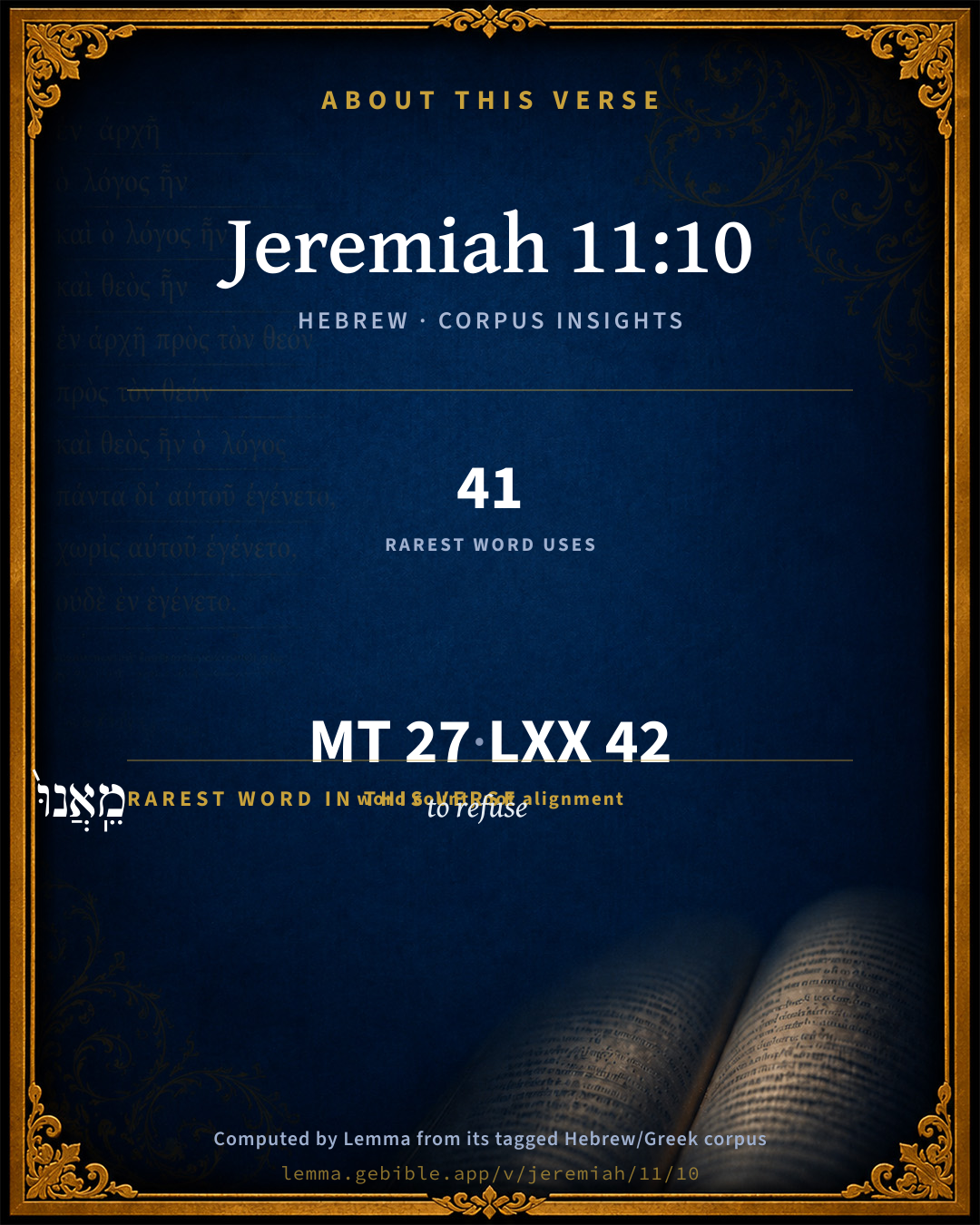
מֵֽאֲנוּ֙ to refuse H3985 occurs in 39 verses of the Hebrew Bible. Also found in:

Grammatical profile

  • 7 verbs
  • 10 nouns
  • 2 adjectives
  • 1 pronoun
  • 3 prepositions
  • 4 particles

Verb forms

  • שָׁ֩בוּ֩ Qal · Perfect
  • מֵֽאֲנוּ֙ Piel · Perfect
  • לִשְׁמ֣וֹעַ Qal · Infinitive Construct
  • הָלְכ֗וּ Qal · Perfect
  • לְעָבְדָ֑ם Qal · Infinitive Construct
  • הֵפֵ֤רוּ Hiphil · Perfect
  • כָּרַ֖תִּי Qal · Perfect

Repetition

Words recur within this verse — often emphatic in Hebrew:

  • אֲבוֹתָ֜ם father H1 ×2
  • בֵֽית house H1004 ×2
  • אֲשֶׁ֤ר which H834 ×2

Hebrew & Septuagint length

In the original languages it is 27 Hebrew tokens and 42 Greek tokens — but the two are counted differently (Hebrew bundles its prefixes and suffixes into one token; the Greek is in lemma form), so that isn’t a like-for-like length.

Cross-references

23

Topical passages linked to Jeremiah 11:10 in the Treasury of Scripture Knowledge — connected by theme and wording, ordered by reader-vote popularity; previews shown in the World English Bible.

  • Deuteronomy 31:16 Yahweh said to Moses, Behold, you shall sleep with your fathers; and this people will rise up, and play the prostitute after the strange gods of the land, where they go to be among them, and will forsake me, and break my covenant which I have made with them.
  • Ezekiel 16:59 For thus says the Lord Yahweh: I will also deal with you as you have done, who have despised the oath in breaking the covenant.
  • Judges 2:12–13 and they forsook Yahweh, the God of their fathers, who brought them out of the land of Egypt, and followed other gods, of the gods of the peoples who were round about them, and bowed themselves down to them: and they provoked Yahweh to anger.
  • Judges 2:17 Yet they didn't listen to their judges; for they played the prostitute after other gods, and bowed themselves down to them: they turned aside quickly out of the way in which their fathers walked, obeying the commandments of Yahweh; [but] they didn't do so.
  • Judges 2:19 But it happened, when the judge was dead, that they turned back, and dealt more corruptly than their fathers, in following other gods to serve them, and to bow down to them; they didn't cease from their doings, nor from their stubborn way.
  • 1 Samuel 15:11 It repents me that I have set up Saul to be king; for he is turned back from following me, and has not performed my commandments. Samuel was angry; and he cried to Yahweh all night.
  • Psalms 78:8–10 And might not be as their fathers, A stubborn and rebellious generation, A generation that didn't make their hearts loyal, Whose spirit was not steadfast with God.
  • Jeremiah 3:6–11 Moreover Yahweh said to me in the days of Josiah the king, Have you seen that which backsliding Israel has done? she is gone up on every high mountain and under every green tree, and there has played the prostitute.
  • Leviticus 26:15 and if you shall reject my statutes, and if your soul abhors my ordinances, so that you will not do all my commandments, but break my covenant;
  • Deuteronomy 9:7 Remember, don't forget, how you provoked Yahweh your God to wrath in the wilderness: from the day that you went forth out of the land of Egypt, until you came to this place, you have been rebellious against Yahweh.
  • 2 Kings 17:7–20 It was so, because the children of Israel had sinned against Yahweh their God, who brought them up out of the land of Egypt from under the hand of Pharaoh king of Egypt, and had feared other gods,
  • 2 Chronicles 34:30–33 The king went up to the house of Yahweh, and all the men of Judah and the inhabitants of Jerusalem, and the priests, and the Levites, and all the people, both great and small: and he read in their ears all the words of the book of the covenant that was found in the house of Yahweh.
  • Psalms 78:57 But turned back, and dealt treacherously like their fathers. They were turned aside like a deceitful bow.
  • Ezekiel 20:18–21 I said to their children in the wilderness, Don't you walk in the statutes of your fathers, neither observe their ordinances, nor defile yourselves with their idols.
  • Ezekiel 44:7 in that you have brought in foreigners, uncircumcised in heart and uncircumcised in flesh, to be in my sanctuary, to profane it, even my house, when you offer my bread, the fat and the blood, and they have broken my covenant, [to add] to all your abominations.
  • Hosea 6:7 But they, like Adam, have broken the covenant. They were unfaithful to me, there.
  • Zephaniah 1:6 those who have turned back from following Yahweh, and those who haven't sought Yahweh nor inquired after him.
  • Acts 7:51–52 "You stiff-necked and uncircumcised in heart and ears, you always resist the Holy Spirit! As your fathers did, so you do.
  • Hebrews 8:9 Not according to the covenant that I made with their fathers, In the day that I took them by the hand to lead them out of the land of Egypt; For they didn't continue in my covenant, And I disregarded them," says the Lord.
  • Zechariah 1:4 Don't you be like your fathers, to whom the former prophets proclaimed, saying: Thus says Yahweh of hosts, 'Return now from your evil ways, and from your evil doings;' but they did not hear, nor listen to me, says Yahweh.
  • Jeremiah 31:32 not according to the covenant that I made with their fathers in the day that I took them by the hand to bring them out of the land of Egypt; which my covenant they broke, although I was a husband to them, says Yahweh.
  • Hosea 6:4 "Ephraim, what shall I do to you? Judah, what shall I do to you? For your love is like a morning cloud, And like the dew that disappears early.
  • Hosea 7:16–8:1 They return, but not to the Most High. They are like a faulty bow. Their princes will fall by the sword for the rage of their tongue. This will be their derision in the land of Egypt.

Cross-references courtesy of OpenBible.info (CC BY 4.0).

Hebrew and Greek witnesses Masoretic Hebrew ↔ Greek Septuagint

The same verse in the two great witnesses to the Old Testament, shown verse-for-verse.

These are two independent witnesses, not word-aligned to each other, and the Septuagint is shown in lemma (dictionary) form.

Hebrew Jeremiah 11:10 Masoretic · Westminster Leningrad Codex

שָׁ֩בוּ֩ עַל עֲוֺנֹ֨ת אֲבוֹתָ֜ם הָרִֽאשֹׁנִ֗ים אֲשֶׁ֤ר מֵֽאֲנוּ֙ לִשְׁמ֣וֹעַ אֶת דְּבָרַ֔י וְהֵ֣מָּה הָלְכ֗וּ אַחֲרֵ֛י אֱלֹהִ֥ים אֲחֵרִ֖ים לְעָבְדָ֑ם הֵפֵ֤רוּ בֵֽית יִשְׂרָאֵל֙ וּבֵ֣ית יְהוּדָ֔ה אֶת בְּרִיתִ֕י אֲשֶׁ֥ר כָּרַ֖תִּי אֶת אֲבוֹתָֽם

They are turned back to the iniquities of their forefathers, who refused to hear my words; and they are gone after other gods to serve them: the house of Israel and the house of Judah have broken my covenant which I made with their fathers.

World English Bible · Public Domain

Greek LXX Structure differs

In the Septuagint, Jeremiah is about an eighth shorter than the Hebrew and arranges its material differently — the Oracles Against the Nations (Hebrew chapters 46–51) appear in the middle of the Greek book, after 25:13. Because the chapter and verse boundaries do not line up, a verse-for-verse comparison with the Hebrew is not shown.

A verse-for-verse comparison isn’t shown here because the chapters and verses don’t line up. Switch to the LXX edition with the MT / LXX toggle above to read the Greek directly.

Hebrew: Westminster Leningrad Codex (CC BY 4.0). Greek: Septuagint (public domain); English from a public-domain English Septuagint. How the Septuagint differs from the Hebrew →

Targum (Aramaic paraphrase)

1

The Targum is the ancient Jewish Aramaic paraphrase of the Hebrew Scriptures — an interpretive translation, not the Hebrew text itself. Onkelos (literal) and Pseudo-Jonathan (expansive) render the Torah, and Jonathan the Prophets. Coverage is partial: where no permissively-licensed English translation exists for a verse, only the Aramaic is shown. This is verse-level text, not a word-by-word alignment to the Hebrew.

  1. Targum Jonathan Prophets (Joshua–Malachi)
    תָּבוּ לְחוֹבֵי אֲבָהַתְהוֹן קַדְמָאֵי דְסָרִיבוּ לְקַבָּלָא יַת פִּתְגָמַי וְאִינוּן טְעוֹ בָּתַר פַלְחֵי כּוֹכְבַיָא לְמִפְלַחְהוֹן אַשְׁנִיאוּ בֵית יִשְׂרָאֵל וּבֵית יְהוּדָה יַת קְיָמִי דִגְזָרִית יַת אֲבָהַתְכוֹן:

    (no public-domain English translation for this verse)

    Targum Jonathan — Aramaic: “Mikraot Gedolot” (public domain). English: “Sefaria Community Translation” (CC0 1.0 (public-domain dedication)); “London "Chaldee Paraphrase," 1871” (public domain). Text via Sefaria.

Commentary

Notes on Jeremiah 11:10 from classic Christian and Jewish commentators (each source and its license shown beneath its notes). The classic Christian expositions comment on the surrounding passage and are grouped to its opening verse, so a note may address several verses; the Jewish commentaries on the Tanakh (Rashi and others) are per-verse, so they appear only where the commentator wrote on this verse.

Lemma curates 59 commentaries, every one of them public domain or Creative Commons licensed, each selected and text-cleaned for this edition rather than reprinted as found. About our sources →

Trapp's Complete Commentary

John Trapp

Jer 11:10 They are turned back to the iniquities of their forefathers, which refused to hear my words; and they went after other gods to serve them: the house of Israel and the house of Judah have broken my covenant which I made with their fathers.

Ver. 10. They are turned away to the iniquities of their forefathers.] Showing themselves herein to be a race of rebels, as good at resisting the Holy Ghost as ever their fathers were, and are therefore justly chargeable with their iniquities, which needeth not.

John Trapp, A Commentary or Exposition upon All the Books of the Old and New Testament (1647–1656) — public domain. Text from a community e-Sword module.

Adam Clarke's Commentary

Verse 10. They are turned back to the iniquities of their forefathers] A great reformation had taken place under the reign of Josiah, and the public worship of idols had been abolished, and most of the high places destroyed; but under the reign of his son and his successors, they had turned back again to idolatry, and were become worse than ever. It required a captivity to cure them of this propensity: and God sent one: after that, there was no idolatry among the Jews.

Adam Clarke's Commentary on the Bible (1810–1826) — public domain. Text from a community e-Sword/MySword module.

John Calvin's Commentaries

He also adds, that they had returned, etc. He shews for what purpose they had conspired, even to return to the vices of their fathers, who had been before them Some render the word “ancestors;” but the meaning of the Prophet is not thus sufficiently expressed, for what he means is, that the Israelites had been refractory from the very beginning, so that God could never subdue their wayward dispositions. It must however be observed, that he speaks not of the most ancient, as הרשנים, erashnim are the ancient who were before them; but as there had been a continued succession or series of impiety, the Prophet calls them here, the former fathers, who had first begun to shake off the yoke of God even to that day. And he again mentions what we have before noticed, that they were unwining to hear Though ignorance does not wholly clear or absolve us, it yet extenuates a crime; but God shews that the Israelites had been disobedient from the beginning. Though he had by Moses sufficiently taught them, we yet find that they often rose up against Moses. If we inquire of their origin, it appears to have been marked with resolute impiety; they were unwining to obey God.

He then adds, that they walked after alien gods that they might serve them There is ever an implied contrast between God and idols. God had given them evidences enough of his power and glory, and we may justly say, that he had sufficiently proved himself to he the only true God. How then was it that the; Israelites had given the preference to fictitious gods? Doubtless no unwining error could have been pretended. We hence see that they had rejected the true God and wilfully followed their own devices. He then says, that they might serve them But God had already bound them to himself, as he had redeemed them; when, therefore, they devoted themselves to alien gods, was not their ingratitude thus most fully proved?

He at length subjoins, by way of explanation, Therefore the house of Israel and the house of Judah have dissolved my covenant He confirms what I have just said, — that they had not erred because the way was unknown, but because they were refractory and untameable in their disposition, and would not bear to hear God, thought he kindly shewed to them what they were to do. But the word covenant expresses more than this, — that God had not only delivered them his precepts by Moses, but had also adopted them as his own people, and at the same time pledged his faith to them,

“I shall be your God, be ye my people,” (Jeremiah 11:4)

Since then God had so kindly allured them to himself, how monstrous was their rebellion, When they refused to hear his voice! With reference to this the word ברית, berit, is used; for God had not only delivered to them a rule of life, but also adopted them as his people, that they might be obedient to him.

By saying that he made a covenant with their fathers, he refers to that time when he brought the people out of Egypt, for then was the race of Abraham united. They were indeed twelve distinct tribes; but there was one head over the people, there was one priesthood, and they formed afterwards one kingdom. God then shews, that though the ten tribes made for themselves in after time another king, and the tribe of Judah was then divided, and there were in this separation some special causes of enmity, they yet had always been of the same disposition, and proved how like their fathers they were, as though he i had said, “They were formerly one people, they are now two, yet they have conspired together; their iniquity is the same, in this they are united; and there is among them a binding together.” It follows —

John Calvin's Commentaries (1540-1563) — public domain. Text from the Calvin Translation Society English edition (1840s-50s) via the Christian Classics Ethereal Library (ccel.org). Calvin's coverage is partial (roughly two-thirds of the Bible); uncommented books and verses are honest gaps, never fabricated. The 19th-century editor's footnotes and remarks are omitted so the notes are faithfully Calvin's own voice.

Ellicott's Commentary for English Readers

(10) Their forefathers.—The Hebrew is more specific—their first fathers (as in Isa_43:27), with special reference to the idolatries of the forty years’ wandering and the first settlement in Canaan.

They went after other gods.—The Hebrew pronoun is emphatically repeated, as pointing back to the subject of the first clause of the verse, the men of Jeremiah’s own time—“they have gone after other gods.”

A Bible Commentary for English Readers, edited by Charles John Ellicott (1878–1897) — public domain. Text from a community e-Sword module.

The Cambridge Bible for Schools and Colleges

gen. ed. J. J. S. Perowne

10. The Northern kingdom’s apostasy and consequent punishment were already of long standing. Now Judah has followed their example in faithlessness to Jehovah, and has “turned back” after an interval of well doing under Josiah’s reforms.

The Cambridge Bible for Schools and Colleges (gen. ed. J. J. S. Perowne; Cambridge University Press, 1878–1918) — public domain. Text from a community e-Sword module.

John Gill's Exposition

Therefore thus saith the Lord, behold, I will bring evil upon them,.... The evil of punishment for the evil of their sins, such as famine, the sword, captivity, which latter is the evil more especially designed; and there is no evil of this nature but what is of God; it is of his sending and bringing; see Amo 3:6,

which they shall not be able to escape; they should not have wisdom enough to form a scheme, nor power enough to put one in execution when formed, whereby they could extricate themselves out of the difficulties they would be in; doubtless reference is had to their being besieged by the Chaldean army, the evil that should come out of the north, Jer 1:14, which should so closely surround them, that none should escape:

and though they shall cry unto me, I will not hearken unto them: because their prayers were hypocritical, and not attended with faith and true repentance; otherwise, when men cry to God, under a sense of sin, being truly sorry for it, and put their trust in him, he hears them, and delivers them; but these would be concerned only for the evil that was come upon them, and not the evil they had been guilty of; and such sinners, when they pray to him, the Lord hears not. The Targum is,

"and they shall pray before me, and I will not receive their prayers.''

John Gill's Exposition of the Whole Bible (1746–1763) — public domain (CC PDM 1.0). Text via the HelloAO Bible API.

Albert Barnes' Notes on the Bible

Their forefathers - literally, “their fathers, the first ones:” in allusion to the idolatries committed in the wilderness, and by the generations whose history is given in the Book of Judges.

And they went after - Rather, yea! they have walked “after other gods to serve them.” The “they” refers to the men of Jeremiah’s day.

Albert Barnes' Notes on the Bible (1834–1885) — public domain. Text from a community e-Sword/MySword module.

Haydock's Catholic Bible Commentary

To them, for a long time. Yet they must not despair, or have recourse to idols, (ver. 12.) or witches, 1 Kings xxviii.

George Leo Haydock (1774–1849), Haydock's Catholic Family Bible and Commentary, 1859 edition — public domain. Excludes Psalms (Douay-Rheims chapter numbering differs from Protestant) and Deuterocanonical books (Catholic canon only).

Matthew Poole's English Annotations

They are turned back from me, or they are turned back from their own better courses in the time of David, to the sins of their forefathers that worshipped the golden calf, or the many idols which they worshipped in the time of the judges. They are all alike, both the ten tribes, which were

the house of Israel, and the two tribes, which made the kingdom of Judah, they have all broken the covenant which I made with their forefathers.

Matthew Poole's English Annotations on the Holy Bible (1683–1685) — public domain. Text from a community e-Sword/MySword module.

Whedon's Commentary on the Bible

Daniel D. Whedon

10. Iniquities of their forefathers — The original is more definite, and makes the allusion specific as to the idolatries of the wilderness.

Have broken my covenant — These words, when placed by the side of that passage which sets forth the solemn and formal covenant of the people, given in Deuteronomy 27, have something of the awfulness of the judgment day itself.

Daniel D. Whedon (gen. ed.), Commentary on the Old and New Testaments (1874–1909) — public domain. Text from a community e-Sword module.

The Pulpit Commentary

Their forefathers. The Hebrew has "their fathers, the former ones." The allusion is to the sins of the Israelites in the wilderness, and in Canaan under the judges. The prophets are constantly pointing their hearers back to those early times, either for warning (as here) or for encouragement. (Jer_2:1 Hos_2:15 Isa_1:26 Isa_63:11, Isa_63:13) And they went after; rather and they (themselves) have gone after. The pronoun is expressed in the Hebrew, to indicate that the prophet"s contemporaries are now the subject.

Spiritual atavism; or, the sins of the fathers.

There are punishments and consequences of ancestral sin which reach even to descendants of remote generations. This seems to imply a descent of responsibility a subject full of difficulty and mystery. The unity of the race in its sin and misery is, with St. Paul, an argument for the probability and even certainty of its unity in the grace of salvation. The doctrine of original sin is treated in Scripture as antecedent to the doctrine of salvation by faith in Christ. In connection with this subject, notice

I THE INFLUENCE OF HEREDITY. In modem times the laws of heredity have been scientifically investigated, and startling results brought to light. Tendency can be traced from parent to child in gradually deepening lines and more confirmed manifestations. Spirit as well as body acknowledges this law, and, whether in health or disease, its operation is now placed beyond all dispute. But another law or modification of this law is perceived working alongside of it, namely, the law of atavism, in which not the general tendency towards improvement or degeneration is observed, but an apparently arbitrary and capricious recurrence of ancestral peculiarities that had long disappeared from the race. Of this nature seems to have been the present sin of Israel. It was not in the line of continuous succession, but a recurrent phase after intervals of normal and religious life. Thus it showed that the power of evil had only been "scotched," not killed; and that it was ready on the slightest provocation to assert itself in the rankest forms. How much that is mysterious in the conduct of individuals can be traced to the influence of such a principle! The two selves of every man represent influences that have been at work in his progenitors from remotest time.

II HOW SOLEMN THE RESPONSIBILITY OF PARENTS. No care can be too great in relation to those we bring into the world. Our own nature and character should be diligently cultivated, and the utmost attention paid to parental example, family influence, and educative circumstance in their upbringing. It will not do to ignore the fact that, from generation to generation, there are transmitted both physical and spiritual tendencies which have largely to do with the formation of character and the determining of destiny. For good or for evil, the parent exercises a despotic influence upon all whom he brings into the world.

III YET THE ACCOUNTABILITY OF THE CHILDREN REMAINS. In the sad entail of evil there are many bright instances of bold and pronounced departure from ancestral sin. The individual is not wholly subject to predetermining influences. If so, moral freedom would be but an illusion. A power is required to break the tyranny of inherited sin, and this is provided in the grace of God. The gospel is the development of this grace as an effectual and adequate means of salvation. M.

The Pulpit Commentary (1880–1919), ed. H.D.M. Spence-Jones & Joseph S. Exell — public domain. Text from a community e-Sword module.

Lesson kit

Teaching starters — assembled from the data on this page, not authored interpretation. Every prompt links to the verse data it draws on. Edit before teaching.

Jeremiah, in the Prophets, opens this verse with 27 words (23 distinct Hebrew lemmas). Its most distinctive word is mâʼên (“to refuse”). A historical commentator’s framing appears above. Read the whole chapter for the surrounding context.

Discussion questions

  1. What does “to refuse” (mâʼên) contribute to the verse as a whole?
  2. Genesis 37:35 shares the word «to refuse» with this verse. How do the two illuminate each other?
  3. “father” occurs 2× in this one verse. What is the effect of the repetition?
  4. These translations render this verse differently. What is at stake in choosing one wording over another?
  5. The verb «שָׁ֩בוּ֩» is Qal Perfect. How does its form color the action?
  6. Reading how Trapp's Complete Commentary and Adam Clarke's Commentary read this verse, where do the two commentators agree and where do they part?

Things to notice

Reading settings

Reading text

Shown beneath each verse's original-language words.

Old Testament
Old Testament edition

Read the OT as the Masoretic Hebrew (MT) or the Greek Septuagint (LXX).

English shown for the Greek Septuagint (in the Hebrew ↔ Greek comparison).

Comparing translations? Open the Compare panel on any verse page to stack up to four side by side.