
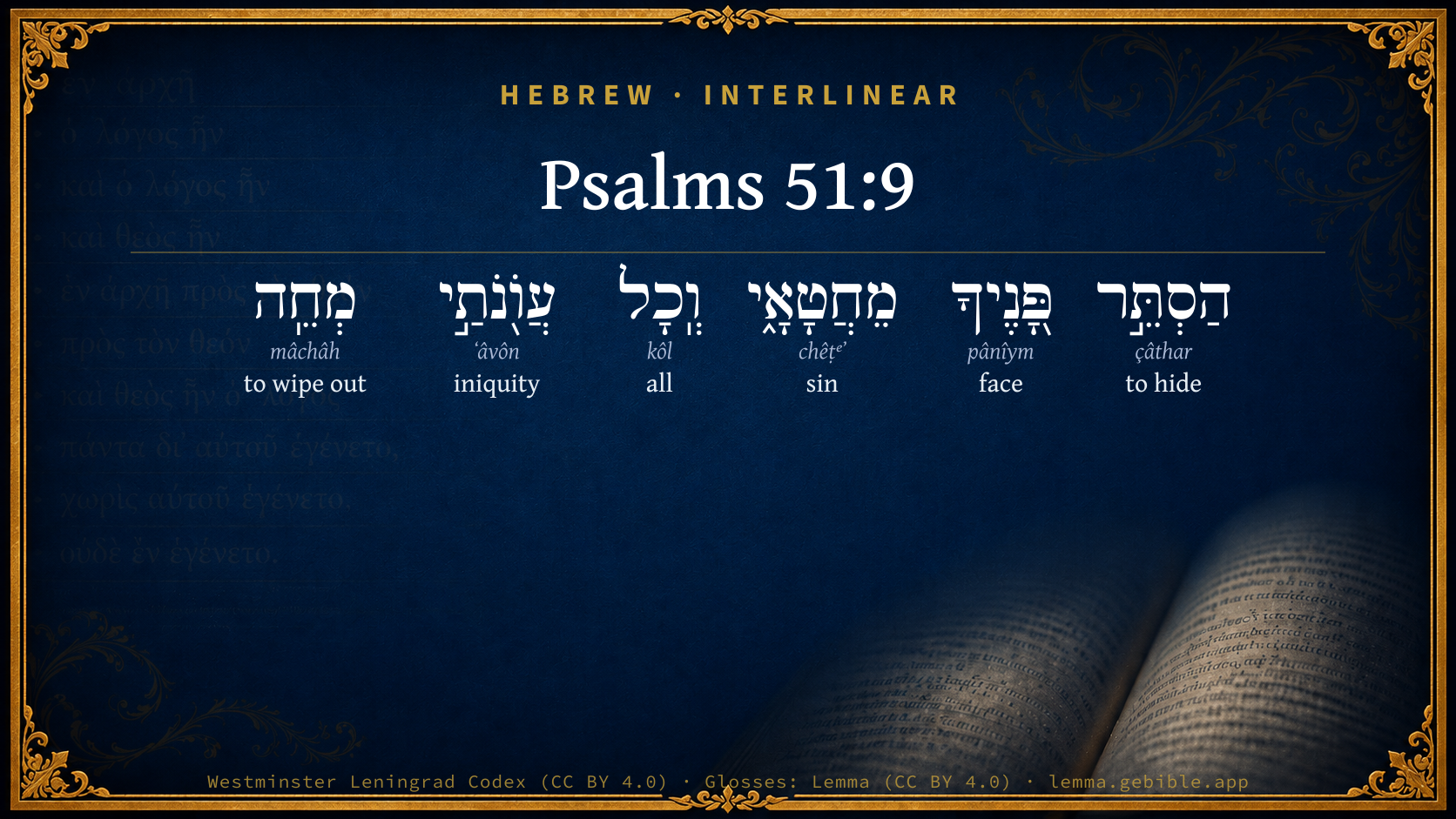
Psalms 51:9

Hebrew (Westminster Leningrad Codex) Psalms 51:9 appears in the Hebrew Old Testament. The text above is from the Westminster Leningrad Codex. Each word links to its Strong’s number, a concise gloss, and parsing drawn from the Open Scriptures Hebrew Bible morphology. Click any word for its full Brown-Driver-Briggs (BDB) entry.
Download image
Cite this verse

Psalms 51:9 (World English Bible). Public Domain. Lemma interlinear Bible study tool, https://lemma.gebible.app/v/psalms/51/9.

Show BibTeX & RIS
BibTeX
RIS
English Translation
Hide your face from my sins, And blot out all of my iniquities.
World English Bible · Public Domain
Download a study sheet

One document with this verse’s original text, its word-by-word gloss line, the meaning frame, cross-references with their text, attributed commentary, and full source and license credits — printable, and it pastes into notes with its structure intact.

This verse Autodidact and up

Study sheet (.html) Plain text (.txt)

A passage Seminary Student

Up to 50 verses in one chapter. A passage sheet keeps up to 6 commentary sources and 12 cross-references per verse, in the order this page ranks them, and says so on the sheet whenever that leaves anything out. Ask for a single verse and you get the Autodidact verse sheet above.

Everything on this page stays free to read, with no account — the sheet is a download of what is already on screen, not access to it.

Want to remove ads? Support Godless Engineer
Compare translations 3

The same verse in 3 English versions, stacked beneath the original-language interlinear above. Click any original word for its lexicon entry.

Each is an independent rendering of the whole verse — the interlinear is not word-aligned to these translations.

Highlighted words mark where these versions differ — a whole-verse word diff, not a word-by-word alignment.

  • World English Bible Public Domain
    Hide your face from my sins, And blot out all of my iniquities.
  • King James Version Public Domain
    Hide thy face from my sins, and blot out all mine iniquities.
  • unfoldingWord Literal Text CC BY-SA 4.0
    Hide your face from my sins, and wipe away all of my iniquities.

unfoldingWord Literal Text — © unfoldingWord, licensed CC BY-SA 4.0. Word-aligned USFM3 via Door43 (git.door43.org/unfoldingWord/en_ult).

Versions to compare (up to 4)

3 of 4 selected

Show all 18 translations

Every available English version of this verse, each an independent rendering of the whole verse.

  • World English Bible Public Domain
    Hide your face from my sins, And blot out all of my iniquities.
  • Berean Standard Bible Public Domain
    Hide Your face from my sins and blot out all my iniquities.
  • Majority Standard Bible Public Domain
    Hide Your face from my sins and blot out all my iniquities.
  • King James Version Public Domain
    Hide thy face from my sins, and blot out all mine iniquities.
  • American Standard Version (1901) Public Domain
    Hide thy face from my sins, And blot out all mine iniquities.
  • Revised Version (1885) Public Domain
    Hide thy face from my sins, and blot out all mine iniquities.
  • Geneva Bible (1599) Public Domain
    Hide thy face from my sinnes, and put away all mine iniquities.
  • Douay-Rheims (1899) Public Domain
    Thou shalt sprinkle me with hyssop, and I shall be cleansed: thou shalt wash me, and I shall be made whiter than snow.
  • Young's Literal Translation Public Domain
    Hide Thy face from my sin. And all mine iniquities blot out.
  • Literal Standard Version CC BY-SA 4.0
    Hide Your face from my sin. And blot out all my iniquities.
  • Unlocked Literal Bible CC BY-SA 4.0
    Hide your face from my sins and blot out all my iniquities.
  • unfoldingWord Literal Text CC BY-SA 4.0
    Hide your face from my sins, and wipe away all of my iniquities.
  • Darby Bible Public Domain
    Hide thy face from my sins, and blot out all mine iniquities.
  • World Messianic Bible Public Domain
    Hide your face from my sins, and blot out all of my iniquities.
  • Webster's Bible Public Domain
    \\51:7\\Purge me with hyssop, and I shall be clean: wash me, and I shall be whiter than snow.
  • Free Bible Version CC BY-SA 4.0
    Turn your face away from looking at my sins; please wipe away my guilt.
  • Bible in Basic English Public Domain
    Let your face be turned from my wrongdoing, and take away all my sins.
  • JPS Tanakh (1917) Public Domain
    (51-11) Hide Thy face from my sins, and blot out all mine iniquities.

Literal Standard Version (2020), Covenant Press — licensed CC BY-SA 4.0. Text via the HelloAO Bible API (eBible.org). Unlocked Literal Bible (unfoldingWord) — licensed CC BY-SA 4.0. Text via the HelloAO Bible API (eBible.org). unfoldingWord Literal Text — © unfoldingWord, licensed CC BY-SA 4.0. Word-aligned USFM3 via Door43 (git.door43.org/unfoldingWord/en_ult). Free Bible Version, Dr. Jonathan Gallagher — licensed CC BY-SA 4.0. Text via the HelloAO Bible API (eBible.org).

Word by word

More ways to search: Search by grammar → Find every occurrence → Compare this word →

Practice this passage: Drill this verse → Learn its vocabulary →

About this verse

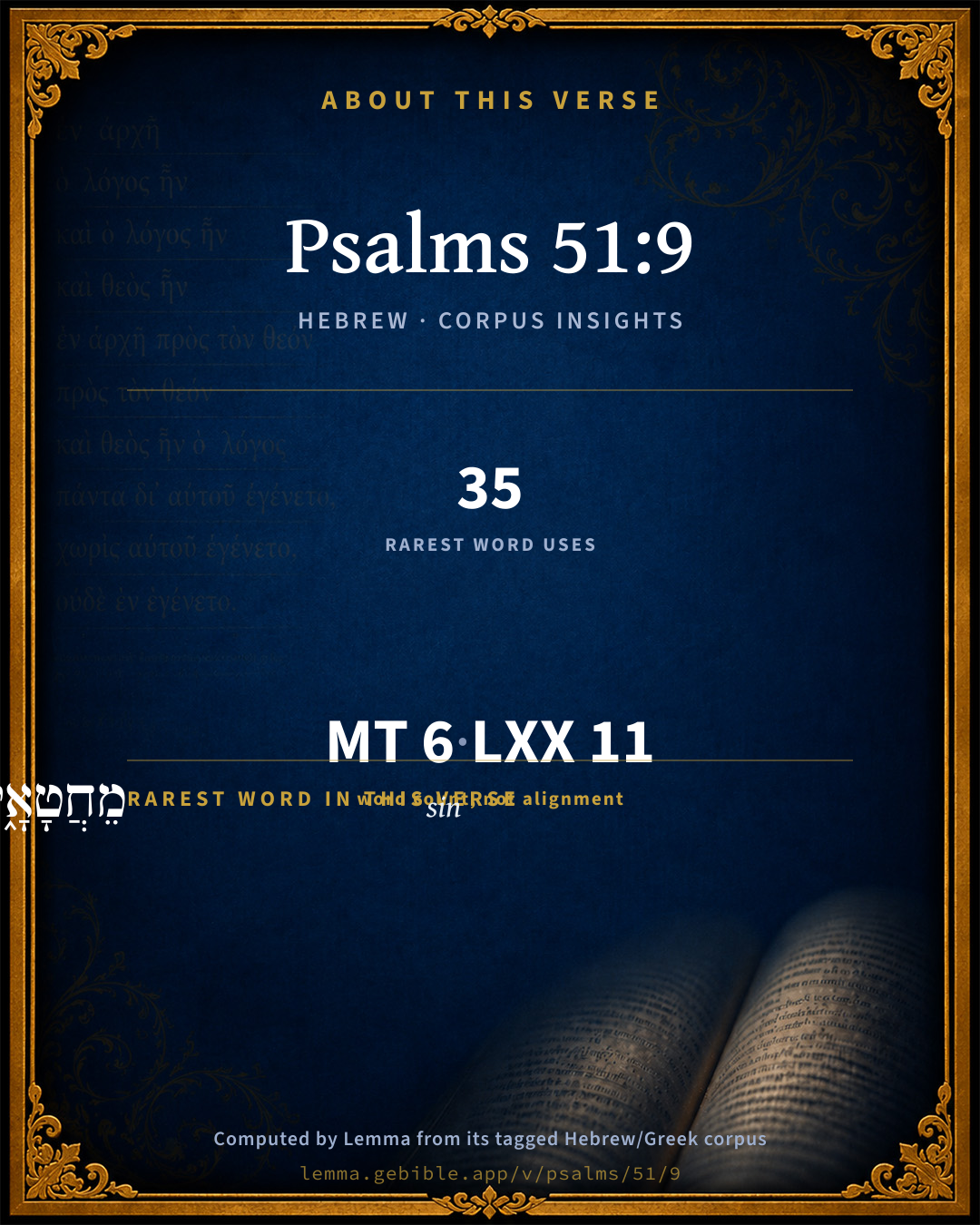
These counts appear in no published source. They are computed here, from the morphology-tagged text and Lemma’s own curated glosses. What Lemma adds →

6
words
6
distinct lemmas
Wisdom
section

Shared distinctive vocabulary

מֵחֲטָאָ֑י sin H2399 occurs in 34 verses of the Hebrew Bible. Also found in:

Grammatical profile

  • 2 verbs
  • 4 nouns

Verb forms

  • הַסְתֵּ֣ר Hiphil · Imperative
  • מְחֵֽה Qal · Imperative

Hebrew & Septuagint length

In English translation the verse runs 13 words from the Hebrew and 13 from the Septuagint (LXX English) — the same length.

A rough comparison of the two English renderings, which tokenize alike — not a word-level alignment.

Word counts can differ between the Hebrew and the Greek without any difference in meaning — e.g. the Hebrew direct-object marker אֵת has no separate Greek word, and Greek often adds the article ὁ.

In the original languages it is 6 Hebrew tokens and 11 Greek tokens — but the two are counted differently (Hebrew bundles its prefixes and suffixes into one token; the Greek is in lemma form), so that isn’t a like-for-like length.

Cross-references

5

Topical passages linked to Psalms 51:9 in the Treasury of Scripture Knowledge — connected by theme and wording, ordered by reader-vote popularity; previews shown in the World English Bible.

  • Jeremiah 16:17 For my eyes are on all their ways; they are not hidden from my face, neither is their iniquity concealed from my eyes.
  • Micah 7:18–19 Who is a God like you, who pardons iniquity, And passes over the disobedience of the remnant of his heritage? He doesn't retain his anger forever, Because he delights in loving kindness.
  • Psalms 51:1 Have mercy on me, God, according to your loving kindness. According to the multitude of your tender mercies, blot out my transgressions.
  • Isaiah 38:17 Behold, [it was] for [my] peace [that] I had great bitterness: But you have in love to my soul delivered it from the pit of corruption; For you have cast all my sins behind your back.
  • Colossians 2:14 wiping out the handwriting in ordinances which was against us; and he has taken it out of the way, nailing it to the cross;

Cross-references courtesy of OpenBible.info (CC BY 4.0).

Hebrew and Greek witnesses Masoretic Hebrew ↔ Greek Septuagint

The same verse in the two great witnesses to the Old Testament, shown verse-for-verse.

You’re reading Greek Psalm 50 (Hebrew Psalm 51). The Septuagint counts the superscription, so verse numbers can differ from the Hebrew — chapter-level alignment, not verse-by-verse. Numbering follows Rahlfs.

These are two independent witnesses, not word-aligned to each other, and the Septuagint is shown in lemma (dictionary) form.

Hebrew Psalms 51:9 Masoretic · Westminster Leningrad Codex

הַסְתֵּ֣ר פָּ֭נֶיךָ מֵחֲטָאָ֑י וְֽכָל עֲוֺ֖נֹתַ֣י מְחֵֽה

Hide your face from my sins, And blot out all of my iniquities.

World English Bible · Public Domain

Greek LXX Greek Psalm 50:9 Septuagint · lemma form

ῥαντίζω ἐγώ ὕσσωπος καί καθαρίζω πλύνω ἐγώ καί ὑπέρ χιών λευκαίνω

Turn away your face from my sins, and blot out all my iniquities.

LXX2012 (modern English Septuagint) · Public Domain

Hebrew: Westminster Leningrad Codex (CC BY 4.0). Greek: Septuagint (public domain); English from LXX2012 (modern English Septuagint) (Public Domain). How the Septuagint differs from the Hebrew →

Commentary

Notes on Psalms 51:9 from classic Christian and Jewish commentators (each source and its license shown beneath its notes). The classic Christian expositions comment on the surrounding passage and are grouped to its opening verse, so a note may address several verses; the Jewish commentaries on the Tanakh (Rashi and others) are per-verse, so they appear only where the commentator wrote on this verse.

Lemma curates 59 commentaries, every one of them public domain or Creative Commons licensed, each selected and text-cleaned for this edition rather than reprinted as found. About our sources →

Trapp's Complete Commentary

John Trapp

Psa 51:9 Hide thy face from my sins, and blot out all mine iniquities.

Ver. 9. Hide thy face from my sins] We are not able to endure God’s presence, much less his justice for our sins; nor can there be any sound peace of conscience while he frowneth. His favour is better than life, but his displeasure more bitter than death itself. See 2Sa 14:32.

And blot out all mine iniquities] See how one sin calleth to mind many thousands; which though they lie asleep a long time, like a sleeping debt, yet we know not how soon they may be reckoned for. Make sure of a general pardon; and take heed of adding new sins to the old.

John Trapp, A Commentary or Exposition upon All the Books of the Old and New Testament (1647–1656) — public domain. Text from a community e-Sword module.

The Biblical Illustrator

Joseph S. Exell

Psa_51:9-10

Hide Thy face from my sins, and blot out all my iniquities.

Gods pardoning grace

This psalm is made up partly of confessions and acknowledgments of his great crimes, partly of petitions and supplications, wherein he intercedes for pardon, and prays for forgiveness. And this was but necessary to complete the duty of confession, which without this additional act of devotion might have looked rather like a daring defiance of Divine justice; God having nowhere promised us His pardon, or indeed any other blessing without our asking; nor that He will open the gates of His mercy to penitent sinners, and grant them readmission into His favour again, but upon their earnest applications and importunate knocking.

I. The sense and meaning of the words.

1. By sins we may understand offences of a high nature, wilful and deliberate transgressions, such as are mightily provoking in the sight of God, from which, therefore, he prays God to hide His face.

2. By iniquities may be understood the common frailties and ordinary miscarriages of our lives, those which with the greatest care we can use, cannot well be avoided; such as we daily run on score with God, which, therefore, he desires may be blotted out.

3. Gods hiding His face from anything is His passing it by, and His not regarding it (Psa_55:1; Eze_39:29). Proportionably to hide His face from our sins is to overlook them; particularly to suspend sentence, not to proceed to judgment against us, but to forbear us. And this is properly that act of forgiveness the Latins call Igno-scentia, to seem not to know, not to resent injuries, and to put up affronts which are done to His Heavenly Majesty. And, oh blessed God, may every one of us, sinners as we are, say, how do we all of us stand obliged to Thy goodness, that Thou hast not dealt with us according to our sins, nor rewarded us according to our iniquities; but hast lengthened out our time and Thy patience, and given us space of repentance, and left us still in a possibility of salvation, and hast from time to time hid Thy face from our provoking sins, oven when we have boldly and deliberately dared Thy justice to Thy face! Oh, praised be that unspeakable mercy of Thine.

4. To blot out all our iniquities is so to forgive them as that they shall never be remembered more (Eze_33:16). This is a metaphor taken from the usual discharge of debts and release of suits and actions we may have against any man, when we wipe out the score, and cancel all bills and obligations whatever, and give him a free general pardon and quit-claim of all duos or demands. And this is that act of forgiveness which in Latin is called condonatio, an absolute and full discharge. And this is the very term and tenor of evangelical pardon, as Himself hath declared it by His prophet (Isa_43:25). Gracious God, be always pleased to hide Thy face from our sins, but never hide it from our persons or from our prayers; which is the severest token of Thy heaviest displeasure.

II. The nature of Gods pardoning grace. Consider the wonderful goodness of Gods nature in Himself and of His will towards us, that He doth as it were lay aside all His glorious attributes almost, to serve us; and shows us mercy, even in disparagement to His infinite knowledge and holiness and justice; that, though He cannot but see and know our sins, because He knows all things, yet He takes no notice of them: and because they cannot be hid from His face, He hides His face from them; though He cannot but abominate sin, and hate it with a perfect hatred, yet He loves and bears with the sinner; and though He stand obliged as a righteous judge to punish sin, wherever He finds it, yet He delays the punishment in expectation of our repentance. And this is the first act of pardon, or, at least, step towards it, that God doth not rebuke us in His anger, nor chasten us in His hot displeasure; that there is a suspension at least of punishment, a reprieve in order to a full pardon; which follows in the next place, the blotting out of all our iniquities, so as never to be remembered more; and this is the removal of guilt, a total and final discharge for the future, as that is a forbearance of vengeance at present. That in a manner is but present impunity; this is an absolute discharge for ever; and that--

1. Total: all mine iniquities; and--

2. Final: by being blotted out.

III. How this forgiveness and full pardon may be attained.

1. Contrition. Labour to be thoroughly convinced of thy sins; consider and lay to heart thy dangerous estate; spread thy sins before thy own conscience first, before thou lay them before God in thy confession. Fruit is first bruised and squeezed before it yields its precious liquor; stones, and the hardest metals themselves, when they are melted down, will run. Then, when thou art thus contrite, when thou hast broken thy heart, and melted it with the coals of Divine love, thy soul will pour out itself.

2. Supplication. Get thee to thy Lord right humbly; beseech His mercy to accept thy repentance, and His grace to improve it. Let Him not alone till thou hast obtained a gracious answer.

3. Lay hold on Christ; plead His passion and merits. In His name and mediation thy supplications must hope to speed, and have their designed effect. Lot thy prayers be perfumed in the censer of thy High Priest, and be mingled with His intercessions.

4. Amendment of life; or else all that thou hast done hitherto falls short and comes to nothing,

IV. The blessed effects and consequence of this pardoning grace.

1. The favour of God as now reconciled in Christ. If thou hast this pardon, thou hast the light of Gods countenance shining upon thy inner man, and art in the same condition as a child restored to his fathers love. And this thou mayest know by thy own dutiful behaviour and ingenuous affections, as well as by His kind reception; if thou givest Him cause by thy filial diligence to rejoice in thy return, as thou thyself rejoicest in His reconcilement.

2. This favour procures the peace and quiet of conscience.

3. The gracious assurance of thy present acceptance, both of thy person and performances.

4. The ascertaining of thy future hopes. Present acceptation goes a great way with a faithful servant; but to have, beside and beyond this, an ascertainment of what expectations and future rewards such a servant may look for at the hands of a kind master; this cannot but raise, as well as quiet, his spirit. This will not only fix, but elevate him in his loyalty.

V. Marks whereby a sinner may know whether he hath attained this pardon. (Adam Littleton, D. D.)

The Biblical Illustrator, edited by Joseph S. Exell (c. 1880s–1900s) — public domain. Text from a community e-Sword module.

Joseph Benson's Commentary

Psa 51:9-10. Hide thy face from my sins — Do not look upon them with an eye of indignation and wrath, but forgive and forget them. Create in me a clean heart — Seeing I have not only defiled myself by these actual sins, but also have a most unclean heart, corrupt even from my birth, which nothing but thy almighty, new-creating power can purify; I beseech thee to exert that power to produce in me a new and holy frame of heart, free from those impure inclinations and vile affections, the effects of which I have too fatally felt; a heart in possession, and under the influence, of those sacred dispositions of piety and virtue, in which the moral rectitude and purity of the mind consist. Thus shall both my inward uncleanness be purged away, and I shall be prevented from falling again into such actual and scandalous sins. And renew a right spirit in me — Hebrew, רוח נכון, ruach nachon, a firm, constant, or steadfast disposition or temper of soul, that I may not be shaken and cast down by temptation, as I have been, but that my resolution may be fixed and immoveable. He says, חדשׁ, chaddesh, renew, because he had had this good temper, in a great measure, before his late apostacy, and here prays that it might be restored to him with increase. Within me — Hebrew, בקרבי, bekirbi, in my inward parts. Thus he wisely strikes at the root and cause of all sinful actions.

Joseph Benson's Commentary on the Old and New Testaments (1811–1818) — public domain. Text from a community e-Sword module.

J. A. Alexander on Psalms

Joseph Addison Alexander

11. (Psa 51:9.) Hide thy face from my sins, and all my iniquities blot out. The desire implied in the anticipations of the two preceding verses now breaks out into its proper form, that of direct petition. Hide thy face from them, so as not to see them, look no longer at them. The same figure is applied, in an unfavourable sense, to God's apparent neglect of his suffering ervants, his refusal to behold them or to notice their condition. See above, on Psa 13:2 (1), Psa 44:25 (24). Blot out, expunge, from thy account, or (erase) from the book of thy remembrance, as in Psa 51:3 (1) above. What he asks as to his sins is that God will cancel and forget them.

Joseph Addison Alexander, The Psalms Translated and Explained (1850) — public domain. Text from a community e-Sword module.

Jamieson, Fausset & Brown

Robert Jamieson, A. R. Fausset & David Brown

Hide, &c.--Turn from beholding.

Jamieson, Fausset & Brown — Commentary Critical and Explanatory on the Whole Bible (1871) — public domain (CC PDM 1.0). Text via the HelloAO Bible API.

Adam Clarke's Commentary

Verse 9. Hide thy face from my sins] The sentiment here is nearly the same as that in Ps 51:3: His sin was ever before his own face; and he knew that the eye of God was constantly upon him, and that his purity and justice must be highly incensed on the account. He therefore, with a just horror of his transgressions, begs God to turn away his face from them, and to blot them out, so that they may never more be seen. See Clarke on Ps 51:1.

Adam Clarke's Commentary on the Bible (1810–1826) — public domain. Text from a community e-Sword/MySword module.

Ellicott's Commentary for English Readers

(9) Hide thy face . . .—i.e., thy angry look. (See Psa_21:9.) More usually the expression is used in the opposite sense of hiding the gracious look. As long as Jehovah kept the offences before Him the breach in the covenant must continue.

A Bible Commentary for English Readers, edited by Charles John Ellicott (1878–1897) — public domain. Text from a community e-Sword module.

The Cambridge Bible for Schools and Colleges

gen. ed. J. J. S. Perowne

9. Hide thy face from my sins] Cease to gaze upon them in displeasure. Cp. Psa_32:1; Psa_90:8. This use of the expression is unusual. Generally God is said to hide His face when He withdraws His favour (Psa_13:1; Psa_44:24, &c.).

blot out] See note on Psa_51:1.

9–12. Repeated prayer for pardon, cleansing, and renewal. The change from the future to the imperative (see above) indicates that a fresh division of the Ps. begins here.

The Cambridge Bible for Schools and Colleges (gen. ed. J. J. S. Perowne; Cambridge University Press, 1878–1918) — public domain. Text from a community e-Sword module.

John Gill's Exposition

Hide thy face from my sins,.... In whose sight they were committed, being now ashamed of them himself, and ashamed that any should see them, and especially his God; and being filthy and nauseous, he knew they must be abominable to him, who is of purer eyes than to behold iniquity; and being breaches of his law, must be offensive to him, and provoke the eyes of his glory; and were such that he knew would not bear the examination of justice; and that if God was strict to mark them, he could not stand before him: moreover, in this petition the psalmist deprecates a severe chastisement of them, which is sometimes expressed by setting sins before him, Psa 90:8; and entreats the pardon of them, or oblivion and non-remembrance of them, that they might be cast behind his back, and into the depths of the sea;

and blot out all mine iniquities; as in Psa 51:1; here repeated, to show his deep sense of them, and his great importunity for the forgiveness of them; and adds the word all, including all his other sins, with those he had lately committed; for he knew that, if anyone, was left unpardoned, he could never answer for it.

John Gill's Exposition of the Whole Bible (1746–1763) — public domain (CC PDM 1.0). Text via the HelloAO Bible API.

Albert Barnes' Notes on the Bible

Hide thy face from my sins - That is, Do not look on them; avert thy face from them; do not regard them. Compare the notes at Psa 13:1.

And blot out all mine iniquities - Take them entirely away. Let the account be erased, cancelled, destroyed. See the notes at Psa 51:1.

Albert Barnes' Notes on the Bible (1834–1885) — public domain. Text from a community e-Sword/MySword module.

Matthew Poole's English Annotations

Do not look upon them with an eye of indignation and revenge, but forget and forgive them. See Psa 51:1.

Matthew Poole's English Annotations on the Holy Bible (1683–1685) — public domain. Text from a community e-Sword/MySword module.

The Treasury of David

Charles H. Spurgeon

Ver. 9. Hide thy face from my sins. Do not look at them; be at pains not to see them. They thrust themselves in the way; but, Lord, refuse to behold them, lest if thou consider them, thine anger burn, and I die. Blot out all mine iniquities. He repeats the prayer of the first verse with the enlargement of it by the word "all." All repetitions are not "vain repetitions." Souls in agony have no space to find variety of language: pain has to content itself with monotones. David's face was ashamed with looking on his sin, and no diverting thoughts could remove it from his memory; but he prays the Lord to do with his sin what he himself cannot. If God hide not his face from our sin, he must hide it forever from us; and if he blot not out our sins, he must blot our names out of his book of life.

Ver. 9. Hide thy face from my sins. The verb (rtk) properly signifies to veil, or hide with a veil. Samuel Chandler.

Ver. 9. Hide thy face from my sins. He said in the third verse, that his sin was always in his sight; and now he prays that God would put it out of his sight. This is a very good order. If we hold our sins in our eyes to pursue them, God will cast them behind his back to pardon them: if we remember them and repent, he will forget them and forgive: otherwise, peccatum unde homo non advertit Deus: et si advertit, animadvertit --the sin from which man turns not, God looks to it; and if he look to it, sure he will punish it. William Cowper.

Ver. 9. All mine iniquities. See how one sin calleth to mind many thousands, which though they lie asleep a long time, like a sleeping debt, yet we know not how soon they may be reckoned for. Make sure of a general pardon, and take heed of adding new sins to the old. John Trapp.

None.

Psalms 51:10*

Charles H. Spurgeon's The Treasury of David (1869–1885) — public domain. Psalms only. Text from a community e-Sword/MySword module.

The Pulpit Commentary

Hide thy face from my sins. Turn thyself away from them do not so much as see them. The apostle speaks of times of ignorance, which God "winked at". (Act_17:30) And blot out all mine iniquities (comp. ver. 1).

Vers. 9-12. Renewal and elevation.

True repentance is not satisfied with the knowledge of forgiveness, but goes on to seek the renewal and elevation of the nature that has sinned and fallen into disorder.

I HE SEEKS A NEW REVELATION OF THE FORCE OR FAVOUR OF GOD. (Ver. 9) "Do not look upon me in anger for my sins, so as to bring me into judgment, but lift upon me the glory of thy face, or presence." And to this end

II "CREATE IN ME A PURE HEART, THAT I MAY BE ABLE TO SEE THEE." (Ver. 10; Mat_5:8)

III "GIVE ME AGAIN A STEADFAST SPIRIT OF OBEDIENCE TO THY WILL." (Ver. 10) A strong spirit not easily swayed to and fro through its own weakness, or by the gusts of temptations, but persistent in right aims and endeavours.

IV HE PRAYS THAT HE MAY NEVER LOSE THE SUCCOUR AND STRENGTH OF THE DIVINE SPIRIT. (Ver. 11) Such a prayer on the lips of David could not mean all that it means now to a Christian. Christ has revealed the work and the necessity of the Divine Strengthener (the Paraclete) far more clearly than it was known to David. As the Teacher of the truth and the Helper of our weakness.

V HE PRAYS FOR THAT SENSE OF JOY WHICH IS UNITED WITH THE SPIRIT OF A FREE OBEDIENCE. (Ver. 12) Our spirits attain to their greatest freedom when under the influence of the Spirit of God like water heated by fire. S.

The Pulpit Commentary (1880–1919), ed. H.D.M. Spence-Jones & Joseph S. Exell — public domain. Text from a community e-Sword module.

Rashi

Rabbi Shlomo Yitzchaki (Rashi)

Purify me with a hyssop As one purifies the “mezora” and the one who became unclean through contact with a corpse.

Rashi on the Tanakh — English translations: “The Judaica Press complete Tanach with Rashi, translated by A. J. Rosenberg” (CC BY 4.0); “Pentateuch with Rashi's commentary by M. Rosenbaum and A.M. Silbermann, 1929-1934” (public domain); “The Metsudah Tanach series, Lakewood, N.J” (CC BY 4.0); and “The Book of Joshua, Metsudah Publications, 1997” (CC BY 4.0). Text via Sefaria.

Lesson kit

Teaching starters — assembled from the data on this page, not authored interpretation. Every prompt links to the verse data it draws on. Edit before teaching.

Psalms, in the Wisdom, opens this verse with 6 words (6 distinct Hebrew lemmas). Its most distinctive word is chêṭᵉʼ (“sin”). A historical commentator’s framing appears above. Read the whole chapter for the surrounding context.

Discussion questions

  1. What does “sin” (chêṭᵉʼ) contribute to the verse as a whole?
  2. How does Genesis 41:9, which shares the word «sin», read alongside this verse?
  3. These translations render this verse differently; the difference is in the English rendering, not the original. What questions does that raise?
  4. «הַסְתֵּ֣ר» is a Hiphil Imperative verb. How does that grammatical form shape the action described?
  5. Compare how Trapp's Complete Commentary and The Biblical Illustrator read this verse. Where do they agree or differ?

Things to notice

Reading settings

Reading text

Shown beneath each verse's original-language words.

Old Testament
Old Testament edition

Read the OT as the Masoretic Hebrew (MT) or the Greek Septuagint (LXX).

English shown for the Greek Septuagint (in the Hebrew ↔ Greek comparison).

Comparing translations? Open the Compare panel on any verse page to stack up to four side by side.