
Deuteronomy 5:9

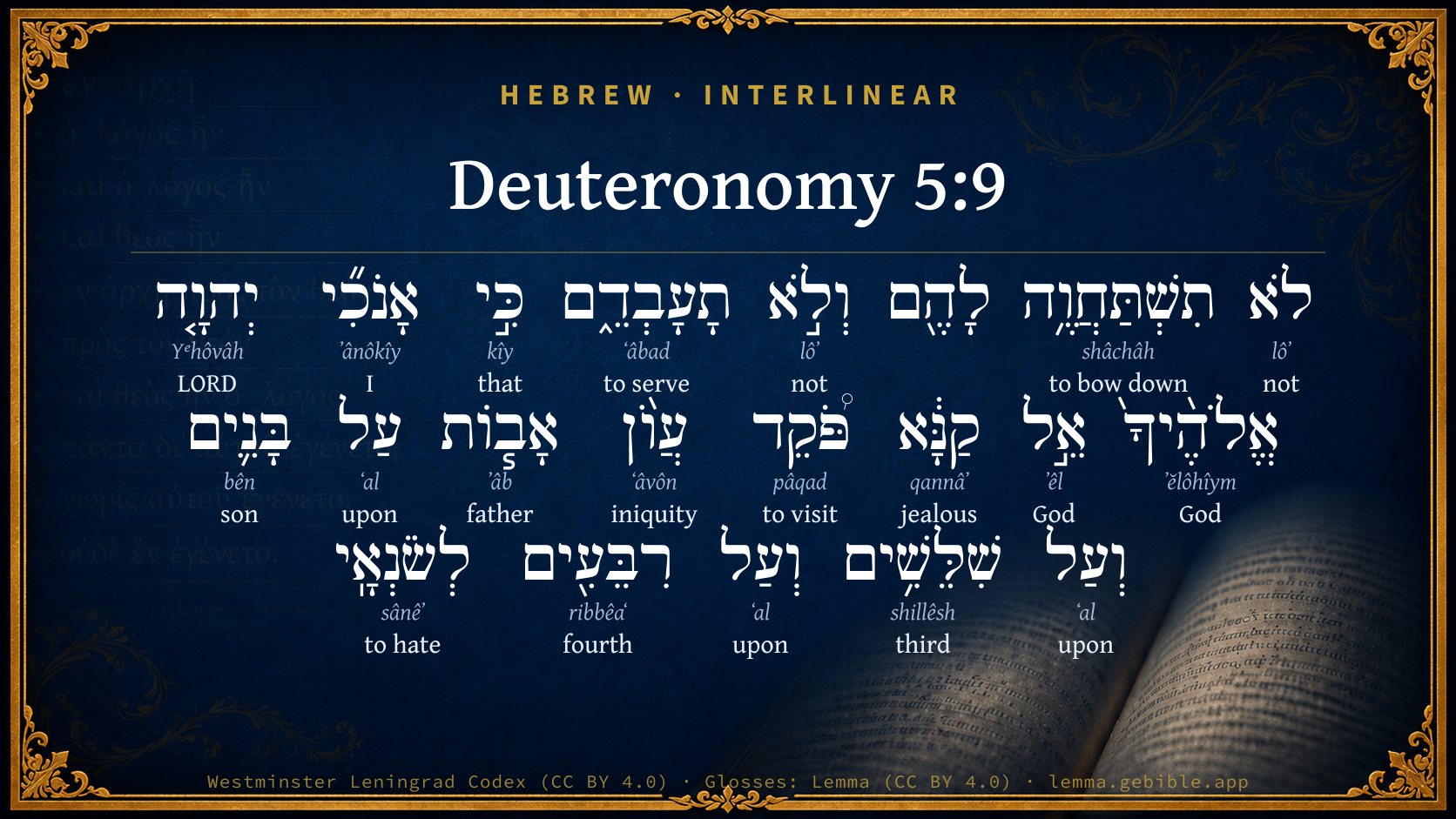
Hebrew (Westminster Leningrad Codex) Deuteronomy 5:9 appears in the Hebrew Old Testament. The text above is from the Westminster Leningrad Codex. Each word links to its Strong’s number, a concise gloss, and parsing drawn from the Open Scriptures Hebrew Bible morphology. Click any word for its full Brown-Driver-Briggs (BDB) entry.
Download image
Cite this verse

Deuteronomy 5:9 (World English Bible). Public Domain. Lemma interlinear Bible study tool, https://lemma.gebible.app/v/deuteronomy/5/9.

Show BibTeX & RIS
BibTeX
RIS
English Translation
you shall not bow down yourself to them, nor serve them; for I, Yahweh, your God, am a jealous God, visiting the iniquity of the fathers on the children, and on the third and on the fourth generation of those who hate me;
World English Bible · Public Domain
Download a study sheet

One document with this verse’s original text, its word-by-word gloss line, the meaning frame, cross-references with their text, attributed commentary, and full source and license credits — printable, and it pastes into notes with its structure intact.

This verse Autodidact and up

Study sheet (.html) Plain text (.txt)

A passage Seminary Student

Up to 50 verses in one chapter. A passage sheet keeps up to 6 commentary sources and 12 cross-references per verse, in the order this page ranks them, and says so on the sheet whenever that leaves anything out. Ask for a single verse and you get the Autodidact verse sheet above.

Everything on this page stays free to read, with no account — the sheet is a download of what is already on screen, not access to it.

Want to remove ads? Support Godless Engineer
Compare translations 3

The same verse in 3 English versions, stacked beneath the original-language interlinear above. Click any original word for its lexicon entry.

Each is an independent rendering of the whole verse — the interlinear is not word-aligned to these translations.

Highlighted words mark where these versions differ — a whole-verse word diff, not a word-by-word alignment.

  • World English Bible Public Domain
    you shall not bow down yourself to them, nor serve them; for I, Yahweh, your God, am a jealous God, visiting the iniquity of the fathers on the children, and on the third and on the fourth generation of those who hate me;
  • King James Version Public Domain
    Thou shalt not bow down thyself unto them, nor serve them: for I the LORD thy God am a jealous God, visiting the iniquity of the fathers upon the children unto the third and fourth generation of them that hate me,
  • unfoldingWord Literal Text CC BY-SA 4.0
    You shall not bow down to them, and you shall not serve them, for I, Yahweh your God, a jealous God, visiting the iniquity of the fathers on the sons, and on the third and on the fourth of the haters of me,

unfoldingWord Literal Text — © unfoldingWord, licensed CC BY-SA 4.0. Word-aligned USFM3 via Door43 (git.door43.org/unfoldingWord/en_ult).

Versions to compare (up to 4)

3 of 4 selected

Show all 18 translations

Every available English version of this verse, each an independent rendering of the whole verse.

  • World English Bible Public Domain
    you shall not bow down yourself to them, nor serve them; for I, Yahweh, your God, am a jealous God, visiting the iniquity of the fathers on the children, and on the third and on the fourth generation of those who hate me;
  • Berean Standard Bible Public Domain
    You shall not bow down to them or worship them; for I, the LORD your God, am a jealous God, visiting the iniquity of the fathers on their children to the third and fourth generations of those who hate Me,
  • Majority Standard Bible Public Domain
    You shall not bow down to them or worship them; for I, the LORD your God, am a jealous God, visiting the iniquity of the fathers on their children to the third and fourth generations of those who hate Me,
  • King James Version Public Domain
    Thou shalt not bow down thyself unto them, nor serve them: for I the LORD thy God am a jealous God, visiting the iniquity of the fathers upon the children unto the third and fourth generation of them that hate me,
  • American Standard Version (1901) Public Domain
    thou shalt not bow down thyself unto them, nor serve them; for I, Jehovah, thy God, am a jealous God, visiting the iniquity of the fathers upon the children, and upon the third and upon the fourth generation of them that hate me;
  • Revised Version (1885) Public Domain
    thou shalt not bow down thyself unto them, nor serve them: for I the LORD thy God am a jealous God, visiting the iniquity of the fathers upon the children, and upon the third and upon the fourth generation of them that hate me;
  • Geneva Bible (1599) Public Domain
    Thou shalt neither bowe thy selfe vnto them, nor serue them: for I the Lord thy God am a ielous God, visiting the iniquitie of the fathers vpon the children, euen vnto the third and fourth generation of them that hate me:
  • Douay-Rheims (1899) Public Domain
    Thou shalt not adore them, and thou shalt not serve them. For I am the Lord thy God, a jealous God, visiting the iniquity of the fathers upon their children unto the third and fourth generation, to them that hate me,
  • Young's Literal Translation Public Domain
    thou dost not bow thyself to them nor serve them, for I Jehovah thy God `am' a zealous God, charging iniquity of fathers on children, and on a third `generation', and on a fourth, to those hating Me;
  • Literal Standard Version CC BY-SA 4.0
    You do not bow yourself to them, nor serve them: for I, your God YHWH, [am] a zealous God, charging iniquity of fathers on sons, and on a third and on a fourth [generation] of those hating Me,
  • Unlocked Literal Bible CC BY-SA 4.0
    You will not bow down to them or serve them, for I, Yahweh your God, am a jealous God. I punish the ancestors' wickedness by bringing punishment on the children, to the third and fourth generation of those who hate me,
  • unfoldingWord Literal Text CC BY-SA 4.0
    You shall not bow down to them, and you shall not serve them, for I, Yahweh your God, a jealous God, visiting the iniquity of the fathers on the sons, and on the third and on the fourth of the haters of me,
  • Darby Bible Public Domain
    thou shalt not bow down thyself to them, nor serve them; for I, Jehovah thy God, am a jealous ùGod, visiting the iniquity of the fathers upon the sons, and upon the third and upon the fourth [generation] of them that hate me,
  • World Messianic Bible Public Domain
    You shall not bow yourself down to them, nor serve them, for I, the LORD your God, am a jealous God, visiting the iniquity of the fathers on the children and on the third and on the fourth generation of those who hate me
  • Webster's Bible Public Domain
    Thou shalt not bow down thyself to them, nor serve them: for I the LORD thy God am a jealous God, visiting the iniquity of the fathers upon the children to the third and fourth generation of them that hate me,
  • Free Bible Version CC BY-SA 4.0
    You must not bow down before them or worship them; for I am the Lord your God and I am passionately exclusive. I lay the consequences of the sin of those who hate me on their sons, grandsons, and great-grandsons;
  • Bible in Basic English Public Domain
    You may not go down on your faces before them or give them worship: for I, the Lord your God, am a God who will not give his honour to another; and I will send punishment on the children for the wrongdoing of their fathers, to the third and fourth generation of my haters;
  • JPS Tanakh (1917) Public Domain
    Thou shalt not bow down unto them, nor serve them; for I the LORD thy God am a jealous God, visiting the iniquity of the fathers upon the children, and upon the third and upon the fourth generation of them that hate Me,

Literal Standard Version (2020), Covenant Press — licensed CC BY-SA 4.0. Text via the HelloAO Bible API (eBible.org). Unlocked Literal Bible (unfoldingWord) — licensed CC BY-SA 4.0. Text via the HelloAO Bible API (eBible.org). unfoldingWord Literal Text — © unfoldingWord, licensed CC BY-SA 4.0. Word-aligned USFM3 via Door43 (git.door43.org/unfoldingWord/en_ult). Free Bible Version, Dr. Jonathan Gallagher — licensed CC BY-SA 4.0. Text via the HelloAO Bible API (eBible.org).

Word by word

More ways to search: Search by grammar → Find every occurrence → Compare this word →

Practice this passage: Drill this verse → Learn its vocabulary →

רִבֵּעִ֖ים
ribbêaʻ
H7256
“fourth generation”
Noun, Common, Masculine, Plural, Absolute
Part of Speech
Noun
Type
Common
Gender
Masculine
Number
Plural
State
Absolute
Full BDB Definition

Origin: from H7251

TWOT: 2107d

pertaining to the fourth
  1. לֹא lôʼ H3808 “not” Particle, Negative
  2. תִשְׁתַּחֲוֶ֥ה shâchâh H7812 “to bow down” Verb, Hishtaphel, Imperfect, 2nd Person, Masculine, Singular
  3. וְלֹ֣א lôʼ H3808 “and · not” Conjunction + Particle, Negative
  4. תָעָבְדֵ֑ם ʻâbad H5647 “to serve · them” Verb, Hophal, Imperfect, 2nd Person, Masculine, Singular + Suffix, Personal, 3rd Person, Masculine, Plural
  5. כִּ֣י kîy H3588 “that” Conjunction
  6. אָנֹכִ֞י ʼânôkîy H595 “I” Pronoun, Personal, 1st Person, Common, Singular
  7. יְהוָ֤ה Yᵉhôvâh H3068 “LORD” Noun, Proper
  8. אֱלֹהֶ֨יךָ֙ ʼĕlôhîym H430 “God(s) · your” Noun, Common, Masculine, Plural, Construct + Suffix, Personal, 2nd Person, Masculine, Singular
  9. אֵ֣ל ʼêl H410 “God” Noun, Common, Masculine, Singular, Absolute
  10. קַנָּ֔א qannâʼ H7067 “jealous” Adjective, Adjective, Masculine, Singular, Absolute
  11. פֹּ֠קֵד pâqad H6485 “visiting” Verb, Qal, Participle Active, Masculine, Singular, Absolute
  12. עֲוֺ֨ן ʻâvôn H5771 “iniquity of” Noun, Common, Both, Singular, Construct
  13. אָב֧וֹת ʼâb H1 “fathers” Noun, Common, Masculine, Plural, Absolute
  14. עַל ʻal H5921 “upon” Preposition
  15. בָּנִ֛ים bên H1121 “sons” Noun, Common, Masculine, Plural, Absolute
  16. וְעַל ʻal H5921 “and · upon” Conjunction + Preposition
  17. שִׁלֵּשִׁ֥ים shillêsh H8029 “third generation” Noun, Common, Masculine, Plural, Absolute
  18. וְעַל ʻal H5921 “and · upon” Conjunction + Preposition
  19. לְשֹׂנְאָֽי sânêʼ H8130 “to/for · hating · me” Preposition + Verb, Qal, Participle Active, Masculine, Plural, Construct + Suffix, Personal, 1st Person, Common, Singular

About this verse

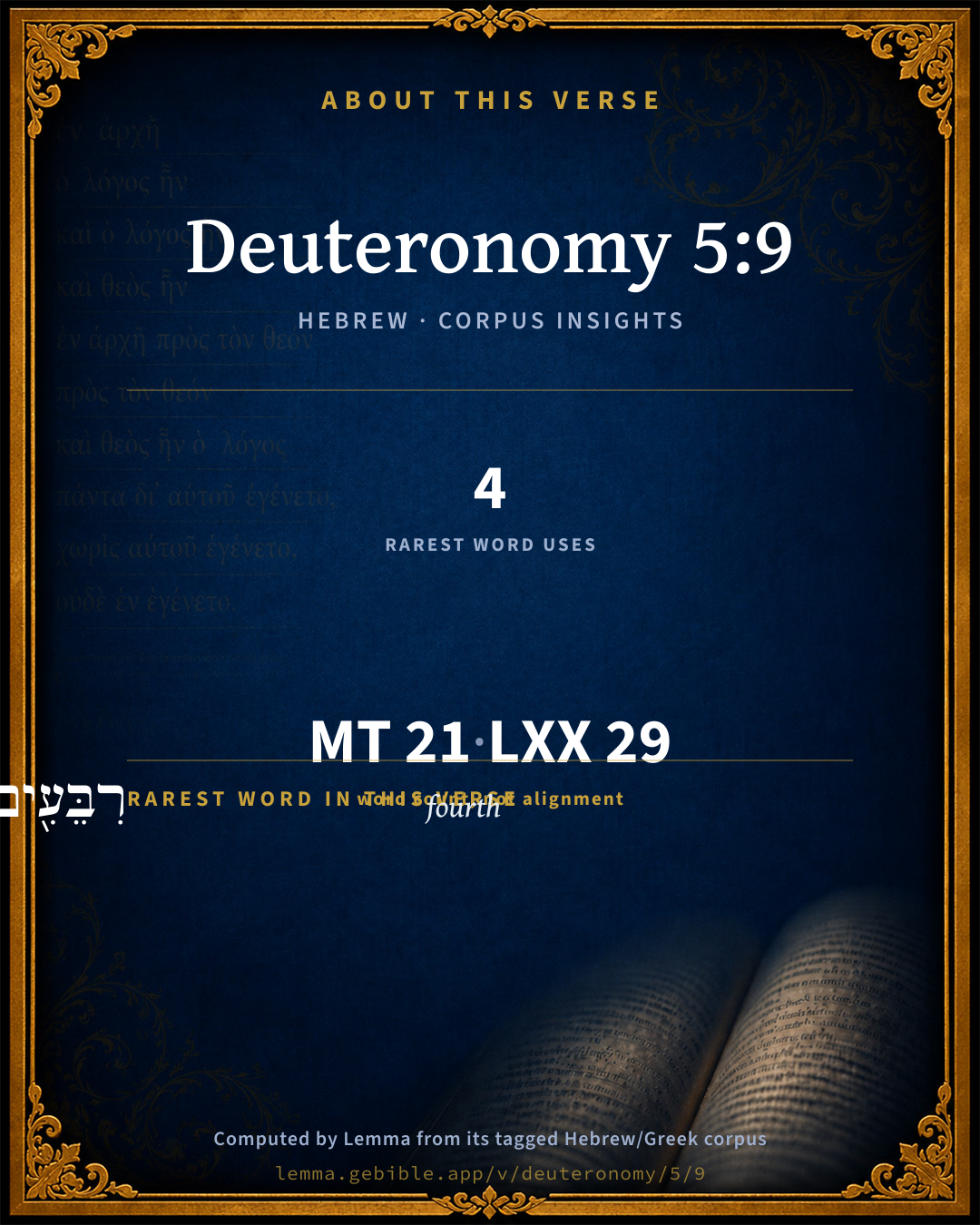
These counts appear in no published source. They are computed here, from the morphology-tagged text and Lemma’s own curated glosses. What Lemma adds →

21
words
17
distinct lemmas
Pentateuch
section

Notable vocabulary

The rarest word here is רִבֵּעִ֖ים fourth H7256 — appearing just 4 times in the whole Hebrew Bible.

Shared distinctive vocabulary

רִבֵּעִ֖ים fourth H7256 occurs in 4 verses of the Hebrew Bible. Also found in:

Grammatical profile

  • 4 verbs
  • 8 nouns
  • 1 adjective
  • 1 pronoun
  • 4 prepositions
  • 1 conjunction
  • 2 particles

Verb forms

  • תִשְׁתַּחֲוֶ֥ה Hishtaphel · Imperfect
  • תָעָבְדֵ֑ם Hophal · Imperfect
  • פֹּ֠קֵד Qal · Participle Active
  • לְשֹׂנְאָֽי Qal · Participle Active

Repetition

Words recur within this verse — often emphatic in Hebrew:

Hebrew & Septuagint length

In English translation the verse runs 43 words from the Hebrew and 42 from the Septuagint (LXX English) — closely comparable.

A rough comparison of the two English renderings, which tokenize alike — not a word-level alignment.

Word counts can differ between the Hebrew and the Greek without any difference in meaning — e.g. the Hebrew direct-object marker אֵת has no separate Greek word, and Greek often adds the article ὁ.

In the original languages it is 21 Hebrew tokens and 29 Greek tokens — but the two are counted differently (Hebrew bundles its prefixes and suffixes into one token; the Greek is in lemma form), so that isn’t a like-for-like length.

Cross-references

8

Topical passages linked to Deuteronomy 5:9 in the Treasury of Scripture Knowledge — connected by theme and wording, ordered by reader-vote popularity; previews shown in the World English Bible.

  • Exodus 20:4–6 "You shall not make for yourselves an idol, nor any image of anything that is in the heavens above, or that is in the earth beneath, or that is in the water under the earth:
  • Exodus 34:7 keeping loving kindness for thousands, forgiving iniquity and disobedience and sin; and that will by no means clear the guilty, visiting the iniquity of the fathers on the children, and on the children's children, on the third and on the fourth generation."
  • Numbers 14:18 Yahweh is slow to anger, and abundant in loving kindness, forgiving iniquity and disobedience; and that will by no means clear [the guilty], visiting the iniquity of the fathers on the children, on the third and on the fourth generation.
  • Daniel 9:4–9 I prayed to Yahweh my God, and made confession, and said, Oh, Lord, the great and dreadful God, who keeps covenant and loving kindness with those who love him and keep his commandments,
  • Exodus 34:14 for you shall worship no other god: for Yahweh, whose name is Jealous, is a jealous God.
  • Matthew 23:35–36 that on you may come all the righteous blood shed on the earth, from the blood of righteous Abel to the blood of Zachariah son of Barachiah, whom you killed between the sanctuary and the altar.
  • Jeremiah 32:18 who show loving kindness to thousands, and recompense the iniquity of the fathers into the bosom of their children after them; the great, the mighty God, Yahweh of Hosts is his name;
  • Romans 11:28–29 Concerning the Gospel, they are enemies for your sake. But concerning the election, they are beloved for the fathers' sake.

Cross-references courtesy of OpenBible.info (CC BY 4.0).

Hebrew and Greek witnesses Masoretic Hebrew ↔ Greek Septuagint

The same verse in the two great witnesses to the Old Testament, shown verse-for-verse.

These are two independent witnesses, not word-aligned to each other, and the Septuagint is shown in lemma (dictionary) form.

Hebrew Deuteronomy 5:9 Masoretic · Westminster Leningrad Codex

לֹא תִשְׁתַּחֲוֶ֥ה לָהֶ֖ם וְלֹ֣א תָעָבְדֵ֑ם כִּ֣י אָנֹכִ֞י יְהוָ֤ה אֱלֹהֶ֨יךָ֙ אֵ֣ל קַנָּ֔א פֹּ֠קֵד עֲוֺ֨ן אָב֧וֹת עַל בָּנִ֛ים וְעַל שִׁלֵּשִׁ֥ים וְעַל רִבֵּעִ֖ים לְשֹׂנְאָֽי

you shall not bow down yourself to them, nor serve them; for I, Yahweh, your God, am a jealous God, visiting the iniquity of the fathers on the children, and on the third and on the fourth generation of those who hate me;

World English Bible · Public Domain

Greek LXX Deuteronomy 5:9 Septuagint · lemma form

οὐ προςκυνέω αὐτός οὐδέ μή λατρεύω αὐτός ὅτι ἐγώ εἰμί κύριος ὁ θεός σύ θεός ζηλωτής ἀποδίδωμι ἁμαρτία πατήρ ἐπί τέκνον ἐπί τρίτος καί τέταρτος γενεά ὁ μισέω ἐγώ

You shall not bow down to them, nor shall you serve them; for I am the Lord your God, a jealous God, visiting the sins of the fathers upon the children to the third and fourth generation to them that hate me,

LXX2012 (modern English Septuagint) · Public Domain

Hebrew: Westminster Leningrad Codex (CC BY 4.0). Greek: Septuagint (public domain); English from LXX2012 (modern English Septuagint) (Public Domain). How the Septuagint differs from the Hebrew →

Targum (Aramaic paraphrase)

2

The Targum is the ancient Jewish Aramaic paraphrase of the Hebrew Scriptures — an interpretive translation, not the Hebrew text itself. Onkelos (literal) and Pseudo-Jonathan (expansive) render the Torah, and Jonathan the Prophets. Coverage is partial: where no permissively-licensed English translation exists for a verse, only the Aramaic is shown. This is verse-level text, not a word-by-word alignment to the Hebrew.

  1. Targum Onkelos Torah (Genesis–Deuteronomy)
    לָא תִסְגוּד לְהוֹן וְלָא תִפְלְחִנוּן אֲרֵי אֲנָא יְיָ אֱלָהָךְ אֵל קַנָא מַסְעַר חוֹבֵי אֲבָהָן עַל בְּנִין מְרָדִין עַל דַר תְּלִיתַי וְעַל דַר רְבִיעַי לְשַׂנְאָי כַּד מְשַׁלְמִין בְּנַיָא לְמֶחֱטֵּי בָּתַר אֲבָהָתְהוֹן

    (no public-domain English translation for this verse)

    Targum Onkelos — Aramaic: “Onkelos Genesis” (public domain); “Onkelos Exodus” (public domain); “Onkelos Leviticus” (public domain); “Onkelos Numbers” (public domain); “Onkelos Deuteronomy” (public domain). English: “Sefaria Community Translation” (CC0 1.0 (public-domain dedication)); “J.W. Etheridge. The Targums of Onkelos and Jonathan Ben Uzziel on the Pentateuch. London: Longmans, Green, 1862” (public domain). Text via Sefaria.

  2. Targum Pseudo-Jonathan Torah (Genesis–Deuteronomy)
    לָא תִסְגְּדוּן לְהוֹן וְלָא תִפְלְחוּן קֳדָמֵיהוֹן אֲרוּם אֲנָא הוּא יְיָ אֱלָהָכוֹן אֱלָהּ קַנְאָן וּפוּרְעָן וּמִתְפְּרַע בְּקִנְאָה מַדְכַּר חוֹבֵי אַבְהָן רַשִׁיעָן עַל בְּנִין מְרוֹדִין עַל דַּר תְּלִיתָאֵי וְעַל דַּר רְבִיעָאֵי לְסַנְאַי כַּד מְשַׁלְמִין בְּנַיָא לְמֶחֱטֵי בָּתַר אַבְהַתְהוֹן

    thou shalt not worship them or do service before them; for I am the Lord your God, a jealous and avenging God, taking vengeance in jealousy; remembering the sins of wicked fathers upon rebellious children to the third generation and to the fourth of them that hate Me, when the children complete to sin after their fathers;

    Targum Pseudo-Jonathan — Aramaic: “Targum Jonathan on Genesis” (public domain); “Targum Jonathan on Exodus” (public domain); “Targum Jonathan on Leviticus” (public domain); “Targum Jonathan on Numbers” (public domain); “Targum Jonathan on Deuteronomy” (public domain). English: “The Targum of Jonathan ben Uzziel, trans. J. W. Etheridge, London, 1862” (public domain). Text via Sefaria.

Commentary

Notes on Deuteronomy 5:9 from classic Christian and Jewish commentators (each source and its license shown beneath its notes). The classic Christian expositions comment on the surrounding passage and are grouped to its opening verse, so a note may address several verses; the Jewish commentaries on the Tanakh (Rashi and others) are per-verse, so they appear only where the commentator wrote on this verse.

Lemma curates 59 commentaries, every one of them public domain or Creative Commons licensed, each selected and text-cleaned for this edition rather than reprinted as found. About our sources →

Tyndale Open Study Notes

Tyndale Open Resources

5:9 The children of sinful parents are not punished for the wrongdoings of their mothers and fathers, but the sins of any generation have consequences that last for generations (see 2 Sam 12:10). • The term reject (literally hate) does not relate to having bitter and hostile feelings but to forsaking a relationship.

Tyndale Open Study Notes — © Tyndale Open Resources, licensed CC BY-SA 4.0. Text via the HelloAO Bible API.

Geneva Bible (1599)

Geneva Bible translators

That is, of his honor, not permitting it to be given to others.

Geneva Bible (1599) marginal notes — public domain. Text via Bolls.life.

Ellicott's Commentary for English Readers

(9) Visiting the iniquity of the fathers upon the children.—There are no sins which so surely entail penal consequences upon succeeding generations as the abominations of idolatry. All idolatry means the degradation of the Divine image in man. But it is not meant here that the soul of the son shall die for the father. The penalty extends only “to them that hate me.”

A Bible Commentary for English Readers, edited by Charles John Ellicott (1878–1897) — public domain. Text from a community e-Sword module.

The Cambridge Bible for Schools and Colleges

gen. ed. J. J. S. Perowne

9. a jealous God] See on Deu_4:24.

The Cambridge Bible for Schools and Colleges (gen. ed. J. J. S. Perowne; Cambridge University Press, 1878–1918) — public domain. Text from a community e-Sword module.

Haydock's Catholic Bible Commentary

Serve. We must neither treat idols, nor their images, with the honour due to God alone. (St. Augustine, q. 61, in Gen.) --- If we do, he will punish our infidelity. --- Generation, for a long time, or as long as the remembrance of the parents’ wickedness subsists, so as to have an influence upon others. (Haydock) --- God mercifully defers correction. (St. Jerome in Ezec. xvii.) He chastises those who imitate their wicked forefathers.

George Leo Haydock (1774–1849), Haydock's Catholic Family Bible and Commentary, 1859 edition — public domain. Excludes Psalms (Douay-Rheims chapter numbering differs from Protestant) and Deuterocanonical books (Catholic canon only).

unfoldingWord translationNotes

Door43 World Missions Community

General Information:

Moses continues to speak to the people of Israel as if they were one man, so all instances of "you" and "your" are singular. (See: Forms of You)

You will not bow down to them or serve them

"You will not worship the carved figures or do as they command"

You will not

"Never"

I ... am a jealous God

"I ... want you to worship only me"

showing covenant faithfulness to thousands, to those who love me

The abstract noun "faithfulness" can be stated as "faithfully" or "faithful." AT: "faithfully loving thousands, those who love me" or "being faithful to the covenant with thousands, with those who love me" (See: Abstract Nouns)

to thousands, to those who love me

Some translations read "to a thousand generations of those who love me." The word "thousands" is a metonym for a number too many to count. AT: "forever, to those who love me" (See: Assumed Knowledge and Implicit Information and Metonymy and Numbers)

translationWords

bow

servant

Yahweh

God

jealous

punish

evil

children

generation

covenant faithfulness

love

command

unfoldingWord translationNotes — © Distant Shores Media and the Door43 World Missions Community, licensed CC BY-SA 4.0. Source: git.door43.org/Door43/en_tn.

Lesson kit

Teaching starters — assembled from the data on this page, not authored interpretation. Every prompt links to the verse data it draws on. Edit before teaching.

Deuteronomy, in the Pentateuch, opens this verse with 21 words (17 distinct Hebrew lemmas). Its most distinctive word is ribbêaʻ (“fourth”). A historical commentator’s framing appears above. Read the whole chapter for the surrounding context.

Discussion questions

  1. How does “fourth” (ribbêaʻ) shape what this verse is saying?
  2. How does Exodus 20:5, which shares the word «fourth», read alongside this verse?
  3. What does the repetition of “upon” (3× in this one verse) do in this verse?
  4. These translations render this verse differently. What is at stake in choosing one wording over another?
  5. «תִשְׁתַּחֲוֶ֥ה» is a Hishtaphel Imperfect verb. How does that grammatical form shape the action described?
  6. Compare how Tyndale Open Study Notes and Geneva Bible (1599) read this verse. Where do they agree or differ?

Things to notice

Reading settings

Reading text

Shown beneath each verse's original-language words.

Old Testament
Old Testament edition

Read the OT as the Masoretic Hebrew (MT) or the Greek Septuagint (LXX).

English shown for the Greek Septuagint (in the Hebrew ↔ Greek comparison).

Comparing translations? Open the Compare panel on any verse page to stack up to four side by side.