Leviticus 20:19

Hebrew (Westminster Leningrad Codex) Leviticus 20:19 appears in the Hebrew Old Testament. The text above is from the Westminster Leningrad Codex. Each word links to its Strong’s number, a concise gloss, and parsing drawn from the Open Scriptures Hebrew Bible morphology. Click any word for its full Brown-Driver-Briggs (BDB) entry.
Download image
Cite this verse

Leviticus 20:19 (World English Bible). Public Domain. Lemma interlinear Bible study tool, https://lemma.gebible.app/v/leviticus/20/19.

Show BibTeX & RIS
BibTeX
RIS
English Translation
"'You shall not uncover the nakedness of your mother's sister, nor of your father's sister; for he has made naked his close relative: they shall bear their iniquity.
World English Bible · Public Domain
Download a study sheet

One document with this verse’s original text, its word-by-word gloss line, the meaning frame, cross-references with their text, attributed commentary, and full source and license credits — printable, and it pastes into notes with its structure intact.

This verse Autodidact and up

Study sheet (.html) Plain text (.txt)

A passage Seminary Student

Up to 50 verses in one chapter. A passage sheet keeps up to 6 commentary sources and 12 cross-references per verse, in the order this page ranks them, and says so on the sheet whenever that leaves anything out. Ask for a single verse and you get the Autodidact verse sheet above.

Everything on this page stays free to read, with no account — the sheet is a download of what is already on screen, not access to it.

Want to remove ads? Support Godless Engineer
Compare translations 3

The same verse in 3 English versions, stacked beneath the original-language interlinear above. Click any original word for its lexicon entry.

Each is an independent rendering of the whole verse — the interlinear is not word-aligned to these translations.

Highlighted words mark where these versions differ — a whole-verse word diff, not a word-by-word alignment.

  • World English Bible Public Domain
    "'You shall not uncover the nakedness of your mother's sister, nor of your father's sister; for he has made naked his close relative: they shall bear their iniquity.
  • King James Version Public Domain
    And thou shalt not uncover the nakedness of thy mother's sister, nor of thy father's sister: for he uncovereth his near kin: they shall bear their iniquity.
  • unfoldingWord Literal Text CC BY-SA 4.0
    And the nakedness of the sister of your mother or the sister of your father, you shall not uncover because he would expose his body. They shall carry their iniquity.

unfoldingWord Literal Text — © unfoldingWord, licensed CC BY-SA 4.0. Word-aligned USFM3 via Door43 (git.door43.org/unfoldingWord/en_ult).

Versions to compare (up to 4)

3 of 4 selected

Show all 18 translations

Every available English version of this verse, each an independent rendering of the whole verse.

  • World English Bible Public Domain
    "'You shall not uncover the nakedness of your mother's sister, nor of your father's sister; for he has made naked his close relative: they shall bear their iniquity.
  • Berean Standard Bible Public Domain
    You must not have sexual relations with the sister of your mother or your father, for it is exposing one’s own kin; both shall bear their iniquity.
  • Majority Standard Bible Public Domain
    You must not have sexual relations with the sister of your mother or your father, for it is exposing one’s own kin; both shall bear their iniquity.
  • King James Version Public Domain
    And thou shalt not uncover the nakedness of thy mother's sister, nor of thy father's sister: for he uncovereth his near kin: they shall bear their iniquity.
  • American Standard Version (1901) Public Domain
    And thou shalt not uncover the nakedness of thy mother's sister, nor of thy father's sister; for he hath made naked his near kin: they shall bear their iniquity.
  • Revised Version (1885) Public Domain
    And thou shalt not uncover the nakedness of thy mother’s sister, nor of thy father’s sister: for he hath made naked his near kin: they shall bear their iniquity.
  • Geneva Bible (1599) Public Domain
    Moreouer thou shalt not vncouer the shame of thy mothers sister, nor of thy fathers sister: because he hath vncouered his kin, they shall beare their iniquitie.
  • Douay-Rheims (1899) Public Domain
    Thou shalt not uncover the nakedness of thy aunt by thy mother, and of thy aunt by thy father: he that doth this, hath uncovered the shame of his own flesh, both shall bear their iniquity.
  • Young's Literal Translation Public Domain
    `And the nakedness of thy mother's sister, and of thy father's sister, thou dost not uncover; because his relation he hath made bare; their iniquity they bear.
  • Literal Standard Version CC BY-SA 4.0
    And you do not uncover the nakedness of your mother’s sister and your father’s sister, because his relation he has made bare; they bear their iniquity.
  • Unlocked Literal Bible CC BY-SA 4.0
    You must not sleep with your mother's sister, or with your father's sister, because you would disgrace your close relative. You must carry your own guilt.
  • unfoldingWord Literal Text CC BY-SA 4.0
    And the nakedness of the sister of your mother or the sister of your father, you shall not uncover because he would expose his body. They shall carry their iniquity.
  • Darby Bible Public Domain
    And the nakedness of thy mother's sister, and of thy father's sister shalt thou not uncover; for he hath laid naked his near relation: they shall bear their iniquity.
  • World Messianic Bible Public Domain
    “‘You shall not uncover the nakedness of your mother’s sister, nor of your father’s sister, for he has made his close relative naked. They shall bear their iniquity.
  • Webster's Bible Public Domain
    And thou shalt not uncover the nakedness of thy mother's sister, nor of thy father's sister: for he uncovereth his near kin: they shall bear their iniquity.
  • Free Bible Version CC BY-SA 4.0
    Don't have sex with your aunt, whether on your father's or your mother's side, because it brings shame on your own family. Both will bear responsibility for their sin.
  • Bible in Basic English Public Domain
    And you may not have sex connection with your mother's sister or your father's sister, for they are his near relations: their sin will be on them.
  • JPS Tanakh (1917) Public Domain
    And thou shalt not uncover the nakedness of thy mother's sister, nor of thy father's sister; for he hath made naked his near kin; they shall bear their iniquity.

Literal Standard Version (2020), Covenant Press — licensed CC BY-SA 4.0. Text via the HelloAO Bible API (eBible.org). Unlocked Literal Bible (unfoldingWord) — licensed CC BY-SA 4.0. Text via the HelloAO Bible API (eBible.org). unfoldingWord Literal Text — © unfoldingWord, licensed CC BY-SA 4.0. Word-aligned USFM3 via Door43 (git.door43.org/unfoldingWord/en_ult). Free Bible Version, Dr. Jonathan Gallagher — licensed CC BY-SA 4.0. Text via the HelloAO Bible API (eBible.org).

Word by word

More ways to search: Search by grammar → Find every occurrence → Compare this word →

Practice this passage: Drill this verse → Learn its vocabulary →

הֶעֱרָ֖ה
ʻârâh
H6168
“to uncover”
Verb, Hiphil, Perfect, 3rd Person, Masculine, Singular
Part of Speech
Verb
Stem
Hiphil
Form
Perfect
Person
3rd Person
Gender
Masculine
Number
Singular
Full BDB Definition

Origin: a primitive root

TWOT: 1692

to be bare, be nude, uncover, leave destitute, discover, empty, raze, pour out - (Piel) - to bare, lay bare - to lay bare by emptying, empty - to pour out - (Hiphil) - to make naked, strip bare (of sexual offences) - to pour out - (Niphal) to be poured out, be exposed - (Hithpael) - to expose oneself, make oneself naked - pouring oneself, spreading oneself (participle)
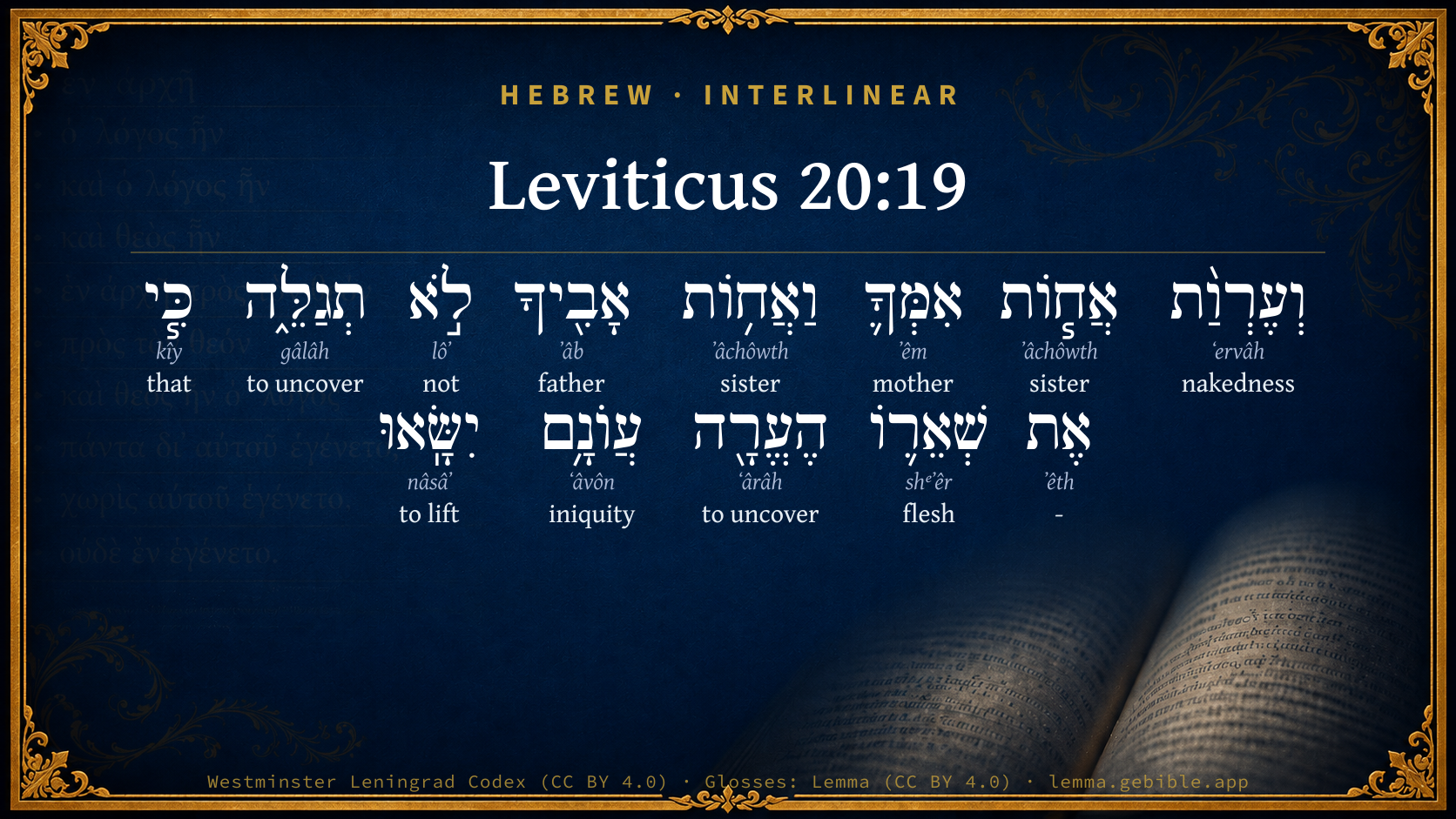
  1. וְעֶרְוַ֨ת ʻervâh H6172 “and · nakedness of” Conjunction + Noun, Common, Feminine, Singular, Construct
  2. אֲח֧וֹת ʼâchôwth H269 “sister of” Noun, Common, Feminine, Singular, Construct
  3. אִמְּךָ֛ ʼêm H517 “mother · your” Noun, Common, Feminine, Singular, Construct + Suffix, Personal, 2nd Person, Masculine, Singular
  4. וַאֲח֥וֹת ʼâchôwth H269 “and · sister of” Conjunction + Noun, Common, Feminine, Singular, Construct
  5. אָבִ֖יךָ ʼâb H1 “father · your” Noun, Common, Masculine, Singular, Construct + Suffix, Personal, 2nd Person, Masculine, Singular
  6. לֹ֣א lôʼ H3808 “not” Particle, Negative
  7. תְגַלֵּ֑ה gâlâh H1540 “to uncover” Verb, Piel, Imperfect, 2nd Person, Masculine, Singular
  8. כִּ֧י kîy H3588 “that” Conjunction
  9. אֶת ʼêth H853 “-” Particle, Direct Object
  10. שְׁאֵר֛וֹ shᵉʼêr H7607 “flesh · his” Noun, Common, Masculine, Singular, Construct + Suffix, Personal, 3rd Person, Masculine, Singular
  11. עֲוֺנָ֥ם ʻâvôn H5771 “iniquity · their” Noun, Common, Both, Singular, Construct + Suffix, Personal, 3rd Person, Masculine, Plural
  12. יִשָּֽׂאוּ nâsâʼ H5375 “to lift” Verb, Qal, Imperfect, 3rd Person, Masculine, Plural

About this verse

These counts appear in no published source. They are computed here, from the morphology-tagged text and Lemma’s own curated glosses. What Lemma adds →

13
words
12
distinct lemmas
Pentateuch
section

Notable vocabulary

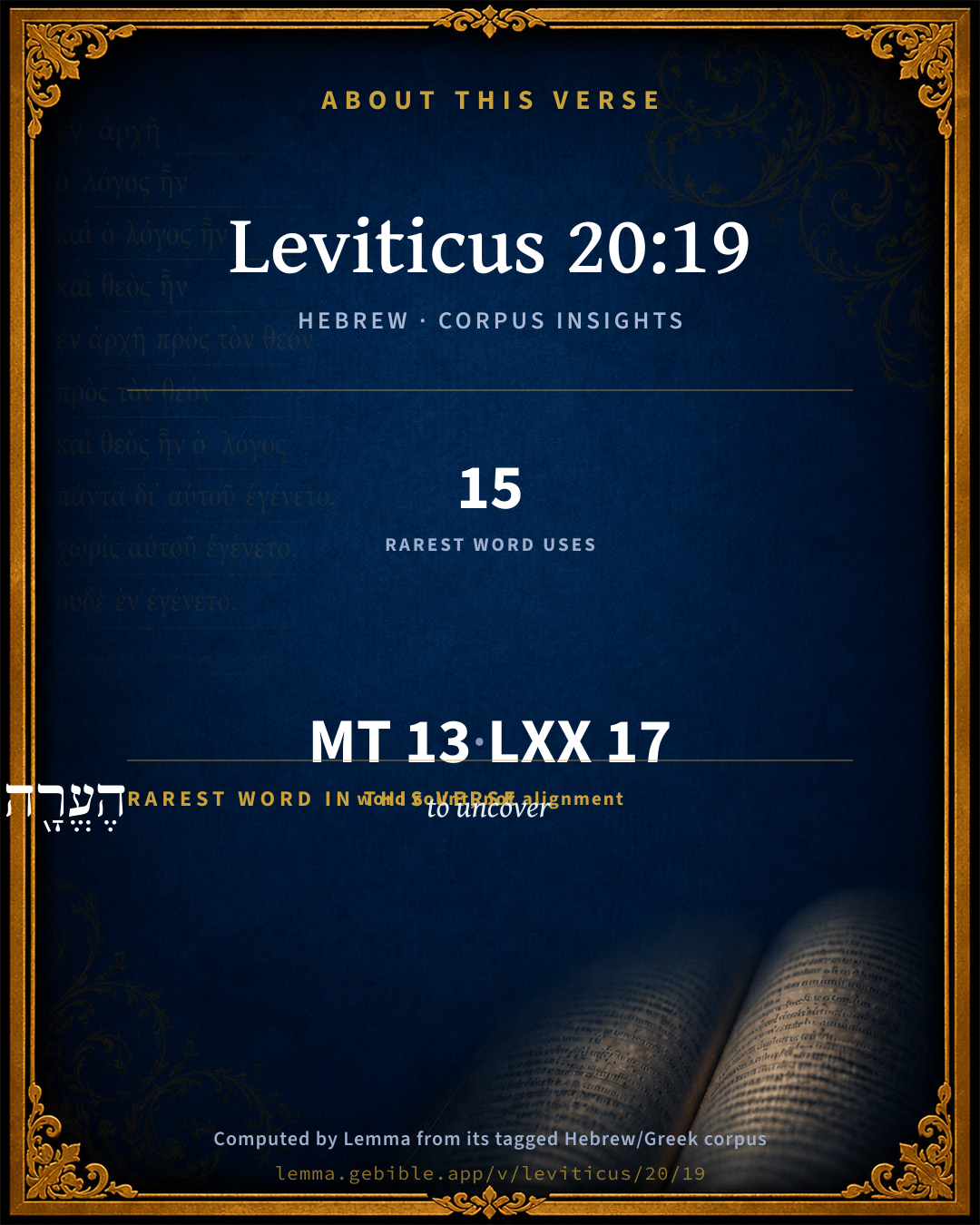
The rarest word here is הֶעֱרָ֖ה to uncover H6168 — appearing just 15 times in the whole Hebrew Bible.

Shared distinctive vocabulary

הֶעֱרָ֖ה to uncover H6168 occurs in 14 verses of the Hebrew Bible. Also found in:

Grammatical profile

  • 3 verbs
  • 7 nouns
  • 1 conjunction
  • 2 particles

Verb forms

  • תְגַלֵּ֑ה Piel · Imperfect
  • הֶעֱרָ֖ה Hiphil · Perfect
  • יִשָּֽׂאוּ Qal · Imperfect

Repetition

A word recurs within this verse — often emphatic in Hebrew:

  • אֲח֧וֹת sister H269 ×2

Hebrew & Septuagint length

In English translation the verse runs 28 words from the Hebrew and 34 from the Septuagint (LXX English) — closely comparable.

A rough comparison of the two English renderings, which tokenize alike — not a word-level alignment.

Word counts can differ between the Hebrew and the Greek without any difference in meaning — e.g. the Hebrew direct-object marker אֵת has no separate Greek word, and Greek often adds the article ὁ.

In the original languages it is 13 Hebrew tokens and 17 Greek tokens — but the two are counted differently (Hebrew bundles its prefixes and suffixes into one token; the Greek is in lemma form), so that isn’t a like-for-like length.

Cross-references

3

Topical passages linked to Leviticus 20:19 in the Treasury of Scripture Knowledge — connected by theme and wording, ordered by reader-vote popularity; previews shown in the World English Bible.

  • Leviticus 18:6 "'None of you shall approach anyone who are his close relatives, to uncover their nakedness: I am Yahweh.
  • Exodus 6:20 Amram took Jochebed his father's sister to himself as wife; and she bore him Aaron and Moses: and the years of the life of Amram were a hundred and thirty-seven years.
  • Leviticus 18:12–30 You shall not uncover the nakedness of your father's sister: she is your father's near kinswoman.

Cross-references courtesy of OpenBible.info (CC BY 4.0).

Hebrew and Greek witnesses Masoretic Hebrew ↔ Greek Septuagint

The same verse in the two great witnesses to the Old Testament, shown verse-for-verse.

These are two independent witnesses, not word-aligned to each other, and the Septuagint is shown in lemma (dictionary) form.

Hebrew Leviticus 20:19 Masoretic · Westminster Leningrad Codex

וְעֶרְוַ֨ת אֲח֧וֹת אִמְּךָ֛ וַאֲח֥וֹת אָבִ֖יךָ לֹ֣א תְגַלֵּ֑ה כִּ֧י אֶת שְׁאֵר֛וֹ הֶעֱרָ֖ה עֲוֺנָ֥ם יִשָּֽׂאוּ

"'You shall not uncover the nakedness of your mother's sister, nor of your father's sister; for he has made naked his close relative: they shall bear their iniquity.

World English Bible · Public Domain

Greek LXX Leviticus 20:19 Septuagint · lemma form

καί ἀσχημοσύνη ἀδελφή πατήρ σύ καί ἀδελφή μήτηρ σύ οὐ ἀποκαλύπτω ὁ γάρ οἰκειότης ἀποκαλύπτω ἁμαρτία ἀποφέρω

And you shall not uncover the nakedness of your father's sister, or of the sister of your mother; for that man has uncovered the nakedness of one near akin: they shall bear their iniquity.

LXX2012 (modern English Septuagint) · Public Domain

Hebrew: Westminster Leningrad Codex (CC BY 4.0). Greek: Septuagint (public domain); English from LXX2012 (modern English Septuagint) (Public Domain). How the Septuagint differs from the Hebrew →

Targum (Aramaic paraphrase)

2

The Targum is the ancient Jewish Aramaic paraphrase of the Hebrew Scriptures — an interpretive translation, not the Hebrew text itself. Onkelos (literal) and Pseudo-Jonathan (expansive) render the Torah, and Jonathan the Prophets. Coverage is partial: where no permissively-licensed English translation exists for a verse, only the Aramaic is shown. This is verse-level text, not a word-by-word alignment to the Hebrew.

  1. Targum Onkelos Torah (Genesis–Deuteronomy)
    וְעֶרְיַת אֲחַת אִמָךְ וַאֲחַת אָבוּךְ לָא תְגַלֵי אֲרֵי יָת קָרִיבֵהּ גַלִי חוֹבְהֶן יְקַבְּלוּן

    (no public-domain English translation for this verse)

    Targum Onkelos — Aramaic: “Onkelos Genesis” (public domain); “Onkelos Exodus” (public domain); “Onkelos Leviticus” (public domain); “Onkelos Numbers” (public domain); “Onkelos Deuteronomy” (public domain). English: “Sefaria Community Translation” (CC0 1.0 (public-domain dedication)); “J.W. Etheridge. The Targums of Onkelos and Jonathan Ben Uzziel on the Pentateuch. London: Longmans, Green, 1862” (public domain). Text via Sefaria.

  2. Targum Pseudo-Jonathan Torah (Genesis–Deuteronomy)
    וְעֶרְיַת אֲחַת אִמָךְ וַאֲחַת אַבָּךְ לָא תִבְזֵי אֲרוּם יַת קְרֵיבֵיהּ בִּישְרֵיהּ בְּזֵי חוֹבֵיהוֹן יְקַבְּלוּן בְּמוֹתָנָא יְסוּפוּן

    Nor shalt thou dishonour the nakedness of thy mother's sister nor thy father's sister; for he hath dishonoured the flesh of his near kin: they shall receive the penalty of their guilt in dying.

    Targum Pseudo-Jonathan — Aramaic: “Targum Jonathan on Genesis” (public domain); “Targum Jonathan on Exodus” (public domain); “Targum Jonathan on Leviticus” (public domain); “Targum Jonathan on Numbers” (public domain); “Targum Jonathan on Deuteronomy” (public domain). English: “The Targum of Jonathan ben Uzziel, trans. J. W. Etheridge, London, 1862” (public domain). Text via Sefaria.

Commentary

Notes on Leviticus 20:19 from classic Christian and Jewish commentators (each source and its license shown beneath its notes). The classic Christian expositions comment on the surrounding passage and are grouped to its opening verse, so a note may address several verses; the Jewish commentaries on the Tanakh (Rashi and others) are per-verse, so they appear only where the commentator wrote on this verse.

Lemma curates 59 commentaries, every one of them public domain or Creative Commons licensed, each selected and text-cleaned for this edition rather than reprinted as found. About our sources →

Trapp's Complete Commentary

John Trapp

Lev 20:19 And thou shalt not uncover the nakedness of thy mother’s sister, nor of thy father’s sister: for he uncovereth his near kin: they shall bear their iniquity.

Ver. 19. See on Lev 18:1-30.

John Trapp, A Commentary or Exposition upon All the Books of the Old and New Testament (1647–1656) — public domain. Text from a community e-Sword module.

Keil & Delitzsch

C. F. Keil & F. Delitzsch

No civil punishment, on the other hand, to be inflicted by the magistrate or by the community generally, was ordered to follow marriage with an aunt, the sister of father or mother (Lev 20:19, cf. Lev 18:12-13), with an uncle's wife (Lev 20:20, cf. Lev 18:4), or with a sister-in-law, a brother's wife (Lev 20:21, cf. Lev 18:16). In all these cases the threat is simply held out, "they shall bear their iniquity," and (according to Lev 20:20, Lev 20:21) "die childless;" that is to say, God would reserve the punishment to Himself (see at Lev 18:14). In the list of punishments no reference is made to intercourse with a mother (Lev 18:7) or a granddaughter (Lev 18:10), as it was taken for granted that the punishment of death would be inflicted in such cases as these; just as marriage with a daughter or a full sister is passed over in the prohibitions in ch. 18.

Keil & Delitzsch — Biblical Commentary on the Old Testament (1861–1891) — public domain (CC PDM 1.0). Text via the HelloAO Bible API. (Old Testament only.)

Geneva Bible (1599)

Geneva Bible translators

Hebrew, flesh.

Geneva Bible (1599) marginal notes — public domain. Text via Bolls.life.

Ellicott's Commentary for English Readers

(19) Thy mother’s sister.—See Lev_18:12.

A Bible Commentary for English Readers, edited by Charles John Ellicott (1878–1897) — public domain. Text from a community e-Sword module.

John Gill's Exposition

And thou shalt not uncover the nakedness of thy mother's sister, nor of thy father's sister,.... An aunt either by mother or father's side, against which the law is, Lev 18:13,

for he uncovereth his near kin; as an aunt is to a man, and so an uncle to a woman, and both equally criminal; for it is a rule that holds good in all those cases, though not expressed, that what is binding upon one sex is upon the other, being in the same degree of relation, whether of consanguinity or affinity:

they shall bear their iniquity; "both" of them, as the Vulgate Latin version, the man and his aunt, and so a woman and her uncle:

the guilt of their sin shall be upon them, and the punishment of it be inflicted on them; either they should be cut off from their people, as before, or be childless, as in the following instances.

John Gill's Exposition of the Whole Bible (1746–1763) — public domain (CC PDM 1.0). Text via the HelloAO Bible API.

Haydock's Catholic Bible Commentary

Flesh, or relation. (Menochius)

George Leo Haydock (1774–1849), Haydock's Catholic Family Bible and Commentary, 1859 edition — public domain. Excludes Psalms (Douay-Rheims chapter numbering differs from Protestant) and Deuterocanonical books (Catholic canon only).

Whedon's Commentary on the Bible

Daniel D. Whedon

19. They shall bear their iniquity — Oehler thinks that this expression does not involve the death penalty. See Lev_10:17; Num_9:13, notes.

Daniel D. Whedon (gen. ed.), Commentary on the Old and New Testaments (1874–1909) — public domain. Text from a community e-Sword module.

unfoldingWord translationNotes

Door43 World Missions Community

sleeps with

This is a polite way of saying that he had sex with his aunt. Some languages use more direct phrases such as "had sex with." (See: Euphemism)

You must carry your own guilt

The idiom "carry your own guilt" means "you are responsible for your own sin." AT: "You are responsible for your sin" or "I will punish you" (See: Idiom)

I will take away from their children any property they may have inherited from their parents

Many versions of the Bible translate this as "they will die childless."

translationWords

die

brother

unfoldingWord translationNotes — © Distant Shores Media and the Door43 World Missions Community, licensed CC BY-SA 4.0. Source: git.door43.org/Door43/en_tn.

Rashi

Rabbi Shlomo Yitzchaki (Rashi)

'וערות אחות אמך וגו‎‎‎ [AND THOU SHALT NOT UNCOVER] THE NAKEDNESS OF THY MOTHERS SISTER [NOR OF THY FATHER’S SISTER] — Scripture repeats the prohibition regarding these (although they had been mentioned already in Leviticus 18:12, 13) to tell us that one is prohibited in respect to them, both in regard to one's father's or mother's sister on their father's side, and in regard to their sisters on their mother's side. But as regards a marriage being forbidden with the wife of one's father’s brother (cf. Leviticus 18:14) the prohibition (i.e. the איסור ערוה מדאורייתא) applies only to the wife of the brother of one's father when he is the father’s brother on the father’s side (i. e. when both have one father) (cf. Yevamot 54b).

Rashi on the Tanakh — English translations: “The Judaica Press complete Tanach with Rashi, translated by A. J. Rosenberg” (CC BY 4.0); “Pentateuch with Rashi's commentary by M. Rosenbaum and A.M. Silbermann, 1929-1934” (public domain); “The Metsudah Tanach series, Lakewood, N.J” (CC BY 4.0); and “The Book of Joshua, Metsudah Publications, 1997” (CC BY 4.0). Text via Sefaria.

Lesson kit

Teaching starters — assembled from the data on this page, not authored interpretation. Every prompt links to the verse data it draws on. Edit before teaching.

Leviticus, in the Pentateuch, opens this verse with 13 words (12 distinct Hebrew lemmas). Its most distinctive word is ʻârâh (“to uncover”). A historical commentator’s framing appears above. Read the whole chapter for the surrounding context.

Discussion questions

  1. The word ʻârâh carries the sense “to uncover.” How does it shape the verse?
  2. Genesis 24:20 shares the word «to uncover» with this verse. How do the two illuminate each other?
  3. “sister” occurs 2× in this one verse. What is the effect of the repetition?
  4. These translations render this verse differently. What is at stake in choosing one wording over another?
  5. The verb «תְגַלֵּ֑ה» is Piel Imperfect. How does its form color the action?
  6. Reading how Trapp's Complete Commentary and Keil & Delitzsch read this verse, where do the two commentators agree and where do they part?

Things to notice

Reading settings

Reading text

Shown beneath each verse's original-language words.

Old Testament
Old Testament edition

Read the OT as the Masoretic Hebrew (MT) or the Greek Septuagint (LXX).

English shown for the Greek Septuagint (in the Hebrew ↔ Greek comparison).

Comparing translations? Open the Compare panel on any verse page to stack up to four side by side.