
Isaiah 26:21

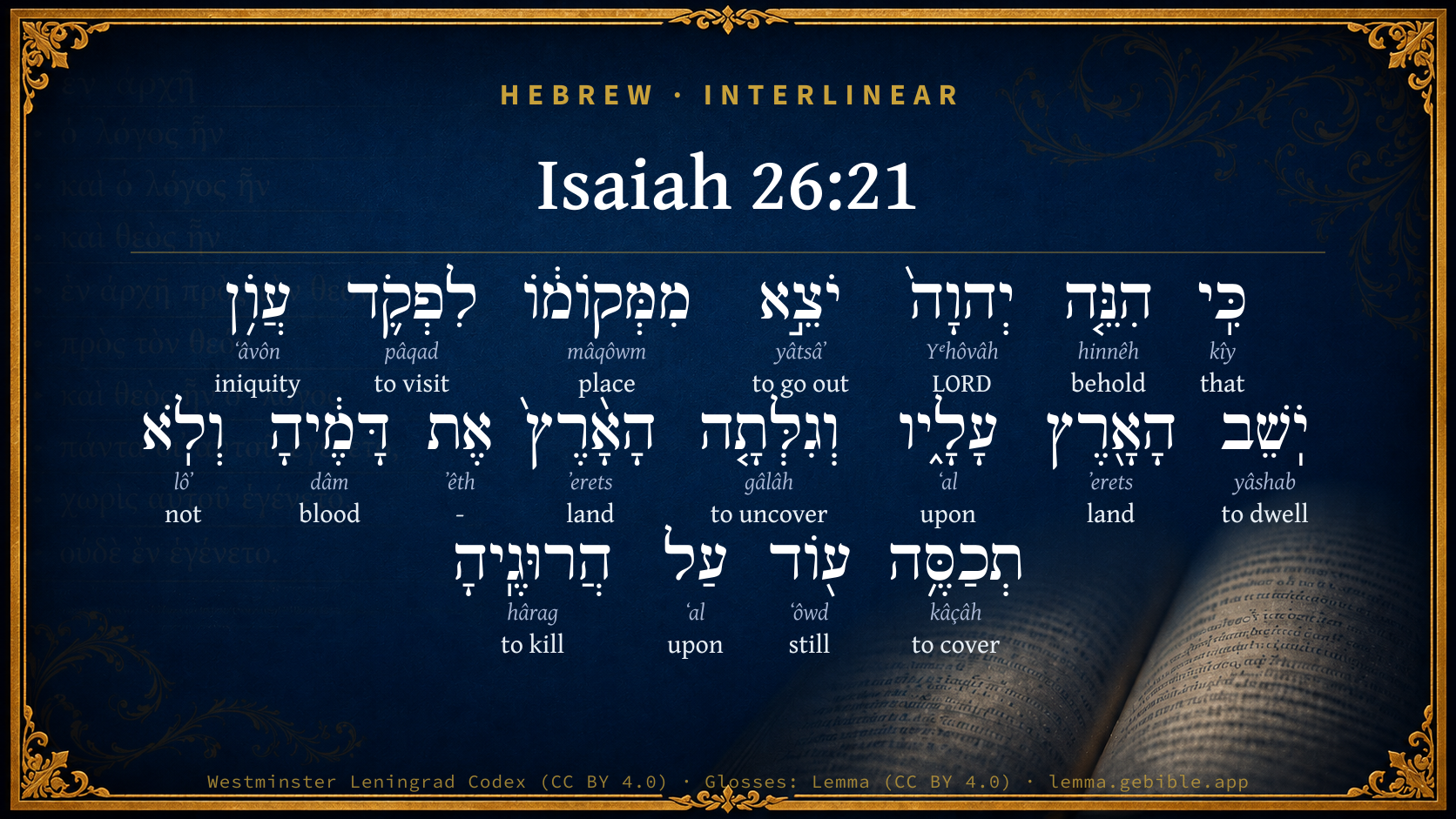
Hebrew (Westminster Leningrad Codex) Isaiah 26:21 appears in the Hebrew Old Testament. The text above is from the Westminster Leningrad Codex. Each word links to its Strong’s number, a concise gloss, and parsing drawn from the Open Scriptures Hebrew Bible morphology. Click any word for its full Brown-Driver-Briggs (BDB) entry.
Download image
Cite this verse

Isaiah 26:21 (World English Bible). Public Domain. Lemma interlinear Bible study tool, https://lemma.gebible.app/v/isaiah/26/21.

Show BibTeX & RIS
BibTeX
RIS
English Translation
For, behold, Yahweh comes forth out of his place to punish the inhabitants of the earth for their iniquity: the earth also shall disclose her blood, and shall no more cover her slain.
World English Bible · Public Domain
Download a study sheet

One document with this verse’s original text, its word-by-word gloss line, the meaning frame, cross-references with their text, attributed commentary, and full source and license credits — printable, and it pastes into notes with its structure intact.

This verse Autodidact and up

Study sheet (.html) Plain text (.txt)

A passage Seminary Student

Up to 50 verses in one chapter. A passage sheet keeps up to 6 commentary sources and 12 cross-references per verse, in the order this page ranks them, and says so on the sheet whenever that leaves anything out. Ask for a single verse and you get the Autodidact verse sheet above.

Everything on this page stays free to read, with no account — the sheet is a download of what is already on screen, not access to it.

Want to remove ads? Support Godless Engineer
Compare translations 3

The same verse in 3 English versions, stacked beneath the original-language interlinear above. Click any original word for its lexicon entry.

Each is an independent rendering of the whole verse — the interlinear is not word-aligned to these translations.

Highlighted words mark where these versions differ — a whole-verse word diff, not a word-by-word alignment.

  • World English Bible Public Domain
    For, behold, Yahweh comes forth out of his place to punish the inhabitants of the earth for their iniquity: the earth also shall disclose her blood, and shall no more cover her slain.
  • King James Version Public Domain
    For, behold, the LORD cometh out of his place to punish the inhabitants of the earth for their iniquity: the earth also shall disclose her blood, and shall no more cover her slain.
  • unfoldingWord Literal Text CC BY-SA 4.0
    For behold Yahweh, coming out from his place to visit the iniquity of the dweller of the earth upon him, and the earth will uncover its blood, and it will no longer cover over its slain.

unfoldingWord Literal Text — © unfoldingWord, licensed CC BY-SA 4.0. Word-aligned USFM3 via Door43 (git.door43.org/unfoldingWord/en_ult).

Versions to compare (up to 4)

3 of 4 selected

Show all 18 translations

Every available English version of this verse, each an independent rendering of the whole verse.

  • World English Bible Public Domain
    For, behold, Yahweh comes forth out of his place to punish the inhabitants of the earth for their iniquity: the earth also shall disclose her blood, and shall no more cover her slain.
  • Berean Standard Bible Public Domain
    For behold, the LORD is coming out of His dwelling to punish the inhabitants of the earth for their iniquity. The earth will reveal her bloodshed and will no longer conceal her slain.
  • Majority Standard Bible Public Domain
    For behold, the LORD is coming out of His dwelling to punish the inhabitants of the earth for their iniquity. The earth will reveal her bloodshed and will no longer conceal her slain.
  • King James Version Public Domain
    For, behold, the LORD cometh out of his place to punish the inhabitants of the earth for their iniquity: the earth also shall disclose her blood, and shall no more cover her slain.
  • American Standard Version (1901) Public Domain
    For, behold, Jehovah cometh forth out of his place to punish the inhabitants of the earth for their iniquity: the earth also shall disclose her blood, and shall no more cover her slain.
  • Revised Version (1885) Public Domain
    For, behold, the LORD cometh forth out of his place to punish the inhabitants of the earth for their iniquity: the earth also shall disclose her blood, and shall no more cover her slain.
  • Geneva Bible (1599) Public Domain
    For lo, the Lord commeth out of his place, to visite the iniquitie of the inhabitants of the earth vpon them: and the earth shall disclose her blood, and shall no more hide her slaine.
  • Douay-Rheims (1899) Public Domain
    For behold the Lord will come out of his place, to visit the iniquity of the inhabitant of the earth against him: and the earth shall disclose her blood, and shall cover her slain no more.
  • Young's Literal Translation Public Domain
    For, lo, Jehovah is coming out of His place, To charge the iniquity of the inhabitant of the earth upon him, And revealed hath the earth her blood, Nor doth she cover any more her slain!'
  • Literal Standard Version CC BY-SA 4.0
    For behold, YHWH is coming out of His place, || To charge the iniquity of the inhabitant of the earth on him, || And the earth has revealed her blood, || Nor does she cover her slain anymore!”
  • Unlocked Literal Bible CC BY-SA 4.0
    For, look, Yahweh is about to come out of his place to punish the inhabitants of the earth for their iniquity; the earth will uncover her bloodshed, and will no longer conceal her slain.
  • unfoldingWord Literal Text CC BY-SA 4.0
    For behold Yahweh, coming out from his place to visit the iniquity of the dweller of the earth upon him, and the earth will uncover its blood, and it will no longer cover over its slain.
  • Darby Bible Public Domain
    For behold, Jehovah cometh out of his place to visit the iniquity of the inhabitants of the earth upon them; and the earth shall disclose her blood, and shall no more cover her slain.
  • World Messianic Bible Public Domain
    For, behold, the LORD comes out of his place to punish the inhabitants of the earth for their iniquity. The earth also will disclose her blood, and will no longer cover her slain.
  • Webster's Bible Public Domain
    For behold, the LORD cometh out of his place to punish the inhabitants of the earth for their iniquity: the earth also shall disclose her blood, and shall no more cover her slain.
  • Free Bible Version CC BY-SA 4.0
    Watch out! The Lord is coming from where he lives to punish the people of the earth for their sins. The earth will reveal the blood that has been shed on it; the earth won't hide those who have been killed any longer.
  • Bible in Basic English Public Domain
    For the Lord is coming out of his place to send punishment on the people of the earth for their evil-doing: the earth will let the blood drained out on her be seen, and will keep her dead covered no longer.
  • JPS Tanakh (1917) Public Domain
    For, behold, the LORD cometh forth out of His place to visit upon the inhabitants of the earth their iniquity; the earth also shall disclose her blood, and shall no more cover her slain.

Literal Standard Version (2020), Covenant Press — licensed CC BY-SA 4.0. Text via the HelloAO Bible API (eBible.org). Unlocked Literal Bible (unfoldingWord) — licensed CC BY-SA 4.0. Text via the HelloAO Bible API (eBible.org). unfoldingWord Literal Text — © unfoldingWord, licensed CC BY-SA 4.0. Word-aligned USFM3 via Door43 (git.door43.org/unfoldingWord/en_ult). Free Bible Version, Dr. Jonathan Gallagher — licensed CC BY-SA 4.0. Text via the HelloAO Bible API (eBible.org).

Word by word

More ways to search: Search by grammar → Find every occurrence → Compare this word →

Practice this passage: Drill this verse → Learn its vocabulary →

תְכַסֶּ֥ה
kâçâh
H3680
“to cover”
Verb, Piel, Imperfect, 3rd Person, Feminine, Singular
Part of Speech
Verb
Stem
Piel
Form
Imperfect
Person
3rd Person
Gender
Feminine
Number
Singular
Full BDB Definition

Origin: a primitive root

TWOT: 1008

to cover, conceal, hide - (Qal) conceal, covered (participle) - (Niphal) to be covered - (Piel) - to cover, clothe - to cover, conceal - to cover (for protection) - to cover over, spread over - to cover, overwhelm - (Pual) - to be covered - to be clothed - (Hithpael) to cover oneself, clothe oneself
  1. כִּֽי kîy H3588 “that” Conjunction
  2. הִנֵּ֤ה hinnêh H2009 “behold” Particle, Demonstrative
  3. יְהוָה֙ Yᵉhôvâh H3068 “LORD” Noun, Proper
  4. יֹצֵ֣א yâtsâʼ H3318 “going out” Verb, Qal, Participle Active, Masculine, Singular, Absolute
  5. מִמְּקוֹמ֔וֹ mâqôwm H4725 “from · place · his” Preposition + Noun, Common, Masculine, Singular, Construct + Suffix, Personal, 3rd Person, Masculine, Singular
  6. לִפְקֹ֛ד pâqad H6485 “to visit” Preposition + Verb, Qal, Infinitive Construct
  7. עֲוֺ֥ן ʻâvôn H5771 “iniquity of” Noun, Common, Both, Singular, Construct
  8. יֹֽשֵׁב yâshab H3427 “dwelling” Verb, Qal, Participle Active, Masculine, Singular, Construct
  9. הָאָ֖רֶץ ʼerets H776 “the · land” Particle, Definite Article + Noun, Common, Both, Singular, Absolute
  10. עָלָ֑יו ʻal H5921 “upon · him” Preposition + Suffix, Personal, 3rd Person, Masculine, Singular
  11. וְגִלְּתָ֤ה gâlâh H1540 “and · to uncover” Conjunction + Verb, Piel, Sequential Perfect, 3rd Person, Feminine, Singular
  12. הָאָ֨רֶץ֙ ʼerets H776 “the · land” Particle, Definite Article + Noun, Common, Both, Singular, Absolute
  13. אֶת ʼêth H853 “-” Particle, Direct Object
  14. דָּמֶ֔יהָ dâm H1818 “blood · her” Noun, Common, Masculine, Plural, Construct + Suffix, Personal, 3rd Person, Feminine, Singular
  15. וְלֹֽא lôʼ H3808 “and · not” Conjunction + Particle, Negative
  16. ע֖וֹד ʻôwd H5750 “still” Adverb
  17. עַל ʻal H5921 “upon” Preposition
  18. הֲרוּגֶֽיהָ hârag H2026 “killed · her” Verb, Qal, Participle Passive, Masculine, Plural, Construct + Suffix, Personal, 3rd Person, Feminine, Singular

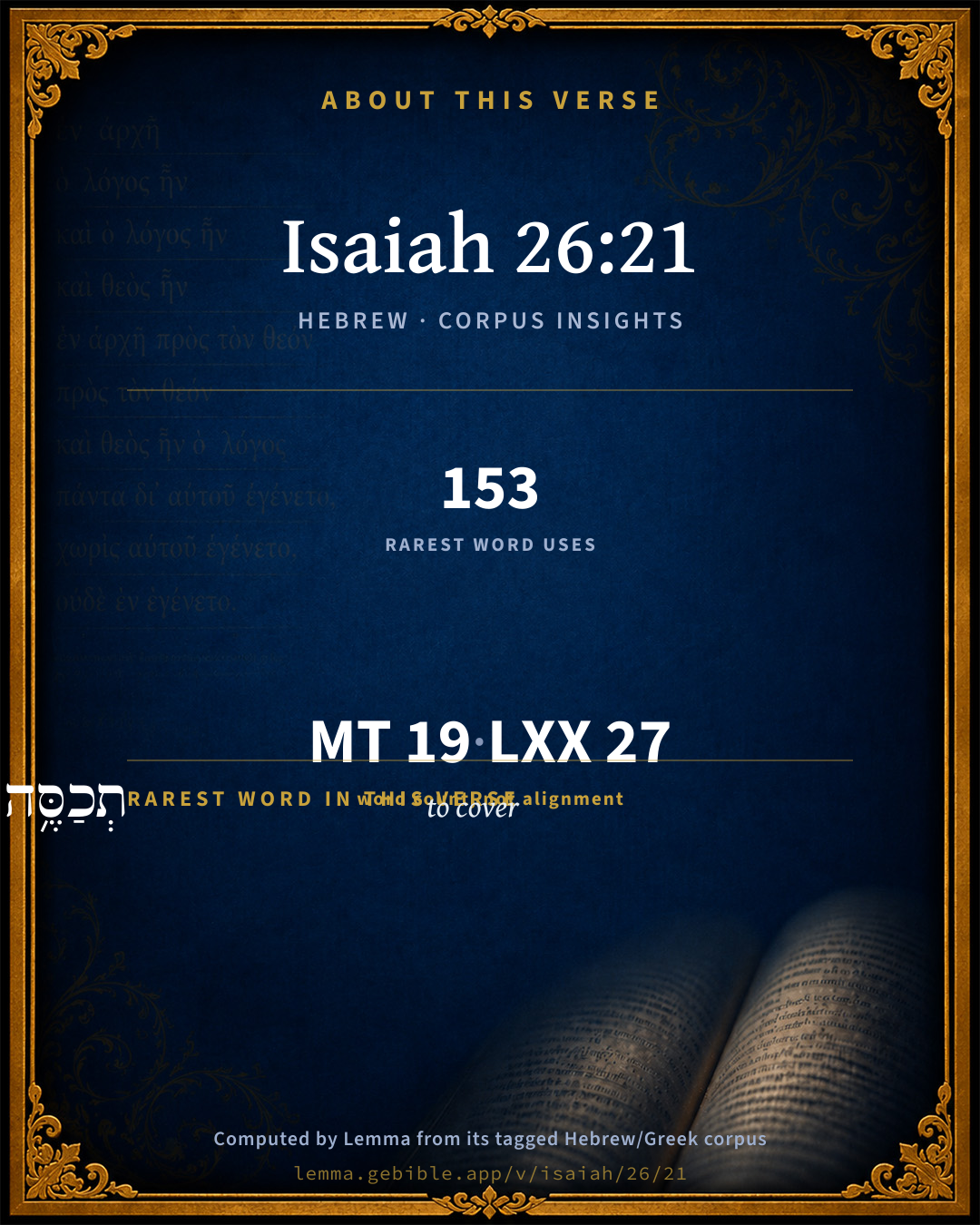
About this verse

These counts appear in no published source. They are computed here, from the morphology-tagged text and Lemma’s own curated glosses. What Lemma adds →

19
words
17
distinct lemmas
Prophets
section

Grammatical profile

  • 6 verbs
  • 6 nouns
  • 2 prepositions
  • 1 conjunction
  • 1 adverb
  • 3 particles

Verb forms

  • יֹצֵ֣א Qal · Participle Active
  • לִפְקֹ֛ד Qal · Infinitive Construct
  • יֹֽשֵׁב Qal · Participle Active
  • וְגִלְּתָ֤ה Piel · Sequential Perfect
  • תְכַסֶּ֥ה Piel · Imperfect
  • הֲרוּגֶֽיהָ Qal · Participle Passive

Repetition

Words recur within this verse — often emphatic in Hebrew:

  • הָאָ֖רֶץ land H776 ×2
  • עָלָ֑יו upon H5921 ×2

Hebrew & Septuagint length

In English translation the verse runs 33 words from the Hebrew and 30 from the Septuagint (LXX English) — closely comparable.

A rough comparison of the two English renderings, which tokenize alike — not a word-level alignment.

Word counts can differ between the Hebrew and the Greek without any difference in meaning — e.g. the Hebrew direct-object marker אֵת has no separate Greek word, and Greek often adds the article ὁ.

In the original languages it is 19 Hebrew tokens and 27 Greek tokens — but the two are counted differently (Hebrew bundles its prefixes and suffixes into one token; the Greek is in lemma form), so that isn’t a like-for-like length.

Cross-references

21

Topical passages linked to Isaiah 26:21 in the Treasury of Scripture Knowledge — connected by theme and wording, ordered by reader-vote popularity; previews shown in the World English Bible.

  • Isaiah 13:11 I will punish the world for [their] evil, and the wicked for their iniquity: and I will cause the arrogance of the proud to cease, and will lay low the haughtiness of the terrible.
  • Jude 1:14–15 About these also Enoch, the seventh from Adam, prophesied, saying, "Behold, the Lord came with ten thousands of his holy ones,
  • Revelation 6:9–11 When he opened the fifth seal, I saw underneath the altar the souls of those who had been killed for the Word of God, and for the testimony of the Lamb which they had.
  • Job 16:18 "Earth, don't cover my blood, Let my cry have no place to rest.
  • Isaiah 18:4 For thus has Yahweh said to me, I will be still, and I will see in my dwelling-place, like clear heat in sunshine, like a cloud of dew in the heat of harvest.
  • Micah 1:3–8 For, behold, Yahweh comes forth out of his place, And will come down and tread on the high places of the earth.
  • Numbers 35:32–33 You shall take no ransom for him who is fled to his city of refuge, that he may come again to dwell in the land, until the death of the priest.
  • Revelation 16:6 For they poured out the blood of the saints and the prophets, and you have given them blood to drink. They deserve this."
  • Genesis 4:10–11 Yahweh said, "What have you done? The voice of your brother's blood cries to me from the ground.
  • Psalms 50:2–3 Out of Zion, the perfection of beauty, God shines forth.
  • Isaiah 30:12–14 Therefore thus says the Holy One of Israel, "Because you despise this word, and trust in oppression and perverseness, and rely thereon;
  • Ezekiel 8:6 He said to me, Son of man, see you what they do? even the great abominations that the house of Israel do commit here, that I should go far off from my sanctuary? but you shall again see yet other great abominations.
  • Ezekiel 9:3–6 The glory of the God of Israel was gone up from the cherub, whereupon it was, to the threshold of the house: and he called to the man clothed in linen, who had the writer's inkhorn by his side.
  • Ezekiel 24:7–8 For her blood is in the midst of her; she set it on the bare rock; she didn't pour it on the ground, to cover it with dust.
  • Luke 11:40 You foolish ones, didn't he who made the outside make the inside also?
  • Luke 11:50 that the blood of all the prophets, which was shed from the foundation of the world, may be required of this generation;
  • 2 Thessalonians 1:7–10 and to give relief to you that are afflicted with us, when the Lord Jesus is revealed from heaven with his mighty angels in flaming fire,
  • Ezekiel 10:3–5 Now the cherubim stood on the right side of the house, when the man went in; and the cloud filled the inner court.
  • Ezekiel 10:18–19 The glory of Yahweh went forth from over the threshold of the house, and stood over the cherubim.
  • Hosea 5:14–15 For I will be to Ephraim like a lion, And like a young lion to the house of Judah. I myself will tear in pieces and go away. I will carry off, and there will be no one to deliver.
  • Revelation 18:24 In her was found the blood of prophets and of saints, and of all who have been slain on the earth."

Cross-references courtesy of OpenBible.info (CC BY 4.0).

Hebrew and Greek witnesses Masoretic Hebrew ↔ Greek Septuagint

The same verse in the two great witnesses to the Old Testament, shown verse-for-verse.

These are two independent witnesses, not word-aligned to each other, and the Septuagint is shown in lemma (dictionary) form.

Hebrew Isaiah 26:21 Masoretic · Westminster Leningrad Codex

כִּֽי הִנֵּ֤ה יְהוָה֙ יֹצֵ֣א מִמְּקוֹמ֔וֹ לִפְקֹ֛ד עֲוֺ֥ן יֹֽשֵׁב הָאָ֖רֶץ עָלָ֑יו וְגִלְּתָ֤ה הָאָ֨רֶץ֙ אֶת דָּמֶ֔יהָ וְלֹֽא תְכַסֶּ֥ה ע֖וֹד עַל הֲרוּגֶֽיהָ

For, behold, Yahweh comes forth out of his place to punish the inhabitants of the earth for their iniquity: the earth also shall disclose her blood, and shall no more cover her slain.

World English Bible · Public Domain

Greek LXX Isaiah 26:21 Septuagint · lemma form

ἰδού γάρ κύριος ἀπό ὁ ἅγιος ἐπιἄγω ὁ ὀργή ἐπί ὁ ἐνοἰκέω ἐπί ὁ γῆ καί ἀνακαλύπτω ὁ γῆ ὁ αἷμα αὐτός καί οὐ κατακαλύπτω ὁ ἀνααἱρέω

For, behold, the Lord is bringing wrath from his holy place upon the dwellers on the earth: the earth also shall disclose her blood, and shall not cover her slain.

LXX2012 (modern English Septuagint) · Public Domain

Hebrew: Westminster Leningrad Codex (CC BY 4.0). Greek: Septuagint (public domain); English from LXX2012 (modern English Septuagint) (Public Domain). How the Septuagint differs from the Hebrew →

Targum (Aramaic paraphrase)

1

The Targum is the ancient Jewish Aramaic paraphrase of the Hebrew Scriptures — an interpretive translation, not the Hebrew text itself. Onkelos (literal) and Pseudo-Jonathan (expansive) render the Torah, and Jonathan the Prophets. Coverage is partial: where no permissively-licensed English translation exists for a verse, only the Aramaic is shown. This is verse-level text, not a word-by-word alignment to the Hebrew.

  1. Targum Jonathan Prophets (Joshua–Malachi)
    אֲרֵי הָא יְיָ מִתְגְלֵי מֵאֲתַר שְׁכִנְתֵּהּ לְאַסְעָרָא חוֹב יָתֵיב אַרְעָא עֲלוֹהִי וּתְגַלֵי אַרְעָא עַל דַם זַכַּאי דְאִתְשֵׁיד בָּהּ וְלָא תְכַסֵי עוֹד עַל קְטִילָהָא:

    For, behold, the Lord is revealing himself from the place of his Shekinah, to punish the inhabitants of the earth for their sins; and the earth shall disclose the innocent blood that was shed in her, and shall no more cover her slain.

    Targum Jonathan — Aramaic: “Mikraot Gedolot” (public domain). English: “Sefaria Community Translation” (CC0 1.0 (public-domain dedication)); “London "Chaldee Paraphrase," 1871” (public domain). Text via Sefaria.

Commentary

Notes on Isaiah 26:21 from classic Christian and Jewish commentators (each source and its license shown beneath its notes). The classic Christian expositions comment on the surrounding passage and are grouped to its opening verse, so a note may address several verses; the Jewish commentaries on the Tanakh (Rashi and others) are per-verse, so they appear only where the commentator wrote on this verse.

Lemma curates 59 commentaries, every one of them public domain or Creative Commons licensed, each selected and text-cleaned for this edition rather than reprinted as found. About our sources →

Trapp's Complete Commentary

John Trapp

Isa 26:21 For, behold, the LORD cometh out of his place to punish the inhabitants of the earth for their iniquity: the earth also shall disclose her blood, and shall no more cover her slain.

Ver. 21. For, behold.] This is as a crier to prepare attention.

The Lord cometh out of his place.] Here God compareth himself to a prince upon his throne, who goeth from his place of state into countries to quiet mutinies and rebellions among his people.

The earth also shall disclose her blood.] Murder shall out; oppression, whether by force or fraud, shall be certainly and severely punished. See Job 16:8. See an instance hereof in leviathan, Isa 27:1. Whether you understand it of the devil, that old man slayer, as many ancients do, or else the kings of the nations, and especially of the Turks, as some Rabbis.

John Trapp, A Commentary or Exposition upon All the Books of the Old and New Testament (1647–1656) — public domain. Text from a community e-Sword module.

The Biblical Illustrator

Joseph S. Exell

Isa_26:21

For, behold, the Lord cometh out of His place

Associations in judgment

1.

Few circumstances of our life are more mysterious and few more important than the influence of associations.

2. The language suggests a subtle sympathy between the earth and the earth born; the earth, it is suggested, has been the reluctant witness of human guilt: within her bosom she holds the memorials of human crime, and in due course, when her Creator summons her to His bar, she will confess her fatal secrets.

3. This notion of the repugnance of nature to human crime underlies the constant association of physical portents and disturbances with exceptional crimes. They strain the tolerance of nature to breaking point; she proclaims her horror. This involuntary association emerges in the record of the Redeemers Passion. The darkest hour that ever dawned on sinful earth was dark naturally, as well as morally.

4. There is something higher than rhetoric, something deeper than poetry, in the prophetic habit of bringing into their moral witness appeals, earnest to the point of passion, to the familiar features of the country. The patriots affection is blended with the mystics sympathy and the seers insight Mic_6:1-2; Jer_22:29; Jos_24:26-27).

5. I have said that there is more in all this than rhetoric and poetry, and my justification lies in the power over men of associations, their origin in human volition, and the witness they are able to bear to mens character and experience. The dramatic language of the prophet conveys, and perhaps, to modern ears, conceals, a truth which we can ill afford to forget. We may express it in this way. Every man is at once the author and the victim of the associations with which he invests material things; so that, if we could know what associations these possess for him, what thoughts they set in motion in his mind, what coercion they exercise upon his will, what appeals they address to his affections, we should be well informed as to his past life, and his present character. In truth, we may judge ourselves, we ought to judge ourselves, by habitual associations. What is the moral furniture of our earthly environment! Be sure it is the faithful reflection of ourselves. To the pure, says St. Paul, all things are pure: but to them that are defiled and unbelieving nothing is pure; but both their mind and their conscience are defiled. The prophet suggests that associations will appear as accusing witnesses in the day of the Lord. Here they are written in cipher, and each man keeps his own key; but then the cipher shall be open and manifest. The origin of associations will be confessed. The earth shall disclose her blood, and shall no more cover her slain. Before us an lies exposure, inexorable and complete.

6. Associations so potent, so relentless, so minatory in their suggestiveness, may be redeemed, cleansed, transformed. The scenes we desecrated with our sins may be purged by our penitence, and reconsecrated by our sacrifice. History records the reclaiming of associations, the transmutation of the symbols and scenes of evil into the very beacons and homes of goodness. But do not underrate the cost of this great conversion. It is no light task to strip off one set of associations and to invest with another. Yet one final stage. Memories of evil may themselves become transmuted into allies of goodness. Christian history is full of this paradox. The protagonists of virtue are, not the flawless saints, but the great penitents. There are who find in their abandoned sins perpetual incitements to service, as she of whom He said, Her sins, which are many, are forgiven; for she loved much: but to whom little is forgiven, the same loveth little. (H. H. Henson, B. D.)

The earth disclosing her blood

In a characteristic passage Lord Macaulay has described the impression made on observers by the rank growth of scarlet poppies on the battlefield of Landen. During many months the ground was strewn with skulls and bones of men and horses, and with fragments of hats and shoes, saddles and holsters. The next summer the soil, fertilised by twenty thousand corpses, broke forth into millions of poppies. The traveller who, on the road from St. Tron to Tirlemont, saw that vast sheet of rich scarlet spreading from Landen to Neerwinden, could hardly help fancying that the figurative prediction of the Hebrew prophet was literally accomplished, that the earth was disclosing her blood, and refusing to cover the slain. (C. H. Spurgeon)

.

The Biblical Illustrator, edited by Joseph S. Exell (c. 1880s–1900s) — public domain. Text from a community e-Sword module.

Tyndale Open Study Notes

Tyndale Open Resources

26:21 The wicked retain power now, but their oppressive rule will end in the day of the Lord’s wrath, when he will punish them for their sins.

Tyndale Open Study Notes — © Tyndale Open Resources, licensed CC BY-SA 4.0. Text via the HelloAO Bible API.

Geneva Bible (1599)

Geneva Bible translators

The earth shall vomit and cast out the innocent blood, which it hath drunk, that it may cry for vengeance against the wicked.

Geneva Bible (1599) marginal notes — public domain. Text via Bolls.life.

Jamieson, Fausset & Brown

Robert Jamieson, A. R. Fausset & David Brown

(Mic 1:3; Jde 1:14).

disclose . . . blood-- (Gen 4:10-11; Job 16:18; Eze 24:7-8). All the innocent blood shed, and all other wrongs done, so long seemingly with impunity, shall then be avenged (Rev 16:6).

At the time when Israel shall be delivered, and the ungodly nations punished, God shall punish also the great enemy of the Church.

Next: Isaiah Chapter 27

Jamieson, Fausset & Brown — Commentary Critical and Explanatory on the Whole Bible (1871) — public domain (CC PDM 1.0). Text via the HelloAO Bible API.

Adam Clarke's Commentary

Verse 21. The earth also shall disclose her blood] Crimes of cruelty and oppression, which have passed away from the eyes of men, God will bring into judgment, and exact punishment for them. O what a reckoning will the kingdoms of the earth have with God, for the torrents of blood which they have shed for the gratification of the lust of power and ambition! Who shall live when he doeth this?

Adam Clarke's Commentary on the Bible (1810–1826) — public domain. Text from a community e-Sword/MySword module.

Ellicott's Commentary for English Readers

(21) The earth also shall disclose her blood.—Literally, her bloods (plural of intensity). The prophet has in his thoughts the reckless destruction of life which characterised the great world-powers of Assyria and Babylon. As in the case of Abel’s blood that cried from the ground (Gen_4:16), so here the earth first brings to light the blood of those that have been slain, and then the forms of the murdered ones themselves.

A Bible Commentary for English Readers, edited by Charles John Ellicott (1878–1897) — public domain. Text from a community e-Sword module.

The Cambridge Bible for Schools and Colleges

gen. ed. J. J. S. Perowne

21. the Lord is coming forth (fut. instans) out of his place] i.e. heaven. Cf. Mic_1:3.

the earth also … blood] Uncovered blood cries for vengeance (Gen_4:11; Eze_24:7-8); and the earth, by drinking in innocent blood, seems to conspire with the murderer, by concealing his guilt. Comp. Job’s impassioned cry in Job_16:18.

shall no more cover her slain] The idea here is the same: the earth will expose the dead bodies as evidence against the persecutors. It is at least doubtful if there is any thought of actual resurrection.

The Cambridge Bible for Schools and Colleges (gen. ed. J. J. S. Perowne; Cambridge University Press, 1878–1918) — public domain. Text from a community e-Sword module.

John Gill's Exposition

For, behold, the Lord cometh out of his place,.... God, as omnipresent, is everywhere, and cannot be properly said to quit one place, and go to another; but as heaven is the seat of his majesty, and where he more manifestly displays his glory, when he is said to do anything remarkable on earth, he is said to come out of his place, and come down thither, Mic 1:3 especially in the exertion of his power and justice, in a way of punishment of sin; which is his act, his strange act; and comes off from his throne of grace and mercy, in which he delights: the allusion is to a king leaving his throne and palace, to go forth against an enemy abroad, or to quell and punish rebellious subjects: some reference may be had to the Lord's dwelling in the temple secretly, in the inward part of it, and coming out from thence in the display of his perfections, as Calvin thinks; with which may be compared Rev 14:15,

to punish the inhabitants of the earth for their iniquity; not the same as in Isa 26:10 for those are distinguished from the Lord's people; but carnal, worldly, and earthly men, particularly the followers of antichrist, called the inhabiters of the earth, who have committed fornication with the whore of Rome, Rev 17:2 these the Lord will punish for their iniquity; for he punishes none but for sin, even for their idolatries, adulteries, sorceries, thefts, and murders, particularly their shedding of innocent blood, as follows; and therefore their punishment will be just, God will remember their iniquities, and retaliate; see Rev 9:20,

the earth also shall disclose her blood, and shall no more cover her slain; when God shall make inquisition for blood, the blood of all his saints and prophets will be found in mystical Babylon, and what was hid and covered, or thought to be so, will now be discerned, and brought to light, and just punishment inflicted for it, Rev 18:24 unless this should rather denote the great effusion of blood and carnage that will be made, so that the earth will not be able to drink it in, and the slain will lie unburied on it; see Rev 11:13. The Targum favours the former sense,

"and the earth shall reveal the innocent blood that is shed on it, and shall no more cover her slain.''

Next: Isaiah Chapter 27

John Gill's Exposition of the Whole Bible (1746–1763) — public domain (CC PDM 1.0). Text via the HelloAO Bible API.

Albert Barnes' Notes on the Bible

For, behold, the Lord cometh out of his place - That is, from heaven, which is the dwelling-place or residence of God Psa 115:3; Eze 3:12; Mic 1:3. When God executes vengeance, he is represented as coming from his abode, his dwelling-place, his capitol, as a monarch goes forth to war to destroy his foes.

To punish the inhabitants of the earth - The land of Chaldea, or of Babylon.

The earth also shall disclose her blood - Blood, in the Scriptures, often denotes “guilt.” The sense here is, that the land of Chaldea would reveal its guilt; that is, the punishment which God would inflict would be a revelation of the crimes of the nation. There is a resemblance here to the language which was used respecting the blood of Abel, Gen 4:10 : ‘The voice of thy brother’s blood (Hebrew as here, “bloods”) crieth unto me from the ground.

And shall no more cover her slain - Shall no more be able to conceal its guilt in slaying the people of God. By these hopes, the Jews were to be comforted in their calamity; and no doubt this song was penned by Isaiah long before that captivity, in order that, in the midst of their protracted and severe trials, they might be consoled with the hope of deliverance, and might know what to do when the storms of war should rage around the place of their captivity, and when the proud city was to fall. They were not to mingle in the strife; were to take no part with either their foes or their deliverers; but were to be calm, gentle, peaceful, and to remember that all this was to effect their deliverance. Compare Exo 14:13-14 : ‘Fear ye not, stand still, and see the salvation of Yahweh; Yahweh shall fight for you, and ye shall hold your peace.’ There are times when the children of God should look calmly on the conflicts of the people of this world. They should mingle with neither party, for they should remember that Yahweh presides over these agitations, and that their ultimate end is to bring deliverance to his church, and to advance the interests of his kingdom on the earth. Then they should be mild, gentle, prayerful; and should look up to God to make all these agitations and strifes the means of advancing the interests of his kingdom.

Albert Barnes' Notes on the Bible (1834–1885) — public domain. Text from a community e-Sword/MySword module.

Haydock's Catholic Bible Commentary

Shall cover her stain no more. This is said with relation to the martyrs, and their happy resurrection. (Challoner) --- The blood of the saints shall demand vengeance. (Calmet)

George Leo Haydock (1774–1849), Haydock's Catholic Family Bible and Commentary, 1859 edition — public domain. Excludes Psalms (Douay-Rheims chapter numbering differs from Protestant) and Deuterocanonical books (Catholic canon only).

Matthew Poole's English Annotations

Cometh out of his place; cometh down from heaven; which God in Scripture is frequently said to do, when he undertaketh any great and glorious work, either of delivering his people, or of destroying their enemies. The speech is borrowed from the manner of princes, who come out of their palaces either to sit in judgment, or to fight against their enemies, which is the case here.

The inhabitants of the earth; all the enemies of God and of his people; for these are here opposed to God’s people. Therefore take heed you be not found in the number of them.

The earth also shall disclose her blood, and shall no more cover her slain; the innocent blood which hath been spilled upon the earth shall be brought to light, and shall be severely revenged upon the murderers. For the phrase, see on Gen 4:10; Job 16:18; Eze 24:7.

Matthew Poole's English Annotations on the Holy Bible (1683–1685) — public domain. Text from a community e-Sword/MySword module.

Whedon's Commentary on the Bible

Daniel D. Whedon

21. Out of his place — The Hebrew idea of God’s residence, namely, the heavens; an idea simple, childlike, unmetaphysical as to the divine infinitude.

Inhabitants of the earth — Such were the people of the lands, belonging to the great world-powers, accounted — the people of Chaldea.

Blood — Guilt is here meant — guilt for the shedding the blood of the righteous. See Gen_4:10.

Cover her slain — The same idea expanded. They shall no more conceal their guilt for shedding righteous blood.

The people of God are ever avenged for wrongs done them. See Exo_14:13-14. “Fear ye not, stand still, and see the salvation of Jehovah. Jehovah shall fight for you and ye shall hold your peace.”

Daniel D. Whedon (gen. ed.), Commentary on the Old and New Testaments (1874–1909) — public domain. Text from a community e-Sword module.

The Pulpit Commentary

The Lord cometh out of his place. (comp. Mic_1:3) In the Psalms God is represented as "bowing the heavens and coming down," bringing them, as it were, with him. Here (and in Micah) he quits his place in heaven, as a king quits his own country when he proceeds to take vengeance on rebels in another. The expressions are, both of them, accommodations to human modes of thought. To punish the inhabitants of the earth for their iniquity; literally, to visit the iniquity of the inhabitant of the earth upon him. The earth also shall disclose her blood; literally, her bloods; i.e. her bloodsheddings; the many murders committed by man upon her surface. Isaiah denounced "murderers" in his first chapter (ver. 27). Manasseh"s murders were the main cause of the first destruction of Jerusalem. (2Ki_24:4) The second destruction was equally a judgment for the innocent blood that had been shed upon the earth, "from the blood of righteous Abel unto the blood of Zacharias son of Bars-chins". (Mat_23:35) Bloodshed "cries to God for vengeance", (Gen_4:10) and will be one of the main causes of the world"s final destruction. (Rev_16:6 Rev_18:20) And shall no more cover her slain. "There is nothing covered that shall not" in the last day "be revealed, and hid that shall not be known". (Mat_10:26) Every murder, however secret, will be brought to light, and every murderer, however unsuspected previously, denounced and punished.

The Pulpit Commentary (1880–1919), ed. H.D.M. Spence-Jones & Joseph S. Exell — public domain. Text from a community e-Sword module.

John Wesley's Explanatory Notes

Cometh - Cometh down from heaven. To punish - All the enemies of God, and of his people. Her slain - The innocent blood which hath been spilled upon the earth shall be brought to light, and severely revenged upon the murderers.

John Wesley, Explanatory Notes Upon the Whole Bible (1754–1765) — public domain. Text via the GEBible commentary corpus.

J. A. Alexander on Isaiah

Joseph Addison Alexander

“For behold, Jehovah (is) coming out of His place, to visit the iniquity of the inhabitant of the earth upon him, and the earth shall disclose her blood, and shall no more cover her slain.” This is a reason both for expecting ultimate deliverance and for patiently awaiting it. The reason is that God has a work of chastisement to finish, first upon His own people, and then upon their enemies. During the former process, let the faithful hide themselves until the wrath be past. When the other begins, let them lift up their heads, for their redemption draweth nigh. This large interpretation of the verse is altogether natural and more satisfactory than those which restrict it either to the judgments upon Israel or to those upon Babylon. On the latter the eye of the Prophet chiefly rests, especially at last, so that the closing words may be applied almost exclusively to the retribution which awaited the Chaldean for the slaughter of God’s people. The blood, which the earth had long since drunk in, should as it were be vomited up, and the bodies of the murdered, which had long been buried, should be now disclosed to view.

Joseph Addison Alexander, The Prophecies of Isaiah (1846–1847; New York: Scribner, 1870–1878) — public domain. Text from a community e-Sword module.

Rashi

Rabbi Shlomo Yitzchaki (Rashi)

For behold the Lord comes forth from the divine standard of mercy to the divine standard of justice.

the dweller of the land That is Mount Seir. ([Some manuscripts read:] That is Esau and Mount Seir.) ([Others read:] That is Esau on Mount Seir.)

its slain ones that they slew of Israel.

Rashi on the Tanakh — English translations: “The Judaica Press complete Tanach with Rashi, translated by A. J. Rosenberg” (CC BY 4.0); “Pentateuch with Rashi's commentary by M. Rosenbaum and A.M. Silbermann, 1929-1934” (public domain); “The Metsudah Tanach series, Lakewood, N.J” (CC BY 4.0); and “The Book of Joshua, Metsudah Publications, 1997” (CC BY 4.0). Text via Sefaria.

Ibn Ezra

Rabbi Abraham ibn Ezra

The Lord cometh out. The decrees of the Lord come out.

Her blood. The slain, that are buried in the earth.

Ibn Ezra on the Tanakh — English translations: “Sefaria Community Translation” (CC0 1.0 (public-domain dedication)); “Yalkut, Sifsei Chachomim Chumash, Metsudah Publications, 2009” (CC BY 4.0); and “Commentary of Ibn Ezra on Isaiah - trans. by M. Friedlander, 1873” (public domain). Text via Sefaria.

Lesson kit

Teaching starters — assembled from the data on this page, not authored interpretation. Every prompt links to the verse data it draws on. Edit before teaching.

Isaiah, in the Prophets, opens this verse with 19 words (17 distinct Hebrew lemmas). Its most distinctive word is kâçâh (“to cover”). A historical commentator’s framing appears above. Read the whole chapter for the surrounding context.

Discussion questions

  1. What does “to cover” (kâçâh) contribute to the verse as a whole?
  2. Isaiah 13:11 shares this passage’s theme. How do the two illuminate each other?
  3. “land” occurs 2× in this one verse. What is the effect of the repetition?
  4. These translations render this verse differently; the difference is in the English rendering, not the original. What questions does that raise?
  5. The verb «יֹצֵ֣א» is Qal Participle Active. How does its form color the action?
  6. Reading how Trapp's Complete Commentary and The Biblical Illustrator read this verse, where do the two commentators agree and where do they part?

Things to notice

Reading settings

Reading text

Shown beneath each verse's original-language words.

Old Testament
Old Testament edition

Read the OT as the Masoretic Hebrew (MT) or the Greek Septuagint (LXX).

English shown for the Greek Septuagint (in the Hebrew ↔ Greek comparison).

Comparing translations? Open the Compare panel on any verse page to stack up to four side by side.