
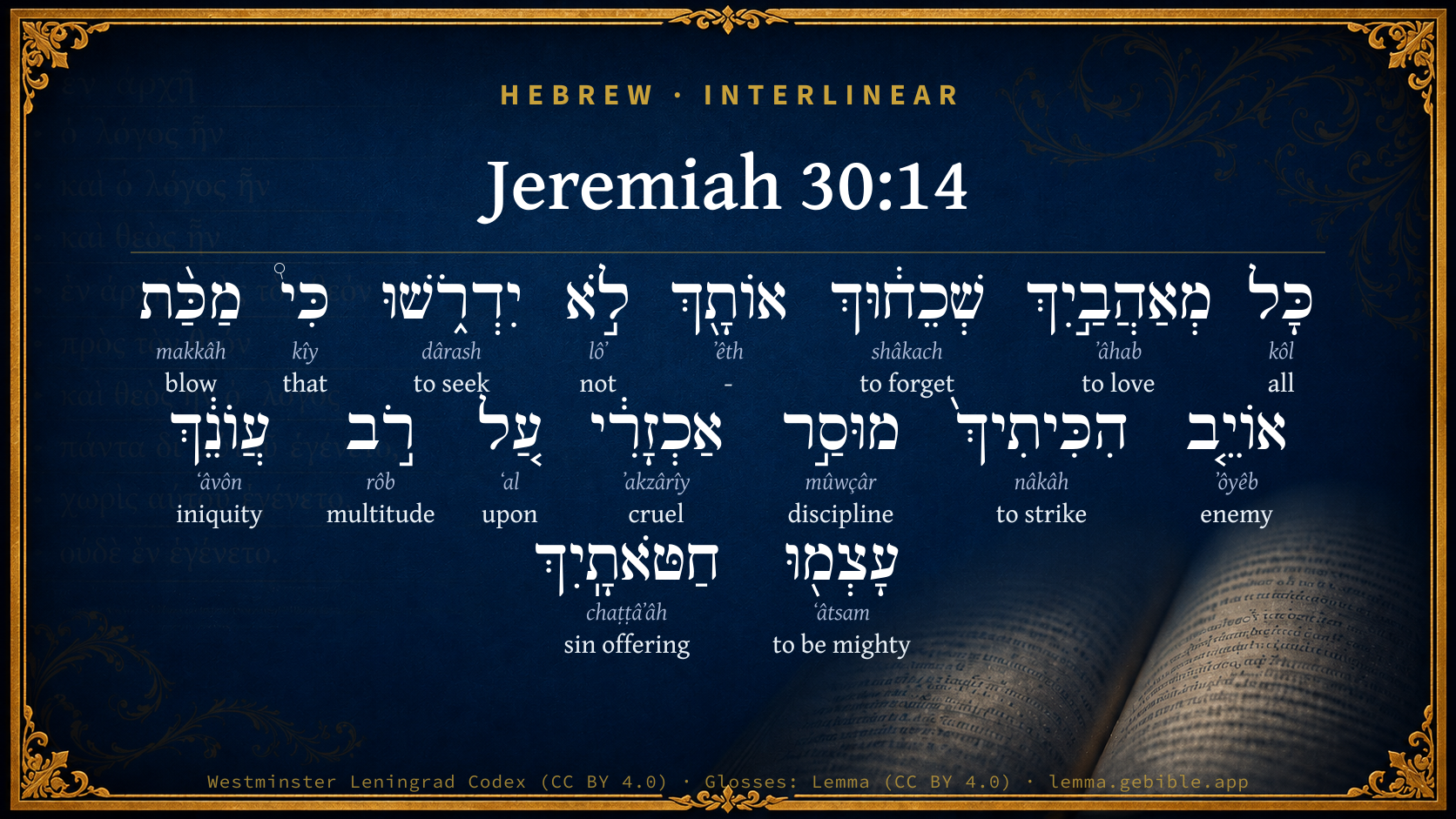
Jeremiah 30:14

Hebrew (Westminster Leningrad Codex) Jeremiah 30:14 appears in the Hebrew Old Testament. The text above is from the Westminster Leningrad Codex. Each word links to its Strong’s number, a concise gloss, and parsing drawn from the Open Scriptures Hebrew Bible morphology. Click any word for its full Brown-Driver-Briggs (BDB) entry.
Download image
Cite this verse

Jeremiah 30:14 (World English Bible). Public Domain. Lemma interlinear Bible study tool, https://lemma.gebible.app/v/jeremiah/30/14.

Show BibTeX & RIS
BibTeX
RIS
English Translation
All your lovers have forgotten you; they don't seek you: for I have wounded you with the wound of an enemy, with the chastisement of a cruel one, for the greatness of your iniquity, because your sins were increased.
World English Bible · Public Domain
Download a study sheet

One document with this verse’s original text, its word-by-word gloss line, the meaning frame, cross-references with their text, attributed commentary, and full source and license credits — printable, and it pastes into notes with its structure intact.

This verse Autodidact and up

Study sheet (.html) Plain text (.txt)

A passage Seminary Student

Up to 50 verses in one chapter. A passage sheet keeps up to 6 commentary sources and 12 cross-references per verse, in the order this page ranks them, and says so on the sheet whenever that leaves anything out. Ask for a single verse and you get the Autodidact verse sheet above.

Everything on this page stays free to read, with no account — the sheet is a download of what is already on screen, not access to it.

Want to remove ads? Support Godless Engineer
Compare translations 3

The same verse in 3 English versions, stacked beneath the original-language interlinear above. Click any original word for its lexicon entry.

Each is an independent rendering of the whole verse — the interlinear is not word-aligned to these translations.

Highlighted words mark where these versions differ — a whole-verse word diff, not a word-by-word alignment.

  • World English Bible Public Domain
    All your lovers have forgotten you; they don't seek you: for I have wounded you with the wound of an enemy, with the chastisement of a cruel one, for the greatness of your iniquity, because your sins were increased.
  • King James Version Public Domain
    All thy lovers have forgotten thee; they seek thee not; for I have wounded thee with the wound of an enemy, with the chastisement of a cruel one, for the multitude of thine iniquity; because thy sins were increased.
  • unfoldingWord Literal Text CC BY-SA 4.0
    All of your lovers have forgotten you. They will not look for you, for I have wounded you with the wound of an enemy and the discipline of a cruel master because of your many iniquities and your innumerable sins.

unfoldingWord Literal Text — © unfoldingWord, licensed CC BY-SA 4.0. Word-aligned USFM3 via Door43 (git.door43.org/unfoldingWord/en_ult).

Versions to compare (up to 4)

3 of 4 selected

Show all 18 translations

Every available English version of this verse, each an independent rendering of the whole verse.

  • World English Bible Public Domain
    All your lovers have forgotten you; they don't seek you: for I have wounded you with the wound of an enemy, with the chastisement of a cruel one, for the greatness of your iniquity, because your sins were increased.
  • Berean Standard Bible Public Domain
    All your lovers have forgotten you; they no longer seek you, for I have struck you as an enemy would, with the discipline of someone cruel, because of your great iniquity and your numerous sins.
  • Majority Standard Bible Public Domain
    All your lovers have forgotten you; they no longer seek you, for I have struck you as an enemy would, with the discipline of someone cruel, because of your great iniquity and your numerous sins.
  • King James Version Public Domain
    All thy lovers have forgotten thee; they seek thee not; for I have wounded thee with the wound of an enemy, with the chastisement of a cruel one, for the multitude of thine iniquity; because thy sins were increased.
  • American Standard Version (1901) Public Domain
    All thy lovers have forgotten thee; they seek thee not: for I have wounded thee with the wound of an enemy, with the chastisement of a cruel one, for the greatness of thine iniquity, because thy sins were increased.
  • Revised Version (1885) Public Domain
    All thy lovers have forgotten thee; they seek thee not: for I have wounded thee with the wound of an enemy, with the chastisement of a cruel one; for the greatness of thine iniquity, because thy sins were increased.
  • Geneva Bible (1599) Public Domain
    All thy louers haue forgotten thee: they seeke thee not: for I haue striken thee with the wound of an enemie, and with a sharpe chastisement for ye multitude of thine iniquities, because thy sinnes were increased.
  • Douay-Rheims (1899) Public Domain
    All thy lovers have forgotten thee, and will not seek after thee: for I have wounded thee with the wound of an enemy, with a cruel chastisement: by reason of the multitude of thy iniquities, thy sins are hardened.
  • Young's Literal Translation Public Domain
    all loving thee have forgotten thee, Thee they do not seek, For with the stroke of an enemy I smote thee, The chastisement of a fierce one, Because of the abundance of thy iniquity, Mighty have been thy sins!
  • Literal Standard Version CC BY-SA 4.0
    All loving you have forgotten you, || They do not seek you, || For I struck you with the stroke of an enemy, || The discipline of a fierce one, || Because of the abundance of your iniquity, your sins have been mighty!
  • Unlocked Literal Bible CC BY-SA 4.0
    All of your lovers have forgotten you. They will not look for you, for I have wounded you with the wound of an enemy and the discipline of a cruel master because of your many iniquities and your innumerable sins.
  • unfoldingWord Literal Text CC BY-SA 4.0
    All of your lovers have forgotten you. They will not look for you, for I have wounded you with the wound of an enemy and the discipline of a cruel master because of your many iniquities and your innumerable sins.
  • Darby Bible Public Domain
    All thy lovers have forgotten thee; they seek thee not. For I have smitten thee with the stroke of an enemy, with the chastisement of a cruel one, for the greatness of thine iniquity: thy sins are manifold.
  • World Messianic Bible Public Domain
    All your lovers have forgotten you. They don’t seek you. For I have wounded you with the wound of an enemy, with the chastisement of a cruel one, for the greatness of your iniquity, because your sins were increased.
  • Webster's Bible Public Domain
    All thy lovers have forgotten thee; they seek thee not; for I have wounded thee with the wound of an enemy, with the chastisements of a cruel one, for the multitude of thy iniquity; because thy sins were increased.
  • Free Bible Version CC BY-SA 4.0
    All your lovers have forgotten about you; they don't bother looking for you anymore, because I have beaten you as if I were your enemy, the discipline of a cruel person, because of how wicked you are, because of your many sins.
  • Bible in Basic English Public Domain
    Your lovers have no more thought for you, they go after you no longer; for I have given you the wound of a hater, even cruel punishment;
  • JPS Tanakh (1917) Public Domain
    All thy lovers have forgotten thee, they seek thee not; for I have wounded thee with the wound of an enemy, with the chastisement of a cruel one; for the greatness of thine iniquity, because thy sins were increased.

Literal Standard Version (2020), Covenant Press — licensed CC BY-SA 4.0. Text via the HelloAO Bible API (eBible.org). Unlocked Literal Bible (unfoldingWord) — licensed CC BY-SA 4.0. Text via the HelloAO Bible API (eBible.org). unfoldingWord Literal Text — © unfoldingWord, licensed CC BY-SA 4.0. Word-aligned USFM3 via Door43 (git.door43.org/unfoldingWord/en_ult). Free Bible Version, Dr. Jonathan Gallagher — licensed CC BY-SA 4.0. Text via the HelloAO Bible API (eBible.org).

Word by word

More ways to search: Search by grammar → Find every occurrence → Compare this word →

Practice this passage: Drill this verse → Learn its vocabulary →

אַכְזָרִ֔י
ʼakzârîy
H394
“cruel”
Adjective, Adjective, Masculine, Singular, Absolute
Part of Speech
Adjective
Type
Adjective
Gender
Masculine
Number
Singular
State
Absolute
Full BDB Definition

Origin: from H393

TWOT: 971b

cruel
  1. כָּל kôl H3605 “all of” Noun, Common, Masculine, Singular, Construct
  2. מְאַהֲבַ֣יִךְ ʼâhab H157 “loving · you” Verb, Piel, Participle Active, Masculine, Plural, Construct + Suffix, Personal, 2nd Person, Feminine, Singular
  3. שְׁכֵח֔וּךְ shâkach H7911 “to forget · you” Verb, Qal, Perfect, 3rd Person, Common, Plural + Suffix, Personal, 2nd Person, Feminine, Singular
  4. אוֹתָ֖ךְ ʼêth H853 “- · you” Particle, Direct Object + Suffix, Personal, 2nd Person, Feminine, Singular
  5. לֹ֣א lôʼ H3808 “not” Particle, Negative
  6. יִדְרֹ֑שׁוּ dârash H1875 “to seek” Verb, Qal, Imperfect, 3rd Person, Masculine, Plural
  7. כִּי֩ kîy H3588 “that” Conjunction
  8. מַכַּ֨ת makkâh H4347 “blow of” Noun, Common, Feminine, Singular, Construct
  9. אוֹיֵ֤ב ʼôyêb H341 “enemy” Verb, Qal, Participle Active, Masculine, Singular, Absolute
  10. הִכִּיתִיךְ֙ nâkâh H5221 “to strike · you” Verb, Hiphil, Perfect, 1st Person, Common, Singular + Suffix, Personal, 2nd Person, Feminine, Singular
  11. מוּסַ֣ר mûwçâr H4148 “discipline of” Noun, Common, Masculine, Singular, Construct
  12. עַ֚ל ʻal H5921 “upon” Preposition
  13. רֹ֣ב rôb H7230 “multitude of” Noun, Common, Both, Singular, Construct
  14. עֲוֺנֵ֔ךְ ʻâvôn H5771 “iniquity · your” Noun, Common, Both, Singular, Construct + Suffix, Personal, 2nd Person, Feminine, Singular
  15. עָצְמ֖וּ ʻâtsam H6105 “to be mighty” Verb, Qal, Perfect, 3rd Person, Common, Plural
  16. חַטֹּאתָֽיִךְ chaṭṭâʼâh H2403 “sin offerings · your” Noun, Common, Feminine, Plural, Construct + Suffix, Personal, 2nd Person, Feminine, Singular

About this verse

These counts appear in no published source. They are computed here, from the morphology-tagged text and Lemma’s own curated glosses. What Lemma adds →

17
words
17
distinct lemmas
Prophets
section

Notable vocabulary

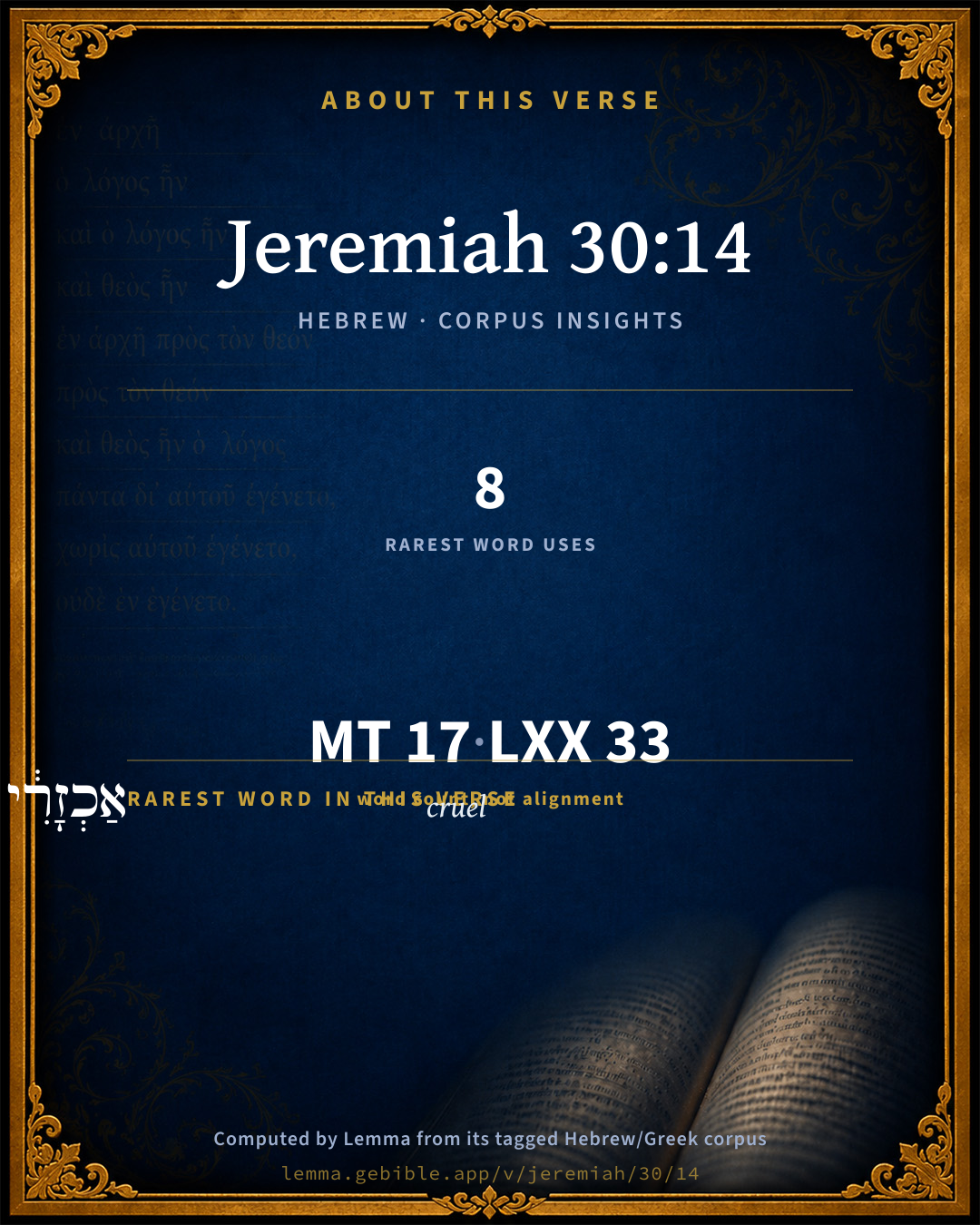
The rarest word here is אַכְזָרִ֔י cruel H394 — appearing just 8 times in the whole Hebrew Bible.

Shared distinctive vocabulary

אַכְזָרִ֔י cruel H394 occurs in 8 verses of the Hebrew Bible. Also found in:

Grammatical profile

  • 6 verbs
  • 6 nouns
  • 1 adjective
  • 1 preposition
  • 1 conjunction
  • 2 particles

Verb forms

  • מְאַהֲבַ֣יִךְ Piel · Participle Active
  • שְׁכֵח֔וּךְ Qal · Perfect
  • יִדְרֹ֑שׁוּ Qal · Imperfect
  • אוֹיֵ֤ב Qal · Participle Active
  • הִכִּיתִיךְ֙ Hiphil · Perfect
  • עָצְמ֖וּ Qal · Perfect

Hebrew & Septuagint length

In the original languages it is 17 Hebrew tokens and 33 Greek tokens — but the two are counted differently (Hebrew bundles its prefixes and suffixes into one token; the Greek is in lemma form), so that isn’t a like-for-like length.

Cross-references

23

Topical passages linked to Jeremiah 30:14 in the Treasury of Scripture Knowledge — connected by theme and wording, ordered by reader-vote popularity; previews shown in the World English Bible.

  • Job 30:21 You have turned to be cruel to me. With the might of your hand you persecute me.
  • Jeremiah 5:6 Therefore a lion out of the forest shall kill them, a wolf of the evenings shall destroy them, a leopard shall watch against their cities; everyone who goes out there shall be torn in pieces; because their transgressions are many, [and] their backsliding is increased.
  • Lamentations 1:2 She weeps sore in the night, and her tears are on her cheeks; Among all her lovers she has none to comfort her: All her friends have dealt treacherously with her; they are become her enemies.
  • Jeremiah 22:20 Go up to Lebanon, and cry; and lift up your voice in Bashan, and cry from Abarim; for all your lovers are destroyed.
  • Job 19:11 He has also kindled his wrath against me. He counts me among his adversaries.
  • Jeremiah 2:36 Why go you about so much to change your way? you shall be ashamed of Egypt also, as you were ashamed of Assyria.
  • Jeremiah 4:30 You, when you are made desolate, what will you do? Though you clothe yourself with scarlet, though you deck you with ornaments of gold, though you enlarge your eyes with paint, in vain do you make yourself beautiful; [your] lovers despise you, they seek your life.
  • Jeremiah 22:22 The wind shall feed all your shepherds, and your lovers shall go into captivity: surely then shall you be ashamed and confounded for all your wickedness.
  • Jeremiah 30:15 Why cry you for your hurt? your pain is incurable: for the greatness of your iniquity, because your sins were increased, I have done these things to you.
  • Job 13:24–28 Why hide you your face, And hold me for your enemy?
  • Job 16:9 He has torn me in his wrath, and persecuted me; He has gnashed on me with his teeth: My adversary sharpens his eyes on me.
  • Jeremiah 6:23 They lay hold on bow and spear; they are cruel, and have no mercy; their voice roars like the sea, and they ride on horses, everyone set in array, as a man to the battle, against you, daughter of Zion.
  • Jeremiah 38:22 behold, all the women who are left in the king of Judah's house shall be brought forth to the king of Babylon's princes, and those women shall say, Your familiar friends have set you on, and have prevailed over you: [now that] your feet are sunk in the mire, they are turned away back.
  • Lamentations 1:19 I called for my lovers, [but] they deceived me: My priests and my elders gave up the spirit in the city, While they sought them food to refresh their souls.
  • Lamentations 2:4–5 He has bent his bow like an enemy, he has stood with his right hand as an adversary, Has killed all that were pleasant to the eye: In the tent of the daughter of Zion he has poured out his wrath like fire.
  • Ezekiel 9:8–10 It happened, while they were smiting, and I was left, that I fell on my face, and cried, and said, Ah Lord Yahweh! will you destroy all the residue of Israel in your pouring out of your wrath on Jerusalem?
  • Ezekiel 23:9 Therefore I delivered her into the hand of her lovers, into the hand of the Assyrians, on whom she doted.
  • Ezekiel 23:22 Therefore, Oholibah, thus says the Lord Yahweh: Behold, I will raise up your lovers against you, from whom your soul is alienated, and I will bring them against you on every side:
  • Hosea 2:5 For their mother has played the prostitute. She who conceived them has done shamefully; For she said, 'I will go after my lovers, Who give me my bread and my water, My wool and my flax, My oil and my drink.'
  • Hosea 2:10–16 Now I will uncover her lewdness in the sight of her lovers, And no one will deliver her out of my hand.
  • Hosea 5:14 For I will be to Ephraim like a lion, And like a young lion to the house of Judah. I myself will tear in pieces and go away. I will carry off, and there will be no one to deliver.
  • Revelation 17:12–18 The ten horns that you saw are ten kings who have received no kingdom as yet, but they receive authority as kings, with the beast, for one hour.
  • Psalms 90:7–8 For we are consumed in your anger. We are troubled in your wrath.

Cross-references courtesy of OpenBible.info (CC BY 4.0).

Hebrew and Greek witnesses Masoretic Hebrew ↔ Greek Septuagint

The same verse in the two great witnesses to the Old Testament, shown verse-for-verse.

These are two independent witnesses, not word-aligned to each other, and the Septuagint is shown in lemma (dictionary) form.

Hebrew Jeremiah 30:14 Masoretic · Westminster Leningrad Codex

כָּל מְאַהֲבַ֣יִךְ שְׁכֵח֔וּךְ אוֹתָ֖ךְ לֹ֣א יִדְרֹ֑שׁוּ כִּי֩ מַכַּ֨ת אוֹיֵ֤ב הִכִּיתִיךְ֙ מוּסַ֣ר אַכְזָרִ֔י עַ֚ל רֹ֣ב עֲוֺנֵ֔ךְ עָצְמ֖וּ חַטֹּאתָֽיִךְ

All your lovers have forgotten you; they don't seek you: for I have wounded you with the wound of an enemy, with the chastisement of a cruel one, for the greatness of your iniquity, because your sins were increased.

World English Bible · Public Domain

Greek LXX Structure differs

In the Septuagint, Jeremiah is about an eighth shorter than the Hebrew and arranges its material differently — the Oracles Against the Nations (Hebrew chapters 46–51) appear in the middle of the Greek book, after 25:13. Because the chapter and verse boundaries do not line up, a verse-for-verse comparison with the Hebrew is not shown.

A verse-for-verse comparison isn’t shown here because the chapters and verses don’t line up. Switch to the LXX edition with the MT / LXX toggle above to read the Greek directly.

Hebrew: Westminster Leningrad Codex (CC BY 4.0). Greek: Septuagint (public domain); English from a public-domain English Septuagint. How the Septuagint differs from the Hebrew →

Targum (Aramaic paraphrase)

1

The Targum is the ancient Jewish Aramaic paraphrase of the Hebrew Scriptures — an interpretive translation, not the Hebrew text itself. Onkelos (literal) and Pseudo-Jonathan (expansive) render the Torah, and Jonathan the Prophets. Coverage is partial: where no permissively-licensed English translation exists for a verse, only the Aramaic is shown. This is verse-level text, not a word-by-word alignment to the Hebrew.

  1. Targum Jonathan Prophets (Joshua–Malachi)
    כָּל רַחֲמִיךְ אַנְשִׁיוּךְ מִשְׁאַל בִּשְׁלָמָךְ לָא תְבָעוּ אֲרֵי מְחַת סָנְאָה אַלְקֵיתִיךְ יִסוּר אַכְזְרָאִין עַל דִסְגִיאוּ חוֹבַיִךְ תַּקִיפֵי חַטְאָיִךְ:

    (no public-domain English translation for this verse)

    Targum Jonathan — Aramaic: “Mikraot Gedolot” (public domain). English: “Sefaria Community Translation” (CC0 1.0 (public-domain dedication)); “London "Chaldee Paraphrase," 1871” (public domain). Text via Sefaria.

Commentary

Notes on Jeremiah 30:14 from classic Christian and Jewish commentators (each source and its license shown beneath its notes). The classic Christian expositions comment on the surrounding passage and are grouped to its opening verse, so a note may address several verses; the Jewish commentaries on the Tanakh (Rashi and others) are per-verse, so they appear only where the commentator wrote on this verse.

Lemma curates 59 commentaries, every one of them public domain or Creative Commons licensed, each selected and text-cleaned for this edition rather than reprinted as found. About our sources →

Trapp's Complete Commentary

John Trapp

Jer 30:14 All thy lovers have forgotten thee; they seek thee not; for I have wounded thee with the wound of an enemy, with the chastisement of a cruel one, for the multitude of thine iniquity; [because] thy sins were increased.

Ver. 14. All thy lovers have forgotten thee.] Thy sweethearts, thine idols, thy carnal friends, thy priests, prophets, riches, pleasures, all these have given thee the bag, as we say; they stand aloof from thy help.

They seek thee not.] Sink thou mayest, or swim, for them; thou art no part of their care.

For I have wounded thee with the wound of an enemy.] As if I cared not where I hit thee, or how much I hurt thee.

With the chastisement of a cruel one.] So it may seem, and so Job thought; {Job 30:21} but that was his error. See here what a pass a saint may be at, and how deeply he may suffer, when his sins are increased. God, out of love displeased, may lay upon him and not spare, leave bloody wales on his back, &c. Crudelem medicum intemperans aeger facit.

For the multitude of thine iniquities.] Because thy sins are many and mighty, or bony. See Amo 5:12. {See Trapp on "Amo 5:12"}

John Trapp, A Commentary or Exposition upon All the Books of the Old and New Testament (1647–1656) — public domain. Text from a community e-Sword module.

Jamieson, Fausset & Brown

Robert Jamieson, A. R. Fausset & David Brown

lovers--the peoples formerly allied to thee, Assyria and Egypt (compare Lam 1:2).

seek thee not--have cast away all concern for thee in thy distress.

wound of an enemy--a wound such as an enemy would inflict. God condescends to employ language adapted to human conceptions. He is incapable of "enmity" or "cruelty"; it was their grievous sin which righteously demanded a grievous punishment, as though He were an "enemy" (Jer 5:6; Job 13:24; Job 30:21).

Jamieson, Fausset & Brown — Commentary Critical and Explanatory on the Whole Bible (1871) — public domain (CC PDM 1.0). Text via the HelloAO Bible API.

John Calvin's Commentaries

The Prophet again repeats, that nothing remained for Israel as coming from men, for no one offered to bring help. Some, indeed, explain the words as though the Prophet had said, that friends, as it is usually the case, concealed themselves through shame on seeing the condition of the people hopeless: for as long as friends can relieve the sick, they are ready at hand, and anxiously exert themselves, but when life is despaired of, they no longer appear. But the Prophet, I have no doubt, condemns here the Jews for the false confidence with which they had been long fascinated; for we know, that at one time they placed hope in the Egyptians; at another in the Assyrians; and thus it happened that they brought on themselves many calamities. And we have seen elsewhere, in many passages, that these confederacies are compared to impure lusts; for when the people sought at one time the friendship of the Egyptians, at another, that of the Assyrians, it was a kind of adultery. God had taken the Jews under his care and protection; but unbelief led them astray, so that. they sought to strengthen themselves by the aid of others. Hence, everywhere in the Prophets the Egyptians and the Assyrians are compared to lovers. And this view will suit well here; for it was not enough to point out the miseries of the people, without making known the cause of them.

Then the Prophet refers to those false counsels which the Jews had adopted, when they thought themselves secure and safe while the Egyptians, or the Assyrians, or the Chaldeans were favorable to them. For this reason he says, that all their friends had forgotten them, and also that they did not inquire for them, that is, that they had cast off every care for them. And he adds the reason, because God had smitten, the people with an hostile wound Here the Prophet summons them again to God’s tribunal, that they might learn to consider that these evils did not happen by chance, but that they were the testimonies of God’s just wrath. God then comes forth here, and declares himself the author of all those calamities; for the Prophet would have spoken to no purpose of the miseries of the people, had not this truth been thoroughly impressed on their minds, — that they had to do with God.

Now, that God calls himself an enemy, and compares himself to a cruel enemy, must not be so understood as that the covenant had been abolished by which he had adopted the children of Abraham as his own; for he, through his mercy, always reserved some remnants. Nor ought we to understand that there was excess in God’s severity, as though he raged cruelly against his people, when he executed his judgments: but this ought to be understood according to the common perceptions of men. God also calls elsewhere the Israelites his enemies, but not without lamentation,

“Alas!” he says, “I will take vengeance on my enemies.” (Isaiah 1:24)

He assumed there the character of one grieving, as though he had said, that he unwillingly proceeded to so much rigor, for he would have willingly spared the people, had not necessity forced him to such severity. But, as I have already said, when God calls himself the enemy of his people, it ought to be understood of temporal punishment, or it ought to be explained of the reprobate and lost, who had wholly alienated themselves from God’s favor, and whom God had also cut off from the body of his Church as putrid members. But as the Prophet here addresses the faithful, there is no doubt but that God calls himself an enemy, because, according to the state of things at that time, the Jews could not have otherwise thought than that God was angry with them.

With regard to cruel one, we have already said, that excess is thereby denoted, as though too much rigor or severity were ascribed to God: but the Jews could not have been otherwise awakened to consider their sins, nor be sufficiently terrified so as to be led seriously to acknowledge the judgment of God. And God himself, in what follows, sufficiently proves, that though he compares himself to a severe or cruel man, yet nothing wrong could be found in his judgments.

For he adds, for the multitude of thine iniquity, because thy sins have prevailed Though the Jews thought that God acted severely, when he threatened them with long exile, here their mouth was closed by the multitude of their iniquity; as though he had said, “Set in a balance on one side, the weight of the punishment of which ye complain, and on the other side the heap of sins by which ye have often, and for a long time, provoked my wrath against you.” God then, by multitude of iniquity, shews that it could not be ascribed to him as a fault that he so severely punished the Jews, because they deserved to be so punished. And he confirms the same thing in other words, not that there was anything ambiguous in what he had said, but because the Prophet saw that he had to do with perverse men. That he might then reprove their indifference, he says, that their sins had grown strong It follows —

John Calvin's Commentaries (1540-1563) — public domain. Text from the Calvin Translation Society English edition (1840s-50s) via the Christian Classics Ethereal Library (ccel.org). Calvin's coverage is partial (roughly two-thirds of the Bible); uncommented books and verses are honest gaps, never fabricated. The 19th-century editor's footnotes and remarks are omitted so the notes are faithfully Calvin's own voice.

Ellicott's Commentary for English Readers

(14) All thy lovers have forgotten thee . . .—The lovers of a nation are, of course, as in Jer_22:20, its allies and tributaries. Moab, Ammon, Edom, Tyre, had at one time courted the favour of Judah (Jer_27:3). They looked on her now as “smitten of God and afflicted.” He had smitten her as an enemy smites. His chastisement had seemed to imply that she was given over to a deserved destruction. In Jer_40:14; Jer_48:27, Lam_4:21, Psa_137:7, we have traces of this change of feeling.

A Bible Commentary for English Readers, edited by Charles John Ellicott (1878–1897) — public domain. Text from a community e-Sword module.

The Cambridge Bible for Schools and Colleges

gen. ed. J. J. S. Perowne

14. thy lovers] See on Jer_22:20.

for the greatness, etc.] mg. multitude. Probably the latter part of the v. has been accidentally introduced from Jer_30:15, where it suits the context better.

The Cambridge Bible for Schools and Colleges (gen. ed. J. J. S. Perowne; Cambridge University Press, 1878–1918) — public domain. Text from a community e-Sword module.

John Gill's Exposition

All thy lovers have forgotten thee,.... The Egyptians and Assyrians, whom they sought unto for help, and entered into an alliance with, and who promised them great things; but forgot their promises and forsook them:

they seek thee not; to ask of thy welfare, as the Targum adds; they do not, visit thee, nor inquire after thine health, or how it is with thee, having no manner of care and concern for thee; this has been the case of the Jews for many ages:

for I have wounded thee with the wound of an enemy, with the chastisement of a cruel one; so it might seem to be; and thus it might be interpreted by them, as if the Lord acted the part of an enemy, and a very cruel one, that had no mercy; though he corrected them, as in Jer 30:11, in measure, moderation, and mercy: or else the meaning is, that he wounded them, when their nation, city, and temple, were destroyed, by the hand and means of an enemy, even a very cruel and merciless one, the Romans:

for the multitude of thine iniquity; because thy sins were increased; a very wicked people the Jews were, not only before they went into the Babylonish captivity, but after their return; and in the times of Christ and his apostles; who complain of their covetousness, hypocrisy, adultery, thefts, murders, and sacrilege; and particularly they were in the above manner chastised by means of the Romans, for their unbelief and rejection of the true Messiah, and the persecution of his followers.

John Gill's Exposition of the Whole Bible (1746–1763) — public domain (CC PDM 1.0). Text via the HelloAO Bible API.

Albert Barnes' Notes on the Bible

For the multitude ... - Or,

Because of the multitude of thine iniquity,

Because thy sins are strong.

Judah’s lovers are the nations which once sought her alliance (see Jer 22:20; Jer 27:3).

Albert Barnes' Notes on the Bible (1834–1885) — public domain. Text from a community e-Sword/MySword module.

Haydock's Catholic Bible Commentary

Lovers. Nations which had seduced thee to worship their idols. (Haydock) --- Enemy. This judgment (ver. 11.) was requisite. (Calmet)

George Leo Haydock (1774–1849), Haydock's Catholic Family Bible and Commentary, 1859 edition — public domain. Excludes Psalms (Douay-Rheims chapter numbering differs from Protestant) and Deuterocanonical books (Catholic canon only).

Matthew Poole's English Annotations

In the time of thy prosperity thou hadst many friends, but now they have

forgotten thee. Very probably the Egyptians and Assyrians, whose help the Jews made often use of, are the lovers here intended, 2Ch 28:21; Hos. 12:1; indeed the Egyptians were before conquered, or very much brought low, by the king of Babylon. They see the miserable case they are in, and now do not covet thee as formerly, they discern that I have wounded thee with such a wound as cruel men use to give their enemies; though it be in me no act of cruelty, for it is but in a just punishment of your iniquities, which were increased to a very great multitude.

Matthew Poole's English Annotations on the Holy Bible (1683–1685) — public domain. Text from a community e-Sword/MySword module.

Whedon's Commentary on the Bible

Daniel D. Whedon

14. Lovers — Allied peoples; such, for instance, as Egypt and Syria. Comp. Jer_22:20; Jer_27:3.

Wound of an enemy — As it appeared; merciless and severe.

Daniel D. Whedon (gen. ed.), Commentary on the Old and New Testaments (1874–1909) — public domain. Text from a community e-Sword module.

The Pulpit Commentary

All thy lovers; i.e. the peoples confederate with thee. (as Jer_22:20)

The Pulpit Commentary (1880–1919), ed. H.D.M. Spence-Jones & Joseph S. Exell — public domain. Text from a community e-Sword module.

John Wesley's Explanatory Notes

Thy lovers - The Egyptians and Assyrians.

John Wesley, Explanatory Notes Upon the Whole Bible (1754–1765) — public domain. Text via the GEBible commentary corpus.

unfoldingWord translationNotes

Door43 World Missions Community

General Information:

Yahweh continues speaking to the people of Israel.

All of your lovers

Yahweh describes the people of Israel as an unfaithful wife who takes lovers other than her husband. Here "lovers" refers to other nations. The Israelites allied with them and worshiped their gods instead of relying on Yahweh. (See: Metaphor)

They will not look for you

"They no longer want to be your friends"

I have wounded you with the wound of an enemy

Yahweh has treated his people like he would treat his enemy. (See: Metaphor)

the discipline of a cruel master

Yahweh has treated his people like a cruel master would treat a rebellious slave. (See: Metaphor)

Why do you call for help for your injury?

Yahweh asks a question here to make the people think about why they are asking him for help now. AT: "You are calling for help for your injury because you have disobeyed me." or "Do not call for help for your injury." (See: Rhetorical Question)

your innumerable sins

"your sins, which are too many to count"

translationWords

adversary

lord

iniquity

sin

call

unfoldingWord translationNotes — © Distant Shores Media and the Door43 World Missions Community, licensed CC BY-SA 4.0. Source: git.door43.org/Door43/en_tn.

Rashi

Rabbi Shlomo Yitzchaki (Rashi)

cruel chastisement chastisements of cruelty. The chastisement is cruel.

Rashi on the Tanakh — English translations: “The Judaica Press complete Tanach with Rashi, translated by A. J. Rosenberg” (CC BY 4.0); “Pentateuch with Rashi's commentary by M. Rosenbaum and A.M. Silbermann, 1929-1934” (public domain); “The Metsudah Tanach series, Lakewood, N.J” (CC BY 4.0); and “The Book of Joshua, Metsudah Publications, 1997” (CC BY 4.0). Text via Sefaria.

Lesson kit

Teaching starters — assembled from the data on this page, not authored interpretation. Every prompt links to the verse data it draws on. Edit before teaching.

Jeremiah, in the Prophets, opens this verse with 17 words (17 distinct Hebrew lemmas). Its most distinctive word is ʼakzârîy (“cruel”). A historical commentator’s framing appears above. Read the whole chapter for the surrounding context.

Discussion questions

  1. The word ʼakzârîy carries the sense “cruel.” How does it shape the verse?
  2. How does Proverbs 5:9, which shares the word «cruel», read alongside this verse?
  3. The translations on this page render this verse differently — a whole-verse word diff, not a word-by-word alignment. What might account for the different wordings?
  4. «מְאַהֲבַ֣יִךְ» is a Piel Participle Active verb. How does that grammatical form shape the action described?
  5. Compare how Trapp's Complete Commentary and Jamieson, Fausset & Brown read this verse. Where do they agree or differ?

Things to notice

Reading settings

Reading text

Shown beneath each verse's original-language words.

Old Testament
Old Testament edition

Read the OT as the Masoretic Hebrew (MT) or the Greek Septuagint (LXX).

English shown for the Greek Septuagint (in the Hebrew ↔ Greek comparison).

Comparing translations? Open the Compare panel on any verse page to stack up to four side by side.