
Numbers 14:34

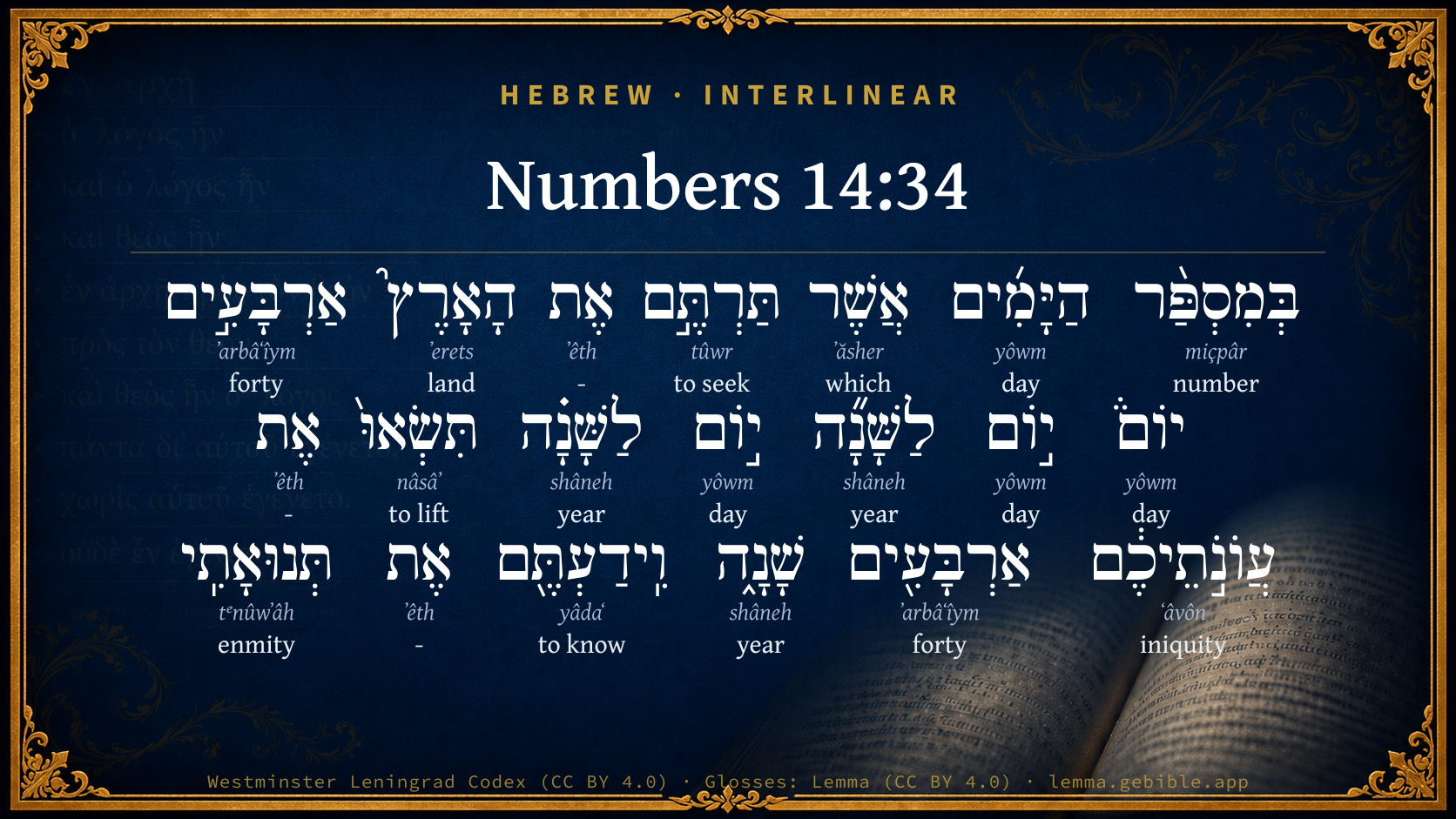
Hebrew (Westminster Leningrad Codex) Numbers 14:34 appears in the Hebrew Old Testament. The text above is from the Westminster Leningrad Codex. Each word links to its Strong’s number, a concise gloss, and parsing drawn from the Open Scriptures Hebrew Bible morphology. Click any word for its full Brown-Driver-Briggs (BDB) entry.
Download image
Cite this verse

Numbers 14:34 (World English Bible). Public Domain. Lemma interlinear Bible study tool, https://lemma.gebible.app/v/numbers/14/34.

Show BibTeX & RIS
BibTeX
RIS
English Translation
After the number of the days in which you spied out the land, even forty days, for every day a year, shall you bear your iniquities, even forty years, and you shall know my alienation.
World English Bible · Public Domain
Highlights
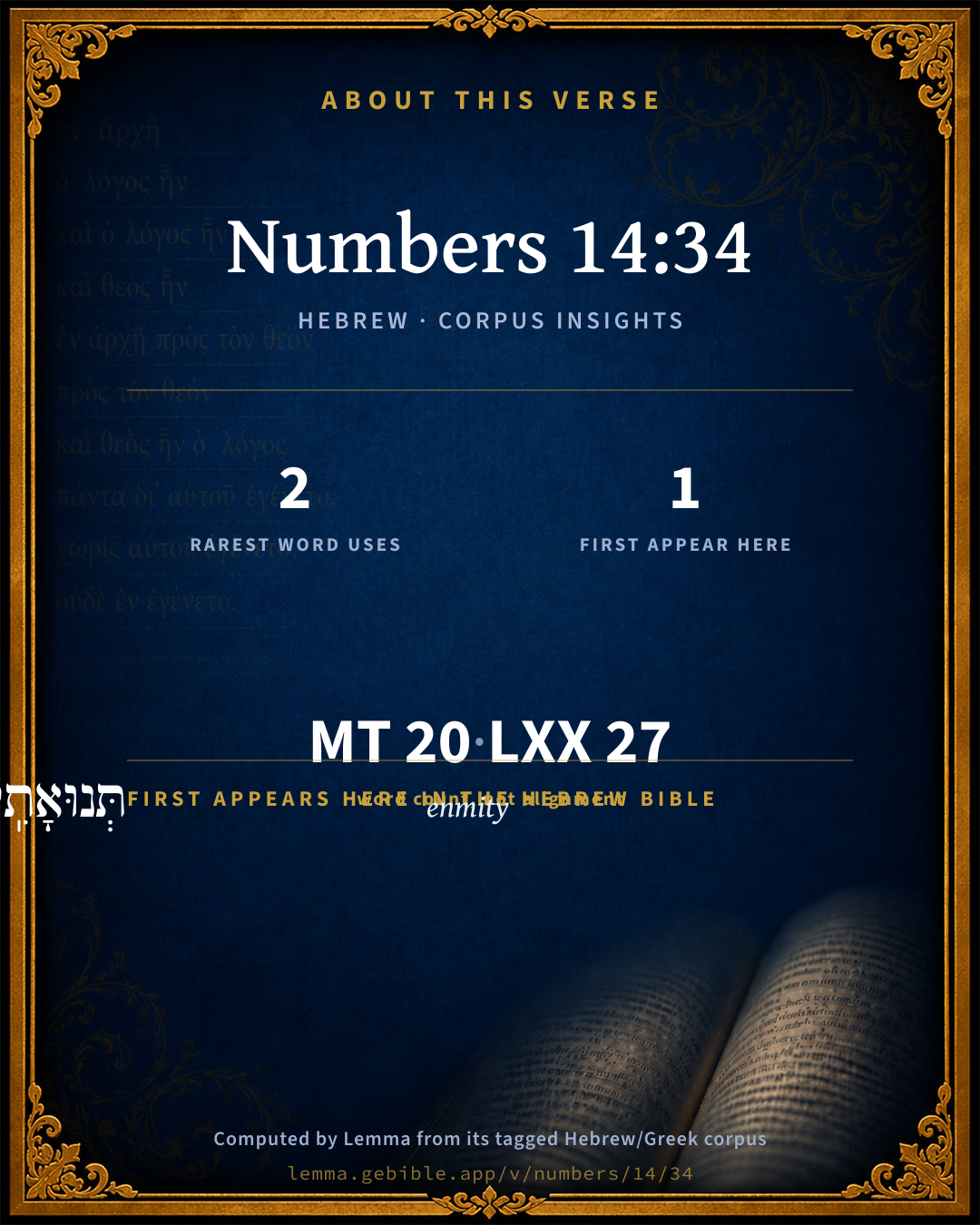
  • 1 first appearance in the Hebrew Bible
Full analysis ↓
Download a study sheet

One document with this verse’s original text, its word-by-word gloss line, the meaning frame, cross-references with their text, attributed commentary, and full source and license credits — printable, and it pastes into notes with its structure intact.

This verse Autodidact and up

Study sheet (.html) Plain text (.txt)

A passage Seminary Student

Up to 50 verses in one chapter. A passage sheet keeps up to 6 commentary sources and 12 cross-references per verse, in the order this page ranks them, and says so on the sheet whenever that leaves anything out. Ask for a single verse and you get the Autodidact verse sheet above.

Everything on this page stays free to read, with no account — the sheet is a download of what is already on screen, not access to it.

Want to remove ads? Support Godless Engineer
Compare translations 3

The same verse in 3 English versions, stacked beneath the original-language interlinear above. Click any original word for its lexicon entry.

Each is an independent rendering of the whole verse — the interlinear is not word-aligned to these translations.

Highlighted words mark where these versions differ — a whole-verse word diff, not a word-by-word alignment.

  • World English Bible Public Domain
    After the number of the days in which you spied out the land, even forty days, for every day a year, shall you bear your iniquities, even forty years, and you shall know my alienation.
  • King James Version Public Domain
    After the number of the days in which ye searched the land, even forty days, each day for a year, shall ye bear your iniquities, even forty years, and ye shall know my breach of promise.
  • unfoldingWord Literal Text CC BY-SA 4.0
    By the number of the days that you explored the land, 40 days, a day for the year, a day for the year, you will lift up your iniquities 40 years. And you will know my opposition.’

unfoldingWord Literal Text — © unfoldingWord, licensed CC BY-SA 4.0. Word-aligned USFM3 via Door43 (git.door43.org/unfoldingWord/en_ult).

Versions to compare (up to 4)

3 of 4 selected

Show all 18 translations

Every available English version of this verse, each an independent rendering of the whole verse.

  • World English Bible Public Domain
    After the number of the days in which you spied out the land, even forty days, for every day a year, shall you bear your iniquities, even forty years, and you shall know my alienation.
  • Berean Standard Bible Public Domain
    In keeping with the forty days you spied out the land, you shall bear your guilt forty years—a year for each day—and you will experience My alienation.
  • Majority Standard Bible Public Domain
    In keeping with the forty days you spied out the land, you shall bear your guilt forty years—a year for each day—and you will experience My alienation.
  • King James Version Public Domain
    After the number of the days in which ye searched the land, even forty days, each day for a year, shall ye bear your iniquities, even forty years, and ye shall know my breach of promise.
  • American Standard Version (1901) Public Domain
    After the number of the days in which ye spied out the land, even forty days, for every day a year, shall ye bear your iniquities, even forty years, and ye shall know my alienation.
  • Revised Version (1885) Public Domain
    After the number of the days in which ye spied out the land, even forty days, for every day a year, shall ye bear your iniquities, even forty years, and ye shall know my alienation.
  • Geneva Bible (1599) Public Domain
    After the number of the dayes, in the which ye searched out the lande, euen fourtie dayes, euery day for a yeere, shall ye beare your iniquity, for fourtie yeeres, and ye shall feele my breach of promise.
  • Douay-Rheims (1899) Public Domain
    According to the number of the forty days, wherein you viewed the land: year shall be counted for a day. And forty years you shall receive your iniquities, and shall know my revenge:
  • Young's Literal Translation Public Domain
    by the number of the days `in' which ye spied the land, forty days, -- a day for a year, a day for a year -- ye do bear your iniquities, forty years, and ye have known my breaking off;
  • Literal Standard Version CC BY-SA 4.0
    by the number of the days [in] which you spied out the land, forty days—a day for a year, a day for a year—you bear your iniquities [for] forty years, and you have known My opposition;
  • Unlocked Literal Bible CC BY-SA 4.0
    Just as the number of the days during which you examined the land—forty days, you must likewise bear the consequences of your sins for forty years—one year for every day, and you must know what it is like for me to oppose you.
  • unfoldingWord Literal Text CC BY-SA 4.0
    By the number of the days that you explored the land, 40 days, a day for the year, a day for the year, you will lift up your iniquities 40 years. And you will know my opposition.’
  • Darby Bible Public Domain
    After the number of the days in which ye have searched out the land, forty days, each day for a year shall ye bear your iniquities forty years, and ye shall know mine estrangement [from you].
  • World Messianic Bible Public Domain
    After the number of the days in which you spied out the land, even forty days, for every day a year, you will bear your iniquities, even forty years, and you will know my alienation.’
  • Webster's Bible Public Domain
    After the number of the days in which ye searched the land, even forty days (each day for a year) shall ye bear your iniquities, even forty years, and ye shall know my breach of promise.
  • Free Bible Version CC BY-SA 4.0
    Just as you explored the country for forty days, so shall your punishment for your sins be forty years, a year for every day, and you will see what happens when I oppose you.
  • Bible in Basic English Public Domain
    And as you went through the land viewing it for forty days, so for forty years, a year for every day, you will undergo punishment for your wrongdoing, and you will see that I am against you.
  • JPS Tanakh (1917) Public Domain
    After the number of the days in which ye spied out the land, even forty days, for every day a year, shall ye bear your iniquities, even forty years, and ye shall know My displeasure.

Literal Standard Version (2020), Covenant Press — licensed CC BY-SA 4.0. Text via the HelloAO Bible API (eBible.org). Unlocked Literal Bible (unfoldingWord) — licensed CC BY-SA 4.0. Text via the HelloAO Bible API (eBible.org). unfoldingWord Literal Text — © unfoldingWord, licensed CC BY-SA 4.0. Word-aligned USFM3 via Door43 (git.door43.org/unfoldingWord/en_ult). Free Bible Version, Dr. Jonathan Gallagher — licensed CC BY-SA 4.0. Text via the HelloAO Bible API (eBible.org).

Word by word

More ways to search: Search by grammar → Find every occurrence → Compare this word →

Practice this passage: Drill this verse → Learn its vocabulary →

תְּנוּאָתִֽי
tᵉnûwʼâh
H8569
“enmity · my”
Noun, Common, Feminine, Singular, Construct + Suffix, Personal, 1st Person, Common, Singular
Part of Speech
Noun
Type
Common
Gender
Feminine
Number
Singular
State
Construct
Full BDB Definition

Origin: from H5106

TWOT: 1317a

opposition, alienation, enmity
  1. בְּמִסְפַּ֨ר miçpâr H4557 “in/at · number of” Preposition + Noun, Common, Masculine, Singular, Construct
  2. הַיָּמִ֜ים yôwm H3117 “the · days” Particle, Definite Article + Noun, Common, Masculine, Plural, Absolute
  3. אֲשֶׁר ʼăsher H834 “which” Particle, Relative
  4. תַּרְתֶּ֣ם tûwr H8446 “to seek” Verb, Qal, Perfect, 2nd Person, Masculine, Plural
  5. אֶת ʼêth H853 “-” Particle, Direct Object
  6. הָאָרֶץ֮ ʼerets H776 “the · land” Particle, Definite Article + Noun, Common, Both, Singular, Absolute
  7. אַרְבָּעִ֣ים ʼarbâʻîym H705 “forty” Adjective, Cardinal number, Both, Plural, Absolute
  8. יוֹם֒ yôwm H3117 “day” Noun, Common, Masculine, Singular, Absolute
  9. י֣וֹם yôwm H3117 “day” Noun, Common, Masculine, Singular, Absolute
  10. לַשָּׁנָ֞ה shâneh H8141 “to/for the · year” Preposition, Determined + Noun, Common, Feminine, Singular, Absolute
  11. י֣וֹם yôwm H3117 “day” Noun, Common, Masculine, Singular, Absolute
  12. לַשָּׁנָ֗ה shâneh H8141 “to/for the · year” Preposition, Determined + Noun, Common, Feminine, Singular, Absolute
  13. תִּשְׂאוּ֙ nâsâʼ H5375 “to lift” Verb, Qal, Imperfect, 2nd Person, Masculine, Plural
  14. אֶת ʼêth H853 “-” Particle, Direct Object
  15. עֲוֺנֹ֣תֵיכֶ֔ם ʻâvôn H5771 “iniquities · your” Noun, Common, Both, Plural, Construct + Suffix, Personal, 2nd Person, Masculine, Plural
  16. אַרְבָּעִ֖ים ʼarbâʻîym H705 “forty” Adjective, Cardinal number, Both, Plural, Absolute
  17. שָׁנָ֑ה shâneh H8141 “year” Noun, Common, Feminine, Singular, Absolute
  18. וִֽידַעְתֶּ֖ם yâdaʻ H3045 “and · to know” Conjunction + Verb, Qal, Sequential Perfect, 2nd Person, Masculine, Plural
  19. אֶת ʼêth H853 “-” Particle, Direct Object

About this verse

These counts appear in no published source. They are computed here, from the morphology-tagged text and Lemma’s own curated glosses. What Lemma adds →

20
words
12
distinct lemmas
Pentateuch
section

Notable vocabulary

The rarest word here is תְּנוּאָתִֽי enmity H8569 — appearing just 2 times in the whole Hebrew Bible.

First appearance in Scripture

This word makes its first canonical appearance in the Hebrew Bible here:

  • תְּנוּאָתִֽי enmity H8569

Shared distinctive vocabulary

תְּנוּאָתִֽי enmity H8569 occurs in 2 verses of the Hebrew Bible. Also found in:

Grammatical profile

  • 3 verbs
  • 11 nouns
  • 2 adjectives
  • 4 particles

Verb forms

  • תַּרְתֶּ֣ם Qal · Perfect
  • תִּשְׂאוּ֙ Qal · Imperfect
  • וִֽידַעְתֶּ֖ם Qal · Sequential Perfect

Repetition

Words recur within this verse — often emphatic in Hebrew:

  • הַיָּמִ֜ים day H3117 ×4
  • לַשָּׁנָ֞ה year H8141 ×3
  • אַרְבָּעִ֣ים forty H705 ×2

Hebrew & Septuagint length

In English translation the verse runs 35 words from the Hebrew and 34 from the Septuagint (LXX English) — closely comparable.

A rough comparison of the two English renderings, which tokenize alike — not a word-level alignment.

Word counts can differ between the Hebrew and the Greek without any difference in meaning — e.g. the Hebrew direct-object marker אֵת has no separate Greek word, and Greek often adds the article ὁ.

In the original languages it is 20 Hebrew tokens and 27 Greek tokens — but the two are counted differently (Hebrew bundles its prefixes and suffixes into one token; the Greek is in lemma form), so that isn’t a like-for-like length.

Cross-references

19

Topical passages linked to Numbers 14:34 in the Treasury of Scripture Knowledge — connected by theme and wording, ordered by reader-vote popularity; previews shown in the World English Bible.

  • Ezekiel 4:6 Again, when you have accomplished these, you shall lie on your right side, and shall bear the iniquity of the house of Judah: forty days, each day for a year, have I appointed it to you.
  • Numbers 13:25 They returned from spying out the land at the end of forty days.
  • Jeremiah 18:9–10 At what instant I shall speak concerning a nation, and concerning a kingdom, to build and to plant it;
  • Daniel 9:24 Seventy weeks are decreed on your people and on your holy city, to finish disobedience, and to make an end of sins, and to make reconciliation for iniquity, and to bring in everlasting righteousness, and to seal up vision and prophecy, and to anoint the most holy.
  • Deuteronomy 31:16–17 Yahweh said to Moses, Behold, you shall sleep with your fathers; and this people will rise up, and play the prostitute after the strange gods of the land, where they go to be among them, and will forsake me, and break my covenant which I have made with them.
  • 1 Samuel 2:30 Therefore Yahweh, the God of Israel, says, I said indeed that your house, and the house of your father, should walk before me forever: but now Yahweh says, Be it far from me; for those who honor me I will honor, and those who despise me shall be lightly esteemed.
  • 2 Chronicles 36:21 to fulfill the word of Yahweh by the mouth of Jeremiah, until the land had enjoyed its Sabbaths: [for] as long as it lay desolate it kept Sabbath, to fulfill seventy years.
  • Psalms 95:10 Forty long years I was grieved with that generation, And said, "It is a people that errs in their heart. They have not known my ways."
  • Zechariah 11:10 I took my staff Favor, and cut it apart, that I might break my covenant that I had made with all the peoples.
  • Hebrews 4:1 Let us fear therefore, lest perhaps a promise being left of entering into his rest, anyone of you should seem to have come short of it.
  • Leviticus 20:19 "'You shall not uncover the nakedness of your mother's sister, nor of your father's sister; for he has made naked his close relative: they shall bear their iniquity.
  • Numbers 18:23 But the Levites shall do the service of the tent of meeting, and they shall bear their iniquity: it shall be a statute forever throughout your generations; and among the children of Israel they shall have no inheritance.
  • 1 Kings 8:56 Blessed be Yahweh, who has given rest to his people Israel, according to all that he promised: there has not failed one word of all his good promise, which he promised by Moses his servant.
  • Psalms 38:4 For my iniquities have gone over my head. As a heavy burden, they are too heavy for me.
  • Psalms 77:8 Has his loving kindness vanished forever? Does his promise fail for generations?
  • Psalms 105:42 For he remembered his holy word, And Abraham, his servant.
  • Lamentations 3:31–33 For the Lord will not cast off forever.
  • Ezekiel 14:10 They shall bear their iniquity: the iniquity of the prophet shall be even as the iniquity of him who seeks [to him];
  • Revelation 11:3 I will give power to my two witnesses, and they will prophesy one thousand two hundred sixty days, clothed in sackcloth."

Cross-references courtesy of OpenBible.info (CC BY 4.0).

Hebrew and Greek witnesses Masoretic Hebrew ↔ Greek Septuagint

The same verse in the two great witnesses to the Old Testament, shown verse-for-verse.

These are two independent witnesses, not word-aligned to each other, and the Septuagint is shown in lemma (dictionary) form.

Hebrew Numbers 14:34 Masoretic · Westminster Leningrad Codex

בְּמִסְפַּ֨ר הַיָּמִ֜ים אֲשֶׁר תַּרְתֶּ֣ם אֶת הָאָרֶץ֮ אַרְבָּעִ֣ים יוֹם֒ י֣וֹם לַשָּׁנָ֞ה י֣וֹם לַשָּׁנָ֗ה תִּשְׂאוּ֙ אֶת עֲוֺנֹ֣תֵיכֶ֔ם אַרְבָּעִ֖ים שָׁנָ֑ה וִֽידַעְתֶּ֖ם אֶת תְּנוּאָתִֽי

After the number of the days in which you spied out the land, even forty days, for every day a year, shall you bear your iniquities, even forty years, and you shall know my alienation.

World English Bible · Public Domain

Greek LXX Numbers 14:34 Septuagint · lemma form

κατά ὁ ἀριθμός ὁ ἡμέρα ὅσος κατασκέπτομαι ὁ γῆ τεσσαράκοντα ἡμέρα ἡμέρα ὁ ἐνιαυτός λαμβάνω ὁ ἁμαρτία σύ τεσσαράκοντα ἔτος καί γιγνώσκω ὁ θυμός ὁ ὀργή ἐγώ

According to the number of the days during which you⌃ spied the land, forty days, a day for a year, you⌃ shall bear your sins forty years, and you⌃ shall know my fierce anger.

LXX2012 (modern English Septuagint) · Public Domain

On this verse, Adam Clarke's Commentary discusses the Septuagint’s reading. Read the note in Commentary ↓

Hebrew: Westminster Leningrad Codex (CC BY 4.0). Greek: Septuagint (public domain); English from LXX2012 (modern English Septuagint) (Public Domain). How the Septuagint differs from the Hebrew →

Targum (Aramaic paraphrase)

2

The Targum is the ancient Jewish Aramaic paraphrase of the Hebrew Scriptures — an interpretive translation, not the Hebrew text itself. Onkelos (literal) and Pseudo-Jonathan (expansive) render the Torah, and Jonathan the Prophets. Coverage is partial: where no permissively-licensed English translation exists for a verse, only the Aramaic is shown. This is verse-level text, not a word-by-word alignment to the Hebrew.

  1. Targum Onkelos Torah (Genesis–Deuteronomy)
    בְּמִנְיַן יוֹמַיָא דִי אַלֶלְתּוּן יָת אַרְעָא אַרְבְּעִין יוֹמִין יוֹמָא לְשַׁתָּא יוֹמָא לְשַּׁתָּא תְּקַבְּלוּן יָת חוֹבֵיכוֹן אַרְבְּעִין שְׁנִין וְתִדְעוּן יָת דְאִתְרַעַמְתּוּן עֲלָי

    (no public-domain English translation for this verse)

    Targum Onkelos — Aramaic: “Onkelos Genesis” (public domain); “Onkelos Exodus” (public domain); “Onkelos Leviticus” (public domain); “Onkelos Numbers” (public domain); “Onkelos Deuteronomy” (public domain). English: “Sefaria Community Translation” (CC0 1.0 (public-domain dedication)); “J.W. Etheridge. The Targums of Onkelos and Jonathan Ben Uzziel on the Pentateuch. London: Longmans, Green, 1862” (public domain). Text via Sefaria.

  2. Targum Pseudo-Jonathan Torah (Genesis–Deuteronomy)
    בְּמִנְיַן יוֹמִין דְאַלֵילְתּוּן יַת אַרְעָא אַרְבְּעִין יוֹמִין יוֹמָא לְשַׁתָּא יוֹמָא לְשַׁתָּא תְּקַבְּלוּן יַת חוֹבֵיכוֹן אַרְבְּעִין שְׁנִין וְתִנְדְעוּן יַת דְאִתְרַעַמְתּוּן עָלָי

    According to the number of the days in which you were exploring the land, forty days, a day for a year, a day for a year, you shall receive for your sins, forty years, and shall know (the consequence) of your murmuring against Me.

    Targum Pseudo-Jonathan — Aramaic: “Targum Jonathan on Genesis” (public domain); “Targum Jonathan on Exodus” (public domain); “Targum Jonathan on Leviticus” (public domain); “Targum Jonathan on Numbers” (public domain); “Targum Jonathan on Deuteronomy” (public domain). English: “The Targum of Jonathan ben Uzziel, trans. J. W. Etheridge, London, 1862” (public domain). Text via Sefaria.

Commentary

Notes on Numbers 14:34 from classic Christian and Jewish commentators (each source and its license shown beneath its notes). The classic Christian expositions comment on the surrounding passage and are grouped to its opening verse, so a note may address several verses; the Jewish commentaries on the Tanakh (Rashi and others) are per-verse, so they appear only where the commentator wrote on this verse.

Lemma curates 59 commentaries, every one of them public domain or Creative Commons licensed, each selected and text-cleaned for this edition rather than reprinted as found. About our sources →

Trapp's Complete Commentary

John Trapp

Num 14:34 After the number of the days in which ye searched the land, [even] forty days, each day for a year, shall ye bear your iniquities, [even] forty years, and ye shall know my breach of promise.

Ver. 34. My breach of promise,] i.e., Ye shall find to your cost, what it is to charge me with breach of promise, through unbelief.

John Trapp, A Commentary or Exposition upon All the Books of the Old and New Testament (1647–1656) — public domain. Text from a community e-Sword module.

Joseph Benson's Commentary

Num 14:34. Each day for a year — So there should have been forty years to come, but God was pleased mercifully to accept of the time past as a part of that time. Ye shall know my breach of promise — That as you have first broken the covenant between you and me, by breaking the conditions of it, so I will make it void on my part, by denying you the blessings promised in that covenant. Thus you shall see that the breach of promise wherewith you charged me, lies at your door, and was forced from me by your perfidiousness.

Joseph Benson's Commentary on the Old and New Testaments (1811–1818) — public domain. Text from a community e-Sword module.

Tyndale Open Study Notes

Tyndale Open Resources

14:34 each day: Cp. 13:25. • to have me for an enemy: Cp. Ezek 5:8; 21:3.

Tyndale Open Study Notes — © Tyndale Open Resources, licensed CC BY-SA 4.0. Text via the HelloAO Bible API.

Geneva Bible (1599)

Geneva Bible translators

Whether my promise be true or no.

Geneva Bible (1599) marginal notes — public domain. Text via Bolls.life.

Jamieson, Fausset & Brown

Robert Jamieson, A. R. Fausset & David Brown

ye shall know my breach of promise--that is, in consequence of your violation of the covenant betwixt you and Me, by breaking the terms of it, it shall be null and void on My part, as I shall withhold the blessings I promised in that covenant to confer on you on condition of your obedience.

Jamieson, Fausset & Brown — Commentary Critical and Explanatory on the Whole Bible (1871) — public domain (CC PDM 1.0). Text via the HelloAO Bible API.

Adam Clarke's Commentary

Verse 34. After the number of the days] The spies were forty days in searching the land, and the people who rebelled on their evil report are condemned to wander forty years in the wilderness! Now let them make them a captain and go back to Egypt if they can. God had so hedged them about with his power and providence that they could neither go back to Egypt nor get forward to the promised land! God has provided innumerable spiritual blessings for mankind, but in the pursuit of earthly good they lose them, and often lose the others also! If ye be willing and obedient, ye shall eat the fruit of the land, but not otherwise; unless for your farther punishment God give you your portion in THIS life, and ye get none in the life to come. From so great a curse may God save thee, thou money-loving, honour-hunting, pleasure-taking, thoughtless, godless man!

And ye shall know my breach of promise.] This is certainly a most harsh expression; and most learned men agree that the words את תנואתי eth tenuathi should be translated my vengeance, which is the rendering of the Septuagint, Vulgate, Coptic, and Anglo-Saxon, and which is followed by almost all our ancient English translations. The meaning however appears to be this: As God had promised to bring them into the good land, provided they kept his statutes, ordinances, c., and they had now broken their engagements, he was no longer held by his covenant and therefore, by excluding them from the promised land, he showed them at once his annulling of the covenant which they had broken, and his vengeance because they had broken it.

Adam Clarke's Commentary on the Bible (1810–1826) — public domain. Text from a community e-Sword/MySword module.

Ellicott's Commentary for English Readers

(34) Even forty days, each day for a year.—The numbering which is recorded in chapter 26 took place after the death of Aaron, which happened on the first day of the fifth month of the fortieth year after the exodus (Num_33:38). Hence it follows that the year and a half which had elapsed since the exodus must be included in the forty years of shepherd life in the wilderness.

My breach of promise.—The noun which is thus rendered occurs only in one other place, viz., Job_33:10. The cognate verb, however, occurs several times in this book in the sense of refuse, disallow, or hinder. (See Num_30:5; Num_30:8; Num_30:11; Num_32:7.) The meaning here appears to be rejection or alienation.

A Bible Commentary for English Readers, edited by Charles John Ellicott (1878–1897) — public domain. Text from a community e-Sword module.

The Cambridge Bible for Schools and Colleges

gen. ed. J. J. S. Perowne

34. my alienation] my opposition. Ye shall experience what it means to be opposed and hindered by me. The subst. occurs in Job_33:10 only. For the verb cf. Num_30:6 (R.V. ‘disallow’), Num_32:7 (R.V. ‘discourage’).

The Cambridge Bible for Schools and Colleges (gen. ed. J. J. S. Perowne; Cambridge University Press, 1878–1918) — public domain. Text from a community e-Sword module.

John Gill's Exposition

I the Lord have said,.... Determined, resolved on doing what I have declared, and again repeat it; the decree is absolute and peremptory, and will never be revoked:

I will surely do it to all this evil congregation, that are gathered together against me; against his ministers, Moses the chief magistrate, and Aaron the high priest; and this is interpreted gathering, conspiring, and rebelling against the Lord himself, on account of which they might be truly called an evil congregation, and therefore it was a determined point with him to destroy them:

in this wilderness they shall be consumed; by wasting diseases:

and there they shall die; as they wished they might, Num 14:22; with respect to which this was so often repeated, Exo 16:3; and which the Jews interpret not only of a corporeal death, but of an eternal one; for they say (c)"the generation of the wilderness (of those that died there) have no part in the world to come, nor shall stand in judgment, as it is said, "in this wilderness", &c. Num 14:35.''

(c) Misn. Sanhedrin, c. 11. sect. 3.

John Gill's Exposition of the Whole Bible (1746–1763) — public domain (CC PDM 1.0). Text via the HelloAO Bible API.

Albert Barnes' Notes on the Bible

My breach of promise - In the original, a word, found elsewhere only in Job 30:10, and meaning “my withdrawals” “my turning away.” See the margin.

Albert Barnes' Notes on the Bible (1834–1885) — public domain. Text from a community e-Sword/MySword module.

Haydock's Catholic Bible Commentary

CHAPTER XIV.

Revenge. Hebrew, "my breach of promise, or if my threats be vain," &c. Septuagint, "you shall know the fury of my anger." (Calmet) --- I will convince you by the severity with which I shall execute this sentence, that you had no reason to distrust my former promises. St. Jerome (in Ezec. xx.) entertains hopes of the eternal salvation of many of these Hebrews, who had time to do penance for their sins.

George Leo Haydock (1774–1849), Haydock's Catholic Family Bible and Commentary, 1859 edition — public domain. Excludes Psalms (Douay-Rheims chapter numbering differs from Protestant) and Deuterocanonical books (Catholic canon only).

Matthew Poole's English Annotations

Each day for a year; so there should have been forty years to come, but God was pleased mercifully to accept of the time past as a part of that time.

My breach of promise, that as you have first broken the covenant between you and me, by breaking the terms or conditions of it, so I will make it void on my part, by denying you the blessings promised in that covenant, and to be given to you in case of your obedience. So you shall see that the breach of promise wherewith you charged me, Num 14:3, lies at your door, and was forced from me by your perfidiousness. Or, my breach; either passively, i.e. your breaking off from me, as such pronouns are oft used, as Gen 1:4; Isa 53:11; 56:7; or actively, i.e. my breaking off or departing from you, and stopping the current of my blessings towards you; you shall feel by experience how sad your condition is when I withdraw my grace and favour from you.

Matthew Poole's English Annotations on the Holy Bible (1683–1685) — public domain. Text from a community e-Sword/MySword module.

Whedon's Commentary on the Bible

Daniel D. Whedon

34. Forty days… forty years — Thus the sin of the spies and the unbelief of the nation would be vividly set before them as the cause of their exclusion from Canaan. At every question, “How long?” the mind would revert to the forty days’ search by the spies, to their majority report, and to the slough of despond into which the people fell at Kadesh.

Shall ye bear your iniquities — In the next verse we find an explanation of bearing iniquities. “In this wilderness shall they be consumed, and there shall they die.” “The weight of guilt is so great that they stagger under it in crooked ways for many years, till they sink exhausted with the weary load. The transition is very easy from the idea of bearing sin to that of bearing punishment.” — Bibliotheca Sacra. As Prof. Park expresses it, “Sin presses the sinner down in punishment and into punishment.”

My breach of promise — Here is but one Hebrew word, t’nooah, used elsewhere only in Job_33:10, and rendered occasions. It literally signifies removal or alienation, the withdrawal of one’s self from a person, and so metaphorically expresses enmity. Hence the strong rendering of the Septuagint, τον θυμον της οργης μου, the vehemence of my anger, and of the Vulgate, ultionem meam, my vengeance. Luther’s translation, though more correct, is not so concise and vigorous — What it shall be when I withdraw my hand. The breach of promise is induced by the wilful and persistent disobedience of Israel in refusing to carry out Jehovah’s purpose of love. His immutability requires him to treat unbelievers as rebels. The justice of their punishment is vindicated by their own contumacy.

Daniel D. Whedon (gen. ed.), Commentary on the Old and New Testaments (1874–1909) — public domain. Text from a community e-Sword module.

The Pulpit Commentary

After the number of the days... each day for a year. It is said, and truly, that the connection between the two periods was arbitrary, and that the apparent correspondence lay only upon the surface. Exactly for this reason it was the better fitted to fix itself in the mind of a nation incapable of following a deeper and more spiritual analogy of guilt and punishment. It served the purpose which God had in view, viz., to make them feel that the quantity as well as the quality of their punishment was entirely due to themselves; and it needed no other justification. If God assigns reasons at all, he assigns such as can be understood by those to whom he speaks. Ye shall know my breach of promise. ytiaWnT. The noun only occurs elsewhere in Job_33:10, but the verb is found in Num_32:7 in the sense of "discouraging," or "turning away" (Septuagint, inati diastrefete ). Here it must mean "my withdrawal," or "my turning aside, from you." They should know by sad experience that "with the froward" God will "show" himself "froward". (Psa_18:26)

The Pulpit Commentary (1880–1919), ed. H.D.M. Spence-Jones & Joseph S. Exell — public domain. Text from a community e-Sword module.

John Wesley's Explanatory Notes

Each day for a year - So there should have been forty years to come, but God was pleased mercifully to accept of the time past as a part of that time. Ye shall know my breach of promise - That as you have first broken the covenant between you and me, by breaking the conditions of it, so I will make it void on my part, by denying you the blessings promised in that covenant. So you shall see, that the breach of promise wherewith you charged me, lies at your door, and was forced from me by your perfidiousness.

John Wesley, Explanatory Notes Upon the Whole Bible (1754–1765) — public domain. Text via the GEBible commentary corpus.

unfoldingWord translationNotes

Door43 World Missions Community

bear the consequences of your sins

"suffer the consequences of your sins" or "suffer because of your sins"

They will be completely cut off

This probably means that they will no longer exist. AT: "they will come to an end" or "they will all be destroyed" (See: Assumed Knowledge and Implicit Information)

translationWords

sin

adversary

Yahweh

evil

consume

unfoldingWord translationNotes — © Distant Shores Media and the Door43 World Missions Community, licensed CC BY-SA 4.0. Source: git.door43.org/Door43/en_tn.

Rashi

Rabbi Shlomo Yitzchaki (Rashi)

את תנואתי [AND YE SHALL KNOW] את תנואתי — You shall know (realise) that you have removed your heart from following after Me. תנואה is an expression for “removing”, similar to (Numbers 30:6) “for her father hath removed her (הניא) from her vow” (cf. Rashi on that verse, where he quotes this phrase).

Rashi on the Tanakh — English translations: “The Judaica Press complete Tanach with Rashi, translated by A. J. Rosenberg” (CC BY 4.0); “Pentateuch with Rashi's commentary by M. Rosenbaum and A.M. Silbermann, 1929-1934” (public domain); “The Metsudah Tanach series, Lakewood, N.J” (CC BY 4.0); and “The Book of Joshua, Metsudah Publications, 1997” (CC BY 4.0). Text via Sefaria.

Lesson kit

Teaching starters — assembled from the data on this page, not authored interpretation. Every prompt links to the verse data it draws on. Edit before teaching.

Numbers, in the Pentateuch, opens this verse with 20 words (12 distinct Hebrew lemmas). Its most distinctive word is tᵉnûwʼâh (“enmity”). A historical commentator’s framing appears above. Read the whole chapter for the surrounding context.

Discussion questions

  1. The word tᵉnûwʼâh carries the sense “enmity.” How does it shape the verse?
  2. The word “enmity” first appears here in Scripture. What is being introduced at this debut?
  3. Job 33:10 shares the word «enmity» with this verse. How do the two illuminate each other?
  4. “day” occurs 4× in this one verse. What is the effect of the repetition?
  5. The translations on this page render this verse differently — a whole-verse word diff, not a word-by-word alignment. What might account for the different wordings?
  6. The verb «תַּרְתֶּ֣ם» is Qal Perfect. How does its form color the action?
  7. Reading how Trapp's Complete Commentary and Joseph Benson's Commentary read this verse, where do the two commentators agree and where do they part?

Things to notice

Reading settings

Reading text

Shown beneath each verse's original-language words.

Old Testament
Old Testament edition

Read the OT as the Masoretic Hebrew (MT) or the Greek Septuagint (LXX).

English shown for the Greek Septuagint (in the Hebrew ↔ Greek comparison).

Comparing translations? Open the Compare panel on any verse page to stack up to four side by side.