
Leviticus 16:21

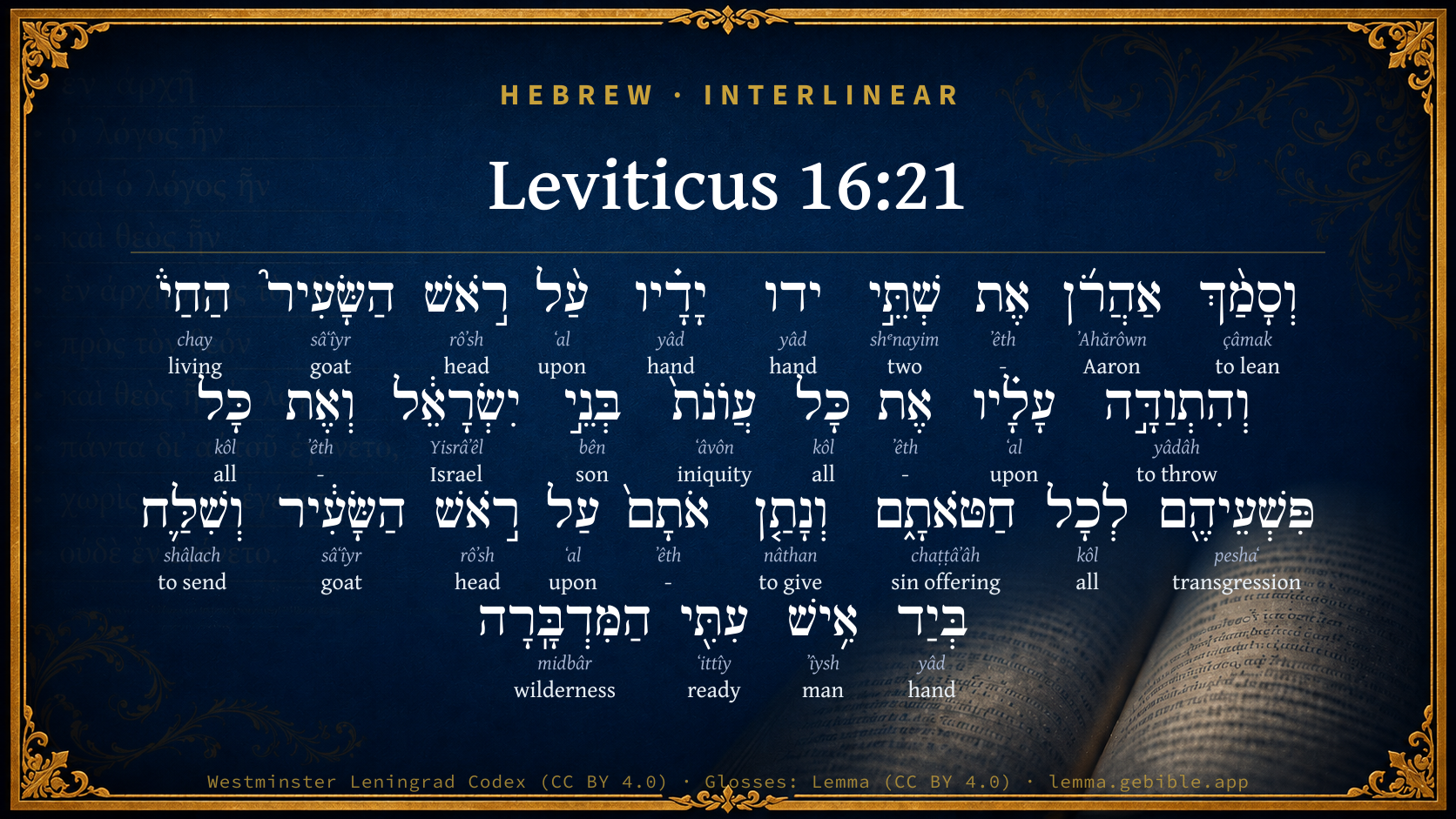
Hebrew (Westminster Leningrad Codex) Leviticus 16:21 appears in the Hebrew Old Testament. The text above is from the Westminster Leningrad Codex. Each word links to its Strong’s number, a concise gloss, and parsing drawn from the Open Scriptures Hebrew Bible morphology. Click any word for its full Brown-Driver-Briggs (BDB) entry.
Download image
Cite this verse

Leviticus 16:21 (World English Bible). Public Domain. Lemma interlinear Bible study tool, https://lemma.gebible.app/v/leviticus/16/21.

Show BibTeX & RIS
BibTeX
RIS
English Translation
Aaron shall lay both his hands on the head of the live goat, and confess over him all the iniquities of the children of Israel, and all their transgressions, even all their sins; and he shall put them on the head of the goat, and shall send him away into the wilderness by the hand of a man who is in readiness.
World English Bible · Public Domain
Highlights
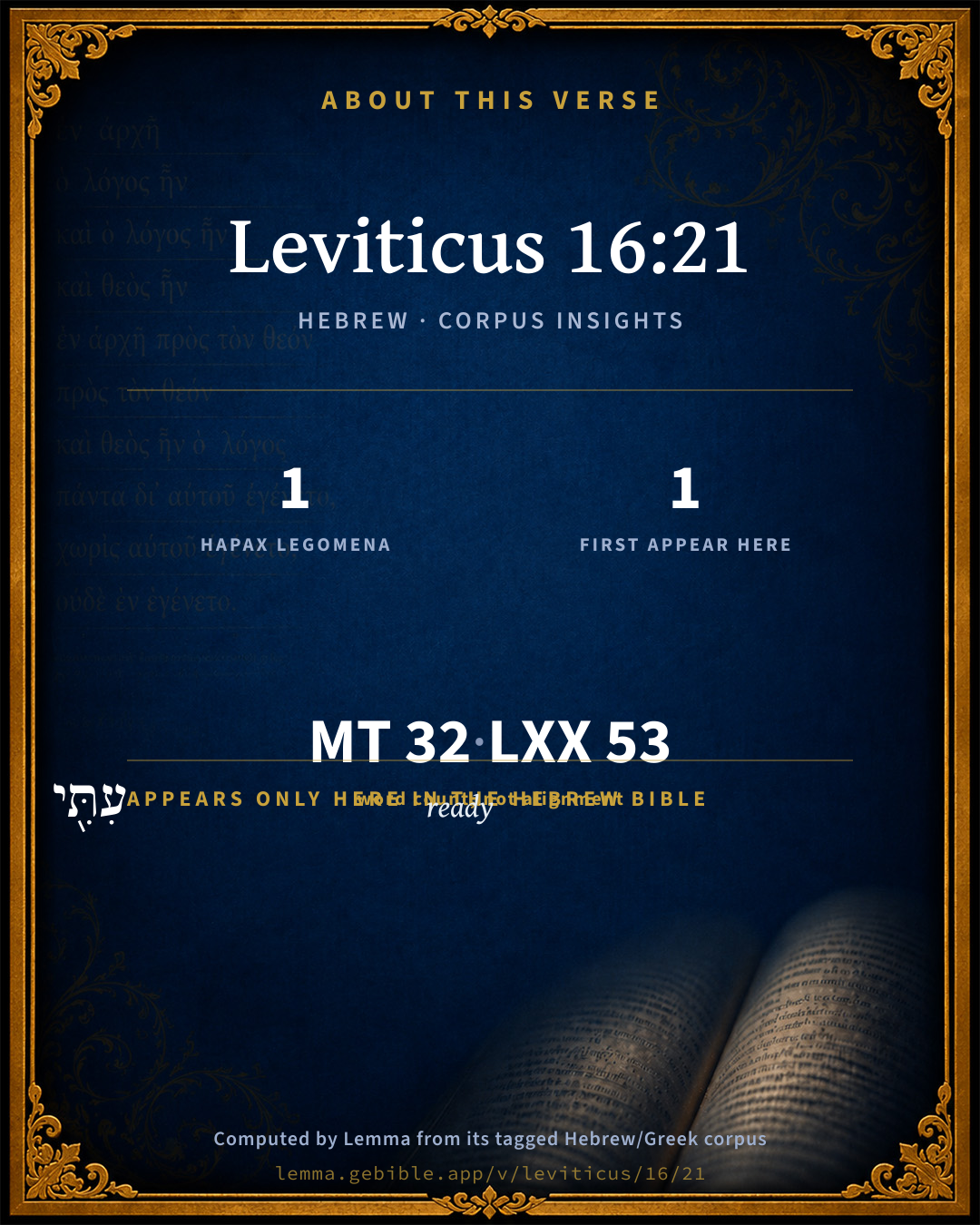
  • 1 hapax legomenon — only here in the Hebrew Bible
  • 1 first appearance in the Hebrew Bible
Full analysis ↓
Download a study sheet

One document with this verse’s original text, its word-by-word gloss line, the meaning frame, cross-references with their text, attributed commentary, and full source and license credits — printable, and it pastes into notes with its structure intact.

This verse Autodidact and up

Study sheet (.html) Plain text (.txt)

A passage Seminary Student

Up to 50 verses in one chapter. A passage sheet keeps up to 6 commentary sources and 12 cross-references per verse, in the order this page ranks them, and says so on the sheet whenever that leaves anything out. Ask for a single verse and you get the Autodidact verse sheet above.

Everything on this page stays free to read, with no account — the sheet is a download of what is already on screen, not access to it.

Want to remove ads? Support Godless Engineer
Compare translations 3

The same verse in 3 English versions, stacked beneath the original-language interlinear above. Click any original word for its lexicon entry.

Each is an independent rendering of the whole verse — the interlinear is not word-aligned to these translations.

Highlighted words mark where these versions differ — a whole-verse word diff, not a word-by-word alignment.

  • World English Bible Public Domain
    Aaron shall lay both his hands on the head of the live goat, and confess over him all the iniquities of the children of Israel, and all their transgressions, even all their sins; and he shall put them on the head of the goat, and shall send him away into the wilderness by the hand of a man who is in readiness.
  • King James Version Public Domain
    And Aaron shall lay both his hands upon the head of the live goat, and confess over him all the iniquities of the children of Israel, and all their transgressions in all their sins, putting them upon the head of the goat, and shall send him away by the hand of a fit man into the wilderness:
  • unfoldingWord Literal Text CC BY-SA 4.0
    And Aaron shall lay two of his hands on the head of the living goat, and he shall confess over it all the iniquity of the sons of Israel and all their rebellion, to all their sins. And he shall put them on the head of the goat, and he shall send away by the hand of a timely man to the wilderness.

unfoldingWord Literal Text — © unfoldingWord, licensed CC BY-SA 4.0. Word-aligned USFM3 via Door43 (git.door43.org/unfoldingWord/en_ult).

Versions to compare (up to 4)

3 of 4 selected

Show all 18 translations

Every available English version of this verse, each an independent rendering of the whole verse.

  • World English Bible Public Domain
    Aaron shall lay both his hands on the head of the live goat, and confess over him all the iniquities of the children of Israel, and all their transgressions, even all their sins; and he shall put them on the head of the goat, and shall send him away into the wilderness by the hand of a man who is in readiness.
  • Berean Standard Bible Public Domain
    Then he is to lay both hands on the head of the live goat and confess over it all the iniquities and rebellious acts of the Israelites in regard to all their sins. He is to put them on the goat’s head and send it away into the wilderness by the hand of a man appointed for the task.
  • Majority Standard Bible Public Domain
    Then he is to lay both hands on the head of the live goat and confess over it all the iniquities and rebellious acts of the Israelites in regard to all their sins. He is to put them on the goat’s head and send it away into the wilderness by the hand of a man appointed for the task.
  • King James Version Public Domain
    And Aaron shall lay both his hands upon the head of the live goat, and confess over him all the iniquities of the children of Israel, and all their transgressions in all their sins, putting them upon the head of the goat, and shall send him away by the hand of a fit man into the wilderness:
  • American Standard Version (1901) Public Domain
    and Aaron shall lay both his hands upon the head of the live goat, and confess over him all the iniquities of the children of Israel, and all their transgressions, even all their sins; and he shall put them upon the head of the goat, and shall send him away by the hand of a man that is in readiness into the wilderness:
  • Revised Version (1885) Public Domain
    and Aaron shall lay both his hands upon the head of the live goat, and confess over him all the iniquities of the children of Israel, and all their transgressions, even all their sins; and he shall put them upon the head of the goat, and shall send him away by the hand of a man that is in readiness into the wilderness:
  • Geneva Bible (1599) Public Domain
    And Aaron shall put both his handes vpon the head of the liue goate, and confesse ouer him al the iniquities of the children of Israel, and all their trespasses, in all their sinnes, putting them vpon the head of the goate, and shall sende him away (by the hand of a man appointed) into the wildernes.
  • Douay-Rheims (1899) Public Domain
    And putting both hands upon his head, let him confess all the iniquities of the children of Israel, and all their offences and sins: and praying that they may light on his head, he shall turn him out by a man ready for it, into the desert.
  • Young's Literal Translation Public Domain
    and Aaron hath laid his two hands on the head of the living goat, and hath confessed over it all the iniquities of the sons of Israel, and all their transgressions in all their sins, and hath put them on the head of the goat, and hath sent `it' away by the hand of a fit man into the wilderness;
  • Literal Standard Version CC BY-SA 4.0
    and Aaron has laid his two hands on the head of the living goat, and has confessed over it all the iniquities of the sons of Israel, and all their transgressions in all their sins, and has put them on the head of the goat, and has sent [it] away by the hand of a ready man into the wilderness;
  • Unlocked Literal Bible CC BY-SA 4.0
    Aaron must lay both his hands on the head of the live goat and confess over him all the wickedness of the people of Israel, all their rebellion, and all their sins. Then he must put that sinfulness on the head of the goat and send the goat away in the care of a man who is ready to lead the goat into the wilderness.
  • unfoldingWord Literal Text CC BY-SA 4.0
    And Aaron shall lay two of his hands on the head of the living goat, and he shall confess over it all the iniquity of the sons of Israel and all their rebellion, to all their sins. And he shall put them on the head of the goat, and he shall send away by the hand of a timely man to the wilderness.
  • Darby Bible Public Domain
    and Aaron shall lay both his hands on the head of the living goat, and confess over it all the iniquities of the children of Israel, and all their transgressions in all their sins, and he shall put them on the head of the goat, and shall send him away to the wilderness by the hand of a man standing ready;
  • World Messianic Bible Public Domain
    Aaron shall lay both his hands on the head of the live goat, and confess over him all the iniquities of the children of Israel, and all their transgressions, even all their sins; and he shall put them on the head of the goat, and shall send him away into the wilderness by the hand of a man who is ready.
  • Webster's Bible Public Domain
    And Aaron shall lay both his hands upon the head of the live goat, and confess over him all the iniquities of the children of Israel, and all their transgressions in all their sins, putting them upon the head of the goat, and shall send him away by the hand of a fit man into the wilderness:
  • Free Bible Version CC BY-SA 4.0
    Then he will put both hands on the head of the live goat and confess over it all the wrongs of the Israelites, all their acts of rebellion, and all their sins. He is to put them on the goat's head and send it away into the desert, taken there by a man chosen to do it.
  • Bible in Basic English Public Domain
    And Aaron, placing his two hands on the head of the living goat, will make a public statement over him of all the evil doings of the children of Israel and all their wrongdoing, in all their sins; and he will put them on the head of the goat and send him away, in the care of a man who will be waiting there, into the waste land.
  • JPS Tanakh (1917) Public Domain
    And Aaron shall lay both his hands upon the head of the live goat, and confess over him all the iniquities of the children of Israel, and all their transgressions, even all their sins; and he shall put them upon the head of the goat, and shall send him away by the hand of an appointed man into the wilderness.

Literal Standard Version (2020), Covenant Press — licensed CC BY-SA 4.0. Text via the HelloAO Bible API (eBible.org). Unlocked Literal Bible (unfoldingWord) — licensed CC BY-SA 4.0. Text via the HelloAO Bible API (eBible.org). unfoldingWord Literal Text — © unfoldingWord, licensed CC BY-SA 4.0. Word-aligned USFM3 via Door43 (git.door43.org/unfoldingWord/en_ult). Free Bible Version, Dr. Jonathan Gallagher — licensed CC BY-SA 4.0. Text via the HelloAO Bible API (eBible.org).

Word by word

More ways to search: Search by grammar → Find every occurrence → Compare this word →

Practice this passage: Drill this verse → Learn its vocabulary →

עִתִּ֖י
ʻittîy
H6261
“ready”
Adjective, Adjective, Masculine, Singular, Absolute
Part of Speech
Adjective
Type
Adjective
Gender
Masculine
Number
Singular
State
Absolute
Full BDB Definition

Origin: from H6256

TWOT: 1650d

timely, ready
  1. וְסָמַ֨ךְ çâmak H5564 “and · to lean” Conjunction + Verb, Qal, Sequential Perfect, 3rd Person, Masculine, Singular
  2. אַהֲרֹ֜ן ʼAhărôwn H175 “Aaron” Noun, Proper
  3. אֶת ʼêth H853 “-” Particle, Direct Object
  4. שְׁתֵּ֣י shᵉnayim H8147 “two” Adjective, Cardinal number, Feminine, Dual, Construct
  5. ידו yâd H3027 “hands · his” Noun, Common, Both, Dual, Construct + Suffix, Personal, 3rd Person, Masculine, Singular
  6. יָדָ֗יו yâd H3027 “hands · his” Noun, Common, Both, Dual, Construct + Suffix, Personal, 3rd Person, Masculine, Singular
  7. עַ֨ל ʻal H5921 “upon” Preposition
  8. רֹ֣אשׁ rôʼsh H7218 “head of” Noun, Common, Masculine, Singular, Construct
  9. הַשָּׂעִיר֮ sâʻîyr H8163 “the · goat” Particle, Definite Article + Noun, Common, Masculine, Singular, Absolute
  10. הַחַי֒ chay H2416 “the · living” Particle, Definite Article + Adjective, Adjective, Masculine, Singular, Absolute
  11. וְהִתְוַדָּ֣ה yâdâh H3034 “and · to throw” Conjunction + Verb, Hithpael, Perfect, 3rd Person, Masculine, Singular
  12. עָלָ֗יו ʻal H5921 “upon · him” Preposition + Suffix, Personal, 3rd Person, Masculine, Singular
  13. אֶת ʼêth H853 “-” Particle, Direct Object
  14. כָּל kôl H3605 “all of” Noun, Common, Masculine, Singular, Construct
  15. עֲוֺנֹת֙ ʻâvôn H5771 “iniquities of” Noun, Common, Both, Plural, Construct
  16. בְּנֵ֣י bên H1121 “sons of” Noun, Common, Masculine, Plural, Construct
  17. יִשְׂרָאֵ֔ל Yisrâʼêl H3478 “Israel” Noun, Proper
  18. וְאֶת ʼêth H853 “and · -” Conjunction + Particle, Direct Object
  19. כָּל kôl H3605 “all of” Noun, Common, Masculine, Singular, Construct
  20. פִּשְׁעֵיהֶ֖ם peshaʻ H6588 “transgressions · their” Noun, Common, Masculine, Plural, Construct + Suffix, Personal, 3rd Person, Masculine, Plural
  21. לְכָל kôl H3605 “to/for · all of” Preposition + Noun, Common, Masculine, Singular, Construct
  22. חַטֹּאתָ֑ם chaṭṭâʼâh H2403 “sin offerings · their” Noun, Common, Feminine, Plural, Construct + Suffix, Personal, 3rd Person, Masculine, Plural
  23. וְנָתַ֤ן nâthan H5414 “and · to give” Conjunction + Verb, Qal, Sequential Perfect, 3rd Person, Masculine, Singular
  24. אֹתָם֙ ʼêth H853 “- · them” Particle, Direct Object + Suffix, Personal, 3rd Person, Masculine, Plural
  25. עַל ʻal H5921 “upon” Preposition
  26. רֹ֣אשׁ rôʼsh H7218 “head of” Noun, Common, Masculine, Singular, Construct
  27. הַשָּׂעִ֔יר sâʻîyr H8163 “the · goat” Particle, Definite Article + Noun, Common, Masculine, Singular, Absolute
  28. וְשִׁלַּ֛ח shâlach H7971 “and · to send” Conjunction + Verb, Piel, Sequential Perfect, 3rd Person, Masculine, Singular
  29. בְּיַד yâd H3027 “in/at · hand of” Preposition + Noun, Common, Both, Singular, Construct
  30. אִ֥ישׁ ʼîysh H376 “man” Noun, Common, Masculine, Singular, Absolute
  31. הַמִּדְבָּֽרָה midbâr H4057 “the · wilderness · toward” Particle, Definite Article + Noun, Common, Masculine, Singular, Absolute + Suffix, Demonstrative

About this verse

These counts appear in no published source. They are computed here, from the morphology-tagged text and Lemma’s own curated glosses. What Lemma adds →

32
words
21
distinct lemmas
Pentateuch
section

Notable vocabulary

1 hapax legomenon — a word that appears only here in the entire Hebrew Bible:

  • עִתִּ֖י ready H6261

First appearance in Scripture

This word makes its first canonical appearance in the Hebrew Bible here:

  • עִתִּ֖י ready H6261

Shared distinctive vocabulary

וְסָמַ֨ךְ to lean H5564 occurs in 47 verses of the Hebrew Bible. Also found in:

Grammatical profile

  • 4 verbs
  • 18 nouns
  • 3 adjectives
  • 3 prepositions
  • 4 particles

Verb forms

  • וְסָמַ֨ךְ Qal · Sequential Perfect
  • וְהִתְוַדָּ֣ה Hithpael · Perfect
  • וְנָתַ֤ן Qal · Sequential Perfect
  • וְשִׁלַּ֛ח Piel · Sequential Perfect

Repetition

Words recur within this verse — often emphatic in Hebrew:

  • ידו hand H3027 ×3
  • עַ֨ל upon H5921 ×3
  • כָּל all H3605 ×3
  • רֹ֣אשׁ head H7218 ×2
  • הַשָּׂעִיר֮ goat H8163 ×2

Hebrew & Septuagint length

In English translation the verse runs 62 words from the Hebrew and 61 from the Septuagint (LXX English) — closely comparable.

A rough comparison of the two English renderings, which tokenize alike — not a word-level alignment.

Word counts can differ between the Hebrew and the Greek without any difference in meaning — e.g. the Hebrew direct-object marker אֵת has no separate Greek word, and Greek often adds the article ὁ.

In the original languages it is 32 Hebrew tokens and 53 Greek tokens — but the two are counted differently (Hebrew bundles its prefixes and suffixes into one token; the Greek is in lemma form), so that isn’t a like-for-like length.

Cross-references

14

Topical passages linked to Leviticus 16:21 in the Treasury of Scripture Knowledge — connected by theme and wording, ordered by reader-vote popularity; previews shown in the World English Bible.

  • Isaiah 53:6 All we like sheep have gone astray; everyone has turned to his own way; and Yahweh has laid on him the iniquity of us all.
  • 2 Corinthians 5:21 For him who knew no sin he made to be sin on our behalf; so that in him we might become the righteousness of God.
  • Ezra 10:1 Now while Ezra prayed and made confession, weeping and casting himself down before the house of God, there was gathered together to him out of Israel a very great assembly of men and women and children; for the people wept very sore.
  • Psalms 51:3 For I know my transgressions. My sin is constantly before me.
  • Exodus 29:10 "You shall bring the bull before the tent of meeting: and Aaron and his sons shall lay their hands on the head of the bull.
  • Leviticus 26:40 "'If they confess their iniquity, and the iniquity of their fathers, in their trespass which they trespassed against me, and also that, because they walked contrary to me,
  • Nehemiah 9:3–5 They stood up in their place, and read in the book of the law of Yahweh their God a fourth part of the day; and [another] fourth part they confessed, and worshiped Yahweh their God.
  • Psalms 32:5 I acknowledged my sin to you. I didn't hide my iniquity. I said, I will confess my transgressions to Yahweh, And you forgave the iniquity of my sin. Selah.
  • Proverbs 28:13 He who conceals his sins doesn't prosper, But whoever confesses and renounces them finds mercy.
  • Daniel 9:3–20 I set my face to the Lord God, to seek by prayer and petitions, with fasting and sackcloth and ashes.
  • Romans 10:10 For with the heart, one believes unto righteousness; and with the mouth confession is made unto salvation.
  • Leviticus 1:4 He shall lay his hand on the head of the burnt offering, and it shall be accepted for him to make atonement for him.
  • Leviticus 5:5 It shall be, when he is guilty of one of these, he shall confess that in which he has sinned:
  • Nehemiah 1:6–7 Let your ear now be attentive, and your eyes open, that you may listen to the prayer of your servant, which I pray before you at this time, day and night, for the children of Israel your servants while I confess the sins of the children of Israel, which we have sinned against you. Yes, I and my father's house have sinned:

Cross-references courtesy of OpenBible.info (CC BY 4.0).

Hebrew and Greek witnesses Masoretic Hebrew ↔ Greek Septuagint

The same verse in the two great witnesses to the Old Testament, shown verse-for-verse.

These are two independent witnesses, not word-aligned to each other, and the Septuagint is shown in lemma (dictionary) form.

Hebrew Leviticus 16:21 Masoretic · Westminster Leningrad Codex

וְסָמַ֨ךְ אַהֲרֹ֜ן אֶת שְׁתֵּ֣י ידו יָדָ֗יו עַ֨ל רֹ֣אשׁ הַשָּׂעִיר֮ הַחַי֒ וְהִתְוַדָּ֣ה עָלָ֗יו אֶת כָּל עֲוֺנֹת֙ בְּנֵ֣י יִשְׂרָאֵ֔ל וְאֶת כָּל פִּשְׁעֵיהֶ֖ם לְכָל חַטֹּאתָ֑ם וְנָתַ֤ן אֹתָם֙ עַל רֹ֣אשׁ הַשָּׂעִ֔יר וְשִׁלַּ֛ח בְּיַד אִ֥ישׁ עִתִּ֖י הַמִּדְבָּֽרָה

Aaron shall lay both his hands on the head of the live goat, and confess over him all the iniquities of the children of Israel, and all their transgressions, even all their sins; and he shall put them on the head of the goat, and shall send him away into the wilderness by the hand of a man who is in readiness.

World English Bible · Public Domain

Greek LXX Leviticus 16:21 Septuagint · lemma form

καί ἐπιτίθημι ἀαρών ὁ χείρ αὐτός ἐπί ὁ κεφαλή ὁ χίμαρος ὁ ζάω καί ἐκἀγορεύω ἐπί αὐτός πᾶς ὁ ἀνομία ὁ υἱός ἰσραήλ καί πᾶς ὁ ἀδικία αὐτός καί πᾶς ὁ ἁμαρτία αὐτός καί ἐπιτίθημι αὐτός ἐπί ὁ κεφαλή ὁ χίμαρος ὁ ζάω καί ἐκ ἀποστέλλω ἐν χείρ ἄνθρωπος ἕτοιμος εἰς ὁ ἔρημος

and Aaron shall lay his hands on the head of the live goat, and he shall declare over him all the iniquities of the children of Israel, and all their unrighteousness, and all their sins; and he shall lay them upon the head of the live goat, and shall send him by the hand of a ready man into the wilderness.

LXX2012 (modern English Septuagint) · Public Domain

On this verse, John Gill's Exposition discusses the Septuagint’s reading. Read the note in Commentary ↓

Hebrew: Westminster Leningrad Codex (CC BY 4.0). Greek: Septuagint (public domain); English from LXX2012 (modern English Septuagint) (Public Domain). How the Septuagint differs from the Hebrew →

Targum (Aramaic paraphrase)

2

The Targum is the ancient Jewish Aramaic paraphrase of the Hebrew Scriptures — an interpretive translation, not the Hebrew text itself. Onkelos (literal) and Pseudo-Jonathan (expansive) render the Torah, and Jonathan the Prophets. Coverage is partial: where no permissively-licensed English translation exists for a verse, only the Aramaic is shown. This is verse-level text, not a word-by-word alignment to the Hebrew.

  1. Targum Onkelos Torah (Genesis–Deuteronomy)
    וְיִסְמוֹךְ אַהֲרֹן יָת תַּרְתֵּין יְדוֹהִי עַל רֵישׁ צְפִירָא חַיָא וִיוַדֵי עֲלוֹהִי יָת כָּל עֲוָיַת בְּנֵי יִשְׂרָאֵל וְיָת כָל מֶרְדֵיהוֹן לְכָל חֲטָּאֵיהוֹן וְיִתֵּן יָתְהוֹן עַל רֵישׁ צְפִירָא וִישַׁלַח בְּיַד גְבַר דִזְמִין לִמְהַךְ לְמַדְבְּרָא

    (no public-domain English translation for this verse)

    Targum Onkelos — Aramaic: “Onkelos Genesis” (public domain); “Onkelos Exodus” (public domain); “Onkelos Leviticus” (public domain); “Onkelos Numbers” (public domain); “Onkelos Deuteronomy” (public domain). English: “Sefaria Community Translation” (CC0 1.0 (public-domain dedication)); “J.W. Etheridge. The Targums of Onkelos and Jonathan Ben Uzziel on the Pentateuch. London: Longmans, Green, 1862” (public domain). Text via Sefaria.

  2. Targum Pseudo-Jonathan Torah (Genesis–Deuteronomy)
    וְיִסְמוֹךְ אַהֲרן יַת תַּרְתֵּין יְדוֹי בְּסִידְרָא חֲדָא יַת יְמִינֵיהּ עַל שְמָאלֵיהּ עַל רֵישׁ צְפִירָא חַיָיא וְיוֹדֵי עֲלוֹי יַת כָּל עֲוָיַית בְּנֵי יִשְרָאֵל וְיַת כָּל מְרוֹדֵיהוֹן לְכָל חַטָאֵיהוֹן וְיִתֵּן יַתְהוֹן בִּשְׁבוּעָה אֲמִירָא וּמְפָרְשָׁא בִּשְׁמָא רַבָּא וְיַקִירָא עַל רֵישׁ צְפִירָא וְיִפְטוֹר בְּיַד גְבַר דִי מְזַמֵן מִן אִשְׁתַּקֵד לִמְהַךְ לְמַדְבְּרָא דְצוֹק דְהוּא בֵּית חַרוֹרִי

    And Aharon shall lay his hands (upon him) in this order, his right hand upon his left, upon the head of the living goat, and confess over him all the iniquities of the children of Israel, and all their rebellions, and all their sins, and shall put them, with an oath uttered and expressed with the Great and glorious Name, upon the head of the goat, and send (him) away by the hand of a man prepared from the year foregoing, to take him into a rocky desert which is Beth-hadurey;

    Targum Pseudo-Jonathan — Aramaic: “Targum Jonathan on Genesis” (public domain); “Targum Jonathan on Exodus” (public domain); “Targum Jonathan on Leviticus” (public domain); “Targum Jonathan on Numbers” (public domain); “Targum Jonathan on Deuteronomy” (public domain). English: “The Targum of Jonathan ben Uzziel, trans. J. W. Etheridge, London, 1862” (public domain). Text via Sefaria.

Commentary

Notes on Leviticus 16:21 from classic Christian and Jewish commentators (each source and its license shown beneath its notes). The classic Christian expositions comment on the surrounding passage and are grouped to its opening verse, so a note may address several verses; the Jewish commentaries on the Tanakh (Rashi and others) are per-verse, so they appear only where the commentator wrote on this verse.

Lemma curates 59 commentaries, every one of them public domain or Creative Commons licensed, each selected and text-cleaned for this edition rather than reprinted as found. About our sources →

Trapp's Complete Commentary

John Trapp

Lev 16:21 And Aaron shall lay both his hands upon the head of the live goat, and confess over him all the iniquities of the children of Israel, and all their transgressions in all their sins, putting them upon the head of the goat, and shall send [him] away by the hand of a fit man into the wilderness:

Ver. 21. All their transgressions in all their sins,] i.e., In their several circumstances and aggravations: laying open how many transgressions were wrapped up in their several sins. This was to bring out their sins, as they took the vessels of the temple, {Ezr 8:34} "by number and by weight."

John Trapp, A Commentary or Exposition upon All the Books of the Old and New Testament (1647–1656) — public domain. Text from a community e-Sword module.

Joseph Benson's Commentary

Lev 16:21. All the iniquities — He mentions iniquities, transgressions, and sins, to denote sins of all sorts, and that a free and full confession was to be made, and that the smallest sins needed, and the greatest sins were not excluded from, the benefit of Christ’s death here represented. On the head — Charging all their sins and the punishment due to them upon the goat, which, though only a ceremony, yet being done according to God’s appointment, and manifestly pointing at Christ, upon whom their iniquities and punishments were laid, (Isa 53:5-6,) it was available for this end. And hence the heathens took their custom of selecting one beast or man, upon whom they laid all their imprecations and curses, and whom they killed as an expiatory sacrifice for their sins, and to prevent their ruin. A fit man — Hebrew, a man of time, that is, of years and discretion, who might be trusted with this work. Into the wilderness — Which signified the removal of their sins far away both from the people, and out of God’s sight. And here the goat being neglected by all men, and exposed to many hazards from wild beasts, which were numerous there, might further signify Christ’s being forsaken both by God and by men, even by his own disciples, and the many dangers and sufferings he underwent.

Joseph Benson's Commentary on the Old and New Testaments (1811–1818) — public domain. Text from a community e-Sword module.

Whedon's Commentary on the Bible

Daniel D. Whedon

21. Lay… hands upon — See Lev_16:21, and Lev_1:4, notes. Among the modern orthodox Jews, instead of the scapegoat, a cock is substituted, which they call an atonement. On the eve of the day of atonement they swing this cock three times around their head, each time saving, in Hebrew, “This is to be sacrificed instead of me.” Then it is slaughtered and eaten.

And confess — The Mishna preserves the form of confession: “O Lord, thy people, the house of Israel, have transgressed, they have rebelled, they have sinned before thee. I beseech thee now absolve their transgressions, their rebellion and their sin that they have sinned against thee, as it is written in the law of Moses thy servant,” concluding with Lev_16:30.

All the iniquities — This includes all those sins of penitent Israelites for which the ordinary sacrifices did not avail. See Lev_16:9, note.

Putting them upon the head of the goat — Here is a positive proof that the laying on of hands upon a victim symbolically transferred the sins of the offerer. The high priest was accustomed to pronounce the following confession of sins, placing both hands on the goat’s head: “O Jehovah, thy people, the house of Israel hath sinned, transgressed, and committed wickedness before thee. O Jehovah, let atonement be made for the sins, transgressions, and wickedness whereby thy people, the house of Israel, hath sinned.” Joseph Roberts, who was for years a Wesleyan missionary in India, tells of a Hindoo custom which seems to recognise the devotedness of a substitute goat, which is set at liberty by one who seeks divine favour. “When a person is sick,” says Roberts, “he vows, on his recovery, to set a goat at liberty in honour of his deity. Having selected a suitable one from his flocks he makes a slit in the ear, or ties a yellow string round its neck, and lets it go whithersoever it pleases. Whoever sees the animal knows it to be a nate kadi, ‘the vowed goat,’ and no person will molest it.… When a person has committed what he considers a great sin he does the same thing; but, in addition to other ceremonies, he sprinkles the animal with water, puts his hands upon it, and prays to be forgiven.”

Fit man — “A man that is in readiness.” R.V. He was appointed at a suitable time, hence skilled in his office. Tradition says that he was not an Israelite.

Wilderness — See Lev_16:10, note. In the time of Christ the scapegoat was led to a high rock, twelve miles from Jerusalem, down which it was precipitated and killed. This was done by relays of men stationed along the route a sabbath day’s journey, two thousand paces, apart. By this arrangement the goat was hurried rapidly along and dashed down the precipice, and the fact was quickly telegraphed back from man to man to the vast congregation in the holy city, who awaited in breathless silence the sequel which assured them that their sins had been successfully borne away, according to the ritual, when a shout of gladness went up to heaven. — Delitzsch on the Hebrews, Appendix.

Daniel D. Whedon (gen. ed.), Commentary on the Old and New Testaments (1874–1909) — public domain. Text from a community e-Sword module.

Geneva Bible (1599)

Geneva Bible translators

Herein this goat is a true figure of Jesus Christ, who beareth the sins of the people, Isa. 53:9.

Geneva Bible (1599) marginal notes — public domain. Text via Bolls.life.

Adam Clarke's Commentary

Verse 21. Aaron shall lay both his hands upon the head, c.] What this imposition of hands meant see in Clarke's notes on "Ex 29:10", and "Le 1:4".

And confess over him all the iniquities - transgressions - sins] The three terms used here, INIQUITIES, עונת avonoth, from עוה avah, to pervert, distort, or turn aside TRANSGRESSIONS, פשעים peshaim, from פשע pasha, to transgress, to rebel; and SINS, חטאת chattaoth, from חטא chata, to miss the mark, are supposed by the Jews to comprise every thing that implies a breach of the Divine law, or an offence against God. See Clarke on Ge 12:13. Maimonides gives us the confession in the following words: -

"O Lord, thy people, the house of Israel, have sinned and done iniquity, and trespassed before thee. O Lord, make atonement now for the iniquities and transgressions and sins that thy people, the house of Israel, have sinned and transgressed against thee; as it is written in the law of Moses thy servant, saying: That in this day he shall make atonement for you, to cleanse you from all your sins before the Lord, and ye shall be clean." - See the Mishna, vol. ii., p. 329.

When this confession was finished, the goat was sent by a proper hand to the wilderness, and there let loose; and nothing farther was ever heard of it. Did not all this signify that Christ has so carried and borne away our sins, that against them who receive him as the only true atoning sacrifice they should never more be brought to remembrance?

On the head of the scape-goat, a piece of scarlet cloth was tied, and the tradition of the Jews states that if God accepted the sacrifice, the scarlet cloth turned white while the goat was led to the desert; but if God had not accepted this expiation, the redness continued, and the rest of the year was spent in mourning.

From the foundation of the Church of God it was ever believed by his followers, that there were certain infallible tokens by which he discovered to genuine believers his acceptance of them and their services. This was sometimes done by a fire from heaven consuming the sacrifice; sometimes by an oracular communication to the priest or prophet; and at other times, according to the Jewish account, by changing the fillet or cloth on the head of the scape-goat from scarlet to white: but most commonly, and especially under the Gospel dispensation, he gives this assurance to true believers by the testimony of his Spirit in their consciences, that he has forgiven their iniquities, transgressions, and sins, for his sake who has carried their griefs, and borne their sorrows.

Adam Clarke's Commentary on the Bible (1810–1826) — public domain. Text from a community e-Sword/MySword module.

Ellicott's Commentary for English Readers

(21) And Aaron shall lay both his hands.—With the imposition of “both his hands,” a phrase which only occurs in this ceremony, the high priest indicated in the most solemn manner possible that the animal was intended both for the priesthood and for the laity.

And confess over him all the iniquities.—This confession, which was at first extempore, was formulated during” the second Temple as follows: “O Lord, thy people, the house of Israel, have sinned, and done iniquity, and transgressed before thee. O Lord, I beseech thee, cover over the sins, the iniquities and the transgressions that thy people, the house of Israel, have sinned, have done iniquitously, and have transgressed before thee, as it is written in the Law of thy servant Moses” (Lev_16:30). The priests and the people who stood in the court when they heard the high priest utter the Ineffable name, Jehovah—which in the time of Christ was only pronounced on this day, and that by the pontiff—prostrated themselves, and with their faces to the ground responded, “Blessed be the name of His glorious kingdom for ever and ever.”

Putting them upon the head of the goat.—By this imposition of hands, and the confession, the high priest transferred the sins of the nation to the goat. He then turned to the people, and declared, “Ye shall be clean.”

Send him away by the hand of a fit man.—The guilt-laden animal was then entrusted to a man previously appointed, to be conducted to the lonely region, the abode of Azazel, thus carrying back to him the sins which he enticed the people to commit during the year. The phrase which is here rendered by “a fit man,” and which occurs nowhere else in the Bible, denotes more properly a timely man, a man at hand, one appointed for the occasion. The marginal rendering, “a man of opportunity,” is still more objectionable.

A Bible Commentary for English Readers, edited by Charles John Ellicott (1878–1897) — public domain. Text from a community e-Sword module.

The Cambridge Bible for Schools and Colleges

gen. ed. J. J. S. Perowne

21. The words of confession are given (p. 92) from the Mishna.

21. a man that is in readiness] a fit man, A.V., one appointed (as R.V. mg.) for the purpose. In the time of the second temple, one that was not an Israelite was usually chosen (Tal. Bab. Yoma, 66 a and b).

The Cambridge Bible for Schools and Colleges (gen. ed. J. J. S. Perowne; Cambridge University Press, 1878–1918) — public domain. Text from a community e-Sword module.

John Gill's Exposition

And Aaron shall lay both his hands on the head of the live goat,.... In this order as the Targum of Jonathan says, his right hand upon his left hand on the head of the live goat; this was done in the name of the people, hereby transferring their sins, and the punishment of them, to it:

and confess him all the iniquities of the children of Israel, and all their transgressions in all their sins; which takes in their sins, greater or lesser, sins of ignorance and presumption, known or not known (x), even all sorts of and all of them: the form of confession used in after times was this (y); O Lord, thy people, the house of Israel, have done perversely, have transgressed sinned berate thee, O Lord, expiate now the iniquities, transgressions, and sins, in which thy people, the house of Israel, have done perversely, transgressed, and sinned before thee, as it is written in the law of Moses thy servant (#Le 16:30;) and it is added, and the priests and people that stood in the court, when they heard the name Jehovah go out of the mouth of the high priest, they bowed, and worshipped, and fell upon their faces, and said, blessed be God, let the glory of his kingdom be for ever and ever:

putting them upon the head of the goat; that is, the iniquities, transgressions, and sins of the people of Israel before confessed, and that by confession of them, with imposition of hands; and which was typical of the imputation of the sins of the people of God to Christ, of the Lord laying, or causing to meet on him the iniquities of them all, and of his being made sin by imputation for them:

and shall send him away by the hand of a fit man into the wilderness; whether the wilderness of Judea, or what other is intended, is not certain. The Targum of Jonathan calls it the wilderness of Zuck; which, according to the Misnah (z), was three miles from Jerusalem, at the entrance of the wilderness; and whereas in another Misnah (a), instead of Bethchadudo, Bethhoron is mentioned, which is said also to be three miles from Jerusalem: it is not an improbable conjecture of Dr. Lightfoot (b), that the goat was sent in the way to Bethhoron, which was the same distance from Jerusalem as the other place was, in the northern coast of Judea, and had very rough hills about it, and a narrow passage to it. The man, by whom he was sent, was one fit for the purpose, that knew the way to the wilderness, and was acquainted with it; a man of years and understanding, and of a disposition suitable for such a service; the Septuagint version renders it one that was "ready"; and the Targums, one that was "prepared" to go, or "appointed", and got ready; Jarchi says, the day before; but the Targum of Jonathan a year ago: perhaps it designs one, that being once appointed, was continued, and so was used to it from time to time, and constantly did it: the phrase properly signifies "a man of time" or "opportunity" (c); Aben Ezra finds fault with those who render it a wise man, but observes, that some of their Rabbins say it was a priest that led the goat to the wilderness, which he approves of; according to the Misnah (d), all were fit for this service (formerly common and unclean), but what the high priest did (afterwards) was fixed, and they did not suffer an Israelite to lead him (i.e. a common Israelite, one that was not a priest); according to the Talmud (e), even a stranger, and an unclean person, was fit for this service. In the mystical sense, by this fit man, or man of opportunity, is not meant, according to Abarbinel, Nebuchadnezzar, who led the children of Israel into the wilderness of the people, into the Babylonish captivity; but rather, if it could be understood of Christ being sent, and carried into the wilderness of the Gentile world, upon his resurrection and ascension to heaven, the Apostle Paul might be thought of; who was a chosen vessel to carry his name there, and was eminently the apostle of the Gentiles: but seeing by Azazel, to whom this goat was let go, Satan seems to be meant; if, as some think (f), Christ was baptized on the day of atonement, and on that day was led by the Spirit to the wilderness of Judea, there to be tempted of the devil, that might be considered as a very singular accomplishment of the type; and the Jews seem to expect the Messiah on the day of atonement (g): or rather, as Witsius (h) observes, the hand of the fit man may denote the power that rose up against Christ, namely, the Gentiles and the people of Israel, and particularly Pilate, who took care that Christ, burdened with the cross, an emblem of the curse, should be led without the gate, where he had his last conflict with the devil; See Gill on Lev 16:10. This is applied to Pilate by Origen (i).

(x) Vid. Maimon. Hilchot Teshnbah, c. 1. sect. 2. (y) Misnah Yoma, c. 6. sect. 2. (z) Misnah Yoma, sect. 8. (a) Misn. Hieros. c. 6. sect. 9. fol. 43. 2. (b) Chorograph. Cent. on Matth. c. liv. Vid. ib. c. 6. xix. (c) "viri opportuni", Montanus; "viri tempestivi", Tigurine version. (d) Ut supra, (a)) sect. 3. (e) T. Bab. Yoma, fol. 66. 1, 2. (f) Jackson & alii, apud Patrick in loe. (g) T. Bab. Yoma, fol. 19. 2. (h) De Oeconomia Foeder. l. 4. c. 6. sect. 72. (i) In Levit. Homil. 10. c. 16. fol. 82.

John Gill's Exposition of the Whole Bible (1746–1763) — public domain (CC PDM 1.0). Text via the HelloAO Bible API.

Matthew Poole's English Annotations

Both his hands. See on Exo 29:10; Lev 1:4. And confess over him; confession of sin being a duty to accompany the sacrifice offered for it, as we see Lev 5:5; Num 5:7. All their transgressions in all their sins, or, with or according to all their sins; for so the Hebrew particle is oft used. He mentions iniquities, transgressions, and sins, to note sins of all sorts, and that a very free and full confession was to be made, and that the smallest sins needed, and the greatest sins were not excluded from, the benefit of Christ’s death here represented.

Putting them upon the head of the goat; charging all their sins and the punishment due to them upon the goat, which though only a ceremony, yet being done according to God’s appointment, and manifestly pointing at Christ, upon whom their iniquities and punishments were laid, Isa 53:5,6, it was available for this end. And hence the heathens took their custom of selecting one beast or man upon whom they laid all their imprecations and curses, and whom they killed as an expiatory sacrifice for their sins, and to prevent their ruin. A fit man; one that knows the wilderness, and the way to it, and what places in it are most convenient for that use. Heb. a man of time, i.e. of years and discretion, who may be trusted with this work. Into the wilderness; which signified the removal of their sins far away, both from the people, and out of God’s sight, or from the place of his presence. And here the goat being neglected by all men, and exposed to many hardships and hazards from wild beasts, which were numerous there, might further signify Christ’s being forsaken, both by God and by men, even by his own disciples, and the many dangers and sufferings he underwent. The Jews write, that this goat was carried to the mountain called Azazel, whence the goat is so called, Lev 16:10; and that there he was cast down headlong; and that the red string by which he was led turned white when God was pleased with the Israelites, otherwise it remained red; and then they mourned all that year. And the ancient Hebrews write, that forty years before the destruction of the temple, which was about the time of Christ’s death, this red string turned no more white.

Matthew Poole's English Annotations on the Holy Bible (1683–1685) — public domain. Text from a community e-Sword/MySword module.

John Wesley's Explanatory Notes

All the iniquities - He mentions iniquities, transgressions, and sins, to note sins of all sorts, and that a free and full confession was to be made, and that the smallest sins needed, and the greatest sins were not excluded from, the benefit of Christ's death here represented. On the head - Charging all their sins and the punishment due to them upon the goat, which tho' only a ceremony, yet being done according to God's appointment and manifestly pointing at Christ upon whom their iniquities and punishments were laid, Isaiah liii, 5, 6, it was available for this end. And hence the Heathens took their custom of selecting one beast or man, upon whom they laid all their imprecations and curses, and whom they killed as an expiatory sacrifice for their sins, and to prevent their ruin. A fit man - Hebrew. a man of time, that is, of years and discretion, who may be trusted with this work. Into the wilderness - Which signified the removal of their sins far away both from the people, and out of God's sight. And here the goat being neglected by all men, and exposed to many hazards from wild beasts, which were numerous there, might further signify Christ's being forsaken both by God and by men, even by his own disciples, and the many dangers and sufferings he underwent. The Jews write, that this goat was carried to the mountain called Azazel, whence the goat is so called, ver. 10, and that there he was cast down headlong.

John Wesley, Explanatory Notes Upon the Whole Bible (1754–1765) — public domain. Text via the GEBible commentary corpus.

Rashi

Rabbi Shlomo Yitzchaki (Rashi)

איש עתי A READY MAN — one who was held in readiness for this purpose from yesterday (Yoma 66a; Sifra, Acharei Mot, Section 4 8).

Rashi on the Tanakh — English translations: “The Judaica Press complete Tanach with Rashi, translated by A. J. Rosenberg” (CC BY 4.0); “Pentateuch with Rashi's commentary by M. Rosenbaum and A.M. Silbermann, 1929-1934” (public domain); “The Metsudah Tanach series, Lakewood, N.J” (CC BY 4.0); and “The Book of Joshua, Metsudah Publications, 1997” (CC BY 4.0). Text via Sefaria.

Ramban (Nachmanides)

Rabbi Moshe ben Nachman (Ramban / Nachmanides)

AND HE SHALL PUT THEM UPON THE HEAD OF THE GOAT. Such an expression is not used with reference to the bullock of Aaron [over which he confessed his own sins and those of the other priests], nor in relation to the goat of the sin-offering of the Eternal, nor regarding the leaning of hands upon any of the offerings. This is because all offerings were brought for acceptance upon the fires of G-d [which burnt on the altar], and thus they effected pardon and atonement. But this [goat that was sent away to Azazel], since it was not for G-d, and the recipient thereof [i.e. Sammael] has no power to offer atonement or pardon, therefore the goat merely carries the people’s sins away, and [the accusing angel] must answer “Amen” against his will. When the Israelites are free from all sins and transgressions [as after the moment of confession of sins over the goat sent to Azazel], he indeed carries their sins away, as is mentioned in many verses in the Torah (Deuteronomy 11:29). and the prophets. This then is [the meaning of the expression], and the goat shall bear upon him all their iniquities. That was the reason why the thread of crimson wool, 67a). There was also a thread of crimson wool tied to the door of the Sanctuary (ibid., 68 b). At the moment of the fulfillment of the Divine command concerning this goat, the threads miraculously turned white as a sign of the Divine forgiveness, as it is said, though your sins be as scarlet, they shall be as white as snow (Isaiah 1:18) (Yoma 68 b). turned white at the time when the goat was sent away to Azazel, i.e., at the moment that he pushed it over the cliff, when it was broken in pieces, as is mentioned in the words of the Sages., 67 a.

Ramban (Nachmanides) on the Tanakh — English translation: “Commentary on the Torah by Ramban (Nachmanides). Translated and annotated by Charles B. Chavel. New York, Shilo Pub. House, 1971-1976” (CC BY 4.0). Text via Sefaria.

Ibn Ezra

Rabbi Abraham ibn Ezra

And put them. After they are removed from Israel it is as if they are placed on the goat’s head, and they go to a place that they will never be remembered again. Scripture speaks in a language that will be understood by all.

Designated. He is ready for his time. Alternatively, it means he is accustomed to go every time of atonement. The yud of the word עתי refers to עת (the time), like the word פנימי (inside). However, the ones that explain it as “wise” are not correct in my opinion. The Sages said that the one who carries it is a kohein, and their words are true.

Ibn Ezra on the Tanakh — English translations: “Sefaria Community Translation” (CC0 1.0 (public-domain dedication)); “Yalkut, Sifsei Chachomim Chumash, Metsudah Publications, 2009” (CC BY 4.0); and “Commentary of Ibn Ezra on Isaiah - trans. by M. Friedlander, 1873” (public domain). Text via Sefaria.

Lesson kit

Teaching starters — assembled from the data on this page, not authored interpretation. Every prompt links to the verse data it draws on. Edit before teaching.

Leviticus, in the Pentateuch, opens this verse with 32 words (21 distinct Hebrew lemmas). Its most distinctive word is ʻittîy (“ready”). A historical commentator’s framing appears above. Read the whole chapter for the surrounding context.

Discussion questions

  1. What does “ready” (ʻittîy) contribute to the verse as a whole?
  2. This verse holds 1 word here found nowhere else in the Hebrew Bible. What might the rare word draw attention to?
  3. The word “ready” first appears here in Scripture. What is being introduced at this debut?
  4. Genesis 27:37 shares the word «to lean» with this verse. How do the two illuminate each other?
  5. “hand” occurs 3× in this one verse. What is the effect of the repetition?
  6. The translations on this page render this verse differently — a whole-verse word diff, not a word-by-word alignment. What might account for the different wordings?
  7. The verb «וְסָמַ֨ךְ» is Qal Sequential Perfect. How does its form color the action?
  8. Reading how Trapp's Complete Commentary and Joseph Benson's Commentary read this verse, where do the two commentators agree and where do they part?

Things to notice

  • 1 word in this verse appears nowhere else in the Hebrew Bible.
  • 1 word makes its first canonical appearance in Scripture here.
  • This verse counts 32 Hebrew ↔ 53 Greek words.
  • These translations choose different wording for 20 words in this verse.
  • “hand” occurs 3× in this single verse.

Reading settings

Reading text

Shown beneath each verse's original-language words.

Old Testament
Old Testament edition

Read the OT as the Masoretic Hebrew (MT) or the Greek Septuagint (LXX).

English shown for the Greek Septuagint (in the Hebrew ↔ Greek comparison).

Comparing translations? Open the Compare panel on any verse page to stack up to four side by side.