Isaiah 59:3

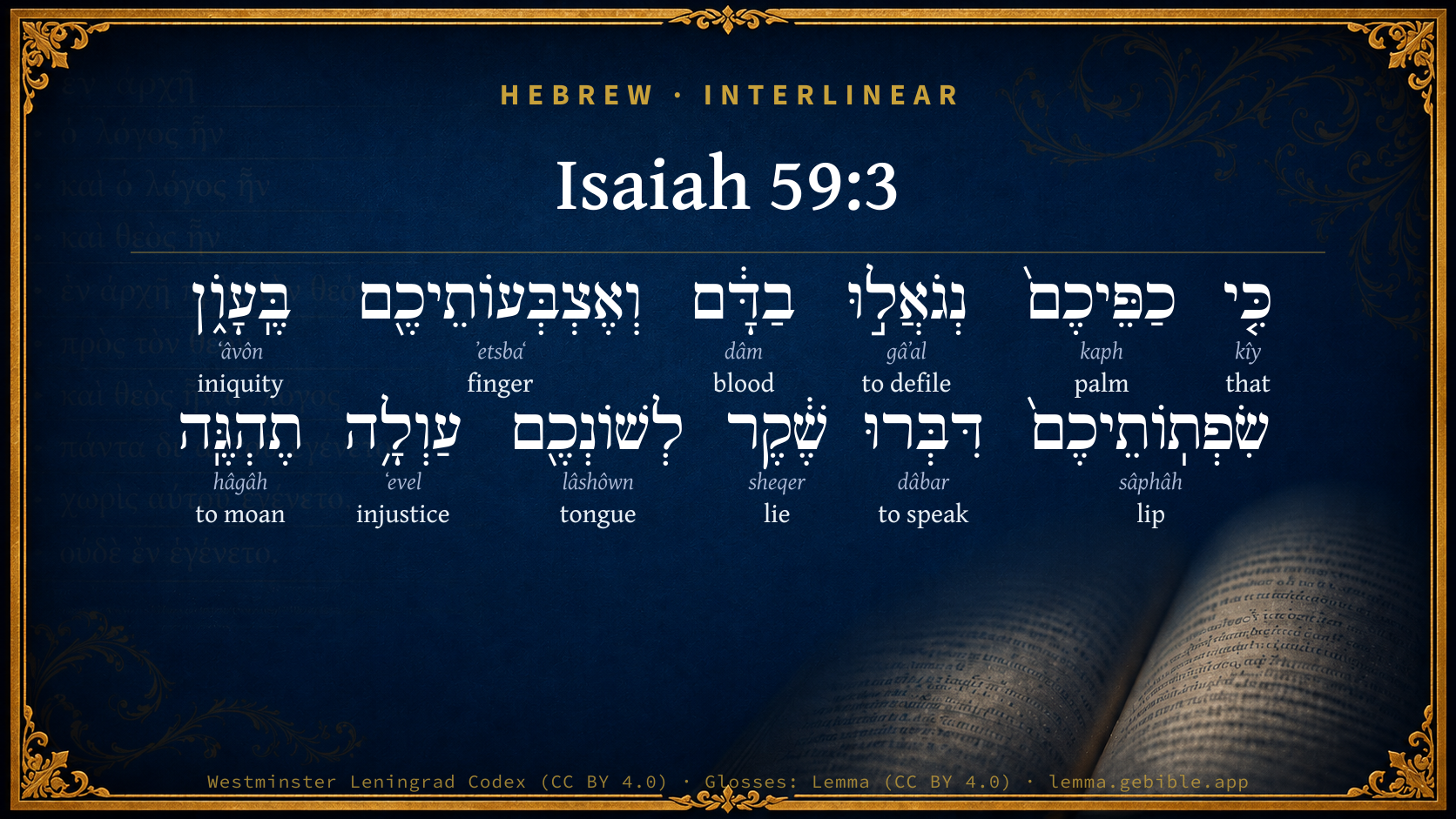
Hebrew (Westminster Leningrad Codex) Isaiah 59:3 appears in the Hebrew Old Testament. The text above is from the Westminster Leningrad Codex. Each word links to its Strong’s number, a concise gloss, and parsing drawn from the Open Scriptures Hebrew Bible morphology. Click any word for its full Brown-Driver-Briggs (BDB) entry.
Download image
Cite this verse

Isaiah 59:3 (World English Bible). Public Domain. Lemma interlinear Bible study tool, https://lemma.gebible.app/v/isaiah/59/3.

Show BibTeX & RIS
BibTeX
RIS
English Translation
For your hands are defiled with blood, and your fingers with iniquity; your lips have spoken lies, your tongue mutters wickedness.
World English Bible · Public Domain
Download a study sheet

One document with this verse’s original text, its word-by-word gloss line, the meaning frame, cross-references with their text, attributed commentary, and full source and license credits — printable, and it pastes into notes with its structure intact.

This verse Autodidact and up

Study sheet (.html) Plain text (.txt)

A passage Seminary Student

Up to 50 verses in one chapter. A passage sheet keeps up to 6 commentary sources and 12 cross-references per verse, in the order this page ranks them, and says so on the sheet whenever that leaves anything out. Ask for a single verse and you get the Autodidact verse sheet above.

Everything on this page stays free to read, with no account — the sheet is a download of what is already on screen, not access to it.

Want to remove ads? Support Godless Engineer
Compare translations 3

The same verse in 3 English versions, stacked beneath the original-language interlinear above. Click any original word for its lexicon entry.

Each is an independent rendering of the whole verse — the interlinear is not word-aligned to these translations.

Highlighted words mark where these versions differ — a whole-verse word diff, not a word-by-word alignment.

  • World English Bible Public Domain
    For your hands are defiled with blood, and your fingers with iniquity; your lips have spoken lies, your tongue mutters wickedness.
  • King James Version Public Domain
    For your hands are defiled with blood, and your fingers with iniquity; your lips have spoken lies, your tongue hath muttered perverseness.
  • unfoldingWord Literal Text CC BY-SA 4.0
    For your palms are stained with blood, and your fingers, with iniquity. Your lips have spoken falsehood; your tongue murmurs wickedness.

unfoldingWord Literal Text — © unfoldingWord, licensed CC BY-SA 4.0. Word-aligned USFM3 via Door43 (git.door43.org/unfoldingWord/en_ult).

Versions to compare (up to 4)

3 of 4 selected

Show all 18 translations

Every available English version of this verse, each an independent rendering of the whole verse.

  • World English Bible Public Domain
    For your hands are defiled with blood, and your fingers with iniquity; your lips have spoken lies, your tongue mutters wickedness.
  • Berean Standard Bible Public Domain
    For your hands are stained with blood, and your fingers with iniquity; your lips have spoken lies, and your tongue mutters injustice.
  • Majority Standard Bible Public Domain
    For your hands are stained with blood, and your fingers with iniquity; your lips have spoken lies, and your tongue mutters injustice.
  • King James Version Public Domain
    For your hands are defiled with blood, and your fingers with iniquity; your lips have spoken lies, your tongue hath muttered perverseness.
  • American Standard Version (1901) Public Domain
    For your hands are defiled with blood, and your fingers with iniquity; your lips have spoken lies, your tongue muttereth wickedness.
  • Revised Version (1885) Public Domain
    For your hands are defiled with blood, and your fingers with iniquity; your lips have spoken lies, your tongue muttereth wickedness.
  • Geneva Bible (1599) Public Domain
    For your handes are defiled with blood, and your fingers with iniquitie: your lips haue spoken lies and your tongue hath murmured iniquitie.
  • Douay-Rheims (1899) Public Domain
    For your hands are defiled with blood, and your fingers with iniquity: your lips have spoken lies, and your tongue uttereth iniquity.
  • Young's Literal Translation Public Domain
    For your hands have been polluted with blood, And your fingers with iniquity, Your lips have spoken falsehood, Your tongue perverseness doth mutter.
  • Literal Standard Version CC BY-SA 4.0
    For your hands have been defiled with blood, || And your fingers with iniquity, || Your lips have spoken falsehood, || Your tongue mutters perverseness.
  • Unlocked Literal Bible CC BY-SA 4.0
    For your hands are stained with blood and your fingers with sin. Your lips speak lies and your tongue speaks maliciously.
  • unfoldingWord Literal Text CC BY-SA 4.0
    For your palms are stained with blood, and your fingers, with iniquity. Your lips have spoken falsehood; your tongue murmurs wickedness.
  • Darby Bible Public Domain
    For your hands are stained with blood, and your fingers with iniquity; your lips speak lies, your tongue muttereth unrighteousness:
  • World Messianic Bible Public Domain
    For your hands are defiled with blood, and your fingers with iniquity. Your lips have spoken lies. Your tongue mutters wickedness.
  • Webster's Bible Public Domain
    For your hands are defiled with blood, and your fingers with iniquity; your lips have spoken lies, your tongue hath uttered perverseness.
  • Free Bible Version CC BY-SA 4.0
    Your hands are covered in blood and your fingers tainted with guilt, your lips speak lies and your mouth whispers evil things.
  • Bible in Basic English Public Domain
    For your hands are unclean with blood, and your fingers with sin; your lips have said false things, and your tongue gives out deceit.
  • JPS Tanakh (1917) Public Domain
    For your hands are defiled with blood, and your fingers with iniquity; your lips have spoken lies, your tongue muttereth wickedness.

Literal Standard Version (2020), Covenant Press — licensed CC BY-SA 4.0. Text via the HelloAO Bible API (eBible.org). Unlocked Literal Bible (unfoldingWord) — licensed CC BY-SA 4.0. Text via the HelloAO Bible API (eBible.org). unfoldingWord Literal Text — © unfoldingWord, licensed CC BY-SA 4.0. Word-aligned USFM3 via Door43 (git.door43.org/unfoldingWord/en_ult). Free Bible Version, Dr. Jonathan Gallagher — licensed CC BY-SA 4.0. Text via the HelloAO Bible API (eBible.org).

Word by word

More ways to search: Search by grammar → Find every occurrence → Compare this word →

Practice this passage: Drill this verse → Learn its vocabulary →

נְגֹאֲל֣וּ
gâʼal
H1351
“to defile”
Verb, Niphal, Perfect, 3rd Person, Common, Plural
Part of Speech
Verb
Stem
Niphal
Form
Perfect
Person
3rd Person
Gender
Common
Number
Plural
Full BDB Definition

Origin: a primitive root

TWOT: 301

to defile, pollute, desecrate - (Niphal) to be defiled, be polluted - (Piel) to pollute, desecrate - (Pual) to be desecrated (of removal from priesthood) - (Hiphil) to pollute, stain - (Hithpael) to defile oneself
  1. כִּ֤י kîy H3588 “that” Conjunction
  2. כַפֵּיכֶם֙ kaph H3709 “palms · your” Noun, Common, Feminine, Dual, Construct + Suffix, Personal, 2nd Person, Masculine, Plural
  3. בַדָּ֔ם dâm H1818 “in/at the · blood” Preposition, Determined + Noun, Common, Masculine, Singular, Absolute
  4. וְאֶצְבְּעוֹתֵיכֶ֖ם ʼetsbaʻ H676 “and · fingers · your” Conjunction + Noun, Common, Feminine, Plural, Construct + Suffix, Personal, 2nd Person, Masculine, Plural
  5. בֶּֽעָוֺ֑ן ʻâvôn H5771 “in/at the · iniquity” Preposition, Determined + Noun, Common, Both, Singular, Absolute
  6. שִׂפְתֽוֹתֵיכֶם֙ sâphâh H8193 “lips · your” Noun, Common, Feminine, Plural, Construct + Suffix, Personal, 2nd Person, Masculine, Plural
  7. דִּבְּרוּ dâbar H1696 “to speak” Verb, Piel, Perfect, 3rd Person, Common, Plural
  8. שֶׁ֔קֶר sheqer H8267 “lie” Noun, Common, Masculine, Singular, Absolute
  9. לְשׁוֹנְכֶ֖ם lâshôwn H3956 “tongue · your” Noun, Common, Both, Singular, Construct + Suffix, Personal, 2nd Person, Masculine, Plural
  10. עַוְלָ֥ה ʻevel H5766 “injustice” Noun, Common, Both, Singular, Absolute
  11. תֶהְגֶּֽה hâgâh H1897 “to moan” Verb, Qal, Imperfect, 3rd Person, Feminine, Singular

About this verse

These counts appear in no published source. They are computed here, from the morphology-tagged text and Lemma’s own curated glosses. What Lemma adds →

12
words
12
distinct lemmas
Prophets
section

Notable vocabulary

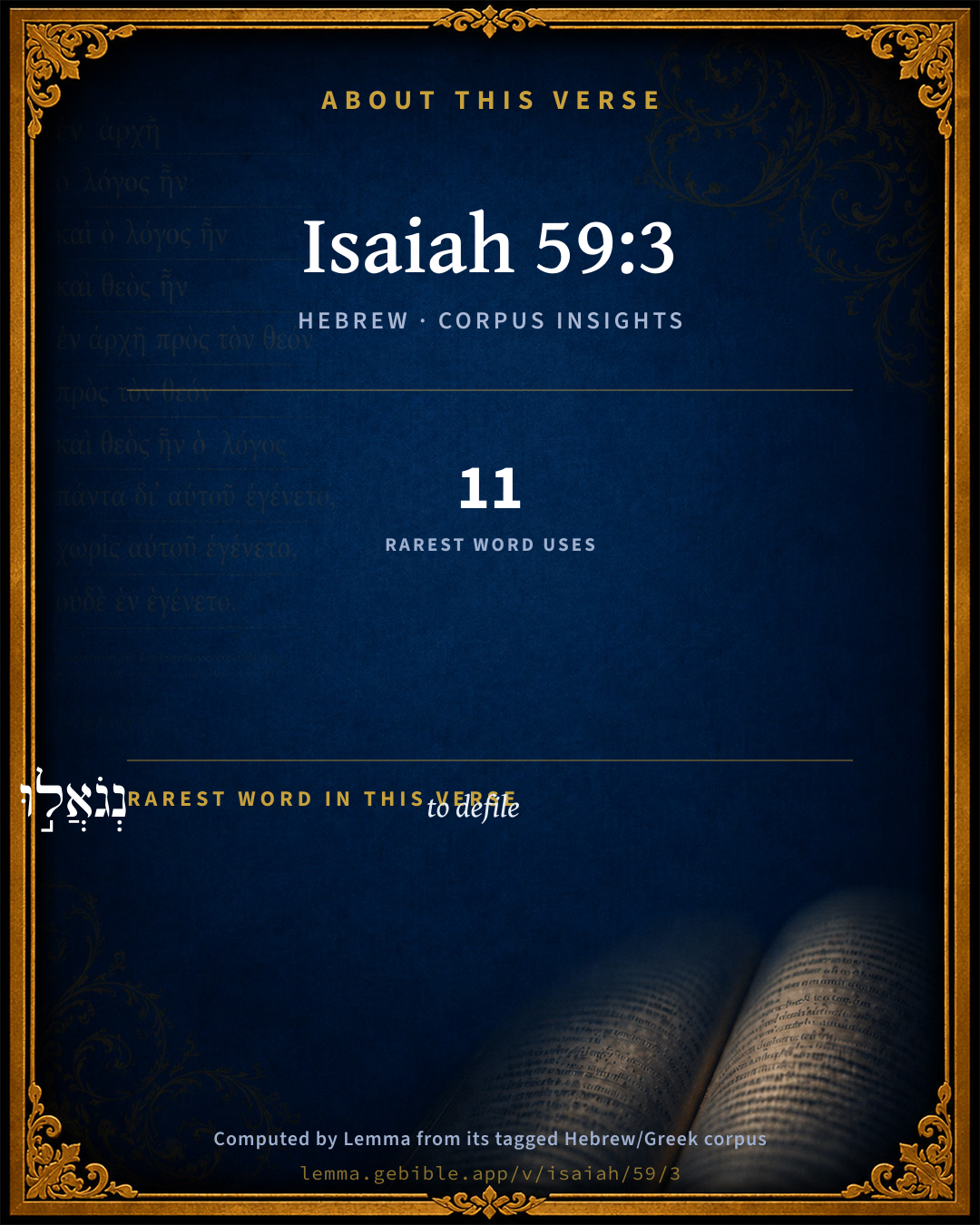
The rarest word here is נְגֹאֲל֣וּ to defile H1351 — appearing just 11 times in the whole Hebrew Bible.

Shared distinctive vocabulary

נְגֹאֲל֣וּ to defile H1351 occurs in 9 verses of the Hebrew Bible. Also found in:

Grammatical profile

  • 3 verbs
  • 8 nouns
  • 1 conjunction

Verb forms

  • נְגֹאֲל֣וּ Niphal · Perfect
  • דִּבְּרוּ Piel · Perfect
  • תֶהְגֶּֽה Qal · Imperfect

Hebrew & Septuagint length

In English translation the verse runs 21 words from the Hebrew and 23 from the Septuagint (LXX English) — closely comparable.

A rough comparison of the two English renderings, which tokenize alike — not a word-level alignment.

Word counts can differ between the Hebrew and the Greek without any difference in meaning — e.g. the Hebrew direct-object marker אֵת has no separate Greek word, and Greek often adds the article ὁ.

Cross-references

20

Topical passages linked to Isaiah 59:3 in the Treasury of Scripture Knowledge — connected by theme and wording, ordered by reader-vote popularity; previews shown in the World English Bible.

  • Isaiah 1:15 When you spread forth your hands, I will hide my eyes from you; Yes, when you make many prayers, I will not hear. Your hands are full of blood.
  • Ezekiel 13:8 Therefore thus says the Lord Yahweh: Because you have spoken falsehood, and seen lies, therefore, behold, I am against you, says the Lord Yahweh.
  • Jeremiah 2:34 Also in your skirts is found the blood of the souls of the innocent poor: you did not find them breaking in; but it is because of all these things.
  • Isaiah 1:21 How the faithful city has become a prostitute! She was full of justice; righteousness lodged in her, But now murderers.
  • Jeremiah 2:30 In vain have I struck your children; they received no correction: your own sword has devoured your prophets, like a destroying lion.
  • Jeremiah 7:8 Behold, you trust in lying words, that can't profit.
  • Ezekiel 7:23 Make the chain; for the land is full of bloody crimes, and the city is full of violence.
  • Ezekiel 9:9 Then said he to me, The iniquity of the house of Israel and Judah is exceeding great, and the land is full of blood, and the city full of wrestling [of judgment]: for they say, Yahweh has forsaken the land, and Yahweh doesn't see.
  • Ezekiel 35:6 therefore, as I live, says the Lord Yahweh, I will prepare you to blood, and blood shall pursue you: since you have not hated blood, therefore blood shall pursue you.
  • Hosea 4:2 There is cursing, lying, murder, stealing, and committing adultery; They break boundaries, and bloodshed causes bloodshed.
  • Hosea 7:13 Woe to them! For they have wandered from me. Destruction to them! For they have trespassed against me. Though I would redeem them, Yet they have spoken lies against me.
  • Micah 6:12 Her rich men are full of violence, Her inhabitants speak lies, And their tongue is deceitful in their speech.
  • Micah 7:2 The godly man has perished out of the earth, And there is no one upright among men. They all lie in wait for blood; Every man hunts his brother with a net.
  • Jeremiah 9:3–6 They bend their tongue, [as it were] their bow, for falsehood; and they are grown strong in the land, but not for truth: for they proceed from evil to evil, and they don't know me, says Yahweh.
  • Jeremiah 22:17 But your eyes and your heart are not but for your covetousness, and for shedding innocent blood, and for oppression, and for violence, to do it.
  • Ezekiel 22:2 You, son of man, will you judge, will you judge the bloody city? then cause her to know all her abominations.
  • Hosea 7:3 They make the king glad with their wickedness, And the princes with their lies.
  • Micah 3:10–12 They build up Zion with blood, And Jerusalem with iniquity.
  • Matthew 27:4 saying, "I have sinned in that I betrayed innocent blood." But they said, "What is that to us? You see to it."
  • 1 Timothy 4:2 through the hypocrisy of men who speak lies, branded in their own conscience as with a hot iron;

Cross-references courtesy of OpenBible.info (CC BY 4.0).

Hebrew and Greek witnesses Masoretic Hebrew ↔ Greek Septuagint

The same verse in the two great witnesses to the Old Testament, shown verse-for-verse.

These are two independent witnesses, not word-aligned to each other, and the Septuagint is shown in lemma (dictionary) form.

Hebrew Isaiah 59:3 Masoretic · Westminster Leningrad Codex

כִּ֤י כַפֵּיכֶם֙ נְגֹאֲל֣וּ בַדָּ֔ם וְאֶצְבְּעוֹתֵיכֶ֖ם בֶּֽעָוֺ֑ן שִׂפְתֽוֹתֵיכֶם֙ דִּבְּרוּ שֶׁ֔קֶר לְשׁוֹנְכֶ֖ם עַוְלָ֥ה תֶהְגֶּֽה

For your hands are defiled with blood, and your fingers with iniquity; your lips have spoken lies, your tongue mutters wickedness.

World English Bible · Public Domain

Greek LXX Isaiah 59:3 Septuagint · lemma form

ὁ γάρ χείρ σύ μολύνω αἷμα καί ὁ δάκτυλος σύ ἐν ἁμαρτία ὁ δέ χεῖλος σύ λαλέω ἀνομία καί ὁ γλῶσσα σύ ἀδικία μελετάω

For your hands are defiled with blood, and your fingers with sins; your lips also have spoken iniquity, and your tongue meditates unrighteousness.

LXX2012 (modern English Septuagint) · Public Domain

On this verse, Adam Clarke's Commentary discusses the Septuagint’s reading. Read the note in Commentary ↓

Hebrew: Westminster Leningrad Codex (CC BY 4.0). Greek: Septuagint (public domain); English from LXX2012 (modern English Septuagint) (Public Domain). How the Septuagint differs from the Hebrew →

Targum (Aramaic paraphrase)

1

The Targum is the ancient Jewish Aramaic paraphrase of the Hebrew Scriptures — an interpretive translation, not the Hebrew text itself. Onkelos (literal) and Pseudo-Jonathan (expansive) render the Torah, and Jonathan the Prophets. Coverage is partial: where no permissively-licensed English translation exists for a verse, only the Aramaic is shown. This is verse-level text, not a word-by-word alignment to the Hebrew.

  1. Targum Jonathan Prophets (Joshua–Malachi)
    אֲרֵי יְדֵיכוֹן שׁוּטְפִין בְּדַם זַכַּאי וְאֶצְבְּעַתְכוֹן בְּחוֹבִין סִפְוַתְכוֹן מְמַלְלִין שְׁקַר לִישַׁנְכוֹן נִכְלִין מְחַשֵׁב:

    For your hands are associated with innocent blood, and your fingers with iniquity; your lips speak lies, your tongue muttereth deceit.

    Targum Jonathan — Aramaic: “Mikraot Gedolot” (public domain). English: “Sefaria Community Translation” (CC0 1.0 (public-domain dedication)); “London "Chaldee Paraphrase," 1871” (public domain). Text via Sefaria.

Commentary

Notes on Isaiah 59:3 from classic Christian and Jewish commentators (each source and its license shown beneath its notes). The classic Christian expositions comment on the surrounding passage and are grouped to its opening verse, so a note may address several verses; the Jewish commentaries on the Tanakh (Rashi and others) are per-verse, so they appear only where the commentator wrote on this verse.

Lemma curates 59 commentaries, every one of them public domain or Creative Commons licensed, each selected and text-cleaned for this edition rather than reprinted as found. About our sources →

Trapp's Complete Commentary

John Trapp

Isa 59:3 For your hands are defiled with blood, and your fingers with iniquity; your lips have spoken lies, your tongue hath muttered perverseness.

Ver. 3. For your hands are defiled with blood.] The prophet well knew that these perverse Jews would stand upon their justification, and put God to his proofs, as their posterity also did, {Jer 2:35} catalogum ergo bene longum texit; therefore he here brings in a long bead roll of their sins, wherein their hands, lips, heart, feet, &c., were found guilty of high offence. See Isa 1:15.

Your lips have spoken lies.] Those very "lips" of yours that have uttered prayers, have muttered lies. See Jas 3:10.

And your tongue hath muttered perverseness.] How this was done, none hath better set forth than the prophet Jeremiah {Jer 9:3-8}

John Trapp, A Commentary or Exposition upon All the Books of the Old and New Testament (1647–1656) — public domain. Text from a community e-Sword module.

Joseph Benson's Commentary

Isa 59:3. Your hands are defiled with blood — Here the prophet proceeds from a more general to a more particular charge against them. By blood, we are to understand, either murders and bloodshed, properly so called, or ways of injustice, extortion, oppression, and cruelties, whereby men are deprived of a livelihood: hence, hating our brother is called murder, 1Jn 3:15, and the inhabitants of Jerusalem murderers, Isa 1:21. And your fingers with iniquity — This is added to aggravate their sin; as if he had said, Not only your hands, but your fingers are defiled, and not the least part of you is free from injustice. Your lips have spoken lies — Not only properly so called, but perjuries, slanders, and false accusations: you have not only offered violence to your neighbours by your hands, but circumvented them by your lips. Your tongue hath muttered perverseness — Perverse words, or such as were contrary to God’s word and will. When they could not, for shame, utter their malice against their neighbours aloud, nor dared to do it for fear of being convicted of falsehood, and put to confusion, they muttered it secretly.

Joseph Benson's Commentary on the Old and New Testaments (1811–1818) — public domain. Text from a community e-Sword module.

Geneva Bible (1599)

Geneva Bible translators

Read Isa. 1:15.

Geneva Bible (1599) marginal notes — public domain. Text via Bolls.life.

Jamieson, Fausset & Brown

Robert Jamieson, A. R. Fausset & David Brown

(Isa 1:15; Rom 3:13-15).

hands . . . fingers--Not merely the "hands" perpetrate deeds of grosser enormity ("blood"), but the "fingers" commit more minute acts of "iniquity."

lips . . . tongue--The lips "speak" openly "lies," the tongue "mutters" malicious insinuations ("perverseness"; perverse misrepresentations of others) (Jer 6:28; Jer 9:4).

Jamieson, Fausset & Brown — Commentary Critical and Explanatory on the Whole Bible (1871) — public domain (CC PDM 1.0). Text via the HelloAO Bible API.

Adam Clarke's Commentary

Verse 3. Your tongue - "And your tongue"] An ancient MS., and the Septuagint and Vulgate, add the conjunction.

Adam Clarke's Commentary on the Bible (1810–1826) — public domain. Text from a community e-Sword/MySword module.

Ellicott's Commentary for English Readers

(3) Your hands are defiled with blood.—The accusation of the “grand indictment” of Isa_1:15 is reproduced verbatim.

A Bible Commentary for English Readers, edited by Charles John Ellicott (1878–1897) — public domain. Text from a community e-Sword module.

The Cambridge Bible for Schools and Colleges

gen. ed. J. J. S. Perowne

3. your hands are defiled with blood] Cf. ch. Isa_1:15.

hath uttered] Better muttereth (as R.V.).

The Cambridge Bible for Schools and Colleges (gen. ed. J. J. S. Perowne; Cambridge University Press, 1878–1918) — public domain. Text from a community e-Sword module.

John Gill's Exposition

For your hands are defiled with blood, and your fingers with iniquity,.... From a general charge, the prophet proceeds to a particular enumeration of sins they were guilty of; and idolatry not being mentioned, as Jerom observes, shows that the prophecy belongs to other times than Isaiah's, when that sin greatly prevailed. He begins the account with the sin of shedding blood; the blood of innocents, as the Targum; designing either the sin of murder, now frequently committed in Christian nations; or wars between Christian princes, by means of which much blood is shed; or persecutions of Christian brethren, by casting them into prisons, which have issued in their death; and at least want of brotherly love, or, the hatred of brethren, which is called murder, Jo1 3:15 a prevailing sin in the present Sardian state; and which will not be removed till the spiritual reign or Philadelphian state takes place: and this sin is of a defiling nature; it "defiles" the "hands" or actions; and without love all works signify nothing, Co1 13:1, yea, even their "fingers" are said to be defiled "with iniquity"; meaning either their lesser actions; or rather those more curiously and nicely performed, and seemingly more agreeable to the divine will; and yet defiled with some sin or other, as hypocrisy, vain glory, or the like: or it may be this may design the same as putting forth the fingers, and smiting with the fist, Isa 58:4, as Kimchi and Ben Melech observe; and so may have respect to some sort of persecution of their brethren for conscience sake, as there.

Your lips have spoken lies: or "falsehood" (q); that is, false doctrines, so called because contrary to the word of truth, and which deceive men:

your tongue hath muttered perverseness: that which is a perversion of the Gospel of Christ, and of the souls of men; what is contrary to the sacred Scriptures, the standard of faith and practice, and that premeditated, as the word (r) signifies; done with design, and on purpose: the abounding of errors and heresies in the present day, openly taught and divulged, to the ruin of souls, seems here to be pointed at. In the Talmud (s) these are explained of the several sorts of men in a court of judicature; the "hands" of the judges; the "fingers" of, the Scribes; the "lips" of advocates and solicitors; and the "tongue" of adversaries, or the contending parties.

(q) "falsitatem", Montanus, Cocceius; "falsum", Junius & Tremeliius, Piscator. (r) Sept.; "meditabitur", Montanus; "meditatur", Piscator; "meditatam effert", Junius & Tremellius. (s) T. Bab. Sabbat. fol. 139. 1.

John Gill's Exposition of the Whole Bible (1746–1763) — public domain (CC PDM 1.0). Text via the HelloAO Bible API.

Albert Barnes' Notes on the Bible

For your hands are defiled with blood - The prophet proceeds here more particularly to specify the sins of which they were guilty; and in order to show the extent and depth of their depravity, he specifies the various members of the body - the hands, the fingers, the lips, the tongue, the feet as the agents by which people commit iniquity. See a similar argument on the subject of depravity in Rom 3:13-15, where a part of the description which the prophet here gives is quoted by Paul, and applied to the Jews in his own time. The phrase ‘your hands are defiled with blood,’ means with the blood of the innocent; that is, they were guilty of murder, oppression, and cruelty. See a similar statement in Isa 1:15, where the phrase ‘your hands are full of blood’ occurs. The word rendered here ‘defiled’ (גאל gā'al) means commonly to redeem, to ransom; then to avenge, or to demand and inflict punishment for bloodshed. In the sense of defiling it occurs only in the later Hebrew writers - perhaps used in this sense because those who were avengers became covered, that is, defiled with blood.

And your fingers with iniquity - The fingers in the Scriptures are represented as the agents by which any purpose is executed Isa 2:8, ‘Which their own fingers have made’ (compare Isa 17:8). Some have supposed that the phrase used here means the same as the preceding, that they were guilty of murder and cruelty. But it seems more probable that the idea suggested by Grotius is the true sense, that it means that they were guilty of rapine and theft. The fingers are the instruments by which theft - especially the lighter and more delicate kinds of theft - is executed. Thus we use the word ‘light-fingered’ to denote anyone who is dexterous in taking and conveying away anything, or anyone who is addicted to petty thefts.

Your lips have spoken lies - The nation is false, and no confidence can be reposed in the declarations which are made.

Your tongue hath muttered - On the word rendered ‘muttered’ (הגה hâgâh), see the notes at Isa 8:19. Probably there is included in the word here, the idea that they not only spoke evil, but that they did it with a complaining, discontented, or malicious spirit. It may also mean that they calumniated the government of God, and complained of his laws; or it may mean, as Grotius supposes, that they calumniated others - that is, that slander abounded among them.

Perverseness - Hebrew, עולה ‛avlâh - ‘Evil ‘ - the word from which our word evil is derived.

Albert Barnes' Notes on the Bible (1834–1885) — public domain. Text from a community e-Sword/MySword module.

Matthew Poole's English Annotations

Your hands are defiled with blood: here the prophet comes from a more general to a more particular charge against them; by blood we are to understand either murders and bloodshed properly so called; or ways of injustice, extortion, oppression, and cruelties, whereby men are deprived of a livelihood; hence hating our brother is called murder, 1Jo 3:15, and the inhabitants of Jerusalem called murderers. See how the prophet phraseth their oppression, Mic 3:1-3.

Your fingers: this is not added to protract the discourse, but to aggravate their sin: q.d. Not only your hands, but your fingers; you are not free from the least part of injustice.

Your lips have spoken lies; not only properly so called, but perjuries, and wronging’ your neighbours by slanders and false accusations; wherein he shows they did not only offer violence by the hand, but they had ways of circumventing with their lips.

Your tongue hath muttered: the verb doth properly signify to muse, or meditate; then the meaning is, that what they mutter, or utter with the tongue, they do it out of premeditated malice, from a perverse spirit; you may have a larger comment upon this Jer 9:3-6.

Perverseness: perverse words are such as are contrary to God’s word, and it is put here in the abstract, to intimate that their words were every way contrary to God’s will.

Matthew Poole's English Annotations on the Holy Bible (1683–1685) — public domain. Text from a community e-Sword/MySword module.

Whedon's Commentary on the Bible

Daniel D. Whedon

3, 4. Hands… fingers… lips — The sins of Israel are sins of deed and word, by which accusation is to be found in every organ.

Daniel D. Whedon (gen. ed.), Commentary on the Old and New Testaments (1874–1909) — public domain. Text from a community e-Sword module.

The Pulpit Commentary

Your hands are defiled with blood. (comp. Isa_1:15, Isa_1:21) (On the "innocent blood" shed by the Jews of the later Judaean kingdom, see 2Ki_21:6, 16 24:4 25:25 2Ch_24:21 2Ch_28:3 2Ch_33:6 2Ch_36:16, etc.) It consisted in

(1) sacrifices of children to Moloch;

(2) persecution of prophets; and

(3) judicial murders, either actual (like that of Naboth, in Israel) or virtual, i.e. such perversion of justice as produced general poverty and misery, and tended to shorten men"s lives. (see the comment on Isa_1:15) Your lips have spoken lies. (comp. Isa_32:7) The wicked oppressors "devised wicked devices to destroy the poor with lying words."

The Pulpit Commentary (1880–1919), ed. H.D.M. Spence-Jones & Joseph S. Exell — public domain. Text from a community e-Sword module.

John Wesley's Explanatory Notes

Perverseness - Perverse words are such as are contrary to God's word. Words every way contrary to God's will.

John Wesley, Explanatory Notes Upon the Whole Bible (1754–1765) — public domain. Text via the GEBible commentary corpus.

Keil & Delitzsch

C. F. Keil & F. Delitzsch

The sins of Israel are sins in words and deeds. "For your hands are defiled with blood, and your fingers with iniquity; your lips speak lies, your tongue murmurs wickedness." The verb גּאל, to spot (see Isa 63:3), is a later softening down of גּעל (e.g., Sa2 1:21); and in the place of the niphal נגאל (Zep 3:1), we have here, as in Lam 4:14, the double passive form נגאל, compounded of niphal and pual. The post-biblical nithpal, compounded of the niphal and the hithpael, is a mixed form of the same kind, though we also meet with it in a few biblical passages (Deu 21:8; Pro 27:15; Eze 23:48). The verb hâgâh (lxx μελετᾶ) combines the two meanings of "thought" (meditation or reflection), and of a light low "expression," half inward half outward.

Keil & Delitzsch — Biblical Commentary on the Old Testament (1861–1891) — public domain (CC PDM 1.0). Text via the HelloAO Bible API. (Old Testament only.)

J. A. Alexander on Isaiah

Joseph Addison Alexander

“For your hands are defiled with blood, and your fingers with iniquity; your lips have spoken falsehood, your tongue will utter wickedness.” The Prophet now, according to a common usage of the Scriptures, classifies the prevalent iniquities as sins of the hands, the mouth, the feet, as if to intimate that every member of the social body was affected. On the staining of the hands with blood, see above, Isa 1:15. The preterit and future forms describe the evil as habitual, and ought to be retained in the translation, were it only for the purpose of exhibiting the characteristic form of the original. The wide meaning of the whole description is evident from Paul’s combining parts of it with phrases drawn from several Psalms remarkably resembling it, in proof of the depravity of human nature (Rom 3:15-17).

Joseph Addison Alexander, The Prophecies of Isaiah (1846–1847; New York: Scribner, 1870–1878) — public domain. Text from a community e-Sword module.

unfoldingWord translationNotes

Door43 World Missions Community

General Information:

Isaiah continues speaking to the people of Israel.

For your hands are stained with blood and your fingers with sin

Here "hands" and "fingers" refers to their actions. This means they are guilty of doing violent and sinful things. "Your" is plural. AT: "For you have committed violent sins" (See: Metonymy and Forms of You)

Your lips speak lies and your tongue speaks maliciously

The parts of the body that make speech represent what people say. AT: "You speak lies and malicious things" (See: Metonymy)

they conceive trouble and give birth to sin

"Conceiving" and "giving birth" emphasize how carefully they plan to do sinful things. Here "they" still refers to the people of Israel. AT: "they work hard to do sinful things" (See: Metaphor)

translationWords

hand

blood

sin

tongue

call

righteous

true

trust

word

trouble

unfoldingWord translationNotes — © Distant Shores Media and the Door43 World Missions Community, licensed CC BY-SA 4.0. Source: git.door43.org/Door43/en_tn.

Rashi

Rabbi Shlomo Yitzchaki (Rashi)

were defiled Heb. נְגֹאֲלוּ, an expression of defilement. Comp. (Mal. 1:7) “polluted bread (מְגֹאָל).”

Rashi on the Tanakh — English translations: “The Judaica Press complete Tanach with Rashi, translated by A. J. Rosenberg” (CC BY 4.0); “Pentateuch with Rashi's commentary by M. Rosenbaum and A.M. Silbermann, 1929-1934” (public domain); “The Metsudah Tanach series, Lakewood, N.J” (CC BY 4.0); and “The Book of Joshua, Metsudah Publications, 1997” (CC BY 4.0). Text via Sefaria.

Ibn Ezra

Rabbi Abraham ibn Ezra

נגאלו Are defiled. The grammatical form of the word is a compound of the Niphal and Pual.

With blood. With murder.

Your fingers with iniquity, that is, with dishonesty.

Your lips, etc. Your deeds and words are equally bad.

Ibn Ezra on the Tanakh — English translations: “Sefaria Community Translation” (CC0 1.0 (public-domain dedication)); “Yalkut, Sifsei Chachomim Chumash, Metsudah Publications, 2009” (CC BY 4.0); and “Commentary of Ibn Ezra on Isaiah - trans. by M. Friedlander, 1873” (public domain). Text via Sefaria.

Lesson kit

Teaching starters — assembled from the data on this page, not authored interpretation. Every prompt links to the verse data it draws on. Edit before teaching.

Isaiah, in the Prophets, opens this verse with 12 words (12 distinct Hebrew lemmas). Its most distinctive word is gâʼal (“to defile”). A historical commentator’s framing appears above. Read the whole chapter for the surrounding context.

Discussion questions

  1. The word gâʼal carries the sense “to defile.” How does it shape the verse?
  2. Ezra 2:62 shares the word «to defile» with this verse. How do the two illuminate each other?
  3. These translations render this verse differently. What is at stake in choosing one wording over another?
  4. The verb «נְגֹאֲל֣וּ» is Niphal Perfect. How does its form color the action?
  5. Reading how Trapp's Complete Commentary and Joseph Benson's Commentary read this verse, where do the two commentators agree and where do they part?

Things to notice

Reading settings

Reading text

Shown beneath each verse's original-language words.

Old Testament
Old Testament edition

Read the OT as the Masoretic Hebrew (MT) or the Greek Septuagint (LXX).

English shown for the Greek Septuagint (in the Hebrew ↔ Greek comparison).

Comparing translations? Open the Compare panel on any verse page to stack up to four side by side.