Nehemiah 4:5

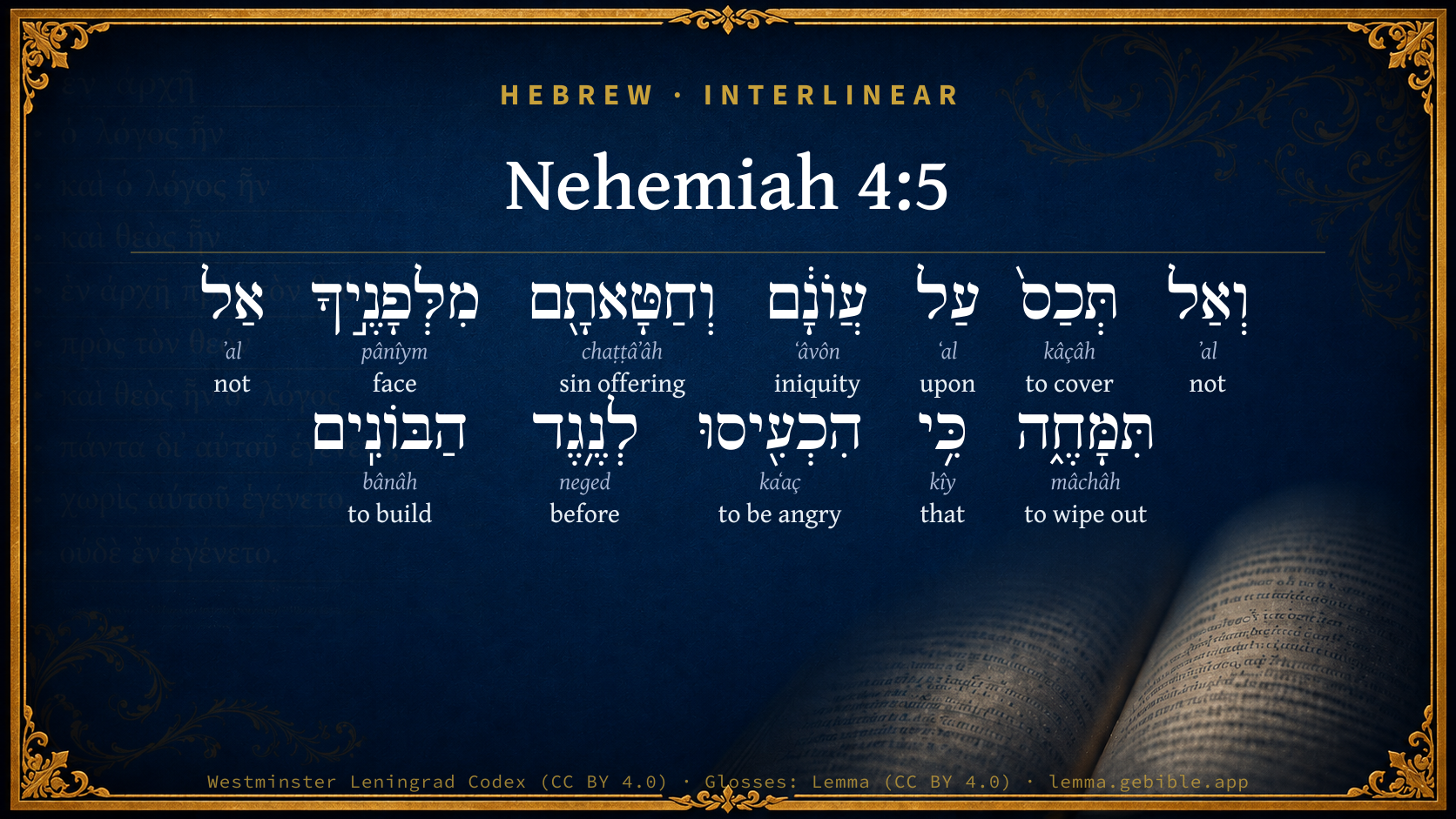
Hebrew (Westminster Leningrad Codex) Nehemiah 4:5 appears in the Hebrew Old Testament. The text above is from the Westminster Leningrad Codex. Each word links to its Strong’s number, a concise gloss, and parsing drawn from the Open Scriptures Hebrew Bible morphology. Click any word for its full Brown-Driver-Briggs (BDB) entry.
Download image
Cite this verse

Nehemiah 4:5 (World English Bible). Public Domain. Lemma interlinear Bible study tool, https://lemma.gebible.app/v/nehemiah/4/5.

Show BibTeX & RIS
BibTeX
RIS
English Translation
and don't cover their iniquity, and don't let their sin be blotted out from before you; for they have provoked [you] to anger before the builders.
World English Bible · Public Domain
Download a study sheet

One document with this verse’s original text, its word-by-word gloss line, the meaning frame, cross-references with their text, attributed commentary, and full source and license credits — printable, and it pastes into notes with its structure intact.

This verse Autodidact and up

Study sheet (.html) Plain text (.txt)

A passage Seminary Student

Up to 50 verses in one chapter. A passage sheet keeps up to 6 commentary sources and 12 cross-references per verse, in the order this page ranks them, and says so on the sheet whenever that leaves anything out. Ask for a single verse and you get the Autodidact verse sheet above.

Everything on this page stays free to read, with no account — the sheet is a download of what is already on screen, not access to it.

Want to remove ads? Support Godless Engineer
Compare translations 3

The same verse in 3 English versions, stacked beneath the original-language interlinear above. Click any original word for its lexicon entry.

Each is an independent rendering of the whole verse — the interlinear is not word-aligned to these translations.

Highlighted words mark where these versions differ — a whole-verse word diff, not a word-by-word alignment.

  • World English Bible Public Domain
    and don't cover their iniquity, and don't let their sin be blotted out from before you; for they have provoked [you] to anger before the builders.
  • King James Version Public Domain
    And cover not their iniquity, and let not their sin be blotted out from before thee: for they have provoked thee to anger before the builders.
  • unfoldingWord Literal Text CC BY-SA 4.0
    And do not cover over their iniquity, and do not wipe out their sin from before your face, for they have provoked anger before the front of the builders.

unfoldingWord Literal Text — © unfoldingWord, licensed CC BY-SA 4.0. Word-aligned USFM3 via Door43 (git.door43.org/unfoldingWord/en_ult).

Versions to compare (up to 4)

3 of 4 selected

Show all 18 translations

Every available English version of this verse, each an independent rendering of the whole verse.

  • World English Bible Public Domain
    and don't cover their iniquity, and don't let their sin be blotted out from before you; for they have provoked [you] to anger before the builders.
  • Berean Standard Bible Public Domain
    Do not cover up their iniquity or let their sin be blotted out from Your sight, for they have provoked the builders.
  • Majority Standard Bible Public Domain
    Do not cover up their iniquity or let their sin be blotted out from Your sight, for they have provoked the builders.
  • King James Version Public Domain
    And cover not their iniquity, and let not their sin be blotted out from before thee: for they have provoked thee to anger before the builders.
  • American Standard Version (1901) Public Domain
    and cover not their iniquity, and let not their sin be blotted out from before thee; for they have provoked `thee' to anger before the builders.
  • Revised Version (1885) Public Domain
    and cover not their iniquity, and let not their sin be blotted out from before thee: for they have provoked thee to anger before the builders.
  • Geneva Bible (1599) Public Domain
    And couer not their iniquitie, neither let their sinne be put out in thy presence: for they haue prouoked vs before the builders.
  • Douay-Rheims (1899) Public Domain
    Cover not their iniquity, and let not their sin be blotted out from before thy face, because they have mocked thy builders.
  • Young's Literal Translation Public Domain
    and do not cover over their iniquity, and their sin from before Thee let not be blotted out, for they have provoked to anger -- over-against those building.
  • Literal Standard Version CC BY-SA 4.0
    and do not cover over their iniquity, and do not let their sin be blotted out from before You, for they have provoked [You] to anger in front of those building.
  • Unlocked Literal Bible CC BY-SA 4.0
    Do not cover over their iniquity and do not erase their sin from before you, for they have provoked the builders to anger.
  • unfoldingWord Literal Text CC BY-SA 4.0
    And do not cover over their iniquity, and do not wipe out their sin from before your face, for they have provoked anger before the front of the builders.
  • Darby Bible Public Domain
    And cover not their iniquity, and let not their sin be blotted out from before thee; for they have provoked the builders.
  • World Messianic Bible Public Domain
    Don’t cover their iniquity. Don’t let their sin be blotted out from before you; for they have insulted the builders.”
  • Webster's Bible Public Domain
    And cover not their iniquity, and let not their sin be blotted out from before thee: for they have provoked thee to anger before the builders.
  • Free Bible Version CC BY-SA 4.0
    Don't forgive their guilt or blot out their sins, for they have made you angry in front of the builders.”
  • Bible in Basic English Public Domain
    Let not their wrongdoing be covered or their sin washed away from before you: for they have made you angry before the builders.
  • JPS Tanakh (1917) Public Domain
    (3-37) and cover not their iniquity, and let not their sin be blotted out from before Thee; for they have vexed Thee before the builders.

Literal Standard Version (2020), Covenant Press — licensed CC BY-SA 4.0. Text via the HelloAO Bible API (eBible.org). Unlocked Literal Bible (unfoldingWord) — licensed CC BY-SA 4.0. Text via the HelloAO Bible API (eBible.org). unfoldingWord Literal Text — © unfoldingWord, licensed CC BY-SA 4.0. Word-aligned USFM3 via Door43 (git.door43.org/unfoldingWord/en_ult). Free Bible Version, Dr. Jonathan Gallagher — licensed CC BY-SA 4.0. Text via the HelloAO Bible API (eBible.org).

Word by word

More ways to search: Search by grammar → Find every occurrence → Compare this word →

Practice this passage: Drill this verse → Learn its vocabulary →

תִּמָּחֶ֑ה
mâchâh
H4229
“to wipe out”
Verb, Niphal, Jussive, 3rd Person, Feminine, Singular
Part of Speech
Verb
Stem
Niphal
Form
Jussive
Person
3rd Person
Gender
Feminine
Number
Singular
Full BDB Definition

Origin: a primitive root

TWOT: 1178 , 1179 , 1181c

to wipe, wipe out - (Qal) - to wipe - to blot out, obliterate - to blot out, exterminate - (Niphal) - to be wiped out - to be blotted out - to be exterminated - (Hiphil) to blot out (from memory) - (Qal) to strike - (Pual) full of marrow (participle)
  1. וְאַל ʼal H408 “and · not” Conjunction + Particle, Negative
  2. תְּכַס֙ kâçâh H3680 “to cover” Verb, Piel, Jussive, 2nd Person, Masculine, Singular
  3. עַל ʻal H5921 “upon” Preposition
  4. עֲוֺנָ֔ם ʻâvôn H5771 “iniquity · their” Noun, Common, Both, Singular, Construct + Suffix, Personal, 3rd Person, Masculine, Plural
  5. וְחַטָּאתָ֖ם chaṭṭâʼâh H2403 “and · sin offering · their” Conjunction + Noun, Common, Feminine, Singular, Construct + Suffix, Personal, 3rd Person, Masculine, Plural
  6. מִלְּפָנֶ֣יךָ pânîym H6440 “from · to/for · face(s) · your” Preposition + Preposition + Noun, Common, Both, Plural, Construct + Suffix, Personal, 2nd Person, Masculine, Singular
  7. אַל ʼal H408 “not” Particle, Negative
  8. כִּ֥י kîy H3588 “that” Conjunction
  9. הִכְעִ֖יסוּ kaʻaç H3707 “to be angry” Verb, Hiphil, Perfect, 3rd Person, Common, Plural
  10. לְנֶ֥גֶד neged H5048 “to/for · before” Preposition + Preposition
  11. הַבּוֹנִֽים bânâh H1129 “the · building” Particle, Definite Article + Verb, Qal, Participle Active, Masculine, Plural, Absolute

About this verse

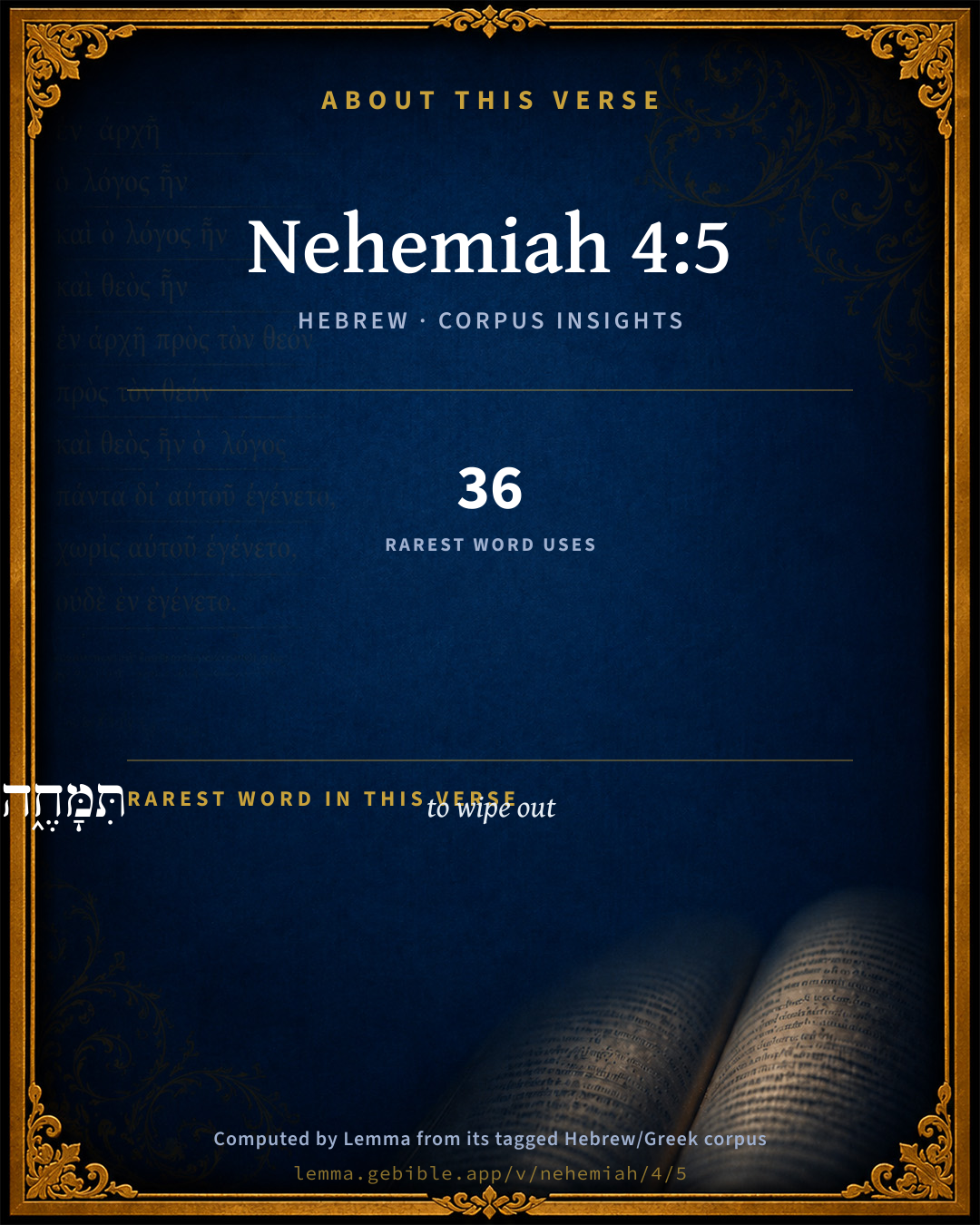
These counts appear in no published source. They are computed here, from the morphology-tagged text and Lemma’s own curated glosses. What Lemma adds →

12
words
11
distinct lemmas
Historical
section

Shared distinctive vocabulary

תִּמָּחֶ֑ה to wipe out H4229 occurs in 32 verses of the Hebrew Bible. Also found in:

Grammatical profile

  • 4 verbs
  • 3 nouns
  • 2 prepositions
  • 1 conjunction
  • 2 particles

Verb forms

  • תְּכַס֙ Piel · Jussive
  • תִּמָּחֶ֑ה Niphal · Jussive
  • הִכְעִ֖יסוּ Hiphil · Perfect
  • הַבּוֹנִֽים Qal · Participle Active

Repetition

A word recurs within this verse — often emphatic in Hebrew:

  • וְאַל not H408 ×2

Cross-references

9

Topical passages linked to Nehemiah 4:5 in the Treasury of Scripture Knowledge — connected by theme and wording, ordered by reader-vote popularity; previews shown in the World English Bible.

  • Psalms 109:14 Let the iniquity of his fathers be remembered by Yahweh. Don't let the sin of his mother be blotted out.
  • Jeremiah 18:23 Yet, Yahweh, you know all their counsel against me to kill me; don't forgive their iniquity, neither blot out their sin from your sight; but let them be overthrown before you; deal you with them in the time of your anger.
  • Psalms 69:27–28 Charge them with crime upon crime. Don't let them come into your righteousness.
  • Isaiah 44:22 I have blotted out, as a thick cloud, your transgressions, and, as a cloud, your sins: return to me; for I have redeemed you.
  • 2 Timothy 4:14 Alexander, the coppersmith, did much evil to me. The Lord will repay him according to his works,
  • Psalms 51:1 Have mercy on me, God, according to your loving kindness. According to the multitude of your tender mercies, blot out my transgressions.
  • Isaiah 43:25 I, even I, am he who blots out your transgressions for my own sake; and I will not remember your sins.
  • Psalms 51:9 Hide your face from my sins, And blot out all of my iniquities.
  • Psalms 59:5–13 You, Yahweh God of hosts, the God of Israel, Rouse yourself to punish the nations. Show no mercy to the wicked traitors. Selah.

Cross-references courtesy of OpenBible.info (CC BY 4.0).

Hebrew and Greek witnesses Masoretic Hebrew ↔ Greek Septuagint

The same verse in the two great witnesses to the Old Testament, shown verse-for-verse.

These are two independent witnesses, not word-aligned to each other, and the Septuagint is shown in lemma (dictionary) form.

Hebrew Nehemiah 4:5 Masoretic · Westminster Leningrad Codex

וְאַל תְּכַס֙ עַל עֲוֺנָ֔ם וְחַטָּאתָ֖ם מִלְּפָנֶ֣יךָ אַל תִּמָּחֶ֑ה כִּ֥י הִכְעִ֖יסוּ לְנֶ֥גֶד הַבּוֹנִֽים

and don't cover their iniquity, and don't let their sin be blotted out from before you; for they have provoked [you] to anger before the builders.

World English Bible · Public Domain

Greek LXX Structure differs

The Septuagint has no separate book of Nehemiah. Its Greek text is the second half of Esdras B (2 Esdras), chapters 11–23; Ezra is the first half (1–10).

A verse-for-verse comparison isn’t shown here because the chapters and verses don’t line up. Switch to the LXX edition with the MT / LXX toggle above to read the Greek directly.

On this verse, The Cambridge Bible for Schools and Colleges discusses the Septuagint’s reading. Read the note in Commentary ↓

Hebrew: Westminster Leningrad Codex (CC BY 4.0). Greek: Septuagint (public domain); English from a public-domain English Septuagint. How the Septuagint differs from the Hebrew →

Commentary

Notes on Nehemiah 4:5 from classic Christian and Jewish commentators (each source and its license shown beneath its notes). The classic Christian expositions comment on the surrounding passage and are grouped to its opening verse, so a note may address several verses; the Jewish commentaries on the Tanakh (Rashi and others) are per-verse, so they appear only where the commentator wrote on this verse.

Lemma curates 59 commentaries, every one of them public domain or Creative Commons licensed, each selected and text-cleaned for this edition rather than reprinted as found. About our sources →

Trapp's Complete Commentary

John Trapp

Neh 4:5 And cover not their iniquity, and let not their sin be blotted out from before thee: for they have provoked [thee] to anger before the builders.

Ver 5. And cover not their iniquity.] O fearful imprecation! Surely if they only are blessed whose sin is covered, Psa 32:1, what shall become of those that are in a contrary condition? If pardon of sin be such a voluminous mercy, as having many other mercies bound up with it, think what a misery it is to have sin imputed; and get a cover speedily, for that abominable filth, and to God himself an eye sore.

For they have provoked thee to anger, &c.] This was it that Nehemiah so stomached; and that drew from him these dreadful imprecations, viz. God’s glory, and not any self-concern: he hated and cursed non virum, sed virium, &c.

John Trapp, A Commentary or Exposition upon All the Books of the Old and New Testament (1647–1656) — public domain. Text from a community e-Sword module.

Tyndale Open Study Notes

Tyndale Open Resources

4:5 Do not ignore their guilt: See also “Prayers for Vengeance” Theme Note.

Tyndale Open Study Notes — © Tyndale Open Resources, licensed CC BY-SA 4.0. Text via the HelloAO Bible API.

Geneva Bible (1599)

Geneva Bible translators

Let the plagues declare to the world that they set themselves against thee and against thy Church: that he prayeth only having respect to God’s glory and not for any private affection, or grudge.

Geneva Bible (1599) marginal notes — public domain. Text via Bolls.life.

Adam Clarke's Commentary

Verse 5. Let not their sin be blotted out] These are the most terrible imprecations; but probably we should understand them as declaratory, for the same form of the verb, in the Hebrew, is used as precative and imperative. Turn their reproach - Their reproach shall be turned. Give them for a prey - They shall be given for a prey. Cover not their iniquity - Their iniquity shall not be covered. Let not their sin be blotted out - Their sin shall not be blotted out. All who know the genius of the Hebrew language, know that the future tense is used to express all these senses. Besides, we may rest assured that Nehemiah's curses, or declaration of God's judgments, had respect only to their bodies, and to their life: not to their souls and the world to come. And then they amount to no more than this: What a man soweth that he shall reap.

Adam Clarke's Commentary on the Bible (1810–1826) — public domain. Text from a community e-Sword/MySword module.

The Cambridge Bible for Schools and Colleges

gen. ed. J. J. S. Perowne

5. and cover not their iniquity] i.e. forgive it not. Cf. Psa_85:2, ‘Thou hast forgiven the iniquity of thy people, thou hast covered all their sin’—i.e. so as not to see and visit it.

and let not their sin be blotted out from before thee] i.e. let its record remain for ever in the book of divine remembrance and cry for retribution. Compare Psa_109:14, ‘Let the iniquity of his fathers be remembered with the Lord; and let not the sin of his mother be blotted out.’ The metaphor is differently applied in Psa_69:28, ‘Let them be blotted out of the book of life.’

for they have provoked thee to anger] The verb, which is of frequent occurrence in connexion with idolatrous practices, is here used absolutely as in 2Ki_21:6; 2Ki_21:22. But there is no ambiguity of meaning, if we supply the pronoun ‘thee’ as the object. The LXX. omit the clause: the Vulg. renders ‘quia irriserunt aedificantes.’

before the builders] Sanballat and Tobiah had publicly contemned Jehovah; perhaps they sought to alienate the Jews engaged in building the wall by means of their mockery and their provocation. Nehemiah prays, as it were, that the same builders who had heard their utterance of defiance might witness their overthrow. Compare again Rabshakeh’s endeavour to shake the fidelity of the people of Jerusalem, 2Ki_18:26-28.

The Cambridge Bible for Schools and Colleges (gen. ed. J. J. S. Perowne; Cambridge University Press, 1878–1918) — public domain. Text from a community e-Sword module.

John Gill's Exposition

And cover not their iniquity, and let not their sin be blotted out from before thee,.... Let it not go unpunished, and even let it not be pardoned; which is spoken, not from a private spirit of revenge, but from a public spirit for the glory of God, and his justice; and not as a mere imprecation, but as a prophecy of what would be the case, in like manner as many of David's petitions in the Psalms; and for this there was a good foundation, since God had threatened the Moabites and Ammonites with utter destruction:

for they have provoked thee to anger before the builders; by despising his people, and mocking at the work the Lord had called them to; and this they did publicly, and on purpose to discourage the workmen.

John Gill's Exposition of the Whole Bible (1746–1763) — public domain (CC PDM 1.0). Text via the HelloAO Bible API.

Haydock's Catholic Bible Commentary

Face. Punish the obstinate. (Tirinus) --- He does not wish that they may continue impenitent. (Calmet) --- But, on that supposition, he approves of the divine justice, and foretells what will happen. (Estius) --- Revenge was equally criminal under the old law, as it is at present. But the servants of God express their approbation (Calmet) of his inscrutable counsels. The imperative in Hebrew is often used for the future tense. (Haydock) --- Mocked. Protestants, "provoked thee....before the builders." Septuagint omit most of this and the following verses; having only, "Do not hide thyself, with respect to wickedness." (Haydock)

George Leo Haydock (1774–1849), Haydock's Catholic Family Bible and Commentary, 1859 edition — public domain. Excludes Psalms (Douay-Rheims chapter numbering differs from Protestant) and Deuterocanonical books (Catholic canon only).

Matthew Poole's English Annotations

Let not their sin be blotted out from before thee; let their wickedness be in thy sight, so as to bring down deserved judgments it. upon them, that either they may be convinced and reformed, or others may be warned by their example. God is said to cover or hide sin when he forbears to punish.

They have provoked thee to anger before the builders, i.e. they have not only provoked us builders, but thee also. Or, they have provoked or derided the builders to their face, i.e. openly and impudently, in contempt of God, and of this work, which is done by his direction and encouragement.

Matthew Poole's English Annotations on the Holy Bible (1683–1685) — public domain. Text from a community e-Sword/MySword module.

Whedon's Commentary on the Bible

Daniel D. Whedon

5. Cover not — That is, forgive not; do not pardon.

Let not their sin be blotted out — All these imprecations of Nehemiah are to be understood and explained, like the imprecatory psalms, as the voice of down-trodden humanity and injured innocence uttering by a divine inspiration the judgments of righteousness upon the wicked oppressor. Such psalms as the one hundred and twenty-third and the one hundred and twenty-fourth were probably written on this occasion.

Daniel D. Whedon (gen. ed.), Commentary on the Old and New Testaments (1874–1909) — public domain. Text from a community e-Sword module.

The Pulpit Commentary

Cover not their iniquity, etc. Some of David"s imprecations are very similar, (Psa_109:7, Psa_109:14, Psa_109:15, etc.) as also some of Jeremiah"s. (Jer_18:23) They have provoked thee to anger before the builders. It is not as if they had merely thought scorn" of thee, or insulted thee before one or two. They have uttered their insult publicly, so that it is known to the whole body of the builders. Therefore they deserve not to be forgiven.

The Pulpit Commentary (1880–1919), ed. H.D.M. Spence-Jones & Joseph S. Exell — public domain. Text from a community e-Sword module.

John Wesley's Explanatory Notes

Cover not - Let their wickedness be in thy sight, so as to bring down judgments upon them, that either they may be reformed, or others may be warned by their example. God is said to cover or hide sin when he forbears to punish it. Provoked thee - They have not only provoked us builders, but thee also.

John Wesley, Explanatory Notes Upon the Whole Bible (1754–1765) — public domain. Text via the GEBible commentary corpus.

Rashi

Rabbi Shlomo Yitzchaki (Rashi)

And our adversaries said Nehemiah proceeds to tell this.

They will not know, and they will not see So were our adversaries saying about us: “They will not know, and the Israelites will not recognize us until we come suddenly into their midst and kill them, and with this plot we will stop and curtail the building.”

Rashi on the Tanakh — English translations: “The Judaica Press complete Tanach with Rashi, translated by A. J. Rosenberg” (CC BY 4.0); “Pentateuch with Rashi's commentary by M. Rosenbaum and A.M. Silbermann, 1929-1934” (public domain); “The Metsudah Tanach series, Lakewood, N.J” (CC BY 4.0); and “The Book of Joshua, Metsudah Publications, 1997” (CC BY 4.0). Text via Sefaria.

Lesson kit

Teaching starters — assembled from the data on this page, not authored interpretation. Every prompt links to the verse data it draws on. Edit before teaching.

Nehemiah, in the Historical, opens this verse with 12 words (11 distinct Hebrew lemmas). Its most distinctive word is mâchâh (“to wipe out”). A historical commentator’s framing appears above. Read the whole chapter for the surrounding context.

Discussion questions

  1. The word mâchâh carries the sense “to wipe out.” How does it shape the verse?
  2. Genesis 6:7 shares the word «to wipe out» with this verse. How do the two illuminate each other?
  3. “not” occurs 2× in this one verse. What is the effect of the repetition?
  4. These translations render this verse differently. What is at stake in choosing one wording over another?
  5. The verb «תְּכַס֙» is Piel Jussive. How does its form color the action?
  6. Reading how Trapp's Complete Commentary and Tyndale Open Study Notes read this verse, where do the two commentators agree and where do they part?

Things to notice

Reading settings

Reading text

Shown beneath each verse's original-language words.

Old Testament
Old Testament edition

Read the OT as the Masoretic Hebrew (MT) or the Greek Septuagint (LXX).

English shown for the Greek Septuagint (in the Hebrew ↔ Greek comparison).

Comparing translations? Open the Compare panel on any verse page to stack up to four side by side.