
Psalms 103:10

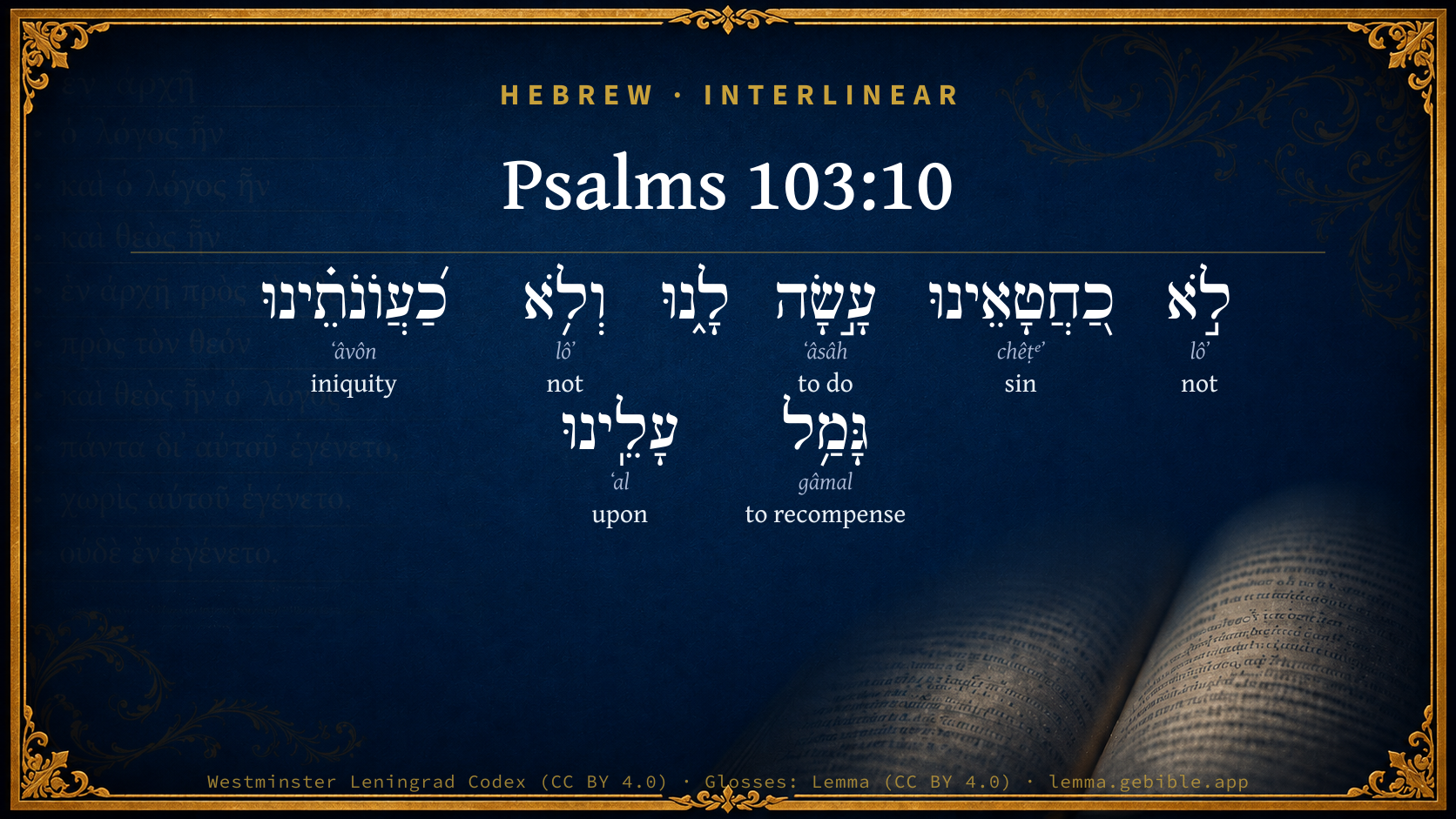
Hebrew (Westminster Leningrad Codex) Psalms 103:10 appears in the Hebrew Old Testament. The text above is from the Westminster Leningrad Codex. Each word links to its Strong’s number, a concise gloss, and parsing drawn from the Open Scriptures Hebrew Bible morphology. Click any word for its full Brown-Driver-Briggs (BDB) entry.
Download image
Cite this verse

Psalms 103:10 (World English Bible). Public Domain. Lemma interlinear Bible study tool, https://lemma.gebible.app/v/psalms/103/10.

Show BibTeX & RIS
BibTeX
RIS
English Translation
He has not dealt with us according to our sins, Nor repaid us for our iniquities.
World English Bible · Public Domain
Download a study sheet

One document with this verse’s original text, its word-by-word gloss line, the meaning frame, cross-references with their text, attributed commentary, and full source and license credits — printable, and it pastes into notes with its structure intact.

This verse Autodidact and up

Study sheet (.html) Plain text (.txt)

A passage Seminary Student

Up to 50 verses in one chapter. A passage sheet keeps up to 6 commentary sources and 12 cross-references per verse, in the order this page ranks them, and says so on the sheet whenever that leaves anything out. Ask for a single verse and you get the Autodidact verse sheet above.

Everything on this page stays free to read, with no account — the sheet is a download of what is already on screen, not access to it.

Want to remove ads? Support Godless Engineer
Compare translations 3

The same verse in 3 English versions, stacked beneath the original-language interlinear above. Click any original word for its lexicon entry.

Each is an independent rendering of the whole verse — the interlinear is not word-aligned to these translations.

Highlighted words mark where these versions differ — a whole-verse word diff, not a word-by-word alignment.

  • World English Bible Public Domain
    He has not dealt with us according to our sins, Nor repaid us for our iniquities.
  • King James Version Public Domain
    He hath not dealt with us after our sins; nor rewarded us according to our iniquities.
  • unfoldingWord Literal Text CC BY-SA 4.0
    He does not deal with us according to our sins, and he does not treat us according to our iniquities.

unfoldingWord Literal Text — © unfoldingWord, licensed CC BY-SA 4.0. Word-aligned USFM3 via Door43 (git.door43.org/unfoldingWord/en_ult).

Versions to compare (up to 4)

3 of 4 selected

Show all 18 translations

Every available English version of this verse, each an independent rendering of the whole verse.

  • World English Bible Public Domain
    He has not dealt with us according to our sins, Nor repaid us for our iniquities.
  • Berean Standard Bible Public Domain
    He has not dealt with us according to our sins or repaid us according to our iniquities.
  • Majority Standard Bible Public Domain
    He has not dealt with us according to our sins or repaid us according to our iniquities.
  • King James Version Public Domain
    He hath not dealt with us after our sins; nor rewarded us according to our iniquities.
  • American Standard Version (1901) Public Domain
    He hath not dealt with us after our sins, Nor rewarded us after our iniquities.
  • Revised Version (1885) Public Domain
    He hath not dealt with us after our sins, nor rewarded us after our iniquities.
  • Geneva Bible (1599) Public Domain
    He hath not dealt with vs after our sinnes, nor rewarded vs according to our iniquities.
  • Douay-Rheims (1899) Public Domain
    He hath not dealt with us according to our sins: nor rewarded us according to our iniquities.
  • Young's Literal Translation Public Domain
    Not according to our sins hath He done to us, Nor according to our iniquities Hath He conferred benefits upon us.
  • Literal Standard Version CC BY-SA 4.0
    He has not done to us according to our sins, || Nor according to our iniquities || Has He conferred benefits on us.
  • Unlocked Literal Bible CC BY-SA 4.0
    He does not deal with us as our sins deserve or repay us for what our sins demand.
  • unfoldingWord Literal Text CC BY-SA 4.0
    He does not deal with us according to our sins, and he does not treat us according to our iniquities.
  • Darby Bible Public Domain
    He hath not dealt with us according to our sins, nor rewarded us according to our iniquities.
  • World Messianic Bible Public Domain
    He has not dealt with us according to our sins, nor repaid us for our iniquities.
  • Webster's Bible Public Domain
    He hath not dealt with us according to our sins; nor rewarded us according to our iniquities.
  • Free Bible Version CC BY-SA 4.0
    He does not punish us for our sins as he ought to; he does not pay us back for our wrongdoing as we deserve.
  • Bible in Basic English Public Domain
    He has not given us the punishment for our sins, or the reward of our wrongdoing.
  • JPS Tanakh (1917) Public Domain
    He hath not dealt with us after our sins, nor requited us according to our iniquities.

Literal Standard Version (2020), Covenant Press — licensed CC BY-SA 4.0. Text via the HelloAO Bible API (eBible.org). Unlocked Literal Bible (unfoldingWord) — licensed CC BY-SA 4.0. Text via the HelloAO Bible API (eBible.org). unfoldingWord Literal Text — © unfoldingWord, licensed CC BY-SA 4.0. Word-aligned USFM3 via Door43 (git.door43.org/unfoldingWord/en_ult). Free Bible Version, Dr. Jonathan Gallagher — licensed CC BY-SA 4.0. Text via the HelloAO Bible API (eBible.org).

Word by word

More ways to search: Search by grammar → Find every occurrence → Compare this word →

Practice this passage: Drill this verse → Learn its vocabulary →

כַ֭חֲטָאֵינוּ
chêṭᵉʼ
H2399
“like/as · sins · our”
Preposition + Noun, Common, Masculine, Plural, Construct + Suffix, Personal, 1st Person, Common, Plural
Part of Speech
Preposition + Noun
Type
Common
Gender
Masculine
Number
Plural
State
Construct
Full BDB Definition

Origin: from H2398

TWOT: 638a

sin - sin - guilt for sin - punishment for sin
  1. לֹ֣א lôʼ H3808 “not” Particle, Negative
  2. עָ֣שָׂה ʻâsâh H6213 “to do” Verb, Qal, Perfect, 3rd Person, Masculine, Singular
  3. וְלֹ֥א lôʼ H3808 “and · not” Conjunction + Particle, Negative
  4. כַ֝עֲוֺנֹתֵ֗ינוּ ʻâvôn H5771 “like/as · iniquities · our” Preposition + Noun, Common, Both, Plural, Construct + Suffix, Personal, 1st Person, Common, Plural
  5. גָּמַ֥ל gâmal H1580 “to recompense” Verb, Qal, Perfect, 3rd Person, Masculine, Singular
  6. עָלֵֽינוּ ʻal H5921 “upon · us” Preposition + Suffix, Personal, 1st Person, Common, Plural

About this verse

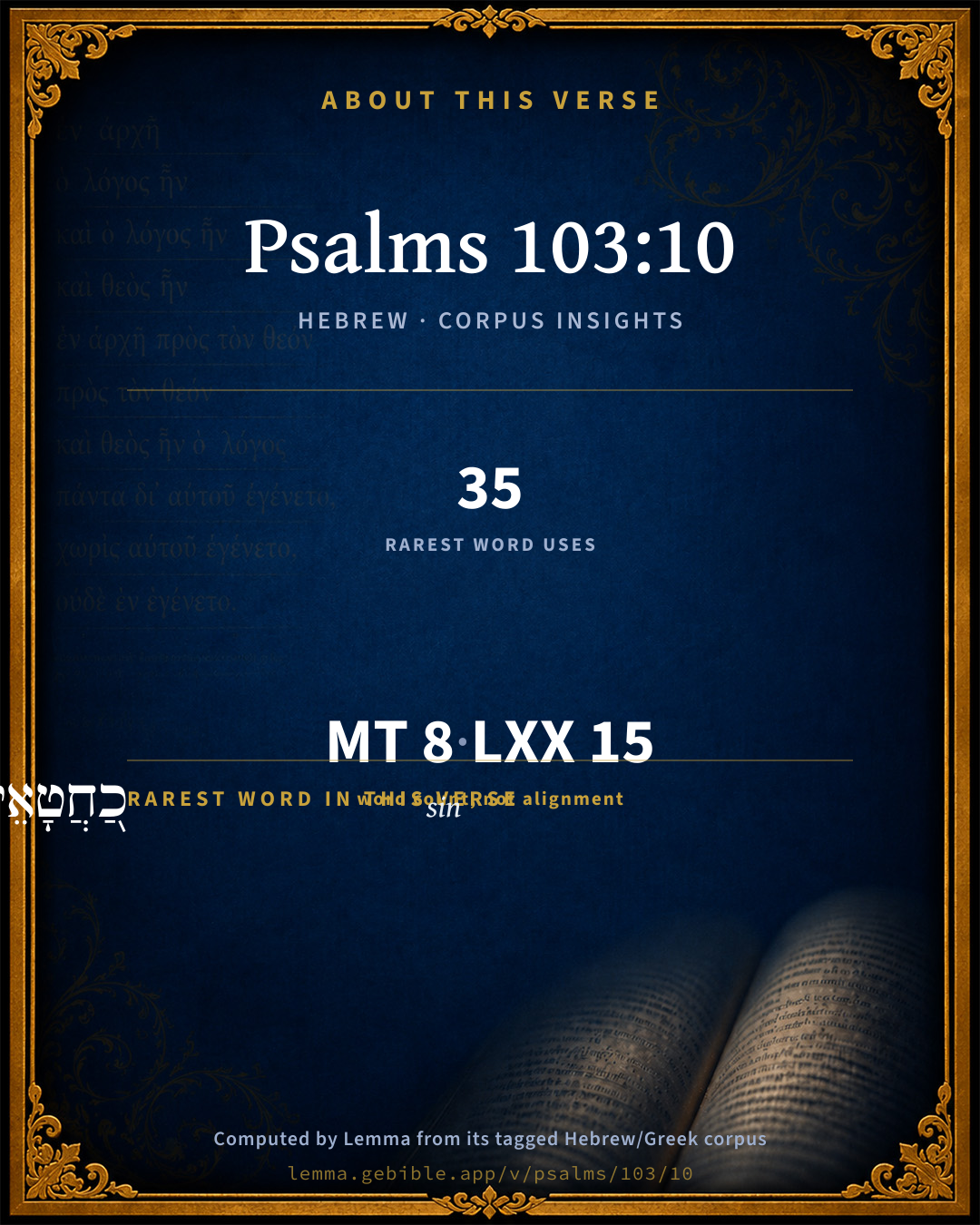
These counts appear in no published source. They are computed here, from the morphology-tagged text and Lemma’s own curated glosses. What Lemma adds →

8
words
6
distinct lemmas
Wisdom
section

Shared distinctive vocabulary

כַ֭חֲטָאֵינוּ sin H2399 occurs in 34 verses of the Hebrew Bible. Also found in:

Grammatical profile

  • 2 verbs
  • 2 nouns
  • 2 prepositions
  • 2 particles

Verb forms

  • עָ֣שָׂה Qal · Perfect
  • גָּמַ֥ל Qal · Perfect

Repetition

A word recurs within this verse — often emphatic in Hebrew:

Hebrew & Septuagint length

In English translation the verse runs 16 words from the Hebrew and 17 from the Septuagint (LXX English) — closely comparable.

A rough comparison of the two English renderings, which tokenize alike — not a word-level alignment.

Word counts can differ between the Hebrew and the Greek without any difference in meaning — e.g. the Hebrew direct-object marker אֵת has no separate Greek word, and Greek often adds the article ὁ.

In the original languages it is 8 Hebrew tokens and 15 Greek tokens — but the two are counted differently (Hebrew bundles its prefixes and suffixes into one token; the Greek is in lemma form), so that isn’t a like-for-like length.

Cross-references

7

Topical passages linked to Psalms 103:10 in the Treasury of Scripture Knowledge — connected by theme and wording, ordered by reader-vote popularity; previews shown in the World English Bible.

  • Ezra 9:13 After all that is come on us for our evil deeds, and for our great guilt, seeing that you our God have punished us less than our iniquities deserve, and have given us such a remnant,
  • Nehemiah 9:31 Nevertheless in your manifold mercies you did not make a full end of them, nor forsake them; for you are a gracious and merciful God.
  • Lamentations 3:22 [It is of] Yahweh's loving kindnesses that we are not consumed, because his compassion doesn't fail.
  • Psalms 130:3 If you, Yah, kept a record of sins, Lord, who could stand?
  • Job 11:6 That he would show you the secrets of wisdom! For true wisdom has two sides. Know therefore that God exacts of you less than your iniquity deserves.
  • Daniel 9:18–19 My God, turn your ear, and hear; open your eyes, and see our desolations, and the city which is called by your name: for we do not present our petitions before you for our righteousness, but for your great mercies' sake.
  • Habakkuk 3:2 Yahweh, I have heard of your fame. I stand in awe of your deeds, Yahweh. Renew your work in the midst of the years. In the midst of the years make it known. In wrath, you remember mercy.

Cross-references courtesy of OpenBible.info (CC BY 4.0).

Hebrew and Greek witnesses Masoretic Hebrew ↔ Greek Septuagint

The same verse in the two great witnesses to the Old Testament, shown verse-for-verse.

You’re reading Greek Psalm 102 (Hebrew Psalm 103). The Septuagint counts the superscription, so verse numbers can differ from the Hebrew — chapter-level alignment, not verse-by-verse. Numbering follows Rahlfs.

These are two independent witnesses, not word-aligned to each other, and the Septuagint is shown in lemma (dictionary) form.

Hebrew Psalms 103:10 Masoretic · Westminster Leningrad Codex

לֹ֣א כַ֭חֲטָאֵינוּ עָ֣שָׂה לָ֑נוּ וְלֹ֥א כַ֝עֲוֺנֹתֵ֗ינוּ גָּמַ֥ל עָלֵֽינוּ

He has not dealt with us according to our sins, Nor repaid us for our iniquities.

World English Bible · Public Domain

Greek LXX Greek Psalm 102:10 Septuagint · lemma form

οὐ κατά ὁ ἁμαρτία ἐγώ ποιέω ἐγώ οὐδέ κατά ὁ ἀνομία ἐγώ ἀντι ἀποδίδωμι ἐγώ

He has not dealt with us according to our sins, nor recompensed us according to our iniquities.

LXX2012 (modern English Septuagint) · Public Domain

Hebrew: Westminster Leningrad Codex (CC BY 4.0). Greek: Septuagint (public domain); English from LXX2012 (modern English Septuagint) (Public Domain). How the Septuagint differs from the Hebrew →

Commentary

Notes on Psalms 103:10 from classic Christian and Jewish commentators (each source and its license shown beneath its notes). The classic Christian expositions comment on the surrounding passage and are grouped to its opening verse, so a note may address several verses; the Jewish commentaries on the Tanakh (Rashi and others) are per-verse, so they appear only where the commentator wrote on this verse.

Lemma curates 59 commentaries, every one of them public domain or Creative Commons licensed, each selected and text-cleaned for this edition rather than reprinted as found. About our sources →

Trapp's Complete Commentary

John Trapp

Psa 103:10 He hath not dealt with us after our sins; nor rewarded us according to our iniquities.

Ver. 10. He hath not dealt with us after our sins] Heb. our errors, our involuntary and unavoidable infirmities.

According to our iniquities] Heb. perversely committed; for of these evils also the saints are not free; but God beareth with more than small faults, especially if not scandalous.

John Trapp, A Commentary or Exposition upon All the Books of the Old and New Testament (1647–1656) — public domain. Text from a community e-Sword module.

The Biblical Illustrator

Joseph S. Exell

Psa_103:10

He hath not dealt with us after our sins.

Gods mercy to sinners

I. The views which this declaration presents to us of the Divine conduct.

1. He has not dealt with us as our sins deserve.

2. He has not dealt with us as He has dealt with others. This especially will be a reflection greatly beneficial to our minds, when we enumerate our mercies of a personal and relative kind--our mercies of a civil and religious kind--our mercies temporal and spiritual, the unexpected concurrence of events overruled by Divine Providence in our favour, the staying of the rough wind, in the day of His east wind.

3. His dealings towards us have always been mingled with mercy even in the severest dispensations.

II. The practical uses we should make of this declaration,

1. It should lead us faithfully to inquire what has been the effect of chastening and trial on us. Are we brought to humility, self-abasement, penitential sorrow?

2. The subject ought to excite adoring gratitude for the love, the patience, the wisdom, and the faithfulness of your Father in heaven.

3. Let the subject teach you to cherish humble confidence. Whatever be the issue of His conduct towards you, remember it must be for the best.

4. Let there be practical imitation of the Divine conduct in your judgment towards others--in your temper towards others--in your patience, forbearance, in your longsuffering, in your forgiveness. (J. Fletcher, D.D.)

The mercy of God

I. What have we deserved during the past year? We are painfully conscious that we have been guilty of sins and iniquities, heinous and aggravated because committed against light and knowledge. We have not deserved the least of Gods mercies. Let us be humble, penitent.

II. What have we received during the past year? The gifts of God to us are as innumerable as they are inestimable.

1. Think of temporal mercies--health, food, clothing, home, friends.

2. Think of spiritual mercies--Bible, Sabbath, sanctuary, means of grace, hope of glory.

III. What have we returned during the past year? The earth has received the showers and sunshine, and in return has given foliage, flowers, and fruits. Have our hearts and lives yielded fruit to the glory of God for all His goodness to us? Or have our hearts been like the barren rock or desert sands, giving no response or return for heavenly influences received? (F. W. Brown.)

The Biblical Illustrator, edited by Joseph S. Exell (c. 1880s–1900s) — public domain. Text from a community e-Sword module.

J. A. Alexander on Psalms

Joseph Addison Alexander

10. (Psa 103:10) Not according to our sins has he done to us, and not according to our iniquities has he dealt with us. That the people stood in need of the divine forbearance, is now still more distinctly intimated. The last verb is the one of which the participle occurs in Psa 103:2, and might here be rendered, with still closer adherence to the strict sense of the Hebrew preposi-tion, has he bestowed upon us. See the same construction in the Hebrew of Psa 13:6; Psa 116:7; Psa 142:7. The past tense has reference to the previous history of Israel as a nation, but involves the statement of a general truth. At the end of the verse, we may suppose it to be tacitly added: as he might have done, not only in strict justice, but in execution of his express threatening, Leviticus 26 L:21.

Joseph Addison Alexander, The Psalms Translated and Explained (1850) — public domain. Text from a community e-Sword module.

Geneva Bible (1599)

Geneva Bible translators

Who have proved by continual experience, that his mercy hath ever prevailed against our offences.

Geneva Bible (1599) marginal notes — public domain. Text via Bolls.life.

Adam Clarke's Commentary

Verse 10. He has not dealt unity us after our sins] He has never apportioned our punishment to our sins, nor has he regulated the exercise of his mercy by our merits.

Adam Clarke's Commentary on the Bible (1810–1826) — public domain. Text from a community e-Sword/MySword module.

John Calvin's Commentaries

10. He hath not dealt with us after our sins The Psalmist here proves from experience, or from the effect, what he has stated concerning the Divine character; for it was entirely owing to the wonderful forbearance of God that the Israelites had hitherto continued to exist. Let each of us, as if he had said, examine his own life; let us inquire in how many ways we have provoked the wrath of God? or, rather, do we not continually provoke it? and yet he not only forbears to punish us, but bountifully maintains those whom he might justly destroy.

John Calvin's Commentaries (1540-1563) — public domain. Text from the Calvin Translation Society English edition (1840s-50s) via the Christian Classics Ethereal Library (ccel.org). Calvin's coverage is partial (roughly two-thirds of the Bible); uncommented books and verses are honest gaps, never fabricated. The 19th-century editor's footnotes and remarks are omitted so the notes are faithfully Calvin's own voice.

The Cambridge Bible for Schools and Colleges

gen. ed. J. J. S. Perowne

10. God has punished Israel less than their iniquities deserved. Cp. Ezr_9:13.

The Cambridge Bible for Schools and Colleges (gen. ed. J. J. S. Perowne; Cambridge University Press, 1878–1918) — public domain. Text from a community e-Sword module.

John Gill's Exposition

For as the heaven is high above the earth,.... Which is the greatest distance known, or can be conceived of; the space between the heaven and the earth is seemingly almost infinite; and nothing can more illustrate the mercy of God, which reaches to the heavens, and is in heaven; though this is but a faint representation of the largeness and abundance of it, and which indeed is boundless and infinite:

so great is his mercy towards them that fear him, or, his mercy hath prevailed over them that fear him (a); as the waters of the flood prevailed upon the earth, and reached and overflowed the highest hills, Gen 7:18, so abundant and superabundant is the grace of God over them that "fear" him. Which character is given, not as being the cause of their obtaining mercy, but as descriptive of the persons that partake of it; on whom it has such an effect, as to cause them to fear the Lord, and his goodness; and is mentioned to prevent obstinate and presumptuous sinners expecting it, or trusting to it.

(a) "praevalet super", Musculus; so Cocceius, Michaelis.

John Gill's Exposition of the Whole Bible (1746–1763) — public domain (CC PDM 1.0). Text via the HelloAO Bible API.

Albert Barnes' Notes on the Bible

He hath not dealt with us after our sins - All may say this, and this “is” a ground of thanksgiving and praise. It is a matter for which we should render unceasing praise that God has not done to us as our sins deserved. Who of us can fail to stand in awe and to tremble when we think what God “might” have justly done to us; what sufferings he “might” have brought upon us, which would have been no more than we have deserved; what pain of body, what distress of mind, what anguish of bereavement - what sorrow, danger, sickness, losses - we “might” have suffered before the point would be reached at which it could be said that we were suffering more than a holy and just God might properly inflict on us.

Nor rewarded us according to our iniquities - That is, he has not inflicted suffering on us that could be regarded in any proper sense as a just retribution for what we have done; or, so that it could properly be said that the one fairly “measured” the other.

Albert Barnes' Notes on the Bible (1834–1885) — public domain. Text from a community e-Sword/MySword module.

Matthew Poole's English Annotations

He hath punished us less than our iniquities have deserved, as was confessed, Ezr 9:13.

Matthew Poole's English Annotations on the Holy Bible (1683–1685) — public domain. Text from a community e-Sword/MySword module.

The Treasury of David

Charles H. Spurgeon

Ver. 10. He hath not dealt with us after our sins; nor rewarded us according to our iniquities. Else had Israel perished outright, and we also had long ago been consigned to the lowest hell. We ought to praise the Lord for what he has not done as well as for what he has wrought for us; even the negative side deserves our adoring gratitude. Up to this moment, at our very worst estate, we have never suffered as we deserved to suffer; our daily lot has not been apportioned upon the rule of what we merited, but on the far different measure of undeserved kindness. Shall we not bless the Lord? Every power of our being might have been rent with anguish, instead of which we are all in the enjoyment of comparative happiness, and many of us are exceedingly favoured with inward joy; let then every faculty, yea, all that is within us, bless his holy name.

Ver. 10. He hath not dealt with us after our sins. Might we not have expected, with such conduct, that God would have withdrawn from us the blessing of his providence, withheld from us the communication of his Spirit, permitted us to find the means of grace profitless, left our temptations to multiply, and suffered us to sink into a state of fixed backsliding? and then, with our hearts at last sinking into too natural depression, might we not have seemed to hear him saying to us this day, "Thine own wickedness shall correct thee, and thy backslidings shall reprove thee; know, therefore, and see that it is an evil thing and bitter, that thou hast forsaken the Lord thy God, and that my fear is not in thee, saith the Lord God of Hosts." Baptist W. Noel, 1798-1873.

Ver. 10. He hath not dealt with us after our sins. Why is it that God hath not dealt with us after our sins? Is it not because he hath dealt with another after our sins? Another who look our sins upon him; of whom it is said, that "God chastened him in his fierce wrath"? and why did he chasten him, but for our sins? O gracious God, thou art too just to take revenge twice for the same faults; and therefore, having turned thy fierce wrath upon him, thou wilt not turn it upon us too; but having rewarded him according to our iniquities, thou wilt now reward us according to his merits. Sir R. Baker.

Ver. 10. Work out the terrible supposition, show the reasons why it has not yet been actually so; then suggest that it may yet become a terrible fact, and exhort the guilty to seek mercy.

Psalms 103:11*

Charles H. Spurgeon's The Treasury of David (1869–1885) — public domain. Psalms only. Text from a community e-Sword/MySword module.

Whedon's Commentary on the Bible

Daniel D. Whedon

10. He hath not dealt with us after our sins—Although the Lord had often chided the Israelites for their sins, and allowed his “anger,” at times, to break forth in just punishment, his judgments had never been as severe as the occasion merited, but mercy had ever tempered justice in all his dealings with them.

Nor rewarded us—A repetition of the same thought, making a synonymous parallelism.

Daniel D. Whedon (gen. ed.), Commentary on the Old and New Testaments (1874–1909) — public domain. Text from a community e-Sword module.

The Pulpit Commentary

He hath not dealt with us after our sins; nor rewarded us (rather, requited us) according to our iniquities. God never punishes men so much as they deserve to be punished; "in his wrath he" always "thinketh upon mercy.

The measure of the Divine dealings.

The point made by the psalmist is that God"s dealings with men are not measured with the same measure as man"s dealings with his fellow men. If we think precisely we shall admit that God does deal exactly with us "after our sins;" but it is as our sins are divinely estimated. When man proceeds to recognize and punish sins, he deals with sins, rather than with sinners; and metes out his punishments according to standard, with no consideration for the individual. Man, when he authoritatively punishes, is not supposed to make allowances. Judges administer law irrespective of persons. Clemency, with us, is left to the supreme authority behind the judge; and only comes in after the judge has given his judgment according to standard. Man"s law concerns acts, not motives. God"s judgments are after another standard. God judges sinners, not merely sins. God unites the clemency of the king with the justice of the magistrate. God makes all reasonable allowances. God considers the force of human frailty. God estimates circumstances and motives. Then God"s is the higher standard, but it is one which only the God of infinite wisdom and perfect righteousness can use. This may be worked out along two lines.

I THE MEASURE OF DIVINE DEALING IS WHAT IS POSSIBLE FOR THE RACE. God never measures humanity by the standard he provides for the angels. He never measures humanity fallen by the standard he provides for humanity intact. He does not measure the race in its savage condition with the standard for the race civilized. He does not make one absolute standard to apply equally to every branch of the race. He is mindful of, and considerate towards, all forms of racial peculiarity and disability. Carefully show the distinction between an absolute standard of morals, and an absolute setting, or application, of that standard. If God deals with a morally fallen and frail race, he lets mercy help justice to fix the standard.

II THE MEASURE OF DIVINE DEALINGS IS WHAT IS POSSIBLE TO THE INDIVIDUAL. This is fully treated under ver. 14. One point only need be mentioned. In every sin committed by the individual the element of heredity has to be taken into account. The sin is not absolutely and entirely the man"s own. Yet man can never measure this heredity; so his measures will never suffice for deciding the Divine judgments and dealings. R.T.

The Pulpit Commentary (1880–1919), ed. H.D.M. Spence-Jones & Joseph S. Exell — public domain. Text from a community e-Sword module.

Lesson kit

Teaching starters — assembled from the data on this page, not authored interpretation. Every prompt links to the verse data it draws on. Edit before teaching.

Psalms, in the Wisdom, opens this verse with 8 words (6 distinct Hebrew lemmas). Its most distinctive word is chêṭᵉʼ (“sin”). A historical commentator’s framing appears above. Read the whole chapter for the surrounding context.

Discussion questions

  1. What does “sin” (chêṭᵉʼ) contribute to the verse as a whole?
  2. How does Genesis 41:9, which shares the word «sin», read alongside this verse?
  3. What does the repetition of “not” (2× in this one verse) do in this verse?
  4. These translations render this verse differently. What is at stake in choosing one wording over another?
  5. «עָ֣שָׂה» is a Qal Perfect verb. How does that grammatical form shape the action described?
  6. Compare how Trapp's Complete Commentary and The Biblical Illustrator read this verse. Where do they agree or differ?

Things to notice

Reading settings

Reading text

Shown beneath each verse's original-language words.

Old Testament
Old Testament edition

Read the OT as the Masoretic Hebrew (MT) or the Greek Septuagint (LXX).

English shown for the Greek Septuagint (in the Hebrew ↔ Greek comparison).

Comparing translations? Open the Compare panel on any verse page to stack up to four side by side.