
1 Samuel 20:8

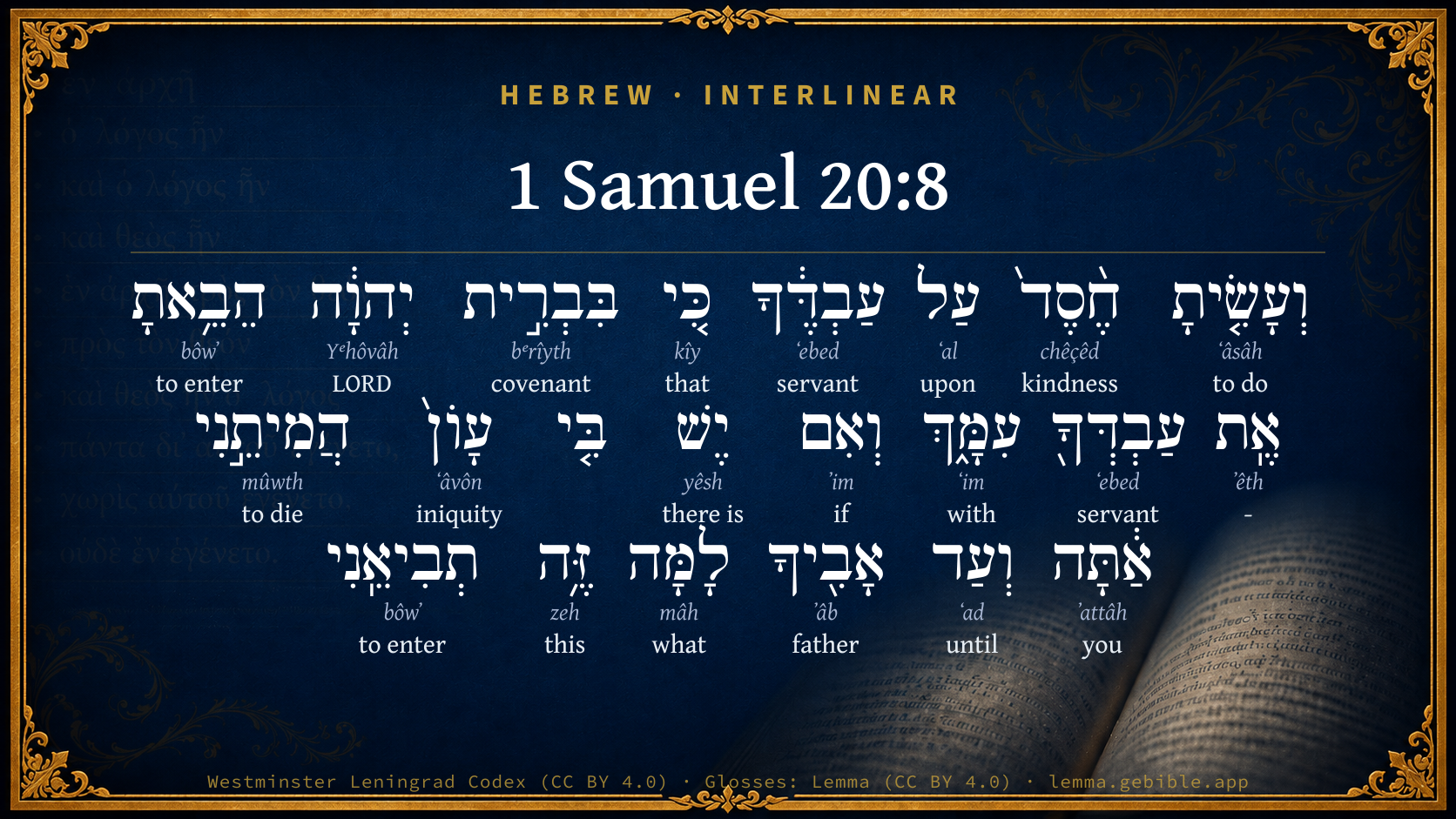
Hebrew (Westminster Leningrad Codex) 1 Samuel 20:8 appears in the Hebrew Old Testament. The text above is from the Westminster Leningrad Codex. Each word links to its Strong’s number, a concise gloss, and parsing drawn from the Open Scriptures Hebrew Bible morphology. Click any word for its full Brown-Driver-Briggs (BDB) entry.
Download image
Cite this verse

1 Samuel 20:8 (World English Bible). Public Domain. Lemma interlinear Bible study tool, https://lemma.gebible.app/v/1-samuel/20/8.

Show BibTeX & RIS
BibTeX
RIS
English Translation
Therefore deal kindly with your servant; for you have brought your servant into a covenant of Yahweh with you: but if there be in me iniquity, kill me yourself; for why should you bring me to your father?
World English Bible · Public Domain
Download a study sheet

One document with this verse’s original text, its word-by-word gloss line, the meaning frame, cross-references with their text, attributed commentary, and full source and license credits — printable, and it pastes into notes with its structure intact.

This verse Autodidact and up

Study sheet (.html) Plain text (.txt)

A passage Seminary Student

Up to 50 verses in one chapter. A passage sheet keeps up to 6 commentary sources and 12 cross-references per verse, in the order this page ranks them, and says so on the sheet whenever that leaves anything out. Ask for a single verse and you get the Autodidact verse sheet above.

Everything on this page stays free to read, with no account — the sheet is a download of what is already on screen, not access to it.

Want to remove ads? Support Godless Engineer
Compare translations 3

The same verse in 3 English versions, stacked beneath the original-language interlinear above. Click any original word for its lexicon entry.

Each is an independent rendering of the whole verse — the interlinear is not word-aligned to these translations.

Highlighted words mark where these versions differ — a whole-verse word diff, not a word-by-word alignment.

  • World English Bible Public Domain
    Therefore deal kindly with your servant; for you have brought your servant into a covenant of Yahweh with you: but if there be in me iniquity, kill me yourself; for why should you bring me to your father?
  • King James Version Public Domain
    Therefore thou shalt deal kindly with thy servant; for thou hast brought thy servant into a covenant of the LORD with thee: notwithstanding, if there be in me iniquity, slay me thyself; for why shouldest thou bring me to thy father?
  • unfoldingWord Literal Text CC BY-SA 4.0
    Then you shall do covenant faithfulness with your servant. For you have brought your servant into a covenant of Yahweh with you. But if there is iniquity in me, kill me yourself. For why this, that should you bring me to your father?”

unfoldingWord Literal Text — © unfoldingWord, licensed CC BY-SA 4.0. Word-aligned USFM3 via Door43 (git.door43.org/unfoldingWord/en_ult).

Versions to compare (up to 4)

3 of 4 selected

Show all 18 translations

Every available English version of this verse, each an independent rendering of the whole verse.

  • World English Bible Public Domain
    Therefore deal kindly with your servant; for you have brought your servant into a covenant of Yahweh with you: but if there be in me iniquity, kill me yourself; for why should you bring me to your father?
  • Berean Standard Bible Public Domain
    Therefore deal faithfully with your servant, for you have brought me into a covenant with you before the LORD. If there is iniquity in me, then kill me yourself; why should you bring me to your father?”
  • Majority Standard Bible Public Domain
    Therefore show kindness to your servant, for you have brought me into a covenant with you before the LORD. If there is iniquity in me, then kill me yourself; why should you bring me to your father?”
  • King James Version Public Domain
    Therefore thou shalt deal kindly with thy servant; for thou hast brought thy servant into a covenant of the LORD with thee: notwithstanding, if there be in me iniquity, slay me thyself; for why shouldest thou bring me to thy father?
  • American Standard Version (1901) Public Domain
    Therefore deal kindly with thy servant; for thou hast brought thy servant into a covenant of Jehovah with thee: but if there be in me iniquity, slay me thyself; for why shouldest thou bring me to thy father?
  • Revised Version (1885) Public Domain
    Therefore deal kindly with thy servant; for thou hast brought thy servant into a covenant of the LORD with thee: but if there be in me iniquity, slay me thyself; for why shouldest thou bring me to thy father?
  • Geneva Bible (1599) Public Domain
    So shalt thou shew mercy vnto thy seruant: for thou hast ioyned thy seruant into a couenant of the Lord with thee, and if there be in me iniquitie, slay thou me: for why shouldest thou bring me to thy father?
  • Douay-Rheims (1899) Public Domain
    Deal mercifully then with thy servant: for thou hast brought me thy servant into a covenant of the Lord with thee. But if there be any iniquity in me, do thou kill me, and bring me not in to thy father.
  • Young's Literal Translation Public Domain
    and thou hast done kindness, to thy servant, for into a covenant of Jehovah thou hast brought thy servant with thee; -- and if there is in me iniquity, put thou me to death; and unto thy father, why is this -- thou dost bring me in?'
  • Literal Standard Version CC BY-SA 4.0
    and you have done kindness to your servant, for you have brought your servant into a covenant of YHWH with you—and if there is iniquity in me, put me to death yourself; for why [is] this [that] you bring me to your father?”
  • Unlocked Literal Bible CC BY-SA 4.0
    Therefore deal kindly with your servant. For you have brought your servant into a covenant of Yahweh with you. But if there is sin in me, kill me yourself; for why then should you bring me to your father?”
  • unfoldingWord Literal Text CC BY-SA 4.0
    Then you shall do covenant faithfulness with your servant. For you have brought your servant into a covenant of Yahweh with you. But if there is iniquity in me, kill me yourself. For why this, that should you bring me to your father?”
  • Darby Bible Public Domain
    Deal kindly then with thy servant; for thou hast brought thy servant into a covenant of Jehovah with thee; but if there be in me iniquity, slay me thyself; for why shouldest thou bring me to thy father?
  • World Messianic Bible Public Domain
    Therefore deal kindly with your servant, for you have brought your servant into a covenant of the LORD with you; but if there is iniquity in me, kill me yourself, for why should you bring me to your father?”
  • Webster's Bible Public Domain
    Therefore thou shalt deal kindly with thy servant; for thou hast brought thy servant into a covenant of the LORD with thee: notwithstanding, if there is in me iniquity, slay me thyself; for why shouldst thou bring me to thy father?
  • Free Bible Version CC BY-SA 4.0
    So please treat me well, as you promised when you made an agreement with me before the Lord. If I've done wrong, then kill me yourself! Why take me to your father for him to do it?”
  • Bible in Basic English Public Domain
    So, then, be kind to your servant; for you have been united with your servant in an agreement made before the Lord: but if there is any wrongdoing in me, put me to death yourself; why take me to your father?
  • JPS Tanakh (1917) Public Domain
    Therefore deal kindly with thy servant; for thou hast brought thy servant into a covenant of the LORD with thee; but if there be in me iniquity, slay me thyself; for why shouldest thou bring me to thy father?'

Literal Standard Version (2020), Covenant Press — licensed CC BY-SA 4.0. Text via the HelloAO Bible API (eBible.org). Unlocked Literal Bible (unfoldingWord) — licensed CC BY-SA 4.0. Text via the HelloAO Bible API (eBible.org). unfoldingWord Literal Text — © unfoldingWord, licensed CC BY-SA 4.0. Word-aligned USFM3 via Door43 (git.door43.org/unfoldingWord/en_ult). Free Bible Version, Dr. Jonathan Gallagher — licensed CC BY-SA 4.0. Text via the HelloAO Bible API (eBible.org).

Word by word

More ways to search: Search by grammar → Find every occurrence → Compare this word →

Practice this passage: Drill this verse → Learn its vocabulary →

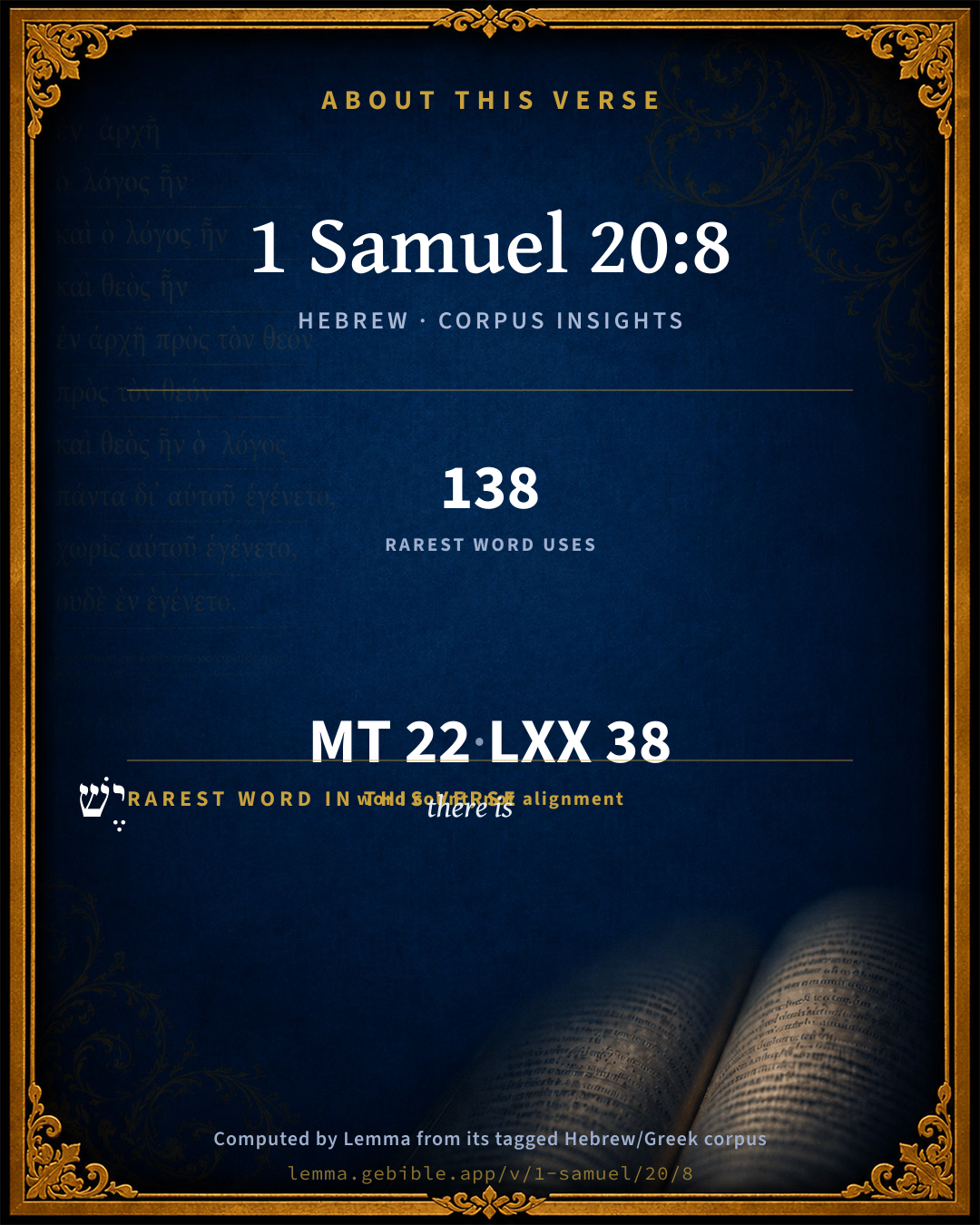
יֶשׁ
yêsh
H3426
“there is”
Particle, Demonstrative
Part of Speech
Particle
Type
Demonstrative
Full BDB Definition

Origin: perhaps from an unused root meaning to stand out, or exist

TWOT: 921

being, existence, substance, there is or are - substance - existence - there is or are
  1. וְעָשִׂ֤יתָ ʻâsâh H6213 “and · to do” Conjunction + Verb, Qal, Sequential Perfect, 2nd Person, Masculine, Singular
  2. חֶ֨סֶד֙ chêçêd H2617 “kindness” Noun, Common, Masculine, Singular, Absolute
  3. עַל ʻal H5921 “upon” Preposition
  4. עַבְדֶּ֔ךָ ʻebed H5650 “servant · your” Noun, Common, Masculine, Singular, Construct + Suffix, Personal, 2nd Person, Masculine, Singular
  5. כִּ֚י kîy H3588 “that” Conjunction
  6. בִּבְרִ֣ית bᵉrîyth H1285 “in/at · covenant of” Preposition + Noun, Common, Feminine, Singular, Construct
  7. יְהוָ֔ה Yᵉhôvâh H3068 “LORD” Noun, Proper
  8. הֵבֵ֥אתָ bôwʼ H935 “to enter” Verb, Hiphil, Perfect, 2nd Person, Masculine, Singular
  9. אֶֽת ʼêth H853 “-” Particle, Direct Object
  10. עַבְדְּךָ֖ ʻebed H5650 “servant · your” Noun, Common, Masculine, Singular, Construct + Suffix, Personal, 2nd Person, Masculine, Singular
  11. עִמָּ֑ךְ ʻim H5973 “with · you” Preposition + Suffix, Personal, 2nd Person, Feminine, Singular
  12. וְאִם ʼim H518 “and · if” Conjunction + Conjunction
  13. עָוֺן֙ ʻâvôn H5771 “iniquity” Noun, Common, Both, Singular, Absolute
  14. הֲמִיתֵ֣נִי mûwth H4191 “die · me” Verb, Hiphil, Imperative, 2nd Person, Masculine, Singular + Suffix, Personal, 1st Person, Common, Singular
  15. אַ֔תָּה ʼattâh H859 “you” Pronoun, Personal, 2nd Person, Masculine, Singular
  16. וְעַד ʻad H5704 “and · until” Conjunction + Preposition
  17. אָבִ֖יךָ ʼâb H1 “father · your” Noun, Common, Masculine, Singular, Construct + Suffix, Personal, 2nd Person, Masculine, Singular
  18. לָמָּה mâh H4100 “to/for · what” Preposition + Particle, Interrogative
  19. זֶּ֥ה zeh H2088 “this” Pronoun, Demonstrative, Masculine, Singular
  20. תְבִיאֵֽנִי bôwʼ H935 “to enter · me” Verb, Hiphil, Imperfect, 2nd Person, Masculine, Singular + Suffix, Personal, 1st Person, Common, Singular

About this verse

These counts appear in no published source. They are computed here, from the morphology-tagged text and Lemma’s own curated glosses. What Lemma adds →

22
words
19
distinct lemmas
Historical
section

Grammatical profile

  • 4 verbs
  • 7 nouns
  • 2 pronouns
  • 4 prepositions
  • 2 conjunctions
  • 3 particles

Verb forms

  • וְעָשִׂ֤יתָ Qal · Sequential Perfect
  • הֵבֵ֥אתָ Hiphil · Perfect
  • הֲמִיתֵ֣נִי Hiphil · Imperative
  • תְבִיאֵֽנִי Hiphil · Imperfect

Repetition

Words recur within this verse — often emphatic in Hebrew:

  • עַבְדֶּ֔ךָ servant H5650 ×2
  • הֵבֵ֥אתָ to enter H935 ×2

Hebrew & Septuagint length

In English translation the verse runs 38 words from the Hebrew and 43 from the Septuagint (LXX English) — closely comparable.

A rough comparison of the two English renderings, which tokenize alike — not a word-level alignment.

Word counts can differ between the Hebrew and the Greek without any difference in meaning — e.g. the Hebrew direct-object marker אֵת has no separate Greek word, and Greek often adds the article ὁ.

In the original languages it is 22 Hebrew tokens and 38 Greek tokens — but the two are counted differently (Hebrew bundles its prefixes and suffixes into one token; the Greek is in lemma form), so that isn’t a like-for-like length.

Cross-references

14

Topical passages linked to 1 Samuel 20:8 in the Treasury of Scripture Knowledge — connected by theme and wording, ordered by reader-vote popularity; previews shown in the World English Bible.

  • 1 Samuel 18:3 Then Jonathan and David made a covenant, because he loved him as his own soul.
  • 2 Samuel 14:32 Absalom answered Joab, Behold, I sent to you, saying, Come here, that I may send you to the king, to say, Why am I come from Geshur? it were better for me to be there still. Now therefore let me see the king's face; and if there be iniquity in me, let him kill me.
  • 1 Samuel 23:18 They two made a covenant before Yahweh: and David abode in the wood, and Jonathan went to his house.
  • 1 Samuel 20:16 So Jonathan made a covenant with the house of David, [saying], Yahweh will require it at the hand of David's enemies.
  • Genesis 24:49 Now if you will deal kindly and truly with my master, tell me. If not, tell me. That I may turn to the right hand, or to the left."
  • Genesis 47:29 The time drew near that Israel must die, and he called his son Joseph, and said to him, "If now I have found favor in your sight, please put your hand under my thigh, and deal kindly and truly with me. Please don't bury me in Egypt,
  • Joshua 2:14 The men said to her, Our life for yours, if you don't utter this our business; and it shall be, when Yahweh gives us the land, that we will deal kindly and truly with you.
  • Joshua 22:22 The Mighty One, God, Yahweh, the Mighty One, God, Yahweh, he knows; and Israel he shall know: if it be in rebellion, or if in trespass against Yahweh (don't save us this day),
  • Ruth 1:8 Naomi said to her two daughters-in-law, Go, return each of you to her mother's house: Yahweh deal kindly with you, as you have dealt with the dead, and with me.
  • 1 Chronicles 12:17 David went out to meet them, and answered them, If you be come peaceably to me to help me, my heart shall be knit to you; but if [you be come] to betray me to my adversaries, seeing there is no wrong in my hands, the God of our fathers look thereon, and rebuke it.
  • Psalms 7:4–5 If I have rewarded evil to him who was at peace with me (Yes, I have delivered him who without cause was my adversary),
  • Psalms 116:11 I said in my haste, "All men are liars."
  • Proverbs 3:3 Don't let kindness and truth forsake you. Bind them around your neck. Write them on the tablet of your heart.
  • Acts 25:11 For if I have done wrong, and have committed anything worthy of death, I don't refuse to die; but if none of those things is true that they accuse me of, no one can give me up to them. I appeal to Caesar!"

Cross-references courtesy of OpenBible.info (CC BY 4.0).

Hebrew and Greek witnesses Masoretic Hebrew ↔ Greek Septuagint

The same verse in the two great witnesses to the Old Testament, shown verse-for-verse.

These are two independent witnesses, not word-aligned to each other, and the Septuagint is shown in lemma (dictionary) form.

Hebrew 1 Samuel 20:8 Masoretic · Westminster Leningrad Codex

וְעָשִׂ֤יתָ חֶ֨סֶד֙ עַל עַבְדֶּ֔ךָ כִּ֚י בִּבְרִ֣ית יְהוָ֔ה הֵבֵ֥אתָ אֶֽת עַבְדְּךָ֖ עִמָּ֑ךְ וְאִם יֶשׁ בִּ֤י עָוֺן֙ הֲמִיתֵ֣נִי אַ֔תָּה וְעַד אָבִ֖יךָ לָמָּה זֶּ֥ה תְבִיאֵֽנִי

Therefore deal kindly with your servant; for you have brought your servant into a covenant of Yahweh with you: but if there be in me iniquity, kill me yourself; for why should you bring me to your father?

World English Bible · Public Domain

Greek LXX 1 Samuel 20:8 Septuagint · lemma form

καί ποιέω ἔλεος μετά ὁ δοῦλος σύ ὅτι εἰςἄγω εἰς διαθήκη κύριος ὁ δοῦλος σύ μετά σεαυτοῦ καί εἰ εἰμί ἀδικία ἐν ὁ δοῦλος σύ θανατόω ἐγώ σύ καί ἕως ὁ πατήρ σύ ἵνα τίς οὕτως εἰςἄγω ἐγώ

And you shall deal mercifully with your servant; for you have brought your servant into a covenant of the Lord with yourself: and if there is iniquity in your servant, kill me yourself; but why do you thus bring me to your father?

LXX2012 (modern English Septuagint) · Public Domain

Hebrew: Westminster Leningrad Codex (CC BY 4.0). Greek: Septuagint (public domain); English from LXX2012 (modern English Septuagint) (Public Domain). How the Septuagint differs from the Hebrew →

Targum (Aramaic paraphrase)

1

The Targum is the ancient Jewish Aramaic paraphrase of the Hebrew Scriptures — an interpretive translation, not the Hebrew text itself. Onkelos (literal) and Pseudo-Jonathan (expansive) render the Torah, and Jonathan the Prophets. Coverage is partial: where no permissively-licensed English translation exists for a verse, only the Aramaic is shown. This is verse-level text, not a word-by-word alignment to the Hebrew.

  1. Targum Jonathan Prophets (Joshua–Malachi)
    וְתַעְבֵּיד טִיבוּ עִם עַבְדָךְ אֲרֵי בְּקַיָמָא דַייָ אָעֵלִיתָא יַת עַבְדָךְ עִמָךְ וְאִם אִית בִּי חוֹבָא קְטוֹלְנִי אַתְּ וּלְוַת אָבוּךְ לְמָא דְנָן תַּעֵילִינַנִי:

    (no public-domain English translation for this verse)

    Targum Jonathan — Aramaic: “Mikraot Gedolot” (public domain). English: “Sefaria Community Translation” (CC0 1.0 (public-domain dedication)); “London "Chaldee Paraphrase," 1871” (public domain). Text via Sefaria.

Commentary

Notes on 1 Samuel 20:8 from classic Christian and Jewish commentators (each source and its license shown beneath its notes). The classic Christian expositions comment on the surrounding passage and are grouped to its opening verse, so a note may address several verses; the Jewish commentaries on the Tanakh (Rashi and others) are per-verse, so they appear only where the commentator wrote on this verse.

Lemma curates 59 commentaries, every one of them public domain or Creative Commons licensed, each selected and text-cleaned for this edition rather than reprinted as found. About our sources →

Trapp's Complete Commentary

John Trapp

1Sa 20:8 Therefore thou shalt deal kindly with thy servant; for thou hast brought thy servant into a covenant of the LORD with thee: notwithstanding, if there be in me iniquity, slay me thyself; for why shouldest thou bring me to thy father?

Ver. 8. Into a covenant of the Lord.] Who is witness to the bargain, and keepeth the bands.

Slay me thyself.] Let me die by a friendly and merciful hand. Nimis opto amantis immori manibus, said she in Seneca. {a} This David speaketh pathetically, to stir up his friend Jonathan to act vigorously for him.

For why shouldest thou bring me to thy father?] Who will not only slay me, but so torture me, that I may feel myself to die. "The tender mercies of the wicked are cruelties." {Pro 12:10}

{a} Phaedra, apud Sen.

John Trapp, A Commentary or Exposition upon All the Books of the Old and New Testament (1647–1656) — public domain. Text from a community e-Sword module.

Joseph Benson's Commentary

1Sa 20:8. Thou shalt deal kindly with thy servant — In giving me timely notice, and a true account of Saul’s disposition and intention toward me. A covenant of the Lord — That is, a solemn covenant, not lightly undertaken, but seriously entered into, in the name and fear of God, and in his presence, calling him to be the witness of our sincerity therein, and the avenger of perfidiousness in him that breaks it. Slay me — I am contented thou shouldest kill me. For why — Why shouldest thou betray me to thy father, by concealing his evil intentions from me?

Joseph Benson's Commentary on the Old and New Testaments (1811–1818) — public domain. Text from a community e-Sword module.

Tyndale Open Study Notes

Tyndale Open Resources

20:8 Loyalty (Hebrew khesed) denotes faithfulness between covenant partners. • a solemn pact: See 18:3; 20:16.

Tyndale Open Study Notes — © Tyndale Open Resources, licensed CC BY-SA 4.0. Text via the HelloAO Bible API.

Adam Clarke's Commentary

Verse 8. If there be in me iniquity] If thou seest that I am plotting either against the state, or the life of thy father, then slay me thyself.

Adam Clarke's Commentary on the Bible (1810–1826) — public domain. Text from a community e-Sword/MySword module.

Ellicott's Commentary for English Readers

(8) A covenant of the Lord with thee.—It may at first sight seem strange that we have these last meetings of David and Jonathan told us in such detail—the speaker’s very words quoted, and so many apparently trivial circumstances related.

The question, too, might be asked: Whence did the compiler of the book derive his intimate acquaintance with what took place at these meetings, when David was alone with Jonathan? But the difficulties are only surface ones, for we must never forget how intensely interesting to the chosen people were all the circumstances connected with their loved king’s life—never lose sight of the deathless interest with which they would hear and read the particulars of David’s rise through great suffering and long trial to the throne; and this period here related in such detail was the turning-point of a grand career. From this moment, David’s way diverged from the every-day life of ordinary duty and prosperity, and became, during a long and weary period, for him the way of almost uninterrupted suffering. The way of suffering and of trial is in all ages the royal road to true greatness. As to the source whence the compiler of the book derived his knowledge of what passed at these last meetings of the two friends, Ewald suggests that when in after years David drew to his Court the posterity of Jonathan, he often told them himself of these last events before their separation (events with which no one but the two friends could be acquainted).

Slay me thyself.—“This supposes that Jonathan had the right to inflict capital punishment for crimes against his father as king.”—Lange. This was David’s last earnest request to the prince. If Jonathan felt there was any truth in the charges brought against him by Saul—if he deemed his friend a traitor to the reigning dynasty—let him slay the betrayer himself there and then.

A Bible Commentary for English Readers, edited by Charles John Ellicott (1878–1897) — public domain. Text from a community e-Sword module.

The Cambridge Bible for Schools and Colleges

gen. ed. J. J. S. Perowne

8. thou hast brought, &c.] The initiative had been on Jonathan’s side (1Sa_18:3). David calls their league of friendship “a covenant of Jehovah” as being ratified in His name by solemn oath. See 1Sa_20:12 ff.

The Cambridge Bible for Schools and Colleges (gen. ed. J. J. S. Perowne; Cambridge University Press, 1878–1918) — public domain. Text from a community e-Sword module.

John Gill's Exposition

Therefore thou shall deal kindly with thy servant,.... By informing him how his father's mind stood affected to him, that he might conduct himself accordingly, either by appearing at court, or by providing for his safety by flight:

for thou hast brought thy servant into a covenant of the Lord with thee; a covenant of friendship between Jonathan and David, of which Jonathan was the first mover, and so is said to bring or persuade him into it; called the covenant of the Lord, because made in his name and fear, and before him as a witness of it; and this David pleads as an argument with Jonathan, to deal kindly and faithfully by him in the present case:

notwithstanding, if there be in me iniquity, slay me thyself: or pass sentence upon him to be slain; which, if guilty, he might have power to do in his father's absence, and which David desires might be done, notwithstanding the covenant of friendship between them, should he appear to deserve it by any action of his, of which he was not conscious; this expresses the strong sense he had of his own integrity, and served to confirm Jonathan in his opinion of it:

for why shouldest thou bring me to thy father? deliver him up into his hands to be put to a cruel death by him, or give him the trouble of doing it, when he might as well dispatch him at once.

John Gill's Exposition of the Whole Bible (1746–1763) — public domain (CC PDM 1.0). Text via the HelloAO Bible API.

Haydock's Catholic Bible Commentary

Lord, the most durable and sacred, confirmed by the name of God. (Calmet) --- Kill. So Moses besought God to take away his life. A friend would put him to as little torture as possible. (Menochius) --- But David only means strongly to assert his own innocence. (Haydock)

George Leo Haydock (1774–1849), Haydock's Catholic Family Bible and Commentary, 1859 edition — public domain. Excludes Psalms (Douay-Rheims chapter numbering differs from Protestant) and Deuterocanonical books (Catholic canon only).

Matthew Poole's English Annotations

Thou shalt deal kindly with thy servant, in giving me timely notice, and a true account of Saul’s disposition and intention towards me.

A covenant of the Lord, i.e. a solemn covenant, not lightly undertaken, but seriously entered into, in the name and fear of God, and in his presence, calling him to be the witness of our sincerity therein, and the avenger of perfidiousness in him that breaks it.

Slay me thyself; I am contented thou shouldst kill me.

Why shouldest thou bring me to thy father? why shouldst thou betray me to thy father, by concealing his evil intentions from me?

Matthew Poole's English Annotations on the Holy Bible (1683–1685) — public domain. Text from a community e-Sword/MySword module.

The Pulpit Commentary

Thou hast brought thy servant into a covenant of Jehovah with thee. As the friendship between Jonathan and David had been cemented by the invocation of the name of Jehovah, it was one firm and assured, and David might look not merely for one act of kindness, but for constant truth and help. It was, moreover, Jonathan"s own doing; and yet, if there be in me, David says, iniquity, i.e. treason against Saul, if I have not been a faithful and true servant to him, but, on the contrary, have plotted evil against him, or now entertain any evil designs, then let the covenant be abrogated. David refuses to shelter himself under it if he has incurred guilt, and only asks that Jonathan, by the authority which he exercised as the king"s son, should himself put him to death, and not deliver him up to Saul

The Pulpit Commentary (1880–1919), ed. H.D.M. Spence-Jones & Joseph S. Exell — public domain. Text from a community e-Sword module.

John Wesley's Explanatory Notes

Deal kindly - In giving me timely notice, and a true account of Saul's disposition and intention towards me. A covenant of the Lord - That is, a solemn covenant, not lightly undertaken, but seriously entered into, in the name and fear of God, and in his presence, calling him to be the witness of our sincerity therein, and the avenger of perfidiousness in him that breaks it. Slay me - I am contented thou shouldst kill me. For why - Why shouldst thou betray me to thy father, by concealing his evil intentions from me?

John Wesley, Explanatory Notes Upon the Whole Bible (1754–1765) — public domain. Text via the GEBible commentary corpus.

unfoldingWord translationNotes

Door43 World Missions Community

Connecting Statement:

David continues speaking to Jonathan.

with your servant ... have brought your servant

David speak of himself in the third person as a form of humility. AT: "with me, your servant ... have brought me, your servant" or "with me ... have brought me" (See: Pronouns)

you have brought your servant into a covenant of Yahweh with you

What it was that the two men agreed on can be made explicit. AT: "Yahweh heard you when you made a solemn agreement with me that you and I will always be good friends" (See: Assumed Knowledge and Implicit Information)

for why then should you bring me to your father?

This rhetorical question can be translated as a statement. AT: "then there would be no reason for you to bring me to your father" (See: Rhetorical Question)

Far be it from you!

This is an idiom that means it will never happen to you. AT: "This will never happen to you!" (See: Idiom)

would I not tell you?

This rhetorical question can be translated as a statement. AT: "I would certainly tell you." (See: Rhetorical Question)

translationWords

covenant

Yahweh

sin

unfoldingWord translationNotes — © Distant Shores Media and the Door43 World Missions Community, licensed CC BY-SA 4.0. Source: git.door43.org/Door43/en_tn.

Rashi

Rabbi Shlomo Yitzchaki (Rashi)

Be kind. To let me go.

Rashi on the Tanakh — English translations: “The Judaica Press complete Tanach with Rashi, translated by A. J. Rosenberg” (CC BY 4.0); “Pentateuch with Rashi's commentary by M. Rosenbaum and A.M. Silbermann, 1929-1934” (public domain); “The Metsudah Tanach series, Lakewood, N.J” (CC BY 4.0); and “The Book of Joshua, Metsudah Publications, 1997” (CC BY 4.0). Text via Sefaria.

Lesson kit

Teaching starters — assembled from the data on this page, not authored interpretation. Every prompt links to the verse data it draws on. Edit before teaching.

1 Samuel, in the Historical, opens this verse with 22 words (19 distinct Hebrew lemmas). Its most distinctive word is yêsh (“there is”). A historical commentator’s framing appears above. Read the whole chapter for the surrounding context.

Discussion questions

  1. What does “there is” (yêsh) contribute to the verse as a whole?
  2. 1 Samuel 18:3 shares this passage’s theme. How do the two illuminate each other?
  3. “servant” occurs 2× in this one verse. What is the effect of the repetition?
  4. The translations on this page render this verse differently — a whole-verse word diff, not a word-by-word alignment. What might account for the different wordings?
  5. The verb «וְעָשִׂ֤יתָ» is Qal Sequential Perfect. How does its form color the action?
  6. Reading how Trapp's Complete Commentary and Joseph Benson's Commentary read this verse, where do the two commentators agree and where do they part?

Things to notice

Reading settings

Reading text

Shown beneath each verse's original-language words.

Old Testament
Old Testament edition

Read the OT as the Masoretic Hebrew (MT) or the Greek Septuagint (LXX).

English shown for the Greek Septuagint (in the Hebrew ↔ Greek comparison).

Comparing translations? Open the Compare panel on any verse page to stack up to four side by side.