
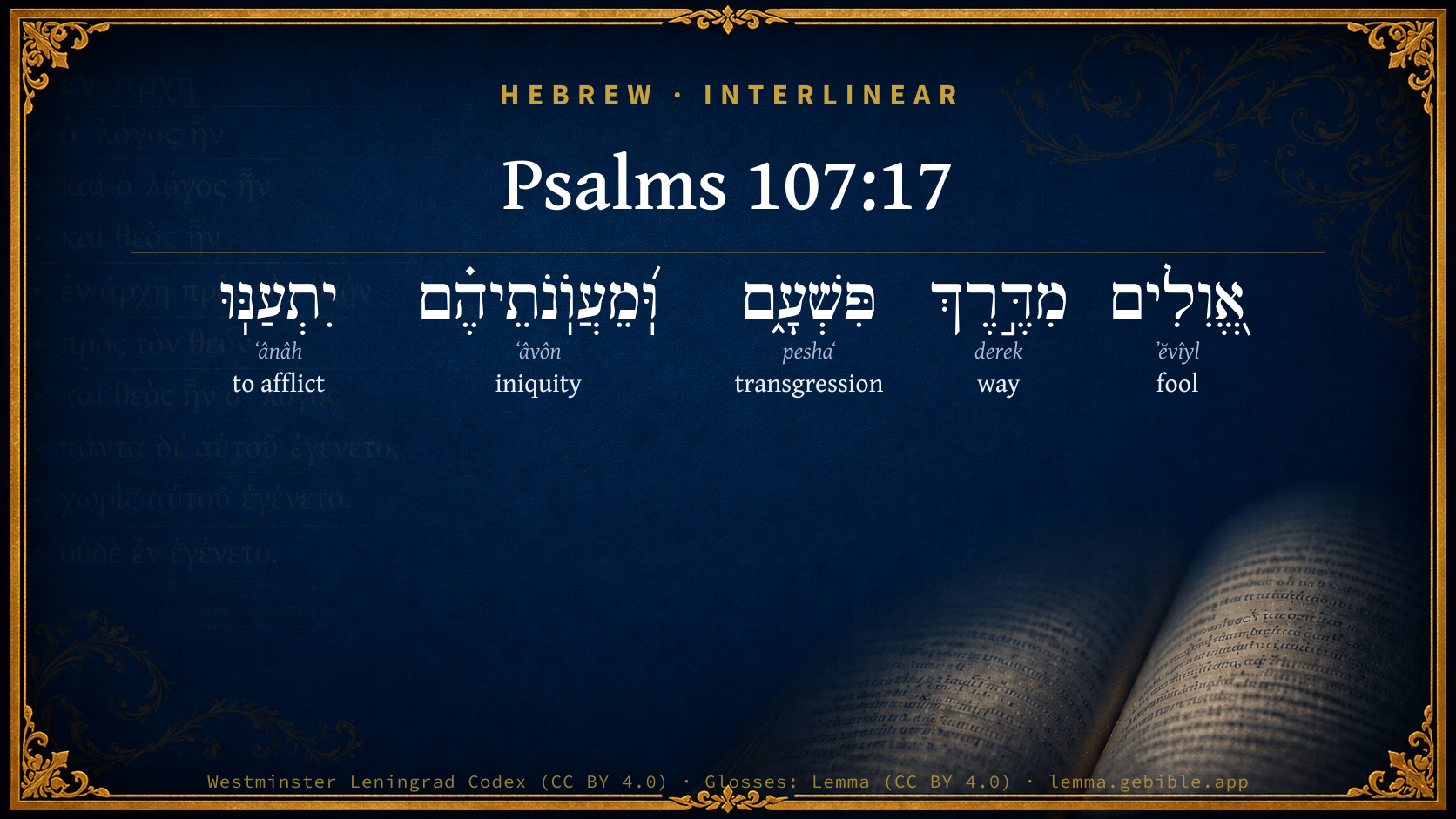
Psalms 107:17

Hebrew (Westminster Leningrad Codex) Psalms 107:17 appears in the Hebrew Old Testament. The text above is from the Westminster Leningrad Codex. Each word links to its Strong’s number, a concise gloss, and parsing drawn from the Open Scriptures Hebrew Bible morphology. Click any word for its full Brown-Driver-Briggs (BDB) entry.
Download image
Cite this verse

Psalms 107:17 (World English Bible). Public Domain. Lemma interlinear Bible study tool, https://lemma.gebible.app/v/psalms/107/17.

Show BibTeX & RIS
BibTeX
RIS
English Translation
Fools are afflicted because of their disobedience, And because of their iniquities.
World English Bible · Public Domain
Download a study sheet

One document with this verse’s original text, its word-by-word gloss line, the meaning frame, cross-references with their text, attributed commentary, and full source and license credits — printable, and it pastes into notes with its structure intact.

This verse Autodidact and up

Study sheet (.html) Plain text (.txt)

A passage Seminary Student

Up to 50 verses in one chapter. A passage sheet keeps up to 6 commentary sources and 12 cross-references per verse, in the order this page ranks them, and says so on the sheet whenever that leaves anything out. Ask for a single verse and you get the Autodidact verse sheet above.

Everything on this page stays free to read, with no account — the sheet is a download of what is already on screen, not access to it.

Want to remove ads? Support Godless Engineer
Compare translations 3

The same verse in 3 English versions, stacked beneath the original-language interlinear above. Click any original word for its lexicon entry.

Each is an independent rendering of the whole verse — the interlinear is not word-aligned to these translations.

Highlighted words mark where these versions differ — a whole-verse word diff, not a word-by-word alignment.

  • World English Bible Public Domain
    Fools are afflicted because of their disobedience, And because of their iniquities.
  • King James Version Public Domain
    Fools because of their transgression, and because of their iniquities, are afflicted.
  • unfoldingWord Literal Text CC BY-SA 4.0
    Foolish from their rebellious way and afflicted from their sins,

unfoldingWord Literal Text — © unfoldingWord, licensed CC BY-SA 4.0. Word-aligned USFM3 via Door43 (git.door43.org/unfoldingWord/en_ult).

Versions to compare (up to 4)

3 of 4 selected

Show all 18 translations

Every available English version of this verse, each an independent rendering of the whole verse.

  • World English Bible Public Domain
    Fools are afflicted because of their disobedience, And because of their iniquities.
  • Berean Standard Bible Public Domain
    Fools, in their rebellious ways, and through their iniquities, suffered affliction.
  • Majority Standard Bible Public Domain
    Fools, in their rebellious ways, and through their iniquities, suffered affliction.
  • King James Version Public Domain
    Fools because of their transgression, and because of their iniquities, are afflicted.
  • American Standard Version (1901) Public Domain
    Fools because of their transgression, And because of their iniquities, are afflicted.
  • Revised Version (1885) Public Domain
    Fools because of their transgression, and because of their iniquities, are afflicted.
  • Geneva Bible (1599) Public Domain
    Fooles by reason of their transgression, and because of their iniquities are afflicted.
  • Douay-Rheims (1899) Public Domain
    He took them out of the way of their iniquity: for they were brought low for their injustices.
  • Young's Literal Translation Public Domain
    Fools, by means of their transgression, And by their iniquities, afflict themselves.
  • Literal Standard Version CC BY-SA 4.0
    Fools, by means of their transgression, || And by their iniquities, afflict themselves.
  • Unlocked Literal Bible CC BY-SA 4.0
    They were foolish in their rebellious ways and afflicted because of their sins.
  • unfoldingWord Literal Text CC BY-SA 4.0
    Foolish from their rebellious way and afflicted from their sins,
  • Darby Bible Public Domain
    Fools, because of their way of transgression, and because of their iniquities, are afflicted;
  • World Messianic Bible Public Domain
    Fools are afflicted because of their disobedience, and because of their iniquities.
  • Webster's Bible Public Domain
    Fools, because of their transgression, and because of their iniquities, are afflicted.
  • Free Bible Version CC BY-SA 4.0
    They were stupid because they rebelled; they suffered for their sins.
  • Bible in Basic English Public Domain
    Foolish men, because of their sins, and because of their wrongdoing, are troubled;
  • JPS Tanakh (1917) Public Domain
    Crazed because of the way of their transgression, and afflicted because of their iniquities —

Literal Standard Version (2020), Covenant Press — licensed CC BY-SA 4.0. Text via the HelloAO Bible API (eBible.org). Unlocked Literal Bible (unfoldingWord) — licensed CC BY-SA 4.0. Text via the HelloAO Bible API (eBible.org). unfoldingWord Literal Text — © unfoldingWord, licensed CC BY-SA 4.0. Word-aligned USFM3 via Door43 (git.door43.org/unfoldingWord/en_ult). Free Bible Version, Dr. Jonathan Gallagher — licensed CC BY-SA 4.0. Text via the HelloAO Bible API (eBible.org).

Word by word

More ways to search: Search by grammar → Find every occurrence → Compare this word →

Practice this passage: Drill this verse → Learn its vocabulary →

About this verse

These counts appear in no published source. They are computed here, from the morphology-tagged text and Lemma’s own curated glosses. What Lemma adds →

5
words
5
distinct lemmas
Wisdom
section

Shared distinctive vocabulary

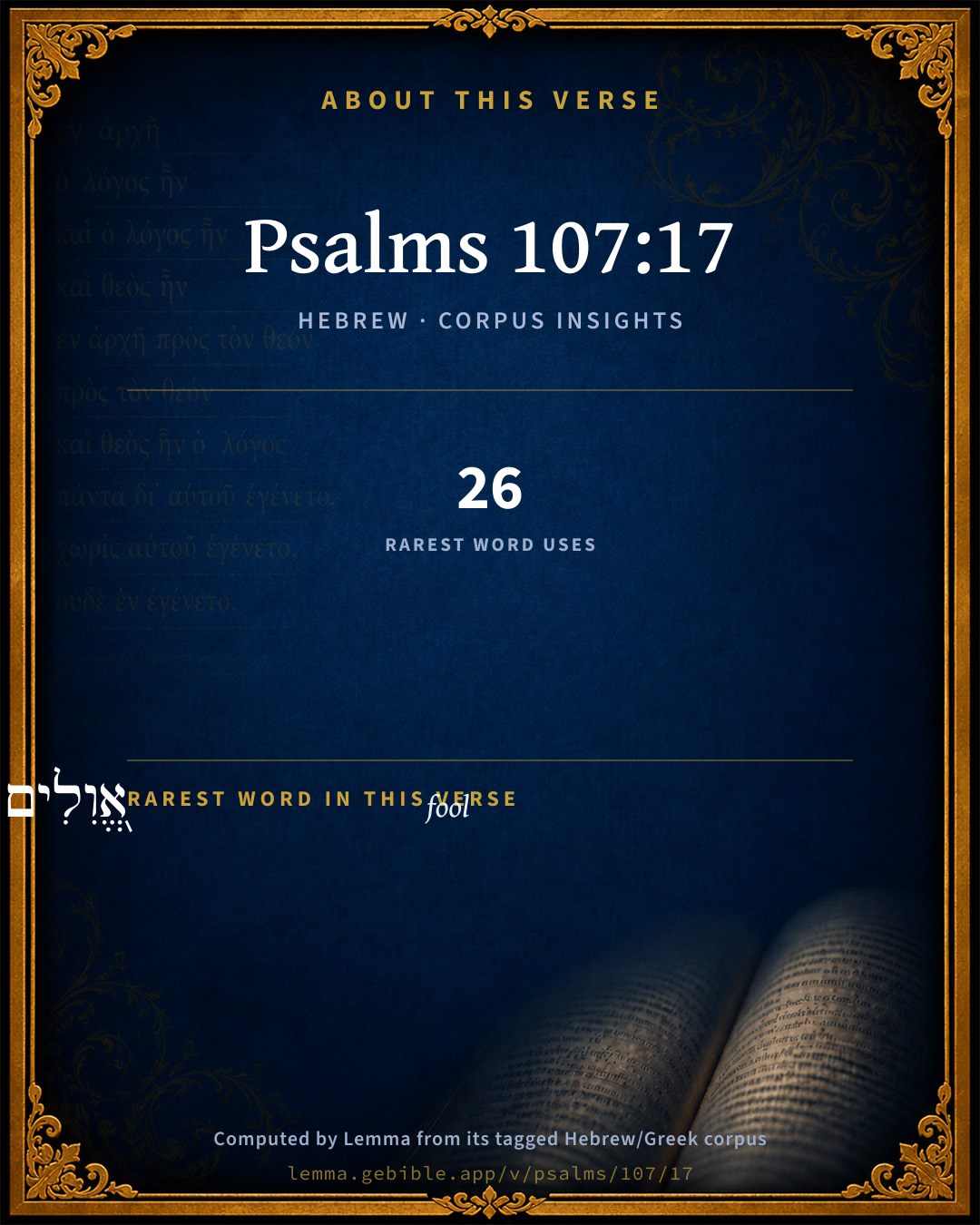
אֱ֭וִלִים fool H191 occurs in 26 verses of the Hebrew Bible. Also found in:

Grammatical profile

  • 1 verb
  • 3 nouns
  • 1 adjective

Verb forms

  • יִתְעַנּֽוּ Hithpael · Imperfect

Hebrew & Septuagint length

In English translation the verse runs 12 words from the Hebrew and 19 from the Septuagint (LXX English) — closely comparable.

A rough comparison of the two English renderings, which tokenize alike — not a word-level alignment.

Word counts can differ between the Hebrew and the Greek without any difference in meaning — e.g. the Hebrew direct-object marker אֵת has no separate Greek word, and Greek often adds the article ὁ.

Cross-references

13

Topical passages linked to Psalms 107:17 in the Treasury of Scripture Knowledge — connected by theme and wording, ordered by reader-vote popularity; previews shown in the World English Bible.

  • Lamentations 3:39 Why does a living man complain, a man for the punishment of his sins?
  • Proverbs 1:22 "How long, you simple ones, will you love simplicity? How long will mockers delight themselves in mockery, And fools hate knowledge?
  • Numbers 11:33–34 While the flesh was yet between their teeth, before it was chewed, the anger of Yahweh was kindled against the people, and Yahweh struck the people with a very great plague.
  • Numbers 21:5–9 The people spoke against God, and against Moses, Why have you brought us up out of Egypt to die in the wilderness? for there is no bread, and there is no water; and our soul loathes this light bread.
  • Psalms 14:1 The fool has said in his heart, "There is no God." They are corrupt. They have done abominable works. There is none who does good.
  • Psalms 38:1–8 Yahweh, don't rebuke me in your wrath, Neither chasten me in your hot displeasure.
  • Psalms 92:6 A senseless man doesn't know, Neither does a fool understand this:
  • Proverbs 7:7 I saw among the simple ones. I discerned among the youths a young man void of understanding,
  • Isaiah 57:17–18 For the iniquity of his covetousness was I angry, and struck him; I hid [my face] and was angry; and he went on backsliding in the way of his heart.
  • Isaiah 65:6–7 Behold, it is written before me: I will not keep silence, but will recompense, yes, I will recompense into their bosom,
  • Jeremiah 2:19 Your own wickedness shall correct you, and your backsliding shall reprove you: know therefore and see that it is an evil thing and a bitter, that you have forsaken Yahweh your God, and that my fear is not in you, says the Lord, Yahweh of Hosts.
  • Numbers 12:10–13 The cloud removed from over the Tent; and, behold, Miriam was leprous, as [white as] snow: and Aaron looked at Miriam, and, behold, she was leprous.
  • Proverbs 7:22 He followed her immediately, As an ox goes to the slaughter, As a fool stepping into a noose.

Cross-references courtesy of OpenBible.info (CC BY 4.0).

Hebrew and Greek witnesses Masoretic Hebrew ↔ Greek Septuagint

The same verse in the two great witnesses to the Old Testament, shown verse-for-verse.

You’re reading Greek Psalm 106 (Hebrew Psalm 107). The Septuagint counts the superscription, so verse numbers can differ from the Hebrew — chapter-level alignment, not verse-by-verse. Numbering follows Rahlfs.

These are two independent witnesses, not word-aligned to each other, and the Septuagint is shown in lemma (dictionary) form.

Hebrew Psalms 107:17 Masoretic · Westminster Leningrad Codex

אֱ֭וִלִים מִדֶּ֣רֶךְ פִּשְׁעָ֑ם וּֽ֝מֵעֲוֺֽנֹתֵיהֶ֗ם יִתְעַנּֽוּ

Fools are afflicted because of their disobedience, And because of their iniquities.

World English Bible · Public Domain

Greek LXX Greek Psalm 106:17 Septuagint · lemma form

ἀντιλαμβάνω αὐτός ἐκ ὁδός ἀνομία αὐτός διά γάρ ὁ ἀνομία αὐτός ταπεινόω

He helped them out of the way of their iniquity; for they were brought low because of their iniquities.

LXX2012 (modern English Septuagint) · Public Domain

On this verse, Ellicott's Commentary for English Readers discusses the Septuagint’s reading. Read the note in Commentary ↓

Hebrew: Westminster Leningrad Codex (CC BY 4.0). Greek: Septuagint (public domain); English from LXX2012 (modern English Septuagint) (Public Domain). How the Septuagint differs from the Hebrew →

Commentary

Notes on Psalms 107:17 from classic Christian and Jewish commentators (each source and its license shown beneath its notes). The classic Christian expositions comment on the surrounding passage and are grouped to its opening verse, so a note may address several verses; the Jewish commentaries on the Tanakh (Rashi and others) are per-verse, so they appear only where the commentator wrote on this verse.

Lemma curates 59 commentaries, every one of them public domain or Creative Commons licensed, each selected and text-cleaned for this edition rather than reprinted as found. About our sources →

Matthew Henry's Commentary

Bodily sickness is another of the calamities of this life which gives us an opportunity of experiencing the goodness of God in recovering us, and of that the psalmist speaks in these verses, where we may observe,

I. That we, by our sins, bring sickness upon ourselves and then it is our duty to pray, Psa 107:17-19. 1. It is the sin of the soul that is the cause of sickness; we bring it upon ourselves both meritoriously and efficiently: Fools, because of their transgression, are thus afflicted; they are thus corrected for the sins they have committed and thus cured of their evil inclinations to sin. If we knew no sin, we should know no sickness; but the transgression of our life, and the iniquity of our heart, make it necessary. Sinners are fools; they wrong themselves, and all against their own interest, not only their spiritual, but their secular interest. They prejudice their bodily health by intemperance and endanger their lives by indulging their appetites. This their way is their folly, and they need the rod of correction to drive out the foolishness that is bound up in their hearts. 2. The weakness of the body is the effect of sickness, Psa 107:18. When people are sick their soul abhors all manner of meat; they not only have no desire to eat nor power to digest it, but they nauseate it, and their stomach is turned against it. And here they may read their sin in their punishment: those that doted most on the meat that perishes, when they come to be sick are sick of it, and the dainties they loved are loathed; what they took too much of now they can take nothing of, which commonly follows upon the overcharging of the heart with surfeiting and drunkenness. And when the appetite is gone the life is as good as gone: They draw near unto the gates of death; they are, in their own apprehension and in the apprehension of all about them, at the brink of the grave, as ready to be turned to destruction. 3. Then is a proper time for prayer: Then they cry unto the Lord, Psa 107:19. Is any sick? Let him pray; let him be prayed for. Prayer is a salve for every sore.

II. That it is by the power and mercy of God that we are recovered from sickness, and then it is our duty to be thankful. Compare with this Job 33:18, Job 33:28. 1. When those that are sick call upon God he returns them an answer of peace. They cry unto him and he saves them out of their distresses (Psa 107:19); he removes their griefs and prevents their fears. (1.) He does it easily: He sent his word and healed them, Psa 107:20. This may be applied to the miraculous cures which Christ wrought when he was upon earth, by a word's speaking; he said, Be clean, Be whole, and the work was done. It may also be applied to the spiritual cures which the Spirit of grace works in regeneration; he sends his word, and heals souls, convinces, converts, sanctifies them, and all by the word. In the common instances of recovery from sickness God in his providence does but speak, and it is done. (2.) He does it effectually: He delivereth them out of their destructions, that they shall neither be destroyed nor distressed with the fear of being so. Nothing is too hard for that God to do who kills and makes alive again, brings down to the grave and raises up, who turneth man almost to destruction, and yet saith, Return. 2. When those that have been sick are restored they must return to God an answer of praise (Psa 107:21, Psa 107:22): Let all men praise the Lord for his goodness, and let those, particularly, to whom God has thus granted a new life, spend it in his service; let them sacrifice with thanksgiving, not only bring a thank-offering to the altar, but a thankful heart to God. Thanksgivings are the best thank-offerings, and shall please the Lord better than an ox or bullock. And let them declare his works with rejoicing, to his honour and for the encouragement of others. The living, the living, they shall praise him.

Matthew Henry's Commentary on the Whole Bible (1708–1710) — public domain (CC PDM 1.0). Text via the HelloAO Bible API.

Trapp's Complete Commentary

John Trapp

Psa 107:17 Fools because of their transgression, and because of their iniquities, are afflicted.

Ver. 17. Fools because of their transgression] Propter viam defectionis sum, by means of their defection, their departing away from the living God, through an evil heart of unbelief, Heb 3:12.

And because of their iniquities] The flood gates whereof are set open, as it were, by that their defection from God; for now what should hinder?

Are afflicted] Heb. do afflict themselves, procure their own ruth, if not ruin, and so prove sinners against their own souls, as those, Num 16:30-33

John Trapp, A Commentary or Exposition upon All the Books of the Old and New Testament (1647–1656) — public domain. Text from a community e-Sword module.

The Biblical Illustrator

Joseph S. Exell

Psa_107:17-20

Fools, because of their transgression and because of their iniquities, are afflicted.

The history of sundry fools

Here are four pictures, and you may find your likeness in one of the four; but, be not so unwise as to condemn yourself if you are not seen in the other three. I never went to sea, says one, this cannot picture me. I never traversed a Sahara, says another, this cannot picture me. I never was in prison in the dark, says a third, this cannot picture me. But it is possible that you have been a fool, and therefore the sick fool may picture you. When you find yourself in one of the pictures, you may conclude that, as the four are but variations of the same subject, all the four in some degree belong to you.

I. The miserable people.

1. They were fools. We call those fools who have a great want of knowledge of things which it is necessary to know. Where other men find their way, they are lost. Where other men know what to do upon very simple matters, they are quite bewildered and cannot tell how to act. He, too, is a fool who, when he does know, does not make right use of his knowledge. He is a greater fool than the former one. He understands that the only way to be saved is to believe in Christ; but he does not believe. He knows that men must repent of sin if they would find mercy; but he does not repent of sin. He knows that life is uncertain, and yet he is risking his soul upon the chances of his continuing to live. We call him a fool who hurts himself without any profit--without any justifying cause. We count the ox foolish that goes willingly to the shambles; but there are multitudes of men and women who take delight in sin; and, though every cup around them be poisoned, yet they drink of it as though it were nectar. Verily, sinners are fools! We are great fools when we think that we can find pleasure in sin, or profit in rebellion. We are great fools when we displease our God,--when our best Friend, on whom our eternal future depends, is despised, neglected, and even rejected and hated by us.

2. They were not only fools, but sinners. The text says that fools, because of their transgression, and because of their iniquities, are afflicted. They began with one transgression; they went on to multiplied iniquities. There was first in their heart a transgression against God; afterwards, there were found in their lives many iniquities, both towards God and towards man. Sin multiplies itself very rapidly. It grows from one to a countless multitude. What form has your sin taken? Think of it in your own heart. But, whatever form it has taken, God is able to forgive you. The blood of Jesus Christ, His Son, cleanseth us from all sin.

3. These people had a third mischief about them: they were afflicted. Their affliction was the result of their folly and their transgression.

4. They had fallen into a soul-sickness (verse 18).

5. They were almost dead.

II. The merciful Lord.

1. He sent the affliction. Your sicknesses, your poverty, and your misery--oh, I bless God for them! The heavenly Father has sent this rumbling wagger to bring you home to Himself. Oh that you would but come to yourself! Oh that you would but come to Him!

2. They began to pray; and here we see the Lord again; for no one seeks after God till God has put the prayer into his heart, and breathed a new lifo into his spirit.

3. Then, as soon as ever he did pray, the Lord heard the prayer. He sent His word, and healed them, etc. So all that God has to do, in order to save us, is to send us His Word. He has done that by sending His dear Son, who is the incarnate Word. He sends us the Word in the shape of the Holy Scriptures; He sends us the Word in the preaching of His servants; but what we want most of all is to have that Word sent home by the power of the Holy Spirit. The Lord does not operate upon the symptoms, but upon the person; He does not deliver us from this sin, and that sin, and the other sin; but He takes away the old heart, out of which the sin comes, and gives a new heart, out of which there come repentance, and faith, and a change of life. (C. H. Spurgeon.)

A rescue from death, with a return of praise

In these words you have--

1. The cause of this visitation, and of all the grievance he speaks of: transgression and iniquity.

2. The kind of this visitation: sickness.

3. The extremity, in two branches: Their soul abhorreth, all manner of meat; and secondly, They draw near to the gates of death.

4. The carriage of the affected and sick parties: They cry unto the Lord in their distress.

5. The remedy of the universal and great Physician: He saves them out of their distress.

6. The manner of this remedy: He sent his word and healed them; His operative and commanding word, so as it works with His command.

7. The fee that this high Commander asks for; all the tribute or reward that He expects is praise and thanksgiving. Oh that men would therefore praise the Lord for His goodness, etc.

I. The quality of the persons here described. Why are wicked men fools? and Gods children, so far as they yield to their lusts?

1. For lack of discerning in all the carriage and passages of their lives.

2. A fool is led with his humour and his lust, even as the beast.

3. He is a fool that will play with edged tools, that makes a sport of sin.

4. He is a fool that knows not or forgets his end.

5. He is a fool that hurts and wounds himself.

II. The cause. Because of their transgressions, and because of their iniquities. Transgression especially hath reference to rebellion against God and His ordinances in the first table. Iniquity hath reference to the breach of the second table, against men; and both these have their rise from folly. For want of wisdom causeth rebellion against God, and iniquity against men. All breaches of Gods will come from spiritual folly. Why doth He begin with transgressions against the first table, and then iniquities, the breach of the second? Because all breaches of the second table issue from the breach of the first.

III. The extremity.

1. Fools for their transgressions are afflicted. We by our sins put a rod into Gods hand--a rod for the fools back (Pro_26:8); and when we will be fools, we must needs endure the scourge and rod in one kind or other. Those that will sin must look for a rod.

2. Their soul abhors all manner of meat. This the great Physician of heaven and earth sets down as a symptom of a sick state, when one cannot relish and digest meat. Experience seals this truth, and proves it to be true.

3. They draw near the gates of death. Death is a great commander, a great tyrant; and hath gates to sit in, as judges and magistrates used to sit in the gates.

(1) They draw near to the gates of death; that is, they were near to death; as he that draws near the gates of a city is near the city, because the gates enter into the city.

(2) Gates are applied to death for authority. They were almost in deaths jurisdiction. Death is a great tyrant. He rules over all the men in the world, over kings and potentates, and over mean men; and the greatest men fear death most.

(3) The power of death. It is the executioner of Gods justice.

IV. Their carriage in their extremity. They cried to God in their trouble. This is the carriage of man in extreme ills, if he have any fear of God in him, to pray; and then prayers are cries. They are darted out of the heart, as it were, to heaven. Extremity of afflictions doth force prayers: In their affliction they will seek Me early. When all second causes fail, then we go to God. Nature therefore is against atheism.

V. The remedy.

1. He saved them out of their distress. God is a physician, good at all manner of sicknesses. Other physicians can cure, but they must have means. Other physicians cannot cure all manner of diseases, nor in all places, but God can cure all. He saved them out of their distress. Other physicians cannot be always present, but God is so to every one of His patients. He is a compassionate, tender, present Physician.

2. He sent His word and healed them. What word? His secret command, His will.

VI. The duty.

1. The persons who must praise God: Oh that men would praise the Lord.

2. The duty they are to perform: to praise God, to sacrifice to God, to declare His works--one main duty expressed by three terms.

3. For what they should praise Him: for His goodness. It is the spring of all, for all particular actions do come from His nature. Why is He gracious, and merciful, and longsuffering? Because He is good. This is the primitive attribute. And then another thing for which we must praise Him: for His wondrous works for the children of men.

4. The manner how this should be done: with rejoicing and singing, as the word signifies, declare His works with rejoicing. God loveth a cheerful giver (2Co_9:7), much more a cheerful thanksgiver, for cheerfulness is the very nature of thanksgiving.

VII. Helps and means to perform this duty the better.

1. Consider our own unworthiness.

2. Dwell not on second causes.

3. Consider the necessity and use of the favour we pray for.

4. Again, if we would praise God, let us every day keep a diary of His favours and blessings: what good He doth us privately, what positive blessings He bestows upon us, and what dangers He frees us from, and continues and renews His mercy every day; and publicly what benefit we have by the state we live in. (R. Sibbes.)

The Biblical Illustrator, edited by Joseph S. Exell (c. 1880s–1900s) — public domain. Text from a community e-Sword module.

Joseph Benson's Commentary

Psa 107:17-22. Fools — That is, wicked men whom he calls fools, because through their own sin and folly they wrong themselves, and act against their own interest; not only their spiritual, but their secular interest; they often even prejudice their bodily health by their intemperance, and endanger their lives by indulging their appetites and fleshly lusts, as well as bring upon themselves many other evils and miseries: because of their transgressions — Hebrew, מדרךְ פשׁעם, because of the way of their transgressions, that is, their custom and course of sinning, as the word way is often used; are afflicted — With wasting sickness, as appears from Psa 107:18; Psa 107:20. Their soul abhorreth all manner of meat — They not only have no desire for it, nor power to digest it, but they nauseate it; nay, they loathe and detest the very sight and smell of that which should nourish and support them; in which case, if not relieved, they must waste away, and soon draw near to the gates of death. But from those dreadful gates the power of God can snatch them, when they are just about to enter them. “To an infirm and emaciated body he can restore health; strength, and beauty; for diseases are his ministers and messengers; they visit us at his command, and at his command they retire, and we recover again. Now here, namely, in the recovery of men from sickness, we have a third image of the benefits conferred on our nature by the Redeemer. “The mind of man,” we must remember, “by reason of sin, is not less subject to infirmities than his body; these infirmities reduce him to a state of languor and listlessness; he finds himself incapable of action, indisposed for the reception of divine truths, without taste for knowledge, or inclination for virtue; he even nauseates the book of God, and the bread of heaven; and the life of faith is in great danger. But the case is not desperate, while there is breath enough left to call in, by prayer, the Physician of spirits. The most inveterate malady gives place to his efficacious medicines; appetite revives, health returns, and the believer is reinstated in the vigour and beauty of holiness. Let all, who have been thus healed and saved from destruction, either of body or soul, acknowledge to Jehovah his mercy, and his wonders wrought for the children of Adam; let them sacrifice the sacrifices of thanksgiving, and declare his works with rejoicing.” — Horne.

Joseph Benson's Commentary on the Old and New Testaments (1811–1818) — public domain. Text from a community e-Sword module.

J. A. Alexander on Psalms

Joseph Addison Alexander

17. (Psa 107:17) Fools by their course of transgression, and by their crimes, afflict themselves. Here begins the third scene or picture, at the very opening of which the charge of folly is added to the previous one of guilt. The reflexive meaning of the verb is essential, and cannot be diluted into a mere passive without weakening the whole sentence, the very point of which consists in making them the guilty authors of their own distresses. The word for transgression is the one that originally means revolt from God, apostasy. See above on Psa 36:1. Course, literally way or path. By, literally from, as when we speak of an effect as arising or proceeding from a cause.

Joseph Addison Alexander, The Psalms Translated and Explained (1850) — public domain. Text from a community e-Sword module.

Tyndale Open Study Notes

Tyndale Open Resources

107:17-22 Fools who received what they deserved but were rescued from death offer thanksgiving to the Lord.

Tyndale Open Study Notes — © Tyndale Open Resources, licensed CC BY-SA 4.0. Text via the HelloAO Bible API.

Geneva Bible (1599)

Geneva Bible translators

They that have no fear of God, by his sharp rods are brought to call upon him, and so find mercy.

Geneva Bible (1599) marginal notes — public domain. Text via Bolls.life.

Adam Clarke's Commentary

Verse 17. Fools because of their transgression] This is the THIRD comparison; the captivity being compared to a person in a dangerous malady. Our Version does not express this clause well: Fools מדרך פשעם midderech pisham, because of the way of their transgressions, are afflicted. Most human maladies are the fruits of sin; misery and sin are married together in bonds that can never be broken.

Adam Clarke's Commentary on the Bible (1810–1826) — public domain. Text from a community e-Sword/MySword module.

John Calvin's Commentaries

17 Fools are afflicted on account of the way of their transgression. He comes to another species of chastisement. For as he observed above, that those were given over to captivity who refused to yield obedience to God, so now he teaches that others have been visited by God with disease, as the fruit of their transgressions. And when the transgressor shall find that it is God who is administering correction to him, this will pave the way for his arriving at the knowledge of his grace.

He denominates those fools, who, thoughtlessly giving themselves up to sensuality, bring destruction upon themselves. The sin which they commit is not the result of ignorance and error only, but of their carnal affections, which depriving them of proper understanding, cause them to devise things detrimental to themselves. The maxim, that the fear of God is wisdom, must never be lost sight of. Hence it plainly follows, that they who shake off the yoke of God, and surrender themselves to Satan and sin, are the victims of their own folly and fury. And as constituting a principal ingredient of this madness, the prophet employs the term deletion or transgression; and subsequently he adds iniquities; because it happens that when once a man departs from God, from that moment he loses all self-control, and falls from one sin into another. But it is not of the distempers which commonly prevail in the world to which a reference is made in this passage, but to those which are deemed fatal, and in which all hope of life is abandoned, so that the grace of God becomes the more conspicuous when deliverance from them is obtained. When a man recovers from a slight indisposition, he does not so plainly discern the effects of God’s power, as when it is put forth in a wonderful and notable manner to bring back some from the gates of death, and restores them to their wonted health and rigour. He says, therefore, that they are preserved from many corruptions, which is equivalent to his saying, that they are delivered from as many deaths. To this purport are the following words of the prophet, in which he says, that they approach the gates of death, and that they loathe all food We have already adverted to their calling upon God, namely, that when men are reduced to the greatest straits, they, by thus calling upon God for aid, acknowledge that they would be undone unless he wonderfully interposed for their deliverance.

John Calvin's Commentaries (1540-1563) — public domain. Text from the Calvin Translation Society English edition (1840s-50s) via the Christian Classics Ethereal Library (ccel.org). Calvin's coverage is partial (roughly two-thirds of the Bible); uncommented books and verses are honest gaps, never fabricated. The 19th-century editor's footnotes and remarks are omitted so the notes are faithfully Calvin's own voice.

Ellicott's Commentary for English Readers

(17) Fools—i.e., infatuated in wickedness. (Comp. the noun foolishness in Psa_38:5 with the same ethical sense; and comp. Job_5:3 and the frequent connection of folly with sin in the book of Proverbs.) Another Hebrew word is used in the same way (Psa_14:1).

Because of their transgressions.—Better more literally, because of way of transgression, or, their course of sin, indicating a settled habit.

Are afflicted . . .—Properly, brought (or bring) affliction on themselves. LXX. and Vulgate, “were humbled;” and some understand “afflict themselves”—i.e., grieve for their sins. This would explain the distaste for food in the next verse equally well as actual sickness. But the analogy of the other stanzas is not in favour of indicating repentance before the emphatic “then they cry,” &c.

(17-22) The sick.

A Bible Commentary for English Readers, edited by Charles John Ellicott (1878–1897) — public domain. Text from a community e-Sword module.

The Cambridge Bible for Schools and Colleges

gen. ed. J. J. S. Perowne

17. Fools] Many commentators think that some word is needed to express the plight of those whose restoration is to be described, and

conjecture that we should read sick (חולים) instead of fools (אולים). This emendation gives a good parallelism:—Those who are sick by reason of their course of transgression, and bring affliction on themselves by their iniquities. But the change is unnecessary. The poet looks behind the sickness to the sin which was its cause. Folly denotes moral perversity, not mere weakness or ignorance; it leads to ruin. It is the opposite of wisdom, which leads to life. Cp. Pro_1:7, &c.; Job_5:3. Sickness is commonly regarded in the O.T. as the consequence and punishment of sin. Cp. Psa_38:5. That sickness is not necessarily a proof of sin was one of the great lessons taught in the Book of Job.

their transgression] Lit. the way of their transgression, implying persistence in evil courses.

are afflicted] The form of the verb conveys the meaning, bring affliction on themselves.

17–22. A third example of Divine goodness, in the restoration of those who have been punished with sickness for their sins, based upon Job_33:19-26.

The Cambridge Bible for Schools and Colleges (gen. ed. J. J. S. Perowne; Cambridge University Press, 1878–1918) — public domain. Text from a community e-Sword module.

John Gill's Exposition

He sent his word, and healed them,.... It was his will and pleasure they should be healed, and accordingly they were; he issued his orders for the removal of the affliction, and it was done; diseases are his servants, which come and go at his command; so Christ, in the days of his flesh, healed by speaking a word, Mat 8:3. This is true of Christ the essential Word, who was sent in the fulness of time, and was made flesh and dwelt among men, and went about healing all manner of diseases among the people; and who is also the physician of souls who came with healing in his wings; that is, with pardon of sin, for which his blood was shed: he is the only physician, the skilful, universal, and infallible one, and does all freely, and in a most marvellous manner, by his stripes, blood and wounds, and by an application of these to diseased persons sensible of their case. It may also be applied to the word of the Gospel; the law is the means of wounding, it is the killing letter; the Gospel is the means of healing, the doctrines of it are the leaves of the tree of life, which are for the healing of the nations; it is the doctrine of remission of sins by the blood of Christ, and by it Christ speaks peace and pardon to wounded consciences.

And delivered them from their destructions; from the destruction of the body, of the beauty and strength of it by diseases; restoring to health is a redeeming of the life from destruction; from the grave, the pit of corruption and destruction, so called because in it bodies corrupt, putrefy, and are destroyed by worms; and such who are savingly convinced of sin, and blessed with pardoning grace and mercy, are delivered from the everlasting destruction of body and soul in hell.

John Gill's Exposition of the Whole Bible (1746–1763) — public domain (CC PDM 1.0). Text via the HelloAO Bible API.

Albert Barnes' Notes on the Bible

Fools, because of their transgression - Wicked people, considered as fools, because they “are” transgressors. Compare Psa 14:1, note; Psa 73:3, note; Psa 75:4, note. The immediate allusion here, probably, is to the Jews, who had been so wicked and so supremely foolish in violating the commands of God, and making it necessary to bring upon them as a punishment the captivity at Babylon; but the language is made general because it will with equal propriety describe the conduct of all wicked people. There is nothing more foolish than an act of wickedness; there is no wisdom equal to that of obeying God.

And because of their iniquities, are afflicted - A more literal rendering of this verse would be, “Fools from the way of their transgressions (that is, by their course of transgression), and by their iniquities, afflict themselves.” The idea is, that it is “in the very line” of their trangressions; or, that they “bring it upon themselves.” All punishment is in fact in the line of the offence; that is, sin leads directly to it; or, in other words, if a man treads along in the path of sin, he will come to this result - to punishment. Punishment is not arbitrary on the part of God, and it is not of the nature of a mere direct infliction from his “hand.” It is what people mete out to themselves, and what they might have avoided if they had chosen to do so.

Albert Barnes' Notes on the Bible (1834–1885) — public domain. Text from a community e-Sword/MySword module.

Matthew Poole's English Annotations

Fools, i.e. wicked men, whom he calls fools, because of the mischiefs which through their own folly they bring upon themselves.

Because of their transgression, Heb. because of the way of their transgression, i.e. their custom and course of sinning, as the word way is used, Psa 1:1; Pro 2:12. They did not fall into sin once or twice, as good men may do, but it was their usual practice, and therefore they are justly punished.

Afflicted with wasting sickness, as appears from Psa 107:18,20. Compare Job 33:19, &c.; Psa 39:11, &c.

Matthew Poole's English Annotations on the Holy Bible (1683–1685) — public domain. Text from a community e-Sword/MySword module.

The Treasury of David

Charles H. Spurgeon

Ver. 17. Fools because of their transgression, and because of their iniquities, are afflicted. Many sicknesses are the direct result of foolish acts. Thoughtless and lustful men by drunkenness, gluttony, and the indulgence of their passions fill their bodies with diseases of the worst kind. Sin is at the bottom of all sorrow, but some sorrows are the immediate results of wickedness: men by a course of transgression afflict themselves and are fools for their pains. Worse still, even when they are in affliction they are fools still; and if they were brayed in a mortar among wheat with a pestle, yet would not their folly depart from them. From one transgression they go on to many iniquities, and while under the rod they add sin to sin. Alas, even the Lord's own people sometimes play the fool in this sad manner.

Ver. 17. Fools. There is nothing more foolish than an act of wickedness; there is no wisdom equal to that of obeying God. Albert Barnes.

Ver. 17-20. Fools because of their transgression, and because of their iniquities, are afflicted. Their soul abhorreth all manner of meat (they are so sick that they can relish, take down nothing,)and they draw near unto the gates of death, they are almost in, they were on the brink of hell; what course must be used for their cure? Truly this, He sent his word, and healed them, and delivered them from their destructions. No herb in the garden of the whole world can do these distressed creatures the least good. Friends may speak, and ministers may speak, yea, angels may speak, and all in vain; the wounds are incurable for all their words; but if God please to speak, the dying soul revives. This word is the only balm that can cure the wounded conscience: he sendeth his word and healeth them. Conscience is God's prisoner, he claps it in hold, he layeth it in fetters, that the iron enters the very soul; this he doth by his word, and truly he only who shuts up can let out; all the world cannot open the iron gate, knock off the shackles, and set the poor prisoner at liberty, till God speak the word. George Swinnock, 1627-1673.

Ver. 17., etc. A Rescue from Death, with a Return of Praise. R. Sibbes' Works, Vol. 51; Nichol's edition.

Ver. 17-21.

1. The distress of the sick.

2. Their cure by the Great Physician.

3. Their grateful behaviour to him.

W. Romaine.

Ver. 17-22. A Visit to Christ's Hospital.

1. The names and characters of the patients"fools"; all sinners are fools.

2. The cause of their pains and afflictions"because of their transgressions", etc.

3. The progress of the disease"their soul abhorreth all manner of meat"; and, "they draw near onto the gates of death."

4. The interposition of the physician"then they cry", etc., Ver. 19-20.

(a) Note, when the physician comes inwhen "they cry",

etc.

(b) The kind of prayera cry.

(c) What the physician did"saved", "healed",

"delivered."

(d) How this was effected"He sent his word", etc.

5. The consequent conduct of those who were healed; they praised God for his goodness. They added sacrifice to this praise, Ps 107:22. In addition to sacrifice the healed ones began to offer songs"sacrifice of thanksgiving." They added a declaration of joy"Let them declare his works with rejoicing."

Psalms 107:18*

Charles H. Spurgeon's The Treasury of David (1869–1885) — public domain. Psalms only. Text from a community e-Sword/MySword module.

Whedon's Commentary on the Bible

Daniel D. Whedon

17-22. These verses form the third strophe, with Psa_107:19; Psa_107:21, for the double refrain. Israel’s sufferings are here set forth by severe sickness.

17. Fools—The word denotes one who is thoughtless, inconsiderate, slack, and at the same time perverse. The ethical notion does not exclude intellect, but only a just foresight of consequences. One who lives only for present gratification. Psa_14:1

Daniel D. Whedon (gen. ed.), Commentary on the Old and New Testaments (1874–1909) — public domain. Text from a community e-Sword module.

The Pulpit Commentary

Vers. 17-22. A third class of persons under God"s displeasure are punished by grievous sickness, and brought to the very verge of the grave.

They, too, in many cases, turn to God, and, "crying to him," are delivered from their peril. It is for them, under such circumstances, to make a return by means of praise and thanks giving.

Fools because of their transgression, and because of their iniquities, are afflicted. Some read "sick men," for "fools," here. But the change is not necessary. Folly and sin are regarded as two aspects of the same moral condition by the sacred writers, and sickness is spoken of as an ordinary punishment for them. (Job_33:17-22 2Ki_5:27 2Ch_21:15 2Ch_26:16-19 Act_12:23)

Bringing affliction on ourselves.

"Foolish men," so called "because of the moral infatuation which marks their conduct. Men of earthly, sensual, selfish minds, who turn a deaf ear to warning, and despise counsel." The fool" of the Bible is usually the strongly self-willed man, who accepts no guidance or control, but persists in following the "devices and desires of his own heart." Such a man is sure to bring trouble upon himself. It is true that all men are tempted into self-will at times; but the case introduced here is that of men who are persistent in their self-will, and let it fashion their course of conduct, their habit of life.

I AFFLICTIONS ARE THE NATURAL CONSEQUENCE OF WILFULNESS. Because the willful spirit is sure to lead to acts which involve trouble. The world is ordered according to the will of God; and it keeps the order when man"s will is in harmony with God"s will. Illustrate by the peace of a country, and welfare of all its inhabitants, when the will of the people and the will of the governing body are in harmony. Every self-willed citizen spoils the harmony for the whole, and brings trouble on himself. So in God"s kingdom. The self-willed (foolish) man is a disturbing element; and the king, all law-abiders, and all the arrangements of the kingdom, must be against him. He cannot get his own way; he must "bring affliction on himself," and not on himself alone. It is a searching and humbling inquiry How many of our earthly afflictions are the direct result the natural consequence of our willful persistence in wrongdoings? The humiliation of the review of life is the discovery of how many troubles were our own fault, and might have been avoided by mastering our self-will. "Many sicknesses are the direct result of foolish acts. Thoughtless and lustful men, by drunkenness, gluttony, and the indulgence of their passions, fill their bodies with diseases. Men, by a course of transgression, afflict themselves, and are fools for their pains.

II AFFLICTIONS ARE THE DIVINE AGENCY FOR BRINGING WILFUL ONES TO REASON. Perhaps it is true that God"s afflictions are never "judgments," in the sense of mere vindicatory punishments. But they are not always "judgments" in the sense of "chastisements." They are certainly they are for the persistently willful in the sense of "humiliations." Their design is to break men away from their self-confidence. And therefore the affliction is so directly connected with the sin, and men are compelled, humiliatingly, to admit that they have brought their troubles on themselves. R.T.

The Pulpit Commentary (1880–1919), ed. H.D.M. Spence-Jones & Joseph S. Exell — public domain. Text from a community e-Sword module.

John Wesley's Explanatory Notes

Afflicted - With sickness.

John Wesley, Explanatory Notes Upon the Whole Bible (1754–1765) — public domain. Text via the GEBible commentary corpus.

Keil & Delitzsch

C. F. Keil & F. Delitzsch

Others were brought to the brink of the grave by severe sickness; but when they draw nigh in earnest prayer to Him who appointed that they should suffer thus on account of their sins, He became their Saviour. אויל (cf. e.g., Job 5:3), like נבל (vid., Psa 14:1), is also an ethical notion, and not confined to the idea of defective intellect merely. It is one who insanely lives only for the passing hour, and ruins health, calling, family, and in short himself and everything belonging to him. Those who were thus minded, the poet begins by saying, were obliged to suffer by reason of (in consequence of) their wicked course of life. The cause of their days of pain and sorrow is placed first by way of emphasis; and because it has a meaning that is related to the past יתענּוּ thereby comes all the more easily to express that which took place simultaneously in the past. The Hithpa. in Kg1 2:26 signifies to suffer willingly or intentionally; here: to be obliged to submit to suffering against one's will. Hengstenberg, for example, construes it differently: "Fools because of their walk in transgression (more than 'because of their transgression'), and those who because of their iniquities were afflicted - all food," etc. But מן beside יתענּוּ has the assumption in its favour of being an affirmation of the cause of the affliction. In Psa 107:18 the poet has the Book of Job (Job 33:20, Job 33:22) before his eye. And in connection with Psa 107:20, ἀπέστειλεν τὸν λόγον αὐτοῦ καὶ ἰάσατο αὐτοὺς (lxx), no passage of the Old Testament is more vividly recalled to one's mind than Psa 105:19, even more than Psa 147:18; because here, as in Psa 105:19, it treats of the intervention of divine acts within the sphere of human history, and not of the intervention of divine operations within the sphere of the natural world. In the natural world and in history the word (דּבר) is God's messenger (Psa 105:19, cf. Isa 55:10.), and appears here as a mediator of the divine healing. Here, as in Job 33:23., the fundamental fact of the New Testament is announced, which Theodoret on this passage expresses in words: Ὁ Θεὸς Λόγος ἐνανθρωπήσας καὶ ἀποσταλεὶς ὡς ἄνθρωπος τὰ παντοδαπὰ τῶν ψυχῶν ἰάσατο τραύματα καὶ τοὺς διαφθαρέντας ἀνέῤῥωσε λογισμούς. The lxx goes on to render it: καὶ ἐῤῥύσατο αὐτοὺς ἐκ τῶν διαφθορῶν αὐτῶν, inasmuch as the translators derive שׁחיתותם from שׁחיתה (Dan 6:5), and this, as שׁחת elsewhere (vid., Psa 16:10), from שׁחת, διαφθείρειν, which is approved by Hitzig. But Lam 4:20 is against this. From שׁחה is formed a noun שׁחוּת (שׁחוּת) in the signification a hollow place (Pro 28:10), the collateral form of which, שׁחית (שׁחית), is inflected like חנית, plur. חניתות with a retention of the substantival termination. The "pits" are the deep afflictions into which they were plunged, and out of which God caused them to escape. The suffix of וירפאם avails also for ימלּט, as in Gen 27:5; Gen 30:31; Psa 139:1; Isa 46:5.

Keil & Delitzsch — Biblical Commentary on the Old Testament (1861–1891) — public domain (CC PDM 1.0). Text via the HelloAO Bible API. (Old Testament only.)

Kretzmann's Popular Commentary

Paul E. Kretzmann

The next section treats of those who foolishly bring misery upon themselves by willful indulgence in sin.

v. 17. Fools because of their transgression, men devoid of proper mentality, as they prove themselves to be by indulging in sins which invariably carry their own punishment with them, like immorality and intemperance, and because of their iniquities, are affiliated. A person yielding to every sensual and sensuous desire, setting aside all sanity and deliberately ruining his health and risking his reputation, will find himself subject to many burdens of punishment, even in this world.

v. 18. Their soul abhorreth all manner of meat, foods which they formerly delighted in now fill their souls with disgust and loathing; and they draw near unto the gates of death.

v. 19. Then they cry unto the Lord in their trouble, having been brought to the knowledge of their sin by the severity of the punishment which struck them, and He saveth them out of their distresses, delivering them out of the tight place into which their foolishness wedged them.

v. 20. He sent His Word and healed them, the healing of the soul through the application of the Word being the chief step in the great Physician’s treatment, and delivered them from their destructions, permitting them to escape out of the pits which their own lack of sense had dug for them.

v. 21. Oh, that men, such as have had experiences of this kind, would praise the Lord for His goodness and for His wonderful works to the children of men! v. 8.

v. 22. And let them sacrifice the sacrifices of thanksgiving, in seeking most earnestly to be united with Jehovah in the fellowship of faith and love, and declare His works with rejoicing, proclaiming the fact of their deliverance from the misery into which their own fault had plunged them. This attitude is all the more necessary in the case of such people, since their shame is usually known in a community, and they are obliged to live down their past.

Paul E. Kretzmann, Popular Commentary of the Bible (1921–1924) — public domain. Text from a community e-Sword module.

unfoldingWord translationNotes

Door43 World Missions Community

They were foolish in their rebellious ways

"They were foolish in the way they rebelled against Yahweh"

and afflicted

"and they suffered." Specifically they were afflicted by becoming sick. AT: "and they became sick" (See: Assumed Knowledge and Implicit Information)

they came close to the gates of death

Here the act of "dying" is described as a place, "the gates of death" AT: "they almost died" (See: Metaphor)

Then they called out to Yahweh in their trouble

It is implied that they are praying to Yahweh so that he will help them. See how you translated this in Psalms 107:6. AT: "Then they prayed to Yahweh to help them in their trouble" (See: Assumed Knowledge and Implicit Information)

translationWords

fool

rebel

afflicted

sin

gate

die

Yahweh

trouble

unfoldingWord translationNotes — © Distant Shores Media and the Door43 World Missions Community, licensed CC BY-SA 4.0. Source: git.door43.org/Door43/en_tn.

Rashi

Rabbi Shlomo Yitzchaki (Rashi)

Fools, because of the way of their transgression and because of their iniquities, are afflicted with the agonies of illnesses. They too are among those who are required to give thanks. There are markers in this chapter (i.e., six inverted “nuns” are written) and they come to be expounded upon instead of “buts” and “onlys” to limit [the power of the verse] meaning that if they [the prisoners] cry out before the verdict has been promulgated, they are answered; after the verdict has been promulgated, they are not answered.

Rashi on the Tanakh — English translations: “The Judaica Press complete Tanach with Rashi, translated by A. J. Rosenberg” (CC BY 4.0); “Pentateuch with Rashi's commentary by M. Rosenbaum and A.M. Silbermann, 1929-1934” (public domain); “The Metsudah Tanach series, Lakewood, N.J” (CC BY 4.0); and “The Book of Joshua, Metsudah Publications, 1997” (CC BY 4.0). Text via Sefaria.

Lesson kit

Teaching starters — assembled from the data on this page, not authored interpretation. Every prompt links to the verse data it draws on. Edit before teaching.

Psalms, in the Wisdom, opens this verse with 5 words (5 distinct Hebrew lemmas). Its most distinctive word is ʼĕvîyl (“fool”). A historical commentator’s framing appears above. Read the whole chapter for the surrounding context.

Discussion questions

  1. How does “fool” (ʼĕvîyl) shape what this verse is saying?
  2. Job 5:2 shares the word «fool» with this verse. How do the two illuminate each other?
  3. The translations on this page render this verse differently — a whole-verse word diff, not a word-by-word alignment. What might account for the different wordings?
  4. The verb «יִתְעַנּֽוּ» is Hithpael Imperfect. How does its form color the action?
  5. Reading how Matthew Henry's Commentary and Trapp's Complete Commentary read this verse, where do the two commentators agree and where do they part?

Things to notice

Reading settings

Reading text

Shown beneath each verse's original-language words.

Old Testament
Old Testament edition

Read the OT as the Masoretic Hebrew (MT) or the Greek Septuagint (LXX).

English shown for the Greek Septuagint (in the Hebrew ↔ Greek comparison).

Comparing translations? Open the Compare panel on any verse page to stack up to four side by side.