
Ezekiel 21:24

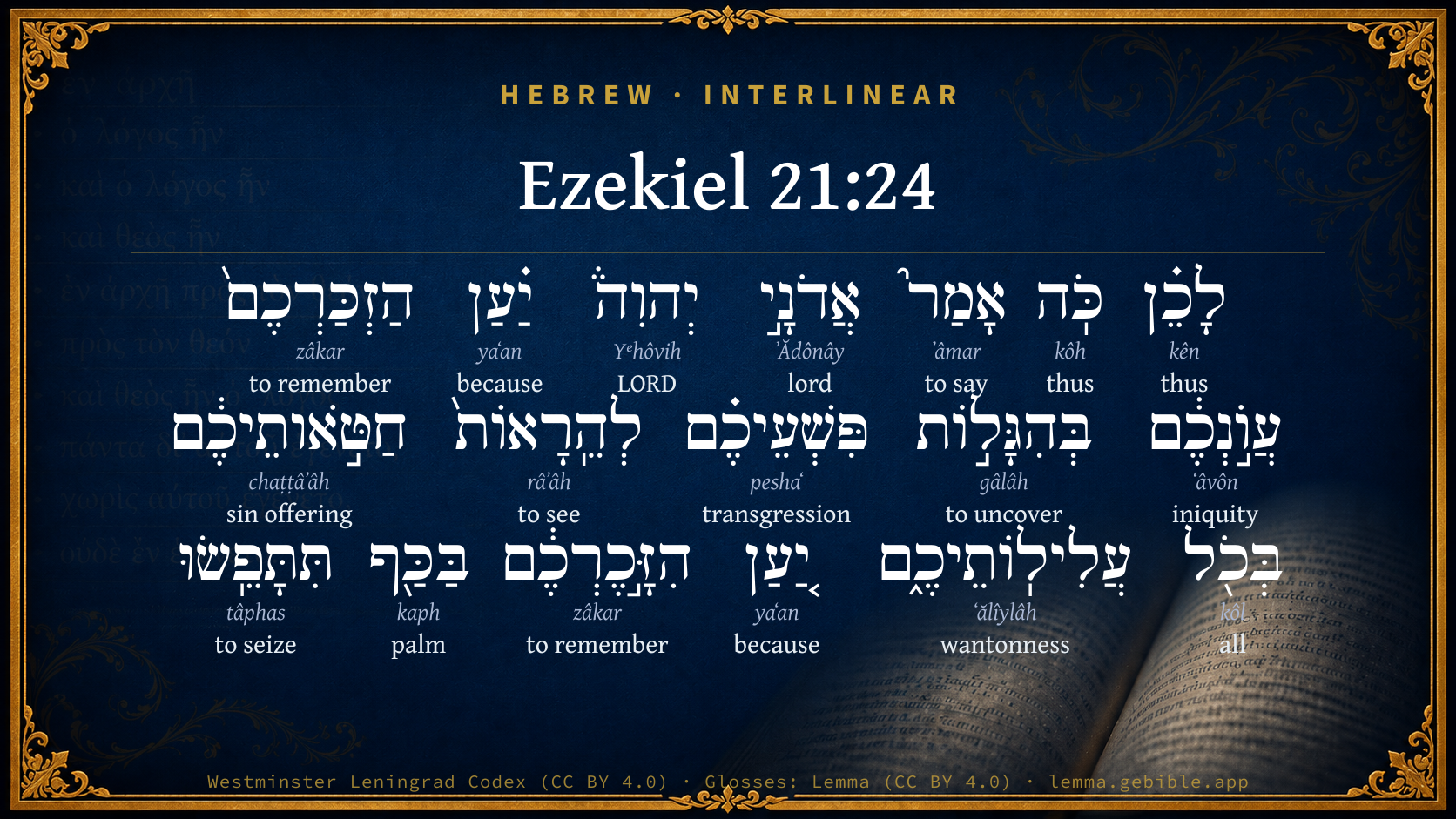
Hebrew (Westminster Leningrad Codex) Ezekiel 21:24 appears in the Hebrew Old Testament. The text above is from the Westminster Leningrad Codex. Each word links to its Strong’s number, a concise gloss, and parsing drawn from the Open Scriptures Hebrew Bible morphology. Click any word for its full Brown-Driver-Briggs (BDB) entry.
Download image
Cite this verse

Ezekiel 21:24 (World English Bible). Public Domain. Lemma interlinear Bible study tool, https://lemma.gebible.app/v/ezekiel/21/24.

Show BibTeX & RIS
BibTeX
RIS
English Translation
Therefore thus says the Lord Yahweh: Because you have made your iniquity to be remembered, in that your transgressions are uncovered, so that in all your doings your sins do appear; because you have come to memory, you shall be taken with the hand.
World English Bible · Public Domain
Download a study sheet

One document with this verse’s original text, its word-by-word gloss line, the meaning frame, cross-references with their text, attributed commentary, and full source and license credits — printable, and it pastes into notes with its structure intact.

This verse Autodidact and up

Study sheet (.html) Plain text (.txt)

A passage Seminary Student

Up to 50 verses in one chapter. A passage sheet keeps up to 6 commentary sources and 12 cross-references per verse, in the order this page ranks them, and says so on the sheet whenever that leaves anything out. Ask for a single verse and you get the Autodidact verse sheet above.

Everything on this page stays free to read, with no account — the sheet is a download of what is already on screen, not access to it.

Want to remove ads? Support Godless Engineer
Compare translations 3

The same verse in 3 English versions, stacked beneath the original-language interlinear above. Click any original word for its lexicon entry.

Each is an independent rendering of the whole verse — the interlinear is not word-aligned to these translations.

Highlighted words mark where these versions differ — a whole-verse word diff, not a word-by-word alignment.

  • World English Bible Public Domain
    Therefore thus says the Lord Yahweh: Because you have made your iniquity to be remembered, in that your transgressions are uncovered, so that in all your doings your sins do appear; because you have come to memory, you shall be taken with the hand.
  • King James Version Public Domain
    Therefore thus saith the Lord GOD; Because ye have made your iniquity to be remembered, in that your transgressions are discovered, so that in all your doings your sins do appear; because, I say, that ye are come to remembrance, ye shall be taken with the hand.
  • unfoldingWord Literal Text CC BY-SA 4.0
    Therefore the Lord Yahweh says this: Because you have made your guilt to be remembered, making your transgressions to be revealed, so that in all your actions your sins will be seen— because you have done this you will be taken in hand.

unfoldingWord Literal Text — © unfoldingWord, licensed CC BY-SA 4.0. Word-aligned USFM3 via Door43 (git.door43.org/unfoldingWord/en_ult).

Versions to compare (up to 4)

3 of 4 selected

Show all 18 translations

Every available English version of this verse, each an independent rendering of the whole verse.

  • World English Bible Public Domain
    Therefore thus says the Lord Yahweh: Because you have made your iniquity to be remembered, in that your transgressions are uncovered, so that in all your doings your sins do appear; because you have come to memory, you shall be taken with the hand.
  • Berean Standard Bible Public Domain
    Therefore this is what the Lord GOD says: ‘Because you have drawn attention to your guilt, exposing your transgressions, so that your sins are revealed in all your deeds—because you have come to remembrance—you shall be taken in hand.
  • Majority Standard Bible Public Domain
    Therefore this is what the Lord GOD says: ‘Because you have drawn attention to your guilt, exposing your transgressions, so that your sins are revealed in all your deeds—because you have come to remembrance—you shall be taken in hand.
  • King James Version Public Domain
    Therefore thus saith the Lord GOD; Because ye have made your iniquity to be remembered, in that your transgressions are discovered, so that in all your doings your sins do appear; because, I say, that ye are come to remembrance, ye shall be taken with the hand.
  • American Standard Version (1901) Public Domain
    Therefore thus saith the Lord Jehovah: Because ye have made your iniquity to be remembered, in that your transgressions are uncovered, so that in all your doings your sins do appear; because that ye are come to remembrance, ye shall be taken with the hand.
  • Revised Version (1885) Public Domain
    Therefore thus saith the Lord GOD: Because ye have made your iniquity to be remembered, in that your transgressions are discovered, so that in all your doings your sins do appear; because that ye are come to remembrance, ye shall be taken with the hand.
  • Geneva Bible (1599) Public Domain
    Therefore thus sayeth the Lord God, Because ye haue made your iniquitie to bee remembred, in discouering your rebellion, that in al your workes your sinnes might appeare: because, I say, that ye are come to remembrance, ye shall be taken with the hand.
  • Douay-Rheims (1899) Public Domain
    Therefore thus saith the Lord God: Because you have remembered your iniquity, and have discovered your prevarications, and your sins have appeared in all your devices: because, I say, you have remembered, you shall be taken with the hand.
  • Young's Literal Translation Public Domain
    Therefore, thus said the Lord Jehovah: Because of your causing your iniquity to be remembered, In your transgressions being revealed, For your sins being seen, in all your doings, Because of your being remembered, By the hand ye are caught.
  • Literal Standard Version CC BY-SA 4.0
    Therefore, thus said Lord YHWH: Because of your causing your iniquity to be remembered, || In your transgressions being revealed, || For your sins being seen, in all your doings, || Because of your being remembered, || You are caught by the hand.
  • Unlocked Literal Bible CC BY-SA 4.0
    Therefore the Lord Yahweh says this: Because you have made your guilt to be remembered, making your transgressions to be revealed, so that in all your actions your sins will be seen— because you have done this you will be taken in hand.
  • unfoldingWord Literal Text CC BY-SA 4.0
    Therefore the Lord Yahweh says this: Because you have made your guilt to be remembered, making your transgressions to be revealed, so that in all your actions your sins will be seen— because you have done this you will be taken in hand.
  • Darby Bible Public Domain
    Therefore thus saith the Lord Jehovah: Because ye make your iniquity to be remembered in that your transgressions are discovered, so that in all your doings your sins appear; because ye are come to remembrance, ye shall be taken with the hand.
  • World Messianic Bible Public Domain
    “Therefore the Lord GOD says: ‘Because you have caused your iniquity to be remembered, in that your transgressions are uncovered, so that in all your doings your sins appear; because you have come to memory, you will be taken with the hand.
  • Webster's Bible Public Domain
    Therefore thus saith the Lord GOD; Because ye have made your iniquity to be remembered, in that your transgressions are disclosed, so that in all your doings your sins do appear; because, I say, that ye are come to remembrance, ye shall be taken with the hand.
  • Free Bible Version CC BY-SA 4.0
    So this is what the Lord God says: Because you have revealed your guilt and demonstrated your rebellion, showing your sins in everything you've done, now that you've made all this clear, you will be taken prisoner.
  • Bible in Basic English Public Domain
    For this cause the Lord has said: Because you have made your evil-doing come to mind by the uncovering of your wrongdoing, causing your sins to be seen in all your evil-doings; because you have come to mind, you will be taken in them.
  • JPS Tanakh (1917) Public Domain
    (21-29) Therefore thus saith the Lord GOD: Because ye have made your iniquity to be remembered, in that your transgressions are uncovered, so that your sins do appear in all your doings; because that ye are come to remembrance, ye shall be taken with the hand.

Literal Standard Version (2020), Covenant Press — licensed CC BY-SA 4.0. Text via the HelloAO Bible API (eBible.org). Unlocked Literal Bible (unfoldingWord) — licensed CC BY-SA 4.0. Text via the HelloAO Bible API (eBible.org). unfoldingWord Literal Text — © unfoldingWord, licensed CC BY-SA 4.0. Word-aligned USFM3 via Door43 (git.door43.org/unfoldingWord/en_ult). Free Bible Version, Dr. Jonathan Gallagher — licensed CC BY-SA 4.0. Text via the HelloAO Bible API (eBible.org).

Word by word

More ways to search: Search by grammar → Find every occurrence → Compare this word →

Practice this passage: Drill this verse → Learn its vocabulary →

עֲלִילֽוֹתֵיכֶ֑ם
ʻălîylâh
H5949
“deeds · your”
Noun, Common, Feminine, Plural, Construct + Suffix, Personal, 2nd Person, Masculine, Plural
Part of Speech
Noun
Type
Common
Gender
Feminine
Number
Plural
State
Construct
Full BDB Definition

Origin: from H5953 in the sense of effecting

TWOT: 1627c

wantonness, deed, doing - wantonness - deed - practices, evil deeds
  1. לָכֵ֗ן kên H3651 “to/for · thus” Preposition + Adverb
  2. כֹּֽה kôh H3541 “thus” Adverb
  3. אָמַר֮ ʼâmar H559 “to say” Verb, Qal, Perfect, 3rd Person, Masculine, Singular
  4. אֲדֹנָ֣י ʼĂdônây H136 “Lord · my” Noun, Common, Masculine, Plural, Construct + Suffix, Personal, 1st Person, Common, Singular
  5. יְהוִה֒ Yᵉhôvih H3069 “LORD” Noun, Proper
  6. יַ֗עַן yaʻan H3282 “because” Conjunction
  7. הַזְכַּרְכֶם֙ zâkar H2142 “to remember · you” Verb, Hiphil, Infinitive Construct + Suffix, Personal, 2nd Person, Masculine, Plural
  8. עֲוֺ֣נְכֶ֔ם ʻâvôn H5771 “iniquity · your” Noun, Common, Both, Singular, Construct + Suffix, Personal, 2nd Person, Masculine, Plural
  9. בְּהִגָּל֣וֹת gâlâh H1540 “in/at · to uncover” Preposition + Verb, Niphal, Infinitive Construct
  10. פִּשְׁעֵיכֶ֗ם peshaʻ H6588 “transgressions · your” Noun, Common, Masculine, Plural, Construct + Suffix, Personal, 2nd Person, Masculine, Plural
  11. לְהֵֽרָאוֹת֙ râʼâh H7200 “to see” Preposition + Verb, Niphal, Infinitive Construct
  12. חַטֹּ֣אותֵיכֶ֔ם chaṭṭâʼâh H2403 “sin offerings · your” Noun, Common, Feminine, Plural, Construct + Suffix, Personal, 2nd Person, Masculine, Plural
  13. בְּכֹ֖ל kôl H3605 “in/at · all of” Preposition + Noun, Common, Masculine, Singular, Construct
  14. יַ֚עַן yaʻan H3282 “because” Conjunction
  15. הִזָּ֣כֶרְכֶ֔ם zâkar H2142 “to remember · you” Verb, Niphal, Infinitive Construct + Suffix, Personal, 2nd Person, Masculine, Plural
  16. בַּכַּ֖ף kaph H3709 “in/at the · palm” Preposition, Determined + Noun, Common, Feminine, Singular, Absolute
  17. תִּתָּפֵֽשׂוּ tâphas H8610 “to seize” Verb, Niphal, Imperfect, 2nd Person, Masculine, Plural

About this verse

These counts appear in no published source. They are computed here, from the morphology-tagged text and Lemma’s own curated glosses. What Lemma adds →

18
words
16
distinct lemmas
Prophets
section

Notable vocabulary

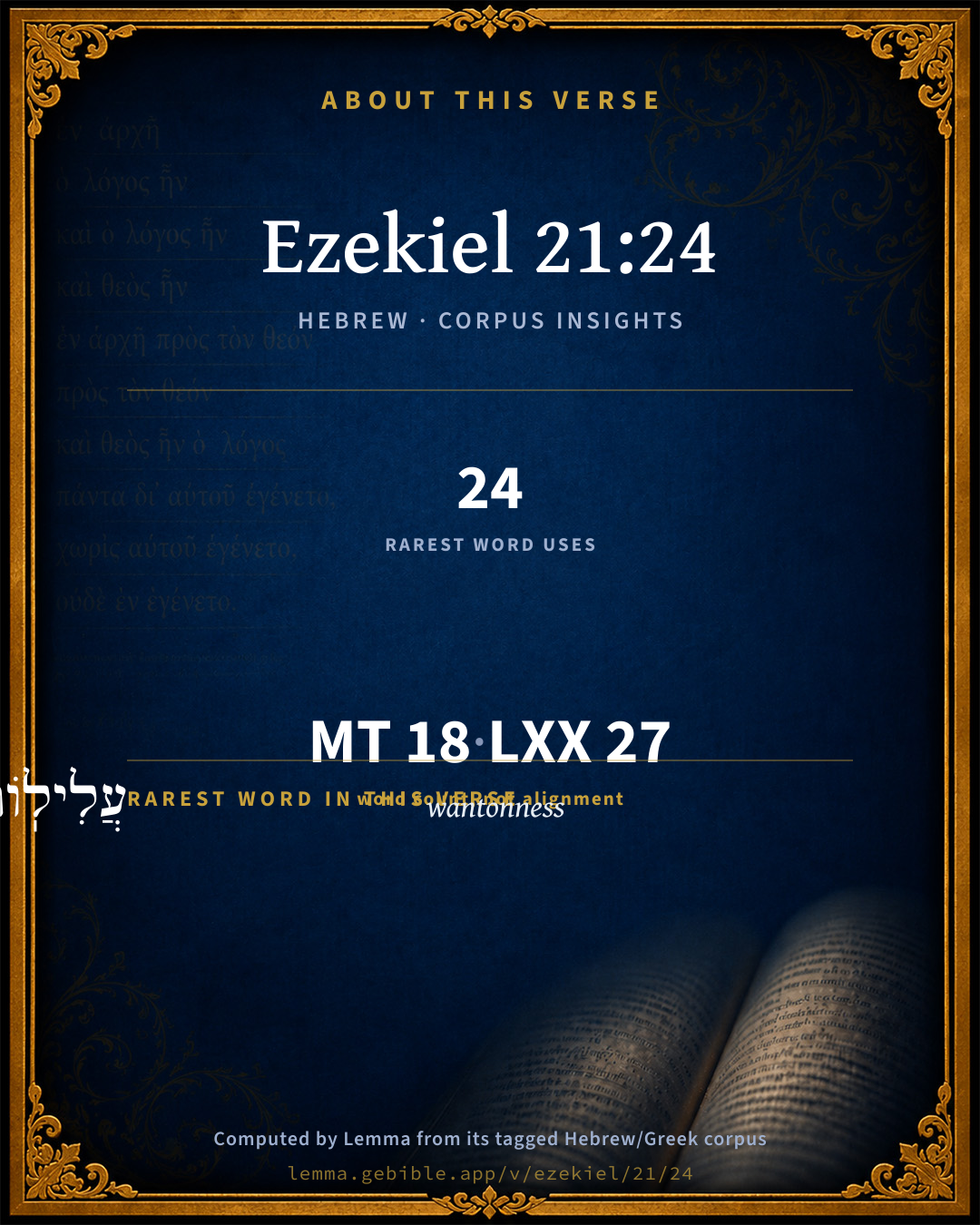
The rarest word here is עֲלִילֽוֹתֵיכֶ֑ם wantonness H5949 — appearing just 24 times in the whole Hebrew Bible.

Shared distinctive vocabulary

עֲלִילֽוֹתֵיכֶ֑ם wantonness H5949 occurs in 24 verses of the Hebrew Bible. Also found in:

Grammatical profile

  • 6 verbs
  • 8 nouns
  • 2 conjunctions
  • 2 adverbs

Verb forms

  • אָמַר֮ Qal · Perfect
  • הַזְכַּרְכֶם֙ Hiphil · Infinitive Construct
  • בְּהִגָּל֣וֹת Niphal · Infinitive Construct
  • לְהֵֽרָאוֹת֙ Niphal · Infinitive Construct
  • הִזָּ֣כֶרְכֶ֔ם Niphal · Infinitive Construct
  • תִּתָּפֵֽשׂוּ Niphal · Imperfect

Repetition

Words recur within this verse — often emphatic in Hebrew:

  • יַ֗עַן because H3282 ×2
  • הַזְכַּרְכֶם֙ to remember H2142 ×2

Hebrew & Septuagint length

In English translation the verse runs 44 words from the Hebrew and 49 from the Septuagint (LXX English) — closely comparable.

A rough comparison of the two English renderings, which tokenize alike — not a word-level alignment.

Word counts can differ between the Hebrew and the Greek without any difference in meaning — e.g. the Hebrew direct-object marker אֵת has no separate Greek word, and Greek often adds the article ὁ.

In the original languages it is 18 Hebrew tokens and 27 Greek tokens — but the two are counted differently (Hebrew bundles its prefixes and suffixes into one token; the Greek is in lemma form), so that isn’t a like-for-like length.

Cross-references

17

Topical passages linked to Ezekiel 21:24 in the Treasury of Scripture Knowledge — connected by theme and wording, ordered by reader-vote popularity; previews shown in the World English Bible.

  • Hosea 4:2 There is cursing, lying, murder, stealing, and committing adultery; They break boundaries, and bloodshed causes bloodshed.
  • Isaiah 3:9 The look of their faces testify against them. They parade their sin like Sodom. They don't hide it. Woe to their soul! For they have brought disaster upon themselves.
  • Isaiah 22:17–18 Behold, Yahweh, like a [strong] man, will hurl you away violently; yes, he will wrap you up closely.
  • Jeremiah 2:34 Also in your skirts is found the blood of the souls of the innocent poor: you did not find them breaking in; but it is because of all these things.
  • Jeremiah 3:2 Lift up your eyes to the bare heights, and see; where have you not been lain with? By the ways have you sat for them, as an Arabian in the wilderness; and you have polluted the land with your prostitution and with your wickedness.
  • Jeremiah 5:27–28 As a cage is full of birds, so are their houses full of deceit: therefore they are become great, and grew rich.
  • Jeremiah 6:15 Were they ashamed when they had committed abomination? nay, they were not at all ashamed, neither could they blush: therefore they shall fall among those who fall; at the time that I visit them they shall be cast down, says Yahweh.
  • Jeremiah 8:12 Were they ashamed when they had committed abomination? nay, they were not at all ashamed, neither could they blush: therefore shall they fall among those who fall; in the time of their visitation they shall be cast down, says Yahweh.
  • Jeremiah 9:2–7 Oh that I had in the wilderness a lodging-place of wayfaring men; that I might leave my people, and go from them! for they are all adulterers, an assembly of treacherous men.
  • Jeremiah 15:2 It shall happen, when they tell you, Where shall we go forth? then you shall tell them, Thus says Yahweh: Such as are for death, to death; and such as are for the sword, to the sword; and such as are for the famine, to the famine; and such as are for captivity, to captivity.
  • Ezekiel 16:16–22 You took of your garments, and made for yourselves high places decked with various colors, and played the prostitute on them: [the like things] shall not come, neither shall it be [so].
  • Ezekiel 22:3–12 You shall say, Thus says the Lord Yahweh: A city that sheds blood in the midst of her, that her time may come, and that makes idols against herself to defile her!
  • Ezekiel 22:24–31 Son of man, tell her, You are a land that is not cleansed, nor rained on in the day of indignation.
  • Ezekiel 23:5–21 Oholah played the prostitute when she was mine; and she doted on her lovers, on the Assyrians [her] neighbors,
  • Ezekiel 24:7 For her blood is in the midst of her; she set it on the bare rock; she didn't pour it on the ground, to cover it with dust.
  • Amos 9:1–3 I saw the Lord standing beside the altar, and he said, "Strike the tops of the pillars, that the thresholds may shake; and break them in pieces on the head of all of them; and I will kill the last of them with the sword: there shall not one of them flee away, and there shall not one of them escape.
  • Micah 3:10–12 They build up Zion with blood, And Jerusalem with iniquity.

Cross-references courtesy of OpenBible.info (CC BY 4.0).

Hebrew and Greek witnesses Masoretic Hebrew ↔ Greek Septuagint

The same verse in the two great witnesses to the Old Testament, shown verse-for-verse.

These are two independent witnesses, not word-aligned to each other, and the Septuagint is shown in lemma (dictionary) form.

Hebrew Ezekiel 21:24 Masoretic · Westminster Leningrad Codex

לָכֵ֗ן כֹּֽה אָמַר֮ אֲדֹנָ֣י יְהוִה֒ יַ֗עַן הַזְכַּרְכֶם֙ עֲוֺ֣נְכֶ֔ם בְּהִגָּל֣וֹת פִּשְׁעֵיכֶ֗ם לְהֵֽרָאוֹת֙ חַטֹּ֣אותֵיכֶ֔ם בְּכֹ֖ל עֲלִילֽוֹתֵיכֶ֑ם יַ֚עַן הִזָּ֣כֶרְכֶ֔ם בַּכַּ֖ף תִּתָּפֵֽשׂוּ

Therefore thus says the Lord Yahweh: Because you have made your iniquity to be remembered, in that your transgressions are uncovered, so that in all your doings your sins do appear; because you have come to memory, you shall be taken with the hand.

World English Bible · Public Domain

Greek LXX Ezekiel 21:24 Septuagint · lemma form

καί σύ υἱός ἄνθρωπος διατάσσω σεαυτοῦ δύο ὁδός ὁ εἰςἔρχομαι ῥομφαία βασιλεύς βαβυλών ἐκ χώρα εἷς ἐκἔρχομαι ὁ δύο καί χείρ ἐν ἀρχή ὁδός πόλις ἐπί ἀρχή

Therefore thus says the Lord, Because you⌃ have caused your iniquities to be remembered, in the discovery of your wickedness, so that your sins should be seen, in all your wickedness and in your evil practices; because you⌃ have caused remembrance of them, in these shall you⌃ be taken.

LXX2012 (modern English Septuagint) · Public Domain

On this verse, Whedon's Commentary on the Bible discusses the Septuagint’s reading. Read the note in Commentary ↓

Hebrew: Westminster Leningrad Codex (CC BY 4.0). Greek: Septuagint (public domain); English from LXX2012 (modern English Septuagint) (Public Domain). How the Septuagint differs from the Hebrew →

Targum (Aramaic paraphrase)

1

The Targum is the ancient Jewish Aramaic paraphrase of the Hebrew Scriptures — an interpretive translation, not the Hebrew text itself. Onkelos (literal) and Pseudo-Jonathan (expansive) render the Torah, and Jonathan the Prophets. Coverage is partial: where no permissively-licensed English translation exists for a verse, only the Aramaic is shown. This is verse-level text, not a word-by-word alignment to the Hebrew.

  1. Targum Jonathan Prophets (Joshua–Malachi)
    וְאַתְּ בַּר אָדָם אַתְקִין לָךְ תַּרְתֵּין אוֹרְחָן דְיֵיתוּן בְּהוֹן קְטוֹלֵי חַרְבָּא דְמַלְכָּא דְבָבֶל מִמְדִינְתָא הֲדָא יִפְקוּן תַּרְוֵיהוֹן וְאַתְרָא אַתְקִין בְּרֵישׁ פְּרָשׁוּת אוֹרַח קַרְתָּא אַתְרָא אַתְקֵין:

    (no public-domain English translation for this verse)

    Targum Jonathan — Aramaic: “Mikraot Gedolot” (public domain). English: “Sefaria Community Translation” (CC0 1.0 (public-domain dedication)); “London "Chaldee Paraphrase," 1871” (public domain). Text via Sefaria.

Commentary

Notes on Ezekiel 21:24 from classic Christian and Jewish commentators (each source and its license shown beneath its notes). The classic Christian expositions comment on the surrounding passage and are grouped to its opening verse, so a note may address several verses; the Jewish commentaries on the Tanakh (Rashi and others) are per-verse, so they appear only where the commentator wrote on this verse.

Lemma curates 59 commentaries, every one of them public domain or Creative Commons licensed, each selected and text-cleaned for this edition rather than reprinted as found. About our sources →

Trapp's Complete Commentary

John Trapp

Eze 21:24 Therefore thus saith the Lord GOD; Because ye have made your iniquity to be remembered, in that your transgressions are discovered, so that in all your doings your sins do appear; because, [I say], that ye are come to remembrance, ye shall be taken with the hand.

Ver. 24. Because ye have made your iniquity.] Your old sins, by an addition of new ones.

Your sins do appear.] You are scandalous, shameless as Sodom. {Isa 3:9}

John Trapp, A Commentary or Exposition upon All the Books of the Old and New Testament (1647–1656) — public domain. Text from a community e-Sword module.

Jamieson, Fausset & Brown

Robert Jamieson, A. R. Fausset & David Brown

Their unfaithfulness to Nebuchadnezzar was a type of their general unfaithfulness to their covenant God.

with the hand--namely, of the king of Babylon.

Jamieson, Fausset & Brown — Commentary Critical and Explanatory on the Whole Bible (1871) — public domain (CC PDM 1.0). Text via the HelloAO Bible API.

Ellicott's Commentary for English Readers

(24) In all your doings your sins do appear.—But one particular has just been mentioned, their rebellion and perjury; but this was only the last act of a long course of sin in many ways. These have been spoken of at large in previous chapters, and therefore, when this last sin is exposed, it may well be said that sin is shown in all their doings.

A Bible Commentary for English Readers, edited by Charles John Ellicott (1878–1897) — public domain. Text from a community e-Sword module.

The Cambridge Bible for Schools and Colleges

gen. ed. J. J. S. Perowne

24. so that in … appear] Or, so that your sins do appear, even all your evil doings. Cf. Eze_29:16.

The Cambridge Bible for Schools and Colleges (gen. ed. J. J. S. Perowne; Cambridge University Press, 1878–1918) — public domain. Text from a community e-Sword module.

John Gill's Exposition

Thus saith the Lord God, remove the diadem, and take off the crown,.... That is, from Zedekiah; and as these are the regalia and ensigns of royal dignity, taking them off signifies the deposition of him as a king, the stripping him of his kingly power and authority: an earthly crown is a corruptible and fading one, at most it continues but during this life, and sometimes not so long; it does not always sit firm; sometimes it is tottering and shakes, and sometimes quite fails off to the ground; it is taken from the head of one, and put upon the head of another, by him who gives the orders in the text, and has the sovereign disposal of crowns and kingdoms; who sets up one, and puts down another. The "diadem" was a royal tire of the head, wore in common; the "crown" was put on at certain times; both signify one and the same thing, royal dignity; though the former is sometimes used as an ornament of the priesthood, as the latter of kingly power; hence the Targum,

"remove the diadem (or mitre) from Seraiah the high priest, and I will take away the crown from Zedekiah the king;''

but the latter is only meant; besides, as Kimchi observes, it was not Seraiah, but Jehozadak his son, that was carried captive with Zedekiah:

this shall not be the same; this royal dignity shall not continue the same; the kingdom shall not be in the same lustre and glory, nor in the same hands:

exalt him that is low: either Jeconiah now in captivity; and which was fulfilled when Evilmerodach lifted up his head, and set his throne above the thrones of the kings in Babylon, Jer 52:31, or Zerubbabel, of the seed of Jeconiah, who was born in the captivity, and became prince of Judah; or rather the Messiah, who was of a low extraction; born of mean parents; was as a root out of a dry ground; appeared in the form of a servant, poor and lowly; yet, when he had done his work, was highly exalted at the right hand of God; far above angels, principalities, and powers; as well as set upon the throne of his father David:

and abase him that is high; the then prince upon the throne, Zedekiah; who was high and lifted up, but should be pulled down and humbled, as he was.

John Gill's Exposition of the Whole Bible (1746–1763) — public domain (CC PDM 1.0). Text via the HelloAO Bible API.

Haydock's Catholic Bible Commentary

Remembered. Hebrew, "caused....to be remembered," (Haydock) sinning publicly. (Calmet)

George Leo Haydock (1774–1849), Haydock's Catholic Family Bible and Commentary, 1859 edition — public domain. Excludes Psalms (Douay-Rheims chapter numbering differs from Protestant) and Deuterocanonical books (Catholic canon only).

Matthew Poole's English Annotations

Either referring to God, who saw still their wicked perjuries, and other sins which they persisted in, or rather referring to Nebuchadnezzar, and his ministers of state and war, to whose memory all the falsehood of the Jews was still kept fresh by repeated disloyalty, with reproach to God, whose oath the king and inhabitants of Jerusalem had violated.

Your transgressions against God, and against the king of Babylon, whose yoke you submitted to with promised obedience.

Discovered; visibly to all in court, city, and country.

All your doings; public management of matters of the kingdom, and private too; you add sin to sin, and that without blushing for them, or hiding them.

Because; the whole summed up for confirming the threats.

Taken with the hand; as birds or beasts taken in the net, encompassed therein that they cannot get away, are taken with the hand, so shall you, and be carried into Babylon.

Matthew Poole's English Annotations on the Holy Bible (1683–1685) — public domain. Text from a community e-Sword/MySword module.

Whedon's Commentary on the Bible

Daniel D. Whedon

24. With the hand — Does this mean that they shall be taken in the hand of Nebuchadnezzar or that they shall be seized by the hand so as to be unable to escape? Or is the reading of the Septuagint to be preferred, “Ye shall be taken in them;” that is, the nation’s sins are the net in which she has become ensnared?

Daniel D. Whedon (gen. ed.), Commentary on the Old and New Testaments (1874–1909) — public domain. Text from a community e-Sword module.

The Pulpit Commentary

The prophet adds words which in part explain these that precede. The iniquity of the people has forced, not the Chaldean king only, but Jehovah himself, to remember and to punish them.

Transgressions discovered.

I TRANSGRESSIONS ARE DISCOVERED BY GOD AS SOON AS THEY ARE COMMITTED. He is present when the deeds are done; his eyes are always open to observe the conduct of his creatures; he is not negligent of sin. We start, therefore, with the position that there is no such thing as secret sin. The appearance of secrecy arises from the fact that the great Witness withholds his evidence for the present. Such a position leads to the inevitable conclusion that some day the most hidden evil may be made manifest. God holds the key, and he will unlock the door whenever he sees fit.

II TRANSGRESSIONS WILL BE DISCOVERED TO THE UNIVERSE IN THE FUTURE JUDGMENT. This must be what the judgment really means. We have been accustomed to the picture of a vast assize, as though God needed to go through the forms of a criminal trial with souls, every secret of whom has been perfectly known to him from the first. Such a trial would be an empty form, a mere theatrical display. But God will make the justice of his action apparent to all, and in doing so the secrets of all hearts will be revealed.

III TRANSGRESSIONS ARE LIKELY TO BE DISCOVERED ON EARTH. It is scarcely possible for a man to play the hypocrite successfully till his secret is sealed in death. At some moment of inadvertency he is almost certain to lift the mask, and then the discovery of his deceit, once made, will destroy forever the reputation of years. Sin will work its fruits in the bad man"s life. Though never confessed in words, it is expressed in tone and temper. The very features of the countenance set themselves to the character of the life within. Moreover, sudden surprises and unexpected turns of events will reveal a man to the world. The long buried secret comes to light. Achan"s Babylonish garment is brought to light. (Jos_7:18-20) Ananias and Sapphira cannot conceal their lie. (Act_5:9) Eugene Aram cannot hide the corpse of his victim. Dimsdale is driven to reveal the scarlet letter that burns in fire on his breast.

IV TRANSGRESSIONS MAY BE HIDDEN BY FORGIVENESS. In the expressive Hebrew phrase, they are then said to be "covered." The only way to have our transgression thus buried out of sight is for us first to confess it to God. Thus we need to pray that be will search us and try us, and see if there be any wicked way in us. (Psa_139:23, Psa_139:24) Until our sins are brought home to our consciences, there is no hope that they will be permanently hidden. If we forget them, God will remember them. For God to forget them we must first remember them. When transgressions are thus owned to God, we are in the condition to receive his pardon, after which we may take the assurance, "Your sins and iniquities will I remember no more." The sins are then banished "as far as the east is from the west." They are "buried in the depth of the sea." God does not goad his restored children with their old sins.

The Pulpit Commentary (1880–1919), ed. H.D.M. Spence-Jones & Joseph S. Exell — public domain. Text from a community e-Sword module.

John Wesley's Explanatory Notes

Your transgressions - Against God, and against the king of Babylon. Discovered - To all in court, city, and country. With the hand - As birds, or beasts in the net, are taken with the hands, so shall you, and be carried into Babylon.

John Wesley, Explanatory Notes Upon the Whole Bible (1754–1765) — public domain. Text via the GEBible commentary corpus.

unfoldingWord translationNotes

Door43 World Missions Community

General Information:

Yahweh continues giving Ezekiel his message to the people of Jerusalem.

Because you have made your guilt to be remembered

"Because you remind me of your iniquity"

making your transgressions to be revealed, so that in all your actions your sins will be seen

This can be stated in active form. AT: "revealing your transgressions, so that everyone can see your sins in all of your actions" (See: Active or Passive)

you will be taken in hand

This can be stated in active form. The "enemy's hand" represents the enemy's control. AT: "your enemy will take you in his hand" or "your enemies will capture you and take you into captivity" (See: Active or Passive and Metonymy)

translationWords

Lord Yahweh

iniquity

transgress

reveal

sin

adversary

hand

unfoldingWord translationNotes — © Distant Shores Media and the Door43 World Missions Community, licensed CC BY-SA 4.0. Source: git.door43.org/Door43/en_tn.

Rashi

Rabbi Shlomo Yitzchaki (Rashi)

make for yourself two roads as He concludes the [next] verse.

and clear a place; at the head of the road to the city Clear for yourself a place at the head of the road you are on, and make for yourself a sort of road opening into the crossroads, one facing right and one facing left.

both of them will emanate The two roads.

and clear a place A place cleared of the thorns and the thistles; [בָּרִא is like] essarter in French, to clear. A word similar to it appears in the Book of Joshua (17:15): “then go up to the forest, and clear it (וּבֵרֵאתָ) for yourself there.” Again (ibid. verse 18): “But the mountain shall be yours, for it is a forest, and you shall cut it down (וּבֵרֵאתוֹ).” Menachem connected them all (p. 48) as an expression of choosing, like (I Sam. 17:8): “Choose (בְּרוּ) for yourselves a man”; בָּרֵא meaning lisant in Old French, choosing, appointing.

Rashi on the Tanakh — English translations: “The Judaica Press complete Tanach with Rashi, translated by A. J. Rosenberg” (CC BY 4.0); “Pentateuch with Rashi's commentary by M. Rosenbaum and A.M. Silbermann, 1929-1934” (public domain); “The Metsudah Tanach series, Lakewood, N.J” (CC BY 4.0); and “The Book of Joshua, Metsudah Publications, 1997” (CC BY 4.0). Text via Sefaria.

Lesson kit

Teaching starters — assembled from the data on this page, not authored interpretation. Every prompt links to the verse data it draws on. Edit before teaching.

Ezekiel, in the Prophets, opens this verse with 18 words (16 distinct Hebrew lemmas). Its most distinctive word is ʻălîylâh (“wantonness”). A historical commentator’s framing appears above. Read the whole chapter for the surrounding context.

Discussion questions

  1. How does “wantonness” (ʻălîylâh) shape what this verse is saying?
  2. Deuteronomy 22:14 shares the word «wantonness» with this verse. How do the two illuminate each other?
  3. “because” occurs 2× in this one verse. What is the effect of the repetition?
  4. These translations render this verse differently; the difference is in the English rendering, not the original. What questions does that raise?
  5. The verb «אָמַר֮» is Qal Perfect. How does its form color the action?
  6. Reading how Trapp's Complete Commentary and Jamieson, Fausset & Brown read this verse, where do the two commentators agree and where do they part?

Things to notice

Reading settings

Reading text

Shown beneath each verse's original-language words.

Old Testament
Old Testament edition

Read the OT as the Masoretic Hebrew (MT) or the Greek Septuagint (LXX).

English shown for the Greek Septuagint (in the Hebrew ↔ Greek comparison).

Comparing translations? Open the Compare panel on any verse page to stack up to four side by side.