Jeremiah 31:30

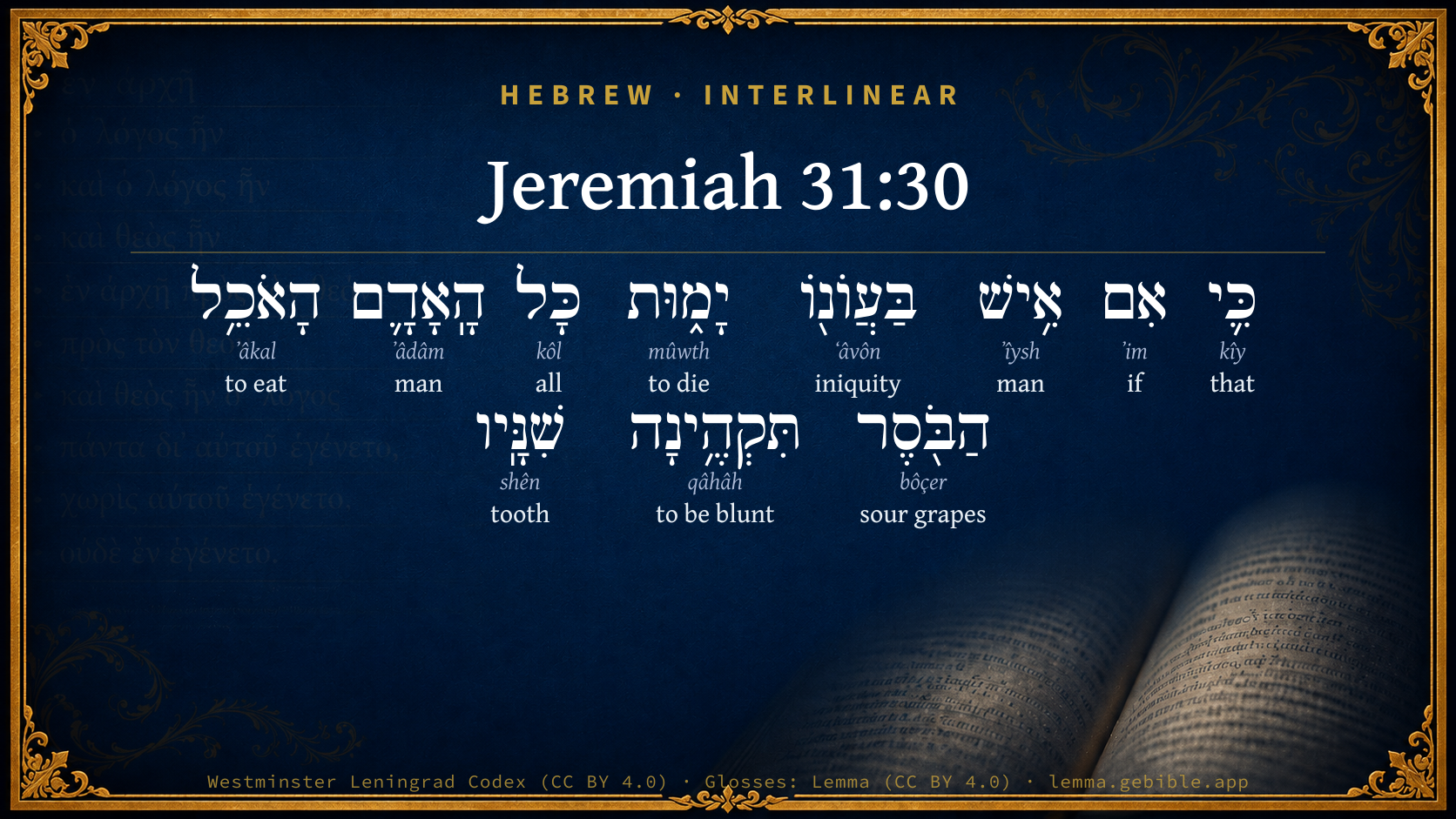
Hebrew (Westminster Leningrad Codex) Jeremiah 31:30 appears in the Hebrew Old Testament. The text above is from the Westminster Leningrad Codex. Each word links to its Strong’s number, a concise gloss, and parsing drawn from the Open Scriptures Hebrew Bible morphology. Click any word for its full Brown-Driver-Briggs (BDB) entry.
Download image
Cite this verse

Jeremiah 31:30 (World English Bible). Public Domain. Lemma interlinear Bible study tool, https://lemma.gebible.app/v/jeremiah/31/30.

Show BibTeX & RIS
BibTeX
RIS
English Translation
But everyone shall die for his own iniquity: every man who eats the sour grapes, his teeth shall be set on edge.
World English Bible · Public Domain
Download a study sheet

One document with this verse’s original text, its word-by-word gloss line, the meaning frame, cross-references with their text, attributed commentary, and full source and license credits — printable, and it pastes into notes with its structure intact.

This verse Autodidact and up

Study sheet (.html) Plain text (.txt)

A passage Seminary Student

Up to 50 verses in one chapter. A passage sheet keeps up to 6 commentary sources and 12 cross-references per verse, in the order this page ranks them, and says so on the sheet whenever that leaves anything out. Ask for a single verse and you get the Autodidact verse sheet above.

Everything on this page stays free to read, with no account — the sheet is a download of what is already on screen, not access to it.

Want to remove ads? Support Godless Engineer
Compare translations 3

The same verse in 3 English versions, stacked beneath the original-language interlinear above. Click any original word for its lexicon entry.

Each is an independent rendering of the whole verse — the interlinear is not word-aligned to these translations.

Highlighted words mark where these versions differ — a whole-verse word diff, not a word-by-word alignment.

  • World English Bible Public Domain
    But everyone shall die for his own iniquity: every man who eats the sour grapes, his teeth shall be set on edge.
  • King James Version Public Domain
    But every one shall die for his own iniquity: every man that eateth the sour grape, his teeth shall be set on edge.
  • unfoldingWord Literal Text CC BY-SA 4.0
    For each man will die in his own iniquity; everyone who eats sour grapes, his teeth will be dulled.

unfoldingWord Literal Text — © unfoldingWord, licensed CC BY-SA 4.0. Word-aligned USFM3 via Door43 (git.door43.org/unfoldingWord/en_ult).

Versions to compare (up to 4)

3 of 4 selected

Show all 18 translations

Every available English version of this verse, each an independent rendering of the whole verse.

  • World English Bible Public Domain
    But everyone shall die for his own iniquity: every man who eats the sour grapes, his teeth shall be set on edge.
  • Berean Standard Bible Public Domain
    Instead, each will die for his own iniquity. If anyone eats the sour grapes, his own teeth will be set on edge.
  • Majority Standard Bible Public Domain
    Instead, each will die for his own iniquity. If anyone eats the sour grapes, his own teeth will be set on edge.
  • King James Version Public Domain
    But every one shall die for his own iniquity: every man that eateth the sour grape, his teeth shall be set on edge.
  • American Standard Version (1901) Public Domain
    But every one shall die for his own iniquity: every man that eateth the sour grapes, his teeth shall be set on edge.
  • Revised Version (1885) Public Domain
    But every one shall die for his own iniquity: every man that eateth the sour grapes, his teeth shall be set on edge.
  • Geneva Bible (1599) Public Domain
    But euery one shall die for his owne iniquitie: euery man that eateth the sowre grape, his teeth shalbe set on edge.
  • Douay-Rheims (1899) Public Domain
    But every one shall die for his own iniquity: every man that shall eat the sour grape, his teeth shall be set on edge.
  • Young's Literal Translation Public Domain
    But -- each for his own iniquity doth die, Every man who is eating the unripe fruit, Blunted are his teeth.
  • Literal Standard Version CC BY-SA 4.0
    But—each dies for his own iniquity, || Every man who is eating the unripe fruit, || His teeth are blunted.
  • Unlocked Literal Bible CC BY-SA 4.0
    For each man will die in his own iniquity; everyone who eats sour grapes, his teeth will be dulled.
  • unfoldingWord Literal Text CC BY-SA 4.0
    For each man will die in his own iniquity; everyone who eats sour grapes, his teeth will be dulled.
  • Darby Bible Public Domain
    for every one shall die for his own iniquity; every man that eateth the sour grapes, his teeth shall be set on edge.
  • World Messianic Bible Public Domain
    But everyone will die for his own iniquity. Every man who eats the sour grapes, his teeth will be set on edge.
  • Webster's Bible Public Domain
    But every one shall die for his own iniquity: every man that eateth the sour grape, his teeth shall be set on edge.
  • Free Bible Version CC BY-SA 4.0
    No. Each person will die because of their own sins. If anyone eats unripe grapes, they will get the sour taste themselves.
  • Bible in Basic English Public Domain
    But everyone will be put to death for the evil which he himself has done: whoever has taken bitter grapes will himself have his teeth put on edge.
  • JPS Tanakh (1917) Public Domain
    But every one shall die for his own iniquity; every man that eateth the sour grapes, his teeth shall be set on edge.

Literal Standard Version (2020), Covenant Press — licensed CC BY-SA 4.0. Text via the HelloAO Bible API (eBible.org). Unlocked Literal Bible (unfoldingWord) — licensed CC BY-SA 4.0. Text via the HelloAO Bible API (eBible.org). unfoldingWord Literal Text — © unfoldingWord, licensed CC BY-SA 4.0. Word-aligned USFM3 via Door43 (git.door43.org/unfoldingWord/en_ult). Free Bible Version, Dr. Jonathan Gallagher — licensed CC BY-SA 4.0. Text via the HelloAO Bible API (eBible.org).

Word by word

More ways to search: Search by grammar → Find every occurrence → Compare this word →

Practice this passage: Drill this verse → Learn its vocabulary →

הַבֹּ֖סֶר
bôçer
H1155
“the · sour grapes”
Particle, Definite Article + Noun, Common, Masculine, Singular, Absolute
Part of Speech
Particle + Noun
Type
Common
Gender
Masculine
Number
Singular
State
Absolute
Full BDB Definition

Origin: from the same as H1154

TWOT: 257a

unripe grapes, sour grapes
  1. כִּ֛י kîy H3588 “that” Conjunction
  2. אִם ʼim H518 “if” Conjunction
  3. אִ֥ישׁ ʼîysh H376 “man” Noun, Common, Masculine, Singular, Absolute
  4. בַּעֲוֺנ֖וֹ ʻâvôn H5771 “in/at · iniquity · his” Preposition + Noun, Common, Both, Singular, Construct + Suffix, Personal, 3rd Person, Masculine, Singular
  5. יָמ֑וּת mûwth H4191 “to die” Verb, Qal, Imperfect, 3rd Person, Masculine, Singular
  6. כָּל kôl H3605 “all of” Noun, Common, Masculine, Singular, Construct
  7. הָֽאָדָ֛ם ʼâdâm H120 “the · man” Particle, Definite Article + Noun, Common, Masculine, Singular, Absolute
  8. הָאֹכֵ֥ל ʼâkal H398 “the · eating” Particle, Definite Article + Verb, Qal, Participle Active, Masculine, Singular, Absolute
  9. תִּקְהֶ֥ינָה qâhâh H6949 “to be blunt” Verb, Qal, Imperfect, 3rd Person, Feminine, Plural
  10. שִׁנָּֽיו shên H8127 “teeth · his” Noun, Common, Both, Dual, Construct + Suffix, Personal, 3rd Person, Masculine, Singular

About this verse

These counts appear in no published source. They are computed here, from the morphology-tagged text and Lemma’s own curated glosses. What Lemma adds →

11
words
11
distinct lemmas
Prophets
section

Notable vocabulary

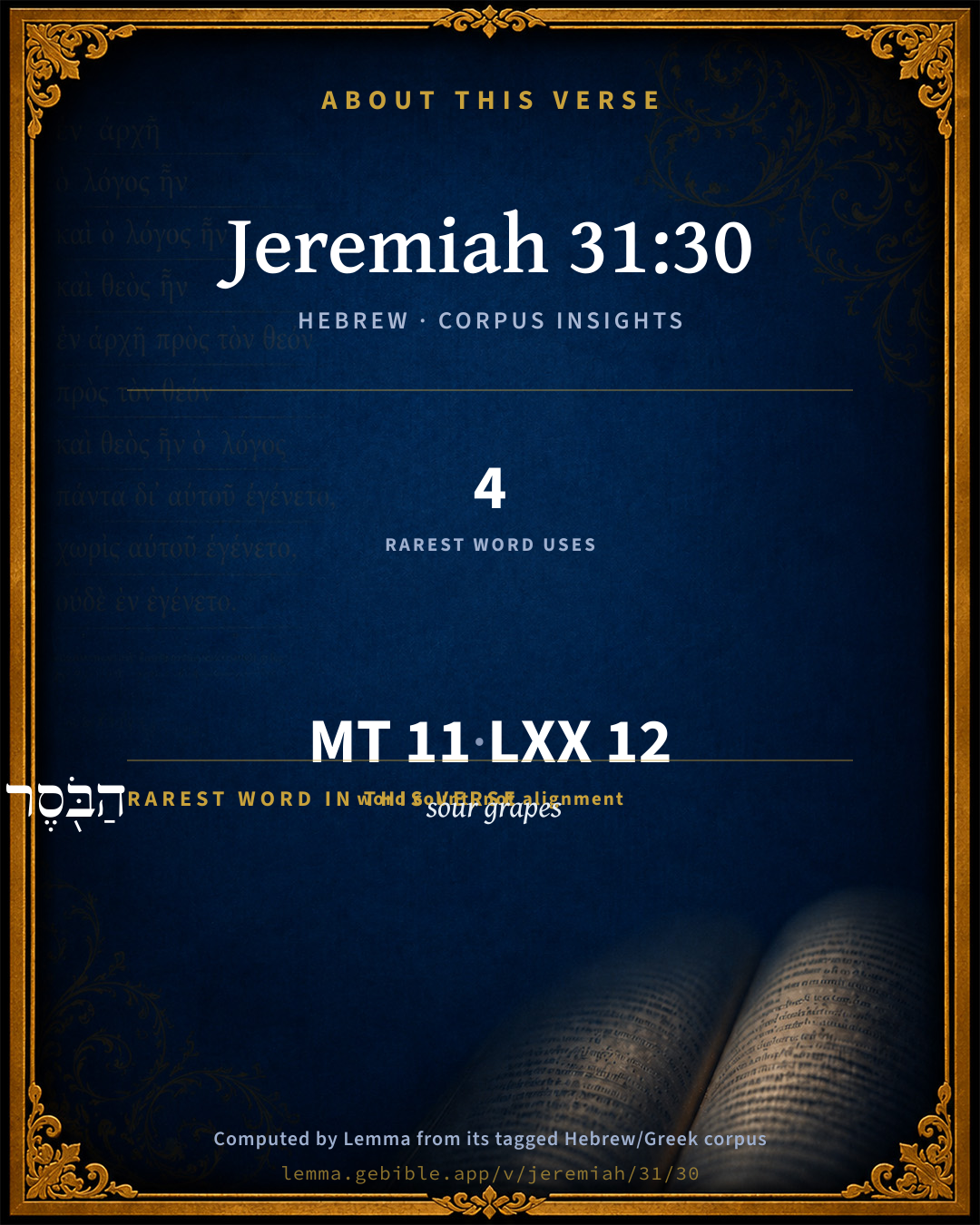
The rarest word here is הַבֹּ֖סֶר sour grapes H1155 — appearing just 4 times in the whole Hebrew Bible.

Shared distinctive vocabulary

הַבֹּ֖סֶר sour grapes H1155 occurs in 4 verses of the Hebrew Bible. Also found in:

Grammatical profile

  • 3 verbs
  • 6 nouns
  • 2 conjunctions

Verb forms

  • יָמ֑וּת Qal · Imperfect
  • הָאֹכֵ֥ל Qal · Participle Active
  • תִּקְהֶ֥ינָה Qal · Imperfect

Hebrew & Septuagint length

In the original languages it is 11 Hebrew tokens and 12 Greek tokens — but the two are counted differently (Hebrew bundles its prefixes and suffixes into one token; the Greek is in lemma form), so that isn’t a like-for-like length.

Cross-references

11

Topical passages linked to Jeremiah 31:30 in the Treasury of Scripture Knowledge — connected by theme and wording, ordered by reader-vote popularity; previews shown in the World English Bible.

  • Ezekiel 18:20 The soul who sins, he shall die: the son shall not bear the iniquity of the father, neither shall the father bear the iniquity of the son; the righteousness of the righteous shall be on him, and the wickedness of the wicked shall be on him.
  • Isaiah 3:11 Woe to the wicked! Disaster is upon them; For the deeds of his hands will be paid back to him.
  • Deuteronomy 24:16 The fathers shall not be put to death for the children, neither shall the children be put to death for the fathers: every man shall be put to death for his own sin.
  • Galatians 6:5 For each man will bear his own burden.
  • Ezekiel 18:4 Behold, all souls are mine; as the soul of the father, so also the soul of the son is mine: the soul who sins, he shall die.
  • Ezekiel 3:18–19 When I tell the wicked, You shall surely die; and you give him no warning, nor speak to warn the wicked from his wicked way, to save his life; the same wicked man shall die in his iniquity; but his blood will I require at your hand.
  • Ezekiel 33:18 When the righteous turns from his righteousness, and commits iniquity, he shall even die therein.
  • Ezekiel 33:8 When I tell the wicked, O wicked man, you shall surely die, and you don't speak to warn the wicked from his way; that wicked man shall die in his iniquity, but his blood will I require at your hand.
  • Ezekiel 33:13 When I tell the righteous, that he shall surely live; if he trust to his righteousness, and commit iniquity, none of his righteous deeds shall be remembered; but in his iniquity that he has committed, therein shall he die.
  • Galatians 6:7–8 Don't be deceived. God is not mocked, for whatever a man sows, that will he also reap.
  • James 1:15 Then the lust, when it has conceived, bears sin; and the sin, when it is full grown, brings forth death.

Cross-references courtesy of OpenBible.info (CC BY 4.0).

Hebrew and Greek witnesses Masoretic Hebrew ↔ Greek Septuagint

The same verse in the two great witnesses to the Old Testament, shown verse-for-verse.

These are two independent witnesses, not word-aligned to each other, and the Septuagint is shown in lemma (dictionary) form.

Hebrew Jeremiah 31:30 Masoretic · Westminster Leningrad Codex

כִּ֛י אִם אִ֥ישׁ בַּעֲוֺנ֖וֹ יָמ֑וּת כָּל הָֽאָדָ֛ם הָאֹכֵ֥ל הַבֹּ֖סֶר תִּקְהֶ֥ינָה שִׁנָּֽיו

But everyone shall die for his own iniquity: every man who eats the sour grapes, his teeth shall be set on edge.

World English Bible · Public Domain

Greek LXX Structure differs

In the Septuagint, Jeremiah is about an eighth shorter than the Hebrew and arranges its material differently — the Oracles Against the Nations (Hebrew chapters 46–51) appear in the middle of the Greek book, after 25:13. Because the chapter and verse boundaries do not line up, a verse-for-verse comparison with the Hebrew is not shown.

A verse-for-verse comparison isn’t shown here because the chapters and verses don’t line up. Switch to the LXX edition with the MT / LXX toggle above to read the Greek directly.

Hebrew: Westminster Leningrad Codex (CC BY 4.0). Greek: Septuagint (public domain); English from a public-domain English Septuagint. How the Septuagint differs from the Hebrew →

Targum (Aramaic paraphrase)

1

The Targum is the ancient Jewish Aramaic paraphrase of the Hebrew Scriptures — an interpretive translation, not the Hebrew text itself. Onkelos (literal) and Pseudo-Jonathan (expansive) render the Torah, and Jonathan the Prophets. Coverage is partial: where no permissively-licensed English translation exists for a verse, only the Aramaic is shown. This is verse-level text, not a word-by-word alignment to the Hebrew.

  1. Targum Jonathan Prophets (Joshua–Malachi)
    אֱלָהֵין אֱנַשׁ בְּחוֹבֵיהּ יְמוּת כָּל אֱנַשׁ דְיֶחְטֵי הוּא יְמוּת:

    "But every man in his sin shall die, whoever sins, he shall die."

    Targum Jonathan — Aramaic: “Mikraot Gedolot” (public domain). English: “Sefaria Community Translation” (CC0 1.0 (public-domain dedication)); “London "Chaldee Paraphrase," 1871” (public domain). Text via Sefaria.

Commentary

Notes on Jeremiah 31:30 from classic Christian and Jewish commentators (each source and its license shown beneath its notes). The classic Christian expositions comment on the surrounding passage and are grouped to its opening verse, so a note may address several verses; the Jewish commentaries on the Tanakh (Rashi and others) are per-verse, so they appear only where the commentator wrote on this verse.

Lemma curates 59 commentaries, every one of them public domain or Creative Commons licensed, each selected and text-cleaned for this edition rather than reprinted as found. About our sources →

Trapp's Complete Commentary

John Trapp

Jer 31:30 But every one shall die for his own iniquity: every man that eateth the sour grape, his teeth shall be set on edge.

Ver. 30. But every one shall die for his own iniquity,] i.e., Every unbeliever shall: neither shall the gospel save him.

John Trapp, A Commentary or Exposition upon All the Books of the Old and New Testament (1647–1656) — public domain. Text from a community e-Sword module.

Jamieson, Fausset & Brown

Robert Jamieson, A. R. Fausset & David Brown

(Gal 6:5, Gal 6:7).

Jamieson, Fausset & Brown — Commentary Critical and Explanatory on the Whole Bible (1871) — public domain (CC PDM 1.0). Text via the HelloAO Bible API.

John Gill's Exposition

But everyone shall die for his own iniquity,.... His own personal iniquity; and not a corporeal death only, but an eternal one, which is the just wages of sin. It seems to intimate, that, after the Babylonish captivity, no public calamity should come upon them for the sins of their fathers and their own jointly, but for their own iniquities singly; so their last destruction by the Romans was for their personal disbelief and rejection of the Messiah; see Joh 8:24; and the calamities upon them ever since have been for the same reason. Indeed, they imprecated his blood upon them, and upon their children, and so it is; but then, their children are under the power of the same sin of unbelief, and will remain so, until the veil is taken away, and they turn to the Lord; after which it will still be a more clear case that everyone shall die for his own iniquity;

every man that eateth the sour grape, his teeth shall be set on edge; sin, though it may be esteemed a sweet morsel, is a sour grape, and will prove so in the issue; and will give a man as much trouble and disquietude, when he is convinced of the evil of it, or suffers the punishment of it, as when a man's "teeth are set on edge"; and indeed the consequence of it will be weeping, wailing, and gnashing of teeth.

John Gill's Exposition of the Whole Bible (1746–1763) — public domain (CC PDM 1.0). Text via the HelloAO Bible API.

Matthew Poole's English Annotations

But yet (saith God) you must not think that sinners shall escape my vengeance; but if men commit iniquity, they shall die; no man’s teeth shall be set on edge but his only who hath eaten the sour grape.

Matthew Poole's English Annotations on the Holy Bible (1683–1685) — public domain. Text from a community e-Sword/MySword module.

Lesson kit

Teaching starters — assembled from the data on this page, not authored interpretation. Every prompt links to the verse data it draws on. Edit before teaching.

Jeremiah, in the Prophets, opens this verse with 11 words (11 distinct Hebrew lemmas). Its most distinctive word is bôçer (“sour grapes”). A historical commentator’s framing appears above. Read the whole chapter for the surrounding context.

Discussion questions

  1. The word bôçer carries the sense “sour grapes.” How does it shape the verse?
  2. Isaiah 18:5 shares the word «sour grapes» with this verse. How do the two illuminate each other?
  3. These translations render this verse differently. What is at stake in choosing one wording over another?
  4. The verb «יָמ֑וּת» is Qal Imperfect. How does its form color the action?
  5. Reading how Trapp's Complete Commentary and Jamieson, Fausset & Brown read this verse, where do the two commentators agree and where do they part?

Things to notice

Reading settings

Reading text

Shown beneath each verse's original-language words.

Old Testament
Old Testament edition

Read the OT as the Masoretic Hebrew (MT) or the Greek Septuagint (LXX).

English shown for the Greek Septuagint (in the Hebrew ↔ Greek comparison).

Comparing translations? Open the Compare panel on any verse page to stack up to four side by side.