
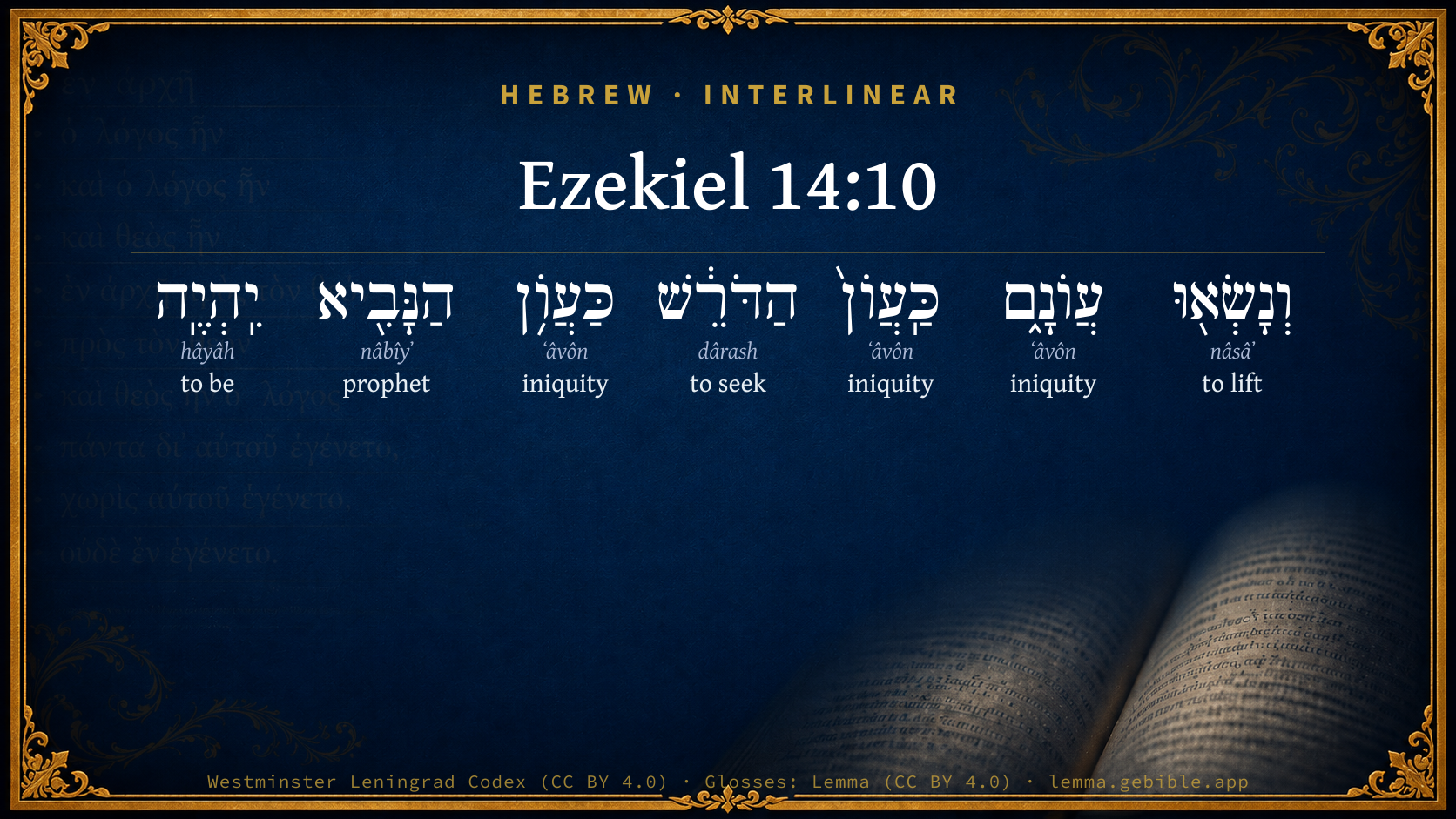
Ezekiel 14:10

Hebrew (Westminster Leningrad Codex) Ezekiel 14:10 appears in the Hebrew Old Testament. The text above is from the Westminster Leningrad Codex. Each word links to its Strong’s number, a concise gloss, and parsing drawn from the Open Scriptures Hebrew Bible morphology. Click any word for its full Brown-Driver-Briggs (BDB) entry.
Download image
Cite this verse

Ezekiel 14:10 (World English Bible). Public Domain. Lemma interlinear Bible study tool, https://lemma.gebible.app/v/ezekiel/14/10.

Show BibTeX & RIS
BibTeX
RIS
English Translation
They shall bear their iniquity: the iniquity of the prophet shall be even as the iniquity of him who seeks [to him];
World English Bible · Public Domain
Download a study sheet

One document with this verse’s original text, its word-by-word gloss line, the meaning frame, cross-references with their text, attributed commentary, and full source and license credits — printable, and it pastes into notes with its structure intact.

This verse Autodidact and up

Study sheet (.html) Plain text (.txt)

A passage Seminary Student

Up to 50 verses in one chapter. A passage sheet keeps up to 6 commentary sources and 12 cross-references per verse, in the order this page ranks them, and says so on the sheet whenever that leaves anything out. Ask for a single verse and you get the Autodidact verse sheet above.

Everything on this page stays free to read, with no account — the sheet is a download of what is already on screen, not access to it.

Want to remove ads? Support Godless Engineer
Compare translations 3

The same verse in 3 English versions, stacked beneath the original-language interlinear above. Click any original word for its lexicon entry.

Each is an independent rendering of the whole verse — the interlinear is not word-aligned to these translations.

Highlighted words mark where these versions differ — a whole-verse word diff, not a word-by-word alignment.

  • World English Bible Public Domain
    They shall bear their iniquity: the iniquity of the prophet shall be even as the iniquity of him who seeks [to him];
  • King James Version Public Domain
    And they shall bear the punishment of their iniquity: the punishment of the prophet shall be even as the punishment of him that seeketh unto him;
  • unfoldingWord Literal Text CC BY-SA 4.0
    They will carry their own iniquity; the iniquity of the prophet will be the same as the iniquity of the one who inquires from him.

unfoldingWord Literal Text — © unfoldingWord, licensed CC BY-SA 4.0. Word-aligned USFM3 via Door43 (git.door43.org/unfoldingWord/en_ult).

Versions to compare (up to 4)

3 of 4 selected

Show all 18 translations

Every available English version of this verse, each an independent rendering of the whole verse.

  • World English Bible Public Domain
    They shall bear their iniquity: the iniquity of the prophet shall be even as the iniquity of him who seeks [to him];
  • Berean Standard Bible Public Domain
    They will bear their punishment—the punishment of the inquirer will be the same as that of the prophet—
  • Majority Standard Bible Public Domain
    They will bear their punishment—the punishment of the inquirer will be the same as that of the prophet—
  • King James Version Public Domain
    And they shall bear the punishment of their iniquity: the punishment of the prophet shall be even as the punishment of him that seeketh unto him;
  • American Standard Version (1901) Public Domain
    And they shall bear their iniquity: the iniquity of the prophet shall be even as the iniquity of him that seeketh `unto him';
  • Revised Version (1885) Public Domain
    And they shall bear their iniquity: the iniquity of the prophet shall be even as the iniquity of him that seeketh unto him;
  • Geneva Bible (1599) Public Domain
    And they shall beare their punishment: the punishment of the Prophet shall bee euen as the punishment of him that asketh,
  • Douay-Rheims (1899) Public Domain
    And they shall bear their iniquity: according to the iniquity of him that inquireth, so shall the iniquity of the prophet be.
  • Young's Literal Translation Public Domain
    And they have borne their iniquity: as the iniquity of the inquirer, so is the iniquity of the prophet;
  • Literal Standard Version CC BY-SA 4.0
    And they have borne their iniquity: as the iniquity of the inquirer, so is the iniquity of the prophet;
  • Unlocked Literal Bible CC BY-SA 4.0
    They will carry their own iniquity; the iniquity of the prophet will be the same as the iniquity of the one who inquires from him.
  • unfoldingWord Literal Text CC BY-SA 4.0
    They will carry their own iniquity; the iniquity of the prophet will be the same as the iniquity of the one who inquires from him.
  • Darby Bible Public Domain
    And they shall bear their iniquity: the iniquity of the prophet shall be even as the iniquity of the inquirer;
  • World Messianic Bible Public Domain
    They will bear their iniquity. The iniquity of the prophet will be even as the iniquity of him who seeks him,
  • Webster's Bible Public Domain
    And they shall bear the punishment of their iniquity: the punishment of the prophet shall be even as the punishment of him that seeketh to him;
  • Free Bible Version CC BY-SA 4.0
    They will be responsible for the punishment they receive, along with those who consult such prophets. They will receive the same punishment.
  • Bible in Basic English Public Domain
    And the punishment of their sin will be on them: the sin of the prophet will be the same as the sin of him who goes to him for directions;
  • JPS Tanakh (1917) Public Domain
    And they shall bear their iniquity; the iniquity of the prophet shall be even as the iniquity of him that inquireth;

Literal Standard Version (2020), Covenant Press — licensed CC BY-SA 4.0. Text via the HelloAO Bible API (eBible.org). Unlocked Literal Bible (unfoldingWord) — licensed CC BY-SA 4.0. Text via the HelloAO Bible API (eBible.org). unfoldingWord Literal Text — © unfoldingWord, licensed CC BY-SA 4.0. Word-aligned USFM3 via Door43 (git.door43.org/unfoldingWord/en_ult). Free Bible Version, Dr. Jonathan Gallagher — licensed CC BY-SA 4.0. Text via the HelloAO Bible API (eBible.org).

Word by word

More ways to search: Search by grammar → Find every occurrence → Compare this word →

Practice this passage: Drill this verse → Learn its vocabulary →

הַדֹּרֵ֔שׁ
dârash
H1875
“the · seeking”
Particle, Definite Article + Verb, Qal, Participle Active, Masculine, Singular, Absolute
Part of Speech
Particle + Verb
Stem
Qal
Form
Participle Active
Gender
Masculine
Number
Singular
State
Absolute
Full BDB Definition

Origin: a primitive root

TWOT: 455

to resort to, seek, seek with care, enquire, require - (Qal) - to resort to, frequent (a place), (tread a place) - to consult, enquire of, seek - of God - of heathen gods, necromancers - to seek deity in prayer and worship - God - heathen deities - to seek (with a demand), demand, require - to investigate, enquire - to ask for, require, demand - to practice, study, follow, seek with application - to seek with care, care for - (Niphal) - to allow oneself to be enquired of, consulted (only of God) - to be sought, be sought out - to be required (of blood)
  1. וְנָשְׂא֖וּ nâsâʼ H5375 “and · to lift” Conjunction + Verb, Qal, Sequential Perfect, 3rd Person, Common, Plural
  2. עֲוֺנָ֑ם ʻâvôn H5771 “iniquity · their” Noun, Common, Both, Singular, Construct + Suffix, Personal, 3rd Person, Masculine, Plural
  3. כַּֽעֲוֺן֙ ʻâvôn H5771 “like/as · iniquity of” Preposition + Noun, Common, Both, Singular, Construct
  4. כַּעֲוֺ֥ן ʻâvôn H5771 “like/as · iniquity of” Preposition + Noun, Common, Both, Singular, Construct
  5. הַנָּבִ֖יא nâbîyʼ H5030 “the · prophet” Particle, Definite Article + Noun, Common, Masculine, Singular, Absolute
  6. יִֽהְיֶֽה hâyâh H1961 “to be” Verb, Qal, Imperfect, 3rd Person, Masculine, Singular

About this verse

These counts appear in no published source. They are computed here, from the morphology-tagged text and Lemma’s own curated glosses. What Lemma adds →

7
words
5
distinct lemmas
Prophets
section

Grammatical profile

  • 3 verbs
  • 4 nouns

Verb forms

  • וְנָשְׂא֖וּ Qal · Sequential Perfect
  • הַדֹּרֵ֔שׁ Qal · Participle Active
  • יִֽהְיֶֽה Qal · Imperfect

Repetition

A word recurs within this verse — often emphatic in Hebrew:

  • עֲוֺנָ֑ם iniquity H5771 ×3

Hebrew & Septuagint length

In English translation the verse runs 22 words from the Hebrew and 28 from the Septuagint (LXX English) — closely comparable.

A rough comparison of the two English renderings, which tokenize alike — not a word-level alignment.

Word counts can differ between the Hebrew and the Greek without any difference in meaning — e.g. the Hebrew direct-object marker אֵת has no separate Greek word, and Greek often adds the article ὁ.

Cross-references

14

Topical passages linked to Ezekiel 14:10 in the Treasury of Scripture Knowledge — connected by theme and wording, ordered by reader-vote popularity; previews shown in the World English Bible.

  • Ezekiel 23:49 They shall recompense your lewdness on you, and you shall bear the sins of your idols; and you shall know that I am the Lord Yahweh.
  • Genesis 4:13 Cain said to Yahweh, "My punishment is greater than I can bear.
  • Numbers 5:31 The man shall be free from iniquity, and that woman shall bear her iniquity."
  • Deuteronomy 13:1–10 If there arise in the midst of you a prophet, or a dreamer of dreams, and he give you a sign or a wonder,
  • Deuteronomy 17:2–7 If there be found in the midst of you, within any of your gates which Yahweh your God gives you, man or woman, who does that which is evil in the sight of Yahweh your God, in transgressing his covenant,
  • Jeremiah 6:14–15 They have healed also the hurt of my people slightly, saying, Peace, peace; when there is no peace.
  • Jeremiah 8:11–12 They have healed the hurt of the daughter of my people slightly, saying, Peace, peace; when there is no peace.
  • Jeremiah 14:15 Therefore thus says Yahweh concerning the prophets who prophesy in my name, and I didn't send them, yet they say, Sword and famine shall not be in this land: By sword and famine shall those prophets be consumed.
  • Ezekiel 14:4 Therefore speak to them, and tell them, Thus says the Lord Yahweh: Every man of the house of Israel who takes his idols into his heart, and puts the stumbling block of his iniquity before his face, and comes to the prophet; I Yahweh will answer him therein according to the multitude of his idols;
  • Ezekiel 14:7–8 For everyone of the house of Israel, or of the strangers who sojourn in Israel, who separates himself from me, and takes his idols into his heart, and puts the stumbling block of his iniquity before his face, and comes to the prophet to inquire for himself of me; I Yahweh will answer him by myself:
  • Ezekiel 17:18–20 For he has despised the oath by breaking the covenant; and behold, he had given his hand, and yet has done all these things; he shall not escape.
  • Micah 7:9 I will bear the indignation of Yahweh, Because I have sinned against him, Until he pleads my case, and executes judgment for me. He will bring me forth to the light. I will see his righteousness.
  • Galatians 6:5 For each man will bear his own burden.
  • Revelation 19:19–21 I saw the beast, and the kings of the earth, and their armies, gathered together to make war against him who sat on the horse, and against his army.

Cross-references courtesy of OpenBible.info (CC BY 4.0).

Hebrew and Greek witnesses Masoretic Hebrew ↔ Greek Septuagint

The same verse in the two great witnesses to the Old Testament, shown verse-for-verse.

These are two independent witnesses, not word-aligned to each other, and the Septuagint is shown in lemma (dictionary) form.

Hebrew Ezekiel 14:10 Masoretic · Westminster Leningrad Codex

וְנָשְׂא֖וּ עֲוֺנָ֑ם כַּֽעֲוֺן֙ הַדֹּרֵ֔שׁ כַּעֲוֺ֥ן הַנָּבִ֖יא יִֽהְיֶֽה

They shall bear their iniquity: the iniquity of the prophet shall be even as the iniquity of him who seeks [to him];

World English Bible · Public Domain

Greek LXX Ezekiel 14:10 Septuagint · lemma form

καί λαμβάνω ὁ ἀδικία αὐτός κατά ὁ ἀδίκημα ὁ ἐπιἐρωτάω καί κατά ὁ ἀδίκημα ὁμοίως ὁ προφήτης εἰμί

And they shall bear their iniquity according to the trespass of him that asks; and it shall be in like manner to the prophet according to the trespass:

LXX2012 (modern English Septuagint) · Public Domain

Hebrew: Westminster Leningrad Codex (CC BY 4.0). Greek: Septuagint (public domain); English from LXX2012 (modern English Septuagint) (Public Domain). How the Septuagint differs from the Hebrew →

Targum (Aramaic paraphrase)

1

The Targum is the ancient Jewish Aramaic paraphrase of the Hebrew Scriptures — an interpretive translation, not the Hebrew text itself. Onkelos (literal) and Pseudo-Jonathan (expansive) render the Torah, and Jonathan the Prophets. Coverage is partial: where no permissively-licensed English translation exists for a verse, only the Aramaic is shown. This is verse-level text, not a word-by-word alignment to the Hebrew.

  1. Targum Jonathan Prophets (Joshua–Malachi)
    וִיקַבְּלוּן חוֹבֵיהוֹן כְּחוֹב דְאָתֵי לְמֵילַף וְלָא אַלֵיף כְּחוֹב נְבִיֵי שִׁקְרָא יְהֵי:

    (no public-domain English translation for this verse)

    Targum Jonathan — Aramaic: “Mikraot Gedolot” (public domain). English: “Sefaria Community Translation” (CC0 1.0 (public-domain dedication)); “London "Chaldee Paraphrase," 1871” (public domain). Text via Sefaria.

Commentary

Notes on Ezekiel 14:10 from classic Christian and Jewish commentators (each source and its license shown beneath its notes). The classic Christian expositions comment on the surrounding passage and are grouped to its opening verse, so a note may address several verses; the Jewish commentaries on the Tanakh (Rashi and others) are per-verse, so they appear only where the commentator wrote on this verse.

Lemma curates 59 commentaries, every one of them public domain or Creative Commons licensed, each selected and text-cleaned for this edition rather than reprinted as found. About our sources →

Trapp's Complete Commentary

John Trapp

Eze 14:10 And they shall bear the punishment of their iniquity: the punishment of the prophet shall be even as the punishment of him that seeketh [unto him];

Ver. 10. And they shall bear the punishment of their iniquity.] Neither shall excuse other; but as they have sinned together, so shall they suffer together, quia volentes et scientes errabant, they wilfully went astray. Quandoquidem hic populus vult decipi, decipiatur; they shall infallibly perish. An evil pilot may easily drown himself, and all that are with him, on the same bottom.

John Trapp, A Commentary or Exposition upon All the Books of the Old and New Testament (1647–1656) — public domain. Text from a community e-Sword module.

Jamieson, Fausset & Brown

Robert Jamieson, A. R. Fausset & David Brown

As they dealt deceitfully with God by seeking answers of peace without repentance, so God would let them be dealt with deceitfully by the prophets whom they consulted. God would chastise their sin with a corresponding sin; as they rejected the safe directions of the true light, He would send the pernicious delusions of a false one; prophets would be given them who should re-echo the deceitfulness that already wrought in their own bosom, to their ruin [FAIRBAIRN]. The people had themselves alone to blame, for they were long ago forewarned how to discern and to treat a false prophet (Deu 13:3); the very existence of such deceivers among them was a sign of God's judicial displeasure (compare in Saul's case, Sa1 16:14; Sa1 28:6-7). They and the prophet, being dupes of a common delusion, should be involved in a common ruin.

Jamieson, Fausset & Brown — Commentary Critical and Explanatory on the Whole Bible (1871) — public domain (CC PDM 1.0). Text via the HelloAO Bible API.

Adam Clarke's Commentary

Verse 10. The punishment of the prophet] They are both equally guilty; both have left the Lord, and both shall be equally punished.

Adam Clarke's Commentary on the Bible (1810–1826) — public domain. Text from a community e-Sword/MySword module.

John Calvin's Commentaries

Here what Ezekiel had partially touched upon is more clearly taught. For he had said, that at length false prophets should meet with punishment, but he now joins the whole people with them, and at the same time repels the empty pretenses by which men are always willing to conceal their fault. For when he mentions their iniquity by name, it is the same as forbidding them to turn their back any more. In this way, then, God removes all the cavils to which men usually resort, since they never pursue these tortuous paths without being conscious of their iniquity. For when God says that he is a searcher of hearts, he brings openly before us the secret feelings of mankind. As long as hypocrites have to deal with men, they easily delude them: and then they put on various disguises, by which they throw off the blame from themselves. But when God addresses them, his language necessarily penetrates to their hidden thoughts. Now therefore we understand the force of the words which God uses, they shall bear their iniquity

He now adds, the iniquity of the inquirer shall be like that of the prophet. We have said that the sacred name of prophet is improperly transferred to impostors: but God often speaks thus by concession, and in this way a stumbling block occurs by which the weak are disturbed. For when they hear that deceivers, who not only obscure God’s word but pervert it, proudly boast in their title, they are moved, and not without reason. For divine things ought seriously to move us to reverence, since prophets are organs of the Holy Spirit. Hence that man is worthy of such honor that no man ought to despise one who is reckoned a prophet. But because God tries his own people and blinds the reprobate, as we have said, when he sends them false prophets, in order that the faith of the pious should not faint when they hear that sacred name profaned, he says by concession — well, they shall be called prophets — but he does not mean that those shall be truly and really esteemed such who falsely claim to themselves that glory. Now let us come to the next clause, the iniquity of the inquirer shall be like that of the prophet. We have already spoken of the iniquity of those who, being led captive by the lies of Satan, endeavor to pervert both the worship and the pure doctrine of God. Since therefore they propose to contend with God, their iniquity is by no means excusable. But another question may arise concerning the people, which, although we have solved it before, yet it may be expedient to repeat it. He says, then, that those who had been deceived by the false prophets would be subject to punishment, that they may sustain the same penalty. This seems hard, as I have said: but the Prophet had previously taught that the people would be justly involved in the same punishment with the impostors, because they erred knowingly and willingly. For if they had cordially devoted themselves to God, and had suffered themselves to be ruled by his Spirit, and by the teaching of the law, they had doubtless been freed from all error. For God takes care of his own people, though he does not defend them from the insults of the ungodly, yet he fortifies them by the foresight and fortitude of his Spirit. Those who are deceived, receive the just reward of either their sloth or pride or ingratitude. For many scarcely deigned to inquire what the will of God was: others looked down as from an eminence on whatever was uttered in God’s name: for through self-confidence they receive with difficulty any instruction but their own. Since then they were so unteachable, they are worthy of the reward which I have mentioned. Others again are ungrateful to God: for they stifle his instructions and the knowledge of heavenly things, and contaminate and pollute what is sacred; so that God justly joins the disciples with their masters when he revenges sacrilege as we see, since all sacred teaching is overthrown.

But Ezekiel expresses more when he says, that the people had inquired. For they had counselors, who thereby gave a direct approbation to their employment. If they had been teachable they would not have betaken themselves so eagerly to the false prophets: hence the greater their diligence in this direction, the more their crime was apparent, since they purposely rejected God and his servants, by transferring themselves to the false prophets. We now understand the meaning of this sentence. It only remains that each of us should apply what is here said to his own profit. The Papists think themselves to be twice or thrice absolved if they have been deceived in any quarter. But, on the other hand, Christ exclaims — If the blind lead the blind, it is not surprising if both fall into the ditch. (Matthew 15:14.) The reason is here expressed, because however those who are deceived show their simplicity, it is by no means doubtful that they flee from the light and desire the darkness by a crooked and perverse craving. Hence it happens that the iniquity of the inquirer is like that of the prophet.

John Calvin's Commentaries (1540-1563) — public domain. Text from the Calvin Translation Society English edition (1840s-50s) via the Christian Classics Ethereal Library (ccel.org). Calvin's coverage is partial (roughly two-thirds of the Bible); uncommented books and verses are honest gaps, never fabricated. The 19th-century editor's footnotes and remarks are omitted so the notes are faithfully Calvin's own voice.

The Cambridge Bible for Schools and Colleges

gen. ed. J. J. S. Perowne

10. Both the people and prophet shall perish together; the punishment of the one shall be as that of the other. Already Jer_14:15-16; Jer_27:15.

The passage rests on such general assumptions as these: 1. That the principles of the constitution of Israel are known, and the fundamental one is, thou shalt have no other gods before Me. Probably Ezekiel interpreted this first principle as Hosea did, including among “other gods” not only gods different from Jehovah, but images or representations of Jehovah himself (Hos_8:6). Men’s first duty was to be true to this principle; cf. the summary proceeding advocated in Deu_13:2. To those who sin against this fundamental article of religion all other religious offices and ordinances, so far from being beneficial, are made by God a means of destruction. The preaching of the true prophets only hardens (Isaiah 6); or prophecy may be turned into false prophecy. The man who wittingly commits sin had better keep clear of religious ordinances and performances. And the “prophet” (even the modern one) had better keep clear of wicked men, lest he should be used as the instrument of their punishment and perish with them. See on Eze_3:20.

The Cambridge Bible for Schools and Colleges (gen. ed. J. J. S. Perowne; Cambridge University Press, 1878–1918) — public domain. Text from a community e-Sword module.

John Gill's Exposition

And they shall bear the punishment of their iniquity,.... Both the false prophet, and those that sought unto him, and were deceived by him; and which being laid according to the strictness of divine justice, is intolerable: sad is the case when a man is obliged to bear his own sins, and the punishment of them, and has no surety to undertake for him, and be a mediator between God and him, and make atonement for him:

the punishment of the prophet shall be even as the punishment of him that seekest unto him; they being both alike culpable, each pursuing the desires of their own evil hearts; the one seeking for smooth things to be spoken to him; the other speaking them, in order to gratify him, and for the sake of gain; the one being a false prophet, and the other seeking to and inquiring of him, though he was such, slighting and rejecting the true prophets of the Lord; both being deceived, and both blind, and so should fall into the same ditch, being under the same judicial blindness and hardness of heart. The Targum is,

"according to the sin of him that comes to learn and learns not; according to the sin of the false prophet shall it be.''

John Gill's Exposition of the Whole Bible (1746–1763) — public domain (CC PDM 1.0). Text via the HelloAO Bible API.

Haydock's Catholic Bible Commentary

Be. They shall be punished alike. (Calmet)

George Leo Haydock (1774–1849), Haydock's Catholic Family Bible and Commentary, 1859 edition — public domain. Excludes Psalms (Douay-Rheims chapter numbering differs from Protestant) and Deuterocanonical books (Catholic canon only).

Matthew Poole's English Annotations

There is so great parity in the folly and impiety of both seducing prophets and the seduced people, that it is hard to say whose sin is greatest. Their punishment shall be by the Lord made as like as they made their sin, and both shall be cut off and destroyed.

Matthew Poole's English Annotations on the Holy Bible (1683–1685) — public domain. Text from a community e-Sword/MySword module.

Whedon's Commentary on the Bible

Daniel D. Whedon

10. The punishment of the prophet shall be, etc. — This penalty has been described in detail previously (Eze_13:9; chaps. 5-7, etc.).

Daniel D. Whedon (gen. ed.), Commentary on the Old and New Testaments (1874–1909) — public domain. Text from a community e-Sword module.

The Pulpit Commentary

The prophet"s punishment.

The prophet is to be punished equally with the rest of the people, because his guilt is equal to theirs. The pleas and excuses which he might suggest are all swept away as so many refuges or lies.

I ECCLESIASTICAL RANK. There was a recognized professional distinction between the prophets and the people; the prophets belonged to a separate order. But "orders" have no saving efficacy. The status of the Christian ministry affords certain earthly privileges, while it confers certain spiritual obligations. But it is only economic, temporary, and for this world"s service. Before God the distraction between cleric and laic vanishes, and each soul stands in its simple human character. God judges an archbishop as a man, not as a dignitary. His office appertains to his powers and dudes, the talents for which he will have to account. But in this respect it is like the office of any other person a measure for his service, not a shelter for his sinfulness. In the world beyond the grave each soul is but a soul; rank and office are left behind like castoff vestments. Therefore the sinful ecclesiastic will be treated as any other sinner.

II DIVINE GIFTS. The false prophets of Ezekiel"s day do not appear to have had any peculiar Divine gifts. They were mere pretenders. But even those men who are especially endowed are not to consider themselves as thereby lifted above common standards of judgment. The prophet of Bethel was a true messenger from God, yet a lion met him in the way and slew him for his disobedience. (1Ki_13:26) The apostle may "have the gift of prophecy," yet if he "have not charity" he is "nothing". (1Co_13:2)

III KNOWLEDGE. If the prophets did not know the right way, they should have made themselves acquainted with it, for they were supposed to hold the keys of revelation. But as the signpost never reaches the city to which it is constantly pointing, the man who knows the way, and who is capable of showing it to others, may yet be never treading it himself. Then his knowledge will not save him. It is the same in respect to those who are enlightened by Divine teaching, though they are not called upon to teach others. A clear conception of "the plan of salvation" will not save a man. If a prophet will be punished like any other man, surely the merely orthodox believer in the dogmas of the Church will stand in a similar position of peril if he does not add practice to creed.

IV POPULARITY. Those guilty prophets of Israel were popular men. Their doom was to suffer the fate of the people they fawned upon. A moment"s reflection must make it apparent that the favour of the world, and even the favour of the Church, are no guarantees for the favour of Heaven; for men may be deceived or may judge by low, unworthy standards. But appearances are so flattering that people fall into the snare, and take.comfort from the thought that all is going well with them among men. The one vital question is, "How do we stand before God?

The misleader and the misled.

One of the features of Israelitish life at this epoch of the Captivity was the evident number and power of false prophets. General excitement and change are, of course, favourable to imposture. Men sought everywhere for guidance, comfort, hope; but, instead of having recourse to the authorized prophets of the Lord, they went to the pretentious and deceptive religious guides who seem to have traded upon the misfortunes of their country. These men were in the habit of saying what was expected and desired, of uttering smooth things, of buoying up the people with the hope that threatening calamities might be averted. Thus the effect of these men"s counsels was to prevent the people from true repentance and to hasten the country"s ruin. Ezekiel was directed to denounce these misleaders of the nation, and to declare that they should participate in the approaching calamities. "The punishment of the prophet shall be even as the punishment of him that seeketh unto him.

I PROPHET AND PEOPLE WERE PARTAKERS IN SIN. The sin in essence was departure from God. Those who should have repaired to the Source of all wisdom and authority turned aside, and "sought unto" ignorant, self-seeking impostors. In this they sinned; and the sin was shared by those to whom they had recourse. These pretended prophets knowingly misled the people; for they saw no vision and heard no voice, and their utterances were dictated, not by the law of Divine righteousness, but by the aims of human policy. People and prophets sinned together, and sinned alike.

II PROPHET AND PEOPLE WERE PARTAKERS IN CONSEQUENT ERROR. The counsel which was thus given and accepted, and consequently acted upon, led the people astray. The only hope for Jerusalem and for the Jews was a general humiliation, confession, and repentance, a turning unto the Lord. From such a course they were deterred by the deception which they practised upon one another, and the delusion which they mutually encouraged. Hence the error into which they were misled, the error of continued idolatry, unbelief, and rebellion.

III PROPHET AND PEOPLE WERE PARTAKERS IN COMMON PUNISHMENT. It would have been unjust to punish only those who were led astray, for their false guides and evil counsellors were to blame for misleading them. It would have been unjust to punish only the false prophets; for these men were induced and encouraged to practise their deceiving arts by the readiness of their dupes to receive and to act upon their advice. Hence a common guilt entailed a common penalty. There was little distinction in crime; there was little distinction in punishment. Retribution is a fact in the government of the Supreme, who can never look upon iniquity. "Though Land join in hand, the wicked shall not go unpunished. T.

The Pulpit Commentary (1880–1919), ed. H.D.M. Spence-Jones & Joseph S. Exell — public domain. Text from a community e-Sword module.

Rashi

Rabbi Shlomo Yitzchaki (Rashi)

Like the iniquity of the inquirer, so will be the iniquity of the prophet Like the iniquity of the one who comes to learn and does not learn, so will be the iniquity of the false prophets.

Rashi on the Tanakh — English translations: “The Judaica Press complete Tanach with Rashi, translated by A. J. Rosenberg” (CC BY 4.0); “Pentateuch with Rashi's commentary by M. Rosenbaum and A.M. Silbermann, 1929-1934” (public domain); “The Metsudah Tanach series, Lakewood, N.J” (CC BY 4.0); and “The Book of Joshua, Metsudah Publications, 1997” (CC BY 4.0). Text via Sefaria.

Lesson kit

Teaching starters — assembled from the data on this page, not authored interpretation. Every prompt links to the verse data it draws on. Edit before teaching.

Ezekiel, in the Prophets, opens this verse with 7 words (5 distinct Hebrew lemmas). Its most distinctive word is dârash (“to seek”). A historical commentator’s framing appears above. Read the whole chapter for the surrounding context.

Discussion questions

  1. What does “to seek” (dârash) contribute to the verse as a whole?
  2. How does Ezekiel 23:49, which shares this passage’s theme, read alongside this verse?
  3. What does the repetition of “iniquity” (3× in this one verse) do in this verse?
  4. These translations render this verse differently. What is at stake in choosing one wording over another?
  5. «וְנָשְׂא֖וּ» is a Qal Sequential Perfect verb. How does that grammatical form shape the action described?
  6. Compare how Trapp's Complete Commentary and Jamieson, Fausset & Brown read this verse. Where do they agree or differ?

Things to notice

Reading settings

Reading text

Shown beneath each verse's original-language words.

Old Testament
Old Testament edition

Read the OT as the Masoretic Hebrew (MT) or the Greek Septuagint (LXX).

English shown for the Greek Septuagint (in the Hebrew ↔ Greek comparison).

Comparing translations? Open the Compare panel on any verse page to stack up to four side by side.