
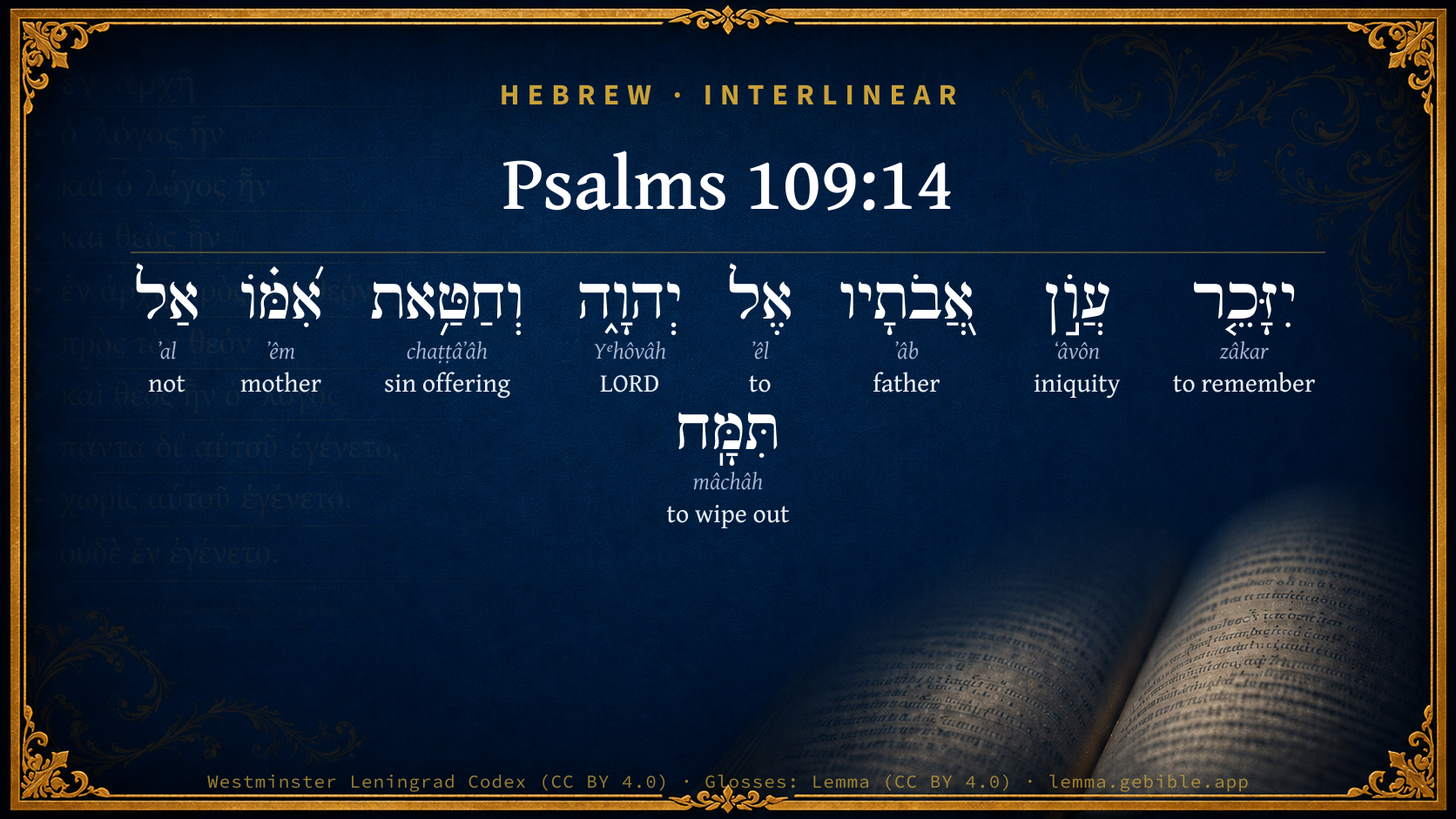
Psalms 109:14

Hebrew (Westminster Leningrad Codex) Psalms 109:14 appears in the Hebrew Old Testament. The text above is from the Westminster Leningrad Codex. Each word links to its Strong’s number, a concise gloss, and parsing drawn from the Open Scriptures Hebrew Bible morphology. Click any word for its full Brown-Driver-Briggs (BDB) entry.
Download image
Cite this verse

Psalms 109:14 (World English Bible). Public Domain. Lemma interlinear Bible study tool, https://lemma.gebible.app/v/psalms/109/14.

Show BibTeX & RIS
BibTeX
RIS
English Translation
Let the iniquity of his fathers be remembered by Yahweh. Don't let the sin of his mother be blotted out.
World English Bible · Public Domain
Download a study sheet

One document with this verse’s original text, its word-by-word gloss line, the meaning frame, cross-references with their text, attributed commentary, and full source and license credits — printable, and it pastes into notes with its structure intact.

This verse Autodidact and up

Study sheet (.html) Plain text (.txt)

A passage Seminary Student

Up to 50 verses in one chapter. A passage sheet keeps up to 6 commentary sources and 12 cross-references per verse, in the order this page ranks them, and says so on the sheet whenever that leaves anything out. Ask for a single verse and you get the Autodidact verse sheet above.

Everything on this page stays free to read, with no account — the sheet is a download of what is already on screen, not access to it.

Want to remove ads? Support Godless Engineer
Compare translations 3

The same verse in 3 English versions, stacked beneath the original-language interlinear above. Click any original word for its lexicon entry.

Each is an independent rendering of the whole verse — the interlinear is not word-aligned to these translations.

Highlighted words mark where these versions differ — a whole-verse word diff, not a word-by-word alignment.

  • World English Bible Public Domain
    Let the iniquity of his fathers be remembered by Yahweh. Don't let the sin of his mother be blotted out.
  • King James Version Public Domain
    Let the iniquity of his fathers be remembered with the LORD; and let not the sin of his mother be blotted out.
  • unfoldingWord Literal Text CC BY-SA 4.0
    May the sin of his fathers be remembered to Yahweh; and the offense of his mother not be blotted out.

unfoldingWord Literal Text — © unfoldingWord, licensed CC BY-SA 4.0. Word-aligned USFM3 via Door43 (git.door43.org/unfoldingWord/en_ult).

Versions to compare (up to 4)

3 of 4 selected

Show all 18 translations

Every available English version of this verse, each an independent rendering of the whole verse.

  • World English Bible Public Domain
    Let the iniquity of his fathers be remembered by Yahweh. Don't let the sin of his mother be blotted out.
  • Berean Standard Bible Public Domain
    May the iniquity of his fathers be remembered before the LORD, and the sin of his mother never be blotted out.
  • Majority Standard Bible Public Domain
    May the iniquity of his fathers be remembered before the LORD, and the sin of his mother never be blotted out.
  • King James Version Public Domain
    Let the iniquity of his fathers be remembered with the LORD; and let not the sin of his mother be blotted out.
  • American Standard Version (1901) Public Domain
    Let the iniquity of his fathers be remembered with Jehovah; And let not the sin of his mother be blotted out.
  • Revised Version (1885) Public Domain
    Let the iniquity of his fathers be remembered with the LORD; and let not the sin of his mother be blotted out.
  • Geneva Bible (1599) Public Domain
    Let the iniquitie of his fathers bee had in remembrance with the Lord: and let not the sinne of his mother be done away.
  • Douay-Rheims (1899) Public Domain
    May the iniquity of his fathers be remembered in the sight of the Lord: and let not the sin of his mother be blotted out.
  • Young's Literal Translation Public Domain
    The iniquity of his fathers Is remembered unto Jehovah, And the sin of his mother is not blotted out.
  • Literal Standard Version CC BY-SA 4.0
    The iniquity of his fathers || Is remembered to YHWH, || And the sin of his mother is not blotted out.
  • Unlocked Literal Bible CC BY-SA 4.0
    May his ancestors' sins be mentioned to Yahweh; and may the sin of his mother not be forgotten.
  • unfoldingWord Literal Text CC BY-SA 4.0
    May the sin of his fathers be remembered to Yahweh; and the offense of his mother not be blotted out.
  • Darby Bible Public Domain
    Let the iniquity of his fathers be remembered with Jehovah, and let not the sin of his mother be blotted out;
  • World Messianic Bible Public Domain
    Let the iniquity of his fathers be remembered by the LORD. Don’t let the sin of his mother be blotted out.
  • Webster's Bible Public Domain
    Let the iniquity of his fathers be remembered with the LORD; and let not the sin of his mother be blotted out.
  • Free Bible Version CC BY-SA 4.0
    May the Lord be reminded of the sins of his fathers; may his mother's sins not be blotted out.
  • Bible in Basic English Public Domain
    Let the Lord keep in mind the wrongdoing of his fathers; and may the sin of his mother have no forgiveness.
  • JPS Tanakh (1917) Public Domain
    Let the iniquity of his fathers be brought to remembrance unto the LORD; and let not the sin of his mother be blotted out.

Literal Standard Version (2020), Covenant Press — licensed CC BY-SA 4.0. Text via the HelloAO Bible API (eBible.org). Unlocked Literal Bible (unfoldingWord) — licensed CC BY-SA 4.0. Text via the HelloAO Bible API (eBible.org). unfoldingWord Literal Text — © unfoldingWord, licensed CC BY-SA 4.0. Word-aligned USFM3 via Door43 (git.door43.org/unfoldingWord/en_ult). Free Bible Version, Dr. Jonathan Gallagher — licensed CC BY-SA 4.0. Text via the HelloAO Bible API (eBible.org).

Word by word

More ways to search: Search by grammar → Find every occurrence → Compare this word →

Practice this passage: Drill this verse → Learn its vocabulary →

תִּמָּֽח
mâchâh
H4229
“to wipe out”
Verb, Niphal, Jussive, 3rd Person, Feminine, Singular
Part of Speech
Verb
Stem
Niphal
Form
Jussive
Person
3rd Person
Gender
Feminine
Number
Singular
Full BDB Definition

Origin: a primitive root

TWOT: 1178 , 1179 , 1181c

to wipe, wipe out - (Qal) - to wipe - to blot out, obliterate - to blot out, exterminate - (Niphal) - to be wiped out - to be blotted out - to be exterminated - (Hiphil) to blot out (from memory) - (Qal) to strike - (Pual) full of marrow (participle)
  1. יִזָּכֵ֤ר zâkar H2142 “to remember” Verb, Niphal, Imperfect, 3rd Person, Masculine, Singular
  2. עֲוֺ֣ן ʻâvôn H5771 “iniquity of” Noun, Common, Both, Singular, Construct
  3. אֲ֭בֹתָיו ʼâb H1 “fathers · his” Noun, Common, Masculine, Plural, Construct + Suffix, Personal, 3rd Person, Masculine, Singular
  4. אֶל ʼêl H413 “to” Preposition
  5. יְהוָ֑ה Yᵉhôvâh H3068 “LORD” Noun, Proper
  6. וְחַטַּ֥את chaṭṭâʼâh H2403 “and · sin offering of” Conjunction + Noun, Common, Feminine, Singular, Construct
  7. אִ֝מּ֗וֹ ʼêm H517 “mother · his” Noun, Common, Feminine, Singular, Construct + Suffix, Personal, 3rd Person, Masculine, Singular
  8. אַל ʼal H408 “not” Particle, Negative

About this verse

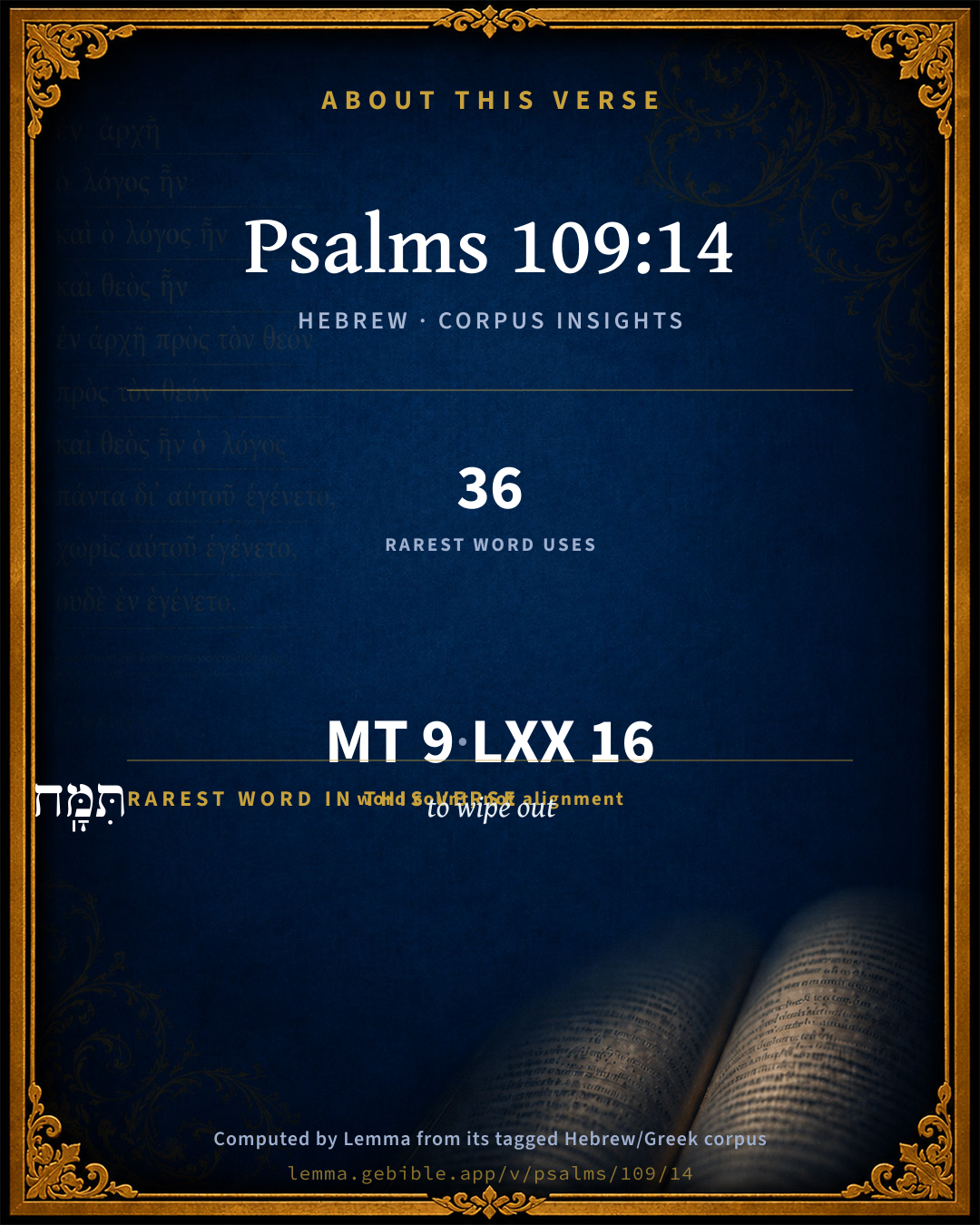
These counts appear in no published source. They are computed here, from the morphology-tagged text and Lemma’s own curated glosses. What Lemma adds →

9
words
9
distinct lemmas
Wisdom
section

Shared distinctive vocabulary

תִּמָּֽח to wipe out H4229 occurs in 32 verses of the Hebrew Bible. Also found in:

Grammatical profile

  • 2 verbs
  • 5 nouns
  • 1 preposition
  • 1 particle

Verb forms

  • יִזָּכֵ֤ר Niphal · Imperfect
  • תִּמָּֽח Niphal · Jussive

Hebrew & Septuagint length

In English translation the verse runs 20 words from the Hebrew and 22 from the Septuagint (LXX English) — closely comparable.

A rough comparison of the two English renderings, which tokenize alike — not a word-level alignment.

Word counts can differ between the Hebrew and the Greek without any difference in meaning — e.g. the Hebrew direct-object marker אֵת has no separate Greek word, and Greek often adds the article ὁ.

In the original languages it is 9 Hebrew tokens and 16 Greek tokens — but the two are counted differently (Hebrew bundles its prefixes and suffixes into one token; the Greek is in lemma form), so that isn’t a like-for-like length.

Cross-references

14

Topical passages linked to Psalms 109:14 in the Treasury of Scripture Knowledge — connected by theme and wording, ordered by reader-vote popularity; previews shown in the World English Bible.

  • Exodus 20:5 you shall not bow yourself down to them, nor serve them, for I, Yahweh your God, am a jealous God, visiting the iniquity of the fathers on the children, on the third and on the fourth generation of those who hate me,
  • Nehemiah 4:5 and don't cover their iniquity, and don't let their sin be blotted out from before you; for they have provoked [you] to anger before the builders.
  • Jeremiah 18:23 Yet, Yahweh, you know all their counsel against me to kill me; don't forgive their iniquity, neither blot out their sin from your sight; but let them be overthrown before you; deal you with them in the time of your anger.
  • Leviticus 26:39 Those of you who are left will pine away in their iniquity in your enemies' lands; and also in the iniquities of their fathers shall they pine away with them.
  • 2 Samuel 3:29 let it fall on the head of Joab, and on all his father's house; and let there not fail from the house of Joab one who has an issue, or who is a leper, or who leans on a staff, or who falls by the sword, or who lacks bread.
  • 2 Samuel 21:1 There was a famine in the days of David three years, year after year; and David sought the face of Yahweh. Yahweh said, It is for Saul, and for his bloody house, because he put to death the Gibeonites.
  • 2 Samuel 21:8–9 But the king took the two sons of Rizpah the daughter of Aiah, whom she bore to Saul, Armoni and Mephibosheth; and the five sons of Michal the daughter of Saul, whom she bore to Adriel the son of Barzillai the Meholathite:
  • 2 Kings 8:27 He walked in the way of the house of Ahab, and did that which was evil in the sight of Yahweh, as did the house of Ahab; for he was the son-in-law of the house of Ahab.
  • 2 Kings 9:27 But when Ahaziah the king of Judah saw this, he fled by the way of the garden-house. Jehu followed after him, and said, Smite him also in the chariot: [and they struck him] at the ascent of Gur, which is by Ibleam. He fled to Megiddo, and died there.
  • 2 Kings 10:13–14 Jehu met with the brothers of Ahaziah king of Judah, and said, Who are you? They answered, We are the brothers of Ahaziah: and we go down to Greet the children of the king and the children of the queen.
  • 2 Kings 11:1 Now when Athaliah the mother of Ahaziah saw that her son was dead, she arose and destroyed all the seed royal.
  • 2 Chronicles 22:3–4 He also walked in the ways of the house of Ahab; for his mother was his counselor to do wickedly.
  • Isaiah 43:25 I, even I, am he who blots out your transgressions for my own sake; and I will not remember your sins.
  • Matthew 23:31–36 Therefore you testify to yourselves that you are children of those who killed the prophets.

Cross-references courtesy of OpenBible.info (CC BY 4.0).

Hebrew and Greek witnesses Masoretic Hebrew ↔ Greek Septuagint

The same verse in the two great witnesses to the Old Testament, shown verse-for-verse.

You’re reading Greek Psalm 108 (Hebrew Psalm 109). The Septuagint counts the superscription, so verse numbers can differ from the Hebrew — chapter-level alignment, not verse-by-verse. Numbering follows Rahlfs.

These are two independent witnesses, not word-aligned to each other, and the Septuagint is shown in lemma (dictionary) form.

Hebrew Psalms 109:14 Masoretic · Westminster Leningrad Codex

יִזָּכֵ֤ר עֲוֺ֣ן אֲ֭בֹתָיו אֶל יְהוָ֑ה וְחַטַּ֥את אִ֝מּ֗וֹ אַל תִּמָּֽח

Let the iniquity of his fathers be remembered by Yahweh. Don't let the sin of his mother be blotted out.

World English Bible · Public Domain

Greek LXX Greek Psalm 108:14 Septuagint · lemma form

ἀναμιμνήσκω ὁ ἀνομία ὁ πατήρ αὐτός ἔναντι κύριος καί ὁ ἁμαρτία ὁ μήτηρ αὐτός μή ἐκἀλείφω

Let the iniquity of his fathers be remembered before the Lord; and let not the sin of his mother be blotted out.

LXX2012 (modern English Septuagint) · Public Domain

Hebrew: Westminster Leningrad Codex (CC BY 4.0). Greek: Septuagint (public domain); English from LXX2012 (modern English Septuagint) (Public Domain). How the Septuagint differs from the Hebrew →

Commentary

Notes on Psalms 109:14 from classic Christian and Jewish commentators (each source and its license shown beneath its notes). The classic Christian expositions comment on the surrounding passage and are grouped to its opening verse, so a note may address several verses; the Jewish commentaries on the Tanakh (Rashi and others) are per-verse, so they appear only where the commentator wrote on this verse.

Lemma curates 59 commentaries, every one of them public domain or Creative Commons licensed, each selected and text-cleaned for this edition rather than reprinted as found. About our sources →

Trapp's Complete Commentary

John Trapp

Psa 109:14 Let the iniquity of his fathers be remembered with the LORD; and let not the sin of his mother be blotted out.

Ver. 14. Let the iniquity of his fathers, &c.] In whose sinful steps he treadeth, be charged upon him.

And let not the sin of his mother] Who bred him no better, but cockered him in wicked courses, and gave him no good example, Partus fere sequitur ventrem.

John Trapp, A Commentary or Exposition upon All the Books of the Old and New Testament (1647–1656) — public domain. Text from a community e-Sword module.

J. A. Alexander on Psalms

Joseph Addison Alexander

14. (Psa 109:14) Let the guilt of his fathers be remembered by Jehovah, and his mother's sin not blotted out. This is perhaps the most fearful imprecation in the psalm, as it extends the consequences of transgression, not merely to the children, who might naturally be expected to partake of them, but to the parents. It is not to be forgotten, however, that in all such cases, the personal guilt of the implicated parties is presupposed, and not inferred from their connection with the principals. Remembered by (literally to) Jehovah, which may possibly mean brought to his remembrance, recalled to mind by another, perhaps by the accuser before mentioned.

Joseph Addison Alexander, The Psalms Translated and Explained (1850) — public domain. Text from a community e-Sword module.

Tyndale Open Study Notes

Tyndale Open Resources

109:14 Children inherit the sinful nature of their parents (51:5; Exod 20:5; Eph 2:3). The speaker wants the Lord to punish the perpetrator for the guilt of family members who went before him (cp. Matt 23:35-36).

Tyndale Open Study Notes — © Tyndale Open Resources, licensed CC BY-SA 4.0. Text via the HelloAO Bible API.

Geneva Bible (1599)

Geneva Bible translators

Thus punisheth the Lord to the third and fourth generation the wickedness of the parents in their wicked children.

Geneva Bible (1599) marginal notes — public domain. Text via Bolls.life.

John Calvin's Commentaries

And as the destruction which he denounces against the houses and families of the wicked is so extensive, that God punishes them in the person of their posterity, so he desires that God may remember the iniquities of their fathers and mothers, in order that their condemnation may be complete; and this is a principle in perfect accordance with the commonly received doctrine of Scripture. God, out of regard to his covenant, which is in force to a thousand generations, extends and continues his mercy towards posterity; but he also punishes iniquity unto the third and fourth generation. In doing this he does not involve the guiltless with the wicked indiscriminately, but by withholding from the reprobate the grace and illumination of his Spirit, he prepares the vessels of wrath for destruction, even before they are born, Romans 9:21. To the common sense of mankind, the thought of such severity is horrifying: but then we must recollect, that if we attempt to measure the secret and inscrutable judgments of God by our finite minds, we do him wrong. Struck with horror at the severity of this threatening, let us improve it as the means of filling us with reverence and godly fear. In reference to the language of Ezekiel,

“The son shall not bear the iniquity of the father, but the soul that sinneth, it shall die;” Ezekiel 18:20

we know that in these words he disproves the groundless complaints of the people, who, boasting that they were guiltless, imagined that they were punished wrongfully. When, however, God continues his vengeance from the father to the children, he leaves them no room for palliation or complaint, because they are all equally guilty. We have already said, that vengeance commences when God in withdrawing his Spirit, both from the children and the fathers, delivers them over to Satan. Some may inquire how it comes to pass, that the prophet, in desiring that their sin may be continually before God’s eyes, does not likewise add, let their name be blotted out from heaven, but merely wishes them to be cut off, and to perish in the world? My reply is, that he spoke agreeably to the custom of the age in which he lived, when the nature of spiritual punishments was not so well understood as in our times, because the period had not yet arrived, when the revelation of God’s will was to be full and complete. Besides, it is the design of David, that the vengeance of God may be so manifest, that the whole world may acquiesce in his equity as a judge.

John Calvin's Commentaries (1540-1563) — public domain. Text from the Calvin Translation Society English edition (1840s-50s) via the Christian Classics Ethereal Library (ccel.org). Calvin's coverage is partial (roughly two-thirds of the Bible); uncommented books and verses are honest gaps, never fabricated. The 19th-century editor's footnotes and remarks are omitted so the notes are faithfully Calvin's own voice.

Ellicott's Commentary for English Readers

(14) Fathers.—The sweet of vengeance lies in its completeness. The curse must strike backwards as well as forwards, and the root as well as the branch be destroyed. Undoubtedly the Mosaic Law, which proclaimed that the “iniquity of the fathers should be visited on the children,” suggested the form of the imprecation.

Sin of his mother.—Is the necessity of the parallel. ism sufficient to account for this mention of the mother, or is some definite circumstance in the poet’s thought? The theory which makes this portion of the psalm (Psa_109:6-20), a quotation of curses really uttered by Shimei against David, finds an allusion to the Moabitish descent on the mother’s side. (Comp. the Rabbinical explanation of Psa_51:5.)

A Bible Commentary for English Readers, edited by Charles John Ellicott (1878–1897) — public domain. Text from a community e-Sword module.

The Cambridge Bible for Schools and Colleges

gen. ed. J. J. S. Perowne

14. be blotted out] From God’s book in which it is recorded as a debt. Cp. Psa_51:1.

14, 15. Let the full penalty for the sins of his ancestors be exacted from him, in accordance with the warning of the law, that the sins of the fathers are visited upon the children. See Exo_20:5; cp. Mat_23:32-36.

The Cambridge Bible for Schools and Colleges (gen. ed. J. J. S. Perowne; Cambridge University Press, 1878–1918) — public domain. Text from a community e-Sword module.

John Gill's Exposition

Let them be before the Lord continually,.... And not cast behind his back, or into the depths of the sea, never to be seen more, as sins are when forgiven; but be always in sight, as loathsome and abominable, and causing those that committed them to be abhorred for them; and be before him, as a Judge, to examine them, the nature and kind of them, and to condemn and punish for them; see Exo 20:5. The Targum is,

"let them be before the Word of the Lord always;''

see Heb 4:13.

That he may cut off the memory of them from the earth; so that they may not be remembered with any applause, or their name spoken of with any commendation; see Job 18:17.

John Gill's Exposition of the Whole Bible (1746–1763) — public domain (CC PDM 1.0). Text via the HelloAO Bible API.

Albert Barnes' Notes on the Bible

Let the iniquity of his fathers - Of his ancestors.

Be remembered with the Lord - Or, by the Lord. The doctrine of the Bible is, that God “visits the iniquities of the fathers upon the children unto the third and fourth generation of them that hate” him Exo 20:5; the matter of fact is that children and children’s children often suffer from the errors, the crimes, and the follies of their parents, as in the case of intemperance, murder, and treason (compare the notes at Rom 5:12 ff); and the prayer here is, that this regular effect of sin might follow in this instance; that these consequences might not be arrested by divine interposition.

And let not the sin of his mother be blotted out - This is probably added to complete the parallelism; the sin of his father and his mother. There may, however, if this is a composition of David, be a similar allusion to that which occurs in Psa 51:5, “Behold, I was shapen in iniquity, and in sin did my mother conceive me.” The prayer is, that whatever effects might properly follow from the fact that his mother was a sinner - either in some special sense, or in the general sense that all are sinhers - might come upon him.

Albert Barnes' Notes on the Bible (1834–1885) — public domain. Text from a community e-Sword/MySword module.

Matthew Poole's English Annotations

Be remembered against him, or punished in him, as God hath threatened to deal with great delinquents, Exo 20:5.

Matthew Poole's English Annotations on the Holy Bible (1683–1685) — public domain. Text from a community e-Sword/MySword module.

The Treasury of David

Charles H. Spurgeon

Ver. 14. This verse is, perhaps, the most terrible of all, but yet as a matter of fact children do procure punishment upon their parents' sins, and are often themselves the means of such punishment. A bad son brings to mind his father's bad points of character; people say, "Ah, he is like the old man. He takes after his father." A mother's sins also will be sure to be called to mind if her daughter becomes grossly wicked. "Ah", they will say, "there is little wonder, when you consider what her mother was." These are matters of everyday occurrence. We cannot, however, pretend to explain the righteousness of this malediction, though we fully believe in it. We leave it till our heavenly Father is pleased to give us further instruction. Yet, as a man's faults are often learned from his parents, it is not unjust that his consequent crimes should recoil upon him.

Psalms 109:15*

Charles H. Spurgeon's The Treasury of David (1869–1885) — public domain. Psalms only. Text from a community e-Sword/MySword module.

Whedon's Commentary on the Bible

Daniel D. Whedon

14. Iniquity of his fathers… the sin of his mother—So called because they were of like character before him. The law forbade the transfer of punishment due to personal sins, (Deu_24:16; Eze_18:20;) but where the wickedness of the parents repeated itself in the children, the punishment followed down also. See Exo_20:5

Daniel D. Whedon (gen. ed.), Commentary on the Old and New Testaments (1874–1909) — public domain. Text from a community e-Sword module.

The Pulpit Commentary

Let the iniquity of his fathers be remembered with the Lord. Let the threatening of Exo_20:5 take effect in his case, and the sins of his forefathers be remembered by God, and visited upon him. And let not the sin of his mother be blotted out; i.e. erased from God"s remembrance. Let it also be visited on him, as Jezebel"s was on her children.

The Pulpit Commentary (1880–1919), ed. H.D.M. Spence-Jones & Joseph S. Exell — public domain. Text from a community e-Sword module.

unfoldingWord translationNotes

Door43 World Missions Community

May his ancestors' sins be mentioned to Yahweh

This can be stated in active form. AT: "May you remember the sins of his ancestors, Yahweh" (See: Active or Passive)

may the sin of his mother not be forgotten

This can be stated in active form. AT: "May you not forget the sins that his mother committed" (See: Active or Passive)

May their guilt always be before Yahweh

Here David speaks about Yahweh thinking about their guilt as if their guilt is something physically present before him. AT: "May Yahweh continually think about their sins" (See: Metaphor)

may Yahweh cut off their memory from the earth

David uses the word "earth" to refer to all the people that live on the earth. Also, the phrase "their memory" refers to people remembering them after they have died. AT: "may Yahweh make it so that no one on earth remembers them" (See: Metonymy)

this man never bothered to show any covenant faithfulness

This refers to him showing covenant faithfulness to people. The abstract noun "faithfulness" can be translated with an adjective. AT: "this man never bothered to show any covenant faithfulness to people" or "this man never did anything to show that he was faithful to his covenant" (See: Assumed Knowledge and Implicit Information and Abstract Nouns)

the oppressed, the needy

This refers to oppressed and needy people. AT: "oppressed people, needy people" (See: Nominal Adjectives)

the disheartened

This refers to people who are disheartened. AT: "disheartened people" or "people who have lost hope" (See: Nominal Adjectives)

to death

"until they died." This means that he harassed them until they died.

translationWords

sin

Yahweh

guilt

cut off

earth

oppress

unfoldingWord translationNotes — © Distant Shores Media and the Door43 World Missions Community, licensed CC BY-SA 4.0. Source: git.door43.org/Door43/en_tn.

Rashi

Rabbi Shlomo Yitzchaki (Rashi)

the iniquity against his forefathers The iniquity that he sinned against his forebears, to Abraham, whose life he shortened by five years, and to his father he caused blindness.

and the sin against his mother that he destroyed her womb, and that he caused the day of her burial to be concealed from the people, lest they curse her for Esau emerged from her womb, as it is said (Gen. 35:8): “Deborah, Rebecca’s nurse, died...the Plain of Weeping.” In Greek, another is called “allon,” for Jacob had another mourning along with that of Deborah, for his mother died and they concealed her death.

Rashi on the Tanakh — English translations: “The Judaica Press complete Tanach with Rashi, translated by A. J. Rosenberg” (CC BY 4.0); “Pentateuch with Rashi's commentary by M. Rosenbaum and A.M. Silbermann, 1929-1934” (public domain); “The Metsudah Tanach series, Lakewood, N.J” (CC BY 4.0); and “The Book of Joshua, Metsudah Publications, 1997” (CC BY 4.0). Text via Sefaria.

Lesson kit

Teaching starters — assembled from the data on this page, not authored interpretation. Every prompt links to the verse data it draws on. Edit before teaching.

Psalms, in the Wisdom, opens this verse with 9 words (9 distinct Hebrew lemmas). Its most distinctive word is mâchâh (“to wipe out”). A historical commentator’s framing appears above. Read the whole chapter for the surrounding context.

Discussion questions

  1. What does “to wipe out” (mâchâh) contribute to the verse as a whole?
  2. How does Genesis 6:7, which shares the word «to wipe out», read alongside this verse?
  3. The translations on this page render this verse differently — a whole-verse word diff, not a word-by-word alignment. What might account for the different wordings?
  4. «יִזָּכֵ֤ר» is a Niphal Imperfect verb. How does that grammatical form shape the action described?
  5. Compare how Trapp's Complete Commentary and J. A. Alexander on Psalms read this verse. Where do they agree or differ?

Things to notice

Reading settings

Reading text

Shown beneath each verse's original-language words.

Old Testament
Old Testament edition

Read the OT as the Masoretic Hebrew (MT) or the Greek Septuagint (LXX).

English shown for the Greek Septuagint (in the Hebrew ↔ Greek comparison).

Comparing translations? Open the Compare panel on any verse page to stack up to four side by side.