
Ezekiel 36:33

Hebrew (Westminster Leningrad Codex) Ezekiel 36:33 appears in the Hebrew Old Testament. The text above is from the Westminster Leningrad Codex. Each word links to its Strong’s number, a concise gloss, and parsing drawn from the Open Scriptures Hebrew Bible morphology. Click any word for its full Brown-Driver-Briggs (BDB) entry.
Download image
Cite this verse

Ezekiel 36:33 (World English Bible). Public Domain. Lemma interlinear Bible study tool, https://lemma.gebible.app/v/ezekiel/36/33.

Show BibTeX & RIS
BibTeX
RIS
English Translation
Thus says the Lord Yahweh: In the day that I cleanse you from all your iniquities, I will cause the cities to be inhabited, and the waste places shall be built.
World English Bible · Public Domain
Download a study sheet

One document with this verse’s original text, its word-by-word gloss line, the meaning frame, cross-references with their text, attributed commentary, and full source and license credits — printable, and it pastes into notes with its structure intact.

This verse Autodidact and up

Study sheet (.html) Plain text (.txt)

A passage Seminary Student

Up to 50 verses in one chapter. A passage sheet keeps up to 6 commentary sources and 12 cross-references per verse, in the order this page ranks them, and says so on the sheet whenever that leaves anything out. Ask for a single verse and you get the Autodidact verse sheet above.

Everything on this page stays free to read, with no account — the sheet is a download of what is already on screen, not access to it.

Want to remove ads? Support Godless Engineer
Compare translations 3

The same verse in 3 English versions, stacked beneath the original-language interlinear above. Click any original word for its lexicon entry.

Each is an independent rendering of the whole verse — the interlinear is not word-aligned to these translations.

Highlighted words mark where these versions differ — a whole-verse word diff, not a word-by-word alignment.

  • World English Bible Public Domain
    Thus says the Lord Yahweh: In the day that I cleanse you from all your iniquities, I will cause the cities to be inhabited, and the waste places shall be built.
  • King James Version Public Domain
    Thus saith the Lord GOD; In the day that I shall have cleansed you from all your iniquities I will also cause you to dwell in the cities, and the wastes shall be builded.
  • unfoldingWord Literal Text CC BY-SA 4.0
    The Lord Yahweh says this: On the day that I purify you from all your iniquity, I will cause you to inhabit the cities and to rebuild the ruined places.

unfoldingWord Literal Text — © unfoldingWord, licensed CC BY-SA 4.0. Word-aligned USFM3 via Door43 (git.door43.org/unfoldingWord/en_ult).

Versions to compare (up to 4)

3 of 4 selected

Show all 18 translations

Every available English version of this verse, each an independent rendering of the whole verse.

  • World English Bible Public Domain
    Thus says the Lord Yahweh: In the day that I cleanse you from all your iniquities, I will cause the cities to be inhabited, and the waste places shall be built.
  • Berean Standard Bible Public Domain
    This is what the Lord GOD says: On the day I cleanse you from all your iniquities, I will cause the cities to be resettled and the ruins to be rebuilt.
  • Majority Standard Bible Public Domain
    This is what the Lord GOD says: On the day I cleanse you from all your iniquities, I will cause the cities to be resettled and the ruins to be rebuilt.
  • King James Version Public Domain
    Thus saith the Lord GOD; In the day that I shall have cleansed you from all your iniquities I will also cause you to dwell in the cities, and the wastes shall be builded.
  • American Standard Version (1901) Public Domain
    Thus saith the Lord Jehovah: In the day that I cleanse you from all your iniquities, I will cause the cities to be inhabited, and the waste places shall be builded.
  • Revised Version (1885) Public Domain
    Thus saith the Lord GOD: In the day that I cleanse you from all your iniquities, I will cause the cities to be inhabited, and the waste places shall be builded.
  • Geneva Bible (1599) Public Domain
    Thus sayth the Lord God, What time as I shall haue clensed you from all your iniquities, I will cause you to dwel in the cities, and the desolate places shalbe builded.
  • Douay-Rheims (1899) Public Domain
    Thus saith the Lord God: In the day that I shall cleanse you from all your iniquities, and shall cause the cities to be inhabited, and shall repair the ruinous places,
  • Young's Literal Translation Public Domain
    Thus said the Lord Jehovah: In the day of My cleansing you from all your iniquities, I have caused the cities to be inhabited, And the wastes have been built,
  • Literal Standard Version CC BY-SA 4.0
    Thus said Lord YHWH: In the day of My cleansing you from all your iniquities, || I have caused the cities to be inhabited, || And the ruins have been built,
  • Unlocked Literal Bible CC BY-SA 4.0
    The Lord Yahweh says this: On the day that I purify you from all your iniquity, I will cause you to inhabit the cities and to rebuild the ruined places.
  • unfoldingWord Literal Text CC BY-SA 4.0
    The Lord Yahweh says this: On the day that I purify you from all your iniquity, I will cause you to inhabit the cities and to rebuild the ruined places.
  • Darby Bible Public Domain
    Thus saith the Lord Jehovah: In the day that I shall cleanse you from all your iniquities I will also cause the cities to be inhabited, and the waste places shall be builded.
  • World Messianic Bible Public Domain
    “‘The Lord GOD says: “In the day that I cleanse you from all your iniquities, I will cause the cities to be inhabited and the waste places will be built.
  • Webster's Bible Public Domain
    Thus saith the Lord GOD; In the day that I shall have cleansed you from all your iniquities I will also cause you to dwell in the cities, and the wastes shall be built.
  • Free Bible Version CC BY-SA 4.0
    This is what the Lord God says: On the day I make you clean from all your sins, I will have you live in your towns again and make sure the ruins are rebuilt.
  • Bible in Basic English Public Domain
    This is what the Lord has said: In the day when I make you clean from all your evil-doings I will let the towns be peopled and there will be building on the waste places.
  • JPS Tanakh (1917) Public Domain
    Thus saith the Lord GOD: In the day that I cleanse you from all your iniquities, I will cause the cities to be inhabited, and the waste places shall be builded.

Literal Standard Version (2020), Covenant Press — licensed CC BY-SA 4.0. Text via the HelloAO Bible API (eBible.org). Unlocked Literal Bible (unfoldingWord) — licensed CC BY-SA 4.0. Text via the HelloAO Bible API (eBible.org). unfoldingWord Literal Text — © unfoldingWord, licensed CC BY-SA 4.0. Word-aligned USFM3 via Door43 (git.door43.org/unfoldingWord/en_ult). Free Bible Version, Dr. Jonathan Gallagher — licensed CC BY-SA 4.0. Text via the HelloAO Bible API (eBible.org).

Word by word

More ways to search: Search by grammar → Find every occurrence → Compare this word →

Practice this passage: Drill this verse → Learn its vocabulary →

הֶחֳרָבֽוֹת
chorbâh
H2723
“the · ruins”
Particle, Definite Article + Noun, Common, Feminine, Plural, Absolute
Part of Speech
Particle + Noun
Type
Common
Gender
Feminine
Number
Plural
State
Absolute
Full BDB Definition

Origin: from H2721

TWOT: 731d

a place laid waste, ruin, waste, desolation
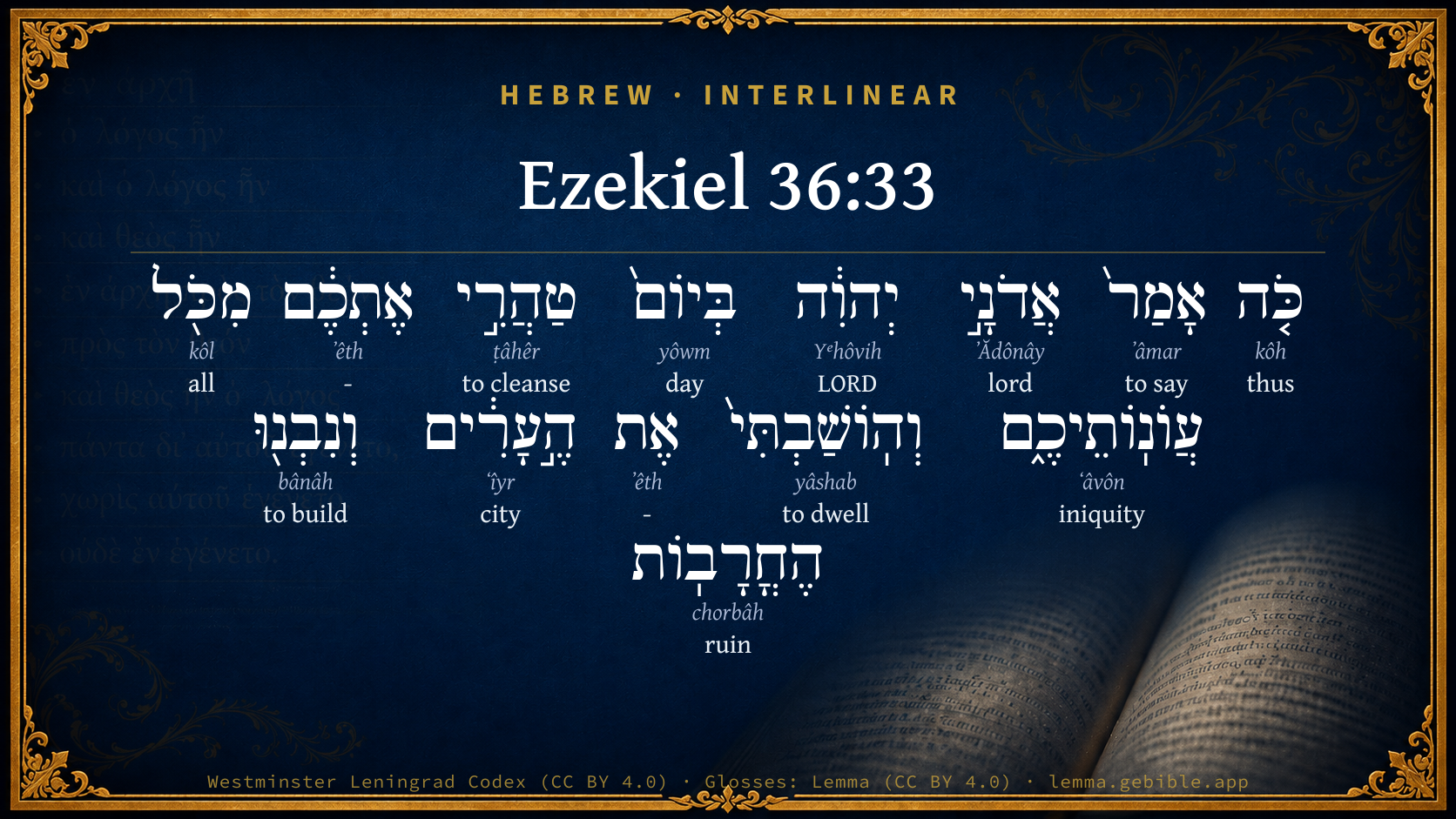
  1. כֹּ֤ה kôh H3541 “thus” Adverb
  2. אָמַר֙ ʼâmar H559 “to say” Verb, Qal, Perfect, 3rd Person, Masculine, Singular
  3. אֲדֹנָ֣י ʼĂdônây H136 “Lord · my” Noun, Common, Masculine, Plural, Construct + Suffix, Personal, 1st Person, Common, Singular
  4. יְהוִ֔ה Yᵉhôvih H3069 “LORD” Noun, Proper
  5. בְּיוֹם֙ yôwm H3117 “in/at · day of” Preposition + Noun, Common, Masculine, Singular, Construct
  6. טַהֲרִ֣י ṭâhêr H2891 “to cleanse · me” Verb, Piel, Infinitive Construct + Suffix, Personal, 1st Person, Common, Singular
  7. אֶתְכֶ֔ם ʼêth H853 “- · you” Particle, Direct Object + Suffix, Personal, 2nd Person, Masculine, Plural
  8. מִכֹּ֖ל kôl H3605 “from · all of” Preposition + Noun, Common, Masculine, Singular, Construct
  9. עֲוֺנֽוֹתֵיכֶ֑ם ʻâvôn H5771 “iniquities · your” Noun, Common, Both, Plural, Construct + Suffix, Personal, 2nd Person, Masculine, Plural
  10. וְהֽוֹשַׁבְתִּי֙ yâshab H3427 “and · to dwell” Conjunction + Verb, Hiphil, Sequential Perfect, 1st Person, Common, Singular
  11. אֶת ʼêth H853 “-” Particle, Direct Object
  12. הֶ֣עָרִ֔ים ʻîyr H5892 “the · cities” Particle, Definite Article + Noun, Common, Feminine, Plural, Absolute
  13. וְנִבְנ֖וּ bânâh H1129 “and · to build” Conjunction + Verb, Niphal, Sequential Perfect, 3rd Person, Common, Plural

About this verse

These counts appear in no published source. They are computed here, from the morphology-tagged text and Lemma’s own curated glosses. What Lemma adds →

14
words
13
distinct lemmas
Prophets
section

Shared distinctive vocabulary

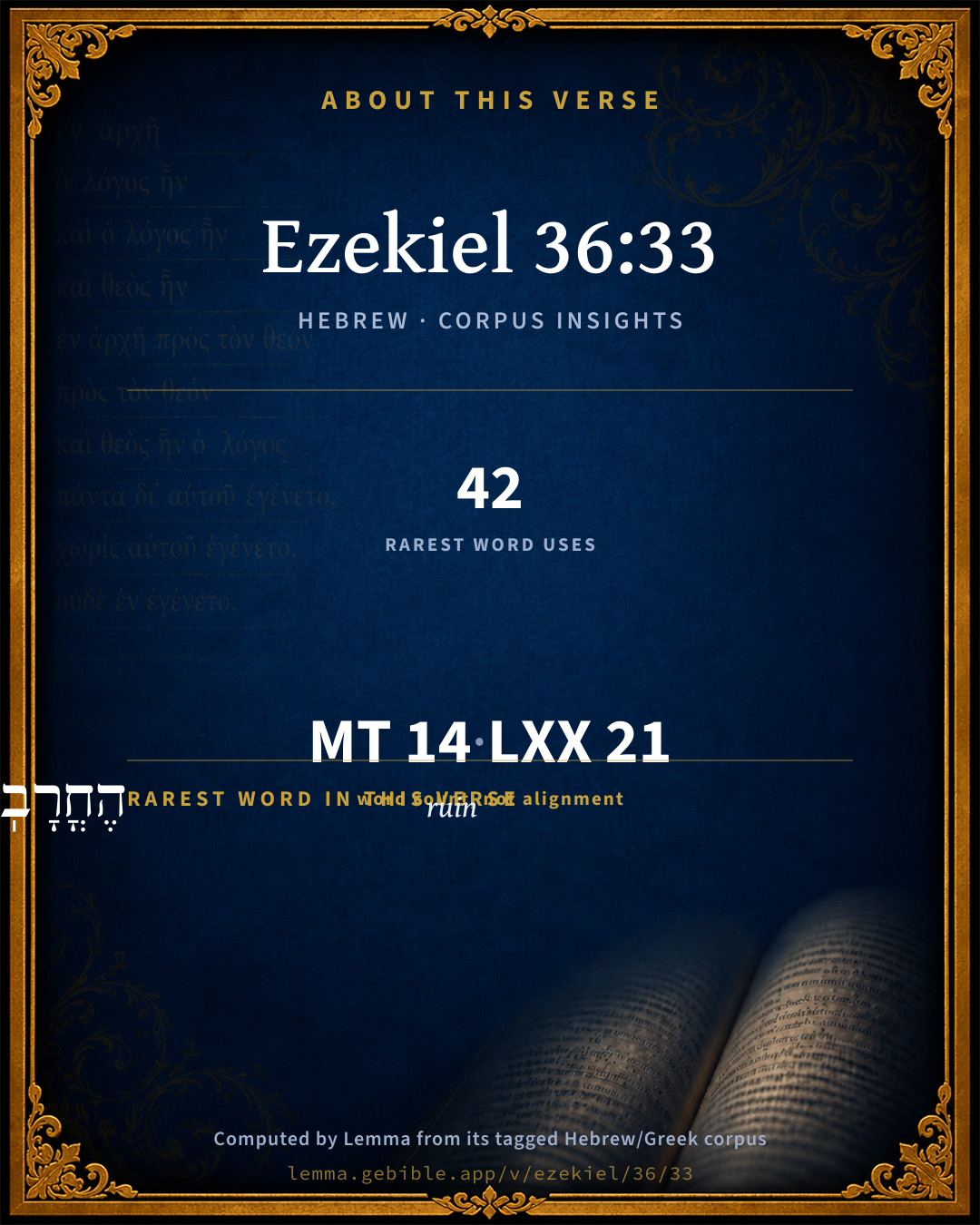
הֶחֳרָבֽוֹת ruin H2723 occurs in 42 verses of the Hebrew Bible. Also found in:

Grammatical profile

  • 4 verbs
  • 7 nouns
  • 1 adverb
  • 2 particles

Verb forms

  • אָמַר֙ Qal · Perfect
  • טַהֲרִ֣י Piel · Infinitive Construct
  • וְהֽוֹשַׁבְתִּי֙ Hiphil · Sequential Perfect
  • וְנִבְנ֖וּ Niphal · Sequential Perfect

Hebrew & Septuagint length

In English translation the verse runs 31 words from the Hebrew and 34 from the Septuagint (LXX English) — closely comparable.

A rough comparison of the two English renderings, which tokenize alike — not a word-level alignment.

Word counts can differ between the Hebrew and the Greek without any difference in meaning — e.g. the Hebrew direct-object marker אֵת has no separate Greek word, and Greek often adds the article ὁ.

In the original languages it is 14 Hebrew tokens and 21 Greek tokens — but the two are counted differently (Hebrew bundles its prefixes and suffixes into one token; the Greek is in lemma form), so that isn’t a like-for-like length.

Cross-references

7

Topical passages linked to Ezekiel 36:33 in the Treasury of Scripture Knowledge — connected by theme and wording, ordered by reader-vote popularity; previews shown in the World English Bible.

  • Isaiah 58:12 Those who shall be of you shall build the old waste places; you shall raise up the foundations of many generations; and you shall be called The repairer of the breach, The restorer of paths to dwell in.
  • Ezekiel 36:10 and I will multiply men on you, all the house of Israel, even all of it; and the cities shall be inhabited, and the waste places shall be built;
  • Jeremiah 33:10 Thus says Yahweh: Yet again there shall be heard in this place, about which you say, It is waste, without man and without animal, even in the cities of Judah, and in the streets of Jerusalem, that are desolate, without man and without inhabitant and without animal,
  • Zechariah 8:7–8 Thus says Yahweh of Hosts: "Behold, I will save my people from the east country, and from the west country;
  • Jeremiah 32:43 Fields shall be bought in this land, about which you say, It is desolate, without man or animal; it is given into the hand of the Chaldeans.
  • Jeremiah 50:19–20 I will bring Israel again to his pasture, and he shall feed on Carmel and Bashan, and his soul shall be satisfied on the hills of Ephraim and in Gilead.
  • Amos 9:14–15 I will bring back the captivity of my people Israel, And they will rebuild the ruined cities, and inhabit them; and they will plant vineyards, and drink wine from them. They shall also make gardens, And eat the fruit of them.

Cross-references courtesy of OpenBible.info (CC BY 4.0).

Hebrew and Greek witnesses Masoretic Hebrew ↔ Greek Septuagint

The same verse in the two great witnesses to the Old Testament, shown verse-for-verse.

These are two independent witnesses, not word-aligned to each other, and the Septuagint is shown in lemma (dictionary) form.

Hebrew Ezekiel 36:33 Masoretic · Westminster Leningrad Codex

כֹּ֤ה אָמַר֙ אֲדֹנָ֣י יְהוִ֔ה בְּיוֹם֙ טַהֲרִ֣י אֶתְכֶ֔ם מִכֹּ֖ל עֲוֺנֽוֹתֵיכֶ֑ם וְהֽוֹשַׁבְתִּי֙ אֶת הֶ֣עָרִ֔ים וְנִבְנ֖וּ הֶחֳרָבֽוֹת

Thus says the Lord Yahweh: In the day that I cleanse you from all your iniquities, I will cause the cities to be inhabited, and the waste places shall be built.

World English Bible · Public Domain

Greek LXX Ezekiel 36:33 Septuagint · lemma form

ὅδε λέγω κύριος ἐν ἡμέρα ὅς καθαρίζω σύ ἐκ πᾶς ὁ ἀνομία σύ καί καταοἰκίζω ὁ πόλις καί οἰκοδομέω ὁ ἔρημος

Thus says the Lord God; In the day wherein I shall cleanse you from all your iniquities I will also cause the cities to be inhabited, and the waste places shall be built upon:

LXX2012 (modern English Septuagint) · Public Domain

Hebrew: Westminster Leningrad Codex (CC BY 4.0). Greek: Septuagint (public domain); English from LXX2012 (modern English Septuagint) (Public Domain). How the Septuagint differs from the Hebrew →

Targum (Aramaic paraphrase)

1

The Targum is the ancient Jewish Aramaic paraphrase of the Hebrew Scriptures — an interpretive translation, not the Hebrew text itself. Onkelos (literal) and Pseudo-Jonathan (expansive) render the Torah, and Jonathan the Prophets. Coverage is partial: where no permissively-licensed English translation exists for a verse, only the Aramaic is shown. This is verse-level text, not a word-by-word alignment to the Hebrew.

  1. Targum Jonathan Prophets (Joshua–Malachi)
    כִּדְנַן אֲמַר יְיָ אֱלֹהִים בְּיוֹמָא דַאֲדַכֵּי יַתְכוֹן מִכָּל חוֹבֵיכוֹן וְאָתִיב יַת קִרְוַיָא וְיִתְבַּנְיָן חוּרְבָתָא:

    (no public-domain English translation for this verse)

    Targum Jonathan — Aramaic: “Mikraot Gedolot” (public domain). English: “Sefaria Community Translation” (CC0 1.0 (public-domain dedication)); “London "Chaldee Paraphrase," 1871” (public domain). Text via Sefaria.

Commentary

Notes on Ezekiel 36:33 from classic Christian and Jewish commentators (each source and its license shown beneath its notes). The classic Christian expositions comment on the surrounding passage and are grouped to its opening verse, so a note may address several verses; the Jewish commentaries on the Tanakh (Rashi and others) are per-verse, so they appear only where the commentator wrote on this verse.

Lemma curates 59 commentaries, every one of them public domain or Creative Commons licensed, each selected and text-cleaned for this edition rather than reprinted as found. About our sources →

Trapp's Complete Commentary

John Trapp

Eze 36:33 Thus saith the Lord GOD; In the day that I shall have cleansed you from all your iniquities I will also cause [you] to dwell in the cities, and the wastes shall be builded.

Ver. 33. I shall have cleansed you.] See on Eze 36:29.

I will also cause you to dwell.] See Eze 36:28.

John Trapp, A Commentary or Exposition upon All the Books of the Old and New Testament (1647–1656) — public domain. Text from a community e-Sword module.

Fairbairn on Ezekiel, Jonah & the Pastoral Epistles

Patrick Fairbairn

The last section, as was noticed before, is merely a gathering up of the general result, with some reference to the impressions it was fitted to produce upon the minds of others.

Eze 36:33. Thus saith the Lord Jehovah, In the day that I cleanse you from all your iniquities, I shall also make you to dwell in the cities, and the ruins are built. 34. And the land that is desolate shall be tilled, whereas it was desolate in the eyes of all that pass by. 35. And they say, “This land that was waste is become as the garden of Eden, and the cities, ruined and deserted and destroyed, sit fortified.” 36. And the heathen that are left round about you shall know that I Jehovah build the destroyed, plant the deserted; I Jehovah speak and do. 37. Thus saith the Lord Jehovah, Yet for this will I be inquired of by the house of Israel to do it for them; I will multiply them as a flock of men. 38. As the holy flock, as the flock of Jerusalem in her solemn feasts, so shall the ruined cities be full of flocks of men; and ye shall know that I am Jehovah.

The general meaning is, that the purpose of God was to accomplish an entire change in the outward as well as the inward condition of his people. They would be as remarkably distinguished for prosperity and blessing as they had been for distress and desolation, so that even the passing stranger could not fail to notice the happy revolution that had taken place in their circumstances; but still not as a matter of fixed and inevitable necessity, nor in any way that might supersede the obligation resting on themselves personally to seek and serve the Lord. Hence the intimation is made at Eze 36:37, that for this the Lord would “yet be inquired of by the house of Israel to do it for them.” On former occasions he had refused to be inquired of by them (Eze 14:3, Eze 20:3), that is, sought after in such a manner as to be found ready to perform what was expected, because the inquirers were not in a condition to receive any token of his favour and blessing. Only, therefore, in so far as they attained to a better condition, and stood morally on right terms with God, were they warranted to look for the happy and flourishing state described in the promise. And the higher always they rose in the one respect, the higher also might they expect God to raise them in the other.

Such promises as those contained in this chapter cannot therefore be taken in an absolute sense; they must be understood to some extent conditionally. They reveal the kind propensions of God towards his people—what he is disposed and ready to do toward them—rather than what he will for certain accomplish at any one stage or period of their history. So far the word contains an absolute element, as God certainly pledges himself to make provision for securing, in a larger measure than formerly, a proper regeneration of heart and conduct in his people, and also for giving palpable proof of this in their more flourishing and prosperous condition generally. The goodness of God was certainly to manifest itself for these ends; but it would do so to the full extent represented, only if they continued in his goodness. In the case of God’s threatenings, even when most particular and express,, it was always possible by a change of mind to the better to escape the evil; according to the word in Jeremiah: “At what instant I speak concerning a kingdom to pluck up, and to pull down, and to destroy; if that nation against whom I have pronounced turn from their evil, I will repent of the evil that I thought to do unto them” (Eze 18:7). And there is no reason why we should not expect the same rule to hold in respect to the promises. Here also there would be but a partial realization of what was announced, if the spiritual condition on which it proceeded was not complied with, and those to whom the promise was given set themselves to resist the grace of God, The possibility of their doing this is plainly implied in the accomplishment of the promise being so specially connected with their inquiring of God concerning it; and it was still more distinctly indicated in another passage, where they are commanded to do for themselves what the Lord here promised to do for them,—“make you a new heart and a new spirit” (Eze 18:31),as much as to say, Do not expect the good as an absolute and inalienable heritage of blessing; like all spiritual blessing, it stands inseparably connected with your own earnestness of purpose and diligence in working.

The question, no doubt, may still be asked, Since God himself undertakes to give to Israel as a people the new heart and the right spirit, on which all depends, how could there be any failure of what was promised without unfaithfulness in God? The question, however, touches on the secret things, which belong not to us, but to God himself. For it may as well be asked, Why is there only a partial renewal in the case of any individual Christian, seeing he has the Omnipotent Spirit dwelling in him? or, Why, since the Lord promised the Spirit to convince the world of sin, righteousness, and judgment, is the world still so imperfectly convinced? Had the Spirit continued to work universally, as he did on the day of Pentecost, or with sinners individually, as he did in the case of Saul of Tarsus, the world would long ere now have been converted to the truth of Christ. But somehow there are elements at work, and ends higher even than salvation, though closely connected with it, which still limit, though they cannot altogether prevent, the realization of the good unfolded in the promises. Were we to look simply to the good exhibited in these, we might have expected to see in Israel before the coming of Messiah a people all righteous, and a land replenished through all its bounds with fruitfulness and blessing; as after his coming we might equally have expected to find a Church instinct in every part with the Spirit of life and holiness, and ordinances of grace operating with resistless might to the diffusion of light and blessing in the world. But in both respects alike the good promised on the part of God is qualified by the evil that works in the world; and though the good must ultimately triumph because it has Omnipotence on its side, yet till the last issues of Providence are brought in, we may still expect it to be to some extent countervailed by the intermingling evil. So far, then, the matter admits of an explanation, and that of a kind fitted to abase and silence man, as it charges on his own culpable negligence and waywardness whatever shortcoming may appear in the good that is realized, as compared with the larger good that is promised. But when we rise to the higher region of Divine grace, sovereignty, and power, and begin to inquire why these operate no farther, or not otherwise than they do, we soon reach an insurmountable barrier; for with our present imperfect powers of discernment we have no way of explaining how the good that is in God, the good even that is expressed in his promises of blessing, should not prevail more effectually than it does over the evil that is in man. In this respect God gives no account of his matters; and remembering that we now see but in part, it becomes us to be silent, or to say only with our blessed Lord: “Even so, Father, for so it seemeth good in thy sight.”

Patrick Fairbairn — An Exposition of Ezekiel (1851), Jonah (1849), and The Pastoral Epistles (1874) — public domain. Text from a community e-Sword module.

The Cambridge Bible for Schools and Colleges

gen. ed. J. J. S. Perowne

33. The order stated here is of course a necessity: as the sins of the people caused them to be cast out of their land, their forgiveness must precede their restoration to it. In the prophets events are not events merely, they are exhibitions of moral principles. So in Isaiah 40-66. the restoration of Israel to Canaan is preceded by the atonement of their sins by the servant of the Lord (Isa_40:2).

33–36. The prophet returns to the lessons which Israel’s history, the author of which is their God, will read to the nations of the world. When they behold the desolated land of Israel become like the garden of Eden they shall form another judgment regarding Jehovah, and know that which he is, and the meaning of the history of his people.

The Cambridge Bible for Schools and Colleges (gen. ed. J. J. S. Perowne; Cambridge University Press, 1878–1918) — public domain. Text from a community e-Sword module.

John Gill's Exposition

Thus saith the Lord God, in the day that I shall have cleansed you from all your iniquities,.... By the free and full pardon of them; by sprinkling clean water on them, the blood of Christ on their consciences; and by applying the righteousness of Christ to them for their justification; as well as by creating clean hearts in them, for their sanctification; and enabling them by grace to escape and abstain from the pollutions of the world:

I will also cause you to dwell in the cities; that is, of Judea, which, as well as Jerusalem, shall be rebuilt and inhabited, as follows:

and the wastes shall be builded: such cities and towns as lay in ruins: temporal prosperity shall go along with or follow spiritual blessings to the people of the Jews at their conversion; or they shall dwell in the churches of Christ, which are as cities compact together, well regulated, and where Jews and Gentiles at this time will be fellow citizens.

John Gill's Exposition of the Whole Bible (1746–1763) — public domain (CC PDM 1.0). Text via the HelloAO Bible API.

Matthew Poole's English Annotations

Committed sin, that deserveth, and imputed sin, that doth bring down, judgments on the sinner, so did the Jews’ sins, and continued the punishment in those judgments, until a pardon take away guilt, and then judgments will be removed; so here, pardoned captives return to and dwell in their own cities. Sin unpardoned wasted the country, but sinners repenting and pardoned shall build the wastes. Sin unpardoned leaves the land untilled and barren, but pardoned ones shall plough, sow, reap, and eat.

Matthew Poole's English Annotations on the Holy Bible (1683–1685) — public domain. Text from a community e-Sword/MySword module.

The Pulpit Commentary

Vers. 33-36 describe the effect of Israel"s restored prosperity on the surrounding nations.

Vers. 33-37. The period of spiritual prosperity.

The promised restoration and prosperity of Israel very fitly portrays the condition of spiritual well-being in the Church of Christ. It is marked by four things.

I SPIRITUAL STABILITY. "I will cause you to dwell in the cities" (ver. 33). They were not to be as travelers who are always moving, sleeping beneath the trees or the stars, or as men, that pitch their tents for a few days and pass on; they should "dwell in the cities. It is one sign of a healthy moral condition when we reach some permanency of principle and of feeling; when we are not "driven with the wind and tossed," but abide where we are, dwelling in the strong cities of assured conviction, of peace, of sacred joy, of blessed hope. It is the man who has learnt much of God and has attained to no small measure of heavenly wisdom whom we know where to find, on whose constancy we may depend, who is "steadfast and immovable.

II FRUITFUL ENERGY. The wastes shall be builded, and the desolate land shall be tilled" (vers. 33, 34). Before the Churches of Christ there lie sad and desolate wastes souls that are in ruins and urgently need to be restored; large stretches of manhood that are now uncultivated, but that would yield a very precious harvest if only the seed of heavenly truth were sown. The great work to which these Churches should have addressed themselves with utmost earnestness and zeal is the work of human restoration, of sacred culture. The fields lie fallow and are barren; the land is desolate; mankind is not yielding its fruit, though there are boundless capacities slumbering in the soil. But when the breath of Divine inspiration is felt by the Church, and the pulse of a Divine life is beating within it, then does it go forward in the fullness of its faithfulness and its pity, and the wastes are builded and the land is tilled.

III IMPRESSIVENESS AND INFLUENCE. (Vers. 35, 36.) A Christian Church may not be composed of those whose outward behavior contrasts greatly with what it once was; for its members may be those who have "been with Christ from the beginning." Nevertheless, it ought to be a distinctively and unmistakably holy community; a society of men and women who are recognized by "all that pass by" as those that love righteousness and hate iniquity; as those that are seriously and earnestly endeavoring to translate the will of Christ into their daily and their public life; as those whose whole conduct is governed by Christian principle; as those who are intent upon the elevation of their country and of their race, whatever sacrifice of time, or money, or strength it may require to accomplish it. Then would the great Name of Jesus Christ be magnified, and men would know that he was the Lord, the Lord of all power and grace.

IV PRAYERFULNESS. (Ver. 37.) God will have his children near to him in reverential and grateful thought, and he desires that they ask him for the help and the blessings they need at his hand. He will "be inquired of." As soon as we reach a point where we begin to think of independence, we are in spiritual danger. The wise, safe, prosperous condition, both of the individual and of the Church, is that of constant nearness to God and a deep sense of dependence upon him. The upward look and the earnest prayer become us well; and they not only become us, but they secure for us the responsive bounty and blessing of God. C.

The Pulpit Commentary (1880–1919), ed. H.D.M. Spence-Jones & Joseph S. Exell — public domain. Text from a community e-Sword module.

Lesson kit

Teaching starters — assembled from the data on this page, not authored interpretation. Every prompt links to the verse data it draws on. Edit before teaching.

Ezekiel, in the Prophets, opens this verse with 14 words (13 distinct Hebrew lemmas). Its most distinctive word is chorbâh (“ruin”). A historical commentator’s framing appears above. Read the whole chapter for the surrounding context.

Discussion questions

  1. The word chorbâh carries the sense “ruin.” How does it shape the verse?
  2. Leviticus 26:31 shares the word «ruin» with this verse. How do the two illuminate each other?
  3. These translations render this verse differently; the difference is in the English rendering, not the original. What questions does that raise?
  4. The verb «אָמַר֙» is Qal Perfect. How does its form color the action?
  5. Reading how Trapp's Complete Commentary and Fairbairn on Ezekiel, Jonah & the Pastoral Epistles read this verse, where do the two commentators agree and where do they part?

Things to notice

Reading settings

Reading text

Shown beneath each verse's original-language words.

Old Testament
Old Testament edition

Read the OT as the Masoretic Hebrew (MT) or the Greek Septuagint (LXX).

English shown for the Greek Septuagint (in the Hebrew ↔ Greek comparison).

Comparing translations? Open the Compare panel on any verse page to stack up to four side by side.