
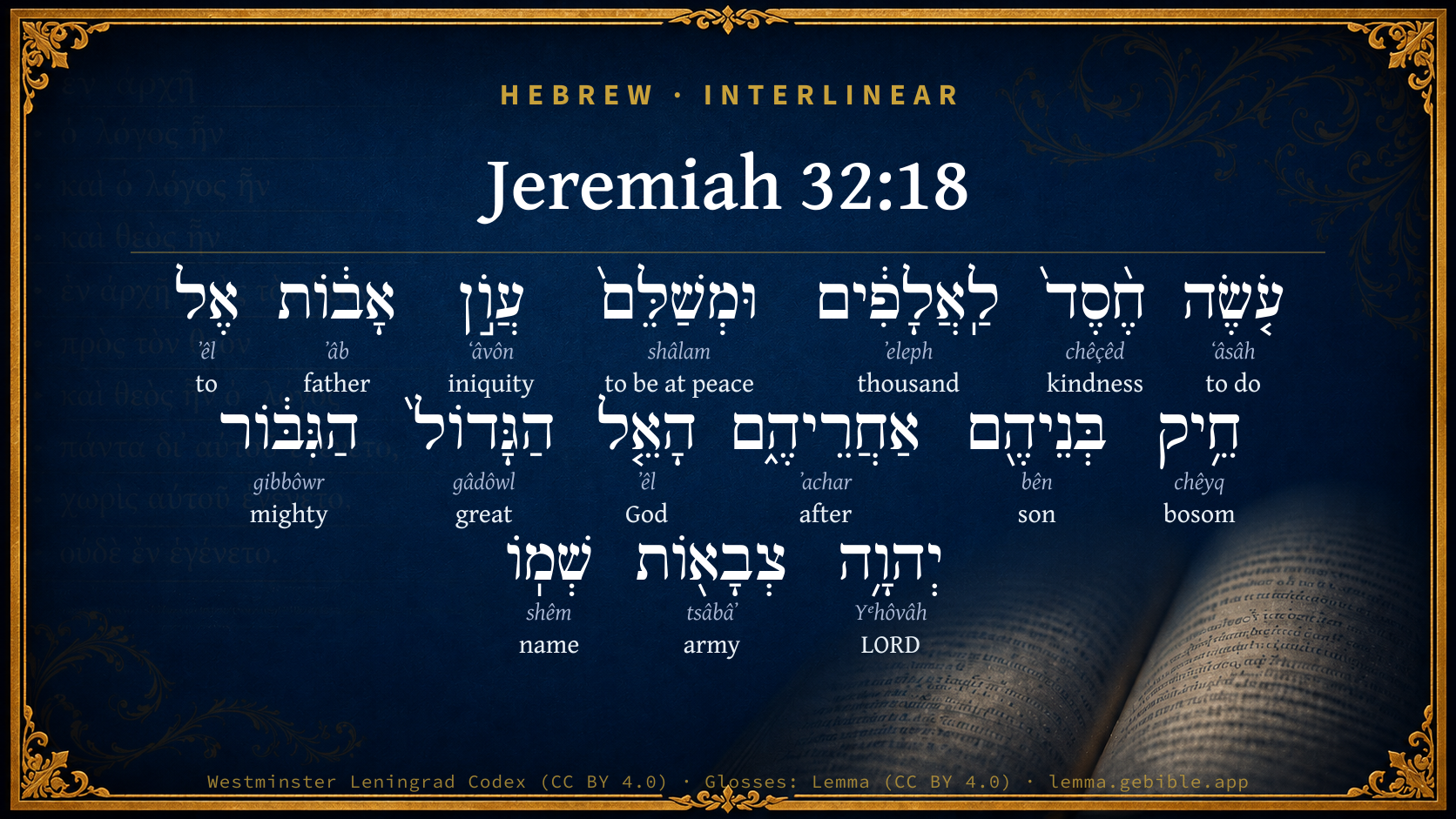
Jeremiah 32:18

Hebrew (Westminster Leningrad Codex) Jeremiah 32:18 appears in the Hebrew Old Testament. The text above is from the Westminster Leningrad Codex. Each word links to its Strong’s number, a concise gloss, and parsing drawn from the Open Scriptures Hebrew Bible morphology. Click any word for its full Brown-Driver-Briggs (BDB) entry.
Download image
Cite this verse

Jeremiah 32:18 (World English Bible). Public Domain. Lemma interlinear Bible study tool, https://lemma.gebible.app/v/jeremiah/32/18.

Show BibTeX & RIS
BibTeX
RIS
English Translation
who show loving kindness to thousands, and recompense the iniquity of the fathers into the bosom of their children after them; the great, the mighty God, Yahweh of Hosts is his name;
World English Bible · Public Domain
Download a study sheet

One document with this verse’s original text, its word-by-word gloss line, the meaning frame, cross-references with their text, attributed commentary, and full source and license credits — printable, and it pastes into notes with its structure intact.

This verse Autodidact and up

Study sheet (.html) Plain text (.txt)

A passage Seminary Student

Up to 50 verses in one chapter. A passage sheet keeps up to 6 commentary sources and 12 cross-references per verse, in the order this page ranks them, and says so on the sheet whenever that leaves anything out. Ask for a single verse and you get the Autodidact verse sheet above.

Everything on this page stays free to read, with no account — the sheet is a download of what is already on screen, not access to it.

Want to remove ads? Support Godless Engineer
Compare translations 3

The same verse in 3 English versions, stacked beneath the original-language interlinear above. Click any original word for its lexicon entry.

Each is an independent rendering of the whole verse — the interlinear is not word-aligned to these translations.

Highlighted words mark where these versions differ — a whole-verse word diff, not a word-by-word alignment.

  • World English Bible Public Domain
    who show loving kindness to thousands, and recompense the iniquity of the fathers into the bosom of their children after them; the great, the mighty God, Yahweh of Hosts is his name;
  • King James Version Public Domain
    Thou shewest lovingkindness unto thousands, and recompensest the iniquity of the fathers into the bosom of their children after them: the Great, the Mighty God, the LORD of hosts, is his name,
  • unfoldingWord Literal Text CC BY-SA 4.0
    You show covenant faithfulness to thousands and pour the guilt of men into the laps of their children after them. You are the great and mighty God; Yahweh of hosts is your name.

unfoldingWord Literal Text — © unfoldingWord, licensed CC BY-SA 4.0. Word-aligned USFM3 via Door43 (git.door43.org/unfoldingWord/en_ult).

Versions to compare (up to 4)

3 of 4 selected

Show all 18 translations

Every available English version of this verse, each an independent rendering of the whole verse.

  • World English Bible Public Domain
    who show loving kindness to thousands, and recompense the iniquity of the fathers into the bosom of their children after them; the great, the mighty God, Yahweh of Hosts is his name;
  • Berean Standard Bible Public Domain
    You show loving devotion to thousands but lay the iniquity of the fathers into the laps of their children after them, O great and mighty God whose name is the LORD of Hosts,
  • Majority Standard Bible Public Domain
    You show loving devotion to thousands but lay the iniquity of the fathers into the laps of their children after them, O great and mighty God whose name is the LORD of Hosts,
  • King James Version Public Domain
    Thou shewest lovingkindness unto thousands, and recompensest the iniquity of the fathers into the bosom of their children after them: the Great, the Mighty God, the LORD of hosts, is his name,
  • American Standard Version (1901) Public Domain
    who showest lovingkindness unto thousands, and recompensest the iniquity of the fathers into the bosom of their children after them; the great, the mighty God, Jehovah of hosts is his name;
  • Revised Version (1885) Public Domain
    which shewest mercy unto thousands, and recompensest the iniquity of the fathers into the bosom of their children after them: the great, the mighty God, the LORD of hosts is his name:
  • Geneva Bible (1599) Public Domain
    Thou shewest mercie vnto thousands, and recompensest the iniquitie of the fathers into the bosome of their children after them: O God the great and mightie, whose Name is ye Lord of hostes,
  • Douay-Rheims (1899) Public Domain
    Thou shewest mercy unto thousands, and returnest the iniquity of the fathers into the bosom of their children after them: O most mighty, great, and powerful, the Lord of hosts is thy name.
  • Young's Literal Translation Public Domain
    Doing kindness to thousands, and recompensing iniquity of fathers into the bosom of their sons after them; God, the great, the mighty, Jehovah of Hosts `is' His name,
  • Literal Standard Version CC BY-SA 4.0
    doing kindness to thousands, and repaying iniquity of fathers into the bosom of their sons after them; God, the great, the mighty, YHWH of Hosts [is] His Name;
  • Unlocked Literal Bible CC BY-SA 4.0
    You show covenant faithfulness to thousands and pour the guilt of men into the laps of their children after them. You are the great and mighty God; Yahweh of hosts is your name.
  • unfoldingWord Literal Text CC BY-SA 4.0
    You show covenant faithfulness to thousands and pour the guilt of men into the laps of their children after them. You are the great and mighty God; Yahweh of hosts is your name.
  • Darby Bible Public Domain
    who shewest mercy unto thousands, and recompensest the iniquity of the fathers into the bosom of their children after them, thou, the great, the mighty ùGod, -- Jehovah of hosts is his name;
  • World Messianic Bible Public Domain
    You show loving kindness to thousands, and repay the iniquity of the fathers into the bosom of their children after them. The great, the mighty God, the LORD of Hosts is your name:
  • Webster's Bible Public Domain
    Thou showest loving-kindness to thousands, and recompensest the iniquity of the fathers into the bosom of their children after them: the Great, the Mighty God, JEHOVAH of hosts, is his name,
  • Free Bible Version CC BY-SA 4.0
    You give your trustworthy love to thousands, but the consequences of your punishment of the sins of the fathers affect their children too. Great and powerful is the God whose name is the Lord Almighty—
  • Bible in Basic English Public Domain
    You have mercy on thousands, and send punishment for the evil-doing of the fathers on their children after them: the great, the strong God, the Lord of armies is his name:
  • JPS Tanakh (1917) Public Domain
    who showest mercy unto thousands, and recompensest the iniquity of the fathers into the bosom of their children after them; the great, the mighty God, the LORD of hosts is His name;

Literal Standard Version (2020), Covenant Press — licensed CC BY-SA 4.0. Text via the HelloAO Bible API (eBible.org). Unlocked Literal Bible (unfoldingWord) — licensed CC BY-SA 4.0. Text via the HelloAO Bible API (eBible.org). unfoldingWord Literal Text — © unfoldingWord, licensed CC BY-SA 4.0. Word-aligned USFM3 via Door43 (git.door43.org/unfoldingWord/en_ult). Free Bible Version, Dr. Jonathan Gallagher — licensed CC BY-SA 4.0. Text via the HelloAO Bible API (eBible.org).

Word by word

More ways to search: Search by grammar → Find every occurrence → Compare this word →

Practice this passage: Drill this verse → Learn its vocabulary →

חֵ֥יק
chêyq
H2436
“bosom of”
Noun, Common, Masculine, Singular, Construct
Part of Speech
Noun
Type
Common
Gender
Masculine
Number
Singular
State
Construct
Full BDB Definition

Origin: from an unused root, apparently meaning to inclose

TWOT: 629a

bosom, hollow, bottom, midst
  1. עֹ֤שֶׂה ʻâsâh H6213 “doing” Verb, Qal, Participle Active, Masculine, Singular, Absolute
  2. חֶ֨סֶד֙ chêçêd H2617 “kindness” Noun, Common, Masculine, Singular, Absolute
  3. לַֽאֲלָפִ֔ים ʼeleph H505 “to/for the · thousand” Preposition, Determined + Adjective, Cardinal number, Both, Plural, Absolute
  4. וּמְשַׁלֵּם֙ shâlam H7999 “and · being at peace” Conjunction + Verb, Piel, Participle Active, Masculine, Singular, Absolute
  5. עֲוֺ֣ן ʻâvôn H5771 “iniquity of” Noun, Common, Both, Singular, Construct
  6. אָב֔וֹת ʼâb H1 “fathers” Noun, Common, Masculine, Plural, Absolute
  7. אֶל ʼêl H413 “to” Preposition
  8. בְּנֵיהֶ֖ם bên H1121 “sons · their” Noun, Common, Masculine, Plural, Construct + Suffix, Personal, 3rd Person, Masculine, Plural
  9. אַחֲרֵיהֶ֑ם ʼachar H310 “after · them” Preposition + Suffix, Personal, 3rd Person, Masculine, Plural
  10. הָאֵ֤ל ʼêl H410 “the · God” Particle, Definite Article + Noun, Common, Masculine, Singular, Absolute
  11. הַגָּדוֹל֙ gâdôwl H1419 “the · great” Particle, Definite Article + Adjective, Adjective, Masculine, Singular, Absolute
  12. הַגִּבּ֔וֹר gibbôwr H1368 “the · mighty” Particle, Definite Article + Adjective, Adjective, Masculine, Singular, Absolute
  13. יְהוָ֥ה Yᵉhôvâh H3068 “LORD” Noun, Proper
  14. צְבָא֖וֹת tsâbâʼ H6635 “armies” Noun, Common, Both, Plural, Absolute
  15. שְׁמֽוֹ shêm H8034 “name · his” Noun, Common, Masculine, Singular, Construct + Suffix, Personal, 3rd Person, Masculine, Singular

About this verse

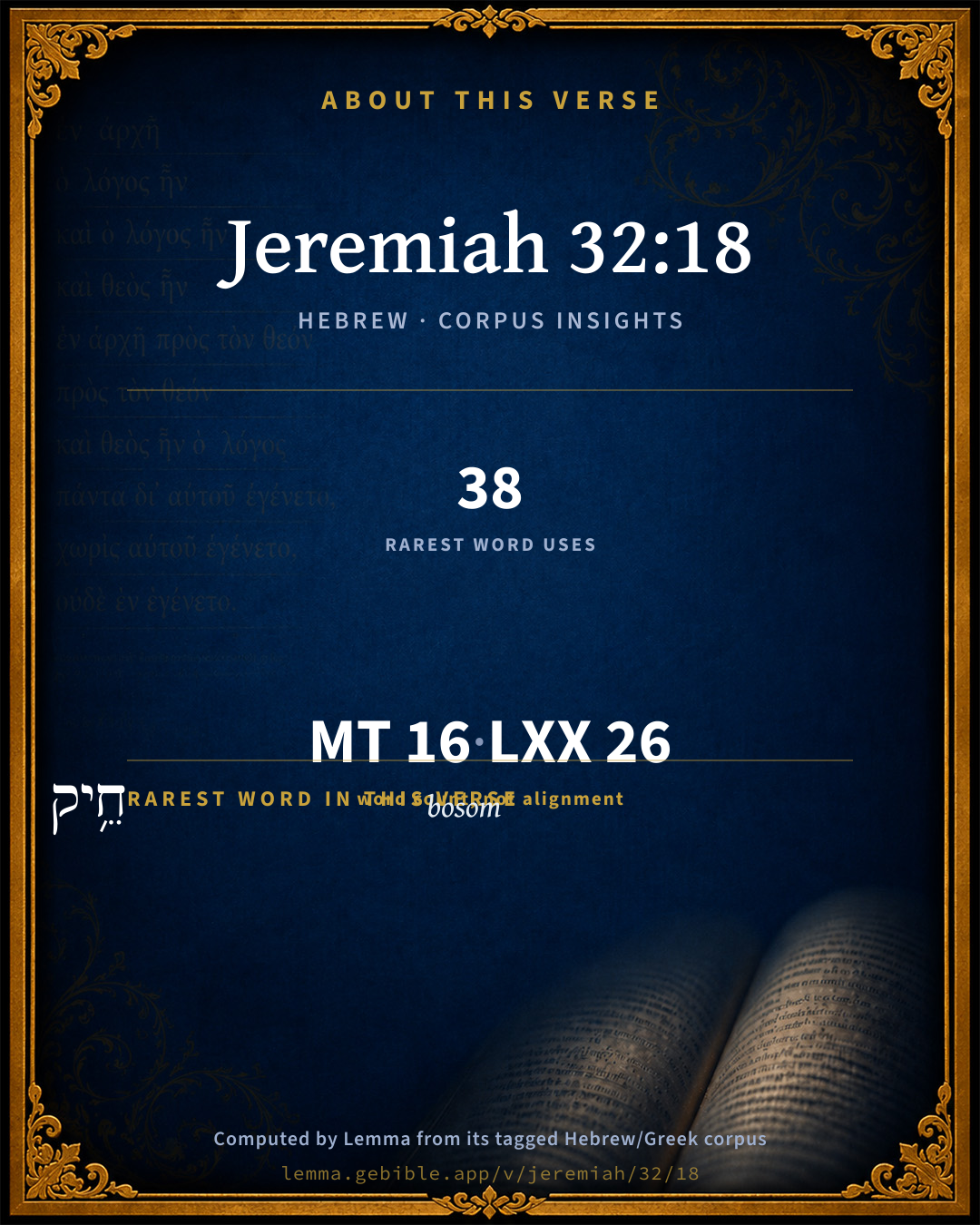
These counts appear in no published source. They are computed here, from the morphology-tagged text and Lemma’s own curated glosses. What Lemma adds →

16
words
16
distinct lemmas
Prophets
section

Shared distinctive vocabulary

חֵ֥יק bosom H2436 occurs in 34 verses of the Hebrew Bible. Also found in:

Grammatical profile

  • 2 verbs
  • 9 nouns
  • 3 adjectives
  • 2 prepositions

Verb forms

  • עֹ֤שֶׂה Qal · Participle Active
  • וּמְשַׁלֵּם֙ Piel · Participle Active

Hebrew & Septuagint length

In the original languages it is 16 Hebrew tokens and 26 Greek tokens — but the two are counted differently (Hebrew bundles its prefixes and suffixes into one token; the Greek is in lemma form), so that isn’t a like-for-like length.

Cross-references

25

Topical passages linked to Jeremiah 32:18 in the Treasury of Scripture Knowledge — connected by theme and wording, ordered by reader-vote popularity; previews shown in the World English Bible.

  • Jeremiah 10:16 The portion of Jacob is not like these; for he is the former of all things; and Israel is the tribe of his inheritance: Yahweh of Hosts is his name.
  • Exodus 34:7 keeping loving kindness for thousands, forgiving iniquity and disobedience and sin; and that will by no means clear the guilty, visiting the iniquity of the fathers on the children, and on the children's children, on the third and on the fourth generation."
  • Deuteronomy 5:9–10 you shall not bow down yourself to them, nor serve them; for I, Yahweh, your God, am a jealous God, visiting the iniquity of the fathers on the children, and on the third and on the fourth generation of those who hate me;
  • Exodus 20:5–6 you shall not bow yourself down to them, nor serve them, for I, Yahweh your God, am a jealous God, visiting the iniquity of the fathers on the children, on the third and on the fourth generation of those who hate me,
  • Deuteronomy 7:9–10 Know therefore that Yahweh your God, he is God, the faithful God, who keeps covenant and loving kindness with them who love him and keep his commandments to a thousand generations,
  • Numbers 14:18 Yahweh is slow to anger, and abundant in loving kindness, forgiving iniquity and disobedience; and that will by no means clear [the guilty], visiting the iniquity of the fathers on the children, on the third and on the fourth generation.
  • Deuteronomy 10:17 For Yahweh your God, he is God of gods, and Lord of lords, the great God, the mighty, and the awesome, who doesn't regard persons, nor takes reward.
  • 1 Kings 14:9–10 but have done evil above all who were before you, and have gone and made you other gods, and molten images, to provoke me to anger, and have cast me behind your back:
  • 1 Kings 16:1–3 The word of Yahweh came to Jehu the son of Hanani against Baasha, saying,
  • Isaiah 9:6 For to us a child is born, to us a son is given; and the government shall be on his shoulder: and his name shall be called Wonderful, Counselor, Mighty God, Everlasting Father, Prince of Peace.
  • Isaiah 10:21 A remnant shall return, [even] the remnant of Jacob, to the mighty God.
  • Isaiah 57:15 For thus says the high and lofty One who inhabits eternity, whose name is Holy: I dwell in the high and holy place, with him also who is of a contrite and humble spirit, to revive the spirit of the humble, and to revive the heart of the contrite.
  • Matthew 23:32–36 Fill up, then, the measure of your fathers.
  • Matthew 27:25 All the people answered, "May his blood be on us, and on our children!"
  • Joshua 7:24–26 Joshua, and all Israel with him, took Achan the son of Zerah, and the silver, and the mantle, and the wedge of gold, and his sons, and his daughters, and his oxen, and his donkeys, and his sheep, and his tent, and all that he had: and they brought them up to the valley of Achor.
  • 2 Samuel 21:1–9 There was a famine in the days of David three years, year after year; and David sought the face of Yahweh. Yahweh said, It is for Saul, and for his bloody house, because he put to death the Gibeonites.
  • 1 Kings 21:21–24 Behold, I will bring evil on you, and will utterly sweep you away and will cut off from Ahab every man-child, and him who is shut up and him who is left at large in Israel:
  • 2 Kings 9:26 Surely I have seen yesterday the blood of Naboth, and the blood of his sons, says Yahweh; and I will requite you in this plat, says Yahweh. Now therefore take and cast him into the plat [of ground], according to the word of Yahweh.
  • Nehemiah 1:5 and said, I beg you, Yahweh, the God of heaven, the great and awesome God, who keeps covenant and loving kindness with those who love him and keep his commandments:
  • Psalms 145:3–6 Great is Yahweh, and greatly to be praised! His greatness is unsearchable.
  • Habakkuk 1:12 Aren't you from everlasting, Yahweh my God, my Holy One? We will not die. Yahweh, you have appointed him for judgment. You, Rock, have established him to punish.
  • Psalms 50:1 The Mighty One, God, Yahweh, speaks, And calls the earth from sunrise to sunset.
  • Jeremiah 31:35 Thus says Yahweh, who gives the sun for a light by day, and the ordinances of the moon and of the stars for a light by night, who stirs up the sea, so that the waves of it roar; Yahweh of hosts is his name:
  • Genesis 49:24 But his bow abode in strength, The arms of his hands were made strong, By the hands of the Mighty One of Jacob, (From there is the shepherd, the stone of Israel),
  • Deuteronomy 7:21 You shall not be scared of them; for Yahweh your God is in the midst of you, a great and awesome God.

Cross-references courtesy of OpenBible.info (CC BY 4.0).

Hebrew and Greek witnesses Masoretic Hebrew ↔ Greek Septuagint

The same verse in the two great witnesses to the Old Testament, shown verse-for-verse.

These are two independent witnesses, not word-aligned to each other, and the Septuagint is shown in lemma (dictionary) form.

Hebrew Jeremiah 32:18 Masoretic · Westminster Leningrad Codex

עֹ֤שֶׂה חֶ֨סֶד֙ לַֽאֲלָפִ֔ים וּמְשַׁלֵּם֙ עֲוֺ֣ן אָב֔וֹת אֶל חֵ֥יק בְּנֵיהֶ֖ם אַחֲרֵיהֶ֑ם הָאֵ֤ל הַגָּדוֹל֙ הַגִּבּ֔וֹר יְהוָ֥ה צְבָא֖וֹת שְׁמֽוֹ

who show loving kindness to thousands, and recompense the iniquity of the fathers into the bosom of their children after them; the great, the mighty God, Yahweh of Hosts is his name;

World English Bible · Public Domain

Greek LXX Structure differs

In the Septuagint, Jeremiah is about an eighth shorter than the Hebrew and arranges its material differently — the Oracles Against the Nations (Hebrew chapters 46–51) appear in the middle of the Greek book, after 25:13. Because the chapter and verse boundaries do not line up, a verse-for-verse comparison with the Hebrew is not shown.

A verse-for-verse comparison isn’t shown here because the chapters and verses don’t line up. Switch to the LXX edition with the MT / LXX toggle above to read the Greek directly.

Hebrew: Westminster Leningrad Codex (CC BY 4.0). Greek: Septuagint (public domain); English from a public-domain English Septuagint. How the Septuagint differs from the Hebrew →

Targum (Aramaic paraphrase)

1

The Targum is the ancient Jewish Aramaic paraphrase of the Hebrew Scriptures — an interpretive translation, not the Hebrew text itself. Onkelos (literal) and Pseudo-Jonathan (expansive) render the Torah, and Jonathan the Prophets. Coverage is partial: where no permissively-licensed English translation exists for a verse, only the Aramaic is shown. This is verse-level text, not a word-by-word alignment to the Hebrew.

  1. Targum Jonathan Prophets (Joshua–Malachi)
    עֱבֵיד טִיבוּ לְאַלְפֵי דָרִין וּמְשַׁלֵם חוֹבֵי אֲבָהָתָא לְבָנַיָא כַּד מְשַׁלְמִין לְמֶחֱטֵי בַּתְרֵיהוֹן אֱלָהָא רַבָּא גַבְרָא יְיָ צְבָאוֹת שְׁמֵיהּ:

    (no public-domain English translation for this verse)

    Targum Jonathan — Aramaic: “Mikraot Gedolot” (public domain). English: “Sefaria Community Translation” (CC0 1.0 (public-domain dedication)); “London "Chaldee Paraphrase," 1871” (public domain). Text via Sefaria.

Commentary

Notes on Jeremiah 32:18 from classic Christian and Jewish commentators (each source and its license shown beneath its notes). The classic Christian expositions comment on the surrounding passage and are grouped to its opening verse, so a note may address several verses; the Jewish commentaries on the Tanakh (Rashi and others) are per-verse, so they appear only where the commentator wrote on this verse.

Lemma curates 59 commentaries, every one of them public domain or Creative Commons licensed, each selected and text-cleaned for this edition rather than reprinted as found. About our sources →

Trapp's Complete Commentary

John Trapp

Jer 32:18 Thou shewest lovingkindness unto thousands, and recompensest the iniquity of the fathers into the bosom of their children after them: the Great, the Mighty God, the LORD of hosts, [is] his name,

Ver. 18. Thou showest lovingkindness.] See on Jer 32:17.

And recompensest the iniquity.] Thou art not made all of mercy either, as silly folk are apt to conceit it.

Into the bosom of their children.] Who have it in full measure, long though it be first sometimes. Such parents are parricides.

The great, the mighty God.] Surgit hic oratio. Let us learn to represent the Lord to ourselves in prayer under fit notions and attributes; this will both increase faith and inflame affection.

John Trapp, A Commentary or Exposition upon All the Books of the Old and New Testament (1647–1656) — public domain. Text from a community e-Sword module.

Tyndale Open Study Notes

Tyndale Open Resources

32:18 The Lord consistently showed his unfailing love, but he also held generations accountable for their sins, and their children harvested the consequences. Through his mercy and his judgment, the Lord demonstrated his unlimited power. Jeremiah was confident that the Lord would show his love to his people as he had promised.

Tyndale Open Study Notes — © Tyndale Open Resources, licensed CC BY-SA 4.0. Text via the HelloAO Bible API.

Geneva Bible (1599)

Geneva Bible translators

Because the wicked are subject to the curse of God, he showeth that their posterity which by nature are under this malediction, shall be punisheth both for their own wickedness, and that the iniquity of their fathers, which is likewise in them, shall be also revenged on their head.

Geneva Bible (1599) marginal notes — public domain. Text via Bolls.life.

Jamieson, Fausset & Brown

Robert Jamieson, A. R. Fausset & David Brown

(Exo 34:7; Isa 65:6). This is taken from the decalogue (Exo 20:5-6). This is a second consideration to check hasty judgments as to God's ways: Thou art the gracious and righteous Judge of the world.

Jamieson, Fausset & Brown — Commentary Critical and Explanatory on the Whole Bible (1871) — public domain (CC PDM 1.0). Text via the HelloAO Bible API.

John Calvin's Commentaries

He now adds, Thou shewest mercy to thousands, and repayest the iniquity of the fathers to the bosom of their children Here the Prophet acknowledges God’s judgments to be right, though the reason for them escapes human minds. Both these things were necessary, that is, that Jeremiah should set before himself the awful power of God, and that he should also regard God’s judgments as right, though men often think otherwise. For God has hidden reasons for his judgments; and so it happens, that various thoughts disturb us, and every one is disposed to set himself up against God. Hence the Prophet, after having spoken of the immeasurable power of God, now declares also that he is a just judge of the world; and he again restrains himself by another bridle, lest he should pronounce a judgment on God’s works according to his own perceptions.

Thou, he says, shewest mercy to thousands This is taken from the Law of Moses, (Exodus 20:6) for the Prophets often borrowed their chief sentences from Moses, of whom they were the interpreters. Since God then under the Law declared that he is merciful to thousand generations, though it appears unnaccountable to us, yet nothing remains for us to do, but to learn reverently to receive what we cannot comprehend. The Prophet then here confesses that the method which God adopts as to his mercy is hid from the human mind. But the latter clause seems, however, less reasonable, — that God should repay the iniquity of fathers to their children Shortly before we saw that this was set forth as an impious blasphemy, (Jeremiah 31:29) when they said that their fathers had eaten sour grapes, and that their children’s teeth were set on edge; for it is always true that the soul that sinneth, it shall die. (Ezekiel 18:2, 20; Deuteronomy 24:16) But if God repays the iniquity of fathers to their children, he punishes the innocent, and transfers to children what he ought to have rendered to their fathers. But the Prophet, regarding it a wicked thing to contradict what God had spoken by Moses, adores here this mystery, and thus brings himself to humility and meekness, so that he might not break forth into extremes when speaking of the hidden works of God.

We must at the same time briefly observe, that the innocent are not punished when God includes children with their fathers, and casts the iniquity of fathers into the bosom of their children, for he does not refer to the innocent and the righteous, but to the wicked. Some, when they saw that this truth militated against the common feelings of mankind, have laid hold of an evasion, that is, that God by a temporal punishment renders to children what their fathers had deserved. But God speaks without exception, that he repays to the bosom of children the reward due to their fathers. But how ought this to be understood? It is a part of this punishment, that God withholds from them his Spirit. When, therefore, his purpose is to punish the vices of fathers in their posterity, he withholds from their posterity the light and grace of his Spirit. It cannot then be but that they will ever accumulate evils on evils, and thus they are entangled in the guilt of their fathers. God then proceeds by degrees in the work of punishing sins; for when it is his purpose to forgive the son the punishment which he together with his father has deserved, he draws him to himself by his Spirit, so that he is freed from punishment; but if his purpose is to execute vengeance on sons and grandsons, he withholds from them, as I have already said, the gift of the Spirit, so that they do nothing but provoke his wrath more and more, and thus they become involved in the same guilt with their fathers; hence fathers and children receive in common the same punishment.

This indeed seems not at the first view to be just and right; but let us remember that God’s judgments are hid from us, and for this reason, — that we may cultivate meekness and humility and learn to be soberly wise, and so confess God to be a just judge as to know that our minds cannot penetrate into this deep abyss. But still the solution given seems plain enough, that is, that God never punishes the innocent. For when he visits the sins of fathers on their children, a part of that punishment is, as I have already stated, that he withholds from the children the light of his Spirit; being blind, they ever run headlong to their own ruin, and thus by the continual commission of new sins they provoke God’s vengeance against themselves. When therefore God renders to them the reward due to their fathers, he punishes them at the same time for what they themselves have deserved; nor have they any reason to complain, because they have been guilty in common with their fathers: there is, therefore, nothing strange that they share with them in their punishment. But it, however, depends on the hidden mercy of God, that. he favors some with pardon, and thus delivers them from ruin, while he forsakes others; and as they are wicked, they deserve all the punishment he inflicts on them: Thou, then, repayest into the bosom of their sons after them, that is, after their death.

He afterwards exclaims, God, strong and mighty! Jehovah of hosts is his name He again declares the greatness of God’s power, that he might restrain himself, and not rashly undertake any new inquiry, as the ease is with curious men, who indulge themselves in speculations, and thus summon God as it were to an account, as though there could be appointed a tribunal before which he might be found guilty. As then the insolence and arrogance of human nature are so great, the Prophet here sets barriers around himself, so that he might keep within the bounds of humility and soberness.

He afterwards changes the person, which is a proof of vehemence and ardor; for it is, as we have seen, a prayer. He does not now address God directly, but says, Jehovah of hosts is his name, speaking in the third person. Had he continued in the same strain, he would have said, “Thou art God, strong and mighty,” etc., but he says, “Jehovah of hosts is his name.” We then see that the Prophet as it were turns aside; and this change of person, as I have stated, proceeded from the vehemence and ardor of his mind. And it often happens to the faithful, that they break off their direct address when they pray, while they contemplate God’s works, as displaying, now his power, then his goodness, or his wisdom. The faithful then do not always pray in a continued strain; but as feeling guides them, they now address God, then they turn aside and blend apostrophes. It follows, —

John Calvin's Commentaries (1540-1563) — public domain. Text from the Calvin Translation Society English edition (1840s-50s) via the Christian Classics Ethereal Library (ccel.org). Calvin's coverage is partial (roughly two-thirds of the Bible); uncommented books and verses are honest gaps, never fabricated. The 19th-century editor's footnotes and remarks are omitted so the notes are faithfully Calvin's own voice.

Ellicott's Commentary for English Readers

(18) Thou showest lovingkindness unto thousands . . .—The words are, in part, an echo from Exo_20:6, yet more from the revelation of the Divine glory in Exo_34:7. They recognise the laws of a righteous retribution, working even through the seeming injustice of that visiting the sins of the fathers upon the children which is inseparable from the continuity of family or national life, and which had been caricatured in the “sour grapes” proverb of Jer_31:29. They recognise also a mercy which is wider than that retribution, and at last triumphant. In the “Mighty God” we have the reproduction of the name used by Isaiah in his great Messianic prediction (Isa_9:6).

A Bible Commentary for English Readers, edited by Charles John Ellicott (1878–1897) — public domain. Text from a community e-Sword module.

The Cambridge Bible for Schools and Colleges

gen. ed. J. J. S. Perowne

18. recompensest the iniquity of the fathers] an allusion to the Decalogue (Exo_20:5; Deu_5:9). See on Jer_31:29.

into the bosom] The Eastern garment formed at the bosom numerous folds, which served as a pocket. Cp. Rth_3:15; Pro_17:23, and for the phrase itself Psa_79:12; Isa_65:6.

The Cambridge Bible for Schools and Colleges (gen. ed. J. J. S. Perowne; Cambridge University Press, 1878–1918) — public domain. Text from a community e-Sword module.

John Gill's Exposition

Great in counsel, and mighty in word,.... Counsel belongs to him, and he does all things after the counsel of his will, all things in nature, providence, and grace; and such a display of his wisdom is there in all, that show him to be excellent in counsel; to excel all others; not only to be great, but to be the greatest in counsel; and who regularly and perfectly performs all that he has wisely contrived; his wisdom and his power are equal to each other; he forms the scheme of all that he does with the greatest wisdom, and accomplishes by his power all that he has purposed in his eternal mind; see Isa 28:29;

for thine eyes are open upon all the ways of the sons of men; all their thoughts, schemes, devices, and purposes; all their words and actions, every step they take, whether good or bad, they are all before ham, and manifest to him; he is God omniscient as well as God omnipotent; and he does not look upon men, and their ways and works, as an idle spectator or indifferent person, as unconcerned at what they do, letting them pass without calling them to an account for them, or without passing any judgment on them, or sentence concerning them; no, he is the Judge of all the earth, and he sits in the heavens and observes what is done on earth:

to give everyone according to his ways, and according to the fruit of his doings: good things to good men for Christ's sake; and evil things to evil men, according to the just demerit of their sins and transgressions.

John Gill's Exposition of the Whole Bible (1746–1763) — public domain (CC PDM 1.0). Text via the HelloAO Bible API.

Albert Barnes' Notes on the Bible

Recompensest - The recompence is placed in the bosom, because, in the East, the garments are so arranged as to form a pocket there. Thus then, men must receive and carry with them God’s requital for their deeds.

Albert Barnes' Notes on the Bible (1834–1885) — public domain. Text from a community e-Sword/MySword module.

Haydock's Catholic Bible Commentary

After them, to the third and fourth generation, Exodus xxxiv. 7. His mercy is more exalted. (Calmet)

George Leo Haydock (1774–1849), Haydock's Catholic Family Bible and Commentary, 1859 edition — public domain. Excludes Psalms (Douay-Rheims chapter numbering differs from Protestant) and Deuterocanonical books (Catholic canon only).

Matthew Poole's English Annotations

Thou shewest loving-kindness unto thousands, and recompensest the iniquity of the fathers into the bosom of their children after them: this is the name which God gave himself, Exo 34:7; Deu 5:9,10, and of this latter clause, declarative of the vengeance of God in punishing children for their parents’ sins, are many instances in Scripture, Jos 7:24; 1Sa 2:33,34; 1Ki 14:10,11; 21:24.

Matthew Poole's English Annotations on the Holy Bible (1683–1685) — public domain. Text from a community e-Sword/MySword module.

Whedon's Commentary on the Bible

Daniel D. Whedon

18. Recompensest… into the bosom — “The recompense is placed in the bosom because, in the East, the garments are so arranged as to form a pocket there. Thus, then, men must receive and carry with them God’s requital for their deeds.”-Dean Smith.

Daniel D. Whedon (gen. ed.), Commentary on the Old and New Testaments (1874–1909) — public domain. Text from a community e-Sword module.

The Pulpit Commentary

Into the bosom, etc. The ample dress of an Eastern rendering a bag or basket unnecessary. (comp. Rth_3:15)

The Pulpit Commentary (1880–1919), ed. H.D.M. Spence-Jones & Joseph S. Exell — public domain. Text from a community e-Sword module.

Rashi

Rabbi Shlomo Yitzchaki (Rashi)

and requites the iniquity of the fathers in the bosom Of this generation who follow their ancestors in their evil way.

Great and Mighty But he did not say, “and awesome.” He said. Heathens are dancing in His Temple. Where then are His awesome deeds? In Tractate Yoma (69b).

Rashi on the Tanakh — English translations: “The Judaica Press complete Tanach with Rashi, translated by A. J. Rosenberg” (CC BY 4.0); “Pentateuch with Rashi's commentary by M. Rosenbaum and A.M. Silbermann, 1929-1934” (public domain); “The Metsudah Tanach series, Lakewood, N.J” (CC BY 4.0); and “The Book of Joshua, Metsudah Publications, 1997” (CC BY 4.0). Text via Sefaria.

Lesson kit

Teaching starters — assembled from the data on this page, not authored interpretation. Every prompt links to the verse data it draws on. Edit before teaching.

Jeremiah, in the Prophets, opens this verse with 16 words (16 distinct Hebrew lemmas). Its most distinctive word is chêyq (“bosom”). A historical commentator’s framing appears above. Read the whole chapter for the surrounding context.

Discussion questions

  1. How does “bosom” (chêyq) shape what this verse is saying?
  2. How does Genesis 16:5, which shares the word «bosom», read alongside this verse?
  3. The translations on this page render this verse differently — a whole-verse word diff, not a word-by-word alignment. What might account for the different wordings?
  4. «עֹ֤שֶׂה» is a Qal Participle Active verb. How does that grammatical form shape the action described?
  5. Compare how Trapp's Complete Commentary and Tyndale Open Study Notes read this verse. Where do they agree or differ?

Things to notice

Reading settings

Reading text

Shown beneath each verse's original-language words.

Old Testament
Old Testament edition

Read the OT as the Masoretic Hebrew (MT) or the Greek Septuagint (LXX).

English shown for the Greek Septuagint (in the Hebrew ↔ Greek comparison).

Comparing translations? Open the Compare panel on any verse page to stack up to four side by side.