1 Samuel 3:14

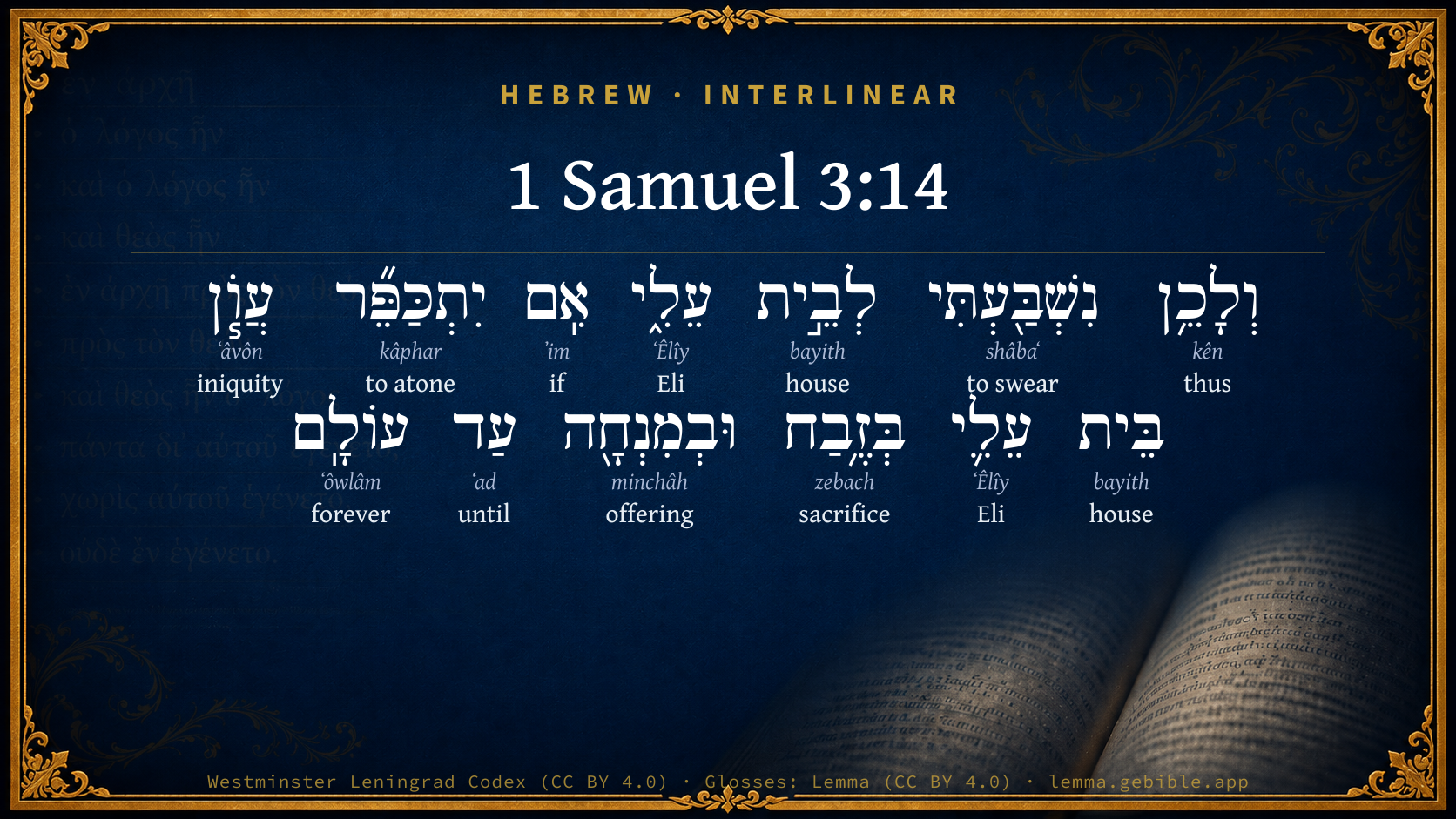
Hebrew (Westminster Leningrad Codex) 1 Samuel 3:14 appears in the Hebrew Old Testament. The text above is from the Westminster Leningrad Codex. Each word links to its Strong’s number, a concise gloss, and parsing drawn from the Open Scriptures Hebrew Bible morphology. Click any word for its full Brown-Driver-Briggs (BDB) entry.
Download image
Cite this verse

1 Samuel 3:14 (World English Bible). Public Domain. Lemma interlinear Bible study tool, https://lemma.gebible.app/v/1-samuel/3/14.

Show BibTeX & RIS
BibTeX
RIS
English Translation
Therefore I have sworn to the house of Eli, that the iniquity of Eli's house shall not be expiated with sacrifice nor offering forever.
World English Bible · Public Domain
Download a study sheet

One document with this verse’s original text, its word-by-word gloss line, the meaning frame, cross-references with their text, attributed commentary, and full source and license credits — printable, and it pastes into notes with its structure intact.

This verse Autodidact and up

Study sheet (.html) Plain text (.txt)

A passage Seminary Student

Up to 50 verses in one chapter. A passage sheet keeps up to 6 commentary sources and 12 cross-references per verse, in the order this page ranks them, and says so on the sheet whenever that leaves anything out. Ask for a single verse and you get the Autodidact verse sheet above.

Everything on this page stays free to read, with no account — the sheet is a download of what is already on screen, not access to it.

Want to remove ads? Support Godless Engineer
Compare translations 3

The same verse in 3 English versions, stacked beneath the original-language interlinear above. Click any original word for its lexicon entry.

Each is an independent rendering of the whole verse — the interlinear is not word-aligned to these translations.

Highlighted words mark where these versions differ — a whole-verse word diff, not a word-by-word alignment.

  • World English Bible Public Domain
    Therefore I have sworn to the house of Eli, that the iniquity of Eli's house shall not be expiated with sacrifice nor offering forever.
  • King James Version Public Domain
    And therefore I have sworn unto the house of Eli, that the iniquity of Eli's house shall not be purged with sacrifice nor offering for ever.
  • unfoldingWord Literal Text CC BY-SA 4.0
    And therefore I have sworn to the house of Eli, ‘If forever the iniquity of the house of Eli will cover itself by sacrifice or by offering!’”

unfoldingWord Literal Text — © unfoldingWord, licensed CC BY-SA 4.0. Word-aligned USFM3 via Door43 (git.door43.org/unfoldingWord/en_ult).

Versions to compare (up to 4)

3 of 4 selected

Show all 18 translations

Every available English version of this verse, each an independent rendering of the whole verse.

  • World English Bible Public Domain
    Therefore I have sworn to the house of Eli, that the iniquity of Eli's house shall not be expiated with sacrifice nor offering forever.
  • Berean Standard Bible Public Domain
    Therefore I have sworn to the house of Eli, ‘The iniquity of Eli’s house shall never be atoned for by sacrifice or offering.’”
  • Majority Standard Bible Public Domain
    Therefore I have sworn to the house of Eli, ‘The iniquity of Eli’s house shall never be atoned for by sacrifice or offering.’”
  • King James Version Public Domain
    And therefore I have sworn unto the house of Eli, that the iniquity of Eli's house shall not be purged with sacrifice nor offering for ever.
  • American Standard Version (1901) Public Domain
    And therefore I have sworn unto the house of Eli, that the iniquity of Eli's house shall not be expiated with sacrifice nor offering for ever.
  • Revised Version (1885) Public Domain
    And therefore I have sworn unto the house of Eli, that the iniquity of Eli’s house shall not be purged with sacrifice nor offering for ever.
  • Geneva Bible (1599) Public Domain
    Nowe therefore I haue sworne vnto the house of Eli, that the wickednes of Elis house, shall not be purged with sacrifice nor offring for euer.
  • Douay-Rheims (1899) Public Domain
    Therefore have I sworn to the house of Hell, that the iniquity of his house shall not be expiated with victims nor offerings for ever.
  • Young's Literal Translation Public Domain
    and therefore I have sworn to the house of Eli: the iniquity of the house of Eli is not atoned for, by sacrifice, and by offering -- unto the age.'
  • Literal Standard Version CC BY-SA 4.0
    and therefore I have sworn to the house of Eli: the iniquity of the house of Eli is not atoned for, by sacrifice, and by offering—for all time.”
  • Unlocked Literal Bible CC BY-SA 4.0
    Because of this I have sworn to the house of Eli that the sins of his house will never be atoned for by sacrifice or offering.”
  • unfoldingWord Literal Text CC BY-SA 4.0
    And therefore I have sworn to the house of Eli, ‘If forever the iniquity of the house of Eli will cover itself by sacrifice or by offering!’”
  • Darby Bible Public Domain
    And therefore I have sworn unto the house of Eli that the iniquity of Eli's house shall not be expiated with sacrifice or oblation for ever.
  • World Messianic Bible Public Domain
    Therefore I have sworn to the house of Eli that the iniquity of Eli’s house shall not be removed with sacrifice or offering forever.”
  • Webster's Bible Public Domain
    And therefore I have sworn to the house of Eli, that the iniquity of Eli's house shall not be purged with sacrifice nor offering for ever.
  • Free Bible Version CC BY-SA 4.0
    That's why I swore to Eli and his family, ‘The guilt of Eli and his descendants will never be removed by sacrifice or offering.’”
  • Bible in Basic English Public Domain
    So I have made an oath to the family of Eli that no offering of meat or of meal which they may make will ever take away the sin of his family.
  • JPS Tanakh (1917) Public Domain
    And therefore I have sworn unto the house of Eli, that the iniquity of Eli's house shall not be expiated with sacrifice nor offering for ever.'

Literal Standard Version (2020), Covenant Press — licensed CC BY-SA 4.0. Text via the HelloAO Bible API (eBible.org). Unlocked Literal Bible (unfoldingWord) — licensed CC BY-SA 4.0. Text via the HelloAO Bible API (eBible.org). unfoldingWord Literal Text — © unfoldingWord, licensed CC BY-SA 4.0. Word-aligned USFM3 via Door43 (git.door43.org/unfoldingWord/en_ult). Free Bible Version, Dr. Jonathan Gallagher — licensed CC BY-SA 4.0. Text via the HelloAO Bible API (eBible.org).

Word by word

More ways to search: Search by grammar → Find every occurrence → Compare this word →

Practice this passage: Drill this verse → Learn its vocabulary →

עֵלִ֑י
ʻÊlîy
H5941
“Eli”
Noun, Proper
Part of Speech
Noun
Type
Proper
Full BDB Definition

Origin: from H5927

TWOT: None

Eli = "ascension" - descendant of Aaron through Ithamar and high priest and judge of Israel when Samuel entered service as a child
  1. וְלָכֵ֥ן kên H3651 “and · to/for · thus” Conjunction + Preposition + Adverb
  2. נִשְׁבַּ֖עְתִּי shâbaʻ H7650 “to swear” Verb, Niphal, Perfect, 1st Person, Common, Singular
  3. לְבֵ֣ית bayith H1004 “to/for · house of” Preposition + Noun, Common, Masculine, Singular, Construct
  4. אִֽם ʼim H518 “if” Conjunction
  5. יִתְכַּפֵּ֞ר kâphar H3722 “to atone” Verb, Hithpael, Imperfect, 3rd Person, Masculine, Singular
  6. עֲוֺ֧ן ʻâvôn H5771 “iniquity of” Noun, Common, Both, Singular, Construct
  7. בֵּית bayith H1004 “house of” Noun, Common, Masculine, Singular, Construct
  8. עֵלִ֛י ʻÊlîy H5941 “Eli” Noun, Proper
  9. בְּזֶ֥בַח zebach H2077 “in/at · sacrifice” Preposition + Noun, Common, Masculine, Singular, Absolute
  10. וּבְמִנְחָ֖ה minchâh H4503 “and · in/at · offering” Conjunction + Preposition + Noun, Common, Feminine, Singular, Absolute
  11. עַד ʻad H5704 “until” Preposition
  12. עוֹלָֽם ʻôwlâm H5769 “forever” Noun, Common, Masculine, Singular, Absolute

About this verse

These counts appear in no published source. They are computed here, from the morphology-tagged text and Lemma’s own curated glosses. What Lemma adds →

13
words
11
distinct lemmas
Historical
section

Shared distinctive vocabulary

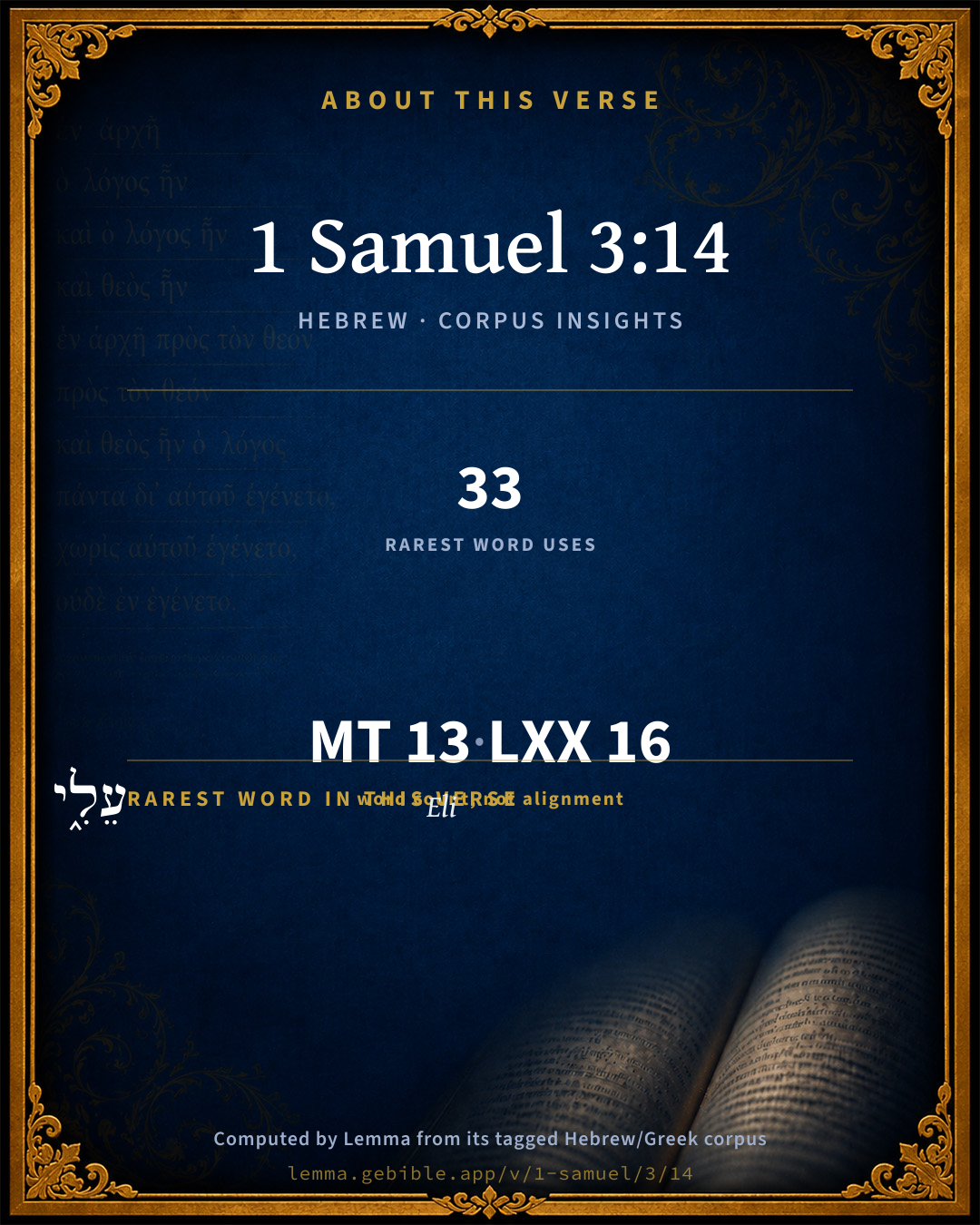
עֵלִ֑י Eli H5941 occurs in 30 verses of the Hebrew Bible. Also found in:

Grammatical profile

  • 2 verbs
  • 8 nouns
  • 1 preposition
  • 1 conjunction
  • 1 adverb

Verb forms

  • נִשְׁבַּ֖עְתִּי Niphal · Perfect
  • יִתְכַּפֵּ֞ר Hithpael · Imperfect

Repetition

Words recur within this verse — often emphatic in Hebrew:

  • לְבֵ֣ית house H1004 ×2
  • עֵלִ֑י Eli H5941 ×2

Hebrew & Septuagint length

In English translation the verse runs 24 words from the Hebrew and 33 from the Septuagint (LXX English) — closely comparable.

A rough comparison of the two English renderings, which tokenize alike — not a word-level alignment.

Word counts can differ between the Hebrew and the Greek without any difference in meaning — e.g. the Hebrew direct-object marker אֵת has no separate Greek word, and Greek often adds the article ὁ.

In the original languages it is 13 Hebrew tokens and 16 Greek tokens — but the two are counted differently (Hebrew bundles its prefixes and suffixes into one token; the Greek is in lemma form), so that isn’t a like-for-like length.

Cross-references

10

Topical passages linked to 1 Samuel 3:14 in the Treasury of Scripture Knowledge — connected by theme and wording, ordered by reader-vote popularity; previews shown in the World English Bible.

  • Isaiah 22:14 Yahweh of Hosts revealed himself in my ears, Surely this iniquity shall not be forgiven you until you die, says the Lord, Yahweh of Hosts.
  • 1 Samuel 2:25 If one man sin against another, God shall judge him; but if a man sin against Yahweh, who shall entreat for him? Notwithstanding, they didn't listen to the voice of their father, because Yahweh was minded to kill them.
  • Jeremiah 7:16 Therefore don't you pray for this people, neither lift up a cry nor prayer for them, neither make intercession to me; for I will not hear you.
  • Jeremiah 15:1 Then said Yahweh to me, Though Moses and Samuel stood before me, yet my mind would not be toward this people: cast them out of my sight, and let them go forth.
  • Leviticus 15:31 "'Thus you shall separate the children of Israel from their uncleanness, so they will not die in their uncleanness, when they defile my tabernacle that is in their midst.'"
  • Numbers 15:30–31 But the soul who does anything with a high hand, whether he is home-born or a foreigner, the same blasphemes Yahweh; and that soul shall be cut off from among his people.
  • Psalms 51:16 For you don't delight in sacrifice, or else I would give it. You have no pleasure in burnt offering.
  • Ezekiel 24:13 In your filthiness is lewdness: because I have cleansed you and you weren't cleansed, you shall not be cleansed from your filthiness any more, until I have caused my wrath toward you to rest.
  • Hebrews 10:4–10 For it is impossible that the blood of bulls and goats should take away sins.
  • Hebrews 10:26–31 For if we sin willfully after we have received the knowledge of the truth, there remains no more a sacrifice for sins,

Cross-references courtesy of OpenBible.info (CC BY 4.0).

Hebrew and Greek witnesses Masoretic Hebrew ↔ Greek Septuagint

The same verse in the two great witnesses to the Old Testament, shown verse-for-verse.

These are two independent witnesses, not word-aligned to each other, and the Septuagint is shown in lemma (dictionary) form.

Hebrew 1 Samuel 3:14 Masoretic · Westminster Leningrad Codex

וְלָכֵ֥ן נִשְׁבַּ֖עְתִּי לְבֵ֣ית עֵלִ֑י אִֽם יִתְכַּפֵּ֞ר עֲוֺ֧ן בֵּית עֵלִ֛י בְּזֶ֥בַח וּבְמִנְחָ֖ה עַד עוֹלָֽם

Therefore I have sworn to the house of Eli, that the iniquity of Eli's house shall not be expiated with sacrifice nor offering forever.

World English Bible · Public Domain

Greek LXX 1 Samuel 3:14 Septuagint · lemma form

ὄμνυμι ὁ οἶκος ηλι εἰ ἐκἱλάσκομαι ἀδικία οἶκος ηλι ἐν θυμίαμα καί ἐν θυσία ἕως αἰών

And it shall not go on so; I have sworn to the house of Eli, the iniquity of the house of Eli shall not be atoned for with incense or sacrifices for ever.

LXX2012 (modern English Septuagint) · Public Domain

Hebrew: Westminster Leningrad Codex (CC BY 4.0). Greek: Septuagint (public domain); English from LXX2012 (modern English Septuagint) (Public Domain). How the Septuagint differs from the Hebrew →

Targum (Aramaic paraphrase)

1

The Targum is the ancient Jewish Aramaic paraphrase of the Hebrew Scriptures — an interpretive translation, not the Hebrew text itself. Onkelos (literal) and Pseudo-Jonathan (expansive) render the Torah, and Jonathan the Prophets. Coverage is partial: where no permissively-licensed English translation exists for a verse, only the Aramaic is shown. This is verse-level text, not a word-by-word alignment to the Hebrew.

  1. Targum Jonathan Prophets (Joshua–Malachi)
    וּבְכֵן קַיֵמִית לְבֵית עֵלִי אִם יִשְׁתַּבְקוּן חוֹבֵי בֵית עֵלִי בְּנִכְסַת קוּדְשִׁין וּבְקָרְבְּנִין עַד עַלְמָא:

    (no public-domain English translation for this verse)

    Targum Jonathan — Aramaic: “Mikraot Gedolot” (public domain). English: “Sefaria Community Translation” (CC0 1.0 (public-domain dedication)); “London "Chaldee Paraphrase," 1871” (public domain). Text via Sefaria.

Commentary

Notes on 1 Samuel 3:14 from classic Christian and Jewish commentators (each source and its license shown beneath its notes). The classic Christian expositions comment on the surrounding passage and are grouped to its opening verse, so a note may address several verses; the Jewish commentaries on the Tanakh (Rashi and others) are per-verse, so they appear only where the commentator wrote on this verse.

Lemma curates 59 commentaries, every one of them public domain or Creative Commons licensed, each selected and text-cleaned for this edition rather than reprinted as found. About our sources →

Trapp's Complete Commentary

John Trapp

1Sa 3:14 And therefore I have sworn unto the house of Eli, that the iniquity of Eli’s house shall not be purged with sacrifice nor offering for ever.

Ver. 14. That the iniquity of Eli’s house shall not be purged.] Hence some concluded that their sin was that sin unto death, {1Jn 5:16} for which "there remaineth no more sacrifice," {Heb 10:26} and that they were damned, because so hardened that they could not repent. {Rom 1:28} If some of that race proved right, as they did, yet the temporal punishment of losing the chief priesthood could not be averted or avoided.

John Trapp, A Commentary or Exposition upon All the Books of the Old and New Testament (1647–1656) — public domain. Text from a community e-Sword module.

Joseph Benson's Commentary

1Sa 3:14. I have sworn — Or, I do swear; the past tense being commonly put for the present in the Hebrew tongue. Unto the house of Eli — Or, concerning it. Shall not be purged — That is, the punishment threatened against Eli and his family shall not be prevented by all their sacrifices, but shall infallibly be executed.

Joseph Benson's Commentary on the Old and New Testaments (1811–1818) — public domain. Text from a community e-Sword module.

Tyndale Open Study Notes

Tyndale Open Resources

3:14 Neither blood sacrifices nor offerings would be acceptable on behalf of Eli and his sons. The offerings of Lev 4–5 were for sins committed inadvertently or unintentionally, whereas the sins of Eli and his sons were deliberate and rebellious.

Tyndale Open Study Notes — © Tyndale Open Resources, licensed CC BY-SA 4.0. Text via the HelloAO Bible API.

Geneva Bible (1599)

Geneva Bible translators

Meaning that his posterity should never enjoy the chief Priest’s office.

Geneva Bible (1599) marginal notes — public domain. Text via Bolls.life.

Adam Clarke's Commentary

Verse 14. Shall not be purged with sacrifice nor offering] That is, God was determined that they should be removed by a violent death. They had committed the sin unto death; and no offering or sacrifice could prevent this. What is spoken here relates to their temporal death only.

Adam Clarke's Commentary on the Bible (1810–1826) — public domain. Text from a community e-Sword/MySword module.

Ellicott's Commentary for English Readers

(14) Shall not be purged with sacrifice.—No earthly sacrifice, bloody or unbloody, should ever purge on earth the sin of the doomed high priestly house. A great theological truth is contained in these few words. in the sacrificial theory of the Mosaic Law we see there was a limit to the efficacy of sacrifice after a certain point in sin and evil example had been reached: a scar was printed on the life which no blood of bullock or of goat could wash away; but the quiet, though sorrowful, resignation with which the old man received the intimation of the certain earthly doom seems to indicate that Eli, sure of the love of the All-Pitiful, looked on to some other means of deliverance, devised in the counsels of the Eternal Friend of Israel, by which his deathless soul, after the earthly penalty, would be reconciled to the invisible King. Did not men like Eli look on in sure and certain trust to the one hope? Did not these holy, though often erring, patriarchs and priests see in those far-back days, “as in a glass darkly,” the blood of another Victim, which should cleanse the repentant and sorrowing sinner from all sin?

A Bible Commentary for English Readers, edited by Charles John Ellicott (1878–1897) — public domain. Text from a community e-Sword module.

The Cambridge Bible for Schools and Colleges

gen. ed. J. J. S. Perowne

14. shall not be purged] Lit., shall not cover itself; shall not make atonement for itself. The sons of Eli had sinned, ‘with a high hand,’ against light and warnings, and for such unrepentant presumptuous offenders the Law had no atonement. See Num_15:27-31. The doom of their house is pronounced, and ratified by the oath of God. Clearly however it is only to the temporal punishment of Eli’s family that the words refer in the first instance. Cp. Isa_22:14.

sacrifice nor offering] See note on 1Sa_2:29.

The Cambridge Bible for Schools and Colleges (gen. ed. J. J. S. Perowne; Cambridge University Press, 1878–1918) — public domain. Text from a community e-Sword module.

John Gill's Exposition

And therefore I have sworn unto the house of Eli,.... Either had done this before, which was signified to him by the man of God, or did swear now for the confirmation of his threatenings, and to assure the certain performance of them:

that the iniquity of Eli's house shall not be purged with sacrifice nor offering for ever: not even typically, which was all that legal sacrifice could do; and not so that the priesthood should ever return to the family again, as the office of high priesthood never did; or, as Abarbinel interprets it, because of sacrifice and offering, that the iniquity Eli's sons were guilty of in taking the flesh of the sacrifices and offerings, which did not belong to them, and before the Lord had his part, should never be expiated. (There are some sins that are not covered in the atonement of Jesus Christ. This is one of them and the sin against the Holy Ghost is another. Mat 12:31. Editor.)

John Gill's Exposition of the Whole Bible (1746–1763) — public domain (CC PDM 1.0). Text via the HelloAO Bible API.

Albert Barnes' Notes on the Bible

See the marginal references. The sin of the sons of Eli could not be purged by the appointed sacrifices of the Law. In blessed contrast with this declaration is the assurance of the New Testament 1Jo 1:7; Act 13:39.

Albert Barnes' Notes on the Bible (1834–1885) — public domain. Text from a community e-Sword/MySword module.

Haydock's Catholic Bible Commentary

Sworn. We read not of an express oath; (Calmet) but the denunciation of God was equivalent. (Haydock) --- Iniquity, or punishment. Nothing could withhold the indignation of the Lord, in correcting the sinner, though he would shew mercy eternally to the penitent. But he saw the obstinacy of these priests, and their unhappy end. The sacrifices of the old law always presupposed suitable internal sentiments, to grant the remission of sin; and even for the avoiding of the legal punishments, they must have been offered in a true spirit of religion, which these abandoned wretches despised and neglected. (Calmet) --- God threatens that he will punish their crimes for ever, as he abominates the contempt of priest. (Tirinus)

George Leo Haydock (1774–1849), Haydock's Catholic Family Bible and Commentary, 1859 edition — public domain. Excludes Psalms (Douay-Rheims chapter numbering differs from Protestant) and Deuterocanonical books (Catholic canon only).

Matthew Poole's English Annotations

I have sworn; which might be done before, though it be mentioned here only. Or, I do swear; the past tense being commonly put for the present in the Hebrew tongue. Unto the house, or, concerning, as the prefix lamed is oft used, as Exo 14:3; 18:7; 2Sa 11:7; Psa 91:11, compared with Mat 4:6.

Shall not be purged with sacrifice, i.e. the punishment threatened against Eli and his family shall not be prevented or hindered by all their sacrifices, as they fondly imagine, but shall infallibly be executed.

Matthew Poole's English Annotations on the Holy Bible (1683–1685) — public domain. Text from a community e-Sword/MySword module.

The Pulpit Commentary

Sacrifice nor offering. The first of these is zebach, the sacrifice of an animal by the shedding of its blood; the second is the minchah, or unbloody sacrifice. The guilt of Eli"s sons could be purged, i.e. expiated, by none of the appointed offerings for sin, because they had hardened themselves in their wrong doing even after the solemn warning in 1Sa_2:27-36. Hence the marked repetition of the denunciation of finality in their doom. Again it is said that it is forever. It has, however, been well noticed that though the message of Samuel confirms all that had been threatened by the man of God, yet that no bitter or painful words are put into the mouth of one who was still a child. For this there may also be a further reason. The first message was intended to give Eli and his sons a final opportunity of repentance, and, that it might produce its full effect, the severity of the doom impending upon them was clearly set before their eyes. They did not repent. Eli hardened himself in his weakness, and took no steps to vindicate God"s service from the slur cast upon it by an unworthy priesthood. His sons hardened themselves in crime, and made their office a reproach. It was enough, therefore, to repeat and confirm generally the terms of the former prophecy, as no moral object would be gained by calling attention to the severity of the coming judgment.

The Pulpit Commentary (1880–1919), ed. H.D.M. Spence-Jones & Joseph S. Exell — public domain. Text from a community e-Sword module.

John Wesley's Explanatory Notes

Have sworn - Or, I do swear: the past tense being commonly put for the present in the Hebrew tongue. Unto - Or, concerning it. Purged - That is, the punishment threatened against Eli and his family, shall not he prevented by all their sacrifices, but shall infallibly be executed.

John Wesley, Explanatory Notes Upon the Whole Bible (1754–1765) — public domain. Text via the GEBible commentary corpus.

Lesson kit

Teaching starters — assembled from the data on this page, not authored interpretation. Every prompt links to the verse data it draws on. Edit before teaching.

1 Samuel, in the Historical, opens this verse with 13 words (11 distinct Hebrew lemmas). Its most distinctive word is ʻÊlîy (“Eli”). A historical commentator’s framing appears above. Read the whole chapter for the surrounding context.

Discussion questions

  1. How does “Eli” (ʻÊlîy) shape what this verse is saying?
  2. 1 Samuel 1:3 shares the word «Eli» with this verse. How do the two illuminate each other?
  3. “house” occurs 2× in this one verse. What is the effect of the repetition?
  4. These translations render this verse differently; the difference is in the English rendering, not the original. What questions does that raise?
  5. The verb «נִשְׁבַּ֖עְתִּי» is Niphal Perfect. How does its form color the action?
  6. Reading how Trapp's Complete Commentary and Joseph Benson's Commentary read this verse, where do the two commentators agree and where do they part?

Things to notice

Reading settings

Reading text

Shown beneath each verse's original-language words.

Old Testament
Old Testament edition

Read the OT as the Masoretic Hebrew (MT) or the Greek Septuagint (LXX).

English shown for the Greek Septuagint (in the Hebrew ↔ Greek comparison).

Comparing translations? Open the Compare panel on any verse page to stack up to four side by side.