
Ezekiel 14:4

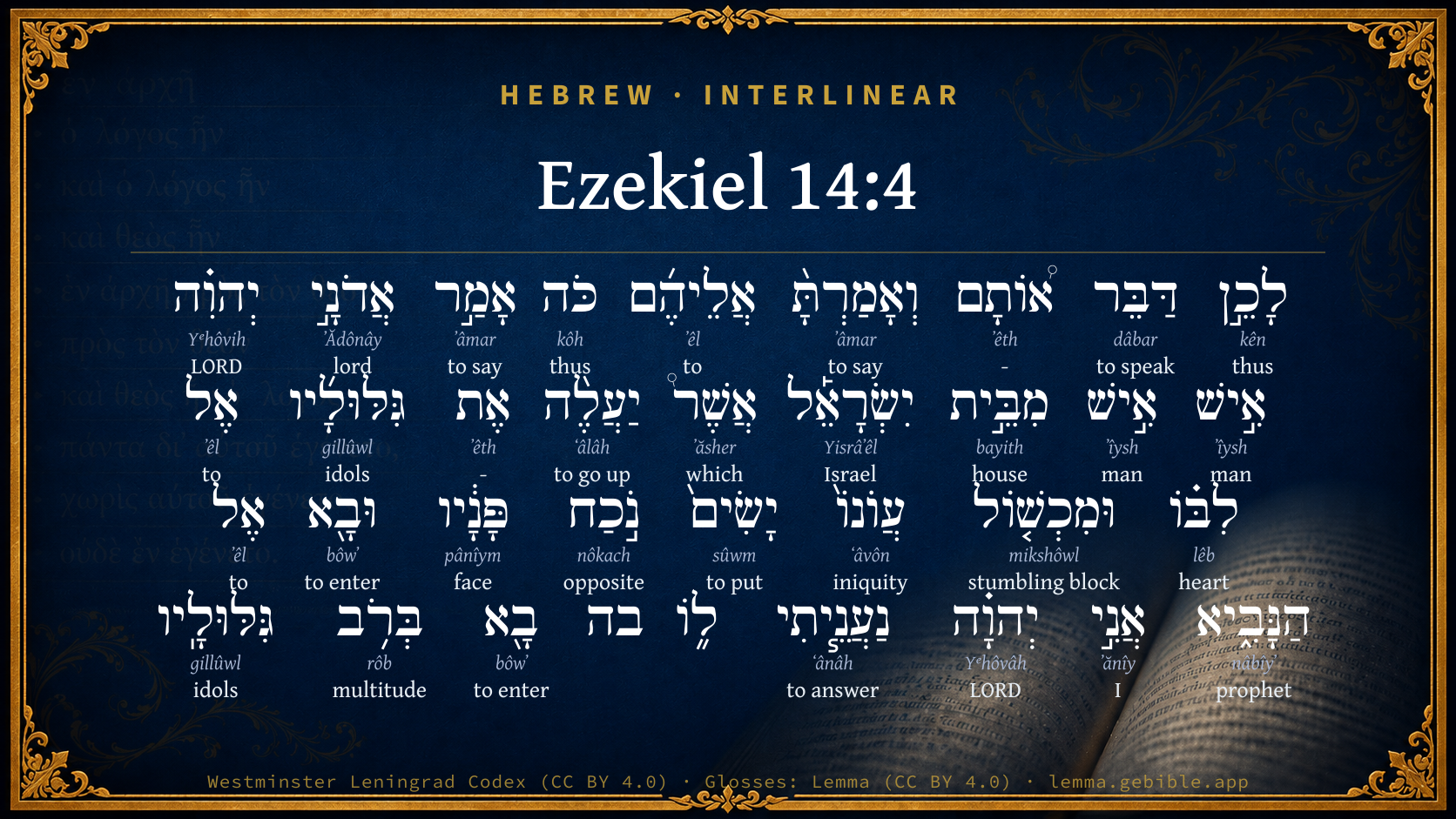
Hebrew (Westminster Leningrad Codex) Ezekiel 14:4 appears in the Hebrew Old Testament. The text above is from the Westminster Leningrad Codex. Each word links to its Strong’s number, a concise gloss, and parsing drawn from the Open Scriptures Hebrew Bible morphology. Click any word for its full Brown-Driver-Briggs (BDB) entry.
Download image
Cite this verse

Ezekiel 14:4 (World English Bible). Public Domain. Lemma interlinear Bible study tool, https://lemma.gebible.app/v/ezekiel/14/4.

Show BibTeX & RIS
BibTeX
RIS
English Translation
Therefore speak to them, and tell them, Thus says the Lord Yahweh: Every man of the house of Israel who takes his idols into his heart, and puts the stumbling block of his iniquity before his face, and comes to the prophet; I Yahweh will answer him therein according to the multitude of his idols;
World English Bible · Public Domain
Download a study sheet

One document with this verse’s original text, its word-by-word gloss line, the meaning frame, cross-references with their text, attributed commentary, and full source and license credits — printable, and it pastes into notes with its structure intact.

This verse Autodidact and up

Study sheet (.html) Plain text (.txt)

A passage Seminary Student

Up to 50 verses in one chapter. A passage sheet keeps up to 6 commentary sources and 12 cross-references per verse, in the order this page ranks them, and says so on the sheet whenever that leaves anything out. Ask for a single verse and you get the Autodidact verse sheet above.

Everything on this page stays free to read, with no account — the sheet is a download of what is already on screen, not access to it.

Want to remove ads? Support Godless Engineer
Compare translations 3

The same verse in 3 English versions, stacked beneath the original-language interlinear above. Click any original word for its lexicon entry.

Each is an independent rendering of the whole verse — the interlinear is not word-aligned to these translations.

Highlighted words mark where these versions differ — a whole-verse word diff, not a word-by-word alignment.

  • World English Bible Public Domain
    Therefore speak to them, and tell them, Thus says the Lord Yahweh: Every man of the house of Israel who takes his idols into his heart, and puts the stumbling block of his iniquity before his face, and comes to the prophet; I Yahweh will answer him therein according to the multitude of his idols;
  • King James Version Public Domain
    Therefore speak unto them, and say unto them, Thus saith the Lord GOD; Every man of the house of Israel that setteth up his idols in his heart, and putteth the stumblingblock of his iniquity before his face, and cometh to the prophet; I the LORD will answer him that cometh according to the multitude of his idols;
  • unfoldingWord Literal Text CC BY-SA 4.0
    Therefore announce this to them and say to them, ‘The Lord Yahweh says this: Every man of the house of Israel who takes his idols into his heart, or who puts the stumbling block of his iniquity before his face, and who then comes to a prophet—I, Yahweh, will answer him according to the number of his idols.

unfoldingWord Literal Text — © unfoldingWord, licensed CC BY-SA 4.0. Word-aligned USFM3 via Door43 (git.door43.org/unfoldingWord/en_ult).

Versions to compare (up to 4)

3 of 4 selected

Show all 18 translations

Every available English version of this verse, each an independent rendering of the whole verse.

  • World English Bible Public Domain
    Therefore speak to them, and tell them, Thus says the Lord Yahweh: Every man of the house of Israel who takes his idols into his heart, and puts the stumbling block of his iniquity before his face, and comes to the prophet; I Yahweh will answer him therein according to the multitude of his idols;
  • Berean Standard Bible Public Domain
    Therefore speak to them and tell them that this is what the Lord GOD says: ‘When any Israelite sets up idols in his heart and puts a wicked stumbling block before his face, and then comes to the prophet, I the LORD will answer him according to his great idolatry,
  • Majority Standard Bible Public Domain
    Therefore speak to them and tell them that this is what the Lord GOD says: ‘When any Israelite sets up idols in his heart and puts a wicked stumbling block before his face, and then comes to the prophet, I the LORD will answer him according to his great idolatry,
  • King James Version Public Domain
    Therefore speak unto them, and say unto them, Thus saith the Lord GOD; Every man of the house of Israel that setteth up his idols in his heart, and putteth the stumblingblock of his iniquity before his face, and cometh to the prophet; I the LORD will answer him that cometh according to the multitude of his idols;
  • American Standard Version (1901) Public Domain
    Therefore speak unto them, and say unto them, Thus saith the Lord Jehovah: Every man of the house of Israel that taketh his idols into his heart, and putteth the stumblingblock of his iniquity before his face, and cometh to the prophet; I Jehovah will answer him therein according to the multitude of his idols;
  • Revised Version (1885) Public Domain
    Therefore speak unto them, and say unto them, Thus saith the Lord GOD: Every man of the house of Israel that taketh his idols into his heart, and putteth the stumblingblock of his iniquity before his face, and cometh to the prophet; I the LORD will answer him therein according to the multitude of his idols;
  • Geneva Bible (1599) Public Domain
    Therefore speake vnto them, and say vnto them, Thus saith the Lord God, Euery man of the house of Israel that setteth vp his idols in his heart, and putteth the stumbling blocke of his iniquitie before his face, and commeth to the Prophet, I the Lord will answere him that commeth, according to the multitude of his idoles:
  • Douay-Rheims (1899) Public Domain
    Therefore speak to them, and say to them: Thus saith the Lord God: Man, man of the house of Israel that shall place his uncleannesses in his heart, and set up the stumblingblock of his iniquity before his face, and shall come to the prophet inquiring of me by him: I the Lord will answer him according to the multitude of his uncleannesses:
  • Young's Literal Translation Public Domain
    `Therefore, speak with them, and thou hast said unto them: Thus said the Lord Jehovah: Every one of the house of Israel who causeth his idols to go up unto his heart, and the stumbling-block of his iniquity setteth over-against his face, and hath gone in unto the prophet -- I Jehovah have given an answer to him for this, for the abundance of his idols,
  • Literal Standard Version CC BY-SA 4.0
    Therefore, speak with them, and you have said to them, Thus said Lord YHWH: Everyone of the house of Israel who causes his idols to go up to his heart, and sets the stumbling-block of his iniquity before his face, and has gone to the prophet—I, YHWH, have given an answer to him for this, for the abundance of his idols,
  • Unlocked Literal Bible CC BY-SA 4.0
    Therefore announce this to them and say to them, 'The Lord Yahweh says this: Every man of the house of Israel who takes his idols into his heart, or who puts the stumbling block of his iniquity before his face, and who then comes to a prophet—I, Yahweh, will answer him according to the number of his idols.
  • unfoldingWord Literal Text CC BY-SA 4.0
    Therefore announce this to them and say to them, ‘The Lord Yahweh says this: Every man of the house of Israel who takes his idols into his heart, or who puts the stumbling block of his iniquity before his face, and who then comes to a prophet—I, Yahweh, will answer him according to the number of his idols.
  • Darby Bible Public Domain
    Therefore speak to them, and say unto them, Thus saith the Lord Jehovah: Every man of the house of Israel that setteth up his idols in his heart, and putteth the stumbling-block of his iniquity before his face, and cometh to the prophet, I Jehovah will answer him according to this, according to the multitude of his idols:
  • World Messianic Bible Public Domain
    Therefore speak to them and tell them, ‘The Lord GOD says: “Every man of the house of Israel who takes his idols into his heart and puts the stumbling block of his iniquity before his face then comes to the prophet, I the LORD will answer him there according to the multitude of his idols,
  • Webster's Bible Public Domain
    Therefore speak to them, and say to them, Thus saith the Lord GOD; Every man of the house of Israel that setteth up his idols in his heart, and putteth the stumbling-block of his iniquity before his face, and cometh to the prophet; I the LORD will answer him that cometh according to the multitude of his idols;
  • Free Bible Version CC BY-SA 4.0
    So tell them that this is what the Lord God says: When the people of Israel worship idols in their minds that will lead them to sin, and then come to consult the prophet, I the Lord will give them an answer appropriate to their many idols.
  • Bible in Basic English Public Domain
    For this cause say to them, These are the words of the Lord: Every man of Israel who has taken his false god into his heart, and put before his face the sin which is the cause of his fall, and comes to the prophet; I the Lord will give him an answer by myself in agreement with the number of his false gods;
  • JPS Tanakh (1917) Public Domain
    Therefore speak unto them, and say unto them: Thus saith the Lord GOD: Every man of the house of Israel that setteth up his idols in his mind, and putteth the stumblingblock of his iniquity before his face, and cometh to the prophet — I the LORD will answer him that cometh according to the multitude of his idols;

Literal Standard Version (2020), Covenant Press — licensed CC BY-SA 4.0. Text via the HelloAO Bible API (eBible.org). Unlocked Literal Bible (unfoldingWord) — licensed CC BY-SA 4.0. Text via the HelloAO Bible API (eBible.org). unfoldingWord Literal Text — © unfoldingWord, licensed CC BY-SA 4.0. Word-aligned USFM3 via Door43 (git.door43.org/unfoldingWord/en_ult). Free Bible Version, Dr. Jonathan Gallagher — licensed CC BY-SA 4.0. Text via the HelloAO Bible API (eBible.org).

Word by word

More ways to search: Search by grammar → Find every occurrence → Compare this word →

Practice this passage: Drill this verse → Learn its vocabulary →

וּמִכְשׁ֤וֹל
mikshôwl
H4383
“and · stumbling block of”
Conjunction + Noun, Common, Masculine, Singular, Construct
Part of Speech
Conjunction + Noun
Type
Common
Gender
Masculine
Number
Singular
State
Construct
Full BDB Definition

Origin: from H3782

TWOT: 1050c

a stumbling, means or occasion of stumbling, stumbling block - stumbling, fall - means or occasion of stumbling, stumbling block
  1. לָכֵ֣ן kên H3651 “to/for · thus” Preposition + Adverb
  2. דַּבֵּר dâbar H1696 “speak” Verb, Piel, Imperative, 2nd Person, Masculine, Singular
  3. א֠וֹתָם ʼêth H853 “- · them” Particle, Direct Object + Suffix, Personal, 3rd Person, Masculine, Plural
  4. וְאָמַרְתָּ֨ ʼâmar H559 “and · to say” Conjunction + Verb, Qal, Sequential Perfect, 2nd Person, Masculine, Singular
  5. אֲלֵיהֶ֜ם ʼêl H413 “to · them” Preposition + Suffix, Personal, 3rd Person, Masculine, Plural
  6. כֹּה kôh H3541 “thus” Adverb
  7. אָמַ֣ר ʼâmar H559 “to say” Verb, Qal, Perfect, 3rd Person, Masculine, Singular
  8. אֲדֹנָ֣י ʼĂdônây H136 “Lord · my” Noun, Common, Masculine, Plural, Construct + Suffix, Personal, 1st Person, Common, Singular
  9. יְהוִ֗ה Yᵉhôvih H3069 “LORD” Noun, Proper
  10. אִ֣ישׁ ʼîysh H376 “man” Noun, Common, Masculine, Singular, Absolute
  11. אִ֣ישׁ ʼîysh H376 “man” Noun, Common, Masculine, Singular, Absolute
  12. מִבֵּ֣ית bayith H1004 “from · house of” Preposition + Noun, Common, Masculine, Singular, Construct
  13. יִשְׂרָאֵ֡ל Yisrâʼêl H3478 “Israel” Noun, Proper
  14. אֲשֶׁר֩ ʼăsher H834 “which” Particle, Relative
  15. יַעֲלֶ֨ה ʻâlâh H5927 “to go up” Verb, Hiphil, Imperfect, 3rd Person, Masculine, Singular
  16. אֶת ʼêth H853 “-” Particle, Direct Object
  17. גִּלּוּלָ֜יו gillûwl H1544 “idols · his” Noun, Common, Masculine, Plural, Construct + Suffix, Personal, 3rd Person, Masculine, Singular
  18. אֶל ʼêl H413 “to” Preposition
  19. לִבּ֗וֹ lêb H3820 “heart · his” Noun, Common, Masculine, Singular, Construct + Suffix, Personal, 3rd Person, Masculine, Singular
  20. עֲוֺנוֹ֙ ʻâvôn H5771 “iniquity · his” Noun, Common, Both, Singular, Construct + Suffix, Personal, 3rd Person, Masculine, Singular
  21. יָשִׂים֙ sûwm H7760 “to put” Verb, Qal, Imperfect, 3rd Person, Masculine, Singular
  22. נֹ֣כַח nôkach H5227 “opposite” Preposition
  23. פָּנָ֔יו pânîym H6440 “face(s) · his” Noun, Common, Both, Plural, Construct + Suffix, Personal, 3rd Person, Masculine, Singular
  24. וּבָ֖א bôwʼ H935 “and · to enter” Conjunction + Verb, Qal, Sequential Perfect, 3rd Person, Masculine, Singular
  25. אֶל ʼêl H413 “to” Preposition
  26. הַנָּבִ֑יא nâbîyʼ H5030 “the · prophet” Particle, Definite Article + Noun, Common, Masculine, Singular, Absolute
  27. אֲנִ֣י ʼănîy H589 “I” Pronoun, Personal, 1st Person, Common, Singular
  28. יְהוָ֗ה Yᵉhôvâh H3068 “LORD” Noun, Proper
  29. נַעֲנֵ֧יתִי ʻânâh H6030 “to answer” Verb, Niphal, Perfect, 1st Person, Common, Singular
  30. בָ֖א bôwʼ H935 “to enter” Verb, Qal, Perfect, 3rd Person, Masculine, Singular
  31. בְּרֹ֥ב rôb H7230 “in/at · multitude of” Preposition + Noun, Common, Both, Singular, Construct
  32. גִּלּוּלָֽיו gillûwl H1544 “idols · his” Noun, Common, Masculine, Plural, Construct + Suffix, Personal, 3rd Person, Masculine, Singular

About this verse

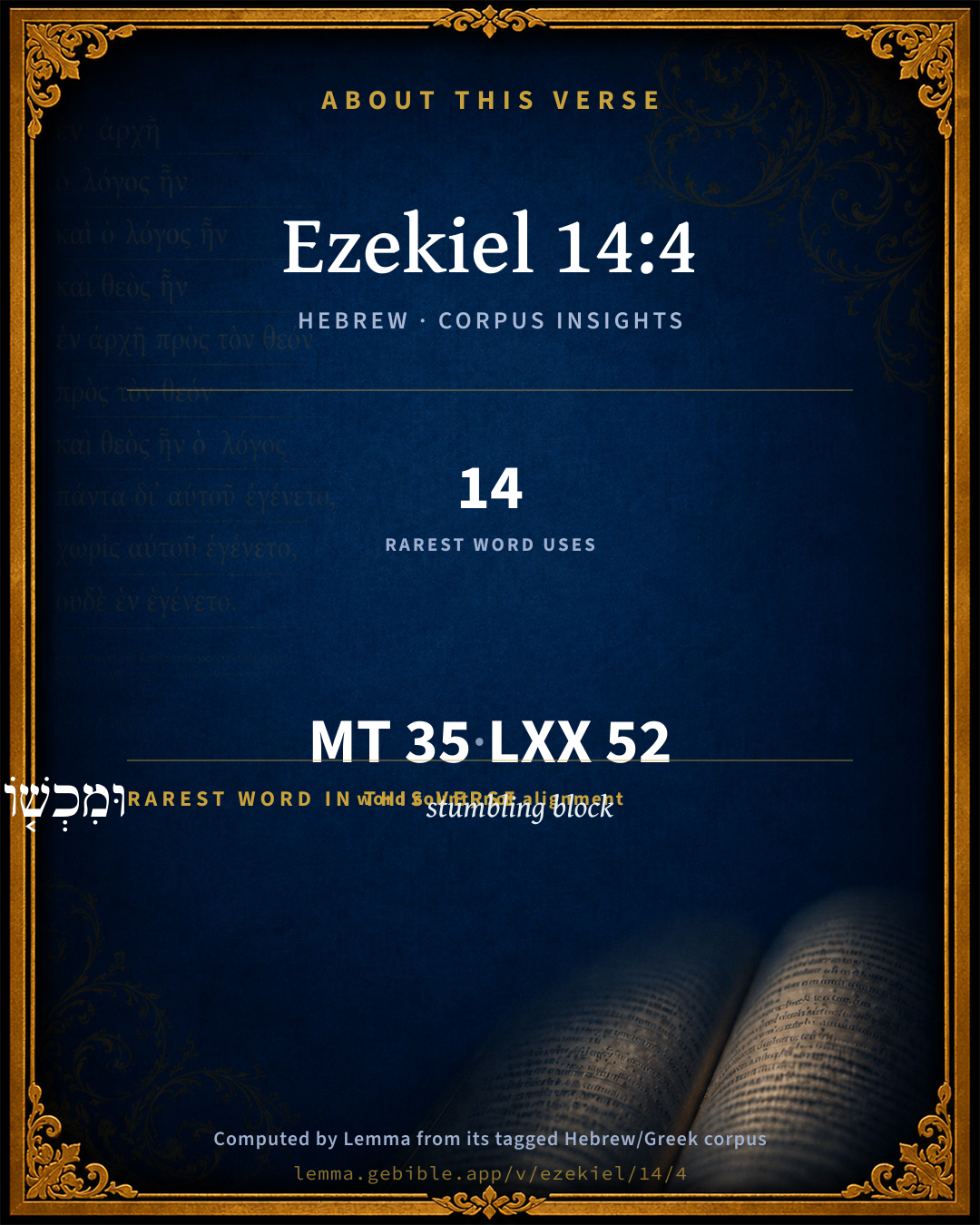
These counts appear in no published source. They are computed here, from the morphology-tagged text and Lemma’s own curated glosses. What Lemma adds →

35
words
26
distinct lemmas
Prophets
section

Notable vocabulary

The rarest word here is וּמִכְשׁ֤וֹל stumbling block H4383 — appearing just 14 times in the whole Hebrew Bible.

Shared distinctive vocabulary

וּמִכְשׁ֤וֹל stumbling block H4383 occurs in 14 verses of the Hebrew Bible. Also found in:

Grammatical profile

  • 8 verbs
  • 15 nouns
  • 1 pronoun
  • 6 prepositions
  • 2 adverbs
  • 3 particles

Verb forms

  • דַּבֵּר Piel · Imperative
  • וְאָמַרְתָּ֨ Qal · Sequential Perfect
  • אָמַ֣ר Qal · Perfect
  • יַעֲלֶ֨ה Hiphil · Imperfect
  • יָשִׂים֙ Qal · Imperfect
  • וּבָ֖א Qal · Sequential Perfect
  • נַעֲנֵ֧יתִי Niphal · Perfect
  • בָ֖א Qal · Perfect

Repetition

Words recur within this verse — often emphatic in Hebrew:

  • וְאָמַרְתָּ֨ to say H559 ×2
  • אִ֣ישׁ man H376 ×2
  • גִּלּוּלָ֜יו idols H1544 ×2
  • וּבָ֖א to enter H935 ×2
  • אֲלֵיהֶ֜ם to H413 ×3

Hebrew & Septuagint length

In English translation the verse runs 55 words from the Hebrew and 62 from the Septuagint (LXX English) — closely comparable.

A rough comparison of the two English renderings, which tokenize alike — not a word-level alignment.

Word counts can differ between the Hebrew and the Greek without any difference in meaning — e.g. the Hebrew direct-object marker אֵת has no separate Greek word, and Greek often adds the article ὁ.

In the original languages it is 35 Hebrew tokens and 52 Greek tokens — but the two are counted differently (Hebrew bundles its prefixes and suffixes into one token; the Greek is in lemma form), so that isn’t a like-for-like length.

Cross-references

8

Topical passages linked to Ezekiel 14:4 in the Treasury of Scripture Knowledge — connected by theme and wording, ordered by reader-vote popularity; previews shown in the World English Bible.

  • Isaiah 66:4 I also will choose their delusions, and will bring their fears on them; because when I called, none did answer; when I spoke, they did not hear: but they did that which was evil in my eyes, and chose that in which I didn't delight.
  • Ezekiel 14:7 For everyone of the house of Israel, or of the strangers who sojourn in Israel, who separates himself from me, and takes his idols into his heart, and puts the stumbling block of his iniquity before his face, and comes to the prophet to inquire for himself of me; I Yahweh will answer him by myself:
  • Isaiah 3:11 Woe to the wicked! Disaster is upon them; For the deeds of his hands will be paid back to him.
  • Ezekiel 3:17–21 Son of man, I have made you a watchman to the house of Israel: therefore hear the word at my mouth, and give them warning from me.
  • 1 Kings 21:20–25 Ahab said to Elijah, Have you found me, my enemy? He answered, I have found you, because you have sold yourself to do that which is evil in the sight of Yahweh.
  • 2 Kings 1:16 He said to him, Thus says Yahweh, Because you have sent messengers to inquire of Baal Zebub, the god of Ekron, is it because there is no God in Israel to inquire of his word? therefore you shall not come down from the bed where you are gone up, but shall surely die.
  • Ezekiel 2:7 You shall speak my words to them, whether they will hear, or whether they will forbear; for they are most rebellious.
  • Ezekiel 3:4 He said to me, Son of man, go, get you to the house of Israel, and speak with my words to them.

Cross-references courtesy of OpenBible.info (CC BY 4.0).

Hebrew and Greek witnesses Masoretic Hebrew ↔ Greek Septuagint

The same verse in the two great witnesses to the Old Testament, shown verse-for-verse.

These are two independent witnesses, not word-aligned to each other, and the Septuagint is shown in lemma (dictionary) form.

Hebrew Ezekiel 14:4 Masoretic · Westminster Leningrad Codex

לָכֵ֣ן דַּבֵּר א֠וֹתָם וְאָמַרְתָּ֨ אֲלֵיהֶ֜ם כֹּה אָמַ֣ר אֲדֹנָ֣י יְהוִ֗ה אִ֣ישׁ אִ֣ישׁ מִבֵּ֣ית יִשְׂרָאֵ֡ל אֲשֶׁר֩ יַעֲלֶ֨ה אֶת גִּלּוּלָ֜יו אֶל לִבּ֗וֹ וּמִכְשׁ֤וֹל עֲוֺנוֹ֙ יָשִׂים֙ נֹ֣כַח פָּנָ֔יו וּבָ֖א אֶל הַנָּבִ֑יא אֲנִ֣י יְהוָ֗ה נַעֲנֵ֧יתִי ל֦וֹ בה בָ֖א בְּרֹ֥ב גִּלּוּלָֽיו

Therefore speak to them, and tell them, Thus says the Lord Yahweh: Every man of the house of Israel who takes his idols into his heart, and puts the stumbling block of his iniquity before his face, and comes to the prophet; I Yahweh will answer him therein according to the multitude of his idols;

World English Bible · Public Domain

Greek LXX Ezekiel 14:4 Septuagint · lemma form

διά οὗτος λαλέω αὐτός καί εἶπον πρός αὐτός ὅδε λέγω κύριος ἄνθρωπος ἄνθρωπος ἐκ ὁ οἶκος ἰσραήλ ὅς ἄν τίθημι ὁ διανόημα αὐτός ἐπί ὁ καρδία αὐτός καί ὁ κόλασις ὁ ἀδικία αὐτός τάσσω πρό πρόσωπον αὐτός καί ἔρχομαι πρός ὁ προφήτης ἐγώ κύριος ἀποκρίνω αὐτός ἐν ὅς ἐνἔχω ὁ διάνοια αὐτός

Therefore speak to them, and you shall say to them, Thus says the Lord; Any man of the house of Israel, who shall conceive his devices in his heart, and shall set the punishment of his iniquity before his face, and shall come to the prophet; I the Lord will answer him according to the things in which his mind is entangled,

LXX2012 (modern English Septuagint) · Public Domain

Hebrew: Westminster Leningrad Codex (CC BY 4.0). Greek: Septuagint (public domain); English from LXX2012 (modern English Septuagint) (Public Domain). How the Septuagint differs from the Hebrew →

Targum (Aramaic paraphrase)

1

The Targum is the ancient Jewish Aramaic paraphrase of the Hebrew Scriptures — an interpretive translation, not the Hebrew text itself. Onkelos (literal) and Pseudo-Jonathan (expansive) render the Torah, and Jonathan the Prophets. Coverage is partial: where no permissively-licensed English translation exists for a verse, only the Aramaic is shown. This is verse-level text, not a word-by-word alignment to the Hebrew.

  1. Targum Jonathan Prophets (Joshua–Malachi)
    בְּכֵן אִתְנַבֵּי לְהוֹן וְתֵימַר לְהוֹן כִּדְנַן אֲמַר יְיָ אֱלֹהִים גְבַר גְבַר מִבֵּית יִשְׂרָאֵל דִי יַסֵיק פּוּלְחַן טַעֲוְתֵיהּ עַל לִבֵּיהּ וְתַקְלַת חוֹבֵיהּ יְשַׁוֵי לָקֳבֵיל אַפּוֹהִי וְיֵיתֵי לְוַת נְבִיָא אֲנָא יְיָ מִשְׁתְּאֵיל לֵיהּ בְּמֵימְרִי דְאָתֵי לְמִתְבַּע אוּלְפַן מַן קֳדָמַי אַף עַל גַב דְמִתְעָרֵב בִּסְגִי פּוּלְחַן טַעֲוָתֵיהּ:

    (no public-domain English translation for this verse)

    Targum Jonathan — Aramaic: “Mikraot Gedolot” (public domain). English: “Sefaria Community Translation” (CC0 1.0 (public-domain dedication)); “London "Chaldee Paraphrase," 1871” (public domain). Text via Sefaria.

Commentary

Notes on Ezekiel 14:4 from classic Christian and Jewish commentators (each source and its license shown beneath its notes). The classic Christian expositions comment on the surrounding passage and are grouped to its opening verse, so a note may address several verses; the Jewish commentaries on the Tanakh (Rashi and others) are per-verse, so they appear only where the commentator wrote on this verse.

Lemma curates 59 commentaries, every one of them public domain or Creative Commons licensed, each selected and text-cleaned for this edition rather than reprinted as found. About our sources →

Trapp's Complete Commentary

John Trapp

Eze 14:4 Therefore speak unto them, and say unto them, Thus saith the Lord GOD; Every man of the house of Israel that setteth up his idols in his heart, and putteth the stumblingblock of his iniquity before his face, and cometh to the prophet; I the LORD will answer him that cometh according to the multitude of his idols;

Ver. 4. I the Lord will answer him.] Or, As I am the Lord (oath wise), I will answer him, but with bitter answers

According to the multitude of his idols,] i.e., As by his abominations he hath well deserved; or, concerning the multitude of his idols; that is a sin he shall be sure to hear of, and to suffer for.

John Trapp, A Commentary or Exposition upon All the Books of the Old and New Testament (1647–1656) — public domain. Text from a community e-Sword module.

The Biblical Illustrator

Joseph S. Exell

Eze_14:4

I the Lord will answer him that cometh according to the multitude of his idols.

Answered according to their idols

With them, as froward, the All-seeing will, in the psalmists terribly bold phrase, show Himself froward; they will incur that penalty which Scripture describes as a blinding of their eyes and a hardening of their heart, and which essentially consists in their being left to themselves without the light which they do not sincerely seek for--left, in fact, to take their own way, and see what will come of it. This line of Biblical language has caused difficulties which cannot be passed over; the more so, because one passage in which it is found (Isa_6:10) is of all passages in the Old Testament the one most frequently cited in the New Testament; and St. John, with a startling distinctness, attributes the blinding and hardening to the Lord. The explanation must be found in that law of ethical life whereby persistency in self-will--the process, as Shakespeare, in an awfully vivid passage, calls it, of growing hard in viciousness--does inevitably produce moral insensibility. All serious moralists, whatever be their theological standpoint, will admit this to be a fact; and all who believe in a God will see in it a revelation of His character, so that when it works He is, in fact, allowing it to take its course. And it is the method of Scripture writers to impress the fact on mens minds with a concrete vividness, by representing such action on Gods part as a literal penal infliction. There, anyhow, stands the fact, and we have to reckon with it. Let us also fear, and be on our guard, lest, for lack of the single-eyed purpose which our Lord insists upon in His great sermon, we too should be left in the great darkness which waits like a shadow on hardness of heart. (Canon Bright.)

The blight of the idol

A mans vision determines what kind of revelation he will accept. It will guide him in the choice of his prophet: Son of man, these men have set up their idols in their heart, and put the stumbling block of their iniquity before their face: should I be inquired of at all by them? (Eze_14:3). When an inquirer comes with his idol in his heart, he is not an inquirer, but a claimant; he has brought with him the only answer which he is prepared to entertain: he falls over the stumbling block of his iniquity, and misses the light of the bright and morning star. How that according to reverberates through the prophets messages! Here it declares that every idol carries with it a lie that will be believed for truth. There is an atmosphere in which the true prophet cannot draw his breath and speak distinctly; the false prophet can and that is the disaster. Mischief shall come upon mischief, and rumour shall be upon rumour; then shall they seek a vision of the prophet; but the law shall perish from the priest, and counsel from the ancients (Eze_7:26). when idols flourish, ideals perish. (H. E. Lewis.)

The Biblical Illustrator, edited by Joseph S. Exell (c. 1880s–1900s) — public domain. Text from a community e-Sword module.

Joseph Benson's Commentary

Eze 14:4-5. Say unto them — Declare my will clearly and faithfully; Every man of the house of Israel — Whoever he be, rich or poor, mighty or mean; that setteth up his idols in his heart — That is attached in his heart to any species of idolatry; and cometh to the prophet — As if he were desirous to know what is best to be done, that he might do it; or what is the will of God, that he might comply with it: and what will be the issue of these times and affairs; I the Lord will answer him that cometh — And that in a way but little to his satisfaction; according to the multitude of his idols — According to his real iniquity, not according to his pretended piety: I will declare the greatness of his sin by the greatness of his punishment; he has multiplied his idols, and I will multiply his sorrows. That I may take the house of Israel in their own heart — That I may lay open what is in their hearts, and discover their hypocrisy and impiety; or, that I may reprove and convince them, from their own words and behaviour, what a base part they act, and that their inward and secret wickedness is perfectly known to me. Because they are estranged from me through their idols — It is always through some idol or other that the hearts of men are estranged from God. Some creature has gained that place in the heart which belongs to none but God.

Joseph Benson's Commentary on the Old and New Testaments (1811–1818) — public domain. Text from a community e-Sword module.

Tyndale Open Study Notes

Tyndale Open Resources

14:4-5 Though the exiles were going through the motions of seeking the Lord, their hearts had turned from the Lord to worship their detestable idols. It was tempting for the exiles to think that the Babylonians’ many military successes demonstrated that true power lay with the Babylonian gods rather than with the Lord.

Tyndale Open Study Notes — © Tyndale Open Resources, licensed CC BY-SA 4.0. Text via the HelloAO Bible API.

Geneva Bible (1599)

Geneva Bible translators

To inquire of things which the Lord hath appointed to come to pass.

As his abomination hath deserved: that is, he shall be led with lies according as he delighted therein, 2 Thess. 2:10.

Geneva Bible (1599) marginal notes — public domain. Text via Bolls.life.

Jamieson, Fausset & Brown

Robert Jamieson, A. R. Fausset & David Brown

and cometh--and yet cometh, reigning himself to be a true worshipper of Jehovah.

him that cometh--so the Hebrew Margin reads. But the Hebrew text reading is, "according to it, according to the multitude of his idols"; the anticipative clause with the pronoun not being pleonastic, but increasing the emphasis of the following clause with the noun. "I will answer," literally, reflexively, "I will Myself (or for Myself) answer him."

according to . . . idols--thus, "answering a fool according to his folly"; making the sinner's sin his punishment; retributive justice (Pro 1:31; Pro 26:5).

Jamieson, Fausset & Brown — Commentary Critical and Explanatory on the Whole Bible (1871) — public domain (CC PDM 1.0). Text via the HelloAO Bible API.

Adam Clarke's Commentary

Verse 4. According to the multitude of his idols] I will treat him as an idolater, as a flagrant idolater.

Adam Clarke's Commentary on the Bible (1810–1826) — public domain. Text from a community e-Sword/MySword module.

John Calvin's Commentaries

Here God seems to treat those hypocrites too indulgently who pretend to ask his advice and yet despise his counsel. But God here rather threatens what would be destructive to the wicked than promises anything which they ought to expect. It is indeed a singular testimony of God’s grace when he answers us: for prophecy is an image of God’s paternal anxiety towards us and our salvation. But sometimes prophecy only ends in destruction; and this is but an accident. Although, therefore, God’s word by itself is naturally to be greatly desired, yet when God answers as a judge, and takes away all hope of pardon and pity, no taste of his favor can then be perceived. Thus this passage must be understood. God pronounces that he would answer, but whom? The reprobate, and those who tauntingly inquired of the Prophet what they should do. When he answers them, he only shows himself the avenger of their perfidy; and thus his answer contains nothing else but the fearful judgment which hangs over all the reprobate. For God does not here impose a perpetual law on himself; for he does not always act in the same way towards all the reprobate, but says that those impious ones should feel that they shall not profit by their cunning and artifices, since they shall find the difference between God and Satan: for they were accustomed to lies, and had itching ears; hence they wished to have some pleasing and flattering answer from the servant of God, since the false prophets gratified their inclinations. What then does God say? I will answer them, but far otherwise than they either wish or desire: for I will answer them according to the multitude of their idols: for they bring with them the material for their own condemnation: hence they shall take back nothing from me but the seal of that condemnation which is already placed upon their hearts, and appears on their hands. In fine, God here laughs at the foolish confidence of those who inquire about future events of his prophets; but meanwhile they have their heart bound up with superstitions, so as openly to show their gross impiety: hence he says, that he would answer them, not as they thought, but as they deserved.

John Calvin's Commentaries (1540-1563) — public domain. Text from the Calvin Translation Society English edition (1840s-50s) via the Christian Classics Ethereal Library (ccel.org). Calvin's coverage is partial (roughly two-thirds of the Bible); uncommented books and verses are honest gaps, never fabricated. The 19th-century editor's footnotes and remarks are omitted so the notes are faithfully Calvin's own voice.

Ellicott's Commentary for English Readers

(4) Will answer him that cometh.—The words that cometh, not being in the original, should be omitted. The verb answer in the original is in the passive, and has a reflexive sense=“I will show myself answering,” a softer form than the English. The principle that when man persists in going counter to God’s known will He will allow him to misunderstand that will, is abundantly established by such instances as that of Balaam (Num_22:20) and of Micaiah (1Ki_22:15). No man can hope to know what God would have him to do unless his own heart is truly submissive to the Divine will. The threat here is, that the man coming to inquire of God with a heart full of idolatry, shall receive no true answer from that Omniscience which he does not respect; but will rather find himself deceived by the illusions of his own heart. This idea is more fully developed in the following verse. (Comp. Isa_44:20.)

A Bible Commentary for English Readers, edited by Charles John Ellicott (1878–1897) — public domain. Text from a community e-Sword module.

The Cambridge Bible for Schools and Colleges

gen. ed. J. J. S. Perowne

4. The Lord will answer such men directly through himself, by involving them in the consequences of their own idolatries and destroying them.

setteth up his idols] Cf. Eze_14:3.

will answer him that cometh] If this reading be adopted, the rendering must be, I the Lord will answer him; he cometh in the multitude—a meaning which has no probability. The present text reads, I will answer him according to it, (i.e. the iniquity, or the stumbling-block) (even) according to the multitude, &c. In Eze_14:7, where the same expression occurs, the reading is, “I will answer him by myself;” and the present passage had better be assimilated to Eze_14:7. What is meant by the Lord’s answering “through himself” is stated Eze_14:8, “I will set my face against that man.” The answer will be given in acts of judgment.

according to the multitude] The divine chastisement will be heavy, proportionate to the gross idolatry.

The Cambridge Bible for Schools and Colleges (gen. ed. J. J. S. Perowne; Cambridge University Press, 1878–1918) — public domain. Text from a community e-Sword module.

John Gill's Exposition

Therefore speak unto them, and say unto them,.... That is, speak unto them as a prophet, and as from the Lord, and say what follows; so the Targum,

"prophesy unto them and say unto them;''

thus saith the Lord God, every man of the house of Israel, that setteth up his idols in his heart, and putteth the stumbling block of his iniquity before his face; let him be who he will, one in public office, an elder of Israel, or a private person; no respect will be had, no distinction made, nor favour shown; being an idolater in heart and practice, secretly and openly, he shall bear the punishment of his sin:

and cometh to the prophet: the Prophet Ezekiel, as the elders of Israel now did, or any other prophet of the Lord: the Vulgate Latin version adds, "inquiring of me by him"; expecting to have an answer, and one according to their wishes:

I the Lord will answer him that cometh; that cometh to the prophet; or, as the Targum,

"that cometh to ask instruction of me:''

here is a various reading, a "Keri" and a "Cetib"; we follow the Keri, or marginal reading, "that cometh"; and so does the Targum; but the "Cetib", or written text, is "in it", thus; "I the Lord will answer him in it" (t); in the question he puts to the prophet, or to the Lord by him; or in that time, immediately; but not with smooth things, as he expects, but with terrible things in righteousness; not in a way of grace and mercy, but in a way of judgment; not as he desires, but as he deserves:

according to the multitude of his idols; in proportion to the number of his gods, and his idolatrous actions, shall the answer or punishment be: or these words may be connected with the word cometh, and be read thus, "that cometh with the multitude of his idols" (u); with his heart full of idols, set up there; which is an instance of his hypocrisy, seen and detected by the Lord; and of his impudence, in daring to come unto him in such a manner; and of his folly, to expect a gracious answer from the Lord, this being his case. The Targum understands it quite otherwise, as if the answer the Lord would give would be a kind and agreeable one, paraphrasing this clause thus,

"although he is mixed (implicated or entangled) in the multitude of the worship of his idols.''

(t) "Eodem (tempore)", Junius & Tremellius, Polanus; "in illo tempore", Piscator; "in ea re", Cocceius, Starckius. (u) "ipsi venienti in multitudine idolorum suorum", Pagninus, Montanus.

John Gill's Exposition of the Whole Bible (1746–1763) — public domain (CC PDM 1.0). Text via the HelloAO Bible API.

Albert Barnes' Notes on the Bible

Omit “that cometh.”

According to the multitiude of his idols - i. e., I will give him an answer as delusive as the idols which he serves. Compare Micaiah’s answer to Ahab 1Ki 22:15.

Albert Barnes' Notes on the Bible (1834–1885) — public domain. Text from a community e-Sword/MySword module.

Haydock's Catholic Bible Commentary

According. Hebrew, "in (Calmet) the multitude of his idols." (Haydock) --- I will still disclose the truth; (Chaldean) or a false prophet is here spoken of, whom God will suffer to deceive those who wish to be deluded. He will not have his own prophets speak an untruth. See 3 Kings xxii. 10. Christ evaded the insidious questions of his enemies, Matthew xxi. 23. (Calmet)

George Leo Haydock (1774–1849), Haydock's Catholic Family Bible and Commentary, 1859 edition — public domain. Excludes Psalms (Douay-Rheims chapter numbering differs from Protestant) and Deuterocanonical books (Catholic canon only).

Matthew Poole's English Annotations

Mince not the matter, lessen not, neither vary, what I say unto thee, but declare fully and undauntedly

unto them, though great men, and who will compliment with thee.

Every man, without exception, whoever be the man among the Israelites, that hath his heart riveted to idols, and yet comes to the prophet, as if it were to know what were best to be done, and what will be the issue of these times and things, I will answer him but little to his satisfaction or safety; such answer shall such receive, as in seeing they shall not see, &c. I will declare the greatness of their sin and punishment; they multiplied idols, this their sin, I will multiply their sorrows; they first run into darkness of idolatry, I will leave them to the darkness of misery. I will give answer, but in just judgment, and with severe reproofs, and menaces, and commands.

Matthew Poole's English Annotations on the Holy Bible (1683–1685) — public domain. Text from a community e-Sword/MySword module.

Whedon's Commentary on the Bible

Daniel D. Whedon

4. According to the multitude — The severity of the Lord’s answer will be proportionate to the heinousness of the transgression.

Daniel D. Whedon (gen. ed.), Commentary on the Old and New Testaments (1874–1909) — public domain. Text from a community e-Sword module.

The Pulpit Commentary

I will answer him that cometh, etc. The two last words represent the K"ri, or marginal reading of the Hebrew; the "therein" of the Revised Version, the Kh"-tib, or written text. Probably we should read, as in ver. 7, "I will answer him by myself" (Hitzig).

The Pulpit Commentary (1880–1919), ed. H.D.M. Spence-Jones & Joseph S. Exell — public domain. Text from a community e-Sword module.

John Wesley's Explanatory Notes

According - According to his desert, I will give answer, but in just judgment.

John Wesley, Explanatory Notes Upon the Whole Bible (1754–1765) — public domain. Text via the GEBible commentary corpus.

unfoldingWord translationNotes

Door43 World Missions Community

Therefore announce this to them

The word "them" refers to the "men from the elders of Israel."

the house of Israel

The word "house" is a metonym for the family that lives in the house, in this case the Israelites, the descendants of Jacob over many years. See how you translated this in Ezekiel 3:1. AT: "the Israelite people group" (See: Metonymy)

who takes his idols into his heart

Yahweh speaks of the people committing themselves to worshiping idols as if they had taken their idols into their hearts. See how you translated this metaphor in Ezekiel 14:3. AT: "who devotes himself to idols" (See: Metaphor)

who puts the stumbling block of his iniquity before his face

Yahweh speaks of the idols that people worship as if they were blocks over which the people stumble, and of being determined to worship those idols as if they had placed those stumbling blocks in front of their faces. See how you translated this metaphor in Ezekiel 14:3. AT: "who resolutely determines to worship the things that lead to iniquity" (See: Metaphor)

then comes to a prophet

A person goes to a prophet in order to inquire of the Lord. (See: Assumed Knowledge and Implicit Information)

I, Yahweh, will answer him according to the number of his idols

This phrase refers to the many idols that the people worship. It is implied that the severity of Yahweh's answer will as great as the number of idols that they worship. AT: "I, Yahweh, will give him the answer that he deserves because he worships so many idols" (See: Assumed Knowledge and Implicit Information)

I may take back the house of Israel in their hearts

Here the word "hearts" represents the minds and affections of the people. Yahweh speaks of causing them to be devoted to him once again as if he were to capture their hearts. AT: "I will cause the people of Israel to be devoted to me again" (See: Metonymy and Metaphor)

their hearts that have been driven far from me through their idols

Here the word "hearts" represents the minds and affections of the people. This can be stated in active form. AT: "who have all left me to worship their idols" (See: Metonymy and Active or Passive)

translationWords

Lord Yahweh

house

Israel

prophet

Yahweh

unfoldingWord translationNotes — © Distant Shores Media and the Door43 World Missions Community, licensed CC BY-SA 4.0. Source: git.door43.org/Door43/en_tn.

Rashi

Rabbi Shlomo Yitzchaki (Rashi)

shall respond to him Heb. נַעֲנֵיתִי, suys reponduz in Old French, I was answered, although he comes before me with his many idols. So did Jonathan render it.

Rashi on the Tanakh — English translations: “The Judaica Press complete Tanach with Rashi, translated by A. J. Rosenberg” (CC BY 4.0); “Pentateuch with Rashi's commentary by M. Rosenbaum and A.M. Silbermann, 1929-1934” (public domain); “The Metsudah Tanach series, Lakewood, N.J” (CC BY 4.0); and “The Book of Joshua, Metsudah Publications, 1997” (CC BY 4.0). Text via Sefaria.

Lesson kit

Teaching starters — assembled from the data on this page, not authored interpretation. Every prompt links to the verse data it draws on. Edit before teaching.

Ezekiel, in the Prophets, opens this verse with 35 words (26 distinct Hebrew lemmas). Its most distinctive word is mikshôwl (“stumbling block”). A historical commentator’s framing appears above. Read the whole chapter for the surrounding context.

Discussion questions

  1. The word mikshôwl carries the sense “stumbling block.” How does it shape the verse?
  2. Leviticus 19:14 shares the word «stumbling block» with this verse. How do the two illuminate each other?
  3. “to say” occurs 2× in this one verse. What is the effect of the repetition?
  4. These translations render this verse differently; the difference is in the English rendering, not the original. What questions does that raise?
  5. The verb «דַּבֵּר» is Piel Imperative. How does its form color the action?
  6. Reading how Trapp's Complete Commentary and The Biblical Illustrator read this verse, where do the two commentators agree and where do they part?

Things to notice

Reading settings

Reading text

Shown beneath each verse's original-language words.

Old Testament
Old Testament edition

Read the OT as the Masoretic Hebrew (MT) or the Greek Septuagint (LXX).

English shown for the Greek Septuagint (in the Hebrew ↔ Greek comparison).

Comparing translations? Open the Compare panel on any verse page to stack up to four side by side.