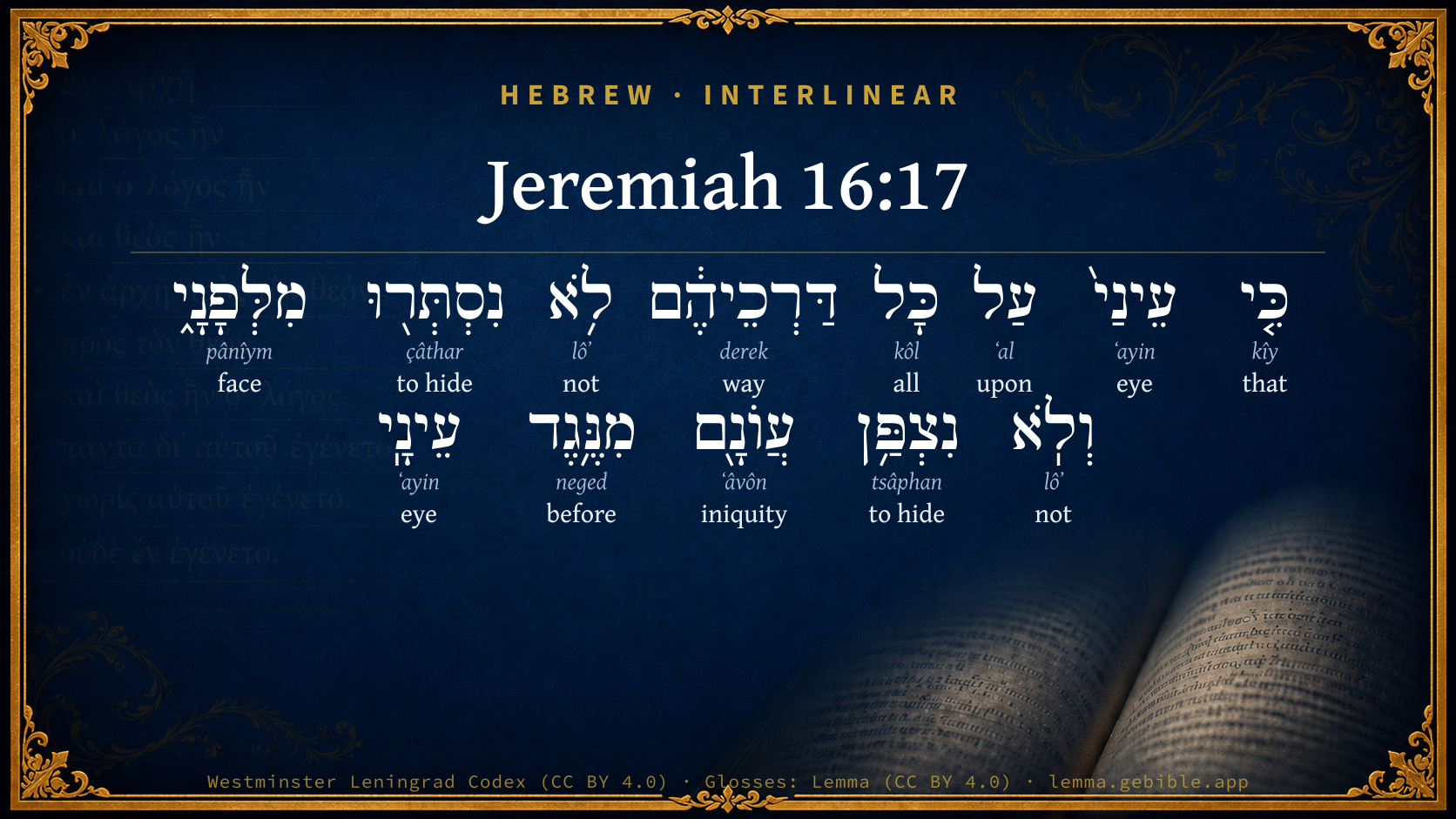
Jeremiah 16:17

Hebrew (Westminster Leningrad Codex) Jeremiah 16:17 appears in the Hebrew Old Testament. The text above is from the Westminster Leningrad Codex. Each word links to its Strong’s number, a concise gloss, and parsing drawn from the Open Scriptures Hebrew Bible morphology. Click any word for its full Brown-Driver-Briggs (BDB) entry.
Download image
Cite this verse

Jeremiah 16:17 (World English Bible). Public Domain. Lemma interlinear Bible study tool, https://lemma.gebible.app/v/jeremiah/16/17.

Show BibTeX & RIS
BibTeX
RIS
English Translation
For my eyes are on all their ways; they are not hidden from my face, neither is their iniquity concealed from my eyes.
World English Bible · Public Domain
Download a study sheet

One document with this verse’s original text, its word-by-word gloss line, the meaning frame, cross-references with their text, attributed commentary, and full source and license credits — printable, and it pastes into notes with its structure intact.

This verse Autodidact and up

Study sheet (.html) Plain text (.txt)

A passage Seminary Student

Up to 50 verses in one chapter. A passage sheet keeps up to 6 commentary sources and 12 cross-references per verse, in the order this page ranks them, and says so on the sheet whenever that leaves anything out. Ask for a single verse and you get the Autodidact verse sheet above.

Everything on this page stays free to read, with no account — the sheet is a download of what is already on screen, not access to it.

Want to remove ads? Support Godless Engineer
Compare translations 3

The same verse in 3 English versions, stacked beneath the original-language interlinear above. Click any original word for its lexicon entry.

Each is an independent rendering of the whole verse — the interlinear is not word-aligned to these translations.

Highlighted words mark where these versions differ — a whole-verse word diff, not a word-by-word alignment.

  • World English Bible Public Domain
    For my eyes are on all their ways; they are not hidden from my face, neither is their iniquity concealed from my eyes.
  • King James Version Public Domain
    For mine eyes are upon all their ways: they are not hid from my face, neither is their iniquity hid from mine eyes.
  • unfoldingWord Literal Text CC BY-SA 4.0
    For my eyes on all their ways; they are not hidden from before my face nor is their iniquity concealed from before my eyes.

unfoldingWord Literal Text — © unfoldingWord, licensed CC BY-SA 4.0. Word-aligned USFM3 via Door43 (git.door43.org/unfoldingWord/en_ult).

Versions to compare (up to 4)

3 of 4 selected

Show all 18 translations

Every available English version of this verse, each an independent rendering of the whole verse.

  • World English Bible Public Domain
    For my eyes are on all their ways; they are not hidden from my face, neither is their iniquity concealed from my eyes.
  • Berean Standard Bible Public Domain
    For My eyes are on all their ways. They are not hidden from My face, and their guilt is not concealed from My eyes.
  • Majority Standard Bible Public Domain
    For My eyes are on all their ways. They are not hidden from My face, and their guilt is not concealed from My eyes.
  • King James Version Public Domain
    For mine eyes are upon all their ways: they are not hid from my face, neither is their iniquity hid from mine eyes.
  • American Standard Version (1901) Public Domain
    For mine eyes are upon all their ways; they are not hid from my face, neither is their iniquity concealed from mine eyes.
  • Revised Version (1885) Public Domain
    For mine eyes are upon all their ways: they are not hid from my face, neither is their iniquity concealed from mine eyes.
  • Geneva Bible (1599) Public Domain
    For mine eyes are vpon al their wayes: they are not hid from my face, neither is their iniquitie hid from mine eyes.
  • Douay-Rheims (1899) Public Domain
    For my eyes are upon all their ways: they are not hid from my face, and their iniquity hath not been hid from my eyes.
  • Young's Literal Translation Public Domain
    For Mine eyes `are' upon all their ways, They have not been hidden from My face, Nor hath their iniquity been concealed from before Mine eyes.
  • Literal Standard Version CC BY-SA 4.0
    For My eyes [are] on all their ways, || They have not been hidden from My face, || Nor has their iniquity been concealed from before My eyes.
  • Unlocked Literal Bible CC BY-SA 4.0
    For my eye is on all their ways; they cannot be hidden from before me. Their iniquity cannot be concealed from before my eyes.
  • unfoldingWord Literal Text CC BY-SA 4.0
    For my eyes on all their ways; they are not hidden from before my face nor is their iniquity concealed from before my eyes.
  • Darby Bible Public Domain
    For mine eyes are upon all their ways; they are not concealed from my face, neither is their iniquity hidden from before mine eyes.
  • World Messianic Bible Public Domain
    For my eyes are on all their ways. They are not hidden from my face. Their iniquity isn’t concealed from my eyes.
  • Webster's Bible Public Domain
    For my eyes are upon all their ways: they are not hid from my face, neither is their iniquity hid from my eyes.
  • Free Bible Version CC BY-SA 4.0
    I see everything they're doing. They can't hide from me, and their sins aren't hidden from me either.
  • Bible in Basic English Public Domain
    For my eyes are on all their ways: there is no cover for them from my face, and their evil-doing is not kept secret from my eyes.
  • JPS Tanakh (1917) Public Domain
    For Mine eyes are upon all their ways, they are not hid from My face; Neither is their iniquity concealed from Mine eyes.

Literal Standard Version (2020), Covenant Press — licensed CC BY-SA 4.0. Text via the HelloAO Bible API (eBible.org). Unlocked Literal Bible (unfoldingWord) — licensed CC BY-SA 4.0. Text via the HelloAO Bible API (eBible.org). unfoldingWord Literal Text — © unfoldingWord, licensed CC BY-SA 4.0. Word-aligned USFM3 via Door43 (git.door43.org/unfoldingWord/en_ult). Free Bible Version, Dr. Jonathan Gallagher — licensed CC BY-SA 4.0. Text via the HelloAO Bible API (eBible.org).

Word by word

More ways to search: Search by grammar → Find every occurrence → Compare this word →

Practice this passage: Drill this verse → Learn its vocabulary →

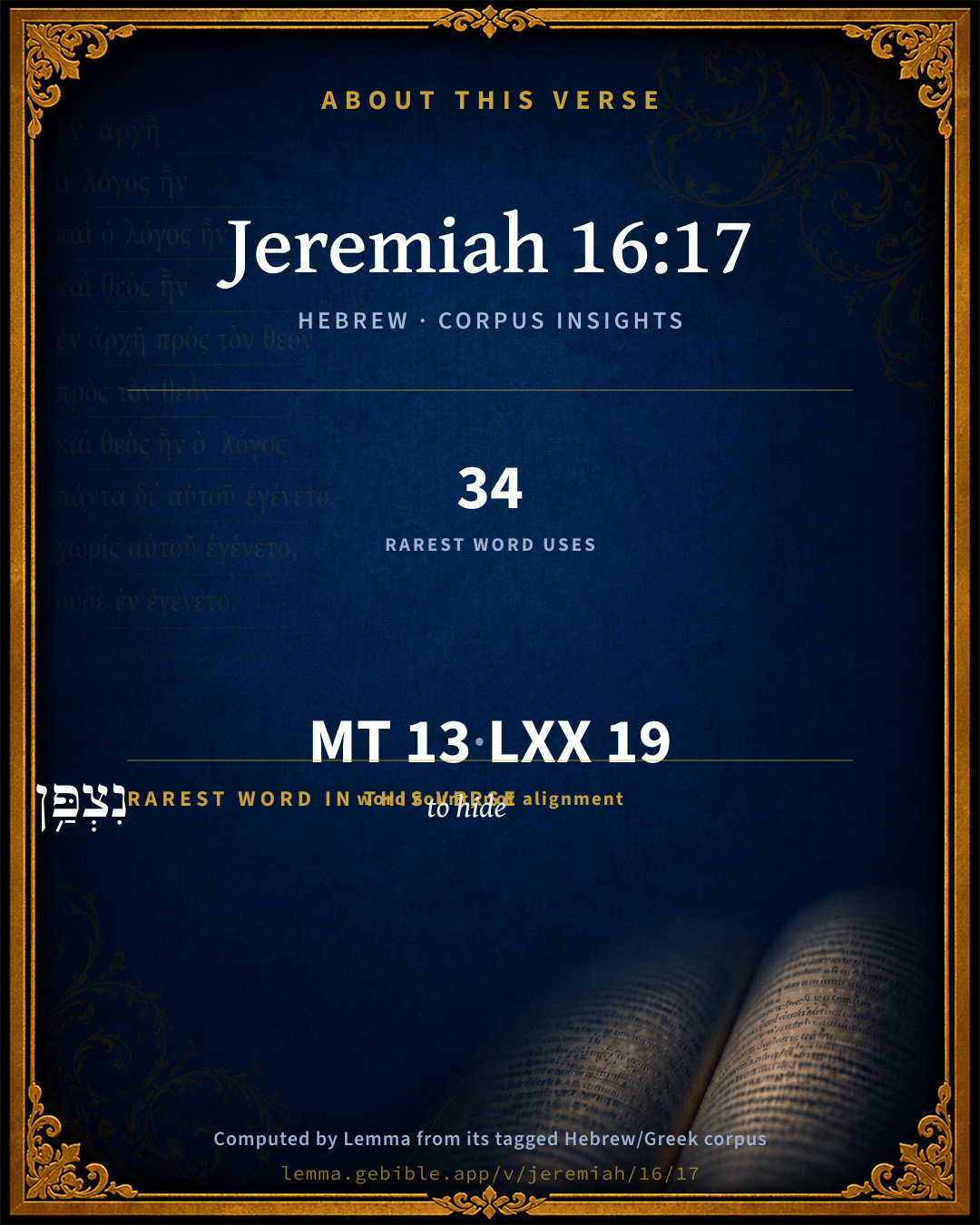
נִצְפַּ֥ן
tsâphan
H6845
“to hide”
Verb, Niphal, Perfect, 3rd Person, Masculine, Singular
Part of Speech
Verb
Stem
Niphal
Form
Perfect
Person
3rd Person
Gender
Masculine
Number
Singular
Full BDB Definition

Origin: a primitive root

TWOT: 1953

to hide, treasure, treasure or store up - (Qal) - to hide, treasure, treasure up - to lie hidden, lurk - (Niphal) to be hidden, be stored up - (Hiphil) to hide, hide from discovery
  1. כִּ֤י kîy H3588 “that” Conjunction
  2. עֵינַי֙ ʻayin H5869 “eyes · my” Noun, Common, Both, Dual, Construct + Suffix, Personal, 1st Person, Common, Singular
  3. עַל ʻal H5921 “upon” Preposition
  4. כָּל kôl H3605 “all of” Noun, Common, Masculine, Singular, Construct
  5. דַּרְכֵיהֶ֔ם derek H1870 “ways · their” Noun, Common, Both, Plural, Construct + Suffix, Personal, 3rd Person, Masculine, Plural
  6. לֹ֥א lôʼ H3808 “not” Particle, Negative
  7. נִסְתְּר֖וּ çâthar H5641 “to hide” Verb, Niphal, Perfect, 3rd Person, Common, Plural
  8. מִלְּפָנָ֑י pânîym H6440 “from · to/for · face(s) · my” Preposition + Preposition + Noun, Common, Both, Plural, Construct + Suffix, Personal, 1st Person, Common, Singular
  9. וְלֹֽא lôʼ H3808 “and · not” Conjunction + Particle, Negative
  10. עֲוֺנָ֖ם ʻâvôn H5771 “iniquity · their” Noun, Common, Both, Singular, Construct + Suffix, Personal, 3rd Person, Masculine, Plural
  11. מִנֶּ֥גֶד neged H5048 “from · before” Preposition + Preposition
  12. עֵינָֽי ʻayin H5869 “eyes · my” Noun, Common, Both, Dual, Construct + Suffix, Personal, 1st Person, Common, Singular

About this verse

These counts appear in no published source. They are computed here, from the morphology-tagged text and Lemma’s own curated glosses. What Lemma adds →

13
words
11
distinct lemmas
Prophets
section

Shared distinctive vocabulary

נִצְפַּ֥ן to hide H6845 occurs in 31 verses of the Hebrew Bible. Also found in:

Grammatical profile

  • 2 verbs
  • 6 nouns
  • 2 prepositions
  • 1 conjunction
  • 2 particles

Verb forms

  • נִסְתְּר֖וּ Niphal · Perfect
  • נִצְפַּ֥ן Niphal · Perfect

Repetition

Words recur within this verse — often emphatic in Hebrew:

  • עֵינַי֙ eye H5869 ×2
  • לֹ֥א not H3808 ×2

Hebrew & Septuagint length

In the original languages it is 13 Hebrew tokens and 19 Greek tokens — but the two are counted differently (Hebrew bundles its prefixes and suffixes into one token; the Greek is in lemma form), so that isn’t a like-for-like length.

Cross-references

14

Topical passages linked to Jeremiah 16:17 in the Treasury of Scripture Knowledge — connected by theme and wording, ordered by reader-vote popularity; previews shown in the World English Bible.

  • Proverbs 15:3 Yahweh's eyes are everywhere, Keeping watch on the evil and the good.
  • Proverbs 5:21 For the ways of man are before the eyes of Yahweh. He examines all his paths.
  • Jeremiah 23:24 Can any hide himself in secret places so that I shall not see him? says Yahweh. Don't I fill heaven and earth? says Yahweh.
  • Psalms 90:8 You have set our iniquities before you, Our secret sins in the light of your presence.
  • Job 34:21–22 "For his eyes are on the ways of a man, He sees all his goings.
  • 2 Chronicles 16:9 For the eyes of Yahweh run back and forth throughout the whole earth, to show himself strong in the behalf of them whose heart is perfect toward him. Herein you have done foolishly; for from henceforth you shall have wars.
  • Jeremiah 32:19 great in counsel, and mighty in work; whose eyes are open on all the ways of the sons of men, to give everyone according to his ways, and according to the fruit of his doings:
  • 1 Corinthians 4:5 Therefore judge nothing before the time, until the Lord comes, who will both bring to light the hidden things of darkness, and reveal the counsels of the hearts. Then each man will get his praise from God.
  • Hebrews 4:13 There is no creature that is hidden from his sight, but all things are naked and laid open before the eyes of him with whom we have to do.
  • Psalms 139:3 You search out my path and my lying down, And are acquainted with all my ways.
  • Ezekiel 9:9 Then said he to me, The iniquity of the house of Israel and Judah is exceeding great, and the land is full of blood, and the city full of wrestling [of judgment]: for they say, Yahweh has forsaken the land, and Yahweh doesn't see.
  • Isaiah 29:15 Woe to those who hide deep their counsel from Yahweh, and whose works are in the dark, and who say, Who sees us? and who knows us?
  • Ezekiel 8:12 Then said he to me, Son of man, have you seen what the elders of the house of Israel do in the dark, every man in his chambers of imagery? for they say, Yahweh doesn't see us; Yahweh has forsaken the land.
  • Luke 12:1–2 Meanwhile, when a multitude of many thousands had gathered together, so much so that they trampled on each other, he began to tell his disciples first of all, "Beware of the yeast of the Pharisees, which is hypocrisy.

Cross-references courtesy of OpenBible.info (CC BY 4.0).

Hebrew and Greek witnesses Masoretic Hebrew ↔ Greek Septuagint

The same verse in the two great witnesses to the Old Testament, shown verse-for-verse.

These are two independent witnesses, not word-aligned to each other, and the Septuagint is shown in lemma (dictionary) form.

Hebrew Jeremiah 16:17 Masoretic · Westminster Leningrad Codex

כִּ֤י עֵינַי֙ עַל כָּל דַּרְכֵיהֶ֔ם לֹ֥א נִסְתְּר֖וּ מִלְּפָנָ֑י וְלֹֽא נִצְפַּ֥ן עֲוֺנָ֖ם מִנֶּ֥גֶד עֵינָֽי

For my eyes are on all their ways; they are not hidden from my face, neither is their iniquity concealed from my eyes.

World English Bible · Public Domain

Greek LXX Structure differs

In the Septuagint, Jeremiah is about an eighth shorter than the Hebrew and arranges its material differently — the Oracles Against the Nations (Hebrew chapters 46–51) appear in the middle of the Greek book, after 25:13. Because the chapter and verse boundaries do not line up, a verse-for-verse comparison with the Hebrew is not shown.

A verse-for-verse comparison isn’t shown here because the chapters and verses don’t line up. Switch to the LXX edition with the MT / LXX toggle above to read the Greek directly.

Hebrew: Westminster Leningrad Codex (CC BY 4.0). Greek: Septuagint (public domain); English from a public-domain English Septuagint. How the Septuagint differs from the Hebrew →

Targum (Aramaic paraphrase)

1

The Targum is the ancient Jewish Aramaic paraphrase of the Hebrew Scriptures — an interpretive translation, not the Hebrew text itself. Onkelos (literal) and Pseudo-Jonathan (expansive) render the Torah, and Jonathan the Prophets. Coverage is partial: where no permissively-licensed English translation exists for a verse, only the Aramaic is shown. This is verse-level text, not a word-by-word alignment to the Hebrew.

  1. Targum Jonathan Prophets (Joshua–Malachi)
    אֲרֵי קֳדָמַי גְלַן כָּל אוֹרְחַתְהוֹן לָא מְסַתְּרָן מִן קֳדָמַי וְלָא מְטַמְרָן חוֹבֵיהוֹן מִלְקָבֵיל מֵימְרִי:

    (no public-domain English translation for this verse)

    Targum Jonathan — Aramaic: “Mikraot Gedolot” (public domain). English: “Sefaria Community Translation” (CC0 1.0 (public-domain dedication)); “London "Chaldee Paraphrase," 1871” (public domain). Text via Sefaria.

Commentary

Notes on Jeremiah 16:17 from classic Christian and Jewish commentators (each source and its license shown beneath its notes). The classic Christian expositions comment on the surrounding passage and are grouped to its opening verse, so a note may address several verses; the Jewish commentaries on the Tanakh (Rashi and others) are per-verse, so they appear only where the commentator wrote on this verse.

Lemma curates 59 commentaries, every one of them public domain or Creative Commons licensed, each selected and text-cleaned for this edition rather than reprinted as found. About our sources →

Trapp's Complete Commentary

John Trapp

Jer 16:17 For mine eyes [are] upon all their ways: they are not hid from my face, neither is their iniquity hid from mine eyes.

Ver. 17. For mine eyes are upon all their ways.] And though they hide me from themselves, yet can they not hide themselves from me possibly, nor from my hunters, who shall ferret them out.

John Trapp, A Commentary or Exposition upon All the Books of the Old and New Testament (1647–1656) — public domain. Text from a community e-Sword module.

Jamieson, Fausset & Brown

Robert Jamieson, A. R. Fausset & David Brown

(Jer 32:19; Pro 5:21; Pro 15:3).

their iniquity--the cause of God's judgments on them.

Jamieson, Fausset & Brown — Commentary Critical and Explanatory on the Whole Bible (1871) — public domain (CC PDM 1.0). Text via the HelloAO Bible API.

John Calvin's Commentaries

The Prophet now shews that the grievous calamity of which he had spoken would be a just reward for the wickedness of the people; for we know that the prophets were endued with the Spirit of God not merely that they might foretell things to come — for that would have been very jejune; but a doctrine was connected with their predictions. Hence the prophets not only foretold what God would do, but at the same time added the causes. There is then now added a doctrine as a seasoning to the prophecy; for the Prophet says that the destructiorl of the Jews was at hand, because they had long greatly provoked the wrath of God. As there is no end to the evasions of hypocrites, according to what we observed yesterday, God here reminds them of his judgment, as though he had said, “This one thing is sufficient, he knows their iniquities, and he is a fit judge; so they contend in vain, and try in vain, to excuse or to extenuate their fault.”

Hence he says that the eyes of God were on all their ways: and he mentions all their ways, because they had not offended only once, or in one way, but they had added sins to sins. Nor are they hid, he says: the Prophet presses the matter on their attention; for had he allowed their false pretences, they would have made no end of excuses. He therefore says that their ways were not hid, nor their iniquities concealed from the eyes of God. Now follows a confirmation —

John Calvin's Commentaries (1540-1563) — public domain. Text from the Calvin Translation Society English edition (1840s-50s) via the Christian Classics Ethereal Library (ccel.org). Calvin's coverage is partial (roughly two-thirds of the Bible); uncommented books and verses are honest gaps, never fabricated. The 19th-century editor's footnotes and remarks are omitted so the notes are faithfully Calvin's own voice.

Ellicott's Commentary for English Readers

(17) Mine eyes are upon all their ways.—The context shows that here also the thought is presented on its severer side. The sins of Israel have not escaped the all-seeing eye of Jehovah.

A Bible Commentary for English Readers, edited by Charles John Ellicott (1878–1897) — public domain. Text from a community e-Sword module.

John Gill's Exposition

And first I will recompense their iniquity and their sin double,.... Or, "but first I will recompense", &c. (f); meaning, before he showed favour to them, and returned their captivity, Jer 16:15, he would punish them according to their sins; not double to what they deserved, but to what: they were used to have, or he was used to inflict upon them, punishing them less than their sins deserved; but now he would reward them to the full, though not beyond the measure of justice, yet largely and abundantly, and with rigour and severity. Some understand this of God's gathering together all their sins and iniquities "from the beginning" (g), as they render the word; the sins of their fathers and their own, and punishing them for them all at once; or first their fathers' sins, and then their own, in which they imitated their fathers, and filled up the measure of their iniquity. So the Targum,

"and I will render to the second as to the first, for everyone of both, their iniquities and their sins.''

Because they have defiled my land; out of which he cast the Canaanites for the same reason; and which he chose for the place of his residence and worship, and settled the people of Israel for that purpose in it: that they might serve him in it, and not do as the Heathens before them had done, and which yet they did; and this was what was provoking to him.

They have filled mine inheritance with the carcasses of their detestable and abominable things; with their idols, which were not only lifeless, but stinking, loathsome, and abominable; or unclean creatures, which were sacrificed unto them; and some think human sacrifices, the bodies of men, are meant: places of idolatrous worship were set up everywhere in the land, and therefore it is said to be filled therewith; and it was an aggravation of their wickedness, that this was done in a land which the Lord had chosen for his own possession, and had given to Israel as an inheritance.

(f) "sed reddum primum". (g) "ab initio" Calvin; "initio", Montanus.

John Gill's Exposition of the Whole Bible (1746–1763) — public domain (CC PDM 1.0). Text via the HelloAO Bible API.

Albert Barnes' Notes on the Bible

This chastisement arises not from caprice, but is decreed upon full knowledge and examination of their doings.

Albert Barnes' Notes on the Bible (1834–1885) — public domain. Text from a community e-Sword/MySword module.

Matthew Poole's English Annotations

God is of purer eyes than that he can behold iniquity in any so as to approve it, and therefore though he be long patient, yet he will at last punish evil-doers; for his eyes behold them, their sins are open in his sight, and he particularly observeth men’s actions, that he may render unto every one according to his works.

Matthew Poole's English Annotations on the Holy Bible (1683–1685) — public domain. Text from a community e-Sword/MySword module.

Lesson kit

Teaching starters — assembled from the data on this page, not authored interpretation. Every prompt links to the verse data it draws on. Edit before teaching.

Jeremiah, in the Prophets, opens this verse with 13 words (11 distinct Hebrew lemmas). Its most distinctive word is tsâphan (“to hide”). A historical commentator’s framing appears above. Read the whole chapter for the surrounding context.

Discussion questions

  1. The word tsâphan carries the sense “to hide.” How does it shape the verse?
  2. Exodus 2:2 shares the word «to hide» with this verse. How do the two illuminate each other?
  3. “eye” occurs 2× in this one verse. What is the effect of the repetition?
  4. The translations on this page render this verse differently — a whole-verse word diff, not a word-by-word alignment. What might account for the different wordings?
  5. The verb «נִסְתְּר֖וּ» is Niphal Perfect. How does its form color the action?
  6. Reading how Trapp's Complete Commentary and Jamieson, Fausset & Brown read this verse, where do the two commentators agree and where do they part?

Things to notice

Reading settings

Reading text

Shown beneath each verse's original-language words.

Old Testament
Old Testament edition

Read the OT as the Masoretic Hebrew (MT) or the Greek Septuagint (LXX).

English shown for the Greek Septuagint (in the Hebrew ↔ Greek comparison).

Comparing translations? Open the Compare panel on any verse page to stack up to four side by side.