

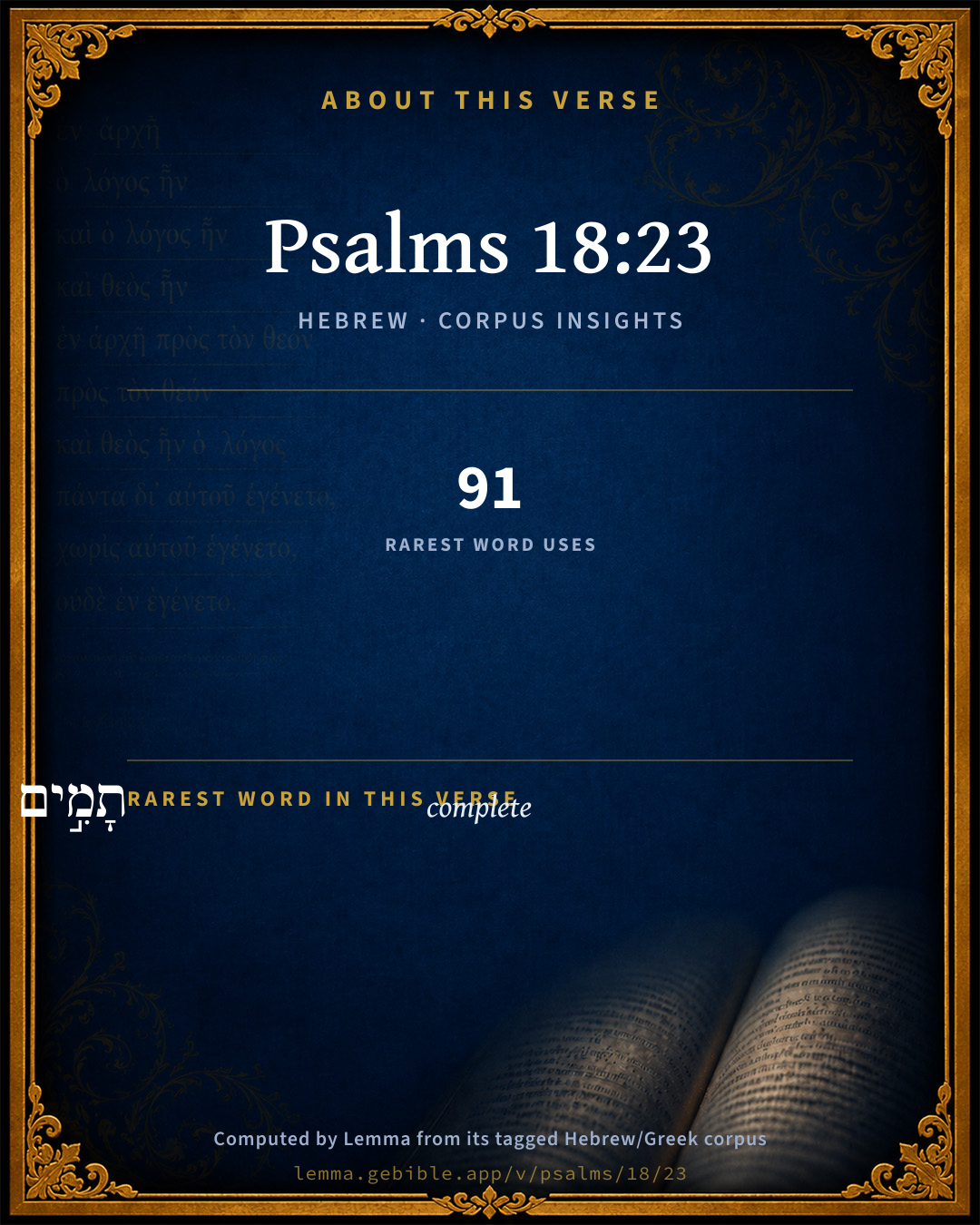
Psalms 18:23

Hebrew (Westminster Leningrad Codex) Psalms 18:23 appears in the Hebrew Old Testament. The text above is from the Westminster Leningrad Codex. Each word links to its Strong’s number, a concise gloss, and parsing drawn from the Open Scriptures Hebrew Bible morphology. Click any word for its full Brown-Driver-Briggs (BDB) entry.
Download image
Cite this verse

Psalms 18:23 (World English Bible). Public Domain. Lemma interlinear Bible study tool, https://lemma.gebible.app/v/psalms/18/23.

Show BibTeX & RIS
BibTeX
RIS
English Translation
I was also blameless with him. I kept myself from my iniquity.
World English Bible · Public Domain
Download a study sheet

One document with this verse’s original text, its word-by-word gloss line, the meaning frame, cross-references with their text, attributed commentary, and full source and license credits — printable, and it pastes into notes with its structure intact.

This verse Autodidact and up

Study sheet (.html) Plain text (.txt)

A passage Seminary Student

Up to 50 verses in one chapter. A passage sheet keeps up to 6 commentary sources and 12 cross-references per verse, in the order this page ranks them, and says so on the sheet whenever that leaves anything out. Ask for a single verse and you get the Autodidact verse sheet above.

Everything on this page stays free to read, with no account — the sheet is a download of what is already on screen, not access to it.

Want to remove ads? Support Godless Engineer
Compare translations 3

The same verse in 3 English versions, stacked beneath the original-language interlinear above. Click any original word for its lexicon entry.

Each is an independent rendering of the whole verse — the interlinear is not word-aligned to these translations.

Highlighted words mark where these versions differ — a whole-verse word diff, not a word-by-word alignment.

  • World English Bible Public Domain
    I was also blameless with him. I kept myself from my iniquity.
  • King James Version Public Domain
    I was also upright before him, and I kept myself from mine iniquity.
  • unfoldingWord Literal Text CC BY-SA 4.0
    And I have been blameless with him, and I have kept myself from my iniquity.

unfoldingWord Literal Text — © unfoldingWord, licensed CC BY-SA 4.0. Word-aligned USFM3 via Door43 (git.door43.org/unfoldingWord/en_ult).

Versions to compare (up to 4)

3 of 4 selected

Show all 18 translations

Every available English version of this verse, each an independent rendering of the whole verse.

  • World English Bible Public Domain
    I was also blameless with him. I kept myself from my iniquity.
  • Berean Standard Bible Public Domain
    And I have been blameless before Him and kept myself from iniquity.
  • Majority Standard Bible Public Domain
    And I have been blameless before Him and kept myself from iniquity.
  • King James Version Public Domain
    I was also upright before him, and I kept myself from mine iniquity.
  • American Standard Version (1901) Public Domain
    I was also perfect with him, And I kept myself from mine iniquity.
  • Revised Version (1885) Public Domain
    I was also perfect with him, and I kept myself from mine iniquity.
  • Geneva Bible (1599) Public Domain
    I was vpright also with him, and haue kept me from my wickednes.
  • Douay-Rheims (1899) Public Domain
    For till his judgments are in my sight: and his justices I have not put away from me.
  • Young's Literal Translation Public Domain
    And I am perfect with him, And I keep myself from mine iniquity.
  • Literal Standard Version CC BY-SA 4.0
    And I am perfect with Him, || And I keep myself from my iniquity.
  • Unlocked Literal Bible CC BY-SA 4.0
    I have also been innocent before him, and I have kept myself from sin.
  • unfoldingWord Literal Text CC BY-SA 4.0
    And I have been blameless with him, and I have kept myself from my iniquity.
  • Darby Bible Public Domain
    And I was upright with him, and kept myself from mine iniquity.
  • World Messianic Bible Public Domain
    I was also blameless with him. I kept myself from my iniquity.
  • Webster's Bible Public Domain
    \\18:22\\For all his judgments were before me, and I did not put away his statutes from me.
  • Free Bible Version CC BY-SA 4.0
    I am blameless in his sight; I keep myself from sinning.
  • Bible in Basic English Public Domain
    And I was upright before him, and I kept myself from sin.
  • JPS Tanakh (1917) Public Domain
    (18-24) And I was single-hearted with Him, and I kept myself from mine iniquity.

Literal Standard Version (2020), Covenant Press — licensed CC BY-SA 4.0. Text via the HelloAO Bible API (eBible.org). Unlocked Literal Bible (unfoldingWord) — licensed CC BY-SA 4.0. Text via the HelloAO Bible API (eBible.org). unfoldingWord Literal Text — © unfoldingWord, licensed CC BY-SA 4.0. Word-aligned USFM3 via Door43 (git.door43.org/unfoldingWord/en_ult). Free Bible Version, Dr. Jonathan Gallagher — licensed CC BY-SA 4.0. Text via the HelloAO Bible API (eBible.org).

Word by word

More ways to search: Search by grammar → Find every occurrence → Compare this word →

Practice this passage: Drill this verse → Learn its vocabulary →

About this verse

These counts appear in no published source. They are computed here, from the morphology-tagged text and Lemma’s own curated glosses. What Lemma adds →

5
words
5
distinct lemmas
Wisdom
section

Grammatical profile

  • 2 verbs
  • 1 noun
  • 1 adjective
  • 1 preposition

Verb forms

  • וָאֱהִ֣י Qal · Sequential Imperfect
  • וָ֝אֶשְׁתַּמֵּ֗ר Hithpael · Sequential Imperfect

Hebrew & Septuagint length

In English translation the verse runs 12 words from the Hebrew and 14 from the Septuagint (LXX English) — closely comparable.

A rough comparison of the two English renderings, which tokenize alike — not a word-level alignment.

Word counts can differ between the Hebrew and the Greek without any difference in meaning — e.g. the Hebrew direct-object marker אֵת has no separate Greek word, and Greek often adds the article ὁ.

Cross-references

8

Topical passages linked to Psalms 18:23 in the Treasury of Scripture Knowledge — connected by theme and wording, ordered by reader-vote popularity; previews shown in the World English Bible.

  • Matthew 5:29–30 If your right eye causes you to stumble, pluck it out and throw it away from you. For it is more profitable for you that one of your members should perish, than for your whole body to be cast into Gehenna.
  • Matthew 18:8–9 If your hand or your foot causes you to stumble, cut it off, and cast it from you. It is better for you to enter into life maimed or crippled, rather than having two hands or two feet to be cast into the eternal fire.
  • 1 Samuel 26:23 Yahweh will render to every man his righteousness and his faithfulness; because Yahweh delivered you into my hand today, and I wouldn't put forth my hand against Yahweh's anointed.
  • 1 Chronicles 29:17 I know also, my God, that you try the heart, and have pleasure in uprightness. As for me, in the uprightness of my heart I have willingly offered all these things: and now have I seen with joy your people, that are present here, offer willingly to you.
  • Psalms 11:7 For Yahweh is righteous. He loves righteousness. The upright shall see his face.
  • Psalms 17:3 You have proved my heart; you have visited me in the night; You have tried me, and found nothing; I have resolved that my mouth shall not disobey.
  • Psalms 37:27 Depart from evil, and do good; Live securely forever.
  • Psalms 7:1–8 Yahweh, my God, I take refuge in you. Save me from all those who pursue me, and deliver me,

Cross-references courtesy of OpenBible.info (CC BY 4.0).

Hebrew and Greek witnesses Masoretic Hebrew ↔ Greek Septuagint

The same verse in the two great witnesses to the Old Testament, shown verse-for-verse.

You’re reading Greek Psalm 17 (Hebrew Psalm 18). The Septuagint counts the superscription, so verse numbers can differ from the Hebrew — chapter-level alignment, not verse-by-verse. Numbering follows Rahlfs.

These are two independent witnesses, not word-aligned to each other, and the Septuagint is shown in lemma (dictionary) form.

Hebrew Psalms 18:23 Masoretic · Westminster Leningrad Codex

וָאֱהִ֣י תָמִ֣ים עִמּ֑וֹ וָ֝אֶשְׁתַּמֵּ֗ר מֵעֲוֺנִֽי

I was also blameless with him. I kept myself from my iniquity.

World English Bible · Public Domain

Greek LXX Greek Psalm 17:23 Septuagint · lemma form

ὅτι πᾶς ὁ κρίμα αὐτός ἐνώπιον ἐγώ καί ὁ δικαίωμα αὐτός οὐ ἀποἵστημι ἀπό ἐγώ

And I shall be blameless with him, and shall keep myself from my iniquity.

LXX2012 (modern English Septuagint) · Public Domain

Hebrew: Westminster Leningrad Codex (CC BY 4.0). Greek: Septuagint (public domain); English from LXX2012 (modern English Septuagint) (Public Domain). How the Septuagint differs from the Hebrew →

Commentary

Notes on Psalms 18:23 from classic Christian and Jewish commentators (each source and its license shown beneath its notes). The classic Christian expositions comment on the surrounding passage and are grouped to its opening verse, so a note may address several verses; the Jewish commentaries on the Tanakh (Rashi and others) are per-verse, so they appear only where the commentator wrote on this verse.

Lemma curates 59 commentaries, every one of them public domain or Creative Commons licensed, each selected and text-cleaned for this edition rather than reprinted as found. About our sources →

Trapp's Complete Commentary

John Trapp

Psa 18:23 I was also upright before him, and I kept myself from mine iniquity.

Ver. 23. I was also upright before him] This he had because he kept God’s commandments, as Psa 18:22, had respect to them all, Psa 119:6, both to the magnalia and minutula legis, which he kept as the apple of his eye, Pro 7:2, even all God’s wills, Act 13:22, and was therefore approved in Christ, as Apelles, Rom 16:10, and passed for an Israelite indeed, in whom was no guile, as Nathanael, Joh 1:47.

And I kept myself from mine iniquity] i.e. From my peccatum in deliciis, my darling sin, whereto I am either by nature or custom most inclined and addicted; from the iniquity of my heart and secret thoughts, which no man can charge me with, saith Aben Ezra; from that sin of disloyalty, which Saul and his courtiers charge me with, say others.

John Trapp, A Commentary or Exposition upon All the Books of the Old and New Testament (1647–1656) — public domain. Text from a community e-Sword module.

The Biblical Illustrator

Joseph S. Exell

Psa_18:23

I was also upright before Him, and kept myself from mine iniquity.

The upright heart, and its darling sin

Things that David here takes notice of.

1. The greatness of the danger he was in.

2. The glory of his deliverance, regarded as an answer to prayer.

3. The fruit of it. The love of God is enlarged and inflamed. His confidence in God is enlarged. He is by this quickened and encouraged unto prayer.

4. The grounds of all these mercies. Gods free grace. In the person to whom the mercy is bestowed; for as God stands in a peculiar covenant relation to His people, so He hath a peculiar providence over them. God is with His people at all times, but He is nearest to them in the worst times. David shows wherein his sincerity doth appear. I have not departed from God wickedly. All His judgments were before me. I was also upright before Him, and I kept me from mine iniquity. A sincere heart hath the most serious resolutions, the most unfeigned detestations, and therefore the greatest and the most diligent watchings against his own iniquity, that sin to which his nature is most prone, and wherein he is most apt to be ensnared. In the text are two things.

I. Davids profession of his sincerity. There is a two-fold perfection. A legal perfection, which is a perfect conformity in nature and in life to the law of God. This was not the perfection that David here spoke of, for his failings were known and confessed by himself. There is an evangelical perfection, according to the tenor of the second covenant, and this is two fold: a perfection of justification, and a perfection of sanctification. There is a walking with God, before God, and after God; that is, in reference to the precepts of God, the providences of God, and the pattern and example of God; and these three expressions set forth a choice perfection. A godly man may have his heart upright and perfect, even in the imperfection of his ways. A man that is sincere is in Gods account a perfect man; sincerity is the truth of all grace, the highest pitch that is to be attained here. Sincerity of heart gives a man boldness, even ill the presence of God, notwithstanding many failings.

II. The testification of it. How did he prove this perfection? I have kept myself from mine iniquity. He refers to some proper and peculiar evil and way of sinning that Was his special darling; a beloved sin. His care was to keep himself from it. A man cannot keep himself: the Lord is his keeper. But the Lord will have us cooperate with Him. When we perform anything, by His grace we do it. So we are said to cleanse ourselves. The doctrine is this--even the best and dearest of Gods people have some sins that they are more prone to than others, which may be called their own iniquity. What is a mans own iniquity? In every man by nature sin doth reign, and a man is in just judgment given up unto the power of it. The reign of sin is double, virtual, due to original sin; and actual, due to bias of will. Actual sin is that way of sin and death that a man chooseth to himself, he having looked abroad upon all the contentments of the world, his own corrupt inclination doth choose unto himself to follow with greatest sweetness, and contentment, and delight, as that wherein the happiness of his life consists. What is it for a man to keep himself from his iniquity?

1. He takes care to keep the evil of that sin always in his eye, and to keep himself low in this consideration, that he hath been guilty of it in times past.

2. There is no sin that the heart of man is more perfectly against. The godly man hates that sin most, and breaks out against it with the greatest detestation, by which God hath been most dishonoured, and whereby his conscience hath been most enslaved in times past.

3. He is in this, above all other sins, most jealous of his heart; he fears it in respect of every occasion, and opportunity, and temptation.

4. This sin he prays most against.

5. He turns the edge of the threatening against this sin.

6. He endeavours to grow up in the contrary grace, and strengthens it by all means. How doth this prove a sincere heart? It shows a man to be truly affected by Gods dishonour. It shows the truth of a mans self-denial, and his hatred against sin. It shows forth the sincerity of a mans love for God. How may a man know what his darling sin is? It is that where a mans treasure is. It is what is most sweet to him; what he favours most, and hides most. This sin makes all a mans lusts serviceable to it. It is the sin that most interrupts thee in holy duties. (William Strong.)

I kept myself from mine iniquity.

Kept from iniquity

I. A personal danger. Mine iniquity. This is a dreadful possession to have in the house: a man had better have a cage of cobras than have an iniquity, yet we have each of us to deal at home with some special form of sin. Each man has his own way of sinning. It may take its speciality from our natural constitution. He who judges all men alike does them an injustice. Our tendency is to decry the particular form of sin that we find in others. It may be engendered by education. How impressible we are in childhood! Certain forms of iniquity grow out of our particular condition. Each period of life has its own special snare. It is so with the condition of our life as to our outward circumstances. The rich man has his temptations, and the poor has his. Iniquities come through both prosperity and adversity. Iniquities surround us all in daily life. Your iniquity is likely to be that iniquity which thou hast oftenest fallen into in thy previous life. And that which you do not like to hear condemned is, very probably, your iniquity.

II. A special guard. I kept myself from mine iniquity.

1. You must find out what it is. You must get a clear idea of your own iniquity. Endeavour to get a due sense of its foulness and guilt in the sight of God. Ask the Lord to make thee hate most that sin to which thou art most inclined.

2. Be resolved in the power of the Holy Spirit that this particular sin shall be overcome. There is nothing like hanging it up by the neck,--that very sin, I mean. The true path of safety is to pray and believe against all sin. We conquer sin by faith in Christ.

III. A happy result. If we do keep from sin, what a blessing it will be to us. It will be a triumph of grace. It will be our best testimony to others. And what a sweet peace this will give to the conscience. (C. H. Spurgeon.)

Resolute restraint

A noted characteristic of Mr. Cecil was his decision of character. It is said that he had studied for a painter, and after he had changed his object he retained a fondness and taste for the art. He was once called to visit a sick lady, in whose room there was a painting which so strongly attracted his attention that he found himself diverted from the sick person and absorbed by the painting. From that moment he formed the resolution of mortifying a taste which he found so intrusive and so obstructive to his nobler pursuits, and determined never again to frequent the exhibition.

Our own iniquity

David comforts himself in his innocence and integrity, but ascribes that to Gods restraining and assisting grace, which kept him back from that iniquity to which be was strongly tempted. What that particular sin was is not here mentioned.

I. There is some particular sin which each one may call his own iniquity. What it is in each case is certainly known to God. And every man may know it himself, by communing with his own heart, and considering his ways; by laying his life to the rule of his conscience, and measuring his conscience by the rule of Gods law. That there is greater proclivity in every, one to some peculiar sins is sufficiently evident from every mans private conscience.

1. We are more inclinable to some sins than to others, through our natural tempers and complexions. The corruptible body presseth down the soul. And such is the predominancy of some elements and humours, to which the naturalist ascribes the diversity of constitutions, that from thence also the moralist derives the different tempers of mens minds and inclinations, Thus the sanguine incline most to lust and wantonness, incontinence and intemperance; the choleric to anger and passion, pride and contention; the melancholic to envy, discontent, distrust, and despair; the phlegmatic to covetousness and idleness, and lukewarmness in religion. So that, according to the different constitutions of mens bodies, there arise different inclinations in their souls and minds; and as it is the proper business of reason to find out and restrain, so it is the great work of grace and religion to subdue and mortify the predominant passion.

II. At some certain periods of our lives we are more inclinable to some sins than others. Every age of human life has some peculiar darling that commonly bears the sway. In age, men are prone to such things as most conduce to their temporal advantage; they hoard up riches. In youth, men are prone to such things as most gratify their sensual appetites.

III. We are more inclinable to some sins than others, by reason of our education or our company. By these things mens minds and manners are as much, if not more, fashioned than by nature itself.

IV. We are prone to some sins through the several states and conditions of life into which providence brings us. When we are healthy and strong we are apt to forget God. Sickness tempts us to be impatient towards Him. Prosperity makes men proud, and abundance insolent and wanton. Adversity tempts us to be envious and querulous, fraudulent and pilfering. There are more temptations to some sins than others, from the different professions or courses of life men take upon themselves.

V. There are some particular sins to which men are liable through religion itself. Many mens confidence of their own way is often attended with great censoriousness and uncharitableness towards all that differ from them. Observe that it is possible to keep ourselves from our own particular sins, as David did. This we may do by cherishing the grace that is freely given us of God, and remembering the vows we have so often made Him. What helps and directions are needful?

1. By constant and fervent prayer implore the Divine aid.

2. In vain may we expect Gods help without our own diligent endeavours.

3. Take care to avoid such things and decline such occasions as are most likely to ensnare us.

4. Never think the evil of sin less than it is.

5. Be tender of violating your consciences. (Henry Dove, D. D.)

The Christian successful in conquering his besetting sins

I. Every man has one or more particular sins to which he, as an individual, is especially prone. The iniquity is emphatically his own. Varied and numerous, indeed, are the sins of the human heart, against which the Christian must guard; but every man has some particular sins which especially cleave to him (Heb_12:1), and David seems to allude to such. It would be well for us frequently to examine our own hearts for the express purpose of finding out our besetting sins.

1. There is usually a constitutional propensity to the sin.

2. The circumstances in which the individual is placed may favour the indulgence of the sin. How ill would it have been for Joseph, had he been of profligate nature, that he was placed in the house of Potiphar.

3. And Satan is particularly busy in furnishing temptations to the commission of the darling sin. He knows too well the evil propensities of the human heart, and, like a skilful angler, varies his baits to suit the tastes of his victims. When he saw pride working in the heart of David he provoked him to number Israel.

II. Every good man, conscious that he is prone to some particular sins, will direct his principal efforts against them. He is anxious to keep himself from his own iniquity. His efforts proceed on enlightened principles. The good man does not presume on his own strength; he devoutly prays for the assistance of the Holy Spirit. At the same time, he is persuaded that vigorous efforts on his part are indispensable, in the order of means. True, no man, strictly speaking, can keep himself.. David could not, he knew he could not; but he means that he had so exerted himself that God had given him success. How to secure this for ourselves I urge--

1. The importance of acknowledging our individual sins when we come before God. Be not content with general confession. For sometimes, when the conscience prompts to minute confession, we restrain the impulse, through a secret misgiving that if cherished it would either prevent the gratification of our favourite lust, or at least augment our subsequent distress, by rendering us the more inexcusable in the indulgence of it. Guard against this delusion. Go and spread your ease, with all its aggravations, before God, and cry for help against the darling sin.

2. The Christian makes it his especial business to mortify the sin: he is not satisfied with merely weakening its power; he aims at its destruction.

3. He forms strong resolutions against the sin. All the powers of his mind are in exercise; he deliberates and resolves to oppose his iniquity. His vows are recorded not on tables of stone, but in the fleshy tables of the heart. Aware of his own weakness, this is his determination--I will go forth against the sin in the strength of the Lord of hosts.

4. He carefully shuns everything which may facilitate the indulgence of the sin. Is intemperance the favourite propensity? In vain do former jovial companions invite him to partake of the intoxicating cup. The Christian will not go in the way of evil men. When unavoidably in circumstances of danger he is doubly on his guard. We are, at times, thus unavoidably placed in such positions.

5. The first risings of the sin he quickly and stoutly opposes. Nothing is more important than this. It is the part of wisdom to commence the attack, before the enemy has time to concentrate his forces. The smallest aperture in the embankment of a mighty river should be stopped, or it will increase, and the waters deluge the surrounding country, in spite of all resistance. The single spark must be extinguished, or a general conflagration may ensue.

6. The Christian furnishes his mind with cogent arguments, especially Scriptural ones, against his particular sins. If the prince of heathen philosophers could subdue his passionate temper by considerations derived from reason only, how much more may be expected from us who have reason and revelation both. Let the Psalmist teach us, who said, Thy word have I hid in my heart, that I might not sin against Thee.

7. He will carefully cherish the opposite graces. The timid child we stimulate to acts of bravery, convinced that as these acts increase his timidity Will decline. It is thus in the school of Christ; the more individual graces are cherished, the more their opposite vices will diminish.

8. He vigorously perseveres, till he has in a great measure gained his end.

III. Success in his efforts the good man will ever regard as an invaluable blessing. He can scarcely find language sufficiently elevated to express his feelings. Oh, success in these efforts, what a blessing!

1. It is a signal victory: a powerful enemy is subdued. Would you estimate its power? How difficult victory was. How many have fallen ill such conflict.

2. No other victory can equal it. He that ruleth his spirit is better than he that taketh a city.

3. The results are glorious. For--

(1) Other conflicts are rendered comparatively easy: The soldier who has stormed the strongly fortified castle has no difficulty in battering down the mud walls of a cottage; and the Christian who has subdued his reigning sin has a fair prospect of overcoming his other iniquities.

(2) It affords the most decisive evidence of personal piety. How anxious the believer is to make his calling and election sure, and where is he to look for decisive evidence? But if he be successful in the subjection of reigning lusts, his conscience assures him this is the best evidence.

(3) It enables the Christian to discharge the duties, and realise the privileges of religion, with greater spirit and delight.

(4) It diffuses a sweet calm over the soul and imparts solid satisfaction. Suppose the reigning passion indulged, what evil consequences ensue. The gratification, too, is but momentary. Soon it biteth like a serpent and stingeth like an adder. How delightful the feelings of David when Abigail kept him from shedding the blood of Nabal.

(5) It is particularly pleasing to God, and will be honoured, not only now but hereafter, with the emphatic marks of the Divine approbation. Oh, ye in whose hearts sin reigns without opposition, beware lest iniquity be your ruin. Take refuge in the Lord Jesus. Pray for the Spirit of God. Christians, if the subject has been exemplified in your happy practice, be humble, be grateful, and give God the praise. If it has reproved and grieved you, remember it is designed to stimulate and profit you. Rely upon the Spirit of God, and fear not to say, I will keep myself from mine iniquity. (Essex Remembrancer.)

The Biblical Illustrator, edited by Joseph S. Exell (c. 1880s–1900s) — public domain. Text from a community e-Sword module.

J. A. Alexander on Psalms

Joseph Addison Alexander

24. (Psa 18:23). And I have been perfect with him, and have kept myself from my iniquity. He not only will be faithful, but he has been so already, in the sense before explained. There is evident reference in the first clause to the requisition of the Law, "thou shalt be perfect with the Lord thy God," Deu 18:13. (Compare Gen 17:1.) With means not merely in his presence, or his sight, as distinguished from men's estimate of moral objects, but "in my intercourse and dealing with him." Compare 1Ki 11:4, and the description of David in 1Ki 14:8; 1Ki 15:5. In the last clause some see an allusion to David's adventure in the cave, when his conscience smote him for meditating violence against Saul. See 1Sa 24:6, and compare 1Sa 26:23-24. But whether this be so or not, the clause undoubtedly contains a confession of corruption. My iniquity can only mean that to which I am naturally prone and subject. We have here, then, a further proof that the perfection claimed in the first clause is not an absolute immunity from sin, but an upright purpose and desire to serve God.

Joseph Addison Alexander, The Psalms Translated and Explained (1850) — public domain. Text from a community e-Sword module.

Geneva Bible (1599)

Geneva Bible translators

I neither gave place to their wicked tentations, nor to mine own affections.

Geneva Bible (1599) marginal notes — public domain. Text via Bolls.life.

Jamieson, Fausset & Brown

Robert Jamieson, A. R. Fausset & David Brown

upright before him--In my relation to God I have been perfect as to all parts of His law. The perfection does not relate to degree.

mine iniquity--perhaps the thought of his heart to kill Saul (Sa1 24:6). That David does not allude to all his conduct, in all relations, is evident from Psa 51:1, &c.

Jamieson, Fausset & Brown — Commentary Critical and Explanatory on the Whole Bible (1871) — public domain (CC PDM 1.0). Text via the HelloAO Bible API.

Adam Clarke's Commentary

Verse 23. I was also upright] The times in which David was most afflicted were the times of his greatest uprightness. Adversity was always to him a time of spiritual prosperity.

Mine iniquity.] Probably meaning what is generally termed the easily-besetting sin; the sin of his constitution, or that to which the temperament of his body most powerfully disposed him. What this was, is a subject of useless conjecture.

Adam Clarke's Commentary on the Bible (1810–1826) — public domain. Text from a community e-Sword/MySword module.

John Calvin's Commentaries

23. I was also upright with him. All the verbs in this verse are put by David in the future tense, I will be upright, etc. because he does not boast of one act only, or of a good work performed by fits and starts, but of steady perseverance in an upright course. What I have said before, namely, that David takes God for his judge, as he saw that he was wrongfully and unrighteously condemned by men, appears still more clearly from what he here says, “I have been upright with him.” The Scriptures, indeed, sometimes speak in similar terms of the saints, to distinguish them from hypocrites, who content themselves with wearing the outward mask of religious observances; but it is to disprove the false reports which were spread against him that David thus confidently appeals to God with respect to them. This is still more fully confirmed by the repetition of the same thing which is made a little after, According to the cleanness of my hands before his eyes In these words there is evidently a contrast between the eyes of God and the blinded or malignant eyes of the world; as if he had said, I disregard false and wicked calumnies, provided I am pure and upright in the sight of God, whose judgment can never be perverted by malevolent or other vicious and perverse affections. Moreover, the integrity which he attributes to himself is not perfection but sincerity, which is opposed to dissimulation and hypocrisy. This may be gathered from the last clause of the 23rd verse, where he says, I have kept myself from my iniquity In thus speaking, he tacitly acknowledges that he had not been so pure and free from sinful affections as that the malignity of his enemies did not frequently excite indignation within him, and gall him to the heart. He had therefore to fight in his own mind against many temptations, for as he was a man, he must have felt in the flesh on many occasions the stirrings of vexation and anger. But this was the proof of his virtue, that he imposed a restraint upon himself, and refrained from whatever he knew to be contrary to the word of God. A man will never persevere in the practice of uprightness and of godliness, unless he carefully keep himself from his iniquity.

John Calvin's Commentaries (1540-1563) — public domain. Text from the Calvin Translation Society English edition (1840s-50s) via the Christian Classics Ethereal Library (ccel.org). Calvin's coverage is partial (roughly two-thirds of the Bible); uncommented books and verses are honest gaps, never fabricated. The 19th-century editor's footnotes and remarks are omitted so the notes are faithfully Calvin's own voice.

The Cambridge Bible for Schools and Colleges

gen. ed. J. J. S. Perowne

23. upright before him] R.V., perfect with him, living in the fellowship of a sincere devotion. See note on Psa_15:2.

I kept myself from mine iniquity] I have watched over myself that I might not transgress, lest I should cherish any sin till it became a part of me. There is no reference to indwelling corruption or a besetting sin.

The Cambridge Bible for Schools and Colleges (gen. ed. J. J. S. Perowne; Cambridge University Press, 1878–1918) — public domain. Text from a community e-Sword module.

John Gill's Exposition

Therefore hath the Lord recompensed me according to my righteousness,.... Having proved and supported this proposition by the above reasons, it is repeated, for confirmation's sake;

according to the cleanness of my hands in his eyesight; this phrase, "in his eyesight", is here added, to show that the righteousness of Christ was clean, pure, and spotless in the sight of God; in the eye of divine justice: hence those that are clothed with it are holy and unblamable, and irreprovable in his sight, Col 1:22.

John Gill's Exposition of the Whole Bible (1746–1763) — public domain (CC PDM 1.0). Text via the HelloAO Bible API.

Albert Barnes' Notes on the Bible

I was also upright before him - Margin, with. The meaning is that he was upright in his sight. The word rendered upright is the same which in Job 1:1 is rendered perfect. See the note at that passage.

And I kept myself from mine iniquity - From the iniquity to which I was prone or inclined. This is an acknowledgment that he was prone to sin, or that if he had acted out his natural character he would have indulged in sin - perhaps such sins as had been charged upon him. But he here says that, with this natural proneness to sin, he had restrained himself, and had not been deserving of the treatment which he had received. This is one of those incidental remarks which often occur in the Scriptures which recognize the doctrine of depravity, or the fact that the heart, even when most restrained, is by nature inclined to sin. If this psalm was composed in the latter part of the life of David (see the introduction), then this must mean either

(a) that in the review of his life he felt it had been his general and habitual aim to check his natural inclination to sin; or

(b) that at the particular periods referred to in the psalm, when God had so wonderfully interposed in his behalf, he felt that this had been his aim, and that he might now regard that as a reason why God had interposed in his behalf.

It is, however, painfully certain that at some periods of his life - as in the matter of Uriah - he did give indulgence to some of the most corrupt inclinations of the human heart, and that, in acting out these corrupt propensities, he was guilty of crimes which have forever dimmed the luster of his name and stained his memory. These painful facts, however, are not inconsistent with the statement that in his general character he did restrain these corrupt propensities, and did “keep himself from his iniquity” So, in the review of our own lives, if we are truly the friends of God, while we may be painfully conscious that we have often given indulgence to the corrupt propensities of our natures - over which, if we are truly the children of God, we shall have repented - we may still find evidence that, as the great and habitual rule of life, we have restrained those passions, and have “kept ourselves” from the particular forms of sin to which our hearts were prone.

Albert Barnes' Notes on the Bible (1834–1885) — public domain. Text from a community e-Sword/MySword module.

Matthew Poole's English Annotations

I did not pretend religion before men for my own ends, but did approve my heart and ways to the all-seeing God.

And I kept myself from mine iniquity, i e. from that sin which I was most inclined or tempted to; either,

1. From my hereditary and natural corruption, so far that it should not have dominion over me, nor break forth into any presumptuous or scandalous sins. Or rather,

2. From the sin of killing Saul, which might be called his sin, because this might seem most agreeable and desirable to him, both as a man and as a soldier, and as anointed to be king, as being a likely way both to revenge, and to preserve, and to advance himself; to which also he might seem to be both invited by the fair opportunity which Providence had put into his hand, 1Sa 24:4; 26:8, and necessitated by Saul’s implacable malice, and his own perpetual and extreme dangers and distresses; and to which he was so strongly tempted by his own followers, in the place now quoted.

Matthew Poole's English Annotations on the Holy Bible (1683–1685) — public domain. Text from a community e-Sword/MySword module.

The Treasury of David

Charles H. Spurgeon

Ver. 23. I was also upright before him. Sincerity is here claimed; sincerity, such as would be accounted genuine before the bar of God. Whatever evil men might think of him, David felt that he had the good opinion of his God. Moreover, freedom from his one great besetting sin he ventures also to plead,

I kept myself from mine iniquity. It is a very gracious sign when the most violent parts of our nature have been well guarded. If the weakest link in the chain is not broken, the stronger links will be safe enough. David's impetuous temper might have led him to slay Saul when he had him within his power, but grace enabled him to keep his hands clean of the blood of his enemy; but what a wonder it was, and how well worthy of such a grateful record as these verses afford! It will be a sweet cordial to us one of these days to remember our self denials, and to bless God that we were able to exhibit them.

Ver. 23. I was also upright before him, and I kept myself from mine iniquity. He who says, "Lo, I come: in the volume of the book it is written of me, I delight to do thy will, O my God; yea, thy law is within my heart; "and who by the apostle in the tenth chapter of the epistle to the Hebrews, is identified with Jesus Christ, says also (Heb 10:12), "innumerable evils have compassed me about; mine iniquities have taken hold upon me, so that I am not able to look up: they are more than the hairs of mine head; therefore mine heart faileth me; "and in Ps 41:9, "He whose familiar friend, to whom he had committed a trust, who ate of his bread, lifted up his heel against him, "whom our Lord in the thirteenth chapter of the gospel of John identifies with himself, says (Joh 13:4), "Lord, be merciful to me: heal my soul, for I have sinned; "I am guilty "before thee." The difficulty is removed by the undoubtedly true principlethe principle which, above all others, gives Christianity its peculiar character"He who knew no sin, was made sin; ""On his righteous servant, Jehovah made to fall the iniquities of us all." In this sense, "innumerable iniquities compassed him, "the iniquities made to fall on himmade "his" as to their liabilitiesby divine appointment laid hold of him. In the sense of culpa blame worthinesshe had no sin. In the sense of reatus liability to the penal effects of sinnever had any one so much sin to bear as he"He bore the sins of many." John Brown.

Ver. 23. I was upright before him. Hence observe: first, that a godly man may have his heart upright and perfect even in the imperfection of his ways. Secondly, a man that is sincere is in God's account a perfect man: sincerity is the truth of all grace, the highest pitch that is to be attained here. Thirdly, sincerity of heart gives a man boldness even in the presence of God, notwithstanding many failings. The Lord doth "charge his angels with folly, "how much more man that "dwells in a house of clay"? Job 4:18-19. David, whose faith failed, and who had said, "I shall one day perish by the hand of Saul, "and whose tongue had faltered also to Abimelech, the priest; three or four several lies he had told; yet David can say to God, that he was perfect with him for all that. It is a strange boldness that the saints have in the presence of God by virtue of the new covenant. All their sins shall be laid open at the last day as a cancelled bond, that they wonder how they shall look upon them and not blush; but the same spirit of sonship that shall give them perfect boldness then, doth give them boldness in a great measure even now in this life; that they shall be able to say, "Neither height not depth, " etc., nothing "shall separate us from the love of Christ." William Strong.

Ver. 23. I was upright. etc. An upright Christian will not allow himself in any known sin; he dares not touch the forbidden fruit. Ge 39:9. "How then can I do this great wickedness, and sin against God?" Though it be a complexion sin, he disinherits it. There is no man but doth propend and incline more to one sin than another; as in the body there is one humour predominant, or as in the hive there is one master bee; so in the heart there is one master sin; there is one sin which is not only near to a man as the garment, but dear to him as the right eye. This sin is Satan's fort royal, all his strength lies here; and though we beat down his out works, gross sin, yet if we let him hold this fort of complexion sin, it is as much as he desires. The devil can hold a man as fast by this one link, as by a whole chain of vices. The fowler hath the bird fast enough by one wing. Now, an upright Christian will not indulge himself in this complexion sin: I was upright before him, and kept myself from mine iniquity. An upright Christian takes the sacrificing knife of mortification, and runs it through his dearest sin. Herod did many things, but there was one sin so dear to him, that he would sooner behead the prophet, than behead that sin. Herod would have a gap for his incest. An upright heart is not only angry with sin (which may admit of reconciliation), but hates sin; and if he sees this serpent creeping into his bosom, the nearer it is the more he hates it. Thomas Watson.

Ver. 23. I kept myself. Keep himself! Who made man his own keeper! It's the Lord that is his keeper: he is the keeper of Israel, and the preserver of man. If a man cannot keep himself from sorrow, how is he able to keep himself from sin? God indeed in our first conversion works upon us as he did upon the earth, or Adam's body in paradise, before he breathed a soul into it, and made it a living creature; such a power as Christ put forth on Lazarus in his grave, for we are "dead in trespasses and sins; "but yet being living he must walk and act of himself, the Lord will have us to cooperate together with him, for we are built upon Christ, not as dead, but as "living stones." 1Pe 2:5. The grace whereby we are made alive is his, and the power is his; and yet by his grace we do it also; ille facit ut nos faciamus, quae praecepit (Augustine). William Strong.

Ver. 23. I kept myself from mine iniquity. It is possible to keep ourselves from such sins as David did; who professes here of himself great sincerity, that he had kept himself from that iniquity to which he was strongly tempted, and which he was prone to fall into. The method which holy David made use of gives us the first and the best direction; and that is, by constant and fervent prayer to implore the divine aid and the continual assistance of his Holy Spirit, that God would not only keep us from falling into them, but even turn our hearts from inclining to them, and help us to see our folly and our danger. For alas! we are not able of ourselves to help ourselves, not so much as to think a good thought, much less to resist an evil inclination, or a strong temptation; but "our sufficiency is of God:" "It is God (says the psalmist here), that girdeth me with strength, and maketh my way perfect:" Ps 18:32... Next, that we take care to avoid such things and decline such occasions as are most likely to snare us and gain upon us, lest one thing hook in another, and we be caught in the gin before we suspect the danger. Henry Dove, 1690.

Ver. 23. Mine iniquity. A man's darling sin may change with the change of a man's condition, and some occasion that may present itself. What was Saul's and Jehu's sin before they came into the crown we know not; but surely it was wherein their lust did afterwards run outthe establishing a kingdom upon their posterity. Wantonness may be the darling of a man's youth, and worldliness the darling of his age; and a man's being raised unto honour, and having the opportunities that he had not in times past, the lust may run in another channel, he having now such an opportunity as before he never expected. William Strong.

Ver. 23. Mine iniquity. There is some particular sin to which one is more prone than to another, of which he may say by way of emphasis, it is "mine iniquity, "at which he may point with his finger, and say, "That's it."...There are more temptations to some sins than others, from the different professions or courses of life men take upon themselves. If they follow the court I need not tell you what temptations and snares there are to divers sins, and what danger there is of falling into them, unless your vows for virtue, and a tender regard to the honour which cometh of God only, keep you upright. If they be listed in the camp, that tempts them to rapine and violence, neglect of God's worship, and profaneness. If they exercise trading and merchandise, they meet with greater enticements to lying and cozening, over reaching, and unjust dealing; and the mystery of some trades, as bad men manage them, is a downright "mystery of iniquity." If husbandry, to anxiety about the things of the world, a distrust of God's providence, or murmuring against it. Nay, I could wish in the most sacred profession of all there might be an exception made in this particular; but Paul tells us that even in his days "some preached Christ even of envy and strife, "some for filthy lucre only, as well as "some of good will." Php 1:15. Henry Dove.

Ver. 23. Mine iniquity. The actual reign of sin is commonly of some particular master lust, which is as the viceroy over all the rest of the sins in the soul, and commands them all as lord paramount, and makes them all subservient and subordinate unto it; and this is according to custom, calling, constitution, abilities, relations, and according to the different administrations of the Spirit of God; for though God be not the author of sin, yet he is the orderer of sin. So that it is that way of sin and death that a man chooseth to himself, he having looked abroad upon all the contentments of the world, his own corrupt inclination doth choose unto himself to follow with greatest sweetness and contentment and delight, as that wherein the happiness of his life consists; that as in the body there is in every one some predominant humour, so there is in the body of sin also; that as the natural man, though there be all the faculties, yet some faculties are in some more lively and vigorous than in others, some are more witty, some are more strong, some quick of sight, some have a ready ear, and others a nimble tongue, etc. So it is in the old man also; there is all the power of sin in an unregenerate man, but in some more dexterous one way than another; as men in the choice of calling, some have a greater inclination to one thing than to another, so it is in the choice of contentments also: as in the appetite for food, so it is in lust, being nothing else but the appetite of the creature corrupted to some sinful object. William Strong.

Ver. 23. Growth in mortification... Men may deceive themselves when they estimate their progress herein by having overcome such lusts as their natures are not so prone unto. The surest way is to take a judgment of it from the decay of a man's bosom sin, even as David did estimate his uprightness by his keeping himself from his iniquity; so a man of his growth in uprightness. When physicians would judge of a consumption of the whole, they do it not by the falling away of any part whatever, as of the flesh in the face alone, or any the like; such a particular abatement of flesh in some one part may come from some other cause; but they use to judge by the falling away of the brawn of the hands, or arms and thighs, etc., for these are the more solid parts. The like judgments do physicians make upon other diseases, and of the abatement of them from the decrease in such symptoms as are pathognomical, and proper, and peculiar to them. In like manner also the estimate of the progress of the victories of a conqueror in an enemy's kingdom is not taken from the taking or burning of a few villages or dorps, but by taking the forts and strongest holds, and by what ground he hath won upon the chief strength, and by what forces he hath cut off of the main army. Do the like in the decrease of, and victory over, your lusts. Thomas Goodwin.

Ver. 23. We must remember always that though the grace of God prevents us, that we may have a good will, and works in us when we have it, that so we may find success; yet in vain do we expect the continuance of his help without diligent endeavours. Whilst he assists our weakness, he does not intend to encourage our laziness, and therefore we are also "to labour, and strive according to his working, which worketh in us mightily, "as the apostle expresses it, Col 1:29. Henry Dove.

Ver. 23. The upright heart and its darling sin. W. Strong's Sermons.

Ver. 23. Peccata in deliciis; a discourse of bosom sins. P. Newcome.

Ver. 23. The sure trial of uprightness. Dr. Bates.

Psalms 18:24*

Charles H. Spurgeon's The Treasury of David (1869–1885) — public domain. Psalms only. Text from a community e-Sword/MySword module.

Whedon's Commentary on the Bible

Daniel D. Whedon

23. Mine iniquity—The iniquity that a king in my circumstances is exposed to, such as ambition, pride, revenge, forgetfulness of God. All conditions of life have their besetting sins. Heb_12:1

Daniel D. Whedon (gen. ed.), Commentary on the Old and New Testaments (1874–1909) — public domain. Text from a community e-Sword module.

The Pulpit Commentary

I was also upright before him. (compare what is said of David in 1Ki_11:4 1Ki_14:8 1Ki_15:5) Like Job, he was "perfect and upright that feared God, and eschewed evil". (Job_1:1) And I kept myself from mine iniquity; i.e. from the sin to which I was especially tempted." (Kay compares the auperistatov amartia of Heb_12:1) But what sin this was, we have no means of determining. All that appears is that David had an inclination to some particular form of sin, against which he found it necessary to be continually upon his guard.

The Pulpit Commentary (1880–1919), ed. H.D.M. Spence-Jones & Joseph S. Exell — public domain. Text from a community e-Sword module.

Rashi

Rabbi Shlomo Yitzchaki (Rashi)

For all His ordinances were before me I always placed them before my eyes.

Rashi on the Tanakh — English translations: “The Judaica Press complete Tanach with Rashi, translated by A. J. Rosenberg” (CC BY 4.0); “Pentateuch with Rashi's commentary by M. Rosenbaum and A.M. Silbermann, 1929-1934” (public domain); “The Metsudah Tanach series, Lakewood, N.J” (CC BY 4.0); and “The Book of Joshua, Metsudah Publications, 1997” (CC BY 4.0). Text via Sefaria.

Lesson kit

Teaching starters — assembled from the data on this page, not authored interpretation. Every prompt links to the verse data it draws on. Edit before teaching.

Psalms, in the Wisdom, opens this verse with 5 words (5 distinct Hebrew lemmas). Its most distinctive word is tâmîym (“complete”). A historical commentator’s framing appears above. Read the whole chapter for the surrounding context.

Discussion questions

  1. What does “complete” (tâmîym) contribute to the verse as a whole?
  2. Matthew 5:29–30 shares this passage’s theme. How do the two illuminate each other?
  3. The translations on this page render this verse differently — a whole-verse word diff, not a word-by-word alignment. What might account for the different wordings?
  4. The verb «וָאֱהִ֣י» is Qal Sequential Imperfect. How does its form color the action?
  5. Reading how Trapp's Complete Commentary and The Biblical Illustrator read this verse, where do the two commentators agree and where do they part?

Things to notice

Reading settings

Reading text

Shown beneath each verse's original-language words.

Old Testament
Old Testament edition

Read the OT as the Masoretic Hebrew (MT) or the Greek Septuagint (LXX).

English shown for the Greek Septuagint (in the Hebrew ↔ Greek comparison).

Comparing translations? Open the Compare panel on any verse page to stack up to four side by side.