
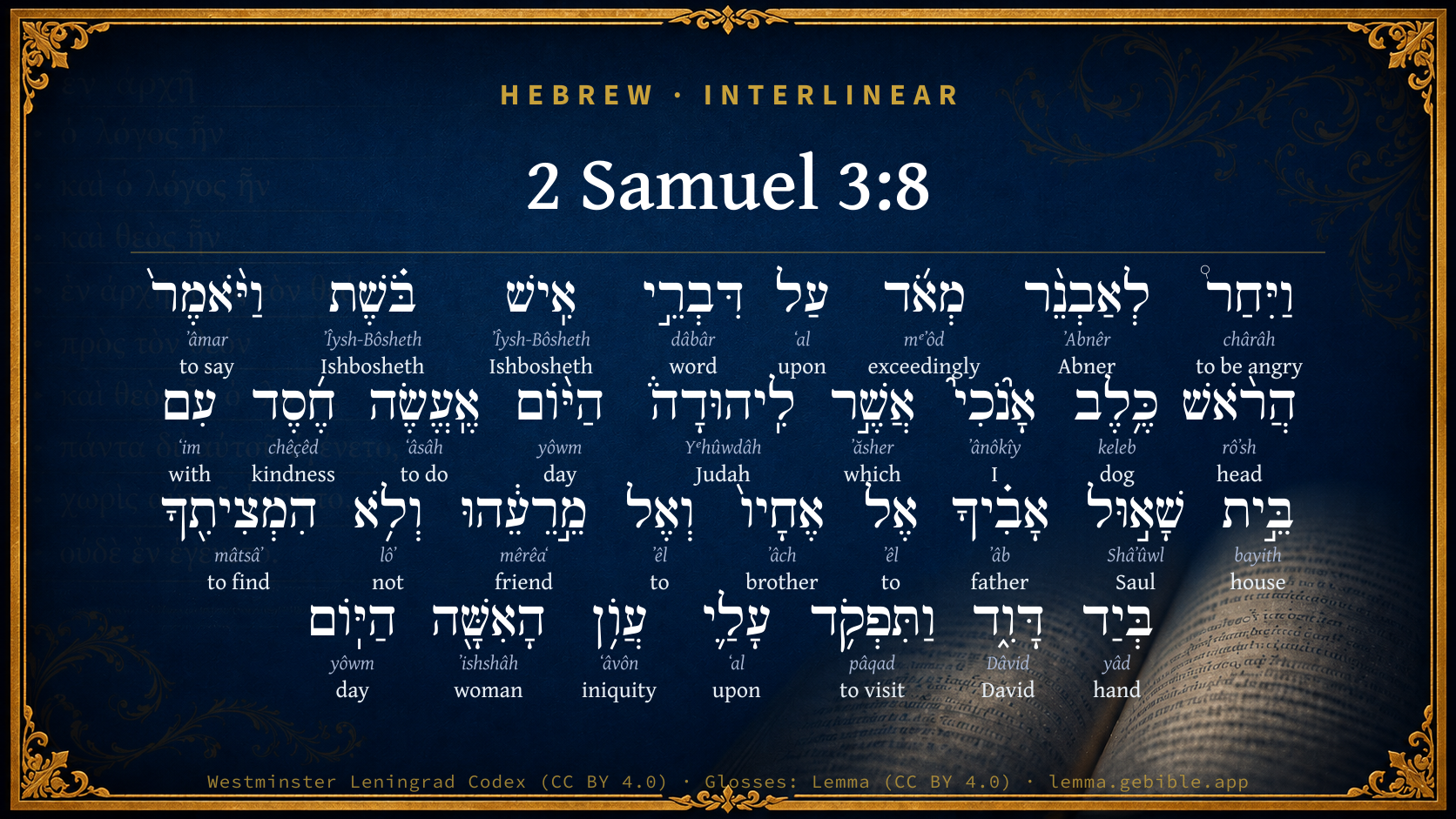
2 Samuel 3:8

Hebrew (Westminster Leningrad Codex) 2 Samuel 3:8 appears in the Hebrew Old Testament. The text above is from the Westminster Leningrad Codex. Each word links to its Strong’s number, a concise gloss, and parsing drawn from the Open Scriptures Hebrew Bible morphology. Click any word for its full Brown-Driver-Briggs (BDB) entry.
Download image
Cite this verse

2 Samuel 3:8 (World English Bible). Public Domain. Lemma interlinear Bible study tool, https://lemma.gebible.app/v/2-samuel/3/8.

Show BibTeX & RIS
BibTeX
RIS
English Translation
Then was Abner very angry for the words of Ish-bosheth, and said, Am I a dog's head that belongs to Judah? This day do I show kindness to the house of Saul your father, to his brothers, and to his friends, and have not delivered you into the hand of David; and yet you charge me this day with a fault concerning this woman.
World English Bible · Public Domain
Download a study sheet

One document with this verse’s original text, its word-by-word gloss line, the meaning frame, cross-references with their text, attributed commentary, and full source and license credits — printable, and it pastes into notes with its structure intact.

This verse Autodidact and up

Study sheet (.html) Plain text (.txt)

A passage Seminary Student

Up to 50 verses in one chapter. A passage sheet keeps up to 6 commentary sources and 12 cross-references per verse, in the order this page ranks them, and says so on the sheet whenever that leaves anything out. Ask for a single verse and you get the Autodidact verse sheet above.

Everything on this page stays free to read, with no account — the sheet is a download of what is already on screen, not access to it.

Want to remove ads? Support Godless Engineer
Compare translations 3

The same verse in 3 English versions, stacked beneath the original-language interlinear above. Click any original word for its lexicon entry.

Each is an independent rendering of the whole verse — the interlinear is not word-aligned to these translations.

Highlighted words mark where these versions differ — a whole-verse word diff, not a word-by-word alignment.

  • World English Bible Public Domain
    Then was Abner very angry for the words of Ish-bosheth, and said, Am I a dog's head that belongs to Judah? This day do I show kindness to the house of Saul your father, to his brothers, and to his friends, and have not delivered you into the hand of David; and yet you charge me this day with a fault concerning this woman.
  • King James Version Public Domain
    Then was Abner very wroth for the words of Ishbosheth, and said, Am I a dog's head, which against Judah do show kindness this day unto the house of Saul thy father, to his brethren, and to his friends, and have not delivered thee into the hand of David, that thou chargest me to day with a fault concerning this woman?
  • unfoldingWord Literal Text CC BY-SA 4.0
    And it burned greatly to Abner concerning the words of Ish Bosheth. And he said, “ I the head of a dog that to Judah? Today I am doing kindness with the house of Saul your father, to his brothers, and to his friends, and I have not delivered you into the hand of David. Yet today you charge against me the iniquity of a woman!

unfoldingWord Literal Text — © unfoldingWord, licensed CC BY-SA 4.0. Word-aligned USFM3 via Door43 (git.door43.org/unfoldingWord/en_ult).

Versions to compare (up to 4)

3 of 4 selected

Show all 18 translations

Every available English version of this verse, each an independent rendering of the whole verse.

  • World English Bible Public Domain
    Then was Abner very angry for the words of Ish-bosheth, and said, Am I a dog's head that belongs to Judah? This day do I show kindness to the house of Saul your father, to his brothers, and to his friends, and have not delivered you into the hand of David; and yet you charge me this day with a fault concerning this woman.
  • Berean Standard Bible Public Domain
    Abner was furious over Ish-bosheth’s accusation. “Am I the head of a dog that belongs to Judah?” he asked. “All this time I have been loyal to the house of your father Saul, to his brothers, and to his friends. I have not delivered you into the hand of David, but now you accuse me of wrongdoing with this woman!
  • Majority Standard Bible Public Domain
    Abner was furious over Ish-bosheth’s accusation. “Am I the head of a dog that belongs to Judah?” he asked. “All this time I have been loyal to the house of your father Saul, to his brothers, and to his friends. I have not delivered you into the hand of David, but now you accuse me of wrongdoing with this woman!
  • King James Version Public Domain
    Then was Abner very wroth for the words of Ishbosheth, and said, Am I a dog's head, which against Judah do show kindness this day unto the house of Saul thy father, to his brethren, and to his friends, and have not delivered thee into the hand of David, that thou chargest me to day with a fault concerning this woman?
  • American Standard Version (1901) Public Domain
    Then was Abner very wroth for the words of Ish-bosheth, and said, Am I a dog's head that belongeth to Judah? This day do I show kindness unto the house of Saul thy father, to his brethren, and to his friends, and have not delivered thee into the hand of David; and yet thou chargest me this day with a fault concerning this woman.
  • Revised Version (1885) Public Domain
    Then was Abner very wroth for the words of Ish-bosheth, and said, Am I a dog’s head that belongeth to Judah? This day do I shew kindness unto the house of Saul thy father, to his brethren, and to his friends, and have not delivered thee into the hand of David, and yet thou chargest me this day with a fault concerning this woman.
  • Geneva Bible (1599) Public Domain
    Then was Abner very wroth for the words of Ish-bosheth, and said, Am I a dogges head, which against Iudah do shew mercie this day vnto the house of Saul thy father, to his brethren, and to his neighbours, and haue not deliuered thee into the hande of Dauid, that thou chargest me this day with a fault concerning this woman?
  • Douay-Rheims (1899) Public Domain
    Why didst thou go in to my father's concubine? And he was exceedingly angry for the words of Isboseth, and said: Am I a dog's head against Juda this day, who have shewn mercy to the house of Saul thy father, and to his brethren and friends, and have not delivered thee into the hands of David, and hast thou sought this day against me to charge me with a matter concerning a woman?
  • Young's Literal Translation Public Domain
    And it is displeasing to Abner exceedingly, because of the words of Ish-Bosheth, and he saith, `The head of a dog `am' I -- that in reference to Judah to-day I do kindness with the house of Saul thy father, unto his brethren, and unto his friends, and have not delivered thee into the hand of David -- that thou chargest against me iniquity concerning the woman to-day?
  • Literal Standard Version CC BY-SA 4.0
    And it is exceedingly displeasing to Abner, because of the words of Ish-Bosheth, and he says, “[Am] I the head of a dog—that in reference to Judah, today I do kindness with the house of your father Saul, to his brothers, and to his friends, and have not delivered you into the hand of David—that you charge against me iniquity concerning the woman today?
  • Unlocked Literal Bible CC BY-SA 4.0
    Then Abner was very angry at the words of Ishbosheth and said, “Am I a dog's head that belongs to Judah? Today I am showing faithfulness to the house of Saul, your father, to his brothers, and to his friends, by not delivering you into the hand of David. But now you accuse me of an offense concerning this woman?
  • unfoldingWord Literal Text CC BY-SA 4.0
    And it burned greatly to Abner concerning the words of Ish Bosheth. And he said, “ I the head of a dog that to Judah? Today I am doing kindness with the house of Saul your father, to his brothers, and to his friends, and I have not delivered you into the hand of David. Yet today you charge against me the iniquity of a woman!
  • Darby Bible Public Domain
    Then was Abner very wroth for the words of Ishbosheth, and said, Am I a dog's head, I who against Judah do shew kindness this day to the house of Saul thy father, to his brethren, and to his friends, and have not delivered thee into the hand of David, that thou reproachest me this day with the fault of this woman?
  • World Messianic Bible Public Domain
    Then Abner was very angry about Ishbosheth’s words, and said, “Am I a dog’s head that belongs to Judah? Today I show kindness to your father Saul’s house, to his brothers, and to his friends, and have not delivered you into the hand of David; and yet you charge me today with a fault concerning this woman!
  • Webster's Bible Public Domain
    Then was Abner very wroth for the words of Ish-bosheth, and said, Am I a dog's head, who against Judah do show kindness this day to the house of Saul thy father, to his brethren, and to his friends, and have not delivered thee into the hand of David, that thou chargest me to-day with a fault concerning this woman?
  • Free Bible Version CC BY-SA 4.0
    Abner got extremely angry at Ishbosheth's accusation. “Am I a dog's head siding with Judah?” he replied. “Right up to the present day I have been loyal to your dynasty—to your father Saul, and to his brothers and friends. I haven't betrayed you to David. But now you dare to accuse me of sinning with this woman!
  • Bible in Basic English Public Domain
    And Abner was very angry at the words of Ish-bosheth, and he said, Am I a dog's head of Judah? I am this day doing all in my power for the cause of your father Saul and for his brothers and his friends, and have not given you up into the hands of David, and now you say I have done wrong with a woman.
  • JPS Tanakh (1917) Public Domain
    Then was Abner very wroth for the words of Ish-bosheth, and said: 'Am I a dog's head that belongeth to Judah? This day do I show kindness unto the house of Saul thy father, to his brethren, and to his friends, and have not delivered thee into the hand of David, and yet thou chargest me this day with a fault concerning this woman.

Literal Standard Version (2020), Covenant Press — licensed CC BY-SA 4.0. Text via the HelloAO Bible API (eBible.org). Unlocked Literal Bible (unfoldingWord) — licensed CC BY-SA 4.0. Text via the HelloAO Bible API (eBible.org). unfoldingWord Literal Text — © unfoldingWord, licensed CC BY-SA 4.0. Word-aligned USFM3 via Door43 (git.door43.org/unfoldingWord/en_ult). Free Bible Version, Dr. Jonathan Gallagher — licensed CC BY-SA 4.0. Text via the HelloAO Bible API (eBible.org).

Word by word

More ways to search: Search by grammar → Find every occurrence → Compare this word →

Practice this passage: Drill this verse → Learn its vocabulary →

מֵ֣רֵעֵ֔הוּ
mêrêaʻ
H4828
“friend · his”
Noun, Common, Masculine, Singular, Construct + Suffix, Personal, 3rd Person, Masculine, Singular
Part of Speech
Noun
Type
Common
Gender
Masculine
Number
Singular
State
Construct
Full BDB Definition

Origin: from H7462 in the sense of companionship

TWOT: 2186f

companion, friend, confidential friend
  1. וַיִּחַר֩ chârâh H2734 “and · to be angry” Conjunction + Verb, Qal, Sequential Imperfect, 3rd Person, Masculine, Singular
  2. לְאַבְנֵ֨ר ʼAbnêr H74 “to/for · Abner” Preposition + Noun, Proper
  3. מְאֹ֜ד mᵉʼôd H3966 “exceedingly” Adverb
  4. עַל ʻal H5921 “upon” Preposition
  5. דִּבְרֵ֣י dâbâr H1697 “words of” Noun, Common, Masculine, Plural, Construct
  6. אִֽישׁ ʼÎysh-Bôsheth H378 “Ishbosheth” Noun, Proper
  7. בֹּ֗שֶׁת ʼÎysh-Bôsheth H378 “Ishbosheth” Noun, Proper
  8. וַיֹּ֨אמֶר֙ ʼâmar H559 “and · to say” Conjunction + Verb, Qal, Sequential Imperfect, 3rd Person, Masculine, Singular
  9. הֲרֹ֨אשׁ rôʼsh H7218 “head of” Particle, Interrogative + Noun, Common, Masculine, Singular, Construct
  10. כֶּ֥לֶב keleb H3611 “dog” Noun, Common, Masculine, Singular, Absolute
  11. אָנֹ֘כִי֮ ʼânôkîy H595 “I” Pronoun, Personal, 1st Person, Common, Singular
  12. אֲשֶׁ֣ר ʼăsher H834 “which” Particle, Relative
  13. לִֽיהוּדָה֒ Yᵉhûwdâh H3063 “to/for · Judah” Preposition + Noun, Proper
  14. הַיּ֨וֹם yôwm H3117 “the · day” Particle, Definite Article + Noun, Common, Masculine, Singular, Absolute
  15. אֶֽעֱשֶׂה ʻâsâh H6213 “to do” Verb, Qal, Imperfect, 1st Person, Common, Singular
  16. חֶ֜סֶד chêçêd H2617 “kindness” Noun, Common, Masculine, Singular, Absolute
  17. עִם ʻim H5973 “with” Preposition
  18. בֵּ֣ית bayith H1004 “house of” Noun, Common, Masculine, Singular, Construct
  19. שָׁא֣וּל Shâʼûwl H7586 “Saul” Noun, Proper
  20. אָבִ֗יךָ ʼâb H1 “father · your” Noun, Common, Masculine, Singular, Construct + Suffix, Personal, 2nd Person, Masculine, Singular
  21. אֶל ʼêl H413 “to” Preposition
  22. אֶחָיו֙ ʼâch H251 “brothers · his” Noun, Common, Masculine, Plural, Construct + Suffix, Personal, 3rd Person, Masculine, Singular
  23. וְאֶל ʼêl H413 “and · to” Conjunction + Preposition
  24. וְלֹ֥א lôʼ H3808 “and · not” Conjunction + Particle, Negative
  25. הִמְצִיתִ֖ךָ mâtsâʼ H4672 “to find · you” Verb, Hiphil, Perfect, 1st Person, Common, Singular + Suffix, Personal, 2nd Person, Masculine, Singular
  26. בְּיַד yâd H3027 “in/at · hand of” Preposition + Noun, Common, Both, Singular, Construct
  27. דָּוִ֑ד Dâvid H1732 “David” Noun, Proper
  28. וַתִּפְקֹ֥ד pâqad H6485 “and · to visit” Conjunction + Verb, Qal, Sequential Imperfect, 2nd Person, Masculine, Singular
  29. עָלַ֛י ʻal H5921 “upon · me” Preposition + Suffix, Personal, 1st Person, Common, Singular
  30. עֲוֺ֥ן ʻâvôn H5771 “iniquity of” Noun, Common, Both, Singular, Construct
  31. הָאִשָּׁ֖ה ʼishshâh H802 “the · woman” Particle, Definite Article + Noun, Common, Feminine, Singular, Absolute
  32. הַיּֽוֹם yôwm H3117 “the · day” Particle, Definite Article + Noun, Common, Masculine, Singular, Absolute

About this verse

These counts appear in no published source. They are computed here, from the morphology-tagged text and Lemma’s own curated glosses. What Lemma adds →

33
words
29
distinct lemmas
Historical
section

Notable vocabulary

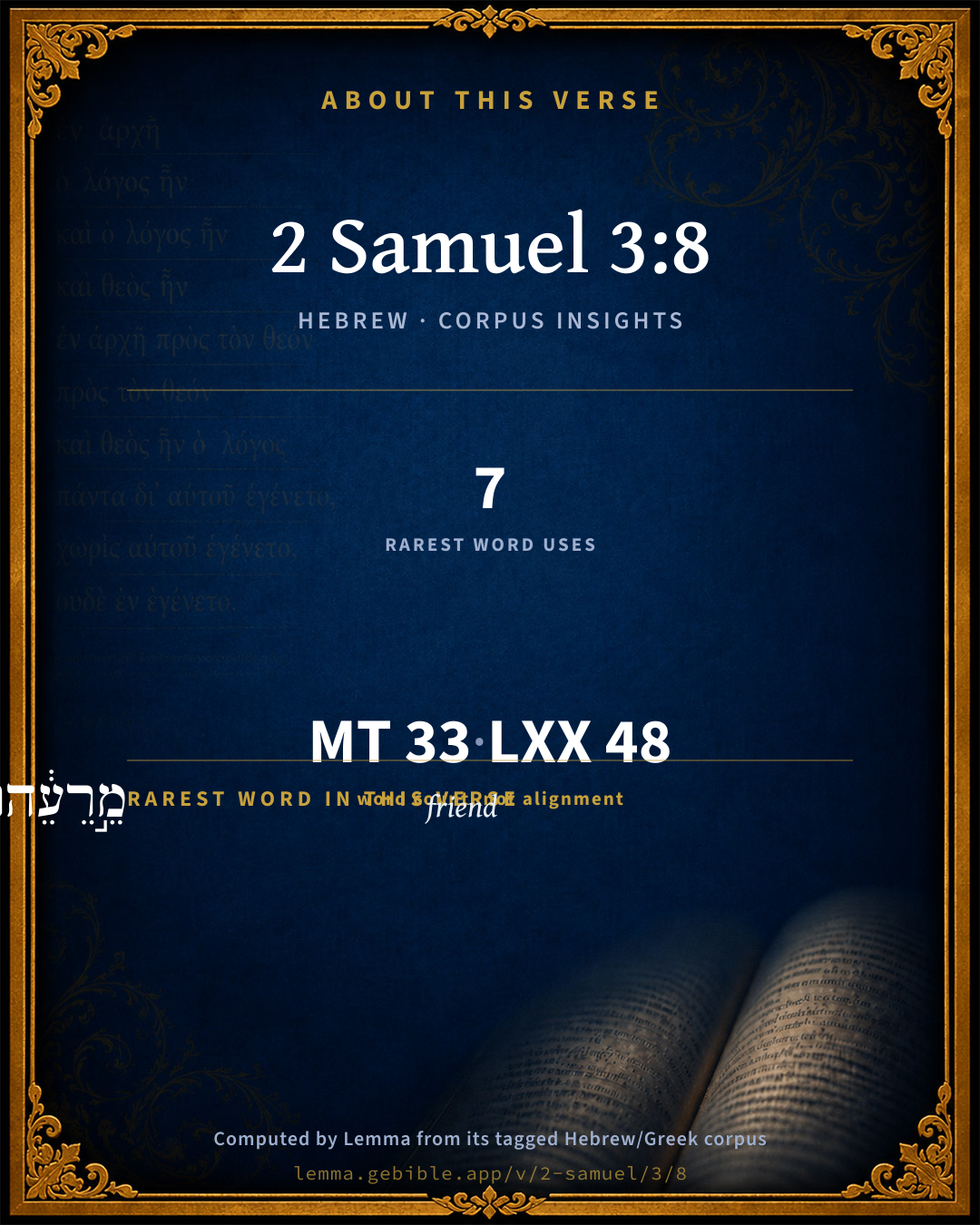
The rarest word here is מֵ֣רֵעֵ֔הוּ friend H4828 — appearing just 7 times in the whole Hebrew Bible.

Shared distinctive vocabulary

מֵ֣רֵעֵ֔הוּ friend H4828 occurs in 7 verses of the Hebrew Bible. Also found in:

Grammatical profile

  • 5 verbs
  • 19 nouns
  • 1 pronoun
  • 5 prepositions
  • 1 adverb
  • 2 particles

Verb forms

  • וַיִּחַר֩ Qal · Sequential Imperfect
  • וַיֹּ֨אמֶר֙ Qal · Sequential Imperfect
  • אֶֽעֱשֶׂה Qal · Imperfect
  • הִמְצִיתִ֖ךָ Hiphil · Perfect
  • וַתִּפְקֹ֥ד Qal · Sequential Imperfect

Repetition

Words recur within this verse — often emphatic in Hebrew:

  • עַל upon H5921 ×2
  • אִֽישׁ Ishbosheth H378 ×2
  • הַיּ֨וֹם day H3117 ×2
  • אֶל to H413 ×2

Hebrew & Septuagint length

In English translation the verse runs 64 words from the Hebrew and 64 from the Septuagint (LXX English) — the same length.

A rough comparison of the two English renderings, which tokenize alike — not a word-level alignment.

Word counts can differ between the Hebrew and the Greek without any difference in meaning — e.g. the Hebrew direct-object marker אֵת has no separate Greek word, and Greek often adds the article ὁ.

In the original languages it is 33 Hebrew tokens and 48 Greek tokens — but the two are counted differently (Hebrew bundles its prefixes and suffixes into one token; the Greek is in lemma form), so that isn’t a like-for-like length.

Cross-references

14

Topical passages linked to 2 Samuel 3:8 in the Treasury of Scripture Knowledge — connected by theme and wording, ordered by reader-vote popularity; previews shown in the World English Bible.

  • 2 Samuel 9:8 He did obeisance, and said, "What is your servant, that you should look on such a dead dog as I am?"
  • 2 Samuel 16:9 Then said Abishai the son of Zeruiah to the king, "Why should this dead dog curse my lord the king? Please let me go over and take off his head."
  • Deuteronomy 23:18 You shall not bring the hire of a prostitute, or the wages of a dog, into the house of Yahweh your God for any vow: for even both these are an abomination to Yahweh your God.
  • 1 Samuel 15:28 Samuel said to him, Yahweh has torn the kingdom of Israel from you this day, and has given it to a neighbor of yours who is better than you.
  • 1 Samuel 24:14–15 After whom is the king of Israel come out? after whom do you pursue? after a dead dog, after a flea.
  • 2 Samuel 3:9 God do so to Abner, and more also, if, as Yahweh has sworn to David, I don't do even so to him;
  • 2 Samuel 3:18 now then do it; for Yahweh has spoken of David, saying, By the hand of my servant David I will save my people Israel out of the hand of the Philistines, and out of the hand of all their enemies.
  • 2 Samuel 5:2 In times past, when Saul was king over us, it was you who led out and brought in Israel: and Yahweh said to you, You shall be shepherd of my people Israel, and you shall be prince over Israel.
  • 2 Kings 8:13 Hazael said, But what is your servant, who is but a dog, that he should do this great thing? Elisha answered, Yahweh has shown me that you shall be king over Syria.
  • Psalms 2:1–4 Why do the nations rage, And the peoples plot a vain thing?
  • Psalms 76:10 Surely the wrath of man praises you. The survivors of your wrath are restrained.
  • Isaiah 37:23 Whom have you defied and blasphemed? and against whom have you exalted your voice and lifted up your eyes on high? [even] against the Holy One of Israel.
  • Mark 6:18–19 For John said to Herod, "It is not lawful for you to have your brother's wife."
  • Acts 9:4–5 He fell on the earth, and heard a voice saying to him, "Saul, Saul, why do you persecute me?"

Cross-references courtesy of OpenBible.info (CC BY 4.0).

Hebrew and Greek witnesses Masoretic Hebrew ↔ Greek Septuagint

The same verse in the two great witnesses to the Old Testament, shown verse-for-verse.

These are two independent witnesses, not word-aligned to each other, and the Septuagint is shown in lemma (dictionary) form.

Hebrew 2 Samuel 3:8 Masoretic · Westminster Leningrad Codex

וַיִּחַר֩ לְאַבְנֵ֨ר מְאֹ֜ד עַל דִּבְרֵ֣י אִֽישׁ בֹּ֗שֶׁת וַיֹּ֨אמֶר֙ הֲרֹ֨אשׁ כֶּ֥לֶב אָנֹ֘כִי֮ אֲשֶׁ֣ר לִֽיהוּדָה֒ הַיּ֨וֹם אֶֽעֱשֶׂה חֶ֜סֶד עִם בֵּ֣ית שָׁא֣וּל אָבִ֗יךָ אֶל אֶחָיו֙ וְאֶל מֵ֣רֵעֵ֔הוּ וְלֹ֥א הִמְצִיתִ֖ךָ בְּיַד דָּוִ֑ד וַתִּפְקֹ֥ד עָלַ֛י עֲוֺ֥ן הָאִשָּׁ֖ה הַיּֽוֹם

Then was Abner very angry for the words of Ish-bosheth, and said, Am I a dog's head that belongs to Judah? This day do I show kindness to the house of Saul your father, to his brothers, and to his friends, and have not delivered you into the hand of David; and yet you charge me this day with a fault concerning this woman.

World English Bible · Public Domain

Greek LXX 2 Samuel 3:8 Septuagint · lemma form

καί θυμόω σφόδρα αβεννηρ περί ὁ λόγος μεμφιβοσθε καί εἶπον αβεννηρ πρός αὐτός μή κεφαλή κύων ἐγώ εἰμί ποιέω ἔλεος σήμερον μετά ὁ οἶκος σαούλ ὁ πατήρ σύ καί περί ἀδελφός καί γνώριμος καί οὐ αὐτομολέω εἰς ὁ οἶκος δαυίδ καί ἐπιζητέω ἐπί ἐγώ ὑπέρ ἀδικία γυνή σήμερον

And Abenner was very angry with Jebosthe for this saying; and Abenner said to him, Am I a dog's head? I have this day wrought kindness with the house of Saul your father, and with his brethren and friends, and have not gone over to the house of David, and do you this day seek a charge against me concerning injury to a woman?

LXX2012 (modern English Septuagint) · Public Domain

On this verse, Haydock's Catholic Bible Commentary discusses the Septuagint’s reading. Read the note in Commentary ↓

Hebrew: Westminster Leningrad Codex (CC BY 4.0). Greek: Septuagint (public domain); English from LXX2012 (modern English Septuagint) (Public Domain). How the Septuagint differs from the Hebrew →

Targum (Aramaic paraphrase)

1

The Targum is the ancient Jewish Aramaic paraphrase of the Hebrew Scriptures — an interpretive translation, not the Hebrew text itself. Onkelos (literal) and Pseudo-Jonathan (expansive) render the Torah, and Jonathan the Prophets. Coverage is partial: where no permissively-licensed English translation exists for a verse, only the Aramaic is shown. This is verse-level text, not a word-by-word alignment to the Hebrew.

  1. Targum Jonathan Prophets (Joshua–Malachi)
    וּתְקֵיף לְאַבְנֵר לַחֲדָא עַל פִּתְגָמֵי אִישׁ בֹּשֶׁת וַאֲמַר הֲלָא רֵישָׁא דְכַלְבָּא אֲנָא מִכְּעַן הֲוֵיתִי גְבַר הֶדְיוֹט לִשְׁאָרָא דְבֵית יְהוּדָה יוֹמָא דֵין אַעְבֵּיד טִיבוּ עִם בֵּית שָׁאוּל אֲבוּךְ עִם אֲחוֹהִי וְעִם רַחֲמוֹהִי וְלָא מְסַרְתִּיךְ בִּידָא דְדָוִד וּמִכְּעַן אַתְּ מַסְעַר עָלַי חוֹב אִתְּתָא יוֹמָא דֵין:

    (no public-domain English translation for this verse)

    Targum Jonathan — Aramaic: “Mikraot Gedolot” (public domain). English: “Sefaria Community Translation” (CC0 1.0 (public-domain dedication)); “London "Chaldee Paraphrase," 1871” (public domain). Text via Sefaria.

Commentary

Notes on 2 Samuel 3:8 from classic Christian and Jewish commentators (each source and its license shown beneath its notes). The classic Christian expositions comment on the surrounding passage and are grouped to its opening verse, so a note may address several verses; the Jewish commentaries on the Tanakh (Rashi and others) are per-verse, so they appear only where the commentator wrote on this verse.

Lemma curates 59 commentaries, every one of them public domain or Creative Commons licensed, each selected and text-cleaned for this edition rather than reprinted as found. About our sources →

Trapp's Complete Commentary

John Trapp

2Sa 3:8 Then was Abner very wroth for the words of Ishbosheth, and said, [Am] I a dog’s head, which against Judah do shew kindness this day unto the house of Saul thy father, to his brethren, and to his friends, and have not delivered thee into the hand of David, that thou chargest me to day with a fault concerning this woman?

Ver. 8. Am I a dog’s head?] An persona canina sum? Am I so worthless and abject? as some sense it; what! a dog, or a dog-keeper? Others, Am I so given to lust and lasciviousness, as dogs are? Thus Deu 23:18, the price of a bitch, that is, of a whore, which, as a suit-bitch, is followed up and down by her libidinous {lecherous} paramours. Aristogiton, an Athenian orator, was for this cause called Dog: and it was not permitted to a dog to enter into the Acropolis or tower at Athens, for his heat in venery, and for his ill favour. Goats likewise came not there, saith Varro, unless for necessary sacrifice. {a}

{a} Plutarch.

John Trapp, A Commentary or Exposition upon All the Books of the Old and New Testament (1647–1656) — public domain. Text from a community e-Sword module.

Joseph Benson's Commentary

2Sa 3:8. Then was Abner very wroth — He accounted his merits so great, and was become so haughty, that he thought he might do any thing without reprehension; and said, Am I a dog’s head? — So contemptible a person that thou thinkest it a disgrace to thy family for me to have intercourse with thy father’s concubine. Whether Abner was guilty of the crime laid to his charge or not, does not appear; nor what ground Ish-bosheth had for the suspicion. But, however it was, it would have been prudent in him to have connived at it for the present, considering how much it was his interest not to dis-oblige Abner. And if the thing was false, and his jealousy groundless, it was very disingenuous and ungrateful to entertain unjust surmises of one who had ventured his all for him, and was certainly the best friend he had in the world. Who against Judah do show kindness unto the house of Saul — Is this my recompense for the kindness I have shown to thee and thy father’s house, and the good services I have done you? He magnifies his service with this, that it was against Judah, the tribe on which the crown was settled, and which would certainly have it at last. So that in supporting the house of Saul he acted both against his conscience and against his interest, for which he deserved a better requital than this. And yet, probably, he would not have been so zealous for the house of Saul, if he had not thereby gratified his own ambition, and hoped to find his own account in it. That thou chargest me with a fault concerning this woman? — That is, either that thou accusest me falsely concerning this matter; or that thou canst not wink at so small a fault (for so he esteemed it) as conversation with this woman, who, whatsoever she formerly was, is now so impotent and inconsiderable that she can neither serve nor disserve thy cause.

Joseph Benson's Commentary on the Old and New Testaments (1811–1818) — public domain. Text from a community e-Sword module.

Tyndale Open Study Notes

Tyndale Open Resources

3:8 some Judean dog: Cp. 1 Sam 17:43. • by not handing you over to David: Abner had control over the life and death of Saul’s son.

Tyndale Open Study Notes — © Tyndale Open Resources, licensed CC BY-SA 4.0. Text via the HelloAO Bible API.

Geneva Bible (1599)

Geneva Bible translators

Dost thou esteem me no more than a dog, for all my service done to thy father’s house?

Geneva Bible (1599) marginal notes — public domain. Text via Bolls.life.

Adam Clarke's Commentary

Verse 8. Am I a dog's head] Dost thou treat a man with indignity who has been the only prop of thy tottering kingdom, and the only person who could make head against the house of David?

Adam Clarke's Commentary on the Bible (1810–1826) — public domain. Text from a community e-Sword/MySword module.

Ellicott's Commentary for English Readers

(8) Am I a dog’s head?—The translation of this clause is taken from the Vulg., and is hardly possible; it should rather be, Am I a dog’s head belonging to Judah?

A Bible Commentary for English Readers, edited by Charles John Ellicott (1878–1897) — public domain. Text from a community e-Sword module.

The Cambridge Bible for Schools and Colleges

gen. ed. J. J. S. Perowne

8. Am I a dog’s head, &c.] Render, Am I a dog’s head belonging to Judah? This day do I shew kindness … and thou hast charged me! &c. i.e. Am I at once despicable and hostile to your interests? Nay, I am faithful to the house of Saul, otherwise I should long ago have made terms with David by surrendering you into his hands.

In the East in ancient times as at the present day, dogs, although used for guarding flocks and houses (Job_30:1; Isa_56:10), were chiefly seen prowling about towns in a half-wild condition, owning no master, living on offal and garbage. Cp. Psa_59:14-15; 1Ki_21:19; 1Ki_21:23-24; 1Ki_22:38. Hence the aversion with which they were regarded, and “dog” became (1), as here, a term of reproach and contempt; cp. 1Sa_17:43; 1Sa_24:14; 2Sa_9:8; 2Sa_16:9; 2Ki_8:13 : (2) an expression for fierce and cruel men (Psa_22:16): (3) a name for impure persons (Mat_7:6; Php_3:2; Rev_22:15). See Tristram’s Nat. Hist. of the Bible, p. 78.

The Cambridge Bible for Schools and Colleges (gen. ed. J. J. S. Perowne; Cambridge University Press, 1878–1918) — public domain. Text from a community e-Sword module.

John Gill's Exposition

Then was Abner very wroth for the words of Ishbosheth,.... If false he had a good deal of reason for it; and if true, he thought he deserved better at his hands, than to be reproved for and upbraided with what he might think was a very small fault, and might easily be connived at, and especially in one that had been so serviceable to him:

and said, am I a dog's head; such a mean, vile, contemptible person with thee, as if no better than a dog, and as useless and as unserviceable as a dead dog, the head of a dog cut off; see Sa1 24:14 Sa2 9:8; or am I esteemed and to be treated as a head of dogs, a keeper of a pack of hounds, and not as a general of the armies of Israel? so Jarchi and others; but it seems rather to respect the filthy nature of a dog, that will couple with any; and so the sense is, am I such a filthy lustful creature that care not with whom I lie, no more, than a dog?

which against Judah do show kindness to the house of Saul thy father,

to his brethren, and to his friends; who in opposition to the tribe of Judah, which alone abode by David, had shown respect to the family of Saul, and all his friends, by his close attachment to Ishbosheth:

and have not delivered thee into the hand David; when it was in his power to have done it many a tithe:

that thou chargest me today with a fault concerning this woman? he neither denies nor owns the charge, and yet, by his not denying it, tacitly owns it; though, by his way of speaking, he suggests as if it was no fault at all, at least a very trifling one, and such as ought not to have been mentioned to him, considering the services he had done to Ishbosheth and his family.

John Gill's Exposition of the Whole Bible (1746–1763) — public domain (CC PDM 1.0). Text via the HelloAO Bible API.

Albert Barnes' Notes on the Bible

The words against Judah are very obscure. If the text be correct, the words would seem to be Ish-bosheth’s, who in his anger had charged Abner with being a vile partisan of Judah: Abner retorts, “Am I (as you say) a dog’s head which belongeth to Judah, or on Judah’s side! This day I show you kindness, etc., and this day thou chargest me with a fault, etc.”

Albert Barnes' Notes on the Bible (1834–1885) — public domain. Text from a community e-Sword/MySword module.

Haydock's Catholic Bible Commentary

Concubine. To marry the king’s widow was deemed an attempt upon the throne, 3 Kings ii. 22. Hence Solomon was so displeased at Adonias, ver. 24. Some think that Isboseth formed the accusation on mere conjecture; but Abner does not deny the fact. (Calmet) --- Dog’s head: of no account, like a dead dog; (Haydock) or no better than a servant, who leads a dog. The Jews considered the dog as one of the vilest of animals, chap. ix. 8., and Job xxx. 1. --- Juda. This word is neglected by the Septuagint. Some would substitute Liduth, "to be cast away." (Calmet) --- God permits the defenders of a wrong cause to fall out, that the right one may be advanced. (Worthington)

George Leo Haydock (1774–1849), Haydock's Catholic Family Bible and Commentary, 1859 edition — public domain. Excludes Psalms (Douay-Rheims chapter numbering differs from Protestant) and Deuterocanonical books (Catholic canon only).

Matthew Poole's English Annotations

A dog’s head, i.e. a vile and contemptible creature, as a dog was. See Deu 23:18; 1Sa 24:14; 2Sa 9:8; 16:9; Job 30:1; Ecc 9:4. And a dog’s head is put for a dog by a synecdoche, usual both in the Hebrew and in other languages, as the head is oft put for the whole man in the Latin tongue. Which against Judah; so the particle lamed is well rendered, as el, which among the Hebrews is confessedly of the same nature and use, is used Ecc 9:14; Jer 34:7; Eze 13:9,20; Am 7:15.

Have not delivered thee into the hand of David, which I could oft and easily have done. That thou chargest me to-day with a fault concerning this woman; either, that thou accusest me falsely concerning this matter; or, that thou canst not wink at so small a fault (for so he esteemed it) as conversation with this woman, who, whatsoever she formerly was, is now so impotent and inconsiderable, that she can do thee no service, as I have done.

Matthew Poole's English Annotations on the Holy Bible (1683–1685) — public domain. Text from a community e-Sword/MySword module.

Whedon's Commentary on the Bible

Daniel D. Whedon

8. A dog’s head — A thing utterly contemptible, to be despised and cast aside as vile and mean. He shows the king that he must not lightly treat the man to whom he owes the kingdom.

Daniel D. Whedon (gen. ed.), Commentary on the Old and New Testaments (1874–1909) — public domain. Text from a community e-Sword module.

The Pulpit Commentary

Then was Abner very wroth. This extreme indignation on Abner"s part is not easy to understand; for he could scarcely have expected Ishbosheth to endure quietly what at least was a great insult. But probably the question, Wherefore hast thou gone in unto my father"s concubine? does not mean a mild expostulation on the king"s part, but the purpose to degrade Abner and strip him of his office. Probably after the defeat by Joab at Gibeon, the army was less satisfied with its leader, and his detractors may gladly have encouraged the king to use this opportunity for bringing Abner down to his proper place. Weak kings often try to play the strong man; but the attempt here only drove the imperious soldier to put the matter to the proof, and show that the strength was his. We know that David groaned all his life through under Joab"s iron will, and, though he tried, yet that he never succeeded in throwing off the yoke. But Joab never behaved unfaithfully to his sovereign as Abner did here, and his crimes were deeds of violence committed in David"s cause. Am I a dog"s head, which against Judah, etc.? The words literally are, Am I a dog"s head that is for Judah? and are rightly rendered in the Revised Version, Am I a dog"s head that belongeth to Judah? Am I at once worthless and a traitor, a thing of no account, and on the side of thy enemies? In the words that follow he protests, not so much his innocence as his great deserts. This day that is, at this very timeI am showing kindness unto the house of Saul and this day thou wouldest visit upon me that is, punish me forthe fault about this woman. I make and maintain thee as king, and thou wouldst play the king upon me, the kingmaker!

The Pulpit Commentary (1880–1919), ed. H.D.M. Spence-Jones & Joseph S. Exell — public domain. Text from a community e-Sword module.

unfoldingWord translationNotes

Door43 World Missions Community

Am I a dog's head that belongs to Judah?

This question is used by Abner as an angry denial of Ishbosheth's accusation. It can be translated as a statement. AT: "I am not a traitor working for David!" (See: Rhetorical Question)

Am I a dog's head that belongs to Judah?

Abner speaks of himself as the head of a dog, which the Israelites considered to be loyal to anyone who fed them. Here "belongs to Judah" implies that Abner's loyalty is to Judah, to which David belonged, and not to Saul's house. AT: "Am I a traitor for Judah?" or "I am not a traitor working for David!" (See: Metaphor and Metonymy)

into the hand of David

Here "hand" represents the power to defeat. AT: "to be defeated by David" (See: Metonymy)

But now you accuse me of an offense concerning this woman?

Abner asks this question to rebuke Ishbosheth. It is unclear if Abner actually slept with Rizpah, or if he was falsely accused. Possible meanings are 1) Abner was guilty. AT: "You should not be upset that I slept with this woman!" or 2) Abner was not guilty. AT: "You should not think that I have slept with this woman!" (See: Rhetorical Question)

translationWords

anger

word

Judah

faithful

unfoldingWord translationNotes — © Distant Shores Media and the Door43 World Missions Community, licensed CC BY-SA 4.0. Source: git.door43.org/Door43/en_tn.

Rashi

Rabbi Shlomo Yitzchaki (Rashi)

Am I the chief dog [watcher] for [the kingdom of] Yehudah? Am I at least as important as the chief dog watcher for Dovid. However, according to the cantillation which has the accent under [the word] ראׁשׁ and [the word] כֶּלֶב אָנׂכׅי coralled [together], then this is the explanation: The chief? Do I want to be a chief in your house? It is better for me to be a dog and an ordinary person in the house of Dovid. This is also Yonasan's translation.

From this day on should I [continue to] be kind. From now on [is it] proper for me to be kind to the house of Shaul and with all those who love him as I have done until now and I have not delivered you into the hand of Dovid?

Rashi on the Tanakh — English translations: “The Judaica Press complete Tanach with Rashi, translated by A. J. Rosenberg” (CC BY 4.0); “Pentateuch with Rashi's commentary by M. Rosenbaum and A.M. Silbermann, 1929-1934” (public domain); “The Metsudah Tanach series, Lakewood, N.J” (CC BY 4.0); and “The Book of Joshua, Metsudah Publications, 1997” (CC BY 4.0). Text via Sefaria.

Lesson kit

Teaching starters — assembled from the data on this page, not authored interpretation. Every prompt links to the verse data it draws on. Edit before teaching.

2 Samuel, in the Historical, opens this verse with 33 words (29 distinct Hebrew lemmas). Its most distinctive word is mêrêaʻ (“friend”). A historical commentator’s framing appears above. Read the whole chapter for the surrounding context.

Discussion questions

  1. How does “friend” (mêrêaʻ) shape what this verse is saying?
  2. Genesis 26:26 shares the word «friend» with this verse. How do the two illuminate each other?
  3. “upon” occurs 2× in this one verse. What is the effect of the repetition?
  4. These translations render this verse differently. What is at stake in choosing one wording over another?
  5. The verb «וַיִּחַר֩» is Qal Sequential Imperfect. How does its form color the action?
  6. Reading how Trapp's Complete Commentary and Joseph Benson's Commentary read this verse, where do the two commentators agree and where do they part?

Things to notice

Reading settings

Reading text

Shown beneath each verse's original-language words.

Old Testament
Old Testament edition

Read the OT as the Masoretic Hebrew (MT) or the Greek Septuagint (LXX).

English shown for the Greek Septuagint (in the Hebrew ↔ Greek comparison).

Comparing translations? Open the Compare panel on any verse page to stack up to four side by side.