
Numbers 5:15

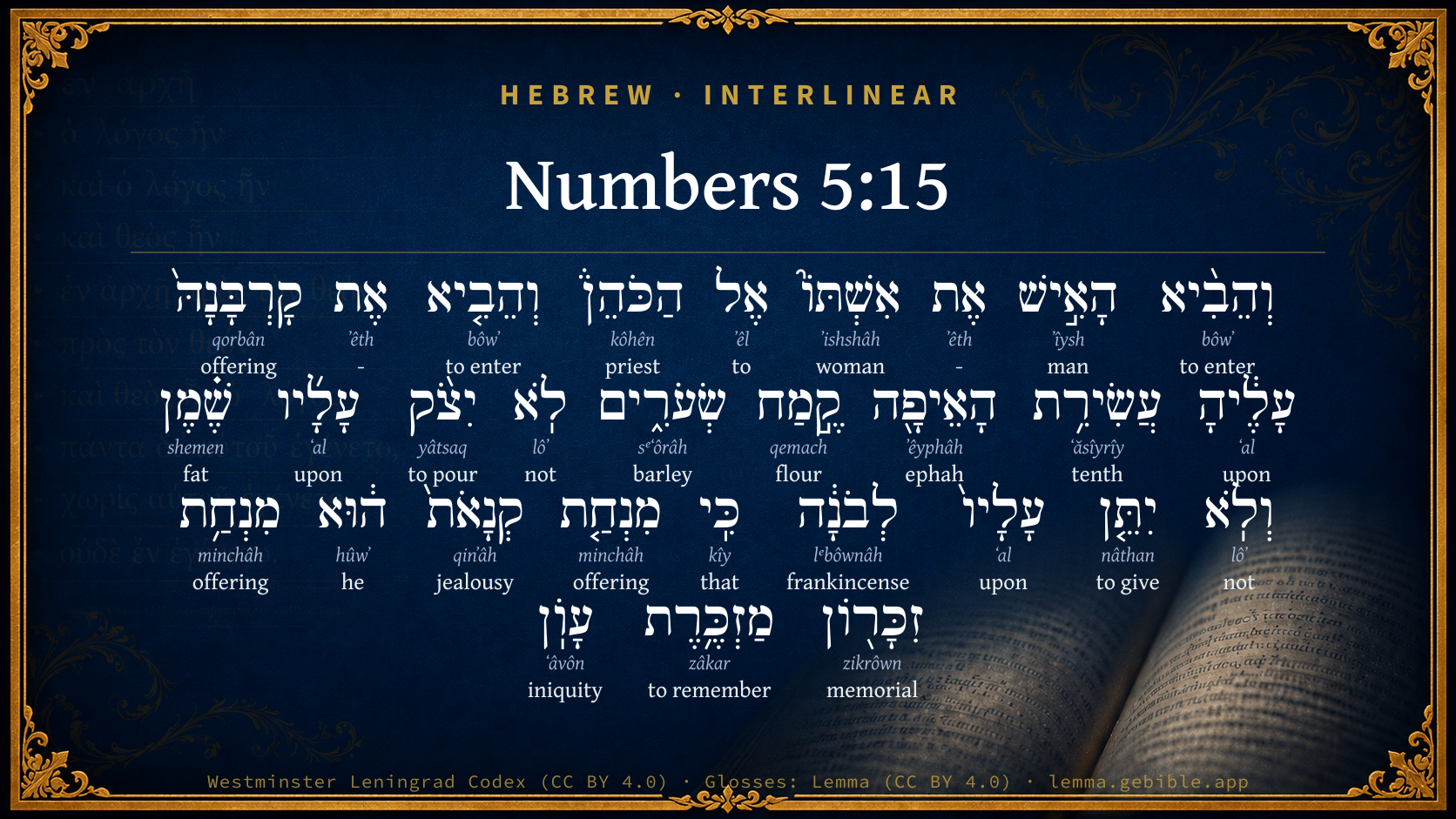
Hebrew (Westminster Leningrad Codex) Numbers 5:15 appears in the Hebrew Old Testament. The text above is from the Westminster Leningrad Codex. Each word links to its Strong’s number, a concise gloss, and parsing drawn from the Open Scriptures Hebrew Bible morphology. Click any word for its full Brown-Driver-Briggs (BDB) entry.
Download image
Cite this verse

Numbers 5:15 (World English Bible). Public Domain. Lemma interlinear Bible study tool, https://lemma.gebible.app/v/numbers/5/15.

Show BibTeX & RIS
BibTeX
RIS
English Translation
then the man shall bring his wife to the priest, and shall bring her offering for her: the tenth part of an ephah of barley meal. He shall pour no oil on it, nor put frankincense on it, for it is a meal offering of jealousy, a meal offering of memorial, bringing iniquity to memory.
World English Bible · Public Domain
Download a study sheet

One document with this verse’s original text, its word-by-word gloss line, the meaning frame, cross-references with their text, attributed commentary, and full source and license credits — printable, and it pastes into notes with its structure intact.

This verse Autodidact and up

Study sheet (.html) Plain text (.txt)

A passage Seminary Student

Up to 50 verses in one chapter. A passage sheet keeps up to 6 commentary sources and 12 cross-references per verse, in the order this page ranks them, and says so on the sheet whenever that leaves anything out. Ask for a single verse and you get the Autodidact verse sheet above.

Everything on this page stays free to read, with no account — the sheet is a download of what is already on screen, not access to it.

Want to remove ads? Support Godless Engineer
Compare translations 3

The same verse in 3 English versions, stacked beneath the original-language interlinear above. Click any original word for its lexicon entry.

Each is an independent rendering of the whole verse — the interlinear is not word-aligned to these translations.

Highlighted words mark where these versions differ — a whole-verse word diff, not a word-by-word alignment.

  • World English Bible Public Domain
    then the man shall bring his wife to the priest, and shall bring her offering for her: the tenth part of an ephah of barley meal. He shall pour no oil on it, nor put frankincense on it, for it is a meal offering of jealousy, a meal offering of memorial, bringing iniquity to memory.
  • King James Version Public Domain
    Then shall the man bring his wife unto the priest, and he shall bring her offering for her, the tenth part of an ephah of barley meal; he shall pour no oil upon it, nor put frankincense thereon; for it is an offering of jealousy, an offering of memorial, bringing iniquity to remembrance.
  • unfoldingWord Literal Text CC BY-SA 4.0
    then the man shall bring his wife to the priest. And he shall bring her offering upon her, the tenth of the ephah of flour of barley. He shall not pour oil on it, and he shall not put frankincense on it, for it a grain offering of jealousy, a grain offering of memorial causing iniquity to be remembered.

unfoldingWord Literal Text — © unfoldingWord, licensed CC BY-SA 4.0. Word-aligned USFM3 via Door43 (git.door43.org/unfoldingWord/en_ult).

Versions to compare (up to 4)

3 of 4 selected

Show all 18 translations

Every available English version of this verse, each an independent rendering of the whole verse.

  • World English Bible Public Domain
    then the man shall bring his wife to the priest, and shall bring her offering for her: the tenth part of an ephah of barley meal. He shall pour no oil on it, nor put frankincense on it, for it is a meal offering of jealousy, a meal offering of memorial, bringing iniquity to memory.
  • Berean Standard Bible Public Domain
    then he is to bring his wife to the priest. He must also bring for her an offering of a tenth of an ephah of barley flour. He is not to pour oil over it or put frankincense on it, because it is a grain offering for jealousy, an offering of memorial as a reminder of iniquity.
  • Majority Standard Bible Public Domain
    then he is to bring his wife to the priest. He must also bring for her an offering of a tenth of an ephah of barley flour. He is not to pour oil over it or put frankincense on it, because it is a grain offering for jealousy, an offering of memorial as a reminder of iniquity.
  • King James Version Public Domain
    Then shall the man bring his wife unto the priest, and he shall bring her offering for her, the tenth part of an ephah of barley meal; he shall pour no oil upon it, nor put frankincense thereon; for it is an offering of jealousy, an offering of memorial, bringing iniquity to remembrance.
  • American Standard Version (1901) Public Domain
    then shall the man bring his wife unto the priest, and shall bring her oblation for her, the tenth part of an ephah of barley meal; he shall pour no oil upon it, nor put frankincense thereon; for it is a meal-offering of jealousy, a meal-offering of memorial, bringing iniquity to remembrance.
  • Revised Version (1885) Public Domain
    then shall the man bring his wife unto the priest, and shall bring her oblation for her, the tenth part of an ephah of barley meal; he shall pour no oil upon it, nor put frankincense thereon; for it is a meal offering of jealousy, a meal offering of memorial, bringing iniquity to remembrance.
  • Geneva Bible (1599) Public Domain
    Then shall the man bring his wife to the Priest, and bring her offering with her, the tenth part of an Ephah of barly meale, but he shall not powre oyle vpon it, nor put incense thereon: for it is an offring of ielousie, an offring for a remembrance, calling the sinne to minde:
  • Douay-Rheims (1899) Public Domain
    He shall bring her to the priest, and shall offer an oblation for her, the tenth part of a measure of barley meal: he shall not pour oil thereon, nor put frank- incense upon it: because it is a sacrifice of jealousy, and an oblation searching out adultery.
  • Young's Literal Translation Public Domain
    `Then hath the man brought in his wife unto the priest, and he hath brought in her offering for her, a tenth of the ephah of barley meal, he doth not pour on it oil, nor doth he put on it frankincense, for it `is' a present of jealousy, a present of memorial, causing remembrance of iniquity.
  • Literal Standard Version CC BY-SA 4.0
    then the man has brought in his wife to the priest, and he has brought in her offering for her—a tenth of the ephah of barley meal; he does not pour oil on it, nor does he put frankincense on it, for it [is] a present of jealousy, a present of memorial, causing remembrance of iniquity.
  • Unlocked Literal Bible CC BY-SA 4.0
    In such cases, the man must bring his wife to the priest. The husband must take an offering required on her behalf, a tenth of an ephah of barley flour. He must pour no oil on it and put no frankincense on it, because it is a grain offering of jealousy, a grain offering for remembering, as a reminder of the iniquity.
  • unfoldingWord Literal Text CC BY-SA 4.0
    then the man shall bring his wife to the priest. And he shall bring her offering upon her, the tenth of the ephah of flour of barley. He shall not pour oil on it, and he shall not put frankincense on it, for it a grain offering of jealousy, a grain offering of memorial causing iniquity to be remembered.
  • Darby Bible Public Domain
    -- then shall the man bring his wife unto the priest, and he shall bring her offering for her, a tenth part of an ephah of barley-meal; he shall pour no oil upon it, nor put frankincense thereon; for it is an oblation of jealousy, a memorial oblation, bringing iniquity to remembrance.
  • World Messianic Bible Public Domain
    then the man shall bring his wife to the priest, and shall bring her offering for her: one tenth of an efah of barley meal. He shall pour no oil on it, nor put frankincense on it, for it is a meal offering of jealousy, a meal offering of memorial, bringing iniquity to memory.
  • Webster's Bible Public Domain
    Then shall the man bring his wife to the priest, and he shall bring her offering for her, the tenth part of an ephah of barley-meal; he shall pour no oil upon it, nor put frankincense upon it; for it is an offering of jealousy, an offering of memorial, bringing iniquity to remembrance.
  • Free Bible Version CC BY-SA 4.0
    he is to take her before the priest. He is also to take with him on her behalf an offering of one tenth of an ephath of barley flour. He must also bring for her an offering of an ephath of barley flour. He's not to pour olive oil over it or put frankincense on it, since it's a grain offering for jealousy, a reminder offering to remind people about sin.
  • Bible in Basic English Public Domain
    Then let him take her to the priest, offering for her the tenth part of an ephah of barley meal, without oil or perfume; for it is a meal offering of a bitter spirit, a meal offering keeping wrongdoing in mind.
  • JPS Tanakh (1917) Public Domain
    then shall the man bring his wife unto the priest, and shall bring her offering for her, the tenth part of an ephah of barley meal; he shall pour no oil upon it, nor put frankincense thereon; for it is a meal-offering of jealousy, a meal-offering of memorial, bringing iniquity to remembrance.

Literal Standard Version (2020), Covenant Press — licensed CC BY-SA 4.0. Text via the HelloAO Bible API (eBible.org). Unlocked Literal Bible (unfoldingWord) — licensed CC BY-SA 4.0. Text via the HelloAO Bible API (eBible.org). unfoldingWord Literal Text — © unfoldingWord, licensed CC BY-SA 4.0. Word-aligned USFM3 via Door43 (git.door43.org/unfoldingWord/en_ult). Free Bible Version, Dr. Jonathan Gallagher — licensed CC BY-SA 4.0. Text via the HelloAO Bible API (eBible.org).

Word by word

More ways to search: Search by grammar → Find every occurrence → Compare this word →

Practice this passage: Drill this verse → Learn its vocabulary →

קֶ֣מַח
qemach
H7058
“flour of”
Noun, Common, Masculine, Singular, Construct
Part of Speech
Noun
Type
Common
Gender
Masculine
Number
Singular
State
Construct
Full BDB Definition

Origin: from an unused root probably meaning to grind

TWOT: 2033a

flour, meal, meal flour
  1. וְהֵבִ֨יא bôwʼ H935 “and · to enter” Conjunction + Verb, Hiphil, Sequential Perfect, 3rd Person, Masculine, Singular
  2. הָאִ֣ישׁ ʼîysh H376 “the · man” Particle, Definite Article + Noun, Common, Masculine, Singular, Absolute
  3. אֶת ʼêth H853 “-” Particle, Direct Object
  4. אִשְׁתּוֹ֮ ʼishshâh H802 “woman · his” Noun, Common, Feminine, Singular, Construct + Suffix, Personal, 3rd Person, Masculine, Singular
  5. אֶל ʼêl H413 “to” Preposition
  6. הַכֹּהֵן֒ kôhên H3548 “the · priest” Particle, Definite Article + Noun, Common, Masculine, Singular, Absolute
  7. וְהֵבִ֤יא bôwʼ H935 “and · to enter” Conjunction + Verb, Hiphil, Sequential Perfect, 3rd Person, Masculine, Singular
  8. אֶת ʼêth H853 “-” Particle, Direct Object
  9. קָרְבָּנָהּ֙ qorbân H7133 “offering · her” Noun, Common, Masculine, Singular, Construct + Suffix, Personal, 3rd Person, Feminine, Singular
  10. עָלֶ֔יהָ ʻal H5921 “upon · her” Preposition + Suffix, Personal, 3rd Person, Feminine, Singular
  11. עֲשִׂירִ֥ת ʻăsîyrîy H6224 “tenth” Adjective, Ordinal number, Feminine, Singular, Construct
  12. הָאֵיפָ֖ה ʼêyphâh H374 “the · ephah” Particle, Definite Article + Noun, Common, Feminine, Singular, Absolute
  13. שְׂעֹרִ֑ים sᵉʻôrâh H8184 “barley” Noun, Common, Feminine, Plural, Absolute
  14. לֹֽא lôʼ H3808 “not” Particle, Negative
  15. יִצֹ֨ק yâtsaq H3332 “to pour” Verb, Qal, Imperfect, 3rd Person, Masculine, Singular
  16. עָלָ֜יו ʻal H5921 “upon · him” Preposition + Suffix, Personal, 3rd Person, Masculine, Singular
  17. שֶׁ֗מֶן shemen H8081 “fat” Noun, Common, Masculine, Singular, Absolute
  18. וְלֹֽא lôʼ H3808 “and · not” Conjunction + Particle, Negative
  19. יִתֵּ֤ן nâthan H5414 “to give” Verb, Qal, Imperfect, 3rd Person, Masculine, Singular
  20. עָלָיו֙ ʻal H5921 “upon · him” Preposition + Suffix, Personal, 3rd Person, Masculine, Singular
  21. לְבֹנָ֔ה lᵉbôwnâh H3828 “frankincense” Noun, Common, Feminine, Singular, Absolute
  22. כִּֽי kîy H3588 “that” Conjunction
  23. מִנְחַ֤ת minchâh H4503 “offering of” Noun, Common, Feminine, Singular, Construct
  24. קְנָאֹת֙ qinʼâh H7068 “jealousy” Noun, Common, Feminine, Plural, Absolute
  25. ה֔וּא hûwʼ H1931 “he” Pronoun, Personal, 3rd Person, Masculine, Singular
  26. מִנְחַ֥ת minchâh H4503 “offering of” Noun, Common, Feminine, Singular, Construct
  27. זִכָּר֖וֹן zikrôwn H2146 “memorial” Noun, Common, Masculine, Singular, Absolute
  28. מַזְכֶּ֥רֶת zâkar H2142 “remembering” Verb, Hiphil, Participle Active, Feminine, Singular, Absolute
  29. עָוֺֽן ʻâvôn H5771 “iniquity” Noun, Common, Both, Singular, Absolute

About this verse

These counts appear in no published source. They are computed here, from the morphology-tagged text and Lemma’s own curated glosses. What Lemma adds →

30
words
24
distinct lemmas
Pentateuch
section

Notable vocabulary

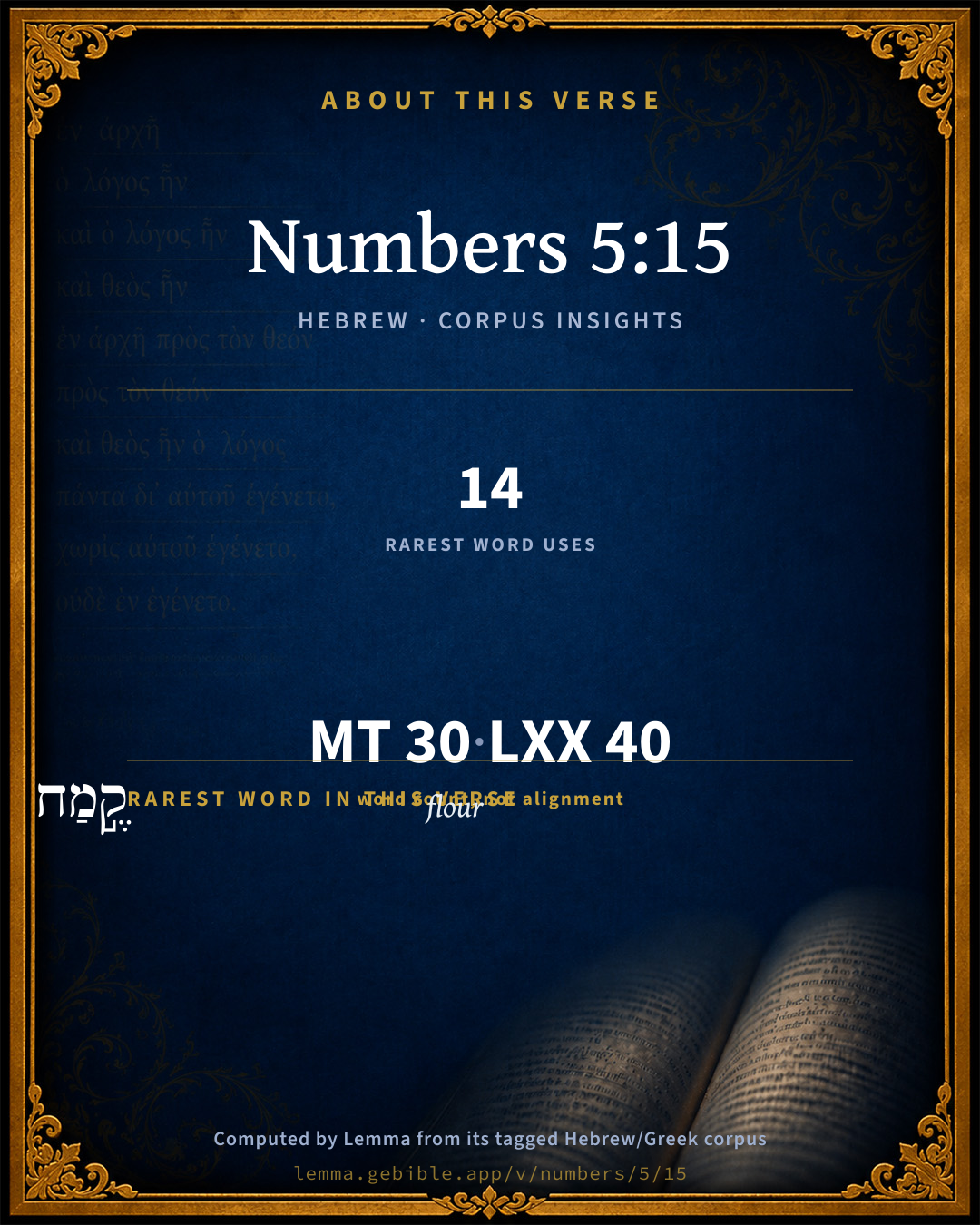
The rarest word here is קֶ֣מַח flour H7058 — appearing just 14 times in the whole Hebrew Bible.

Shared distinctive vocabulary

קֶ֣מַח flour H7058 occurs in 14 verses of the Hebrew Bible. Also found in:

Grammatical profile

  • 5 verbs
  • 14 nouns
  • 1 adjective
  • 1 pronoun
  • 4 prepositions
  • 1 conjunction
  • 4 particles

Verb forms

  • וְהֵבִ֨יא Hiphil · Sequential Perfect
  • וְהֵבִ֤יא Hiphil · Sequential Perfect
  • יִצֹ֨ק Qal · Imperfect
  • יִתֵּ֤ן Qal · Imperfect
  • מַזְכֶּ֥רֶת Hiphil · Participle Active

Repetition

Words recur within this verse — often emphatic in Hebrew:

  • עָלֶ֔יהָ upon H5921 ×3
  • וְהֵבִ֨יא to enter H935 ×2
  • מִנְחַ֤ת offering H4503 ×2
  • לֹֽא not H3808 ×2

Hebrew & Septuagint length

In English translation the verse runs 55 words from the Hebrew and 54 from the Septuagint (LXX English) — closely comparable.

A rough comparison of the two English renderings, which tokenize alike — not a word-level alignment.

Word counts can differ between the Hebrew and the Greek without any difference in meaning — e.g. the Hebrew direct-object marker אֵת has no separate Greek word, and Greek often adds the article ὁ.

In the original languages it is 30 Hebrew tokens and 40 Greek tokens — but the two are counted differently (Hebrew bundles its prefixes and suffixes into one token; the Greek is in lemma form), so that isn’t a like-for-like length.

Cross-references

6

Topical passages linked to Numbers 5:15 in the Treasury of Scripture Knowledge — connected by theme and wording, ordered by reader-vote popularity; previews shown in the World English Bible.

  • Ezekiel 29:16 It shall be no more the confidence of the house of Israel, bringing iniquity to memory, when they turn to look after them: and they shall know that I am the Lord Yahweh.
  • Leviticus 5:11 "'But if he can't afford two turtledoves, or two young pigeons, then he shall bring his offering for that in which he has sinned, the tenth part of an ephah of fine flour for a sin offering. He shall put no oil on it, neither shall he put any frankincense on it, for it is a sin offering.
  • 1 Kings 17:18 She said to Elijah, What have I to do with you, you man of God? You have come to me to bring my sin to memory, and to kill my son!
  • Leviticus 2:1 "'When anyone offers an offering of a meal offering to Yahweh, his offering shall be of fine flour; and he shall pour oil on it, and put frankincense on it.
  • Hosea 3:2 So I bought her for myself for fifteen pieces of silver and a homer and a half of barley.
  • Hebrews 10:3 But in those sacrifices there is yearly reminder of sins.

Cross-references courtesy of OpenBible.info (CC BY 4.0).

Hebrew and Greek witnesses Masoretic Hebrew ↔ Greek Septuagint

The same verse in the two great witnesses to the Old Testament, shown verse-for-verse.

These are two independent witnesses, not word-aligned to each other, and the Septuagint is shown in lemma (dictionary) form.

Hebrew Numbers 5:15 Masoretic · Westminster Leningrad Codex

וְהֵבִ֨יא הָאִ֣ישׁ אֶת אִשְׁתּוֹ֮ אֶל הַכֹּהֵן֒ וְהֵבִ֤יא אֶת קָרְבָּנָהּ֙ עָלֶ֔יהָ עֲשִׂירִ֥ת הָאֵיפָ֖ה קֶ֣מַח שְׂעֹרִ֑ים לֹֽא יִצֹ֨ק עָלָ֜יו שֶׁ֗מֶן וְלֹֽא יִתֵּ֤ן עָלָיו֙ לְבֹנָ֔ה כִּֽי מִנְחַ֤ת קְנָאֹת֙ ה֔וּא מִנְחַ֥ת זִכָּר֖וֹן מַזְכֶּ֥רֶת עָוֺֽן

then the man shall bring his wife to the priest, and shall bring her offering for her: the tenth part of an ephah of barley meal. He shall pour no oil on it, nor put frankincense on it, for it is a meal offering of jealousy, a meal offering of memorial, bringing iniquity to memory.

World English Bible · Public Domain

Greek LXX Numbers 5:15 Septuagint · lemma form

καί ἄγω ὁ ἄνθρωπος ὁ γυνή αὐτός πρός ὁ ἱερεύς καί προςφέρω ὁ δῶρον περί αὐτός ὁ δέκατος ὁ οιφι ἄλευρον κρίθινος οὐ ἐπιχέω ἐπί αὐτός ἔλαιον οὐδέ ἐπιτίθημι ἐπί αὐτός λίβανος εἰμί γάρ θυσία ζηλοτυπία θυσία μνημόσυνον ἀναμιμνήσκω ἁμαρτία

then shall the man bring his wife to the priest, and shall bring his gift for her, the tenth part of an ephah of barley-meal: he shall not pour oil upon it, neither shall he put frankincense upon it; for it is a sacrifice of jealousy, a sacrifice of memorial, recalling sin to remembrance.

LXX2012 (modern English Septuagint) · Public Domain

On this verse, Haydock's Catholic Bible Commentary discusses the Septuagint’s reading. Read the note in Commentary ↓

Hebrew: Westminster Leningrad Codex (CC BY 4.0). Greek: Septuagint (public domain); English from LXX2012 (modern English Septuagint) (Public Domain). How the Septuagint differs from the Hebrew →

Targum (Aramaic paraphrase)

2

The Targum is the ancient Jewish Aramaic paraphrase of the Hebrew Scriptures — an interpretive translation, not the Hebrew text itself. Onkelos (literal) and Pseudo-Jonathan (expansive) render the Torah, and Jonathan the Prophets. Coverage is partial: where no permissively-licensed English translation exists for a verse, only the Aramaic is shown. This is verse-level text, not a word-by-word alignment to the Hebrew.

  1. Targum Onkelos Torah (Genesis–Deuteronomy)
    וְיַיְתֵי גַבְרָא יָת אִתְּתֵהּ לְוַת כַּהֲנָא וְיַיְתֵי יָת קֻרְבָּנַהּ עֲלַהּ חַד מִן עַסְרָא בִּתְלַת סְאִין קִמְחָא שְׂעָרִין לָא יְרִיק עֲלוֹהִי מִשְׁחָא וְלָא יִתֵּן עֲלוֹהִי לְבֻנְתָּא אֲרֵי מִנְחַת קִנְאָתָא הוּא מִנְחַת דוּכְרָנָא מַדְכָּרַת חוֹבָא

    (no public-domain English translation for this verse)

    Targum Onkelos — Aramaic: “Onkelos Genesis” (public domain); “Onkelos Exodus” (public domain); “Onkelos Leviticus” (public domain); “Onkelos Numbers” (public domain); “Onkelos Deuteronomy” (public domain). English: “Sefaria Community Translation” (CC0 1.0 (public-domain dedication)); “J.W. Etheridge. The Targums of Onkelos and Jonathan Ben Uzziel on the Pentateuch. London: Longmans, Green, 1862” (public domain). Text via Sefaria.

  2. Targum Pseudo-Jonathan Torah (Genesis–Deuteronomy)
    וּמְטוֹל דְלָא אַיְיתִי גַבְרָא הַהוּא אַפְרָשׁוּתָא וּמַעַשְרָא אִסְתְּקַף עֲלוֹי דְיַיתֵי יַת אִנְתְּתֵיהּ לְכַהֲנָא וּמְטוֹל דְאִיהִי אַטְעִימַת לְגִיוֹרָא תַפְנוּקִין אִסְתְּקַף עֲלָהּ דְיַיְתֵי יַת קוּרְבָּנָהּ דְקַיִץ עֲלָהּ מִדִילָהּ חַד מִן עַשְרָא בִּתְלַת סְאִין קִמְחָא דְשַעֲרֵי דְהִינוּן מֵיכְלָא דִבְעִירֵי לָא יְרִיק עֲלָהּ מִשְׁחָא וְלָא יִתֵּן עֲלָהּ לְבוֹנְתָּא אֲרוּם מִנְחַת קִנְאֵיתָא הִיא מִנְחַת דוּכְרָנָא מַדְכְּרַת חוֹבִין

    and though that man may have not brought separation or tythe, there is constraint upon him to bring his wife unto the priest. Now, because she may have brought delicacies to the adulterer, she ought to bring an appointed oblation of her own, a tenth of three sata of barley flour, that being the food of beasts: he shall not pour oil, nor put frankincense thereon; for it is a mincha (on account) of jealousy, a mincha of a memorial which calleth guilt to mind.

    Targum Pseudo-Jonathan — Aramaic: “Targum Jonathan on Genesis” (public domain); “Targum Jonathan on Exodus” (public domain); “Targum Jonathan on Leviticus” (public domain); “Targum Jonathan on Numbers” (public domain); “Targum Jonathan on Deuteronomy” (public domain). English: “The Targum of Jonathan ben Uzziel, trans. J. W. Etheridge, London, 1862” (public domain). Text via Sefaria.

Commentary

Notes on Numbers 5:15 from classic Christian and Jewish commentators (each source and its license shown beneath its notes). The classic Christian expositions comment on the surrounding passage and are grouped to its opening verse, so a note may address several verses; the Jewish commentaries on the Tanakh (Rashi and others) are per-verse, so they appear only where the commentator wrote on this verse.

Lemma curates 59 commentaries, every one of them public domain or Creative Commons licensed, each selected and text-cleaned for this edition rather than reprinted as found. About our sources →

Trapp's Complete Commentary

John Trapp

Num 5:15 Then shall the man bring his wife unto the priest, and he shall bring her offering for her, the tenth [part] of an ephah of barley meal; he shall pour no oil upon it, nor put frankincense thereon; for it [is] an offering of jealousy, an offering of memorial, bringing iniquity to remembrance.

Ver. 15. Barley meal.] Barley, not wheat. She hath done the act of a beast, and her oblation is the meat of a beast, as Sal. Zarchi here noteth.

John Trapp, A Commentary or Exposition upon All the Books of the Old and New Testament (1647–1656) — public domain. Text from a community e-Sword module.

Joseph Benson's Commentary

Num 5:15. The man shall bring her to the priest — With the witnesses that could prove the ground of his suspicions, and desire she might be put upon her trial. The Jews say, the priest was first to endeavour to persuade her to confess the truth, saying, to this purpose, “Dear daughter, perhaps thou wast overtaken by drinking wine, or wast carried away by the heat of youth, or the examples of ill neighbours; come, confess the truth, for the sake of his great name, which is described in this most sacred ceremony; and do not let it be blotted out with the bitter water.” If she confessed, saying, I am defiled, she was not put to death, but was divorced, and lost her dowry; if she said, I am pure, then they proceeded.

Joseph Benson's Commentary on the Old and New Testaments (1811–1818) — public domain. Text from a community e-Sword module.

Geneva Bible (1599)

Geneva Bible translators

Or, making the sin known, and not purging it.

Only in the sin offering, and so this offering of jealousy were neither oil nor incense offered.

Geneva Bible (1599) marginal notes — public domain. Text via Bolls.life.

The Cambridge Bible for Schools and Colleges

gen. ed. J. J. S. Perowne

15. the tenth part of an ephah] A little under 7 pints. An ephah was a dry measure equivalent to the liquid measure bath; both were equal to 1/10th homer. See Isa_5:10.

barley meal] The coarsest farinaceous food, ordinarily used by the poorer classes (Jdg_7:13, Joh_6:9; Joh_6:13), and given to animals (1Ki_4:28). It would frequently be used as an offering in early days, but the mention of it is unique in P , which probably shews that it was an integral part of a primitive ceremony on which P’s account is based. Elsewhere in P ‘fine meal’ is always prescribed.

he shall pour no oil upon it &c.] Perhaps because symbols of joy and festivity were excluded by the grievous nature of the woman’s alleged crime. Oil and frankincense were also forbidden in the case of a poor man’s sin-offering (Lev_5:11).

The Cambridge Bible for Schools and Colleges (gen. ed. J. J. S. Perowne; Cambridge University Press, 1878–1918) — public domain. Text from a community e-Sword module.

John Gill's Exposition

Then shall the man bring his wife unto the priest,.... Not to the high priest but to a common priest, anyone then officiating in his course; for there was a jealousy offering to be offered up before the Lord upon the altar, which none but a priest might do; and besides, the whole process in this affair was to be carried, on by him: according to the Misnah (n), the man brought his wife first to the sanhedrim, or court of judicature in the place where he lived; before whom, as Maimonides (o) says, he proved by witnesses that he had warned his wife of being in private with such a man, and yet she had done it again; and whereas she insisted on her chastity, he desired that the bitter waters might be given her, that the truth might appear; and then they sent him with two disciples of the wise men, to the great sanhedrim at Jerusalem, where the trial was made; who, in order to bring her too confession, endeavoured to terrify her, as they do persons in capital cases, and finding this wilt not do, then they used smooth words, saying, my daughter, perhaps much wine was the occasion of it, or much laughter, &c.

and he shall bring her offering for her: not the priest, but her husband, and that whether he is willing or not, as Aben Ezra; who also observes, that it may be interpreted, with her, or for her sake, not to make any expiation for any fault of his, that when he first observed her immodesty, did not reprove her; for the offering, though brought by him, was not his, but his wife's, and not to expiate her sin, but to bring it to remembrance, as is after expressed:

the tenth part of an ephah of barley meal; which was an omer, Exo 16:36, the quantity of manna for one man every day, Exo 16:16, and the quantity of flour in the daily meat offering, Exo 29:40; only that was of fine wheaten flour; this of barley, the food of beasts, as the Targum of Jonathan remarks; and R. Gamaliel in the Misnah (p) says, that as her deed was the deed of a beast, so her offering was the food of a beast; and this is observed by Jarchi and Aben Ezra on the text, as the reason of barley being used in this offering: some say it was a symbol of her impudence, others of her being little at home, as the barley is not long under ground (q); the true reason, it may be, was for her humiliation, being vile, and mean, hence it follows:

he shall pour no oil upon it, nor put frankincense thereon; as used to be oft meat offerings, denoting their acceptableness to God, Lev 2:1; the reason seems to be, because these were tokens of joy and gladness, whereas this was a mournful affair to the husband, that he should have any cause of suspicion and jealousy, to the wife that she should be suspected, and to the whole family on that account:

for it is an offering of jealousy, an offering of memorial, bringing iniquity to remembrance; if guilty of it, and therefore oil and frankincense were forbidden in this kind of offering as in a sin offering, Lev 5:11.

(n) Ut supra, (Misn. Bava Kama, c. 9.) sect. 3, 4. (o) Hilchot Sotah, c. 3. sect. 1. (p) Sotah, c. 2. sect. 1. (q) Apud Muis. in loc.

John Gill's Exposition of the Whole Bible (1746–1763) — public domain (CC PDM 1.0). Text via the HelloAO Bible API.

Haydock's Catholic Bible Commentary

Measure, (sati). Hebrew and Septuagint, "epha," of which the measure was only one-third. (Calmet) --- Oil, &c. These were rejected in sacrifices for sin, Leviticus v. 11. Jealous husbands have no sentiments of commiseration, or of sweetness; (Haydock) nor can any experience the emotions of joy, while they are in such a situation. (Tirinus)

George Leo Haydock (1774–1849), Haydock's Catholic Family Bible and Commentary, 1859 edition — public domain. Excludes Psalms (Douay-Rheims chapter numbering differs from Protestant) and Deuterocanonical books (Catholic canon only).

Matthew Poole's English Annotations

Then, she persisting in her denial, and her husband requiring her submission to this way of trial. Her offering was partly because none were to appear before God empty, Exo 23:15; partly, by way of solemn appeal to God, whom hereby she desired to judge between her and her husband; and partly, by way of atonement to appease God, who had for her sins stirred up her husband against her, and sent an evil spirit between them. See 1Sa 26:19. No oil nor frankincense, both because it was a kind of sin-offering, from which these were excluded, Lev 5:11, and to testify, her sorrowful sense of the hand of God, and of her husband’s displeasure, and because she came thither as a delinquent, or one suspected of delinquency, and under an ill fame, and unpleasing both to God and men; as one that wanted that grace and amiableness and joy which oil signified, and that acceptance with God which frankincense designed, Psa 141:2.

Bringing iniquity to remembrance; both to God, before whom she appeared as a sinner, and to her own conscience, if she were guilty, and, if she were not guilty of this, yet it reminded her of her other sins, for which this might be a punishment.

Matthew Poole's English Annotations on the Holy Bible (1683–1685) — public domain. Text from a community e-Sword/MySword module.

Whedon's Commentary on the Bible

Daniel D. Whedon

15. Bring his wife unto the priest — The outline of this ritual consisted in the presentation of the suspected wife by her husband to the priest with an offering to bring iniquity “to remembrance.” The essential part was the oath, in which she solemnly protested her innocence, the water being merely the visible channel through which the supernatural curse was to operate, as the clay put upon the eyes of the blind was a visible link between the divine omnipotence and the opening of the eyes. God was invoked to pronounce sentence, and his presence was recognised by throwing a handful of the barley meal on the blazing altar, the woman meanwhile standing before the Lord with the offering in her hand. The priest stood holding the earthen vessel of holy water, mixed with dust taken from the floor of the sanctuary, declaring the woman free from evil consequences if innocent, and dooming her to terrible sufferings if guilty. The curses written in a book were then washed off into the water; the woman drank it, and uttered “Amen, amen,” to the curses falling upon her head from the lips of the priest.

Her offering — None were allowed to approach the sanctuary empty handed. Exo_23:15. The Hebrew word for offering — corban — is from the verb to approach, implying that an offering of access or introduction must be made to Jehovah, in accordance with Oriental usage when an inferior comes into the presence of a superior.

The tenth of an ephah of barley meal — The ephah, according to Josephus, was about eight and a half gallons; but the Rabbies say that it was about half that quantity. The barley meal, without oil or frankincense, was a coarse and cheap offering, symbolizing the gross animal character and vileness of the crime in question, and the sad state of the family offering it. It was not an atoning sacrifice, but a memorial solemnly referring the decision to Jehovah. This meat offering, made without the accompaniment of burnt offerings and peace offerings, proves its independence, which has been denied by Bahr and Kurtz on insufficient grounds. No oil was to be poured upon it, probably because the oil is not only the emblem of joy, but in its threefold use for light, food, and healing, symbolizes the illumination, the spiritual sustenance, and restoring efficacy of the Holy Ghost, whose inner abode presupposes the sincerity of the worshipper, the very point in question in the case of the suspected wife.

Nor… frankincense — Since this was the emblem of acceptable prayer, it could not be offered by her who might be regarding iniquity in her heart, in which case prayer, instead of being a savour of sweet smell, is a stench in the nostrils of Jehovah.

Bringing iniquity to remembrance — This was designed not only to quicken the slumbering conscience of the accused, but to exhibit to all spectators the turpitude of this great sin. In an anthropomorphic view of God, it was an appeal to the memory of God to remind him of his promise to interpose for the decision of this trial.

Daniel D. Whedon (gen. ed.), Commentary on the Old and New Testaments (1874–1909) — public domain. Text from a community e-Sword module.

The Pulpit Commentary

He shall bring her offering for her HnBdq, "her offering;" hyl, "on her account." It was to be a meat offering not connected on this occasion with any other sacrifice of the fruits of the earth, symbolizing the fruits of her guilty, or at least care. less and suspicious, conduct. As of barley meal, not of fine wheat flour, it indicated her present low and vile estate (deserved or undeserved); as without incense or oil, it disclaimed for itself the sanctifying influences of God"s grace and of prayer. Thus every detail of the offering, while it did not condemn the woman (for one found guilty could not have made any offering at all), yet represented her questionable repute and unquestionable dishonour, for even the unjust suspicion of the husband is a dishonour to the wife. Barley meal. In the days of Elisha half the price of fine flour, (2Ki_7:1) and only eaten by the poor. (Eze_4:12Jo Eze_6:9) An offering of jealousy. Literally, "of jealousies." taonq, an intensive plural. An offering of memorial, bringing iniquity to remembrance. Yusia mnhmosinou , Septuagint. An offering to bring the woman into judicial remembrance before the Lord, in order that her sin (if any) might be remembered with him, and be declared.

The Pulpit Commentary (1880–1919), ed. H.D.M. Spence-Jones & Joseph S. Exell — public domain. Text from a community e-Sword module.

John Wesley's Explanatory Notes

The man shall bring her to the priest - Who first strove to persuade her to own the truth. If she did, she was not put to death, (which must have been, if it had been proved against her) but only was divorced and lost her dowry. Her offering - By way of solemn appeal to God, whom hereby she desired to judge between her and her husband, and by way of atonement to appease God, who had for her sins stirred up her husband against her. He shall pour no oil - Both because it was a kind of sin-offering, from which these were excluded, and because she came thither as a delinquent, or suspected of delinquency, unpleasing both to God and men; as one that wanted that grace and amiableness and joy which oil signified, and that acceptance with God which frankincense denoted, Psalm 1xli, 2. Bringing iniquity to remembrance - Both to God before whom she appeared as a sinner, and to her own conscience, if she was guilty; and, if she were not guilty of this, yet it reminded her of her other sins, for which this might be a punishment.

John Wesley, Explanatory Notes Upon the Whole Bible (1754–1765) — public domain. Text via the GEBible commentary corpus.

unfoldingWord translationNotes

Door43 World Missions Community

a tenth

This is one part out of ten equal parts. (See: Fractions)

a tenth of an ephah

This can be written in modern measurements. AT: "a tenth of an ephah (which is about 2 liters)" or "2 liters" (See: Biblical Volume)

a grain offering of jealousy

"a grain offering for jealousy"

a reminder of the iniquity

A "reminder" is something that shows evidence that something had occurred that required justice. In this case, he made the offering to determine whether his wife had committed adultery or not.

translationWords

priest

drink offering

tenth

barley

oil

frankincense

grain offering

sin

unfoldingWord translationNotes — © Distant Shores Media and the Door43 World Missions Community, licensed CC BY-SA 4.0. Source: git.door43.org/Door43/en_tn.

Rashi

Rabbi Shlomo Yitzchaki (Rashi)

קמח implies that it shall not be of fine sifted flour.

It must be שערים BARLEY, and not wheat; because she committed a bestial act, therefore shall her offering consist of that which is food for beasts (Sifrei Bamidbar 8; Sotah 14a).

לא יצק עליו שמן HE SHALL POUR NO OIL UPON IT, so that her offering shall not be embellished (cf. Rashi on Leviticus 5:11) — and also because oil is called light (it is named יצהר from the root צהר, to give light; see Tanchuma) whilst she acted in darkness (Midrash Tanchuma, Nasso 3; cf. Sotah 15a).

ולא יתן עליו לבנה NOR SHALL HE PUT FRANKINCENSE THEREON — Because the matriarchs are symbolically termed frankincense, as it is said, (Songs 4:6) “I will get me … to the hill of frankincense” (which is taken as an allusion to the matriarchs), whilst she deviated from their paths (Midrash Tanchuma, Nasso 3).

כי מנחת קנאת הוא FOR IT IS A MEAL OFFERING OF JEALOUSY — i.e., this קמח is a meal offering of jealousy; for the word קמח is masculine and is therefore referred to by the masc. form.

מנחת קנאת A MEAL OFFERING OF JEALOUSY — The plural קנאות is used because it arouses against her two outbreaks of jealousy — the jealousy of the Omnipresent and the jealousy of her husband (Tosefta Sotah 2; Sifrei Bamidbar 8; cf. Rashi’s second comment on איש איש v. 12).

Rashi on the Tanakh — English translations: “The Judaica Press complete Tanach with Rashi, translated by A. J. Rosenberg” (CC BY 4.0); “Pentateuch with Rashi's commentary by M. Rosenbaum and A.M. Silbermann, 1929-1934” (public domain); “The Metsudah Tanach series, Lakewood, N.J” (CC BY 4.0); and “The Book of Joshua, Metsudah Publications, 1997” (CC BY 4.0). Text via Sefaria.

Ramban (Nachmanides)

Rabbi Moshe ben Nachman (Ramban / Nachmanides)

HE SHALL POUR NO OIL UPON IT — “so that her offering shall not be enriched, for oil is called light, whereas she acted in darkness. NOR SHALL HE PUT FRANKINCENSE THEREON, for the matriarchs are compared to frankincense, as it is said, to the hill of frankincense [an allegorical expression explained by the Midrash as an allusion to the matriarchs], but this woman turned aside from their [virtuous] ways (Midrash Tanhuma Nasso 3). FOR IT IS A MEAL-OFFERING OF JEALOUSIES. This flour arouses against her two jealousies — the jealousy of G-d, and the jealousy of her husband.” Thus far is Rashi’s language on the basis of the words of our Rabbis. 3; Sifre Naso 8.But in the opinion of all the commentators [the meaning of the expression] for it is a meal-offering of jealousies is to say that because this meal-offering [of the sotah] is a woman suspected of adultery, and is subject to the laws explained further on in Verses 11-31. The law concerning her meal-offering is found in Verse 15, where it is called a meal-offering of jealousy. is an offering which may bring her punishment [if the charge against her is true], therefore it is of a lesser quality [than all other meal-offerings and is to be brought of] barley without oil and frankincense. On the other hand, a meal-offering of which the memorial-part is brought to be acceptable before the Eternal, is to be brought from fine wheat-flour with oil and frankincense. But in my opinion the expression for it is a meal-offering of jealousies refers to the beginning of the verse, stating that the husband shall bring the offering for his wife, that is to say, instead of her, for it is a meal-offering of jealousies bringing her iniquity to remembrance. Thus it is not fitting that she should bring it of her own property, but it is he who is to bring the meal-offering to G-d so that He should take note of his suspicions of her, and punish her on his [the husband’s] behalf. And the reason [why this meal-offering comes from] se’orim (barley) (barley) is suggestive of the word sa’ar (storm), as is indicated in the next verse quoted by Ramban. is so that ‘sa’arath’ (a storm of) the Eternal is gone forth in fury, yea, a whirling storm; it shall whirl upon the head of wickedness, like the cake of barley bread, 22-28). mentioned in the story of Gideon, which [one of the Midianites who saw it in a dream] interpreted as referring to a storm (sa’ar) and great confusion [which would break forth upon the camp of the Midianites]. Similarly, the earthen vessel [in which the holy water is put] is a hint that she shall be broken like a potter’s vessel, and likewise the dust [which must be taken from the floor of the Tabernacle and put into the water indicates] that she is dust, and into dust shall she return [if she is guilty of adultery]. The meaning of the word hu [ki minchath kna’oth ‘hu’ — using the masculine form of “it” in the phrase “it is a meal-offering of jealousies,” when it should have used hi, the feminine form, since the word minchah (meal-offering) is feminine] is because it refers back to the word kemach (flour) [which is mentioned above in the same verse, and the word kemach is masculine]. But this [unusual usage of the masculine here] has a mystical explanation, for further on when the meal-offering is in the hands of the woman Scripture uses the word hi [minchath kna’oth hi — literally: “‘she’ is a meal-offering of jealousies”]. And now [in this verse] Scripture mentions the memorial first, stating that “she” brings iniquity to remembrance. [literally: “for a meal-offering of jealousies ‘he’ is, a meal-offering of memorial, bringing iniquity to remembrance”], and the meaning thereof is that in this meal-offering there is both judgment and mercy: judgment, if she is guilty, and mercy if innocent. The word hu in this verse thus refers both to kemach and zikaron, which allude to these two attributes. Hence also the word hu is mentioned before zikaron (“memorial”), for “the memorial which brings iniquity to remembrance” surely alludes to the attribute of judgment, and the word hu which is mentioned before “the memorial” therefore alludes to mercy. Further on in Verse 18, however, the text reads: eith minchath hazikaron minchath kna’oth hi. There the word hi (“she”) appears at the end of the whole expression, after hazikaron (“the memorial”), when the meal-offering is in her hands [as the verse states] it is only “judgment” which brings the iniquity to remembrance. See further my Hebrew commentary p. 213.

Ramban (Nachmanides) on the Tanakh — English translation: “Commentary on the Torah by Ramban (Nachmanides). Translated and annotated by Charles B. Chavel. New York, Shilo Pub. House, 1971-1976” (CC BY 4.0). Text via Sefaria.

Lesson kit

Teaching starters — assembled from the data on this page, not authored interpretation. Every prompt links to the verse data it draws on. Edit before teaching.

Numbers, in the Pentateuch, opens this verse with 30 words (24 distinct Hebrew lemmas). Its most distinctive word is qemach (“flour”). A historical commentator’s framing appears above. Read the whole chapter for the surrounding context.

Discussion questions

  1. How does “flour” (qemach) shape what this verse is saying?
  2. How does Genesis 18:6, which shares the word «flour», read alongside this verse?
  3. What does the repetition of “upon” (3× in this one verse) do in this verse?
  4. These translations render this verse differently; the difference is in the English rendering, not the original. What questions does that raise?
  5. «וְהֵבִ֨יא» is a Hiphil Sequential Perfect verb. How does that grammatical form shape the action described?
  6. Compare how Trapp's Complete Commentary and Joseph Benson's Commentary read this verse. Where do they agree or differ?

Things to notice

Reading settings

Reading text

Shown beneath each verse's original-language words.

Old Testament
Old Testament edition

Read the OT as the Masoretic Hebrew (MT) or the Greek Septuagint (LXX).

English shown for the Greek Septuagint (in the Hebrew ↔ Greek comparison).

Comparing translations? Open the Compare panel on any verse page to stack up to four side by side.