
Psalms 65:3

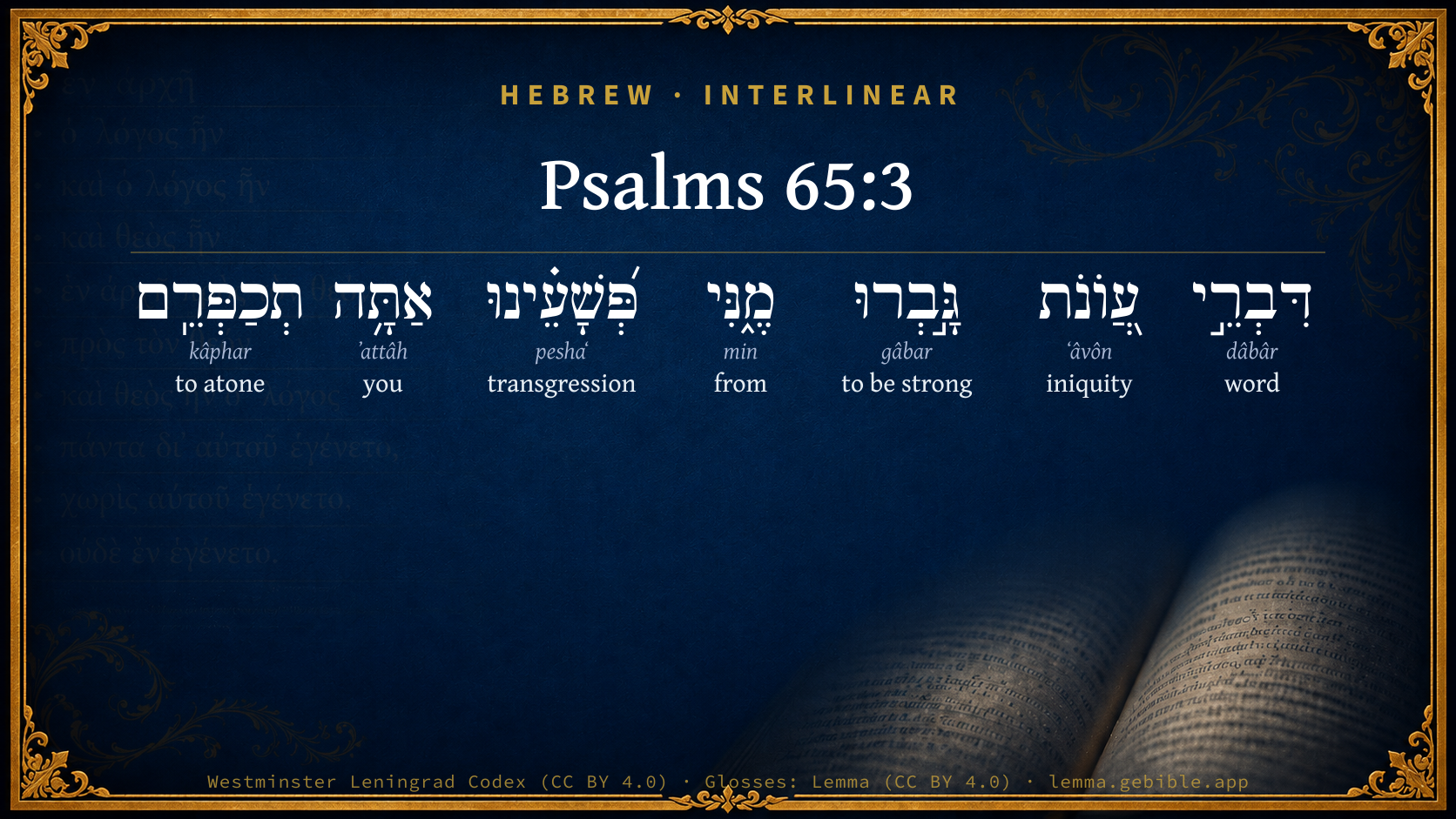
Hebrew (Westminster Leningrad Codex) Psalms 65:3 appears in the Hebrew Old Testament. The text above is from the Westminster Leningrad Codex. Each word links to its Strong’s number, a concise gloss, and parsing drawn from the Open Scriptures Hebrew Bible morphology. Click any word for its full Brown-Driver-Briggs (BDB) entry.
Download image
Cite this verse

Psalms 65:3 (World English Bible). Public Domain. Lemma interlinear Bible study tool, https://lemma.gebible.app/v/psalms/65/3.

Show BibTeX & RIS
BibTeX
RIS
English Translation
Sins overwhelmed me, But you atoned for our transgressions.
World English Bible · Public Domain
Download a study sheet

One document with this verse’s original text, its word-by-word gloss line, the meaning frame, cross-references with their text, attributed commentary, and full source and license credits — printable, and it pastes into notes with its structure intact.

This verse Autodidact and up

Study sheet (.html) Plain text (.txt)

A passage Seminary Student

Up to 50 verses in one chapter. A passage sheet keeps up to 6 commentary sources and 12 cross-references per verse, in the order this page ranks them, and says so on the sheet whenever that leaves anything out. Ask for a single verse and you get the Autodidact verse sheet above.

Everything on this page stays free to read, with no account — the sheet is a download of what is already on screen, not access to it.

Want to remove ads? Support Godless Engineer
Compare translations 3

The same verse in 3 English versions, stacked beneath the original-language interlinear above. Click any original word for its lexicon entry.

Each is an independent rendering of the whole verse — the interlinear is not word-aligned to these translations.

Highlighted words mark where these versions differ — a whole-verse word diff, not a word-by-word alignment.

  • World English Bible Public Domain
    Sins overwhelmed me, But you atoned for our transgressions.
  • King James Version Public Domain
    Iniquities prevail against me: as for our transgressions, thou shalt purge them away.
  • unfoldingWord Literal Text CC BY-SA 4.0
    Matters of iniquities prevail against me; our transgressions, you, you cover them.

unfoldingWord Literal Text — © unfoldingWord, licensed CC BY-SA 4.0. Word-aligned USFM3 via Door43 (git.door43.org/unfoldingWord/en_ult).

Versions to compare (up to 4)

3 of 4 selected

Show all 18 translations

Every available English version of this verse, each an independent rendering of the whole verse.

  • World English Bible Public Domain
    Sins overwhelmed me, But you atoned for our transgressions.
  • Berean Standard Bible Public Domain
    When iniquities prevail against me, You atone for our transgressions.
  • Majority Standard Bible Public Domain
    When iniquities prevail against me, You atone for our transgressions.
  • King James Version Public Domain
    Iniquities prevail against me: as for our transgressions, thou shalt purge them away.
  • American Standard Version (1901) Public Domain
    Iniquities prevail against me: As for our transgressions, thou wilt forgive them.
  • Revised Version (1885) Public Domain
    Iniquities prevail against me: as for our transgressions, thou shalt purge them away.
  • Geneva Bible (1599) Public Domain
    Wicked deedes haue preuailed against me: but thou wilt be mercifull vnto our transgressions.
  • Douay-Rheims (1899) Public Domain
    O hear my prayer: all flesh shall come to thee.
  • Young's Literal Translation Public Domain
    Matters of iniquities were mightier than I, Our transgressions -- Thou dost cover them.
  • Literal Standard Version CC BY-SA 4.0
    Matters of iniquities were mightier than I, || Our transgressions—You cover them.
  • Unlocked Literal Bible CC BY-SA 4.0
    Iniquities prevail against us; as for our transgressions, you will forgive them.
  • unfoldingWord Literal Text CC BY-SA 4.0
    Matters of iniquities prevail against me; our transgressions, you, you cover them.
  • Darby Bible Public Domain
    Iniquities have prevailed against me: our transgressions, thou wilt forgive them.
  • World Messianic Bible Public Domain
    Sins overwhelmed me, but you atoned for our transgressions.
  • Webster's Bible Public Domain
    \\65:2\\O thou that hearest prayer, to thee shall all flesh come.
  • Free Bible Version CC BY-SA 4.0
    Even though we're drowning in our sins and our disobedience, you forgive us.
  • Bible in Basic English Public Domain
    Evils have overcome us: but as for our sins, you will take them away.
  • JPS Tanakh (1917) Public Domain
    (65-4) The tale of iniquities is too heavy for me; as for our transgressions, Thou wilt pardon them.

Literal Standard Version (2020), Covenant Press — licensed CC BY-SA 4.0. Text via the HelloAO Bible API (eBible.org). Unlocked Literal Bible (unfoldingWord) — licensed CC BY-SA 4.0. Text via the HelloAO Bible API (eBible.org). unfoldingWord Literal Text — © unfoldingWord, licensed CC BY-SA 4.0. Word-aligned USFM3 via Door43 (git.door43.org/unfoldingWord/en_ult). Free Bible Version, Dr. Jonathan Gallagher — licensed CC BY-SA 4.0. Text via the HelloAO Bible API (eBible.org).

Word by word

More ways to search: Search by grammar → Find every occurrence → Compare this word →

Practice this passage: Drill this verse → Learn its vocabulary →

גָּ֣בְרוּ
gâbar
H1396
“to be strong”
Verb, Qal, Perfect, 3rd Person, Common, Plural
Part of Speech
Verb
Stem
Qal
Form
Perfect
Person
3rd Person
Gender
Common
Number
Plural
Full BDB Definition

Origin: a primitive root

TWOT: 310

to prevail, have strength, be strong, be powerful, be mighty, be great - (Qal) - to be strong, mighty - to prevail - (Piel) to make strong, strengthen - (Hiphil) - to confirm, give strength - to confirm (a covenant) - (Hithpael) - to show oneself mighty - to act proudly (toward God)
  1. דִּבְרֵ֣י dâbâr H1697 “words of” Noun, Common, Masculine, Plural, Construct
  2. עֲ֭וֺנֹת ʻâvôn H5771 “iniquities” Noun, Common, Both, Plural, Absolute
  3. מֶ֑נִּי min H4480 “from · me” Preposition + Suffix, Personal, 1st Person, Common, Singular
  4. פְּ֝שָׁעֵ֗ינוּ peshaʻ H6588 “transgressions · our” Noun, Common, Masculine, Plural, Construct + Suffix, Personal, 1st Person, Common, Plural
  5. אַתָּ֥ה ʼattâh H859 “you” Pronoun, Personal, 2nd Person, Masculine, Singular
  6. תְכַפְּרֵֽם kâphar H3722 “to atone · them” Verb, Piel, Imperfect, 2nd Person, Masculine, Singular + Suffix, Personal, 3rd Person, Masculine, Plural

About this verse

These counts appear in no published source. They are computed here, from the morphology-tagged text and Lemma’s own curated glosses. What Lemma adds →

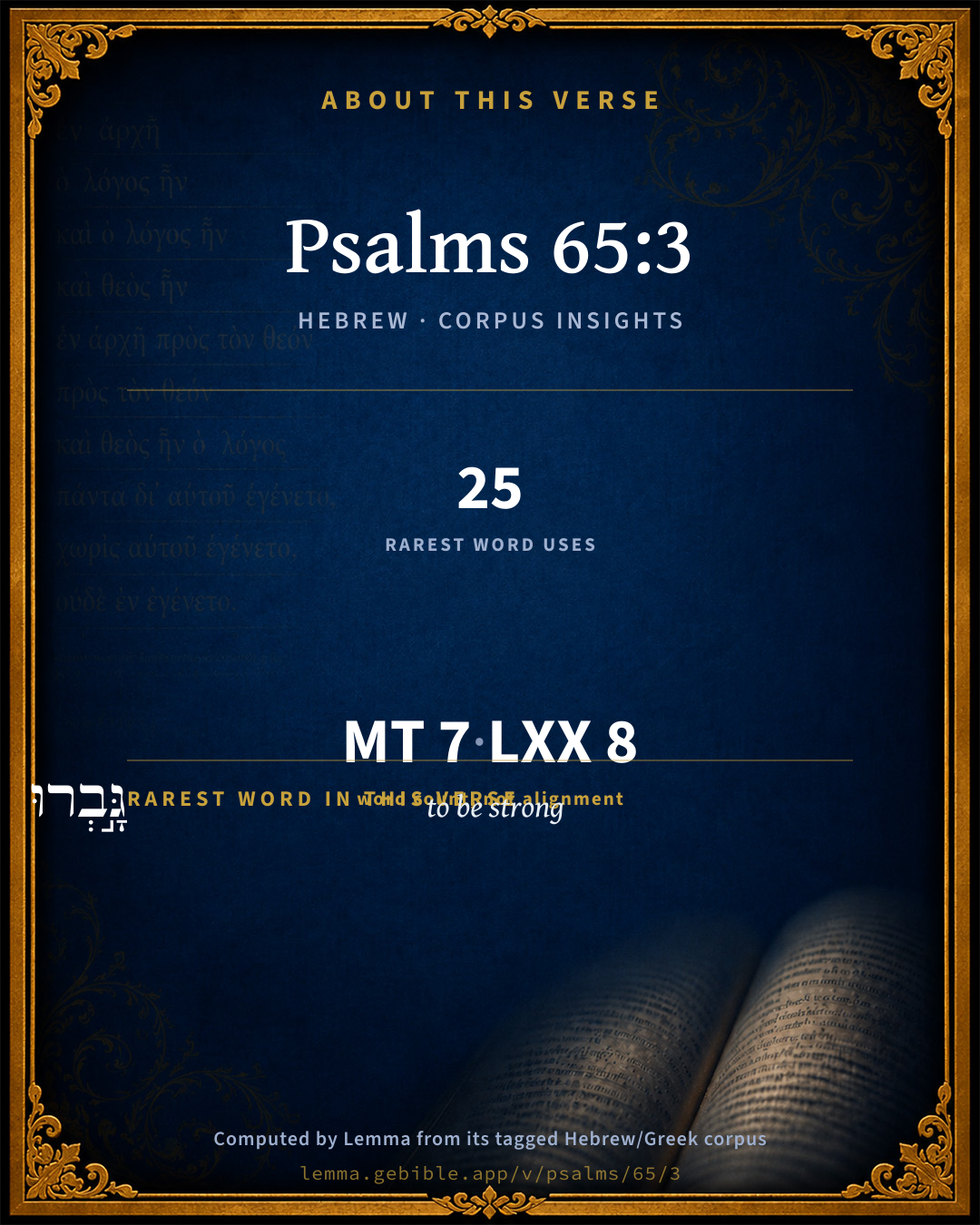
7
words
7
distinct lemmas
Wisdom
section

Notable vocabulary

The rarest word here is גָּ֣בְרוּ to be strong H1396 — appearing just 25 times in the whole Hebrew Bible.

Shared distinctive vocabulary

גָּ֣בְרוּ to be strong H1396 occurs in 24 verses of the Hebrew Bible. Also found in:

Grammatical profile

  • 2 verbs
  • 3 nouns
  • 1 pronoun
  • 1 preposition

Verb forms

  • גָּ֣בְרוּ Qal · Perfect
  • תְכַפְּרֵֽם Piel · Imperfect

Hebrew & Septuagint length

In English translation the verse runs 9 words from the Hebrew and 13 from the Septuagint (LXX English) — closely comparable.

A rough comparison of the two English renderings, which tokenize alike — not a word-level alignment.

Word counts can differ between the Hebrew and the Greek without any difference in meaning — e.g. the Hebrew direct-object marker אֵת has no separate Greek word, and Greek often adds the article ὁ.

In the original languages it is 7 Hebrew tokens and 8 Greek tokens — but the two are counted differently (Hebrew bundles its prefixes and suffixes into one token; the Greek is in lemma form), so that isn’t a like-for-like length.

Cross-references

16

Topical passages linked to Psalms 65:3 in the Treasury of Scripture Knowledge — connected by theme and wording, ordered by reader-vote popularity; previews shown in the World English Bible.

  • Psalms 38:4 For my iniquities have gone over my head. As a heavy burden, they are too heavy for me.
  • Isaiah 6:7 He touched my mouth with it, and said, "Behold, this has touched your lips; and your iniquity is taken away, and your sin forgiven."
  • Psalms 79:9 Help us, God of our salvation, for the glory of your name. Deliver us, and forgive our sins, for your name's sake.
  • Hebrews 9:14 how much more will the blood of Christ, who through the eternal Spirit offered himself without blemish to God, cleanse your conscience from dead works to serve the living God?
  • 1 John 1:7–9 But if we walk in the light, as he is in the light, we have fellowship with one another, and the blood of Jesus Christ, his Son, cleanses us from all sin.
  • Psalms 40:12 For innumerable evils have surrounded me. My iniquities have overtaken me, so that I am not able to look up. They are more than the hairs of my head. My heart has failed me.
  • Zechariah 13:1 "In that day there will be a spring opened to the house of David and to the inhabitants of Jerusalem, for sin and for uncleanness.
  • John 1:29 The next day, he saw Jesus coming to him, and said, "Behold, the Lamb of God, who takes away the sin of the world!
  • Galatians 5:17 For the flesh lusts against the Spirit, and the Spirit against the flesh; and these are contrary to one other, that you may not do the things that you desire.
  • Revelation 1:5 and from Jesus Christ, the faithful witness, the firstborn of the dead, and the ruler of the kings of the earth. To him who loves us, and washed us from our sins by his blood;
  • Isaiah 1:18–19 "Come now, and let us reason together," says Yahweh: "Though your sins be as scarlet, they shall be as white as snow. Though they be red like crimson, they shall be as wool.
  • Psalms 51:2–3 Wash me thoroughly from my iniquity. Cleanse me from my sin.
  • Psalms 51:7 Purify me with hyssop, and I will be clean. Wash me, and I will be whiter than snow.
  • Micah 7:8–9 Don't rejoice against me, my enemy. When I fall, I will arise. When I sit in darkness, Yahweh will be a light to me.
  • Romans 7:23–25 but I see a different law in my members, warring against the law of my mind, and bringing me into captivity under the law of sin which is in my members.
  • 2 Samuel 12:7–13 Nathan said to David, "You are the man. This is what Yahweh, the God of Israel, says: 'I anointed you king over Israel, and I delivered you out of the hand of Saul.

Cross-references courtesy of OpenBible.info (CC BY 4.0).

Hebrew and Greek witnesses Masoretic Hebrew ↔ Greek Septuagint

The same verse in the two great witnesses to the Old Testament, shown verse-for-verse.

You’re reading Greek Psalm 64 (Hebrew Psalm 65). The Septuagint counts the superscription, so verse numbers can differ from the Hebrew — chapter-level alignment, not verse-by-verse. Numbering follows Rahlfs.

These are two independent witnesses, not word-aligned to each other, and the Septuagint is shown in lemma (dictionary) form.

Hebrew Psalms 65:3 Masoretic · Westminster Leningrad Codex

דִּבְרֵ֣י עֲ֭וֺנֹת גָּ֣בְרוּ מֶ֑נִּי פְּ֝שָׁעֵ֗ינוּ אַתָּ֥ה תְכַפְּרֵֽם

Sins overwhelmed me, But you atoned for our transgressions.

World English Bible · Public Domain

Greek LXX Greek Psalm 64:3 Septuagint · lemma form

εἰςἀκούω προσευχή ἐγώ πρός σύ πᾶς σάρξ ἥκω

The words of transgressors have overpowered us; but do you pardon our sins.

LXX2012 (modern English Septuagint) · Public Domain

On this verse, Ellicott's Commentary for English Readers discusses the Septuagint’s reading. Read the note in Commentary ↓

Hebrew: Westminster Leningrad Codex (CC BY 4.0). Greek: Septuagint (public domain); English from LXX2012 (modern English Septuagint) (Public Domain). How the Septuagint differs from the Hebrew →

Commentary

Notes on Psalms 65:3 from classic Christian and Jewish commentators (each source and its license shown beneath its notes). The classic Christian expositions comment on the surrounding passage and are grouped to its opening verse, so a note may address several verses; the Jewish commentaries on the Tanakh (Rashi and others) are per-verse, so they appear only where the commentator wrote on this verse.

Lemma curates 59 commentaries, every one of them public domain or Creative Commons licensed, each selected and text-cleaned for this edition rather than reprinted as found. About our sources →

Trapp's Complete Commentary

John Trapp

Psa 65:3 Iniquities prevail against me: [as for] our transgressions, thou shalt purge them away.

Ver. 3. Iniquities prevail against me] And seek to choke my prayers; they prick me in the foot, as it were, that I cannot come to thee in prayer; or not with that confidence; but that is more than needs, since

As for our transgressions, thou shalt purge them away] So that if we turn from them they shall not hinder good things from us. No man was ever rejected by God for his confessed badness, as sundry have been for their supposed goodness: witness the publican and the Pharisee, Luk 18:9-14

John Trapp, A Commentary or Exposition upon All the Books of the Old and New Testament (1647–1656) — public domain. Text from a community e-Sword module.

The Biblical Illustrator

Joseph S. Exell

Psa_65:3

Iniquities prevail against me: as for our transgressions, Thou shalt purge them away.

Sin overcoming and overcome

There is an intended contrast in these two clauses, between mans impotence and Gods power in the face of the fact of sin. The first clause might be translated, iniquities are too strong for me; and the Thou of the next clause is emphatically expressed in the original, as for our transgressions (which we cannot touch), Thou shalt purge them away. Despair of self is the mother of confidence in God; and no man has learned the blessedness and the sweetness of Gods power to cleanse who has not learnt the impotence of his own feeble attempts to overcome his transgression. The very heart of Christianity is redemption. Only he who knows the cruel bondage of sin understands and appreciates the meaning and the brightness of the Gospel of Christ. He was called Jesus because He should save His people from their sins. So here we have our own hopelessness and misery, but also our confidence in the Divine help.

I. The cry of despair. Too strong for me, and yet they are me. Me, and not me; mine, and yet, somehow or other, my enemies, although my children--too strong for me. The picture suggested by the words is that of some usurping power that has mastered a man, laid its grip upon him so that all efforts to get away from the grasp are hopeless. But some of you say, We were never in bondage to any man. You do not know or feel that anything has got hold of you which is stronger than you. Well, let us see. Consider for a moment. You are powerless to master your evil, considered as habits. You do not know the tyranny of the usurper until a rebellion is got up against him. As long as you are gliding with the stream you have no notion of its force. Turn your boat and try to pull against it, and when the sweat-drops come on your brow, and you are sliding backwards, in spite of all your struggles, you will then know the force of the stream. Did you over try to cure some trivial bad habit, some trick of your fingers, for instance? You know what infinite pains and patience and time it took you to do that, and do you think that you would find it easier if you once set yourself to cure that lust, say, or that petulance, pride, passion, dishonesty? Any honest attempt at mending character drives a man to this--Iniquities are too strong for me. And so also it is with sin regarded as guilt, you cannot rid yourself of it. What is done is done. What I have written I have written. Nothing will ever wash that little lily hand white again, as the magnificent murderess in Shakespeares great creation found out. You can forget your guilt; you can ignore it. You do not take away the rock because you blow out the lamps of the lighthouse. And you do not alter an ugly fact by ignoring it. I beseech you, as reasonable men and women, to open your eyes to these plain facts about yourselves, that you have an element of demerit and liability to consequent evil and suffering which you are perfectly powerless to touch or to lighten in the slightest degree.

II. The ringing cry of confident hope. Jesus Christ, when trusted, will do for sin, as habit, what cannot be done without Him. He will give the motiye to resist, which is lacking in the majority of cases. He will give the power to resist, which is lacking in all cases. He will put a new life and spirit into our nature which shall strengthen and transform our feeble wills. The only way to conquer the world, the flesh, and the devil, is to let Christ clothe you with His armour. (A. Maclaren, D. D.)

Iniquities

I. The language of complaint--Imquities prevail, etc. They may do so--

1. In the growing sense of our guilt. As light increases, we see them more and more.

2. In the power of their acting. This prevalence cannot be entire, for sin shall not have dominion over the believer in Christ. He may be bruised, but he is not enslaved.

II. Of triumph. The Lord purges away our transgressions.

1. By His pardoning mercy.

2. By His sanctifying grace. And that He will do this the Christian is confidently persuaded. (W. Jay.)

The Biblical Illustrator, edited by Joseph S. Exell (c. 1880s–1900s) — public domain. Text from a community e-Sword module.

J. A. Alexander on Psalms

Joseph Addison Alexander

4. (Psa 65:3). Words of iniquities are too strong for me; (as for) our transgres-sions, thou wilt expiate them, or forgive them for the sake of an atonement. Words of iniquities is by some regarded as a pleonastic paraphrase for iniquities themselves. More probably, however, the phrase means the charge or accusation of iniquity. See above, on Psa 7:1; Psa 41:8), and below, on Psa 105:27. Too strong for me, more than I am able to account for or endure. See above, on Psa 40:12, and below, on Psa 130:3. The last clause contains the encouragement suited to the alarming situation mentioned in the first.

Joseph Addison Alexander, The Psalms Translated and Explained (1850) — public domain. Text from a community e-Sword module.

MacLaren's Expositions of Holy Scripture

Alexander MacLaren

Psalms

SIN OVERCOMING AND OVERCOME

Psa 65:3.

There is an intended contrast in these two clauses more pointed and emphatic in the original than in our Bible, between man’s impotence and God’s power in the face of the fact of sin. The words of the first clause might be translated, with perhaps a little increase of vividness, ‘iniquities are too strong for me’; and the ‘Thou’ of the next clause is emphatically expressed in the original, ‘as for our transgressions’ {which we cannot touch}, ‘Thou shalt purge them away.’ Despair of self is the mother of confidence in God; and no man has learned the blessedness and the sweetness of God’s power to cleanse, who has not learned the impotence of his own feeble attempts to overcome his transgression. The very heart of Christianity is redemption. There are a great many ways of looking at Christ’s mission and Christ’s work, but I venture to say that they are all inadequate unless they start with this as the fundamental thought, and that only he who has learned by serious reflection and bitter personal experience the gravity and the hopelessness of the fact of the bondage of sin, rightly understands the meaning and the brightness of the Gospel of Christ. The angel voice that told us His name, and based His name upon His characteristic work, went deeper into the ‘philosophy’ of Christianity than many a modern thinker, when it said, ‘Thou shalt call His name Jesus, because He shall save His people from their sins.’ So here we have the hopelessness and misery of man’s vain struggles, and side by side with these the joyful confidence in the divine victory. We have the problem and the solution, the barrier and the overleaping of it; man’s impotence and the omnipotence of God’s mercy. My iniquities are too strong for me, but Thou art too strong for them. As for our transgressions, of which I cannot purge the stain, with all my tears and with all my work, ‘Thou shalt purge them away.’ Note, then, these two-first, the cry of despair; second, the ringing note of confidence.

I. The cry of despair.

‘Too strong for me,’ and yet they are me. Me, and not me; mine, and yet, somehow or other, my enemies, although my children-too strong for me, yet I give them their strength by my own cowardly and feeble compliance with their temptations; too strong for me and overmastering me, though I pride myself often on my freedom and spirit when I am yielding to them. Mine iniquities are mine, and yet they are not mine; me and yet, blessed be God! they can be separated from me.

The picture suggested by the words is that of some usurping power that has mastered a man, and laid its grip upon him so that all efforts to get away from the grasp are hopeless. Now, I dare say, that some of you are half consciously thinking that this is a piece of ordinary pulpit exaggeration, and has no kind of application to the respectable and decent lives that most of you live, and that you are ready to say, with as much promptitude and as much falsehood as the old Jews did, even whilst the Roman eagles, lifted above the walls of the castle, were giving them the lie: ‘We were never in bondage to any man.’ You do not know or feel that anything has got hold of you which is stronger than you. Well, let us see.

Consider for a moment. You are powerless to master your evil, considered as habits. You do not know the tyranny of the usurper until a rebellion is got up against him. As long as you are gliding with the stream you have no notion of its force. Turn your boat and try to pull against it, and when the sweat-drops come on your brow, and you are sliding backwards, in spite of all your effort, you will begin to find out what a tremendous down-sucking energy there is in that quiet, silent flow. So the ready compliance of the worst part of my nature masks for me the tremendous force with which my evil tyrannises over me, and it is only when I face round and try to go the other way, that I find out what a power there is in its invisible grasp.

Did you ever try to cure some trivial bad habit, some trick of your fingers, for instance? You know what infinite pains and patience and time it took you to do that, and do you think that you would find it easier if you once set yourself to cure that lust, say, or that petulance, pride, passion, dishonesty, or whatsoever form of selfish living in forgetfulness of God may be your besetting sin? If you will try to pull the poison fang up, you will find how deep its roots are. It is like the yellow charlock in a field, which seems only to spread in consequence of attempts to get rid of it-as the rough rhyme says; ‘One year’s seeding, seven years’ weeding’-and more at the end of the time than at the beginning. Any honest attempt at mending character drives a man to this-’My iniquities are too strong for me.’

I do not for a moment deny that there may be, and occasionally is, a magnificent force of will and persistency of purpose in efforts at self-improvement on the part of perfectly irreligious men. But, if by the occasional success of such effort, a man conquers one form of evil, that does not deliver him from evil. You have the usurping dominion deep in your nature, and what does it matter in essence which part of your being is most conspicuously under its control? It may be some animal passion, and you may conquer that. A man, for instance, when he is young, lives in the sphere of sensuous excitement; and when he gets old he turns a miser, and laughs at the pleasures that he used to get from the flesh, and thinks himself ever so much wiser. Is he any better? He has changed, so to speak, the kind of sin. That is all. The devil has put a new viceroy in authority, but it is the old government, though with fresh officials. The house which is cleared of the seven devils without getting into it the all-filling and sanctifying grace of God and love of Jesus Christ will stand empty. Nature abhors a vacuum, and so does Satan, and the empty house invites the seven ill-tenants, and back they come in their diabolical completeness.

So, dear friends! though you may do a great deal-thank God!-in subduing evil habits and inclinations, you cannot touch, so as to master, the central fact of sin unless you get God to help you to do it, and you have to go down on your knees before you can do that work. ‘Iniquities are too strong for me.’

Then, again, consider our utter impotence in dealing with our own evil regarded as guilt. When we do wrong, the judge within, which we call conscience, says to us two things, or perhaps three. It says first, ‘That is wrong’; it says secondly, ‘You have got to answer for it’; and I think it says thirdly, ‘And you will be punished for it.’ That is to say, there is a sense of demerit that goes side by side with our evil, as certainly as the shadow travels with the substance. And though, sometimes, when the sun goes behind a cloud, there is no shadow, and sometimes, when the light within us is darkened, conscience does not cast the black shade of demerit across the mind; yet conscience is there, though silent. When it does speak it says, ‘You have done wrong, and you are answerable.’ Answerable to whom? To it? No! To society? No! To law? No! You can only be answerable to a person, and that is God. Against Him we have sinned. We do wrong; and if wrong were all that we had to charge ourselves with, it would be because there was nothing but law that we were answerable to. We do unkind things, and if unkindness and inhumanity were all that we had to charge ourselves with, it would be because we were only answerable to one another. We do suicidal things, and if self-inflicted injury were all our definition of evil, it would be because we were only answerable to our conscience and ourselves. But we sin, and that means that every wrong thing, big or little, which we do, whether we think about God in the doing of it or no, is, in its deepest essence, an offence against Him.

The judgment of conscience carries with it the solemn looking for of future judgment. It says, ‘I am only a herald: He is coming.’ No man feels the burden of guilt without an anticipation of judgment. What are you going to do with these two feelings? Do you think that you can deal with them? It is no use saying, ‘I am not responsible for what I did; I inherited such-and-such tendencies; circumstances are so-and-so. I could not help it; environment, and evolution, and all the rest of it diminish, if they do not destroy, responsibility.’ Be it so! And yet, after all, this is left-the certainty in my own convictions that I had the power to do or not to do. That is a fundamental part of a man’s consciousness. If it is a delusion, what is to be trusted, and how can we be sure of anything? So that we are responsible for our action, and can no more elude the guilt that follows sin than we can jump off our own shadow. And I want you to consider what you are going to do about your guilt.

One thing you cannot do-you cannot remove it. Men have tried to do so by sacrifices, and false religions. They have swung in the air by means of hooks fastened into their bodies, and I do not know what besides, and they have not managed it. You can no more get rid of your guilt by being sorry for your sin than you could bring a dead man to life again by being sorry for his murder. What is done is done. ‘What I have written I have written!’ Nothing will ever ‘wash that little lily hand white again,’ as the magnificent murderess in Shakespeare’s great creation found out. You can forget your guilt; you can ignore it. You can adopt some of the easily-learned-by-rote and fashionable theories that will enable you to minimise it, and to laugh at us old-fashioned believers in guilt and punishment. You do not take away the rock because you blow out the lamps of the lighthouse, and you do not alter an ugly fact by ignoring it. I beseech you, as reasonable men and women, to open your eyes to these plain facts about yourselves, that you have an element of demerit and of liability to consequent evil and suffering which you are perfectly powerless to touch or to lighten in the slightest degree.

Consider, again, our utter impotence in regard to our evil, looked upon as a barrier between us and God. That is the force of the context here. The Psalmist has just been saying, ‘O Thou that hearest prayer! unto Thee shall all flesh come.’ And then he bethinks himself how flesh compassed with infirmities can come. And he staggers back bewildered. There can be no question but that the plain dictate of common sense is, ‘We know that God heareth not sinners.’ My evil not only lies like a great black weight of guilt and of habit on my consciousness and on my activity, but it actually stands like a frowning cliff, barring my path and making a barrier between me and God. ‘Your hands are full of blood; I hate your vain oblations,’ says the solemn Voice through the prophet. And this stands for ever true-’The prayer of the wicked is an abomination.’ There frowns the barrier. Thank God! mercies come through it, howsoever close-knit and impenetrable it may seem. Thank God! no sin can shut Him out from us, but it can shut us out from Him. And though we cannot separate God from ourselves, and He is nearer us than our consciousness and the very basis of our being, yet by a mysterious power we can separate ourselves from Him. We may build up, of the black blocks of our sins flung up from the inner fires, and cemented with the bituminous mortar of our lusts and passions, a black wall between us and our Father. You and I have done it. We can build it-we cannot throw it down; we can rear it-we cannot tunnel it. Our iniquities are too strong for us.

Now notice that this great cry of despair in my text is the cry of a single soul. This is the only place in the psalm in which the singular person is used. ‘Iniquities are too strong for us,’ is not sufficient. Each man must take guilt to himself. The recognition and confession of evil must be an intensely personal and individual act. My question to you, dear friend! is, Did you ever know it by experience? Going apart by yourself, away from everybody else, with no companions or confederates to lighten the load of your felt evil, forgetting tempters and associates and all other people, did you ever stand, you and God, face to face, with nobody to listen to the conference? And did you ever feel in that awful presence that whether the world was full of men, or deserted and you the only survivor, would make no difference to the personal responsibility and weight and guilt of your individual sin? Have you ever felt, ‘Against Thee, Thee only, have I’-solitary- ‘sinned,’ and confessed that iniquities are ‘too strong for me’?

II. Now, let me say a word or two about the second clause of this great verse, the ringing cry of confident hope.

The confidence is, as I said, the child of despair. You will never go into that large place of assured trust in God’s effacing finger passed over all your evil until you have come through the narrow pass, where the black rocks all but bar the traveller’s foot, of conscious impotence to deal with your sin. You must, first of all, dear friends! go down into the depths, and learn to have no trust in yourselves before you can rise to the heights, and rejoice in the hope of the glory and of the mercy of God. Begin with ‘too strong for me,’ and the impotent ‘me’ leads on to the almighty ‘Thou.’

Then, do not forget that what was confidence on the Psalmist’s part is knowledge on ours. ‘As for our transgressions, Thou wilt purge them away.’ You and I know why, and know how. Jesus Christ in His great work for us has vindicated the Psalmist’s confidence, and has laid bare for the world’s faith the grounds upon which that divine power proceeds in its cleansing mercy. ‘Thou wilt purge them away,’ said he. ‘Christ hath borne our sins in His own body on the tree,’ says the New Testament. I have spoken about our impotence in regard to our own evil, considered under three aspects. I meant to have said more about Christ’s work upon our sins, considered under the same three aspects. But let me just, very briefly, touch upon them.

Jesus Christ, when trusted, will do for sin, as habit, what cannot be done without Him. He will give the motive to resist, which is lacking in the majority of cases. He will give the power to resist, which is lacking in all cases. He will put a new life and spirit into our nature which will strengthen and transform our feeble wills, will elevate and glorify our earthward trailing affections, will make us love that which He loves, and aspire to that which He is, until we become, in the change from glory to glory, reflections of the image of the Lord. As habit and as dominant power within us, nothing will cast out the evil that we have entertained in our hearts except the power of the life of Christ Jesus, in His Spirit dwelling within us and making us clean. When ‘a strong man keeps his house, his goods are in peace, but when a stronger than he cometh he taketh from him all his implements in which he trusteth, and divideth his spoil.’ And so Christ has bound the strong man, in that one great sacrifice on the Cross. And now He comes to each of us, if we will trust Him, and gives motives, power, pattern, hopes, which enable us to cast out the tyrant that has held dominion over us. ‘If the Son make you free, ye shall be free indeed.’

And I tell all of you, especially you young men and women, who presumably have noble aspirations and desires, that the only way to conquer the world, the flesh, and the devil, is to let Christ clothe you with His armour; and let Him lay His hand on your feeble hands whilst you aim the arrows and draw the bow, as the prophet did in the old story, and then you will shoot, and not miss. Christ, and Christ alone, within us will make us powerful to cast out the evil.

In like manner, He, and He only, deals with sin, considered as guilt. Here is the living secret and centre of all Christ’s preciousness and power-that He died on the Cross; and in His spirit, which knew the drear desolation of being forsaken by God, and in His flesh, which bore the outward consequences of sin, in death as a sinful world knows it, ‘bare our sins and carried our sorrows,’ so that ‘by His stripes we are healed.’

If you will trust yourselves to the mighty Sacrifice, and with no reservation, as if you could do anything, will cast your whole weight and burden upon Him, then the guilt will pass away, and the power of sin will be broken. Transgressions will be buried-’covered,’ as the original of my text has it-as with a great mound piled upon them, so that they shall never offend or smell rank to heaven any more, but be lost to sight for ever.

Christ can take away the barrier reared by sin between God and the human spirit. Solid and black as it stands, His blood dropped upon it melts away. Then it disappears like the black bastions of the aerial structures in the clouds before the sunshine. He hath opened for us a new and living way, that we might ‘have access and confidence,’ and, sinners as we are, that we might dwell for ever more at the side of our Lord.

So, dear brother! whilst humanity cries-and I pray that all of us may cry like the Apostle, ‘Oh, wretched man that I am! who shall deliver me from the body of this death?’-Faith lifts up, swift and clear, her ringing note of triumph, which I pray God or rather, which I beseech you that you will make your own, ‘I thank God! I through Jesus Christ our Lord.’

Alexander MacLaren, Expositions of Holy Scripture (1904–1910) — public domain. Text from a community e-Sword module.

Tyndale Open Study Notes

Tyndale Open Resources

65:3 you forgive: God graciously removes the guilt of sin (see 32:5).

Tyndale Open Study Notes — © Tyndale Open Resources, licensed CC BY-SA 4.0. Text via the HelloAO Bible API.

Geneva Bible (1599)

Geneva Bible translators

He imputeth it to his sins and to the sins of the people, that God who was accustomed to assist them withdraweth his succor from them.

Geneva Bible (1599) marginal notes — public domain. Text via Bolls.life.

Jamieson, Fausset & Brown

Robert Jamieson, A. R. Fausset & David Brown

God's mercy alone delivers us from the burden of iniquities, by purging or expiating by an atonement the transgressions with which we are charged, and which are denoted by--

Iniquities--or, literally, "Words of iniquities."

Jamieson, Fausset & Brown — Commentary Critical and Explanatory on the Whole Bible (1871) — public domain (CC PDM 1.0). Text via the HelloAO Bible API.

Adam Clarke's Commentary

Verse 3. Iniquities prevail against me] This is no just rendering of the original, דברי עונת גברו מני dibrey avonoth gaberu menni; "iniquitous words have prevailed against me," or, "The words of iniquity are strong against me." All kinds of calumnies, lies, and slanders have been propagated, to shake my confidence, and ruin my credit.

Our transgressions, thou shalt purge them away.] Whatsoever offences we have committed against thee, thou wilt pardon; תכפרם tecapperem, thou wilt make atonement for them, when with hearty repentance and true faith we turn unto thee. This verse has been abused to favour Antinomian licentiousness. The true and correct translation of the former clause will prevent this.

The old Scottish Version of this verse, in their singing Psalms, is most execrable: -

"Iniquities, I must confess,

Prevail against me do:

And as for our trans-gres-si-ons

Them purge away wilt thou."

O David, if thou art capable of hearing such abominable doggerel substituted for the nervous words thou didst compose by the inspiration of the Holy Ghost, what must thou feel, if chagrin can affect the inhabitants of heaven!

Adam Clarke's Commentary on the Bible (1810–1826) — public domain. Text from a community e-Sword/MySword module.

John Calvin's Commentaries

3 Words of iniquity have prevailed against me He does not complain of the people being assailed with calumny, but is to be understood as confessing that their sins were the cause of any interruption which had taken place in the communication of the divine favor to the Jews. The passage is parallel with that,

“The ear of the Lord is not heavy that it cannot hear, but our iniquities have separated betwixt us and him.” — Isaiah 59:1

David imputes it to his own sins and those of the people, that God, who was wont to be liberal in his help, and so gracious and kind in inviting their dependence upon him, had withdrawn for a time his divine countenance. First, he acknowledges his own personal guilt; afterwards, like Daniel 9:5, he joins the whole nation with himself. And this truth is introduced by the Psalmist with no design to damp confidence in prayer, but rather to remove an obstacle standing in the way of it, as none could draw near to God unless convinced that he would hear the unworthy. It is probable that the Lord’s people were at theft time suffering under some token of the divine displeasure, since David seems here to struggle with some temptation of this kind. He evidently felt that there was a sure remedy at hand, for no sooner has he referred to the subject of guilt, than he recognises the prerogative of God to pardon and expiate it. The verse before us must be viewed in connection with the preceding, and as meaning, that though their iniquities merited their being cast out of God’s sight, yet they would continue to pray, encouraged by his readiness to be reconciled to them. We learn from the passage that God will not be entreated of us, unless we humbly supplicate the pardon of our sins. On the other hand, we are to believe firmly in reconciliation with God being procured through gratuitous remission. Should he at any time withdraw his favor, and frown upon us, we must learn by David’s example to rise to the hope of the expiation of our sins. The reason of his using the singular number, in the confession which he makes of sin, may be, that as king he represented the whole people, or that he intended, like Daniel, to exhort them each to an individual and particular examination and confession of his own guilt. We know how apt hypocrites are to hide their personal sin, under a formal acknowledgement of their share in the general transgression. But David, from no affectation of humility, but from deep inward conviction, begins with himself, and afterwards includes others in the same charge.

John Calvin's Commentaries (1540-1563) — public domain. Text from the Calvin Translation Society English edition (1840s-50s) via the Christian Classics Ethereal Library (ccel.org). Calvin's coverage is partial (roughly two-thirds of the Bible); uncommented books and verses are honest gaps, never fabricated. The 19th-century editor's footnotes and remarks are omitted so the notes are faithfully Calvin's own voice.

Ellicott's Commentary for English Readers

(3) Iniquities.—Literally, Words (or, things) of iniquities, i.e., details of crime, or instances of wickedness. (Comp. Psa_35:20; Psa_105:27; Psa_145:5.)

Prevail.—Better, have prevailed, have overcome me, been too much for me. No doubt, though the pronoun is singular, we are to think of Israel at large here, confessing, by the mouth of the poet, its unworthiness of that Divine communion for which still (see next verse) God had chosen them. This is more in keeping with the general tone of the psalm than to refer the confession to an individual. The LXX. and Vulg. give the pronoun in the plural.

There appears in this verse an antithesis between iniquity and transgression. The latter certainly sometimes seems to be applied in distinction to the violation of the covenant, and possibly the distinction is present here. The frailty and sin common to all flesh has not exempted Israel; but the chosen people have to mourn besides transgressions of their own law. These, however, will be by sacrifice purged away, and then, brought back into full covenant privilege, the offenders will approach the earthly dwelling-place of the Divine, and dwell there.

A Bible Commentary for English Readers, edited by Charles John Ellicott (1878–1897) — public domain. Text from a community e-Sword module.

The Cambridge Bible for Schools and Colleges

gen. ed. J. J. S. Perowne

3. Iniquities] Lit., words, or, matters of iniquities: many various items of iniquity. Cp. for the same idiom Psa_105:27, Psa_145:5. Virtually the clause is a protasis to the second line:

Though manifold iniquities are too strong for me,

As for our transgressions, Thou wilt purge them away.

In the singular ‘me’ we may hear the voice of the Psalmist himself, or of some representative of the nation, the king or high-priest, who, like Daniel or Nehemiah, confesses his own sin as well as the sin of his people (Dan_9:20; Neh_1:6 : cp. Heb_5:3; Heb_7:27): but more probably it is the assembled congregation which speaks of itself first as an individual (‘against me’), then as an aggregate of individuals (‘our transgressions’). For a similar change from sing. to plur. cp. Num_21:22, and many other passages. Its sins are an enemy which it cannot defeat (Gen_4:7; cp. Psa_38:4; Psa_130:3; Psa_143:2); yet God who “forgives iniquity and transgression and sin” will purge away their transgressions. thou is emphatic. He, and He alone, can do it. The word for purge away is that commonly rendered ‘make atonement for’ (whether its primary meaning is ‘to blot out’ or ‘to cover’ is disputed), and it would be natural to see in it an allusion to the Day of Atonement which immediately preceded the Feast of Tabernacles (Lev_23:27; Lev_23:34), and to suppose that the Ps. was intended for use at that Festival, did not Psa_65:13 speak of the corn as still standing in the fields.

The Cambridge Bible for Schools and Colleges (gen. ed. J. J. S. Perowne; Cambridge University Press, 1878–1918) — public domain. Text from a community e-Sword module.

John Gill's Exposition

Iniquities prevail against me,.... Or, "are mightier than I" (h); this may be understood either of the iniquities of others, his enemies; their "words of iniquities" (i) or iniquitous words, as in the Hebrew text; their calumnies, reproaches, false charges, and accusations, which prevailed against David in Saul's court; or rather his own iniquities, inward lusts, indwelling sins, as well as open transgressions, which he considers as his enemies, as numerous and powerful, too mighty for him, which warred against him, and sometimes got the better of him, and threatened him with utter ruin and destruction; but amidst all this he spies atonement and pardon through the blood and sacrifice of Christ, as follows;

as for our transgressions, thou shall purge them away; not only his own, but others, which Christ has done by the sacrifice of himself; and when his blood is applied to the conscience of a sensible sinner, it purges it from all his sins, Heb 1:3; it may be rendered, "thou shall expiate them", or "make atonement for them" (k); which Christ, our propitiation, has done: this was the work appointed him, which he undertook, came into the world to do, and has performed, Dan 9:24, Heb 2:17; or "thou shalt cover them"; with the blood and righteousness of Christ; or forgive them for the sake of them, Psa 32:1.

(h) "prae me", Muis, Michaelis. (i) "verba iniquitatum", Montanus, Vatablus, Gejerus, Michaelis; so Ainsworth. (k) "propitiaberis", V. L. Pagninus, Montanus; "expiabis", Vatablus, Gejerus, Michaelis.

John Gill's Exposition of the Whole Bible (1746–1763) — public domain (CC PDM 1.0). Text via the HelloAO Bible API.

Albert Barnes' Notes on the Bible

Iniquities prevail against me - Margin, as in Hebrew, Words, or matters of iniquities. The literal meaning is words; and the idea may be that words spoken in iniquity, or slanderous words spoken by others, prevailed against him. The phrase, however, is susceptible of the interpretation which refers it to iniquity itself; meaning the matter of iniquity - the thing - iniquity itself - as if that overcame him, or got the mastery of him. The psalmist here, in his own name, seems to represent the people who thus approached God, for the psalm refers to the worship of an assembly or a congregation. The idea is, that when they thus came before God; when they had prepared all things for his praise Psa 65:1; when they approached him in an attitude of prayer, they were so bowed down under a load of transgression - a weight of sin - as to hinder their easy access to his throne. They were so conscious of unworthiness; their sin had such an effect on their minds; it rendered them so dull, cold, and stupid, that they could not find access to the throne of God. How often do the people of God find this to be the case!

As for our transgressions, thou shalt purge them away - That is, In reference to these very transgressions or iniquities that now press us down, thou wilt remove them. The language expresses the rising confidence and hope of the worshippers that God would not allow those transgressions so to prevail as to prevent their worshipping God acceptably. Heavy as was the burden of sin, and much as the consciousness of guilt tended to impede their worship, yet they felt assured that God would so remove their transgressions that they might have access to his mercy-seat. The word rendered “purge away” - כפר kâphar - is the word which is commonly rendered “to atone for,” or which is used to represent the idea of atonement. See the notes at Isa 43:3. The word has here the sense of cleansing or purifying, but it always carries with it, in the Scriptures, a reference to that through which the heart is cleansed - the atonement, or the expiatory offering made for sin. The language here expresses the feeling which all may have, and should have, and which very many do have, when they approach God, that, although they are deeply conscious of sin, God will so graciously remove the guilt of sin, and lift off the burden, cleansing the soul by his grace, as to make it not improper that we should approach him, and that he will enable us to do it with peace, and joy, and hope. Compare the notes at Psa 51:2.

Albert Barnes' Notes on the Bible (1834–1885) — public domain. Text from a community e-Sword/MySword module.

Matthew Poole's English Annotations

Iniquities prevail against me; they are a burden too heavy for me, as he complains, Psa 38:4. They are so many and great, that for them thou mightest justly reject my prayers, and destroy my person. But this is another glorious privilege granted to thy people, and that, in answer to their prayers, thou dost graciously pardon and purge away their sins.

Matthew Poole's English Annotations on the Holy Bible (1683–1685) — public domain. Text from a community e-Sword/MySword module.

The Treasury of David

Charles H. Spurgeon

Ver. 3. Iniquities prevail against me. Others accuse and slander me, and in addition to my own sins rise up and would beset me to my confusion, were it not for the remembrance of the atonement which covers every one of my iniquities. Our sins would, but for grace, prevail against us in the court of divine justice, in the court of conscience, and in the battle of life. Unhappy is the man who despises these enemies, and worse still is he who counts them his friends! He is best instructed who knows their deadly power, and flees for refuge to him who pardons iniquity.

As for our transgressions, thou shalt purge them away. Thou dost cover them all, for thou hast provided a covering propitiation, a mercyseat which wholly covers thy law. Note the word our, the faith of the one penitent who speaks for himself in the first clause, here embraces all the faithful in Zion; and he is so persuaded of the largeness of forgiving love that he leads all the saints to sing of the blessing. What a comfort that iniquities that prevail against us, do not prevail against God. They would keep us away from God, but he sweeps them away from before himself and us; they are too strong for us, but not for our Redeemer, who is mighty, yea, and almighty to save. It is worthy of note that as the priest washed in the laver before he sacrificed, so David leads us to obtain purification from sin before we enter upon the service of song. When we have washed our robes and made them white in his blood, then shall we acceptably sing, "Worthy is the Lamb that was slain."

Ver. 3. Iniquities prevail against me. There are two ways in which iniquities may prevail against the Christian--the first is in the growing sense of his guilt, the second is in the power of their acting. This prevalence cannot be entire, for sin shall not have dominion over them; but it may be occasional and partial. There are two ways, according to Scripture, in which God purges our transgressions; and they always go together. The one is by pardoning mercy. Thus David prays: "Purge me with hyssop, and I shall be clean." Thus the blood of Jesus Christ cleanseth us from all sin. The other is by sanctifying grace: "I will sprinkle clean water upon you, and ye shall be clean." And this is as much the work of God as the former. He subdues our iniquities as well as forgives them. William Jay.

Ver. 3. Iniquities. Literally, Words of iniquities, by some regarded as a pleonastic phrase for iniquities themselves. More probably, however, the phrase means the charge or accusation of iniquity. Joseph Addison Alexander.

Ver. 3. The deeds of iniquity are said To prevail against us, in so far as they are too strong and powerful for us to deny or refute, and to subject us to a demand of those penalties which the sin merits; hence there remains no other refuge than the clemency and grace of God, the Judge. See Ps 143:2 130: 3-4. Hermann Venema.

Ver. 3. As for our transgressions, thou shalt purge them away. In the Hebrew it is, Thou shalt hide them. It alludes to the mercy seat which was covered with the wings of the Cherubim; so are the sins of the godly, when repented of, covered with the wings of mercy and favour. Thomas Watson.

Ver. 3. Thou shalt purge them away; or, Thou coverest them. The pronoun is emphatic, as though to express the conviction that God and God alone could do this. J. J. Stewart Perowne.

Ver. 3. The holy prophets, and penmen of Scripture, have no grounds of hope for pardon of sin, save those which are common to the meanest of God's people; for David, in his confession, cometh in by himself alone, aggravating his own sins most: Iniquities prevail against me, saith he. But in hope of pardon, he joins with the rest of God's people, saying, As for our transgressions, thou shalt purge them away. David Dickson.

Ver. 3-4. Now, soul, thou art molested with many lusts that infect thee, and obstruct thy commerce with heaven; yea, thou hast complained to thy God, what loss thou hast suffered by them; is it now presumption to expect relief from him, that he will rescue thee from them, that thou mayest serve him without fear, who is thy liege Lord? You have the saints for your precedents; who, when they have been in combat with their corruptions, yea, been foiled by them, have even then exercised their faith on God, and expected the ruin of those enemies, which, for the present, have overrun them. Iniquities prevail against me; he means his own sins; but see his faith; at the same time that they prevailed over him, he beholds God destroying them, as appears in the very next words, As for our transgressions, thou shalt purge them away. See here, poor Christian, who thinkest that thou shalt never get above deck, holy David has a faith, not only for himself, but also for all believers, of whose number I suppose thee one. And mark the ground he hath for this his confidence, taken from God's choosing act: Blessed is the man whom thou choosest, and causest to approach unto thee, that he may dwell in thy courts. As if he had said, Surely he will not let them be under the power of sin, or in want of his gracious succour, whom he sets so near himself. This is Christ's own argument against Satan, in the behalf of his people. "The Lord said unto Satan, the Lord rebuke thee." Zec 3:2. William Gurnall.

Ver. 3.

I. The humble confession. Sins prevail against us.

1. When we are not alert, or go into temptation, and even after most sacred engagements.

2. How. Through our inbred corruption, natural constitution, suddenness of temptation, neglect of means of grace, and want of fellowship.

3. In whom. In the best of men: David says, against me. Let us take home the caution. II. The reassuring confidence. Sin is forgiven.

1. By God: Thou.

2. By atonement: covering all.

3. Effectually: purge away.

4. Comprehensively: our transgressions.

Ver. 3.

I. A cry of distress. Man soul besieged: Iniquities

prevail against me.

II. A shout of delight. Man soul relieved: Thou shalt

purge them away. E. G. Gange.

Psalms 65:4*

Charles H. Spurgeon's The Treasury of David (1869–1885) — public domain. Psalms only. Text from a community e-Sword/MySword module.

Whedon's Commentary on the Bible

Daniel D. Whedon

3. Iniquities prevail—Hebrew, words or matters of iniquities have prevailed. They have been too strong. Psa_38:4; Psa_40:12. The preterit of the verb refers to sins, or matters of public wrong, the consequences of which they had not been able to endure nor their guilt atone, till now God had interfered and directed the atonement, and delivered them.

Against me—The sudden transition from the third to the first person singular is a poetic freedom often used, the psalmist representing the people.

Purge them—כפר, (kaphar,) atone, expiate, cover. The standing word in the Old Testament for the expiatory act.

Daniel D. Whedon (gen. ed.), Commentary on the Old and New Testaments (1874–1909) — public domain. Text from a community e-Sword module.

The Pulpit Commentary

Iniquities prevail against me. Not so much, perhaps, his own iniquities, as these of his nation. Compare the expression, our transgressions," in the next clause. As for our trangressions, thou shalt purge them away; or, cover them.

Defeat and victory.

I Here is A CONFESSION DEFEAT. When we look within we find that, instead of all being right, all is wrong. This alarms us. We rouse ourselves to action. We resolve to live a new life of love and holiness. But the more we try the less we succeed. Our strength is weakness. Our purposes are broken off. Our best endeavours end in defeat. Instead of overcoming evil, we are overcome of evil. Instead of gaining purity and freedom, our case grows worse, and we groan in misery as the bond slaves of sin. Confused and confounded, our cry is, "O wretched man that I am, who shall deliver me?

II THANKSGIVING FOR VICTORY. Though we despair of ourselves, we must not despair of God. We know what God is, and what he has done for us, and therefore we turn to him with hope. Casting ourselves simply upon his mercy in Christ, we are able to grasp the gracious promise, "Sin shall not have dominion over you." God"s love to us is a personal love. God"s work in us is designed to make us pure from sin, and he will perfect it in the day of Christ. While we say, therefore, with grief and pain, "Iniquities prevail against me," let us with renewed hope proclaim, "As for our transgressions, thou shalt purge them away. W.F.

The Pulpit Commentary (1880–1919), ed. H.D.M. Spence-Jones & Joseph S. Exell — public domain. Text from a community e-Sword module.

Lesson kit

Teaching starters — assembled from the data on this page, not authored interpretation. Every prompt links to the verse data it draws on. Edit before teaching.

Psalms, in the Wisdom, opens this verse with 7 words (7 distinct Hebrew lemmas). Its most distinctive word is gâbar (“to be strong”). A historical commentator’s framing appears above. Read the whole chapter for the surrounding context.

Discussion questions

  1. What does “to be strong” (gâbar) contribute to the verse as a whole?
  2. Genesis 7:18 shares the word «to be strong» with this verse. How do the two illuminate each other?
  3. These translations render this verse differently; the difference is in the English rendering, not the original. What questions does that raise?
  4. The verb «גָּ֣בְרוּ» is Qal Perfect. How does its form color the action?
  5. Reading how Trapp's Complete Commentary and The Biblical Illustrator read this verse, where do the two commentators agree and where do they part?

Things to notice

Reading settings

Reading text

Shown beneath each verse's original-language words.

Old Testament
Old Testament edition

Read the OT as the Masoretic Hebrew (MT) or the Greek Septuagint (LXX).

English shown for the Greek Septuagint (in the Hebrew ↔ Greek comparison).

Comparing translations? Open the Compare panel on any verse page to stack up to four side by side.