
Hosea 4:8

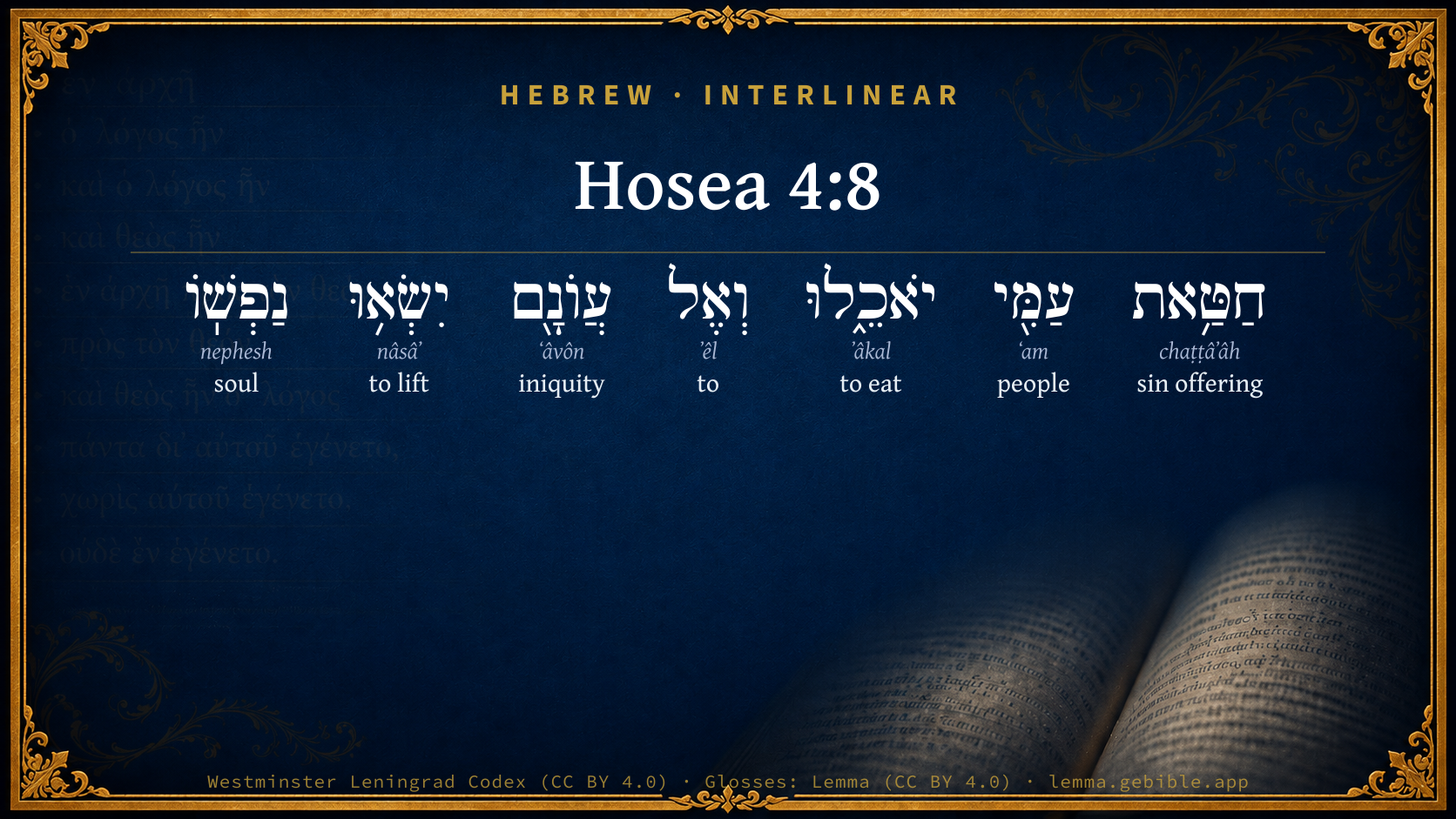
Hebrew (Westminster Leningrad Codex) Hosea 4:8 appears in the Hebrew Old Testament. The text above is from the Westminster Leningrad Codex. Each word links to its Strong’s number, a concise gloss, and parsing drawn from the Open Scriptures Hebrew Bible morphology. Click any word for its full Brown-Driver-Briggs (BDB) entry.
Download image
Cite this verse

Hosea 4:8 (World English Bible). Public Domain. Lemma interlinear Bible study tool, https://lemma.gebible.app/v/hosea/4/8.

Show BibTeX & RIS
BibTeX
RIS
English Translation
They feed on the sin of my people, And set their heart on their iniquity.
World English Bible · Public Domain
Download a study sheet

One document with this verse’s original text, its word-by-word gloss line, the meaning frame, cross-references with their text, attributed commentary, and full source and license credits — printable, and it pastes into notes with its structure intact.

This verse Autodidact and up

Study sheet (.html) Plain text (.txt)

A passage Seminary Student

Up to 50 verses in one chapter. A passage sheet keeps up to 6 commentary sources and 12 cross-references per verse, in the order this page ranks them, and says so on the sheet whenever that leaves anything out. Ask for a single verse and you get the Autodidact verse sheet above.

Everything on this page stays free to read, with no account — the sheet is a download of what is already on screen, not access to it.

Want to remove ads? Support Godless Engineer
Compare translations 3

The same verse in 3 English versions, stacked beneath the original-language interlinear above. Click any original word for its lexicon entry.

Each is an independent rendering of the whole verse — the interlinear is not word-aligned to these translations.

Highlighted words mark where these versions differ — a whole-verse word diff, not a word-by-word alignment.

  • World English Bible Public Domain
    They feed on the sin of my people, And set their heart on their iniquity.
  • King James Version Public Domain
    They eat up the sin of my people, and they set their heart on their iniquity.
  • unfoldingWord Literal Text CC BY-SA 4.0
    They eat the sin of my people, and to their iniquity they lift up his soul.

unfoldingWord Literal Text — © unfoldingWord, licensed CC BY-SA 4.0. Word-aligned USFM3 via Door43 (git.door43.org/unfoldingWord/en_ult).

Versions to compare (up to 4)

3 of 4 selected

Show all 18 translations

Every available English version of this verse, each an independent rendering of the whole verse.

  • World English Bible Public Domain
    They feed on the sin of my people, And set their heart on their iniquity.
  • Berean Standard Bible Public Domain
    They feed on the sins of My people and set their hearts on iniquity.
  • Majority Standard Bible Public Domain
    They feed on the sins of My people and set their hearts on iniquity.
  • King James Version Public Domain
    They eat up the sin of my people, and they set their heart on their iniquity.
  • American Standard Version (1901) Public Domain
    They feed on the sin of my people, and set their heart on their iniquity.
  • Revised Version (1885) Public Domain
    They feed on the sin of my people, and set their heart on their iniquity.
  • Geneva Bible (1599) Public Domain
    They eate vp the sinnes of my people, and lift vp their mindes in their iniquitie.
  • Douay-Rheims (1899) Public Domain
    They shall eat the sins of my people, and shall lift up their souls to their iniquity.
  • Young's Literal Translation Public Domain
    The sin of My people they do eat, And unto their iniquity lift up their soul.
  • Literal Standard Version CC BY-SA 4.0
    The sin of My people they eat, || And to their iniquity lift up their soul.
  • Unlocked Literal Bible CC BY-SA 4.0
    They feed on the sin of my people; they are greedy for more of their wickedness.
  • unfoldingWord Literal Text CC BY-SA 4.0
    They eat the sin of my people, and to their iniquity they lift up his soul.
  • Darby Bible Public Domain
    They eat the sin of my people, and their soul longeth for their iniquity.
  • World Messianic Bible Public Domain
    They feed on the sin of my people, and set their heart on their iniquity.
  • Webster's Bible Public Domain
    They eat up the sin of my people, and they set their heart on their iniquity.
  • Free Bible Version CC BY-SA 4.0
    They feed on the sin of my people, greedy for their iniquity.
  • Bible in Basic English Public Domain
    The sin of my people is like food to them; and their desire is for their wrongdoing.
  • JPS Tanakh (1917) Public Domain
    They feed on the sin of My people, and set their heart on their iniquity.

Literal Standard Version (2020), Covenant Press — licensed CC BY-SA 4.0. Text via the HelloAO Bible API (eBible.org). Unlocked Literal Bible (unfoldingWord) — licensed CC BY-SA 4.0. Text via the HelloAO Bible API (eBible.org). unfoldingWord Literal Text — © unfoldingWord, licensed CC BY-SA 4.0. Word-aligned USFM3 via Door43 (git.door43.org/unfoldingWord/en_ult). Free Bible Version, Dr. Jonathan Gallagher — licensed CC BY-SA 4.0. Text via the HelloAO Bible API (eBible.org).

Word by word

More ways to search: Search by grammar → Find every occurrence → Compare this word →

Practice this passage: Drill this verse → Learn its vocabulary →

About this verse

These counts appear in no published source. They are computed here, from the morphology-tagged text and Lemma’s own curated glosses. What Lemma adds →

7
words
7
distinct lemmas
Prophets
section

Grammatical profile

  • 2 verbs
  • 4 nouns
  • 1 preposition

Verb forms

  • יֹאכֵ֑לוּ Qal · Imperfect
  • יִשְׂא֥וּ Qal · Imperfect

Hebrew & Septuagint length

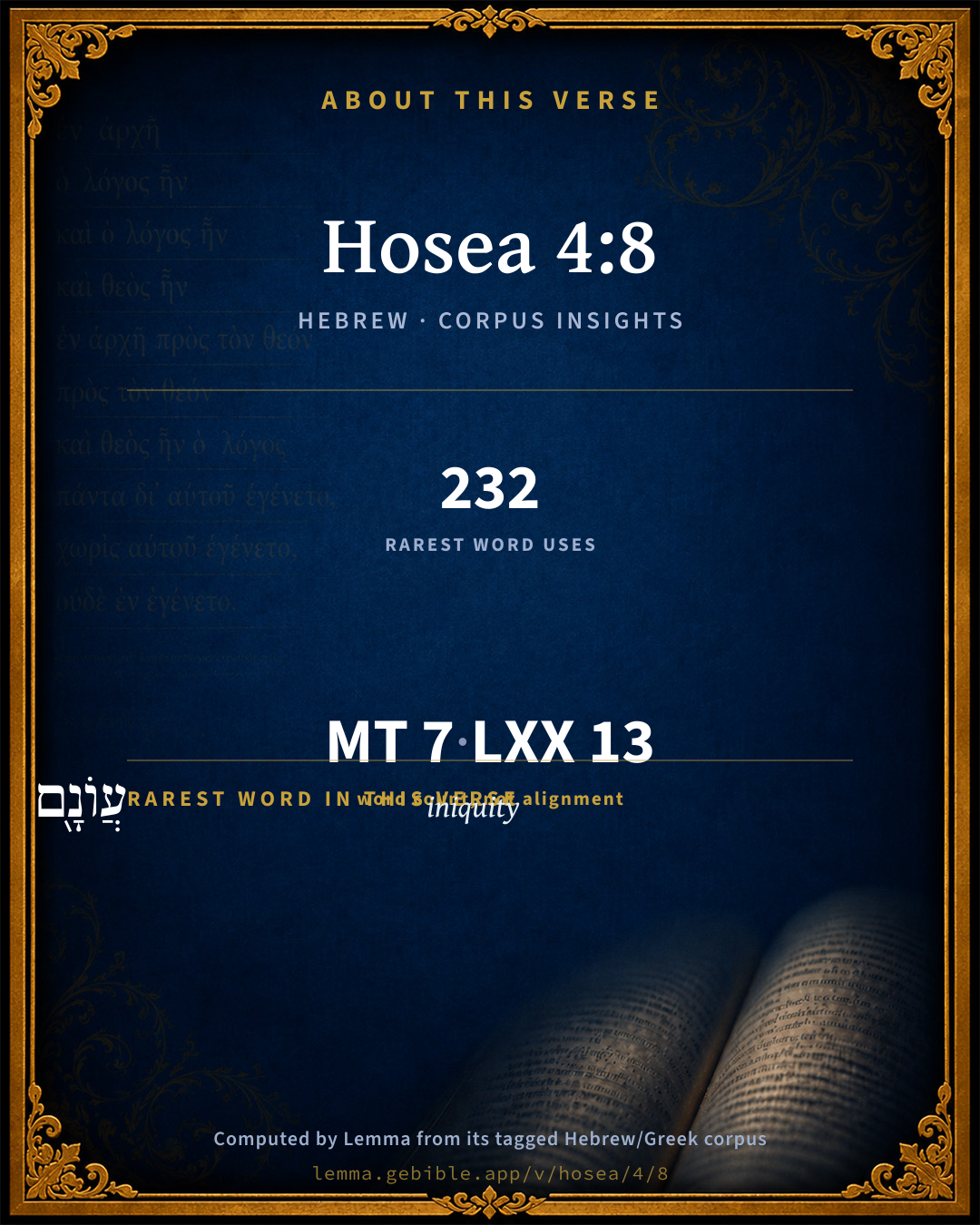
In English translation the verse runs 15 words from the Hebrew and 16 from the Septuagint (LXX English) — closely comparable.

A rough comparison of the two English renderings, which tokenize alike — not a word-level alignment.

Word counts can differ between the Hebrew and the Greek without any difference in meaning — e.g. the Hebrew direct-object marker אֵת has no separate Greek word, and Greek often adds the article ὁ.

In the original languages it is 7 Hebrew tokens and 13 Greek tokens — but the two are counted differently (Hebrew bundles its prefixes and suffixes into one token; the Greek is in lemma form), so that isn’t a like-for-like length.

Cross-references

13

Topical passages linked to Hosea 4:8 in the Treasury of Scripture Knowledge — connected by theme and wording, ordered by reader-vote popularity; previews shown in the World English Bible.

  • Isaiah 56:11 Yes, the dogs are greedy, they can never have enough; and these are shepherds who can't understand: they have all turned to their own way, each one to his gain, from every quarter.
  • Micah 3:11 Her leaders judge for bribes, And her priests teach for a price, And her prophets of it tell forturnes for money: Yet they lean on Yahweh, and say, Isn't Yahweh in the midst of us? No disaster will come on us.
  • Titus 1:11 whose mouths must be stopped; men who overthrow whole houses, teaching things which they ought not, for dishonest gain's sake.
  • Leviticus 6:26 The priest who offers it for sin shall eat it. It shall be eaten in a holy place, in the court of the Tent of Meeting.
  • 1 Samuel 2:29 Why kick you at my sacrifice and at my offering, which I have commanded in [my] habitation, and honor your sons above me, to make yourselves fat with the best of all the offerings of Israel my people?
  • Leviticus 7:6–7 Every male among the priests may eat of it. It shall be eaten in a holy place. It is most holy.
  • Psalms 24:4 He who has clean hands and a pure heart; Who has not lifted up his soul to falsehood, And has not sworn deceitfully.
  • Malachi 1:10 "Oh that there were one among you who would shut the doors, that you might not kindle fire on my altar in vain! I have no pleasure in you," says Yahweh of hosts, "neither will I accept an offering at your hand.
  • Romans 16:18 For those who are such don't serve our Lord, Jesus Christ, but their own belly; and by their smooth and flattering speech, they deceive the hearts of the innocent.
  • Psalms 25:1 To you, Yahweh, do I lift up my soul.
  • Ezekiel 14:3 Son of man, these men have taken their idols into their heart, and put the stumbling block of their iniquity before their face: should I be inquired of at all by them?
  • Ezekiel 14:7 For everyone of the house of Israel, or of the strangers who sojourn in Israel, who separates himself from me, and takes his idols into his heart, and puts the stumbling block of his iniquity before his face, and comes to the prophet to inquire for himself of me; I Yahweh will answer him by myself:
  • 2 Peter 2:3 In covetousness they will exploit you with deceptive words: whose sentence now from of old doesn't linger, and their destruction will not slumber.

Cross-references courtesy of OpenBible.info (CC BY 4.0).

Hebrew and Greek witnesses Masoretic Hebrew ↔ Greek Septuagint

The same verse in the two great witnesses to the Old Testament, shown verse-for-verse.

These are two independent witnesses, not word-aligned to each other, and the Septuagint is shown in lemma (dictionary) form.

Hebrew Hosea 4:8 Masoretic · Westminster Leningrad Codex

חַטַּ֥את עַמִּ֖י יֹאכֵ֑לוּ וְאֶל עֲוֺנָ֖ם יִשְׂא֥וּ נַפְשֽׁוֹ

They feed on the sin of my people, And set their heart on their iniquity.

World English Bible · Public Domain

Greek LXX Hosea 4:8 Septuagint · lemma form

ἁμαρτία λαός ἐγώ ἐσθίω καί ἐν ὁ ἀδικία αὐτός λαμβάνω ὁ ψυχή αὐτός

They will devour the sins of my people, and will set their hearts on their iniquities.

LXX2012 (modern English Septuagint) · Public Domain

Hebrew: Westminster Leningrad Codex (CC BY 4.0). Greek: Septuagint (public domain); English from LXX2012 (modern English Septuagint) (Public Domain). How the Septuagint differs from the Hebrew →

Targum (Aramaic paraphrase)

1

The Targum is the ancient Jewish Aramaic paraphrase of the Hebrew Scriptures — an interpretive translation, not the Hebrew text itself. Onkelos (literal) and Pseudo-Jonathan (expansive) render the Torah, and Jonathan the Prophets. Coverage is partial: where no permissively-licensed English translation exists for a verse, only the Aramaic is shown. This is verse-level text, not a word-by-word alignment to the Hebrew.

  1. Targum Jonathan Prophets (Joshua–Malachi)
    כַּהֲנַיָא פַּסוּ לְמֵיכַל חַטְוַת עַמִי בְּדִיל לְאוֹסָפָא חוֹבִין עַל חוֹבֵי נַפְשֵׁהוֹן:

    (no public-domain English translation for this verse)

    Targum Jonathan — Aramaic: “Mikraot Gedolot” (public domain). English: “Sefaria Community Translation” (CC0 1.0 (public-domain dedication)); “London "Chaldee Paraphrase," 1871” (public domain). Text via Sefaria.

Commentary

Notes on Hosea 4:8 from classic Christian and Jewish commentators (each source and its license shown beneath its notes). The classic Christian expositions comment on the surrounding passage and are grouped to its opening verse, so a note may address several verses; the Jewish commentaries on the Tanakh (Rashi and others) are per-verse, so they appear only where the commentator wrote on this verse.

Lemma curates 59 commentaries, every one of them public domain or Creative Commons licensed, each selected and text-cleaned for this edition rather than reprinted as found. About our sources →

Trapp's Complete Commentary

John Trapp

Hos 4:8 They eat up the sin of my people, and they set their heart on their iniquity.

Ver. 8. They eat up the sin of my people] That is, the sin offerings, as Exo 29:14. This they might lawfully do, Lev 6:16; Lev 6:18; Lev 6:23; Lev 6:26; Lev 6:29-30; Lev 10:17. But they were greedy dogs; and looked every one to his gain from his quarter, Isa 5:6; Isa 5:11. They winked at the people’s sins, and cared not what evils they fell into, so that they would bring in store of fat and good expiatory sacrifices, which made for the priest’s advantage. They ate that on earth which they were to digest in hell; they fed upon such diet as bred the worm of conscience, that never dies. Just so the Papists do at this day: they teach the people, though they sin, yet, by giving money for so many masses to be mumbled over by a greasy priest, or by so many indulgences and dirges purchased of the pope’s pardon mongers, they shall be delivered, etiamsi, per impossibile, matrem Dei vitiassent. although impossible, they may damage the mother of God, I tremble to translate it. Tecelius told them so in Germany; and got huge masses of money for the pope’s coffers. The common sort of Papists (for want of better teaching) will say, when we have sinned we must confess: and when we have confessed we must sin again, that we may confess again; and make work for new indulgences and jubilees. But have these "workers of iniquity no knowledge, that eat up God’s people as they eat bread?" Psa 14:4, that drink up the blood of souls, much more worth than the lives that David’s men had jeopardized to procure him the water of the well of Bethlehem, which therefore he dared not drink of? This surely is that filthy lucre (αισχροκερδεια) ministers should be free from, 1Pe 5:2. Let all non-residents look to it, that carry only forcipes et mulctrum, tongs and a milking pail, those instruments of a foolish shepherd, Zec 11:15 {See Trapp on "Zec 11:15"} feeding themselves, but starving the flock: a heavy account will they one day make to the arch-shepherd, of their sacrilegious rapacity.

And they set their hearts on their iniquity] Heb. they lift up their souls: that is, they not only prick up their ears, as Danaeus expounds it, to listen after sins and sin offerings, but they greedily desire and earnestly look after Such emoluments, such belly timber: being gulae mancipia, slaves to their guts, and wholly given up to gormandise. See the same expression, and in this sense, Jer 22:27 Deu 24:15 Eze 24:25, and compare the practice of Popish priests, who make infinite gain of everything almost, as their ringing of saints’ bells, places of burial, selling of licences for marriage and meats, selling of corpses and sepulchres. All things are saleable and soluble at Rome; and the savour of gain sweet, though it comes out of a stinking stews, or Jew’s counting house. The priests had a trick by wires to make their images here wag their chaps apace, if some good gift were presented; as, if otherwise, to hang the lip in token of discontent.

John Trapp, A Commentary or Exposition upon All the Books of the Old and New Testament (1647–1656) — public domain. Text from a community e-Sword module.

The Biblical Illustrator

Joseph S. Exell

Hos_4:8

They eat up the sin of My people.

Feeding on sin

Dr. Henderson renders these words, They devour the sin-offering of My people. The priests lived upon the sacrificial meat (Lev_6:26), and the more they had of this the more they were pleased. But this increased with the increase of the sins of the people. The more the people sinned, the more sin-offerings, and the more sin-offerings, the more priestly banquets. So in truth, without a figure, they feed upon the sin of the people. Such men can be found now--

I. In the ecclesiastical world.

II. In the commercial world.

1. Men who have vested interest in the sin of intemperance.

2. Men who have vested interest in the sin of war.

III. In the professional world. What could lawyers do without chicaneries, breach of contracts, and all kinds of social immoralities and crimes? What would popular journalists do were there no scandals, no tragedies, no crimes, no fraudulent advertisements? What would become of the sensational novelist, if there were no sinful love in the people for the horrible and the prurient? Herein is the great obstruction to moral reformations. Destroy a popular sin, and you destroy the livelihood of hundreds, and the pomp and splendour of many. (Homilist.)

The Biblical Illustrator, edited by Joseph S. Exell (c. 1880s–1900s) — public domain. Text from a community e-Sword module.

Joseph Benson's Commentary

Hos 4:8-11. They eat up the sin of my people — These priests, mentioned Hos 4:6, live upon the sin-offerings of the people; and are so far from restraining them, that they take delight in seeing them commit iniquity, because the more they sin, the greater is the number of their sin-offerings, which are the priests’ portions. Bishop Horsley translates the verse, “Every one of them, while they eat the sin-offerings of my people, sets his own heart upon the crime;” that is, while they exercise the sacred function of the priesthood, and claim its highest privileges, their own hearts are set upon the prevailing idolatry. And there shall be, like people, like priest — “The people’s sins deserve to be punished with such priests; and such priests have helped to make the people thus wicked.” — Bishop Hall. Or, rather, the sense is, It shall be, as with the people, so with the priest; that is, as they are alike in sinning, so shall they be alike in punishment, which shall be correspondent to their crimes. For they shall eat and not have enough — Or, not be satisfied, as the word, ישׂבעו, is elsewhere translated. The expression may signify, either that their food should not afford due nourishment, for want of God’s blessing, or that they should be afflicted with a famine or scarcity, so that they should not have food enough to satisfy their craving appetites. The contrary phrase, To eat and be full, or satisfied, denotes plenty. They shall commit whoredoms, &c., and not increase — Though they think to multiply by taking a plurality of wives, or concubines, yet in this they shall find their expectations disappointed. Because they have left off to take heed to the Lord — Here the reason is given why they should eat and not have enough, &c., namely, because they had apostatized from the love and service of God; for how ready so ever we may be to attribute every thing to the operation of natural causes, yet the Scriptures always speak of God’s co-operation with them as necessary in order to the producing of their desired effects. Whoredom and wine, &c., take away the heart — Deprive men of their judgment, and darken their understandings. So a gift is said to destroy the heart, Ecc 7:7, that is, to bereave men of the use of their discerning faculties.

Joseph Benson's Commentary on the Old and New Testaments (1811–1818) — public domain. Text from a community e-Sword module.

Geneva Bible (1599)

Geneva Bible translators

To wit, the Priests seek to eat the people’s offerings, and flatter them in their sins.

Geneva Bible (1599) marginal notes — public domain. Text via Bolls.life.

Jamieson, Fausset & Brown

Robert Jamieson, A. R. Fausset & David Brown

eat . . . sin of my people--that is, the sin offerings (Lev 6:26; Lev 10:17). The priests greedily devoured them.

set their heart on their iniquity--literally "lift up the animal soul to lust after," or strongly desire. Compare Deu 24:15, Margin; Psa 24:4; Jer 22:27. The priests set their own hearts on the iniquity of the people, instead of trying to suppress it. For the more the people sinned, the more sacrificial victims in atonement for sin the priests gained.

Jamieson, Fausset & Brown — Commentary Critical and Explanatory on the Whole Bible (1871) — public domain (CC PDM 1.0). Text via the HelloAO Bible API.

Adam Clarke's Commentary

Verse 8. They eat up the sin of my people] חטאת chattath, the sin-offering, though it be offered contrary to the law; for their hearts are set on iniquity, they wish to do whatever is contrary to God.

Adam Clarke's Commentary on the Bible (1810–1826) — public domain. Text from a community e-Sword/MySword module.

John Calvin's Commentaries

This verse has given occasion to many interpreters to think that all the particulars we have noticed ought to be restricted to the priests alone: but there is no sufficient reason for this. We have already said, that the Prophet is wont frequently to pass from the people to the priests: but as a heavier guilt belonged to the priests, he very often inveighs against them, as he does in this place, They eat, he says, the sin of my people, and lift up to their iniquity his soul, that is, ‘every one lifts up his own soul,’ or, ‘they lift up the soul of the sinner by iniquity;’ for the pronoun applies to the priests as well as to the people. The number is changed: for he says,יאכלו, iacalu and ישאו ishau, in the plural number, They will eat the sin, and will lift up, etc., in the third person; and then his soul it may be, their own; it is, however, a pronoun in the singular number: hence a change of number is necessary. We are then at liberty to choose , whether the Prophet says this of the people or of the priests: and as we have said, it may apply to both, but in a different sense.

We may understand him as saying, that the priests lifted up their souls to the iniquity of the people, because they anxiously wished the people to be given to many vices, for they hoped thereby to gain much prey, as the case is, when any one expects a reward from robbers: he is glad to hear that they become rich, for he considers their riches to be for his gain. So it was with the priests, who gaped for lucre; they thought that they were going on well, when the people brought many sacrifices. And this is usually the case, when the doctrine of the law is adulterated, and when the ungodly think that this alone remains for them, — to satisfy God with sacrifices, and similar expiations. Then, if we apply the passage to the priests, the lifting up of the soul is the lust for gain. But if we prefer to apply the words to sinners themselves, the sense is, ‘Upon their iniquity they lift up their soul,’ that is, the guilty raise up themselves by false comforts, and extenuate their vices; or, by their own flatteries, bury and entirely smother every remnant of God’s fear. Then, according to this second sense, to lift up the soul is to deceive, and to take away all doubts by vain comforts, or to remove every sorrow, and to erase every guilt by a false notion.

I come now to the meaning of the whole. Though the Prophet here accuses the priests, yet he involves, no doubt, the whole people, and deservedly, in the same guilt: for how was it that the priests expected gain from sacrifices? Even because the doctrine of the law was subverted. God had instituted sacrifices for this end, that whosoever sinned, being reminded of his guilt, might mourn for his sin, and further, that by witnessing that sad spectacle, his conscience might be more wounded: when he saw the innocent animal slain at the altar, he ought to have dreaded God’s judgment. Besides, God also intended to exercise the faith of all, in order that they might flee to the expiation which was to be made by the promised Mediator. And at the same time, the penalty which God then laid on sinners, ought to have been as a bridle to restrain them. In a word, the sacrifices had, in every way, this as their object, — to keep the people from being so ready or so prone to sin. But what did the ungodly do? They even mocked God, and thought that they had fully done their duty, when they offered an ox or a lamb; and afterwards they freely indulged themselves in their sins.

So gross a folly has been even laughed to scorn by heathen writers. Even Plato has so spoken of such sacrifices, as to show that those who would by such trifles make a bargain with God, are altogether ungodly: and certainly he so speaks in his second book on the Commonwealth, as though he meant to describe the Papacy. For he speaks of purgatory, he speaks of satisfactions; and every thing the Papists of this day bring forward, Plato in that book distinctly sets forth as being altogether sottish and absurd. But yet in all ages this assurance has prevailed, that men have thought themselves delivered from God’s hand, when they offered some sacrifice: it is, as they imagine, a compensation.

Hence the Prophet now complains of this perversion, They eat, he says, (for he speaks of a continued act,) the sins of my people, and to iniquity they lift up the heart of each; that is, When all sin, one after the other, each one is readily absolved, because he brings a gift to the priests. It is the same thing as though the Prophet said, “There is a collusion between them, between the priests and the people.” How so? Because the priests were the associates of robbers, and gladly seized on what was brought: and so they carried on no war, as they ought to have done, with vices, but on the contrary urged only the necessity of sacrifices: and it was enough, if men brought things plentifully to the temple. The people also themselves showed their contempt of God; for they imagined, that provided they made satisfaction by their ceremonial performances, they would be exempt from punishment. Thus then there was an ungodly compact between the priests and the people: the Lord was mocked in the midst of them. We now then understand the real meaning of the Prophet: and thus I prefer the latter exposition as to ‘the lifting up of the soul,’ which is, that the priests lifted up the soul of each, by relieving their consciences, by soothing words of flattery, and by promising life, as Ezekiel says, to souls doomed to die, (Ezekiel 13:19.) It now follows —

John Calvin's Commentaries (1540-1563) — public domain. Text from the Calvin Translation Society English edition (1840s-50s) via the Christian Classics Ethereal Library (ccel.org). Calvin's coverage is partial (roughly two-thirds of the Bible); uncommented books and verses are honest gaps, never fabricated. The 19th-century editor's footnotes and remarks are omitted so the notes are faithfully Calvin's own voice.

The Cambridge Bible for Schools and Colleges

gen. ed. J. J. S. Perowne

8. They eat up the sin of my people] The subject of the verb is evidently the priests (see Hos_4:9), and the phrase can therefore only mean, they eat the sin-offering of my people (i.e. the portion assigned to the priests, comp. Lev_10:17). Here we come into collision with a theory of the radical school of criticism that the Levitical legislation (including the appointment of ‘sin-offerings’ and ‘guilt-offerings’) originated after the Babylonian captivity. There are however two earlier references to the sin-offering, viz. here and in Psa_40:6, and one to the guilt-offering in Pro_14:9, not to insist on the disputable allusions in Isa_1:11; Mic_6:7; 2Ki_12:16 (17). And if the dates of one or another of these passages be challenged, yet the supposed novelties are not referred to at all frequently in undoubtedly post-Captivity writings. Sin-offerings are mentioned twice (Neh_10:34; 2Ma_12:43); guilt-offerings only once (if we accept a very probable emendation of Ezr_10:19, pointing ashâmîm). Next, granting a reference to the sin-offering, does the prophet mean to condemn the priests for eating of it? Certainly not; whatever were the traditional rules respecting the sin-offering, the priests would naturally have a just claim to their portion of the victim. The next clause explains the charge brought against them—it is that (like the sons of Eli, 1Sa_2:13-17) they greedily devoured what the people brought to atone for their sins; so that in eating the ‘sin-offering’, they also fed upon the ‘sin’ (the same word, khattath, covers both) of Jehovah’s people. Instead of trying to stem the tide of iniquity, they long for its onward march, with a view to unholy gains.

set their heart] Literally, ‘lift up their soul’ (or, ‘each one his soul’), i.e. ‘direct their desires’, as Psa_24:4; Psa_25:1.

The Cambridge Bible for Schools and Colleges (gen. ed. J. J. S. Perowne; Cambridge University Press, 1878–1918) — public domain. Text from a community e-Sword module.

John Gill's Exposition

They eat up the sin of my people,.... That is, the priests did so, as the Targum, the priests of Jeroboam; they ate up the sacrifices which the people brought for their sins: and their fault was, either that they ate that which belonged to the true priests of the Lord, so Jarchi; or they did that, and had no concern to instruct the people in the right way; all that they regarded were good eating and drinking, and living voluptuously; and were altogether careless about instructing the people in the nature of sacrifices, and in the way of their duty: or this may regard the Bacchanalian feasts, as some think, which the people made in the temples of idols, and so sinned; and of which the priests greatly partook, and encouraged them in, and so were partakers not only of their banquets, but of their sins.

They set their heart on their iniquity: either their offerings for their iniquity, or their iniquity itself: or, "lift up their soul" (u) to it; diligently looking after it, not caring how much they committed; since the more sin offerings would be brought which would be to their advantage. Though some think the sin of whoredom, frequently and impudently committed at these idol feasts, is meant, which the priests were much addicted to, and very greedy of; they committed cleanness with greediness, Eph 4:19.

(u) "et ad iniquitatem eorum levaverunt animam suam", Montanus, Pagninus, Tigurine version; "attollunt", Junius & Tremellius, Piscator; "et ad iniquitatem eorum tollunt anumam suam", Schmidt.

John Gill's Exposition of the Whole Bible (1746–1763) — public domain (CC PDM 1.0). Text via the HelloAO Bible API.

Albert Barnes' Notes on the Bible

They eat up the sin of My people - The priests made a gain of the sins of the people, lived upon them and by them, conniving at or upholding the idolatries of the people, partaking in their idol-sacrifices and idolatrous rites, which, as involving the desertion of God, were “the sin of the people,” and the root of all their other sins. This the priests did knowingly. True or false, apostate or irregularly appointed, they knew that there was no truth in the golden calves; but they withheld the truth, they held it down in unrighteousness, and preached Jeroboam’s false-hood, “these be thy gods, O Israel.” The reputation, station, maintenance of the false priests depended upon it. Not being of the line of Aaron, they could be no priests except to the calves, and so they upheld the sin whereby they lived, and, that they might themselves be accounted priests of God, taught them to worship the calves, as representatives of God.

The word, “sin,” may include indirectly the sin-offerings of the people, as if they loved the sin or encouraged it, in order that they might partake of the outward expiations for it.

And they set their heart on their iniquity - , as the source of temporal profit to themselves. “Benefited by the people, they reproved them not in their sinful doings, but charged themselves with their souls, saying, on us be the judgment, as those who said to Pilate, His blood be upon us.” That which was, above all, “their iniquity,” the source of all the rest, was their departure from God and from His ordained worship. On this they “set their hearts;” in this they kept them secure by their lies; they feared any misgivings, which might rend the people from them, and restore them to the true worship of God. But what else is it, to extenuate or flatter sin now, to dissemble it, not to see it, not openly to denounce it, lest we lose our popularity, or alienate those who commit it? What else is it to speak smooth words to the great and wealthy, not to warn them, even in general terms, of the danger of making Mammon their god; of the peril of riches, of parade, of luxury, of immoral dressing, and, amid boundless extravagance, neglect of the poor; encouraging the rich, not only in the neglect of Lazarus, but in pampering the dogs, while they neglect him? hat is the praise of some petty dole to the poor, but connivance at the withholding from God His due in them? “We see now,” says an old writer , “how many prelates live on the oblations and revenues of the laity, and yet, whereas they are bound, by words, by prayers, by exemplary life, to turn them away from sin, and to lead them to amendment, they, in various ways, scandalize, corrupt, infect them, by ungodly conversation, flattery, connivance, cooperation, and neglect of due pastoral care. Whence Jeremiah says, “My people hath been lost sheep: their shepherds have caused them to go astray.” O how horrible and exceeding great will be their damnation, who shall be tormented for each of those under their care, who perish through their negligence” Jer 50:6.

Albert Barnes' Notes on the Bible (1834–1885) — public domain. Text from a community e-Sword/MySword module.

Haydock's Catholic Bible Commentary

Sins: victims. (Worthington) --- Iniquity; or "they seek for support in their propitiatory offerings," and lull the people asleep in their sins. The priests of the golden calf imitated the sacred rites of Moses. It would have been too difficult to make the people change altogether.

George Leo Haydock (1774–1849), Haydock's Catholic Family Bible and Commentary, 1859 edition — public domain. Excludes Psalms (Douay-Rheims chapter numbering differs from Protestant) and Deuterocanonical books (Catholic canon only).

Matthew Poole's English Annotations

They, the priests who minister to the idols,

eat up the sin of my people; live upon with delight, maintain themselves and theirs; either by conniving at their sins, not reproving as they deserve, lest thereby they should disoblige persons, and lessen their bounty to them; or leave them to sin first, and next look for sacrifices for those sins, like some that make gain by the sins of people with whom they dispense. Or more plainly, by

sin is meant sin-offering, in which the priest had his share.

My people: see Hos 4:6.

And they; covetous, luxurious, idolatrous priests, the priests of Baal and the calves,

set their heart on their iniquity; watch to, and earnestly desire, hope, and expect the people will sin, and bring offerings for sin, which is the iniquity as well as gain of these priests.

Matthew Poole's English Annotations on the Holy Bible (1683–1685) — public domain. Text from a community e-Sword/MySword module.

The Pulpit Commentary

Feeding on sin.

"They eat up the sin of my people, and they set their heart on their iniquity." Dr. Henderson renders these words, "They devour the sin offering of my people." "The priests greedily devoured what the people brought for the expiation of their sins; and instead of endeavoring to put a stop to abounding iniquity, only wished it to increase, in order that they might profit by the multitude of the victims presented for sacrifice." The priests lived upon the sacrificial meat, (see Lev_6:26) and the more they had of this the more they were pleased. But this increased with the increase of the sins of the people: the more the people sinned, the more sin offerings; and the more sin offerings, the more priestly banquets. So they "set their heart on their iniquity." That is, they longed for its increase; they had an interest in the growth of sin in the country, so that in truth, with( rot figure, they feed upon the sin of the people. "The more sins," says an old expositor, "the more sacrifice, and therefore they cared not how much sin people were guilty of. Instead of warning the people against sin from the consideration of the sacrifices, which showed them what an offense sin was to God, since it added such an expiation, they emboldened and encouraged the people to sin, since an atonement might be made at so small an expense. Thus they glutted themselves upon the sins of the people, and helped to keep up that which they should have beaten down." Are there no men now that feed and least on the sins of the people? We think such men can be found.

I THERE ARE SUCH MEN IN THE ECCLESIASTICAL WORLD. There is a class of ecclesiastics who live in palaces, fare sumptuously every day, and roll in chariots of opulence, who profess to be the chief ministers of him who made himself of no reputation, took upon himself the form of a servant, and who, when on earth, had nowhere to lay his head. What is it that sustains these men, keeps up the huge imposture? Simply the "sin of the people." Their credulity, their ignorance, their servility, their superstition. Let these sins die out, and these gorgeous and plethoric hierarchs will have to doff their splendor, live on humble fare, and work as honest men or starve. A story is related of a prelate in Charles V"s time, who invited his friends to his house, and prepared a hospitable banquet of which they would not partake. "What!" said he, "will you not eat of dainties that are bought at so dear a rate? The meat that I have prepared for you is like to cost me the pains of hell." The prelate felt that he was a priestly impostor, misrepresenting the Man of sorrows, and shamefully neglecting his duty.

II THERE ARE SUCH MEN IN THE COMMERCIAL WORLD. There are men who have vested interest in the sin of intemperance brewers, distillers, and traffickers in alcoholic drinks. They live on the sin of intemperance, and raise themselves in hot antagonism against any effort to weaken its power or to limit its influence. There are men who have vested interest in the sin of war. The sin of war! The phrase is infinitely too weak. War comprises all sins. It is the totality of all abominations. Yet the manufacturers of armories and war-ships, and traders in the implements and equipages of fighting men, live on this sin. They hail every intimation of war. The first groan of the infernal lion falls as music on their greedy ears.

III THERE ARE SUCH MEN IN THE PROFESSIONAL WORLD. What would the lawyer do without chicaneries, breaches of contract, thefts, violences, seductions, and all kinds of social immoralities and crimes? What would popular journalists do were there no scandals, no tragedies, no crime, no fraudulent advertisements? What would become of the sensational novelist if there was no sinful love in the people for the horrible and the prurient?

CONCLUSION. Alas! that men are sinners, but alas! a thousand times more, that men should feed on sin! Herein is the great obstruction to moral reformations. Destroy a popular sin, and you destroy the livelihood of hundreds, and the pomp and splendor of many. How shall sin be put away flora the world? Who shall destroy this work of the devil? Thank God, we have the answer! D.T.

The Pulpit Commentary (1880–1919), ed. H.D.M. Spence-Jones & Joseph S. Exell — public domain. Text from a community e-Sword module.

John Wesley's Explanatory Notes

They - The priests who minister to the idols. The sin - Probably by sin is meant sin-offering, in which the priest had his share. And they - Covetous, luxurious, idolatrous priests.

John Wesley, Explanatory Notes Upon the Whole Bible (1754–1765) — public domain. Text via the GEBible commentary corpus.

Keil & Delitzsch

C. F. Keil & F. Delitzsch

"The sin of my people they eat, and after their transgression do they lift up their soul." The reproof advances from the sin of the whole nation to the sin of the priesthood. For it is evident that this is intended, not only from the contents of the present verse, but still more from the commencement of the next. Chatta'th ‛ammı̄ (the sin of my people) is the sin-offering of the people, the flesh of which the priests were commanded to eat, to wipe away the sin of the people (see Lev 6:26, and the remarks upon this law at Lev 10:17). The fulfilment of this command, however, became a sin on the part of the priests, from the fact that they directed their soul, i.e., their longing desire, to the transgression of the people; in other words, that they wished the sins of the people to be increased, in order that they might receive a good supply of sacrificial meat to eat. The prophet evidently uses the word chattâ'th, which signifies both sin and sin-offering, in a double sense, and intends to designate the eating of the flesh of the sin-offering as eating or swallowing the sin of the people. נשׂא נפשׁ אל, to lift up or direct the soul after anything, i.e., to cherish a longing for it, as in Deu 24:15, etc. The singular suffix attached to naphshō (his soul) is to be taken distributively: "(they) every one his soul."

(Note: It is evident from this verse, that the sacrificial worship was maintained in the kingdom of Israel according to the ritual of the Mosaic law, and that the Israelitish priests were still in possession of the rights conferred by the Pentateuch upon Levitical priests.)

Keil & Delitzsch — Biblical Commentary on the Old Testament (1861–1891) — public domain (CC PDM 1.0). Text via the HelloAO Bible API. (Old Testament only.)

unfoldingWord translationNotes

Door43 World Missions Community

General Information:

Yahweh continues speaking about the priests.

They feed on the sin of my people

When people sinned, they would offer sacrifices so God would forgive them. The priests were allowed to eat these sacrifices. The priests eating these sacrifices for sin is spoken of as if they would actually feed on the people's sins. (See: Assumed Knowledge and Implicit Information and Metaphor)

they are greedy for more of their wickedness

The priests want the people to sin more so that the people will offer more sacrifices that the priests may eat. (See: Assumed Knowledge and Implicit Information)

It will be the same for the people as for the priests

"The people and the priests will be punished in the same way"

their practices

"their habits" or "their conduct"

translationWords

sin

people of God

evil

priest

punish

evil

works

unfoldingWord translationNotes — © Distant Shores Media and the Door43 World Missions Community, licensed CC BY-SA 4.0. Source: git.door43.org/Door43/en_tn.

Rashi

Rabbi Shlomo Yitzchaki (Rashi)

the sin-offerings of My people Heb. חַטַּאת־עַמִּי. Every (mention of) חַטַּאת in the books of the Twelve Prophets appear with (the diacritical voweling of) ‘patachin’ (under the letter ט) as follows: חַטַּאת, since all are connected (to the following word) with the exception of one: “she was the beginning of sin to the daughter of Zion. (Heb. חַטָּאת הִיא לְבַת־צִיּוֹן Michah 1:3).” The sin-offerings of my nation shall be eaten by the false prophets concerning whom had been stated above: “and the prophet that is with you shall also stumble with you (v. 5).” They became for them priests of the high places who would eat what the legitimate priests should rightfully have eaten.

set their heart on their iniquity On the iniquity of the people of Israel, the prophet sets his heart; for the prophet himself hopes that they shall bring him money and sacrifices to expiate their sins.

Rashi on the Tanakh — English translations: “The Judaica Press complete Tanach with Rashi, translated by A. J. Rosenberg” (CC BY 4.0); “Pentateuch with Rashi's commentary by M. Rosenbaum and A.M. Silbermann, 1929-1934” (public domain); “The Metsudah Tanach series, Lakewood, N.J” (CC BY 4.0); and “The Book of Joshua, Metsudah Publications, 1997” (CC BY 4.0). Text via Sefaria.

Lesson kit

Teaching starters — assembled from the data on this page, not authored interpretation. Every prompt links to the verse data it draws on. Edit before teaching.

Hosea, in the Prophets, opens this verse with 7 words (7 distinct Hebrew lemmas). Its most distinctive word is ʻâvôn (“iniquity”). A historical commentator’s framing appears above. Read the whole chapter for the surrounding context.

Discussion questions

  1. What does “iniquity” (ʻâvôn) contribute to the verse as a whole?
  2. Isaiah 56:11 shares this passage’s theme. How do the two illuminate each other?
  3. The translations on this page render this verse differently — a whole-verse word diff, not a word-by-word alignment. What might account for the different wordings?
  4. The verb «יֹאכֵ֑לוּ» is Qal Imperfect. How does its form color the action?
  5. Reading how Trapp's Complete Commentary and The Biblical Illustrator read this verse, where do the two commentators agree and where do they part?

Things to notice

Reading settings

Reading text

Shown beneath each verse's original-language words.

Old Testament
Old Testament edition

Read the OT as the Masoretic Hebrew (MT) or the Greek Septuagint (LXX).

English shown for the Greek Septuagint (in the Hebrew ↔ Greek comparison).

Comparing translations? Open the Compare panel on any verse page to stack up to four side by side.