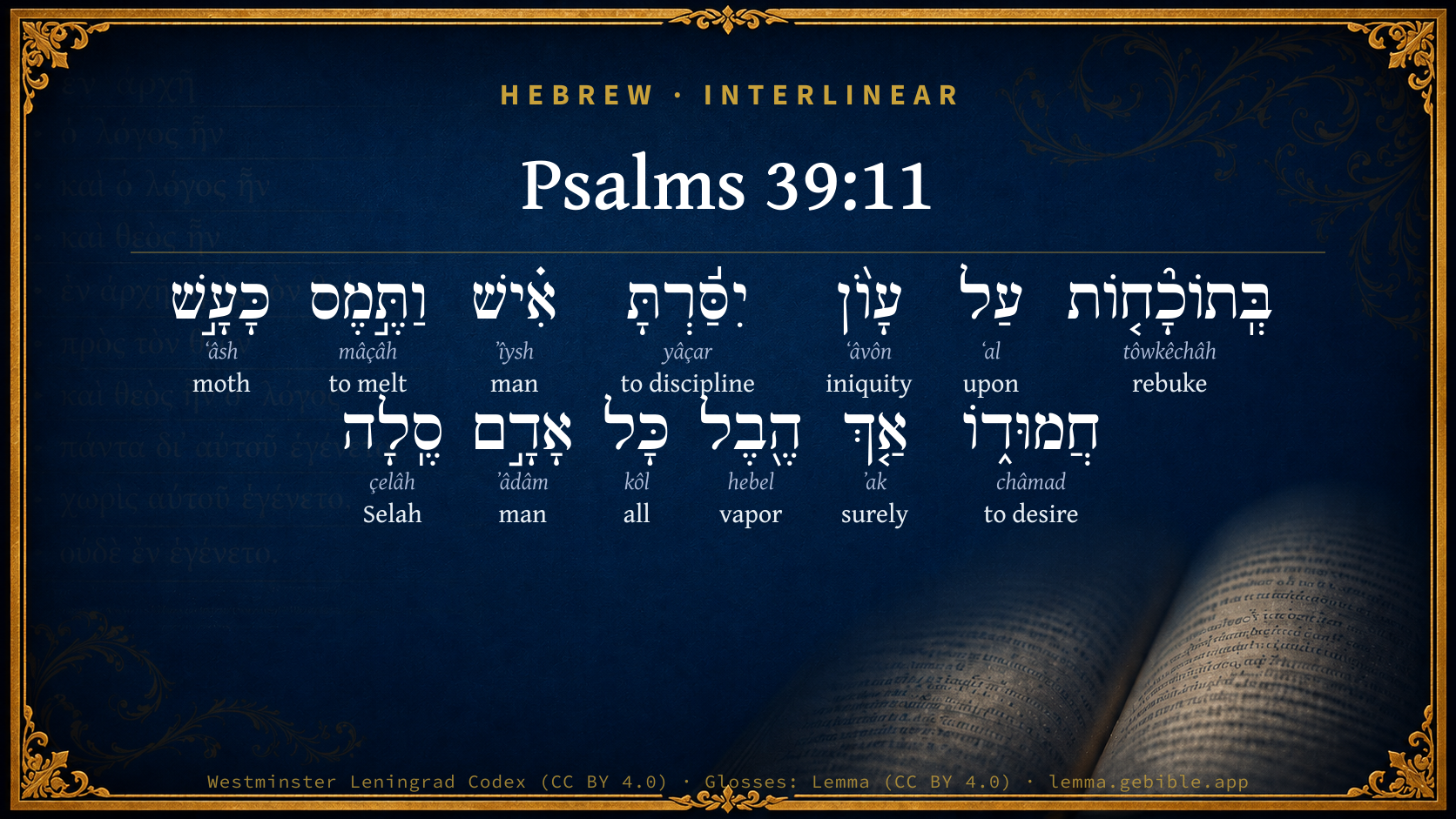
Psalms 39:11

Hebrew (Westminster Leningrad Codex) Psalms 39:11 appears in the Hebrew Old Testament. The text above is from the Westminster Leningrad Codex. Each word links to its Strong’s number, a concise gloss, and parsing drawn from the Open Scriptures Hebrew Bible morphology. Click any word for its full Brown-Driver-Briggs (BDB) entry.
Download image
Cite this verse

Psalms 39:11 (World English Bible). Public Domain. Lemma interlinear Bible study tool, https://lemma.gebible.app/v/psalms/39/11.

Show BibTeX & RIS
BibTeX
RIS
English Translation
When you rebuke and correct man for iniquity, You consume his wealth like a moth. Surely every man is but a breath." Selah.
World English Bible · Public Domain
Download a study sheet

One document with this verse’s original text, its word-by-word gloss line, the meaning frame, cross-references with their text, attributed commentary, and full source and license credits — printable, and it pastes into notes with its structure intact.

This verse Autodidact and up

Study sheet (.html) Plain text (.txt)

A passage Seminary Student

Up to 50 verses in one chapter. A passage sheet keeps up to 6 commentary sources and 12 cross-references per verse, in the order this page ranks them, and says so on the sheet whenever that leaves anything out. Ask for a single verse and you get the Autodidact verse sheet above.

Everything on this page stays free to read, with no account — the sheet is a download of what is already on screen, not access to it.

Want to remove ads? Support Godless Engineer
Compare translations 3

The same verse in 3 English versions, stacked beneath the original-language interlinear above. Click any original word for its lexicon entry.

Each is an independent rendering of the whole verse — the interlinear is not word-aligned to these translations.

Highlighted words mark where these versions differ — a whole-verse word diff, not a word-by-word alignment.

  • World English Bible Public Domain
    When you rebuke and correct man for iniquity, You consume his wealth like a moth. Surely every man is but a breath." Selah.
  • King James Version Public Domain
    When thou with rebukes dost correct man for iniquity, thou makest his beauty to consume away like a moth: surely every man is vanity. Selah.
  • unfoldingWord Literal Text CC BY-SA 4.0
    With rebukes on account of iniquity you discipline a man, and you dissolve like a moth his desired thing. Surely all mankind vapor. Selah

unfoldingWord Literal Text — © unfoldingWord, licensed CC BY-SA 4.0. Word-aligned USFM3 via Door43 (git.door43.org/unfoldingWord/en_ult).

Versions to compare (up to 4)

3 of 4 selected

Show all 18 translations

Every available English version of this verse, each an independent rendering of the whole verse.

  • World English Bible Public Domain
    When you rebuke and correct man for iniquity, You consume his wealth like a moth. Surely every man is but a breath." Selah.
  • Berean Standard Bible Public Domain
    You discipline and correct a man for his iniquity, consuming like a moth what he holds dear; surely each man is but a vapor. Selah
  • Majority Standard Bible Public Domain
    You discipline and correct a man for his iniquity, consuming like a moth what he holds dear; surely each man is but a vapor. Selah
  • King James Version Public Domain
    When thou with rebukes dost correct man for iniquity, thou makest his beauty to consume away like a moth: surely every man is vanity. Selah.
  • American Standard Version (1901) Public Domain
    When thou with rebukes dost correct man for iniquity, Thou makest his beauty to consume away like a moth: Surely every man is vanity. Selah
  • Revised Version (1885) Public Domain
    When thou with rebukes dost correct man for iniquity, thou makest his beauty to consume away like a moth: surely every man is vanity. Selah
  • Geneva Bible (1599) Public Domain
    When thou with rebukes doest chastise man for iniquitie, thou as a mothe makest his beautie to consume: surely euery man is vanitie. Selah.
  • Douay-Rheims (1899) Public Domain
    Remove thy scourges from me. The strength of thy hand hath made me faint in rebukes:
  • Young's Literal Translation Public Domain
    With reproofs against iniquity, Thou hast corrected man, And dost waste as a moth his desirableness, Only, vanity `is' every man. Selah.
  • Literal Standard Version CC BY-SA 4.0
    With reproofs against iniquity, || You have corrected man, || And dissolve his desirableness as a moth, || Only, every man [is] vanity. Selah.
  • Unlocked Literal Bible CC BY-SA 4.0
    When you discipline people for sin, you consume the things they desire like a moth; surely all people are nothing but vapor. Selah
  • unfoldingWord Literal Text CC BY-SA 4.0
    With rebukes on account of iniquity you discipline a man, and you dissolve like a moth his desired thing. Surely all mankind vapor. Selah
  • Darby Bible Public Domain
    When thou with rebukes dost correct a man for iniquity, thou makest his beauty to consume away like a moth: surely, every man is vanity. Selah.
  • World Messianic Bible Public Domain
    When you rebuke and correct man for iniquity, you consume his wealth like a moth. Surely every man is but a breath.” Selah.
  • Webster's Bible Public Domain
    \\39:10\\Remove thy stroke away from me; I am consumed by the blow of thy hand.
  • Free Bible Version CC BY-SA 4.0
    When you discipline us, reprimanding us for our sins, it's like a moth eating up what is precious to us. All of us are just a breath… Selah.
  • Bible in Basic English Public Domain
    By the weight of your wrath against man's sin, the glory of his form is wasted away; truly every man is but a breath. (Selah.)
  • JPS Tanakh (1917) Public Domain
    (39-12) With rebukes dost Thou chasten man for iniquity, and like a moth Thou makest his beauty to consume away; surely every man is vanity. Selah

Literal Standard Version (2020), Covenant Press — licensed CC BY-SA 4.0. Text via the HelloAO Bible API (eBible.org). Unlocked Literal Bible (unfoldingWord) — licensed CC BY-SA 4.0. Text via the HelloAO Bible API (eBible.org). unfoldingWord Literal Text — © unfoldingWord, licensed CC BY-SA 4.0. Word-aligned USFM3 via Door43 (git.door43.org/unfoldingWord/en_ult). Free Bible Version, Dr. Jonathan Gallagher — licensed CC BY-SA 4.0. Text via the HelloAO Bible API (eBible.org).

Word by word

More ways to search: Search by grammar → Find every occurrence → Compare this word →

Practice this passage: Drill this verse → Learn its vocabulary →

וַתֶּ֣מֶס
mâçâh
H4529
“and · to melt”
Conjunction + Verb, Hiphil, Sequential Imperfect, 2nd Person, Masculine, Singular
Part of Speech
Conjunction + Verb
Stem
Hiphil
Form
Sequential Imperfect
Person
2nd Person
Gender
Masculine
Number
Singular
Full BDB Definition

Origin: a primitive root

TWOT: 1219

to melt, dissolve, be liquefied - (Hiphil) - to melt, cause to dissolve, consume, cause to vanish - to intimidate (figuratively)
  1. בְּֽתוֹכָ֘ח֤וֹת tôwkêchâh H8433 “in/at · rebukes” Preposition + Noun, Common, Feminine, Plural, Absolute
  2. עַל ʻal H5921 “upon” Preposition
  3. עָוֺ֨ן ʻâvôn H5771 “iniquity” Noun, Common, Both, Singular, Absolute
  4. יִסַּ֬רְתָּ yâçar H3256 “to discipline” Verb, Piel, Perfect, 2nd Person, Masculine, Singular
  5. אִ֗ישׁ ʼîysh H376 “man” Noun, Common, Masculine, Singular, Absolute
  6. כָּעָ֣שׁ ʻâsh H6211 “like/as the · moth” Preposition, Determined + Noun, Common, Masculine, Singular, Absolute
  7. חֲמוּד֑וֹ châmad H2530 “desired · him” Verb, Qal, Participle Passive, Masculine, Singular, Construct + Suffix, Personal, 3rd Person, Masculine, Singular
  8. אַ֤ךְ ʼak H389 “surely” Particle, Accusative
  9. הֶ֖בֶל hebel H1892 “vapor” Noun, Common, Masculine, Singular, Absolute
  10. כָּל kôl H3605 “all of” Noun, Common, Masculine, Singular, Construct
  11. אָדָ֣ם ʼâdâm H120 “man” Noun, Common, Masculine, Singular, Absolute
  12. סֶֽלָה çelâh H5542 “Selah” Particle, Interjection

About this verse

These counts appear in no published source. They are computed here, from the morphology-tagged text and Lemma’s own curated glosses. What Lemma adds →

13
words
13
distinct lemmas
Wisdom
section

Notable vocabulary

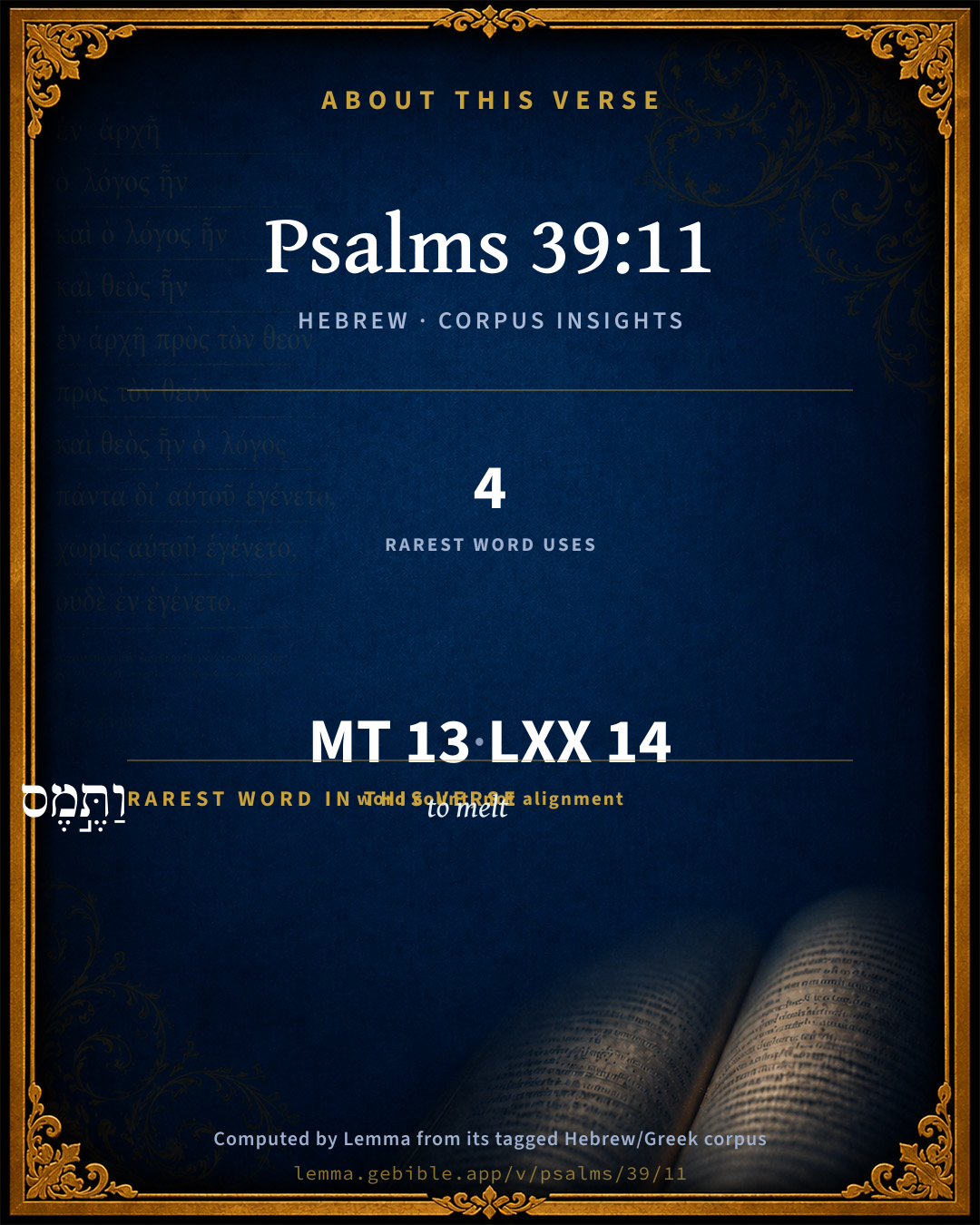
The rarest word here is וַתֶּ֣מֶס to melt H4529 — appearing just 4 times in the whole Hebrew Bible.

Shared distinctive vocabulary

וַתֶּ֣מֶס to melt H4529 occurs in 4 verses of the Hebrew Bible. Also found in:

Grammatical profile

  • 3 verbs
  • 7 nouns
  • 1 preposition
  • 2 particles

Verb forms

  • יִסַּ֬רְתָּ Piel · Perfect
  • וַתֶּ֣מֶס Hiphil · Sequential Imperfect
  • חֲמוּד֑וֹ Qal · Participle Passive

Hebrew & Septuagint length

In English translation the verse runs 23 words from the Hebrew and 27 from the Septuagint (LXX English) — closely comparable.

A rough comparison of the two English renderings, which tokenize alike — not a word-level alignment.

Word counts can differ between the Hebrew and the Greek without any difference in meaning — e.g. the Hebrew direct-object marker אֵת has no separate Greek word, and Greek often adds the article ὁ.

In the original languages it is 13 Hebrew tokens and 14 Greek tokens — but the two are counted differently (Hebrew bundles its prefixes and suffixes into one token; the Greek is in lemma form), so that isn’t a like-for-like length.

Cross-references

13

Topical passages linked to Psalms 39:11 in the Treasury of Scripture Knowledge — connected by theme and wording, ordered by reader-vote popularity; previews shown in the World English Bible.

  • Job 13:28 Though I am decaying like a rotten thing, Like a garment that is moth-eaten.
  • Isaiah 50:9 Behold, the Lord Yahweh will help me; who is he who shall condemn me? Behold, all they shall wax old as a garment, the moth shall eat them up.
  • 1 Corinthians 11:30–32 For this cause many among you are weak and sickly, and not a few sleep.
  • Hebrews 12:6 For whom the Lord loves, he chastens, And scourges every son whom he receives."
  • Revelation 3:19 As many as I love, I reprove and chasten. Be zealous therefore, and repent.
  • Psalms 102:10–11 Because of your indignation and your wrath, For you have taken me up, and thrown me away.
  • 1 Corinthians 5:5 are to deliver such a one to Satan for the destruction of the flesh, that the spirit may be saved in the day of the Lord Jesus.
  • Job 4:19 How much more, those who dwell in houses of clay, Whose foundation is in the dust, Who are crushed before the moth!
  • Job 30:30 My skin grows black and peels from me. My bones are burned with heat.
  • Psalms 38:1–8 Yahweh, don't rebuke me in your wrath, Neither chasten me in your hot displeasure.
  • Hosea 5:12 Therefore I am to Ephraim like a moth, And to the house of Judah like rottenness.
  • 2 Peter 2:16 but he was rebuked for his own disobedience. A mute donkey spoke with man's voice and stopped the madness of the prophet.
  • Psalms 90:7–10 For we are consumed in your anger. We are troubled in your wrath.

Cross-references courtesy of OpenBible.info (CC BY 4.0).

Hebrew and Greek witnesses Masoretic Hebrew ↔ Greek Septuagint

The same verse in the two great witnesses to the Old Testament, shown verse-for-verse.

You’re reading Greek Psalm 38 (Hebrew Psalm 39). The Septuagint counts the superscription, so verse numbers can differ from the Hebrew — chapter-level alignment, not verse-by-verse. Numbering follows Rahlfs.

These are two independent witnesses, not word-aligned to each other, and the Septuagint is shown in lemma (dictionary) form.

Hebrew Psalms 39:11 Masoretic · Westminster Leningrad Codex

בְּֽתוֹכָ֘ח֤וֹת עַל עָוֺ֨ן יִסַּ֬רְתָּ אִ֗ישׁ וַתֶּ֣מֶס כָּעָ֣שׁ חֲמוּד֑וֹ אַ֤ךְ הֶ֖בֶל כָּל אָדָ֣ם סֶֽלָה

When you rebuke and correct man for iniquity, You consume his wealth like a moth. Surely every man is but a breath." Selah.

World English Bible · Public Domain

Greek LXX Greek Psalm 38:11 Septuagint · lemma form

ἀποἵστημι ἀπό ἐγώ ὁ μάστιξ σύ ἀπό ὁ ἰσχύς ὁ χείρ σύ ἐγώ ἐκλείπω

You chasten man with rebukes for iniquity, and you make his life to consume away like a spider's web; nay, every man is disquieted in vain. Pause.

LXX2012 (modern English Septuagint) · Public Domain

On this verse, John Gill's Exposition discusses the Septuagint’s reading. Read the note in Commentary ↓

Hebrew: Westminster Leningrad Codex (CC BY 4.0). Greek: Septuagint (public domain); English from LXX2012 (modern English Septuagint) (Public Domain). How the Septuagint differs from the Hebrew →

Commentary

Notes on Psalms 39:11 from classic Christian and Jewish commentators (each source and its license shown beneath its notes). The classic Christian expositions comment on the surrounding passage and are grouped to its opening verse, so a note may address several verses; the Jewish commentaries on the Tanakh (Rashi and others) are per-verse, so they appear only where the commentator wrote on this verse.

Lemma curates 59 commentaries, every one of them public domain or Creative Commons licensed, each selected and text-cleaned for this edition rather than reprinted as found. About our sources →

Trapp's Complete Commentary

John Trapp

Psa 39:11 When thou with rebukes dost correct man for iniquity, thou makest his beauty to consume away like a moth: surely every man [is] vanity. Selah.

Ver. 11. When thou with rebukes dost correct man for iniquity] Or shouldest thou but correct him according to his iniquity; correct him, I say, or instruct him. Kimchi’s note here is, Morbi sunt interpretes inter Deum et homines increpantes, ut Job 33:19. Diseases are God’s chiding messages or real rebukes.

Thou makest his beauty] Heb. whatsoever in him is desirable, all his prime and pride, pulchritudinem et praestantiam, his beauty and bravery, as that of Jonah’s gourd.

To consume away like a moth] Heb. To melt away as a moth, which is easily crushed between one’s fingers, Job 4:19; or actively, as a moth, caeco morsu, doth secretly and suddenly consume the most precious garment, so dost thou the wicked by thy secret curse, though themselves or others little observe it. Quamvis non palam fulminet e caelo Deus (Vat.).

Surely every man is vanity. Selah] See Psa 39:5.

John Trapp, A Commentary or Exposition upon All the Books of the Old and New Testament (1647–1656) — public domain. Text from a community e-Sword module.

The Biblical Illustrator

Joseph S. Exell

Psa_39:11

When Thou with rebukes dost correct man for iniquity, Thou makest his beauty to consume away like a moth; surely every man is vanity.

The secret blasting of men

These words give an account of two things which are the matter of the greatest wonder.

1. How it comes to pass there are so many and so great evils in the world.

2. How so many persons come to wither and fall away, and come to nothing in the world. As to the first we are told what is the cause of their evils--iniquity; and as to the second, it is Gods rebukes which do blast men. Therefore we learn--

I. That God doth punish sinners. The word punish is used when not strictly correct, for we say a man is punished when any evil befalls him, though he hath done nothing that may procure it. Therefore, in such punishment as the text speaks of, we must except--

1. The effects of Gods absolute sovereignty and power. Therefore, we are not to say that God punishes a man because of the lot in life that He has appointed him. These differences lie within the lot of Gods sovereignty, and speak nothing of either love or hatred.

2. Trials, such as Jobs and many other good men.

3. Disciplines to teach us not to over-value the world.

4. Those sufferings that come upon us through the evil of others. But, these exceptions being made, it is yet true that sin is the cause of punishment. For many sins are the natural cause of the evils that follow them. Punishments are required to maintain Gods honour in the world (Ecc_8:11), and the variety of things and changeable conditions are as requisite to maintain virtue and holiness among mankind as the winds, which occasion storms and tempests, which put the air and sea into motion, and so keep them from stench and putrefaction. This I observe, a great many scriptures impute creatures degeneracy to their living at ease (Zec_1:1-21.; Amo_6:1; Luk_12:19; Jer_48:11).

II. These rebukes of God do blast men. God can immediately, by His influence, fortify and encourage a mans mind, or else throw him down into discontent and frowardness. For the minds and spirits of men lie open to God as much as ought of the creation. When God will, the hearts of men will serve them, and be more than themselves; and if God withdraws, they come to nothing. How contented are some men in a condition that the world doth despise? and how much discontent in others, that live in worldly splendour? Therefore, note--

1. How doth God bring about the ruin of men? Sometimes by taking away their understanding; as Ahithophel and Judas. Making a man discontented and unhappy with his lot in life (Ecc_1:24). All good becomes insipid (Job_6:6). By suspending the forces of nature so that they render not the service they are wont (Deu_28:23). By withdrawing His blessing from mens endeavours, so that they become unprosperous (Ecc_2:26; Pro_10:22). By awakening the guilt of the sinner upon his conscience, making that to sting and gall him, and then all the world is nothing. Or, when men, through their own fear, suspicion and jealousy, have certain foretastes of Gods refusal and displeasure.

2. Where there is imminent danger of such judgments. Where a man sins against light. Where there is hypocrisy, apostacy, worldliness, exemption from outward punishment as these may be. Whensoever God is pleased out of respect to His worshippers, or out of His compassion towards innocent infants and harmless creatures, to keep off judgments, then is it to be thought that, those persons that are wilful sinners, etc., shall hear from God in private; to abate their confidence, and to show how exorbitant they are in their ways. This God can do by letting them sink down into mental distraction, etc. For God can dispossess a man of all his comforts by not giving him power of self-enjoyment and taking content. For this of the two is a far greater mercy of God, for a man to have less and a contented mind, than to have much more and not have satisfaction :For power of self-enjoyment is a far greater thing than right and title. In the last place the case of high spiritual advantages. That was the aggravation of the sin of Capernaum, Coraizin and Bethsaida, that they were lifted up to heaven; and they are threatened to be thrown down into hell. There is no wonder that men cannot hold up their heads, when they are neither at peace with God, nor at peace with their own consciences; and all these things that are without a man will make no more recompense for the want of the peace of conscience than it will make a recompense for the pain of the gout to lie upon a bed of down. Men have no peace, neither with God, because not reconciled to the nature, mind nor will of God; nor have they peace in their own consciences, because under guilt. Therefore, no wonder that friends and revenues, etc., will not relieve them; they have an internal wound. In this respect I may truly say that mens sin go before them lute judgment. It was something in secret between Cain and his conscience that his countenance fell; for he had sacrificed as well as his brother Abel; but it was something within him. In Nabal, his heart died within him upon his wifes words only; which is strange, for a covetous miserable wretch will most commonly endure words hard enough; for words break no bones, but the text tells us God struck him. Other instances are Ahithophel (2Sa_17:14-23); Judas (Mat_27:3-5); Ananias and Sapphira (Act_5:9). Another lesson from the subject is, the world and the devil cannot hurt men if men do not themselves consent. If we are guilty before God, and repent not, and do not seek pardon, then are we in fear and damager every moment, for at Gods sentence our souls live or die. (B. Whichcote, D. D.)

The Biblical Illustrator, edited by Joseph S. Exell (c. 1880s–1900s) — public domain. Text from a community e-Sword module.

The Treasury of David

Charles H. Spurgeon

Ver. 11. When thou with rebukes dost correct man for iniquity. God does not trifle with his rod; he uses it because of sin, and with a view to whip us from it; hence he means his strokes to be felt, and felt they are. Thou makest his beauty to consume away like a moth. As the moth frets the substance of the fabric, mars all its beauty, and leaves it worn out and worthless, so do the chastisements of God discover to us our folly, weakness, and nothingness, and make us feel ourselves to be as worn out vestures, worthless and useless. Beauty must be a poor thing when a moth can consume it and a rebuke can mar it. All our desires and delights are wretched moth eaten things when the Lord visits us in his anger. Surely every man is vanity. He is as Trapp wittily says "a curious picture of nothing." He is unsubstantial as his own breath, a vapour which appeareth for a little while, and then vanisheth away. Selah. Well may this truth bring us to a pause, like the dead body of Amasa, which, lying in the way, stopped the hosts of Joab.

Ver. 11. Thou makest his beauty to consume away like a moth. The meaning may be, As the moth crumbles into dust under the slightest pressure, or the gentlest touch, so man dissolves with equal ease, and vanishes into darkness, under the finger of the Almighty. Paxton's Illustrations of Scripture.

Ver. 11. Thou makest his beauty to consume away like a moth. Moths I must not omit naming. I once saw some knives, the black bone hafts of which were said to have been half consumed by them. I also saw the remains of a hair seated sofa which had been devoured. It is no uncommon thing to find dresses consumed in a single night. In Isa 51:6, "wax old" probably refers to a garment that is moth eaten. So in Ps 6:7 31:9, consumed means moth eaten; and again in Ps 39:11. John Gadsby.

Ver. 11. Like a moth. The moths of the East are very large and beautiful, but short lived. After a few showers these splendid insects may be seen fluttering in every breeze, but the dry weather, and their numerous enemies, soon consign them to the common lot. Thus the beauty of man consumes away like that of this gay rover, dressed in his robes of purple, and scarlet, and green. John Kitto.

Ver. 11. The body of man is as a "garment" to the soul: in this garment sin hath lodged a "moth, "which, by degrees, fretteth and weareth away, first, the beauty, then the strength, and finally, the contexture of its parts. Whoever has watched the progress of a consumption, or any other lingering distemper, nay, the slow and silent devastations of time alone, in the human frame, will need no farther illustration of this just and affecting similitude; but will discern at once the propriety of the reflection which follows upon it. Surely every man is vanity. George Horne.

Ver. 11. Surely every man is vanity. What is greatness? Can we predicate it of man, independently of his qualities as an immortal being? or of his actions, independently of principles and motives? Then the glitter of nobility is not superior to the plumage of the peacock; nor the valour of Alexander to the fury of a tiger; nor the sensual delights of Epicurus to those of any animal that roams the forest. Ebenezer Porter, D.D., in Lectures on Homiletics, 1834.

None.

Psalms 39:12*

Charles H. Spurgeon's The Treasury of David (1869–1885) — public domain. Psalms only. Text from a community e-Sword/MySword module.

J. A. Alexander on Psalms

Joseph Addison Alexander

12. (Psa 39:11). With rebukes for iniquity thou dost chasten man, and waste like the moth what he desires. Only vanity is every man (or all mankind). Selah. He here presents his new and more correct view of God's providential strokes which he has now learned to regard as the punishment of sin. The emphasis of the sentence rests upon the first clause. It is not with cruel and vindictive strokes, it is not with random and unmeaning blows, but with penal visitations, with rebukes (or chastisements) for sin, that thou dost chasten man. The past tense of the verb implies that what he suffers is but one link in a long chain of consistent uniform experiences. He is looking not at what has happened once or for the first time, but at something which has always been so. It is God's accustomed mode of dealing with his sinful creatures. The deduction of meanings in Hebrew is first argument, then conviction, then condemnation, then punishment. See above, on Psa 38:15 (14).—Waste, literally cause to melt away. The same verb is used above, Psa 6:7 (6), and below, Psa 147:18.—Like the moth, not as the moth decays, but as the moth consumes. See Job 4:19; Job 13:28.—What he desires, literally his desired or desirable, whatever he delights in. Beauty is too specific and confined a sense. The last clause, with the selah at the close, announces that the Psalmist has come back to the point from which he started, but, as we have seen, with an extraordinary change of views and feelings.

Joseph Addison Alexander, The Psalms Translated and Explained (1850) — public domain. Text from a community e-Sword module.

Tyndale Open Study Notes

Tyndale Open Resources

39:11 The Lord uses discipline to correct his children (38:1, 3, 7; 40:12; see Prov 3:11-12; Heb 12:5-6).

Tyndale Open Study Notes — © Tyndale Open Resources, licensed CC BY-SA 4.0. Text via the HelloAO Bible API.

Geneva Bible (1599)

Geneva Bible translators

Though thine open plagues light not evermore upon them, yet thy secret curse continually fretteth them.

The word signifieth all that he desireth, as health, force, strength, beauty, and in whatsoever he hath delight, so that the rod of God taketh away all that is desired in this world.

Geneva Bible (1599) marginal notes — public domain. Text via Bolls.life.

Jamieson, Fausset & Brown

Robert Jamieson, A. R. Fausset & David Brown

From his own case, he argues to that of all, that the destruction of man's enjoyments is ascribable to sin.

Jamieson, Fausset & Brown — Commentary Critical and Explanatory on the Whole Bible (1871) — public domain (CC PDM 1.0). Text via the HelloAO Bible API.

Adam Clarke's Commentary

Verse 11. When thou with rebukes dost correct man] תוכחות tochachoth signifies a vindication of proceedings in a court of law, a legal defence. When God comes to maintain the credit and authority of his law against a sinner, he "causes his beauty to consume away:" a metaphor taken from the case of a culprit, who, by the arguments of counsel, and the unimpeachable evidence of witnesses, has the facts all proved against him, grows pale, looks terrified; his fortitude forsakes him, and he faints in court.

Surely every man is vanity.] He is incapable of resistance; he falls before his Maker; and none can deliver him but his Sovereign and Judge, against whom he has offended.

Selah.] This is a true saying, an everlasting truth.

Adam Clarke's Commentary on the Bible (1810–1826) — public domain. Text from a community e-Sword/MySword module.

Ellicott's Commentary for English Readers

(11) When.—This is unnecessary. With judgments for sin Thou chastenest a man.

Rebukes.—The word rendered “reproofs” in Psa_38:14, where see Note.

Beauty.—Literally, Something desirable. (See margin.) Thou, like a moth (consuming a garment: see Pr. Bk. Version), causest his desirable things to melt. (For the image, singularly apt. and natural in a country where “changes of raiment” were so prized, and hoarded up as wealth, comp. Job_13:28; Mat_6:19; Jas_5:2.)

A Bible Commentary for English Readers, edited by Charles John Ellicott (1878–1897) — public domain. Text from a community e-Sword module.

The Cambridge Bible for Schools and Colleges

gen. ed. J. J. S. Perowne

11. When thou with rebukes dost chasten a man for iniquity,

Thou wastest like a moth his desirableness:

Nought but vanity are all men.

The A.V. obscures the correspondence of the first line with Psa_38:1; Psa_6:1. As easily as the moth-grub, working unseen, destroys ‘goodly raiment’ (Gen_27:15), so easily does God’s chastisement destroy a man’s ‘goodliness,’ the bodily strength and beauty which make him attractive (Isa_53:2). It is God’s consuming ‘hand’ which is compared to the ‘moth’ (Hos_5:12); not, as the A.V. might seem to imply, the ephemeral duration of man’s goodliness. Cp. Job_13:28; Isa_50:9; Isa_51:8.

The Cambridge Bible for Schools and Colleges (gen. ed. J. J. S. Perowne; Cambridge University Press, 1878–1918) — public domain. Text from a community e-Sword module.

John Gill's Exposition

When thou with rebukes dost correct man for iniquity,.... The psalmist illustrates his own case, before suggested, by the common case and condition of men, when God corrects them; which he has a right to do, as the Father of spirits, and which he does with rebukes; sometimes with rebukes of wrath, with furious rebukes, rebukes in flames of fire, as the men of the world; and sometimes with rebukes of love, the chastenings of a father, as his own dear children; and always for iniquity, whether one or another; and not the iniquity of Adam is here meant, but personal iniquity: and correction for it is to be understood of some bodily affliction, as the effect of it shows;

thou makest his beauty to consume away like a moth; that is, secretly, suddenly, and at once; as a moth eats a garment, and takes off the beauty of it; or as easily as a moth is crushed between a man's fingers; so the Targum;

"he melts away as a moth, whose body is broken:''

the Vulgate Latin, Septuagint, Ethiopic, and Arabic versions, and so the metaphrase of Apollinarius, read, as a spider which destroys itself. The word rendered "beauty" takes in all that is desirable in man; as his flesh, his strength, his comeliness, his pleasantness of countenance, &c. all which are quickly destroyed by a distemper of the body seizing on it; wherefore the psalmist makes and confirms the conclusion he had made before:

surely every man is vanity; See Gill on Psa 39:5;

Selah; on this word; see Gill on Psa 3:2.

John Gill's Exposition of the Whole Bible (1746–1763) — public domain (CC PDM 1.0). Text via the HelloAO Bible API.

Albert Barnes' Notes on the Bible

When thou with rebukes - The word here rendered “rebukes” means properly:

(a) proof or demonstration;

(b) confutation or contradiction;

(c) reproof or admonition by words;

(d) reproof by correction or punishment.

This is the meaning here. The idea of the psalmist is, that God, by punishment or calamity, expresses his sense of the evil of human conduct; and that, under such an expression of it, man, being unable to sustain it, melts away or is destroyed.

Dost correct man for iniquity - Dost punish man for his sin; or dost express thy sense of the evil of sin by the calamities which are brought upon him.

Thou makest his beauty - Margin: “That which is to be desired in him.” The Hebrew means “desired, delighted in;” then, something desirable, pleasant; a delight. Its meaning is not confined to “beauty.” It refers to anything that is to man an object of desire or delight - strength, beauty, possessions, life itself. All are made to fade away before the expressions of the divine displeasure.

To consume away like a moth - Not as a moth is consumed, but as a moth consumes or destroys valuable objects, such as clothing. See the notes at Job 4:19. The beauty, the vigor, the strength of man is marred and destroyed, as the texture of cloth is by the moth.

Surely every man is vanity - That is, he is seen to be vanity - to have no strength, no permanency - by the ease with which God takes away all on which he had prided himself. See the notes at Psa 39:5.

Albert Barnes' Notes on the Bible (1834–1885) — public domain. Text from a community e-Sword/MySword module.

Matthew Poole's English Annotations

With rebukes, i. e. with punishment, which is oft so called. See Psa 6:1; 76:6.

Dost correct man for iniquity, i. e. dost punish him as his iniquity deserves. His beauty, Heb. his desire, i.e. his desirable things, as this word signifies, Lam 1:11; Dan 9:23; 10:3,11,19. His comeliness, strength, wealth, and prosperity, and all his present excellencies or felicities.

Like a moth; either,

1. Passively, as a moth is quickly and easily crushed to pieces with a touch as this phrase is used, Job 4:19. Or,

2. Actively as a moth consumeth a garment, as it is Job 13:28; Isa 1:9; to which God compareth himself and his judgments, secretly and insensibly consuming a people, Isa 51:8; Hos 5:12.

Every man is vanity; and this confirms what I said Psa 39:5, that every man is vanity; which though men in the height of their prosperity will not believe, yet when God contendeth with them by his judgments, they are forced to acknowledge it.

Matthew Poole's English Annotations on the Holy Bible (1683–1685) — public domain. Text from a community e-Sword/MySword module.

Whedon's Commentary on the Bible

Daniel D. Whedon

11. When thou with rebukes—Still the psalmist holds before him the avenging hand of God, as in vers. 9, 10, as the efficient cause of his affliction.

Beauty to consume away like a moth—Judgments cause the beauty of man to perish, as the garment falls into shreds when eaten by the clothes-moth. The figure is quite common, but startling, (Job_4:19; Job_13:28; Isaiah 1, 9; Hos_5:12; Mat_6:19;) and more impressive in the East, as abundance of clothing was coveted as a token of wealth and rank, with greater exposure to the עשׁ, (‘ash,) or destructive clothes-moth, whose work was stealthy and silent.

Surely every man is vanity—Surely a breath is every man. A refrain of Psa_39:6

Daniel D. Whedon (gen. ed.), Commentary on the Old and New Testaments (1874–1909) — public domain. Text from a community e-Sword module.

The Pulpit Commentary

When thou with rebukes dost correct man for iniquity. The calamities which God sends on a man are of the nature of "rebukes" addressed to his spirit. They are intended to teach, instruct, warn, deter from evil-doing. (see Job_36:8-10) Thou makest his beauty to consume away like a moth; or, "thou dost consume, as by a moth, what he prizes;" i.e. his health, his strength, "all wherein he has joy and satisfaction" (Hengstenberg). As a moth corrodes a beautiful garment, so does thy displeasure and heavy hand pressing on him corrode and destroy all which constituted his delight and glory. Surely every man is vanity (comp. ver. 5 ad fin). This has become a sort of refrain, terminating the second as well as the first part of the psalm. (comp. Psa_107:8, Psa_107:15, Psa_107:21, 31 Ecc_2:1, Ecc_2:11, Ecc_2:15, Ecc_2:19, Ecc_2:21, Ecc_2:23, 26 Isa_9:12, Isa_9:17, Isa_9:21)

The Pulpit Commentary (1880–1919), ed. H.D.M. Spence-Jones & Joseph S. Exell — public domain. Text from a community e-Sword module.

John Wesley's Explanatory Notes

Beauty - His comeliness and all his excellencies or felicities. Moth - As a moth consumeth a garment, to which God compares himself and his judgments, secretly and insensibly consuming a people, Isaiah li, 8.

John Wesley, Explanatory Notes Upon the Whole Bible (1754–1765) — public domain. Text via the GEBible commentary corpus.

Rashi

Rabbi Shlomo Yitzchaki (Rashi)

from the fear of Your hand Heb. מתגרת, from the fear of Your blows. תגרת is an expression of (Num. 22:3): “And Moab became terrified (וַיָגָר).” The “tav” is a defective radical in the word, like תנובה, produce; תלונה, complaint; תקומה, restoration; תכונה, characteristic. This is how Menachem explained it, but I maintain that תגרת is not an expression of מָגוֹר, fear, because he should have said תגוּרה as he says from: וישב (and he returned) תשוּבה, [from] ויקם, וירם and וילן: תקוּמה, תרוּמה and תלוּנה, so he should say from ויגר, תגוּלה, or מגוּרה as (above 31:14, Jer. 20:3): “terror (מגור) from all sides”; (Isa. 66:4) “and their fears (ומגורתם) I will bring.” Thus you learn that מתגרת is nothing but as (II Chron. 25:19), “Why should you provoke (תתגרה) disaster?”; (Deut. 2:5), “Do not provoke (תתגרו) them,” in which case the verb is גרה like קוה, to hope; אוה, to desire; צוה, to command, of which the noun is תקוה, תאוה, מצוה. So one says from גרה, תגרה, and this is its explanation: from the blows of Your hand, with which You fight me, I perish.

Rashi on the Tanakh — English translations: “The Judaica Press complete Tanach with Rashi, translated by A. J. Rosenberg” (CC BY 4.0); “Pentateuch with Rashi's commentary by M. Rosenbaum and A.M. Silbermann, 1929-1934” (public domain); “The Metsudah Tanach series, Lakewood, N.J” (CC BY 4.0); and “The Book of Joshua, Metsudah Publications, 1997” (CC BY 4.0). Text via Sefaria.

Lesson kit

Teaching starters — assembled from the data on this page, not authored interpretation. Every prompt links to the verse data it draws on. Edit before teaching.

Psalms, in the Wisdom, opens this verse with 13 words (13 distinct Hebrew lemmas). Its most distinctive word is mâçâh (“to melt”). A historical commentator’s framing appears above. Read the whole chapter for the surrounding context.

Discussion questions

  1. The word mâçâh carries the sense “to melt.” How does it shape the verse?
  2. Joshua 14:8 shares the word «to melt» with this verse. How do the two illuminate each other?
  3. These translations render this verse differently. What is at stake in choosing one wording over another?
  4. The verb «יִסַּ֬רְתָּ» is Piel Perfect. How does its form color the action?
  5. Reading how Trapp's Complete Commentary and The Biblical Illustrator read this verse, where do the two commentators agree and where do they part?

Things to notice

Reading settings

Reading text

Shown beneath each verse's original-language words.

Old Testament
Old Testament edition

Read the OT as the Masoretic Hebrew (MT) or the Greek Septuagint (LXX).

English shown for the Greek Septuagint (in the Hebrew ↔ Greek comparison).

Comparing translations? Open the Compare panel on any verse page to stack up to four side by side.