
Jeremiah 16:18

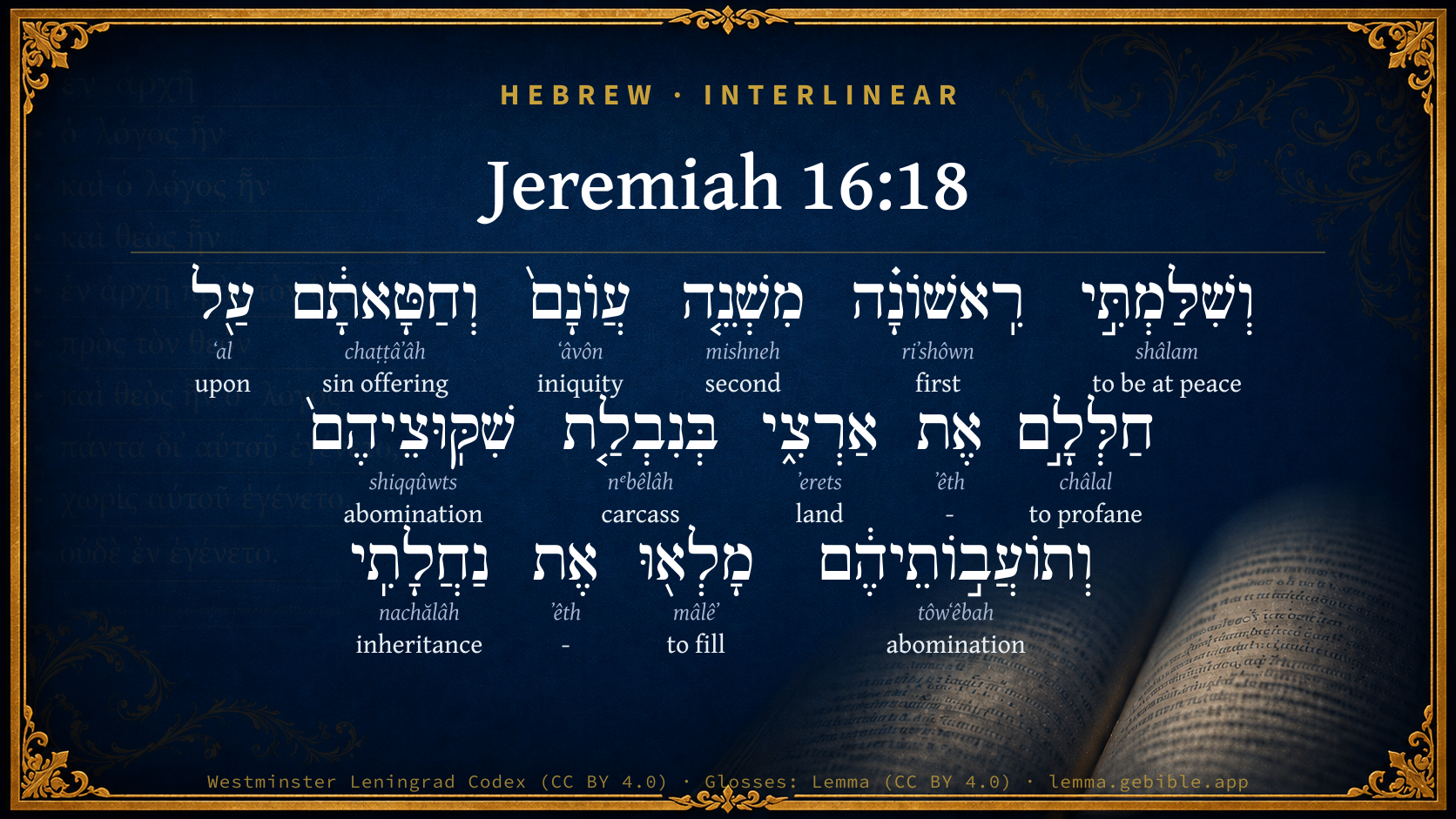
Hebrew (Westminster Leningrad Codex) Jeremiah 16:18 appears in the Hebrew Old Testament. The text above is from the Westminster Leningrad Codex. Each word links to its Strong’s number, a concise gloss, and parsing drawn from the Open Scriptures Hebrew Bible morphology. Click any word for its full Brown-Driver-Briggs (BDB) entry.
Download image
Cite this verse

Jeremiah 16:18 (World English Bible). Public Domain. Lemma interlinear Bible study tool, https://lemma.gebible.app/v/jeremiah/16/18.

Show BibTeX & RIS
BibTeX
RIS
English Translation
First I will recompense their iniquity and their sin double, because they have polluted my land with the carcasses of their detestable things, and have filled my inheritance with their abominations.
World English Bible · Public Domain
Download a study sheet

One document with this verse’s original text, its word-by-word gloss line, the meaning frame, cross-references with their text, attributed commentary, and full source and license credits — printable, and it pastes into notes with its structure intact.

This verse Autodidact and up

Study sheet (.html) Plain text (.txt)

A passage Seminary Student

Up to 50 verses in one chapter. A passage sheet keeps up to 6 commentary sources and 12 cross-references per verse, in the order this page ranks them, and says so on the sheet whenever that leaves anything out. Ask for a single verse and you get the Autodidact verse sheet above.

Everything on this page stays free to read, with no account — the sheet is a download of what is already on screen, not access to it.

Want to remove ads? Support Godless Engineer
Compare translations 3

The same verse in 3 English versions, stacked beneath the original-language interlinear above. Click any original word for its lexicon entry.

Each is an independent rendering of the whole verse — the interlinear is not word-aligned to these translations.

Highlighted words mark where these versions differ — a whole-verse word diff, not a word-by-word alignment.

  • World English Bible Public Domain
    First I will recompense their iniquity and their sin double, because they have polluted my land with the carcasses of their detestable things, and have filled my inheritance with their abominations.
  • King James Version Public Domain
    And first I will recompense their iniquity and their sin double; because they have defiled my land, they have filled mine inheritance with the carcases of their detestable and abominable things.
  • unfoldingWord Literal Text CC BY-SA 4.0
    But I will first repay double of their iniquity and their sin because they have defiled my land with the carcass of their detestable things, and they have filled my inheritance with their abominations.”

unfoldingWord Literal Text — © unfoldingWord, licensed CC BY-SA 4.0. Word-aligned USFM3 via Door43 (git.door43.org/unfoldingWord/en_ult).

Versions to compare (up to 4)

3 of 4 selected

Show all 18 translations

Every available English version of this verse, each an independent rendering of the whole verse.

  • World English Bible Public Domain
    First I will recompense their iniquity and their sin double, because they have polluted my land with the carcasses of their detestable things, and have filled my inheritance with their abominations.
  • Berean Standard Bible Public Domain
    And I will first repay them double their iniquity and their sin, because they have defiled My land with the carcasses of their detestable idols, and they have filled My inheritance with their abominations.”
  • Majority Standard Bible Public Domain
    And I will first repay them double their iniquity and their sin, because they have defiled My land with the carcasses of their detestable idols, and they have filled My inheritance with their abominations.”
  • King James Version Public Domain
    And first I will recompense their iniquity and their sin double; because they have defiled my land, they have filled mine inheritance with the carcases of their detestable and abominable things.
  • American Standard Version (1901) Public Domain
    And first I will recompense their iniquity and their sin double, because they have polluted my land with the carcasses of their detestable things, and have filled mine inheritance with their abominations.
  • Revised Version (1885) Public Domain
    And first I will recompense their iniquity and their sin double; because they have polluted my land with the carcases of their detestable things, and have filled mine inheritance with their abominations.
  • Geneva Bible (1599) Public Domain
    And first I will recompense their iniquitie and their sinne double, because they haue defiled my lande, and haue filled mine inheritance with their filthie carions and their abominations.
  • Douay-Rheims (1899) Public Domain
    And I will repay first their double iniquities, and their sins: because they have defiled my land with the carcasses of their idols, and they have filled my inheritance with their abominations.
  • Young's Literal Translation Public Domain
    And I have recompensed a first -- A second time -- their iniquity and their sin, Because of their polluting My land, With the carcase of their detestable things, Yea, their abominable things have filled Mine inheritance.
  • Literal Standard Version CC BY-SA 4.0
    And I have repaid a first—A second time—their iniquity and their sin, || Because of their defiling My land, || With the carcass of their detestable things, || Indeed, their abominations have filled My inheritance.”
  • Unlocked Literal Bible CC BY-SA 4.0
    I will first pay back double for their iniquity and sin for their polluting of my land with their disgusting idol figures, and for their filling my inheritance with their disgusting idols.”
  • unfoldingWord Literal Text CC BY-SA 4.0
    But I will first repay double of their iniquity and their sin because they have defiled my land with the carcass of their detestable things, and they have filled my inheritance with their abominations.”
  • Darby Bible Public Domain
    But first I will recompense their iniquity and their sin double, because they have profaned my land with the carcases of their detestable things, and with their abominations have they filled mine inheritance.
  • World Messianic Bible Public Domain
    First I will recompense their iniquity and their sin double, because they have polluted my land with the carcasses of their detestable things, and have filled my inheritance with their abominations.”
  • Webster's Bible Public Domain
    And first I will recompense their iniquity and their sin double; because they have defiled my land, they have filled my inheritance with the carcasses of their detestable and abominable things.
  • Free Bible Version CC BY-SA 4.0
    First I'm going to pay them back double for their wickedness and sin, because they have made my land unclean with the lifeless bodies of their disgusting idols, filling my special country with their offensive pagan images.
  • Bible in Basic English Public Domain
    And I will give them the reward of their evil-doing and their sin twice over; because they have made my land unclean, and have made my heritage full of the bodies of their unholy and disgusting things.
  • JPS Tanakh (1917) Public Domain
    And first I will recompense their iniquity and their sin double; because they have profaned My land; they have filled Mine inheritance with the carcasses of their detestable things and their abominations.

Literal Standard Version (2020), Covenant Press — licensed CC BY-SA 4.0. Text via the HelloAO Bible API (eBible.org). Unlocked Literal Bible (unfoldingWord) — licensed CC BY-SA 4.0. Text via the HelloAO Bible API (eBible.org). unfoldingWord Literal Text — © unfoldingWord, licensed CC BY-SA 4.0. Word-aligned USFM3 via Door43 (git.door43.org/unfoldingWord/en_ult). Free Bible Version, Dr. Jonathan Gallagher — licensed CC BY-SA 4.0. Text via the HelloAO Bible API (eBible.org).

Word by word

More ways to search: Search by grammar → Find every occurrence → Compare this word →

Practice this passage: Drill this verse → Learn its vocabulary →

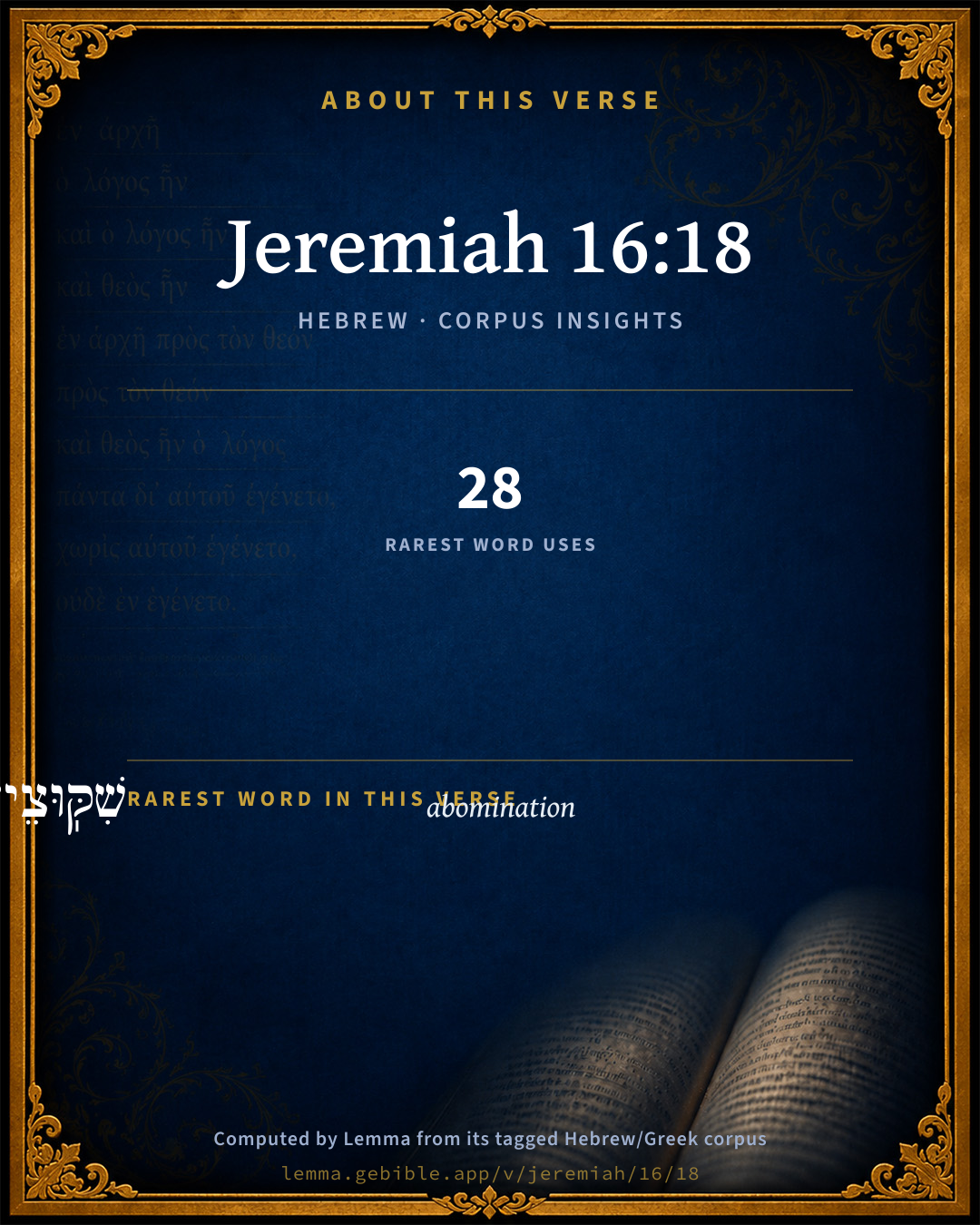
שִׁקּֽוּצֵיהֶם֙
shiqqûwts
H8251
“abominations · their”
Noun, Common, Masculine, Plural, Construct + Suffix, Personal, 3rd Person, Masculine, Plural
Part of Speech
Noun
Type
Common
Gender
Masculine
Number
Plural
State
Construct
Full BDB Definition

Origin: from H8262

TWOT: 2459b

detestable thing or idol, abominable thing, abomination, idol, detested thing
  1. וְשִׁלַּמְתִּ֣י shâlam H7999 “and · to be at peace” Conjunction + Verb, Piel, Sequential Perfect, 1st Person, Common, Singular
  2. רִֽאשׁוֹנָ֗ה riʼshôwn H7223 “first” Adjective, Adjective, Feminine, Singular, Absolute
  3. מִשְׁנֵ֤ה mishneh H4932 “second of” Noun, Common, Masculine, Singular, Construct
  4. עֲוֺנָם֙ ʻâvôn H5771 “iniquity · their” Noun, Common, Both, Singular, Construct + Suffix, Personal, 3rd Person, Masculine, Plural
  5. וְחַטָּאתָ֔ם chaṭṭâʼâh H2403 “and · sin offering · their” Conjunction + Noun, Common, Feminine, Singular, Construct + Suffix, Personal, 3rd Person, Masculine, Plural
  6. עַ֖ל ʻal H5921 “upon” Preposition
  7. חַלְּלָ֣ם châlal H2490 “to profane · them” Verb, Piel, Infinitive Construct + Suffix, Personal, 3rd Person, Masculine, Plural
  8. אֶת ʼêth H853 “-” Particle, Direct Object
  9. אַרְצִ֑י ʼerets H776 “land · my” Noun, Common, Both, Singular, Construct + Suffix, Personal, 1st Person, Common, Singular
  10. בְּנִבְלַ֤ת nᵉbêlâh H5038 “in/at · carcass of” Preposition + Noun, Common, Feminine, Singular, Construct
  11. וְתוֹעֲב֣וֹתֵיהֶ֔ם tôwʻêbah H8441 “and · abominations · their” Conjunction + Noun, Common, Feminine, Plural, Construct + Suffix, Personal, 3rd Person, Masculine, Plural
  12. מָלְא֖וּ mâlêʼ H4390 “to fill” Verb, Qal, Perfect, 3rd Person, Common, Plural
  13. אֶת ʼêth H853 “-” Particle, Direct Object
  14. נַחֲלָתִֽי nachălâh H5159 “inheritance · my” Noun, Common, Feminine, Singular, Construct + Suffix, Personal, 1st Person, Common, Singular

About this verse

These counts appear in no published source. They are computed here, from the morphology-tagged text and Lemma’s own curated glosses. What Lemma adds →

15
words
14
distinct lemmas
Prophets
section

Shared distinctive vocabulary

שִׁקּֽוּצֵיהֶם֙ abomination H8251 occurs in 26 verses of the Hebrew Bible. Also found in:

Grammatical profile

  • 3 verbs
  • 8 nouns
  • 1 adjective
  • 1 preposition
  • 2 particles

Verb forms

  • וְשִׁלַּמְתִּ֣י Piel · Sequential Perfect
  • חַלְּלָ֣ם Piel · Infinitive Construct
  • מָלְא֖וּ Qal · Perfect

Cross-references

17

Topical passages linked to Jeremiah 16:18 in the Treasury of Scripture Knowledge — connected by theme and wording, ordered by reader-vote popularity; previews shown in the World English Bible.

  • Numbers 35:33–34 So you shall not pollute the land in which you are: for blood, it pollutes the land; and no expiation can be made for the land for the blood that is shed therein, but by the blood of him who shed it.
  • Isaiah 40:2 Speak comfortably to Jerusalem; and cry to her, that her warfare is accomplished, that her iniquity is pardoned, that she has received of Yahweh's hand double for all her sins.
  • Jeremiah 2:7 I brought you into a plentiful land, to eat the fruit of it and the goodness of it; but when you entered, you defiled my land, and made my heritage an abomination.
  • Jeremiah 17:18 Let them be disappointed who persecute me, but let not me be disappointed; let them be dismayed, but don't let me be dismayed; bring on them the day of evil, and destroy them with double destruction.
  • Ezekiel 11:21 But as for them whose heart walks after the heart of their detestable things and their abominations, I will bring their way on their own heads, says the Lord Yahweh.
  • Revelation 18:6 Return to her just as she returned, and repay her double as she did, and according to her works. In the cup which she mixed, mix to her double.
  • Isaiah 61:7 Instead of your shame [you shall have] double; and instead of dishonor they shall rejoice in their portion: therefore in their land they shall possess double; everlasting joy shall be to them.
  • Jeremiah 3:9 It happened through the lightness of her prostitution, that the land was polluted, and she committed adultery with stones and with stocks.
  • Ezekiel 11:18 They shall come there, and they shall take away all the detestable things of it and all the abominations of it from there.
  • Ezekiel 43:7–9 He said to me, Son of man, [this is] the place of my throne, and the place of the soles of my feet, where I will dwell in the midst of the children of Israel forever. The house of Israel shall no more defile my holy name, neither they, nor their kings, by their prostitution, and by the dead bodies of their kings [in] their high places;
  • Zephaniah 3:1–5 Woe to her who is rebellious and polluted, the oppressing city!
  • Leviticus 18:27–28 (for all these abominations have the men of the land done, that were before you, and the land became defiled);
  • Leviticus 26:30 I will destroy your high places, and cut down your incense altars, and cast your dead bodies upon the bodies of your idols; and my soul will abhor you.
  • Psalms 106:38 They shed innocent blood, Even the blood of their sons and of their daughters, Whom they sacrificed to the idols of Canaan. The land was polluted with blood.
  • Jeremiah 3:1–2 They say, If a man put away his wife, and she go from him, and become another man's, will he return to her again? Won't that land be greatly polluted? But you have played the prostitute with many lovers; yet return again to me, says Yahweh.
  • Micah 2:10 Arise, and depart! For this is not your resting place, Because of uncleanness that destroys, Even with a grievous destruction.
  • Isaiah 24:5 The earth also is polluted under the inhabitants of it; because they have transgressed the laws, violated the statutes, broken the everlasting covenant.

Cross-references courtesy of OpenBible.info (CC BY 4.0).

Hebrew and Greek witnesses Masoretic Hebrew ↔ Greek Septuagint

The same verse in the two great witnesses to the Old Testament, shown verse-for-verse.

These are two independent witnesses, not word-aligned to each other, and the Septuagint is shown in lemma (dictionary) form.

Hebrew Jeremiah 16:18 Masoretic · Westminster Leningrad Codex

וְשִׁלַּמְתִּ֣י רִֽאשׁוֹנָ֗ה מִשְׁנֵ֤ה עֲוֺנָם֙ וְחַטָּאתָ֔ם עַ֖ל חַלְּלָ֣ם אֶת אַרְצִ֑י בְּנִבְלַ֤ת שִׁקּֽוּצֵיהֶם֙ וְתוֹעֲב֣וֹתֵיהֶ֔ם מָלְא֖וּ אֶת נַחֲלָתִֽי

First I will recompense their iniquity and their sin double, because they have polluted my land with the carcasses of their detestable things, and have filled my inheritance with their abominations.

World English Bible · Public Domain

Greek LXX Structure differs

In the Septuagint, Jeremiah is about an eighth shorter than the Hebrew and arranges its material differently — the Oracles Against the Nations (Hebrew chapters 46–51) appear in the middle of the Greek book, after 25:13. Because the chapter and verse boundaries do not line up, a verse-for-verse comparison with the Hebrew is not shown.

A verse-for-verse comparison isn’t shown here because the chapters and verses don’t line up. Switch to the LXX edition with the MT / LXX toggle above to read the Greek directly.

On this verse, The Cambridge Bible for Schools and Colleges discusses the Septuagint’s reading. Read the note in Commentary ↓

Hebrew: Westminster Leningrad Codex (CC BY 4.0). Greek: Septuagint (public domain); English from a public-domain English Septuagint. How the Septuagint differs from the Hebrew →

Targum (Aramaic paraphrase)

1

The Targum is the ancient Jewish Aramaic paraphrase of the Hebrew Scriptures — an interpretive translation, not the Hebrew text itself. Onkelos (literal) and Pseudo-Jonathan (expansive) render the Torah, and Jonathan the Prophets. Coverage is partial: where no permissively-licensed English translation exists for a verse, only the Aramaic is shown. This is verse-level text, not a word-by-word alignment to the Hebrew.

  1. Targum Jonathan Prophets (Joshua–Malachi)
    וַאֲשַׁלֵם לְתִנְיָנִין כְּקַדְמְאִין עַל חַד תְּרֵין חוֹבֵיהוֹן וְחַטָאֵיהוֹן עַל דְאַחִילוּ יַת אֲרַע בֵּית שְׁכִנְתִּי בְּנִבְלַת שִׁקוּצֵיהוֹן וְתוֹעֲבַתְהוֹן מְלוֹ יַת אַחְסַנְתִּי:

    (no public-domain English translation for this verse)

    Targum Jonathan — Aramaic: “Mikraot Gedolot” (public domain). English: “Sefaria Community Translation” (CC0 1.0 (public-domain dedication)); “London "Chaldee Paraphrase," 1871” (public domain). Text via Sefaria.

Commentary

Notes on Jeremiah 16:18 from classic Christian and Jewish commentators (each source and its license shown beneath its notes). The classic Christian expositions comment on the surrounding passage and are grouped to its opening verse, so a note may address several verses; the Jewish commentaries on the Tanakh (Rashi and others) are per-verse, so they appear only where the commentator wrote on this verse.

Lemma curates 59 commentaries, every one of them public domain or Creative Commons licensed, each selected and text-cleaned for this edition rather than reprinted as found. About our sources →

The Cambridge Bible for Schools and Colleges

gen. ed. J. J. S. Perowne

18. first] The word (rî’shônah) is not found in LXX, and was probably inserted after Jer_16:14 f. had been introduced into the text. Co. however thinks it is a corruption of the frequent expression (e.g. Jdg_9:57) ‘al ro’shâm, upon their head.

double] Cp. Isa_40:2.

because they have polluted] The mg. is more strictly in accordance with the Hebrew.

the carcases, etc.] the idols themselves, called carcases as being in their nature polluting to the touch like a dead body.

The whole of Jer_16:18 is unmetrical, and Co. rejects the second part (from “because”), as containing language belonging to later times, e.g. “carcases” in connexion with idols, as in Ezekiel 6 (specially in Jer_16:5; Jer_16:13) and Lev_26:30.

The Cambridge Bible for Schools and Colleges (gen. ed. J. J. S. Perowne; Cambridge University Press, 1878–1918) — public domain. Text from a community e-Sword module.

Trapp's Complete Commentary

John Trapp

Jer 16:18 And first I will recompense their iniquity and their sin double; because they have defiled my land, they have filled mine inheritance with the carcases of their detestable and abominable things.

Ver. 18. And first,] i.e., Before I restore them. I will recompense their iniquity and their sin

double,] i.e., Abundantly. {a} I will have my full pennyworths of them; not double to their deserts, {as Isa 40:2; Isa 60:1}

With the careases,] i.e., With their idolatries, more odious and loathsome than any stinking carcases can be.

{a} Poenarum abunde. - Jun.

John Trapp, A Commentary or Exposition upon All the Books of the Old and New Testament (1647–1656) — public domain. Text from a community e-Sword module.

Tyndale Open Study Notes

Tyndale Open Resources

16:18 The punishment was double—slaughter and exile—because the people of Judah had violated the two most important commandments. They did not love God (Deut 6:4-5), and they did not love their neighbors (Lev 19:18; see also Matt 22:37-40).

Tyndale Open Study Notes — © Tyndale Open Resources, licensed CC BY-SA 4.0. Text via the HelloAO Bible API.

Geneva Bible (1599)

Geneva Bible translators

That is, their sons and daughters, which they offered to Molech.

Geneva Bible (1599) marginal notes — public domain. Text via Bolls.life.

Jamieson, Fausset & Brown

Robert Jamieson, A. R. Fausset & David Brown

first . . . double--HORSLEY translates, "I will recompense . . . once and again"; literally, "the first time repeated": alluding to the two captivities--the Babylonian and the Roman. MAURER, "I will recompense their former iniquities (those long ago committed by their fathers) and their (own) repeated sins" (Jer 16:11-12). English Version gives a good sense, "First (before 'I bring them again into their land'), I will doubly (that is, fully and amply, Jer 17:18; Isa 40:2) recompense."

carcasses--not sweet-smelling sacrifices acceptable to God, but "carcasses" offered to idols, an offensive odor to God: human victims (Jer 19:5; Eze 16:20), and unclean animals (Isa 65:4; Isa 66:17). MAURER explains it, "the carcasses" of the idols: their images void of sense and life, Compare Jer 16:19-20. Lev 26:30 favors this.

Jamieson, Fausset & Brown — Commentary Critical and Explanatory on the Whole Bible (1871) — public domain (CC PDM 1.0). Text via the HelloAO Bible API.

Adam Clarke's Commentary

Verse 18. The carcasses of their detestable - things.] Either meaning the idols themselves, which were only carcasses without life; or the sacrifices which were made to them.

Adam Clarke's Commentary on the Bible (1810–1826) — public domain. Text from a community e-Sword/MySword module.

John Calvin's Commentaries

Jeremiah introduces here nothing new, but proceeds with the subject we observed in the last verse, — that God would not deal with so much severity with the Jews, because extreme rigor was pleasing to him, or because he had forgotten his own nature or the covenant which he had made with Abraham, but because the Jews had become extremely obstinate in their wickedness. As, then, he had said that the eyes of God were on all their ways, so now he adds that he would recompense them as they deserved.

But every word ought to be considered: He says ראשונה rashune, which I render “From the beginning.” Some render it more obscurely, “at first,” — I will first recompense them. The word means formerly, and refers to time. The Prophet then, I have no doubt, means what I have already referred to, — that God would punish the fathers and their children, and would thus gather into one mass their old iniquities. We have quoted from the law that God would recompense unto the bosom of children the sins of their fathers; and we have also quoted that declaration of Christ,

“Come upon you shall righteous blood from Abel to Zachariah, the son of Barachiah.” (Matthew 23:35; Luke 11:51)

The Prophet now repeats the same thing, — that God, in allotting to the Jews their reward, would collect together as it were all the iniquities which had been as it were long buried, so that he would include the fathers and their children in one bundle, and gather together all their sins, in order that he might consume them as it were in one heap. In this way I explain the term “From the beginning.”

He then adds, The double of their iniquities and their sins The Prophet does not mean that there would be an excess of severity, as though God would not rightly consider what men deserved; but “double” signifies a just and complete measure, according to what is said in Isaiah 40:2,

“The Lord hath recompensed double for all her sins;”

that is, sufficiently and more, (satis superque) as the Latins say. There God assumes the character of a father, and, according to his great kindness, says that the Jews had been more than sufficiently punished. So also in this place, in speaking of punishment, he calls that double, not what would exceed the limits of justice, but because God would shew himself differently to them from what he had done before, when he patiently bore with them; as though he had said, “I will to the utmost punish them; for there will be no remission, no lenity, no mercy.” We hence see that what is here designed is only extreme rigor, which yet was just and right; for had God punished a hundred times more severely even those who seemed to have sinned lightly, his justice could not have been questioned as though he had acted cruelly. Since, the Jews, then, had in so many ways, and for so long a time, and so grievously sinned, God could not have been thought too severe, when he rendered to them their reward; and he calls it double because he omitted nothing in order to carry it to the utmost severity. Probably he alludes also to the enemies as being ministers of his vengeance, whose cruelty would be more atrocious than the Jews thought, who imagined some slight remedies for slight sins, as we say, Il n’y faudra plus retourner, or, tote outre.

He mentions sins and iniquities, for Jeremiah had introduced them before as speaking thus, “What is our iniquity? and what is our sin?” Though they could not wholly exculpate themselves, they yet continued to allege some pretences, that they might not appear to be altogether wicked. But here God declares that they were wholly wicked and ungodly; and he adds a confirmation, that they had polluted the land with the carcases of their abominations The Prophet mentions a particular thing, for had he spoken generally, the Jews would have raised a clamor and said, that they were not conscious of being so wicked. That he might then bring the matter home to them, he shews as it were by the finger that their sin was by no means excusable, for they had polluted the land of God with their superstitions; they have polluted, he says, my land He exaggerates their crime by saying, that they polluted the holy land. The earth indeed is God’s and its fullness. (Psalm 24:1) Hence it might be said justly of the whole world, that the land of God is polluted when men act on it an ungodly part. But here God distinguishes Canaan from other countries, because it was dedicated as it were to his name. As God then had set apart that land for himself, that he might be there worshipped, he says, they have polluted my land

And he adds, With the carcases of their abominations It is probable that he calls their sacrifices carcases. For though in appearance their superstitions bore a likeness to the true and lawful worship of God, yet we know that the sacrifices which God had commanded were seasoned by his word as with salt; they were therefore of good odor and fragrance before God. As to the sacrifices offered to idols, they were foetid carcases, they were mere rottenness, yet the ceremony was altogether alike. But God does not regard the external form, for obedience is better before him than all sacrifices. (1 Samuel 15:22) We hence see that there is to be understood a contrast between the carcases and the sweet odor which lawful sacrifices possessed. For as sacrifices, rightly offered according to the rule of the law, pleased God and were said to be of sweet savor so the victims superstitiously offered having no command of God in their favor, were called filthy carcases.

And he says further, With their defilements have they filled mine inheritance The land of Canaan is called the inheritance of God in the same sense in which the land is before called his land. But in this second clause something more is expressed, as it is the usual manner of Scripture to amplify. It was indeed a grievous thing that the land dedicated to God should be polluted; but when he says, This is mine inheritance, that is, the, land which I have chosen to dwell in with my people, that it might be to me as it were a kind of an earthly habitation, and that this land was fined with defilements, it was a thing altogether intolerable. We now then see that the Jews were so bridled and checked that they in vain attempted to escape, or thought to gain anything by evasions, for their impiety was intolerable and deserved to be most severely punished by God. I will not proceed further, for it is a new discourse.

John Calvin's Commentaries (1540-1563) — public domain. Text from the Calvin Translation Society English edition (1840s-50s) via the Christian Classics Ethereal Library (ccel.org). Calvin's coverage is partial (roughly two-thirds of the Bible); uncommented books and verses are honest gaps, never fabricated. The 19th-century editor's footnotes and remarks are omitted so the notes are faithfully Calvin's own voice.

Ellicott's Commentary for English Readers

(18) I will recompense their iniquity and their sin double.—A restitution, or fine, to double the amount of the wrong done was almost the normal standard of punishment under the Law of Moses (Exo_22:4; Exo_22:7). The words threaten accordingly a full punishment according to the utmost rigour. In Isa_40:2 the same thought is presented in its brighter aspect. Israel has received “double for all her sins,” and therefore, having paid, as it were, “the uttermost farthing” (Mat_5:26), she may now hope for mercy.

The carcases . . .—The word may be used in scorn of the lifeless form of the dumb idols which the people worshipped, to touch which was to be polluted, as by contact with a corpse (Num_19:11); but it more probably points to the dead bodies of the victims that had been sacrificed to them. The phrase occurs also in a like context in Lev_26:30. It would appear from Isa_65:4 that these often included animals which by the Law were unclean: “swine’s flesh and broth of abominable things.”

A Bible Commentary for English Readers, edited by Charles John Ellicott (1878–1897) — public domain. Text from a community e-Sword module.

John Gill's Exposition

O Lord, my strength and my fortress,.... These are the words of the prophet, rising out of the temptation which beset him; casting off his impatience, diffidence, and unbelief; calling upon God, and exercising faith in him; having received the promise of the restoration of his people to their land, and a view of the future conversion of the Gentiles; which were a means of recovering his spiritual strength, of invigorating grace in him, and of encouraging him to exercise it in a lively manner; to go on in his duty constantly, and to bear affliction cheerfully and patiently; "strength" to do which he had from the Lord; and to whom he ascribes it; and whom he calls his "fortress", or strong hold; and such the Lord is to his people, a strong hold to prisoners of hope, and a strong tower or place of defence to all his saints:

and my refuge in the day of affliction; in which he now was, or saw was coming upon him, when he should be carried captive into Babylon; but God was his refuge, shelter, and protection, and to him he betook himself, where he was safe; and which was infinitely better to him than the mountains, hills, and holes of rocks, others would fly unto, Jer 16:16.

The Gentiles shall come unto thee from the ends of the earth; not the Jews, who were like to the Gentiles for their idolatries, and other wicked practices, and therefore so called, who should return from the several distant countries where they had been scattered, to their own land, and to the worship of God in it; but such who were really Gentiles, that should be converted, either at the time of the Babylonish captivity, and should come along with the Jews when they returned, and worship the Lord with them; or rather in Gospel times. And so Kimchi says this belongs to the times of the Messiah; when the Gospel was to be, and was preached among them, even to the ends of the earth; and many savingly came to Christ for righteousness and strength, for peace, pardon, salvation, and eternal life; and turned to him as to a strong hold, and fled to him for refuge, and laid hold on him, the hope set before them.

And shall say, surely our fathers have inherited lies, vanities, and things wherein there is no profit; meaning their idols, which did not give what their priests, and the abettors of them, promised; and so deceived their votaries, and disappointed them of their expectations, which became vain, and so were of no profit and advantage to them; a poor inheritance this, which they had possessed and enjoyed for many generations, which their children, now being convinced of, relinquish; for a false religion is not to be retained on this score, because the religion of ancestors, and of long possession with them.

John Gill's Exposition of the Whole Bible (1746–1763) — public domain (CC PDM 1.0). Text via the HelloAO Bible API.

Albert Barnes' Notes on the Bible

First - Before the return from exile.

I will recompense their iniquity ... double - The ordinary rule of the Law (Isa 40:2 note). Sin is twofold; there is the leaving of God’s will undone, and the actual wrongdoing. And every punishment is twofold: first, there is the loss of the blessing which would have followed upon obedience, and secondly, the presence of actual misery.

Because they have defiled ... - Rather, “because they have profaned My land with the carcases of their detestable things” (their lifeless and hateful idols, the very touch of which pollutes like that of a corpse, Num 19:11); “and hare filled My inheritance with their abominations.”

Albert Barnes' Notes on the Bible (1834–1885) — public domain. Text from a community e-Sword/MySword module.

Haydock's Catholic Bible Commentary

Double: enormous. (Haydock) (Chap. xvii. 18.) --- I will punish them doubly. --- Carcasses. So he styles the victims, or idols, the representations of dead men.

George Leo Haydock (1774–1849), Haydock's Catholic Family Bible and Commentary, 1859 edition — public domain. Excludes Psalms (Douay-Rheims chapter numbering differs from Protestant) and Deuterocanonical books (Catholic canon only).

Matthew Poole's English Annotations

Before I will restore them, and return in my wonted favour to them, I will punish them for their ways which 1 have seen, which are ways of iniquity, and will plentifully punish them; (for so

double here signifies, not the double of what their sins deserve;) because by their idolatry, blood, and cruelty, and other sins, they have defiled the land which I own, and which I have given them; and have filled that country which I have chosen for and named

my inheritance with their

abominable things, that is, practices, or unclean beasts offered to their idols in sacrifices, or innocent persons slain by them.

Matthew Poole's English Annotations on the Holy Bible (1683–1685) — public domain. Text from a community e-Sword/MySword module.

Whedon's Commentary on the Bible

Daniel D. Whedon

18. And first — Namely, before the return already mentioned.

Double — Various interpretations have been given of this. 1) I will recompense double — that is, two times — in allusion to the Babylonian and Roman captivities. 2) I will recompense their former iniquities and the repetition of them. 3) Amply and fully. Compare Isa_40:2; Job_11:16; Jer_17:18. This is the only satisfactory explanation.

Daniel D. Whedon (gen. ed.), Commentary on the Old and New Testaments (1874–1909) — public domain. Text from a community e-Sword module.

The Pulpit Commentary

Firsti.e. before "I bring them back again into their landI will recompense... double; i.e. amply, in full measure. (comp. Jer_17:18 Isa_40:2 Rev_18:6) With the carcasses , etc. The idols, which "defile the consciences" of those who worship them, are compared to the most unclean and loathsome objects.

The Pulpit Commentary (1880–1919), ed. H.D.M. Spence-Jones & Joseph S. Exell — public domain. Text from a community e-Sword module.

John Wesley's Explanatory Notes

I will recompense - Before I will restore them, I will plentifully punish them, (for so double here signifies, not the double of what their sins deserve.) Defiled - By their idolatry, blood and cruelty. Detestable - Unclean beasts offered to their idols, or innocent persons slain by them.

John Wesley, Explanatory Notes Upon the Whole Bible (1754–1765) — public domain. Text via the GEBible commentary corpus.

Rashi

Rabbi Shlomo Yitzchaki (Rashi)

the doubling of their iniquity Because they repeated their iniquity to do the iniquities of their fathers. And Jonathan renders in this manner: And I will recompense the second ones like the first ones double.

Rashi on the Tanakh — English translations: “The Judaica Press complete Tanach with Rashi, translated by A. J. Rosenberg” (CC BY 4.0); “Pentateuch with Rashi's commentary by M. Rosenbaum and A.M. Silbermann, 1929-1934” (public domain); “The Metsudah Tanach series, Lakewood, N.J” (CC BY 4.0); and “The Book of Joshua, Metsudah Publications, 1997” (CC BY 4.0). Text via Sefaria.

Lesson kit

Teaching starters — assembled from the data on this page, not authored interpretation. Every prompt links to the verse data it draws on. Edit before teaching.

Jeremiah, in the Prophets, opens this verse with 15 words (14 distinct Hebrew lemmas). Its most distinctive word is shiqqûwts (“abomination”). A historical commentator’s framing appears above. Read the whole chapter for the surrounding context.

Discussion questions

  1. The word shiqqûwts carries the sense “abomination.” How does it shape the verse?
  2. How does Deuteronomy 29:17, which shares the word «abomination», read alongside this verse?
  3. These translations render this verse differently. What is at stake in choosing one wording over another?
  4. «וְשִׁלַּמְתִּ֣י» is a Piel Sequential Perfect verb. How does that grammatical form shape the action described?
  5. Compare how The Cambridge Bible for Schools and Colleges and Trapp's Complete Commentary read this verse. Where do they agree or differ?

Things to notice

Reading settings

Reading text

Shown beneath each verse's original-language words.

Old Testament
Old Testament edition

Read the OT as the Masoretic Hebrew (MT) or the Greek Septuagint (LXX).

English shown for the Greek Septuagint (in the Hebrew ↔ Greek comparison).

Comparing translations? Open the Compare panel on any verse page to stack up to four side by side.