Leviticus 16:22

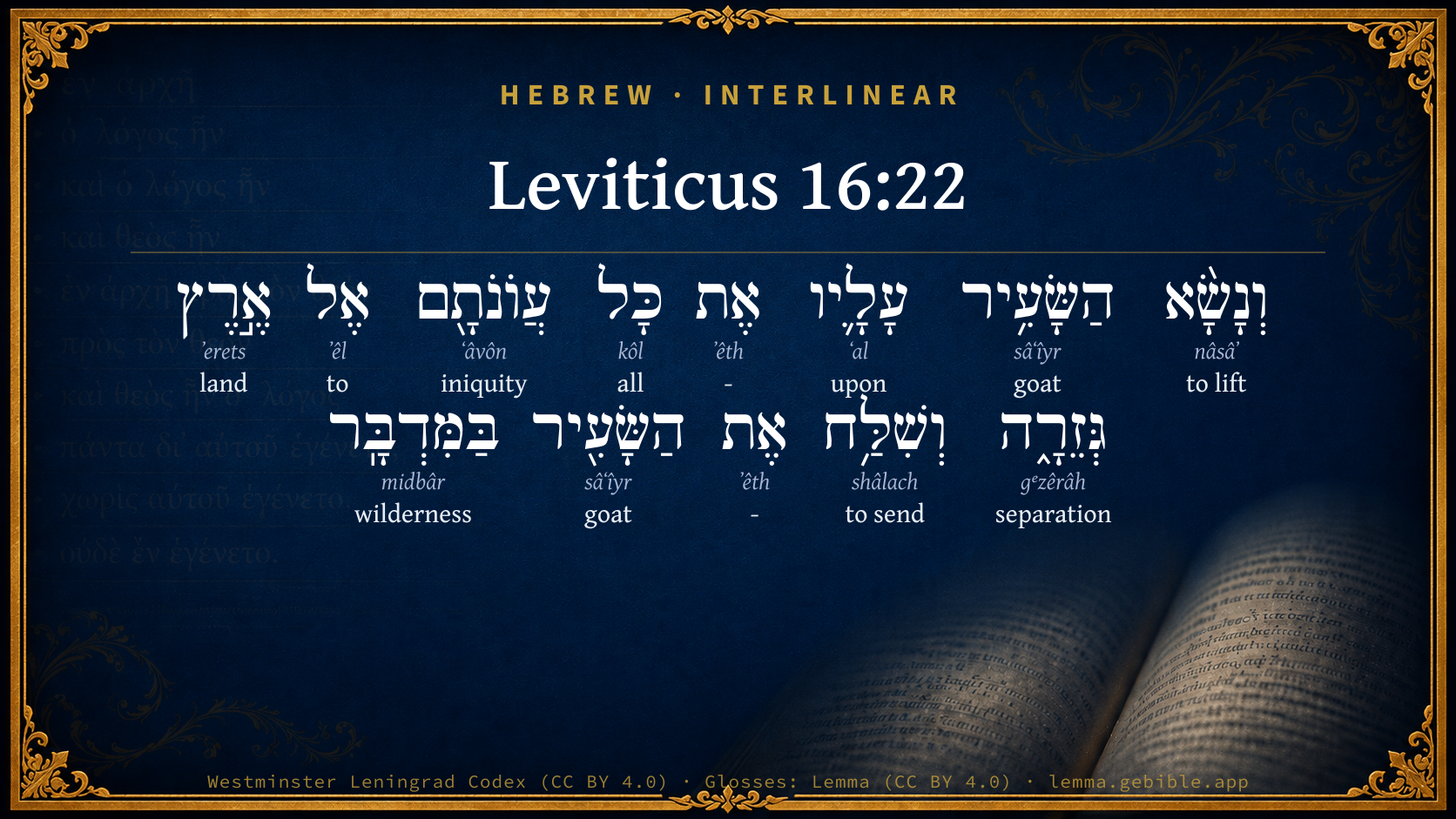
Hebrew (Westminster Leningrad Codex) Leviticus 16:22 appears in the Hebrew Old Testament. The text above is from the Westminster Leningrad Codex. Each word links to its Strong’s number, a concise gloss, and parsing drawn from the Open Scriptures Hebrew Bible morphology. Click any word for its full Brown-Driver-Briggs (BDB) entry.
Download image
Cite this verse

Leviticus 16:22 (World English Bible). Public Domain. Lemma interlinear Bible study tool, https://lemma.gebible.app/v/leviticus/16/22.

Show BibTeX & RIS
BibTeX
RIS
English Translation
The goat shall carry all their iniquities on himself to a solitary land, and he shall let the goat go in the wilderness.
World English Bible · Public Domain
Highlights
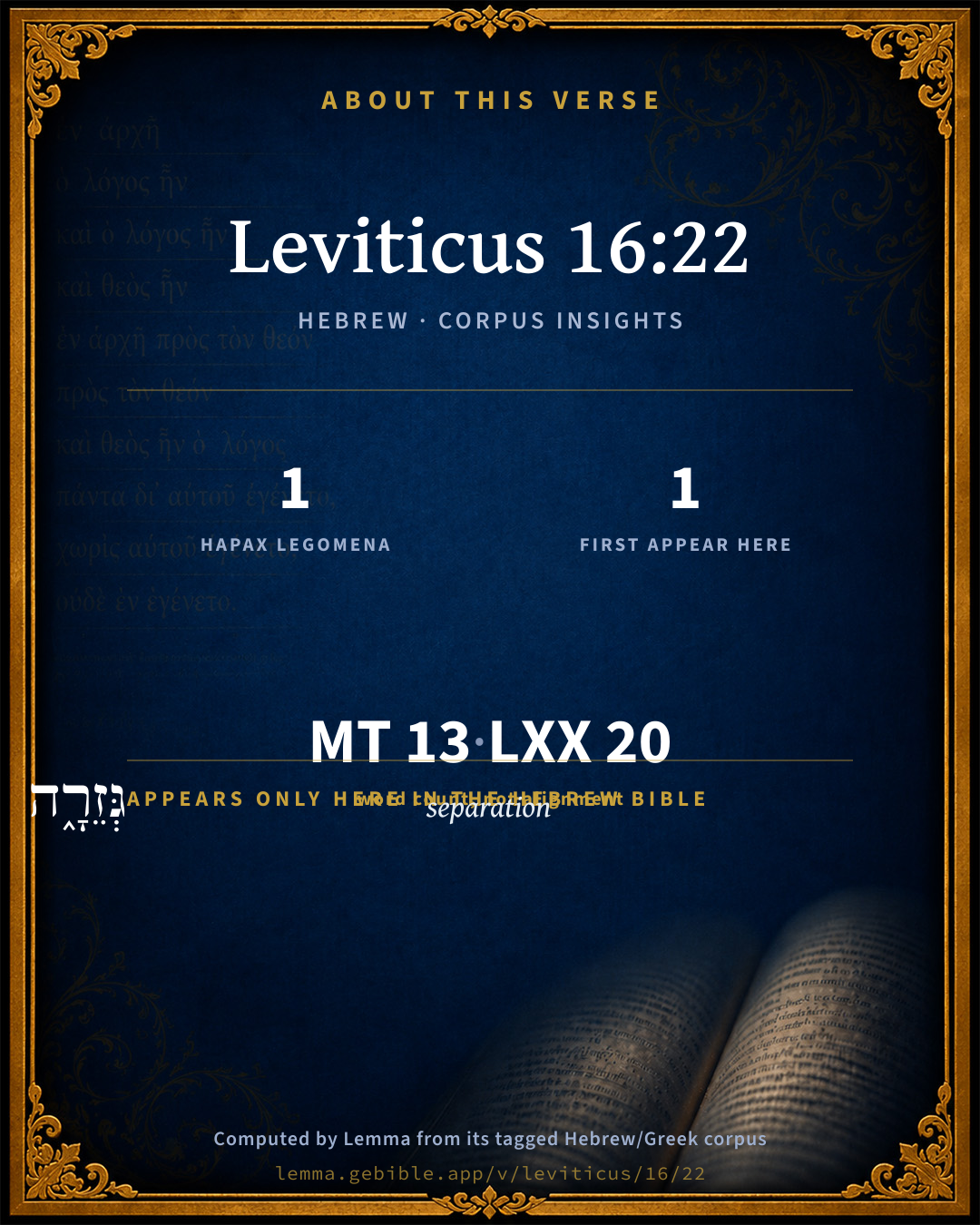
  • 1 hapax legomenon — only here in the Hebrew Bible
  • 1 first appearance in the Hebrew Bible
Full analysis ↓
Download a study sheet

One document with this verse’s original text, its word-by-word gloss line, the meaning frame, cross-references with their text, attributed commentary, and full source and license credits — printable, and it pastes into notes with its structure intact.

This verse Autodidact and up

Study sheet (.html) Plain text (.txt)

A passage Seminary Student

Up to 50 verses in one chapter. A passage sheet keeps up to 6 commentary sources and 12 cross-references per verse, in the order this page ranks them, and says so on the sheet whenever that leaves anything out. Ask for a single verse and you get the Autodidact verse sheet above.

Everything on this page stays free to read, with no account — the sheet is a download of what is already on screen, not access to it.

Want to remove ads? Support Godless Engineer
Compare translations 3

The same verse in 3 English versions, stacked beneath the original-language interlinear above. Click any original word for its lexicon entry.

Each is an independent rendering of the whole verse — the interlinear is not word-aligned to these translations.

Highlighted words mark where these versions differ — a whole-verse word diff, not a word-by-word alignment.

  • World English Bible Public Domain
    The goat shall carry all their iniquities on himself to a solitary land, and he shall let the goat go in the wilderness.
  • King James Version Public Domain
    And the goat shall bear upon him all their iniquities unto a land not inhabited: and he shall let go the goat in the wilderness.
  • unfoldingWord Literal Text CC BY-SA 4.0
    And the goat shall bear on itself all their iniquity to an inaccessible land. And he shall send the goat away into the wilderness.

unfoldingWord Literal Text — © unfoldingWord, licensed CC BY-SA 4.0. Word-aligned USFM3 via Door43 (git.door43.org/unfoldingWord/en_ult).

Versions to compare (up to 4)

3 of 4 selected

Show all 18 translations

Every available English version of this verse, each an independent rendering of the whole verse.

  • World English Bible Public Domain
    The goat shall carry all their iniquities on himself to a solitary land, and he shall let the goat go in the wilderness.
  • Berean Standard Bible Public Domain
    The goat will carry on itself all their iniquities into a solitary place, and the man will release it into the wilderness.
  • Majority Standard Bible Public Domain
    The goat will carry on itself all their iniquities into a solitary place, and the man will release it into the wilderness.
  • King James Version Public Domain
    And the goat shall bear upon him all their iniquities unto a land not inhabited: and he shall let go the goat in the wilderness.
  • American Standard Version (1901) Public Domain
    and the goat shall bear upon him all their iniquities unto a solitary land: and he shall let go the goat in the wilderness.
  • Revised Version (1885) Public Domain
    and the goat shall bear upon him all their iniquities unto a solitary land: and he shall let go the goat in the wilderness.
  • Geneva Bible (1599) Public Domain
    So the goate shall beare vpon him all their iniquities into the land that is not inhabited, and he shall let the goate go into the wildernesse.
  • Douay-Rheims (1899) Public Domain
    And when the goat hath carried all their iniquities into an uninhabited land, and shall be let go into the desert,
  • Young's Literal Translation Public Domain
    and the goat hath borne on him all their iniquities unto a land of separation. `And he hath sent the goat away into the wilderness,
  • Literal Standard Version CC BY-SA 4.0
    and the goat has borne on himself all their iniquities to a land of separation. And he has sent the goat away into the wilderness,
  • Unlocked Literal Bible CC BY-SA 4.0
    The goat must carry on himself all the people's wickedness to a solitary place. There in the wilderness, the man must let the goat go free.
  • unfoldingWord Literal Text CC BY-SA 4.0
    And the goat shall bear on itself all their iniquity to an inaccessible land. And he shall send the goat away into the wilderness.
  • Darby Bible Public Domain
    that the goat may bear upon him all their iniquities to a land apart [from men]; and he shall send away the goat into the wilderness.
  • World Messianic Bible Public Domain
    The goat shall carry all their iniquities on himself to a solitary land, and he shall release the goat in the wilderness.
  • Webster's Bible Public Domain
    And the goat shall bear upon him all their iniquities to a land not inhabited: and he shall let go the goat in the wilderness.
  • Free Bible Version CC BY-SA 4.0
    The goat will take upon itself all their sins and go into a distant place, and the man will send it away into the desert.
  • Bible in Basic English Public Domain
    And the goat will take all their sins into a land cut off from men, and he will send the goat away into the waste land.
  • JPS Tanakh (1917) Public Domain
    And the goat shall bear upon him all their iniquities unto a land which is cut off; and he shall let go the goat in the wilderness.

Literal Standard Version (2020), Covenant Press — licensed CC BY-SA 4.0. Text via the HelloAO Bible API (eBible.org). Unlocked Literal Bible (unfoldingWord) — licensed CC BY-SA 4.0. Text via the HelloAO Bible API (eBible.org). unfoldingWord Literal Text — © unfoldingWord, licensed CC BY-SA 4.0. Word-aligned USFM3 via Door43 (git.door43.org/unfoldingWord/en_ult). Free Bible Version, Dr. Jonathan Gallagher — licensed CC BY-SA 4.0. Text via the HelloAO Bible API (eBible.org).

Word by word

More ways to search: Search by grammar → Find every occurrence → Compare this word →

Practice this passage: Drill this verse → Learn its vocabulary →

גְּזֵרָ֑ה
gᵉzêrâh
H1509
“separation”
Adjective, Adjective, Feminine, Singular, Absolute
Part of Speech
Adjective
Type
Adjective
Gender
Feminine
Number
Singular
State
Absolute
Full BDB Definition

Origin: from H1504

TWOT: 340b

a separation, a separate place
  1. וְנָשָׂ֨א nâsâʼ H5375 “and · to lift” Conjunction + Verb, Qal, Sequential Perfect, 3rd Person, Masculine, Singular
  2. הַשָּׂעִ֥יר sâʻîyr H8163 “the · goat” Particle, Definite Article + Noun, Common, Masculine, Singular, Absolute
  3. עָלָ֛יו ʻal H5921 “upon · him” Preposition + Suffix, Personal, 3rd Person, Masculine, Singular
  4. אֶת ʼêth H853 “-” Particle, Direct Object
  5. כָּל kôl H3605 “all of” Noun, Common, Masculine, Singular, Construct
  6. עֲוֺנֹתָ֖ם ʻâvôn H5771 “iniquities · their” Noun, Common, Both, Plural, Construct + Suffix, Personal, 3rd Person, Masculine, Plural
  7. אֶל ʼêl H413 “to” Preposition
  8. אֶ֣רֶץ ʼerets H776 “land” Noun, Common, Both, Singular, Absolute
  9. וְשִׁלַּ֥ח shâlach H7971 “and · to send” Conjunction + Verb, Piel, Sequential Perfect, 3rd Person, Masculine, Singular
  10. אֶת ʼêth H853 “-” Particle, Direct Object
  11. הַשָּׂעִ֖יר sâʻîyr H8163 “the · goat” Particle, Definite Article + Noun, Common, Masculine, Singular, Absolute
  12. בַּמִּדְבָּֽר midbâr H4057 “in/at the · wilderness” Preposition, Determined + Noun, Common, Masculine, Singular, Absolute

About this verse

These counts appear in no published source. They are computed here, from the morphology-tagged text and Lemma’s own curated glosses. What Lemma adds →

13
words
11
distinct lemmas
Pentateuch
section

Notable vocabulary

1 hapax legomenon — a word that appears only here in the entire Hebrew Bible:

  • גְּזֵרָ֑ה separation H1509

First appearance in Scripture

This word makes its first canonical appearance in the Hebrew Bible here:

  • גְּזֵרָ֑ה separation H1509

Shared distinctive vocabulary

הַשָּׂעִ֥יר goat H8163 occurs in 57 verses of the Hebrew Bible. Also found in:

Grammatical profile

  • 2 verbs
  • 6 nouns
  • 1 adjective
  • 2 prepositions
  • 2 particles

Verb forms

  • וְנָשָׂ֨א Qal · Sequential Perfect
  • וְשִׁלַּ֥ח Piel · Sequential Perfect

Repetition

A word recurs within this verse — often emphatic in Hebrew:

  • הַשָּׂעִ֥יר goat H8163 ×2

Hebrew & Septuagint length

In English translation the verse runs 23 words from the Hebrew and 23 from the Septuagint (LXX English) — the same length.

A rough comparison of the two English renderings, which tokenize alike — not a word-level alignment.

Word counts can differ between the Hebrew and the Greek without any difference in meaning — e.g. the Hebrew direct-object marker אֵת has no separate Greek word, and Greek often adds the article ὁ.

In the original languages it is 13 Hebrew tokens and 20 Greek tokens — but the two are counted differently (Hebrew bundles its prefixes and suffixes into one token; the Greek is in lemma form), so that isn’t a like-for-like length.

Cross-references

9

Topical passages linked to Leviticus 16:22 in the Treasury of Scripture Knowledge — connected by theme and wording, ordered by reader-vote popularity; previews shown in the World English Bible.

  • Isaiah 53:11–12 He shall see of the travail of his soul, [and] shall be satisfied: by the knowledge of himself shall my righteous servant justify many; and he shall bear their iniquities.
  • John 1:29 The next day, he saw Jesus coming to him, and said, "Behold, the Lamb of God, who takes away the sin of the world!
  • Psalms 103:10 He has not dealt with us according to our sins, Nor repaid us for our iniquities.
  • Psalms 103:12 As far as the east is from the west, So far has he removed our transgressions from us.
  • Micah 7:19 He will again have compassion on us. He will tread our iniquities under foot; And you will cast all their sins into the depths of the sea.
  • Galatians 3:13 Christ redeemed us from the curse of the law, having become a curse for us. For it is written, "Cursed is everyone who hangs on a tree,"
  • Hebrews 9:28 so Christ also, having been once offered to bear the sins of many, will appear a second time, without sin, to those who are eagerly waiting for him for salvation.
  • 1 Peter 2:24 who his own self bore our sins in his body on the tree, that we, having died to sins, might live to righteousness; by whose stripes you were healed.
  • Ezekiel 18:22 None of his transgressions that he has committed shall be remembered against him: in his righteousness that he has done he shall live.

Cross-references courtesy of OpenBible.info (CC BY 4.0).

Hebrew and Greek witnesses Masoretic Hebrew ↔ Greek Septuagint

The same verse in the two great witnesses to the Old Testament, shown verse-for-verse.

These are two independent witnesses, not word-aligned to each other, and the Septuagint is shown in lemma (dictionary) form.

Hebrew Leviticus 16:22 Masoretic · Westminster Leningrad Codex

וְנָשָׂ֨א הַשָּׂעִ֥יר עָלָ֛יו אֶת כָּל עֲוֺנֹתָ֖ם אֶל אֶ֣רֶץ גְּזֵרָ֑ה וְשִׁלַּ֥ח אֶת הַשָּׂעִ֖יר בַּמִּדְבָּֽר

The goat shall carry all their iniquities on himself to a solitary land, and he shall let the goat go in the wilderness.

World English Bible · Public Domain

Greek LXX Leviticus 16:22 Septuagint · lemma form

καί λαμβάνω ὁ χίμαρος ἐπί ἑαυτοῦ ὁ ἀδικία αὐτός εἰς γῆ ἄβατος καί ἐκ ἀποστέλλω ὁ χίμαρος εἰς ὁ ἔρημος

And the goat shall bear their unrighteousnesses upon him into a desert land; and Aaron shall send away the goat into the wilderness.

LXX2012 (modern English Septuagint) · Public Domain

On this verse, MacLaren's Expositions of Holy Scripture discusses the Septuagint’s reading. Read the note in Commentary ↓

Hebrew: Westminster Leningrad Codex (CC BY 4.0). Greek: Septuagint (public domain); English from LXX2012 (modern English Septuagint) (Public Domain). How the Septuagint differs from the Hebrew →

Targum (Aramaic paraphrase)

2

The Targum is the ancient Jewish Aramaic paraphrase of the Hebrew Scriptures — an interpretive translation, not the Hebrew text itself. Onkelos (literal) and Pseudo-Jonathan (expansive) render the Torah, and Jonathan the Prophets. Coverage is partial: where no permissively-licensed English translation exists for a verse, only the Aramaic is shown. This is verse-level text, not a word-by-word alignment to the Hebrew.

  1. Targum Onkelos Torah (Genesis–Deuteronomy)
    וְיִטוֹל צְפִירָא עֲלוֹהִי יָת כָּל חוֹבֵיהוֹן לְאַרְעָא דְלָא יָתְבָא וִישַׁלַח יַת צְפִירָא בְּמַדְבְּרָא

    (no public-domain English translation for this verse)

    Targum Onkelos — Aramaic: “Onkelos Genesis” (public domain); “Onkelos Exodus” (public domain); “Onkelos Leviticus” (public domain); “Onkelos Numbers” (public domain); “Onkelos Deuteronomy” (public domain). English: “Sefaria Community Translation” (CC0 1.0 (public-domain dedication)); “J.W. Etheridge. The Targums of Onkelos and Jonathan Ben Uzziel on the Pentateuch. London: Longmans, Green, 1862” (public domain). Text via Sefaria.

  2. Targum Pseudo-Jonathan Torah (Genesis–Deuteronomy)
    וִיסוֹבַר צְפִירָא עֲלוֹי יַת כָּל חוֹבֵיהוֹן לַאֲתַר צַדְיָא וְיִפְטוֹר גַבְרָא יַת צְפִירָא לְמַדְבְּרָא דְצוֹק וְיִסוֹק צְפִירָא עַל טַוְורַיָא דְבֵית חֲרוֹרֵי וְיַדְחִינֵיהּ רוּחַ זִיקָא מִן קֳדָם יְיָ וִימוּת

    and the goat shall bear upon him all their sins into a desert place; and the man shall send forth the goat to a rocky desert; and the goat will go up on the mountains of Beth-hadurey, and a tempestuous wind from the presence of the Lord will carry him away, and he will die.

    Targum Pseudo-Jonathan — Aramaic: “Targum Jonathan on Genesis” (public domain); “Targum Jonathan on Exodus” (public domain); “Targum Jonathan on Leviticus” (public domain); “Targum Jonathan on Numbers” (public domain); “Targum Jonathan on Deuteronomy” (public domain). English: “The Targum of Jonathan ben Uzziel, trans. J. W. Etheridge, London, 1862” (public domain). Text via Sefaria.

Commentary

Notes on Leviticus 16:22 from classic Christian and Jewish commentators (each source and its license shown beneath its notes). The classic Christian expositions comment on the surrounding passage and are grouped to its opening verse, so a note may address several verses; the Jewish commentaries on the Tanakh (Rashi and others) are per-verse, so they appear only where the commentator wrote on this verse.

Lemma curates 59 commentaries, every one of them public domain or Creative Commons licensed, each selected and text-cleaned for this edition rather than reprinted as found. About our sources →

Trapp's Complete Commentary

John Trapp

Lev 16:22 And the goat shall bear upon him all their iniquities unto a land not inhabited: and he shall let go the goat in the wilderness.

Ver. 22. Shall let go the goat.] The Hebrews say, that he was to throw it down the rock, and so it died. The Grecians had a like custom {a} in their solemn expiations of their cities. They tumbled the persons devoted from some rock into the sea; sacrificing them to Neptune, saying, Be thou a propitiation for us. {b}

{a} Aemulus Dei diabolus.

{b} Suidas.

John Trapp, A Commentary or Exposition upon All the Books of the Old and New Testament (1647–1656) — public domain. Text from a community e-Sword module.

Joseph Benson's Commentary

Lev 16:22. Unto a land not inhabited — ארצ גזרהerets gezra, a land cut off separated, remote from intercourse with men. The Seventy render it αβατον, untrod, unpassable, a land through which none travelled. The sending away into this desert land the goat, over which the sins of the people had been humbly and penitently confessed, and to which they were figuratively transferred, was certainly a fine and most expressive emblem that, on condition of the repentance of mankind, and their faith in him who was represented by this goat, and was in due time to take away the sins of the world, God would remember their sins and iniquities no more.

Joseph Benson's Commentary on the Old and New Testaments (1811–1818) — public domain. Text from a community e-Sword module.

MacLaren's Expositions of Holy Scripture

Alexander MacLaren

Leviticus

‘THE SCAPEGOAT’

Lev 16:22.

The import of the remarkable treatment of this goat does not depend on the interpretation of the obscure phrase rendered in the Authorised Version ‘for the scapegoat.’ Leaving that out of sight for the moment, we observe that the two animals were one sacrifice, and that the transaction with the living one was the completion of that with the slain. The sins of the congregation, which had been already expiated by the sacrifice, were laid by the high priest on the head of the goat, which was then sent away into the wilderness that he might ‘bear upon him all their iniquities unto a land not inhabited’ {Lev 16:22}. Nothing depends on the fate of the goat, though, in after times, it was forced over a precipice and so killed. The carrying away of expiated sin, and not the destruction of unexpiated sinners, is the meaning of the impressive rite, and, had it been possible, the same goat that was sacrificed would have been sent into the desert. As that could not be done, an ideal unity was established between the two: the one sacrificed represented the fact of expiation, the one driven away represented the consequences of expiation in the complete removal of sin. The expiation was made ‘within the veil’; but a visible token of its completeness was given to help feeble faith, in the blessed mystery of the unseen propitiation. What was divided in the symbol between the twin goats is all done by the one Sacrifice, who has entered into the holiest of all, at once Priest and Sacrifice, and with His own blood made expiation for sin, and has likewise carried away the sin of the world into a land of forgetfulness, whence it never can return.

The clear meaning of the rite is thus obtained, whatever be the force of the difficult phrase already referred to. ‘Scapegoat’ is certainly wrong. But it may be questioned whether the Revised Version is right in retaining the Hebrew word untranslated, and, by putting a capital letter to it, marking it as a proper name {‘for Azazel’}. The word occurs only here, so that we have no help from other passages. It seems to come from a root meaning ‘to drive away,’ and those who take it to be a proper name, generally suppose it to refer to some malignant spirit, or to Satan, and interpret it as meaning ‘a fiend whom one drives away,’ or, sometimes, ‘who drives away.’ The vindication of such an interpretation is supposed to lie in the necessity of finding a complete antithesis in the phrase to the ‘for Jehovah’ of the previous clause in Lev 16:8. But it is surely sacrificing a good deal to rhetorical propriety to drag in an idea so foreign to the Pentateuch, and so opposed to the plain fact, that both goats were one sin offering {Lev 16:5}, in order to get a pedantically correct antithesis. In the absence of any guidance from usage, certainty as to the meaning of the word is unattainable. But there seems no reason, other than that of the said antithesis, against taking it to mean removal or dismissal, rather than ‘a remover.’ The Septuagint translates it in both ways: as a person in Lev 16:8, and as ‘sending away’ in Lev 16:10. If the latter meaning be adopted, then the word just defines the same purpose as is given more at length in Lev 16:22, namely, the carrying away of the sins of the congregation. The logical imperfection of the opposition in Lev 16:8 would then be simply enough solved by the fact that while both goats were ‘for the Lord,’ one was destined to be actually offered in sacrifice, and the other to be ‘for dismissal.’ The incomplete contrast testifies to the substantial unity of the two, and needs no introduction, into the most sacred rite of the old covenant, of a ceremony which looks liker demon-worship than a parable of the great expiation for a world’s sins.

The question for us is, What spiritual ideas are contained in this Levitical symbolism? There is signified, surely, the condition of approach to God. Remember how the Israelites had impressed on their minds the awful sanctity of ‘within the veil.’ The inmost shrine was trodden once a year only by the high priest, and only after anxious lustrations and when clothed in pure garments, he entered ‘with sacrifice and incense lest he die.’ This ritual was for a gross and untutored age, but the men of that age were essentially like ourselves, and we have the same sins and spiritual necessities as they had.

The two goats are regarded as one sacrifice. They are a ‘sin offering.’ Hence, to show how unimportant and non-essential is the distinction between them, the ‘lot’ is employed; also, while the one is being slain, the other stands before the ‘door of the Tabernacle.’ This shows that both are parts of one whole, and it is only from the impossibility of presenting both halves of the truth to be symbolised in one that two are taken. The one which is slain represents the sacrifice for sin. The other represents the effects of that sacrifice. It is never heard of more. ‘The Lamb of God taketh away the sins of the world.’ ‘As far as the east is from the west, so far hath He removed our transgressions from us.’

I. The perfect removal of all sin is thus symbolised.

Notice {1} the vivid consciousness of sin which marked Judaism.

Was it exaggerated or right?

The same consciousness is part of all of us, but how overlaid! how stifled!

That consciousness once awakened has in it these elements-a bitter sense of sin as mine, involving guilt; despair as to whether I can ever overcome it; and fearful thoughts of my relation to God which conscience itself brings.

{2} The futility of all attempts to remove these fears.

False religions have next to nothing to say about forgiveness. Sacrifices and lustrations they have, but no assurance of absolution. Systems of philosophy and morals have nothing to say but that the universe goes crashing on, and if you have broken its laws you must suffer. That is all, or only the poor cheer of ‘Well! you have fallen, get up and go on again!’ So men often drug themselves into forgetfulness. They turn away from the unwelcome subject, and forget it at the price of all moral earnestness and often of all happiness; a lethargic sleep or a gaiety, as little real as that of the Girondins singing in their prison the night before being led out to the guillotine.

It is only God’s authoritative revelation that can ensure the cure, only He can assure us of pardon, and of the removal of all barriers between ourselves and His love. Only His word can ensure, and His power can effect, the removal of the consequences of our sins. Only His word can ensure, and His power effect, the removal of the power of evil on our characters.

{3} Still the question, Can guilt ever be cancelled? often assumes a fearful significance. Doubtless much seems to say that it cannot be.

{a} The irrevocableness of the past.

{b} The rigid law of consequences in this world.

{c} The indissoluble unity of an individual life and moral nature, confirmed by the experience of failure in all attempts at reformation of self.

{d} The consciousness of disturbed relations with God, and the prophecy of judgment. All this that ancient symbol suggested. The picture of the goat going away, and away, and away, a lessening speck on the horizon, and never heard of more is the divine symbol of the great fact that there is full, free, everlasting forgiveness, and on God’s part, utter forgetfulness. ‘Though your sins be as scarlet, they shall be white as snow.’ ‘I will remember them no more at all for ever.’

II. The bearing away of sin is indissolubly connected with sacrifice.

Two goats were provided, of which one was offered for a sin offering, indicating that sacrifice came first; then the removal of sin was symbolised by the sending away of the second goat. There is an evident reference to this sequence in the words ‘without shedding of blood there is no remission.’ The two goats represent Christ’s work; the one in its essence, the other in its effect.

The one teaches that sacrifice is a necessary condition of pardon. Forgiveness was not given because the offerer confessed his guilt or because ‘God was merciful,’ but because the goat had been slain as a sin offering. There is deep spiritual truth for us in this symbolism. We do not need to enter on the philosophy of atonement, but simply to rest on the fact-that the only authority on which we can be sure of forgiveness at all indissolubly associates the two things, sacrifice and pardon. We have no reason to believe in forgiveness except from the Bible record and assurance.

Was the Mosaic ritual a divinely appointed thing? If so, its testimony is conclusive. But even if it were only the embodiment of human aspirations and wants, it would be a strong evidence of the necessity of some such thing as forgiveness.

The shallow dream that God’s forgiveness can be extended without a sacrifice having been offered does not exalt but detracts from the divine character. It invariably leads to an emasculated abhorrence of evil, and detracts from the holiness of God, as well as introduces low thoughts of the greatness of forgiveness and of the infinite love of God.

III. The bearing away of sin is associated with man’s laying of his sins on the sacrifice appointed by God.

We have seen that the two goats must be regarded as together making one whole. The one which was slain made ‘atonement . . .because of the uncleannesses of the children of Israel, and because of their transgressions, even all their sins,’ but that expiation was not actually effective till Aaron had ‘laid his hands on the head of the live goat, and confessed over him all the iniquities of the children of Israel, . . .and put them on the head of the live goat, and sent him away into the wilderness.’ The sacrifice of the slain goat did not accomplish the pardon or removal of the people’s sins, but made it possible that their sins should be pardoned and removed.

Then the method by which that possibility is realised is the laying hands on the scapegoat and confessing the sins upon it. The sins which are actually forgiven, by virtue of the atonement made for all sins, are those which it bears away to the wilderness.

This answers, point for point, to repentance and faith. By these the possibility is turned into an actuality for as many as believe on Christ.

Christ has died for sin. Christ has made atonement by which all sin may be forgiven; whether any shall actually be forgiven depends on something else. It is conceivable that though Christ died, no sin might be pardoned, if no man believed. His blood would not, even then, have been shed in vain, for the purpose of it would have been fully effected in providing a way by which any and all sin could be forgiven. So that the whole question whether any man’s sin is pardoned turns on this, Has he laid his hand on Christ? Faith is only a condition of forgiveness, not a cause, or in itself a power. There was no healing in the mere laying of the hand on the head of the goat.

It was not faith which was the reason for forgiveness, but God’s love which had provided the sacrifice.

God’s will is not a bare will to pardon, nor a bare will to pardon for Christ’s sake, but for Christ’s sake to pardon them who believe. ‘Behold the Lamb of God which taketh away the sins of the world.’ ‘Dost thou believe on the Son of God?’ ‘Through this Man is preached the remission of sins.’

Alexander MacLaren, Expositions of Holy Scripture (1904–1910) — public domain. Text from a community e-Sword module.

Geneva Bible (1599)

Geneva Bible translators

Hebrew, the land of separations.

Geneva Bible (1599) marginal notes — public domain. Text via Bolls.life.

Ellicott's Commentary for English Readers

(22) Unto a land not inhabited.—Literally, unto a land cut off, that is, a place the ground of which is separated from all around it, hence a summit, a peak standing out by itself, a precipice.

In the wilderness.—Where no human beings dwell, but which is the abode of evil spirits. It will be seen that the directions here are simply to conduct the goat into the wilderness, where it is apparently to be let loose to pursue its own course. During the second Temple, however, the authorities decreed that the animal must be destroyed. Accordingly one of the priests who was appointed to execute this mission led the goat to a rock called Zuck, in the wilderness, situate about twelve miles, or ninety furlongs, from Jerusalem. Between the holy city and this steep rock, ten booths were erected at intervals of one mile, and persons were located in every booth to accompany the messenger to the next tent, which was distant a Sabbath day’s journey. From the last booth to the rock, which was double this distance, the messenger had no companion, but he was carefully watched by the occupants of the last booth to see that he performed the ritual according to the prescribed order. On his arrival at the mountain he divided the crimson thread, which was the badge of the goat, into two; one half he fastened to the rock, and the other he tied between the two horns of the victim, and then pushed the animal down the projecting ledge of the rock, when it was dashed to pieces before it reached the bottom. Hereupon the persons stationed at the last booth to watch the proceedings waved linen cloths or white flags, thus signalling from station to station to the priests in the court of the Temple the arrival of the goat at its proper destination.

A Bible Commentary for English Readers, edited by Charles John Ellicott (1878–1897) — public domain. Text from a community e-Sword module.

The Cambridge Bible for Schools and Colleges

gen. ed. J. J. S. Perowne

22. The goat that was sent away was a symbol of the entire removal of the sins for which the blood of the sacrificed animals had already made atonement (Lev_16:14-15; Lev_16:18). In Lev_16:20 it is expressly said that the high priest had made an end of atoning.

22. a solitary land] Heb. a land cut off, ‘a land not inhabited,’ as A.V., or a land from which return was cut off.

The Cambridge Bible for Schools and Colleges (gen. ed. J. J. S. Perowne; Cambridge University Press, 1878–1918) — public domain. Text from a community e-Sword module.

John Gill's Exposition

And the goat shall bear upon him all their iniquities unto a land not inhabited,.... Where it would never be seen, and from whence it would never return more; and so was a proper type of Christ, who has borne all the sins of all his people in his own body on the cross, and all the punishment due unto them; and so has made full satisfaction for them, and has removed them from them, as far as the east is from the west, and out of the sight of avenging justice; so that when they are sought they shall not be found, nor shall they ever return unto them, or be brought against them any more; see Isa 53:12,

and he shall let go the goat in the wilderness; that is, the man that was appointed to have him thither; and so the Targum of Jonathan,"and the man shall let go the goat into the wilderness of Zuck; and the goat shall go upon the mountains of Beth Chadure (or Chadudo), and a tempestuous wind from the Lord shall drive him down, and he shall die.''The manner of conducting this whole affair was this; they made for him a causeway (i.e. for the man that had the goat committed to his care, to have it out of the court, and out of the city), because of the Babylonians, who would pluck him by the hair, and say, Get out, begone, get out, begone. The nobles of Jerusalem accompanied him to the first booth, for there were ten booths from Jerusalem to Zuck, which were ninety furlongs, seven and a half to every mile; at every (i.e. twelve miles) at every booth they said to him, Lo food, lo water, and they accompanied him from booth to booth, excepting the last of them; for there was not one went with him to Zuck, but stood afar off, and observed what he did: what did he do? he parted a scarlet line, half of it he bound to the rock, and half of it he bound between his horns (the goat's), and pushed him backwards, and he rolled and went down, but before he came half way down the mountain he was dashed to pieces; then he (the man) went and sat under the last booth until it was dark--they said to the high priest, the goat is got to the wilderness; but from whence did they know that the goat was got to the wilderness? they made watchtowers or beacons, and they waved linen cloths, and so knew when the goat was come to the Wilderness (k). But the Scripture is entirely silent about the death of this goat, though it no doubt died in the wilderness, only says that it was let go, and was at liberty to go where it would; intimating that the people of Israel were free from all their sins, and they should be no more seen nor remembered; typical of the deliverance and freedom of the people of God from all their sins by Christ. This affair was imitated by Satan among the Heathens, particularly the Egyptians, as has been observed by many out of Herodotus (l); who relates, that they used to imprecate many things upon the head of a beast slain for sacrifice, and then carried it to market, where were Grecian merchants, to whom they sold it; but if there were none, they cast it into the river, execrating the head after this manner, that if any evil was to befall either themselves that sacrificed, or all Egypt, it might be turned upon that head. And on account of this custom, which obtained among all the Egyptians, no one among them would ever taste the head of any animal; which Plutarch (m) also affirms, who says, that having made an execration upon the head of the sacrifice, and cut it off, formerly they cast it into the river, but now they give it to strangers. And a like custom obtained among other nations, as the Massilians and Grecians (n).

(k) Yoma, c. 6. sect. 4, 5, 6, 8. (l) Euterpe, sive, l. 2. c. 39. (m) De Iside & Osir. (n) Vid. Outram. de Sacrificiis, l. 1. c. 22. sect. 14.

John Gill's Exposition of the Whole Bible (1746–1763) — public domain (CC PDM 1.0). Text via the HelloAO Bible API.

Haydock's Catholic Bible Commentary

Desert, to be devoured by wild beasts, (Menochius) or hurled down a precipice.

George Leo Haydock (1774–1849), Haydock's Catholic Family Bible and Commentary, 1859 edition — public domain. Excludes Psalms (Douay-Rheims chapter numbering differs from Protestant) and Deuterocanonical books (Catholic canon only).

Whedon's Commentary on the Bible

Daniel D. Whedon

22. Shall bear — See extended note, Lev_10:17; Num_9:13.

Daniel D. Whedon (gen. ed.), Commentary on the Old and New Testaments (1874–1909) — public domain. Text from a community e-Sword module.

The Pulpit Commentary

Then the goat went forth, bearing upon him all their iniquities. The slain goat had symbolized and ceremonially wrought full atonement or covering of sins; but in order to impress upon the mind of the nation a joyful sense of entire liberation from the burden of sin, the second symbol of the disappearing goat is used; so that not only sin, but the consciousness and the fear of the taint and presence of sin, might be taken away from the cleansed and delivered people. The goat is to bear the iniquities of the people unto a land not inhabited. The latter words in the original, eretz gezerah would be more correctly translated, a laud cut off, that is, completely isolated from the surrounding country by some barrier of rock or torrent, which would make it impossible for the goat to come back again. Thus the sins were utterly lost, as though they had never been, and they could not return to the sanctified people. The Hebrew word gazar, to cut, (1Ki_3:25 Psa_136:18) is represented in Arabic by jazara, and the substantive gezerah by jaziruh, which means an island, or an area surrounded by rivers. The word is still in use in countries where Arabic is spoken, as the designation of a district divided from the neighbouring territories by rivers cutting it off, and making it a sort of island or peninsula. Into such a district as this, the man who led the goat was to let him go. In later times, contrary to the spirit of the Mosaic appointment, the goat was pushed over a projecting ledge of rock, and so killed, a device of man clumsily introduced for the purpose of perfecting a symbolism of Divine appointment. It was more in accordance with the original institution that "the arrival of the goat in the wilderness was immediately telegraphed by the waving of flags, from station to station, till a few minutes after its occurrence it was known in the temple, and whispered from ear to ear, that the goat had borne upon him all their iniquities into a land not inhabited" (Edersheim, "Temple Service"). Both the goat that was sacrificed and the goat that served as remover of sins typified Christ. The first presents him to our faith as the Victim on the cross, the other as the Sin-bearer on whom the Lord laid "the iniquity of us all". (Isa_53:4; cf. 2Co_5:21 Gal_3:13) "The reason for making use of two animals is to be found purely in the physical impossibility of combining all features that had to be set forth in the sin offering in one animal" (Keil).

The Pulpit Commentary (1880–1919), ed. H.D.M. Spence-Jones & Joseph S. Exell — public domain. Text from a community e-Sword module.

Lesson kit

Teaching starters — assembled from the data on this page, not authored interpretation. Every prompt links to the verse data it draws on. Edit before teaching.

Leviticus, in the Pentateuch, opens this verse with 13 words (11 distinct Hebrew lemmas). Its most distinctive word is gᵉzêrâh (“separation”). A historical commentator’s framing appears above. Read the whole chapter for the surrounding context.

Discussion questions

  1. What does “separation” (gᵉzêrâh) contribute to the verse as a whole?
  2. 1 word here appears nowhere else in the Hebrew Bible. Why might the author reach for such rare wording?
  3. This is the first place “separation” appears in Scripture (first appears here). What does its debut here establish?
  4. How does Genesis 27:11, which shares the word «goat», read alongside this verse?
  5. What does the repetition of “goat” (2× in this one verse) do in this verse?
  6. These translations render this verse differently; the difference is in the English rendering, not the original. What questions does that raise?
  7. «וְנָשָׂ֨א» is a Qal Sequential Perfect verb. How does that grammatical form shape the action described?
  8. Compare how Trapp's Complete Commentary and Joseph Benson's Commentary read this verse. Where do they agree or differ?

Things to notice

  • 1 word in this verse appears nowhere else in the Hebrew Bible.
  • 1 word makes its first canonical appearance in Scripture here.
  • This verse counts 13 Hebrew ↔ 20 Greek words.
  • These translations choose different wording for 16 words in this verse.
  • “goat” occurs 2× in this single verse.

Reading settings

Reading text

Shown beneath each verse's original-language words.

Old Testament
Old Testament edition

Read the OT as the Masoretic Hebrew (MT) or the Greek Septuagint (LXX).

English shown for the Greek Septuagint (in the Hebrew ↔ Greek comparison).

Comparing translations? Open the Compare panel on any verse page to stack up to four side by side.