
Psalms 89:32

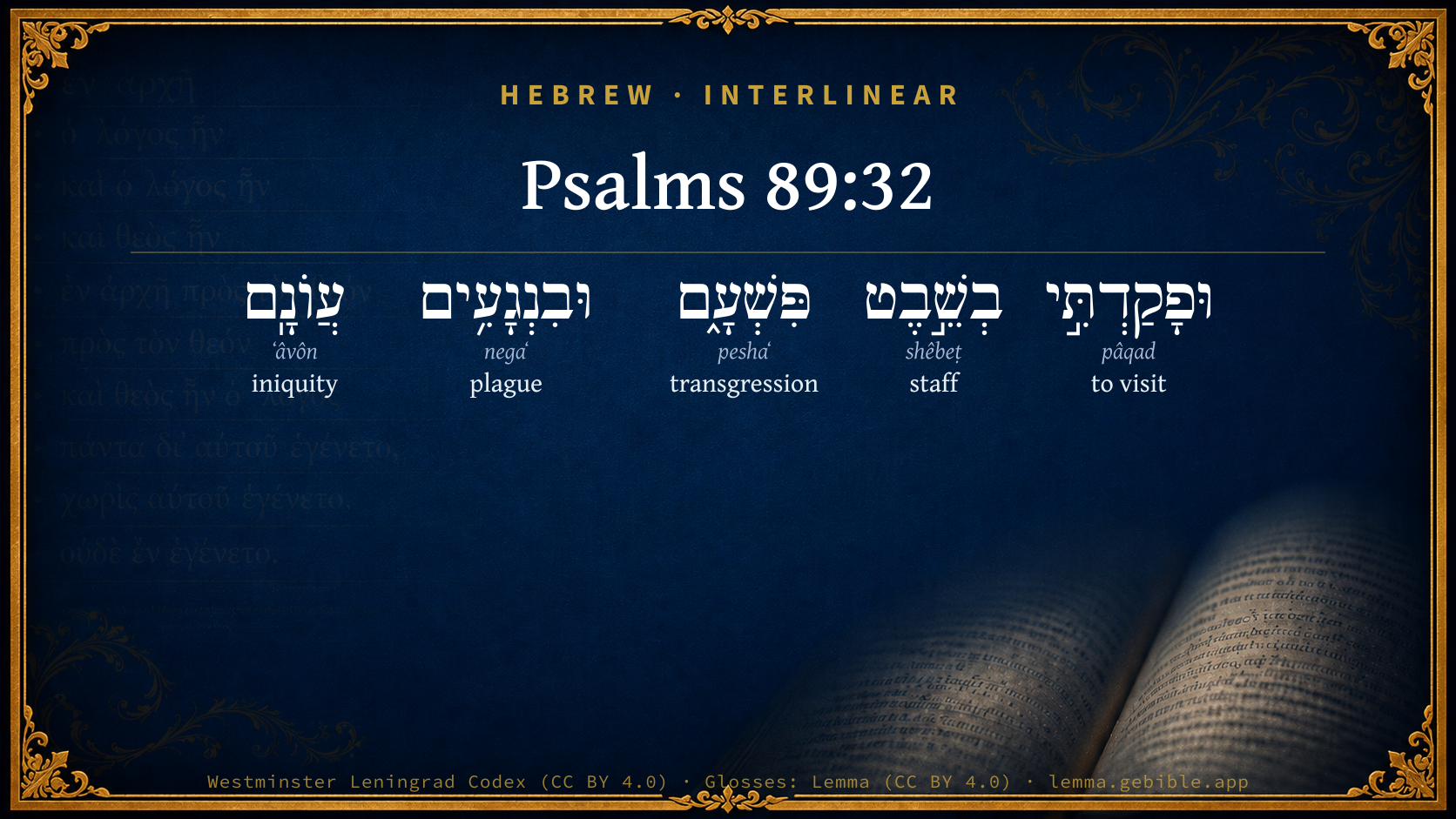
Hebrew (Westminster Leningrad Codex) Psalms 89:32 appears in the Hebrew Old Testament. The text above is from the Westminster Leningrad Codex. Each word links to its Strong’s number, a concise gloss, and parsing drawn from the Open Scriptures Hebrew Bible morphology. Click any word for its full Brown-Driver-Briggs (BDB) entry.
Download image
Cite this verse

Psalms 89:32 (World English Bible). Public Domain. Lemma interlinear Bible study tool, https://lemma.gebible.app/v/psalms/89/32.

Show BibTeX & RIS
BibTeX
RIS
English Translation
Then I will punish their sin with the rod, And their iniquity with stripes.
World English Bible · Public Domain
Download a study sheet

One document with this verse’s original text, its word-by-word gloss line, the meaning frame, cross-references with their text, attributed commentary, and full source and license credits — printable, and it pastes into notes with its structure intact.

This verse Autodidact and up

Study sheet (.html) Plain text (.txt)

A passage Seminary Student

Up to 50 verses in one chapter. A passage sheet keeps up to 6 commentary sources and 12 cross-references per verse, in the order this page ranks them, and says so on the sheet whenever that leaves anything out. Ask for a single verse and you get the Autodidact verse sheet above.

Everything on this page stays free to read, with no account — the sheet is a download of what is already on screen, not access to it.

Want to remove ads? Support Godless Engineer
Compare translations 3

The same verse in 3 English versions, stacked beneath the original-language interlinear above. Click any original word for its lexicon entry.

Each is an independent rendering of the whole verse — the interlinear is not word-aligned to these translations.

Highlighted words mark where these versions differ — a whole-verse word diff, not a word-by-word alignment.

  • World English Bible Public Domain
    Then I will punish their sin with the rod, And their iniquity with stripes.
  • King James Version Public Domain
    Then will I visit their transgression with the rod, and their iniquity with stripes.
  • unfoldingWord Literal Text CC BY-SA 4.0
    then I will punish their transgression with a rod and their iniquity with blows.

unfoldingWord Literal Text — © unfoldingWord, licensed CC BY-SA 4.0. Word-aligned USFM3 via Door43 (git.door43.org/unfoldingWord/en_ult).

Versions to compare (up to 4)

3 of 4 selected

Show all 18 translations

Every available English version of this verse, each an independent rendering of the whole verse.

  • World English Bible Public Domain
    Then I will punish their sin with the rod, And their iniquity with stripes.
  • Berean Standard Bible Public Domain
    I will attend to their transgression with the rod, and to their iniquity with stripes.
  • Majority Standard Bible Public Domain
    I will attend to their transgression with the rod, and to their iniquity with stripes.
  • King James Version Public Domain
    Then will I visit their transgression with the rod, and their iniquity with stripes.
  • American Standard Version (1901) Public Domain
    Then will I visit their transgression with the rod, And their iniquity with stripes.
  • Revised Version (1885) Public Domain
    Then will I visit their transgression with the rod, and their iniquity with stripes.
  • Geneva Bible (1599) Public Domain
    Then will I visite their transgression with the rod, and their iniquitie with strokes.
  • Douay-Rheims (1899) Public Domain
    If they profane my justices: and keep not my commandments:
  • Young's Literal Translation Public Domain
    I have looked after with a rod their transgression, And with strokes their iniquity,
  • Literal Standard Version CC BY-SA 4.0
    I have looked after their transgression with a rod, || And their iniquity with strokes,
  • Unlocked Literal Bible CC BY-SA 4.0
    then will I punish their rebellion with a rod and their iniquity with blows.
  • unfoldingWord Literal Text CC BY-SA 4.0
    then I will punish their transgression with a rod and their iniquity with blows.
  • Darby Bible Public Domain
    Then will I visit their transgression with the rod, and their iniquity with stripes.
  • World Messianic Bible Public Domain
    then I will punish their sin with the rod, and their iniquity with stripes.
  • Webster's Bible Public Domain
    \\89:31\\If they break my statutes, and keep not my commandments;
  • Free Bible Version CC BY-SA 4.0
    I will punish their rebellion by beating them with a rod, and their sin by lashing them with a whip.
  • Bible in Basic English Public Domain
    Then I will send punishment on them for their sin; my rod will be the reward of their evil-doing.
  • JPS Tanakh (1917) Public Domain
    (89-33) Then will I visit their transgression with the rod, and their iniquity with strokes.

Literal Standard Version (2020), Covenant Press — licensed CC BY-SA 4.0. Text via the HelloAO Bible API (eBible.org). Unlocked Literal Bible (unfoldingWord) — licensed CC BY-SA 4.0. Text via the HelloAO Bible API (eBible.org). unfoldingWord Literal Text — © unfoldingWord, licensed CC BY-SA 4.0. Word-aligned USFM3 via Door43 (git.door43.org/unfoldingWord/en_ult). Free Bible Version, Dr. Jonathan Gallagher — licensed CC BY-SA 4.0. Text via the HelloAO Bible API (eBible.org).

Word by word

More ways to search: Search by grammar → Find every occurrence → Compare this word →

Practice this passage: Drill this verse → Learn its vocabulary →

About this verse

These counts appear in no published source. They are computed here, from the morphology-tagged text and Lemma’s own curated glosses. What Lemma adds →

5
words
5
distinct lemmas
Wisdom
section

Grammatical profile

  • 1 verb
  • 4 nouns

Verb forms

  • וּפָקַדְתִּ֣י Qal · Sequential Perfect

Hebrew & Septuagint length

In English translation the verse runs 14 words from the Hebrew and 13 from the Septuagint (LXX English) — closely comparable.

A rough comparison of the two English renderings, which tokenize alike — not a word-level alignment.

Word counts can differ between the Hebrew and the Greek without any difference in meaning — e.g. the Hebrew direct-object marker אֵת has no separate Greek word, and Greek often adds the article ὁ.

Cross-references

11

Topical passages linked to Psalms 89:32 in the Treasury of Scripture Knowledge — connected by theme and wording, ordered by reader-vote popularity; previews shown in the World English Bible.

  • 2 Samuel 7:14 I will be his father, and he shall be my son: if he commit iniquity, I will chasten him with the rod of men, and with the stripes of the children of men;
  • Hebrews 12:6–11 For whom the Lord loves, he chastens, And scourges every son whom he receives."
  • Proverbs 3:11–12 My son, don't despise Yahweh's discipline, Neither be weary of his reproof:
  • 1 Kings 11:39 I will for this afflict the seed of David, but not forever.
  • 1 Kings 11:14 Yahweh raised up an adversary to Solomon, Hadad the Edomite: he was of the king's seed in Edom.
  • Amos 3:2 "You only have I chosen of all the families of the earth. Therefore I will punish you for all of your sins."
  • Exodus 32:34 Now go, lead the people to the place of which I have spoken to you. Behold, my angel shall go before you. Nevertheless in the day when I punish, I will punish them for their sin."
  • 1 Kings 11:6 Solomon did that which was evil in the sight of Yahweh, and didn't go fully after Yahweh, as did David his father.
  • 1 Kings 11:31 He said to Jeroboam, Take ten pieces; for thus says Yahweh, the God of Israel, Behold, I will tear the kingdom out of the hand of Solomon, and will give ten tribes to you
  • Job 9:34 Let him take his rod away from me, Let his terror not make me afraid:
  • 1 Corinthians 11:31–32 For if we discerned ourselves, we wouldn't be judged.

Cross-references courtesy of OpenBible.info (CC BY 4.0).

Hebrew and Greek witnesses Masoretic Hebrew ↔ Greek Septuagint

The same verse in the two great witnesses to the Old Testament, shown verse-for-verse.

You’re reading Greek Psalm 88 (Hebrew Psalm 89). The Septuagint counts the superscription, so verse numbers can differ from the Hebrew — chapter-level alignment, not verse-by-verse. Numbering follows Rahlfs.

These are two independent witnesses, not word-aligned to each other, and the Septuagint is shown in lemma (dictionary) form.

Hebrew Psalms 89:32 Masoretic · Westminster Leningrad Codex

וּפָקַדְתִּ֣י בְשֵׁ֣בֶט פִּשְׁעָ֑ם וּבִנְגָעִ֥ים עֲוֺנָֽם

Then I will punish their sin with the rod, And their iniquity with stripes.

World English Bible · Public Domain

Greek LXX Greek Psalm 88:32 Septuagint · lemma form

ἐάν ὁ δικαίωμα ἐγώ βεβηλόω καί ὁ ἐντολή ἐγώ μή φυλάσσω

I will visit their transgressions with a rod, and their sins with scourges.

LXX2012 (modern English Septuagint) · Public Domain

Hebrew: Westminster Leningrad Codex (CC BY 4.0). Greek: Septuagint (public domain); English from LXX2012 (modern English Septuagint) (Public Domain). How the Septuagint differs from the Hebrew →

Commentary

Notes on Psalms 89:32 from classic Christian and Jewish commentators (each source and its license shown beneath its notes). The classic Christian expositions comment on the surrounding passage and are grouped to its opening verse, so a note may address several verses; the Jewish commentaries on the Tanakh (Rashi and others) are per-verse, so they appear only where the commentator wrote on this verse.

Lemma curates 59 commentaries, every one of them public domain or Creative Commons licensed, each selected and text-cleaned for this edition rather than reprinted as found. About our sources →

Trapp's Complete Commentary

John Trapp

Psa 89:32 Then will I visit their transgression with the rod, and their iniquity with stripes.

Ver. 32. Then will I visit their transgression with the rod] The sins of the saints are transgressions, yea, they are treacheries, and shall be visited with the rod; yea, with the rod of men, 2Sa 7:14, of weak, sickly, frail men, as the word there signifieth, that have but weak hands, and can give no hard blows; such shall rather see God’s care than feel his power in their sufferings. Only they shall see that he will not pass by their sins without a sensible check.

John Trapp, A Commentary or Exposition upon All the Books of the Old and New Testament (1647–1656) — public domain. Text from a community e-Sword module.

The Cambridge Bible for Schools and Colleges

gen. ed. J. J. S. Perowne

32. The rod … stripes] From 2Sa_7:14, where the fuller phrases the rod of men … the stripes of the children of men seem to mean correction such as even human parents know they must administer. The paternal relation involves the duty of chastisement (Pro_23:13 f.; Heb_12:9 f.).

The Cambridge Bible for Schools and Colleges (gen. ed. J. J. S. Perowne; Cambridge University Press, 1878–1918) — public domain. Text from a community e-Sword module.

John Gill's Exposition

Nevertheless, my lovingkindness will I not utterly take from him,.... Or "make it void" (k), not from Christ, who always was, and ever will be, the dear Son of his love, even while he was obeying, suffering, and dying; nor from all those that are in him, loved and chosen in him, from everyone of his spiritual seed, who are all dear sons, and pleasant children; and the love of God to his people is in Christ; and therefore there can he no separation from it; nor will it ever depart from them, or be utterly or at all taken from them, as to that itself, though sometimes the manifestations of it are withdrawn from them; but the love of God itself is invariable and unchangeable; see Rom 8:38, nor is it removed when God afflicts and chastens his people; for his chastenings are from love, and in love; the reason why he chastens them is because he loves them, and he loves them while he is chastening them; he visits and comforts them, sympathizes with them, supports them, and supplies them, and makes all things work together for their good, Rev 3:19,

nor suffer my faithfulness to fail; in making good his engagements to Christ, in keeping the covenant made with him, and in fulfilling his promises to his people; and even when he afflicts them, it is in faithfulness to them; nor will he suffer them to be afflicted above what they are able to bear, and will support them under it, and deliver out of it, Psa 119:75 or "I will not falsify in my truth" (i); or falsify his word; he is faithful that has promised, who will do it, yea, notwithstanding the unbelief of his people, Heb 10:23.

(k) "not irritam faciam", Junius & Tremellius, Piscator, Gejerus. (i) "neque faciam mendacium" ("neque fallam", Montanus) "in veritate mea", Pagninus; "neque mentiar aut fallam in veritate mea", Michaelis.

John Gill's Exposition of the Whole Bible (1746–1763) — public domain (CC PDM 1.0). Text via the HelloAO Bible API.

Albert Barnes' Notes on the Bible

Then will I visit their transgression with the rod - They shall be punished, though my mercy shall not be wholly taken from them. God has two objects in his dealings with his backsliding and offending people;

(a) one is to show his displeasure at their conduct, or to punish them;

(b) the other is to reclaim them.

All who have been truly converted, or who are truly his people, will be recovered though they fall into sin; but it may be done, and will be likely to be done, in such a way as to show his own displeasure at their offences.

And their iniquity with stripes - The word rendercd stripes means properly a stroke, a blow; then, judgments or calamities such as God sends on mankind as a punishment for their sins. Gen 12:17; Exo 11:1; Psa 38:11.

Albert Barnes' Notes on the Bible (1834–1885) — public domain. Text from a community e-Sword/MySword module.

The Treasury of David

Charles H. Spurgeon

Ver. 32. Then will I visit their transgressions with the rod. Not with the sword, not with death and destruction; but still with a smarting, tingling, painful rod. Saints must smart if they sin: God will see to that. He hates sin too much not to visit it, and he loves his saints too well not to chasten them. God never plays with his rod, he lays it well home to his children, he visits them with it in their houses, bodies, and hearts, and makes them know that he is grieved with their ways. He smites home and chastens

their iniquity with stripes, which are either many or few in proportion as the heart is properly affected by them. The rod is a covenant blessing, and is meant to be used. As sin is so frequent, the rod never rests long together; in God's family the rod is not spared, or the children would be spoiled.

Ver. 32. Then will I visit their transgression with the rod, etc. He does not simply say, I will smite them; but, I will visit with the rod. It is one thing merely to smite, it is another thing to smite by visiting. For visitation implies oversight and paternal care. The metaphor is taken from those who undertake to watch over the sick, or train up children, or tend sheep. He does not say, I will visit them with the rod; but, I will visit their transgression with the rod. We ought to think perpetually, what it is the rod of God visits in us, that we may confess our transgressions, and amend our lives. Musculus.

Psalms 89:33*

Charles H. Spurgeon's The Treasury of David (1869–1885) — public domain. Psalms only. Text from a community e-Sword/MySword module.

The Pulpit Commentary

Then will I visit their transgressions with the rod. (comp. 2Sa_7:14) "The rod" was used upon Solomon, (1Ki_11:14-40) Rehoboam, (1Ki_12:16-20) Ahaziah, (2Ki_9:27) Joash, (2Ki_12:17-20) and all the wicked descendants of David, as sufficiently appears from the history of the divided kingdom in Kings and Chronicles. God visited their iniquity with stripes time after time, and generation after generation.

The Pulpit Commentary (1880–1919), ed. H.D.M. Spence-Jones & Joseph S. Exell — public domain. Text from a community e-Sword module.

Lesson kit

Teaching starters — assembled from the data on this page, not authored interpretation. Every prompt links to the verse data it draws on. Edit before teaching.

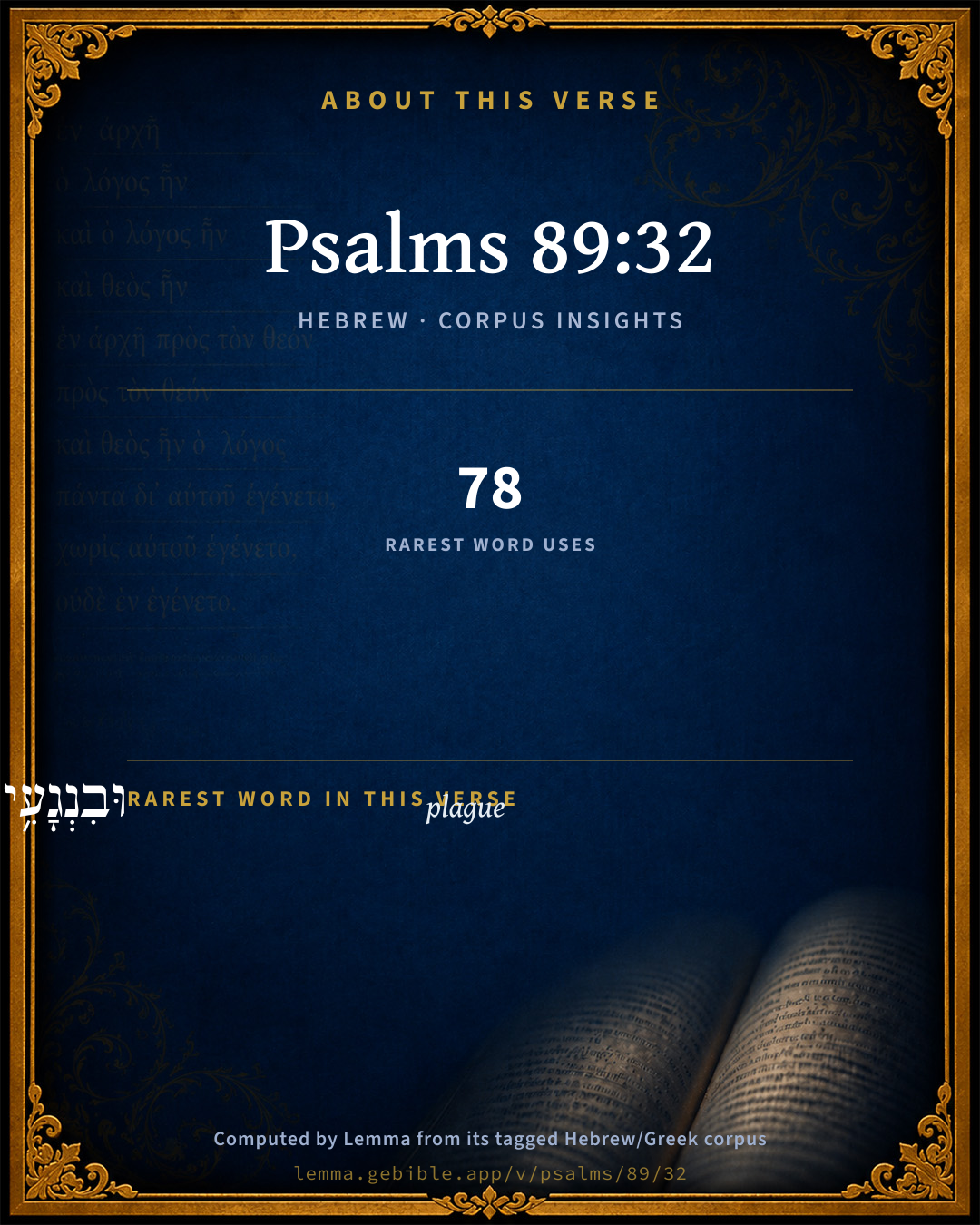
Psalms, in the Wisdom, opens this verse with 5 words (5 distinct Hebrew lemmas). Its most distinctive word is negaʻ (“plague”). A historical commentator’s framing appears above. Read the whole chapter for the surrounding context.

Discussion questions

  1. How does “plague” (negaʻ) shape what this verse is saying?
  2. 2 Samuel 7:14 shares this passage’s theme. How do the two illuminate each other?
  3. These translations render this verse differently; the difference is in the English rendering, not the original. What questions does that raise?
  4. The verb «וּפָקַדְתִּ֣י» is Qal Sequential Perfect. How does its form color the action?
  5. Reading how Trapp's Complete Commentary and The Cambridge Bible for Schools and Colleges read this verse, where do the two commentators agree and where do they part?

Things to notice

Reading settings

Reading text

Shown beneath each verse's original-language words.

Old Testament
Old Testament edition

Read the OT as the Masoretic Hebrew (MT) or the Greek Septuagint (LXX).

English shown for the Greek Septuagint (in the Hebrew ↔ Greek comparison).

Comparing translations? Open the Compare panel on any verse page to stack up to four side by side.