
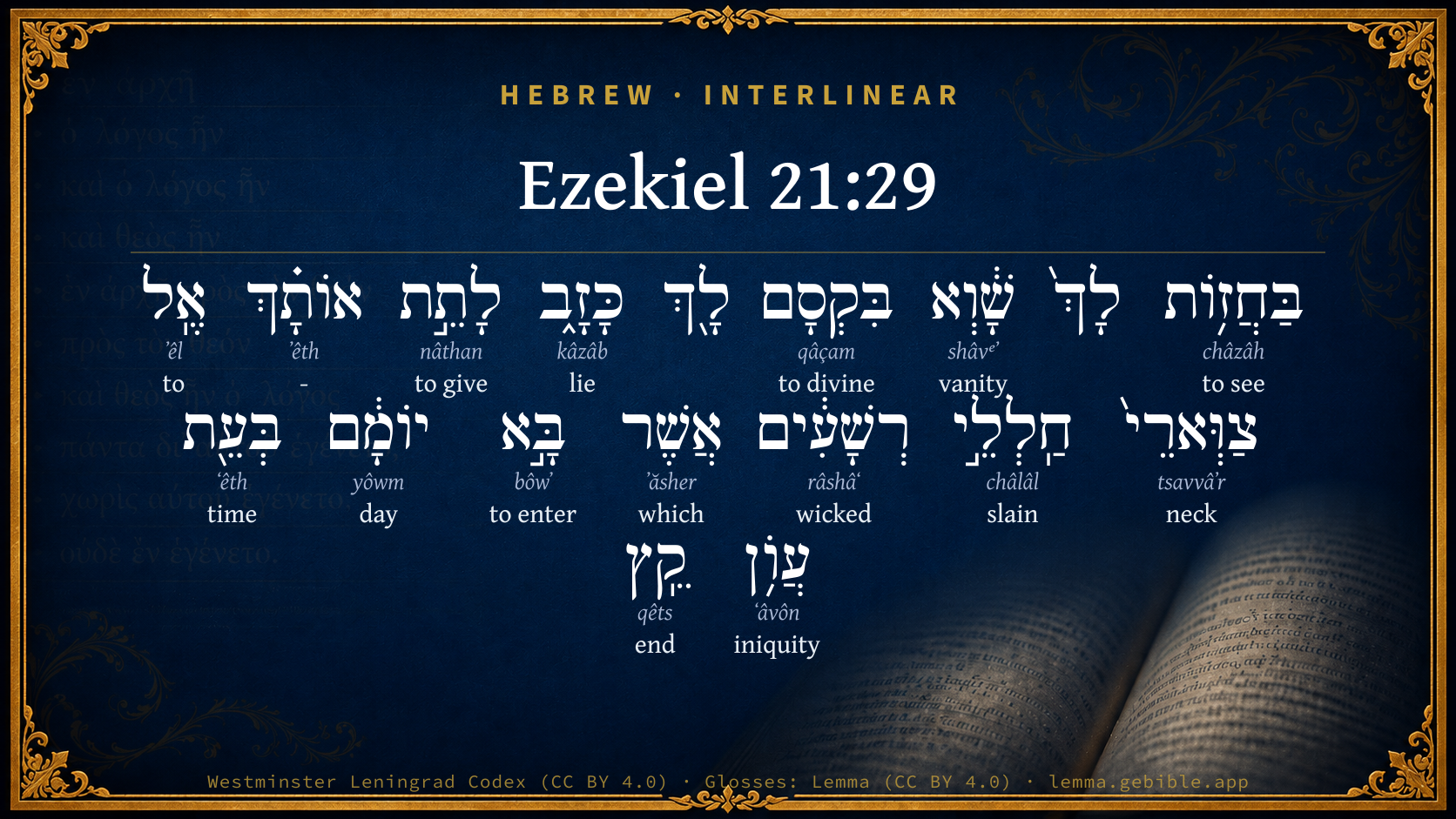
Ezekiel 21:29

Hebrew (Westminster Leningrad Codex) Ezekiel 21:29 appears in the Hebrew Old Testament. The text above is from the Westminster Leningrad Codex. Each word links to its Strong’s number, a concise gloss, and parsing drawn from the Open Scriptures Hebrew Bible morphology. Click any word for its full Brown-Driver-Briggs (BDB) entry.
Download image
Cite this verse

Ezekiel 21:29 (World English Bible). Public Domain. Lemma interlinear Bible study tool, https://lemma.gebible.app/v/ezekiel/21/29.

Show BibTeX & RIS
BibTeX
RIS
English Translation
while they see for you false visions, while they divine lies to you, to lay you on the necks of the wicked who are deadly wounded, whose day is come in the time of the iniquity of the end.
World English Bible · Public Domain
Download a study sheet

One document with this verse’s original text, its word-by-word gloss line, the meaning frame, cross-references with their text, attributed commentary, and full source and license credits — printable, and it pastes into notes with its structure intact.

This verse Autodidact and up

Study sheet (.html) Plain text (.txt)

A passage Seminary Student

Up to 50 verses in one chapter. A passage sheet keeps up to 6 commentary sources and 12 cross-references per verse, in the order this page ranks them, and says so on the sheet whenever that leaves anything out. Ask for a single verse and you get the Autodidact verse sheet above.

Everything on this page stays free to read, with no account — the sheet is a download of what is already on screen, not access to it.

Want to remove ads? Support Godless Engineer
Compare translations 3

The same verse in 3 English versions, stacked beneath the original-language interlinear above. Click any original word for its lexicon entry.

Each is an independent rendering of the whole verse — the interlinear is not word-aligned to these translations.

Highlighted words mark where these versions differ — a whole-verse word diff, not a word-by-word alignment.

  • World English Bible Public Domain
    while they see for you false visions, while they divine lies to you, to lay you on the necks of the wicked who are deadly wounded, whose day is come in the time of the iniquity of the end.
  • King James Version Public Domain
    Whiles they see vanity unto thee, whiles they divine a lie unto thee, to bring thee upon the necks of them that are slain, of the wicked, whose day is come, when their iniquity shall have an end.
  • unfoldingWord Literal Text CC BY-SA 4.0
    While prophets see empty visions for you, while they perform rituals to come up with lies for you, this sword will lie on the necks of the wicked who are about to be killed, whose day of punishment has come and whose time of iniquity is about to end.

unfoldingWord Literal Text — © unfoldingWord, licensed CC BY-SA 4.0. Word-aligned USFM3 via Door43 (git.door43.org/unfoldingWord/en_ult).

Versions to compare (up to 4)

3 of 4 selected

Show all 18 translations

Every available English version of this verse, each an independent rendering of the whole verse.

  • World English Bible Public Domain
    while they see for you false visions, while they divine lies to you, to lay you on the necks of the wicked who are deadly wounded, whose day is come in the time of the iniquity of the end.
  • Berean Standard Bible Public Domain
    while they offer false visions for you and lying divinations about you—to be placed on the necks of the wicked who are slain, whose day has come, the time of their final punishment.
  • Majority Standard Bible Public Domain
    while they offer false visions for you and lying divinations about you—to be placed on the necks of the wicked who are slain, whose day has come, the time of their final punishment.
  • King James Version Public Domain
    Whiles they see vanity unto thee, whiles they divine a lie unto thee, to bring thee upon the necks of them that are slain, of the wicked, whose day is come, when their iniquity shall have an end.
  • American Standard Version (1901) Public Domain
    while they see for thee false visions, while they divine lies unto thee, to lay thee upon the necks of the wicked that are deadly wounded, whose day is come in the time of the iniquity of the end.
  • Revised Version (1885) Public Domain
    whiles they see vanity unto thee, whiles they divine lies unto thee, to lay thee upon the necks of the wicked that are deadly wounded, whose day is come, in the time of the iniquity of the end.
  • Geneva Bible (1599) Public Domain
    Whiles they see vanitie vnto thee, and prophecied a lie vnto thee to bring thee vpon the neckes of the wicked that are slaine, whose day is come when their iniquitie shall haue an ende.
  • Douay-Rheims (1899) Public Domain
    Whilst they see vain things in thy regard, and they divine lies: to bring thee upon the necks of the wicked that are wounded, whose appointed day is come in the time of iniquity.
  • Young's Literal Translation Public Domain
    In the seeing for thee of a vain thing, In the divining for thee of a lie, To put thee on the necks of the wounded of the wicked, whose day hath come, In the time of the iniquity of the end.
  • Literal Standard Version CC BY-SA 4.0
    In seeing a vain thing for you, || In divining a lie for you, || To put you on the necks of the wounded of the wicked, whose day has come, || In the time of the iniquity of the end.
  • Unlocked Literal Bible CC BY-SA 4.0
    While prophets see empty visions for you, while they perform rituals to come up with lies for you, this sword will lie on the necks of the wicked who are about to be killed, whose day of punishment has come and whose time of iniquity is about to end.
  • unfoldingWord Literal Text CC BY-SA 4.0
    While prophets see empty visions for you, while they perform rituals to come up with lies for you, this sword will lie on the necks of the wicked who are about to be killed, whose day of punishment has come and whose time of iniquity is about to end.
  • Darby Bible Public Domain
    whilst they see vanity for thee, whilst they divine a lie unto thee, to lay thee upon the necks of the wicked that are slain, whose day is come at the time of the iniquity of the end.
  • World Messianic Bible Public Domain
    while they see for you false visions, while they divine lies to you, to lay you on the necks of the wicked who are deadly wounded, whose day has come in the time of the iniquity of the end.
  • Webster's Bible Public Domain
    While they see vanity to thee, while they divine a lie to thee, to bring thee upon the necks of them that are slain, of the wicked, whose day is come, when their iniquity shall have an end.
  • Free Bible Version CC BY-SA 4.0
    even as your prophets give you false visions and prophecies that are lies. This sword will cut the necks of the wicked, killing them—those whose day has come for their punishment to be completed.
  • Bible in Basic English Public Domain
    Your vision is to no purpose, your use of secret arts gives a false answer, to put it on the necks of evil-doers who are wounded to death, whose day has come, in the time of the last punishment.
  • JPS Tanakh (1917) Public Domain
    (21-34) While they see falsehood unto thee, while they divine lies unto thee, to lay thee upon the necks of the wicked that are to be slain, whose day is come, in the time of the iniquity of the end!

Literal Standard Version (2020), Covenant Press — licensed CC BY-SA 4.0. Text via the HelloAO Bible API (eBible.org). Unlocked Literal Bible (unfoldingWord) — licensed CC BY-SA 4.0. Text via the HelloAO Bible API (eBible.org). unfoldingWord Literal Text — © unfoldingWord, licensed CC BY-SA 4.0. Word-aligned USFM3 via Door43 (git.door43.org/unfoldingWord/en_ult). Free Bible Version, Dr. Jonathan Gallagher — licensed CC BY-SA 4.0. Text via the HelloAO Bible API (eBible.org).

Word by word

More ways to search: Search by grammar → Find every occurrence → Compare this word →

Practice this passage: Drill this verse → Learn its vocabulary →

בִּקְסָם
qâçam
H7080
“in/at · to divine”
Preposition + Verb, Qal, Infinitive Construct
Part of Speech
Preposition + Verb
Stem
Qal
Form
Infinitive Construct
Full BDB Definition

Origin: a primitive root

TWOT: 2044

(Qal) to practice divination, divine - of diviners of the nations, Balaam - of false prophets of Israel - prohibited
  1. בַּחֲז֥וֹת châzâh H2372 “in/at · to see” Preposition + Verb, Qal, Infinitive Construct
  2. שָׁ֔וְא shâvᵉʼ H7723 “vanity” Noun, Common, Masculine, Singular, Absolute
  3. כָּזָ֑ב kâzâb H3577 “lie” Noun, Common, Masculine, Singular, Absolute
  4. לָתֵ֣ת nâthan H5414 “to give” Preposition + Verb, Qal, Infinitive Construct
  5. אוֹתָ֗ךְ ʼêth H853 “- · you” Particle, Direct Object + Suffix, Personal, 2nd Person, Feminine, Singular
  6. אֶֽל ʼêl H413 “to” Preposition
  7. צַוְּארֵי֙ tsavvâʼr H6677 “necks of” Noun, Common, Masculine, Plural, Construct
  8. חַֽלְלֵ֣י châlâl H2491 “slain of” Adjective, Adjective, Masculine, Plural, Construct
  9. רְשָׁעִ֔ים râshâʻ H7563 “wicked” Adjective, Adjective, Masculine, Plural, Absolute
  10. אֲשֶׁר ʼăsher H834 “which” Particle, Relative
  11. בָּ֣א bôwʼ H935 “to enter” Verb, Qal, Perfect, 3rd Person, Masculine, Singular
  12. יוֹמָ֔ם yôwm H3117 “day · their” Noun, Common, Masculine, Singular, Construct + Suffix, Personal, 3rd Person, Masculine, Plural
  13. בְּעֵ֖ת ʻêth H6256 “in/at · time of” Preposition + Noun, Common, Both, Singular, Construct
  14. עֲוֺ֥ן ʻâvôn H5771 “iniquity of” Noun, Common, Both, Singular, Construct
  15. קֵֽץ qêts H7093 “end” Noun, Common, Masculine, Singular, Absolute

About this verse

These counts appear in no published source. They are computed here, from the morphology-tagged text and Lemma’s own curated glosses. What Lemma adds →

18
words
16
distinct lemmas
Prophets
section

Notable vocabulary

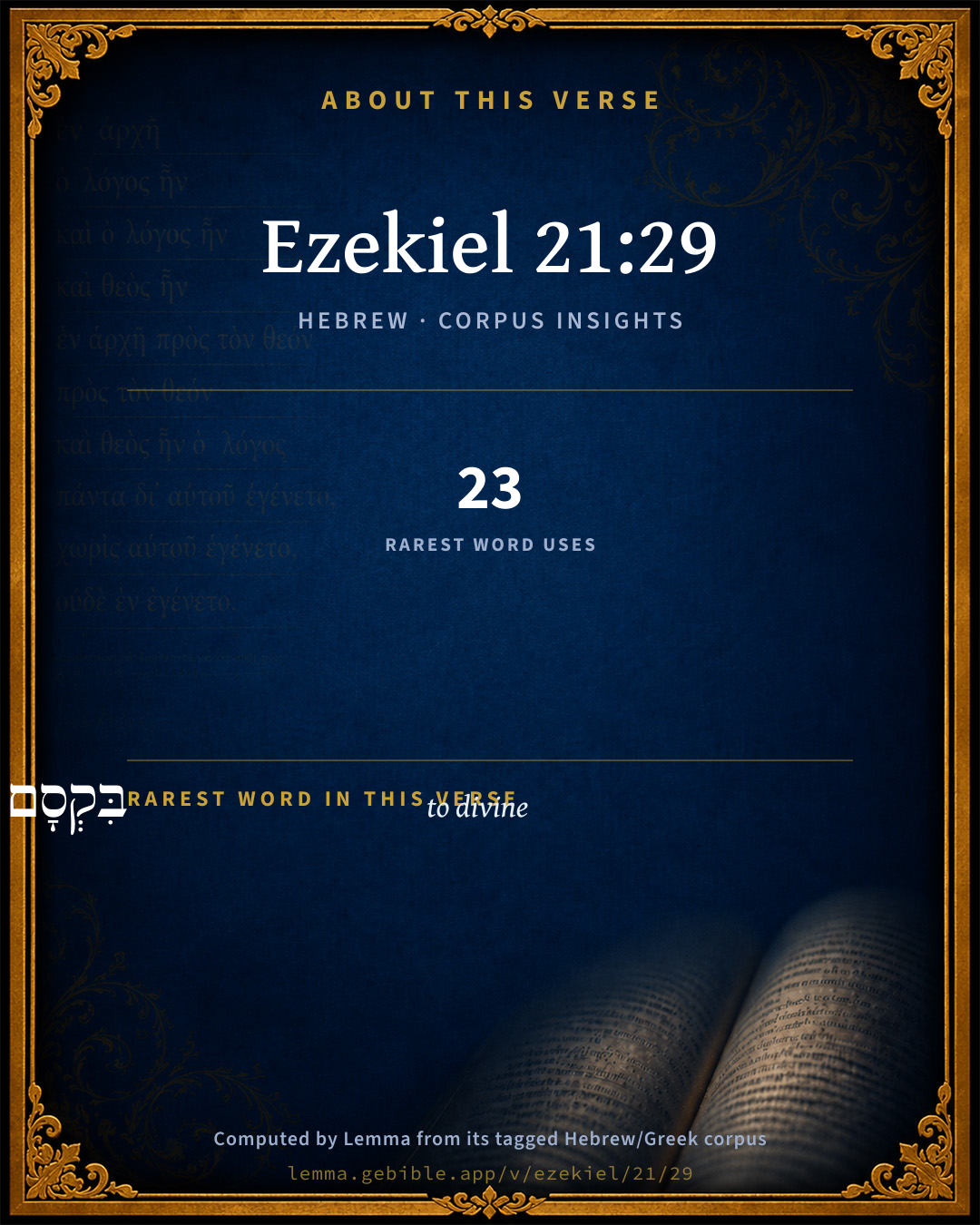
The rarest word here is בִּקְסָם to divine H7080 — appearing just 23 times in the whole Hebrew Bible.

Shared distinctive vocabulary

בִּקְסָם to divine H7080 occurs in 20 verses of the Hebrew Bible. Also found in:

Grammatical profile

  • 4 verbs
  • 7 nouns
  • 2 adjectives
  • 3 prepositions
  • 2 particles

Verb forms

  • בַּחֲז֥וֹת Qal · Infinitive Construct
  • בִּקְסָם Qal · Infinitive Construct
  • לָתֵ֣ת Qal · Infinitive Construct
  • בָּ֣א Qal · Perfect

Hebrew & Septuagint length

In English translation the verse runs 39 words from the Hebrew and 33 from the Septuagint (LXX English) — closely comparable.

A rough comparison of the two English renderings, which tokenize alike — not a word-level alignment.

Word counts can differ between the Hebrew and the Greek without any difference in meaning — e.g. the Hebrew direct-object marker אֵת has no separate Greek word, and Greek often adds the article ὁ.

Cross-references

13

Topical passages linked to Ezekiel 21:29 in the Treasury of Scripture Knowledge — connected by theme and wording, ordered by reader-vote popularity; previews shown in the World English Bible.

  • Ezekiel 21:25 You, deadly wounded wicked one, the prince of Israel, whose day is come, in the time of the iniquity of the end,
  • Ezekiel 22:28 Her prophets have daubed for them with whitewash, seeing false visions, and divining lies to them, saying, Thus says the Lord Yahweh, when Yahweh has not spoken.
  • Psalms 37:13 The Lord will laugh at him, For he sees that his day is coming.
  • Jeremiah 27:9 But as for you, don't you listen to your prophets, nor to your diviners, nor to your dreams, nor to your soothsayers, nor to your sorcerers, who speak to you, saying, You shall not serve the king of Babylon:
  • Job 18:20 Those who come after shall be astonished at his day, As those who went before were frightened.
  • Isaiah 44:25 who frustrates the signs of the liars, and makes diviners mad; who turns wise men backward, and makes their knowledge foolish;
  • Isaiah 47:13 You are wearied in the multitude of your counsels: let now the astrologers, the star-gazers, the monthly prognosticators, stand up, and save you from the things that shall come on you.
  • Lamentations 2:14 Your prophets have seen for you false and foolish visions; They have not uncovered your iniquity, to bring back your captivity, But have seen for you false oracles and causes of banishment.
  • Ezekiel 12:24 For there shall be no more any false vision nor flattering divination within the house of Israel.
  • Ezekiel 13:6 They have seen falsehood and lying divination, who say, Yahweh says; but Yahweh has not sent them: and they have made men to hope that the word would be confirmed.
  • Ezekiel 13:10 Because, even because they have seduced my people, saying, Peace; and there is no peace; and when one builds up a wall, behold, they daub it with whitewash:
  • Ezekiel 13:23 Therefore you shall no more see false visions, nor practice divination. I will deliver my people out of your hand; and you shall know that I am Yahweh.
  • Ezekiel 35:5 Because you have had a perpetual enmity, and have given over the children of Israel to the power of the sword in the time of their calamity, in the time of the iniquity of the end;

Cross-references courtesy of OpenBible.info (CC BY 4.0).

Hebrew and Greek witnesses Masoretic Hebrew ↔ Greek Septuagint

The same verse in the two great witnesses to the Old Testament, shown verse-for-verse.

These are two independent witnesses, not word-aligned to each other, and the Septuagint is shown in lemma (dictionary) form.

Hebrew Ezekiel 21:29 Masoretic · Westminster Leningrad Codex

בַּחֲז֥וֹת לָךְ֙ שָׁ֔וְא בִּקְסָם לָ֖ךְ כָּזָ֑ב לָתֵ֣ת אוֹתָ֗ךְ אֶֽל צַוְּארֵי֙ חַֽלְלֵ֣י רְשָׁעִ֔ים אֲשֶׁר בָּ֣א יוֹמָ֔ם בְּעֵ֖ת עֲוֺ֥ן קֵֽץ

while they see for you false visions, while they divine lies to you, to lay you on the necks of the wicked who are deadly wounded, whose day is come in the time of the iniquity of the end.

World English Bible · Public Domain

Greek LXX Ezekiel 21:29 Septuagint · lemma form

διά οὗτος ὅδε λέγω κύριος ἀντί ὅς ἀναμιμνήσκω ὁ ἀδικία σύ ἐν ὁ ἀποκαλύπτω ὁ ἀσέβεια σύ ὁ ὁράω ἁμαρτία σύ ἐν πᾶς ὁ ἀσέβεια σύ καί ἐν ὁ ἐπιτήδευμα σύ ἀντί ὅς ἀναμιμνήσκω ἐν οὗτος ἁλίσκω

While you are seeing vain visions, and while you are prophesying falsehoods, to bring yourself upon the necks of ungodly transgressors, the day is come, even an end, in a season of iniquity.

LXX2012 (modern English Septuagint) · Public Domain

On this verse, The Cambridge Bible for Schools and Colleges discusses the Septuagint’s reading. Read the note in Commentary ↓

Hebrew: Westminster Leningrad Codex (CC BY 4.0). Greek: Septuagint (public domain); English from LXX2012 (modern English Septuagint) (Public Domain). How the Septuagint differs from the Hebrew →

Targum (Aramaic paraphrase)

1

The Targum is the ancient Jewish Aramaic paraphrase of the Hebrew Scriptures — an interpretive translation, not the Hebrew text itself. Onkelos (literal) and Pseudo-Jonathan (expansive) render the Torah, and Jonathan the Prophets. Coverage is partial: where no permissively-licensed English translation exists for a verse, only the Aramaic is shown. This is verse-level text, not a word-by-word alignment to the Hebrew.

  1. Targum Jonathan Prophets (Joshua–Malachi)
    בְּכֵן כִּדְנַן אֲמַר יְיָ אֱלֹהִים חֲלַף דְאַדְכַּרְתּוּן חוֹבֵיכוֹן בְּאִתְגְלָאָה מְרָדֵיכוֹן לְאִתְחֲזָאָה חֶטְאֵיכוֹן בְּכֹל עוֹבָדֵיכוֹן חֲלַף דְאַדְכַּרְתּוּן בְּיַד מַלְכָּא דְבָבֶל תִּתְמַסְרוּן:

    (no public-domain English translation for this verse)

    Targum Jonathan — Aramaic: “Mikraot Gedolot” (public domain). English: “Sefaria Community Translation” (CC0 1.0 (public-domain dedication)); “London "Chaldee Paraphrase," 1871” (public domain). Text via Sefaria.

Commentary

Notes on Ezekiel 21:29 from classic Christian and Jewish commentators (each source and its license shown beneath its notes). The classic Christian expositions comment on the surrounding passage and are grouped to its opening verse, so a note may address several verses; the Jewish commentaries on the Tanakh (Rashi and others) are per-verse, so they appear only where the commentator wrote on this verse.

Lemma curates 59 commentaries, every one of them public domain or Creative Commons licensed, each selected and text-cleaned for this edition rather than reprinted as found. About our sources →

Trapp's Complete Commentary

John Trapp

Eze 21:29 Whiles they see vanity unto thee, whiles they divine a lie unto thee, to bring thee upon the necks of [them that are] slain, of the wicked, whose day is come, when their iniquity [shall have] an end.

Ver. 29. To bring thee upon the necks of them that are slain.] To deal inhumanly with the dead, or to raise thyself upon the Jews’ ruin.

John Trapp, A Commentary or Exposition upon All the Books of the Old and New Testament (1647–1656) — public domain. Text from a community e-Sword module.

Geneva Bible (1599)

Geneva Bible translators

Though the Jews and Ammonites would not believe that thou, to wit, the sword, shouldest come upon them, and said, that the Prophets, which threatened, spake lies, yet thou shalt as surely come, as though thou werest already upon their necks.

Geneva Bible (1599) marginal notes — public domain. Text via Bolls.life.

Jamieson, Fausset & Brown

Robert Jamieson, A. R. Fausset & David Brown

see vanity . . . divine a lie--Ammon, too, had false diviners who flattered them with assurances of safety; the only result of which will be to "bring Ammon upon the necks," &c., that is, to add the Ammonites to the headless trunks of the slain of Judah, whose bad example Ammon followed, and "whose day" of visitation for their guilt "is come."

when their iniquity shall have an end--See on Eze 21:25.

Jamieson, Fausset & Brown — Commentary Critical and Explanatory on the Whole Bible (1871) — public domain (CC PDM 1.0). Text via the HelloAO Bible API.

Ellicott's Commentary for English Readers

(29) See vanity unto thee.—“See” is used in the sense of the utterances of the “seer,” or prophet. The Ammonites also had false prophets among them.

Thee upon the necks of them that are slain.—Judah is to fall first, then Ammon immediately after, as it were, upon the necks of those already slain. The figure is taken from the battle, in which one warrior falls upon the body of him who fell before him.

When their iniquity shall have an end.—Not through repentance, but because it ceases of necessity with the death of the sinner.

A Bible Commentary for English Readers, edited by Charles John Ellicott (1878–1897) — public domain. Text from a community e-Sword module.

The Cambridge Bible for Schools and Colleges

gen. ed. J. J. S. Perowne

29. they see vanity unto thee] i.e. Ammon’s soothsayers falsely hold out the prospect to it of victory and conquest.

bring thee upon the necks] The sense is doubtful, the phrase “bring, or, put, upon the necks” not occurring again. The “wicked, whose day is come, in the time of the iniquity of the end,” can hardly be any other than the princes and people of Jerusalem, Eze_21:25. 1. The clause “to bring thee,” &c., might express the contents of the lying prophecy: they divine a lie and bring thee—they promise that thou shalt fall upon Israel, and conquer them. 2. The clause may express the issue of the lying divination, the eventual issue of it in God’s hand. These lying prophecies lead the Ammonites to enterprises or to purpose enterprizes the issue of which in God’s hand (or, his judgment because of which) will be that they shall have a common fate with the princes and people of Jerusalem, upon whose necks (bodies) they shall be flung slain. 3. Others (Hitz. Corn.) would alter the text reading it (the sword) for thee, and connecting closely with Eze_21:28 : that it may glitter (whiles they divine a lie unto thee, &c.), in order to bring it (the sword) upon the necks, &c., i.e. assail and slay them with it. This is simpler, though against LXX.

upon the necks … wicked] More plainly: upon the necks of the wicked that are (to be) slain, i.e. the princes, &c. in Jerusalem, Eze_21:25.

when their iniquity … end] At the time of the iniquity (or, punishment) of the end, cf. Eze_21:25.

The Cambridge Bible for Schools and Colleges (gen. ed. J. J. S. Perowne; Cambridge University Press, 1878–1918) — public domain. Text from a community e-Sword module.

John Gill's Exposition

And I will pour out mine indignation upon thee,.... Like a mighty flood, which should sweep them away for their sins and transgressions; and particularly for their reproaches of God and his people, which caused his indignation to rise, and him to pour it out upon them in such a manner:

I will blow against thee in the fire of my wrath; as men put metal into a furnace, and then blow upon it, in order to melt it, and consume the dross; and which fire, so blown, is exceeding fierce and very consuming; who can stand against such a blast as that of the wrath of God, not only kindled, but blown with his breath like a stream of brimstone?

and deliver thee into the hand of brutish men; or "burners" (x); that burn with fierce anger, barbarous and inhuman, that would show no mercy nor compassion, such were the Chaldeans, Hab 1:6,

and skilful to destroy; though like brutes or beasts of prey for their cruelty; yet, like men, rational, cunning, and artful to devise ways and means to destroy men; well versed in the art of war; and thoroughly learned in all the lessons and methods of violence and destruction.

(x) "ardentium", Junius & Tremellius, Piscator, Polanus; "urentium", so some in Vatablus.

John Gill's Exposition of the Whole Bible (1746–1763) — public domain (CC PDM 1.0). Text via the HelloAO Bible API.

Matthew Poole's English Annotations

War and desolation indeed hasten on thee, though in the mean while thy astrologers and soothsayers promise peace and prosperity, and deceive thee with fair but false divinations, of which Jeremiah warns them, Jer 27:9.

Upon the necks of them that are slain; to bring thee under the sword of the Chaldeans, and to destroy thee as the Jews are, who already are fallen under the destroying sword; to make thee stumble and fall on their necks, as men that fall among a multitude of slain.

Of the wicked, i.e. both Jews and their king, as Eze 21:25.

Their iniquity shall have an end: see Eze 21:25.

Matthew Poole's English Annotations on the Holy Bible (1683–1685) — public domain. Text from a community e-Sword/MySword module.

Whedon's Commentary on the Bible

Daniel D. Whedon

29. While they see vanity… divine a lie — This seems to refer to the “reproach” of Israel indulged in by the Ammonites (Eze_21:28) and to their fallen oracles in which they boasted while they sneered and laughed at Jerusalem’s calamity (Eze_25:3-6). To bring [or, lay] thee, etc. — This text is very obscure, but may mean that while “they” (the false prophets of Ammon) “see vanity” and “divine a lie” the sword flashes upon the nation like lightning and its rulers and people fall slain upon the bodies of the dead Israelites against whom they have scoffed. (See Eze_21:25.)

Daniel D. Whedon (gen. ed.), Commentary on the Old and New Testaments (1874–1909) — public domain. Text from a community e-Sword module.

The Pulpit Commentary

Whiles they see, etc. The words may possibly refer to Nebuchadnezzar"s diviners in ver. 21, but more probably to those whom the Ammonites themselves consulted. The pronoun "thee" in both clauses refers to Ammon. The result of those who divined falsely was that the sword would be drawn against the necks of the Ammonites and threw them upon the heap of the slaughtered ones. For them, as in the words that end the verse, reproducing those of ver. 25, punishment is decreed, and that punishment will come.

The Pulpit Commentary (1880–1919), ed. H.D.M. Spence-Jones & Joseph S. Exell — public domain. Text from a community e-Sword module.

John Wesley's Explanatory Notes

While - While thy astrologers, and soothsayers, deceive thee with fair, but false divinations. To bring thee - To bring thee under the sword of the Chaldeans, and destroy thee as the Jews; to make thee stumble and fall on their necks, as men that fall among a multitude of slain.

John Wesley, Explanatory Notes Upon the Whole Bible (1754–1765) — public domain. Text via the GEBible commentary corpus.

Rashi

Rabbi Shlomo Yitzchaki (Rashi)

Because you have made your iniquity to be remembered For you commit new transgressions daily, and your earlier iniquities are remembered through them.

in that your transgressions are revealed [i.e.,] the new ones.

so that your sins appear [i.e.,] the old ones.

because of your being remembered before Me for evil, therefore...

you shall be seized in the hand You shall be delivered into the hand of the king of Babylon.

Rashi on the Tanakh — English translations: “The Judaica Press complete Tanach with Rashi, translated by A. J. Rosenberg” (CC BY 4.0); “Pentateuch with Rashi's commentary by M. Rosenbaum and A.M. Silbermann, 1929-1934” (public domain); “The Metsudah Tanach series, Lakewood, N.J” (CC BY 4.0); and “The Book of Joshua, Metsudah Publications, 1997” (CC BY 4.0). Text via Sefaria.

Lesson kit

Teaching starters — assembled from the data on this page, not authored interpretation. Every prompt links to the verse data it draws on. Edit before teaching.

Ezekiel, in the Prophets, opens this verse with 18 words (16 distinct Hebrew lemmas). Its most distinctive word is qâçam (“to divine”). A historical commentator’s framing appears above. Read the whole chapter for the surrounding context.

Discussion questions

  1. How does “to divine” (qâçam) shape what this verse is saying?
  2. How does Deuteronomy 18:10, which shares the word «to divine», read alongside this verse?
  3. These translations render this verse differently. What is at stake in choosing one wording over another?
  4. «בַּחֲז֥וֹת» is a Qal Infinitive Construct verb. How does that grammatical form shape the action described?
  5. Compare how Trapp's Complete Commentary and Geneva Bible (1599) read this verse. Where do they agree or differ?

Things to notice

Reading settings

Reading text

Shown beneath each verse's original-language words.

Old Testament
Old Testament edition

Read the OT as the Masoretic Hebrew (MT) or the Greek Septuagint (LXX).

English shown for the Greek Septuagint (in the Hebrew ↔ Greek comparison).

Comparing translations? Open the Compare panel on any verse page to stack up to four side by side.