2 Samuel 14:9

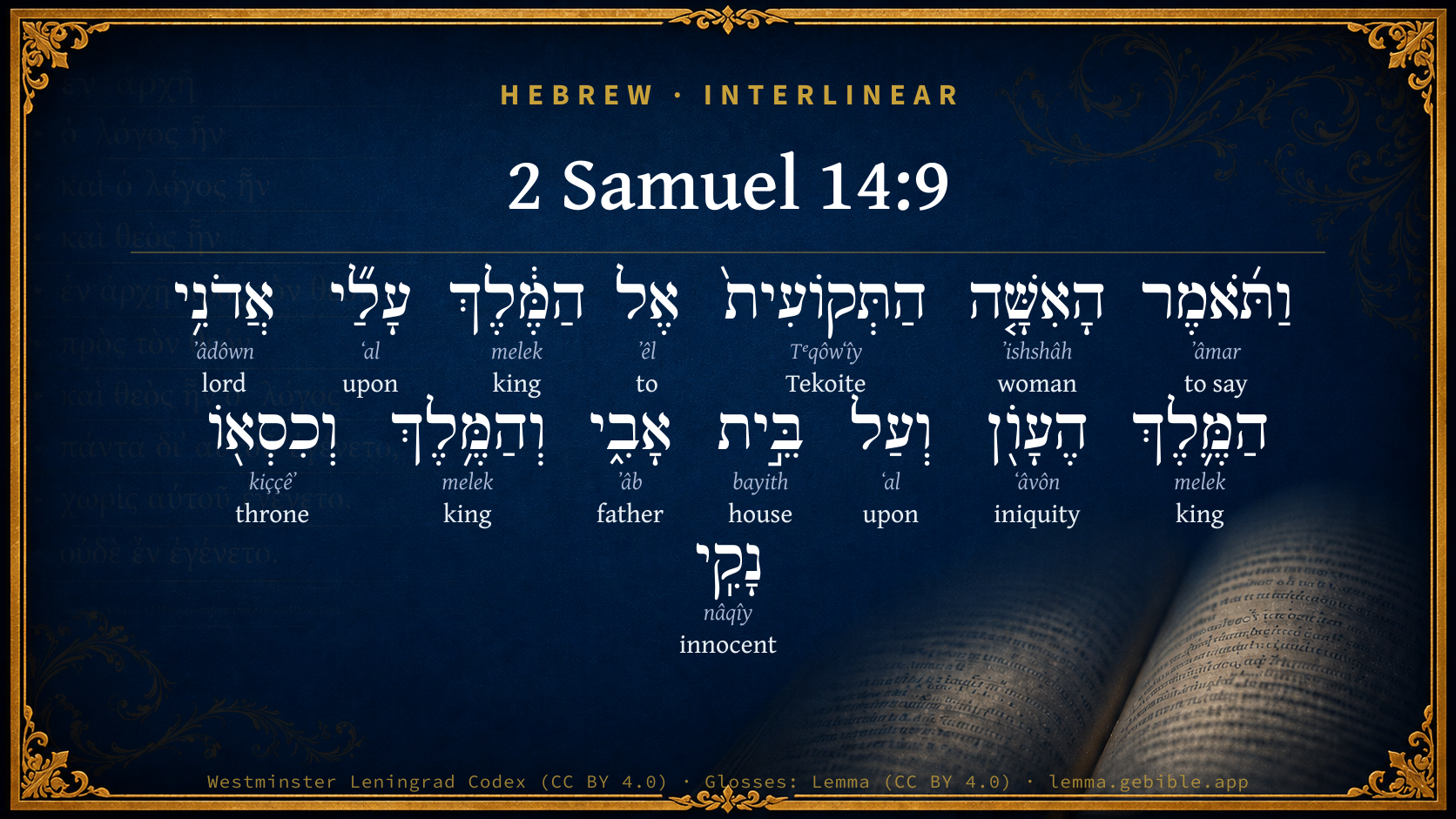
Hebrew (Westminster Leningrad Codex) 2 Samuel 14:9 appears in the Hebrew Old Testament. The text above is from the Westminster Leningrad Codex. Each word links to its Strong’s number, a concise gloss, and parsing drawn from the Open Scriptures Hebrew Bible morphology. Click any word for its full Brown-Driver-Briggs (BDB) entry.
Download image
Cite this verse

2 Samuel 14:9 (World English Bible). Public Domain. Lemma interlinear Bible study tool, https://lemma.gebible.app/v/2-samuel/14/9.

Show BibTeX & RIS
BibTeX
RIS
English Translation
The woman of Tekoa said to the king, My lord, O king, the iniquity be on me, and on my father's house; and the king and his throne be guiltless.
World English Bible · Public Domain
Download a study sheet

One document with this verse’s original text, its word-by-word gloss line, the meaning frame, cross-references with their text, attributed commentary, and full source and license credits — printable, and it pastes into notes with its structure intact.

This verse Autodidact and up

Study sheet (.html) Plain text (.txt)

A passage Seminary Student

Up to 50 verses in one chapter. A passage sheet keeps up to 6 commentary sources and 12 cross-references per verse, in the order this page ranks them, and says so on the sheet whenever that leaves anything out. Ask for a single verse and you get the Autodidact verse sheet above.

Everything on this page stays free to read, with no account — the sheet is a download of what is already on screen, not access to it.

Want to remove ads? Support Godless Engineer
Compare translations 3

The same verse in 3 English versions, stacked beneath the original-language interlinear above. Click any original word for its lexicon entry.

Each is an independent rendering of the whole verse — the interlinear is not word-aligned to these translations.

Highlighted words mark where these versions differ — a whole-verse word diff, not a word-by-word alignment.

  • World English Bible Public Domain
    The woman of Tekoa said to the king, My lord, O king, the iniquity be on me, and on my father's house; and the king and his throne be guiltless.
  • King James Version Public Domain
    And the woman of Tekoah said unto the king, My lord, O king, the iniquity be on me, and on my father's house: and the king and his throne be guiltless.
  • unfoldingWord Literal Text CC BY-SA 4.0
    And the Tekoite woman said to the king, “On me, my lord the king, the iniquity, and on the house of my father, and the king and his throne innocent.”

unfoldingWord Literal Text — © unfoldingWord, licensed CC BY-SA 4.0. Word-aligned USFM3 via Door43 (git.door43.org/unfoldingWord/en_ult).

Versions to compare (up to 4)

3 of 4 selected

Show all 18 translations

Every available English version of this verse, each an independent rendering of the whole verse.

  • World English Bible Public Domain
    The woman of Tekoa said to the king, My lord, O king, the iniquity be on me, and on my father's house; and the king and his throne be guiltless.
  • Berean Standard Bible Public Domain
    But the woman of Tekoa said to the king, “My lord the king, may any blame be on me and on my father’s house, and may the king and his throne be guiltless.”
  • Majority Standard Bible Public Domain
    But the woman of Tekoa said to the king, “My lord the king, may any blame be on me and on my father’s house, and may the king and his throne be guiltless.”
  • King James Version Public Domain
    And the woman of Tekoah said unto the king, My lord, O king, the iniquity be on me, and on my father's house: and the king and his throne be guiltless.
  • American Standard Version (1901) Public Domain
    And the woman of Tekoa said unto the king, My lord, O king, the iniquity be on me, and on my father's house; and the king and his throne be guiltless.
  • Revised Version (1885) Public Domain
    And the woman of Tekoa said unto the king, My lord, O king, the iniquity be on me, and on my father’s house: and the king and his throne be guiltless.
  • Geneva Bible (1599) Public Domain
    Then the woman of Tekoah said vnto the King, My lord, O King, this trespas be on me, and on my fathers house, and the King and his throne be giltlesse.
  • Douay-Rheims (1899) Public Domain
    And the woman of Thecua said to the king: Upon me, my lord, be the iniquity, and upon the house of my father: but may the king and his throne be guiltless.
  • Young's Literal Translation Public Domain
    And the woman of Tekoah saith unto the king, `On me, my lord, O king, `is' the iniquity, and on the house of my father; and the king and his throne `are' innocent.'
  • Literal Standard Version CC BY-SA 4.0
    And the woman of Tekoah says to the king, “On me, my lord, O king, [is] the iniquity, and on the house of my father; and the king and his throne [are] innocent.”
  • Unlocked Literal Bible CC BY-SA 4.0
    The woman of Tekoa replied to the king, “My master, king, may the guilt be on me and on my father's family. The king and his throne are guiltless.”
  • unfoldingWord Literal Text CC BY-SA 4.0
    And the Tekoite woman said to the king, “On me, my lord the king, the iniquity, and on the house of my father, and the king and his throne innocent.”
  • Darby Bible Public Domain
    And the woman of Tekoah said to the king, Upon me, my lord, O king, be the iniquity, and upon my father's house; and the king and his throne be guiltless.
  • World Messianic Bible Public Domain
    The woman of Tekoa said to the king, “My lord, O king, may the iniquity be on me, and on my father’s house; and may the king and his throne be guiltless.”
  • Webster's Bible Public Domain
    And the woman of Tekoah said to the king, My lord, O king, the iniquity be on me, and on my father's house: and the king and his throne be guiltless.
  • Free Bible Version CC BY-SA 4.0
    “Thank you, Your Majesty,” said the woman. “I and my family will take the blame, and may Your Majesty and your family be held to be innocent.”
  • Bible in Basic English Public Domain
    And the woman of Tekoa said to the king, My lord, O king, may the sin be on me and on my family, and may the king and the seat of his kingdom be clear of sin!
  • JPS Tanakh (1917) Public Domain
    And the woman of Tekoa said unto the king: 'My lord, O king, the iniquity be on me, and on my father's house; and the king and his throne be guiltless.'

Literal Standard Version (2020), Covenant Press — licensed CC BY-SA 4.0. Text via the HelloAO Bible API (eBible.org). Unlocked Literal Bible (unfoldingWord) — licensed CC BY-SA 4.0. Text via the HelloAO Bible API (eBible.org). unfoldingWord Literal Text — © unfoldingWord, licensed CC BY-SA 4.0. Word-aligned USFM3 via Door43 (git.door43.org/unfoldingWord/en_ult). Free Bible Version, Dr. Jonathan Gallagher — licensed CC BY-SA 4.0. Text via the HelloAO Bible API (eBible.org).

Word by word

More ways to search: Search by grammar → Find every occurrence → Compare this word →

Practice this passage: Drill this verse → Learn its vocabulary →

הַתְּקוֹעִית֙
Tᵉqôwʻîy
H8621
“the · Tekoite”
Particle, Definite Article + Noun, Gentilic, Feminine, Singular, Absolute
Part of Speech
Particle + Noun
Type
Gentilic
Gender
Feminine
Number
Singular
State
Absolute
Full BDB Definition

Origin: patronymically from H8620

TWOT: None

Tekoite = see Tekoa " trumpet blast" - an inhabitant of Tekoa
  1. וַתֹּ֜אמֶר ʼâmar H559 “and · to say” Conjunction + Verb, Qal, Sequential Imperfect, 3rd Person, Feminine, Singular
  2. הָאִשָּׁ֤ה ʼishshâh H802 “the · woman” Particle, Definite Article + Noun, Common, Feminine, Singular, Absolute
  3. אֶל ʼêl H413 “to” Preposition
  4. הַמֶּ֔לֶךְ melek H4428 “the · king” Particle, Definite Article + Noun, Common, Masculine, Singular, Absolute
  5. עָלַ֞י ʻal H5921 “upon · me” Preposition + Suffix, Personal, 1st Person, Common, Singular
  6. אֲדֹנִ֥י ʼâdôwn H113 “lord · my” Noun, Common, Masculine, Singular, Construct + Suffix, Personal, 1st Person, Common, Singular
  7. הַמֶּ֛לֶךְ melek H4428 “the · king” Particle, Definite Article + Noun, Common, Masculine, Singular, Absolute
  8. הֶעָוֺ֖ן ʻâvôn H5771 “the · iniquity” Particle, Definite Article + Noun, Common, Both, Singular, Absolute
  9. וְעַל ʻal H5921 “and · upon” Conjunction + Preposition
  10. בֵּ֣ית bayith H1004 “house of” Noun, Common, Masculine, Singular, Construct
  11. אָבִ֑י ʼâb H1 “father · my” Noun, Common, Masculine, Singular, Construct + Suffix, Personal, 1st Person, Common, Singular
  12. וְהַמֶּ֥לֶךְ melek H4428 “and · the · king” Conjunction + Particle, Definite Article + Noun, Common, Masculine, Singular, Absolute
  13. וְכִסְא֖וֹ kiççêʼ H3678 “and · throne · his” Conjunction + Noun, Common, Masculine, Singular, Construct + Suffix, Personal, 3rd Person, Masculine, Singular
  14. נָקִֽי nâqîy H5355 “innocent” Adjective, Adjective, Masculine, Singular, Absolute

About this verse

These counts appear in no published source. They are computed here, from the morphology-tagged text and Lemma’s own curated glosses. What Lemma adds →

15
words
12
distinct lemmas
Historical
section

Notable vocabulary

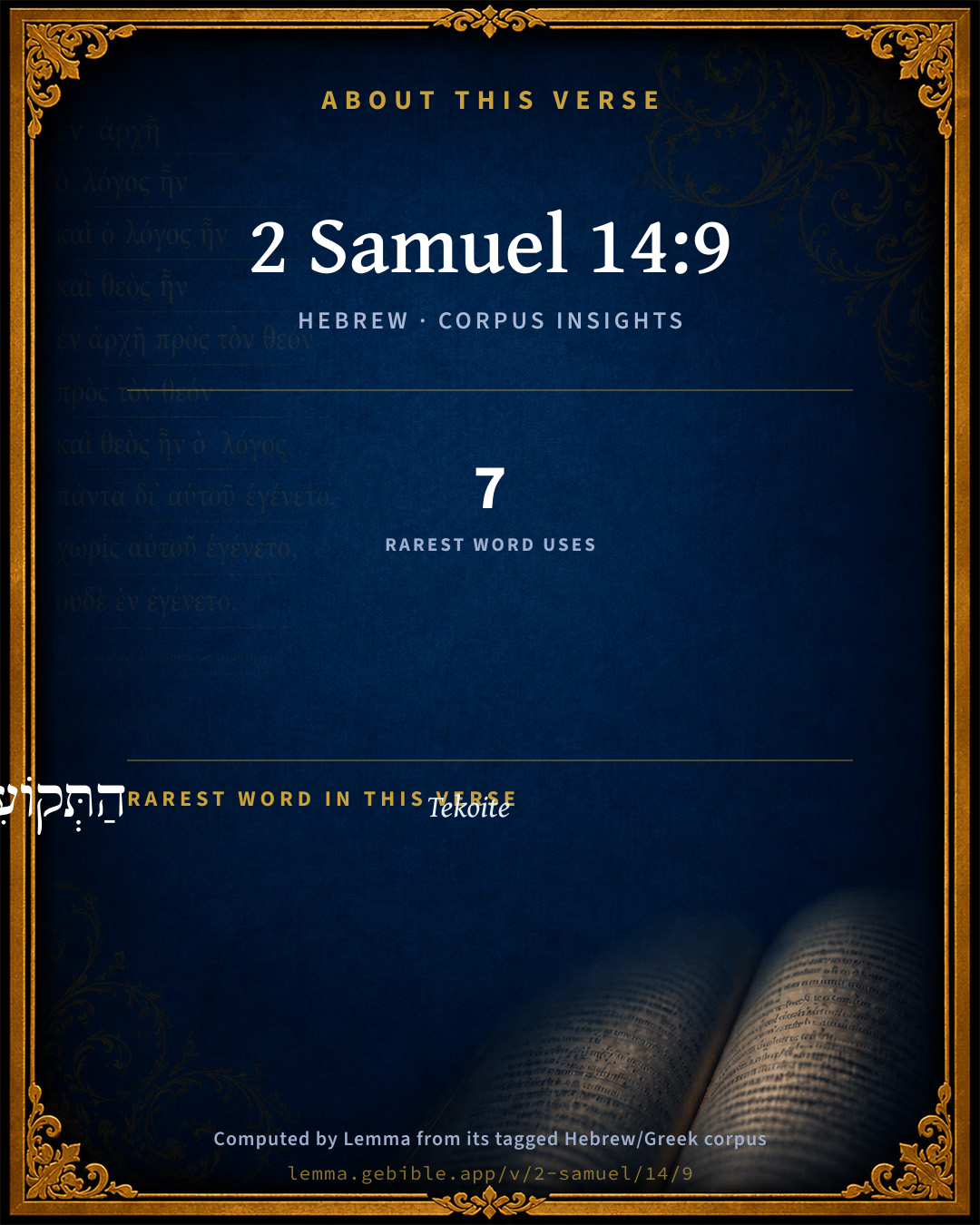
The rarest word here is הַתְּקוֹעִית֙ Tekoite H8621 — appearing just 7 times in the whole Hebrew Bible.

Shared distinctive vocabulary

הַתְּקוֹעִית֙ Tekoite H8621 occurs in 7 verses of the Hebrew Bible. Also found in:

Grammatical profile

  • 1 verb
  • 10 nouns
  • 1 adjective
  • 3 prepositions

Verb forms

  • וַתֹּ֜אמֶר Qal · Sequential Imperfect

Repetition

Words recur within this verse — often emphatic in Hebrew:

  • הַמֶּ֔לֶךְ king H4428 ×3
  • עָלַ֞י upon H5921 ×2

Hebrew & Septuagint length

In English translation the verse runs 30 words from the Hebrew and 31 from the Septuagint (LXX English) — closely comparable.

A rough comparison of the two English renderings, which tokenize alike — not a word-level alignment.

Word counts can differ between the Hebrew and the Greek without any difference in meaning — e.g. the Hebrew direct-object marker אֵת has no separate Greek word, and Greek often adds the article ὁ.

Cross-references

7

Topical passages linked to 2 Samuel 14:9 in the Treasury of Scripture Knowledge — connected by theme and wording, ordered by reader-vote popularity; previews shown in the World English Bible.

  • 1 Samuel 25:24 She fell at his feet, and said, On me, my lord, on me be the iniquity; and please let your handmaid speak in your ears. Hear the words of your handmaid.
  • 1 Kings 2:33 So shall their blood return on the head of Joab, and on the head of his seed forever: but to David, and to his seed, and to his house, and to his throne, shall there be peace for ever from Yahweh.
  • Matthew 27:25 All the people answered, "May his blood be on us, and on our children!"
  • Genesis 27:13 His mother said to him, "Let your curse be on me, my son. Only obey my voice, and go get them for me."
  • Numbers 35:33 So you shall not pollute the land in which you are: for blood, it pollutes the land; and no expiation can be made for the land for the blood that is shed therein, but by the blood of him who shed it.
  • Deuteronomy 21:1–9 If one be found slain in the land which Yahweh your God gives you to possess it, lying in the field, and it isn't known who has struck him;
  • 2 Samuel 3:28–29 Afterward, when David heard it, he said, I and my kingdom are guiltless before Yahweh forever of the blood of Abner the son of Ner:

Cross-references courtesy of OpenBible.info (CC BY 4.0).

Hebrew and Greek witnesses Masoretic Hebrew ↔ Greek Septuagint

The same verse in the two great witnesses to the Old Testament, shown verse-for-verse.

These are two independent witnesses, not word-aligned to each other, and the Septuagint is shown in lemma (dictionary) form.

Hebrew 2 Samuel 14:9 Masoretic · Westminster Leningrad Codex

וַתֹּ֜אמֶר הָאִשָּׁ֤ה הַתְּקוֹעִית֙ אֶל הַמֶּ֔לֶךְ עָלַ֞י אֲדֹנִ֥י הַמֶּ֛לֶךְ הֶעָוֺ֖ן וְעַל בֵּ֣ית אָבִ֑י וְהַמֶּ֥לֶךְ וְכִסְא֖וֹ נָקִֽי

The woman of Tekoa said to the king, My lord, O king, the iniquity be on me, and on my father's house; and the king and his throne be guiltless.

World English Bible · Public Domain

Greek LXX 2 Samuel 14:9 Septuagint · lemma form

καί εἶπον ὁ γυνή ὁ θεκωῖτις πρός ὁ βασιλεύς ἐπί ἐγώ κύριος ἐγώ βασιλεύς ὁ ἀνομία καί ἐπί ὁ οἶκος ὁ πατήρ ἐγώ καί ὁ βασιλεύς καί ὁ θρόνος αὐτός ἀθῷος

And the woman of Thecoe said to the king, On me, my lord, O king, and on my father's house be the iniquity, and the king and his throne be guiltless.

LXX2012 (modern English Septuagint) · Public Domain

Hebrew: Westminster Leningrad Codex (CC BY 4.0). Greek: Septuagint (public domain); English from LXX2012 (modern English Septuagint) (Public Domain). How the Septuagint differs from the Hebrew →

Targum (Aramaic paraphrase)

1

The Targum is the ancient Jewish Aramaic paraphrase of the Hebrew Scriptures — an interpretive translation, not the Hebrew text itself. Onkelos (literal) and Pseudo-Jonathan (expansive) render the Torah, and Jonathan the Prophets. Coverage is partial: where no permissively-licensed English translation exists for a verse, only the Aramaic is shown. This is verse-level text, not a word-by-word alignment to the Hebrew.

  1. Targum Jonathan Prophets (Joshua–Malachi)
    וַאֲמַרַת אִתְּתָא דְמִתְּקוֹעַ לְמַלְכָּא עֲלַי דִי לִי רִבּוֹנִי מַלְכָּא חוֹבָא וְעַל בֵּית אַבָּא וּמַלְכָּא וְכוּרְסֵי מַלְכוּתֵיהּ זַכַּאי:

    (no public-domain English translation for this verse)

    Targum Jonathan — Aramaic: “Mikraot Gedolot” (public domain). English: “Sefaria Community Translation” (CC0 1.0 (public-domain dedication)); “London "Chaldee Paraphrase," 1871” (public domain). Text via Sefaria.

Commentary

Notes on 2 Samuel 14:9 from classic Christian and Jewish commentators (each source and its license shown beneath its notes). The classic Christian expositions comment on the surrounding passage and are grouped to its opening verse, so a note may address several verses; the Jewish commentaries on the Tanakh (Rashi and others) are per-verse, so they appear only where the commentator wrote on this verse.

Lemma curates 59 commentaries, every one of them public domain or Creative Commons licensed, each selected and text-cleaned for this edition rather than reprinted as found. About our sources →

Trapp's Complete Commentary

John Trapp

2Sa 14:9 And the woman of Tekoah said unto the king, My lord, O king, the iniquity [be] on me, and on my father’s house: and the king and his throne [be] guiltless.

Ver. 9. The iniquity be on me,] q.d., I am so confident of my surviving son’s innocency, that I doubt not to take the blame upon myself, and dare be bold to say, that you and yours shall sustain no prejudice by favouring my cause, and protecting my child. See the like expressions in Gen 27:13 Mat 27:25.

John Trapp, A Commentary or Exposition upon All the Books of the Old and New Testament (1647–1656) — public domain. Text from a community e-Sword module.

Tyndale Open Study Notes

Tyndale Open Resources

14:9 If you are criticized: If David allowed a murder to go unavenged, he would be liable for not carrying out justice and would likely draw criticism.

Tyndale Open Study Notes — © Tyndale Open Resources, licensed CC BY-SA 4.0. Text via the HelloAO Bible API.

Geneva Bible (1599)

Geneva Bible translators

Or, innocent.

As touching the breach of the Law which punisheth blood, let me bear the blame.

Geneva Bible (1599) marginal notes — public domain. Text via Bolls.life.

Jamieson, Fausset & Brown

Robert Jamieson, A. R. Fausset & David Brown

the woman said . . . O king, the iniquity be on me--that is, the iniquity of arresting the course of justice and pardoning a homicide, whom the Goel was bound to slay wherever he might find him, unless in a city of refuge. This was exceeding the royal prerogative, and acting in the character of an absolute monarch. The woman's language refers to a common precaution taken by the Hebrew judges and magistrates, solemnly to transfer from themselves the responsibility of the blood they doomed to be shed, either to the accusers or the criminals (Sa2 1:16; Sa2 3:28); and sometimes the accusers took it upon themselves (Mat 27:25).

Jamieson, Fausset & Brown — Commentary Critical and Explanatory on the Whole Bible (1871) — public domain (CC PDM 1.0). Text via the HelloAO Bible API.

Adam Clarke's Commentary

Verse 9. The iniquity be on me] She intimates that, if the king should suppose that the not bringing the offender to the assigned punishment might reflect on the administration of justice in the land, she was willing that all blame should attach to her and her family, and the king and his throne be guiltless.

Adam Clarke's Commentary on the Bible (1810–1826) — public domain. Text from a community e-Sword/MySword module.

Ellicott's Commentary for English Readers

(9) The iniquity be on me—i.e., if there be any wrong in thus condoning blood-guiltiness, let the responsibility rest on me. Although the king has granted her request, the woman seeks to prolong the interview that she may lead him to commit himself more completely.

A Bible Commentary for English Readers, edited by Charles John Ellicott (1878–1897) — public domain. Text from a community e-Sword module.

The Cambridge Bible for Schools and Colleges

gen. ed. J. J. S. Perowne

9. the iniquity be on me, &c.] If there is any guilt in thus leaving bloodshed unavenged, may I and my family bear the punishment. She wishes to lead the king up to a more definite promise, before she applies her parable to the case of Absalom.

The Cambridge Bible for Schools and Colleges (gen. ed. J. J. S. Perowne; Cambridge University Press, 1878–1918) — public domain. Text from a community e-Sword module.

John Gill's Exposition

And the woman of Tekoah said unto the king, my lord and king,.... With much vehemence, and yet with great respect, fearing an inquisition into her case; which it would not bear, being a fable, and being very desirous of having sentence on it immediately pronounced:

the iniquity be on me and on my father's house; let the crime be imputed to me and my family, and punishment inflicted on us for it, if I have misrepresented the case, told lies, and deceived the king:

and the king and his throne be guiltless; let neither he nor his kingdom be charged with any sin, or suffer any damage on that account: or else the sense is, supposing that the king through much business should forget and neglect this affair; and her son should be put to death, through the violence and rage of the family; then she wishes that the fault and punishment of such neglect might not fall upon the king and his kingdom, but upon her and her family: in this form she put it, for the honour of the king, and because she would not be thought to wish ill to him and his kingdom; yet tacitly suggests, that should this be the case, he and his kingdom must expect to answer and suffer for it.

John Gill's Exposition of the Whole Bible (1746–1763) — public domain (CC PDM 1.0). Text via the HelloAO Bible API.

Albert Barnes' Notes on the Bible

The iniquity be on me ... - Compare the principle in Gen 9:5-6; Num 35:30-34. The woman therefore says, if there is any such guilt in sparing my son, may it rest upon me and my house, not on David and his throne. Compare 2Sa 3:28. The cunning speech of the woman extracted a more direct promise of protection from the king 2Sa 14:1.

Albert Barnes' Notes on the Bible (1834–1885) — public domain. Text from a community e-Sword/MySword module.

Haydock's Catholic Bible Commentary

Guiltless, if the murderer be not brought to execution. I am willing to bear all the blame and punishment. (Calmet) --- Abigail and Rebecca speak in the same manner, 1 Kings xxv. 24., and Genesis xxvii. 13. (Tirinus) --- Though kings may not pardon as they please, yet in this instance David might protect the widow’s son, as there was no witness to prove that he had committed the murder. (Menochius) --- The woman was not satisfied with the former promise. She wished to extort something more decisive. She intimates that the danger is pressing, and if any misfortune should arrive, she cannot impute it to the king, (Calmet) which gives him occasion to encourage her the more. (Haydock)

George Leo Haydock (1774–1849), Haydock's Catholic Family Bible and Commentary, 1859 edition — public domain. Excludes Psalms (Douay-Rheims chapter numbering differs from Protestant) and Deuterocanonical books (Catholic canon only).

Matthew Poole's English Annotations

The sense is, either, first, this, If I do not inform thee aright, and thou thereby be drawn to give an unrighteous sentence on my behalf, I am willing to bear the whole blame of it before God, and men; I acknowledge thou art wholly innocent in the case. Compare Gen 27:13. Or, secondly, this, If through thy forgetfulness or neglect of this my just cause, my adversaries prevail and destroy my son, my desire is, that God would not lay it to the king’s charge, but rather to me and mine, so the king may be exempted thereby. Whereby she both insinuates her great esteem of and affection for the king, thereby winning upon him to compass her design; and withal implies that such an omission of the king’s will bring guilt upon him; and yet most prudently and decently orders her phrase so as not to seem to blame or threaten the king. Compare Exo 5:16; 2Sa 20:16. This sense seems best to agree with David’s answer, which shows that she desired some further assurance of the king’s care and justice in her concern.

Matthew Poole's English Annotations on the Holy Bible (1683–1685) — public domain. Text from a community e-Sword/MySword module.

The Pulpit Commentary

The iniquity be on me. The king had given a general promise to help the widow, but she wants to lead him on to a definite assurance that her son shall be pardoned. Less than this would not help Absalom"s case. Instead, therefore, of withdrawing, she represents herself as dissatisfied, and pleads for full forgiveness; and as this would be a violation of the letter of the Levitical Law, in order to remove David"s supposed scruples, she takes upon herself the penalty.

The Pulpit Commentary (1880–1919), ed. H.D.M. Spence-Jones & Joseph S. Exell — public domain. Text from a community e-Sword module.

John Wesley's Explanatory Notes

Be guiltless - If through thy forgetfulness or neglect of this my just cause, my adversaries prevail and destroy my son, my desire is, that God would not lay it to the king's charge, but rather to me and mine, so the king may be exempted thereby. Whereby she insinuates, that such an omission will bring guilt upon him; and yet most decently orders her phrase so as not to seem to blame or threaten the king. This sense seems best to agree with David's answer, which shew's that she desired some farther assurances of the king's care.

John Wesley, Explanatory Notes Upon the Whole Bible (1754–1765) — public domain. Text via the GEBible commentary corpus.

Rashi

Rabbi Shlomo Yitzchaki (Rashi)

My master the king, the sin is upon me. This is euphemistic for [the sake of] his honour in other words, "You are rebutting me [by] saying, 'I will command [someone] concerning you,' I will [then] go on my way and you will not command [anyone] concerning me, and my son will get murdered. Upon who is this sin?"

Rashi on the Tanakh — English translations: “The Judaica Press complete Tanach with Rashi, translated by A. J. Rosenberg” (CC BY 4.0); “Pentateuch with Rashi's commentary by M. Rosenbaum and A.M. Silbermann, 1929-1934” (public domain); “The Metsudah Tanach series, Lakewood, N.J” (CC BY 4.0); and “The Book of Joshua, Metsudah Publications, 1997” (CC BY 4.0). Text via Sefaria.

Lesson kit

Teaching starters — assembled from the data on this page, not authored interpretation. Every prompt links to the verse data it draws on. Edit before teaching.

2 Samuel, in the Historical, opens this verse with 15 words (12 distinct Hebrew lemmas). Its most distinctive word is Tᵉqôwʻîy (“Tekoite”). A historical commentator’s framing appears above. Read the whole chapter for the surrounding context.

Discussion questions

  1. How does “Tekoite” (Tᵉqôwʻîy) shape what this verse is saying?
  2. How does 2 Samuel 14:4, which shares the word «Tekoite», read alongside this verse?
  3. What does the repetition of “king” (3× in this one verse) do in this verse?
  4. The translations on this page render this verse differently — a whole-verse word diff, not a word-by-word alignment. What might account for the different wordings?
  5. «וַתֹּ֜אמֶר» is a Qal Sequential Imperfect verb. How does that grammatical form shape the action described?
  6. Compare how Trapp's Complete Commentary and Tyndale Open Study Notes read this verse. Where do they agree or differ?

Things to notice

Reading settings

Reading text

Shown beneath each verse's original-language words.

Old Testament
Old Testament edition

Read the OT as the Masoretic Hebrew (MT) or the Greek Septuagint (LXX).

English shown for the Greek Septuagint (in the Hebrew ↔ Greek comparison).

Comparing translations? Open the Compare panel on any verse page to stack up to four side by side.