
Job 15:5

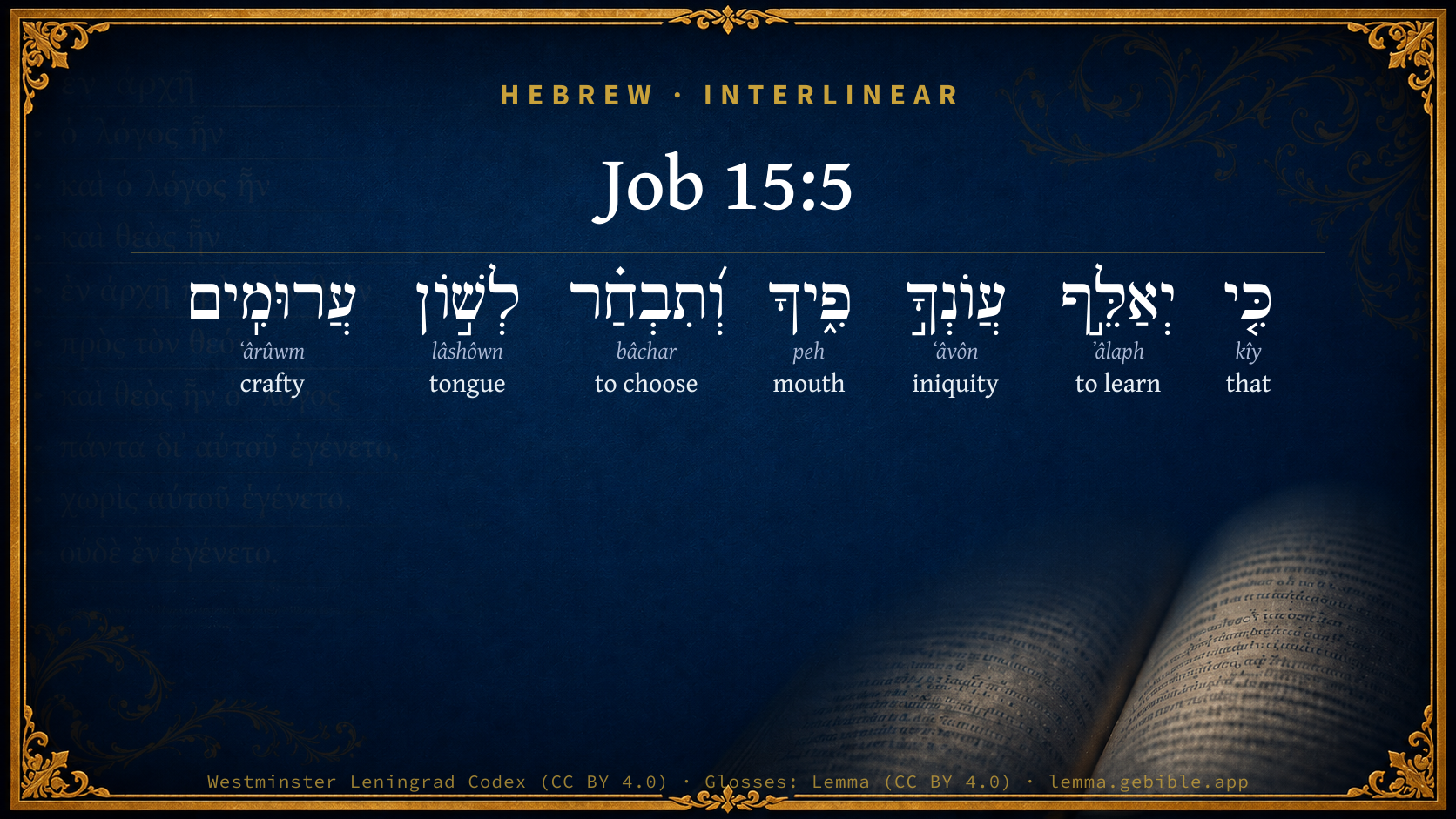
Hebrew (Westminster Leningrad Codex) Job 15:5 appears in the Hebrew Old Testament. The text above is from the Westminster Leningrad Codex. Each word links to its Strong’s number, a concise gloss, and parsing drawn from the Open Scriptures Hebrew Bible morphology. Click any word for its full Brown-Driver-Briggs (BDB) entry.
Download image
Cite this verse

Job 15:5 (World English Bible). Public Domain. Lemma interlinear Bible study tool, https://lemma.gebible.app/v/job/15/5.

Show BibTeX & RIS
BibTeX
RIS
English Translation
For your iniquity teaches your mouth, And you choose the language of the crafty.
World English Bible · Public Domain
Highlights
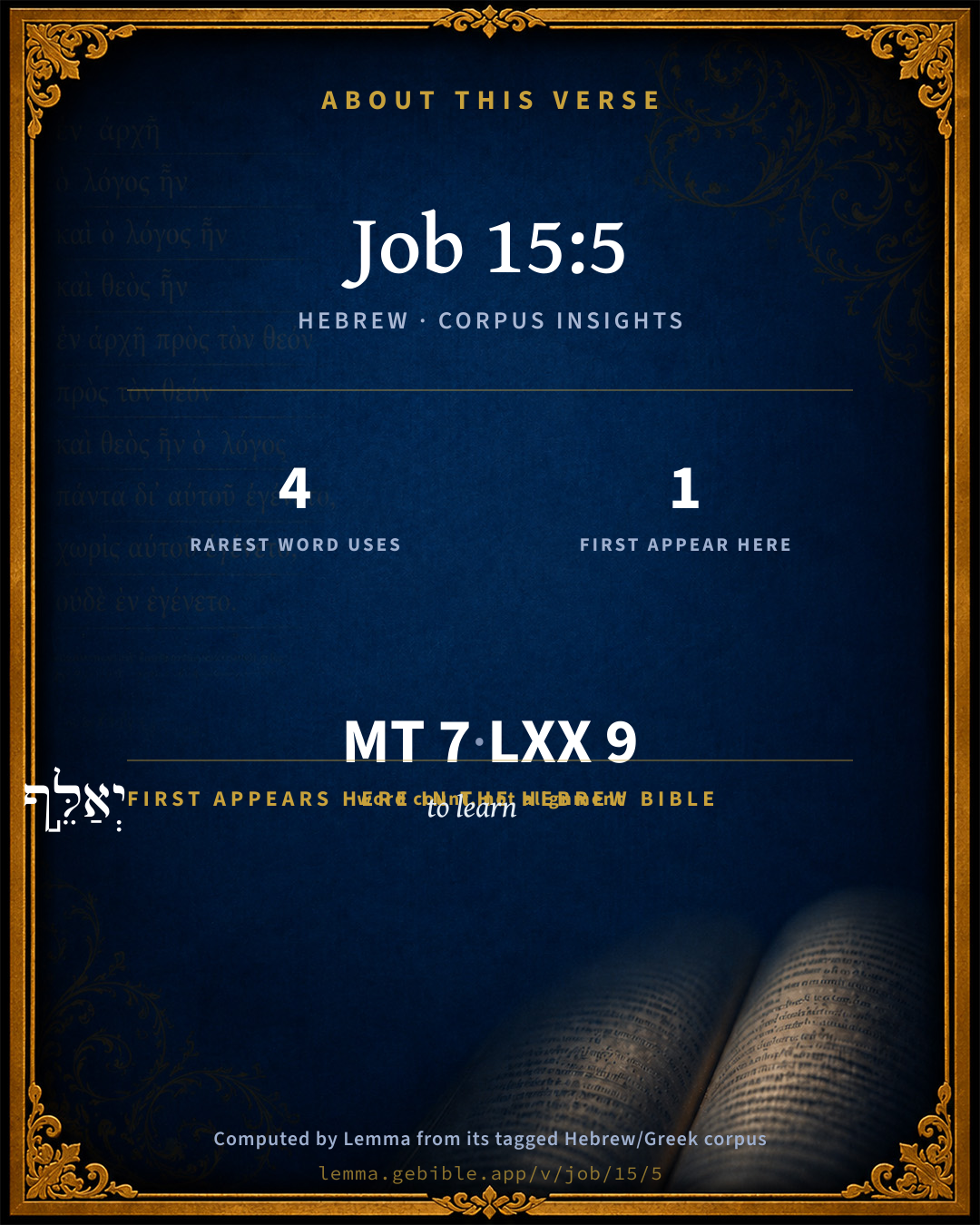
  • 1 first appearance in the Hebrew Bible
Full analysis ↓
Download a study sheet

One document with this verse’s original text, its word-by-word gloss line, the meaning frame, cross-references with their text, attributed commentary, and full source and license credits — printable, and it pastes into notes with its structure intact.

This verse Autodidact and up

Study sheet (.html) Plain text (.txt)

A passage Seminary Student

Up to 50 verses in one chapter. A passage sheet keeps up to 6 commentary sources and 12 cross-references per verse, in the order this page ranks them, and says so on the sheet whenever that leaves anything out. Ask for a single verse and you get the Autodidact verse sheet above.

Everything on this page stays free to read, with no account — the sheet is a download of what is already on screen, not access to it.

Want to remove ads? Support Godless Engineer
Compare translations 3

The same verse in 3 English versions, stacked beneath the original-language interlinear above. Click any original word for its lexicon entry.

Each is an independent rendering of the whole verse — the interlinear is not word-aligned to these translations.

Highlighted words mark where these versions differ — a whole-verse word diff, not a word-by-word alignment.

  • World English Bible Public Domain
    For your iniquity teaches your mouth, And you choose the language of the crafty.
  • King James Version Public Domain
    For thy mouth uttereth thine iniquity, and thou choosest the tongue of the crafty.
  • unfoldingWord Literal Text CC BY-SA 4.0
    for your iniquity teaches your mouth, and you choose the tongue of the crafty.

unfoldingWord Literal Text — © unfoldingWord, licensed CC BY-SA 4.0. Word-aligned USFM3 via Door43 (git.door43.org/unfoldingWord/en_ult).

Versions to compare (up to 4)

3 of 4 selected

Show all 18 translations

Every available English version of this verse, each an independent rendering of the whole verse.

  • World English Bible Public Domain
    For your iniquity teaches your mouth, And you choose the language of the crafty.
  • Berean Standard Bible Public Domain
    For your iniquity instructs your mouth, and you choose the language of the crafty.
  • Majority Standard Bible Public Domain
    For your iniquity instructs your mouth, and you choose the language of the crafty.
  • King James Version Public Domain
    For thy mouth uttereth thine iniquity, and thou choosest the tongue of the crafty.
  • American Standard Version (1901) Public Domain
    For thine iniquity teacheth thy mouth, And thou choosest the tongue of the crafty.
  • Revised Version (1885) Public Domain
    For thine iniquity teacheth thy mouth, and thou choosest the tongue of the crafty.
  • Geneva Bible (1599) Public Domain
    For thy mouth declareth thine iniquitie, seeing thou hast chosen ye tongue of the crafty.
  • Douay-Rheims (1899) Public Domain
    For thy iniquity hath taught thy mouth, and thou imitatest the tongue of blasphemers.
  • Young's Literal Translation Public Domain
    For thy mouth teacheth thine iniquity, And thou chooseth the tongue of the subtile.
  • Literal Standard Version CC BY-SA 4.0
    For your mouth teaches your iniquity, || And you choose the tongue of the cunning.
  • Unlocked Literal Bible CC BY-SA 4.0
    for your iniquity teaches your mouth; you choose to have the tongue of a crafty man.
  • unfoldingWord Literal Text CC BY-SA 4.0
    for your iniquity teaches your mouth, and you choose the tongue of the crafty.
  • Darby Bible Public Domain
    For thy mouth uttereth thine iniquity, and thou hast chosen the tongue of the crafty.
  • World Messianic Bible Public Domain
    For your iniquity teaches your mouth, and you choose the language of the crafty.
  • Webster's Bible Public Domain
    For thy mouth uttereth thy iniquity, and thou choosest the tongue of the crafty.
  • Free Bible Version CC BY-SA 4.0
    It's your sins that are doing the talking, and you are choosing deceptive words.
  • Bible in Basic English Public Domain
    For your mouth is guided by your sin, and you have taken the tongue of the false for yourself.
  • JPS Tanakh (1917) Public Domain
    For thine iniquity teacheth thy mouth, and thou choosest the tongue of the crafty.

Literal Standard Version (2020), Covenant Press — licensed CC BY-SA 4.0. Text via the HelloAO Bible API (eBible.org). Unlocked Literal Bible (unfoldingWord) — licensed CC BY-SA 4.0. Text via the HelloAO Bible API (eBible.org). unfoldingWord Literal Text — © unfoldingWord, licensed CC BY-SA 4.0. Word-aligned USFM3 via Door43 (git.door43.org/unfoldingWord/en_ult). Free Bible Version, Dr. Jonathan Gallagher — licensed CC BY-SA 4.0. Text via the HelloAO Bible API (eBible.org).

Word by word

More ways to search: Search by grammar → Find every occurrence → Compare this word →

Practice this passage: Drill this verse → Learn its vocabulary →

About this verse

These counts appear in no published source. They are computed here, from the morphology-tagged text and Lemma’s own curated glosses. What Lemma adds →

7
words
7
distinct lemmas
Wisdom
section

Notable vocabulary

The rarest word here is יְאַלֵּ֣ף to learn H502 — appearing just 4 times in the whole Hebrew Bible.

First appearance in Scripture

This word makes its first canonical appearance in the Hebrew Bible here:

  • יְאַלֵּ֣ף to learn H502

Shared distinctive vocabulary

יְאַלֵּ֣ף to learn H502 occurs in 4 verses of the Hebrew Bible. Also found in:

Grammatical profile

  • 2 verbs
  • 3 nouns
  • 1 adjective
  • 1 conjunction

Verb forms

  • יְאַלֵּ֣ף Piel · Imperfect
  • וְ֝תִבְחַ֗ר Qal · Imperfect

Hebrew & Septuagint length

In English translation the verse runs 14 words from the Hebrew and 18 from the Septuagint (LXX English) — closely comparable.

A rough comparison of the two English renderings, which tokenize alike — not a word-level alignment.

Word counts can differ between the Hebrew and the Greek without any difference in meaning — e.g. the Hebrew direct-object marker אֵת has no separate Greek word, and Greek often adds the article ὁ.

In the original languages it is 7 Hebrew tokens and 9 Greek tokens — but the two are counted differently (Hebrew bundles its prefixes and suffixes into one token; the Greek is in lemma form), so that isn’t a like-for-like length.

Cross-references

13

Topical passages linked to Job 15:5 in the Treasury of Scripture Knowledge — connected by theme and wording, ordered by reader-vote popularity; previews shown in the World English Bible.

  • Jeremiah 9:3–5 They bend their tongue, [as it were] their bow, for falsehood; and they are grown strong in the land, but not for truth: for they proceed from evil to evil, and they don't know me, says Yahweh.
  • Psalms 50:19–20 "You give your mouth to evil. You harnesses your tongue for deceit.
  • Psalms 52:2–4 Your tongue plots destruction, Like a sharp razor, working deceitfully.
  • Jeremiah 9:8 Their tongue is a deadly arrow; it speaks deceit: one speaks peaceably to his neighbor with his mouth, but in his heart he lays wait for him.
  • Luke 6:45 The good man out of the good treasure of his heart brings out that which is good, and the evil man out of the evil treasure of his heart brings out that which is evil, for out of the abundance of the heart, his mouth speaks.
  • James 1:26 If anyone among you thinks himself to be religious while he doesn't bridle his tongue, but deceives his heart, this man's religion is worthless.
  • James 3:5–8 So the tongue is also a little member, and boasts great things. See how a small fire can spread to a large forest!
  • Job 5:13 He takes the wise in their own craftiness; The counsel of the cunning is carried headlong.
  • Job 9:22–24 "It is all the same. Therefore I say, He destroys the blameless and the wicked.
  • Psalms 64:3 Who sharpen their tongue like a sword, And aim their arrows, deadly words,
  • Psalms 120:2–3 Deliver my soul, Yahweh, from lying lips, From a deceitful tongue.
  • Job 12:6 The tents of robbers prosper, Those who provoke God are secure; Who carry their God in their hands.
  • Mark 7:21–22 For from within, out of the hearts of men, proceed evil thoughts, adulteries, sexual sins, murders, thefts,

Cross-references courtesy of OpenBible.info (CC BY 4.0).

Hebrew and Greek witnesses Masoretic Hebrew ↔ Greek Septuagint

The same verse in the two great witnesses to the Old Testament, shown verse-for-verse.

These are two independent witnesses, not word-aligned to each other, and the Septuagint is shown in lemma (dictionary) form.

Hebrew Job 15:5 Masoretic · Westminster Leningrad Codex

כִּ֤י יְאַלֵּ֣ף עֲוֺנְךָ֣ פִ֑יךָ וְ֝תִבְחַ֗ר לְשׁ֣וֹן עֲרוּמִֽים

For your iniquity teaches your mouth, And you choose the language of the crafty.

World English Bible · Public Domain

Greek LXX Job 15:5 Septuagint · lemma form

ἔνοχος εἰμί ῥῆμα στόμα σύ οὐδέ διακρίνω ῥῆμα δυνάστης

You are guilty by the words of your mouth, neither have you discerned the words of the mighty.

LXX2012 (modern English Septuagint) · Public Domain

On this verse, Haydock's Catholic Bible Commentary discusses the Septuagint’s reading. Read the note in Commentary ↓

Hebrew: Westminster Leningrad Codex (CC BY 4.0). Greek: Septuagint (public domain); English from LXX2012 (modern English Septuagint) (Public Domain). How the Septuagint differs from the Hebrew →

Commentary

Notes on Job 15:5 from classic Christian and Jewish commentators (each source and its license shown beneath its notes). The classic Christian expositions comment on the surrounding passage and are grouped to its opening verse, so a note may address several verses; the Jewish commentaries on the Tanakh (Rashi and others) are per-verse, so they appear only where the commentator wrote on this verse.

Lemma curates 59 commentaries, every one of them public domain or Creative Commons licensed, each selected and text-cleaned for this edition rather than reprinted as found. About our sources →

Trapp's Complete Commentary

John Trapp

Job 15:5 For thy mouth uttereth thine iniquity, and thou choosest the tongue of the crafty.

Ver. 5. For thy mouth uttereth thine iniquity] Heb. Thy crooked, wry disposition, that standeth across to God and goodness, Psa 51:5, Homo est inversus decalogus. Solomon speaketh of perverse lips, as if the upper lip stood where the nether should, Pro 4:24. And St Jude speaketh of hard speeches, uttered by ungodly sinners, Jdg 1:15, such as Job was none, whatever Eliphaz, by misinterpreting, made of him, wresting his words to a wrong sense, as Psa 54:5, and, by a spiritual unmannerliness, making the worst of what he spake; there being not anything that may not be taken with the left hand. Now, if this befell Job from his friends and those godly persons, what wonder though the like, and worse, be done to us by wicked enemies?

Qui id quod boni est excerpunt, dicunt quod mali est.

Nihil est quin male narrando possit depravarier. - (Terent. Phorm.)

And thou choosest the tongue of the crafty] Than the which nothing is a greater enemy to piety, saith an interpreter. Politicians formalize and enervate the power of truth, till at length they leave us a heartless and sapless religion, saith another. Such a one Eliphaz makes Job to be: q.d. Thou wast wont to speak prayer, but now thou speakest policy, yea, Thou choosest to do it, thou lovest evil more than good, and lying rather than to speak right, Psa 52:3. Thou hast as many turnings and windings in thy mind as the serpent hath in his body (so the Hebrew word seemeth to signify, Gen 3:1). Thus he heighteneth his charge, and layeth on yet more load.

John Trapp, A Commentary or Exposition upon All the Books of the Old and New Testament (1647–1656) — public domain. Text from a community e-Sword module.

Joseph Benson's Commentary

Job 15:5-6. Thy mouth uttereth thine iniquity — Thy words discover the naughtiness of thy heart, and justify my charge against thee, that thou castest off fear, &c. Thou choosest the tongue of the crafty — Thou speakest wickedly and craftily: thou coverest thy impious principles with fair pretences of piety and respect for God, wherewith thou endeavourest to deceive men. Thine own mouth condemneth thee — My condemnation of thee is grounded on thy own words.

Joseph Benson's Commentary on the Old and New Testaments (1811–1818) — public domain. Text from a community e-Sword module.

Geneva Bible (1599)

Geneva Bible translators

Thou speakest as do the mockers and contemners of God.

Geneva Bible (1599) marginal notes — public domain. Text via Bolls.life.

Jamieson, Fausset & Brown

Robert Jamieson, A. R. Fausset & David Brown

The sophistry of thine own speeches proves thy guilt.

Jamieson, Fausset & Brown — Commentary Critical and Explanatory on the Whole Bible (1871) — public domain (CC PDM 1.0). Text via the HelloAO Bible API.

Adam Clarke's Commentary

Verse 5. For thy mouth uttereth] In attempting to justify thyself, thou hast added iniquity to sin, and hast endeavoured to impute blame to thy Maker.

The tongue of the crafty.] Thou hast varnished thy own conduct, and used sophistical arguments to defend thyself. Thou resemblest those cunning persons, ערומים arumim, who derive their skill and dexterity from the old serpent, "the nachash, who was ערום arum, subtle, or crafty, beyond all the beasts of the field;" Ge 3:1. Thy wisdom is not from above, but from beneath.

Adam Clarke's Commentary on the Bible (1810–1826) — public domain. Text from a community e-Sword/MySword module.

Ellicott's Commentary for English Readers

(5) Thy mouth uttereth thine iniquity.—These words may mean either “Thy mouth teacheth thine iniquity,” or “Thine iniquity teacheth thy mouth,” and the second clause must be taken adversatively or otherwise according as we understand the meaning, “Thy mouth proclaimeth thine iniquity, though thou choosest the tongue of the crafty, and so contrivest in some degree to conceal it;” or, “Thine iniquity teacheth thy mouth its eloquence, and by consequence thou choosest the tongue of the crafty.” We incline to the latter, though it is fair to say that the next verse seems rather to favour the other meaning.

A Bible Commentary for English Readers, edited by Charles John Ellicott (1878–1897) — public domain. Text from a community e-Sword module.

The Cambridge Bible for Schools and Colleges

gen. ed. J. J. S. Perowne

5. for thy mouth uttereth thine iniquity] Rather, for thine iniquity (or, guilt) teacheth thy mouth; the meaning being that his mouth was prompted by his iniquity, used as its instrument. His inquity taught his mouth what to say.

choosest the tongue of the crafty] i. e. choosest and makest use of,—speakest as the crafty do. The charge of Eliphaz is that Job’s complaint of unrighteousness in God’s treatment of him and his assertions of his own innocence, and such words as those in ch. Job_12:6, were mere crafty pretences put forward to cover his own wickedness. If the first clause have precisely the same sense as the latter, the word “iniquity” must be translated “guilt.”

The Cambridge Bible for Schools and Colleges (gen. ed. J. J. S. Perowne; Cambridge University Press, 1878–1918) — public domain. Text from a community e-Sword module.

John Gill's Exposition

For thy mouth uttereth thine iniquity,.... Which was in his heart, and so was an evidence against him, and proved him perverse, and made good the above charges exhibited against him: or "thine iniquity teaches thy mouth" (y); the wickedness that was in his heart prompted his mouth to speak the things he did, see Mat 12:34; and this, as it was an instance of his folly, Pro 15:2; so a proof of his casting off the fear of the Lord; for if that had been before his eyes, he would have bridled his lips, and not uttered all the wickedness of his heart: for he that "bridleth not his tongue, this man's religion is vain", Jam 1:26;

and thou choosest the tongue of the crafty; coloured over things under specious pretences of religion and godliness, so that the simple and ignorant took him for a holy good man, when he was at heart an hypocrite; in this light Eliphaz puts Job, as one that walked and talked in craftiness, and was a deceitful worker, and imposed upon men with false glosses and plausible pretences.

(y) "docuit iniquitas tua os tuum", V. L. Pagninus, Bolducius; "docebit", Montanus; "docet", Piscator, Cocceius; so Tigurine version.

John Gill's Exposition of the Whole Bible (1746–1763) — public domain (CC PDM 1.0). Text via the HelloAO Bible API.

Albert Barnes' Notes on the Bible

For thy mouth uttereth thine iniquity - Margin, “teacheth.” That is, “your whole argument shows that you are a guilty man. A man who can defend such positions about God cannot be a pious man, or have any proper veneration for the Most High.” A man may pursue an argument, and defend positions, that shall as certainly show that he is destitute of religion as though he lived an abandoned life; and he who holds opinions that are dishonorable to God, can no more be a pious man than if he dishonored God by violating his law.

Thou choosest the tongue of the crafty - Instead of pursuing an argument with candor and sincerity, you have resorted to miserable sophisms, such as running disputants use. You have not showed a disposition to ascertain and defend the truth, but have relied on the arts and evasions of the subtle disputant and the rhetorician. His whole discourse, according to Eliphaz, was a work of mere art, designed to blind his hearers; to deceive them with a favorable opinion of his piety; and to give some plausible, but delusive view of the government of God.

Albert Barnes' Notes on the Bible (1834–1885) — public domain. Text from a community e-Sword/MySword module.

Haydock's Catholic Bible Commentary

Blasphemers. Hebrew, "of the crafty," which is sometimes taken in a good sense. Septuagint, "thou hast not distinguished the speeches of the princes." Thou hast not shewn respect to our admonitions, (Calmet) or understood our meaning. (Haydock) --- Thou rather choosest to imitate those false sages, who strive to deceive the world. Abuse could hardly be carried to greater lengths than it is by this man; who before spoke with some moderation, chap. iv. (Calmet)

George Leo Haydock (1774–1849), Haydock's Catholic Family Bible and Commentary, 1859 edition — public domain. Excludes Psalms (Douay-Rheims chapter numbering differs from Protestant) and Deuterocanonical books (Catholic canon only).

Matthew Poole's English Annotations

i.e. Thy words discover the naughtiness of thy heart, and justify my charge against time, that thou castest off fear, &c. Thou speakest wickedly, but craftily; thou coverest thy impious principles and passions with fair pretences of piety and respect to God, wherewith thou endeavourest to mock God, and deceive men.

Matthew Poole's English Annotations on the Holy Bible (1683–1685) — public domain. Text from a community e-Sword/MySword module.

Whedon's Commentary on the Bible

Daniel D. Whedon

5. Uttereth — יאלŠ, (yealleph,) teacheth. Iniquity is the grammatical subject of the sentence, which should read, For thine iniquity teacheth thee. Iniquity was his oracle — “an oracle of transgression,” נאם פשׁע, (Psa_36:2,) a kind of demon, in the inmost recesses of the heart, whispering the dialect, (the alephs,) the abc’s of evil.

Crafty — ’Haroum; the same word is used of the serpent in Gen_3:1. The use of this comparatively rare word may have made it an offensive echo of the preceding thought. “Job plays the part of a thief, who, when accused, strives to criminate his accusers.” — Ewald.

Daniel D. Whedon (gen. ed.), Commentary on the Old and New Testaments (1874–1909) — public domain. Text from a community e-Sword module.

The Pulpit Commentary

For thy mouth uttereth thine iniquity. Some render, "Thine iniquity teacheth thy mouth," causing it to utter such profane speeches (Vulgate, Dillmann, Canon Cook, Revised Version); but the translation of the Authorized Version is defensible on grammatical grounds, and yields a good sense, so that no alteration is necessary. And thou choosest the tongue of the crafty; or, the tongue of the subtle. (comp. Gen_3:1, where the epithet assigned to the serpent is the same) Eliphaz probably means to tax Job with cloaking his real impiety under a pretence of religiousness.

The Pulpit Commentary (1880–1919), ed. H.D.M. Spence-Jones & Joseph S. Exell — public domain. Text from a community e-Sword module.

John Wesley's Explanatory Notes

Uttereth - Thy words discover the naughtiness of thy heart. Crafty - Thou speakest wickedly, and craftily: thou coverest thy impious principles with fair pretenses of piety.

John Wesley, Explanatory Notes Upon the Whole Bible (1754–1765) — public domain. Text via the GEBible commentary corpus.

Rashi

Rabbi Shlomo Yitzchaki (Rashi)

For your iniquity teaches Your evil inclination [teaches] your mouth to speak such words, but you should have chosen the tongue of the crafty.

Rashi on the Tanakh — English translations: “The Judaica Press complete Tanach with Rashi, translated by A. J. Rosenberg” (CC BY 4.0); “Pentateuch with Rashi's commentary by M. Rosenbaum and A.M. Silbermann, 1929-1934” (public domain); “The Metsudah Tanach series, Lakewood, N.J” (CC BY 4.0); and “The Book of Joshua, Metsudah Publications, 1997” (CC BY 4.0). Text via Sefaria.

Lesson kit

Teaching starters — assembled from the data on this page, not authored interpretation. Every prompt links to the verse data it draws on. Edit before teaching.

Job, in the Wisdom, opens this verse with 7 words (7 distinct Hebrew lemmas). Its most distinctive word is ʼâlaph (“to learn”). A historical commentator’s framing appears above. Read the whole chapter for the surrounding context.

Discussion questions

  1. What does “to learn” (ʼâlaph) contribute to the verse as a whole?
  2. The word “to learn” first appears here in Scripture. What is being introduced at this debut?
  3. Job 33:33 shares the word «to learn» with this verse. How do the two illuminate each other?
  4. The translations on this page render this verse differently — a whole-verse word diff, not a word-by-word alignment. What might account for the different wordings?
  5. The verb «יְאַלֵּ֣ף» is Piel Imperfect. How does its form color the action?
  6. Reading how Trapp's Complete Commentary and Joseph Benson's Commentary read this verse, where do the two commentators agree and where do they part?

Things to notice

Reading settings

Reading text

Shown beneath each verse's original-language words.

Old Testament
Old Testament edition

Read the OT as the Masoretic Hebrew (MT) or the Greek Septuagint (LXX).

English shown for the Greek Septuagint (in the Hebrew ↔ Greek comparison).

Comparing translations? Open the Compare panel on any verse page to stack up to four side by side.