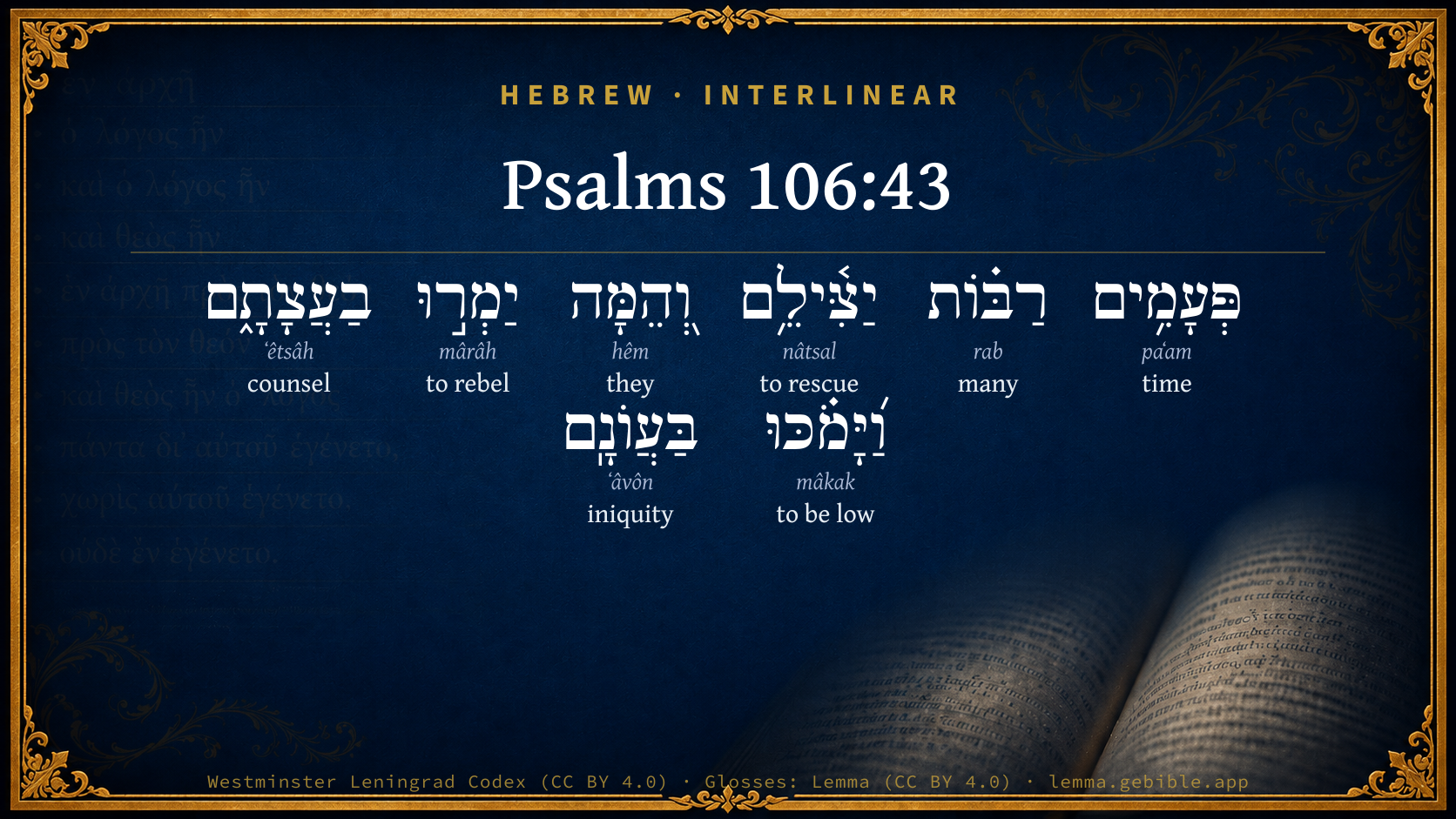
Psalms 106:43

Hebrew (Westminster Leningrad Codex) Psalms 106:43 appears in the Hebrew Old Testament. The text above is from the Westminster Leningrad Codex. Each word links to its Strong’s number, a concise gloss, and parsing drawn from the Open Scriptures Hebrew Bible morphology. Click any word for its full Brown-Driver-Briggs (BDB) entry.
Download image
Cite this verse

Psalms 106:43 (World English Bible). Public Domain. Lemma interlinear Bible study tool, https://lemma.gebible.app/v/psalms/106/43.

Show BibTeX & RIS
BibTeX
RIS
English Translation
Many times he delivered them, But they were rebellious in their counsel, And were brought low in their iniquity.
World English Bible · Public Domain
Download a study sheet

One document with this verse’s original text, its word-by-word gloss line, the meaning frame, cross-references with their text, attributed commentary, and full source and license credits — printable, and it pastes into notes with its structure intact.

This verse Autodidact and up

Study sheet (.html) Plain text (.txt)

A passage Seminary Student

Up to 50 verses in one chapter. A passage sheet keeps up to 6 commentary sources and 12 cross-references per verse, in the order this page ranks them, and says so on the sheet whenever that leaves anything out. Ask for a single verse and you get the Autodidact verse sheet above.

Everything on this page stays free to read, with no account — the sheet is a download of what is already on screen, not access to it.

Want to remove ads? Support Godless Engineer
Compare translations 3

The same verse in 3 English versions, stacked beneath the original-language interlinear above. Click any original word for its lexicon entry.

Each is an independent rendering of the whole verse — the interlinear is not word-aligned to these translations.

Highlighted words mark where these versions differ — a whole-verse word diff, not a word-by-word alignment.

  • World English Bible Public Domain
    Many times he delivered them, But they were rebellious in their counsel, And were brought low in their iniquity.
  • King James Version Public Domain
    Many times did he deliver them; but they provoked him with their counsel, and were brought low for their iniquity.
  • unfoldingWord Literal Text CC BY-SA 4.0
    Many times he rescued them, but they, they were rebellious in their counsel and sank in their sin.

unfoldingWord Literal Text — © unfoldingWord, licensed CC BY-SA 4.0. Word-aligned USFM3 via Door43 (git.door43.org/unfoldingWord/en_ult).

Versions to compare (up to 4)

3 of 4 selected

Show all 18 translations

Every available English version of this verse, each an independent rendering of the whole verse.

  • World English Bible Public Domain
    Many times he delivered them, But they were rebellious in their counsel, And were brought low in their iniquity.
  • Berean Standard Bible Public Domain
    Many times He rescued them, but they were bent on rebellion and sank down in their iniquity.
  • Majority Standard Bible Public Domain
    Many times He rescued them, but they were bent on rebellion and sank down in their iniquity.
  • King James Version Public Domain
    Many times did he deliver them; but they provoked him with their counsel, and were brought low for their iniquity.
  • American Standard Version (1901) Public Domain
    Many times did he deliver them; But they were rebellious in their counsel, And were brought low in their iniquity.
  • Revised Version (1885) Public Domain
    Many times did he deliver them; but they were rebellious in their counsel, and were brought low in their iniquity.
  • Geneva Bible (1599) Public Domain
    Many a time did hee deliuer them, but they prouoked him by their counsels: therefore they were brought downe by their iniquitie.
  • Douay-Rheims (1899) Public Domain
    many times did he deliver them. But they provoked him with their counsel: and they were brought low by their iniquities.
  • Young's Literal Translation Public Domain
    Many times He doth deliver them, And they rebel in their counsel, And they are brought low in their iniquity.
  • Literal Standard Version CC BY-SA 4.0
    He delivers them many times, || And they rebel in their counsel, || And they are brought low in their iniquity.
  • Unlocked Literal Bible CC BY-SA 4.0
    Many times he came to help them, but they kept rebelling and were brought low by their own sin.
  • unfoldingWord Literal Text CC BY-SA 4.0
    Many times he rescued them, but they, they were rebellious in their counsel and sank in their sin.
  • Darby Bible Public Domain
    Often did he deliver them; but as for them they provoked [him] by their counsel, and they were brought low by their iniquity.
  • World Messianic Bible Public Domain
    He rescued them many times, but they were rebellious in their counsel, and were brought low in their iniquity.
  • Webster's Bible Public Domain
    Many times did he deliver them; but they provoked him with their counsel; and were brought low for their iniquity.
  • Free Bible Version CC BY-SA 4.0
    The Lord repeatedly rescued them, but they continued with their rebellious ideas, until they were finally destroyed by their own sins.
  • Bible in Basic English Public Domain
    Again and again he made them free; but their hearts were turned against his purpose, and they were overcome by their sins.
  • JPS Tanakh (1917) Public Domain
    Many times did He deliver them; but they were rebellious in their counsel, and sank low through their iniquity.

Literal Standard Version (2020), Covenant Press — licensed CC BY-SA 4.0. Text via the HelloAO Bible API (eBible.org). Unlocked Literal Bible (unfoldingWord) — licensed CC BY-SA 4.0. Text via the HelloAO Bible API (eBible.org). unfoldingWord Literal Text — © unfoldingWord, licensed CC BY-SA 4.0. Word-aligned USFM3 via Door43 (git.door43.org/unfoldingWord/en_ult). Free Bible Version, Dr. Jonathan Gallagher — licensed CC BY-SA 4.0. Text via the HelloAO Bible API (eBible.org).

Word by word

More ways to search: Search by grammar → Find every occurrence → Compare this word →

Practice this passage: Drill this verse → Learn its vocabulary →

וַ֝יָּמֹ֗כּוּ
mâkak
H4355
“and · to be low”
Conjunction + Verb, Qal, Sequential Imperfect, 3rd Person, Masculine, Plural
Part of Speech
Conjunction + Verb
Stem
Qal
Form
Sequential Imperfect
Person
3rd Person
Gender
Masculine
Number
Plural
Full BDB Definition

Origin: a primitive root

TWOT: 1193

to be low, be humiliated - (Qal) to be low, be humiliated - (Niphal) to sink - (Hophal) to be brought low
  1. פְּעָמִ֥ים paʻam H6471 “times” Noun, Common, Feminine, Plural, Absolute
  2. רַבּ֗וֹת rab H7227 “many” Adjective, Adjective, Feminine, Plural, Absolute
  3. יַצִּ֫ילֵ֥ם nâtsal H5337 “to rescue · them” Verb, Hiphil, Imperfect, 3rd Person, Masculine, Singular + Suffix, Personal, 3rd Person, Masculine, Plural
  4. וְ֭הֵמָּה hêm H1992 “and · they” Conjunction + Pronoun, Personal, 3rd Person, Masculine, Plural
  5. יַמְר֣וּ mârâh H4784 “to rebel” Verb, Hiphil, Imperfect, 3rd Person, Masculine, Plural
  6. בַעֲצָתָ֑ם ʻêtsâh H6098 “in/at · counsel · their” Preposition + Noun, Common, Feminine, Singular, Construct + Suffix, Personal, 3rd Person, Masculine, Plural
  7. בַּעֲוֺנָֽם ʻâvôn H5771 “in/at · iniquity · their” Preposition + Noun, Common, Both, Singular, Construct + Suffix, Personal, 3rd Person, Masculine, Plural

About this verse

These counts appear in no published source. They are computed here, from the morphology-tagged text and Lemma’s own curated glosses. What Lemma adds →

8
words
8
distinct lemmas
Wisdom
section

Notable vocabulary

The rarest word here is וַ֝יָּמֹ֗כּוּ to be low H4355 — appearing just 3 times in the whole Hebrew Bible.

Shared distinctive vocabulary

וַ֝יָּמֹ֗כּוּ to be low H4355 occurs in 3 verses of the Hebrew Bible. Also found in:

Grammatical profile

  • 3 verbs
  • 3 nouns
  • 1 adjective
  • 1 pronoun

Verb forms

  • יַצִּ֫ילֵ֥ם Hiphil · Imperfect
  • יַמְר֣וּ Hiphil · Imperfect
  • וַ֝יָּמֹ֗כּוּ Qal · Sequential Imperfect

Hebrew & Septuagint length

In English translation the verse runs 19 words from the Hebrew and 21 from the Septuagint (LXX English) — closely comparable.

A rough comparison of the two English renderings, which tokenize alike — not a word-level alignment.

Word counts can differ between the Hebrew and the Greek without any difference in meaning — e.g. the Hebrew direct-object marker אֵת has no separate Greek word, and Greek often adds the article ὁ.

Cross-references

8

Topical passages linked to Psalms 106:43 in the Treasury of Scripture Knowledge — connected by theme and wording, ordered by reader-vote popularity; previews shown in the World English Bible.

  • Judges 2:16–18 Yahweh raised up judges, who saved them out of the hand of those who despoiled them.
  • Psalms 81:12 So I let them go after the stubbornness of their hearts, That they might walk in their own counsels.
  • Psalms 1:1 Blessed is the man who doesn't walk in the counsel of the wicked, Nor stand in the way of sinners, Nor sit in the seat of scoffers;
  • 1 Samuel 12:9–11 But they forgot Yahweh their God; and he sold them into the hand of Sisera, captain of the host of Hazor, and into the hand of the Philistines, and into the hand of the king of Moab; and they fought against them.
  • Psalms 106:29 Thus they provoked him to anger with their deeds. The plague broke in on them.
  • Judges 5:8 They chose new gods; Then was war in the gates: Was there a shield or spear seen Among forty thousand in Israel?
  • Judges 6:5 For they came up with their cattle and their tents; they came in as locusts for multitude; both they and their camels were without number: and they came into the land to destroy it.
  • 1 Samuel 13:19 Now there was no smith found throughout all the land of Israel; for the Philistines said, Lest the Hebrews make them swords or spears:

Cross-references courtesy of OpenBible.info (CC BY 4.0).

Hebrew and Greek witnesses Masoretic Hebrew ↔ Greek Septuagint

The same verse in the two great witnesses to the Old Testament, shown verse-for-verse.

You’re reading Greek Psalm 105 (Hebrew Psalm 106). The Septuagint counts the superscription, so verse numbers can differ from the Hebrew — chapter-level alignment, not verse-by-verse. Numbering follows Rahlfs.

These are two independent witnesses, not word-aligned to each other, and the Septuagint is shown in lemma (dictionary) form.

Hebrew Psalms 106:43 Masoretic · Westminster Leningrad Codex

פְּעָמִ֥ים רַבּ֗וֹת יַצִּ֫ילֵ֥ם וְ֭הֵמָּה יַמְר֣וּ בַעֲצָתָ֑ם וַ֝יָּמֹ֗כּוּ בַּעֲוֺנָֽם

Many times he delivered them, But they were rebellious in their counsel, And were brought low in their iniquity.

World English Bible · Public Domain

Greek LXX Greek Psalm 105:43 Septuagint · lemma form

πλεονάκις ῥύομαι αὐτός αὐτός δέ παραπικραίνω αὐτός ἐν ὁ βουλή αὐτός καί ταπεινόω ἐν ὁ ἀνομία αὐτός

Many a time he delivered them; but they provoked him by their counsel, and they were brought low by their iniquities.

LXX2012 (modern English Septuagint) · Public Domain

Hebrew: Westminster Leningrad Codex (CC BY 4.0). Greek: Septuagint (public domain); English from LXX2012 (modern English Septuagint) (Public Domain). How the Septuagint differs from the Hebrew →

Commentary

Notes on Psalms 106:43 from classic Christian and Jewish commentators (each source and its license shown beneath its notes). The classic Christian expositions comment on the surrounding passage and are grouped to its opening verse, so a note may address several verses; the Jewish commentaries on the Tanakh (Rashi and others) are per-verse, so they appear only where the commentator wrote on this verse.

Lemma curates 59 commentaries, every one of them public domain or Creative Commons licensed, each selected and text-cleaned for this edition rather than reprinted as found. About our sources →

Trapp's Complete Commentary

John Trapp

Psa 106:43 Many times did he deliver them; but they provoked [him] with their counsel, and were brought low for their iniquity.

Ver. 43. Many times did he deliver them] And as many times told them, Servati estis ut mihi servatis, I have, therefore, saved you that ye might serve me the better; Sed surdo fabulam, but they would not hearken.

η χαρις αλλαξαι την φυσιν ου δυναται (Theogn.).

John Trapp, A Commentary or Exposition upon All the Books of the Old and New Testament (1647–1656) — public domain. Text from a community e-Sword module.

Joseph Benson's Commentary

Psa 106:43-46. Many times did he deliver them — This seems to refer to the times of the judges; when God, many times, raised up deliverers, and wrought deliverances for them; and yet they relapsed to idolatry. They provoked him with their counsel — By forsaking God’s counsel, and the way which he had appointed, and following after their own evil inclinations. Nevertheless, he regarded their affliction — Yet such was his tender compassion toward them, he did not absolutely refuse to help even these base revolters. When he heard their cry — When, in their distress, they made supplication unto him, and promised amendment. And he remembered his covenant — The covenant made with their forefathers, in consideration of which, notwithstanding their horrible violation of it, he frequently and graciously delivered them. And repented, &c. — Changed his course in dealing with them, as penitent persons usually do. He made them to be pitied of those that carried them captives — By changing their opinions of them, and so inclining their hearts toward them, that they did not endeavour to effect their total extirpation.

Joseph Benson's Commentary on the Old and New Testaments (1811–1818) — public domain. Text from a community e-Sword module.

J. A. Alexander on Psalms

Joseph Addison Alexander

43. (Psa 106:43) Many times he frees them, and they resist (him) by their counsel, and are brought low by their guilt. Having given in the preceding verses a brief but lively summary of the Book of Judges, the Psalmist now passes, by an almost insensible transition, to the later periods of the history, and indeed to its catastrophe; for the meaning of the last clause seems to be, that after all their fluctuations, they at length sink or fall into a ruinous condition, as the ultimate fruit of their rebellions. The meaning of the first clause is, that by their self-willed plans and projects they continually come into collision with the will of God, and with that great providential purpose, in promoting which it was their duty, and would have been their happiness, to co-operate. With the last clause compare Lev 26:39, Eze 32:10.

Joseph Addison Alexander, The Psalms Translated and Explained (1850) — public domain. Text from a community e-Sword module.

Tyndale Open Study Notes

Tyndale Open Resources

106:43-44 When Israel was finally destroyed, the destruction was not complete. The Lord pitied them, so he left a remnant.

Tyndale Open Study Notes — © Tyndale Open Resources, licensed CC BY-SA 4.0. Text via the HelloAO Bible API.

Geneva Bible (1599)

Geneva Bible translators

The prophet showeth that neither by menaces, nor promises we can come to God, except we be altogether newly reformed, and that his mercy overcover and hide our malice.

Geneva Bible (1599) marginal notes — public domain. Text via Bolls.life.

Adam Clarke's Commentary

Verse 43. Many times did he deliver them] See the Book of Judges; it is a history of the rebellions and deliverances of the Israelites.

Adam Clarke's Commentary on the Bible (1810–1826) — public domain. Text from a community e-Sword/MySword module.

John Calvin's Commentaries

43. Many times. As the wicked perversity of the people was manifested in that God’s severe chastisements failed to produce their reformation, so now, on the other hand, the prophet deduces the detestable hardness of their hearts from the fact, that all the benefits which they had received from God could not bend them into obedience. They did, indeed, in the time of their afflictions, groan under the burden of them; but when God not only mitigated their punishment, but also granted them wonderful deliverances, can their subsequent backsliding be excused? It becomes us to bear in mind, that here, as in a glass, we have a picture of the nature of all mankind; for let God but adopt those very means which he employed in relation to the Israelites, in order to reclaim the majority of the sons of men, how comparatively few are there who will not be found continuing in the very same state as they were? And if he either humble us by the severity of his rod, or melt us by his kindness, the effect is only temporary; because, though he visit us with correction upon correction, and heap kindness upon kindness, yet we very soon relapse into our wonted vicious practices. As for the Jews, their insensate stupidity was insufferable, in that, notwithstanding the many and magnificent deliverances which God wrought out for them, they did not cease from their backslidings. For the Psalmist says, that they, nevertheless, provoked God with their wicked inventions Then he declares that they received a just recompense of reward in being oppressed by their iniquity. Moreover, he informs us, that though they were most deserving of all their afflictions, yet their groanings were heard; whence we learn, that God, in his unwearied kindness, did not cease to strive with them on account of their perverseness of spirit.

For what pity was this, to hear the cry of those who turned a deaf ear to his wise instructions, and were regardless of all his warnings and threatenings? And yet after all this forbearance and long-suffering, their exceedingly depraved hearts remained unchanged.

John Calvin's Commentaries (1540-1563) — public domain. Text from the Calvin Translation Society English edition (1840s-50s) via the Christian Classics Ethereal Library (ccel.org). Calvin's coverage is partial (roughly two-thirds of the Bible); uncommented books and verses are honest gaps, never fabricated. The 19th-century editor's footnotes and remarks are omitted so the notes are faithfully Calvin's own voice.

The Cambridge Bible for Schools and Colleges

gen. ed. J. J. S. Perowne

43. but they provoked him &c.] But they were rebellious in their counsel. Self-will was their bane, as before (Psa_106:13) when they would not wait for Jehovah’s counsel. The verbs are frequentative: repeated deliverances were met by repeated rebellion (Jdg_2:16-17).

and were brought low] The Heb. verb closely resembles that in Lev_26:39, “they that are left of you shall pine away in their iniquity,” and in Eze_24:23; Eze_33:10, passages which were doubtless in the Psalmist’s mind. The change may have been intentional, or it may be due to a scribe’s error.

The Cambridge Bible for Schools and Colleges (gen. ed. J. J. S. Perowne; Cambridge University Press, 1878–1918) — public domain. Text from a community e-Sword module.

John Gill's Exposition

Nevertheless he regarded their affliction,.... Or "looked on them in distress" (d); he saw their affliction, and had compassion on them; he was so far from abhorring and despising the affliction of the afflicted, that he pitied them and sympathized with them; in all their afflictions he was afflicted; he looked upon them with an eye of pity and concern, and helped them out of their troubles.

When he heard their cry; or their "prayer", as the Targum, and so other versions; crying is prayer; and it denotes vocal and vehement prayer, such as is put up to God in distress; and which he hears and answers; his ears are open to the cries of his people.

(d) "et vidit in angustia eis", Montanus, Gejerus; so Musculus, Tigurine version.

John Gill's Exposition of the Whole Bible (1746–1763) — public domain (CC PDM 1.0). Text via the HelloAO Bible API.

Albert Barnes' Notes on the Bible

Many times did he deliver them - From danger of invasion; from foreign arms; from entire overthrow. Numerous instances of this are recorded in the history of the Hebrew people.

But they provoked him with their counsel - This does not mean that they gave counsel or advice to God; but it refers to the counsel which they took among themselves; the plans which they formed. These were such as to offend God.

And were brought low for their iniquity - Margin, “impoverished or weakened.” The Hebrew word means to melt away, to pine; and hence, to decay, to be brought low. See Job 24:24, where it is rendered “brought low,” and Ecc 10:18, where it is rendered “decayeth.” The word does not occur elsewhere. The meaning is, that they were weakened; their national strength was exhausted as a punishment for their sins.

Albert Barnes' Notes on the Bible (1834–1885) — public domain. Text from a community e-Sword/MySword module.

Matthew Poole's English Annotations

Provoked him with their counsel, by forsaking God’s counsel and the way which he had appointed, and following after their own inventions and evil inclinations, as charged them, Psa 106:39. See the like Num 15:30.

Matthew Poole's English Annotations on the Holy Bible (1683–1685) — public domain. Text from a community e-Sword/MySword module.

The Treasury of David

Charles H. Spurgeon

Ver. 43. Many times did he deliver them. By reading the book of Judges we shall see how truthful is this sentence: again and again their foes were routed, and they were set free again, only to return with rigour to their former evil ways.

But they provoked him with their counsel. With deliberation they agreed to transgress anew; self will was their counsellor, and they followed it to their own destruction.

And were brought low for their iniquity. Worse and worse were the evils brought upon them, lower and lower they fell in sin, and consequently in sorrow. In dens and caves of the earth they hid themselves; they were deprived of all warlike weapons, and were utterly despised by their conquerors; they were rather a race of serfs than of free men until the Lord in mercy raised them up again. Could we but fully know the horrors of the wars which desolated Palestine, and the ravages which caused famine and starvation, we should shudder at the sins which were thus rebuked. Deeply engrained in their nature must the sin of idolatry have been, or they would not have returned to it with such persistence in the teeth of such penalties; we need not marvel at this, there is a still greater wonder, man prefers sin and hell to heaven and God.

The lesson to ourselves, as God's people, is to walk humbly and carefully before the Lord and above all to keep ourselves from idols. Woe unto those who become partakers of Rome's idolatries, for they will be joined with her in her plagues. May grace be given to us to keep the separated path, and remain undefiled with the fornication of the scarlet harlot of Babylon.

Ver. 43. They were brought low for their iniquity. Sin is of a weakening and impoverishing nature; it has weakened all mankind, and taken from them their moral strength to do good; and has brought them to poverty and want; to be beggars on the dunghill; to a pit wherein is no water; and left them in a hopeless and helpless condition; yea, it brings the people of God often times after conversion into a low estate, when God hides his face because of it, temptations are strong, grace is weak, and they become lukewarm and indifferent to spiritual things. John Gill.

Psalms 106:44*

Ver 44. Nevertheless he regarded their affliction, when he heard their cry. Notwithstanding all these provoking rebellions and detestable enormities the Lord still heard their prayer and pitied them. This is very wonderful, very godlike. One would have thought that the Lord would have shut out their prayer, seeing they had shut their ears against his admonitions; but no, he had a father's heart, and a sight of their sorrows touched his soul, the sound of their cries overcame his heart, and he looked upon them with compassion. His fiercest wrath towards his own people is only a temporary flame, but his love burns on for ever like the light of his own immortality.

Charles H. Spurgeon's The Treasury of David (1869–1885) — public domain. Psalms only. Text from a community e-Sword/MySword module.

Whedon's Commentary on the Bible

Daniel D. Whedon

43. Many times did he deliver them—See Jdg_2:16-19

Daniel D. Whedon (gen. ed.), Commentary on the Old and New Testaments (1874–1909) — public domain. Text from a community e-Sword module.

The Pulpit Commentary

Many times did he deliver them. By Othniel, (Jud_1:3:9) by Ehud, (Jud 3:15-29) by Shamgar, (Jud_1:3:31) by Deborah and Barak, (Jud 4:4-24) by Gideon, (Jud 7:19-25) by Jephthah, (Jud 11:12-33) by Samson, (Jud 15:8-20) and finally by David. (2Sa_5:22-25) But they provoked him with their counsel; rather, they were rebellious in their counsel (see the Revised Version). And were brought low for their iniquity; rather, in their iniquity. (comp. Lev_26:39)

The Divine pity and patience.

The exiles, when about to return to their own land, were brought to repentance by their sense of the goodness of God to them. In the spirit of penitence, the psalmist, a devout exile, reviews the national history, and finds that over and over again his people had to be penitent for their sins, and over and over again their God found them space and opportunity for repentance. Now, that exile read the national history aright, and he helps us in the endeavour to read our lives aright, and find in them ever-recurring proofs of the Divine pity and patience with the wilful and the wayward.

I SOME OF THE SOURCES WHENCE COME OUR SINS.

1. Fear. Illustrate by provocation at Red Sea (ver. 7).

2. Lust. Inordinate desire. Putting God to the test (ver. 14). Envy.

3. Story of Dathan (ver. 17).

4. Unspirituality. Incident of the calf (ver. 19).

5. Impatience. Despising the pleasant land, because it did not come to them at once (ver. 24).

6. Licence. Case of immorality at Beth-peor (ver. 28)

7. Distrust. Waters of strife (ver. 32).

8. Imperfect obedience, a sign of self-will.

They did not destroy the Canaanites, which they were commanded to do (ver. 34).

II THE SORROWS WHICH OUR SINS HAVE CAUSED GOOD MEN. These help us to realize how bad those sins must be. See what sorrow Moses felt in connection with the sin of the golden calf. See what sorrow Aaron felt in the matter of Dathan"s rebellion. See what sorrow Phinehas felt in the matter of Ball-peor.

III THE PITIFUL PATIENCE WITH WHICH GOD HAS EVER DEALT WITH OUR SINS.

1. Waiting until we came to a better mind. Let evil do its own work; it will be sure to punish and humble. God often does so much for us by doing nothing, leaving us to suffer the natural consequences of our sins.

2. Helping us by chastisements to come to a better mind. There may be occasions on which the infinite wisdom decides that it is better not to wait, because there may be active leaders in the evil, or strong self-will, which needs to be dealt with at once. Judgment for some, as in Dathan"s case, may be chastisement for all. The worst thing that could happen to us would be to be finally "let alone." If God is in our life acting in our life all is right, however trying the circumstances of life may be. R.T.

The Pulpit Commentary (1880–1919), ed. H.D.M. Spence-Jones & Joseph S. Exell — public domain. Text from a community e-Sword module.

John Wesley's Explanatory Notes

Counsel - By forsaking God's way, and following their own inventions.

John Wesley, Explanatory Notes Upon the Whole Bible (1754–1765) — public domain. Text via the GEBible commentary corpus.

Rashi

Rabbi Shlomo Yitzchaki (Rashi)

Many times He saved them Many times they provoked Him; yet He was slow to anger and saved them.

and they were humbled because of their iniquity Heb. וימכו, and they were humbled because of their iniquity.

Rashi on the Tanakh — English translations: “The Judaica Press complete Tanach with Rashi, translated by A. J. Rosenberg” (CC BY 4.0); “Pentateuch with Rashi's commentary by M. Rosenbaum and A.M. Silbermann, 1929-1934” (public domain); “The Metsudah Tanach series, Lakewood, N.J” (CC BY 4.0); and “The Book of Joshua, Metsudah Publications, 1997” (CC BY 4.0). Text via Sefaria.

Lesson kit

Teaching starters — assembled from the data on this page, not authored interpretation. Every prompt links to the verse data it draws on. Edit before teaching.

Psalms, in the Wisdom, opens this verse with 8 words (8 distinct Hebrew lemmas). Its most distinctive word is mâkak (“to be low”). A historical commentator’s framing appears above. Read the whole chapter for the surrounding context.

Discussion questions

  1. What does “to be low” (mâkak) contribute to the verse as a whole?
  2. Job 24:24 shares the word «to be low» with this verse. How do the two illuminate each other?
  3. The translations on this page render this verse differently — a whole-verse word diff, not a word-by-word alignment. What might account for the different wordings?
  4. The verb «יַצִּ֫ילֵ֥ם» is Hiphil Imperfect. How does its form color the action?
  5. Reading how Trapp's Complete Commentary and Joseph Benson's Commentary read this verse, where do the two commentators agree and where do they part?

Things to notice

Reading settings

Reading text

Shown beneath each verse's original-language words.

Old Testament
Old Testament edition

Read the OT as the Masoretic Hebrew (MT) or the Greek Septuagint (LXX).

English shown for the Greek Septuagint (in the Hebrew ↔ Greek comparison).

Comparing translations? Open the Compare panel on any verse page to stack up to four side by side.