

Jeremiah 14:10

Hebrew (Westminster Leningrad Codex) Jeremiah 14:10 appears in the Hebrew Old Testament. The text above is from the Westminster Leningrad Codex. Each word links to its Strong’s number, a concise gloss, and parsing drawn from the Open Scriptures Hebrew Bible morphology. Click any word for its full Brown-Driver-Briggs (BDB) entry.
Download image
Cite this verse

Jeremiah 14:10 (World English Bible). Public Domain. Lemma interlinear Bible study tool, https://lemma.gebible.app/v/jeremiah/14/10.

Show BibTeX & RIS
BibTeX
RIS
English Translation
Thus says Yahweh to this people, Even so have they loved to wander; they have not refrained their feet: therefore Yahweh does not accept them; now will he remember their iniquity, and visit their sins.
World English Bible · Public Domain
Download a study sheet

One document with this verse’s original text, its word-by-word gloss line, the meaning frame, cross-references with their text, attributed commentary, and full source and license credits — printable, and it pastes into notes with its structure intact.

This verse Autodidact and up

Study sheet (.html) Plain text (.txt)

A passage Seminary Student

Up to 50 verses in one chapter. A passage sheet keeps up to 6 commentary sources and 12 cross-references per verse, in the order this page ranks them, and says so on the sheet whenever that leaves anything out. Ask for a single verse and you get the Autodidact verse sheet above.

Everything on this page stays free to read, with no account — the sheet is a download of what is already on screen, not access to it.

Want to remove ads? Support Godless Engineer
Compare translations 3

The same verse in 3 English versions, stacked beneath the original-language interlinear above. Click any original word for its lexicon entry.

Each is an independent rendering of the whole verse — the interlinear is not word-aligned to these translations.

Highlighted words mark where these versions differ — a whole-verse word diff, not a word-by-word alignment.

  • World English Bible Public Domain
    Thus says Yahweh to this people, Even so have they loved to wander; they have not refrained their feet: therefore Yahweh does not accept them; now will he remember their iniquity, and visit their sins.
  • King James Version Public Domain
    Thus saith the LORD unto this people, Thus have they loved to wander, they have not refrained their feet, therefore the LORD doth not accept them; he will now remember their iniquity, and visit their sins.
  • unfoldingWord Literal Text CC BY-SA 4.0
    Thus says Yahweh to this people: “Thus they have loved to wander; they have not restrained their feet. Therefore Yahweh does not accept them. Now he will remember their iniquity and will punish their sins.”

unfoldingWord Literal Text — © unfoldingWord, licensed CC BY-SA 4.0. Word-aligned USFM3 via Door43 (git.door43.org/unfoldingWord/en_ult).

Versions to compare (up to 4)

3 of 4 selected

Show all 18 translations

Every available English version of this verse, each an independent rendering of the whole verse.

  • World English Bible Public Domain
    Thus says Yahweh to this people, Even so have they loved to wander; they have not refrained their feet: therefore Yahweh does not accept them; now will he remember their iniquity, and visit their sins.
  • Berean Standard Bible Public Domain
    This is what the LORD says about this people: “Truly they love to wander; they have not restrained their feet. So the LORD does not accept them; He will now remember their guilt and call their sins to account.”
  • Majority Standard Bible Public Domain
    This is what the LORD says about this people: “Truly they love to wander; they have not restrained their feet. So the LORD does not accept them; He will now remember their iniquity and punish them for their sins.”
  • King James Version Public Domain
    Thus saith the LORD unto this people, Thus have they loved to wander, they have not refrained their feet, therefore the LORD doth not accept them; he will now remember their iniquity, and visit their sins.
  • American Standard Version (1901) Public Domain
    Thus saith Jehovah unto this people, Even so have they loved to wander; they have not refrained their feet: therefore Jehovah doth not accept them; now will he remember their iniquity, and visit their sins.
  • Revised Version (1885) Public Domain
    Thus saith the LORD unto this people, Even so have they loved to wander; they have not refrained their feet: therefore the LORD doth not accept them; now will he remember their iniquity, and visit their sins.
  • Geneva Bible (1599) Public Domain
    Thus saith the Lord vnto this people, Thus haue they delited to wander: they haue not refrained their feete, therefore the Lord hath no delight in them: but he will now remember their iniquitie, and visite their sinnes.
  • Douay-Rheims (1899) Public Domain
    Thus saith the Lord to his people, that have loved to move their feet, and have not rested, and have not pleased the Lord: He will now remember their iniquities, and visit their sins.
  • Young's Literal Translation Public Domain
    Thus said Jehovah concerning this people: Well they have loved to wander, Their feet they have not restrained, And Jehovah hath not accepted them, Now doth He remember their iniquity, And inspect their sin.
  • Literal Standard Version CC BY-SA 4.0
    Thus said YHWH concerning this people: “They have loved to wander well, || They have not restrained their feet, || And YHWH has not accepted them, || Now He remembers their iniquity, || And inspects their sin.”
  • Unlocked Literal Bible CC BY-SA 4.0
    Yahweh says this to this people: “Since they love to wander, they have not held back their feet from doing so.” Yahweh is not pleased with them. Now he calls to mind their iniquity and has punished their sins.
  • unfoldingWord Literal Text CC BY-SA 4.0
    Thus says Yahweh to this people: “Thus they have loved to wander; they have not restrained their feet. Therefore Yahweh does not accept them. Now he will remember their iniquity and will punish their sins.”
  • Darby Bible Public Domain
    Thus saith Jehovah to this people: Even so have they loved to wander, they have not refrained their feet; and Jehovah hath no delight in them: now will he remember their iniquity, and visit their sins.
  • World Messianic Bible Public Domain
    The LORD says to this people: “Even so they have loved to wander. They have not restrained their feet. Therefore the LORD does not accept them. Now he will remember their iniquity, and punish them for their sins.”
  • Webster's Bible Public Domain
    Thus saith the LORD to this people, Thus have they loved to wander, they have not restrained their feet, therefore the LORD doth not accept them; he will now remember their iniquity, and visit their sins.
  • Free Bible Version CC BY-SA 4.0
    This is what the Lord says about his people: They really love to wander away from me—they don't even try to stop themselves. So the Lord refuses to accept them. Now he'll remember their guilty actions and punish them for their sins.
  • Bible in Basic English Public Domain
    This is what the Lord has said about this people: Even so they have been glad to go from the right way; they have not kept their feet from wandering, so the Lord has no pleasure in them; now he will keep their wrongdoing in mind and send punishment for their sins.
  • JPS Tanakh (1917) Public Domain
    Thus saith the LORD unto this people: Even so have they loved to wander, they have not refrained their feet; therefore the LORD doth not accept them, now will He remember their iniquity, and punish their sins.

Literal Standard Version (2020), Covenant Press — licensed CC BY-SA 4.0. Text via the HelloAO Bible API (eBible.org). Unlocked Literal Bible (unfoldingWord) — licensed CC BY-SA 4.0. Text via the HelloAO Bible API (eBible.org). unfoldingWord Literal Text — © unfoldingWord, licensed CC BY-SA 4.0. Word-aligned USFM3 via Door43 (git.door43.org/unfoldingWord/en_ult). Free Bible Version, Dr. Jonathan Gallagher — licensed CC BY-SA 4.0. Text via the HelloAO Bible API (eBible.org).

Word by word

More ways to search: Search by grammar → Find every occurrence → Compare this word →

Practice this passage: Drill this verse → Learn its vocabulary →

חָשָׂ֑כוּ
châsak
H2820
“to withhold”
Verb, Qal, Perfect, 3rd Person, Common, Plural
Part of Speech
Verb
Stem
Qal
Form
Perfect
Person
3rd Person
Gender
Common
Number
Plural
Full BDB Definition

Origin: a primitive root

TWOT: 765

to withhold, restrain, hold back, keep in check, refrain - (Qal) - to withhold, keep back, keep for oneself, keep from, hold in check, refrain, spare, reserve - to restrain, check - (Niphal) to assuage, be spared
  1. כֹּֽה kôh H3541 “thus” Adverb
  2. אָמַ֨ר ʼâmar H559 “to say” Verb, Qal, Perfect, 3rd Person, Masculine, Singular
  3. יְהוָ֜ה Yᵉhôvâh H3068 “LORD” Noun, Proper
  4. לָעָ֣ם ʻam H5971 “to/for the · people” Preposition, Determined + Noun, Common, Masculine, Singular, Absolute
  5. הַזֶּ֗ה zeh H2088 “the · this” Particle, Definite Article + Pronoun, Demonstrative, Masculine, Singular
  6. כֵּ֤ן kên H3651 “thus” Particle, Demonstrative
  7. אָֽהֲבוּ֙ ʼâhab H157 “to love” Verb, Qal, Perfect, 3rd Person, Common, Plural
  8. לָנ֔וּעַ nûwaʻ H5128 “to shake” Preposition + Verb, Qal, Infinitive Construct
  9. רַגְלֵיהֶ֖ם regel H7272 “feet · their” Noun, Common, Feminine, Dual, Construct + Suffix, Personal, 3rd Person, Masculine, Plural
  10. לֹ֣א lôʼ H3808 “not” Particle, Negative
  11. וַיהוָה֙ Yᵉhôvâh H3068 “and · LORD” Conjunction + Noun, Proper
  12. לֹ֣א lôʼ H3808 “not” Particle, Negative
  13. רָצָ֔ם râtsâh H7521 “to be pleased · them” Verb, Qal, Perfect, 3rd Person, Masculine, Singular + Suffix, Personal, 3rd Person, Masculine, Plural
  14. עַתָּה֙ ʻattâh H6258 “now” Adverb
  15. יִזְכֹּ֣ר zâkar H2142 “to remember” Verb, Qal, Imperfect, 3rd Person, Masculine, Singular
  16. עֲוֺנָ֔ם ʻâvôn H5771 “iniquity · their” Noun, Common, Both, Singular, Construct + Suffix, Personal, 3rd Person, Masculine, Plural
  17. וְיִפְקֹ֖ד pâqad H6485 “and · to visit” Conjunction + Verb, Qal, Imperfect, 3rd Person, Masculine, Singular
  18. חַטֹּאתָֽם chaṭṭâʼâh H2403 “sin offerings · their” Noun, Common, Feminine, Plural, Construct + Suffix, Personal, 3rd Person, Masculine, Plural

About this verse

These counts appear in no published source. They are computed here, from the morphology-tagged text and Lemma’s own curated glosses. What Lemma adds →

19
words
17
distinct lemmas
Prophets
section

Shared distinctive vocabulary

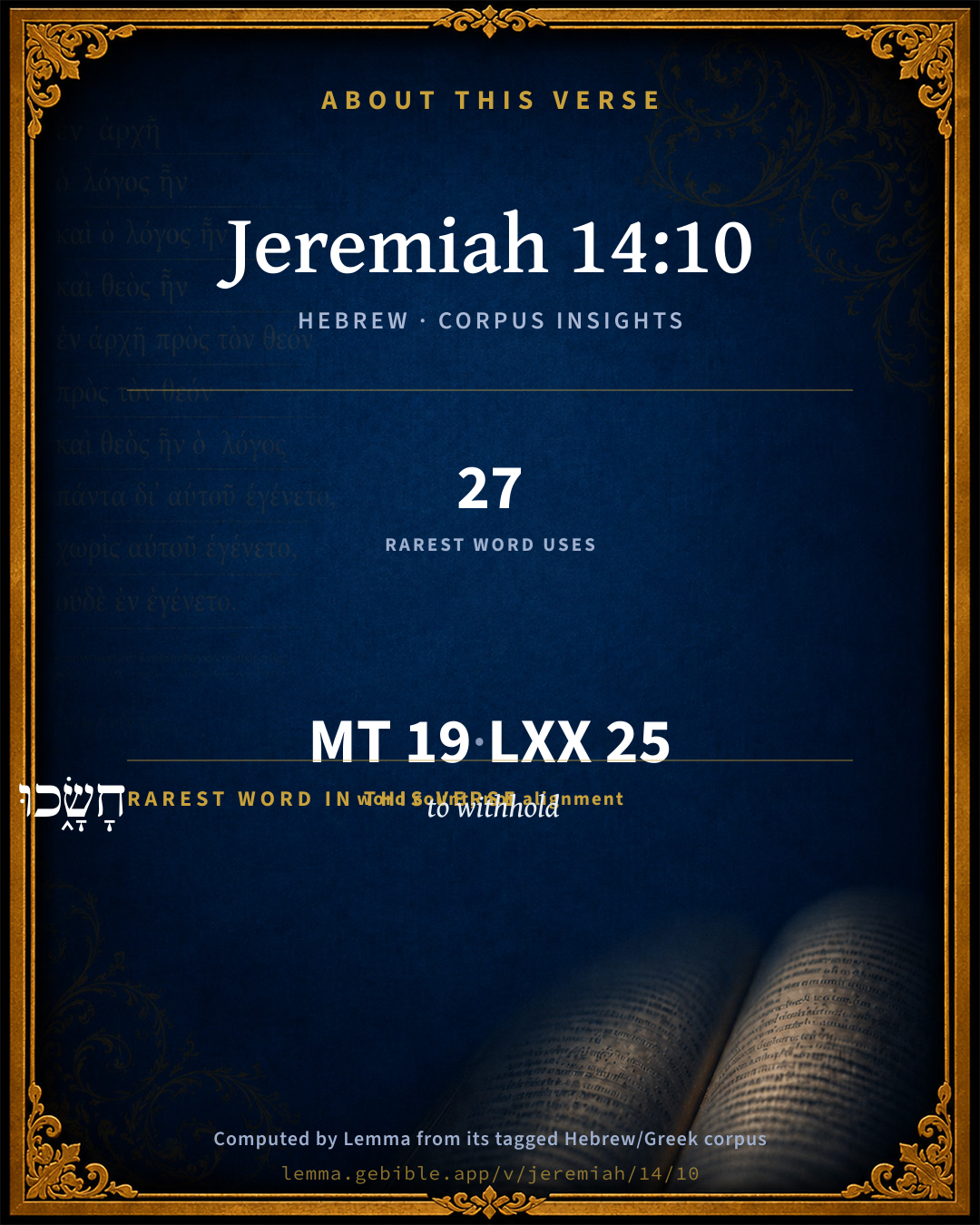
חָשָׂ֑כוּ to withhold H2820 occurs in 27 verses of the Hebrew Bible. Also found in:

Grammatical profile

  • 7 verbs
  • 6 nouns
  • 1 pronoun
  • 2 adverbs
  • 3 particles

Verb forms

  • אָמַ֨ר Qal · Perfect
  • אָֽהֲבוּ֙ Qal · Perfect
  • לָנ֔וּעַ Qal · Infinitive Construct
  • חָשָׂ֑כוּ Qal · Perfect
  • רָצָ֔ם Qal · Perfect
  • יִזְכֹּ֣ר Qal · Imperfect
  • וְיִפְקֹ֖ד Qal · Imperfect

Repetition

Words recur within this verse — often emphatic in Hebrew:

  • יְהוָ֜ה LORD H3068 ×2
  • לֹ֣א not H3808 ×2

Hebrew & Septuagint length

In the original languages it is 19 Hebrew tokens and 25 Greek tokens — but the two are counted differently (Hebrew bundles its prefixes and suffixes into one token; the Greek is in lemma form), so that isn’t a like-for-like length.

Cross-references

18

Topical passages linked to Jeremiah 14:10 in the Treasury of Scripture Knowledge — connected by theme and wording, ordered by reader-vote popularity; previews shown in the World English Bible.

  • Hosea 9:9 They have deeply corrupted themselves, As in the days of Gibeah. He will remember their iniquity. He will punish them for their sins.
  • Psalms 119:101 I have kept my feet from every evil way, That I might observe your word.
  • Hosea 8:13 As for the sacrifices of my offerings, they sacrifice flesh and eat it; But Yahweh doesn't accept them. Now he will remember their iniquity, And punish their sins. They will return to Egypt.
  • Jeremiah 6:20 To what purpose comes there to me frankincense from Sheba, and the sweet cane from a far country? your burnt offerings are not acceptable, nor your sacrifices pleasing to me.
  • Amos 5:22 Yes, though you offer me your burnt offerings and meal-offerings, I will not accept them; Neither will I regard the peace offerings of your fat animals.
  • Jeremiah 31:34 and they shall teach no more every man his neighbor, and every man his brother, saying, Know Yahweh; for they shall all know me, from the least of them to the greatest of them, says Yahweh: for I will forgive their iniquity, and their sin will I remember no more.
  • Hebrews 8:12 For I will be merciful to their unrighteousness. I will remember their sins and lawless deeds no more."
  • 1 Samuel 15:2 Thus says Yahweh of Hosts, I have marked that which Amalek did to Israel, how he set himself against him in the way, when he came up out of Egypt.
  • 1 Kings 17:18 She said to Elijah, What have I to do with you, you man of God? You have come to me to bring my sin to memory, and to kill my son!
  • Psalms 109:14–15 Let the iniquity of his fathers be remembered by Yahweh. Don't let the sin of his mother be blotted out.
  • Jeremiah 2:23–25 How can you say, I am not defiled, I have not gone after the Baals? see your way in the valley, know what you have done: [you are] a swift dromedary traversing her ways;
  • Jeremiah 2:36 Why go you about so much to change your way? you shall be ashamed of Egypt also, as you were ashamed of Assyria.
  • Jeremiah 3:1–2 They say, If a man put away his wife, and she go from him, and become another man's, will he return to her again? Won't that land be greatly polluted? But you have played the prostitute with many lovers; yet return again to me, says Yahweh.
  • Jeremiah 8:5 Why then is this people of Jerusalem slidden back by a perpetual backsliding? they hold fast deceit, they refuse to return.
  • Jeremiah 44:21–23 The incense that you burned in the cities of Judah, and in the streets of Jerusalem, you and your fathers, your kings and your princes, and the people of the land, didn't Yahweh remember them, and didn't it come into his mind?
  • Hosea 11:7 My people are determined to turn from me. Though they call to the Most High, He certainly won't exalt them.
  • Hosea 11:9 I will not execute the fierceness of my anger. I will not return to destroy Ephraim: For I am God, and not man; the Holy One in the midst of you; And I will not come in wrath.
  • Malachi 1:8–13 When you offer the blind for sacrifice, isn't that evil? And when you offer the lame and sick, isn't that evil? Present it now to your governor! Will he be pleased with you? Or will he accept your person?" says Yahweh of Hosts.

Cross-references courtesy of OpenBible.info (CC BY 4.0).

Hebrew and Greek witnesses Masoretic Hebrew ↔ Greek Septuagint

The same verse in the two great witnesses to the Old Testament, shown verse-for-verse.

These are two independent witnesses, not word-aligned to each other, and the Septuagint is shown in lemma (dictionary) form.

Hebrew Jeremiah 14:10 Masoretic · Westminster Leningrad Codex

כֹּֽה אָמַ֨ר יְהוָ֜ה לָעָ֣ם הַזֶּ֗ה כֵּ֤ן אָֽהֲבוּ֙ לָנ֔וּעַ רַגְלֵיהֶ֖ם לֹ֣א חָשָׂ֑כוּ וַיהוָה֙ לֹ֣א רָצָ֔ם עַתָּה֙ יִזְכֹּ֣ר עֲוֺנָ֔ם וְיִפְקֹ֖ד חַטֹּאתָֽם

Thus says Yahweh to this people, Even so have they loved to wander; they have not refrained their feet: therefore Yahweh does not accept them; now will he remember their iniquity, and visit their sins.

World English Bible · Public Domain

Greek LXX Structure differs

In the Septuagint, Jeremiah is about an eighth shorter than the Hebrew and arranges its material differently — the Oracles Against the Nations (Hebrew chapters 46–51) appear in the middle of the Greek book, after 25:13. Because the chapter and verse boundaries do not line up, a verse-for-verse comparison with the Hebrew is not shown.

A verse-for-verse comparison isn’t shown here because the chapters and verses don’t line up. Switch to the LXX edition with the MT / LXX toggle above to read the Greek directly.

On this verse, Keil & Delitzsch discusses the Septuagint’s reading. Read the note in Commentary ↓

Hebrew: Westminster Leningrad Codex (CC BY 4.0). Greek: Septuagint (public domain); English from a public-domain English Septuagint. How the Septuagint differs from the Hebrew →

Targum (Aramaic paraphrase)

1

The Targum is the ancient Jewish Aramaic paraphrase of the Hebrew Scriptures — an interpretive translation, not the Hebrew text itself. Onkelos (literal) and Pseudo-Jonathan (expansive) render the Torah, and Jonathan the Prophets. Coverage is partial: where no permissively-licensed English translation exists for a verse, only the Aramaic is shown. This is verse-level text, not a word-by-word alignment to the Hebrew.

  1. Targum Jonathan Prophets (Joshua–Malachi)
    כִּדְנַן אֲמַר יְיָ לְעַמָא הָדֵין כְּמָא דִרְחִימוּ כֵּן אִתְפְּרַע מִנְהוֹן לְאַגְלָיוּתְהוֹן מֵאֲרַע בֵּית שְׁכִינְתִּי וּכְמָה דַהֲווֹ מְעָרְבִין לְפוּלְחַן טַעֲוָתָא וּמִבֵּית מִקְדָשִׁי רַגְלֵיהוֹן לָא מְנָעוּ וּקְדָם יְיָ לָא רַעֲוָא בְּהוֹן כְּעַן יִסְעַר עֲלֵיהוֹן חוֹבֵיהוֹן וְיִתְפְּרַע עֲוָיָתְהוֹן:

    (no public-domain English translation for this verse)

    Targum Jonathan — Aramaic: “Mikraot Gedolot” (public domain). English: “Sefaria Community Translation” (CC0 1.0 (public-domain dedication)); “London "Chaldee Paraphrase," 1871” (public domain). Text via Sefaria.

Commentary

Notes on Jeremiah 14:10 from classic Christian and Jewish commentators (each source and its license shown beneath its notes). The classic Christian expositions comment on the surrounding passage and are grouped to its opening verse, so a note may address several verses; the Jewish commentaries on the Tanakh (Rashi and others) are per-verse, so they appear only where the commentator wrote on this verse.

Lemma curates 59 commentaries, every one of them public domain or Creative Commons licensed, each selected and text-cleaned for this edition rather than reprinted as found. About our sources →

Matthew Henry's Commentary

The dispute between God and his prophet, in this chapter, seems to be like that between the owner and the dresser of the vineyard concerning the barren fig-tree, Luk 13:7. The justice of the owner condemns it to be cut down; the clemency of the dresser intercedes for a reprieve. Jeremiah had been earnest with God, in prayer, to return in mercy to this people. Now here,

I. God overrules the plea which he had offered in their favour, and shows him that it would not hold. In answer to it thus he says concerning this people, Jer 14:10. He does not say, concerning my people, for he disowns them, because they had broken covenant with him. It is true they were called by his name, and had the tokens of his presence among them; but they had sinned, and provoked God to withdraw. This the prophet had owned, and had hoped to obtain mercy for them, notwithstanding this, through intercession and sacrifice; therefore God here tells him, 1. That they were not duly qualified for a pardon. The prophet had owned that their backslidings were many; and, though they were so, yet there was hope for them if they returned. But this people show no disposition at all to return; they have wandered, and they have loved to wander; their backslidings have been their choice and their pleasure, which should have been their shame and pain, and therefore they will be their ruin. They cannot expect God should take up his rest with them when they take such delight in going astray from him after their idols. It is not through necessity or inadvertency that they wander, but they love to wander. Sinners are wanderers from God; their wanderings forfeit God's favour, but it is their loving to wander that quite cuts them off from it. They were told what their wanderings would come to that one sin would hurry them on to another, and all to ruin; and yet they have not taken warning and refrained their feet. So far were they from returning to their God that neither his prophets nor his judgments could prevail upon them to give themselves the least check in a sinful pursuit. This is that for which God is now reckoning with them. When he denies them rain from heaven he is remembering their iniquity and visiting their sin; that is it for which their fruitful land is thus turned into barrenness. 2. That they had no reason to expect that the God they had rejected should accept them; no, not though they betook themselves to fasting and prayer and put themselves to the expense of burnt-offerings and sacrifice: The Lord doth not accept them, Jer 14:10. He takes no pleasure in them (so the word is); for what pleasure can the holy God take in those that take pleasure in his rivals, in any service, in any society, rather than his? "When they fast (Jer 14:12), which is a proper expression of repentance and reformation, - when they offer a burnt offering and an oblation, which was designed to be an expression of faith in a Mediator, - though their prayers be thus enforced, and offered up in those vehicles that used to be acceptable, yet, because they do not proceed from humble, penitent, and renewed hearts, but still they love to wander, therefore I will not hear their cry, be it ever so loud; nor will I accept them, neither their persons nor their performances." It had been long since declared, The sacrifice of the wicked is an abomination to the Lord; and those only are accepted that do well, Gen 4:7. 3. That they had forfeited all benefit by the prophet's prayers for them because they had not regarded his preaching to them. This is the meaning of that repeated prohibition given to the prophet (Jer 14:11): Pray not thou for this people for their good, as before, Jer 7:15; Jer 11:14. This did not forbid him thus to express his good-will to them (Moses continued to intercede for Israel after God had said, Let me alone, Exo 32:10), but it forbade them to expect any good effect from it as long as they turned away their ear from hearing the law. Thus was the doom of the impenitent ratified, as that of Saul's rejection was by that word to Samuel, When wilt thou cease to mourn for Saul? It therefore follows (Jer 14:12), I will consume them, not only by this famine, but by the further sore judgments of sword and pestilence; for God has many arrows in his quiver, and those that will not be convinced and reclaimed by one shall be consumed by another.

II. The prophet offers another plea in excuse for the people's obstinacy, and it is but an excuse, but he was willing to say whatever their case would bear; it is this, That the prophets, who pretended a commission from heaven, imposed upon them, and flattered them with assurances of peace though they went on in their sinful way, Jer 14:13. He speaks of it with lamentation: "Ah! Lord God, the poor people seem willing to take notice of what comes in thy name, and there are those who in thy name tell them that they shall not see the sword nor famine; and they say it as from thee, with all the gravity and confidence of prophets: I will continue you in this place, and will give you assured peace here, peace of truth. I tell them the contrary; but I am one against many, and every one is apt to credit that which makes for them; therefore, Lord, pity and spare them, for their leaders cause them to err." This excuse would have been of some weight if they had not had warning given them, before, of false prophets, and rules by which to distinguish them; so that if they were deceived it was entirely their own fault. But this teaches us, as far as we can with truth, to make the best of bad, and judge as charitably of others as their case will bear.

III. God not only overrules this plea, but condemns both the blind leaders and the blind followers to fall together into the ditch. 1. God disowns the flatteries (Jer 14:14): They prophesy lies in my name. They had no commission from God to prophesy at all: I neither sent them, nor commanded them, nor spoke unto them. They never were employed to go on any errand at all from God; he never made himself known to them, much less by them to the people; never any word of the Lord came to them, no call, no warrant, no instruction, much less did he send them on this errand, to rock them asleep in security. No; men may flatter themselves, and Satan may flatter them, but God never does. It is a false vision, and a thing of nought. Note, What is false and groundless in vain and worthless. The vision that is not true, be it ever so pleasing, is good for nothing; it is the deceit of their heart, a spider's web spun out of their own bowels, and in it they think to shelter themselves, but it will be swept away in a moment and prove a great cheat. Those that oppose their own thoughts of God's word (God indeed says so, but they think otherwise) walk in the deceit of their heart, and it will be their ruin. 2. He passes sentence upon the flatterers, Jer 14:15. As for the prophets, who put this abuse upon the people by telling them they shall have peace, and this affront upon God by telling them so in God's name, let them know that they shall have no peace themselves. They shall fall first by those very judgments which they have flattered others with the hopes of an exemption from. They undertook to warrant people that sword and famine should not be in the land; but it shall soon appear how little their warrants are good for, when they themselves shall be cut off by sword and famine. How should they secure others or foretel peace to them when they cannot secure themselves, nor have such a foresight of their own calamities as to get out of the way of them? Note, The sorest punishment await those who promise sinners impunity in their sinful ways. 3. He lays the flattered under the same doom: The people to whom they prophesy lies, and who willingly suffer themselves to be thus imposed upon, shall die by sword and famine, Jer 14:16. Note, The unbelief of the deceived, with all the falsehood of the deceivers, shall not make the divine threatenings of no effect; sword and famine will come, whatever they say to the contrary; and those will be least safe that are most secure. Impenitent sinners will not escape the damnation of hell by saying that they can never believe there is such a thing, but will feel what they will not fear. It is threatened that this people shall not only fall by sword and famine, but that they shall be as it were hanged up in chains, as monuments of that divine justice which they set at defiance; their bodies shall be cast out, even in the streets of Jerusalem, which of all places, one would think, should be kept clear from such nuisances: there they shall lie unburied; their nearest relations, who should do them that last office of love, being so poor that they cannot afford it, or so weakened with hunger that they are not able to attend it, or so overwhelmed with grief that they have no heart to it, or so destitute of natural affection that they will not pay them so much respect. Thus will God pour their wickedness upon them, that is, the punishment of their wickedness; the full vials of God's wrath shall be poured upon them, to which they have made themselves obnoxious. Note, When sinners are overwhelmed with trouble they must in it see their own wickedness poured upon them. This refers to the wickedness both of the false prophets and of the people; the blind lead the blind, and both fall together into the ditch, where they will be miserable comforters one to another.

Matthew Henry's Commentary on the Whole Bible (1708–1710) — public domain (CC PDM 1.0). Text via the HelloAO Bible API.

Trapp's Complete Commentary

John Trapp

Jer 14:10 Thus saith the LORD unto this people, Thus have they loved to wander, they have not refrained their feet, therefore the LORD doth not accept them; he will now remember their iniquity, and visit their sins.

Ver. 10. They have loved to wander.] Therefore now they shall have enough of it; yet not wander so wide as to miss hell; {Psa 95:10-11} what wonder that God seemed a stranger to them who had so far estranged themselves from him?

John Trapp, A Commentary or Exposition upon All the Books of the Old and New Testament (1647–1656) — public domain. Text from a community e-Sword module.

The Biblical Illustrator

Joseph S. Exell

Jer_14:10-16

Thus have they loved to wander, they have not refrained their feet; therefore the Lord doth net accept them.

Jehovahs refusal to allow intercession to prevail

I. The Lords answer to the prophets prayer.

1. He points to the backsliding of the people, for which He now punishes them.

2. He refuses the prophets prayer because He loathes the peoples soulless fastings and sacrifices.

3. He specifies the means by which He will destroy this backsliding people. Battle. Famine. Pestilence.

II. The prophet renews his endeavours to entreat Gods favour.

1. He lays stress on the fact that they had been deceived.

2. But they are not excused on that account; for they gave credit to lies.

(1) God had not commissioned these prophets.

(2) Their easy and willing dupes are condemned to ignoring.

3. Seducers should perish with those they seduced. (C. Keil.)

The Biblical Illustrator, edited by Joseph S. Exell (c. 1880s–1900s) — public domain. Text from a community e-Sword module.

Joseph Benson's Commentary

Jer 14:10-12. Thus saith the Lord, &c. — Here God returns an answer to the complaints and expostulations of the prophet, contained in the eight preceding verses. They have loved to wander — They have been fond of their idols; and despising the divine succour, have run after that of strangers, and they have persisted in their sinful courses, notwithstanding all counsels. Therefore the Lord doth not accept them — He will not accept their own prayers or humiliations, nor thine intercessions on their behalf, but will punish them according to their deserts. When they fast, I will not hear — It is likely a public fast had been appointed upon occasion of this drought, as there was in a like case in the Prophet Joel’s time. But I will consume them by the sword, famine, and pestilence — Thus God threatens to add to the drought three sore judgments, ordinarily accompanying one another, both in God’s threatenings and in the execution of them.

Joseph Benson's Commentary on the Old and New Testaments (1811–1818) — public domain. Text from a community e-Sword module.

Whedon's Commentary on the Bible

Daniel D. Whedon

THE PROPHET’S PRAYER REFUSED, Jer_14:10-18.

10. In Jer_14:10-18 we have Jehovah’s answer, once, however, interrupted by the prophet’s additional pleading, (Jer_14:13.) This answer is a full refusal of the prayer, and a vindication of such refusal.

Thus have they loved to wander — And so their punishment answers to their sin, for Jehovah has estranged himself from them.

Therefore the Lord, etc. — Quoted from Hos_8:13.

Daniel D. Whedon (gen. ed.), Commentary on the Old and New Testaments (1874–1909) — public domain. Text from a community e-Sword module.

Keil & Delitzsch

C. F. Keil & F. Delitzsch

The Lord's answer. - Jer 14:10. "Thus saith Jahveh unto this people: Thus they loved to wander, their feet they kept not back; and Jahveh hath no pleasure in them, now will He remember their iniquities and visit their sins. Jer 14:11. And Jahveh hath said unto me: Pray not for this people for their good. Jer 14:12. When they fast, I hear not their cry; and when they bring burnt-offering and meat-offering, I have no pleasure in them; but by sword, and famine, and pestilence will I consume them. Jer 14:13. Then said I: Ah Lord Jahveh, behold, the prophets say to them, Ye shall see no sword, and famine shall not befall you, but assured peace give I in this place. Jer 14:14. And Jahveh said unto me: Lies do the prophets prophesy in my name: I have not sent them, nor commanded them, nor spoken to them; lying vision, and divination, and a thing of nought, and deceit of their heart they prophesy to you. Jer 14:15. Therefore thus saith Jahveh concerning the prophets that prophesy in my name, when I have not sent them, who yet say, Sword and famine shall not be in this land: By sword and famine shall these prophets perish. Jer 14:16. And the people to whom they prophesy shall lie cast out upon the streets of Jerusalem, by reason of the famine and of the sword, and none will bury them, them and their wives, their sons and their daughters; and I pour their wickedness upon them. Jer 14:17. And thou shalt say to them this word: Let mine eyes run down with tears day and night and let them not cease; for with a great breach is broken the virgin-daughter of my people, with a very grievous blow. Jer 14:18. If I go forth into the field, behold the slain with the sword; and if I come into the city, behold them that pine with famine; for prophet and priest pass into a land and know it not."

To the prophet's prayer the Lord answers in the first place, Jer 14:10, by pointing to the backsliding of the people, for which He is now punishing them. In the "thus they love," etc., lies a backward reference to what precedes. The reference is certainly not to the vain going for water (Jer 14:3), as Chr. B. Mich. and R. Salomo Haccohen thought it was; nor is it to the description of the animals afflicted by thirst, Jer 14:5 and Jer 14:6, in which Ng. finds a description of the passionate, unbridled lust after idolatry, the real and final cause of the ruin that has befallen Israel. Where could be the likeness between the wild ass's panting for breath and the wandering of the Jews? That to which the "thus" refers must be sought for in the body of the prayer to which Jahveh makes answer, as Ros. rightly saw. Not by any means in the fact that in Jer 14:9 the Jews prided themselves on being the people of God and yet went after false gods, so that God answered: ita amant vacillare, as good as to say: ita instabiles illos esse, ut nunc ab ipso, nunc ab aliis auxilium quaerant (Ros.); for נוּע cannot here mean the waving and swaying of reeds, but only the wandering after other gods, cf. Jer 2:23, Jer 2:31. This is shown by the addition: they kept not back their feet, cf. with Jer 2:25, where in the same reference the withholding of the feet is enjoined. Graf is right in referring huts to the preceding prayer: "Thus, in the same degree as Jahveh has estranged Himself from His people (cf. Jer 14:8 and Jer 14:9), have they estranged themselves from their God." They loved to wander after strange gods, and so have brought on themselves God's displeasure. Therefore punishment comes on them. The second clause of the verse is a reminiscence of Hos 8:13. - After mentioning the reason why He punishes Judah, the Lord in Jer 14:11. rejects the prayer of the prophet, because He will not hear the people's cry to Him. Neither by means of fasts nor sacrifice will they secure God's pleasure. The prophet's prayer implies that the people will humble themselves and turn to the Lord. Hence God explains His rejection of the prayer by saying that He will give no heed to the people's fasting and sacrifices. The reason of this appears from the context - namely, because they turn to Him only in their need, while their heart still cleaves to the idols, so that their prayers are but lip-service, and their sacrifices a soulless formality. The suffix in רצם refers not to the sacrifices, but, like that in רנּתם, to the Jews who, by bringing sacrifices, seek to win God's love. כּי, but, introducing the antithesis to "have no pleasure in them." The sword in battle, famine, and pestilence, at the siege of the cities, are the three means by which God designs to destroy the backsliding people; cf. Lev 26:25.

In spite of the rejection of his prayer, the prophet endeavours yet again to entreat God's favour for the people, laying stress, Jer 14:13, on the fact that they had been deceived and confirmed in their infatuation by the delusive forecastings of the false prophets who promised peace. Peace of truth, i.e., peace that rests on God's faithfulness, and so: assured peace will I give you. Thus spoke these prophets in the name of Jahveh; cf. on this Jer 4:10; Jer 5:12. Hitz. and Graf propose to change שׁלום אמת into שׁלום ואמת, acc. to Jer 33:6 and Isa 39:8, because the lxx have ἀλήθειαν καὶ εἰρήνην. But none of the passages cited furnishes sufficient ground for this. In Jer 33:6 the lxx have rendered εἰρήνην καὶ πίστιν, in Isa 39:8, εἰρήνη καὶ δικαιοσύνη; giving thereby a clear proof that we cannot draw from their rendering any certain inferences as to the precise words of the original text. Nor do the parallels prove anything, since in them the expression often varies in detail. But there can be no doubt that in the mouth of the pseudo-prophets "assured peace" is more natural than "peace and truth." But the Lord does not allow this excuse. He has not sent the prophets that so prophesy: they prophesy lying vision, divination, falsehood, and deceit, and shall themselves be destroyed by sword and famine. The cumulation of the words, "lying vision," etc., shows God's wrath and indignation at the wicked practices of these men. Graf wants to delete ו before אליל, and to couple אליל with קסם, so as to make one idea: prophecy of nought. For this he can allege none other than the erroneous reason that קסם, taken by itself, does not sufficiently correspond to "lying vision," inasmuch as, he says, it has not always a bad sense attached to it; whereas the fact is that it is nowhere used for genuine prophecy. The Chet. אלוּל and תּרמוּת are unusual formations, for which the usual forms are substituted in the Keri. Deceit of their heart is not self-deceit, but deceit which their heart has devised; cf. Jer 23:26. But the people to whom these prophets prophesied are to perish by sword and famine, and to lie unburied in the streets of Jerusalem; cf. Jer 8:2; Jer 16:4. They are not therefore held excused because false prophets told them lies, for they have given credit to these lies, lies that flattered their sinful passions, and have not been willing to hear or take to heart the word of the true prophets, who preached repentance and return to God.

(Note: The Berleburg Bible says: "They wish to have such teachers, and even to bring it about that there shall be so many deceiving workers, because they can hardly even endure or listen to the upright ones. That is the reason why it is to go no better with them than we see it is." Calvin too has suggested the doubt: posset tamen videri parum humaniter agere Deus, quod tam duras paenas infligit miseris hominibus, qui aliunde decepti sunt, and has then given the true solution: certum est, nisi ultro mundus appeteret mendacia, non tantam fore efficaciam diaboli ad fallendum. Quod igitur ita rapiuntur homines ad imposturas, hoc fit eorum culpa, quoniam magis propensi sunt ad vanitatem, quam ut se Deo et verbo ejus subjiciant.)

To Hitz. it seems surprising that, in describing the punishment which is to fall on seducers and seduced, there should not be severer judgment, in words at least, levelled against the seducers as being those involved in the deeper guilt; whereas the very contrary is the case in the Hebrew text. Hitz. further proposes to get rid of this discrepancy by conjectures founded on the lxx, yet without clearly informing us how we are to read. But the difficulty solves itself as soon as we pay attention to the connection. The portion of the discourse before us deals with the judgment which is to burst on the godless people, in the course of which those who had seduced the people are only casually mentioned. For the purpose in hand, it was sufficient to say briefly of the seducers that they too should perish by sword and famine who affirmed that these punishments should not befall the people, whereas it was necessary to set before the people the terrors of this judgment in all their horror, in order not to fail of effect. With the reckoning of the various classes of persons: they, their wives, etc., cf. the account of their participation in idolatry, Jer 7:18. Hitz. rightly paraphrases ושׁפכתּי: and in this wise will I pour out. רעתם, not: the calamity destined for them, but: their wickedness which falls on them with its consequences, cf. Jer 2:19, Hos 9:15, for propheta videtur causam reddere, cur Deus horribile illud judicium exequi statuerit contra Judaeos, nempe quoniam digni erant tali mercede (Calv.).

Keil & Delitzsch — Biblical Commentary on the Old Testament (1861–1891) — public domain (CC PDM 1.0). Text via the HelloAO Bible API. (Old Testament only.)

Tyndale Open Study Notes

Tyndale Open Resources

14:10 The Lord’s answer to their self-serving prayer cut to the heart of the issue. Their status as God’s people had been destroyed by their wickedness, so their prayer was absurd and God’s judgment would proceed.

Tyndale Open Study Notes — © Tyndale Open Resources, licensed CC BY-SA 4.0. Text via the HelloAO Bible API.

Jamieson, Fausset & Brown

Robert Jamieson, A. R. Fausset & David Brown

Jehovah's reply to the prayer (Jer 14:7-9; Jer 2:23-25).

Thus--So greatly.

loved-- (Jer 5:31).

not refrained . . . feet--They did not obey God's command; "withhold thy foot" (Jer 2:25), namely, from following after idols.

remember . . . iniquity-- (Hos 8:13; Hos 9:9). Their sin is so great, God must punish them.

Jamieson, Fausset & Brown — Commentary Critical and Explanatory on the Whole Bible (1871) — public domain (CC PDM 1.0). Text via the HelloAO Bible API.

Adam Clarke's Commentary

Verse 10. Thus have they loved to wander] And the measure of your iniquity being now full, ye must be punished.

Adam Clarke's Commentary on the Bible (1810–1826) — public domain. Text from a community e-Sword/MySword module.

John Calvin's Commentaries

The Prophet goes on with the same subject; but he reproves the Jews more severely and shews what their sins were. He says then that they were given to inconstancy; but by saying, “to wander,” לנוע lenuo, which means to move here and there, he no doubt mentions this inconstancy as a contrast to that quiemess and rest, of which Isaiah speaks, when he says,

“Behold the Lord hath commanded, In returning and in confidence shall be your strength, in quietness and tranquillity.” (Isaiah 30:15)

He then wished the Jews to adopt different counsels, and not to run here and there when any danger was at hand, but to wait until he, according to his promise, came to their aid. Hence Jeremiah now accuses them of inconstancy, because they would not rely on God’s help and remain firm in their purpose, but run here and there for vain helps; besides a diabolical frenzy led them after idols, as Isaiah says in another place,

“Thou hast wearied thyself in thy ways and without profit,” (Isaiah 47:13)

This fact is often mentioned by the prophets, — that they were like roving strumpets who seek paramours everywhere; for their confederacies with the Egyptians and the Chaldeans cost them much, and yet they spared no expenses. They might have waited quietly for the aid of God, which had been promised; but they did not.

We now then perceive the meaning of the Prophet when he says, that they loved to wander, or to move here and there, and that they restrained not their feet At the first view, indeed, this seems to have been but a small offense; but if we consider its source, that they distrusted God and his power, and placed their safety in the Egyptians, or the Chaldeans, it will appear to have been a shameful and an intolerable sacrilege. Unbelief, then, is here condemned; for the Jews looked around for foreign aids, and made no account of God.

Now this passage, is worthy of being especially noticed, for unbelief is here painted to the life. It is indeed true that even the children of God are not so tranquil in their minds that they never fear, that they are never solicitous or anxious, that they dread no danger; but yet, though the faithful are disturbed by many inquietudes, cares, anxieties, and fears, still God ever preserves them; and the firmness of their faith within continues, though it may happen that they are apparently not only shaken, but even stagger and fall. But God gives to the unbelieving their just reward, who derogate from his power, while they place their safety on men or on idols, for they never find where they may safely stand. They therefore weary themselves without any advantage. On this account he says, Therefore Jehovah will not be pleased with them, that is, God will not give them courage: nay, he says, he will now remember their iniquities and visit their sins In short, he teaches us, that so grievous was the wickedness of that people, that there was no place for the mercy of God. He afterwards adds —

John Calvin's Commentaries (1540-1563) — public domain. Text from the Calvin Translation Society English edition (1840s-50s) via the Christian Classics Ethereal Library (ccel.org). Calvin's coverage is partial (roughly two-thirds of the Bible); uncommented books and verses are honest gaps, never fabricated. The 19th-century editor's footnotes and remarks are omitted so the notes are faithfully Calvin's own voice.

Ellicott's Commentary for English Readers

(10) Thus have they loved to wander.—The prophet has to tell the people that Jehovah’s answer to his prayer is one of seeming refusal. The time of pardon has not yet come. The prophet is told that now (the adverb is emphasised) is the time for remembering iniquity and visiting sins. The latter half of the verse is a verbal quotation from Hos_8:13. The opening word “thus” appears to point back to the “many backslidings” of Jer_14:7.

A Bible Commentary for English Readers, edited by Charles John Ellicott (1878–1897) — public domain. Text from a community e-Sword module.

The Cambridge Bible for Schools and Colleges

gen. ed. J. J. S. Perowne

10. Even so] My withdrawal from them is merely the counterpart of their withdrawal from Me.

therefore, etc.] See introductory note to section.

10–12. The Lord’s answer.

The Cambridge Bible for Schools and Colleges (gen. ed. J. J. S. Perowne; Cambridge University Press, 1878–1918) — public domain. Text from a community e-Sword module.

John Gill's Exposition

Thus saith the Lord unto this people,.... Instead of answering the prophet directly and immediately, he first speaks to the people, and observes their sin is the cause of his conduct; and whom he does not vouchsafe to call his people; they having broken covenant with him, and so notoriously backslidden from him; but this people, this wicked and worthless people:

thus have they loved to wander; from the Lord, and out of the way of their duty, to Egypt and Assyria for help, and after strange gods, and the worship of them; and this they chose and delighted in; it arose from corrupt affections and a depraved heart:

they have not refrained their feet; from going into other lands, or into the temples of idols; wherefore, it ought not to be wondered at that the Lord was as a stranger in their land, and as a wayfaring man that tarried for a night; and hence it was that they should have enough of wandering to and fro, since they loved it; in seeking for water in their own land, and by their being carried captive into others; so the Targum,

"as they loved, so will I take vengeance on them, to cause them to be carried captive from the land of the house of my majesty; and as they have delighted themselves in the worship of idols, and from the house of my sanctuary have not refrained their feet, therefore before the Lord there is no delight in them:''

therefore the Lord doth not accept them; has no favour for them, no pleasure in them; does not accept either their persons or their services:

he will now remember their iniquity; their idolatry; their trust in others, and distrust of him; which might seem to be forgotten because he had taken no notice of them, in a providential way, to correct for them; but now he would let them know that they were had in remembrance, by causing his judgments to come upon them for them: this stands opposed to the forgiveness of sin; when God forgives sin he remembers it no more; but when he does not, but punishes for it, then he is said to remember it: and visit their; sins; or them for their sins; that is, punish them.

John Gill's Exposition of the Whole Bible (1746–1763) — public domain (CC PDM 1.0). Text via the HelloAO Bible API.

Albert Barnes' Notes on the Bible

The answer is addressed to the people. Jeremiah had prayed as their representative, but he must not intercede: for to the same degree that God was determined to punish them, to the same degree (thus) they love to continue their offence.” Compare Jer 15:6 note.

Therefore the Lord ... - Translate:

“And Yahweh hath no pleasure in them:

Now will He remember their iniquity and visit their sins.”

Interference in their behalf is out of the question.

Albert Barnes' Notes on the Bible (1834–1885) — public domain. Text from a community e-Sword/MySword module.

Haydock's Catholic Bible Commentary

Rested. They are inconstant, fond of novelties, and apply to idols.

George Leo Haydock (1774–1849), Haydock's Catholic Family Bible and Commentary, 1859 edition — public domain. Excludes Psalms (Douay-Rheims chapter numbering differs from Protestant) and Deuterocanonical books (Catholic canon only).

Matthew Poole's English Annotations

Here beginneth that Divine revelation mentioned Jer 14:1, as an answer to the prophet’s complaint and prayer in the nine first verses; the substance of which is, that for their manifold sins he was resolved to punish them, and therefore would not be any more solicited on their behalf.

Thus have they loved to wander; they have gone aside out of the way of my precepts, and that out of a principle of love and delight, they have been fond of their idols. They have not refrained their feet; and they have persisted in those deviations and sinful courses, notwithstanding all counsels and arguments used with them to the contrary, nothing could keep their feet to the way of my testimonies.

Therefore the Lord doth not accept them; therefore though they pray, and cry, and fast, God will not accept them.

He will now remember their iniquity, and visit their sins; but by his punishment of them for their sins, he will let them know, that as he hath seen and taken notice of, so he hath not forgot what they have done.

Matthew Poole's English Annotations on the Holy Bible (1683–1685) — public domain. Text from a community e-Sword/MySword module.

The Pulpit Commentary

Vers. 10-16. The answer of Jehovah.

Thus have they loved to wander, ... therefore the Lord doth not accept them; i.e. with such pertinacity have they been set upon "wandering" (roving lawlessly about), that the Lord hath no more pleasure in them. "Therefore," is, literally, and. "Thus," or "so," is used in the same sense as in 1Ki_10:12, which runs literally, "... there came not so abundantly among timber." The particle of comparison has given much occupation to the commentators (see Payne Smith"s note), but the above view is at once simple and suitable to the context; for Jeremiah has already admitted that "our backslidings are multiplied" (Ver. 7). The Lord doth not, etc. (to the end of the verse), is quoted verbatim from Hos_8:13. Jeremiah puts conspicuous honor on the older inspired writers; he has no craving for originality. Nearly all has been said already; what he has to do is chiefly to adapt and to apply, He will now remember, etc. The emphasis is on "now" Nothing is more remarkable in the prophets than the stress laid on the unerring justness of the time chosen for Divine interpositions. When the iniquity is fully ripe, it as it were attracts the punishment, which till then is laid up in store. (comp. Gen_15:16 Isa_18:5 Isa_33:10)

Vers. 10-12. The severities of Jehovah sword, famine, and pestilence.

I THE OCCASION OF THESE SEVERITIES. This occasion is stated in Ver. 10. The people have spoken of Jehovah as a stranger and traveler, which way of speaking gives opportunity for asserting that it is they who are the real wanderers, straying from Jehovah"s highway of righteousness and appointed service; and not only have they strayed, but they have loved to stray. The making of a straight path for Jehovah has been very hard and exacting, and the first voice of temptation to turn into an easier road has been listened to. And even now, out of the midst of their agonies, their cry has no repentance in it. They wish God to come into their midst and protect and comfort them, forgetting that if he is to be really in their midst they must turn from their iniquities. They must show clear signs of forsaking their sins before he can relax his severities. Dreadful as this experience of a waterless land is, they must look for the exciting cause of it in themselves. A disobedient child, suffering punishment at the hands of his parent, while he knows that one cause of his pain is the chastising instrument, knows also that it is a cause which only operates because of the wrong that he himself has done. If we would only give due attention, it is within oar own power to keep the worst pains out of life.

II VAIN DEFENCES AGAINST THE SEVERITIES.

1. The intercession of good men. Jehovah says once again to his prophet, "Pray not for this people for their good." Jeremiah himself, naturally and commendably enough, is prompted to cry on their behalf. But doubtless they themselves also urge the prophet"s intercession.

2. Fasting. Outward and visible humiliation; such attire and such attitudes assumed as were congruous with the cry of Vers. 7-9. All this was easy enough without any humbling or chastening of the heart. Fasting is too often followed by feasting. For a little while the fleshly comforts of life are superstitiously put aside; but there is the full purpose of resuming them, and making up for lost time.

3. Burnt offerings and oblations. The people insulted Jehovah by heaping before him the carcasses of slain beasts. An idol was best served, according to the teaching of its priests, by those who made the largest offerings at its shrine. All these doings only emphasized the disobedience of the people. They were very diligent in giving what Jehovah did not want, vainly thinking it might stand in place of what he imperatively required. When God asks us for repentance and obedience, it is the merest trifling both with his expectations and our interests to bring some unusual demonstration of will-worship. Let quality, not quantity, be the first thing. A little of the right is better than the utmost profession of the wrong. A little of the right, firmly rooted, will increase and strengthen with wonderful rapidity.

III THE SHAPE OF THE SEVERITIES. Sword, famine, and pestilence are coming; coming, plainly set forth as the consuming agents of Jehovah. When Jehovah makes men his sword, it is vain to contend against them. The history of God"s people had often shown how a few could be victorious and a multitude vanquished. It is he who can put strength into the arm that wields the sword or take that strength away. These invading armies were, of course, not conscious that Jehovah was wielding them in this way. They had their own selfish aims, which God could subordinate and mould toward his own ends. It is the worst of blasphemy for the leader of an army to talk as if he were going on God"s errands. Attila was not the scourge of God because he said so, though God may have used him in ways beyond Attila"s power to conceive. Famine. Here was a destroyer which there was no guarding against. The sword could at least be drawn against the sword, however vain the result. But who could stop a general famine? And even supposing a few rich man could store up grain for a while, there was a third foe in reserve the pestilence. David had his choice as to which of the three dread agents he would prefer; but here they all come together. God has a variety of weapons, and his enemies cannot evade them all. How wise men would be if, instead of vainly trying to shut out alike Divine Law and penalty, they would at once and forever take up the attitude of entire submission to God! Then they would be defended indeed. By sword, famine, and pestilence, these rich men of Judah and Jerusalem were forever separated from their ill-gotten gains. But "who shall separate us from the love of Christ? Assuredly not famine or sword," says the apostle; nor pestilence either, he would have added, if he had thought of it. We may he persuaded that nothing has power to separate us from the love of God which is in Christ Jesus our Lord. The mischief is that we reject the protections of that love and all other benefits flowing from it. Y.

The Pulpit Commentary (1880–1919), ed. H.D.M. Spence-Jones & Joseph S. Exell — public domain. Text from a community e-Sword module.

John Wesley's Explanatory Notes

Thus - Here begins the answer to the prophet's complaint and prayer in the nine first verses. The substance is, that for their manifold sins, he was resolved to punish them. They loved - They have been fond of their idols, and they have persisted in those sinful courses, notwithstanding all counsels.

John Wesley, Explanatory Notes Upon the Whole Bible (1754–1765) — public domain. Text via the GEBible commentary corpus.

Kretzmann's Popular Commentary

Paul E. Kretzmann

The Lord Refuses Jeremiah’s Request

v. 10. Thus saith the Lord unto this people, Thus have they loved to wander, like the wild beasts whose behavior had been described in the previous section, they have not refrained their feet, not restraining them from the ways of idolatry, therefore the Lord doth not accept them, He confirms them in their idolatrous practices; He will now remember their iniquity and visit their sins. Cf Hos 8:13.

v. 11. Then said the Lord unto me, Pray not for this people for their good, so that any kind of benefit is given them.

v. 12. When they fast, with a show of devotion toward Jehovah which they were far from feeling, I will not hear their cry, pay no attention to their appeals, and when they offer burnt offering and an oblation, professing adherence to the God of Israel, I will not accept them, because their service was thoroughly hypocritical; but I will consume them by the sword and by the famine and by the pestilence, the three great scourges of ancient times.

v. 13. Then said I, Ah, Lord God! Behold, the prophets, namely, the false prophets who were influencing the people for evil, say unto them, Ye shall not see the sword, neither shall ye have famine, but I will give you assured peace in this place, literally, "peace of truth or faithfulness," that is, a sure and lasting peace. By such vain promises the false prophets tried to maintain their leadership among the people and to lead them astray.

v. 14. Then the Lord, brushing aside this excuse offered on behalf of the people of Judah, said unto me, The prophets prophesy lies in My name, insisting that they were proclaiming their messages by authority of Jehovah; I sent them not, neither have I commanded them, neither spake unto them, thus stating most emphatically that they were not engaged by authority from Him; they prophesy unto you a false vision and divination and a thing of naught, literally, "nothingness," to set forth the utter emptiness of their message, and the deceit of their heart, evil plans which they had laid in order to work mischief.

v. 15. Therefore, thus saith the Lord concerning the prophets that prophesy in My name and I sent them not, who were acting entirely without authority in bringing people a message of their own invention, yet they say, Sword and famine shall not be in this land: By sword and famine shall these prophets be consumed, perishing by the very punishments whose existence they had denied.

v. 16. And the people to whom they prophesy shall be cast out in the streets of Jerusalem, suffering a shameful death, because of the famine and the sword; and they shall have none to bury them, thus being deprived of even the last honor usually accorded to men, them, their wives, nor their sons, nor their daughters, all of these being in the same guilt and therefore in the same condemnation; for I will pour their wickedness upon them, so that us consequences will submerge them.

v. 17. Therefore thou shall say this word unto them, Let mine eyes run down with tears night and day and let them not cease, nothing but weeping being left for the prophet; for the virgin daughter of my people is broken with a great breach, with a wound which is very dangerous, with a very grievous blow, a fact which stirs the love of the prophet to its very depths.

v. 18. If I go forth into the field, then behold the slain with the sword! and if I enter into the city, then behold them that are sick with famine! no matter where he turns, the prophet’s eyes encounter the ravages of war. Yea, both the prophet and the priest go about into a land that they know not, the destruction having rendered the country strange in their eyes, as familiar as they were formerly with every feature of the landscape on account of their frequent journeys. Thus had the Lord fulfilled the words of His threats and rebukes upon Judah.

Paul E. Kretzmann, Popular Commentary of the Bible (1921–1924) — public domain. Text from a community e-Sword module.

unfoldingWord translationNotes

Door43 World Missions Community

General Information:

Jeremiah has been praying and asking Yahweh not to leave them alone.

they love to wander

"they love to wander away from me." This speaks of people being unfaithful to Yahweh and not obey him as if they had wandered from the place where he is. (See: Metaphor)

have not held back their feet

Here the people are referred to by their "feet" to emphasize their walking away from Yahweh. AT: "have not kept themselves" (See: Synecdoche)

calls to mind

This is an idiom. AT: "remembers" or "recalls" (See: Idiom)

on behalf of

"to assist" or "to help"

wailing

loudly crying because of sorrow

I will put an end to them

This is a euphemism. AT: "I will cause them to die" (See: Euphemism)

by sword

Here war is represented by the "sword" which was the common weapon used in battle. AT: "by war" or "by battle" (See: Metonymy)

translationWords

love

call

mind

iniquity

punish

pray

good

people group

fast

burnt offering

sacrifice

sword

famine

plague

unfoldingWord translationNotes — © Distant Shores Media and the Door43 World Missions Community, licensed CC BY-SA 4.0. Source: git.door43.org/Door43/en_tn.

Rashi

Rabbi Shlomo Yitzchaki (Rashi)

So have they loved to wander So, just as I have decreed upon them exile (to Egypt and Babylon - Warsaw edition), they loved it there to go into exile to worship distant idols.

Rashi on the Tanakh — English translations: “The Judaica Press complete Tanach with Rashi, translated by A. J. Rosenberg” (CC BY 4.0); “Pentateuch with Rashi's commentary by M. Rosenbaum and A.M. Silbermann, 1929-1934” (public domain); “The Metsudah Tanach series, Lakewood, N.J” (CC BY 4.0); and “The Book of Joshua, Metsudah Publications, 1997” (CC BY 4.0). Text via Sefaria.

Lesson kit

Teaching starters — assembled from the data on this page, not authored interpretation. Every prompt links to the verse data it draws on. Edit before teaching.

Jeremiah, in the Prophets, opens this verse with 19 words (17 distinct Hebrew lemmas). Its most distinctive word is châsak (“to withhold”). A historical commentator’s framing appears above. Read the whole chapter for the surrounding context.

Discussion questions

  1. How does “to withhold” (châsak) shape what this verse is saying?
  2. How does Genesis 20:6, which shares the word «to withhold», read alongside this verse?
  3. What does the repetition of “LORD” (2× in this one verse) do in this verse?
  4. These translations render this verse differently; the difference is in the English rendering, not the original. What questions does that raise?
  5. «אָמַ֨ר» is a Qal Perfect verb. How does that grammatical form shape the action described?
  6. Compare how Matthew Henry's Commentary and Trapp's Complete Commentary read this verse. Where do they agree or differ?

Things to notice

Reading settings

Reading text

Shown beneath each verse's original-language words.

Old Testament
Old Testament edition

Read the OT as the Masoretic Hebrew (MT) or the Greek Septuagint (LXX).

English shown for the Greek Septuagint (in the Hebrew ↔ Greek comparison).

Comparing translations? Open the Compare panel on any verse page to stack up to four side by side.