
Leviticus 18:25

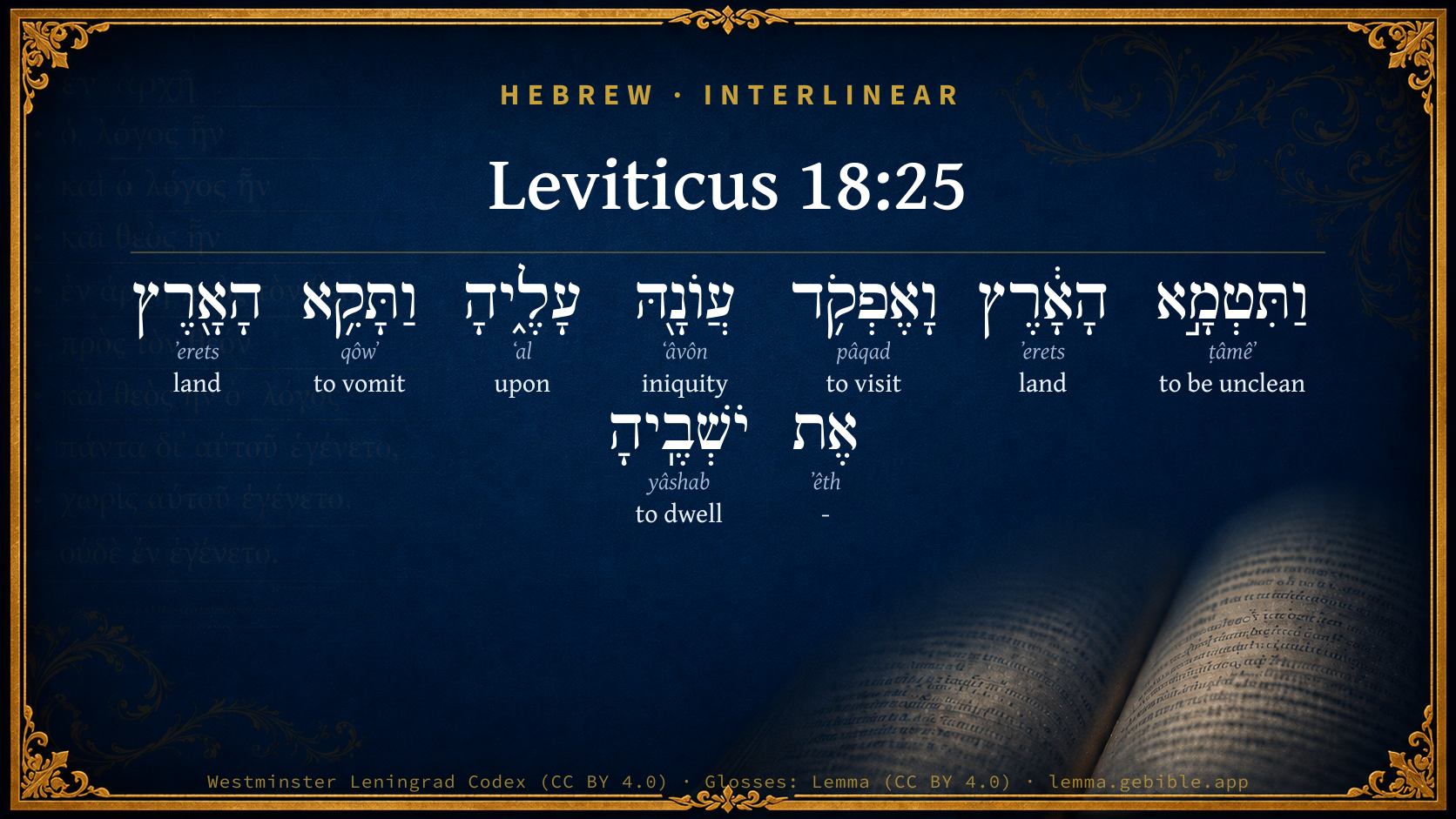
Hebrew (Westminster Leningrad Codex) Leviticus 18:25 appears in the Hebrew Old Testament. The text above is from the Westminster Leningrad Codex. Each word links to its Strong’s number, a concise gloss, and parsing drawn from the Open Scriptures Hebrew Bible morphology. Click any word for its full Brown-Driver-Briggs (BDB) entry.
Download image
Cite this verse

Leviticus 18:25 (World English Bible). Public Domain. Lemma interlinear Bible study tool, https://lemma.gebible.app/v/leviticus/18/25.

Show BibTeX & RIS
BibTeX
RIS
English Translation
The land was defiled: therefore I punished its iniquity, and the land vomitted out her inhabitants.
World English Bible · Public Domain
Highlights Full analysis ↓
Download a study sheet

One document with this verse’s original text, its word-by-word gloss line, the meaning frame, cross-references with their text, attributed commentary, and full source and license credits — printable, and it pastes into notes with its structure intact.

This verse Autodidact and up

Study sheet (.html) Plain text (.txt)

A passage Seminary Student

Up to 50 verses in one chapter. A passage sheet keeps up to 6 commentary sources and 12 cross-references per verse, in the order this page ranks them, and says so on the sheet whenever that leaves anything out. Ask for a single verse and you get the Autodidact verse sheet above.

Everything on this page stays free to read, with no account — the sheet is a download of what is already on screen, not access to it.

Want to remove ads? Support Godless Engineer
Compare translations 3

The same verse in 3 English versions, stacked beneath the original-language interlinear above. Click any original word for its lexicon entry.

Each is an independent rendering of the whole verse — the interlinear is not word-aligned to these translations.

Highlighted words mark where these versions differ — a whole-verse word diff, not a word-by-word alignment.

  • World English Bible Public Domain
    The land was defiled: therefore I punished its iniquity, and the land vomitted out her inhabitants.
  • King James Version Public Domain
    And the land is defiled: therefore I do visit the iniquity thereof upon it, and the land itself vomiteth out her inhabitants.
  • unfoldingWord Literal Text CC BY-SA 4.0
    And the land became unclean, and I visited its iniquity on it. And the land vomited out the ones dwelling it.

unfoldingWord Literal Text — © unfoldingWord, licensed CC BY-SA 4.0. Word-aligned USFM3 via Door43 (git.door43.org/unfoldingWord/en_ult).

Versions to compare (up to 4)

3 of 4 selected

Show all 18 translations

Every available English version of this verse, each an independent rendering of the whole verse.

  • World English Bible Public Domain
    The land was defiled: therefore I punished its iniquity, and the land vomitted out her inhabitants.
  • Berean Standard Bible Public Domain
    Even the land has become defiled, so I am punishing it for its sin, and the land will vomit out its inhabitants.
  • Majority Standard Bible Public Domain
    Even the land has become defiled, so I am punishing it for its sin, and the land will vomit out its inhabitants.
  • King James Version Public Domain
    And the land is defiled: therefore I do visit the iniquity thereof upon it, and the land itself vomiteth out her inhabitants.
  • American Standard Version (1901) Public Domain
    And the land is defiled: therefore I do visit the iniquity thereof upon it, and the land vomiteth out her inhabitants.
  • Revised Version (1885) Public Domain
    And the land is defiled: therefore I do visit the iniquity thereof upon it, and the land vomiteth out her inhabitants.
  • Geneva Bible (1599) Public Domain
    And the land is defiled: therefore I wil visit the wickednesse thereof vpon it, and the lande shall vomit out her inhabitants.
  • Douay-Rheims (1899) Public Domain
    And with which the land is defiled: the abominations of which I will visit, that it may vomit out its inhabitants.
  • Young's Literal Translation Public Domain
    and the land is defiled, and I charge its iniquity upon it, and the land vomiteth out its inhabitants:
  • Literal Standard Version CC BY-SA 4.0
    and the land is defiled, and I charge its iniquity on it, and the land vomits out its inhabitants.
  • Unlocked Literal Bible CC BY-SA 4.0
    The land became defiled, so I punished their sin, and the land vomited out its inhabitants.
  • unfoldingWord Literal Text CC BY-SA 4.0
    And the land became unclean, and I visited its iniquity on it. And the land vomited out the ones dwelling it.
  • Darby Bible Public Domain
    And the land hath become unclean; and I visit the iniquity thereof upon it, and the land vomiteth out its inhabitants.
  • World Messianic Bible Public Domain
    The land was defiled. Therefore I punished its iniquity, and the land vomited out her inhabitants.
  • Webster's Bible Public Domain
    And the land is defiled: therefore I do visit its iniquity upon it, and the land itself vomiteth out her inhabitants.
  • Free Bible Version CC BY-SA 4.0
    Even the land has become polluted, so I am punishing it for the sins committed by the people who live there, and the land will vomit them out.
  • Bible in Basic English Public Domain
    And the land itself has become unclean; so that I have sent on it the reward of its wrongdoing, and the land itself puts out those who are living in it.
  • JPS Tanakh (1917) Public Domain
    And the land was defiled, therefore I did visit the iniquity thereof upon it, and the land vomited out her inhabitants.

Literal Standard Version (2020), Covenant Press — licensed CC BY-SA 4.0. Text via the HelloAO Bible API (eBible.org). Unlocked Literal Bible (unfoldingWord) — licensed CC BY-SA 4.0. Text via the HelloAO Bible API (eBible.org). unfoldingWord Literal Text — © unfoldingWord, licensed CC BY-SA 4.0. Word-aligned USFM3 via Door43 (git.door43.org/unfoldingWord/en_ult). Free Bible Version, Dr. Jonathan Gallagher — licensed CC BY-SA 4.0. Text via the HelloAO Bible API (eBible.org).

Word by word

More ways to search: Search by grammar → Find every occurrence → Compare this word →

Practice this passage: Drill this verse → Learn its vocabulary →

וַתָּקִ֥א
qôwʼ
H6958
“and · to vomit”
Conjunction + Verb, Hiphil, Sequential Imperfect, 3rd Person, Feminine, Singular
Part of Speech
Conjunction + Verb
Stem
Hiphil
Form
Sequential Imperfect
Person
3rd Person
Gender
Feminine
Number
Singular
Full BDB Definition

Origin: a primitive root

TWOT: 2014

to vomit up, spue out, disgorge - (Qal) to vomit - (Hiphil) to vomit up - of land spewing out its inhabitants (figuratively) - vomiting, disgorging
  1. וַתִּטְמָ֣א ṭâmêʼ H2930 “and · to be unclean” Conjunction + Verb, Qal, Sequential Imperfect, 3rd Person, Feminine, Singular
  2. הָאָ֔רֶץ ʼerets H776 “the · land” Particle, Definite Article + Noun, Common, Both, Singular, Absolute
  3. וָאֶפְקֹ֥ד pâqad H6485 “and · to visit” Conjunction + Verb, Qal, Sequential Imperfect, 1st Person, Common, Singular
  4. עֲוֺנָ֖הּ ʻâvôn H5771 “iniquity · her” Noun, Common, Both, Singular, Construct + Suffix, Personal, 3rd Person, Feminine, Singular
  5. עָלֶ֑יהָ ʻal H5921 “upon · her” Preposition + Suffix, Personal, 3rd Person, Feminine, Singular
  6. הָאָ֖רֶץ ʼerets H776 “the · land” Particle, Definite Article + Noun, Common, Both, Singular, Absolute
  7. אֶת ʼêth H853 “-” Particle, Direct Object
  8. יֹשְׁבֶֽיהָ yâshab H3427 “dwelling · her” Verb, Qal, Participle Active, Masculine, Plural, Construct + Suffix, Personal, 3rd Person, Feminine, Singular

About this verse

These counts appear in no published source. They are computed here, from the morphology-tagged text and Lemma’s own curated glosses. What Lemma adds →

9
words
8
distinct lemmas
Pentateuch
section

Notable vocabulary

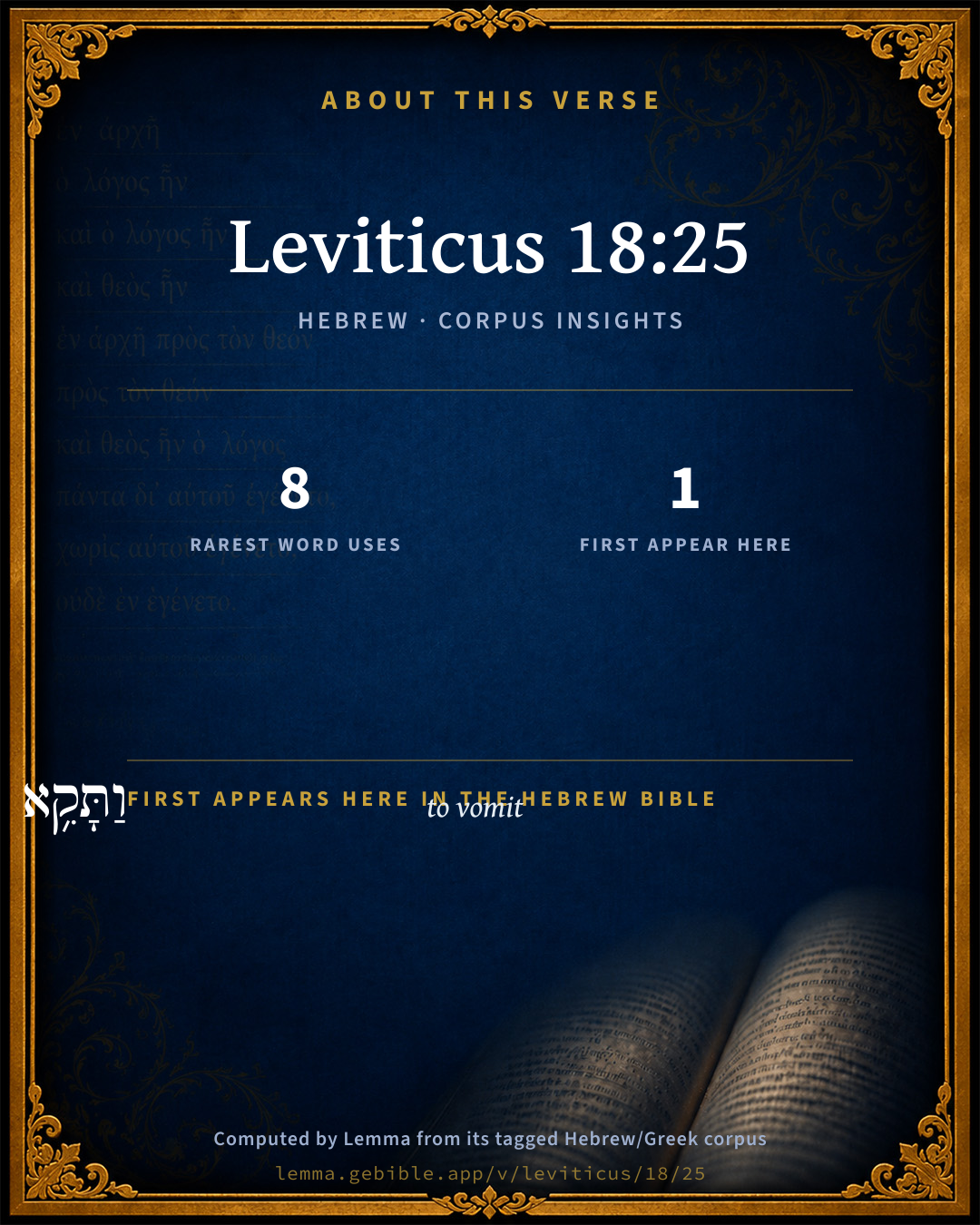
The rarest word here is וַתָּקִ֥א to vomit H6958 — appearing just 8 times in the whole Hebrew Bible.

First appearance in Scripture

This word makes its first canonical appearance in the Hebrew Bible here:

  • וַתָּקִ֥א to vomit H6958

Shared distinctive vocabulary

וַתָּקִ֥א to vomit H6958 occurs in 7 verses of the Hebrew Bible. Also found in:

Grammatical profile

  • 4 verbs
  • 3 nouns
  • 1 preposition
  • 1 particle

Verb forms

  • וַתִּטְמָ֣א Qal · Sequential Imperfect
  • וָאֶפְקֹ֥ד Qal · Sequential Imperfect
  • וַתָּקִ֥א Hiphil · Sequential Imperfect
  • יֹשְׁבֶֽיהָ Qal · Participle Active

Repetition

A word recurs within this verse — often emphatic in Hebrew:

  • הָאָ֔רֶץ land H776 ×2

Hebrew & Septuagint length

In English translation the verse runs 16 words from the Hebrew and 27 from the Septuagint (LXX English) — the Septuagint runs noticeably longer here. See the side-by-side →

A rough comparison of the two English renderings, which tokenize alike — not a word-level alignment.

Word counts can differ between the Hebrew and the Greek without any difference in meaning — e.g. the Hebrew direct-object marker אֵת has no separate Greek word, and Greek often adds the article ὁ.

Cross-references

20

Topical passages linked to Leviticus 18:25 in the Treasury of Scripture Knowledge — connected by theme and wording, ordered by reader-vote popularity; previews shown in the World English Bible.

  • Leviticus 18:28 that the land not vomit you out also, when you defile it, as it vomited out the nation that was before you.
  • Leviticus 20:22–23 "'You shall therefore keep all my statutes, and all my ordinances, and do them; that the land, where I am bringing you to dwell, may not vomit you out.
  • Jeremiah 2:7 I brought you into a plentiful land, to eat the fruit of it and the goodness of it; but when you entered, you defiled my land, and made my heritage an abomination.
  • Psalms 106:38 They shed innocent blood, Even the blood of their sons and of their daughters, Whom they sacrificed to the idols of Canaan. The land was polluted with blood.
  • Jeremiah 9:9 Shall I not visit them for these things? says Yahweh; shall not my soul be avenged on such a nation as this?
  • Numbers 35:33–34 So you shall not pollute the land in which you are: for blood, it pollutes the land; and no expiation can be made for the land for the blood that is shed therein, but by the blood of him who shed it.
  • Deuteronomy 18:12 For whoever does these things is an abomination to Yahweh: and because of these abominations Yahweh your God does drive them out from before you.
  • Isaiah 26:21 For, behold, Yahweh comes forth out of his place to punish the inhabitants of the earth for their iniquity: the earth also shall disclose her blood, and shall no more cover her slain.
  • Jeremiah 5:9 Shall I not visit for these things? says Yahweh; and shall not my soul be avenged on such a nation as this?
  • Jeremiah 5:29 Shall I not visit for these things? says Yahweh; shall not my soul be avenged on such a nation as this?
  • Jeremiah 14:10 Thus says Yahweh to this people, Even so have they loved to wander; they have not refrained their feet: therefore Yahweh does not accept them; now will he remember their iniquity, and visit their sins.
  • Jeremiah 16:18 First I will recompense their iniquity and their sin double, because they have polluted my land with the carcasses of their detestable things, and have filled my inheritance with their abominations.
  • Jeremiah 23:2 Therefore thus says Yahweh, the God of Israel, against the shepherds who feed my people: You have scattered my flock, and driven them away, and have not visited them; behold, I will visit on you the evil of your doings, says Yahweh.
  • Ezekiel 36:17–18 Son of man, when the house of Israel lived in their own land, they defiled it by their way and by their doings: their way before me was as the uncleanness of a woman in her impurity.
  • Hosea 2:13 I will visit on her the days of the Baals, To which she burned incense, When she decked herself with her earrings and her jewels, And went after her lovers, And forgot me," says Yahweh.
  • Psalms 89:32 Then I will punish their sin with the rod, And their iniquity with stripes.
  • Isaiah 24:5 The earth also is polluted under the inhabitants of it; because they have transgressed the laws, violated the statutes, broken the everlasting covenant.
  • Hosea 8:13 As for the sacrifices of my offerings, they sacrifice flesh and eat it; But Yahweh doesn't accept them. Now he will remember their iniquity, And punish their sins. They will return to Egypt.
  • Hosea 9:9 They have deeply corrupted themselves, As in the days of Gibeah. He will remember their iniquity. He will punish them for their sins.
  • Deuteronomy 9:5 Not for your righteousness, or for the uprightness of your heart, do you go in to possess their land; but for the wickedness of these nations Yahweh your God does drive them out from before you, and that he may establish the word which Yahweh swore to your fathers, to Abraham, to Isaac, and to Jacob.

Cross-references courtesy of OpenBible.info (CC BY 4.0).

Hebrew and Greek witnesses Masoretic Hebrew ↔ Greek Septuagint

The same verse in the two great witnesses to the Old Testament, shown verse-for-verse.

Here the Septuagint runs noticeably longer than the Hebrew — LXX2012 (modern English Septuagint) 27 words vs World English Bible 16. A rough length comparison of the two English translations, not a word-level alignment — read both below.

These are two independent witnesses, not word-aligned to each other, and the Septuagint is shown in lemma (dictionary) form.

Hebrew Leviticus 18:25 Masoretic · Westminster Leningrad Codex

וַתִּטְמָ֣א הָאָ֔רֶץ וָאֶפְקֹ֥ד עֲוֺנָ֖הּ עָלֶ֑יהָ וַתָּקִ֥א הָאָ֖רֶץ אֶת יֹשְׁבֶֽיהָ

The land was defiled: therefore I punished its iniquity, and the land vomitted out her inhabitants.

World English Bible · Public Domain

Greek LXX Leviticus 18:25 Septuagint · lemma form

καί μιαίνω ὁ γῆ καί ἀντι ἀποδίδωμι ἀδικία αὐτός διά αὐτός καί προςὀχθίζω ὁ γῆ ὁ ἐν καταἧμαι ἐπί αὐτός

and the land is polluted; and I have recompensed their iniquity to them because of it, and the land is aggrieved with them that dwell upon it.

LXX2012 (modern English Septuagint) · Public Domain

Hebrew: Westminster Leningrad Codex (CC BY 4.0). Greek: Septuagint (public domain); English from LXX2012 (modern English Septuagint) (Public Domain). How the Septuagint differs from the Hebrew →

Targum (Aramaic paraphrase)

2

The Targum is the ancient Jewish Aramaic paraphrase of the Hebrew Scriptures — an interpretive translation, not the Hebrew text itself. Onkelos (literal) and Pseudo-Jonathan (expansive) render the Torah, and Jonathan the Prophets. Coverage is partial: where no permissively-licensed English translation exists for a verse, only the Aramaic is shown. This is verse-level text, not a word-by-word alignment to the Hebrew.

  1. Targum Onkelos Torah (Genesis–Deuteronomy)
    וְאִסְתָּאָבַת אַרְעָא וְאַסְעָרִית חוֹבָהּ עֲלָהּ וְרוֹקֵינַת אַרְעָא יָת יָתְבָהָא

    (no public-domain English translation for this verse)

    Targum Onkelos — Aramaic: “Onkelos Genesis” (public domain); “Onkelos Exodus” (public domain); “Onkelos Leviticus” (public domain); “Onkelos Numbers” (public domain); “Onkelos Deuteronomy” (public domain). English: “Sefaria Community Translation” (CC0 1.0 (public-domain dedication)); “J.W. Etheridge. The Targums of Onkelos and Jonathan Ben Uzziel on the Pentateuch. London: Longmans, Green, 1862” (public domain). Text via Sefaria.

  2. Targum Pseudo-Jonathan Torah (Genesis–Deuteronomy)
    וְאִסְתַּאֲבָא אַרְעָא וְאַסְעָרִית חוֹבָאָה עֲלָהּ וּפְלָטַת אַרְעָא יַת דַיְירָהָא

    And the land hath been defiled, and I have visited the guilt upon it, and the land delivereth itself of its inhabitants.

    Targum Pseudo-Jonathan — Aramaic: “Targum Jonathan on Genesis” (public domain); “Targum Jonathan on Exodus” (public domain); “Targum Jonathan on Leviticus” (public domain); “Targum Jonathan on Numbers” (public domain); “Targum Jonathan on Deuteronomy” (public domain). English: “The Targum of Jonathan ben Uzziel, trans. J. W. Etheridge, London, 1862” (public domain). Text via Sefaria.

Commentary

Notes on Leviticus 18:25 from classic Christian and Jewish commentators (each source and its license shown beneath its notes). The classic Christian expositions comment on the surrounding passage and are grouped to its opening verse, so a note may address several verses; the Jewish commentaries on the Tanakh (Rashi and others) are per-verse, so they appear only where the commentator wrote on this verse.

Lemma curates 59 commentaries, every one of them public domain or Creative Commons licensed, each selected and text-cleaned for this edition rather than reprinted as found. About our sources →

Trapp's Complete Commentary

John Trapp

Lev 18:25 And the land is defiled: therefore I do visit the iniquity thereof upon it, and the land itself vomiteth out her inhabitants.

Ver. 25. And the land is defiled.] From one end thereof to the other; {Ezr 9:11} as the face of the old world was grown so foul, that God was fain to wash it with a flood.

John Trapp, A Commentary or Exposition upon All the Books of the Old and New Testament (1647–1656) — public domain. Text from a community e-Sword module.

Geneva Bible (1599)

Geneva Bible translators

I will punish the land where such incestuous marriages and pollutions are suffered.

He compareth the wicked to evil humors and surfeiting, which corrupt the stomach, and oppress nature, and therefore must be cast out by vomit.

Geneva Bible (1599) marginal notes — public domain. Text via Bolls.life.

Jamieson, Fausset & Brown

Robert Jamieson, A. R. Fausset & David Brown

therefore I do visit the iniquity thereof upon it; and the land itself vomiteth out her inhabitants--The Canaanites, as enormous and incorrigible sinners, were to be exterminated; and this extermination was manifestly a judicial punishment inflicted by a ruler whose laws had been grossly and perseveringly outraged. But before a law can be disobeyed, it must have been previously in existence; and hence a law, prohibiting all the horrid crimes enumerated above--a law obligatory upon the Canaanites as well as other nations--was already known and in force before the Levitical law of incest was promulgated. Some general Iaw, then, prohibiting these crimes must have been published to mankind at a very early period of the world's history; and that law must either have been the moral law, originally written on the human heart, or a law on the institution of marriage revealed to Adam and known to the Canaanites and others by tradition or otherwise.

Jamieson, Fausset & Brown — Commentary Critical and Explanatory on the Whole Bible (1871) — public domain (CC PDM 1.0). Text via the HelloAO Bible API.

Adam Clarke's Commentary

Verse 25. The land itself vomiteth out her inhabitants.] This is a very nervous prosopopoeia or personification; a figure by which any part of inanimate nature may be represented as possessing the passions and reason of man. Here the land is represented as an intelligent being, with a deep and refined sense of moral good and evil: information concerning the abominations of the people is brought to this personified land, with which it is so deeply affected that a nausea is produced, and it vomits out its abominable and accursed inhabitants. It was natural for the inspired penman to make use of such a figure, as the description he was obliged to give of so many and enormous abominations must have affected him nearly in the same way in which he represents the land to be affected.

Adam Clarke's Commentary on the Bible (1810–1826) — public domain. Text from a community e-Sword/MySword module.

Ellicott's Commentary for English Readers

(25) The land itself vomiteth out her inhabitants.—From the creation the earth shared in the punishment of man’s guilt (Gen_3:17), and at the restitution of all things she is to participate in his restoration (Rom_8:19-22). The physical condition of the land, therefore, depends upon the moral conduct of man. When he disobeys God’s commandments she is parched up and does not yield her fruit” (Deu_11:17). “The land is defiled” when he defiles himself. When he walks in the way of the Divine commands she is blessed (Lev_25:19; Lev_26:4); “God is merciful unto his land and to his people” (Deu_32:43). Hence, “the earth mourneth” when her inhabitants sin (Isa_24:4-5), and “the earth is glad” when God avenges the cause of His people (Psa_96:11-13). It is owing to this intimate connection between them that the land, which is here personified, is represented as loathing the wicked conduct of her children and being unable to restrain them. She nauseated them. The same figure is used in Lev_18:28; Lev_20:22; and in Rev_3:16.

A Bible Commentary for English Readers, edited by Charles John Ellicott (1878–1897) — public domain. Text from a community e-Sword module.

John Gill's Exposition

And the land is defiled,.... The inhabitants of it, with the immoralities and idolatries before mentioned:

therefore I do visit the iniquity thereof upon it; or punish the inhabitants that are on it for their sins:

and the land itself vomiteth out her inhabitants; as a stomach loaded with corrupt and bad food it has taken in, nauseates it, and cannot bear and retain it, but casts it up, and never receives it again; so the land of Canaan is represented as loathing its inhabitants, and as having an aversion to them, and indignation against them, and as not being able to bear them, but entirely willing to be rid of them and throw them out of their places in it, never to be admitted more, being as nauseous and as useless as the cast of a man's stomach; see Rev 3:16.

John Gill's Exposition of the Whole Bible (1746–1763) — public domain (CC PDM 1.0). Text via the HelloAO Bible API.

Matthew Poole's English Annotations

I do visit; I am now visiting, or about to visit, i. e. to punish. See Isa 26:21.

The land itself vomiteth out her inhabitants, as no less burdens to the earth than corrupted food is to the stomach. See Jer 9:19; Mic 2:10.

Matthew Poole's English Annotations on the Holy Bible (1683–1685) — public domain. Text from a community e-Sword/MySword module.

Whedon's Commentary on the Bible

Daniel D. Whedon

25. The land itself — Canaan.

Vomiteth — By a striking personification the very ground on which these abominations are enacted, like the stomach of a sick man, figuratively ejects the perpetrators of these filthy deeds.

Daniel D. Whedon (gen. ed.), Commentary on the Old and New Testaments (1874–1909) — public domain. Text from a community e-Sword module.

John Wesley's Explanatory Notes

I visit - I am about to visit, that is, to punish.

John Wesley, Explanatory Notes Upon the Whole Bible (1754–1765) — public domain. Text via the GEBible commentary corpus.

Ramban (Nachmanides)

Rabbi Moshe ben Nachman (Ramban / Nachmanides)

AND THE LAND WAS DEFILED, THEREFORE DID I VISIT THE INIQUITY THEREOF UPON IT, AND THE LAND VOMITED OUT HER INHABITANTS. Scripture was very strict in forbidding these sexual relationships on account of the Land which becomes defiled by them, and which in turn will vomit out the people that do [these abominations]. Now forbidden sexual relationships are matters affecting personal conduct, and do not depend on the Land, [so why should the Land be affected by these personal immoral acts]? But the secret of the matter is in the verse which states, When the Most High gave to the nations their inheritance, when He separated the children of men, He set the borders of the people, etc. For the portion of the Eternal is His people etc. The meaning thereof is as follows: The Glorious Name, 28:58. created everything and He placed the power of the lower creatures in the higher beings, giving over each and every nation in their lands, after their nations some known star or constellation, as is known by means of astrological speculation. It is with reference to this that it is said, which the Eternal thy G-d hath allotted unto all the people, for He allotted to all nations constellations in the heavens, and higher above them are the angels of the Supreme One whom He placed as lords over them, as it is written, But the prince of the kingdom of Persia withstood me, and it is written, lo, the prince of Greece shall come., Verse 20. They are called “kings,” as it is written [there], and I was left over there beside the kings of Persia. Now the Glorious Name, 28:58. is G-d of gods, and Lord of lords over the whole world. But the Land of Israel, which is in the middle of the inhabited earth, is the inheritance of the Eternal designated to His Name. He has placed none of the angels as chief, observer, or ruler over it, since He gave it as a heritage to His people who declare the Unity of His Name, the seed of His beloved ones [i.e., the patriarchs]. It is with reference to this that He said, and ye shall be Mine own treasure from among all peoples; for all the earth is Mine, and it is further written, so shall ye be My people, and I will be your G-d, and you will not be subject to other powers at all. Now He [also] sanctified the people who dwell in His Land with the sanctity of observing the laws against forbidden sexual relationships, and with the abundant commandments, so that they [His people] would be dedicated to His Name. It is for this reason that He said, And ye shall keep all My statutes, and all Mine ordinances, and do them, that the Land, whither I bring you to dwell therein, vomit you not out, and it is further written, But I have said unto you: ‘Ye shall inherit their Land, and I will give it unto you to possess it’ … I am the Eternal your G-d, Who have set you apart from the peoples, Verse 24. meaning to say, that He has set us apart from all the nations over whom He appointed princes and other celestial powers, by giving us the Land [of Israel] so that He, blessed be He, will be our G-d, and we will be dedicated to His Name. Thus the Land which is the inheritance of the Glorious Name, will vomit out all those who defile it and will not tolerate worshippers of idols, nor those who practise immorality. Now this section mentioned the Molech, which is a form of idolatry, together with the forbidden sexual relationships, and with reference to all of them He said, Defile not ye yourselves in any of these things; for in all of these the nations are defiled, and the Land vomited out her inhabitants [thus showing that the Land is unable to contain idol worshippers or those who practise immorality]. And so also did He say in the second section [i.e., in Seder Kedoshim], and I have set you apart from the peoples, that ye should be Mine, which is [the basis for] the strict prohibition against idolatry. Therefore He stated that it is because they are dedicated to His Name that He gave them the Land, as it is said, And I have said unto you: ‘Ye shall inherit their Land, and I will give it unto you to possess it’ … I am the Eternal your G-d, Who have set you apart from the peoples., Verse 24.Now outside the Land of Israel, although it all belongs to the Glorious Name, 28:58. yet its purity is not perfect, because of “the servants” who hold sway there, and the nations go astray after their princes to worship them as well. It is for this reason that Scripture states, the G-d of the whole earth shall He be called, since He is the G-d of gods Who rules over all, and He will in the end punish the host of the high heaven on high, 24:21. removing the celestial powers and demolishing the array of “the servants,” and afterwards He will punish the kings of the earth upon the earth., 24:21. This is the meaning of the verse stating, The matter is by the decree of ‘irin’ (the wakeful ones), and ‘sh’elta’ (the sentence) by the word of the holy ones, meaning, the matter that was decreed on Nebuchadnezzar [that he be driven from men and eat grass as oxen etc.] is the pronouncement of the guarding angels and the sentence of the word of the holy ones, who have ordained on the powers emanating from them that it be so. They [the angels] are called irin [literally: “the wakeful ones”], because from their emanations proceed all the powers that stir all activities, similar to that which it says, and behold ‘ir’ (a wakeful one) and a holy one came down from heaven. He cried aloud, and said thus: ‘Hew down the tree etc., Verse 10-11. — [In the verse] And ‘sh’elta’ (the sentence) is by word of the holy ones, [the word sh’elta] is like sha’alu, meaning first “they ask” what is the will of the Supreme One about it, and afterwards they decree that it be so done. It is with reference to this that Daniel told Nebuchadnezzar, it is the decree of the Most High, Verse 21. for everything is from Him, blessed be He.Thus the Glorious Name, 28:58. blessed be He, is G-d of gods, in the whole world, and G-d of the Land of Israel which is the inheritance of the Eternal. This is the meaning of the expression, and he will go astray after the foreign gods of the Land, for the gods are foreign to the Land of G-d and His inheritance. This is what Scripture means when it states [of the Cutheans who were settled by the king of Assyria in the cities of the kingdom of Israel], they knew not the manner of the G-d of the Land; therefore He hath sent lions among them, and, behold, they slay them, because they know not the manner of the G-d of the Land. Now the Cutheans were not punished in their own land when they worshipped their gods, by G-d sending lions among them, but only when they came into the Land of G-d and conducted themselves as before, did He send lions among them who slew them. And so the Rabbis taught in the Sifra: 11:14. “And the Land vomit not you out also etc. The Land of Israel is unlike other lands; it is unable to contain sinners.” And in the Sifre we find that the Rabbis taught:, 315. “And there was no strange god with Him [when He took Israel out of Egypt, and protected them during their wandering through the wilderness], so that none of the princes of the nations should have power to come and exercise authority over you, something like that which it is said, and when I go forth, lo, the prince of Greece shall come, etc.”, Verse 20. This is the meaning of the saying of the Rabbis: “Whoever lives outside the Land, is as if he had no G-d, for it is said, I am the Eternal your G-d, Who brought you forth out of the land of Egypt, to give you the land of Canaan, to be your G-d, and it is further said, for they have driven me [David] out this day that I should not cleave unto the inheritance of the Eternal, saying: Go, serve other gods.” This can only mean to teach you that he who lives outside the Land is like etc.’” (Kethuboth). Having been forced to leave the Land, David was thus justified in saying that those responsible for it had, as it were, said to him, “Go, etc.” And in the Tosephta of Tractate Abodah Zarah the Rabbis have said: Note 124. “Now it is said, And I [Jacob] will come back to my father’s house in peace, then shall the Eternal be my G-d, and it is further said, to give you the land of Canaan, to be your G-d. When you are in the land of Canaan I am your G-d. When you are not in the land of Canaan, I am not your G-d if it were at all possible to say so [for He is our G-d under all circumstances and in all places]. Similarly it is said, about forty thousand ready armed for war passed on in the presence of the Eternal unto battle, and it is further said, and the Land is subdued before the Eternal, and before His people. But how could it enter one’s mind that Israel subdued the Land before the Eternal [as if to say that they captured it for His sake]? But [this teaches that] as long as they are upon the Land, it is as if it were subdued [before Him, since He is their G-d, as explained above], but when they are not upon it, it is not subdued.”It is on the basis of this matter that the Rabbis have said in the Sifre:, 43. “And ye perish quickly from off the good Land. etc. This clearly indicates even as the Sifre teaches, that after banishment from the Land they are to continue the observance of the commandments. Although I banish you from the Land to outside the Land, make yourselves distinctive by the commandments, so that when you return they shall not be novelties to you. This can be compared to a master who was angry with his wife, and sent her back to her father’s house and told her, ‘Adorn yourself with precious things, so that when you come back they will not be novelties to you.’ And so did the prophet Jeremiah say [to the people in exile in Babylon], Set thee up waymarks. These are the commandments, by which Israel is made distinctive.” Now the verses which state, and ye perish quickly … and ye shall lay up these My words etc. only make obligatory in the exile [the observance of those commandments] affecting personal conduct, such as the [wearing of] phylacteries and [placing of] Mezuzoth [these being specifically mentioned there in the following words of Scripture], and concerning them the Rabbis [in the above text of the Sifre] explained [that we must observe them] so that they shall not be novelties to us when we return to the Land, for the main [fulfillment] of the commandments is [to be kept] when dwelling in the Land of G-d. Therefore the Rabbis have said in the Sifre:, 80. “And ye shall possess it, and dwell therein. And ye shall observe to do all the statutes etc. Dwelling in the Land of Israel is of equal importance to all the commandments of the Torah.” A similar statement is also found in the Tosephta of Tractate Abodah Zarah. This in fact was the thought of the wicked ones who [misusing the intention of the above statement], said to the prophet Ezekiel [whose prophetic activity was in the Babylonian exile]: “Our master Ezekiel, if a servant is sold by his master, does the master still have any claim to him?” ). The answer was that they were never “sold” since the exile was merely a form of temporary punishment for their sins, and therefore, and that which cometh into your mind etc. (see text). For it is said, and that which cometh into your mind shall not be at all; in that ye say: We will be as the nations, as the families of the countries, to serve wood and stone. And this was the command of our patriarch Jacob to his household, and to all that were with him, at the time that they came into the Land, Put away the strange gods that are among you, and purify yourselves. And G-d, by Whom alone actions are weighed, [brought it about] that Rachel died on the way when they started coming into the Land, for on account of her own merit she did not die outside the Land, and for Jacob’s merit, he could not dwell in the Land with two sisters [in their lifetime, since this is forbidden in the Torah, and the laws of the Torah were observed by our ancestors in the Land of Israel even before the Torah was given on Sinai], and she [Rachel] was the one by whose marriage the prohibition against two sisters took effect [since Jacob was already married to Leah]. It would appear that Rachel became pregnant with Benjamin before they came to Shechem, and while in the Land Jacob did not touch her at all, for the reason that we have mentioned. And the prophet states, And first I will recompense their iniquity and their sin double; because they have profaned My Land; they have filled Mine inheritance with the carcasses of their detestable things and their abominations. This matter [i.e., that the Land of Israel is the inheritance of the Eternal and thus cannot tolerate sinners] is found in many places in the Scriptures, and you will see it clearly after I have opened your eyes to it.Now Rabbi Abraham ibn Ezra commented in the section of Vayeilech: “We know that G-d is One, and changes arise because of those who receive [His beneficent deeds], but G-d does not change His deeds, as they are all done in wisdom. And included in the worship of G-d is to guard the ability to receive [His beneficence] according to the place [so that if a particular place is holier than others, one must observe there more strictly the laws of holiness]. Therefore it is written [of the Cutheans, that they did not know] the manner of the G-d of the Land, and of Jacob it is said [when he came into the Land he told his household], put away the strange gods, and the extreme opposite of [the sanctity of] the place [i.e., the Land of Israel] is indulging in forbidden sexual relationships, as they are [sins of the] flesh. The student versed [in the mysteries of the Torah] will understand.” Thus are the words [of Rabbi Abraham ibn Ezra] of blessed memory.Now do not refute me [in what I have written above, that Israel is under the direct guidance of G-d alone, and no celestial power determines their fate], by citing the verse, Michael your prince, for he is only a ministering angel who implores mercy for Israel, but is in no way a prince exercising any royalty or power. So was also the captain of the host who appeared to Joshua at Jericho, showing him that G-d had sent him to fight their battles, similar to [that which happened in the days of] Hezekiah. etc. Besides, this matter [of Michael imploring mercy for Israel] was when we were already outside the Land of Israel.Now I do not have permission to explain on the subject of ha’aretz (“the earth” or “the Land”) more than this., which is mentioned here repeatedly: vatitma ha’aretz … vataki ha’aretz (literally: “and the earth was defiled … and the earth vomited out”). This hints at the first ha’aretz, mentioned in the first verse of Creation, which Ramban has already explained in many places as referring to “the higher earth,” to which the souls finally return after their sojourn on the lower earth. But if you will merit to understand the first “earth” mentioned in the verse of Bereshith (In the beginning G-d created the heaven and the earth), and also the one mentioned in the section of Im Bechukothai, (literally: “and the earth I will remember”). you will know a profound and sublime secret, and you will further understand what our Rabbis have said: 7. “The Sanctuary on high is exactly opposite the Sanctuary below.” I have already alluded to this on the verse, for all the earth is Mine. Now Scripture mentions that the people of the land of Canaan were punished on account of their immoral [sexual] deeds. And our Rabbis have said that they were warned about these matters from the time of creation, when these laws were declared to Adam 9:1, puts it as follows: “The first man was commanded concerning six matters: idolatry, blasphemy, bloodshed, incest, robbery, etc.” and to Noah, for He does not punish unless He admonishes first. Scripture, however, did not state the admonition, but instead said that the Land would vomit them out, for the Land abhors all these abominations. Now the Canaanites were not the only ones who were admonished about these matters [for since these laws were declared to Adam and Noah, they applied to all mankind], and the Scriptural section mentions specifically, After the doings of the land of Egypt, wherein ye dwelt, shall ye not do, which proves that the Egyptians also did all these abominations, and yet the land of Egypt did not vomit them out, nor did the lands of other nations vomit them out! Rather, this whole subject shows the distinction of the Land [of Israel] and its holiness [so that it alone is unable to retain sinners]. Scripture states, and the Land vomited out [using a past tense, although the Canaanites were still living there], for from the time that He was to punish [them] for the sins committed upon her [i.e. the Land], having decreed destruction upon the Canaanites, it is as if the Land had already vomited them out. Or it may be that the expression, and the Land vomited out is a reference to above, similar to what is said, their defense is removed from over them.

Ramban (Nachmanides) on the Tanakh — English translation: “Commentary on the Torah by Ramban (Nachmanides). Translated and annotated by Charles B. Chavel. New York, Shilo Pub. House, 1971-1976” (CC BY 4.0). Text via Sefaria.

Lesson kit

Teaching starters — assembled from the data on this page, not authored interpretation. Every prompt links to the verse data it draws on. Edit before teaching.

Leviticus, in the Pentateuch, opens this verse with 9 words (8 distinct Hebrew lemmas). Its most distinctive word is qôwʼ (“to vomit”). The Greek Septuagint runs longer here. A historical commentator’s framing appears above. Read the whole chapter for the surrounding context.

Discussion questions

  1. What does “to vomit” (qôwʼ) contribute to the verse as a whole?
  2. The word “to vomit” first appears here in Scripture. What is being introduced at this debut?
  3. Leviticus 18:28 shares the word «to vomit» with this verse. How do the two illuminate each other?
  4. “land” occurs 2× in this one verse. What is the effect of the repetition?
  5. Compared with the Hebrew, the Septuagint runs longer here. What questions does that raise?
  6. The translations on this page render this verse differently — a whole-verse word diff, not a word-by-word alignment. What might account for the different wordings?
  7. The verb «וַתִּטְמָ֣א» is Qal Sequential Imperfect. How does its form color the action?
  8. Reading how Trapp's Complete Commentary and Geneva Bible (1599) read this verse, where do the two commentators agree and where do they part?

Things to notice

  • 1 word makes its first canonical appearance in Scripture here.
  • These translations choose different wording for 17 words in this verse.
  • “land” occurs 2× in this single verse.
  • 8 distinct Hebrew lemmas span 9 words in this verse.

Reading settings

Reading text

Shown beneath each verse's original-language words.

Old Testament
Old Testament edition

Read the OT as the Masoretic Hebrew (MT) or the Greek Septuagint (LXX).

English shown for the Greek Septuagint (in the Hebrew ↔ Greek comparison).

Comparing translations? Open the Compare panel on any verse page to stack up to four side by side.