
Ezekiel 14:7

Hebrew (Westminster Leningrad Codex) Ezekiel 14:7 appears in the Hebrew Old Testament. The text above is from the Westminster Leningrad Codex. Each word links to its Strong’s number, a concise gloss, and parsing drawn from the Open Scriptures Hebrew Bible morphology. Click any word for its full Brown-Driver-Briggs (BDB) entry.
Download image
Cite this verse

Ezekiel 14:7 (World English Bible). Public Domain. Lemma interlinear Bible study tool, https://lemma.gebible.app/v/ezekiel/14/7.

Show BibTeX & RIS
BibTeX
RIS
English Translation
For everyone of the house of Israel, or of the strangers who sojourn in Israel, who separates himself from me, and takes his idols into his heart, and puts the stumbling block of his iniquity before his face, and comes to the prophet to inquire for himself of me; I Yahweh will answer him by myself:
World English Bible · Public Domain
Download a study sheet

One document with this verse’s original text, its word-by-word gloss line, the meaning frame, cross-references with their text, attributed commentary, and full source and license credits — printable, and it pastes into notes with its structure intact.

This verse Autodidact and up

Study sheet (.html) Plain text (.txt)

A passage Seminary Student

Up to 50 verses in one chapter. A passage sheet keeps up to 6 commentary sources and 12 cross-references per verse, in the order this page ranks them, and says so on the sheet whenever that leaves anything out. Ask for a single verse and you get the Autodidact verse sheet above.

Everything on this page stays free to read, with no account — the sheet is a download of what is already on screen, not access to it.

Want to remove ads? Support Godless Engineer
Compare translations 3

The same verse in 3 English versions, stacked beneath the original-language interlinear above. Click any original word for its lexicon entry.

Each is an independent rendering of the whole verse — the interlinear is not word-aligned to these translations.

Highlighted words mark where these versions differ — a whole-verse word diff, not a word-by-word alignment.

  • World English Bible Public Domain
    For everyone of the house of Israel, or of the strangers who sojourn in Israel, who separates himself from me, and takes his idols into his heart, and puts the stumbling block of his iniquity before his face, and comes to the prophet to inquire for himself of me; I Yahweh will answer him by myself:
  • King James Version Public Domain
    For every one of the house of Israel, or of the stranger that sojourneth in Israel, which separateth himself from me, and setteth up his idols in his heart, and putteth the stumblingblock of his iniquity before his face, and cometh to a prophet to enquire of him concerning me; I the LORD will answer him by myself:
  • unfoldingWord Literal Text CC BY-SA 4.0
    For every one from the house of Israel and every one of the foreigners staying in Israel who deserts me, who takes his idols into his heart and puts the stumbling block of his iniquity before his own face, and who then comes to a prophet to seek me—I, Yahweh, will answer him myself.

unfoldingWord Literal Text — © unfoldingWord, licensed CC BY-SA 4.0. Word-aligned USFM3 via Door43 (git.door43.org/unfoldingWord/en_ult).

Versions to compare (up to 4)

3 of 4 selected

Show all 18 translations

Every available English version of this verse, each an independent rendering of the whole verse.

  • World English Bible Public Domain
    For everyone of the house of Israel, or of the strangers who sojourn in Israel, who separates himself from me, and takes his idols into his heart, and puts the stumbling block of his iniquity before his face, and comes to the prophet to inquire for himself of me; I Yahweh will answer him by myself:
  • Berean Standard Bible Public Domain
    For when any Israelite or any foreigner dwelling in Israel separates himself from Me, sets up idols in his heart, and puts a wicked stumbling block before his face, and then comes to the prophet to inquire of Me, I the LORD will answer him Myself.
  • Majority Standard Bible Public Domain
    For when any Israelite or any foreigner dwelling in Israel separates himself from Me, sets up idols in his heart, and puts a wicked stumbling block before his face, and then comes to the prophet to inquire of Me, I the LORD will answer him Myself.
  • King James Version Public Domain
    For every one of the house of Israel, or of the stranger that sojourneth in Israel, which separateth himself from me, and setteth up his idols in his heart, and putteth the stumblingblock of his iniquity before his face, and cometh to a prophet to enquire of him concerning me; I the LORD will answer him by myself:
  • American Standard Version (1901) Public Domain
    For every one of the house of Israel, or of the strangers that sojourn in Israel, that separateth himself from me, and taketh his idols into his heart, and putteth the stumblingblock of his iniquity before his face, and cometh to the prophet to inquire for himself of me; I Jehovah will answer him by myself:
  • Revised Version (1885) Public Domain
    For every one of the house of Israel, or of the strangers that sojourn in Israel, which separateth himself from me, and taketh his idols into his heart, and putteth the stumblingblock of his iniquity before his face, and cometh to the prophet to inquire for himself of me; I the LORD will answer him by myself:
  • Geneva Bible (1599) Public Domain
    For euery one of the house of Israel, or of the stranger that soiourneth in Israel, which departeth from mee, and setteth vp his idoles in his heart, and putteth the stumbling blocke of his iniquitie before his face, and commeth to a Prophet, for to inquire of him for me, I the Lord will answere him for my selfe,
  • Douay-Rheims (1899) Public Domain
    For every man of the house of Israel, and every stranger among the proselytes in Israel, if he separate himself from me, and place his idols in his heart, and set the stumblingblock of his iniquity before his face, and come to the prophet to inquire of me by him: I the Lord will answer him by myself.
  • Young's Literal Translation Public Domain
    for every one of the house of Israel, and of the sojourners who doth sojourn in Israel, who is separated from after Me, and doth cause his idols to go up unto his heart, and the stumbling-block of his iniquity setteth over-against his face, and hath come in unto the prophet to inquire of him concerning Me, I, Jehovah, have answered him for Myself;
  • Literal Standard Version CC BY-SA 4.0
    for everyone of the house of Israel, and of the sojourners who sojourn in Israel, who is separated from after Me, and causes his idols to go up to his heart, and sets the stumbling-block of his iniquity before his face, and has come to the prophet to inquire of him concerning Me, I, YHWH, have answered him for Myself;
  • Unlocked Literal Bible CC BY-SA 4.0
    For every one from the house of Israel and every one of the foreigners staying in Israel who deserts me, who takes his idols into his heart and puts the stumbling block of his iniquity before his own face, and who then comes to a prophet to seek me—I, Yahweh, will answer him myself.
  • unfoldingWord Literal Text CC BY-SA 4.0
    For every one from the house of Israel and every one of the foreigners staying in Israel who deserts me, who takes his idols into his heart and puts the stumbling block of his iniquity before his own face, and who then comes to a prophet to seek me—I, Yahweh, will answer him myself.
  • Darby Bible Public Domain
    For every one of the house of Israel, or of the strangers that sojourn in Israel, who separateth himself from me, and setteth up his idols in his heart, and putteth the stumbling-block of his iniquity before his face, and cometh to the prophet to inquire of me by him, I Jehovah will answer him by myself;
  • World Messianic Bible Public Domain
    “‘“For everyone of the house of Israel, or of the strangers who live in Israel, who separates himself from me and takes his idols into his heart, and puts the stumbling block of his iniquity before his face, and comes to the prophet to inquire for himself of me, I the LORD will answer him by myself.
  • Webster's Bible Public Domain
    For every one of the house of Israel, or of the stranger that sojourneth in Israel, who separateth himself from me, and setteth up his idols in his heart, and putteth the stumbling-block of his iniquity before his face, and cometh to a prophet to inquire of him concerning me; I the LORD will answer him by myself:
  • Free Bible Version CC BY-SA 4.0
    When the people of Israel or foreigners living with them worship idols in their minds that will lead them to sin and then come to consult the prophet, I the Lord will answer them myself.
  • Bible in Basic English Public Domain
    When any one of the men of Israel, or of those from other lands who are living in Israel, who has become strange to me, and takes his false gods into his heart, and puts before his face the sin which is the cause of his fall, comes to the prophet to get directions from me; I the Lord will give him an answer by myself:
  • JPS Tanakh (1917) Public Domain
    For every one of the house of Israel, or of the strangers that sojourn in Israel, that separateth himself from Me, and taketh his idols into his heart, and putteth the stumblingblock of his iniquity before his face, and cometh to the prophet, that he inquire for him of Me — I the LORD will answer him by Myself,

Literal Standard Version (2020), Covenant Press — licensed CC BY-SA 4.0. Text via the HelloAO Bible API (eBible.org). Unlocked Literal Bible (unfoldingWord) — licensed CC BY-SA 4.0. Text via the HelloAO Bible API (eBible.org). unfoldingWord Literal Text — © unfoldingWord, licensed CC BY-SA 4.0. Word-aligned USFM3 via Door43 (git.door43.org/unfoldingWord/en_ult). Free Bible Version, Dr. Jonathan Gallagher — licensed CC BY-SA 4.0. Text via the HelloAO Bible API (eBible.org).

Word by word

More ways to search: Search by grammar → Find every occurrence → Compare this word →

Practice this passage: Drill this verse → Learn its vocabulary →

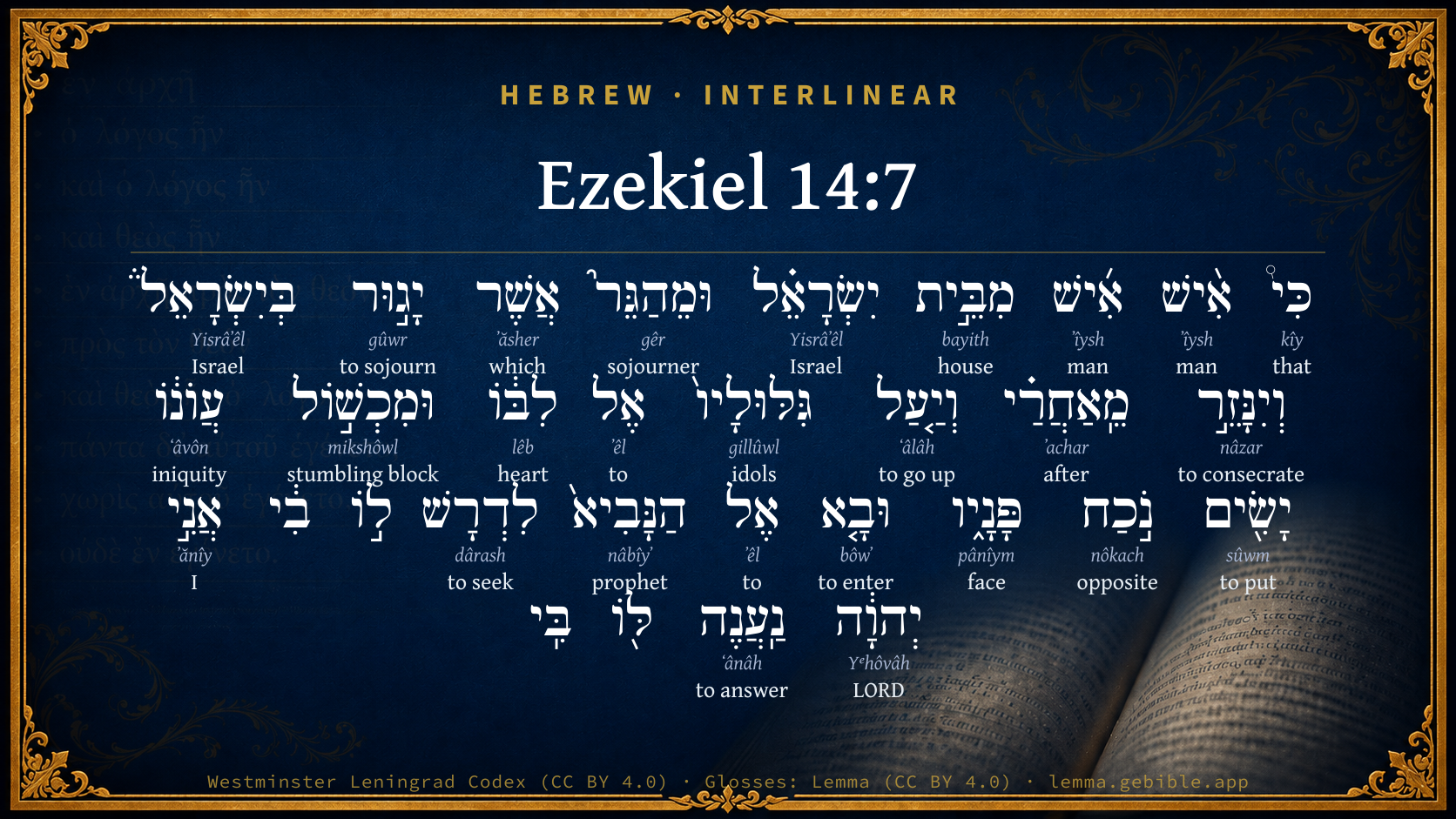
וְיִנָּזֵ֣ר
nâzar
H5144
“and · to consecrate”
Conjunction + Verb, Niphal, Imperfect, 3rd Person, Masculine, Singular
Part of Speech
Conjunction + Verb
Stem
Niphal
Form
Imperfect
Person
3rd Person
Gender
Masculine
Number
Singular
Full BDB Definition

Origin: a primitive root

TWOT: 1340

to dedicate, consecrate, separate - (Niphal) to dedicate oneself, devote oneself - (Hiphil) to keep sacredly separate - (Hiphil) to be a Nazarite, live as a Nazarite
  1. כִּי֩ kîy H3588 “that” Conjunction
  2. אִ֨ישׁ ʼîysh H376 “man” Noun, Common, Masculine, Singular, Absolute
  3. אִ֜ישׁ ʼîysh H376 “man” Noun, Common, Masculine, Singular, Absolute
  4. מִבֵּ֣ית bayith H1004 “from · house of” Preposition + Noun, Common, Masculine, Singular, Construct
  5. יִשְׂרָאֵ֗ל Yisrâʼêl H3478 “Israel” Noun, Proper
  6. וּמֵהַגֵּר֮ gêr H1616 “and · from · the · sojourner” Conjunction + Preposition + Particle, Definite Article + Noun, Common, Masculine, Singular, Absolute
  7. אֲשֶׁר ʼăsher H834 “which” Particle, Relative
  8. יָג֣וּר gûwr H1481 “to sojourn” Verb, Qal, Imperfect, 3rd Person, Masculine, Singular
  9. בְּיִשְׂרָאֵל֒ Yisrâʼêl H3478 “in/at · Israel” Preposition + Noun, Proper
  10. מֵֽאַחֲרַ֗י ʼachar H310 “from · after · me” Preposition + Preposition + Suffix, Personal, 1st Person, Common, Singular
  11. וְיַ֤עַל ʻâlâh H5927 “and · to go up” Conjunction + Verb, Hiphil, Jussive, 3rd Person, Masculine, Singular
  12. גִּלּוּלָיו֙ gillûwl H1544 “idols · his” Noun, Common, Masculine, Plural, Construct + Suffix, Personal, 3rd Person, Masculine, Singular
  13. אֶל ʼêl H413 “to” Preposition
  14. לִבּ֔וֹ lêb H3820 “heart · his” Noun, Common, Masculine, Singular, Construct + Suffix, Personal, 3rd Person, Masculine, Singular
  15. וּמִכְשׁ֣וֹל mikshôwl H4383 “and · stumbling block of” Conjunction + Noun, Common, Masculine, Singular, Construct
  16. עֲוֺנ֔וֹ ʻâvôn H5771 “iniquity · his” Noun, Common, Both, Singular, Construct + Suffix, Personal, 3rd Person, Masculine, Singular
  17. יָשִׂ֖ים sûwm H7760 “to put” Verb, Qal, Imperfect, 3rd Person, Masculine, Singular
  18. נֹ֣כַח nôkach H5227 “opposite” Preposition
  19. פָּנָ֑יו pânîym H6440 “face(s) · his” Noun, Common, Both, Plural, Construct + Suffix, Personal, 3rd Person, Masculine, Singular
  20. וּבָ֤א bôwʼ H935 “and · to enter” Conjunction + Verb, Qal, Sequential Perfect, 3rd Person, Masculine, Singular
  21. אֶל ʼêl H413 “to” Preposition
  22. הַנָּבִיא֙ nâbîyʼ H5030 “the · prophet” Particle, Definite Article + Noun, Common, Masculine, Singular, Absolute
  23. לִדְרָשׁ dârash H1875 “to seek” Preposition + Verb, Qal, Infinitive Construct
  24. אֲנִ֣י ʼănîy H589 “I” Pronoun, Personal, 1st Person, Common, Singular
  25. יְהוָ֔ה Yᵉhôvâh H3068 “LORD” Noun, Proper
  26. נַֽעֲנֶה ʻânâh H6030 “answering” Verb, Niphal, Participle Active, Masculine, Singular, Absolute

About this verse

These counts appear in no published source. They are computed here, from the morphology-tagged text and Lemma’s own curated glosses. What Lemma adds →

31
words
24
distinct lemmas
Prophets
section

Notable vocabulary

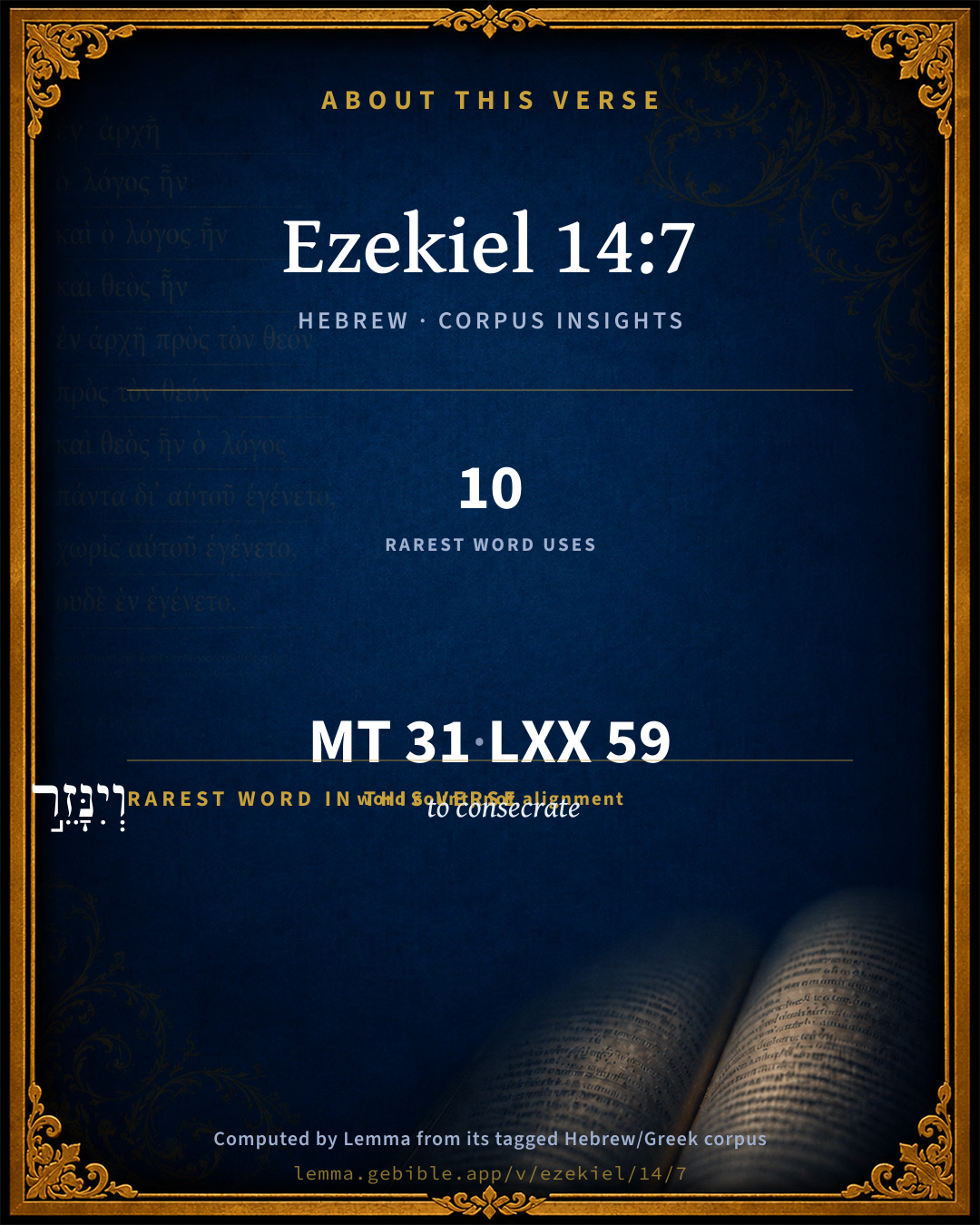
The rarest word here is וְיִנָּזֵ֣ר to consecrate H5144 — appearing just 10 times in the whole Hebrew Bible.

Shared distinctive vocabulary

וְיִנָּזֵ֣ר to consecrate H5144 occurs in 10 verses of the Hebrew Bible. Also found in:

Grammatical profile

  • 7 verbs
  • 13 nouns
  • 1 pronoun
  • 8 prepositions
  • 1 conjunction
  • 1 particle

Verb forms

  • יָג֣וּר Qal · Imperfect
  • וְיִנָּזֵ֣ר Niphal · Imperfect
  • וְיַ֤עַל Hiphil · Jussive
  • יָשִׂ֖ים Qal · Imperfect
  • וּבָ֤א Qal · Sequential Perfect
  • לִדְרָשׁ Qal · Infinitive Construct
  • נַֽעֲנֶה Niphal · Participle Active

Repetition

Words recur within this verse — often emphatic in Hebrew:

  • אִ֨ישׁ man H376 ×2
  • יִשְׂרָאֵ֗ל Israel H3478 ×2
  • אֶל to H413 ×2

Hebrew & Septuagint length

In English translation the verse runs 56 words from the Hebrew and 64 from the Septuagint (LXX English) — closely comparable.

A rough comparison of the two English renderings, which tokenize alike — not a word-level alignment.

Word counts can differ between the Hebrew and the Greek without any difference in meaning — e.g. the Hebrew direct-object marker אֵת has no separate Greek word, and Greek often adds the article ὁ.

In the original languages it is 31 Hebrew tokens and 59 Greek tokens — but the two are counted differently (Hebrew bundles its prefixes and suffixes into one token; the Greek is in lemma form), so that isn’t a like-for-like length.

Cross-references

20

Topical passages linked to Ezekiel 14:7 in the Treasury of Scripture Knowledge — connected by theme and wording, ordered by reader-vote popularity; previews shown in the World English Bible.

  • Exodus 12:48 When a stranger shall live as a foreigner with you, and will keep the Passover to Yahweh, let all his males be circumcised, and then let him come near and keep it; and he shall be as one who is born in the land: but no uncircumcised person shall eat of it.
  • Isaiah 58:1–2 Cry aloud, don't spare, lift up your voice like a trumpet, and declare to my people their disobedience, and to the house of Jacob their sins.
  • Exodus 20:10 but the seventh day is a Sabbath to Yahweh your God. You shall not do any work in it, you, nor your son, nor your daughter, your man-servant, nor your maid-servant, nor your cattle, nor your stranger who is within your gates;
  • Leviticus 16:29 "It shall be a statute to you forever: in the seventh month, on the tenth day of the month, you shall afflict your souls, and shall do no manner of work, the native-born, or the stranger who lives as a foreigner among you:
  • Leviticus 20:2 "Moreover, you shall tell the children of Israel, 'Anyone of the children of Israel, or of the strangers who live as foreigners in Israel, who gives any of his seed to Molech; he shall surely be put to death. The people of the land shall stone him with stones.
  • Leviticus 24:22 You shall have one kind of law, for the foreigner as well as the native-born: for I am Yahweh your God.'"
  • Numbers 15:15 For the assembly, there shall be one statute for you, and for the stranger who lives as a foreigner [with you], a statute forever throughout your generations: as you are, so shall the foreigner be before Yahweh.
  • Numbers 15:29 You shall have one law for him who does anything unwittingly, for him who is home-born among the children of Israel, and for the stranger who lives as a foreigner among them.
  • 2 Kings 8:8–15 The king said to Hazael, Take a present in your hand, and go, meet the man of God, and inquire of Yahweh by him, saying, Shall I recover of this sickness?
  • Jeremiah 21:1–2 The word which came to Jeremiah from Yahweh, when king Zedekiah sent to him Pashhur the son of Malchijah, and Zephaniah the son of Maaseiah, the priest, saying,
  • Jeremiah 37:1–3 Zedekiah the son of Josiah reigned as king, instead of Coniah the son of Jehoiakim, whom Nebuchadrezzar king of Babylon made king in the land of Judah.
  • Jeremiah 37:9–10 Thus says Yahweh, Don't deceive yourselves, saying, The Chaldeans shall surely depart from us; for they shall not depart.
  • Jeremiah 37:17 Then Zedekiah the king sent, and fetched him: and the king asked him secretly in his house, and said, Is there any word from Yahweh? Jeremiah said, There is. He said also, You shall be delivered into the hand of the king of Babylon.
  • Ezekiel 14:3–4 Son of man, these men have taken their idols into their heart, and put the stumbling block of their iniquity before their face: should I be inquired of at all by them?
  • Ezekiel 14:7–8 For everyone of the house of Israel, or of the strangers who sojourn in Israel, who separates himself from me, and takes his idols into his heart, and puts the stumbling block of his iniquity before his face, and comes to the prophet to inquire for himself of me; I Yahweh will answer him by myself:
  • Ezekiel 33:30–32 As for you, son of man, the children of your people talk of you by the walls and in the doors of the houses, and speak one to another, everyone to his brother, saying, Please come and hear what is the word that comes forth from Yahweh.
  • Hosea 4:14 I will not punish your daughters when they play the prostitute, Nor your brides when they commit adultery; Because the men consort with prostitutes, And they sacrifice with the shrine prostitutes; And the people that does not understand will come to ruin.
  • Hosea 9:10 I found Israel like grapes in the wilderness. I saw your fathers as the first ripe in the fig tree at its first season; But they came to Baal Peor, and consecrated themselves to the shameful thing, And became abominable like that which they loved.
  • Jude 1:19 These are they who cause divisions, and are sensual, not having the Spirit.
  • Jeremiah 38:14–23 Then Zedekiah the king sent, and took Jeremiah the prophet to him into the third entry that is in the house of Yahweh: and the king said to Jeremiah, I will ask you a thing; hide nothing from me.

Cross-references courtesy of OpenBible.info (CC BY 4.0).

Hebrew and Greek witnesses Masoretic Hebrew ↔ Greek Septuagint

The same verse in the two great witnesses to the Old Testament, shown verse-for-verse.

These are two independent witnesses, not word-aligned to each other, and the Septuagint is shown in lemma (dictionary) form.

Hebrew Ezekiel 14:7 Masoretic · Westminster Leningrad Codex

כִּי֩ אִ֨ישׁ אִ֜ישׁ מִבֵּ֣ית יִשְׂרָאֵ֗ל וּמֵהַגֵּר֮ אֲשֶׁר יָג֣וּר בְּיִשְׂרָאֵל֒ וְיִנָּזֵ֣ר מֵֽאַחֲרַ֗י וְיַ֤עַל גִּלּוּלָיו֙ אֶל לִבּ֔וֹ וּמִכְשׁ֣וֹל עֲוֺנ֔וֹ יָשִׂ֖ים נֹ֣כַח פָּנָ֑יו וּבָ֤א אֶל הַנָּבִיא֙ לִדְרָשׁ ל֣וֹ בִ֔י אֲנִ֣י יְהוָ֔ה נַֽעֲנֶה לּ֖וֹ בִּֽי

For everyone of the house of Israel, or of the strangers who sojourn in Israel, who separates himself from me, and takes his idols into his heart, and puts the stumbling block of his iniquity before his face, and comes to the prophet to inquire for himself of me; I Yahweh will answer him by myself:

World English Bible · Public Domain

Greek LXX Ezekiel 14:7 Septuagint · lemma form

διότι ἄνθρωπος ἄνθρωπος ἐκ ὁ οἶκος ἰσραήλ καί ἐκ ὁ προσήλυτος ὁ προσηλυτεύω ἐν ὁ ἰσραήλ ὅς ἄν ἀποἀλλοτριόω ἀπό ἐγώ καί τίθημι ὁ ἐνθύμημα αὐτός ἐπί ὁ καρδία αὐτός καί ὁ κόλασις ὁ ἀδικία αὐτός τάσσω πρό πρόσωπον αὐτός καί ἔρχομαι πρός ὁ προφήτης ὁ ἐπιἐρωτάω αὐτός ἐν ἐγώ ἐγώ κύριος ἀποκρίνω αὐτός ἐν ὅς ἐνἔχω ἐν αὐτός

For any man of the house of Israel, or of the strangers that sojourn in Israel, who shall separate himself from me, and conceive his imaginations in his heart, and set before his face the punishment of his iniquity, and come to the prophet to enquire of him concerning me; I the Lord will answer him, according to the things wherein he is entangled.

LXX2012 (modern English Septuagint) · Public Domain

Hebrew: Westminster Leningrad Codex (CC BY 4.0). Greek: Septuagint (public domain); English from LXX2012 (modern English Septuagint) (Public Domain). How the Septuagint differs from the Hebrew →

Targum (Aramaic paraphrase)

1

The Targum is the ancient Jewish Aramaic paraphrase of the Hebrew Scriptures — an interpretive translation, not the Hebrew text itself. Onkelos (literal) and Pseudo-Jonathan (expansive) render the Torah, and Jonathan the Prophets. Coverage is partial: where no permissively-licensed English translation exists for a verse, only the Aramaic is shown. This is verse-level text, not a word-by-word alignment to the Hebrew.

  1. Targum Jonathan Prophets (Joshua–Malachi)
    אֲרֵי גְבַר גְבַר מִבֵית יִשְׂרָאֵל וּמִן גִיוֹרַיָא דְיִתְגַיְרוּן בְּיִשְׂרָאֵל וְיִסְטֵי מִבָּתַר פּוּלְחָנִי וְיַסֵיק פּוּלְחַן טַעֲוָתֵהּ עַל לִבֵּיהּ וְתַקְלַת חוֹבוֹהִי יְשַׁוֵי לָקֳבֵיל אֲפּוֹהִי וְיֵיתֵי לְוַת נְבִיָא לְמִשְׁאַל לֵיהּ בְּמֵימְרִי אֲנָא יְיָ מִשְׁתְּאֵיל לֵיהּ בְּמֵימְרִי:

    (no public-domain English translation for this verse)

    Targum Jonathan — Aramaic: “Mikraot Gedolot” (public domain). English: “Sefaria Community Translation” (CC0 1.0 (public-domain dedication)); “London "Chaldee Paraphrase," 1871” (public domain). Text via Sefaria.

Commentary

Notes on Ezekiel 14:7 from classic Christian and Jewish commentators (each source and its license shown beneath its notes). The classic Christian expositions comment on the surrounding passage and are grouped to its opening verse, so a note may address several verses; the Jewish commentaries on the Tanakh (Rashi and others) are per-verse, so they appear only where the commentator wrote on this verse.

Lemma curates 59 commentaries, every one of them public domain or Creative Commons licensed, each selected and text-cleaned for this edition rather than reprinted as found. About our sources →

Trapp's Complete Commentary

John Trapp

Eze 14:7 For every one of the house of Israel, or of the stranger that sojourneth in Israel, which separateth himself from me, and setteth up his idols in his heart, and putteth the stumblingblock of his iniquity before his face, and cometh to a prophet to enquire of him concerning me; I the LORD will answer him by myself:

Ver. 7. For every one of the house of Israel.] The same over again, and yet no win repetition: Duris enim illis capitibus res non potuit satis inculcari, to these dizzards nothing could be said too much.

Or of the stranger.] But proselyted to the Jewish religion, as Jethro, who was the first of that kind that we read of.

Which separateth himself from me.] As a harlot doth from her husband. See Hos 4:14; Hos 9:10.

I the, Lord will answer him by myself.] Non verbis sed verberibus; not with words, but with blows. Or, According to my most holy truth and justice; or, By myself - scil., do I swear that I will do it. See Eze 14:4.

John Trapp, A Commentary or Exposition upon All the Books of the Old and New Testament (1647–1656) — public domain. Text from a community e-Sword module.

The Biblical Illustrator

Joseph S. Exell

Eze_14:7

Which separateth himself from Me.

Point of contact disturbed by sin

Dr. Cortland Meyers says that one of the electric bells in his home recently refused to ring. He failed to discover the cause. An electrician was sent for. After some time spent over it he found that right up under the bell, so insignificant as to be almost imperceptible, was a place where the point of contact was lost. It is often so with the Church. Battery all right, machinery and wires all right, but the point of contact is defective--disobedience, pride, covetousness have estranged the heart from God. (R. Venting.)

Sins power to separate man from God

A man never gets to the end of the distance that separates between him and the Father, if his face is turned away from God. Every moment the separation is increasing. Two lines start from each other at the acutest angle, are farther apart from each other the farther they are produced, until at last the one may be away up by the side of Gods throne, and the other away down in the deepest depths of hell. (A. Maclaren.)

The Biblical Illustrator, edited by Joseph S. Exell (c. 1880s–1900s) — public domain. Text from a community e-Sword module.

Geneva Bible (1599)

Geneva Bible translators

Or, by myself.

Geneva Bible (1599) marginal notes — public domain. Text via Bolls.life.

Jamieson, Fausset & Brown

Robert Jamieson, A. R. Fausset & David Brown

stranger--the proselyte, tolerated in Israel only on condition of worshipping no God but Jehovah (Lev 17:8-9).

inquire of him concerning me--that is, concerning My will.

by myself--not by word, but by deed, that is, by judgments, marking My hand and direct agency; instead of answering him through the prophet he consults. FAIRBAIRN translates, as it is the same Hebrew as in the previous clause, "concerning Me," it is natural that God should use the same expression in His reply as was used in the consultation of Him. But the sense, I think, is the same. The hypocrite inquires of the prophet concerning God; and God, instead of replying through the prophet, replies for Himself concerning Himself.

Jamieson, Fausset & Brown — Commentary Critical and Explanatory on the Whole Bible (1871) — public domain (CC PDM 1.0). Text via the HelloAO Bible API.

Adam Clarke's Commentary

Verse 7. And cometh to a prophet] Generally supposed to mean a false prophet.

I the Lord will answer him by myself] I shall discover to him, by my own true prophet, what shall be the fruit of his ways. So, while their false prophets were assuring them of peace and prosperity, God's prophets were predicting the calamities that afterwards fell upon them. Yet they believed the false prophets in preference to the true. Ahab, about to engage with the Syrians, who had possession of Ramoth-Gilead, asked Micaiah, the prophet of the Lord, concerning the event; who told him he should lose the battle. He then inquired of Zedekiah, a false prophet, who promised him a glorious victory. Ahab believed the latter, marched against the enemy, was routed, and slain in the battle, 1Kg 22:10, &c.

Adam Clarke's Commentary on the Bible (1810–1826) — public domain. Text from a community e-Sword/MySword module.

John Calvin's Commentaries

Ezekiel again returns to threats, because exhortations was not sufficiently effectual with such hardened ones; for we have seen that they were obdurate in their vices and almost like untamed beasts. For unless God’s judgment had been often set before them, there had been but small fruit of teaching and exhortation. This then is the reason why God here sets before them his vengeance: a man, a man, says he, or a stranger who sojourns among Israel. When he adds strangers, he doubtless speaks of the circumcised who professed to be worshipers of the true God, and so submitted to the law as to refrain from all impieties. For there were two kinds of strangers, those who transacted business there, but were profane men, continuing uncircumcised. But there were others who were not sprung from the sacred race, and were not indigenous to the soil, but yet they had been circumcised, and as far as religion was concerned, had become members of the Church; and God wishes them to be esteemed in the same class and rank as the sons of Abraham. The law shall be the same for the stranger and the home-born, wherever the promise is concerned, (Numbers 15:15,16,) and the same sentiment is repeated in many places. Thus the word foreigners is now to be explained. But this circumstance exaggerates the crime of the chosen people. For if any one settled in the land of Canaan and embraced God’s law, this was an accidental event: but the Israelites were by nature heirs of eternal life, for the adoption was continued through successive ages. Since then they were born sons of God, it was the more disgraceful to depart from his worship. And so when Ezekiel here gravely rebukes the strangers, he shows how much more atrocious the crime was in the case of those who were bound by a more sacred bond to the worship of God. He says, and he was separated from after me. The Prophet yesterday said מעלי, megneli, from near or from towards me: here he more clearly expresses declension, when men reject the teaching of the law, and openly show that they pay no obedience to God. For he is said to follow God or to walk after him, who proposes to himself God as a guide, and is devoted to his precepts, and holds on in the way pointed out by him. Thus by the obedience of faith we follow God or walk after him: so we recede from him when we reject his law, and are openly unwilling to bear his yoke any longer. Hence he shows of what kind the separation of the people or of individuals from God is, namely, when they refuse to follow his law. The Israelites indeed wished God always to remain united to them, but they made the divorce, although they denied it: hence the Prophet cuts away from them beforehand this prop of backsliding, when he says that they separated from God by not following him.

At length he repeats what we saw yesterday, he who caused his idols to ascend unto his heart, he who placed the stumblingblock of his iniquity before his face, that is, was drowned in his own superstitions, so that his idols bore sway in his heart: lastly, he who is so forward in audacity that he did not conceal his wish to oppose the Almighty: if any one, says he, came to a prophet to inquire of him in me, or my name, I will answer him. He confirms what we saw yesterday, that he could no longer bear the hypocrites who deluded themselves so proudly. And certainly when they openly worshipped idols, and were fined with many superstitions, what audacity and pride it was to consult true prophets? It is much the same as if a person should want only insult and rail at a physician, and not only load him with reproaches, but even spit in his face: and should afterwards go and ask his advice, saying, “What do you advise me to do? How must I be cured of this disease?” Such pride could not be borne between man and man. How then will God permit such reproaches to go unpunished? For this reason he says that he would answer, but after his own manner, as if he had said — they seek flatteries, but I will answer in myself: that is, in my natural character. I will not change it according to their pleasure, for they change my character by their fictions, but they are deceived: they profit nothing when they expect me to answer according to their views: I will answer, says he, in myself; that is, they shall feel that the answer proceeds from me, and they shall have no reason for thinking that my servants will be submissive to them, as they are accustomed to abuse the false prophets whom they buy for reward, because they are venal. For when any one is venal he is compelled to flatter like a slave. For there is no freedom but in a good and upright conscience. Hence God here separates his servants from impostors who make a trade of their flatteries. Now it follows —

John Calvin's Commentaries (1540-1563) — public domain. Text from the Calvin Translation Society English edition (1840s-50s) via the Christian Classics Ethereal Library (ccel.org). Calvin's coverage is partial (roughly two-thirds of the Bible); uncommented books and verses are honest gaps, never fabricated. The 19th-century editor's footnotes and remarks are omitted so the notes are faithfully Calvin's own voice.

Ellicott's Commentary for English Readers

(7) Or of the stranger.—Under the Mosaic legislation, “the stranger” living among the Israelites was bound to observe a certain outward deference to the law of the land, just as a foreigner in any country now is bound to respect in certain things the law of the country in which he lives. Israel being a theocracy, its fundamental law against idol-worship could not be violated with impunity by those who sought the protection of its government (Lev_17:10; Lev_20:1-2, &c.). In this case, however, outward idolatry is not alleged, as the accusations of this verse and Eze_14:4 refer only to the secret idolatry of the heart; and the point insisted upon is not so much the idol-worship in itself, as the hypocrisy of attempting to join with this the enquiring of the Lord. God declares that He will answer such hypocrisy, in whomsoever it may be found, not by the prophet through whom the enquiry is made, but by Himself interposing to punish the enquirer, and to make him an example to deter others from a like course.

A Bible Commentary for English Readers, edited by Charles John Ellicott (1878–1897) — public domain. Text from a community e-Sword module.

The Cambridge Bible for Schools and Colleges

gen. ed. J. J. S. Perowne

7. every one … sojourneth in Israel] Comp. Lev_17:8; Lev_17:10; Lev_17:13; Lev_20:2, and remark on Eze_14:1 above. On “setteth up” cf. Eze_14:3.

answer him by myself] Or, through myself, directly in deeds.

The Cambridge Bible for Schools and Colleges (gen. ed. J. J. S. Perowne; Cambridge University Press, 1878–1918) — public domain. Text from a community e-Sword module.

John Gill's Exposition

For everyone of the house of Israel,.... King and subjects, princes and people, high and low, rich and poor, of every rank, sex, and age:

or of the stranger that sojourneth in Israel; the proselytes; whether of righteousness, such as were circumcised, and embraced the Jewish religion; or of the gate, who were only inhabitants with them; one as another were obliged to worship the God of Israel, and abstain from idolatry; there was but one law to the Israelite and to the stranger, respecting this matter:

which separateth himself from me; from the worship of God, and so from communion with him; turns his back on him, and becomes an apostate from him, by joining himself with idols:

and setteth up his idols in his heart, and putteth the stumbling block of his iniquity before his face; these things are repeated, partly to observe the heinousness of the sin they were guilty of; and partly to show the stupidity of this people, which required things to be said over and over, before they could take them in, and be convinced of their evil:

and cometh to a prophet to inquire of him concerning me; this explains what such persons would come to a prophet for, Eze 14:4; and exposes their hypocrisy:

I the Lord will answer him by myself; not by the prophet to whom he comes, but by himself: or, "in my word", as the Targum; yet not by words, but by blows; not in mercy, but in wrath; and in such manner, that it shall appear to come from the Lord, and to be according to truth and justice.

John Gill's Exposition of the Whole Bible (1746–1763) — public domain (CC PDM 1.0). Text via the HelloAO Bible API.

Albert Barnes' Notes on the Bible

The stranger - They who sojourned among Israel, though they were not of Israel, were bound to abstain from idol-worship Lev 17:10; Lev 20:2.

By myself - Or, as in Eze 14:4, “according to” Myself. He who comes to inquire with a heart full of idolatry shall have his answer,

(1) “according to the multitude of his idols” - in delusion,

(2) “according to the holiness of God” - in punishment.

The inquiry was hypocritical and unreal - but God will answer not by the mouth, but by the hand, not by word but by deed, not by speech but by a scourge.

Albert Barnes' Notes on the Bible (1834–1885) — public domain. Text from a community e-Sword/MySword module.

Haydock's Catholic Bible Commentary

By myself, or on my own account. God does not encourage falsehood. (Calmet)

George Leo Haydock (1774–1849), Haydock's Catholic Family Bible and Commentary, 1859 edition — public domain. Excludes Psalms (Douay-Rheims chapter numbering differs from Protestant) and Deuterocanonical books (Catholic canon only).

Matthew Poole's English Annotations

For every Jew of the seed of Abraham, and every proselyte, who withdraws himself from me, and worships idols, keeps them in his heart to the increase of their own sin and my displeasure, yet forsooth comes to the prophet to inquire how his God resenteth what they do, and what God will do with them, what they should do, what they may expect, yet all this while dote on idols, and resolutely hold on in unjust practices, they shall find by the answer it was not the prophet, but the God of the prophet, that answered them, so dreadful, searching, and astonishing shall my answer be.

Matthew Poole's English Annotations on the Holy Bible (1683–1685) — public domain. Text from a community e-Sword/MySword module.

Whedon's Commentary on the Bible

Daniel D. Whedon

7. I the Lord will answer him by myself — In matters of judgment the Lord will not speak by proxy. If they do not repent, they will hear from him in person. The future, of which they are so anxious to learn, will come all too soon, and the answer which they seek will be their total destruction.

Daniel D. Whedon (gen. ed.), Commentary on the Old and New Testaments (1874–1909) — public domain. Text from a community e-Sword module.

The Pulpit Commentary

The stranger that sojourneth among you. It is noticeable that Ezekiel uses here and elsewhere (Eze_47:22, Eze_47:23) the familiar phrase of the books which most influenced his teaching. (Le 16-25 Nu 9 15; passim) It is probable that some such proselytes were found among the exiles of Tel Abib. I the Lord will answer him by myself, etc. This, as has been seen, was probably the right reading in ver. 4. What it means is that, instead of a spoken answer by the mouth of the prophet, there should be an answer in the discipline of life, in the immediate utterance through the conscience, which was the voice of God. The inquirer who came with unconfessed and unrepented hankerings after the worship of other gods deserved and would receive no other answer.

God"s answer.

the Lord will answer him by myself." The people inquire of the false prophets, but God himself will answer them. The question concerning the coming danger will be settled by the event. That will be God"s answer, and it will put an end to all doubt on the one side, and to all deception on the other.

I THE PROMISE OF GOD"S ANSWER. There are questions which grievously perplex us, and to which, as yet, we can get no reply. Those that are frivolous may never be answered; e.g. Clement"s illustration, "Whether the number of the stars be odd or even?" It can be of no use for us to know the answer to such a question. No doubt there are also greater problems which still do not concern us personally, and of these we may never lave the solution. There is no reason to suppose that we shall ever become omniscient. But, on the other hand, there are deep, heart-searching questions, which bear directly upon Our life. We crave an answer to such questions, and God will not leave us forever in the dark concerning them. We may have our patience tried for a season, but at length the light will dawn.

II THE SOURCE OF GOD"S ANSWER. It will come direct from himself. The foolish Jews inquired of false prophets. But not even a true prophet such as Ezekiel would be entrusted with the reply. God himself is to answer them. God does not act by proxy. He has servants and agents. But he is in them, and he can dispense with them altogether whenever he chooses. He has direct dealings with souls. If the answer comes from God, it must be true and sufficient. In momentous questions concerning the soul and its eternal life we cannot be satisfied with a reply from any delegated authority, not from the greatest prophet, apostle, or archangel. We want to hear the voice of God himself.

III THE CHARACTER OF GOD"S ANSWER. In the present case it was to be given by events. The destruction of Jerusalem was to be God"s answer to the disputing Jews. That was as truly a Divine answer as a voice from heaven would have been, for the voice would have been a shaping of air waves, a work of God in nature. This event was God"s working in providence. God speaks to us through his providence. History is a record of God"s answers to man"s questions. Such an answer has many merits.

1. It is perceptible to all. The fall of Jerusalem sent a shock through the Jewish world.

2. It is clear and unmistakable. God had threatened judgment. Would his threat prove true? Who could doubt the meaning of the terrible response?

3. It is irreversible. An event which has once occurred can never be undone. The lessons of history are eternal.

IV THE ADVENT OF GOD"S ANSWER.

1. It may come unsought. The faithless Jews neglected their God, and inquired for oracles from the false prophets. Yet he of whom they sought no word spoke by the awful thunders of judgment.

2. It may come from an unexpected quarter. These unbelieving Jews were not expecting to hear the voice of God. Therefore they were made to hear it in most terrible tones. It is better not to wait for such a startling reply. God has spoken in the great events of Bethlehem and Calvary, and there his voice is one of grace and benediction.

The Pulpit Commentary (1880–1919), ed. H.D.M. Spence-Jones & Joseph S. Exell — public domain. Text from a community e-Sword module.

John Wesley's Explanatory Notes

The stranger - Every proselyte. I the Lord - He shall find by the answer, 'twas not the prophet, but God that answered: so dreadful, searching, and astonishing shall my answer be.

John Wesley, Explanatory Notes Upon the Whole Bible (1754–1765) — public domain. Text via the GEBible commentary corpus.

unfoldingWord translationNotes

Door43 World Missions Community

the house of Israel

The word "house" is a metonym for the family that lives in the house, in this case the Israelites, the descendants of Jacob over many years. See how you translated this in Ezekiel 3:1. AT: "the Israelite people group" (See: Metonymy)

who takes his idols into his heart

Yahweh speaks of the people committing themselves to worshiping idols as if they had taken their idols into their hearts. See how you translated this metaphor in Ezekiel 14:3. AT: "who devotes himself to idols" (See: Metaphor)

puts the stumbling block of his iniquity before his own face

Yahweh speaks of the idols that people worship as if they were blocks over which the people stumble, and of being determined to worship those idols as if they had placed those stumbling blocks in front of their faces. See how you translated this metaphor in Ezekiel 14:3. AT: "who resolutely determines to worship the things that lead to iniquity" (See: Metaphor)

I will set my face against that man

Yahweh speaks of being opposed to a person as if he were to set his face against that person. AT: "I will be against that man" or "I will oppose that man" (See: Symbolic Action)

set my face

Here "face" is a metonym for attention or gaze, and "set my face" refers to staring. AT: "stare" (See: Metonymy)

make him a sign and a proverb

Here the word "sign" refers to something that communicates a special warning to those who see it. The word proverb refers to what people will say about that sign when they see it. AT: "I will make that man to be a warning and a proverb" (See: Metaphor)

I will cut him off from the midst of my people

Yahweh speaks of causing a person no longer to belong to his people as if he were cutting that person off from the people, like a person would cut a branch from a tree. AT: "I will cause him no longer to belong to my people" (See: Metaphor)

know that I am Yahweh

When Yahweh says that people will know that he is Yahweh, he is implying that they will know that he is the one true God who has supreme authority and power. See how you translated this in Ezekiel 6:7. AT: "understand that I am Yahweh, the one true God" or "realize that I, Yahweh, have supreme power and authority" (See: Assumed Knowledge and Implicit Information)

translationWords

alien

Israel

false god

heart

stumbling block

iniquity

face

prophet

Yahweh

sign

proverb

cut off

people of God

unfoldingWord translationNotes — © Distant Shores Media and the Door43 World Missions Community, licensed CC BY-SA 4.0. Source: git.door43.org/Door43/en_tn.

Rashi

Rabbi Shlomo Yitzchaki (Rashi)

I...shall respond to him by Myself Shall be inquired of him about Myself. I shall be inquired of to him.

Rashi on the Tanakh — English translations: “The Judaica Press complete Tanach with Rashi, translated by A. J. Rosenberg” (CC BY 4.0); “Pentateuch with Rashi's commentary by M. Rosenbaum and A.M. Silbermann, 1929-1934” (public domain); “The Metsudah Tanach series, Lakewood, N.J” (CC BY 4.0); and “The Book of Joshua, Metsudah Publications, 1997” (CC BY 4.0). Text via Sefaria.

Lesson kit

Teaching starters — assembled from the data on this page, not authored interpretation. Every prompt links to the verse data it draws on. Edit before teaching.

Ezekiel, in the Prophets, opens this verse with 31 words (24 distinct Hebrew lemmas). Its most distinctive word is nâzar (“to consecrate”). A historical commentator’s framing appears above. Read the whole chapter for the surrounding context.

Discussion questions

  1. What does “to consecrate” (nâzar) contribute to the verse as a whole?
  2. How does Leviticus 15:31, which shares the word «to consecrate», read alongside this verse?
  3. What does the repetition of “man” (2× in this one verse) do in this verse?
  4. These translations render this verse differently. What is at stake in choosing one wording over another?
  5. «יָג֣וּר» is a Qal Imperfect verb. How does that grammatical form shape the action described?
  6. Compare how Trapp's Complete Commentary and The Biblical Illustrator read this verse. Where do they agree or differ?

Things to notice

Reading settings

Reading text

Shown beneath each verse's original-language words.

Old Testament
Old Testament edition

Read the OT as the Masoretic Hebrew (MT) or the Greek Septuagint (LXX).

English shown for the Greek Septuagint (in the Hebrew ↔ Greek comparison).

Comparing translations? Open the Compare panel on any verse page to stack up to four side by side.