Ezekiel 43:10

Hebrew (Westminster Leningrad Codex) Ezekiel 43:10 appears in the Hebrew Old Testament. The text above is from the Westminster Leningrad Codex. Each word links to its Strong’s number, a concise gloss, and parsing drawn from the Open Scriptures Hebrew Bible morphology. Click any word for its full Brown-Driver-Briggs (BDB) entry.
Download image
Cite this verse

Ezekiel 43:10 (World English Bible). Public Domain. Lemma interlinear Bible study tool, https://lemma.gebible.app/v/ezekiel/43/10.

Show BibTeX & RIS
BibTeX
RIS
English Translation
You, son of man, show the house to the house of Israel, that they may be ashamed of their iniquities; and let them measure the pattern.
World English Bible · Public Domain
Download a study sheet

One document with this verse’s original text, its word-by-word gloss line, the meaning frame, cross-references with their text, attributed commentary, and full source and license credits — printable, and it pastes into notes with its structure intact.

This verse Autodidact and up

Study sheet (.html) Plain text (.txt)

A passage Seminary Student

Up to 50 verses in one chapter. A passage sheet keeps up to 6 commentary sources and 12 cross-references per verse, in the order this page ranks them, and says so on the sheet whenever that leaves anything out. Ask for a single verse and you get the Autodidact verse sheet above.

Everything on this page stays free to read, with no account — the sheet is a download of what is already on screen, not access to it.

Want to remove ads? Support Godless Engineer
Compare translations 3

The same verse in 3 English versions, stacked beneath the original-language interlinear above. Click any original word for its lexicon entry.

Each is an independent rendering of the whole verse — the interlinear is not word-aligned to these translations.

Highlighted words mark where these versions differ — a whole-verse word diff, not a word-by-word alignment.

  • World English Bible Public Domain
    You, son of man, show the house to the house of Israel, that they may be ashamed of their iniquities; and let them measure the pattern.
  • King James Version Public Domain
    Thou son of man, shew the house to the house of Israel, that they may be ashamed of their iniquities: and let them measure the pattern.
  • unfoldingWord Literal Text CC BY-SA 4.0
    Son of man, you yourself must tell the house of Israel about this house so they will be ashamed of their iniquities. They should think about this description.

unfoldingWord Literal Text — © unfoldingWord, licensed CC BY-SA 4.0. Word-aligned USFM3 via Door43 (git.door43.org/unfoldingWord/en_ult).

Versions to compare (up to 4)

3 of 4 selected

Show all 17 translations

Every available English version of this verse, each an independent rendering of the whole verse.

  • World English Bible Public Domain
    You, son of man, show the house to the house of Israel, that they may be ashamed of their iniquities; and let them measure the pattern.
  • Berean Standard Bible Public Domain
    As for you, son of man, describe the temple to the people of Israel, so that they may be ashamed of their iniquities. Let them measure the plan,
  • Majority Standard Bible Public Domain
    As for you, son of man, describe the temple to the people of Israel, so that they may be ashamed of their iniquities. Let them measure the plan,
  • King James Version Public Domain
    Thou son of man, shew the house to the house of Israel, that they may be ashamed of their iniquities: and let them measure the pattern.
  • American Standard Version (1901) Public Domain
    Thou, son of man, show the house to the house of Israel, that they may be ashamed of their iniquities; and let them measure the pattern.
  • Revised Version (1885) Public Domain
    Thou, son of man, shew the house to the house of Israel, that they may be ashamed of their iniquities: and let them measure the pattern.
  • Geneva Bible (1599) Public Domain
    Thou sonne of man, shew this House to the house of Israel, that they may be ashamed of their wickednes, and let them measure ye paterne.
  • Young's Literal Translation Public Domain
    Thou, son of man, Shew the house of Israel the house, And they are ashamed of their iniquities, And they have measured the measurement.
  • Literal Standard Version CC BY-SA 4.0
    You, son of man, || Show the house of Israel the house, || And they are ashamed of their iniquities, || And they have measured the measurement.
  • Unlocked Literal Bible CC BY-SA 4.0
    Son of man, you yourself must tell the house of Israel about this house so they will be ashamed of their iniquities. They should think about this description.
  • unfoldingWord Literal Text CC BY-SA 4.0
    Son of man, you yourself must tell the house of Israel about this house so they will be ashamed of their iniquities. They should think about this description.
  • Darby Bible Public Domain
    Thou, son of man, shew the house to the house of Israel, that they may be confounded at their iniquities; and let them measure the pattern.
  • World Messianic Bible Public Domain
    “You, son of man, show the house to the house of Israel, that they may be ashamed of their iniquities; and let them measure the pattern.
  • Webster's Bible Public Domain
    Thou son of man, show the house to the house of Israel, that they may be ashamed of their iniquities: and let them measure the pattern.
  • Free Bible Version CC BY-SA 4.0
    Son of man, tell the people of Israel about the Temple and they'll be ashamed of their sins. Have them carefully consider its plan,
  • Bible in Basic English Public Domain
    You, son of man, give the children of Israel an account of this house, so that they may be shamed because of their evil-doing: and let them see the vision of it and its image.
  • JPS Tanakh (1917) Public Domain
    Thou, son of man, show the house to the house of Israel, that they may be ashamed of their iniquities; and let them measure accurately.

Literal Standard Version (2020), Covenant Press — licensed CC BY-SA 4.0. Text via the HelloAO Bible API (eBible.org). Unlocked Literal Bible (unfoldingWord) — licensed CC BY-SA 4.0. Text via the HelloAO Bible API (eBible.org). unfoldingWord Literal Text — © unfoldingWord, licensed CC BY-SA 4.0. Word-aligned USFM3 via Door43 (git.door43.org/unfoldingWord/en_ult). Free Bible Version, Dr. Jonathan Gallagher — licensed CC BY-SA 4.0. Text via the HelloAO Bible API (eBible.org).

Word by word

More ways to search: Search by grammar → Find every occurrence → Compare this word →

Practice this passage: Drill this verse → Learn its vocabulary →

תָּכְנִֽית
toknîyth
H8508
“pattern”
Noun, Common, Feminine, Singular, Absolute
Part of Speech
Noun
Type
Common
Gender
Feminine
Number
Singular
State
Absolute
Full BDB Definition

Origin: from H8506

TWOT: 2511b

measurement, pattern, proportion
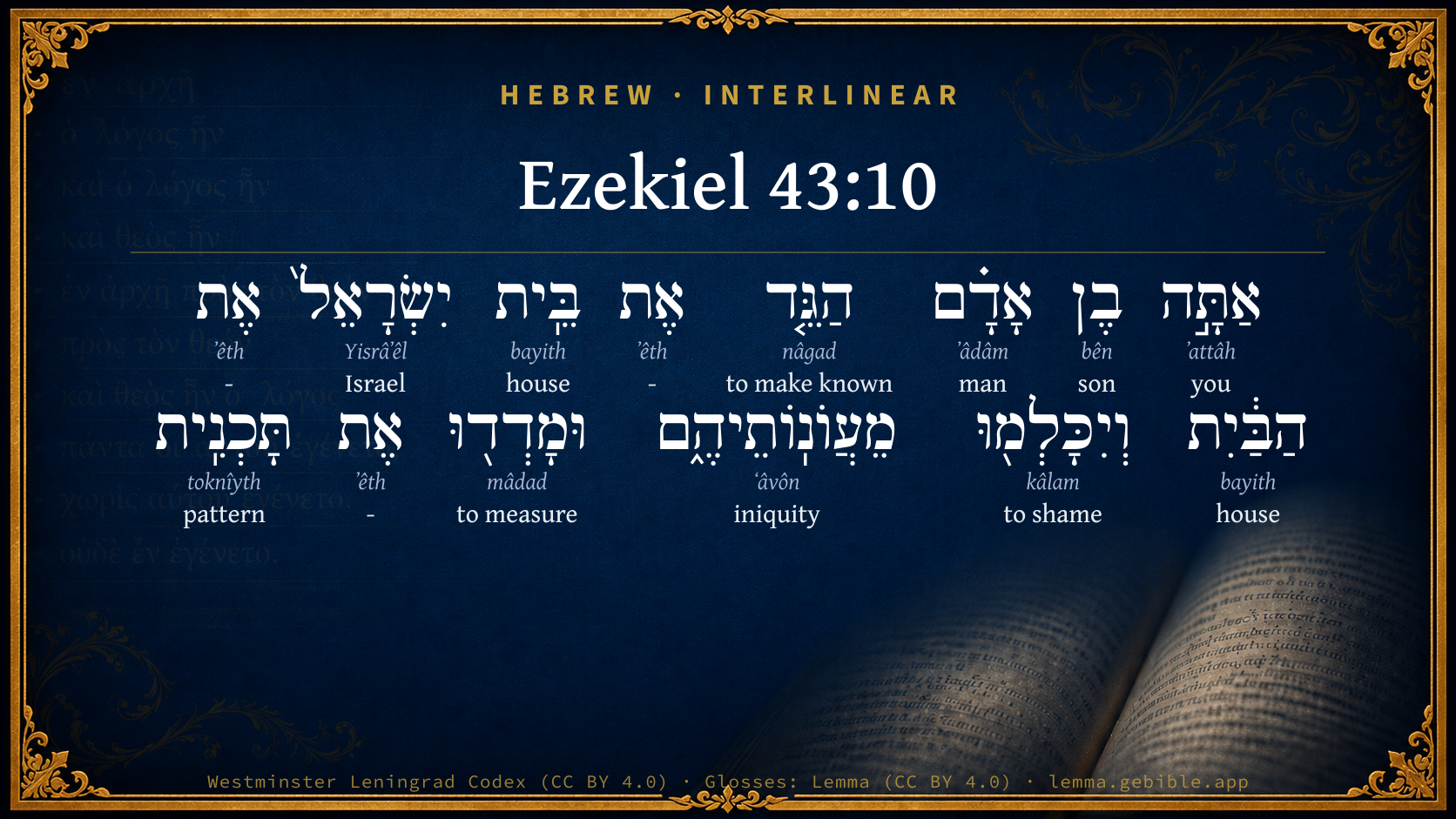
  1. אַתָּ֣ה ʼattâh H859 “you” Pronoun, Personal, 2nd Person, Masculine, Singular
  2. בֶן bên H1121 “son of” Noun, Common, Masculine, Singular, Construct
  3. אָדָ֗ם ʼâdâm H120 “man” Noun, Common, Masculine, Singular, Absolute
  4. הַגֵּ֤ד nâgad H5046 “make known” Verb, Hiphil, Imperative, 2nd Person, Masculine, Singular
  5. אֶת ʼêth H853 “-” Particle, Direct Object
  6. בֵּֽית bayith H1004 “house of” Noun, Common, Masculine, Singular, Construct
  7. יִשְׂרָאֵל֙ Yisrâʼêl H3478 “Israel” Noun, Proper
  8. אֶת ʼêth H853 “-” Particle, Direct Object
  9. הַבַּ֔יִת bayith H1004 “the · house” Particle, Definite Article + Noun, Common, Masculine, Singular, Absolute
  10. וְיִכָּלְמ֖וּ kâlam H3637 “and · to shame” Conjunction + Verb, Niphal, Jussive, 3rd Person, Masculine, Plural
  11. מֵעֲוֺנֽוֹתֵיהֶ֑ם ʻâvôn H5771 “from · iniquities · their” Preposition + Noun, Common, Both, Plural, Construct + Suffix, Personal, 3rd Person, Masculine, Plural
  12. וּמָדְד֖וּ mâdad H4058 “and · to measure” Conjunction + Verb, Qal, Sequential Perfect, 3rd Person, Common, Plural
  13. אֶת ʼêth H853 “-” Particle, Direct Object

About this verse

These counts appear in no published source. They are computed here, from the morphology-tagged text and Lemma’s own curated glosses. What Lemma adds →

14
words
11
distinct lemmas
Prophets
section

Notable vocabulary

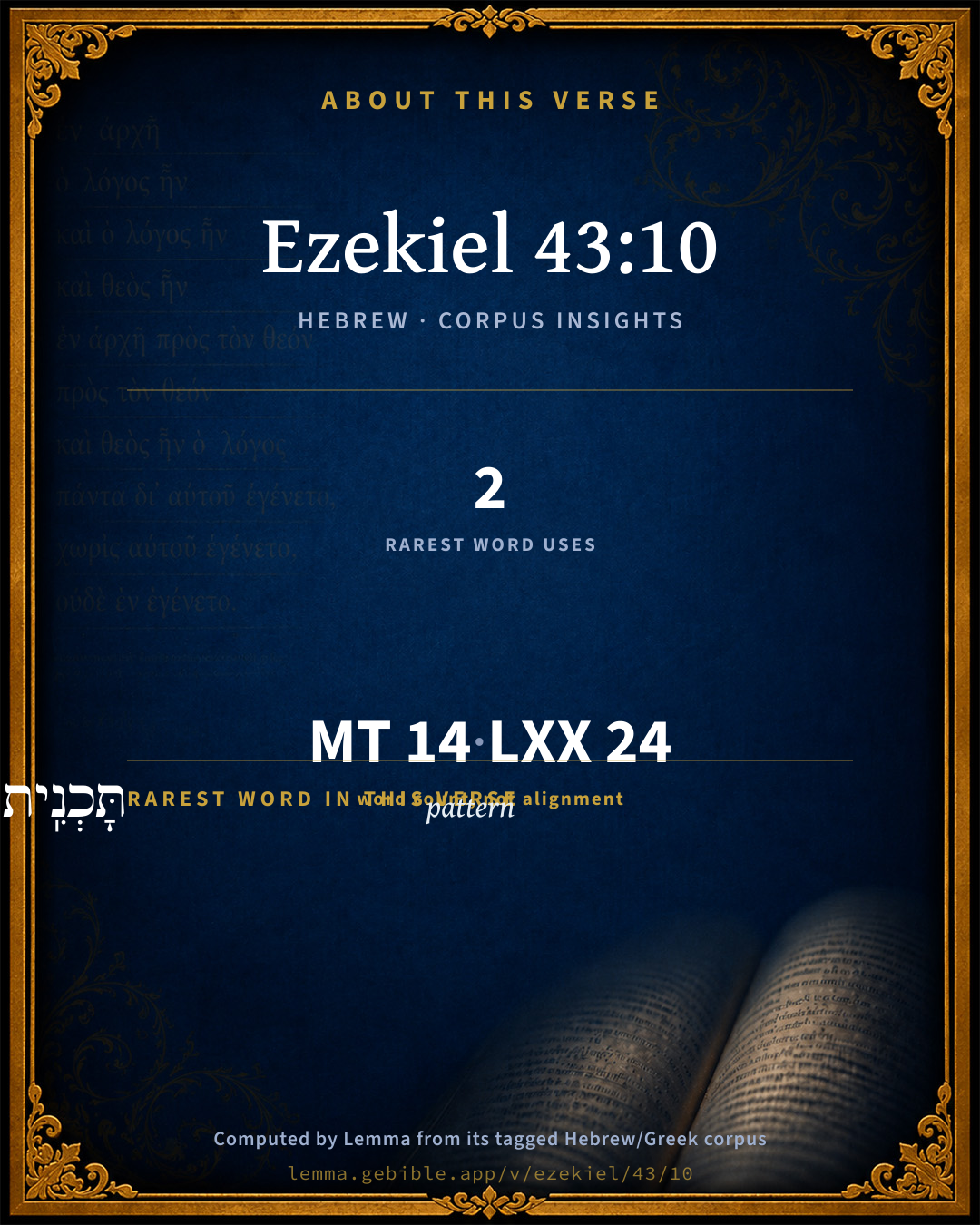
The rarest word here is תָּכְנִֽית pattern H8508 — appearing just 2 times in the whole Hebrew Bible.

Shared distinctive vocabulary

תָּכְנִֽית pattern H8508 occurs in 2 verses of the Hebrew Bible. Also found in:

Grammatical profile

  • 3 verbs
  • 7 nouns
  • 1 pronoun
  • 3 particles

Verb forms

  • הַגֵּ֤ד Hiphil · Imperative
  • וְיִכָּלְמ֖וּ Niphal · Jussive
  • וּמָדְד֖וּ Qal · Sequential Perfect

Repetition

A word recurs within this verse — often emphatic in Hebrew:

  • בֵּֽית house H1004 ×2

Hebrew & Septuagint length

In English translation the verse runs 26 words from the Hebrew and 29 from the Septuagint (LXX English) — closely comparable.

A rough comparison of the two English renderings, which tokenize alike — not a word-level alignment.

Word counts can differ between the Hebrew and the Greek without any difference in meaning — e.g. the Hebrew direct-object marker אֵת has no separate Greek word, and Greek often adds the article ὁ.

In the original languages it is 14 Hebrew tokens and 24 Greek tokens — but the two are counted differently (Hebrew bundles its prefixes and suffixes into one token; the Greek is in lemma form), so that isn’t a like-for-like length.

Cross-references

9

Topical passages linked to Ezekiel 43:10 in the Treasury of Scripture Knowledge — connected by theme and wording, ordered by reader-vote popularity; previews shown in the World English Bible.

  • Ezekiel 40:4 The man said to me, Son of man, see with your eyes, and hear with your ears, and set your heart on all that I shall show you; for, to the intent that I may show them to you, are you brought here: declare all that you see to the house of Israel.
  • Ezekiel 16:61 Then shall you remember your ways, and be ashamed, when you shall receive your sisters, your elder [sisters] and your younger; and I will give them to you for daughters, but not by your covenant.
  • Ezekiel 16:63 that you may remember, and be confounded, and never open your mouth any more, because of your shame, when I have forgiven you all that you have done, says the Lord Yahweh.
  • Ezekiel 43:11 If they be ashamed of all that they have done, make known to them the form of the house, and the fashion of it, and the exits of it, and the entrances of it, and all the forms of it, and all the ordinances of it, and all the forms of it, and all the laws of it; and write it in their sight; that they may keep the whole form of it, and all the ordinances of it, and do them.
  • Exodus 25:40 See that you make them after their pattern, which has been shown to you on the mountain.
  • 1 Chronicles 28:11 Then David gave to Solomon his son the pattern of the porch [of the temple], and of the houses of it, and of the treasuries of it, and of the upper rooms of it, and of the inner chambers of it, and of the place of the mercy seat;
  • 1 Chronicles 28:19 All this, [said David], have I been made to understand in writing from the hand of Yahweh, even all the works of this pattern.
  • Ezekiel 23:31–32 You have walked in the way of your sister; therefore will I give her cup into your hand.
  • Romans 6:21 What fruit then did you have at that time in the things of which you are now ashamed? For the end of those things is death.

Cross-references courtesy of OpenBible.info (CC BY 4.0).

Hebrew and Greek witnesses Masoretic Hebrew ↔ Greek Septuagint

The same verse in the two great witnesses to the Old Testament, shown verse-for-verse.

These are two independent witnesses, not word-aligned to each other, and the Septuagint is shown in lemma (dictionary) form.

Hebrew Ezekiel 43:10 Masoretic · Westminster Leningrad Codex

אַתָּ֣ה בֶן אָדָ֗ם הַגֵּ֤ד אֶת בֵּֽית יִשְׂרָאֵל֙ אֶת הַבַּ֔יִת וְיִכָּלְמ֖וּ מֵעֲוֺנֽוֹתֵיהֶ֑ם וּמָדְד֖וּ אֶת תָּכְנִֽית

You, son of man, show the house to the house of Israel, that they may be ashamed of their iniquities; and let them measure the pattern.

World English Bible · Public Domain

Greek LXX Ezekiel 43:10 Septuagint · lemma form

καί σύ υἱός ἄνθρωπος δεικνύω ὁ οἶκος ἰσραήλ ὁ οἶκος καί κοπάζω ἀπό ὁ ἁμαρτία αὐτός καί ὁ ὅρασις αὐτός καί ὁ διάταξις αὐτός

And you, son of man, show the house to the house of Israel, that they may cease from their sins; and show its aspect and the arrangement of it.

LXX2012 (modern English Septuagint) · Public Domain

On this verse, The Cambridge Bible for Schools and Colleges discusses the Septuagint’s reading. Read the note in Commentary ↓

Hebrew: Westminster Leningrad Codex (CC BY 4.0). Greek: Septuagint (public domain); English from LXX2012 (modern English Septuagint) (Public Domain). How the Septuagint differs from the Hebrew →

Targum (Aramaic paraphrase)

1

The Targum is the ancient Jewish Aramaic paraphrase of the Hebrew Scriptures — an interpretive translation, not the Hebrew text itself. Onkelos (literal) and Pseudo-Jonathan (expansive) render the Torah, and Jonathan the Prophets. Coverage is partial: where no permissively-licensed English translation exists for a verse, only the Aramaic is shown. This is verse-level text, not a word-by-word alignment to the Hebrew.

  1. Targum Jonathan Prophets (Joshua–Malachi)
    אַתְּ בַּר אָדָם חַוִי יַת בֵּית יִשְׂרָאֵל יַת בֵּיתָא וְיִתְכַּנְעוּן מֵחוֹבֵיהוֹן וְיִמְשְׁחוּן יַת טִקוּסֵיהּ:

    (no public-domain English translation for this verse)

    Targum Jonathan — Aramaic: “Mikraot Gedolot” (public domain). English: “Sefaria Community Translation” (CC0 1.0 (public-domain dedication)); “London "Chaldee Paraphrase," 1871” (public domain). Text via Sefaria.

Commentary

Notes on Ezekiel 43:10 from classic Christian and Jewish commentators (each source and its license shown beneath its notes). The classic Christian expositions comment on the surrounding passage and are grouped to its opening verse, so a note may address several verses; the Jewish commentaries on the Tanakh (Rashi and others) are per-verse, so they appear only where the commentator wrote on this verse.

Lemma curates 59 commentaries, every one of them public domain or Creative Commons licensed, each selected and text-cleaned for this edition rather than reprinted as found. About our sources →

Trapp's Complete Commentary

John Trapp

Eze 43:10 Thou son of man, shew the house to the house of Israel, that they may be ashamed of their iniquities: and let them measure the pattern.

Ver. 10. Show the house.] Heb., That house - sc., Which I have showed thee in visions; the idea of that temple which shall shortly be set up, its figure and dimensions.

That they may be ashamed.] Of having dealt so unworthily with a God so gracious.

And let them measure the pattern.] Ut metiantur universe; that, by a holy geometry, they may, in the spirit of their minds, take all the dimensions of it, and be transformed into the likeness of the heavenly pattern. These are those holy and heavenly mathematics, which none can learn but those that are taught of God, and without which none can be Christ’s disciple; like as none might be scholar to Plato that had not the grounds of geometry. {a}

{a} Scholae Platonis haec fuit inscriptio, ουδεις αγεωμετρητος εισιτω.

John Trapp, A Commentary or Exposition upon All the Books of the Old and New Testament (1647–1656) — public domain. Text from a community e-Sword module.

The Biblical Illustrator

Joseph S. Exell

Eze_43:10

Let them measure the pattern.

Measuring the pattern

A correct exhibition of Gods spiritual building was to be the means of awakening the Israelites to a sense of their own deficiencies. The prophet was to hold up the pattern showed in the mount, the temple as it existed in the excellence of its majesty, in order that measuring the present by the past, the national mind might be enlightened as to its true condition.

I. The principle here laid down, in its application to us as members of a national Church. Now there are two errors to which the human mind is prone in estimating moral progress, the one is that of overrating the present, the other that of clothing the past in unreal excellence. It is hard to say which of these forms of error is most injurious to healthy exertion. The man who casts unmixed scorn upon the attainments and practices of his forefathers; who will see nothing admirable in their habits of thought and feeling, is almost certain to end in being intolerant in his judgment, shallow and narrow minded in his counsels. And again, the man who is always taking the lowest view of the present, is almost equally sure to grow apathetic and idle. Now let us apply these thoughts to the state of our own part of Christs Catholic Church. Who has not himself come in contact with both the illusions of which we have spoken--the illusion of overrating and underrating the present? What is that will worship with which we have to struggle in reference to points of faith, but the offspring of the feeling that this generation is so wise and enlightened that it may safely cut asunder all the moorings which bind it to the past, and launch forth upon the dim waters of the future, with its own shrewdness and intellect as its sole pilot and guide? And contrariwise; we have in ourselves and in those who are actually sensible of the evils of the present, to guard against the imagination that the Church is now in a state of hopeless decay; that it is vain to bestir ourselves for a falling fabric; that the most which we can do is to assist in saving individual souls; but that the national disease is beyond the reach of the national Christianity. This latter error is, after all, perhaps the most injurious, because it is that to which the purest and most faithful souls are liable; and is, therefore, if allowed to have place, the greatest obstacle to improvement. And now what is the remedy for this two-fold temptation which we have described? Indeed the remedy is set forth in the text. That which has grown so important a duty for all, clergy and laity, is the duty of calmly, soberly, dispassionately reviewing our position, our advantages and disadvantages, our weaknesses and our strength. What the Church of Christ is, in its original ideal, as designed in the counsels of the Eternal mind; what the Church has been, at every stage of its long sojourn upon earth--the Church of revelation and the Church of history; how much it has ever been corrupted with worldly influences; how far it must concede to, at what point it must resist, the spirit of the age; to what degree it has been really successful in coercing human lusts; these are points most essential for us to form a definite conception of, if we would go forth to our labour with a good heart. Every century has its set task, every lifetime its own office in the majestic march of Gods designs. What if it be the very work of our generation, to certify them that come after; by our failures and discomfitures to acquire and deliver down a clearer knowledge of our standing before God than we received, and so to prepare the way for a revival of faith and obedience which others shall perfect. What if to us, especially in the very difficulties which beset us, in the very perplexities which we encounter, it be given to sweep clear the scene for nobler achievements, so that we may hear our peculiar vocation sketched out in the solemn charge: Thou son of man, shew the house, etc.

II. A striking declaration of our proper duties as priests of God. The charge is a charge to exhibit to the people the sacred edifice, to place before them the Church; and it is implied that the sight of the mystic structure will itself go far to make them ashamed of their own backslidings. Now we learn hence that it is one of our functions, each in his own parish, to exhibit the Church in all the integrity of its provisions for overcoming the world, with the belief that this showing it to the people will have a vast moral effect upon them. The carrying out of the Church system does not depend for its results upon the number of those who use the privileges offered; the simple exhibition of the Church in a parish is calculated to produce immense moral effect. The Church is a Divine instrument for regenerating the people. And the Church is known to the masses, not by definitions of theology, but by its perpetual worship, services, and sacraments, its fast days and festivals, its Lent and its Easter. And there is, we contend, in this Divine instrument fairly exhibited, a power over mens hearts which we are apt to forget. It was the loveliness of the Church catholic which bowed the hearts of the nations in her infancy. Amidst jarring idolatries, the Christian Church stood forth the fairest among ten thousand. It was not more by active preaching, than by the passive exhibition, so to speak, of Christianity as practised by themselves, that the old saints attracted to the Cross the barbarian tribes of ancient Europe. The melody of perpetual prayer and praise rung out through the aisles of primeval forests by night and day, in sweet accord with ascetic lives and heroic exertions, and the institution of practices which preternaturally harmonised with human need; and rough spirits yielded to the constraining Deity. And now, we are persuaded that there is no form of religion which so commends itself to mens hearts, which so enlists the affections, as the Church when thoroughly exhibited. Only in the Church will you find all things at once; the unwearied Litany, the high-wrought exhortation, the didactic catechising, the frequent commemoration of Christs death. Shew the house to the house of Israel. O! it is a noble burden here laid upon us. To be, each in his own parish, like Solomon the king. In quietness and stillness, in peace and gentleness, no sound of axe or hammer being heard, to make to rise up before our people, in all its unearthly beauty, the house of the Lord; to lead hungry souls through the mystic arcade of the seven pillars, and show them the feast of good things which wisdom has prepared; to point out the victories of faith which overcomes the world; the might of prayer which vanquishes God; the omnipotence of love which endureth all things; to cause that upon every cottage home shall rest the shadow of a holier building;--this is our office as doorkeepers of the house of the Lord. Suffer yet one word more. We may not forget that, in measuring the pattern of the Church, men will measure ourselves; how far, as individuals, we fall short of the mark. The people cannot see the house without seeing us who have the charge of it. Let us try, then, to inflame our own souls with the love of the house which we have to show. Whatever we have done, surely we may do more. (Bishop Woodford.)

The Biblical Illustrator, edited by Joseph S. Exell (c. 1880s–1900s) — public domain. Text from a community e-Sword module.

Joseph Benson's Commentary

Eze 43:10. Show the house to the house of Israel, that they may be ashamed, &c. — The prophet is here directed to show the measure and pattern of the house to the Jews, with a view to render them ashamed of their idolatries and other iniquities, which had provoked God to deprive them of the honour and happiness of his residence among them, and the benefit of his ordinances. It seems also, that this same draught and description of the house and its courts, &c., was to be laid before them, as a model for them to imitate, as far as they should be able, when they should return to their own country, and rebuild their temple. See Preliminary Observations to chap. 40.-48. But, as has been more than once intimated, “the words may have a further view, and the model of God’s temple here set forth might be intended as a pattern of heavenly things, as Moses’s was, Exo 25:40, and a type of that pure church, built upon the foundation of the apostles and prophets, which we may hope God will in due time everywhere restore. And, in the mean season, it is the duty of all Christians, according to their ability, to inform themselves and others what is the pattern, form, and fashion of this true church of God, in order to reform all those deviations which have been made from it. Let them measure the pattern — In order to build their new temple by it, when they shall return from captivity, as far as their abilities will reach. For the same purpose the prophet is commanded in the following verse to write it in their sight.

Joseph Benson's Commentary on the Old and New Testaments (1811–1818) — public domain. Text from a community e-Sword module.

Tyndale Open Study Notes

Tyndale Open Resources

43:10-11 At this point, the prophet was given the rationale for the whole Temple vision. He was not the first person to receive the blueprint for a sanctuary from God (see Exod 25–40). This vision was not intended to spark a building project at some time in the future when God would return his people to their land, but to convey a message to the people of Ezekiel’s generation. As they would study its plan, Ezekiel’s hearers should be convicted of their sins and be ashamed of what they have done. The conviction of sin should be induced as they studied its entrances and exits, its decrees and laws, and the overall plan.

Tyndale Open Study Notes — © Tyndale Open Resources, licensed CC BY-SA 4.0. Text via the HelloAO Bible API.

Jamieson, Fausset & Brown

Robert Jamieson, A. R. Fausset & David Brown

show the house . . . that they may be ashamed of their iniquities--When the spirituality of the Christian scheme is shown to men by the Holy Ghost, it makes them "ashamed of their iniquities."

Jamieson, Fausset & Brown — Commentary Critical and Explanatory on the Whole Bible (1871) — public domain (CC PDM 1.0). Text via the HelloAO Bible API.

Adam Clarke's Commentary

Verse 10. Show the house to the house of Israel] Show them this holy house where the holy God dwells, that they may be ashamed of their iniquities. Their name, their profession, their temple, their religious services, all bound them to a holy life; all within them, all without them, should have been holiness unto the Lord. But alas! they have been bound by no ties, and they have sinned against all their obligations; nevertheless, let them measure the pattern, let them see the rule by which they should have walked, and let them measure themselves by this standard, and walk accordingly.

Adam Clarke's Commentary on the Bible (1810–1826) — public domain. Text from a community e-Sword/MySword module.

Ellicott's Commentary for English Readers

(10) Shew the house.—This is still in vision; “make known to the people the new Temple and its appointments,” that, seeing God’s gracious purposes, they may repent of their evil doings.

Let them measure the pattern.—That is, let them carefully consider and follow out the provisions God had made for their worship. (Comp. Heb_8:5.) Exactness in the observance of all positive enactments is a necessary result of a desire to serve God.

A Bible Commentary for English Readers, edited by Charles John Ellicott (1878–1897) — public domain. Text from a community e-Sword module.

The Cambridge Bible for Schools and Colleges

gen. ed. J. J. S. Perowne

10. ashamed of their iniquities] i.e. in disregarding the ordinances of the Lord’s house, in defiling it (Eze_43:7-8), and in committing its services to the hands of uncircumcised aliens (Eze_44:7), and the like.

measure the pattern] LXX. has, “and its appearance and its pattern.” Cf. Eze_42:11, where “measures” and “appearance” were also interchanged.

10–12. The prophet is commanded to shew to Israel the fashion and ordinances of the house that they may observe them.

The Cambridge Bible for Schools and Colleges (gen. ed. J. J. S. Perowne; Cambridge University Press, 1878–1918) — public domain. Text from a community e-Sword module.

John Gill's Exposition

Thou son of man, show the house,.... That is, the house the prophet had seen measured, its gates, courts, and all belonging to it; which he was at first bid to observe, that he might show it to others; the house that the glory of the Lord was now come into, and had filled; and which is no other than the Gospel church in its perfection and glory in the latter day. This the prophet, who is addressed under his usual character in this book, is bid to show "to the house of Israel"; either to the captives in Babylon, among whom he was, and to whom he often speaks in this book, being sent with a message to them: and this he is ordered to show them, both to comfort them in their present state, with a view of what would be hereafter; and to humble them, and bring them to a sense of their sins, and shame for them, which had brought them into the condition they were, and so greatly short of this happy one: or else to the Jews in the first times of the Gospel; the prophet representing the apostles of Christ, who delivered out the form of a Gospel church state to the believing ones, far superior to that they had been in, and into which they entered: or rather he represented the ministers of the word in the latter day, showing to the Christians of those times the order, worship, and discipline of a pure Gospel church, who have been greatly deficient in their observance of them; and which is the work and business of Gospel ministers to do, as well as to preach the doctrine of the Gospel:

that they may be ashamed of their iniquities; how far short they have come of the model of true Gospel churches, and of observing the order, and maintaining the ordinances, and keeping up the discipline of such churches; and when persons are brought to blush and be ashamed, it looks as if they had a true sight and sense of their mistakes, and of repentance for them:

and let them measure the pattern; that is, of the house, and what belongs to it; by which they will see their defects, and correct them; see Rev 11:1.

John Gill's Exposition of the Whole Bible (1746–1763) — public domain (CC PDM 1.0). Text via the HelloAO Bible API.

Albert Barnes' Notes on the Bible

Deviation from the exact rules of the Mosaic ordinances was connected with the transgression of the people. So the restoration, according to the pattern of the Law, was symbolic of their return to obedience.

Albert Barnes' Notes on the Bible (1834–1885) — public domain. Text from a community e-Sword/MySword module.

Haydock's Catholic Bible Commentary

Measure, that they may be convinced of their ingratitude, (Menochius) which has deprived them of so noble a structure, and put them under the necessity of beginning so great a work again. It required all the exertions of the prophets to make them go forward with it, Aggeus i. (Haydock)

George Leo Haydock (1774–1849), Haydock's Catholic Family Bible and Commentary, 1859 edition — public domain. Excludes Psalms (Douay-Rheims chapter numbering differs from Protestant) and Deuterocanonical books (Catholic canon only).

Matthew Poole's English Annotations

Son of man; Ezekiel, who is called thus above eighty times in this book.

Show: he could not lay a model before their eye, but he could, and this is required, describe it to them in all the parts.

The house; temple, which he had seen, and exactly measured.

To the house of Israel; to the rulers, prophets, and priests especially, not excluding others.

That they may be ashamed of their iniquities; when they shall blush to see what glory their iniquities had ruined, how great losers they were by their sins: or else thus interpret the meaning of these things, And let the Jews know what a church God will erect among the Gentiles, that so the Jews may be ashamed of their iniquities, which provoked God to east them off, and to destroy their church and state.

Let them measure the pattern; as thou declarest let them write down, delineate all, and then compute the whole, that they may fully comprehend it.

Matthew Poole's English Annotations on the Holy Bible (1683–1685) — public domain. Text from a community e-Sword/MySword module.

Whedon's Commentary on the Bible

Daniel D. Whedon

10-12. These verses prove that there was a deep symbolic meaning, which would be understood by those for whom Ezekiel wrote, in all these minute particulars. This picture of a perfectly holy worship was intended to bring the exiles to repentance. (Compare the method used in the book of Hebrews.) Principal Douglas (Expository Times, May-July, 1898; compare also Godet, Studies in the Old Testament) points out that much of the deviation from the Levitical law by Ezekiel is due to the principle enunciated in Eze_43:12, that the whole limit should be most holy. For this reason the veil or door which in the tabernacle and in Solomon’s temple had separated the holy from the most holy place was removed, making the entire sanctuary most holy (compare Heb_9:7-11; Heb_10:19-23), and removing every barrier between God and his believing worshipers. So the altar, the chief thing in all the worship, becomes conspicuous for its height (Eze_43:13-17), and the laver and the brazen sea are omitted, for these are no longer needed when the holy purifying stream springs from the temple; so the censer and the incense become unimportant in the presence of the living cherubim, and the golden candlesticks and all the ancient golden ornaments cease to be necessary since the presence of Jehovah fills the house with splendor. The greater holiness of the temple and the presence of the divine glory explain, therefore, the main differences in ritual between Ezekiel and Leviticus; even the king becoming merely a “prince” before this supreme majesty.

Daniel D. Whedon (gen. ed.), Commentary on the Old and New Testaments (1874–1909) — public domain. Text from a community e-Sword module.

The Pulpit Commentary

Show (or, make known, i.e. publish the revelation concerning) the house to the house of Israel For this purpose the vision had been imparted to the prophet. That they may be ashamed of their iniquities. This told the reason why the vision of the house should be made known to Israel. And let them measure the pattern; sum, number, or well-proportioned building. This explained how, by beholding the house, Israel would be led to repent, and be ashamed of her iniquities. There is no ground for thinking the ultimate object Jehovah had in view, in recommending the house of Israel to note the proportions of the visionary edifice, was, as Wellhausen, Smend, and others allege, that they might reproduce these in the post-exilic building; if they were to measure, i.e. scan and meditate upon the fair dimensions of the "house," it was that they might understand its religious or moral and spiritual significance, both as a whole and in detail.

The goodness that leads to repentance.

The people of Israel are to see the new temple in order that they may be ashamed of their iniquities. The goodness of God in restoring the temple will induce them to look with new horror on their old sins. Thus God"s goodness in life generally, and in the gospel of Christ, should lead men to see the evil of their ways and to repent of it.

I GOD"S GOODNESS PRECEDES MAN"S REPENTANCE. The full enjoyment of that goodness is not possible for those who are still living in sin. The prodigal son cannot enjoy the fatted calf before he comes to himself, or arises and returns to his father. But long before any movement is made on the side of the sinner to return, God is preparing the way for him. The shepherd seeks the wandering sheep. The woman sweeps for the lost piece of silver. Even in Eden, on the discovery of the Fall, God promised a gospel and victory. (Gen_3:15) The pity of God for Israel in Egypt was made known to Moses in the bush before the people made any effort to effect their own escape. Christ came into a world that was even unwilling to receive him, yet he came for the world"s salvation. The gospel is now only too often offered to unwilling hearers. God now waits to be gracious.

II THE REVELATION OF GOD"S GOODNESS SHOWS THE NECESSITY OF REPENTANCE.

1. It should reveal our sin.

(1) By contrast. God is good to us, while we behave ill to him. Surely we should see how sad it is to live in rebellion against a gracious God. Thus the dreadful guilt of ingratitude is added to other sins.

(2) By the manner of the revelation. It is a revelation in holiness. God"s glory was seen in the temple. It is a revelation in atonement for sin: the temple was for sacrifices; Christ died on the cross as a sacrifice for the world"s sin. Thus the very proclamation of the gospel involves a declaration of man"s sinfulness.

2. It should incline us to return. If God had turned against us we might feel no inclination to go back to him. But his graciousness should serve as a great attraction. Surely it is bad indeed to hold out against such forgiving mercy as that of our Father and of our Savior Jesus Christ.

III GOD"S GOODNESS ASSISTS US IN REPENTANCE.

1. It opens the door for our return. There is no longer any excuse for delay. Despair need not paralyze our returning footsteps. The preparation is an invitation; the invitation should be an inspiration.

2. It moves our hearts to return. We may only be hardened by denunciations of wrath and doom. But love should melt the heart of ice. God"s love is shed abroad in the hearts of his people. It comes as a glow of reviving energy to the soul that is unable to save itself because it. is just dead in trespasses and sin." All is now ready. The temple built, the sacrifice offered, the welcome waiting. "And the Spirit and the bride say, Come. And let him that heareth say, Come. And let him that is athirst come. And whosoever will, let him take the water of life freely". (Rev_22:17)

Shame for sin.

Shame is an emotion which is often misdirected. Men are ashamed sometimes of those things of which they ought rather to boast, whilst they boast of those things of which they ought to be ashamed. There is one habit of which men ought always to be ashamed the habit of sinning against God. It was this which Ezekiel was directed to bring home to the hearts of his fellow-countrymen of the house of Israel.

I THE SIN OF WHICH A JUSTLY SENSITIVE NATURE IS ASHAMED. The iniquities with which the prophet was directed to charge the people of Jerusalem, and for which he was instructed to reproach them, were their idolatrous practices, especially in connection with the temple precincts. The palaces of the idolatrous monarchs of Judah adjoined the consecrated edifice, and in those palaces heathen rites were celebrated. Not only so, some of the kings of Judah, as Ahaz and Manasseh, actually introduced idolatry into the very courts of the temple. Of such infamous conduct both monarchs and subjects may well have been ashamed. All who put the creature in the place of the Creator, who worship, whether with their lips or in their hearts, others than God, are virtually guilty of idolatry, and have need to humble themselves with shame and confusion of face.

II THE MANNER IN WHICH SHAME FOR SIN IS AWAKENED.

1. The Word of God. Without propounds the sacredness and the exacting character of the Divine Law which has been violated, and summons the offender to contrast his conduct with the commandment which is holy, just, and good.

2. The voice of conscience within responds to the voice of the Word, testifies to its Divinity and its authority, rebukes the sinner for his rebelliousness, and awakens within the soul fear of the righteous judgment of God. No wonder that this conjunction should cause bitter humiliation, poignant shame, deep contrition.

III THE PROPER EFFECTS OF SHAME FOR SIN.

1. The offence is loathed and forsaken; the idolater abandons his idols, the unjust, impure, and profane relinquish their sinful practices.

2. Reverence ensues for the Law and ordinances of God. Corresponding to the aversion and humiliation felt in the retrospect of evil courses now abandoned, is the aspiration which takes possession of the penitent, urging him to conformity to the Divine character, and subjection to the Divine will. To be ashamed of sin is to glory in righteousness, to boast one"s self in God. T.

Vers. 10-12The law of the house.

Through all the ceremonies and observances of the ancient temple one conspicuous lesson ran, viz. a lesson of purity. Every rite and sacrifice were vocal with this lesson. It was written on every altar. It was visible in the priestly dress. It was engraved on the high priest"s miter. On every side men saw and heard the cardinal truth that God is holy, and that on earth he has a residence in order to make men holy.

I GOD"S ABODE AMONG MEN IS THE HIGHEST PROOF OF HIS FAVOR. This is the climax of his condescension. Material gifts he imparts to all his creatures: "He makes his sun to shine on the evil and on the good." It is an act of kindness for God to speak to men through a messenger; an act of kindness to provide pardon for the penitent; an act of kindness to open the way to spiritual eminence and joy. But to dwell among inferior, wayward, rebellious creatures is the highest piece of condescension we can conceive. Such an idea overwhelmed Solomon"s mind with surprise: "Will God in very deed dwell with men on the earth?" And the incarnation of God in the Man Christ Jesus will ever remain the mystery of mysteries. If God be with us we can have no need. If God be with us we are sure to conquer, sure to rise in excellence, sure to reach perfection.

II GOD"S AMAZING KINDNESS IS THE SOURCE OF PENITENCE. The end of this gracious revelation by Ezekiel is "that they may be ashamed of their iniquities." "What the Law could not do" love has accomplished. So constructed is the human heart that love (if mighty enough) shall move and conquer it. The exile in Babylon had ploughed deep furrows in the hearts of the Hebrews, and now the dew and sunshine from heaven had fallen on them to make the Soil fruitful. The purity of the human. soul is an end so transcendently great that no measures are too costly by which such an end can be gained. The magnificent provision which God was making, in Ezekiel"s day, for dwelling again in the midst of Israel was welt calculated to awaken remorse and shame in every breast. Jehovah"s good will, in spite of provocation, was enough to melt the stoutest heart.

III MAN"S PENITENCE IS THE GROUND OF FURTHER REVELATION FROM GOD, "If they be ashamed show them the form of the house," etc. Right moral dispositions are essential to an understanding of God. "To the froward God will appear as froward." To the Jews of his day Jesus said, "How can ye believe, who receive honor one of another, and seek not the honor that cometh from God only?" As natural light cannot find its way into our dwelling if the window be barred with shutters so cannot God"s truth enter the mind if the mind be choked with worldly things. "The secret of the Lord is with them that fear him;" "To the upright there ariseth light in the darkness." For God to reveal his will to sin-loving men would be "to cast pearls before swine." That heart must be right towards God that desires to know the truth; and whensoever a man eagerly desires the truth, God will reveal it unto him. The man who has a docile mind shall see a light that others do not see, shall hear a voice that others do not hear.

IV GOD"S REVELATIONS TO MEN HAVE A PRACTICAL ASPECT. "Write it in their sight, that they may keep the whole form thereof." God has seen fit never to indulge human curiosity. Questions that have no practical bearing on conduct God will not answer. To indulge the curiosity of men would divert them from the great practical tasks required of them tasks which are the largest channel of blessing. Further, God has condescended to put his will in a written form, that it may be more clearly known, and may have permanence amid the dissolutions of mankind. These chapters in the prophet"s book which seem to us void of interest, were written by special command of God. They have served a useful purpose in the past; they may fulfill a beneficent mission in time to come. "All Scripture, written by inspiration of God, is profitable it promotes some noble end. The fashion of the temple, its court within court, its many gates and porches, all conveyed important lessons to the Jews, they convey momentous lessons still.

V GOD"S TEMPLE IS A VISIBLE AND IMPRESSIVE REVELATION OF HIS HOLINESS. "The law of the house" is this, viz. holiness. The sanctuary of God incorporates men"s idea of God. Unless men adopt God"s thoughts and cherish God"s feelings, they will not build God"s temple after God"s plan. This is the visible and eloquent witness for God, age after age. If it be truly a temple of God, and God reside in it, it will be a center of light and purity and blessing to the neighborhood. The purifying power will touch every worshipper. The gracious influence will be felt in the home, in the city, in every commercial circle; it will spread through the nation; it will bless the world. "The whole limit thereof round about shall be holy." What the sanctuary is, the town or city will be. What the combined sanctuaries of the land are, the nation will be. This law of God"s house is influential holiness holiness that uplifts and ennobles and beautifies humanity; the holiness that springs from love. D.

The Pulpit Commentary (1880–1919), ed. H.D.M. Spence-Jones & Joseph S. Exell — public domain. Text from a community e-Sword module.

John Wesley's Explanatory Notes

Son of man - Ezekiel, who is called thus above eighty times in this book. Shew - Describe it to them in all the parts. To the house - To the rulers, prophets, and priests especially, not excluding others. Their iniquities - When they shall blush to see what glory their iniquities had ruined.

John Wesley, Explanatory Notes Upon the Whole Bible (1754–1765) — public domain. Text via the GEBible commentary corpus.

unfoldingWord translationNotes

Door43 World Missions Community

this description

"this pattern" or "this plan"

before their eyes

Here the Israelites are referred to by their "eyes" to emphasize what they see. See how you translated this in Ezekiel 21:6. AT: "before them" or "before the Israelite people" (See: Synecdoche)

will keep to all its design

"will keep its pattern"

translationWords

Son of Man

shame

iniquity

reveal

decree

obey

unfoldingWord translationNotes — © Distant Shores Media and the Door43 World Missions Community, licensed CC BY-SA 4.0. Source: git.door43.org/Door43/en_tn.

Rashi

Rabbi Shlomo Yitzchaki (Rashi)

You, Son of man, describe etc., that they may be ashamed of their iniquities when I show them My loving-kindness that I do not reject them for their iniquity.

let them measure its plan Let them take measurements through you, for you will show them the measurements of the building plan.

Rashi on the Tanakh — English translations: “The Judaica Press complete Tanach with Rashi, translated by A. J. Rosenberg” (CC BY 4.0); “Pentateuch with Rashi's commentary by M. Rosenbaum and A.M. Silbermann, 1929-1934” (public domain); “The Metsudah Tanach series, Lakewood, N.J” (CC BY 4.0); and “The Book of Joshua, Metsudah Publications, 1997” (CC BY 4.0). Text via Sefaria.

Lesson kit

Teaching starters — assembled from the data on this page, not authored interpretation. Every prompt links to the verse data it draws on. Edit before teaching.

Ezekiel, in the Prophets, opens this verse with 14 words (11 distinct Hebrew lemmas). Its most distinctive word is toknîyth (“pattern”). A historical commentator’s framing appears above. Read the whole chapter for the surrounding context.

Discussion questions

  1. What does “pattern” (toknîyth) contribute to the verse as a whole?
  2. How does Ezekiel 28:12, which shares the word «pattern», read alongside this verse?
  3. What does the repetition of “house” (2× in this one verse) do in this verse?
  4. These translations render this verse differently. What is at stake in choosing one wording over another?
  5. «הַגֵּ֤ד» is a Hiphil Imperative verb. How does that grammatical form shape the action described?
  6. Compare how Trapp's Complete Commentary and The Biblical Illustrator read this verse. Where do they agree or differ?

Things to notice

Reading settings

Reading text

Shown beneath each verse's original-language words.

Old Testament
Old Testament edition

Read the OT as the Masoretic Hebrew (MT) or the Greek Septuagint (LXX).

English shown for the Greek Septuagint (in the Hebrew ↔ Greek comparison).

Comparing translations? Open the Compare panel on any verse page to stack up to four side by side.