Lamentations 4:6

Hebrew (Westminster Leningrad Codex) Lamentations 4:6 appears in the Hebrew Old Testament. The text above is from the Westminster Leningrad Codex. Each word links to its Strong’s number, a concise gloss, and parsing drawn from the Open Scriptures Hebrew Bible morphology. Click any word for its full Brown-Driver-Briggs (BDB) entry.
Download image
Cite this verse

Lamentations 4:6 (World English Bible). Public Domain. Lemma interlinear Bible study tool, https://lemma.gebible.app/v/lamentations/4/6.

Show BibTeX & RIS
BibTeX
RIS
English Translation
For the iniquity of the daughter of my people is greater than the sin of Sodom, That was overthrown as in a moment, and no hands were laid on her.
World English Bible · Public Domain
Download a study sheet

One document with this verse’s original text, its word-by-word gloss line, the meaning frame, cross-references with their text, attributed commentary, and full source and license credits — printable, and it pastes into notes with its structure intact.

This verse Autodidact and up

Study sheet (.html) Plain text (.txt)

A passage Seminary Student

Up to 50 verses in one chapter. A passage sheet keeps up to 6 commentary sources and 12 cross-references per verse, in the order this page ranks them, and says so on the sheet whenever that leaves anything out. Ask for a single verse and you get the Autodidact verse sheet above.

Everything on this page stays free to read, with no account — the sheet is a download of what is already on screen, not access to it.

Want to remove ads? Support Godless Engineer
Compare translations 3

The same verse in 3 English versions, stacked beneath the original-language interlinear above. Click any original word for its lexicon entry.

Each is an independent rendering of the whole verse — the interlinear is not word-aligned to these translations.

Highlighted words mark where these versions differ — a whole-verse word diff, not a word-by-word alignment.

  • World English Bible Public Domain
    For the iniquity of the daughter of my people is greater than the sin of Sodom, That was overthrown as in a moment, and no hands were laid on her.
  • King James Version Public Domain
    For the punishment of the iniquity of the daughter of my people is greater than the punishment of the sin of Sodom, that was overthrown as in a moment, and no hands stayed on her.
  • unfoldingWord Literal Text CC BY-SA 4.0
    And the iniquity of the daughter of my people is greater than the sin of Sodom, which was overthrown as in a moment, and hands did not tremble for her. ZAYIN

unfoldingWord Literal Text — © unfoldingWord, licensed CC BY-SA 4.0. Word-aligned USFM3 via Door43 (git.door43.org/unfoldingWord/en_ult).

Versions to compare (up to 4)

3 of 4 selected

Show all 18 translations

Every available English version of this verse, each an independent rendering of the whole verse.

  • World English Bible Public Domain
    For the iniquity of the daughter of my people is greater than the sin of Sodom, That was overthrown as in a moment, and no hands were laid on her.
  • Berean Standard Bible Public Domain
    The punishment of the daughter of my people is greater than that of Sodom, which was overthrown in an instant without a hand turned to help her.
  • Majority Standard Bible Public Domain
    The punishment of the daughter of my people is greater than that of Sodom, which was overthrown in an instant without a hand turned to help her.
  • King James Version Public Domain
    For the punishment of the iniquity of the daughter of my people is greater than the punishment of the sin of Sodom, that was overthrown as in a moment, and no hands stayed on her.
  • American Standard Version (1901) Public Domain
    For the iniquity of the daughter of my people is greater than the sin of Sodom, That was overthrown as in a moment, and no hands were laid upon her.
  • Revised Version (1885) Public Domain
    For the iniquity of the daughter of my people is greater than the sin of Sodom, that was overthrown as in a moment, and no hands were laid upon her.
  • Geneva Bible (1599) Public Domain
    For the iniquitie of the daughter of my people is become greater then the sinne of Sodom, that was destroyed as in a moment, and none pitched campes against her.
  • Douay-Rheims (1899) Public Domain
    Vau. And the iniquity of the daughter of my people is made greater than the sin of Sodom, which was overthrown in a moment, and hands took nothing in her.
  • Young's Literal Translation Public Domain
    And greater is the iniquity of the daughter of my people, Than the sin of Sodom, That was overturned as `in' a moment, And no hands were stayed on her.
  • Literal Standard Version CC BY-SA 4.0
    And greater is the iniquity of the daughter of my people, || Than the sin of Sodom, || That was overturned as [in] a moment, || And no hands were stayed on her.
  • Unlocked Literal Bible CC BY-SA 4.0
    The punishment of the daughter of my people is greater than that of Sodom, which was overthrown in a moment and no hands were wrung for her.
  • unfoldingWord Literal Text CC BY-SA 4.0
    And the iniquity of the daughter of my people is greater than the sin of Sodom, which was overthrown as in a moment, and hands did not tremble for her. ZAYIN
  • Darby Bible Public Domain
    And the punishment of the iniquity of the daughter of my people is greater than the reward of the sin of Sodom, which was overthrown as in a moment, and no hands were violently laid upon her.
  • World Messianic Bible Public Domain
    For the iniquity of the daughter of my people is greater than the sin of Sodom, which was overthrown as in a moment. No hands were laid on her.
  • Webster's Bible Public Domain
    For the punishment of the iniquity of the daughter of my people is greater than the punishment of the sin of Sodom, that was overthrown as in a moment, and no hands stayed on her.
  • Free Bible Version CC BY-SA 4.0
    Jerusalem's punishment is worse than sinful Sodom's, which was destroyed in a brief moment, without the help of human hands.
  • Bible in Basic English Public Domain
    For the punishment of the daughter of my people is greater than the punishment of Sodom, which was overturned suddenly without any hand falling on her.
  • JPS Tanakh (1917) Public Domain
    For the iniquity of the daughter of my people is greater than the sin of Sodom, that was overthrown as in a moment, and no hands fell upon her.

Literal Standard Version (2020), Covenant Press — licensed CC BY-SA 4.0. Text via the HelloAO Bible API (eBible.org). Unlocked Literal Bible (unfoldingWord) — licensed CC BY-SA 4.0. Text via the HelloAO Bible API (eBible.org). unfoldingWord Literal Text — © unfoldingWord, licensed CC BY-SA 4.0. Word-aligned USFM3 via Door43 (git.door43.org/unfoldingWord/en_ult). Free Bible Version, Dr. Jonathan Gallagher — licensed CC BY-SA 4.0. Text via the HelloAO Bible API (eBible.org).

Word by word

More ways to search: Search by grammar → Find every occurrence → Compare this word →

Practice this passage: Drill this verse → Learn its vocabulary →

רָ֔גַע
regaʻ
H7281
“moment”
Noun, Common, Masculine, Singular, Absolute
Part of Speech
Noun
Type
Common
Gender
Masculine
Number
Singular
State
Absolute
Full BDB Definition

Origin: from H7280 a wink (of the eyes), i.e. a very short space of time

TWOT: 2116a

a moment (noun masculine) - for a moment, at one moment...at another moment (adverb) - in a moment (with preposition)
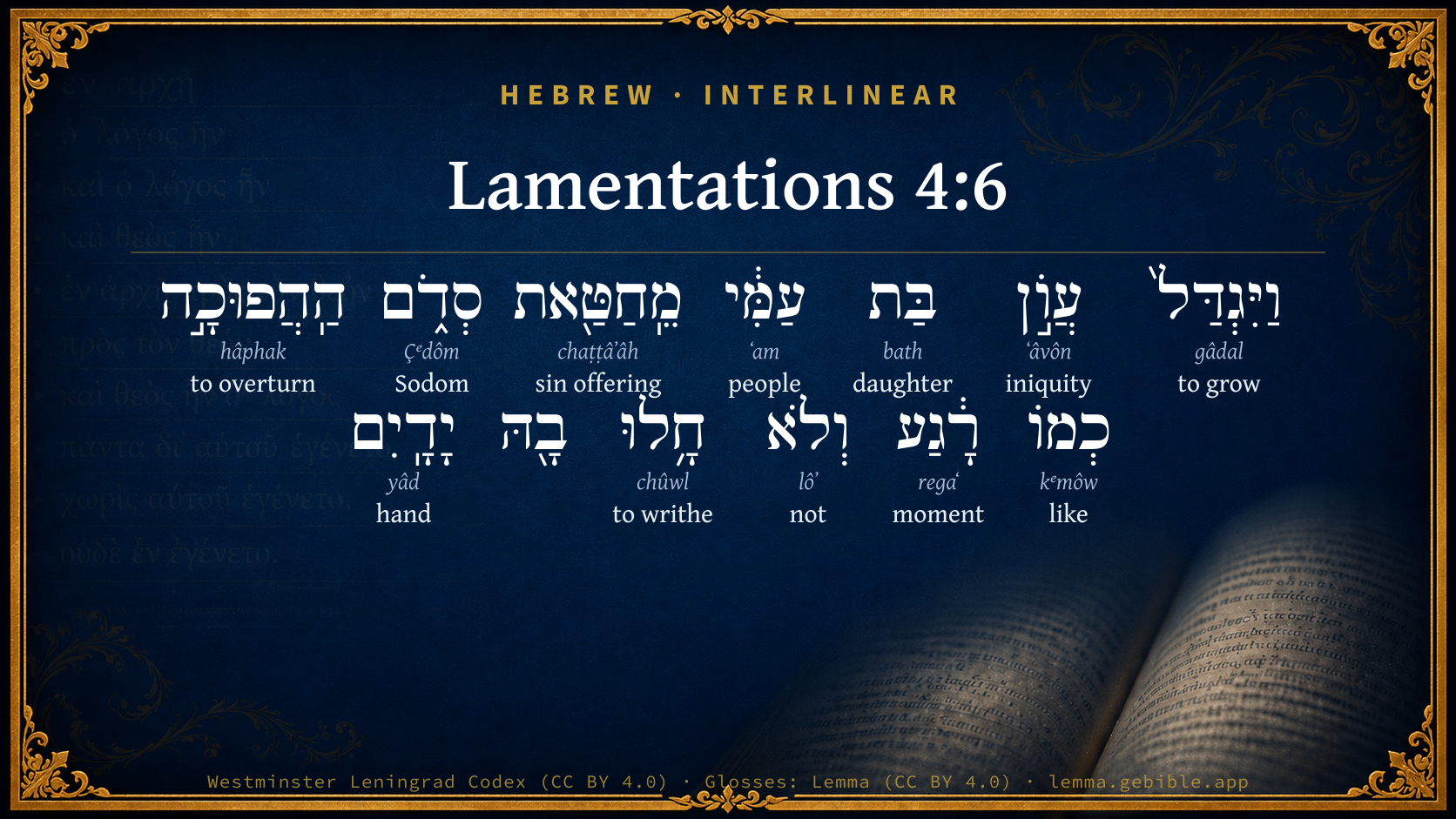
  1. וַיִּגְדַּל֙ gâdal H1431 “and · to grow” Conjunction + Verb, Qal, Sequential Imperfect, 3rd Person, Masculine, Singular
  2. עֲוֺ֣ן ʻâvôn H5771 “iniquity of” Noun, Common, Both, Singular, Construct
  3. בַּת bath H1323 “daughter of” Noun, Common, Feminine, Singular, Construct
  4. עַמִּ֔י ʻam H5971 “people · my” Noun, Common, Masculine, Singular, Construct + Suffix, Personal, 1st Person, Common, Singular
  5. מֵֽחַטַּ֖את chaṭṭâʼâh H2403 “from · sin offering of” Preposition + Noun, Common, Feminine, Singular, Construct
  6. סְדֹ֑ם Çᵉdôm H5467 “Sodom” Noun, Proper
  7. הַֽהֲפוּכָ֣ה hâphak H2015 “the · overturned” Particle, Definite Article + Verb, Qal, Participle Passive, Feminine, Singular, Absolute
  8. כְמוֹ kᵉmôw H3644 “like” Preposition
  9. וְלֹא lôʼ H3808 “and · not” Conjunction + Particle, Negative
  10. חָ֥לוּ chûwl H2342 “to writhe” Verb, Qal, Perfect, 3rd Person, Common, Plural
  11. יָדָֽיִם yâd H3027 “hands” Noun, Common, Both, Dual, Absolute

About this verse

These counts appear in no published source. They are computed here, from the morphology-tagged text and Lemma’s own curated glosses. What Lemma adds →

13
words
12
distinct lemmas
Prophets
section

Notable vocabulary

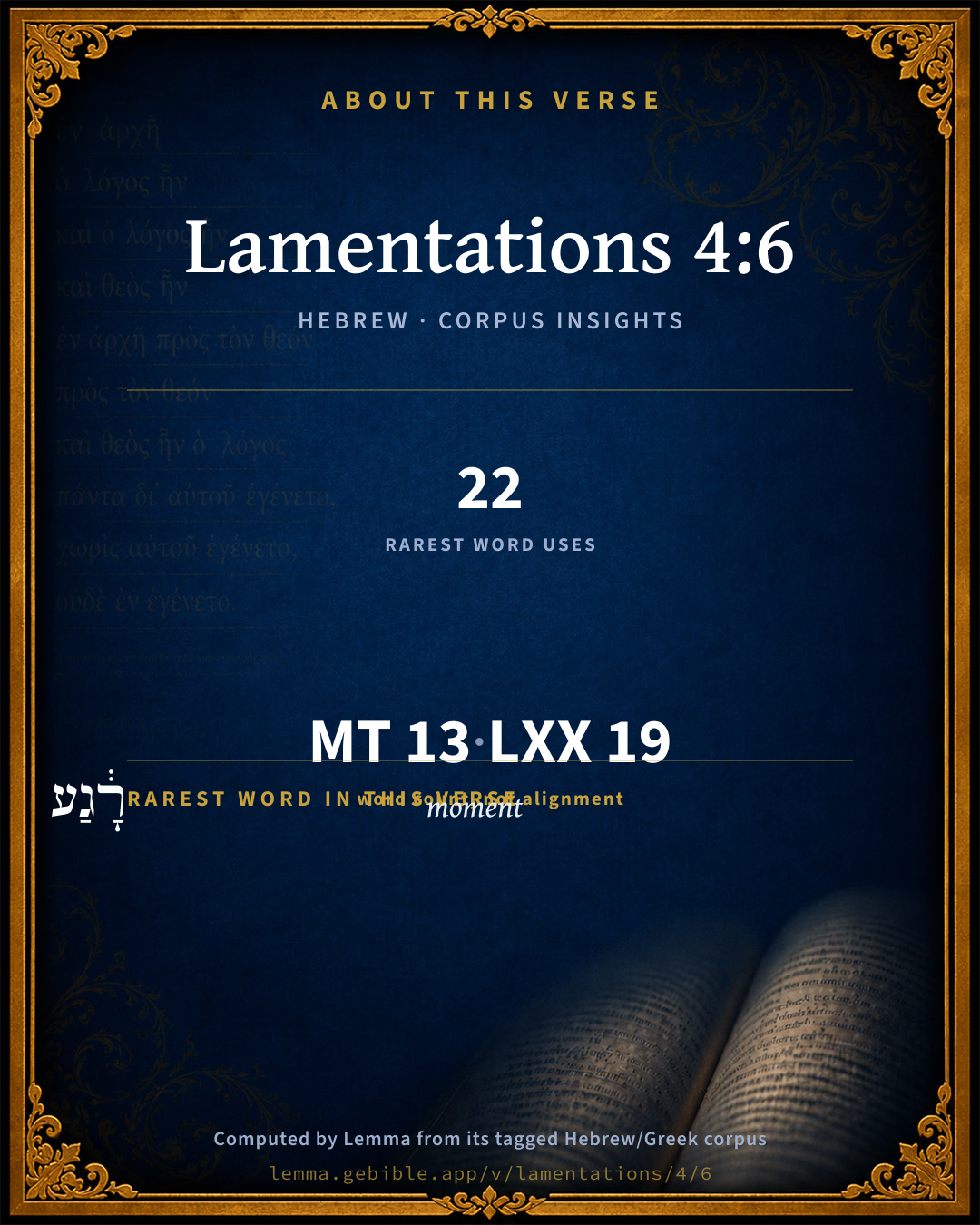
The rarest word here is רָ֔גַע moment H7281 — appearing just 22 times in the whole Hebrew Bible.

Shared distinctive vocabulary

רָ֔גַע moment H7281 occurs in 22 verses of the Hebrew Bible. Also found in:

Grammatical profile

  • 3 verbs
  • 7 nouns
  • 2 prepositions
  • 1 particle

Verb forms

  • וַיִּגְדַּל֙ Qal · Sequential Imperfect
  • הַֽהֲפוּכָ֣ה Qal · Participle Passive
  • חָ֥לוּ Qal · Perfect

Hebrew & Septuagint length

In English translation the verse runs 30 words from the Hebrew and 33 from the Septuagint (LXX English) — closely comparable.

A rough comparison of the two English renderings, which tokenize alike — not a word-level alignment.

Word counts can differ between the Hebrew and the Greek without any difference in meaning — e.g. the Hebrew direct-object marker אֵת has no separate Greek word, and Greek often adds the article ὁ.

In the original languages it is 13 Hebrew tokens and 19 Greek tokens — but the two are counted differently (Hebrew bundles its prefixes and suffixes into one token; the Greek is in lemma form), so that isn’t a like-for-like length.

Cross-references

9

Topical passages linked to Lamentations 4:6 in the Treasury of Scripture Knowledge — connected by theme and wording, ordered by reader-vote popularity; previews shown in the World English Bible.

  • Genesis 19:25 He overthrew those cities, all the plain, all the inhabitants of the cities, and that which grew on the ground.
  • Isaiah 1:9–10 Unless Yahweh of hosts had left to us a very small remnant, We would have been as Sodom; We would have been like Gomorrah.
  • Matthew 24:21 for then there will be great oppression, such as has not been from the beginning of the world until now, no, nor ever will be.
  • Luke 10:12 I tell you, it will be more tolerable in that day for Sodom than for that city.
  • Luke 12:47 That servant, who knew his lord's will, and didn't prepare, nor do what he wanted, will be beaten with many stripes,
  • Lamentations 4:9 Those who are killed with the sword are better than those who are killed with hunger; For these pine away, stricken through, for want of the fruits of the field.
  • Ezekiel 16:48–50 As I live, says the Lord Yahweh, Sodom your sister has not done, she nor her daughters, as you have done, you and your daughters.
  • Daniel 9:12 He has confirmed his words, which he spoke against us, and against our judges who judged us, by bringing on us a great evil; for under the whole sky has not been done as has been done on Jerusalem.
  • Matthew 11:23–24 You, Capernaum, who are exalted to Heaven, you will go down to Hades. For if the mighty works had been done in Sodom which were done in you, it would have remained until this day.

Cross-references courtesy of OpenBible.info (CC BY 4.0).

Hebrew and Greek witnesses Masoretic Hebrew ↔ Greek Septuagint

The same verse in the two great witnesses to the Old Testament, shown verse-for-verse.

These are two independent witnesses, not word-aligned to each other, and the Septuagint is shown in lemma (dictionary) form.

Hebrew Lamentations 4:6 Masoretic · Westminster Leningrad Codex

וַיִּגְדַּל֙ עֲוֺ֣ן בַּת עַמִּ֔י מֵֽחַטַּ֖את סְדֹ֑ם הַֽהֲפוּכָ֣ה כְמוֹ רָ֔גַע וְלֹא חָ֥לוּ בָ֖הּ יָדָֽיִם

For the iniquity of the daughter of my people is greater than the sin of Sodom, That was overthrown as in a moment, and no hands were laid on her.

World English Bible · Public Domain

Greek LXX Lamentations 4:6 Septuagint · lemma form

καί μεγαλύνω ἀνομία θυγάτηρ λαός ἐγώ ὑπέρ ἀνομία σοδομων ὁ καταστρέφω ὥσπερ σπουδή καί οὐ πονέω ἐν αὐτός χείρ

VAU. And the iniquity of the daughter of my people has been increased beyond the iniquities of Sodoma, the city that was overthrown very suddenly, and none laboured against her with their hands.

LXX2012 (modern English Septuagint) · Public Domain

On this verse, Joseph Benson's Commentary discusses the Septuagint’s reading. Read the note in Commentary ↓

Hebrew: Westminster Leningrad Codex (CC BY 4.0). Greek: Septuagint (public domain); English from LXX2012 (modern English Septuagint) (Public Domain). How the Septuagint differs from the Hebrew →

Commentary

Notes on Lamentations 4:6 from classic Christian and Jewish commentators (each source and its license shown beneath its notes). The classic Christian expositions comment on the surrounding passage and are grouped to its opening verse, so a note may address several verses; the Jewish commentaries on the Tanakh (Rashi and others) are per-verse, so they appear only where the commentator wrote on this verse.

Lemma curates 59 commentaries, every one of them public domain or Creative Commons licensed, each selected and text-cleaned for this edition rather than reprinted as found. About our sources →

Trapp's Complete Commentary

John Trapp

Lam 4:6 For the punishment of the iniquity of the daughter of my people is greater than the punishment of the sin of Sodom, that was overthrown as in a moment, and no hands stayed on her.

Ver. 6. For the punishment of the iniquity of Zion is greater.] For Sodom was destroyed by angels, Zion by malicious men. The enemies were not enriched by Sodom, as they were by Zion. Sodom was destroyed in an instant; not so Zion, for she had her punishment piecemeal; first a long siege, and then the loss of all, after a world of miseries sustained in the siege. Julius Caesar was wont to say, It is better once to fall than always to hang in suspense. Augustus wished that he might die suddenly. His life he called a comedy, and said that he thought he had acted his part therein pretty handsomely. Now, if he might soon pass through death, he would hold it a happiness. Soldiers’ wish is thus set forth by the poet:

“ Quid enim? concurritur, horae

Momento aut cita mors venit aut victoria laeta. ”

It is the ancient and manful fashion of the English (who are naturally most impatient with lingering mischiefs) to put their quarrels to the trial of the sword, as the chronicler observeth. {a}

{a} Speed, 963.

John Trapp, A Commentary or Exposition upon All the Books of the Old and New Testament (1647–1656) — public domain. Text from a community e-Sword module.

Joseph Benson's Commentary

Lam 4:6. For the punishment, &c., is greater than the punishment of Sodom — The fate of Sodom was less deplorable than that of Jerusalem; for Sodom was destroyed in an instant; but Jerusalem endured a long siege, and suffered all the miseries of famine, sickness, and hostile arms. In Sodom all were destroyed together, and none left to mourn in bitterness of soul the sad loss of their dearest friends; in Jerusalem many survived to mourn the deplorable fate of their friends and country, and to suffer the ignominy and miseries of captivity. The original of the last clause, ידים לא חלו בה, is rendered by the LXX., και ουκ επονεσαν εν αυτη

χειρας, they did not cause hands to labour, or be weary, in her: and by Blaney, nor were hands weakened in her.

Joseph Benson's Commentary on the Old and New Testaments (1811–1818) — public domain. Text from a community e-Sword module.

Geneva Bible (1599)

Geneva Bible translators

Or, no strength was against her.

Geneva Bible (1599) marginal notes — public domain. Text via Bolls.life.

Jamieson, Fausset & Brown

Robert Jamieson, A. R. Fausset & David Brown

greater than . . . Sodom-- (Mat 11:23). No prophets had been sent to Sodom, as there had been to Judea; therefore the punishment of the latter was heavier than that of the former.

overthrown . . . in a moment--whereas the Jews had to endure the protracted and manifold hardships of a siege.

no hands stayed on her--No hostile force, as the Chaldeans in the case of Jerusalem, continually pressed on her before her overthrow. Jeremiah thus shows the greater severity of Jerusalem's punishment than that of Sodom.

Jamieson, Fausset & Brown — Commentary Critical and Explanatory on the Whole Bible (1871) — public domain (CC PDM 1.0). Text via the HelloAO Bible API.

Adam Clarke's Commentary

Verse 6. For the punishment] He thinks the punishment of Jerusalem far greater than that of Sodom. That was destroyed in a moment, while all her inhabitants were in health and strength; Jerusalem fell by the most lingering calamities; her men partly destroyed by the sword, and partly by the famine.

Instead of no hands stayed on her, Blayney translates, "Nor were hands weakened in her." Perhaps the meaning is, "Sodom was destroyed in a moment without any human labour." It was a judgment from God himself: so the sacred text: "The LORD rained down fire and brimstone from the Lord out of heaven." See Ge 19:24.

Adam Clarke's Commentary on the Bible (1810–1826) — public domain. Text from a community e-Sword/MySword module.

John Calvin's Commentaries

The Prophet says first,, that the punishment of his people was heavier than that of Sodom. If any one prefers the other version, I will not contend, for it is not unsuitable; and hence also a most useful doctrine may be drawn, that we are to judge of the grievousness of our sins by the greatness of our punishment for God never exceeds what is just when he takes vengeance on the sins of men. Then his severity shews how grievously men have sinned. Thus, Jeremiah may have reasoned from the effect to the cause, and declared that the people had been more wicked than the Sodomitites. Nor is this unreasonable; for if the Jews had not fallen into that great wickedness of which the Sodomites were guilty, yet the Prophets everywhere charged them as men who not only equaled but also surpassed the Sodomites, especially Ezekiel, (Ezekiel 16:46, 47.) Isaiah also called them the people of Gomorrha, and the king’s counselors and judges, the princes of Sodom, (Isaiah 1:9, 10.) This mode of speaking is then common in the Prophets, and the meaning is not unsuitable.

But as he dwells only on the grievousness of their punishment, the other explanation seems more simple; for I regard not what is plausible, but accept the true meaning. Let us then repeat the Prophet’s words: greater is the punishment of my people, etc. The word עון, oun, means punishment as well as iniquity; this is certain, beyond dispute. Now חטאת, chethat, means also both sin and punishment. It is hence applied to expiations; the sacrifice for sin is called חטאת, chethat. As to the words, then, they designate punishment as well as sin, the cause of it. But the reason which follows leads me to consider punishment as intended, for he says that Sodom was overthrown as in a moment. Here, doubtless, we see that the sins of the Jews are not compared to the sins of the Sodomites, but their destruction only: God had overthrown Sodom, as afterwards he overthrew Jerusalem; but the ruin of Sodom was milder, for it perished in a moment — for when God had dreadfully thundered, the Sodomites and their neighboring citizens were immediately destroyed; and we know that the shorter the punishment, the more tolerable it is. As the Prophet here compares the momentary destruction of Sodom with the prolonged ruin of the city and slaughter of the people, we see that what is spoken of is not sin, but on the contrary God’s judgment.

There is yet no doubt but that the Prophet summoned the Jews to God’s tribunal, that they might know that they deserved such a vengeance, and that they might perceive that they were worse than the Sodomites. For it was not the Prophet’s object to expostulate with God, or to charge him with having been too rigid in destroying the city of Jerusalem. As, then, the Prophet does not charge God either with injustice or with cruelty, it is certain that punishment is what is here set forth, in order that the people might know what they deserved.

But the words declare nothing more than that God’s vengeance had been severer towards the Jews than towards the Sodomites. How so? it is evident from this reason, because Sodom was consumed as in a moment; and then it is added, and strokes remained not on her. The word יד, id, as it is well known, means hand, a place, but sometimes, metaphorically, a stroke. Interpreters vary here, but I shall not recite the opinions of all, nor is it needful. Those who seem to come nearest to the words of the Prophet, render them thus, “and hands (or forces) have not encamped against her.” But this is a forced and far-fetched meaning. It would run better, “have not remained.” The verb חול chul, means sometimes to encamp and sometimes to remain, to settle. Then the most appropriate meaning would be, that strokes settled not on the Sodomites, while the Jews pined away in their manifold evils. For they did not immediately perish like the Sodomitites; but when God saw them so obstinate in their wickedness, he destroyed some by famine, some by pestilence, and some by the sword; and then the city was not immediately demolished altogether, as it often happens when enemies make a slaughter and kill men, women, and children; but this people were not so destroyed. Many of them were driven into exile, and some of the common people were left to inhabit the ruined cities, for there was dreadful desolation. The king himself, as it has before appeared, was removed to Babylon, but his eyes had previously been pulled out, and his children slain in his presence.

We hence see that the destruction of the city was like a slow consumption: and that thus strokes remained there as it were fixed, which did not happen to Sodom; for Sodom suddenly perished when God thundered against it; but the hand of God did not depart from the Jews, and the strokes or smitings, as I have said, were fixed on them and continued. It follows, —

John Calvin's Commentaries (1540-1563) — public domain. Text from the Calvin Translation Society English edition (1840s-50s) via the Christian Classics Ethereal Library (ccel.org). Calvin's coverage is partial (roughly two-thirds of the Bible); uncommented books and verses are honest gaps, never fabricated. The 19th-century editor's footnotes and remarks are omitted so the notes are faithfully Calvin's own voice.

Ellicott's Commentary for English Readers

(6) The punishment of the iniquity.—Better, The iniquity of the daughter of my people was greater than the sin of Sodom. The words in both cases point to guilt rather than its penalty, though, as the context shows, the greatness of the former is inferred from that of the latter. The point of comparison was that Sodom was not doomed to a protracted misery, like that which had been the lot of Jerusalem.

No hands stayed on her . . .—Literally, no hands went round about her: i.e., her destruction was the direct work of God, and not of human agents, with their more merciless tortures. (Comp. 2Sa_24:14.) The main thought may be noticed as reproduced in Mat_10:15; Mat_11:24.

A Bible Commentary for English Readers, edited by Charles John Ellicott (1878–1897) — public domain. Text from a community e-Sword module.

The Cambridge Bible for Schools and Colleges

gen. ed. J. J. S. Perowne

6. the iniquity—the sin] rather than as mg. and A.V. the punishment of the iniquity—the punishment of the sin. There is no assertion in this part of the v. as to the comparative amount of punishment, but from the admitted fact that the sufferings of Jerusalem exceeded those of Sodom, it is inferred that the sin must have been in like proportion. Sodom perished in a moment, there were no prolonged sufferings, such as are brought about or directly administered by the hand of man.

were laid upon her] The words are susceptible of various interpretations: no hands raged (whirled) about her (Ewald), too swiftly, even for men to wring their hands (Löhr). The verb is used of a tempest in Jer_23:19; Jer_30:23. The mg. here suggests fell, comparing 2Sa_3:29.

The Cambridge Bible for Schools and Colleges (gen. ed. J. J. S. Perowne; Cambridge University Press, 1878–1918) — public domain. Text from a community e-Sword module.

John Gill's Exposition

For the punishment of the iniquity of the daughter of my people,.... In the long siege of their city, and the evils that attended it, especially the sore famine:

is greater than the punishment of the sin of Sodom; which was destroyed at once by fire from heaven: or it may be rendered, "the iniquity of the daughter of my people is greater than the sin of Sodom" (p); though the men of Sodom were great sinners, the Jews were greater, their sins being more aggravated; to this agrees the Targum, which renders the word "sin", and paraphrases the words following thus,

"and there dwelt not in her prophets to prophesy unto her, and turn her by repentance;''

as the Jews had, and therefore their sin was the greater; both senses are true, and the one is the foundation of the other; but the first seems best to agree with what follows:

that was overthrown as in a moment; by a shower of fire from heaven, which consumed it at once; whereas the destruction of Jerusalem was a lingering one, through a long and tedious siege; the inhabitants were gradually wasted and consumed by famine, pestilence, and sword, and so their punishment greater than Sodom's:

and no hand stayed on her; that is, on Sodom; the hand of God was immediately upon her, and dispatched her at once, but not the hands of men; as the hands of the Chaldeans were upon the Jews, afflicting and distressing them a long time, which made their ease the worse.

(p) ldgyw "et ingens fuit iniquitas--prae peccato", Montanus; "et major extitit pravitas--prae peccato", Cocceius. So V. L.

John Gill's Exposition of the Whole Bible (1746–1763) — public domain (CC PDM 1.0). Text via the HelloAO Bible API.

Albert Barnes' Notes on the Bible

Rather, “For” the iniquity “of the daughter of my people was greater than” the sin “of Sodom.” The prophet deduces this conclusion from the greatness of Judah’s misery (compare Jer 30:11; see also Luk 13:1-5).

No hands stayed on her - Or, “no hands were round about her.” Sodom’s sufferings in dying were brief: there were no starving children, no mothers cooking their offspring for food.

Albert Barnes' Notes on the Bible (1834–1885) — public domain. Text from a community e-Sword/MySword module.

Haydock's Catholic Bible Commentary

In her. Sodom was destroyed by God. Her temporal misery was short. (Haydock) --- Jerusalem was exposed to greater afflictions (Calmet) here, (Haydock) and her ingratitude and abominations were greater, Ezechiel xvi. 46.

George Leo Haydock (1774–1849), Haydock's Catholic Family Bible and Commentary, 1859 edition — public domain. Excludes Psalms (Douay-Rheims chapter numbering differs from Protestant) and Deuterocanonical books (Catholic canon only).

Matthew Poole's English Annotations

The word translated

punishment signifies also iniquity, as was said in the notes on Lam 3:39. The sins of the Jews are compared to the sins of Sodom, Isa 3:9; Eze 16:46,48,49; hence their rulers are called rulers of Sodom, Isa 1:10; either their sins were specifically the same (as they were) as to many sins, Eze 16:49, or they were of an equal magnitude and provocative nature. The prophet here complains that they were punished like Sodom, Amo 4:11; yea, and their punishment was greater, because more lingering and gradual, whereas Sodom was overthrown in a moment, and that by no human hands that abode upon her, causing her a continued torment, as there did upon the Jews. David said, It is better to fall into the immediate hand of God than into the hands of men.

Matthew Poole's English Annotations on the Holy Bible (1683–1685) — public domain. Text from a community e-Sword/MySword module.

Whedon's Commentary on the Bible

Daniel D. Whedon

6. The punishment — The margin, iniquity, is to be preferred. The sin of the daughter of my people is greater than the sin of Sodom. The contrast in favour of Sodom’s punishment consisted, 1) In the suddenness of her overthrow, as in a moment; 2) In that its overthrow came direct from God without the intervention of human agency.

No hands stayed on her — More literally, no hands went round in her.

Daniel D. Whedon (gen. ed.), Commentary on the Old and New Testaments (1874–1909) — public domain. Text from a community e-Sword module.

The Pulpit Commentary

The punishment of the iniquity... the punishment of the sin. This is a possible rendering, (see Gen_4:13 Zec_14:19) but the renderings, "the iniquity," "the sin? are preferable, and yield a finer meaning, viz. that the punishment having been so severe, the guilt must have been in proportion. And no hands stayed on her. To make the picture of sudden destruction more vivid, the poet alludes to the ordinary circumstances of the capture of a city, the "hands" of a fierce soldiery ever "whirling" a destroying sword. Comp. "the swinging of the hand of Jehovah Sabaoth, which he swingeth against it". (Isa_19:16)

The sin of Sodom.

God was doing nothing new or indefensible in allowing Jerusalem thus to be wasted and humiliated. The Israelites had in their possession illustrations more than one of how great sin had been followed by great suffering. Jeremiah quotes Sodom, and he might have said something about Egypt when God visited it with the plagues. We must not, of course, press too literally the statement that the sin of Jerusalem was greater than that of Sodom. The prophet"s aim is simply to insist that no sin could have been greater than that of Jerusalem. If it was a right and a necessary thing that Sodom should be so suddenly visited, so completely overwhelmed, then assuredly no complaint could be made against the severe treatment experienced by Jerusalem. Indeed, relatively, Jerusalem might think itself very well off. If the height on which Jerusalem stood had sunk in another Dead Sea, there would have been no ground for complaint. No impartial Israelite, looking at the privileges of Israel, considering how much it had been instructed and warned, and how patiently it had been dealt with, could do anything but confess that on the whole it had been mildly visited. We must, however, be careful here not to attribute anything arbitrary to God. We shall naturally be very much perplexed if we allow ourselves to think that, though Sodom"s sin was less than Jerusalem"s, yet it received a greater punishment. It is only by a figure that we talk of communities being punished. Punishment is strictly an individual thing. Communities may suffer, and the suffering will be according to the needs of God"s government at the time. The cities of the plain were utterly swept away, that the rest of the world might not become as bad as they were. These visitations have to be looked on somewhat in the light of surgical operations. One patient in the hospital needs to have a limb amputated that the whole body may be saved. Another can have his body saved without the loss of a part of it. Y.

The Pulpit Commentary (1880–1919), ed. H.D.M. Spence-Jones & Joseph S. Exell — public domain. Text from a community e-Sword module.

John Wesley's Explanatory Notes

Of Sodom - Their punishment was greater, because more lingering, and gradual, whereas Sodom was overthrown in a moment, and that by no human hands that abode upon her, causing her a continued torment.

John Wesley, Explanatory Notes Upon the Whole Bible (1754–1765) — public domain. Text via the GEBible commentary corpus.

unfoldingWord translationNotes

Door43 World Missions Community

The punishment of the daughter of my people is greater than that of Sodom

The abstract noun "punishment" can be expressed with the verb "punish." AT: "The daughter of my people has been punished more severely than Sodom was punished"

the daughter of my people

This is a poetic name for Jerusalem, which is spoken of here as if it were a woman. See how you translated this in Lamentations 2:11. AT: "my people" (See: Metonymy and Personification)

which was overthrown in a moment

The word "which" refers to Sodom. This can be stated in active form. AT: "which God destroyed in a moment" (See: Active or Passive)

no hands were wrung for her

This can be stated in active form. AT: "no one wrung their hands for her" (See: Active or Passive)

no hands were wrung for her

People sometimes rub and twist their hands when they are worried and cannot fix something, so wringing the hands here represents worrying. The word "her" refers to Jerusalem, which was called "the daughter of my people." AT: "no one was worried about her" (See: Metonymy)

translationWords

punish

Sodom

unfoldingWord translationNotes — © Distant Shores Media and the Door43 World Missions Community, licensed CC BY-SA 4.0. Source: git.door43.org/Door43/en_tn.

Rashi

Rabbi Shlomo Yitzchaki (Rashi)

The iniquity of my people is greater, etc. Their punishment proves about them that their iniquity is greater than that of Sodom.

which was overthrown as in a moment The distress of Sodom was not prolonged; it was overthrown as in one moment.

and no hands fell on her [i.e.,] the hands of the enemy, but through angels it was overthrown. There are also Aggadic midrashim, but they do not fit the sequence of the verses.

Rashi on the Tanakh — English translations: “The Judaica Press complete Tanach with Rashi, translated by A. J. Rosenberg” (CC BY 4.0); “Pentateuch with Rashi's commentary by M. Rosenbaum and A.M. Silbermann, 1929-1934” (public domain); “The Metsudah Tanach series, Lakewood, N.J” (CC BY 4.0); and “The Book of Joshua, Metsudah Publications, 1997” (CC BY 4.0). Text via Sefaria.

Lesson kit

Teaching starters — assembled from the data on this page, not authored interpretation. Every prompt links to the verse data it draws on. Edit before teaching.

Lamentations, in the Prophets, opens this verse with 13 words (12 distinct Hebrew lemmas). Its most distinctive word is regaʻ (“moment”). A historical commentator’s framing appears above. Read the whole chapter for the surrounding context.

Discussion questions

  1. What does “moment” (regaʻ) contribute to the verse as a whole?
  2. How does Exodus 33:5, which shares the word «moment», read alongside this verse?
  3. These translations render this verse differently; the difference is in the English rendering, not the original. What questions does that raise?
  4. «וַיִּגְדַּל֙» is a Qal Sequential Imperfect verb. How does that grammatical form shape the action described?
  5. Compare how Trapp's Complete Commentary and Joseph Benson's Commentary read this verse. Where do they agree or differ?

Things to notice

Reading settings

Reading text

Shown beneath each verse's original-language words.

Old Testament
Old Testament edition

Read the OT as the Masoretic Hebrew (MT) or the Greek Septuagint (LXX).

English shown for the Greek Septuagint (in the Hebrew ↔ Greek comparison).

Comparing translations? Open the Compare panel on any verse page to stack up to four side by side.